

Introduction
The notion that the 50 state legislatures lend themselves to comparative analysis is not novel. Nor is the idea that insights into how Congress functions can be gained through the study of state legislatures. More than a half-century ago, H. Douglas Price (Reference Price and Ornstein1975, 20) observed,
For anyone interested in the variety of historical patterns of organization presented by the House and Senate in the nineteenth century, the current range of state legislative practices have quite a familiar look. One does not need to go, like Darwin, to the Galapagos Islands to rediscover long missing species of legislative operation.
The advantages of the comparative study of American legislatures have long been appreciated (Squire and Hamm Reference Squire and Hamm2005, 1–3). So have the obstacles. In 1997, Malcolm Jewell reviewed seven books that examined state legislatures, only three of which were “comparative in the sense of covering data and examples from more than one legislature.” He observed that “The multistate studies illustrate both the difficulties and possibilities of doing comparative work” (Jewell Reference Jewell, Rosenthal, Thomas, Erikson, Wright, McIver, Loomis, Clucas, Reeher and Loftus1997, 273). The challenges at that time were largely driven by data limitations. As a result, many of the foundational works on state legislatures were rooted in studies of either a single body or a small number of them. For example, Wahlke and his colleagues’ (Reference Wahlke, Eulau, Buchanan and Ferguson1962) pathbreaking book, The Legislative System, examined just four state legislatures. Fortunately, with the advent of the Internet and the digitization of many legislative records, data accessibility increased dramatically, allowing scholars to go beyond the information contained in the Book of the States and whatever other sources they could scrounge up. Consequently, the prospects for comparative studies advanced, allowing for the possibility of more rigorous tests of legislative theories.
We have two missions in reviewing the work on state legislatures published since State Politics & Policy Quarterly (SPPQ) initially appeared in 2001. First, we document the extent to which state legislative studies moved beyond single-state studies to larger comparative examinations. Second, we detail the topics state legislative scholars studied over the last quarter century and assess the possibilities for more generalizable legislative theories growing out of their efforts.
The state of state legislative research
In a conference paper presented a quarter century ago, Hamm (Reference Hamm2001) reported that between 1995 and 2001, 650 articles dealing with legislatures were published across 10 major political science journals. He found that 90 percent of the approximately 70 articles that focused on state legislatures examined more than one institution. This was a noteworthy figure because it contrasted sharply with studies on Congress and non-American legislatures that almost always focused on a single body (or, more specifically, a single house).
As it happened, in 2001, state legislative research found an additional home with the arrival of SPPQ. To trace the evolution of state legislative studies since SPPQ appeared, we examined articles focused on state legislatures published in it from 2001 through the middle of 2025 and in seven other journals where we would anticipate such work to appear: American Journal of Political Science (AJPS), American Political Science Review (APSR), American Politics Research (APR), Journal of Politics (JOP), Legislative Studies Quarterly (LSQ), Political Research Quarterly (PRQ), and Social Science Quarterly (SSQ). We did not include articles that were labeled “field notes,” literature reviews, or book reviews. To be included, an article had to have one or more state legislatures as a focal point, not as a tangential interest or only as a control variable. In total, we collected 449 articles. It is possible that some relevant articles were excluded but we are confident that the sample is representative of publications on state legislatures over that time period.
We categorized the articles into six broad areas of scholarship on legislatures. The first category, elections, is centered on how lawmakers attain and retain office. The second and largest category in terms of the number of articles is legislative behavior, the examination of what legislators do in office. The third category is legislative process, exploring the role of structures, rules, and procedures in explaining how legislatures function. The fourth category is measurement, which covers measurement issues relevant to the study of legislatures. The fifth category is public policy, where the focus is on the role of legislatures in producing specific public policies. The sixth category is representation; the study of whose interests get represented in the legislature.
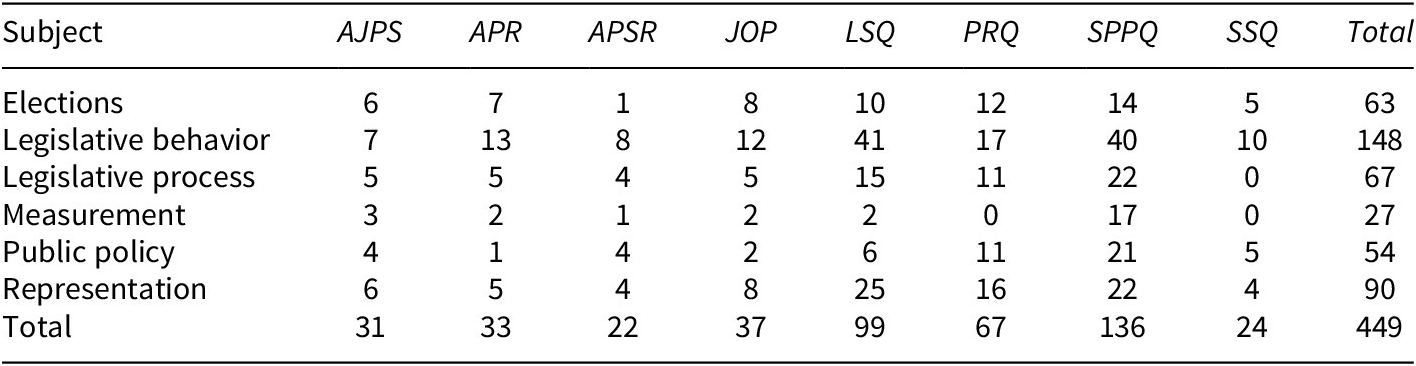
We begin exploring the breadth of the legislative research articles we collected by looking at the topics they investigated and how many states were included in their analyses. The distribution of topics by journal is presented in Table 1. The three journals that published the most articles on state legislatures were, in order, SPPQ, LSQ, and PRQ. The APSR published the fewest articles on the topic. While SPPQ had the highest overall number of articles on state legislatures, it did not publish the most in each area. Of the studies targeting legislative behavior or representation, LSQ published more articles. Articles focused on measurement were the least common, with SPPQ being the only journal to publish more than three articles on the topic.
Article subject, by journal

Table 1. Long description
Beginning at the top row, the table lists six subject categories vertically: Elections, Legislative behavior, Legislative process, Measurement, Public policy, and Representation. Horizontally, nine journals are labeled from left to right: AJP S, AP R, APS R, JO P, LS Q, PR Q, SPP Q, SS Q, and Total. For Elections, counts range from 1 in APSR to 14 in SPP Q, totaling 63. Legislative behavior has the highest counts, with 41 in LSQ and 40 in SPP Q, totaling 148. Legislative process totals 67, with 22 in SPPQ and 0 in SSQ. Measurement is lowest overall, with 27, including 17 in SPPQ and 0 in PRQ and SSQ. Public policy totals 54, with 21 in SPPQ and 1 in APR. Representation totals 90, with 25 in LSQ and 22 in SPPQ. The bottom row sums each journal’s articles, ranging from 22 in APSR to 136 in SPP Q, with a grand total of 449 articles.
In Figure 1, we illustrate the frequency of each subject for each of the journals. Electoral studies were most common in JOP, APR, and SSQ. SSQ, LSQ, and APR published the highest percentage of their articles on legislative behavior. APSR published the highest percentage on the legislative process, and SSQ published no articles on it. While SPPQ published the most measurement articles, they constituted only 12 percent of its state legislative publications. SSQ, APSR, and PRQ had the highest percentages of public policy articles. Finally, LSQ, PRQ, and JOP had the highest rates of representation articles. Overall, SPPQ and AJPS were the most balanced in the state legislative topics they published.
Percentage of publications by subject for each journal.

Figure 1. Long description
The chart displays eight horizontal bars, each representing a journal:, listed from top to bottom. Each bar is divided into segments for six subjects, coded by shade: Elections, Legislative Behavior, Legislative Process, Measurement, Public Policy, and Representation. For AJP S, the percentages are Elections 19, Legislative Behavior 23, Legislative Process 16, Measurement 10, Public Policy 13, Representation 19. For APR: Elections 21, Legislative Behavior 39, Legislative Process 15, Measurement 5, Public Policy 6, Representation 3, and 15. For APSR: Elections 5, Legislative Behavior 36, Legislative Process 18, Measurement 5, Public Policy 18, Representation 18. For JOP: Elections 22, Legislative Behavior 32, Legislative Process 14, Measurement 5, Public Policy 5, Representation 22. For LSQ: Elections 10, Legislative Behavior 41, Legislative Process 15, Measurement 2, Public Policy 6, Representation 25. For PRQ: Elections 18, Legislative Behavior 25, Legislative Process 16, Measurement 16, Public Policy 1, Representation 24. For SPPQ: Elections 10, Legislative Behavior 29, Legislative Process 16, Measurement 12, Public Policy 15, Representation 16. For SSQ: Elections 21, Legislative Behavior 42, Legislative Process 21, Measurement 17. The legend at right matches each subject to a specific shade. Legislative Behavior is the largest segment in most journals, especially SSQ and LS Q.
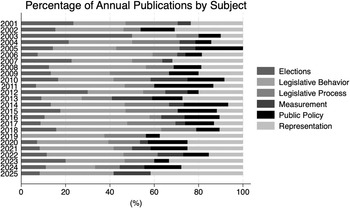
Figure 2 traces the percentage of publications by topic since 2001. The annual trends reveal how scholarship shifted with the additional attention that SPPQ brought to state legislative politics. As might be anticipated, studies of elections remained consistent over time, with a regular small jump two to three years following a presidential election. The most conspicuous change is with studies of representation; there were no publications on the topic in 2005, but they constituted nearly 40 percent of all publications in 2018, 2023, and 2025.
Percentage of annual publications by subject, 2001–2025.

Figure 2. Long description
The chart displays horizontal bars for each year from 2001 at the top to 2025 at the bottom. The x-axis shows percentage from 0 to 100. Each bar is segmented by subject: Elections (dark gray), Legislative Behavior (medium gray), Legislative Process (gray), Measurement (black), Public Policy (very dark gray), and Representation (light gray). Early years (2001–2007) are dominated by Representation and Legislative Behavior. From 2008 to 2015, Measurement and Public Policy segments expand, peaking around 2015–2018. After 2015, Measurement and Public Policy together occupy a larger proportion, while Representation and Legislative Behavior decrease. Elections and Legislative Process remain relatively stable but less prominent. By 2025, Measurement and Public Policy are the largest segments, with Representation and Legislative Behavior at their lowest. The legend on the right matches colors to subjects.
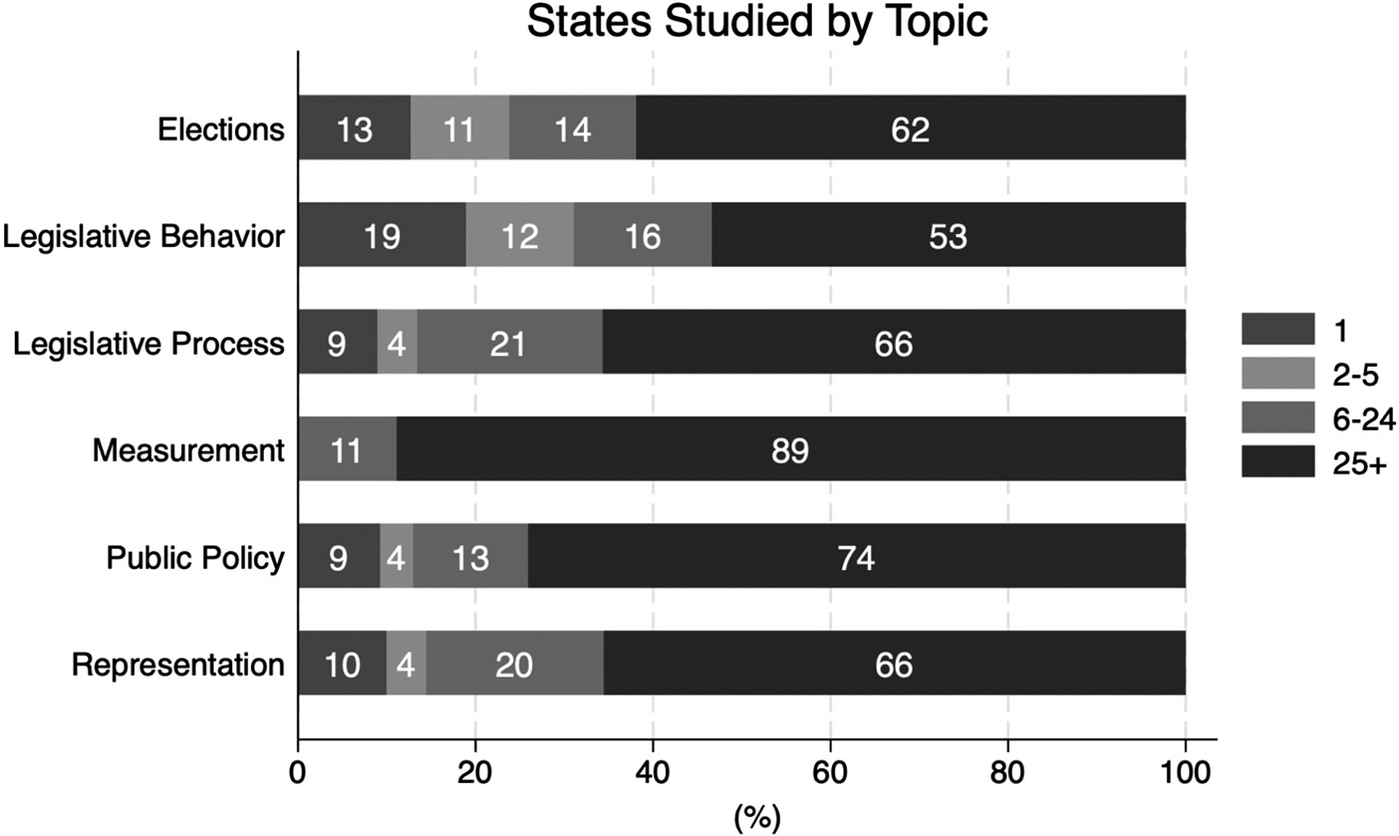
Our next goal is to track the trends in how state legislatures were studied over the last quarter century. For each article, we reviewed its scope and noted whether the bulk of the analysis centered on a single state, 2–5 states, 6–24 states, or 25 or more states. By not having a category for 50 states, we sidestep the oft-present “Nebraska problem” induced by its singular nonpartisan and unicameral status.
In Figure 3, we display the variation in analyses based on the subject studied. Notably, nearly 90 percent of measurement studies included 25 or more states. Comparatively, half of the studies looking at legislative behavior examined 25 or more states, whereas only 12 percent of studies included 2–5 states, and 19 percent examined a single state.
The percentage of states studied, by topic.

Figure 3. Long description
Six horizontal stacked bars represent topics: Elections, Legislative Behavior, Legislative Process, Measurement, Public Policy, and Representation, ordered top to bottom. Each bar is divided into four segments by shading, corresponding to the legend at the right: 1 (lightest), 2 to 5, 6 to 24, and 25 plus (darkest). From left to right, Elections: 13 percent (1), 11 percent (2 to 5), 14 percent (6 to 24), 62 percent (25 plus). Legislative Behavior: 19 percent (1), 12 percent (2 to 5), 16 percent (6 to 24), 53 percent (25 plus). Legislative Process: 9 percent (1), 4 percent (2 to 5), 21 percent (6 to 24), 66 percent (25 plus). Measurement: 11 percent (1), 89 percent (25 plus). Public Policy: 9 percent (1), 4 percent (2 to 5), 13 percent (6 to 24), 74 percent (25 plus). Representation: 10 percent (1), 4 percent (2 to 5), 20 percent (6 to 24), 66 percent (25 plus). The x-axis runs from 0 to 100 percent. The darkest segment (25 plus) dominates all bars, especially for Measurement, Public Policy, Legislative Process, and Representation.
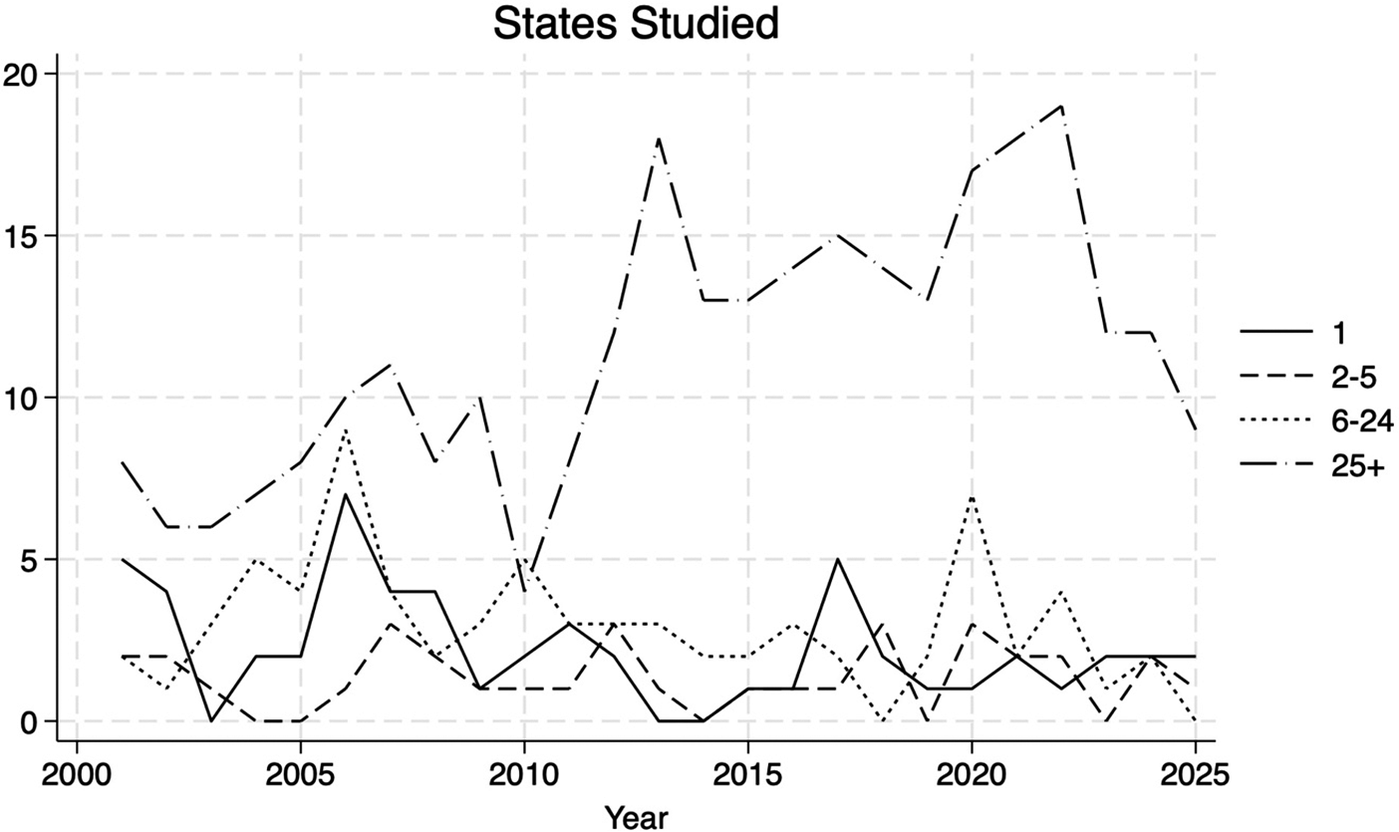
The number of states studied each year shifted over time. Figure 4 reveals that the number of broadly comparative studies increased, particularly those examining 25 or more states. Between 2010 and 2015 there was a noticeable surge in such studies. There was a subsequent decrease around 2024, though the level remained high relative to the other categories.
Frequency of states studied, 2001–2025.

Figure 4. Long description
The line graph plots the number of states studied per year from 2000 to 2025 on the x-axis, with the y-axis showing counts from 0 to 20. Four lines represent categories: solid for 1 state, dashed for 2 to 5, dotted for 6 to 24, and dash-dot for 25 plus. The 25 plus group shows the highest and most variable counts, peaking near 18 in 2012 and again above 17 in 2020, then declining after 2021. The 2 to 5 and 6 to 24 groups fluctuate between 0 and 10, with occasional spikes but no sustained high values. The 1 state group remains mostly below 5 throughout, with minor fluctuations. All lines show year-to-year variability, but only the 25 plus group exhibits pronounced peaks.
There were some noteworthy trends among single-state studies. Unsurprisingly, California was the most common single-state subject with 14 articles solely about it. Other common single-state study subjects included Florida (4), Illinois (5), Michigan (4), North Carolina (3), Texas (3), and Wisconsin (3). Small population state legislatures were never singled out for attention, save for Nebraska.
Trends in state legislative research over the last quarter century
Given the large volume of studies on state legislatures over the last 25 years, including those not appearing in the eight journals analyzed above, our understanding of these bodies has accordingly expanded. In this section, we highlight what we see as important directions the work has taken in each of the six areas of state legislative research.
Elections
State legislative elections are an enticing subject for study in comparison with congressional elections because of the larger number of potential cases and their greater variation across a range of variables of interest. Over the last quarter century, research on state legislative elections encompassed topics such as electoral rules and campaign strategies (Abbe and Herrnson Reference Abbe and Herrnson2003; Hale Reference Hale2020; Herrnson, Lay, and Stokes Reference Herrnson, Lay and Stokes2003), redistricting (Herron and Wiseman Reference Herron and Wiseman2008; Makse Reference Makse2012; Schaffner, Wagner, and Winburn Reference Schaffner, Wagner and Winburn2004; Tolbert, Smith, and Green 2008), and campaign finance (Hamm and Hogan 2007; Kilborn and Vishwanath Reference Kilborn and Vishwanath2022; Pippen, Bowler, and Donovan Reference Pippen, Shaun Bowler and Donovan2002). And as might be anticipated, the prospects for gerrymandering were a keen topic of interest (Kelly Reference Kelly2012; Herron and Wiseman Reference Herron and Wiseman2008; Krasno et al. 2018).
Leveraging the greater variation afforded by the states, studies of legislative elections investigated the effects of different electoral reforms states implemented over the past 25 years. Electoral competitiveness was a particular focus. It was found that district make-up was a strong indicator of vigorous electoral competition (Hogan Reference Hogan2003). Lower campaign contribution limits lead to greater competition (Hamm and Hogan 2007). There were a few unexpected findings. First, term limits did not alter the electoral prospects of incumbents or increase electoral competition (Masket and Lewis Reference Masket and Lewis2007). Second, redistricting commissions only minimally impacted the level of state legislative competition (Forgette, Garner, and Winkle Reference Forgette, Garner and Winkle2009). Third, candidates who relied on public campaign financing were more ideologically extreme than candidates who did not rely on such funds (Kilborn and Vishwanath Reference Kilborn and Vishwanath2022, but see Masket and Miller Reference Masket and Miller2015).
Some state legislative elections articles examined a small number of states, potentially limiting the generalizability of their results. For example, Gaines, Nokken, and Groebe (Reference Gaines, Nokken and Groebe2012) devised an intriguing two-state natural experiment using Illinois and Texas, uncovering little impact of differing term lengths on candidate campaign behavior. Alvarez and Sinclair (Reference Alvarez and Sinclair2012) reported that California’s switch to a nonpartisan blanket primary election system produced lawmakers who were more willing to reach compromises with their colleagues. Other single-state studies included examinations of the impact of party platforms on legislative elections in Illinois (Wiseman Reference Wiseman2005), the effects of a redistricting by formula reform in Ohio (Altman and McDonald 2017), and the different ways gerrymanders might be detected in Wisconsin (Krasno et al. 2018). All their findings are of considerable interest but, perhaps, of limited transportability.
At the same time, in some instances studying a small number of states proved beneficial through exploitation of unique aspects of their elections and rules. For instance, a few analyses capitalized on significant policy contrasts among states, notably the existence of public campaign funding programs (Kilborn Reference Kilborn2018; Kilborn and Vishwanath, Reference Kilborn and Vishwanath2022; Masket and Miller Reference Masket and Miller2015) or strict restrictions on campaign contributions (Barber Reference Barber2016; Schecter and Hedge Reference Schecter and Hedge2001).
Legislative behavior
Legislative behavior centers on what lawmakers do and how they go about doing it. Much of this research over the last quarter century was driven by the increased availability of roll-call floor votes data (Clark et al. Reference Clark, Osborn, Winburn and Wright2009; Jenkins Reference Jenkins2006; Wright Reference Wright2007). But there were additional ways behavior was studied. For instance, Kurtz and his colleagues (Reference Kurtz, Moncrief, Niemi and Powell2006) examined how state legislators regarded the demands of their position. They conducted a national survey to gauge how lawmakers allocated their time, confirming the expected variations across full-time and part-time legislatures. In a study of the Texas legislature, Schilling, Matthews, and Kreitzer (Reference Schilling, Matthews and Kreitzer2023) analyzed more than 73,000 bills that had been introduced between 1979 and 2020 to learn how legislators timed their cosponsorship decisions, reporting that electoral insecurity and partisan considerations were influential in the decisions. Other behavior-related articles explored the relationships that existed among different groups of lawmakers (Hicks, McKee, and Smith Reference Hicks, McKee and Smith2016; Kirkland and Williams Reference Kirkland and Williams2014; Zelizer Reference Zelizer2019; Reference Zelizer2022) and among legislators and outside entities (Armaly Reference Armaly2020; Baker and Hedge Reference Baker and Hedge2013; Bergan Reference Bergan2009; Wilhelm Reference Wilhelm2009).
Considerable attention was devoted to gaining a better understanding of legislator career ambitions and their impact on behavior in office (Lazarus Reference Lazarus2006; Maddox Reference Maddox2004a; Maestas Reference Maestas2003). In the early 2000s, much of the focus was on the effects of term limits. They were found to induce meaningful behavioral changes; dynamically transforming how legislators represented their constituents (Carey et al. Reference Carey, Niemi, Powell and Moncrief2006; Sarbaugh-Thompson et al. Reference Sarbaugh-Thompson, Lyke Thompson, Elder, Comins, Elling and Strate2006), altered their career calculations (Engstrom and Monroe Reference Engstrom and Monroe2006; Herrick and Thomas Reference Herrick and Thomas2005; Moncrief, Niemi, and Powell Reference Moncrief, Niemi and Powell2004), and affected the pipeline of candidates seeking to move to Congress (Steen Reference Steen2006). More recently, some behavioral studies shifted to looking at “how” the legislative job got done despite the challenges created by term limits (Olson and Rogowski Reference Olson and Rogowski2020; Swift and VanderMolen Reference Swift and VanderMolen2016).
Attention was also devoted to the impact of the increased resources that accompanied legislative professionalization. It was determined that professionalized state legislatures accomplished more in terms of passing legislation (Boehmke and Shipan Reference Boehmke and Shipan2015) and that they accorded their leaders more power (Clucas Reference Clucas2007; Shay Reference Shay2021, but see Richman Reference Richman2010). They also attracted stronger, better qualified candidates (Nemerever and Butler Reference Nemerever and Butler2020).
Other behavioral research focused on various groups within the legislature and how they behaved in office. Characteristics of women’s legislative behavior were dissected in terms of their higher levels of collaboration, bill cosponsorship, and productivity (Holman and Mahoney Reference Holman and Mahoney2018; Holman, Mahoney, and Hurler Reference Holman, Mahoney and Hurler2022; Mahoney and Clark Reference Mahoney and Clark2019; Sweet-Cushman, Gill, and Horn Reference Sweet-Cushman, Gill and Zorn2025; Swift and VanderMolen Reference Swift and VanderMolen2021). Also explored were differences in policy preferences between men and women legislators (Poggione Reference Poggione2004) and contrasts in their use of twitter to communicate with constituents (Butler, Kousser, and Oklobdzija Reference Butler, Kousser and Oklobdzija2023).
Legislative behavior research benefited from methodological innovations. Notably, Shor and McCarty (Reference Shor and McCarty2011; Reference Shor and McCarty2022) analyzed vast numbers of roll-call votes to help understand lawmakers’ behavior through identifying their “ideal points.” Another significant development was the uncovering of issue networks to rigorously detect connections between and among lawmakers (Kirkland Reference Kirkland2011; Reference Kirkland2014). Clever design and implementation of experiments using lawmaker surveys established stronger understandings of causal relationships (Bergan Reference Bergan2009; Butler and Broockman Reference Butler and Broockman2011; Druckman and Valdes Reference Druckman and Valdes2019; Harden Reference Harden2013; Rhinehart Reference Rhinehart2020). A shift from mail to digital surveys helped cut the costs of collecting these sorts of data without significant impacts on representativeness or responses (Fisher and Herrick Reference Fisher and Herrick2013). All these developments led to deeper insights into the reasons legislators behave in the ways they do.
Legislative process
Comparative research on the legislative process is arguably the most daunting undertaking in the study of legislatures. Although there are similarities across Congress and state legislatures in rules and committee structures, there are also nuances that make comparative study of them challenging (Squire and Hamm Reference Squire and Hamm2005, 120–22; Squire and Moncrief, 2020, 139–42). Filibusters, for example, are allowed in some legislative houses, but where they are permitted the rules governing how they may be conducted and how they may be ended differ in consequential ways (Clinton and Richardson Reference Clinton and Richardson2019; Grossman Reference Grossman2015; Squire and Hamm Reference Squire and Hamm2005, 122–23). The same is true for discharge petitions; not every set of legislative rules includes them and those that do differ in their application (Clark Reference Clark2015, 43; Squire and Hamm Reference Squire and Hamm2005, 124–26). For legislative scholars, both obvious and subtle differences in rules and procedures are potential landmines that make devising relevant theories and gathering appropriate data to test those theories trying.
That is not to suggest that it has not been done successfully. Among the questions such studies have profitably addressed are the impact of legislative membership size on budget outcomes and lobbying activities (Chen and Malhotra Reference Chen and Malhotra2007; Strickland Reference Strickland2022), the powers granted the majority party to set the legislative agenda (Anzia and Jackman Reference Anzia and Jackman2013; Crosson Reference Crosson2019; Jackman Reference Jackman2014), the employment of conference committees (Emrich Reference Emrich2022), and the rules that shape relationships between lawmakers and outside interests (Garlick, Kroeger, and Pellaton Reference Garlick, Kroeger and Pellaton2025; Strickland Reference Strickland2020).
Some legislative process work was notably innovative. One such analysis focused on Nebraska’s unicameral legislature, seemingly only a conventional single-state study. But by devising a synthetic control to create an alternative bicameral legislature for the state, Hankins (Reference Hankins2020) was able to test the effect of the number of legislative houses on state budgetary outcomes. His finding that lawmakers devise ways to overcome significant institutional restructurings and to eventually continue on as they would have in the absence of any reform has important implications for our understanding of how the legislative process unfolds in the aftermath of extensive transformations.
Measurement
Articles focused on measurement issues related to state legislatures are few in number, but they have proven to be of considerable utility, not just to analyses of legislative institutions but also to the broader study of state politics. Their value comes from putting state legislatures on some common metric, thereby facilitating their comparison. The most widely employed measure related to state legislatures is legislative professionalization. It routinely appears in comparative analyses, sometimes as an independent variable of specific theoretical interest, or more commonly as an essential control variable. It has been found to impact lawmaker behavior, the way legislatures operate, and the substance of policy decisions (Squire Reference Squire2024a, 110–11).
Legislative professionalization’s mechanics garnered considerable attention (Bowen and Greene Reference Bowen and Greene2014; Brown and Mitchell Reference Brown and Mitchell2025; Maddox Reference Maddox2004b; Squire Reference Squire2007; Reference Squire2017a; Reference Squire2024a). There is broad consensus regarding its components: legislator compensation, time demands of service, and staff resources. Measuring compensation is generally straightforward, though questions can be raised about whether salary calculations should be augmented by the inclusion of per diems and benefits. Measuring time demands is tricky with some states reporting calendar days, others reporting legislative days, and a few not reporting any information.
The biggest debate surrounds measuring staff resources. The Squire Index uses a direct measure of the number of legislative staff gathered through a survey conducted roughly every seven years by the National Conference of State Legislatures. That gap may be problematic for studies requiring annual time series data. As a solution, Bowen and Green (Reference Bowen and Greene2014) and Brown and Mitchell (Reference Brown and Mitchell2025) proposed measures substituting annual legislative budget data for staff numbers. The question confronting legislative scholars adopting that approach is determining what spending gets swept into those budget figures and how well they track staffing numbers.
Other useful measurements related to various aspects of state legislatures have been introduced. Exploiting roll-call voting data, Shor and McCarty (Reference Shor and McCarty2011; Reference Shor and McCarty2022, see also Remmel and Mondak Reference Remmel and Mondak2020) provided an ideological mapping of state legislatures. Butcher (Reference Butcher2022) updated and expanded traditional measures of membership turnover. Newmark (Reference Newmark2005) created a measure of lobbying regulations, focusing on the limitations placed on lawmakers and special interests. Measures of standing committee power (Hamm, Hedland, and Martorano Reference Hamm, Hedlund and Martorano2006), speaker power (Mooney Reference Mooney2013), and lawmaker effectiveness (Bucchianeri, Volden, and Wiseman Reference Bucchianeri, Volden and Wiseman2025) were devised. Americans’ policy preferences by congressional and state legislative district were calculated by Tausanovitch and Warshaw (Reference Tausanovitch and Warshaw2013). There were also useful measures of political ideology and political competition, each of which has obvious implications for the study of state legislatures (Berry et al. Reference Berry, Fording, Ringquist, Hanson and Klarner2013; Shufeldt and Flavin Reference Shufeldt and Flavin2012). All of these advanced the ability of scholars to fully exploit the advantages offered by the comparative study of state legislatures.
Public policy
Policymaking articles focus on state legislative production of specific laws and policies. Data on the content of proposed and passed legislation tend to be more voluminous and more accessible to scholars than are data relevant to many other areas of legislative study. Scholars have made use of that wealth of information to produce insightful analyses about legislatures and the policymaking process. Among the policies prominently examined over the last 25 years were those targeting the environment, health care, and education.
Public policy articles can be put in three distinct categories. The first includes studies that examine the process by which legislatures adopt specific policies. Typically, these were analyses carried out across a large number of states, tackling topics such as the adoption of court curbing measures (Leonard Reference Leonard2022), education funding (Kitchens Reference Kitchens2021), English-Only laws (Preuhs Reference Preuhs2005), environmental laws (Fowler and Kettler Reference Fowler and Kettler2021), firearms legislation (Reich and Barth Reference Reich and Barth2017), laws targeting undocumented migrants (Zingher Reference Zingher2014), parental leave policies (Williamson and Carnes Reference Williamson and Carnes2013), public-sector labor laws (Anzia and Moe 2016), welfare policies (Fellowes and Rowe Reference Fellowes and Rowe2004), and wrongful conviction legislation (Hicks, Mullinix, and Norris Reference Hicks, Mullinix and Norris2021). Occasionally, a policy decision in a single state was examined, as with the adoption of in-state tuition for undocumented students in Kansas (Reich and Mendoza Reference Reich and Mendoza2008).
The second category involves studies examining a broad swath of policies. For example, Jansa, Hansen, and Gray (Reference Jansa, Hansen and Gray2019) evaluated 12 policies across the 50 states, finding that legislators in less professional legislatures were more likely to copy bills passed elsewhere than were their counterparts in more professional bodies. Parinandi (Reference Parinandi2020) evaluated hundreds of policies to understand when states were more likely to copy from their neighbors rather than to devise their own policies from scratch, finding electoral vulnerability predicted the former and government ideology the latter. Garlick (Reference Garlick2023) uncovered a pattern of “bottom-up” diffusion of legislation developed by state legislatures to Congress across 12 policy areas.
Studies in the third category evaluate the effect of specific public policies on the legislature itself. The obvious example is the impact of term limits (Kousser Reference Kousser2006; Miller, Nicolson-Crotty, and Nicholson-Crotty Reference Miller, Nicolson-Crotty and Nicholson-Crotty2011). Other studies evaluated policy relationships between the legislature and the bureaucracy (Kroeger Reference Kroeger2022; McGrath Reference McGrath2013; Rosenson Reference Rosenson2003; Weissert and Silberman Reference Weissert and Silberman2002), the legislature and the courts (Hoekstra Reference Hoekstra2009; Miller, Ringsmuth, and Little Reference Miller, Ringsmuth and Little2015; Roch and Howard Reference Roch and Howard2008; Wilhelm Reference Wilhelm2007), and the legislature and interest groups (Grasse and Heidbreder Reference Grasse and Heidbreder2011; Ozymy Reference Ozymy2010; Thieme Reference Thieme2020). There were also policymaking studies that revealed the impact of the initiative and the referendum on legislative decision making (Boehmke, Osborn and Schilling Reference Boehmke, Osborn and Schilling2015; Cummins Reference Cummins2023; Masket and Noel Reference Masket and Noel2012; Preuhs Reference Preuhs2005).
Representation
Research on representation takes advantage of gender, racial, ethnic, and other forms of diversity to determine their impact on legislative decision making and public policies. Many studies over the last 25 years advanced our understanding of different aspects of representation. It was found that the legislative behavior of women legislators differed from that of their male colleagues (Osborn et al. Reference Osborn, Kreitzer, Schilling and Clark2019; Sanbonmatsu Reference Sanbonmatsu2002). This finding was important because it forced a reorienting of legislative scholars’ perspectives, as many of the field’s understandings about lawmaker behavior were generated through a lens focused only on men. Women were found to work together more often than their male colleagues (Holman and Mahoney Reference Holman and Mahoney2018), and they typically overperformed in state legislative office (Holman and Mahoney Reference Holman and Mahoney2023).
Other research demonstrated that there was an “action” required for representation to occur. This action could be generated by a political party (Karpowitz, Monson, and Preece Reference Karpowitz, Monson and Preece2017) or politically prominent women (Ladam, Harden, and Windett Reference Ladam, Harden and Windett2018). In the absence of some deliberate action, representation did not organically occur. Other studies examined how gender balancing laws, party leadership behavior, and district characteristics influenced the ability of women to run and get elected to the legislature (Doherty, Dowling, and Miller Reference Doherty, Dowling and Miller2019; McQueen Reference McQueen2021; Pyeatt and Yanus Reference Pyeatt and Yanus2019), and what was necessary to get them to stay once there (Butcher and Haynes Reference Butcher and Haynes2024; Haynes and Butcher Reference Haynes and Butcher2025).
Representation studies also emphasized the differences between and among lawmakers and came to incorporate a greater emphasis on intersectionality. This perspective changed how lawmakers were viewed, their varied pathways to office, and their behavior once elected. Studies of intersectional relationships broadened our understandings of representation (Scola Reference Scola2013).
Research on representation of different demographic groups was another area of increasing interest. Examinations of the impact of racial and ethnic diversity in state legislatures increased over the last quarter century (Bullock III et al. Reference Bullock, Hicks, Hood, McKee and Smith2020; Hicks et al. Reference Hicks, Klarner, McKee and Smith2018; Juenke Reference Juenke2014; Juenke and Preuhs Reference Juenke and Preuhs2012). There were studies on minority candidate electoral success (Fraga, Juenke, and Shah Reference Fraga, Juenke and Shah2020). A notable development was the increased attention devoted to Asian American representation and the role Asian American lawmakers played once in office (Kistner and Raychaudhuri Reference Kistner and Raychaudhuri2025; Lublin and Wright Reference Lublin and Wright2024; Yeung 2022). Representation research also generated studies on LGBTQ+ legislators and their pathways to office and behavior once there (Brant Reference Brant2025; Brant and Butcher Reference Brant and Butcher2022; Haider-Markel et al. Reference Haider-Markel, Gauding, Flores, Lewis, Miller, Tadlock and Taylor2020; Lollis and Dobson Reference Lollis and Dobson2025).
Studies of representation extended beyond gender, racial, and identity characteristics to include examinations of diversity in lawmaker professional backgrounds and social class (Carnes and Hansen Reference Carnes and Hansen2016; Hansen and Treul Reference Hansen and Treul2025; Lollis Reference Lollis2024; Makse Reference Makse2022), political partisanship (Rouse, Hunt, and Essel Reference Rouse, Charles Hunt and Essel2022; Schaffner, Streb, and Wright Reference Schaffner, Streb and Wright2007), and generational cohorts (Rouse, Hunt, and Barth Reference Rouse, Hunt and Barth2025). Other studies revealed contrasts in how different groups of lawmakers organized within the legislature (Casellas Reference Casellas2009; Green and Gawehns Reference Green Matthew and Gawehns2024; Mahoney and Clark Reference Mahoney and Clark2019). There were also examinations conducted on the impact of external factors on representation; for example, how the use of multi-member districts benefited certain groups of candidates in gaining office (Richardson, Russell, and Cooper Reference Richardson, Russell and Cooper2004; Snyder Jr. and Ueda Reference Snyder and Ueda2007). Overall, the larger number of state lawmakers compared to members of Congress allowed legislative scholars to more fully explore the representational impact of the many demographic characteristics and life experiences lawmakers bring with them to their service.
An emerging area: Historical studies of state legislatures
Given their long and varied histories, the states offer a fruitful area to investigate how legislative institutions change over time. Over the last 25 years a handful of insightful historical studies surfaced. Among the questions they investigated were how notions of what constituted representation emerged, changed, and impacted lawmaker behavior (Butcher and Gooch Reference Butcher and Gooch2021; Olson Reference Olson2025; Squire Reference Squire2017b), how parliamentary rules and procedures evolved (Squire Reference Squire2012; Reference Squire2013), how the powers accorded to standing committees varied (Hamm, Hedlund, and Martorano Reference Hamm, Hedlund and Martorano2006), how constituents instructed state legislators and state legislators instructed U.S. senators (Squire Reference Squire2021), how partisanship in the drawing of legislative districts developed (Gooch Reference Gooch2024), how career movements between state legislatures and Congress changed (Squire Reference Squire2014), how the mix of bills that passed shifted (Gamm and Kousser Reference Gamm and Kousser2010; Reference Gamm and Kousser2013), how the capacity of legislatures to perform their work grew (Burns et al. Reference Burns, Evans, Gamm and McConnaughy2008; Squire Reference Squire2012), and how voters used state ballot measures to shape the way their legislatures were structured and operated (Squire Reference Squire2024b). Even with these works, the historical study of state legislatures and its usefulness for developing and testing legislative theories about organizational and behavioral changes has barely been tapped.
State legislatures, congress, and general theories
At start of the twenty-first century, a major reservation registered about the study of American legislatures was that Congress and state legislatures were usually examined in isolation from each other. Theories devised to explain certain aspects of Congress – almost always meaning the House of Representatives – were seldom tested outside that institution (Squire and Hamm Reference Squire and Hamm2005). Attempts to more broadly explain legislative processes or behaviors were rare.
Fortunately, since then there were efforts to conceive and test more general legislative theories in the American context. In many instances that meant seeing if something that was found to be important in Congress also proved to matter in state legislatures. Take Katz and Sala’s (Reference Katz and Sala1996) finding that the introduction of the Australian ballot led to the development of committee property rights in the U.S. House. An intriguing follow-up question was whether that innovation, having been imposed at the same time and before the same voters, also led to the development of committee property rights in state legislatures. As it happened, it did not (Squire et al. Reference Squire, Hamm, Hedlund and Moncrief2005). The discrepancy in outcomes appeared to be best explained by careerism having emerged at the congressional level around the time the Australian ballot was adopted but not at the state legislative level. Testing a theory outside the confines of just one institution helped to better inform our larger understanding of what happened and why.
Other studies seeking to test findings from the congressional literature on state legislatures examined the extent to which political parties influenced lawmaker voting behavior (Battista and Richman Reference Battista and Richman2011), the extent of committee gatekeeping powers (Thieme Reference Thieme2021), the prevalence of standing committees that were ideological outliers (Overby, Kazee, and Prince Reference Overby, Kazee and Prince2004), the “waffling” behavior of cross-pressured legislators (Kirkland and Harden Reference Kirkland and Harden2016), the degree to which voters held their representatives accountable (Rogers Reference Rogers2017), and lawmaker effectiveness (Bucchianeri, Volden, and Wiseman Reference Bucchianeri, Volden and Wiseman2025).
Although rare, some theorizing was applied simultaneously to Congress and state legislatures. Bianco and Sened’s (Reference Bianco and Sened2005) investigated majority party influence at both levels, reporting that when lawmakers’ preferences were polarized, outcomes were generally closer to the majority party’s wishes, without any positive action having been taken by majority leadership. Chen and Malhotra (Reference Chen and Malhotra2007) examined the positive relationship between legislative membership size and spending, which had been formalized as the law of 1/n. Analyzing data on bicameral state legislatures they found that the size of the upper house was a positive predictor of government expenditures, but the ratio of lower-to-upper house seats exerted a negative effect.
It should also be acknowledged that a rich vein of theory emerged exclusively from the study of state legislatures. For example, legislative term limits do not exist at the federal level. Studies and theories exploring their effects touched on their influence on roll-call voting (Wright Reference Wright2007), electoral competition (Masket and Lewis Reference Masket and Lewis2007), and careers (Lazarus Reference Lazarus2006; Moncrief, Niemi, and Powell Reference Moncrief, Niemi and Powell2004). Similarly, public financing for legislative campaigns is unique to state politics. Accordingly, theories and analyses focused on its impact were restricted to state legislative studies (Kilborn and Vishwanath Reference Kilborn and Vishwanath2022; Mancinelli Reference Mancinelli2022; Masket and Miller Reference Masket and Miller2015).
Discussion
SPPQ created an opportunity for greater attention to be directed toward state legislatures. From our review of state legislative research between 2001 and 2025, we uncovered notable trends on where such research was published, when it was published, and the key subject matters it tackled. Importantly, we found that research was trending toward more fully comparative studies, particularly on topics such as representation and public policy.
At the conclusion of his review of seven state legislative books, Jewell (Reference Jewell, Rosenthal, Thomas, Erikson, Wright, McIver, Loomis, Clucas, Reeher and Loftus1997, 274) proposed that moving forward, “the challenge to specialists in state legislatures is to build on research employing various techniques in one or a number of states to advance a body of knowledge that is both theoretically well-developed and empirically rich.” Our canvass of nearly 450 articles suggests that Jewell’s charge was accepted. Research on state legislatures published between 2001 and 2025 often employed new and sophisticated techniques and usually included data on large numbers of states. As more scholars come to fully appreciate the advantages of the larger number of cases and greater variation on variables of interest afforded by looking at state legislatures, more work along this line is apt to emerge. Both legislative studies and the study of the politics in the states will benefit from such endeavors.
Data availability statement
Replication materials are available on SPPQ Dataverse at https://dataverse.harvard.edu/dataset.xhtml?persistentId=doi:10.7910/DVN/XQQOTH (Butcher and Squire Reference Butcher and Squire2026).
Funding statement
The authors received no financial support for the research, authorship, and/or publication of this article.
Competing interests
The authors declared no potential competing interests with respect to the research, authorship, and/or publication of this article.
Author biographies
Jordan Butcher is an Assistant Professor of Public Administration studying state legislatures with the Hugo Wall School of Public Affairs at Wichita State University. She is the author of Navigating Term Limits: The Careers of State Legislators. Her work has been published in Legislative Studies Quarterly, The Journal of Legislative Studies, and American Politics Research.
Peverill Squire is a Professor Emeritus of Political Science at the University of Missouri. His recent books include A History of American Legislatures, 1619–2024 (2026), Reforming Legislatures: American Voters and State Ballot Measures, 1792–2020 (2024), and The Right of Instruction and Representation in American Legislatures, 1778 to 1900 (2021).


 Open access

