


Introduction
Family businesses (henceforth FBs) play a crucial role in most global economies, significantly contributing to gross domestic product (Mancini, Reference Mancini2024; McKinsey & Company, 2023; World Economic Forum, 2019). Beyond their economic impact, FBs are vital community assets, characterised by higher levels of entrepreneurial orientation and regional embeddedness compared to non-family counterparts (Calabrò & McGinnes, Reference Calabrò and McGinnes2022; Cruz & Nordqvist, Reference Cruz and Nordqvist2012; Basco, Reference Basco2015; Salvato et al., Reference Salvato, Chirico and Sharma2010). Therefore, the survival of FBs is essential for the prosperity of the whole entrepreneurial ecosystem (hereafter EE), which in turn can serve as a driving force for the continuous development of FBs.
For this study, we embrace Stam’s (Reference Stam2015; p. 1765) definition, according to which an EE is: ‘(…) a set of interdependent actors and factors coordinated in such a way that they enable productive entrepreneurship’. Therefore, we pay attention to place–based EEs (country/regional/local) featured by different actors (e.g., firms, universities, investors, policymakers, support organisations) and enabling factors (e.g., finance, human capital, institutions, culture), rather than industry–specific ecosystems. Such a broad scope allows us to elucidate on how EEs support or constrain family firm activity and vice versa. This two-way interaction can involve the following: (i) EE enablers inputs (e.g., finance, knowledge, institutions, networks, etc.) that support or dampen family–firm behaviour; (ii) FB strategies that shape ecosystem resources and actors (e.g., jobs, innovation, social capital, investments, etc.); and (iii) co–evolutionary dynamics through which mutual influence unfolds over time (e.g., feedback loops). This interdependence builds on the embedded nature of family firms, shedding light on how their entrepreneurial activities contribute to the generation of aggregate economic and social value within EEs (Bichler et al., Reference Bichler, Kallmuenzer and Peters2020; Lumpkin & Bacq, Reference Lumpkin and Bacq2022). Furthermore, this synergistic relationship influences firm performance, creating a dynamic of reciprocity that underpins firm resilience and supports EEs over time (Alkaabi et al., Reference Alkaabi, Ramadani and Zeqiri2024; Intenza et al., Reference Intenza, Romano, Netti and Saraò2025). For instance, even though family firms have an inborn inclination to be hugely resilient for surviving across manifold generations (Calabrò et al., Reference Calabrò, Frank, Minichilli and Suess–Reyes2021; Conz et al., Reference Conz, Lamb and De Massis2020), EEs can help them in managing intergenerational succession through support networks, skilled workforce, institutional support, and so on (De Massis et al., Reference De Massis, Kotlar and Manelli2021; Stam & Van de Ven, Reference Stam and Van de Ven2021).
FBs are not only the most widespread organisational form worldwide but also hold distinctive characteristics that play a pivotal role in their local communities. First, a family firm’s business model extends beyond the company itself, often perceived as a continuation of the founder (Zellweger et al., Reference Zellweger, Eddleston and Kellermanns2010). This entails a long–term investment in the local entrepreneurial environment (e.g., preserving jobs, local suppliers, and physical assets), thus enhancing regional resilience and cohesion. Second, they are strongly rooted in their local communities and often serve as drivers in several countries, due to their distinct and paramount capacity to create value (Mostafiz et al., Reference Mostafiz, Gali, Hughes, De Massis and Rahman2024). Hence, they not only contribute to economic growth through innovation and employment but also hold the potential to foster knowledge dissemination, build reputation, cultivate social capital, and nurture trust (Jones & Ratten, Reference Jones and Ratten2021; Sharma et al., Reference Sharma, Bouzdine–Chameeva, Hofstetter, Sharma and Sharma2021). For the above, they firmly shape the level of entrepreneurial activity and aggregate value creation within EEs (Stam, Reference Stam2015). Third, they possess unique traits that are reflected within EEs, such as the intersection between family dynamics and business operations, the different ownership structures, as well as the predominance of keeping up socioemotional wealth (SEW) (Berrone et al., Reference Berrone, Cruz and Gómez–Mejia2012; Gómez–Mejía et al., Reference Gómez–Mejía, Haynes, Núñez–Nickel, Jacobson and Moyano–Fuentes2007). The family idiosyncrasies create a unique environment in which personal relationships significantly impact strategic decisions, governance approaches, and values. For instance, their emphasis on preserving SEW – focused on maintaining family unity and a robust business legacy – encourages family firms to participate in collaborative practices within the business context (Naldi et al., Reference Naldi, Cennamo, Corbetta and Gómez–Mejia2013).
Although the relationship between entrepreneurship and FB has been widely examined in management and strategy studies (Aldrich et al., Reference Aldrich, Brumana, Campopiano and Minola2021; Zahra et al., Reference Zahra, Hayton and Salvato2004), recent studies call for further investigation on the relationship between FBs and EEs (Alkaabi et al., Reference Alkaabi, Ramadani and Zeqiri2024; Bichler et al., Reference Bichler, Kallmuenzer, Peters, Petry and Clauss2022; Del Vecchio et al., Reference Del Vecchio, Secundo, Rubino, Garzoni and Vrontis2019; Ratten, Reference Ratten2024). Building on this, four specific research gaps were picked out. First, there is a scant understanding of how EE elements (e.g., institutional frameworks, resource systems, human capital) interact with family heterogeneity (e.g., non-financial goals, governance, generational involvement, skills, and resources) (Randerson et al., Reference Randerson, Seaman, Daspit and Barredy2020). Second, the level–of–analysis mismatch arises from insufficient integration of individual, family, and firm perspectives in the realm of EEs. Third, there is scarce attention to the broader ecosystem outcomes (e.g., social capital formation, economic development, knowledge transfer, etc.), since the literature remains largely focused on the family firm–level survival (Chrisman et al., Reference Chrisman, Fang and Skorodziyevskiy2025). Fourth, methodological gaps persist because the majority of studies are qualitative or descriptive, with few of them employing a rigorous and systematic approach to explore this research strand. To fill these research voids, a systematic literature review (SLR) was conducted to summarise existing insights by facing the following research question: ‘How do current studies conceptualise and examine the interaction between family businesses and entrepreneurial ecosystems, and what theoretical and contextual insights emerge from this body of literature?’
Through this SLR, we combine FB and EE research streams in order to offer a multi–level outlook of the current knowledge. The study draws on 37 manuscripts identified via Scopus and the Web of Science Core Collection up to December 2025. Consistent with FB literature (Bettinelli et al., Reference Bettinelli, Sciascia, Randerson and Fayolle2017; Calabrò et al., Reference Calabrò, Vecchiarini, Gast, Campopiano, De Massis and Kraus2019; Campopiano et al., Reference Campopiano, De Massis, Rinaldi and Sciascia2017; Carbone et al., Reference Carbone, Cirillo, Saggese and Sarto2022; Debellis et al., Reference Debellis, Rondi, Plakoyiannaki and De Massis2021) and SLR guidelines (Page et al., Reference Page, McKenzie, Bossuyt and Moher2021; Tranfield et al., Reference Tranfield, Denyer and Smart2003), we blend the input-process-outcome (IPO) framework with a multi–level analysis (individual, family, firm).
This study contributes to the ongoing academic debate in several ways. First of all, the paper develops a theory-driven conceptual model illustrating the interplay between FBs and EEs. The latter goes beyond existing frameworks by integrating elements from different models to offer a holistic overview of how FBs influence and are affected by EEs at multiple levels. Second, an inductive thematic map is crafted to provide a clear overview of the main findings from prior studies. Third, a future research agenda to pave the way for further analyses is suggested.
The article is structured as follows: the next section delves into the theoretical foundations. The methodology section elucidates the materials and methods. Subsequently, findings are shown. The discussion section outlines the main insights and translates them into theoretical and practical contributions. Finally, the conclusions section infers implications for both theory and practice.
Theoretical background
Before outlining the findings of our SLR, theoretical foundations on EEs and FB are laid.
On the one hand, the EE concept has surfaced as a framework for studying how entrepreneurship thrives in specific contexts over time (Mason & Brown, Reference Mason and Brown2014; Spigel & Harrison, Reference Spigel and Harrison2018; Stam & Van de Ven, Reference Stam and Van de Ven2021; Theodoraki et al., Reference Theodoraki, Messeghem and Rice2018). EEs represent the environment in which new ventures burgeon, scale, and prosper, thereby piloting economic growth, employment, and technological advances (Feld, Reference Feld2012). EEs have gained substantial relevance across several research fields, including business, economics, and entrepreneurial behaviour, as they offer a comprehensive perspective on the interactions between different actors (i.e., firms, institutions, universities, etc.) and factors (i.e., access to resources, physical infrastructures, etc.). EE topic triggered huge attention from scholars and practitioners (e.g., Acs et al., Reference Acs, Stam, Audretsch and O’Connor2017; Audretsch & Belitski, Reference Audretsch and Belitski2017; Intenza et al., Reference Intenza, Romano, Netti and Saraò2025; Isenberg, Reference Isenberg2010; Spigel, Reference Spigel2017). As previously mentioned in the introduction section, EEs are conceived as ‘a set of interdependent actors and factors coordinated in such a way that they enable productive entrepreneurship’ (Stam, Reference Stam2015; p. 1765). The latter pertains to ‘any entrepreneurial activity that directly or indirectly contributes to the net output of the economy or enhances its capacity to produce additional output’ (Baumol, Reference Baumol1993; p. 30) and represents the intermediate output of the system, displayed by the presence of innovative start-ups, high-growth firms, and employees with an entrepreneurial spirit (Stam, Reference Stam2013). Nevertheless, the overarching goal of the EE is to achieve the aggregate value creation, where the combined value generated by entrepreneurial activities, encompassing both social and economic outcomes, is greater than that created at an individual entrepreneur level.
On the other hand, family firms have emerged as the predominant organisational structure worldwide, depicting the backbone of the global economy (Brunelli et al., Reference Brunelli, Sciascia and Baù2024; Cirillo et al., Reference Cirillo, Huybrechts, Mussolino, Sciascia and Voordeckers2020). Family firms can be viewed as a system encompassing three interrelated components: the controlling family, the business itself, and the individuals involved. Daspit et al. (Reference Daspit, Madison, Nordqvist and Sieger2024) emphasise the significance of this multi-level approach as it sheds light on the dynamics of family firms and enriches our understanding of their unique characteristics. While there is no posited definition of FB (e.g., Chua et al., Reference Chua, Chrisman and Sharma2003; Miller, Le Breton–Miller et al., Reference Miller, Le Breton–Miller, Lester and Cannella2007), the ongoing academic debate focuses on these three specific aspects that theoretically distinguish them from non-family firms (Songini & Gnan, Reference Songini and Gnan2015). Thereon, such distinctive traits are considered the result of the compound interplay among the individual members, family background, and business entity (Habbershon, Reference Habbershon2006). On one side, the family system – with its emphasis on emotions and non-financial goals – not only preserves family control but also encourages transgenerational transitions, thus affecting the firm’s strategic trajectory (Chrisman et al., Reference Chrisman, Sharma, Steier and Chua2013; De Massis et al., Reference De Massis, Eddleston, Hatak, Humphrey, Piva and Tang2023; Gómez–Mejia et al., Reference Gómez–Mejia, Cruz and Imperatore2014). On the other side, the business system spotlights the relevance of financial goals and includes the strategies employed to engender wealth (Chua et al., Reference Chua, Chrisman, Steier and Rau2012; Habbershon, Reference Habbershon2006). Lastly, individuals within FBs fulfil the interests of the firm, the family, and themselves, deriving from the roles they assume (Dawson, Reference Dawson2012). Therefore, FBs represent a unique combination of rules, values, and expectations stemming from both family and business domains (Flemons & Cole, Reference Flemons and Cole1992). Indeed, they distinctively shape ownership, governance, and succession patterns (Chua et al., Reference Chua, Chrisman and Sharma1999; Steier, Reference Steier2003), and above all, they foster the shared aspiration for ongoing family involvement in the firm to ensure long-term survival. FBs generate value similarly to other firms, but huge differences exist in both the components that contribute to value-adding activities and the effects ensuing from these processes within family-owned companies. Moreover, families exert an influence on the value creation process itself, owing to their methods of accumulating and exploiting resources, as well as their strong emphasis on cultivating SEW alongside financial viability (Gómez-Mejia et al., 2007; Lumpkin et al., Reference Lumpkin, Steier and Wright2011).
Developing a theory-driven conceptual model
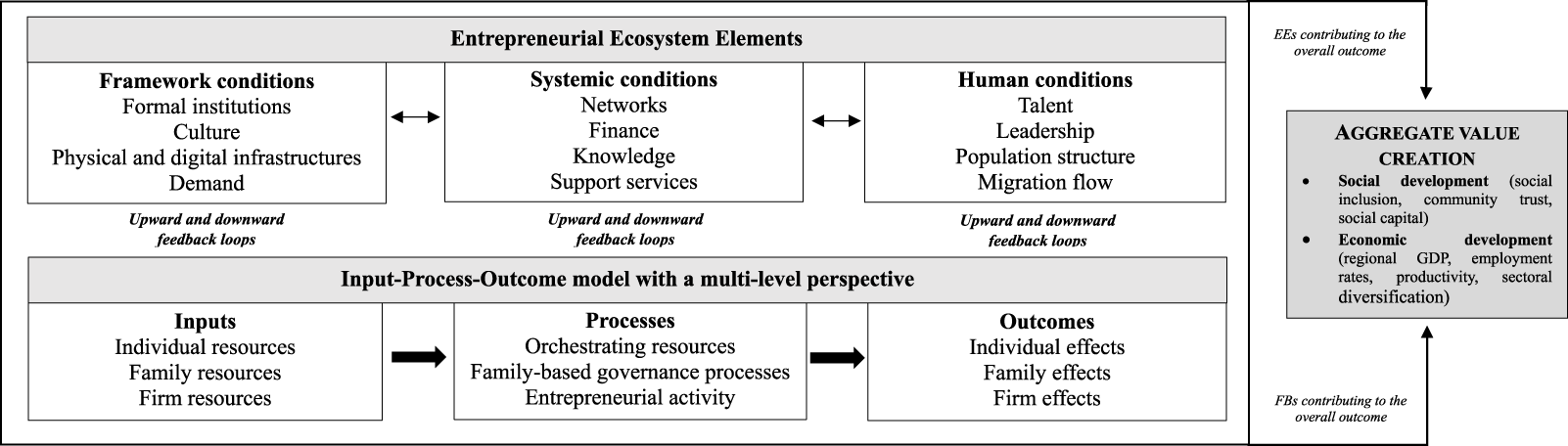
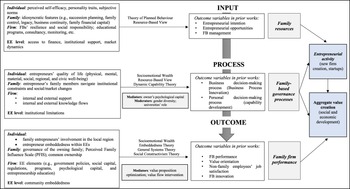
Drawing on earlier studies (Iacobucci & Perugini, Reference Iacobucci and Perugini2021; Lumpkin et al., Reference Lumpkin, Steier and Wright2011; Stam, Reference Stam2015; Stam & Van de Ven, Reference Stam and Van de Ven2021), we develop a theory-informed conceptual model using the IPO framework with a multi–level perspective (i.e., individual, family, firm). By following a deductive approach, Fig. 1 combines insights of the most commonly used theoretical models in the current FB and EE literature.
Integrating FB and EE models.
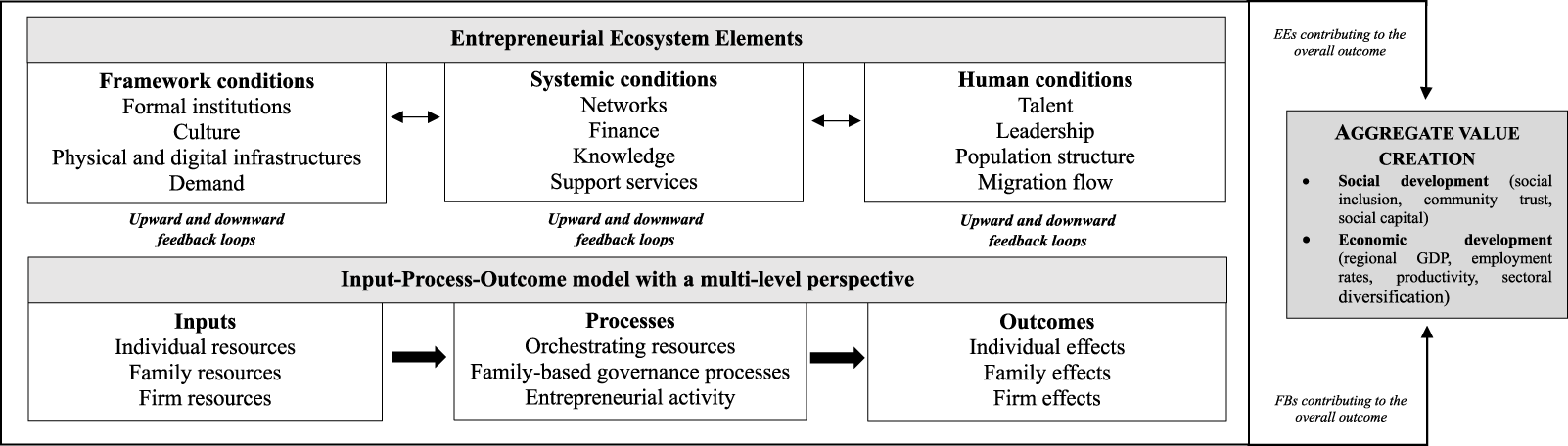
At the top of Fig. 1, EE is interconnected through a flow that moves both upward and downward. Particularly, EE conditions are the exogenous factors that can be distinguished in framework, systemic, and human conditions. Framework conditions refer to the institutional context, social dimensions, and physical/digital infrastructures that either facilitate or hinder human interaction. Systemic conditions pertain to the resource endowments that feature a particular context, such as networks among entrepreneurs, financial resources availability, access to new knowledge, and the presence of supportive organisations. Human conditions relate to human capital aspects, such as the presence of a skilled workforce, effective leadership, migration flows, and population structure. Collectively, EE conditions represent the underlying factors influencing the IPO framework in each level, ultimately shaping the value creation within EEs (e.g., social and economic development).
At the bottom of Fig. 1, the IPO framework spans across three levels – individual, family, and firm – illustrating how the interplay of different elements and the family firms’ dynamics contribute to the generation of aggregate value within EEs. Inputs are the measurable resources at the individual (e.g., entrepreneurial orientation, personality traits, etc.), family (e.g., family legacy, business continuity, etc.), and firm (e.g., resilience, corporate strategy, etc.) levels that shape entrepreneurial opportunities. Processes refer to the interaction mechanisms through which inputs are activated, exchanged, or constrained. They include the resource allocation decisions, family-based governance processes, and entrepreneurial activity. Such components portray the transitioning stage where inputs are translated into tangible outcomes. Outcomes capture family firm–level effects at both individual (such as value orientation), firm (e.g., financial performance, growth, and innovation), and family (e.g., job satisfaction) levels.
Lastly, the aggregate value creation of the system refers to the ecosystem outcomes, such as social and economic development. Particularly, social development involves greater social capital, trust, and rooted communities (Harima & Harima, Reference Harima and Harima2025; Theodoraki et al., Reference Theodoraki, Messeghem and Rice2018), whilst the economic development entails economic growth, job creation, and productivity (Audretsch & Belitski, Reference Audretsch and Belitski2021).
Methodology
An SLR demands a rigorous sequential methodological process to identify articles and summarise their results (Tranfield et al., Reference Tranfield, Denyer and Smart2003). Building on Snyder (Reference Snyder2019), our literature review explores theoretical frameworks, empirical methodologies, and research outcomes (Bettinelli et al., Reference Bettinelli, Mismetti, De Massis and Del Bosco2022; Post et al., Reference Post, Sarala, Gatrell and Prescott2020). Therefore, a systematic process was adopted to ensure transparency and replicability. The research methodology followed two main stages: the data collection and clustering process.
Data collection process
The data collection process entails three sub-steps. In the first one, we conducted an exploratory review of published papers to gain an updated overview of the topics and pick up the common keywords used in the ongoing academic debate. To this end, we identified prominent literature reviews on these different topics. On one side, we followed the search strings suggested by Cao & Shi (Reference Cao and Shi2021) and Cavallo et al. (Reference Cavallo, Ghezzi and Balocco2019) to reach papers in the EE research domain; on the other side, we referenced prior literature reviews in the FB research field (Carbone et al., Reference Carbone, Cirillo, Saggese and Sarto2022; Manzi et al., Reference Manzi, Netti, Favino and Sarto2024).
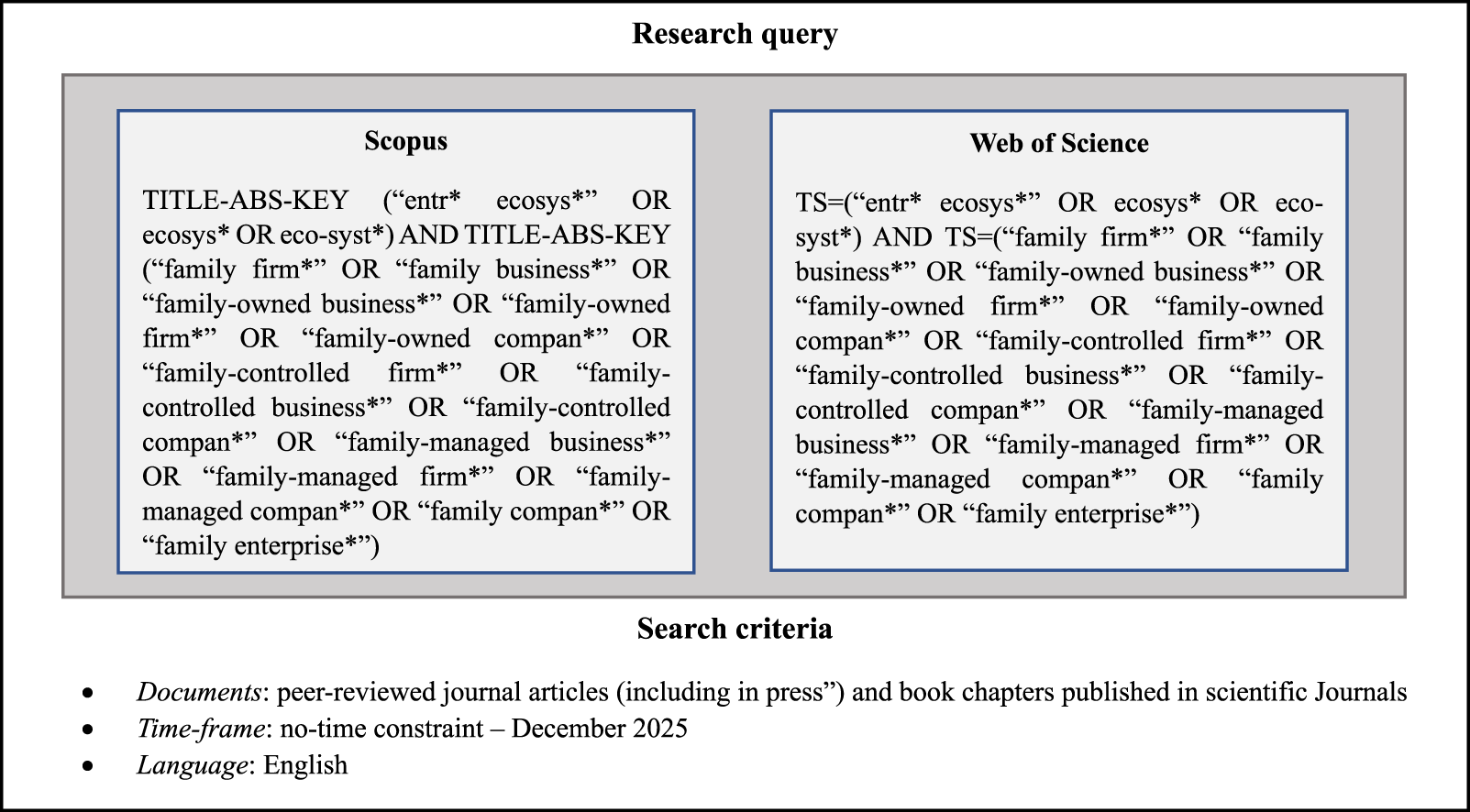
In the second step, we combined the Web of Science and Scopus databases to identify pertinent and qualified studies. The following inclusion criteria were applied: (a) peer-reviewed scientific journals, such as original articles and book chapters (Crossan & Apaydin, Reference Crossan and Apaydin2010; Scott, Reference Scott2007); (b) articles written in the English language; (c) published and ‘in press’ articles up to December 2025; and (d) two sets of search strings to identify papers enclosing pertinent terms in the title, abstract, and/or keywords (Fig. 2).
Research query and criteria.
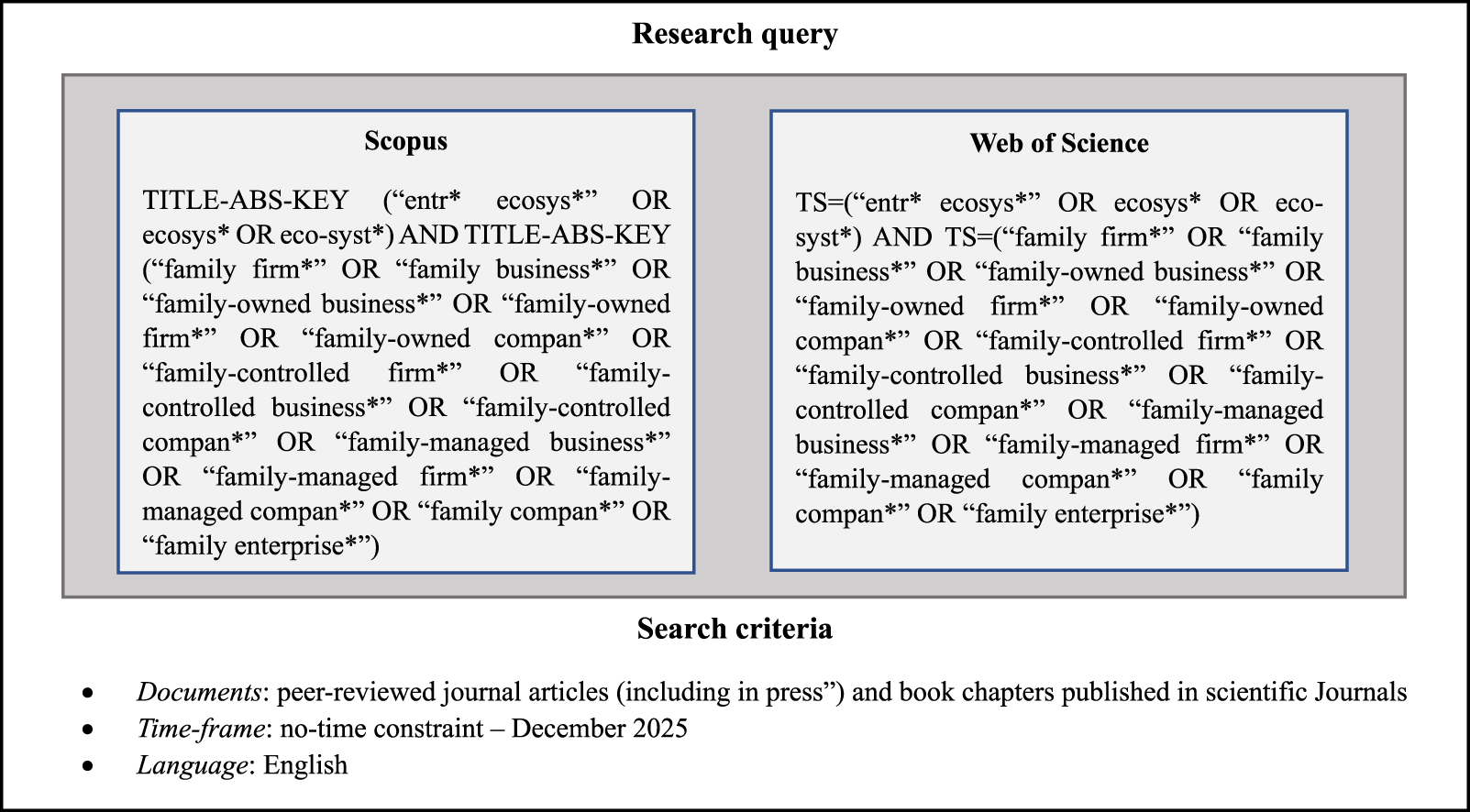
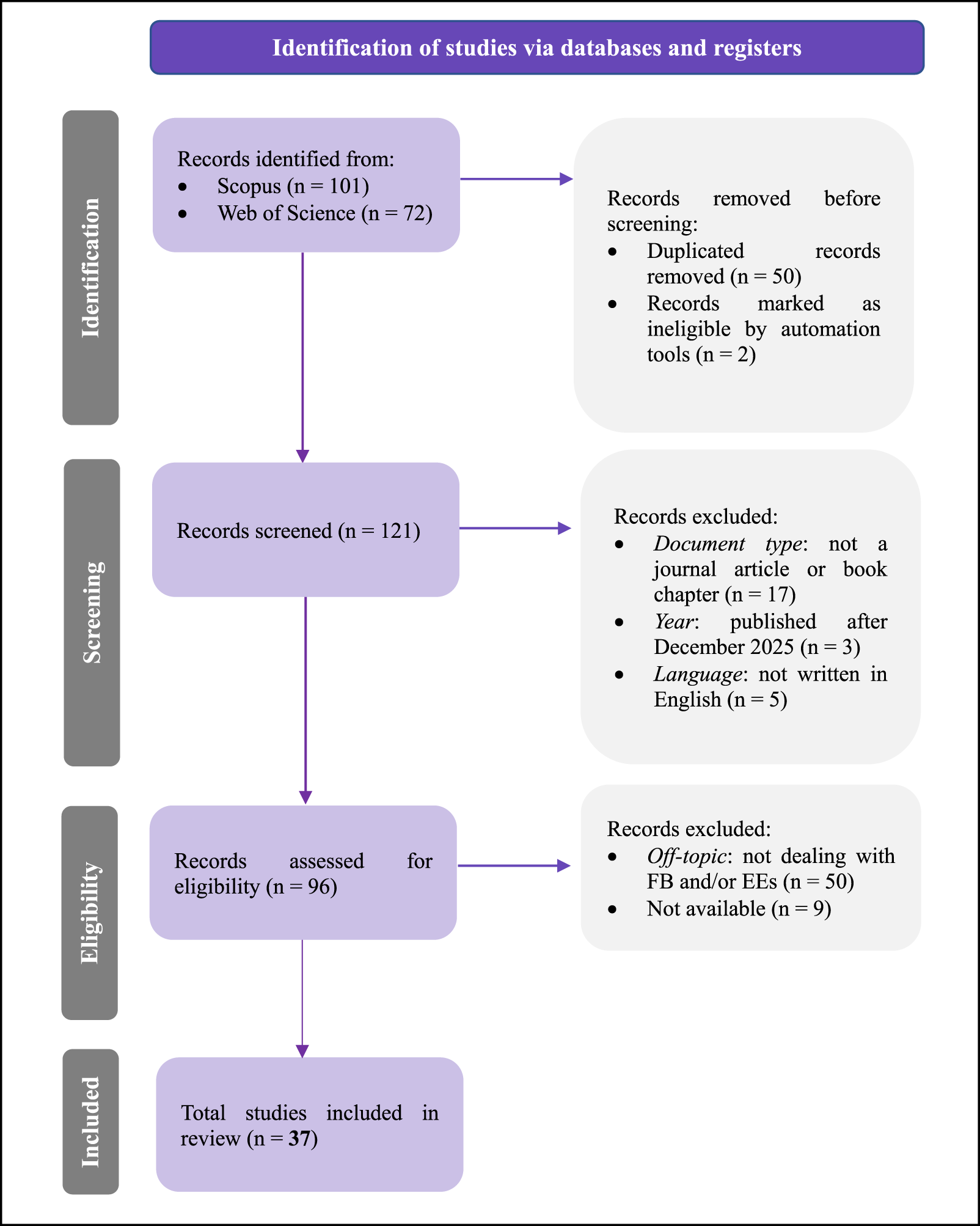
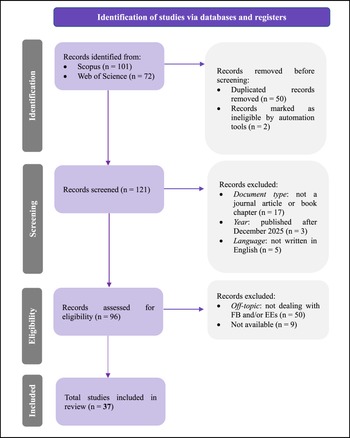
The third step focused on skimming the dataset to exclusively select the papers aligned with our review topic (Ordanini et al., Reference Ordanini, Rubera and DeFillippi2008). The initial search yielded a total of 173 records, with 72 sourced from Web of Science and 101 from Scopus (Fig. 3). Building on the PRISMA 2020 guidelines (Page et al., Reference Page, McKenzie, Bossuyt and Moher2021), we dismissed 50 duplicate articles and 2 ineligible records, then screened the remaining items by document type, language, and publication year. In particular, 17 records were excluded as they were neither journal articles nor book chapters, 3 were removed as they fell outside the time frame, and 5 were withdrawn since they were published in languages other than English. After the screening stage, papers were assessed for eligibility by reading their titles and abstracts (Page et al., Reference Page, McKenzie, Bossuyt and Moher2021). A document was included if it contributed to the conceptual advancement or empirically tested the relationship between family firms and EEs. By following these guidelines, we employed a methodological triangulation to gain a deeper understanding of the insights. Two authors independently reviewed the title, keywords, abstract, and, when necessary, the full text of each publication. Therefore, we removed 49 articles that were not closely associated with the review topic, along with another 9 that were not available for reading or downloading. As a result, 37 records were included in our SLR, representing 30.58% (The sample representativeness is computed as follows: Total studies included (n = 37)/Records screened (n = 121) × 100) of the body of knowledge retrieved by our search strategy. The total number of papers is therefore representative, given that the relatively small final sample reflects the specificity of the FB-EE nexus rather than focusing on a single research field. In particular, this sheds light on the understudied FB-EE relationship, which nevertheless offers huge opportunities for further research.
PRISMA 2020 flow diagram.
Coding and clustering process
After refining the dataset of articles, the SLR was carried out using a structured coding protocol. Two authors independently coded all papers using a predefined Excel extraction sheet (Calabrò et al., Reference Calabrò, Vecchiarini, Gast, Campopiano, De Massis and Kraus2019; Rashman et al., Reference Rashman, Withers and Hartley2009) and items drawn from earlier reviews (Carbone et al., Reference Carbone, Cirillo, Saggese and Sarto2022; Manzi et al., Reference Manzi, Netti, Favino and Sarto2024). For each article, we recorded the following: (i) theoretical framework (e.g., theory of planned behaviour, agency theory, institutional theory, SEW, etc.); (ii) geographical setting (e.g., Italy, Germany, multi–country, etc.); (iii) research method (qualitative/quantitative with finer design distinctions, such as exploratory case study, conceptual/theoretical paper, longitudinal analysis, etc.); and (iv) dependent variables/research focus (see Tables 1–4).
To ensure consistency, the coding scheme was pilot–tested and refined with two research field experts until consensus was reached. Where discrepancies in coding emerged, we engaged in discussions to resolve disagreements or involved an external scholar to provide an independent interpretation (Carbone et al., Reference Carbone, Cirillo, Saggese and Sarto2022).
Following the coding procedure, articles were systematically clustered employing the well-known IPO model (Lumpkin et al., Reference Lumpkin, Steier and Wright2011). Using this classification and building on Fig. 1, we assigned papers to the «input group» if the study focused on resources from individuals, families, or companies. Conversely, if the papers addressed family-based governance processes, new entrepreneurial activity, and the arrangement of resources, the article was assigned to the «process group». Finally, if the study’s topic pertained to the results achieved at the individual, family, and organisational levels, the manuscript was assigned to the «outcome group». In line with prior literature reviews (Carbone et al., Reference Carbone, Cirillo, Saggese and Sarto2022; Habbershon, Reference Habbershon2006; Lumpkin et al., Reference Lumpkin, Steier and Wright2011; Manzi et al., Reference Manzi, Netti, Favino and Sarto2024), we further classified studies by level of analysis within each cluster – individual, family, and firm. The firm level includes firm–specific factors (e.g., goals, governance, resources) (Chua et al., Reference Chua, Chrisman, Steier and Rau2012); the family level covers factors related to family involvement (Chrisman et al., Reference Chrisman, Sharma, Steier and Chua2013); and the individual level addresses personal characteristics influencing entrepreneurship (Shane, Reference Shane2007).
Finally, extracted data (e.g., descriptive information, key findings, assigned cluster, and level) were summarised to map the current state of FB and EE research and to develop an inductive thematic map (Fig. 5).
Findings
Descriptive information
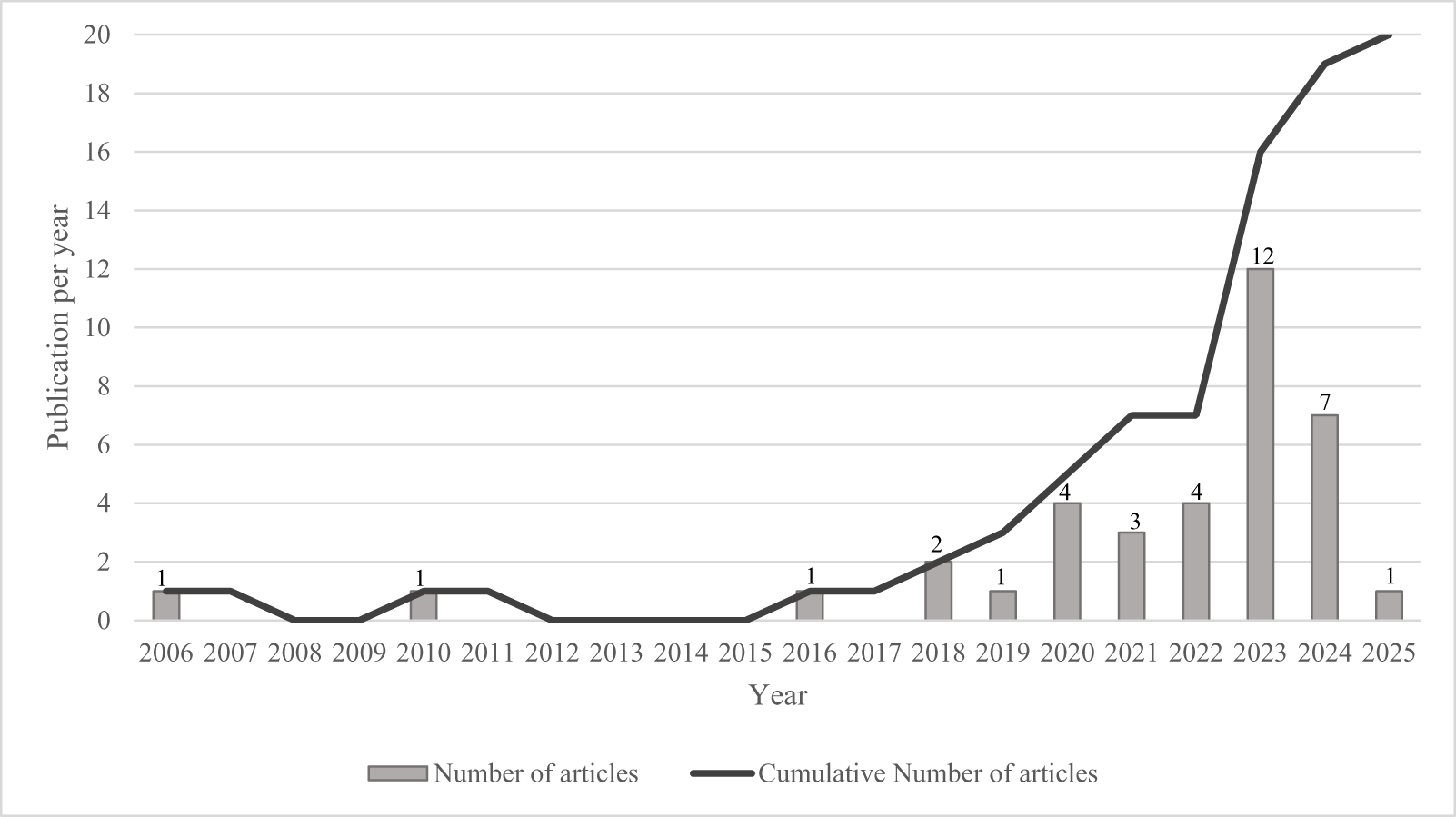
Figure 4 sets out the distribution of papers and the cumulative number of publications up to December 2025. There has been a gradual increase, starting with the initial publication in 2006 and reaching a total of 24 publications in recent years (i.e., 2022–25). A notable rise in publications around 2015 can be attributed to the growing attention devoted to EEs, particularly following the seminal work by Stam (Reference Stam2015), which provided a robust framework for understanding the systemic nature of entrepreneurship. The expansion of research continued to accelerate after 2020, likely due to the global shock of the COVID-19 pandemic, which significantly influenced research trends in EEs and FBs (Kariv et al., Reference Kariv, Cisneros, Guiliani and Chouchane2023).
Distribution of papers over the years.
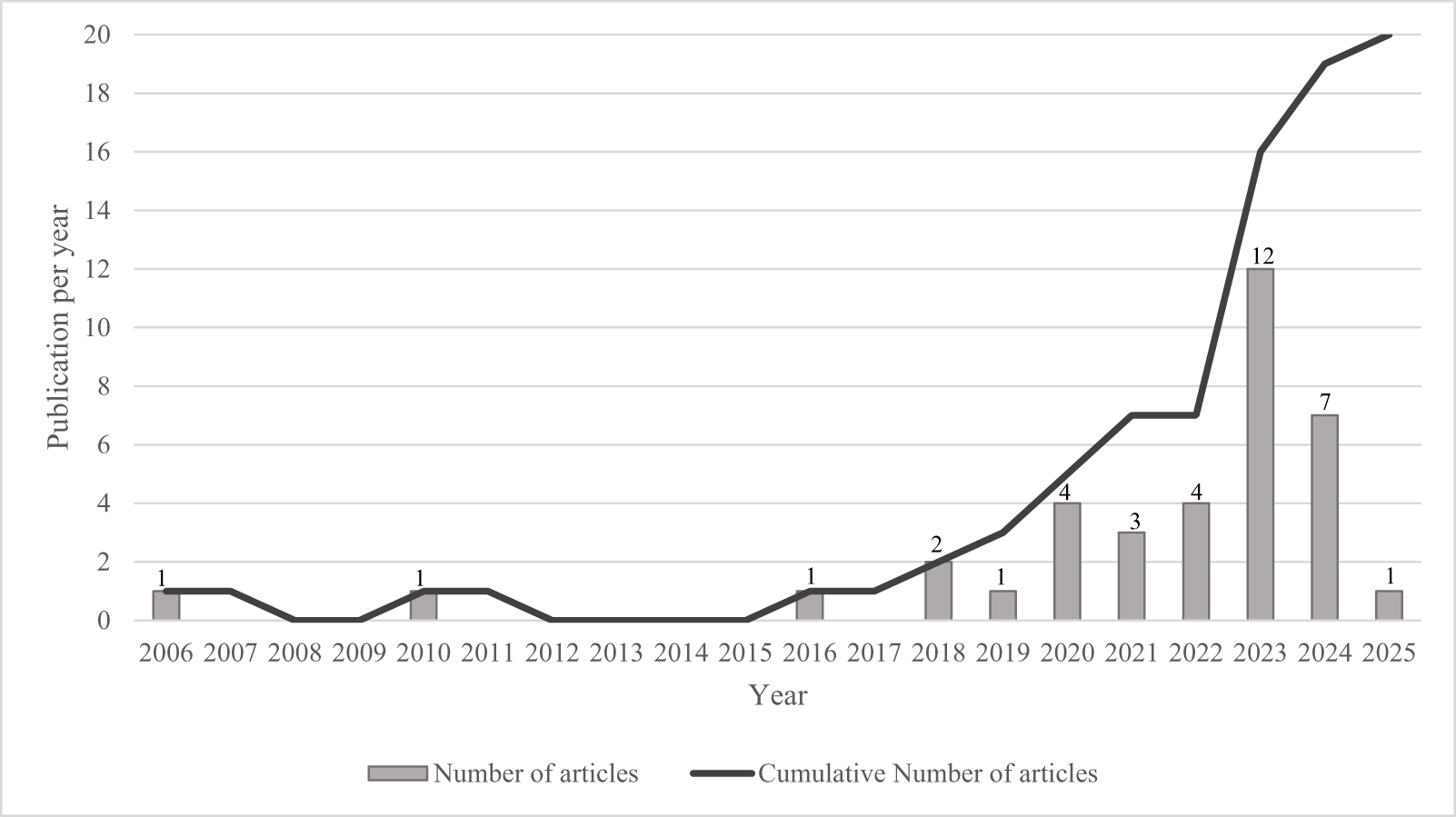
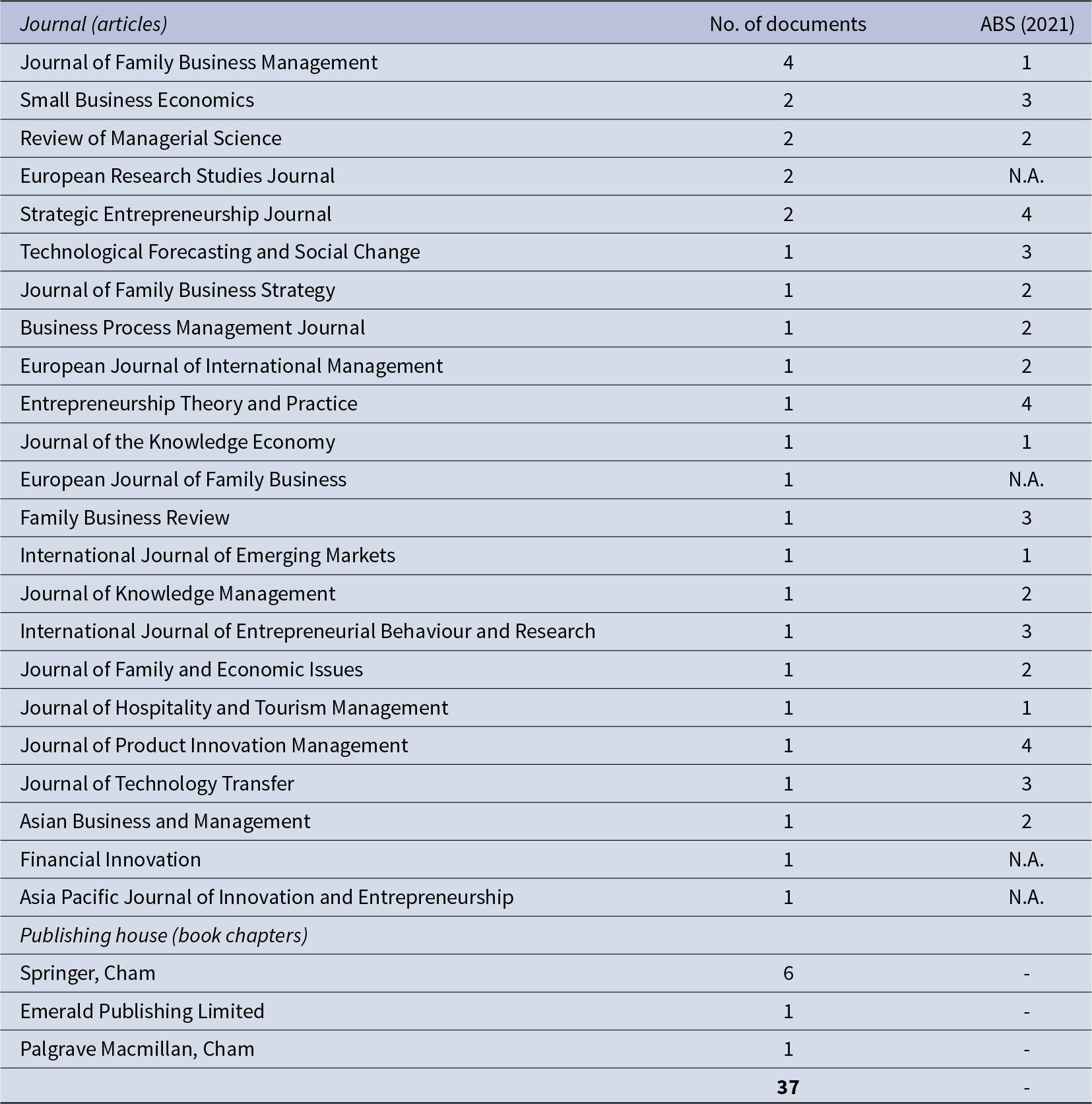
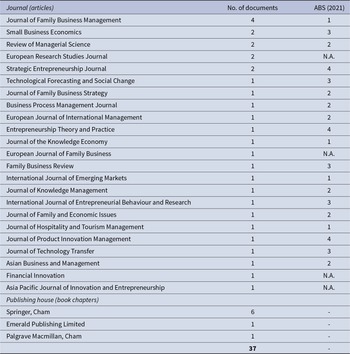
Table 5 highlights the different academic journals focused on the research field of EEs and FBs. Twenty-three distinct journals and three publishing houses emerged. Notably, the distribution of articles across various journals aligns with the Academic Journal Guide (2021) established by the Chartered Association of Business Schools (ABS), which classified journals according to their quality and impact. In addition to the academic journal, the publishing houses associated with book chapters highlight a robust platform for disseminating knowledge in such research fields. The predominance of contributions from esteemed publishers, such as Springer and Emerald Publishing Limited, suggests a reliable avenue for reaching a broader audience.
Tables 1–3 set out the classification of the documents according to the IPO model. Furthermore, Table 4 highlights the literature reviews that could not be included in the earlier tables. This empirical evidence reveals that the topics of interest are distributed almost evenly. The input group accounts for 28% of the total studies, the process group represents 28% of the total papers, while less emphasis is devoted to the outcome group, which represents 25% of the entire panel of studies. The leftover works are represented by literature reviews, which account for 19%.
To address the first part of our research question: ‘How do current studies conceptualise and examine the interaction between family businesses and entrepreneurial ecosystems (…)’, each cluster is analysed in terms of how these levels interact within the context of EEs. Particularly, the following subsections examine the inputs, processes, and outcomes clusters across three distinct levels: individual, family, and firm resources (Fig. 1).
Inputs
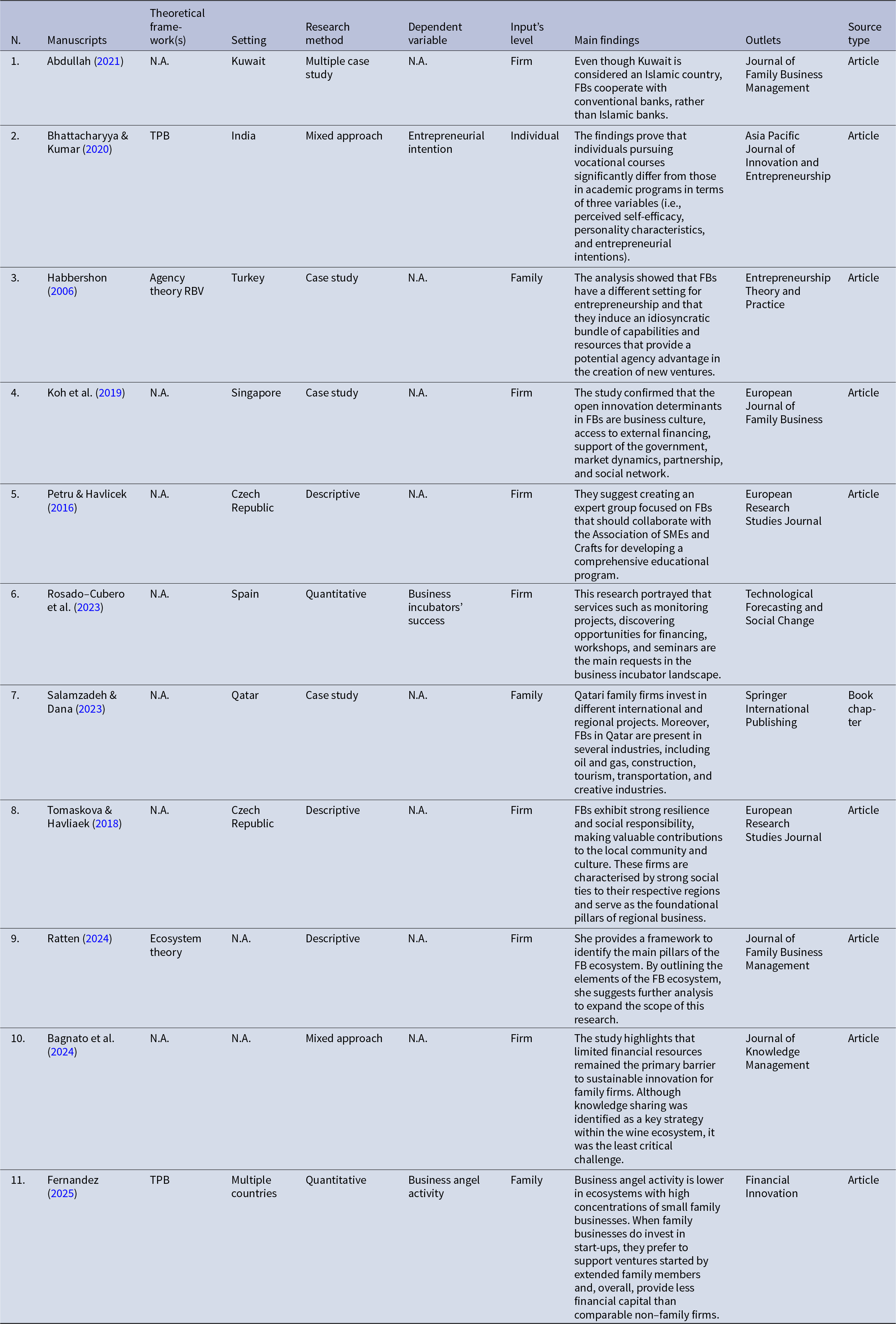
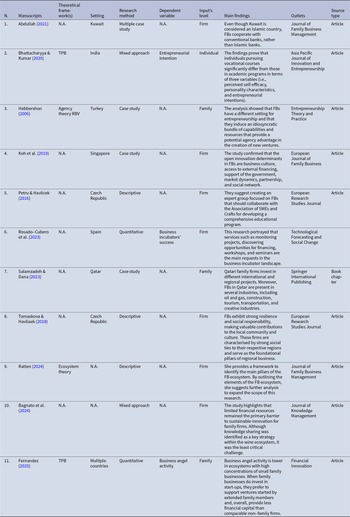
Table 1 offers insights into articles categorised in the input group. Our analysis reveals that the qualitative research is the most adopted methodological approach (Abdullah, Reference Abdullah2021; Habbershon, Reference Habbershon2006; Koh et al., Reference Koh, Kong and Timperio2019; Salamzadeh & Dana, Reference Salamzadeh, Dana, Ramadani, Aloulou and Zainal2023), while only a few studies employ quantitative methods (Bhattacharyya & Kumar, Reference Bhattacharyya and Kumar2020; Rosado–Cubero et al., Reference Rosado–Cubero, Hernández, Jiménez and Freire–Rubio2023).
Review of articles and chapters on FBs and EEs ‘inputs’
Source: Authors’ elaboration.
At the individual level, Bhattacharyya & Kumar (Reference Bhattacharyya and Kumar2020) use the theory of planned behaviour to examine entrepreneurial career choice. In detail, they prove that entrepreneurial intentions – influenced by self–efficacy, personality, and subjective norms – are shaped both by ecosystem inputs (e.g., entrepreneurial culture) and by family resources (FB background).
At the family level, research identifies family resources as distinctive internal inputs that shape entrepreneurial opportunities. In particular, the family context provides idiosyncratic resources and capabilities (Habbershon, Reference Habbershon2006), whilst family financial capital shapes opportunity formation (Fernandez, Reference Fernandez2025). In regions with many small family firms, these endogenous resources can substitute for external finance, lowering business angel activity and accordingly reshaping the local financing landscape. Overall, inherited assets, family capital, and governance norms act as internal inputs that affect entrepreneurial intentions and the creation of new ventures.
At the firm level, family firms exhibit resilience, social responsibility, and deep regional ties that influence local entrepreneurial activity (Tomaskova & Havliaek, Reference Tomaskova and Havliaek2018). Their long–term orientation and commitment to a specific place often translate into stable employment, strong relationships with local suppliers, community investment, and philanthropic engagement, all of which reinforce regional social capital and demand. Policy and education interventions (e.g., tailored university programmes, FB expert groups) are proposed to strengthen the strict interplay between EEs and family firms, facing topics such as succession, risk management, internationalisation, and finance access (Petru & Havlicek, Reference Petru and Havlicek2016). Empirical studies find that EE drivers – entrepreneurial culture, funding access, institutional support, networks, incubators, and market dynamics – shape FBs’ strategic choices and open–innovation practices (Koh et al., Reference Koh, Kong and Timperio2019; Rosado–Cubero et al., Reference Rosado–Cubero, Hernández, Jiménez and Freire–Rubio2023). Moreover, Ratten (Reference Ratten2024) highlights that FB–specific firm resources (e.g., family–owned infrastructure, inherited tangible assets) hold distinctive, often emotional, value that differentiates FBs from non–family firms and affects their interaction with the EE.
To sum up, empirical evidence suggests that ecosystem enablers (culture, finance, institutions) and family resources (family capital, social ties, inherited assets) jointly condition entrepreneurial activity and family–based governance. However, empirical work remains limited across the different layers. At the individual level, little is known about how individuals’ prior experience within family firms interacts with EE resources to fuel new–firm rates. At the family level, it remains unclear how families mobilise reputation, trust, and local entrepreneurial spirit to generate benefits (or dysfunctions) for firm and community outcomes. At the firm level, comparative studies on how familiness and networks yield sustained competitive advantage over non–family firms are scarce.
Process
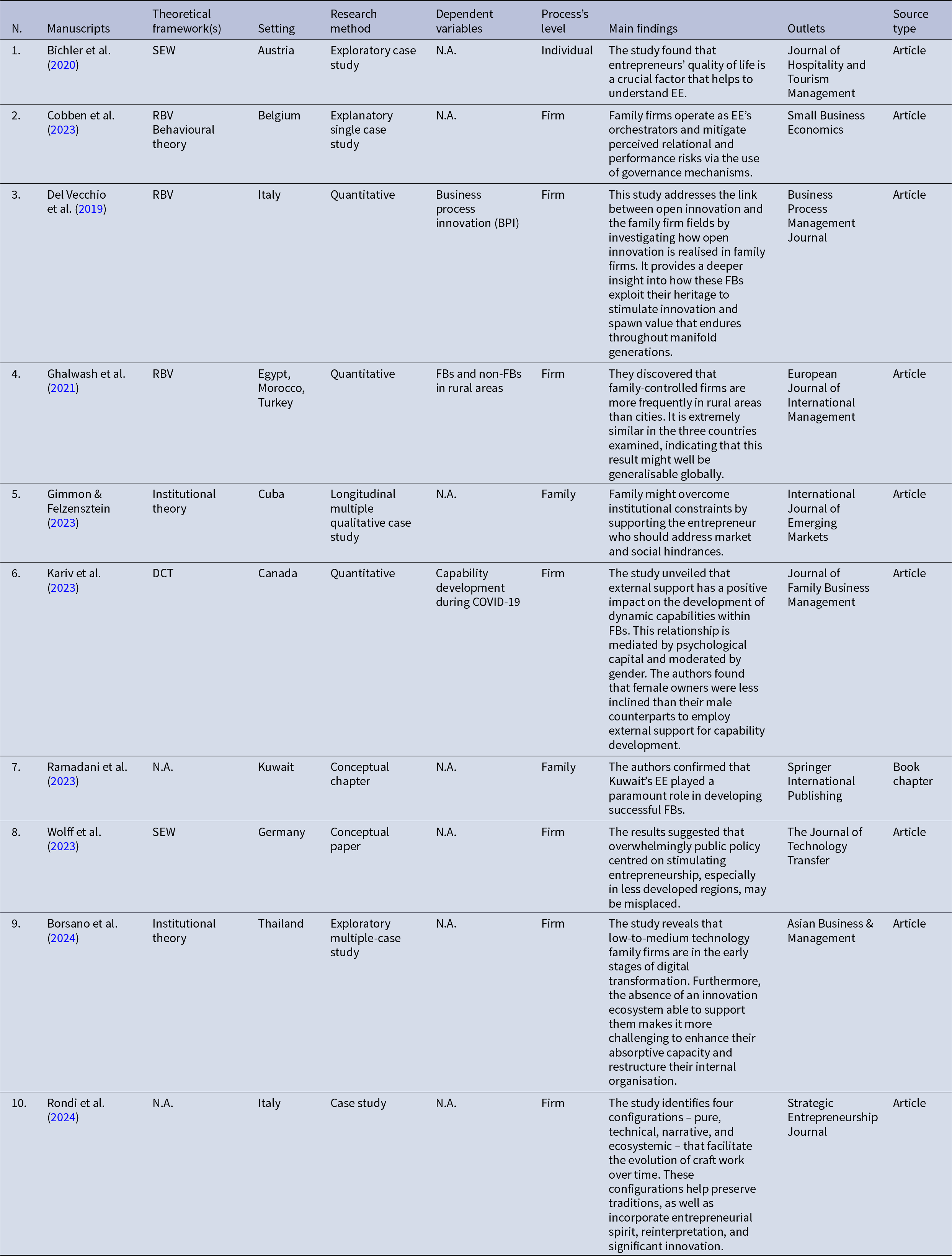
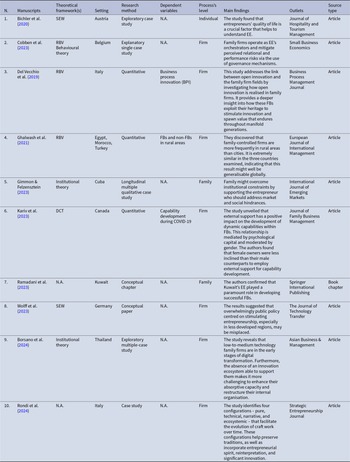
Table 2 points out that some papers are based on case studies (Bichler et al., Reference Bichler, Kallmuenzer and Peters2020; Cobben et al., Reference Cobben, Neessen, Rus and Roijakkers2023; Gimmon & Felzensztein, Reference Gimmon and Felzensztein2023; Rondi et al., Reference Rondi, Magrelli, Debellis and De Massis2024), while others adopt quantitative methods (Del Vecchio et al., Reference Del Vecchio, Secundo, Rubino, Garzoni and Vrontis2019; Ghalwash et al., Reference Ghalwash, Karadeniz and Boutaleb2021; Kariv et al., Reference Kariv, Cisneros, Guiliani and Chouchane2023). The remaining are conceptual papers (Ramadani et al., Reference Ramadani, Dzenopoljac, Zainal, Dzenopoljac, Ramadani, Aloulou and Zainal2023; Wolff et al., Reference Wolff, Guenther, Moog and Audretsch2023).
Review of articles and chapters on FBs and EEs ‘process’
Source: Authors’ elaboration.
At the individual level, SEW theory was employed to investigate entrepreneurs’ quality of life – encompassing physical, mental, material, social, regional, and civic well–being – which in turn shapes both personal and business decision-making (Bichler et al., Reference Bichler, Kallmuenzer and Peters2020). This holistic perspective suggests that individual–level resources and well–being influence how family firms orchestrate their resources.
At the family level, research shows that in contexts where EEs are weak – characterised by institutional gaps or adverse market conditions – family members often leverage internal capabilities to cope with these constraints (Gimmon & Felzensztein, Reference Gimmon and Felzensztein2023). Consequently, family–based governance mechanisms (e.g., informal coordination, swift decision–making, resource sharing) can enable the creation and survival of small–scale ventures even in unsupportive ecosystems, thereby acting as a local entrepreneurial safety network and a source of adaptive capacity.
At the firm level, research shows that family firms often act as ecosystem orchestrators, deploying formal and informal governance mechanisms to handle relational and performance risks and to balance firm goals with employee interests (Chrisman et al., Reference Chrisman, Chua, Le Breton–Miller, Miller and Steier2018; Cobben et al., Reference Cobben, Neessen, Rus and Roijakkers2023; Ghalwash et al., Reference Ghalwash, Karadeniz and Boutaleb2021; Lambrechts et al., Reference Lambrechts, Huybrechts, De Massis and Lehmann2023). Building on the resource-based view, family firms adopt open–innovation practices, leverage external knowledge from universities, suppliers, and institutions, and integrate it through internal co–production processes to generate novel business solutions (Davenport & Prusak, Reference Davenport and Prusak1998; Del Vecchio et al., Reference Del Vecchio, Secundo, Rubino, Garzoni and Vrontis2019). Drawing on the dynamic capability theory, the external support has been linked to the development of dynamic capabilities (Kariv et al., Reference Kariv, Cisneros, Guiliani and Chouchane2023). Nevertheless, the absence of an innovation ecosystem able to support FBs in the transition towards digital transformation emerges as a crucial topic in low-to-medium technology firms (Borsano et al., Reference Borsano, Marozzo, Bonaglia, Di Minin and Crupi2024).
To infer, studies in this cluster show that individual–level resources (e.g., entrepreneurs’ quality of life, tacit knowledge) shape firms’ capacity to orchestrate resources, while family–based governance can enable new venture creation even in weaker EEs. Yet, relevant research gaps remain. At the individual level, few studies compare entrepreneurial orientation in family versus non–family firms and its effects on entrepreneurial activity or productive entrepreneurship. At the family level, longitudinal empirical evidence is scarce on how family governance and succession processes affect ecosystem performance, firm survival, and knowledge generation over time. At the firm level, the role of local embeddedness in fostering a supportive business environment and stimulating new business creation should be further investigated.
Outcomes
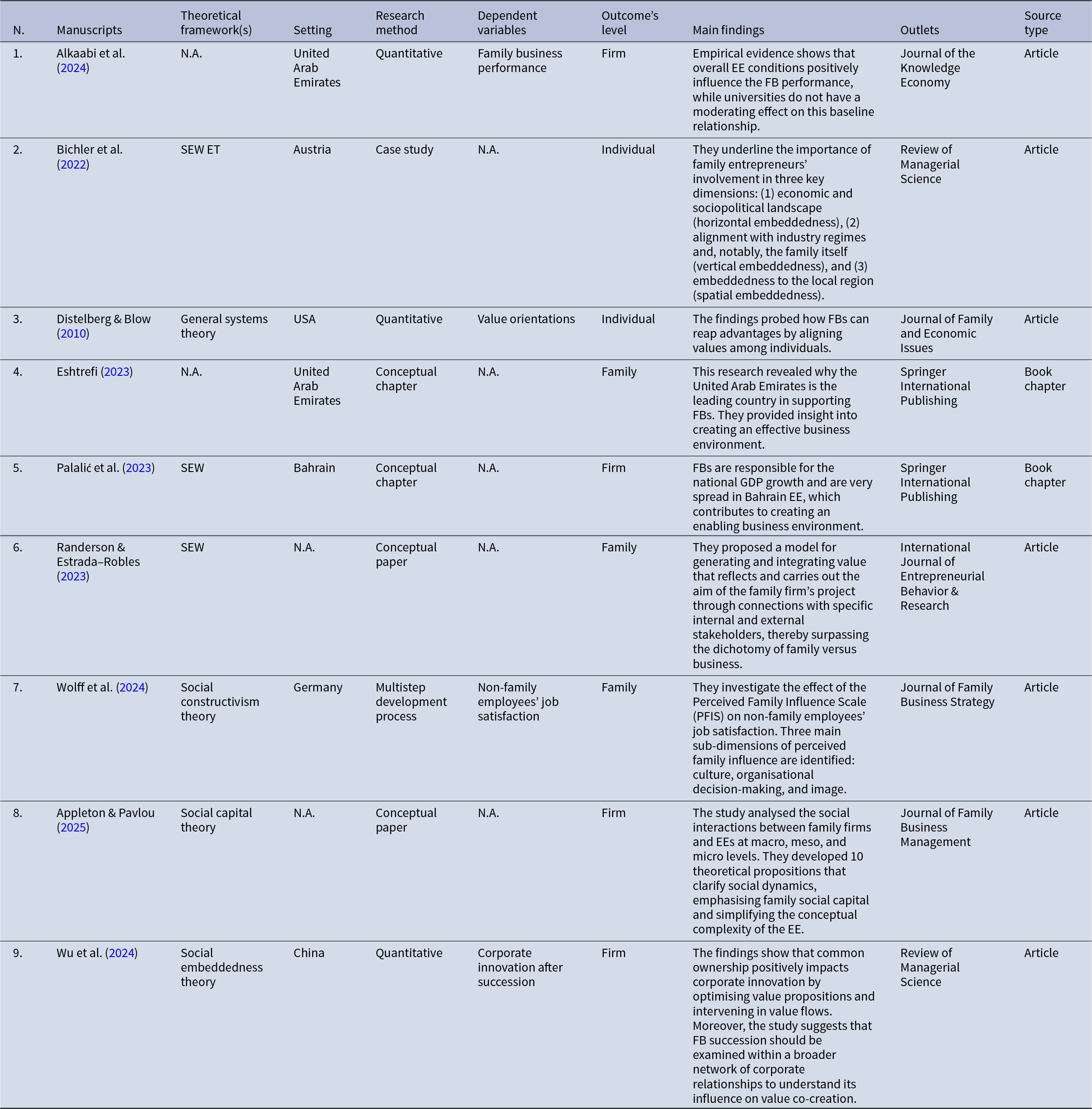
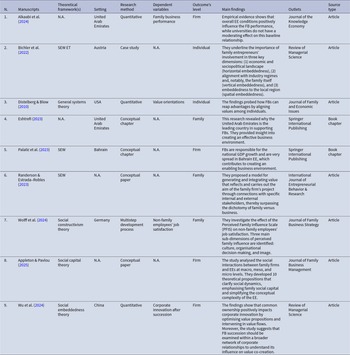
Table 3 shows that there is a prevailing number of conceptual papers (Eshtrefi, Reference Eshtrefi, Ramadani, Aloulou and Zainal2023; Palalić et al., Reference Palalić, Razzak, Al Riyami, Dana, Ramadani, Ramadani, Aloulou and Zainal2023; Randerson & Estrada–Robles, Reference Randerson and Estrada–Robles2023), quantitative research articles (Alkaabi et al., Reference Alkaabi, Ramadani and Zeqiri2024; Distelberg & Blow, Reference Distelberg and Blow2010; Wolff et al., Reference Wolff, Koehn, Ruf, Moog and Strina2024), and case studies (Bichler et al., Reference Bichler, Kallmuenzer, Peters, Petry and Clauss2022).
Review of articles and chapters on FBs and EEs ‘outcomes’
Source: Authors’ elaboration.
At the individual level, research mainly draws on SEW and embeddedness theory (ET). Considerable relevance is devoted to the community embeddedness – notably Bichler et al.’s (Reference Bichler, Kallmuenzer, Peters, Petry and Clauss2022) concept of ‘horizontal embeddedness’ – which highlights family entrepreneurs’ collaborative ties within local economic and sociopolitical networks. Similarly, interactions among players align with cybernetic principles involving negative and positive feedback mechanisms (von Bertalanffy & Sutherland, Reference Bertalanffy and Sutherland1974). By using the general systems theory, research shows that individual behaviours and values are shaped by both internal family processes and broader systemic conditions (Distelberg & Blow, Reference Distelberg and Blow2010). These findings align with our IPO model since ecosystem factors such as community embeddedness and network structure influence individual–level effects (horizontal, spatial, and vertical embeddedness) that feed into entrepreneurial behaviour and outcomes.
At the family level, governance choices by the owning family significantly affect both family welfare and aggregate ecosystem value. On the one hand, perceived family influence (e.g., organisational culture, decision–making, reputation) shapes non–family employees’ job satisfaction; on the other hand, family heterogeneity and the consistent presence of owner–managers can improve accessibility and personal relationships within the firm (Wolff et al., Reference Wolff, Koehn, Ruf, Moog and Strina2024). Driven by SEW, family firms prioritise non–financial goals (control, legacy, reputation, affective ties), which systematically influence strategic choices such as investment horizons, hiring practices, and community engagement. Through these mechanisms, family–level effects (for example, preserved SEW, higher job satisfaction, stronger social capital) translate into measurable sub–national outcomes – improved local employment stability, enhanced social cohesion, and contributions to regional economic performance. Consequently, family governance not only entails firm-level effects but also reshapes regional conditions, processes, and aggregate value by reinforcing long–term commitments, dense local networks, and place–based legitimacy (Basco, Reference Basco2015; Beer et al., Reference Beer, Haughton and Maude2003; Capello & Nijkamp, Reference Capello and Nijkamp2019).
At the firm level, the interplay between EEs and FBs is marked out by a mutually beneficial exchange (Appleton & Pavlou, Reference Appleton and Pavlou2025). The symbiotic association among EE elements – including government policies, social capital, regulations, programs, psychological capital, and entrepreneurship education – impacts the FBs’ success (Alkaabi et al., Reference Alkaabi, Ramadani and Zeqiri2024). Concurrently, FBs assume a pivotal role in contributing to national gross domestic product growth and cultivating a conducive environment for business development (Palalić et al., Reference Palalić, Razzak, Al Riyami, Dana, Ramadani, Ramadani, Aloulou and Zainal2023), thus conditioning both the overall outcome and the intermediate output of the EE.
To conclude, scholars in this cluster concur that family firms’ embeddedness and governance influence outcomes beyond the firm itself, contributing to regional aggregate value. Yet notable empirical gaps remain across levels. At the individual level, few studies compare well-being (emotional, cognitive, financial), job satisfaction, or entrepreneurial intentions in family versus non–family firms or test how EE conditions moderate these effects. At the family level, further insights should be carried out on how family reputation, heterogeneity, and governance translate into ecosystem performance, resilience, and social capital, as well as on the mechanisms linking family decisions to community trust and regional development. At the firm level, there is a shortage of causal and comparative studies identifying which EE elements most effectively support family–firm financial and non–financial performance.
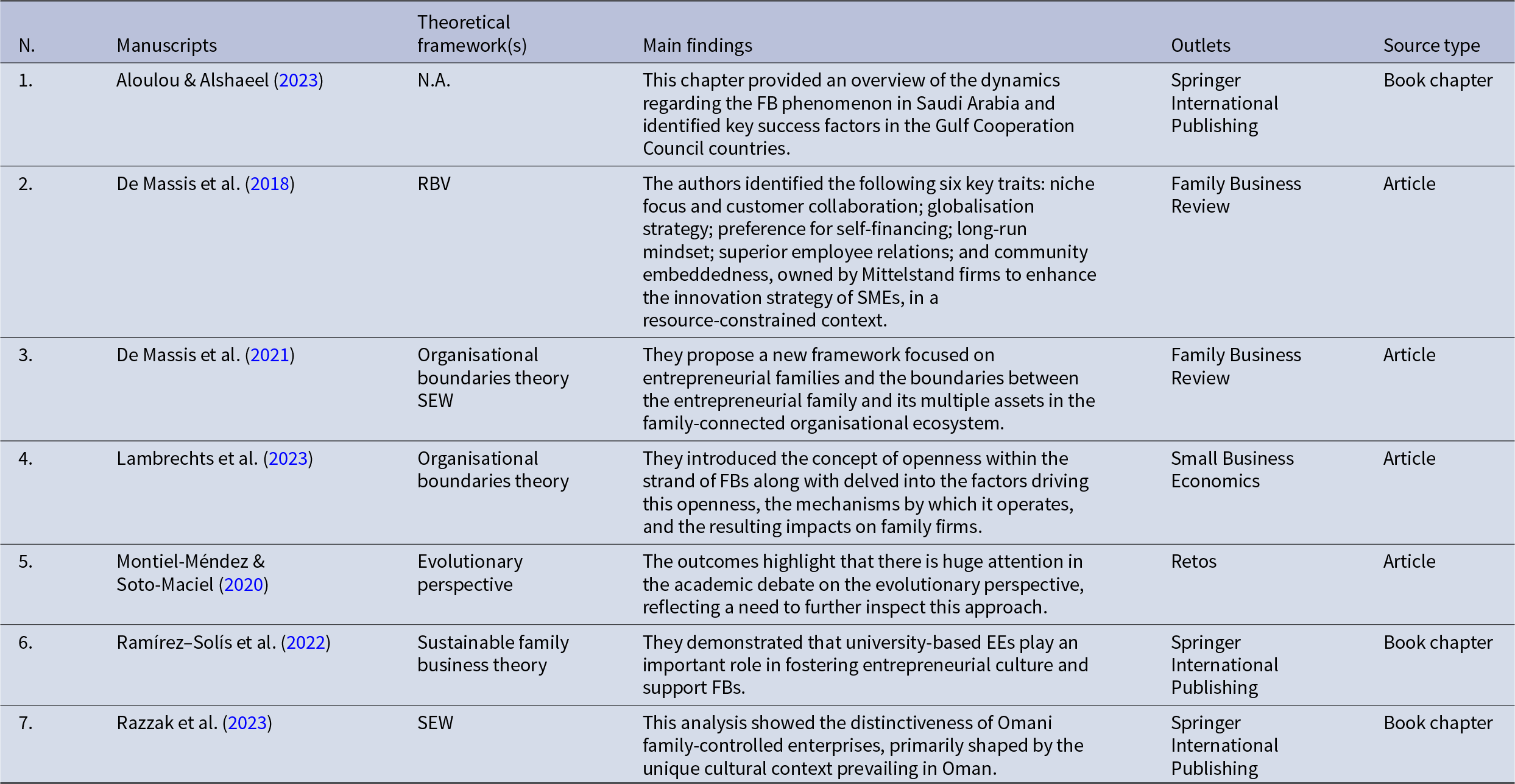
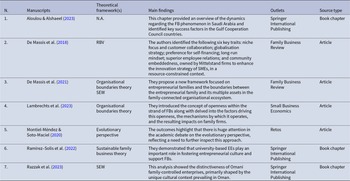
Table 4 showcases seven literature reviews that are included in our final dataset but excluded from the IPO model for the following reasons (Lumpkin et al., Reference Lumpkin, Steier and Wright2011). First, the model typically focuses on high-level components (e.g., antecedents, intermediate output, results). Second, while literature reviews are relevant for understanding a research field, they may not directly align with these high-level elements. Lastly, the model is tailored to capture the core aspects of primary research, covering specific processes, such as data collection, analysis, and outcome generation (Naeem et al., Reference Naeem, Ozuem, Howell and Ranfagni2023; Snyder, Reference Snyder2019).
Review of articles on FBs and EEs ‘literature review’
Source: Authors’ elaboration.
Main journals and publishing house on EEs and FBs
Source: Authors’ elaboration.
Discussion
Thematic map development
Following an inductive approach, Fig. 5 shows a thematic map that provides a comprehensive outlook of the FB-EE relationship. We offer a snapshot of the current state of the art to face the second part of our research question: ‘(…) and what theoretical and contextual insights emerge from this body of literature?’ In detail, Fig. 5 emphasises the main findings within the research field, displaying each category of inputs, processes, and outcomes analysed across individual, family, firm, and EEs levels.
Thematic map: conceptualisation of FBs and EEs.
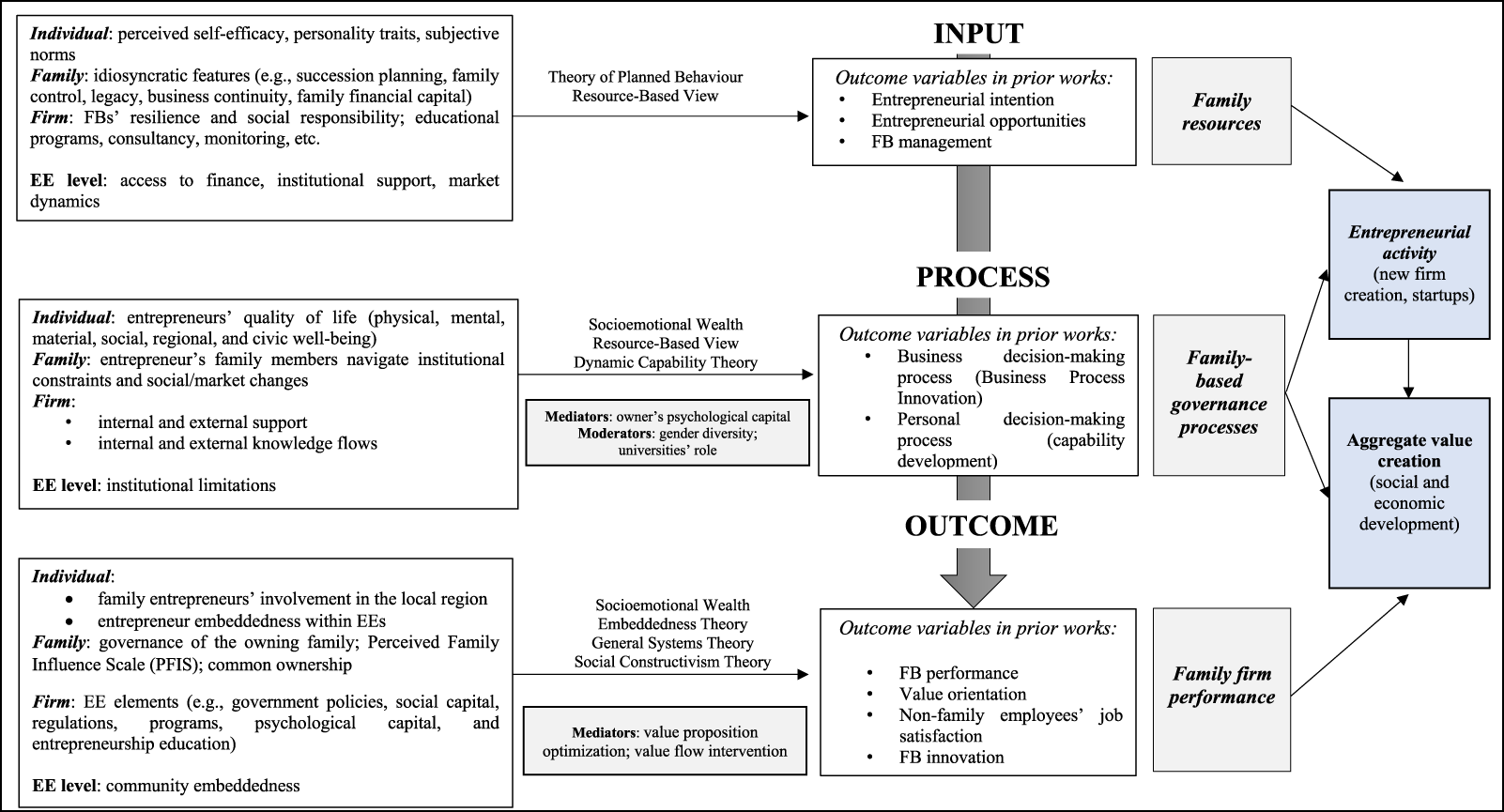
Starting from the inputs cluster, recent research has explored entrepreneurial intention, entrepreneurial opportunities, and FB management as outcome variables. First, entrepreneurial intention is shaped by perceived self-efficacy, personality traits, entrepreneurial culture, and family background. Second, entrepreneurial opportunities are conditioned by family idiosyncrasies, namely the behavioural, cultural, and strategic policies (e.g., conflict patterns, succession planning, family control, inherited assets, legacy, and business continuity) (Fernandez, Reference Fernandez2025; Habbershon, Reference Habbershon2006). Third, FB management (e.g., intergenerational transition, risk management, market entry, etc.) is affected by EE elements, such as access to external finance, institutional support, and market dynamics (Koh et al., Reference Koh, Kong and Timperio2019; Petru & Havlicek, Reference Petru and Havlicek2016; Rosado–Cubero et al., Reference Rosado–Cubero, Hernández, Jiménez and Freire–Rubio2023).
Moving to the processes cluster, the entrepreneurial process of FBs (e.g., business process innovation and capability development) is influenced by various factors at the firm, family, individual, and EE levels (such as entrepreneurs’ quality of life, internal and external support, institutional constraints, etc.) (Bichler et al., Reference Bichler, Kallmuenzer and Peters2020; Kariv et al., Reference Kariv, Cisneros, Guiliani and Chouchane2023), where theoretical explanations are rooted in the SEW and resource-based view. From the methodological standpoint, these relationships are moderated and mediated by specific governance and top management team variables whose implications could be further understood in line with the dynamic capability theory (Kariv et al., Reference Kariv, Cisneros, Guiliani and Chouchane2023).
Concluding with the outcomes cluster, several antecedents, such as entrepreneur local embeddedness, FB’s governance, and EE elements, affect FB performance and value orientation within the ecosystem perspective (Alkaabi et al., Reference Alkaabi, Ramadani and Zeqiri2024; Distelberg & Blow, Reference Distelberg and Blow2010). These relationships are examined within the realm of the SEW, ET, and general systems theory.
Interpreting Fig. 5, family firms emerge as players shaped by individual aspects, family idiosyncrasies, firm characteristics, and EE elements. Grounded in SEW and ET (Gómez–Mejía et al., Reference Gómez–Mejía, Haynes, Núñez–Nickel, Jacobson and Moyano–Fuentes2007; Granovetter, Reference Granovetter1985), the inductive model identifies specific mechanisms that explain the FB-EE interactions. On the one hand, SEW tenets (e.g., control, legacy, and affective attachment) promote legitimacy and reputational strategies that foster local trust and access to specific resources. On the other hand, ET principles claim that familiness and embedded network ties enable firms to build collaborative partnerships with universities, suppliers, and public agencies, thereby promoting knowledge flows and co-creating innovation. In this vein, family governance and succession patterns mediate resource allocation decisions, influencing both firm investment choices and local financing frameworks. Ultimately, managerial choices (e.g., risk management, long-horizon investments, and selective partnerships) translate these ties into firm strategies that affect opportunity exploitation and ecosystem outcomes.
Therefore, the FB-EE link is stronger where family firms’ long-term orientation and place-based commitments strengthen ecosystem resilience and support new-venture formation and regional development (Conz et al., Reference Conz, Lamb and De Massis2020; Stam, Reference Stam2015; Stam & Van de Ven, Reference Stam and Van de Ven2021; Tàpies & Fernández Moya, Reference Tàpies and Fernández Moya2012). Two key features explain this role. First, deep local embeddedness – family firms’ dense ties, reputational capital, and civic engagement – anchors them in regional networks and allows them to mobilise resources and collaborations that support local entrepreneurship (Bichler et al., Reference Bichler, Kallmuenzer, Peters, Petry and Clauss2022; Cirillo et al., Reference Cirillo, Maggi, Sciascia, Lazzarotti and Visconti2022; Jack & Anderson, Reference Jack and Anderson2002). Second, non-financial goals (control, legacy, affective attachment) lead family firms to preserve activities and invest for the long run, even under adverse conditions (Cabrera–Suárez et al., Reference Cabrera–Suárez, Déniz–Déniz and Martín–Santana2014). Empirically, long-lived family firms have shown superior capacity to weather crises and adapt to rapid change – preserving jobs, local suppliers, and institutional relationships that contribute to regional stability (Calabrò et al., Reference Calabrò, Frank, Minichilli and Suess–Reyes2021; De Massis & Foss, Reference De Massis and Foss2018; Salvato et al., Reference Salvato, Sargiacomo, Amore and Minichilli2020; Sharma & Salvato, Reference Sharma, Salvato, Fernandez Perez and Colli2013).
In such a scenario, embeddedness and non-financial goals thus serve as pivotal concepts to elucidate the FB-EE relationship. These theoretical lenses frame how individual, family, and firm ties constitute a social fabric through which entrepreneurial activity is fuelled and sustained.
To infer, embeddedness and non–financial goals are therefore pivotal for understanding the FB-EE relationship. Taken together, they explain how individual, family, and firm ties form a social fabric that fuels and supports entrepreneurial activity.
Building on these insights, Fig. 5 extends the ongoing academic debate beyond by (i) integrating SEW and ET within the IPO framework to move from descriptive mapping to theory–informed causal pathways; (ii) spotlighting specific mechanisms that link ecosystem elements to multi–level inputs, processes, and outcomes; (iii) adopting such a multi-level and co–evolutionary perspective, the model integrates place–based ecosystem dynamics with family–business heterogeneity, ultimately identifying pathways for empirical validation.
Future research agenda development
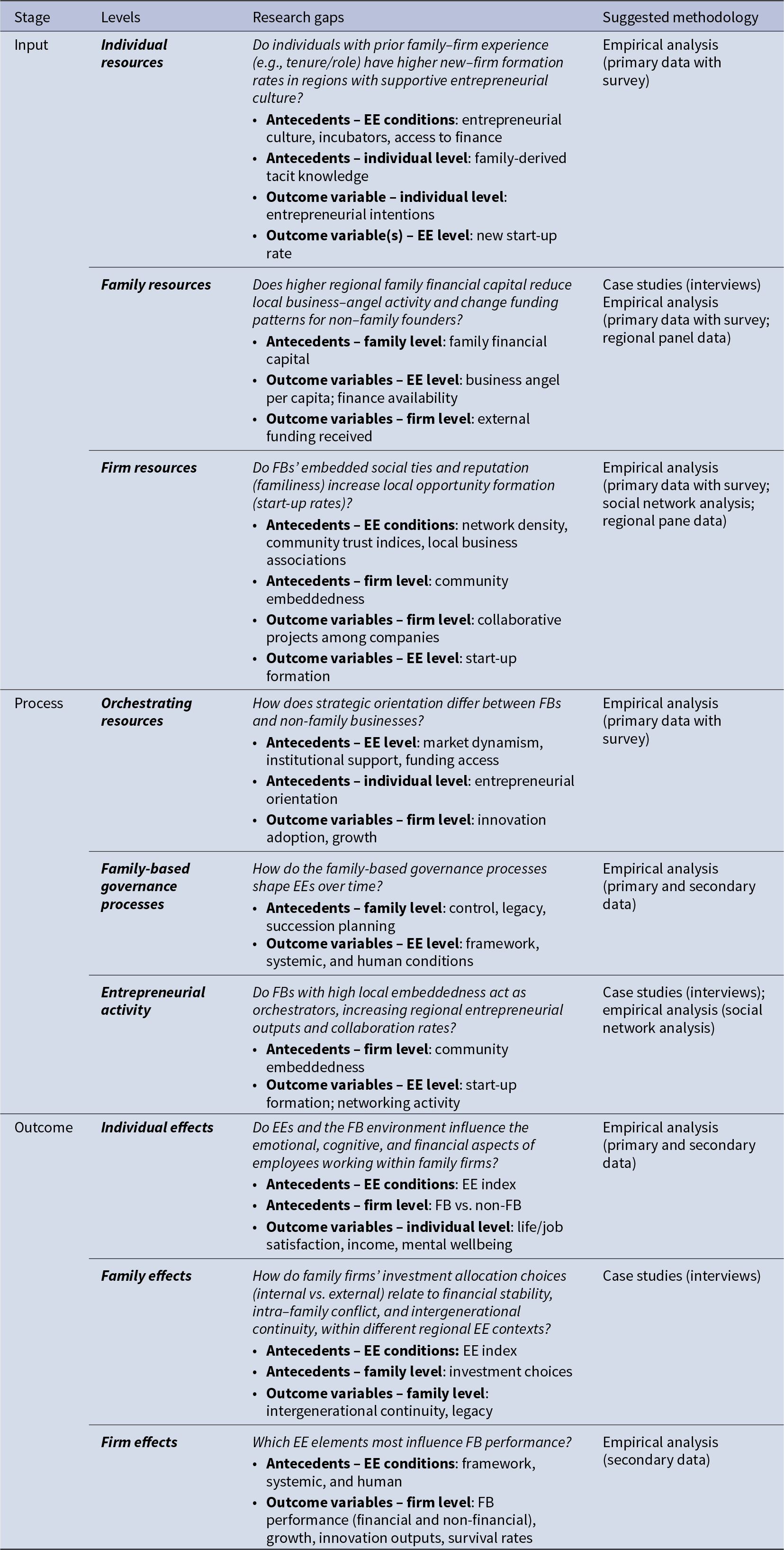
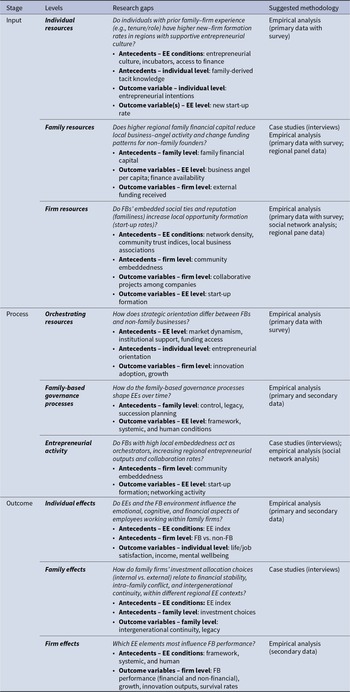
The following sections pinpoint the main research gaps and underexplored research questions to enrich this research field. In particular, Table 6 offers an overview of the future research avenues on FBs and EEs.
Overview of research gaps and future research directions
Source: Authors’ elaboration.
Open issues on input
Our review suggests that the inputs category has been scarcely investigated in the following research strands. At the individual level, prior exposure to family–firm routines and tacit knowledge represents a distinctive form of human capital that may shape entrepreneurial orientation and the propensity to establish new ventures (Sirmon & Hitt, Reference Sirmon and Hitt2003). In such a scenario, future empirical studies might examine how family–derived tacit knowledge, alongside local EE enablers (e.g., incubators, mentoring, finance), affects entrepreneurial intentions and start–up formation. At the family level, a relevant issue emerging from our review is whether higher regional endowments of family financial capital diminish local business–angel activity (Fernandez, Reference Fernandez2025). In this vein, scholars might investigate whether aggregated family financial capital replaces external early–stage finance, thus decreasing business–angel deals per capita. At the firm level, a key question is whether family firms’ embedded social ties and reputational assets stimulate local opportunity formation. Future research may examine how EE conditions (network density, community trust, strength of local business associations) interact with firm–level community embeddedness to affect interfirm collaboration and regional start–up formation.
Open issues on the process
Table 6 outlines some future research directions in the process category. At the individual level, future research might delve into whether and how entrepreneurial orientation differs between family and non–family firms. In detail, scholars should prove whether FBs’ long–term, stewardship–oriented strategies moderate the relationship between EE conditions and firm–level outcomes (such as innovation adoption and growth). At the family level, next studies should enquire how family–based governance processes shape EEs over time. Key research questions include whether governance practices that prioritise long–term control and transgenerational continuity condition the regional framework (regulatory quality, policy engagement), systemic (financial availability, support services), and human conditions (skill formation, leadership). At the firm level, scholars may analyse whether family firms with strong community embeddedness serve as ecosystem orchestrators, driving higher regional start–up formation and networking activity.
Open issues on outcome
Our analysis exhibits that the outcome cluster can be further expanded. At the individual level, scholars could investigate whether EEs and family–firm contexts jointly influence employees’ emotional, cognitive, and financial well-being. Given that the sense of belonging in family firms is likely deeper (Köhn et al., Reference Köhn, Ruf and Moog2023), it becomes crucial to examine how this characteristic extends into the emotional, cognitive, and financial aspects of individuals. At the family level, a relevant avenue for future research is to examine how family firms’ investment allocation choices affect family–level outcomes – financial stability, intra–family conflict, and intergenerational continuity – under varying EE conditions. Empirically, studies should examine how EE performance and family–level investment behaviour influence family outcomes, such as liquidity, intergenerational continuity, and legacy. At the firm level, scholars might identify which EE layers (framework, systemic, human) exert stronger effects on family–firm outcomes, such as financial and non–financial performance, growth, innovation outputs, and survival rates.
Conclusions
The paper systematises the current body of knowledge on FBs and EEs by reviewing 37 academic manuscripts without imposing any time constraints. The SLR is organised into clusters based on the IPO model (Lumpkin et al., Reference Lumpkin, Steier and Wright2011), which conceptually overlaps with the logic system of most established EE models (Iacobucci & Perugini, Reference Iacobucci and Perugini2021; Stam, Reference Stam2015; Stam & Van de Ven, Reference Stam and Van de Ven2021) (see Fig. 1). Additionally, we categorised the studies across three distinct levels of analysis – individual, family, and firm – to provide a comprehensive overview of the research field. By addressing our research questions: ‘How do current studies conceptualise and examine the interaction between family businesses and entrepreneurial ecosystems, and what theoretical and contextual insights emerge from this body of literature?’ this study provides several contributions: (i) an overview of the prevailing research streams concerning FBs and EEs, such as theoretical frameworks, settings, and methodological approaches; (ii) an advancement of the research field by addressing the gap identified by Alkaabi et al. (Reference Alkaabi, Ramadani and Zeqiri2024) and an integrated theory-driven integrative model that encompasses both objective EE elements and idiosyncratic FB features; (iii) an inductive thematic map summarising the main explanatory and dependent variables used in prior studies, as well as interpreting them in light of the FB-EE relationship; and (iv) a future research agenda that can steer potential future research avenues. In doing so, the paper offers a cohesive and multi-faceted contribution to the literature by combining a theory-informed model with a thematic map of current research to pinpoint future research directions. This structured approach not only consolidates existing knowledge but also significantly enriches the field by outlining specific research questions and methodological approaches for future studies.
The insights stemming from our SLR could offer some theoretical, practical, and policy implications. From a theoretical standpoint, our research spotlights an emerging academic interest in the FB-EE nexus and elucidates several mechanisms through which family firms contribute to ecosystem performance and resilience. We show that FBs are not peripheral actors but active co–creators of regional entrepreneurial dynamics since they mobilise their familiness and family financial/human/social capital to support innovation, sustain long–term investments, and accumulate local social capital. SEW emerges as a pivotal driver in shaping investment priorities, community engagement, and risk preferences (Gómez–Mejía et al., Reference Gómez–Mejía, Haynes, Núñez–Nickel, Jacobson and Moyano–Fuentes2007), while ET explains how dense local networks and reputational capital enable knowledge flows and collaborative innovation (Granovetter, Reference Granovetter1985). Integrating SEW and ET to interpret the IPO multi-level framework (Fig. 5) highlights how family idiosyncrasies and ecosystem elements, through the means of governance, succession, and management processes, generate different individual, family, and firm outcomes that feed back into the EE overall outcome. Therefore, these theoretical insights not only might contribute to a deeper understanding of the symbiotic relationship between FBs and EEs but also underscore the complex mechanisms through which FBs navigate and influence such ecosystems.
The practical implications drawn from this study could offer insights for FBs operating within EEs. On the one hand, family firms may positively affect EEs by nurturing regional economic development through new job creation and support for local suppliers and partners. However, they might also negatively sway the wider business environment by hindering the entry of new competitors into the regional landscape. On the other hand, EEs could positively influence FBs by providing access to resources, including accelerators or incubators, thereby enhancing their capacity for innovation and competitiveness. Furthermore, EEs can play a crucial role in facilitating the intergenerational succession process within FBs. By providing mentorship, strategic guidance, and networking opportunities through strategic partnerships with universities or other organisations, EEs help family firms navigate complex intergenerational transitions, ensuring smoother leadership handovers and fostering the next generation of entrepreneurial leaders within the family. In this way, the transition leadership process from one generation to another is more efficient and less disruptive (Miller et al., Reference Miller, Steier and Le Breton–Miller2003). In the context of family firms, this often involves the transferring of managerial control and decision-making responsibilities from senior members of the family (e.g., first entrepreneurial generation) to younger ones (e.g., second- or more entrepreneurial generation) (Bee & Neubaum, Reference Bee and Neubaum2014; De Massis et al., Reference De Massis, Eddleston, Hatak, Humphrey, Piva and Tang2023). With a «smoother» handover, fewer challenges, conflicts, or disruptions to the business occur, allowing the new generation to take on leadership roles more easily. Nevertheless, EEs could also present challenges to FBs, such as increased competitive pressures or the need for cultural managerial change to thrive in a more vigorous and innovative context. Somewhat, their interaction depends on several factors, such as the specific characteristics of family firms, the development stage, and the socioeconomic conditions of EEs in which they operate. Overall, we suggest that family firms adopt more active behaviours within the ecosystem. By recognising their orchestrator role, FBs can contribute both to ecosystem and business growth through networking activities with other local actors to gain mutual benefits.
Finally, our study brings to light insightful policy implications for developing successful FBs within EEs. By fostering the implementation of targeted policies, there is an opportunity not only to reinforce FBs’ growth and sustainability but also to help in the balancing of financial and non-financial wealth. Such initiatives may include tax incentives aimed at nurturing innovation, support mechanisms for succession planning, and programs designed to increase social capital among FBs. Additionally, the creation of a collaborative framework that includes FBs, governmental bodies, and educational institutions is essential for developing a supportive EE. This framework should facilitate access to crucial resources and specialised entrepreneurship education tailored to their unique needs, thereby empowering them to leverage their distinctive resources, behaviours, and attitudes for strategic development. Therefore, we encourage institutional actors to develop policies that strengthen the role of family firms in the growth of place-based EEs.
Nonetheless, our study showcases some shortcomings. We deliberately restricted the final sample to peer–reviewed journal articles and book chapters to ensure methodological rigour. This focused methodological approach improves the reliability, but it inevitably narrows the research scope. Indeed, excluding grey literature, e.g., conference proceedings, may omit emerging, practice–oriented insights and novel hypotheses that have yet to reach peer review. We, therefore, acknowledge this limitation and recommend future research to complement our review with targeted searches of grey literature and neighbouring fields to capture early–stage, contextual, or practitioner perspectives that can inform the academic audience. Therefore, future research could combine certified and uncertified knowledge sources (e.g., consultancy reports, conference proceedings, practitioners’ pamphlets, etc.) to broaden the understanding of FBs in EEs. Furthermore, the study investigated a set of 37 papers, whereas typical SLRs often embrace a larger number of contributions (Snyder, Reference Snyder2019). Despite this limitation, it is essential to recognise the challenges associated with studying FBs and EEs. The latter might arise not only from the restricted availability of data at the macro level but also from the aversion of such firms to share their strategic information, which unavoidably constrains the research scope.
Conflict of interest
No potential conflict of interest was reported by the author(s).

 Open access

