


Since Allport’s (Reference Allport1954) The Nature of Prejudice, intergroup contact has been studied as one of the major topics in intergroup relations, being a variable that is often beneficial for intergroup harmony (Dovidio, Gaertner, & Kawakami, Reference Dovidio, Gaertner and Kawakami2003; Pettigrew & Tropp, Reference Pettigrew, Tropp, Dovidio, Glick and Rudman2005, Reference Pettigrew and Tropp2006; Saguy & Dovidio, Reference Saguy and Dovidio2013). Despite the robust findings on the contact effect, several issues still need to be addressed. First, the lion’s share of previous intergroup contact studies was based on data collected in Western countries (Pettigrew & Tropp, Reference Pettigrew and Tropp2006) and among the majority group members (Tropp & Pettigrew, Reference Tropp and Pettigrew2005). Second, since much of the intergroup relations research has focused on the relationship between two specific groups within a largely unitary societal context (i.e., White and Blacks in westernised societies), it has frequently neglected the unique sociopolitical elements that could influence the role of contact in intergroup relations (see Liu, Reference Liu2012). Thus, findings from previous research may not readily be applicable to different sets of groups (Conley, Rabinowitz, & Matsick, Reference Conley, Rabinowitz and Matsick2016; Liang, Li, & Kim, Reference Liang, Li and Kim2004).
Third, research on intergroup contact has intensively focused on the effect of direct contact over other forms of contact. Notably, direct contact has been found to be stronger among majority groups than minority groups (Binder et al., Reference Binder, Zagefka, Brown, Funke, Kessler and Mummendey2009; Tropp & Pettigrew, Reference Tropp and Pettigrew2005). On the other hand, the mere knowledge that other ingroup members have outgroup friends, known as the extended contact (Wright, Aron, McLaughlin-Volpe, & Ropp, Reference Wright, Aron, McLaughlin-Volpe and Ropp1997), has also been found to improve intergroup relations in some cases (see Dovidio, Eller, & Hewstone, Reference Dovidio, Eller and Hewstone2011). Importantly, the effect of extended contact has been found to be equally strong for both majority and minority groups (Gómez, Tropp, & Fernandez, Reference Gomez, Tropp and Fernandez2011). In addition to direct contact and extended contact, there is a lack of research involving another type of contact that could be promising in this era of social networking: online intergroup contact. For example, in the United States (U.S.) alone, around 65% of adults use social networking sites (Pew Research Center, 2015); whereas in Indonesia, 89% of the adult internet users also use social networking sites (Pew Research Center, 2016). It is very likely that with the increasing use of technology, online intergroup contact could be a valuable channel to promote intergroup relations without the need of face-to-face contact (White, Harvey, & Abu-Rayya, Reference White, Harvey and Abu-Rayya2015).
In this article, we present two studies, one conducted in the U.S. and the other in Indonesia. In both studies, we examined the associations between three different types of intergroup contact — direct, extended, and online contact — and outgroup evaluation among majority and minority groups. Specifically, we collected data from European Americans (majority) and Chinese Americans (minority) in the U.S. and Javanese (majority) and Chinese Indonesians (minority) in Indonesia. By using specific and similar minority groups in both contexts, our goal was to additionally assess how the specific sociopolitical relationships between the two groups relate to intergroup contact and intergroup relations in the different cultures. In doing so, we examined the moderating effects of perceived outgroup political and economic power, perceived government support, and perceived quality of current intergroup relations between the two specific groups in each culture.
Intergroup contact between majority and minority across cultures
In 1954, Allport offered a theory of intergroup contact that specified the conditions under which direct contact with outgroup members can increase positive outgroup evaluations and reduce intergroup hostility. Allport (Reference Allport1954) proposed that for direct intergroup contact to be effective, four conditions have to be met: equality among participants, active goal-directed efforts from participants, cooperation between the participants, and institutional support. Since this initial formulation, considerable research has supported the importance of contact for reducing negative outgroup evaluations, as well as the benefit of these four conditions. In a seminal meta-analysis of 515 studies, Pettigrew and colleagues (Pettigrew & Tropp, Reference Pettigrew and Tropp2006; Pettigrew, Tropp, Wagner, & Christ, Reference Pettigrew, Tropp, Wagner and Christ2011) found a significant negative correlation between intergroup contact and negative outgroup evaluations (r = -.21, p < .001). Further, the analysis found that benefit of contact was stronger for majority-status groups than for minority-status groups. The results also indicated that contact can improve intergroup relations even without the four conditions proposed by Allport (Reference Allport1954), but the effect was stronger when the conditions were met. For example, Pettigrew and Tropp (Reference Pettigrew and Tropp2006) found that when there is greater equity among groups — that is, the power differential is perceived as smaller — direct contact is associated with greater positive intergroup evaluations. Similarly, consistent with the proposal of Allport (Reference Allport1954), Pettigrew and Tropp (Reference Pettigrew and Tropp2006) also found that when institutional support and cooperation among participants increases, the effect of direct contact on intergroup evaluations also increases.
This meta-analysis also provided suggestive evidence that contact improves intergroup relations across cultures (Pettigrew & Tropp, Reference Pettigrew and Tropp2006; Pettigrew et al., Reference Pettigrew, Tropp, Wagner and Christ2011). Nevertheless, the amount of cultural variation in the samples examined was quite limited. For instance, as Pettigrew and Tropp (Reference Pettigrew and Tropp2006) noted, among the samples from 38 countries included in their seminal meta-analysis on intergroup contact, 72% of the studies were based on U.S. data. Furthermore, less than 28% of them assessed contact among minority group members (Tropp & Pettigrew, Reference Tropp and Pettigrew2005). Consequently, there are only a few studies that have been conducted in non-Western countries and that also measured contact among both majority and minority group members (e.g., Al Ramiah & Hewstone, Reference Al Ramiah and Hewstone2012; Goldenberg et al., Reference Goldenberg, Endevelt, Ran, Dweck, Gross and Halperin2017). In an effort to fill this gap, the present research focused on intergroup contact between majority and minority groups in both a Western (i.e., United States) and a non-Western (i.e., Indonesia) country. The inclusion of individuals from Indonesia is notable as, despite being the world’s fourth most populous country with more than 260 million inhabitants, this is a culture rarely studied in intergroup relations research. Additionally, comparisons between the two Indonesian social groups and different social groups in the U.S., the cultural context which has served as the basis for a large portion of intergroup research, are virtually nonexistent in the arena of intergroup relations.
The present research also considered three different forms of intergroup contact: direct contact, extended contact, and online contact. Allport (Reference Allport1954) and the meta-analysis of Pettigrew and colleagues (Pettigrew & Tropp, Reference Pettigrew and Tropp2006; Pettigrew et al., Reference Pettigrew, Tropp, Wagner and Christ2011) focused primarily on direct contact — face-to-face interactions among participants. Additional research has explored extended contact, which refers to knowing about or observing an ingroup member with an outgroup member as a friend (Wright et al., Reference Wright, Aron, McLaughlin-Volpe and Ropp1997). Akin to direct contact, extended contact can also reduce negative outgroup evaluations (Turner, Hewstone, Voci, Paolini, & Christ, Reference Turner, Hewstone, Voci, Paolini and Christ2007). Moreover, whereas direct contact has been shown to yield a stronger positive relationship with outgroup evaluations among majority group members than among minority group members (Pettigrew & Tropp, Reference Pettigrew and Tropp2006), the positive association between extended contact and outgroup evaluations appears to occur regardless of status (Gomez, Tropp, & Fernandez, Reference Gomez, Tropp and Fernandez2011). Finally, this study also measured online contact. Online contact refers to intergroup contact that takes place over the internet and is relatively new to intergroup relations research. As such, the inclusion of this form of contact is exploratory. Importantly, as will be discussed next, if the unique sociopolitical relations between the groups in each cultural context do matter, it is possible that we would see a very different pattern of findings from prior studies on intergroup contact.
The sociopolitical context in intergroup contact
Allport’s proposal, along with the finding from the meta-analytical study of Pettigrew and Tropp (Reference Pettigrew and Tropp2006), point to the possibility of sociopolitical context influencing the way members between two different groups interact with each other. That is, perceptions of the four conditions Allport suggested are critical to the success of contact, such as equal status/group power and government/institutional support for contact, are likely to vary importantly based on sociopolitical context. In fact, studies from other intergroup relations topics, such as collective guilt, intergroup forgiveness and social categorization, have found evidence that this is the case (e.g., Doosje, Branscombe, Spears, & Manstead, Reference Doosje, Branscombe, Spears and Manstead1998; Hanke et al., Reference Hanke, Liu, Hilton, Bilewitcz, Garber, Huang and Wang2013; Kashima et al., Reference Kashima, Kashima, Gelfand, Goto, Takata, Takemura and Zhang2003). Here, we compare the sociopolitical context for the groups in the present studies.
The fate of the minority Chinese community in the two cultural contexts examined here has taken two very different trajectories. In the U.S., Chinese Americans, who were previously viewed as less powerful within the country, have had their status elevated along with the rise of the economic aspects among Asian Americans (Brown & Pannell, Reference Brown, Pannell and McKee2000; Pew Research Center, 2013; United States Census Bureau, October 2012). They are seen as part of the model minority (Maddux, Galinsky, Cuddy, & Polifroni, Reference Maddux, Galinsky, Cuddy and Polifroni2008). Even though the Asian American stereotype carries some negative traits that are associated with ambivalent attitudes targeting this group (Cuddy, Fiske, & Glick, Reference Cuddy, Fiske and Glick2007; Lin, Kwan, Cheung, & Fiske, Reference Lin, Kwan, Cheung and Fiske2005), the positive traits in relation to the model minority seemed to grant this group more respect and perhaps more equivalent social status from majority and fellow minority groups in the society (Bikmen, Reference Bikmen2011; Bikmen & Durkin, Reference Bikmen and Durkin2014).
In Indonesia, the Chinese community has been the target of forced assimilation, requiring them to abandon their cultural identities, and has often been used as a scapegoat by the government and the object of manipulative government propaganda of animosity toward a non-Indigenous population in the country (Freedman, Reference Freedman2003; Wibowo, Reference Wibowo2001). The political situation for Chinese Indonesians was altered after the post-Reform (i.e., 1998) government removed the legal restrictions toward Chinese and introduced new policies that aimed to reduce discrimination toward members of this ethnic minority. Since then, the attitudes toward Chinese Indonesians have been improving along with new opportunities for Chinese Indonesians to rise in both economics and political arenas in the country (Chong, Reference Chong2015; Hoon, Reference Hoon2006; Setijadi, Reference Setijadi2016; Tanasaldy, Reference Tanasaldy2013; Turner & Allen, Reference Turner and Allen2007). Considering the nature of the sociopolitical history of ethnic Chinese as the minority in each cultural context, it seems plausible that the intergroup relation between this specific minority group and the respective majority group in each culture (i.e., European Americans in the U.S. and Javanese in Indonesia) varies.
The present research
The aim of the present research was to add to our current understanding of the relationships between three different types of intergroup contact (i.e., direct contact, extended contact, and online contact) and outgroup evaluation, and the moderating effect of group status and sociopolitical contexts across two cultural contexts. The current set of studies, one conducted in the U.S. and the other in Indonesia, assessed the associations between three different types of intergroup contact — direct, extended, and online contact — and outgroup evaluation among majority and minority groups. Data were collected from European Americans (majority) and Chinese Americans (minority) in the U.S. and from Javanese (majority) and Chinese Indonesians (minority) in Indonesia. In this research, we had both specific hypotheses as well as exploratory research questions.
Based on the aforementioned work on intergroup contact, it was hypothesized that when the other types of contact (i.e., extended and online contact) were controlled, direct contact would have a stronger positive relationship with outgroup evaluations among majority group members than among minority group members. This hypothesis was made for the studies in both cultural contexts. Further, regardless of status, it was anticipated that a positive association would exist between extended contact and outgroup evaluations across cultures. Online contact is relatively new to intergroup relations research. As such, the inclusion of this form of contact is exploratory and there are not enough prior findings from which to make firm hypotheses. When examining the relationship between each form of contact (e.g., direct contact) and outgroup evaluations, we controlled for the other two forms of contact (e.g., extended and online contact). Controlling the other forms of contact allows for the identification of the unique contribution of one form of contact in intergroup evaluations, separate for the shared variance of the other two forms of contact (see Levin, van Laar, & Sidanius, Reference Levin, van Laar and Sidanius2003; Turner & Allen, Reference Turner and Allen2007).
We also examined the possibility that differences in the sociopolitical contexts of the countries altered the link between contact and outgroup evaluations. In this study, we assessed sociopolitical factors that we suggest align with three of the conditions for successful intergroup contact proposed by Allport (Reference Allport1954): equal status, cooperation, and institutional support. Specifically, we measured participants’ perceived outgroup power (i.e., political and economic power), perceived government support in maintaining intergroup harmony, and perceived quality of the current intergroup relations between the two groups. Based on the aforementioned findings that used Allport’s conditions of direct contact effects (Pettigrew & Tropp, Reference Pettigrew and Tropp2006), we hypothesized that perceived outgroup power would weaken the relations between direct contact and positive intergroup relations, whereas government support and perceived quality of current intergroup relations should strengthen the link between intergroup contact and intergroup relations. However, since this is the first study that also examined these elements in relations to other types of contact, we did not make specific predictions on how the sociopolitical elements would affect extended contact and online contact, although there is a possibility that the effect would be similar to those found with direct contact.
Study 1
Method
Participants
In Study 1, 166 U.S. participants initially took part in this study. They were then screened based on the U.S. citizenship status or duration of staying in U.S. (i.e., at least 5 years) and ethnicities (i.e., must be either European or Chinese American). Based on the screening, only 119 participants (i.e., 75 European Americans and 44 Chinese Americans, M age = 34.29, SD = 10.33, 58% male) were included in the analyses. Out of all the participants, 0.8% had less than high school degree, 11.8% had high school degree, 12.6% had some college experience, 32.8% had a bachelor’s degree, and 41.2% had a graduate degree.
Procedures
Participants completed the study measures through an Amazon Mechanical Turk online survey in exchange for a monetary reward. The survey takes approximately 20 minutes to complete.
Measures
Outgroup evaluation
An outgroup feeling thermometer (Haddock, Zanna, & Esses, Reference Haddock, Zanna and Esses1993; Turner et al., Reference Turner, Hewstone, Voci and Vonofakou2008) was used to measure outgroup evaluation. This measure assesses affective intergroup attitudes and ranges from 0 degrees (unfavorable) to 100 degrees (favorable). The scale was explained to participants such that 50 degrees represents neutral feelings, with fully unfavorable evaluations at 0 degrees on fully favorable evaluations at the end of 100 degrees. This outgroup feeling thermometer has been used extensively in prior research examining a wide array of social, political, economic and cultural groups, and scores on the measure correlate strongly with other indicators of outgroup evaluations, such as attitudinal scales (Budesheim, Houston, & DePaola, Reference Budesheim, Houston and DePaola1996; Sharp & Hewstone, Reference Sharp and Hewstone2010; Verkuyten, Reference Verkuyten2007).
Direct contact
Direct contact was measured using four items adapted from previous studies (Eller, Abrams, & Gomez, Reference Eller, Abrams and Gomez2012; Turner, Hewstone, Voci, & Vonofakou, Reference Turner, Hewstone, Voci and Vonofakou2008); α = .90. Participants were asked, “How many friends do you have who are Chinese American(s)/European American(s)?” (1 = none, 2 = one, 3 = two to five, 4 = five to ten, 5 = over ten), “How often do you spend time with Chinese American(s)/European American(s)?”, “How often do you have informal conversation with Chinese American(s)/European American(s)?”, and “How often do you visit any Chinese American/European American’s home?” (1 = never, 2 = occasionally, 3 = sometimes, 4 = quite a lot, 5 = all the time).
Extended contact
Extended contact was measured through five items (Turner et al., Reference Turner, Hewstone, Voci and Vonofakou2008), α = .89, which included “How many European American/Chinese American people do you know who have friends who are Chinese Americans/European Americans?” (1 = none, 2 = a few, 3 = about half, 4 = more than half, 5 = most), “How many of your European American/Chinese American neighbors do you think have friends who are Chinese Americans/European Americans?”, “How many of your European American/Chinese American friends have friends who are Chinese Americans/European Americans?”, “How many of your very best European American/Chinese American friends have friends who are Chinese Americans/European Americans?”, and “How many members of your family (e.g. parents, brothers and sisters, cousins) have friends who are Chinese Americans/European Americans?” (1 = none, 2 = one, 3 = two to five, 4 = five to ten, 5 = over ten).
Online contact
Lastly, participants who identified that they possessed at least one social networking account completed a two-item questionnaire (r =. 82, p < .001), that is, “How many friends do you have in your social media account(s) who are Chinese Americans/European Americans?” (1 = none, 2 = one, 3 = two to five, 4 = five to ten, 5 = over ten) and “How often do you have conversation (online chat) with your Chinese American/European American friend(s) through your social media account(s)?” (1 = never, 2 = occasionally, 3 = sometimes, 4 = quite a lot, 5 = all the time). Participants who claimed they did not have any of the social networking accounts were also coded as one on these two items.
Perceived outgroup political powerFootnote 1
To assess perceptions of outgroup political power, participants were asked to answer: “In general, how powerful do you think the Chinese Americans/European Americans compared to the European Americans/Chinese Americans are in terms of political positioning in United States?” (1 = least powerful, 2 = less powerful, 3 = little powerful, 4 = average, 5 = much powerful, 6 = more powerful, 7 = most powerful). A higher score in this item indicates that participant perceives the outgroup as politically more powerful than their own group.
Perceived outgroup economic power
To assess perceptions of outgroup economic power, participants were asked to answer: “In general, how powerful do you think the Chinese Americans/European Americans compared to the European Americans/Chinese Americans are in terms of economic status in United States?” (1 = least powerful, 2 = less powerful, 3 = little powerful, 4 = average, 5 = much powerful, 6 = more powerful, 7 = most powerful). A higher score in this item indicates that participant perceives the outgroup as economically more powerful than their own group.
Perceived government support
To measure perceived government support in maintaining intergroup harmony, participants answered two items (r = .59, p < .001): “In general, how active do you think the U.S. government is in making efforts to maintain a harmonious relationship between the majority and minority groups in the country?” and “In general, how serious do you think the U.S. government is in making efforts to maintain harmonious relationship between the majority and minority groups in the country?” (1 = not at all, 7 = very much).
Perceived quality of the current intergroup relations
Finally, the perceived quality of the current intergroup relations scale also consisted of two items (r = .37, p < .001); that is, “In general, how close do you think the relationship is between the European Americans and Chinese Americans in the U.S. at the present time?” and “In general, how harmonious do you think the relationship is between the European Americans and Chinese Americans in the U.S.?” (1 = not at all, 7 = very much).
Results
See Table 1 for correlations and descriptive statistics for the focal dependent measures. The results are presented based on the type of intergroup contact and each element of the sociopolitical condition. Thus, for each type of intergroup contact, four separate hierarchical regressions were conducted, with each of the regression analyses including one of the sociopolitical elements. In doing so, all of the predictors and moderating variables were entered in Step 1, followed by two-way interaction terms in Step 2, then the three-way interaction term in Step 3. For instance, in analyzing the effects of direct contact and perceived outgroup political power on outgroup evaluations, all types of contact, sociopolitical variables, and group status were entered in Step 1. In Step 2, the two-way interaction terms between direct contact and group status, direct contact and outgroup political power, as well as direct contact and group status were entered. Finally, in Step 3, the three-way interaction term between direct contact, group status, and outgroup political power was entered into the analysis.
Descriptive information and correlations among focal variables (Study 1)
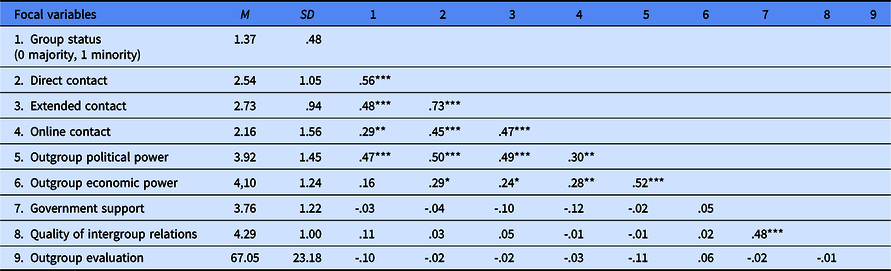
Note:*p < .05, **p < .01, ***p < .001.
Prior to conducting the hierarchical regression analyses, a preliminary correlational analysis was conducted to assess the relationships between all focal variables and the demographic variables of age, educational background, and gender. This preliminary analysis was conducted to detect whether these demographic factors are affecting the relationship between the main predictors, moderating variables, and the dependent variable. If one of these demographic variables turned out to be an important predictor of outgroup evaluation, it was included as a covariate in step 1 of the hierarchical regression. In this study, it turned out that none of the demographic variables were significantly correlated with outgroup evaluation, and thus none of these variables were included in the regression analyses.
Direct contact, group status, and perceived outgroup political power
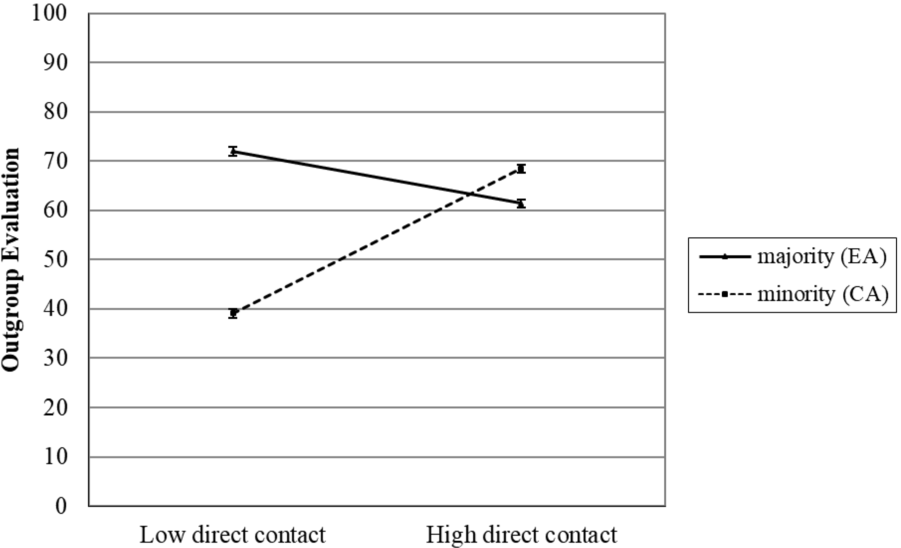
In the first regression analysis involving direct contact as the main predictor with group status (0 = European Americans, 1 = Chinese Americans) and perceived outgroup political power as moderators, the addition of the two-way interaction terms to the regression model (step 2) was found to be significant, R = .39, R 2 = .16, R 2 change = .12, F for R 2 change = 4.97, p = .003. In this model, the main effect of direct contact was not found to be a significant predictor of outgroup evaluation, β = -.22, t(107) = -1.32, p = .190, 95% CI [-12.14, 2.44], but group status was significant, β = -.27, t(107) = -2.15, p = .033, 95% CI [-24.57, -1.02]. Further, the interaction between direct contact and group status was also significant, β = .50, t(107) = 3.18, p = .002, 95% CI [7.08, 30.60]. This interaction tested the hypothesis that direct contact would have a stronger positive relationship with outgroup evaluations among majority group members than among minority group members. This significant interaction does indicate that group status moderated the relationship between direct contact and outgroup evaluation. However, unlike what was predicted, the follow-up simple slope analysis (Aiken & West, Reference Aiken and West1991) showed that the outgroup evaluations made by the European American majority toward the Chinese American minority were high regardless of contact, β = -.19, t(115) = -1.45, p = .149, 95% CI [-10.37, 1.59]. Direct contact, however, significantly improved outgroup evaluations made by the Chinese American minority of their European American counterparts, β = .54, t(115) = 2.86, p = .005, 95% CI [3.88, 21.28], as illustrated in Figure 1. This simple slope model was significant with R = .30, R 2 = .09, F = 3.81, p = .011.
Direct contact improved outgroup evaluations made by minority group members (Chinese Americans), whereas the outgroup evaluations made by majority group members (European Americans) remained high.
In this analysis, the main effect of perceived outgroup political power also turned out to be another significant predictor of outgroup evaluation, β = -.36, t(107) = -2.27, p = .025, 95% CI [-10.75, -.74], indicating that participants who thought that outgroup members were politically less powerful had more positive evaluations of the outgroup. The interaction between direct contact and perceived outgroup political power was also significant, β = -.24, t(107) = -2.07, p = .041, 95% CI [-6.85, -.15], but the follow-up simple slope analysis showed no significant effect of direct contact on either high or low perceived outgroup political power or the other way around (Simple slope model summary: R = .11, R 2 = .01, F = .47, p = .704).
The addition of the three-way interaction (direct contact × group status × perceived outgroup political power) to the overall regression model (step 3) did not significantly improve the model, R = .40, R 2 = .16, R 2 change = .01, F for R 2 change = .59, p = .446. This result indicates that the predictive ability of direct contact on outgroup evaluation was not altered by the other two predictors together. Instead, it was influenced by each of the two variables independently.
Direct contact, group status, and perceived outgroup economic power
In the second regression analysis involving direct contact as the main predictor with group status and perceived outgroup economic power as moderators, the interaction between direct contact and group status was also found to be significant, β = .41, t(107) = 2.77, p = .007, 95% CI [4.38, 26.44], in the step 2 model (R = .36, R 2 = .13, R 2 change = .09, F for R 2 change = 3.73, p = .013), which was the same significant interaction finding described in the previous outgroup political power analysis.
Direct contact, group status, and perceived government support
Next, when direct contact was entered as the main predictor with group status and perceived government support as moderators, it was found that the addition of the two-way interaction terms significantly improved the model, R = .42, R 2 = .18, R 2 change = .14, F for R 2 change = 6.20, p = .001; whereas the addition of the three-way interaction term (direct contact × group status × perceived government support) did not improve the model, R = .45, R 2 = .20, R 2 change = .02, F for R 2 change = 2.54, p = .114.
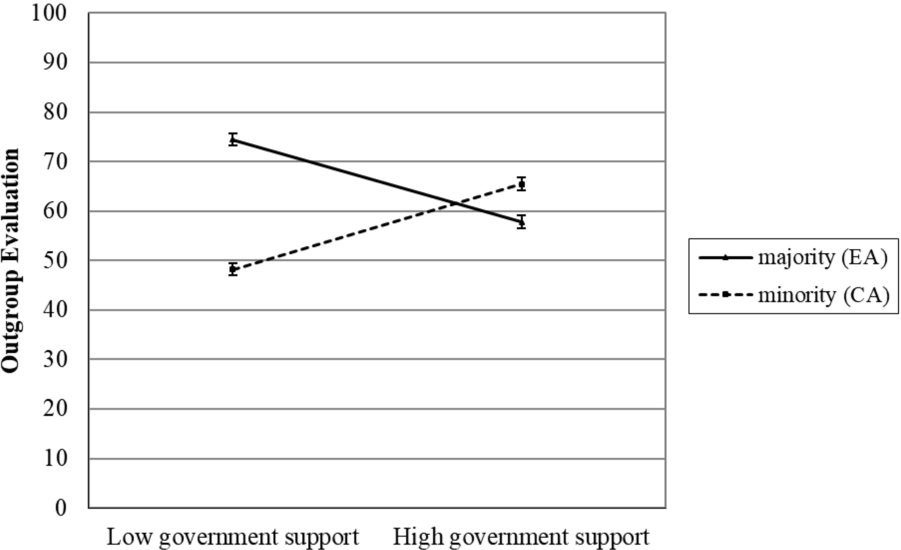
In the step 2 model, a significant interaction between direct contact and group status was again observed, β = .42, t(107) = 3.07, p = .003, 95% CI [5.52, 25.20]. Here, the main effect of perceived government support and the interaction between group status and perceived government support were also found to be significant predictors of outgroup evaluation, β = -.36, t(107) = -2.50, p = .014, 95% CI [-12.22, -1.41], and β = .45, t(107) = 2.94, p = .004, 95% CI [4.53, 23.26], respectively. Further analysis of the simple slope based on group status revealed a good fitting model, R = .27, R 2 = .07, F = 2.90, p = .038. Specifically, whereas perceived government support significantly improved outgroup evaluations made by Chinese Americans of the European Americans majority, β = .29, t(115) = 2.01, p = .046, 95% CI [.11, 13.50], it was not the case, and in the opposite direction, when the European Americans evaluated the Chinese Americans, β = -.21, t(115) = -1.85, p = .067, 95% CI [-10.15, .35]; see Figure 2.
Government support improved outgroup evaluations made by minority group members (Chinese Americans), but weakened outgroup evaluations made by majority group members (European Americans).
Direct contact, group status, and perceived quality of current intergroup relations
Finally, when direct contact was the main predictor and group status and perceived quality of the current intergroup relations were the moderators, only the previously reported interaction between group status and direct contact was found to be significant, β = .45, t(106) = 3.21, p = .002, 95% CI [6.42, 27.24], in the step 2 model, R = .39, R 2 = .15, R 2 change = .11, F for R 2 change = 4.63, p = .004.
Extended contact, group status, and the sociopolitical conditions
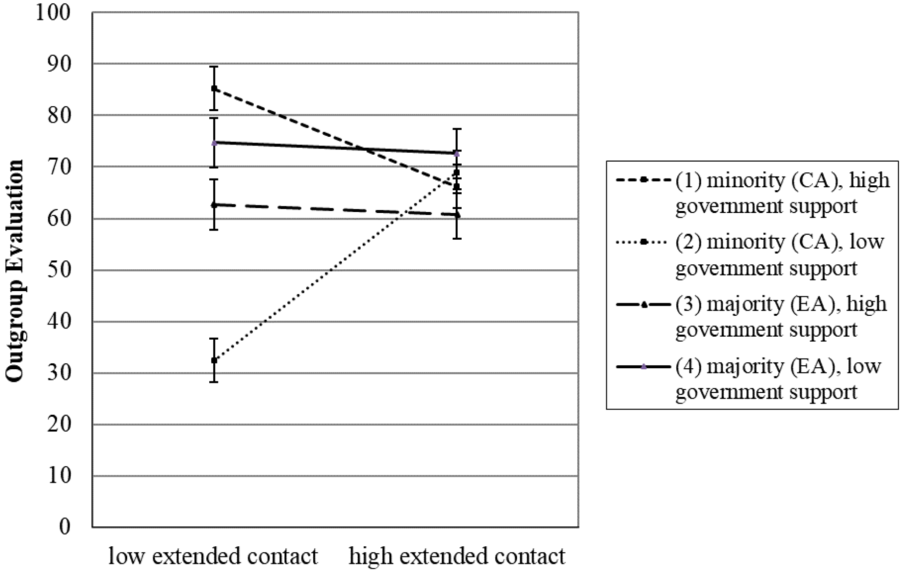
In the analyses involving extended contact, group status, and the sociopolitical condition variables, the models only improved significantly when the interaction terms involving perceived government support were added in the Step 2 and Step 3. Thus, here we only elaborate on the analysis regarding these effects. In this analysis, the addition of the three-way interaction term (extended contact × group status × perceived government support) was also found to significantly improve the model beyond step 2, R = .40, R 2 = .16, R 2 change = .05, F for R 2 change = 5.87, p = .017. Here, a significant interaction between group status and perceived government support was found, β = .49, t(106) = 3.47, p = .001, 95% CI [6.50, 23.82], along with the three-way interaction between extended contact, group status, and perceived government support, β = -.32, t(106) = -2.42, p = .017, 95% CI [-22.10, -2.21]. As Figure 3 illustrates, extended contact improved outgroup evaluations made by the Chinese American minority group members perceiving low government support in maintaining the intergroup harmony, β = .57, t(40) = 3.05, p = .004, 95% CI [4.48, 22.05], but not for any of the other groups (i.e., Chinese Americans-high government support, β = -.26, t(40) = -1.20, p = .237, 95% CI [-16.08, 4.09], European Americans-high government support, β = -.10, t(71) = -.60, p = .548, 95% CI [-9.82, 5.25], and European Americans-low government support, β = -.08, t(71) = -.46, p = .645, 95% CI [-9.82, 5.25].
Extended contact only improved outgroup evaluation made by the minority group members (Chinese Americans) who perceived low government support in maintaining the intergroup harmony.
Online contact, group status, and the sociopolitical conditions
In all the analyses involving online contact, group status, and each of the four sociopolitical conditions, the addition of the two-way interaction terms and the three-way interaction was not found to improve the model. Thus, both the group status and the sociopolitical conditions did not moderate the relations between online contact and the outgroup evaluations.
Discussion
Results from Study 1 revealed that group status did moderate the relationship between direct contact and outgroup evaluations (Tropp & Pettigrew, Reference Tropp and Pettigrew2005). However, an unexpected pattern of relationships was observed between direct contact, group status, and outgroup evaluations. The current results suggest that direct contact improved the outgroup evaluations made by the minority group (Chinese Americans) of the majority group (European Americans), whereas outgroup evaluations made by the majority group of the minority group remained high regardless of direct contact. This finding is inconsistent with previous studies in other contexts, which suggests that the direct contact effect tends to be stronger for the majority than the minority group members (Binder et al., Reference Binder, Zagefka, Brown, Funke, Kessler and Mummendey2009; Tropp & Pettigrew, Reference Tropp and Pettigrew2005). The finding, however, shows that perhaps the model minority stereotype of the Asian Americans in the country influences the way the majority group members evaluate this particular minority ethnic group (Bikmen & Durkin, Reference Bikmen and Durkin2014; Maddux et al., Reference Maddux, Galinsky, Cuddy and Polifroni2008), which indicates that intergroup relations could be influenced by the specific relationship between two particular ethnic groups in a cultural context (Conley et al., Reference Conley, Rabinowitz and Matsick2016; Liang et al., Reference Liang, Li and Kim2004).
When it comes to the extended contact, the finding showed that this type of contact did not yield any significant finding in improving outgroup evaluations, except when it was combined with participants’ perceptions of the government support in maintaining harmony within the society. In this case, extended contact exclusively improved the outgroup evaluations made by the minority group members (Chinese Americans) and only if they also perceived a lower level of government support. This is inconsistent with a previous study that suggests the value of extended contact for both majority and minority groups (Gómez et al., Reference Gomez, Tropp and Fernandez2011). The other type of contact, the online contact, did not seem to have any effect on outgroup evaluations across status and sociopolitical conditions, at least among our U.S. participants in Study 1.
Study 1 results also highlighted the role of the sociopolitical situations that could influence intergroup relations between the two specific groups (Doosje et al., Reference Doosje, Branscombe, Spears and Manstead1998; Hanke et al., Reference Hanke, Liu, Hilton, Bilewitcz, Garber, Huang and Wang2013; Kashima et al., Reference Kashima, Kashima, Gelfand, Goto, Takata, Takemura and Zhang2003; Liu, Reference Liu2012). Here, we found preliminary evidence that the perceived sociopolitical situations could, independently or combined with group status, predict outgroup evaluations without any type of contact. For instance, the perceived outgroup political power predicted outgroup evaluations, where the higher the outgroup political power perceived by participants, the less favorable the evaluations that the participants made toward the outgroup member. Another study finding showed the importance of participants’ perceptions of government support, along with the group status in predicting outgroup evaluations, especially among the minority group members in this study (Chinese Americans). These findings partially supported Allport’s (Reference Allport1954) idea that, specifically in this study, perceptions of equality and institutional support seemed to be influential in intergroup relations.
Study 2
Method
Participants
In Indonesia, 151 participants initially took part in this study. After screening for their ethnicities (i.e., must be either Javanese or Chinese Indonesian), only data from 133 Indonesian participants, consisting of 61 Javanese and 72 Chinese Indonesians (M age = 25.13, SD = 9.52, 46% male), were included in further analysis. In this study, 0.8% of the participants had less than a high school degree, 72.2% had a high school degree, 3.0% had some college experience, 22.7% had a bachelor’s degree, and 0.8% had a graduate degree.
Procedure
Participants were recruited on campus (i.e., university students and staff) and off campus (i.e., minority community group). Participants completed a packet of surveys in exchange for a small gift that took approximately 20 minutes to complete.
Measures
All measures used in Study 1 were adapted into Bahasa Indonesia using an independent translation method (Geisinger, Reference Geisinger1994; Gudmundsson, Reference Gudmundsson2009; de Vijver & Tanzer, Reference de Vijver and Tanzer2004) and then used in Study 2.Footnote 2 The only modification from Study 1 was the name of the ethnic groups and country to reflect the Indonesian cultural context (i.e., majority group: Javanese; minority group: Chinese Indonesians).
Results
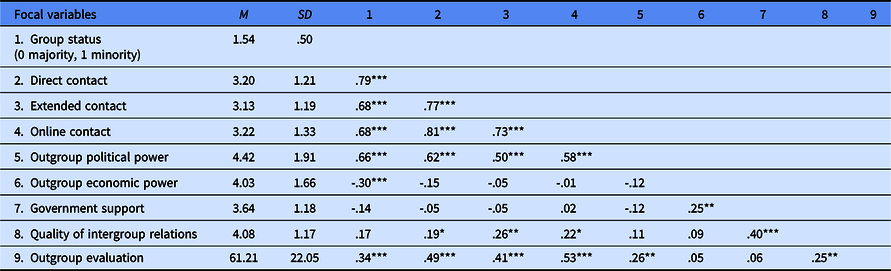
See Table 2 for correlations and descriptive statistics for the focal dependent measures.
Descriptive information and correlations among focal variables (Study 2)
Note:*p < .05, **p < .01, ***p < .001.
The analytical strategy used in Study 1 was again used in Study 2. Here, age and gender of the participants were significantly correlated with outgroup evaluation (r = -.38, p < .001 and r = -.22, p = .015 respectively). Therefore, age and gender were included as covariates in step 1 of each regression analysis to control the influence of these variables on other correlations.
Direct contact, group status, and perceived outgroup political power
The initial regression model (step 1) in our Indonesian sample yielded a good fitting model, R = .59, R 2 = .35, F = 5.76, p < .001. Although the addition of the two-way interaction terms and the two-way interaction did not significantly improve the model, it remained significant (step 2: R = .62, R 2 = .39, F = 4.99, p < .001; Step 3: R = .63, R 2 = .40, F = 4.84, p < .001). In this analysis, where direct contact was the main predictor and group status (0 = Javanese, 1 = Chinese Indonesians) as well as perceived outgroup political power were the moderators, the perceived outgroup political power turned out to be a significant predictor of outgroup evaluation, β = -.70, t(102) = -2.31, p = .023, 95% CI [-15.65, -1.193]. This result indicates that outgroup evaluations were weakened the more participants thought that the outgroup members were politically more powerful than ingroup members. Notably, this analysis shows that our hypothesis that direct contact would have a stronger positive relationship with outgroup evaluations among majority group members than among minority group members was not supported. Finally, online contact was also found to be a significant predictor of outgroup evaluations in this analysis and across other analyses in Study 2, which is described in the forthcoming online contact results section.
Direct contact, group status, and perceived outgroup economic power
Similar to the results in the previous analysis, the addition of two-way interaction and three-way interaction terms did not improve the initial model. However, in this analysis, none of the main effects or interaction effects involving direct contact were found to be a significant predictor of outgroup evaluations.
Direct contact, group status, and perceived government support
Here, direct contact turned to be significant, β = .47, t(103) = 2.20, p = .030, 95% CI [.91, 17.25], once the two-way interaction terms were introduced in step 2 (R = .62, R 2 = .38, F = 4.85, p < .001), which indicates that outgroup evaluation was enhanced with more direct contact.
Direct contact, group status, and perceived quality of current intergroup relations
A similar result was found in the last regression analysis that included direct contact, where direct contact was found to be a significant predictor of outgroup evaluation, β = .50, t(103) = 2.28, p = .025, 95% CI [1.25, 17.88], in step 2 of the analysis (R = .63, R 2 = .39, F = 5.07, p < .001).
Extended contact, group status, and perceived sociopolitical situations
In all the four regression analyses involving extended contact as the main predictor with group status and each of the perceived sociopolitical situations (i.e., perceived outgroup political power, perceived outgroup economic power, perceived government support, and perceived quality of current intergroup relations), none of the main effects or interaction effects involving extended contact turned out to be significant (all ps > .05).
Online contact, group status, and perceived outgroup political power
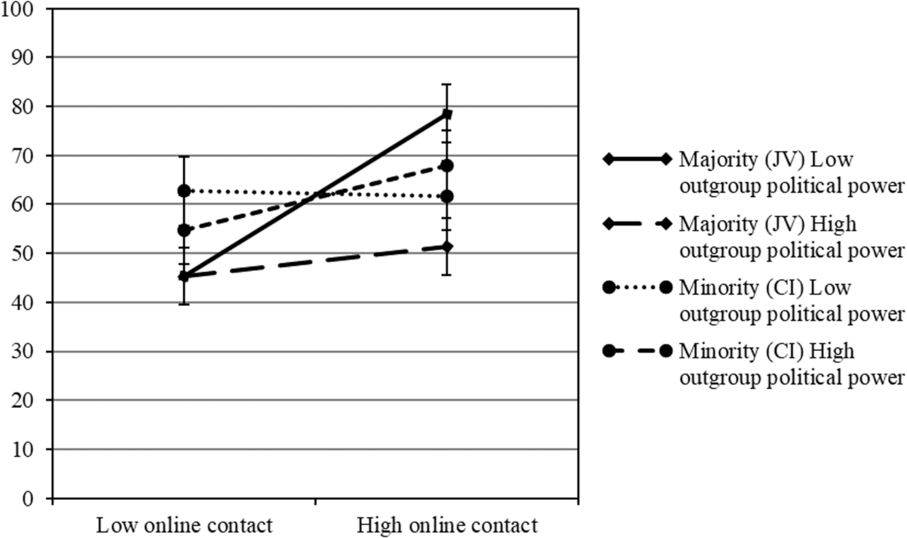
In this analysis, the addition of the two-way interaction terms did not improve the initial model, R = .61, R 2 = .37, R 2 change = .02, F for R 2 change = 1.02, p = .388, but the addition of the three-way interaction (online contact × group status × perceived outgroup political power) did, R = .65, R 2 = .42, R 2 change = .05, F for R 2 change = 9.15, p = .003. In this step 3 model, the main effect of the perceived outgroup political power, β = -.62, t(102) = -2.48, p = .015, 95% CI [-13.32, -1.48], and the three-way interaction between online contact, perceived outgroup political power, and group status were significant, β = .62, t(102) = 3.03, p = .003, 95% CI [2.93, 14.08]. As Figure 4 illustrates, online contact improved outgroup evaluation for most groups (i.e., Chinese Indonesians perceiving higher outgroup political power, β = .55, t(67)= 3.52, p = .001, 95% CI [4.60, 16.63], Javanese perceiving higher outgroup political power, β = .46, t(51) = 2.77, p = .008, 95% CI [2.87, 17.99], and Javanese perceiving lower outgroup political power β = .84, t(51) = 4.47, p < .001, 95% CI [10.65, 28.03]); whereas outgroup evaluations made by the Chinese Indonesians perceiving lower outgroup political power remained high, β = -.07, t(67) = -.47, p = .639, 95% CI [-6.82, 4.21].
Online contact improved outgroup evaluations by most groups, but the outgroup evaluations among minority group members (Chinese Indonesians) perceiving low outgroup political power remained high.
Online contact, group status, and perceived outgroup economic power
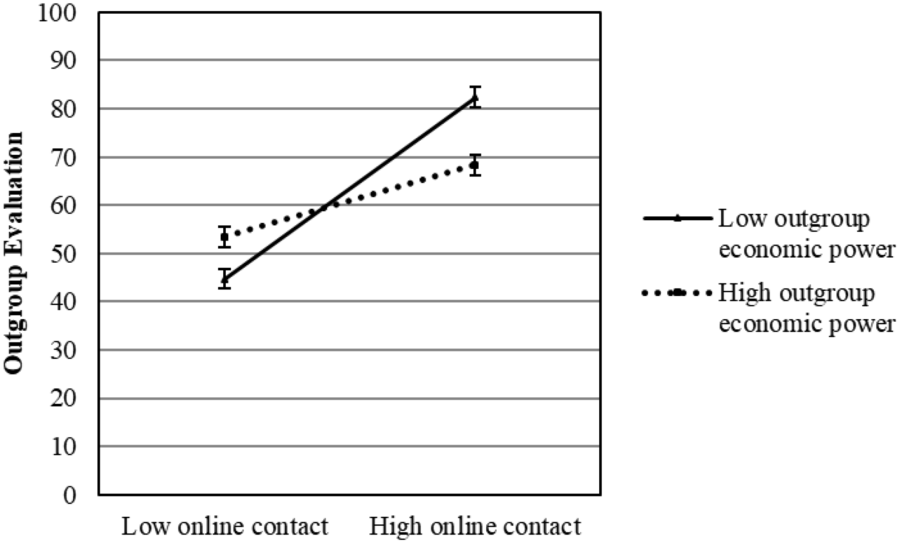
In this analysis, the addition of the two-way interaction terms was found to improve the initial model, R = .61, R 2 = .63, R 2 change = .05, F for R 2 change = 2.87, p = .040, but the addition of the three-way interaction did not, R = .64, R 2 = .41, R 2 change = .00, F for R 2 change = .61, p = .438. In the step 2 model, the main effect of online contact was found to be significant, β = .60, t(103) = 3.02, p = .003, 95% CI [3.62, 17.49], along with the interaction between online contact and the perceived outgroup economic power, β = -.27, t(103) = -2.22, p = .029, 95% CI [-5.23, -.29]. As Figure 5 illustrates, online contact improved outgroup evaluation for those perceiving lower outgroup economic power, β = .65, t(122) = 6.25, p < .001, as well as those perceiving higher outgroup economic power, β = .41, t(122) = 3.73, p < .001.
Online contact improved outgroup evaluations regardless of the perceived outgroup economic power, but the effect was stronger for those perceiving low outgroup economic power.
Online contact, group status, and perceived government support
In this analysis, none of the interaction terms were found to improve the initial regression model. Here, only the main effect of online contact was found to be a significant predictor of outgroup evaluation, β = .41, t(106) = 2.46, p = .016, 95% CI [1.40, 13.10].
Online contact, group status, and perceived quality of current intergroup relations
Online contact was also the sole significant predictor of outgroup evaluation found in this analysis, β = .41, t(106) = 2.46, p = .016, 95% CI [1.40, 13.10].
Discussion
Findings from Study 2 showed a quite different pattern of intergroup contact effects on outgroup evaluation when sociopolitical conditions were taken into account. Unlike what was observed in Study 1 in the U.S., where group status generally moderated direct contact in predicting outgroup evaluation, we found a main effect of direct contact on outgroup evaluation in Indonesia. In this context, direct contact proves itself to be advantageous regardless of the group status in improving outgroup evaluations (Pettigrew & Tropp, Reference Pettigrew and Tropp2006). However, this finding was not without note; the main effect of direct contact in the Indonesian sample only appeared after the interactions between direct contact and perceived government support as well as perception of the current intergroup relations between the two specific groups were controlled in the model. This result shows, although indirectly, the importance of considering participants’ perceptions on several sociopolitical aspects in discussing the relationship between two specific groups in a particular context (Doosje et al., Reference Doosje, Branscombe, Spears and Manstead1998; Hanke et al., Reference Hanke, Liu, Hilton, Bilewitcz, Garber, Huang and Wang2013; Kashima et al., Reference Kashima, Kashima, Gelfand, Goto, Takata, Takemura and Zhang2003; Liu, Reference Liu2012).
Furthermore, findings on extended contact in Indonesian context were also inconsistent with the hypothesis that extended contact tends to improve intergroup relations across group status (Gomez et al., Reference Gomez, Tropp and Fernandez2011; Wright et al., Reference Wright, Aron, McLaughlin-Volpe and Ropp1997), which also showed the specificity of this context. Interestingly, instead of the extended contact and unlike in the U.S., online contact seemed to be more advantageous in the Indonesian cultural context, as we found significant main effect of online contact in predicting outgroup evaluation across analyses, where online contact generally enhanced outgroup evaluations regardless of group status. Still, the sociopolitical conditions such as perception of outgroup political and economic power were found to moderate the relationship between online contact and outgroup evaluations, which is in line with the specific relations between the Javanese (majority group) and Chinese Indonesians (minority group) in this particular context that historically revolves around political and economic aspects (Chong, Reference Chong2015; Hoon, Reference Hoon2006; Setijadi, Reference Setijadi2016; Tanasaldy, Reference Tanasaldy2013; Turner & Allen, Reference Turner and Allen2007).
In sum, findings from Study 2 also provide evidence on the importance of taking into account the sociopolitical conditions in intergroup relations research. Here, in our Indonesian sample, the three of Allport’s (Reference Allport1954) requirements that were tested in this study (equal status, cooperation, institutional support) seemed to influence the intergroup relationship between the majority and minority group members in its own terms.
General Discussion
Two studies examined the relationship between three different types of intergroup contact (i.e., direct contact, extended contact, and online contact) and outgroup evaluation, taking into account the specific sociopolitical relations between a majority and a specific minority group in two different cultural contexts. In Study 1, European Americans represented the majority group and Chinese Americans represented the minority group in the U.S.; whereas in Study 2, Javanese represented the majority group and Chinese Indonesians represented the minority group in Indonesia. The specific two groups involved in both studies experienced unique sociopolitical relations within each own cultural context.
In these two studies, several hypotheses were tested. First, we hypothesized that direct contact would have a stronger positive relationship with outgroup evaluations among majority group members than among minority group members. This hypothesis was not supported, as findings from the U.S. sample in Study 1 showed the opposite pattern, where direct contact improved outgroup evaluations among minority group members and the outgroup evaluations of the majority group members toward the minority group remained high regardless of direct contact; whereas findings from Study 2 in Indonesia showed that direct contact improved outgroup relations regardless of group status, but only when interaction between direct contact and sociopolitical conditions were taken into account.
We then examined the role of various sociopolitical contexts on the relationship between direct contact and outgroup evaluations. Specifically, we hypothesized that perceived outgroup power would weaken the relations between direct contact and positive intergroup relations, whereas government support and perceived quality of current intergroup relations should strengthen the link between intergroup contact and intergroup relations. Findings from either Study 1 and Study 2 did not support these hypotheses. In Study 1, we found that both the perceived government support improved outgroup evaluations among the minority group members in the U.S. regardless of the direct contact. In contrast, none of the sociopolitical contexts moderated the relationship between direct contact and the outgroup evaluations across group status in Indonesia (Study 2).
Next, we predicted that extended contact would be positively correlated with outgroup evaluations both in the U.S. and Indonesian samples. However, findings from the present study were not consistent with this hypothesis. Specifically, extended contact was only found to be positively associated with outgroup evaluation made by the minority group members in the U.S. who perceived low government support in maintaining the intergroup harmony. The significant relationship between extended contact and outgroup evaluations was also not found in Indonesia.
We also examined the role of online contact in improving outgroup evaluations in both cultural contexts. We did not make any predictions regarding this part of the study, but the study found that online contact seemed to be more useful in Indonesia than in the U.S. However, the relationships between this type of contact and outgroup evaluations were moderated by the perceived outgroup power and group status.
Findings from the two studies highlighted several important issues that may require a reconsideration of several aspects of intergroup contact effects and provide new directions for future research in this area.
First, it is clear from the findings in both U.S. and Indonesian cultural contexts that the relationship between intergroup contact and intergroup relations is not as straightforward as might have been anticipated at the outset. The interplay between specific sociopolitical relations between the two groups, individual perceptions about the sociopolitical conditions, group status, and the types of contact is crucial in intergroup relations (Guimond et al., Reference Guimond, Crisp, De Oliveira, Kamiejski, Kteily, Kuepper and Zick2013; Liu, Reference Liu2012). It has to be noted that even though findings from this present study seemed to be in line with the idea that direct contact could improve intergroup relations even without meeting Allport’s (Reference Allport1954) intergroup contact requirements (Pettigrew & Tropp, Reference Pettigrew and Tropp2006; Pettigrew et al., Reference Pettigrew, Tropp, Wagner and Christ2011), the present study also showed that the perceptions of equality, institutional support, and the actual cooperation between the groups were also important components in intergroup relations. Findings suggest that these variables played a role along with the other types of contact in improving outgroup evaluations, of which was also varied across cultural contexts. These factors should be given more attention in future intergroup contact research. In the discourse about intergroup contact, we cannot separate those variables into each standalone variable.
For instance, although findings in both U.S. and Indonesian cultural contexts seem to, once again, show benefits of direct contact in intergroup relations (Pettigrew & Tropp, Reference Pettigrew and Tropp2006), they revealed different patterns across cultures. In the Indonesian context, direct contact was found to be advantageous regardless of the group status, whereas in our U.S. sample, the positive association between direct contact and outgroup evaluation was stronger for the minority group members. Even though this is a positive finding, it is inconsistent with some previous findings suggesting that direct contact effect was stronger for the majority than the minority group members (Tropp & Pettigrew, Reference Tropp and Pettigrew2005). This finding implicates that intergroup relations can be very specific depending on the groups involved in the interactions. In this study, we specifically examined intergroup relations between the majority European Americans and the minority Chinese Americans in the U.S., which could be different from the relationship between the same majority group and another minority group (Liang et al., Reference Liang, Li and Kim2004). As Asian Americans are generally regarded more highly than other minority groups in the U.S. (Bikmen, Reference Bikmen2011; Bonilla-Silva, Reference Bonilla-Silva2004), they perceived themselves comparable with the majority group, which in turn improved their perceptions of their European Americans (Conley et al., Reference Conley, Rabinowitz and Matsick2016).
Notably, we also found that outgroup evaluations made by both majority and minority groups in the two cultural contexts remained high across group status and regardless of direct contact. This finding is possible considering the generally positive attitudes toward higher status groups across various settings (Asbrock, Reference Asbrock2010; Cuddy et al., Reference Cuddy, Fiske, Kwan, Glick, Demoulin, Leyens and Ziegler2009) as well as the current positive views toward Chinese Americans in the U.S. (Bikmen & Durkin, Reference Bikmen and Durkin2014; Maddux et al., Reference Maddux, Galinsky, Cuddy and Polifroni2008) and the post-Reform improvement of attitudes of the Chinese community in Indonesia (Chong, Reference Chong2015; Setijadi, Reference Setijadi2016; Turner & Allen, Reference Turner and Allen2007). Again, this finding suggests potential influence of the dynamic sociopolitical situations on the intergroup relations between two very specific groups in each society (see Liu, Reference Liu2012).
Moreover, in contrast to prior discussion about the advantages of extended contact (Dovidio et al., Reference Dovidio, Eller and Hewstone2011; Wright et al., Reference Wright, Aron, McLaughlin-Volpe and Ropp1997), extended contact was only found to be positively associated with outgroup evaluation in a very specific case in the U.S. cultural context. Here, extended contact only enhanced outgroup evaluations made by the minority group members who also perceived lower government support in maintaining the intergroup harmony within the society. In Indonesia, the extended contact did not seem to matter when it comes to evaluating the outgroup members.
The opposite pattern was found with the online contact. In this case, the online contact did not serve as a significant predictor of outgroup evaluations among the U.S. participants, but seems to be a promising mode of contact in Indonesia — when participants did not have a perception of political power inequality between groups. An additional cross-tabulation analysis showed that in the U.S., only 54% of the participants with at least one online outgroup friend ever communicated with the outgroup members through their social media accounts. In contrast, 82% of the Indonesian participants with at least one online outgroup friend did communicate with the outgroup members through the social media. In general, this finding provides preliminary evidence that online intergroup contact could be useful when it is used as a means for communication, but more research using this type of contact as a valuable channel in intergroup relations should be conducted in the future (White et al., Reference White, Harvey and Abu-Rayya2015).
This set of studies has several notable limitations. First, it was correlational, and thus it does not imply causational effects between variables. Future researchers in this topic should employ experimental methods to examine these issues. Second, it is possible, given the sample sizes, that the studies were underpowered. This could be an explanation for some of the null effects reported, and additional studies should explore these issues in the U.S. and Indonesia with larger samples. Further, the intergroup contact in this study was also only measured quantitatively, leaving the quality of contact unexplained, whereas previous research has indicated the important role of contact valence in prejudice study (Barlow et al., Reference Barlow, Paolini, Pedersen, Hornsey, Radke, Harwood and Sibley2012; Techakesari, Barlow, Hornsey, Thai, & Chak, Reference Techakesari, Barlow, Hornsey, Thai and Chak2015; Vedder, Wenink, & van Geel, Reference Vedder, Wenink and van Geel2017). Future research should consider including this variable to have a complete picture of the influence of intergroup contact in intergroup relations across group status and culture. It is also important to acknowledge that the sociocultural moderating variables examined in these studies were created for this project and were single-item measures. When designing the study, the researchers were unable to locate measures that assessed these moderator constructs that were able to fit into the brief study session time-period required. As such, although the current studies provide unique data regarding the sociopolitical moderators of contact in the U.S. and Indonesia, additional research using well-validated measures is needed that builds on these initial findings.
Despite these and other limitations, this study also has several notable strengths. Unlike much intergroup contact research, the data were not only gathered from a sample that mainly involved Western participants (Henrich, Heine, & Norenzayan, Reference Henrich, Heine and Norenzayan2010). In addition, this study allowed for a rare comparison between minority and majority groups in two different cultures, one highly populous culture (Indonesia) that has received very little empirical attention and hence contributed to the more profound understanding of psychological aspects across different cultures (Arnett, Reference Arnett2008; Kim, Yang, & Hwang, Reference Kim, Yang, Hwang, Kim, Yang and Hwang2006), which can eventually promote the pursuit of a global psychology (Berry, Reference Berry2013).
Acknowledgments
We would like to thank Made A. Suadnyana, Cendy C. Rahmat, and other research assistants at the CICP Universitas Gadjah Mada for their helpful assistance in collecting data from the Indonesian sample.


 Open access

