

1 ‘A short period of insight’: Symbolising defeat as liberation, 1918–1923
On 1 January 1919, a poem published in Vorwärts, the daily newspaper edited by the Majority Social Democratic Party (MSPD) in Berlin, addressed the final year of the war in a ‘farewell to 1918’ with these lines:
While the poetic substance of these stanzas is debatable, they indicate some of the persistent ambivalences in the Social Democratic remembrance of the Great War only shortly after its end. The destructive nature of war is spelled out in no uncertain terms, and the blame for this reign of death is clearly laid on the rulers of the monarchical system. Yet the revolutionary transformation to a regime of peace, freedom and love is presented in rather ambiguous fashion. Instead of celebrating the power and agency of soldiers and workers and their active contribution to the toppling of the Hohenzollern monarchy, the cause of political change is rather reified as a personification of time. Judging from this poem, it was not at all clear that the people had liberated themselves, and that it had been the soldiers in the field army who brought an end to ‘battle’ and ‘serfdom’ by deserting in masses from August 1918 onwards and thus fatally undermining the cohesion of the Imperial Army.2 The poem is equally ambivalent in its treatment of remembrance. It was certainly believed that the end of the war should be associated with the liberation of the German people, and not with the fact that Germany had been defeated, or with the terms of the armistice imposed by the Allies. Given the prospect of a future spent in freedom it seemed reasonable, though, to forget about the horrors of war, or at least to refrain from mentioning them any longer. Yet as we will see, the competitive structure of war remembrance in post-war Germany meant that it was essential for Social Democrats and progressive republicans to bring to mind the misery and bloodshed of life at the front time and time again.
This improvised poem was only one of the many forms through which supporters of the republican system voiced their recollections of the First World War during the first couple of years after the armistice. Indeed, one of the characteristic elements of republican war remembrance in the period up till 1923 was the lack of any stable and coherent framework or core institutional platform on which moderate socialists and radical democrats could rely for these purposes. A variety of media outlets was at their disposal for the representation of war memories, and they were eager to develop institutional structures that could support and sustain concerted efforts to communicate republican narratives of the war in a broader public. Yet while these efforts could at least temporarily be connected in a rather loose network, some of them were only short-lived, and others faced an increasing backlash from the Reichswehr, which had a vested interest in restoring the German public’s Wehrhafigkeit, or fitness to fight. The diverse and unstable nature of these endeavours goes a long way towards explaining both the remarkable strength and the ultimate weakness of republican war narratives in the turbulent years from 1919 to the stabilisation of both currency and political system in late 1923. Political and cultural struggles about the legacy of the war were deeply entwined; any success in this field rested both on the ability to foster support and draw a constituency of interested people together, and on the power of textual and pictorial symbols that resonated among those who had experienced the war first-hand. For these reasons, I will first outline some of the key media outlets and institutional players in the domain of pro-republican war remembrance before the texture and symbolism of these recollections are explored in more detail.
Media outlets for the republican cause
The first crucial platform for republican war memories was provided by the main political newspapers of the moderate left. Vorwärts published a broad variety of articles on the war experiences in the immediate post-war years. In terms of form, these pieces ranged from poems and personal reflections on the problems of returning home from war to fictionalised short stories and opinion statements.3 Apart from these more reflexive genres, Vorwärts also offered critical coverage and commentary on the ‘stab-in-the-back’ or Dolchstoß myth, the most important right-wing attempt to shape public opinion with regard to the causes of the German defeat.4 One driving force for the publication of these recollections was Artur Zickler, a member of the Social Democratic Party (SPD) youth organisation Jungsozialisten, and a member of the Vorwärts editorial staff. Through the publishing house of Vorwärts, Zickler also published an account of his wartime service unter the title In the Madhouse. In this booklet, he detailed how the NCOs in his company had singled him out as a Social Democrat, and described his complete loss of faith in the notion of comradeship after suffering abuse from his roommates. After refusing to return to the front after a stay in hospital, he was transferred to a mental asylum for psychiatric treatment: an indication, for Zickler, of how the war had fundamentally altered the notions of reason and insanity.5
Another important outlet for democratic narratives of the war experience was the Berliner Volks-Zeitung (BVZ). Published by the liberal Jewish newspaper proprietor Georg Lachmann-Mosse, the BVZ was an influential political paper with a long-established tradition and a largely working-class readership. While its chief editor, Otto Nuschke, was a member of the Prussian parliament for the German Democratic Party (DDP), the newspaper itself did not follow any particular party directive, and was an open and diverse forum for left-liberal and radical-democratic ideas. In the aftermath of the war, a group of outspoken pacifistscontributed to the BVZ either as writers, such as Carl von Ossietzky and Berthold Jacob, or as members of the editorial staff, such as Karl Vetter. Vetter was the driving force behind this energetic group of political journalists. Coming from a humble working-class background – his father was a bricklayer in Berlin-Neukölln – and invariably described as a swaggering type of ‘Ur-Berliner’, he had been involved in the youth movement before the war. Devastated by his impressions from his front-line service during the war, he returned home as a radical pacifist.6 Like Artur Zickler and Vorwärts, Vetter was particularly eager to use the BVZ as a platform for reflection on and remembrance of the disastrous consequences of the war. Starting in March 1919, he published a series of articles based on his own reminiscences of the decisive final months of the war at the western front. Inundated with positive responses from the ranks of former Kriegsteilnehmer, and responding to their suggestion to make his reflections available in a more coherent fashion, Vetter published a booklet on The Collapse of the Western Front in 1919. Explicitly blaming Ludendorff, and speaking on behalf of the ‘Feldgrauen’, soldiers in field-grey uniform, he formulated an indictment against the ‘deliberate collusion’ and ‘knowing untruth’ spread by former members of the Third Army Supreme Command about the reasons for German military defeat.7
A number of pacifist and radical-left journals such as Die Weltbühne or Das Tage-Buch also continued to publish articles on the war experience throughout the early 1920s.8 But in terms of readership and political significance, Vorwärts and the BVZ were by far the most important periodicals that promoted a progressive reading of wartime suffering to a broader audience. To be sure, compared with some of the tabloids and other mass papers published in the capital, such as the Berliner Morgenpost, the circulation figures for Vorwärts and BVZ were rather modest. In 1925, the first year for which comparative figures are available, their average print-runs were 95,000 and 90,000 copies respectively. Nonetheless, they were both vital tools for the representation of public opinion in the pro-republican camp, and had a significantly larger circulation than comparable conservative newspapers such as the Deutsche Zeitung.9
Newspapers offered an important outlet for reflections on the meaning of the war precisely because of the instantaneous nature of this medium, making it ideal for ad hoc interventions and as a forum for open debate. A different but closely related medium was that of short pamphlets and booklets on the nature of the war experience and on the systematic abuse of power in the German field army. Many of these brochures served a direct political purpose. From the early months of 1919, a campaign by nationalist circles of the extreme right and by high-ranking officers in the Imperial Army had gathered pace. Keen to deflect from their own failure as military commanders, and to blame the revolution, and by implication the Republic, for the defeat and the harsh terms of the Treaty of Versailles, these circles developed the core elements of the stab-in-the-back myth. In their view, the German army had been ‘undefeated in the field’ (‘Im Felde unbesiegt’), a slogan first used in 1921. As officers such as Colonel Max Bauer relentlessly stressed in their newspaper articles and hastily published memoirs, it had been the socialists and Jews on the home front who had conspired to undermine the fighting power of the army, thus halting the German offensive in 1918, which would have otherwise led to victory. The first peak of this campaign was reached on 18 November 1919, when Paul von Hindenburg and Erich Ludendorff issued a joint statement in front of a parliamentary subcommittee investigating the causes of Germany’s defeat. Here they reiterated and confirmed, with their authority as former leaders of the German military campaign, the Dolchstoß allegation.10
It would be wrong, though, to assume that the republican counter-attack was hindered by widespread ‘veneration’ for Hindenburg among ‘republican circles’.11 Under the headline ‘Broken pillars’, a Social Democrat newspaper in Magdeburg highlighted the appearance in front of the subcommittee as an act of denial by two disoriented elderly men. Their testimony had ultimately destroyed the ‘legend’ that Germany had had a brilliant army leadership during the war.12 Other authors seconded, directing their ire against both Ludendorff and Hindenburg.13 Unmasking the Dolchstoß myth as a deliberate smokescreen that served vested interests was the core aim of many booklets and pamphlets by Social Democrats and other republicans in the immediate post-war period. According to one survey of this literature, no fewer than twenty-three brochures, most of them published between 1919 and 1923, were devoted to this purpose.14 This figure cannot be more than a rough indication, as a number of brochures that explicitly aimed to dispel nationalist myths about the collapse in 1918 are not included.15 Nonetheless, it is important to note that the republicans did not simply surrender when they were blamed for Germany’s defeat. On the contrary, they offered a detemined rebuttal of such allegations. One of their strategies was simple ridicule. In a booklet published in 1921, Erich Kuttner, the founder and first head of the Reichsbund of disabled soldiers, cited Ludendorff’s war memoirs. Complaints that officers were living in luxury at the expense of private soldiers, the former general insisted, had been ‘shameful slander by foreign and domestic propaganda’. Without any comment, Kuttner printed the menu from the officers’ mess of an army headquarters on the next page.16
Many other publications effectively used the worm’s-eye view of the front-line soldier as a narrative strategy.17 Presenting the workings of the Imperial Army from the viewpoint of an ordinary private soldier offered a number of advantages for those authors who did not simply want to indulge in rose-tinted recollections of a time of heroic adventures, but whose main aim was to unmask the deceptive lies of the former elites. Such a perspective allowed them to pitch the worm’s-eye view against the detached position of those staff officers who had only ever observed the battlefield from a remote rear position and were thus never confronted with the brutal reality of the front. Many of the brochures foregrounded the suffering of the ‘poor and betrayed’ front-line soldiers and their ‘still weeping wounds’. Thus, they effectively juxtaposed the authenticity of the real war experience with the bogus claims for superior leadership from nationalist officers.18
Another crucial advantage of those accounts that presented authentic experiences of ordinary soldiers was the claim to veracity. Republican authors tried to illuminate the corruption and dysfunctional organisation in the Imperial Army through the publication of war letters or personal testimony in the form of war diaries. Excerpts from the diary of a sergeant in the medical corps were published in 1919 under the main title Indictment of the Tormented. According to the subtitle, these recollections would provide the reader with the ‘history of a field hospital’. In his introduction, Artur Zickler summed up the gist of these notes, describing them as a ‘classical chronicle of the vileness, crying shame, exploitation, corruption and crimes against the poorest of the poor, the victims of war’. These pages, Zickler claimed, were ‘nothing but an unvarnished description of the facts’. He was eager to pre-empt the standard rebuttal of right-wing authors against such accusations: the argument that the experiences of this particular observer were a deplorable exception, while the German army had generally functioned effectively despite adverse circumstances. On the contrary, Zickler insisted, the situation in this field hospital would have been ‘impossible’ if the ‘whole system’ and command structure of the army had not provided ‘fertile soil for such decay’.19 A brief foreword by the publisher underscored the main point. While he had advised the author to remain anonymous, the veracity of all claims had been subjected to scrutiny, and both the author himself and further eyewitnesses were ready to testify to their accuracy.20
From 1919 to 1923, the republican left used the worm’s-eye view in many brochures as an effective instrument against right-wing denial with regard to the causes of German defeat. But popular representations of the suffering at the front had an impact far beyond the core constituency of those who eagerly supported the new democratic system. One of the characteristic elements of the discourse on war remembrance during the immediate post-war period was that nationalist publications were forced to tap into similar sentiments, and to give voice to those bitter feelings of disillusionment that the left so effectively used for an indictment against the Wilhelmine system. One prominent example of nationalist attempts to accept responsibility and provide an honest account of the ‘causes of the collapse’ was a booklet of the same title, published by Walther Lambach in 1919. A leading official in the German National Union of Commercial Employees (Deutschnationaler Handlungsgehilfen-Verband; DHV), Lambach presented a cross-section of the many war letters by DHV members serving in the field army. The prevalent tone was highly critical: of the Jews – following the anti-Semitic ideology of the DHV – but also of the junior officers, who were keen to exploit the system for their personal advantage but completely uninterested in the welfare of their subordinates. Other letter writers complained about the lack of comradeship and the large discrepancy in pay between private soldiers and junior officers.21 The ideas behind this critique of the national war effort from a nationalist perspective were summed up in the following letter from the western front in May 1917:
I went to the front on the third day of mobilisation as a member of the Landsturm, full of ideals, true to my affiliation with the German National Association. But what I have experienced in the course of time from our officers has already destroyed my idealism. I could tell you incidents that would amaze you. The war is only considered as a profitable business, from which everyone is trying to earn as much as possible.22
When Lambach published these eyewitness accounts from the members of his association, he wanted to demonstrate that the DHV had tried to address the soldiers’ grievances by including these materials in a petition it had filed in February 1916 with the Prussian War Ministry. Another reason, however, was the wave of post-revolutionary indictments of the injustice in the Imperial Army that used the worm’s-eye perspective. Lambach clearly hoped for a restoration of ‘order and for a new German advance’. But in 1919, far from being able to propagate any mythologies of the war experience, he faced a situation where leftist currents effectively used these grievances ‘to attract customers, in order to talk them into also accepting their other dubious products (anti-militarism, cosmopolitanism)’.23 In addition, the presence and substance of these pacifist sentiments were reflected in his material, with letters pointing out how the war had turned nationalists into Social Democrats, and noting the increasing number of desertions towards the end of the war.24 But when the left-liberal Berliner Tageblatt, published by the Mosse publishing house, and Vorwärts seized upon Lambach’s publication, the author immediately backtracked and accused the left of cherry-picking only those quotations that served their agenda. Describing the army with the organicist metaphor of the ‘body politic’ (Volkskörper), Lambach insisted that DHV members had only meant to make it more resilient against the inevitable ‘germs of corrosion’.25
Friedensbund der Kriegsteilnehmer
In addition to and in connection with newspapers and brochures, pro-republican war remembrances until 1923 were also fostered through a network of institutions that aimed, directly or indirectly, to utilise the raw memories of the carnage of war for pacifist and progressive political activism. One of them was the ‘Peace League of Ex-Servicemen’ (Friedensbund der Kriegsteilnehmer; FdK). On 2 October 1919, Karl Vetter invited a number of like-minded pacifists to the editorial offices of the Berliner Volks-Zeitung. Among them were pacifist luminaries such as the journalists and writers Carl von Ossietzky and Kurt Tucholsky, and Georg Friedrich Nicolai, a physician and professor at the University of Berlin who had famously fled to Denmark by plane in 1917 to avoid persecution and imprisonment for his book Biology of War. Other members of this gathering were less well known, including the former captain of the Saxon army, Willy Meyer, who had served as a test-pilot for the nascent German air force during the war and encountered flight aces such as the ‘Red Baron’, Manfred von Richthofen.26 When the members of this gathering founded the FdK, they aimed to mobilise all ex-servicemen irrespective of their political allegiances, provided they were in favour of peace and reconciliation and would support the Republic. War veterans from all social strata were the core constituency because the founders agreed that only they had experienced the ‘full horror of war’ first-hand and were thus able to relay the ‘misery’ of war to the masses, and willing to work towards avoiding another war.27
Based on a general anti-militarist agenda that – among other points – included the rejection of general conscription, the League aimed to ‘nip revanchist ideas in the bud’. Yet it also wanted to work with veterans in the ‘former enemy countries’ on a gradual improvement of those terms of the Treaty of Versailles that were deemed to be a ‘violation of the spirit of reconciliation between peoples’.28 Apart from pursuing a radical pacifist agenda, the FdK thus tried both to exploit and to harness the defiant mood that was prevalent in Germany vis-à-vis the peace treaty in 1919, precisely because its overall aim was to contribute to cultural demobilisation. Public rallies and speeches against the Dolchstoß myth were an intrinsic part of the league’s activities.29 The ‘Peace League of Ex-Servicemen’ was quickly able to establish itself in Berlin and in a number of other larger cities across Germany, including Bavaria. The police reckoned that between about 25,000 and 30,000 members had joined by late 1919. That was not a huge figure, but nonetheless quite remarkable against the backdrop of the chronic inability of the pacifist camp to attract larger crowds, with the German Peace Society (DFG) – the main established moderate pacifist organisation – never able to muster a higher membership throughout the Weimar Republic. Alongside Karl Vetter and Willy Meyer as founding members, the Vorwärts editor Artur Zickler appeared in public as the third member of the executive board. Among the members of the larger Bundesausschuß, or advisory board, was Emil Rabold, an editor of the Berlin-based newspaper Freiheit, which was published on behalf of the Independent Social Democratic Party (USPD).30 Henning Duderstadt, who worked as a journalist for the Berliner Volks-Zeitung, was also a member of the Friedensbund and a contributor to its journal.31 It thus seems appropriate to describe the FdK as based on a cooperation of leftist newspaper editors and journalists representing the DDP, the SPD and the USPD respectively. While these political journalists agreed on the need to use the political leverage provided by the fresh recollections of war among former front-line soldiers, they were also involved in the infighting between different factions of the socialist camp. Looking back in 1923, Carl von Ossietzy identified these bitter internal struggles within the left as the main reason for the short-lived success of the FdK, which was formally disbanded in 1922.32
Associations for POWs and disabled soldiers
A survey of those organisations that contributed to the densely knit web of pro-republican war remembrances would not be complete without at least a brief mention of the Reichsvereinigung ehemaliger Kriegsgefangener (Reich Association of Former POWs; ReK). It was founded in early 1919, and by 1921 about 400,000 from a total of 1.2 million former POWs had joined the association; a remarkable degree of mobilisation among this particular group of war veterans. The ReK basically served as a pressure group for the social interests of its members, particularly with regard to an appropriate pension provision. In principle, the association claimed to pursue a non-partisan agenda and supported the Republic, although leading representatives did in fact represent a moderate conservatism and tried to translate the experiences of the camp-community into the wider ideal of a Volksgemeinschaft.33 Yet political attitudes among the rank-and-file members, particularly those in Berlin and other larger cities, tilted further towards the left. At the grassroots level, cooperation with the Social Democratic Reichsbund was considered to be a matter of course, and many ReK members voiced strictly anti-militarist attitudes, favoured international reconciliation and warned against the dangers of another war. Aiming to turn such ideas into official policy, a number of local branches left the ReK in 1925 and founded the explicitly pacifist Vereinigung ehemaliger Kriegsgefangener (Association of Former Prisoners of War; VeK).34 Prior to 1925, it was self-evident for the many Social Democrats among the ReK membership that this organisation should uphold in public the peaceful values they supported owing to their specific wartime experiences. Reconciliation with the former enemies was thus high on the agenda of official acts of remembrance. Kurt Grossmann (1897–1972), Social Democrat and one of the leading pacifists and active republicans of the Weimar period, recalled how he had joined the ReK immediately upon his return from British captivity in autumn 1919. Quickly progressing to head of the local branch in Berlin-Charlottenburg, he and his comrades used the Totensonntag in 1920, the last Sunday before Advent traditionally used by Protestants for the commemoration of the dead, to pay their respect to the former enemies. During a remembrance ceremony they laid down a wreath at the grave of an unknown French soldier who was buried at a cemetary in the Hasenheide, a public park in which many working-class Berliners spent their leisure time.35
In some respects, the third institutional platform for republican war remembrances was also connected to the Vorwärts newspaper, which certainly acted as the major hub for initiatives in this field. In April 1916, the Jewish Social Democrat and journalist Erich Kuttner had been severely wounded at the battle of Verdun. Nerves in his left arm had been severed, and Kuttner was hospitalised for a total period of eight months. With his treatment not yet finished and his arm still in a sling, Kuttner joined the editorial staff of Vorwärts, and quickly established himself as an expert on the plight of disabled war veterans and social policy initiatives that could improve their situation. Using Vorwärts as a ‘forum’ for a debate on the prospect of an organisation of disabled war veterans, Kuttner faced scepticism from the Social Democratic trade unions who insisted that no separate organisation was needed.36 In May 1917, Kuttner and his supporters went ahead anyway, and founded the Bund der Kriegsbeschädigten und Kriegsteilnehmer (League of Disabled War Veterans and Ex-Servicemen), which was later renamed as Reichsbund der Kriegsbeschädigten, Kriegsteilnehmer und Kriegerhinterbliebenen (Reich League of Disabled War Veterans, Ex-Servicement and War Dependants). The Reichsbund was by far the strongest of the various associations for disabled veterans, even though competitors both on the right and the left emerged in 1919, with radical leftists breaking away and forming the Communist Internationaler Bund. Formally non-partisan, but clearly embedded in the Social Democratic working-class milieu in terms of its ideology, rank-and-file members and its functionaries, the Reichsbund remained by far the largest organisation for disabled war veterans throughout the Republic. In 1921, the Reichsbund represented more veterans than the next three largest groups, all with a moderate conservative tendency, combined.37
In March 1922, the league claimed to have about 830,000 members in no fewer than 7,000 local branches. During the period of hyper-inflation from 1922 to 1923, the number of fee-paying members dropped significantly to less than a third of that figure, as the budgets of working-class families were squeezed. But membership figures had bounced back by the mid 1920s, and in 1930 the Reichsbund represented about 450,000 people in 5,800 local chapters.38 It has been argued that the Reichsbund and other organisations for disabled veterans established themselves only as ‘interest groups’ and were ‘inhospitable associations’ that could not formulate a social and political identity for those who were still carrying the scars and mutilations of their wartime service.39 This argument seems to neglect the relevance of moral claims and a sense of righteousness that disabled veterans developed as a result of their mutilation. These were driving forces both for their personal commitment to the Reichsbund and for the symbolic displays of their collective identity that the association staged. Heinrich Hoffmann, who later served in the regional excutive boards of the Reichsbund in Hamburg and Thuringia, recalled how he founded a local chapter of the League in a military hospital in the town of Schleswig after returning from British imprisonment in April 1919. He and his comrades responded enthusiastically to the demand for ‘Same pay, same food and same clothing as the Noske-guards’, voiced in leaflets they received from Berlin. Disabled veterans had to wear old, deloused and repeatedly mended field-grey uniforms when they were allowed into town. These former POWs believed the better treatment of young soldiers who were recruited by defence minister Gustav Noske in order to crack down on the revolutionary movement, even though they had never ‘smelled fire’ at the front, compared to those who had ‘lain in the mud’, was an ‘injustice that cries to heaven’.40
The Social Democrats in the Reichsbund also used street demonstrations and other gatherings to display the specific reasons for their intervention in the symbolic field of war remembrances in public. The first of these mass rallies took place immediately after a welcome reception for the returning troops, organised by the Reichsbund in the Circus Busch in Berlin on 22 December 1918. Here, and on many other occasions, the mutilated bodies of ex-soldiers were deliberately used to occupy public space and to underpin the moral claims of these disabled veterans in a highly visible manner. In a carefully choreographed arrangement, veterans with the most obvious mutilations – those with severe facial injuries, amputees in wheelchairs and blinded soldiers led by their dogs – were placed at the top of the marching column. As many disabled Reichsbund members in 1918/19 marched in their worn-out army uniforms, these street demonstrations could also be read as a ‘parody’ on the patriotic scenes in August 1914, when young war volunteers had paraded the streets of Berlin. Other organisations of disabled veterans criticised this public use of blind soldiers as a form of propaganda.41 Nonetheless, Erich Kuttner worked tirelessly to remind the public of the very existence of the ‘Kriegszermalmten’ whose faces had been crushed by the war, even after he had stepped down as chairman of the Reichsbund in February 1919. Writing in 1920 about a visit to a number of hospitals in Berlin in which more than 2,000 veterans with extreme facial injuries were hidden from public view, he offered a vivid description of these living ‘memorials of horror’.42 The very ability of the Reichsbund to express – both politically and symbolically – the specific experiences of disabled war veterans and the next-of-kin of the deceased was also the main reason why it failed to attract non-disabled veterans. Even in the immediate post-war period, when Social Democratic war veterans had no alternative associations at their disposal, the rate of non-disabled members stalled at a mere 12 per cent.43
No more war!
Despite the substantial strength of the Reichsbund and the considerable support for pacifist ideas from many POWs in the Reichsvereinigung, republican war remembrances in the years up till 1923 could not rely on a coherent organisational basis. What was lacking in terms of a clearly defined institution that could drive the politics of commemoration, however, was more than outweighed by the emotional power and popular support for a simple slogan that encapsulated the anti-militarist and pacifist sentiments of the masses: ‘Nie wieder Krieg!’ (‘No more war!’). Hundreds of thousands of former soldiers rallied behind this slogan in the immediate post-war years, and it continued to resonate among Social Democrats throughout the 1920s.44 When the Friedensbund der Kriegsteilnehmer was founded during a gathering in Berlin on 2 October 1919, Karl Vetter suggested that its main purpose should be to mark the importance of 1 August with an annual mass gathering on that date. Signifying the historical relevance of this ‘black day’ when the war had begun, these rallies would serve as a reminder about an era that nationalist discourse falsely dubbed the ‘great time’. Collective remembrance of 1 August would not only be relevant for veterans, Vetter argued, but should also serve as a form of political education for the younger generation. All that was needed was a ‘gripping, catchy’ slogan to captivate the masses, and Vetter suggested ‘Nie wieder Krieg!’.45 This had, incidentally, been the headline of a special issue of the BVZ on 3 August 1919, with articles by Otto Nuschke, Minna Cauer – a leading member of the bourgeois women’s movement – and Karl Vetter, who urged all ‘comrades’ to reject the ‘idol of “heroic death”’. Instead of being an idol, he argued, death at the front had been the ‘murder’ of the enemy who fought and suffered alongside German soldiers, and its heroic representation was a ‘poison for your souls’.46
The proposals to commemorate the beginning of the Great War were put into practice by an action committee, ‘Nie wieder Krieg’, which brought together representatives from various pacifist groups under the leadership of the FdK and Vetter. The first ‘no more war’ rally was staged at the Lustgarten in Berlin on 1 August 1920. Its biggest supporters were the Reichsbund and the Reichsvereinigung, while the two socialist parties and the socialist Free Trade Unions held a separate rally at a different venue. Both Vetter and Zickler were among the speakers when an estimated 50,000 people gathered at the Lustgarten, making this one of the largest demonstrations in early Weimar Berlin.47 Turnout was even bigger in 1921 and 1922, with an estimated 100,000 people taking to the streets on 1 August 1921 in Berlin alone, and up to half a million across the Reich, where demonstrations took place in more than 200 cities. The peak of the movement in 1921 and 1922 was due to the additional support of both socialist parties and the Free Trade Unions, with the Independent Social Democrats of the USPD being the main driving force. Yet relations between these powerful players and the small pacifist groups such as the FdK were fraught from the beginning, and intensive competition for hegemony in this very fragile coalition accompanied its success from the start. When the remaining Independent Socialists reunited with the MSPD in September 1922, after their left wing had joined the German Communist Party (KPD) in December 1920, the ‘no more war’ movement declined rapidly. In 1923, the movement still managed to organise some rallies. But bowing to the widespread nationalist frenzy in the wake of the French occupation of the Ruhr, gatherings were only held behind closed doors, and were subject to relentless criticism both from the nationalist right and the KPD.48
Notwithstanding the back-room power struggles between the various organisers, the public appearance of the ‘no more war’ campaign from 1920 to 1922 was that of a powerful mass movement. It could indeed claim to represent the ‘popular desire for peace’, as Vorwärts suggested in its headline with regard to the 1921 rally in the Lustgarten. Both as a performative display of pacifist symbolism, and as a political demonstration, this mass gathering clearly expressed a set of ideas that resonated with many working-class people. In symbolic terms, a delegation from the socialist labour youth movement caught particular attention. Surrounded by groups of musicians who played socialist tunes, it featured a young girl in a white dress, symbolising the moral purity and innocence associated with childhood, holding a placard with the line: ‘I will never let my father go to war again!’49 Decked with flags in both red and black–red–gold, the gathering at the Lustgarten showed the strength of the two main socialist parties acting in unity. Gustav Heller, speaking for the MSPD, highlighted the significance of the anniversary by calling it a commemoration of the day when the ‘murdering of the peoples’ (Völkermorden) had begun. His use of the plural indicated his belief that the people in all belligerent nations were the victims of a war that the ruling elites had unleashed. Accordingly, Heller stressed that reconciliation between such nations was the paramount aim, and warned that right-wing circles wanted to stoke up a revanchist mood in the population.50 As a Vorwärts journalist argued, hinting at the Treaty of Versailles, there were reasons why the Germans should not be ‘cheerful’ about the peace. But the mass gathering in the centre of the capital clearly dispelled any notional idea that Germany could resort to force in order to resolve international conflicts. Instead, it displayed the ‘power of the idea of peace’.51 Summing up the ideas behind the rally, the article stressed that it showed the extent to which a ‘mental disarmament’ had been achieved, not by an Allied Diktat, but internally, through a collective endeavour of the German people.52
Contemporary observers thus understood the public outings of the ‘no more war’ movement as a litmus test for the extent of cultural demobilisation among the German people. They showed that many Social Democrats embraced the end of the Great War as liberation from militarism even though it had brought defeat and a peace treaty with extremely harsh terms for the vanquished. When trade unionists, Social Democrats and pacifists gathered to commemorate the anniversary of 1 August 1914, they also gave voice to the hope that the remembrance of the horrors of war could bring about a new dawn for international solidarity and reconciliation. A pictorial expression for this hope can be found in the poster that advertised the ‘commemoration ceremony for the dead’ by the ‘no more war’ coalition in Munich in 1922. It shows the ruins of a house, an artillery canon and several corpses scattered around in the foreground. Behind such symbols of the utterly devastating consequences of war, the silhouettes of three larger-than-life-sized men shake hands above the clouds, with the sun rising in the background. The caption makes the political aims explicit: ‘Against campaigning for war and murder. Against militarism and enmity between peoples’.53
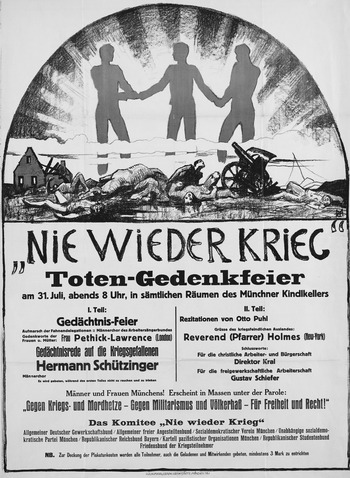
Figure 1 ‘“No more war”: Commemoration Ceremony for the Dead’, 31 July 1922, Munich. The programme included a brief tribute on behalf of women and mothers by the well-known British suffragette and pacifist Emmeline Pethick-Lawrence (1867–1954); a speech in tribute to the fallen by former army officer Hermann Schützinger, later a Reichsbanner luminary; and ‘greetings from a former enemy country’, delivered by Revd Holmes from New York.
Soldiers as victims
For obvious reasons, some symbolic elements of republican war narratives differed, depending on the context in which these recollections were situated, and on the group or individual who used them to highlight specific aspects of the war experience. But by and large, a number of clearly discernible interrelated themes dominated this field of remembrance in the early post-war years. The first relates to the dual role of the conscript soldier in times of war, drafted and employed to kill the enemy as effectively as possible, but also in constant danger of being injured or killed himself. In the rhetoric of the ‘no more war’ movement, the all-encompassing nature of the Great War was described with a terminology that highlighted its genocidal qualities. Usage of the term ‘Völkermord’ made it clear that it was perceived as large-scale murder, also implying a moral responsibility on the part of those who had acted as perpetrators in this carnage. But the republican portrayal of the front-line experience avoided discussing the fact that common soldiers might have been involved in the killing as well. Ordinary soldiers were always victims, never perpetrators. ‘The Murderers Are Sitting in the Opera House!’ Already the title of this poem by expressionist writer and playwright Walter Hasenclever highlights the central message of his moral indictment: the elites are to blame. The poem was written in 1917 and read in public to great acclaim on various occasions in post-war Berlin. Hasenclever dedicated it to the memory of Karl Liebknecht, who was murdered by the Freikorps in January 1919. Liebknecht is also mentioned in one verse, uttering his trademark slogan, ‘Down with the war!’. In this nightmarish vision of slaughter and moral decay where ‘human life is cheap’, ordinary soldiers are ‘held in contempt’ by their superiors. They appear either as corpses; ‘lice-infested cripples’; or ‘deserters’, ‘shot at dawn in the name of the supreme ruler’, the Kaiser. In one way or another, soldiers are invariably described as passive victims of the military machine. Agency rests with the military commanders alone, and they were, from the low-ranking NCO with the ‘distorted face of the ruler’, to the generals who were ‘resplendent’ in the glory of their military decorations, the ones who drove and manipulated the machinery of destruction. In a reference to the set metaphor of the opera house, it was the ‘conductor’ who ‘killed human beings’ and taught others to do the same.54
One direct consequence of this emphasis on portraying soldiers as victims was a reluctance to depict battle scenes at the front in any great detail. What can be considered to be the very essence of war, the killing and dying at the front, did not loom large in republican recollections of the war. The self-stated ‘duty’ of these remembrances was to inject a ‘deep-seated abhorrence’ of war into the public mindset. But nonetheless, it seemed appropriate for Social Democrats to foreground the rare occasions of ‘front-line peace’, those quiet moments when shelling and other fire had stopped and soldiers could sit down and enjoy the first signs of spring.55 Artur Zickler conjured up the image of a moment of reconciliation, when the German and British ‘citizens of no man’s land’ met in a bomb crater between the trenches and grasped the ‘sacred nature’ of life.56 One of the very rare depictions of battle in Vorwärts was published a few days after Ludendorff and von Hindenburg had first voiced their version of the Dolchstoß myth in public in November 1919. Only this appearance, the article claimed, had conjured up those ‘images that the generals had not seen and about which one would not talk if it were unnecessary’. Yet after this political intervention, ‘we have to!’. What followed was a deliberately gruesome recollection of the battle around Fort Vaux at Verdun in July 1916, which repeatedly mentioned how the advancing troops had stumbled over ‘human bodies that had been crushed to mash’. But despite all its gory realism the article presented death as an aggregate state and did not describe how a soldier had killed others or been killed himself. The transition from life to death was signified only by the ‘thundering’ and ‘howling’ of shells.57
In a number of cases, republican authors did spell out the fact that ordinary German soldiers had acted as perpetrators during the war. Yet these recollections were not an attempt to confront an inner demon and to work through the most complicated situation war presented for men in uniform. Rather, they served the clear-cut political aim of denouncing wartime German occupation policy in the West. A 1920 brochure on the Etappensumpf, the ‘quagmire of the rear area’, offered semi-documentary excerpts from the diary of a medical orderly who had worked in a Belgian military hospital. He notes how ‘it was said that’ early in the war ‘hundreds of Belgians were killed for franc-tireur activities that had not been proven’, even though he ‘was not able to verify’ this claim.58 Even with these qualifications, this was a remarkably open reference to the large-scale atrocities that German troops had committed against civilians in August 1914. It was published at a time when the German public was in outright denial of these events while some of the responsible officers, whose extradition the Allies had demanded, prepared to stand in the dock in sham war crimes trials in Leipzig in 1921.59 Writing in December 1916, at a time when thousands of Belgian civilians were deported to Germany as forced labourers, the anonymous author made it clear that he ‘felt ashamed’ about these ‘brutal’ acts, and could ‘not defend’ himself when confronted with these facts by his Belgian hosts.60
Indicting the Etappensumpf
Such a rare acknowledgement that German soldiers were not only victims of war, but had indeed acted as perpetrators, was part of a wider set of recollections that focused on the situation behind the front line. Technically speaking, the term Etappe – or ‘rear area’, to use the nearest equivalent that is available in English – could have at least two different meanings. In the wider sense, the Etappe encompassed all the territory that was out of the firing range of the enemy artillery. In a more narrow, administrative sense it was the territory between the operational area of the field army and the occupied territories or German territory, which was under the command of army rear area inspections and Etappenkommandanturen (rear area commands) in larger Belgian cities. Already during the war, however, the term had begun to acquire another, more colloquial meaning that signified the deep-seated inequality within the German army. For a growing number of soldiers, Etappe epitomised the corruption of the Wilhelmine officer corps. Etappe served as symbol for all those who could exploit the war for their own benefit, without ever being exposed to enemy fire.61
Thus, republican war remembrances eagerly focused on an already well-established set of connotations and could try to maximise the negative image of the Etappenschweine (pigs of the rear area) for political purposes.62 Placing the Etappe centre-stage in a narrative of the German war effort could serve a number of related purposes. First, gross material inequality between common soldiers and the officers could be highlighted as the endemic feature of German army organisation. Citing the popular slogan ‘equal pay and equal food, and the war would be soon forgotten’ not only conjured up the misery and hardship of life in the army. It also extended this class-based experience into the present, thus connecting the wartime past with the ongoing struggle for democratic rights.63 The Etappe invariably signified the corruption and moral degradation of the Wilhelmine officer corps, particularly of its higher echelons. Secondly, painting a vivid and detailed picture of the widespread incompetence and cowardice among staff officers in great detail allowed republicans to portray the transformation of Germany into a ‘people’s state’ (Volksstaat) as the only possible outcome of the war.64 A third reason why the rear area played such a prominent role in republican war narratives was its relevance for contemporary struggles about the legitimacy of claims in this field of remembrance. In the preface to his book Etappe Gent, Heinrich Wandt ridiculed those who presented life at the front in nostalgic terms, as ‘time of greatness’, and who during the war had called on the soldiers in the trenches to ‘hold out’ while they were themselves situated in the ‘bullet-proof’ rear area. Those who now ‘clamoured for revanche’ and stood at the helm of the nationalist combat leagues, Wandt claimed, had to be recognised as the ‘erstwhile Etappenschweine’ who had undermined morale at the front with their ‘life of debauchery’. ‘In truth’, he added, they were the ones who had perpetrated the Dolchstoß against those at the front.65 This opportunity to deflect the stab-in-the-back charge onto those who had invented it in the first place was the fourth and ultimate advantage of the rear area as a trope of republican war remembrances. In a nutshell, the rear area signified how the front-line soldiers had been betrayed and abandoned by cowards.66
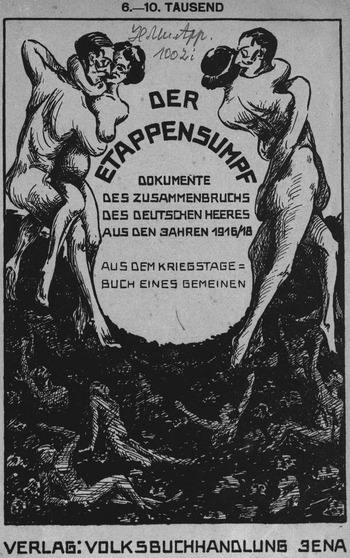
Figure 2 The Etappe was perceived as a site of sexual sleaziness, here pictured above the grey mass of ordinary, desperate victims of the war. Cover illustration from Der Etappensumpf: Dokumente des Zusammenbruchs des deutschen Heeres aus den Jahren 1916/18. Aus dem Kriegstagebuch eines Gemeinen (Jena: Verlag der Volksbuchhandlung, 1920).
The portrayal of life in the rear area included all the key ingredients of a socialist trope. This portrayal brought class to the forefront, as it emphasised that the private soldiers and NCOs who had also served in the rear never took part in upper-class greed and corruption. It offered a stark moral dichotomy between the victimisation of the ordinary people and exploitation by the ruling elites. And it allowed hopes for international solidarity to enter into accounts of one of the darkest aspects of the wartime record of the German military: its occupation regime in Belgium and northern France. Precisely for these reasons, genre-pictures of life in the rear area were the most popular of all pro-republican memories in the early and mid 1920s. Two books in particular demonstrate the tremendous appeal of this topic.67 In late 1919, the first edition of ‘Charleville. Dark Aspects of Life in the Rear Area’ appeared. The author, Wilhelm Appens, had served as an NCO with the food supply officer in Charleville during the war. Stocking up wine supplies from the cellars of local wholesale traders and private properties was one of his core duties, but he also worked as a billeting officer for the many members and guests of the German Army Headquarters, which was situated in the town from September 1914 until January 1916, replaced a few weeks later by the staff of the Army Group led by the German Crown Prince Wilhelm. Appens painted a vivid picture of the ‘rear area militarism’ that characterised German rule in this town, exemplified by a decree that demanded that all local citizens must raise their hat and step off the pavement when they pass a German officer. At the core of his narrative was the exploitation and robbery meted out by the system of requisitions. Appens detailed his feelings of anger and despair about these abuses. But the emphatic, if not pathetic, coda to his brief booklet indulged in hopes for reconciliation between France and Germany. The ‘sounds of shawms’ over northern France would call for peace while ‘columns of workers’ marched onto the scene. ‘We’, he insisted, referring to German socialists, were ‘innocent’ of the death of the French ‘fallen comrades’.68
Crucial for the appeal of this book was surely the strong element of soul-searching and self-examination it contained. Appens (1877–1947) had gained a Ph.D. in philosophy before the war, and, as a member of the educated middle class, he tended to believe in the phraseology of nationalism before the encounters in Charleville opened his eyes.69 A teacher by training, he served as a district school inspector in the coal-mining city of Hörde, near Dortmund, after the war. During the Weimar Republic, Appens was a member of the SPD, the Liga für Menschenrechte and, from 1930, also the Reichsbanner.70 His book was reprinted in a number of editions shortly after its release. When a slightly enlarged edition was published in 1927 under a different title, the overall print-run had reached 170,000 copies, turning ‘Charleville’ into one of the best-selling books of the Weimar period, though it has since been largely forgotten.71 The same must be said about Etappe Gent, first published in two volumes in 1920. Reprinted in a single-volume version in 1926, it had by then already sold more than 100,000 copies. The author, Heinrich Wandt (1890–1965), was a socialist journalist who had spent some time in France before the war. No longer fit for front-line duty owing to an injury, he was commanded to serve with the rear-area inspection of the fourth army in Gent in 1915.72 There he found plenty of examples for inclusion in his extended philippic tirade against the ‘binging, greedy gobbling and whoring’ of all those ‘princes, counts and barons’ who populated the rear area. Many members of the ruling houses were named and shamed with a detailed account of their worst exploits and acts of corruption. Wandt also included a detailed chapter on the plight of Belgian women who worked as prostitutes for the German military. Again, this topic was presented in the binary coding that characterised all critical accounts of the rear area. The hypocrisy and luxurious lifestyle of the officer caste, who could frequent separate designated brothels, were painted in dark colours, while the sexual encounters of ordinary soldiers were presented in a rather uncritical manner. Privates who met local women working as casual prostitutes in popular estaminets were introduced as ‘decent soldiers in field-grey’ (biedere Feldgraue). As Wandt explained, they were simply keen to have ‘een groote pint Bier’ and, in addition, ‘something for their heart and soul’.73
Discipline and revolution
A systematic rejection of the stab-in-the-back myth was the foremost aim of all republican war remembrances in the immediate post-war years. To support this claim, however, it was necessary to offer a more detailed account of the endgame of the German army on the western front. How exactly could the predicament of the German troops in the final months of the war be explained, if not through the revolutionary agitation emanating from the home front? One obvious answer was to blame the ‘inner decay’ in the rear area as a ‘decisive’ reason for the collapse of the army.74 Karl Vetter argued that ‘hatred and emnity’ against the officers had been ‘systematically cultivated’ through the class structure of the German army. In the very moment when only a final, ‘fraternal’ attempt could have rescued the situation, these seeds ‘germinated’ and shattered what little fighting power was left among the exhausted and decimated troops. Rather than blaming revolutionary propaganda, Vetter insisted, it was necessary to stress that the higher echelons were never informed about the widespread longing for peace. Among the war-weary and hungry troops, Allied leaflets, offering a reminder of all the promises the Prussian system had broken, had done more to convince the soldiers that the end was due than any leftist propaganda.75 Timing was another crucial element in accounts that did not blame the revolutionary transformation at home for the defeat. Rather than existing as a strong and united force until the very end, troops were already showing symptoms of a ‘disease’ at the beginning of 1918, as increasing numbers of soldiers went AWOL, and performed self-mutilation and other acts of ‘passive resistance’. When further German offensives did not seem to offer any hope for a swift conclusion to the war, and the Allied troops made rapid advances, ‘morale was completely shattered’. Thus, the turning point came in July and August 1918, and from that moment onwards, the German army disintegrated. The ‘general strike’ of the ‘battle-weary millions’ in the final weeks of the conflict sealed the end of the imperial system. Yet it did not come about as a result of top-down organised action, but rather through a final intensification of all the grievances that had already undermined military cohesion.76
Revolutionary agency did not play any role in republican recollections of the dying months of the Imperial Army. To be sure, some accounts stressed that a large majority of the soldiers had in principle been supporters of a revolutionary transformation.77 However, stating that soldiers had actively revolutionised the army was an entirely different matter. In some accounts, the events of the final weeks were rendered as a kind of ordered surrender in which junior troop officers marched to the back, bringing their troops to safety, without waiting for any specific orders from the top.78 Against the contemporary backdrop of revolutionary upheaval and street-fighting in many German cities, other versions of events stressed that the revolution had actually saved Germany from something worse. If Allied troops had pursued their enemy beyond the border, and had enacted revenge on behalf of Belgium, a much more devastating form of ‘anarchy’ would have ensued.79 Representing the perspective of the MSPD, articles in Vorwärts were keen to mark offences against military discipline as a violation of moral rules. In a fictional story, for example, a group of soldiers in a train compartment expressed their hopes for the future while travelling back home after armistice. The main character, Heinrich, confronted two men who boasted that they had survived the last six months of the war as deserters. Heinrich felt the ‘evil’ in one of the shirkers when he justified his deed with the longing for freedom. Freedom, he lectured the two who had abandoned their unit, had always to be reconciled with a sense of duty.80 Majority Social Democrats had to acknowledge that the value of discipline had lost any repute and that it was now seen as something that had only served the ‘masters’ in the bygone Imperial Army. Nonetheless, they were anxious to praise self-discipline as a requirement for labour-movement activism.81
Radical Democrats and moderate socialists were rather evasive when they had to describe the extent of mass desertion and other forms of shirking in the final months of the war, and they had good reasons for this, as any mentioning of such incidents would have only played into the hands of those who denied the reality of the German defeat. Even so, all pro-republican accounts in the early post-war period were clear on one point: that the defeat had come for a reason, as the superiority of Allied manpower and weaponry overwhelmed exhausted and ultimately disappointed German soldiers who were sure that any further resistance was futile.82 Moreover, the moment of defeat that the armistice on 11 November 1918 encapsulated was not remembered as a tragic moment of failure, when hopes for national grandeur were shattered. Rather, the defeat was described as something that the soldiers had embraced, as a moment of liberation both from the machinery of war and from the oppression they had endured under the imperial system. Karl Vetter recalled how young reservists from Pomerania had ‘longed for a defeat with diabolical joy’, claiming that ‘the end could not come soon enough’ anyway. He described Armistice Day, using religious language, as an ‘hour of redemption’, when soldiers rejoiced and commiserated at the same time. Everyone knew, Vetter claimed, that they could not have fought any further. While the Belgians celebrated, he and his comrades welcomed the news that Germany had become a republic, and the toast was to ‘the fatherland of the free man’.83 Elsewhere, the few remaining troops on the front line at a time when many companies consisted of no more than forty men received the news of the armistice and defeat ‘as a matter of course’.84 Guilt and remorse were not brushed under the carpet; rather responsibility was felt for the failure to prevent the war from happening in the first place.85 Another booklet, published in 1919, described the ambivalent feelings of liberation and of nostalgia about futile sacrifices that the memory of the armistice conjured up:
Nobody believed honestly in any military successes. Naturally, the resistance against the storm-like advance of the enemy was growing weaker. Thus, the lines were tottering at many points where they would probably have been able to hold in military terms … But nobody considered the defeat as his own defeat, but rather as a defeat of the old system. The withdrawal was welcomed as a march back home. There was just a wistful glance on some faces when they passed some famous places that were once conquered with the blood of many comrades.86
The pestilence of war and the need for peace
For the survivors, the armistice had brought peace and, with the revolution, a new political settlement that promised to deliver freedom and an end to the oppression they had endured at the front. Yet it was felt that the fallen soldiers should not be forgotten. They emerged from the dark like ‘millions of pale shadows’. Coming from an ‘ice cold night’, they deserved and indeed demanded to have the ‘love’ of the living, and affirmed, in return, to be ‘eternally attached’ to them.87 The title of a poem by Karl Bröger, ‘Self-Reflection’ (‘Einkehr’), suggests that feelings of loss and bereavement demanded contemplation. As they were about to usher in a new regime based on freedom and justice, it demanded that republicans should not forget the fate of the fallen soldiers who had not lived to see the arrival of this historic turning point.88 Bröger (1886–1944) is nowadays largely unknown to a wider public, and is not a household name even among professional historians. Yet in many respects his biographical trajectory encapsulates both the significance and the political potential of war remembrance for Social Democrats in the Weimar period. Raised in a working-class family in Nuremberg, and from 1913 working as a journalist, he was already a distinguished labour movement poet before the war began. During the war, he rose to fame for his poem ‘Bekenntnis’ (‘Confession’), published in January 1915. Its key line was the solemn oath that Germany’s ‘poorest son is also its most loyal one’.89 More than any other text or gesture this line seemed to express the promise of the Burgfrieden in 1914, when the – on paper still revolutionary – Social Democrats had joined the national war effort. Such was the symbolic significance of this line that Chancellor Bethmann Hollweg quoted it in a Reichstag speech in February 1917. Yet during the war, Bröger had come out in support of an immediate peace. Returning home from the front, he resumed his work as a journalist for a Social Democrat newspaper in Nuremberg. In 1924 he was also one of the founding members of the Reichsbanner in Nuremberg, which he used as a platform to reflect upon the legacy of the fallen soldiers.90
To be sure, Bröger was not the only Social Democrat to commemorate the fallen in the immediate post-war period. On Totensonntag in November 1919, hundreds of local Reichsbund branches across the country organised ceremonies of remembrance. Speaking to thousands of disabled veterans at the central rally in the Circus Busch in Berlin, Erich Roßmann, who had followed Erich Kuttner as the head of this organisation, asked why and for what reason millions had had to die. They had been sacrificed, he explained, because humankind had not yet learned to condemn war as a ‘moral pestilence’. But they would not have died in vain if the survivors were now able to build a new social order ‘without war and serfdom’. Introducing Reich president Friedrich Ebert as the next speaker, Roßmann reminded the audience that two of Ebert’s sons had died at the front. Ebert urged the audience to remember both the fallen and those who had escaped the ‘murder’, but were no longer able to work. In no uncertain terms, he demanded that Germans, and indeed people of other nations, learn ‘to detest and to combat war as the most gruesome crime against humanity’. After the ceremony had ended with the tunes of a dead march, several hundred people joined the procession that marched off to lay a wreath at a cemetery in the Hasenheide. On their way to the outskirts of town, the Social Democrat veterans experienced the difficulties of performing a republican war commemoration. A detachment of the Sicherheitswehr (Security Force), troops who would just a couple of months later support the reactionary Kapp Putsch, stood in their way and prevented them from marching in a closed formation.91 Yet the Reich president’s speech had been a powerful reminder of the destructive nature of war, in a stark contrast to the established image of Ebert as someone who had allegedly nurtured the Dolchstoß myth when he greeted the returning troops of the Garde Korps in Berlin on 10 December 1918.92 This image, however, is wrong. It rests on a selective reading of Ebert’s words on that earlier occasion. Then, he had explicitly admitted that the ‘superior force’ (Übermacht) of the Allied forces had motivated the revolutionary government to stop fighting, and that it had been a patriotic ‘duty’ not to demand any further ‘meaningless sacrifices’.93
As the members of the Reichsbund made abundantly clear, their fallen comrades would never have wanted a ‘glorification of the battles’ in which they had died. Nor, it was believed, should generals or other individual persons be idolised as heroes for their supposedly eminent contribution to the war effort. Whenever disabled veterans gathered to remember the war, they should renew their testimony ‘against the war’ and against the ‘triumph of force’.94 These Social Democratic veterans were wary of the many efforts to exploit ceremonies of mourning for the propagation of revanchist ideas, even more so as they consistently employed the rhetoric of the ‘national’ to stoke up hatred and enmity. What was needed was not a national day of mourning, but a ‘popular holiday’ for the celebration of republican citizenship that served to underpin and strengthen the new state and its constitution.95 Inherent to this pacifist agenda was a commitment to international reconciliation and an international confederation of disabled veterans. The veterans of the Reichsbund were all too aware of how ‘utopian’ such a vision seemed to be at a time when the Treaty of Versailles caused widespread resentment. Public opinion among the former Allies was not favourable to the project either. Nevertheless, in the view of the Reichsbund, whenever a former ‘Kriegsteilnehmer of German nationality’ conversed with one of his counterparts in other countries, he should do so not in the spirit of ‘partisanship’, but ‘in the interests of humanity and culture’.96
‘A short period of insight’, 1918–1923
As the evidence in this chapter has amply demonstrated, nationalist mythologies of the war experience were anything but hegemonic in the immediate post-war period. On the contrary, an abundance of critical recollections of life at the front were published by radical democrats and moderate socialists in the first few years after the war, both as separate publications and in a number of newspapers. Through their portrayal of the corruption among the officer caste, particularly in the rear area, and their focus on the exploitation of common soldiers as victims of a brutal war machinery, these memories were in many ways a corollary of the revolutionary mass movement that had swept the ruling houses aside in the autumn of 1918 and ushered in a new republican system that provided peace and freedom as its most important achievements.97 Now, after censorship and military repression had been lifted, Social Democrats and other convinced republicans were free to speak out about the injustice and brutality they had experienced, and to use the worm’s-eye perspective for a thorough indictment of the old system.98 The fact that the former twin heads of the Third Army Supreme Command publicly endorsed the Dolchstoß myth in November 1919 provided another incentive to vent their anger about the recent past and its current falsification. It is simply not true, as historian Ulrich Heinemann has argued with regard to the Dolchstoß myth, that the republicans ‘surrendered without a fight under the burden of the past’.99 It seems much more appropriate to suggest, as the Social Democratic author of an anti-Dolchstoß brochure did in 1931, that the stab-in-the-back myth did not actually find much resonance in the immediate post-war years, least of all among war veterans. This was partly because the ‘memory of the war years’ was still fresh, and partly because millions of men who had served at the front ‘kept their gruesome experiences alive’ and were still aware of the inevitability of the German collapse.100 There are enough reasons to challenge the lopsided claim by historian Hans Mommsen that large segments of the political left subscribed to the ‘idea that Germany’s defeat in World War I’ was only ‘a passing episode’. Rather, the ‘inner rejection of the peace’ – to quote Mommsen’s phrase – among the German public was not shared by those radical democrats and socialists who, in the immediate post-war years, regarded the defeat of the imperial system as a liberation.101
Early republican war memories consistently employed a class-based binary coding, which contrasted the misery of the ordinary people with the selfish and reckless attitude of the masters in a system of ‘class distinctions’.102 In that sense, they supported the republican cause, as they insisted that military defeat had been a moment of liberation, that peace was paramount and that the Republic would serve a positive purpose.103 In substance, however, these were socialist recollections of war, because the notion of class provided the core around which most aspects of the war experience were constructed. Most of these ideas also resonated with the members of two mass organisations, the Reichsbund and the Reichsvereinigung, and among the hundreds of thousands who attended the ‘no more war’ rallies from 1920 to 1922. In the immediate post-war years, a very large segment of German public opinion was indeed ready to evaluate the legacy of the war in a highly critical fashion, and to reject war as an instrument of politics, thus supporting the notion of cultural demobilisation. Franz Carl Endres (1878–1954), a Bavarian officer, had served on the general staff of the Ottoman Empire during the war before illness forced him to return to Germany in 1915. Now supporting a moderate pacifism, he wrote a series of books and articles on the legacy of the war, including a critique of the Dolchstoß myth.104 Writing in 1924, Endres noted that the ‘preparations for a persistent glorification of the war’ were already under way. Nonetheless, he added in a footnote, it seemed justified to argue that the years from 1918 to 1922 had been a ‘short period of insight’, when critical recollections of the war experience did find substantial resonance in public opinion.105 The perception of this major-turned-pacifist was indeed corroborated by another major who dealt with war remembrances in a professional capacity, George Soldan. Major Soldan was head of the department for ‘popular writings’ (Volkstümliche Schriften) in the Reichsarchiv in Potsdam, which will be discussed in more detail in Chapter 6. In a letter to his superior Hans von Haeften, director of the department for the history of war, Soldan explained in 1924 that not only newspapers on the left of the political spectrum, but also those that supported the Centre Party and the right-liberal German People’s Party (DVP) were ‘conspicuously negative’ about printing articles on front-line experiences. Left liberal and Social Democrat dailies would only cover war experiences if they served to ‘pursue a pacifist tendency’.106
This was a candid admission of the uphill struggle faced by nationalist circles within and outside the Reichswehr in 1924, when they aimed to circulate positive reminiscences of the war to a wider public. Any efforts to utilise war remembrances for ‘nationalist publicity work’ had in fact only increased the ‘reluctance’ of left-leaning and moderate newspaper editors to print them, as Soldan noted with regret.107 But the backlash by nationalist circles and the Reichswehr began early. Immediately after the publication of his Etappe Gent, Heinrich Wandt became the target of repeated judicial attacks that effectively aimed to gag him. For libel against Prince Heinrich of Reuss, a criminal court in Berlin sentenced him in December 1920 to six months’ imprisonment.108 Another trial referred to an incident, detailed in Etappe Gent, in which a German sergeant had been executed by order of a court martial. This was a potentially damaging case for the Reichswehr, as throughout the 1920s it was insisted that only very few death sentences had been carried out during the war, particularly in comparison with the French and British armies.109 Having been remanded in custody for almost four months, Wandt managed to reach a judicial settlement in this case.110 The next trial, for high treason, took place in December 1923 at the Reichsgericht in Leipzig and amounted, as Wandt correctly stated, to nothing less than the charge of a ‘judicial crime’ against him. He was falsely accused of handing over a secret document from 1918 about a Flemish collaborator to someone in Belgium. Ernst Müsebeck, director of the archive department in the Reichsarchiv, and a Major Staehle from the Reichswehr ministry, were key witnesses for the prosecution. Although the evidence was thin and contradictory, Wandt was sentenced to six years’ imprisonment, whilst the public was excluded from his trial. Only when the Social Democrat deputy Paul Levi raised this controversial, if not scandalous, sentence in the Reichstag in March 1925 did a wave of public indignation finally force the Reich Ministry of Justice to pardon Wandt in February 1926.111
Wandt was very aware of the peculiar irony that many of the judges and state prosecutors who exacted judicial revenge on him for publicising the exploits of high-ranking officers in occupied Belgium had served as officers – exactly there.112 And Wandt was not the only pacifist who found himself in the dock. The Reichswehr received the support of a conservative judiciary when it cracked down on pacifist publications through judicial means. Between 1924 and 1927, it is estimated that 10,000 charges of treason or high treason were brought against pacifist or Social Democrat critics of the military, with 1,071 persons sentenced for these offences.113 But it was not only political pressure and persecution by the Reichswehr and the judiciary that diminished the spread and impact of republican war memories in the years until 1923. The inherent weaknesses of the republican camp to which these authors and initiatives belonged outweighed any external pressure. Three shortcomings in particular stand out.
First, the coalition between left liberals and the two Social Democratic parties on which many of these commemorative initiatives rested was fragile. When the majority of Independent Social Democrats decided to join the KPD in December 1920, much momentum was lost simply because some of the most outspoken critics of the war abandoned the cooperation with the democratic camp. And the subsequent cooperation between bourgeois pacifists and the MSPD was not an easy one either. Secondly, critical memories of the war experience lost some of their potency when French and Belgian troops invaded the Ruhr in January 1923 in retaliation for delayed German reparation payments. The German public responded with an outpouring of jingoistic emotions. Some of those who had been among the most aggressive critics of the Imperial Army in 1919 joined in, and now honed their writing skills through vitriolic attacks against the French. Artur Zickler, for instance, wrote a series of articles about passive German resistance against the occupation for the right-wing Deutsche Allgemeine Zeitung, which was affiliated with the DVP.114 In spring 1923, he also joined a ‘Freischar’ group among the Jungsozialisten, which embraced, in the wake of the famous Hofgeismar meeting of the Young Socialists over the Easter holidays that year, an aggressive nationalism and a renewal of the nation through the Führer principle.115
A third weakness was the lack of a larger audience across the country for these critical recollections. We have seen that journalists writing for daily newspapers published in the capital played a crucial role in orchestrating and publicising a campaign against the Dolchstoß myth, based on the memories of former front-line soldiers. But the geographical reach of these publications was ultimately limited. As Kurt Tucholsky noted in a self-critical reflection, Berlin-based leader-writers often used the phrase ‘out there in the country’ when they talked about Germany. Thus, they tended to forget the limited resonance that republican ideas had in provincial towns and cities, particularly in the Prussian territories east of the River Elbe and, worse still, east of the River Oder.116 To some extent, the Reichsbund could compensate for such a lack of coverage at least as far as the war memories of disabled veterans were concerned. Still missing, though, was an association of pro-republican war veterans that could systematically engage in the commemoration of war and reach out into even the most remote corners of the Reich. This gap, however, was only filled when a coalition of devoted republicans founded the Reichsbanner Black–Red–Gold in early 1924.
1 ‘Abschied von 1918’, Vorwärts no. 1, 1 January 1919. Throughout the book, all translations are mine unless stated otherwise.
2 See Wilhelm Deist, ‘The Military Collapse of the German Empire’, War in History 3 (Reference Deist1996), 186–207.
3 See for instance Kurt Juliusberger, ‘Front-Frieden’, Vorwärts no. 101, 24 February 1919; Walter Dornbusch, ‘Die Heimkehr’, Vorwärts no. 138, 27 March 1919.
4 Kurt Heilbut, ‘Von hinten erdolcht’, Vorwärts no. 59, 9 February 1920.
5 Artur Zickler, Im Tollhause (Berlin: Verlag Vorwärts, n.d. [Reference Zickler1919]), pp. 14–19, 31–7. See the review by Ignaz Wrobel (i.e. ), Weltbühne16.I (1920), 282f. See also, without much detail on his anti-militarist writings, the autobiographical note by Zickler, 3 August 1945: BArch, SAPMO, SgY 30, 1052.
6 See the recollections by Margret Boveri, Wir lügen alle: Eine Hauptstadtzeitung unter Hitler (Olten; Freiburg: Walter, Reference Boveri1965), pp. 37f. (quote); Modris Eksteins, The Limits of Reason: The German Democratic Press and the Collapse of Weimar Democracy (Oxford University Press, Reference Eksteins1975), pp. 110f., 136, 227–30.
7 Karl Vetter, ‘Wie es kam: Ein Beitrag zur Geschichte des Zusammenbruchs’, BVZ no. 129, 25 March 1919; and Der Zusammenbruch der Westfront: Ludendorff ist schuld! Die Anklage der Feldgrauen (Berlin: Koch & Jürgens, n.d. [Reference Vetter1919]), pp. 3f. (quotes).
8 See Vanessa Ther, ‘“Humans are cheap and the bread is dear”: Republican Portrayals of the War Experience in Weimar Germany’, in Heather Jones, Jennifer O’Brien and Christoph Schmidt-Supprian (eds.), Untold War: New Perspectives in First World War Studies (Leiden; Boston, MA: Brill, Reference Ther, Jones, O’Brien and Schmidt-Supprian2008), pp. 357–84.
9 See Bernhard Fulda, Press and Politics in the Weimar Republic (Oxford University Press, Reference Fulda2009), p. 24.
10 Barth, Dolchstoßlegenden, pp. 302–39 (quote on p. 326); on the appearance in front of the subcommittee see also the cynical commentary by , ‘Zwei Mann in Zivil’, Weltbühne15.II (1919), 659–64.
11 See Anna von der Goltz, Hindenburg: Power, Myth, and the Rise of the Nazis (Oxford University Press, Reference Goltz2009), pp. 66–9 (quote on p. 66). Throughout her book, Goltz grossly exaggerates the acceptance of the Hindenburg myth among Social Democrats, largely based on a few articles in Vorwärts; ibid., pp. 50f. She also fails to recognise the almost total collapse of the Hindenburg myth among front-line soldiers in the autumn of 1918. For references, see Benjamin Ziemann, War Experiences in Rural Germany, 1914–1923 (Oxford: Berg, Reference Ziemann2007), p. 138; and Bernd Ulrich and Benjamin Ziemann (eds.), German Soldiers in the Great War: Letters and Eyewitness Accounts (Barnsley: Pen & Sword, Reference Ulrich and Zieman2010), pp. 150, 179.
12 ‘Geborstene Säulen’, Volksstimme no. 272, 21 November 1919.
13 Vetter, Zusammenbruch, p. 6; Der ‘Dolchstoß’: Warum das deutsche Heer zusammenbrach (Berlin: Zentralverlag, 1920), pp. 4–6.
14 Rainer Sammet, ‘Dolchstoss’: Deutschland und die Auseinandersetzung mit der Niederlage im Ersten Weltkrieg (1918–1933) (Berlin: Trafo, Reference Sammet2003), pp. 178f.
15 See for instance Der Zusammenbruch der Kriegspolitik und die Novemberrevolution: Beobachtungen und Betrachtungen eines ehemaligen Frontsoldaten (Berlin: Verlagsgenossenschaft Freiheit, 1919); Der Etappensumpf: Dokumente des Zusammenbruchs des deutschen Heeres aus den Jahren 1916/1918. Aus dem Kriegstagebuch eines Gemeinen (Jena: Volksbuchhandlung, 1920); Hermann Schützinger, Zusammenbruch: Die Tragödie des deutschen Feldheeres (Leipzig: Ernst Oldenburg, Reference Schützinger1924).
16 Erich Kuttner, Der Sieg war zum Greifen nahe! Authentische Zeugnisse vom Frontzusammenbruch (Berlin: Verlag für Sozialwissenschaft, Reference Kuttner1921), pp. 23f.
17 See Bernd Ulrich, ‘Die Perspektive “von unten” und ihre Instrumentalisierung am Beispiel des Ersten Weltkrieges’, Krieg und Literatur/War and Literature 1 (Reference Ulrich1989), 47–64.
18 Vetter, Zusammenbruch, p. 4.
19 Anklage der Gepeinigten! Geschichte eines Feldlazarettes: Aus den Tagebüchern eines Sanitäts-Feldwebels (Berlin: Firn-Verlag, 1919), pp. 6f. (on this book, see , ‘Militaria’, Weltbühne15.II (1919), pp. 195f.; and , ‘Die Anklage der Gepeinigten’, BVZ no. 193, 30 April 1919); a similar indictment of the ‘system’ can be found in Der Etappensumpf, p. 4.
20 Anklage der Gepeinigten, p. 3.
21 Walther Lambach, Ursachen des Zusammenbruchs (Hamburg: Deutschnationale Verlagsanstalt, n.d. [Reference Lambach1919]), pp. 23, 25f., 32f., 56f.
22 Cited in ibid., p. 59. For a related argument on the internal reasons for the military collapse in 1918 from a nationalist perspective see Otto Dietz, Der Todesgang der deutschen Armee: Militärische Ursachen (Berlin: Karl Curtius, Reference Dietz1919), pp. 5ff.
23 Quotes from Lambach, Ursachen, pp. 111, 21f.
24 Ibid., pp. 59, 85.
25 Walther Lambach, ‘Die Zermürber der Front’, Deutsche Tageszeitung no. 208, 5 May 1920; see Ulrich, ‘Perspektive’, p. 54.
26 See the recollections by , ‘Nie wieder Krieg: Der Rundlauf einer Parole’ (1923), in Sämtliche Schriften, 8 vols., Vol. II: 1922–1924 (Reinbek: Rowohlt, Reference Ossietzky1994), pp. 267–70; on Nicolai, see Bernhard vom Brocke, ‘“An die Europäer”: Der Fall Nicolai und die Biologie des Krieges. Zur Entstehung und Wirkungsgeschichte eines unzeitgemäßen Buches’, HZ 240 (Reference Brocke1985), 363–75; on Meyer, see Jürgen Schmidt and Bernd Ulrich, ‘Pragmatischer Pazifist und Demokrat: Hauptmann a.D. Willy Meyer (1885–1945)’, in Wolfram Wette and Helmut Donat (eds.), Pazifistische Offiziere in Deutschland 1871–1933 (Bremen: Donat, Reference Wette1999), pp. 303–17.
27 Report by Staatskommissar für die Überwachung der öffentlichen Ordnung, 3 December 1919: StA Bremen, 4, 65, 1157.
28 ‘Der Friedensbund der Kriegsteilnehmer’, excerpt from a report by the RKO, 25 January 1921: StA Bremen, 4, 65, 1157; see also ‘Ein Aufruf des Friedensbundes der Kriegsteilnehmer’, Berliner Tageblatt, 19 October 1919.
29 See for instance ‘Gegen die Dolchstoß-Legende’, Freiheit no. 193, 26 May 1920.
30 Berlin Police President to Prussian Ministry of the Interior, 8 December 1919: GStA, Rep. 77, Tit. 1137, Nr. 50; Report by Staatskommissar für die Überwachung der öffentlichen Ordnung, 3 December 1919.
31 See , ‘Die Internationale der Soldaten’, Nie wieder Krieg: Organ des Friedensbundes der Kriegsteilnehmer no. 16/17 (November 1921): LAB, A Pr. Br. Rep. 030, 21643, fos. 147f.
32 Ossietzky, ‘Nie wieder Krieg’, p. 268; see also the recollection by Kurt R. Grossmann, Ossietzky: Ein deutscher Patriot (Munich: Kindler, Reference Grossmann1963), p. 80.
33 Rainer Pöppinghege, ‘“Kriegsteilnehmer zweiter Klasse”? Die Reichsvereinigung ehemaliger Kriegsgefangener 1919–1933’, MGZ 64 (Reference Pöppinghege2005), 391–423 (pp. 401, 412ff.).
34 Ibid., pp. 395f., 398, 404.
35 Grossmann, Ossietzky, p. 80. See the example from Bielefeld in Pöppinghege, ‘Kriegsteilnehmer’, p. 408.
36 See Maximilian Ingenthron, “Falls nur die Sache siegt”. Erich Kuttner (1887–1942): Publizist und Politiker (Mannheim: Palatium, Reference Ingenthron2000), pp. 132–45; Whalen, Bitter Wounds, quote on p. 122.
37 James M. Diehl, ‘The Organization of German Veterans, 1917–1919’, AfS 11 (Reference Diehl1971), 141–84; Whalen, Bitter Wounds, pp. 123–9.
38 , ‘Die Wirksamkeit des Reichsbundes in Staat und Gesellschaft’, Reichsbund15 (1932), no. 9/10, 99.
39 Michael Geyer, ‘Ein Vorbote des Wohlfahrtsstaates: Die Kriegsopferversorgung in Frankreich, Deutschland und Großbritannien nach dem Ersten Weltkrieg’, GG 9 (Reference Geyer1983), 256.
40 ‘Erinnerungen Heinrich Hoffmann’, n.d. [c. 1965]: BArch, SAPMO, SgY 30, 1365/2, fos. 501f.
41 Sabine Kienitz, Beschädigte Helden: Kriegsinvalidität und Körperbilder 1914–1923 (Paderborn: Schöningh, Reference Kienitz2008), pp. 301–5 (quote on p. 303). On the politics of disabled veterans see , The War Come Home: Disabled Veterans in Britain and Germany, 1914–1939 (Berkeley: University of California Press, 2001), pp. 88–97.
42 Erich Kuttner, ‘Vergessen! Die Kriegszermalmten in Berliner Lazaretten’, Vorwärts no. 449, 8 September 1920, partly printed in Ulrich and Ziemann, German Soldiers, pp. 81f. (quote); see Ingenthron, Kuttner, p. 175.
43 Diehl, ‘The Organization of German Veterans’, p. 179.
44 For the organisational and political context of the ‘no more war’ movement see Reinhold Lütgemeier-Davin, ‘Basismobilisierung gegen den Krieg: Die Nie-wieder-Krieg-Bewegung in der Weimarer Republik’, in Karl Holl and Wolfram Wette (eds.), Pazifismus in der Weimarer Republik (Paderborn: Schöningh, Reference Lütgemeier-Davin, Holl and Wette1981), pp. 47–76.
45 See Ossietzky, ‘Nie wieder Krieg’, p. 268.
46 ‘Nie wieder Krieg!’, BVZ no. 356, 3 August 1919.
47 ‘Nach sechs Jahren’, BVZ no. 358, 1 August 1920; see Lütgemeier-Davin, ‘Basismobilisierung’, pp. 54–56.
48 Lütgemeier-Davin, ‘Basismobilisierung’, pp. 56–67.
49 ‘Der Friedenswille des Volkes’, Vorwärts no. 358, 1 August 1921. In the rally on 1 August 1920, the disabled veterans of the Reichsbund, in wheelchairs and on stretchers, took centre stage, carrying placards reading ‘We hate genocide [Völkermord]!’ or ‘Do you want even more cripples?’. See the report by Welt am Montag, 2 August 1920, reprinted in , Sämtliche Schriften, 8 vols., Vol. VII (Reinbek: Rowohlt, 1994), pp. 151f.
50 ‘Der Friedenswille des Volkes’, Vorwärts no. 358, 1 August 1921.
51 Ibid.
52 Ibid.
53 The ‘no more war’ movement is often associated with the activist image of an oath against war that Käthe Kollwitz created for a socialist youth gathering in 1924. But the iconography of the ‘no more war’ movement from 1920 to 1922 was dominated by visions of international reconciliation across the battlefield. See Annegret Jürgens-Kirchhoff, ‘Kunst gegen den Krieg im Antikriegsjahr 1924’, in Jost Dülffer and Gerd Krumeich (eds.), Der verlorene Frieden: Politik und Kriegskultur nach 1918 (Essen: Klartext, Reference Dülffer and Krumeich2002), pp. 287–310 (p. 296); picture postcards from 1921, and by the Friedensbund der Kriegsteilnehmer, n.d.: AdsD, 6/CARD000294; ibid., 6/CARD000561.
54 Walter Hasenclever, ‘Die Mörder sitzen in der Oper!’, Vorwärts no. 296, 12 June 1919. Soldiers without cockade, who had been demoted for disciplinary offences, were ‘victims of the system’; Vetter, Zusammenbruch, p. 11.
55 Kurt Juliusburger, ‘Front-Frieden’, Vorwärts no. 101, 24 February 1919.
56 Artur Zickler, ‘Der Mann auf Niemandsland’, Vorwärts no. 79, 12 February 1919.
57 ‘Heil dir im Siegerkranz!’, Vorwärts no. 599, 23 November 1919.
58 Der Etappensumpf, p. 7. The atrocities were also alluded to by Karl Vetter, ‘Wie es kam: Ein Beitrag zur Geschichte des Zusammenbruchs’, BVZ no. 129, 25 March 1919.
59 See John Horne and Alan Kramer, German Atrocities, 1914: A History of Denial (New Haven; London: Yale University Press, Reference Horne and Kramer2001), pp. 345–55.
60 Der Etappensumpf, p. 7.
61 See the documents in Ulrich and Ziemann, German Soldiers, pp. 120f., 123; for an attempt by a former staff officer to offer a balanced view see ‘Das alte Heer’, Weltbühne16.I (1920), 325–9.
62 See the popular poem ‘Die Etappensäue’, which had already circulated during the war; Der Etappensumpf, p. 5.
63 Ibid., p. 6. Embezzlement and fraud by officers were also remembered in relation to the front. But the rear area epitomised these charges. See Anklage der Gepeinigten, pp. 8ff.
64 Der Etappensumpf, p. 3.
65 Heinrich Wandt, Etappe Gent, 2nd edn (Vienna; Berlin: Agis-Verlag, 1926 [1920]), p. 3; see Anklage der Gepeinigten, p. 5.
66 Vetter, Zusammenbruch, p. 7.
67 See in more detail Benjamin Ziemann, ‘“Charleville” und “Etappe Gent”: Zwei kriegskritische Bestseller der Weimarer Republik’, Krieg und Literatur/War and Literature 23 (Reference Ziemann2012), 59–82.
68 Wilhelm Appens, Charleville: Dunkle Punkte aus dem Etappenleben (Dortmund: Gerisch, n.d. [1919]), pp. 6, 12, 23, quotes on pp. 25, 38.
69 Ibid., p. 10.
70 On his biography see the extensive documentation in his personal file; on party membership see ‘Fragebogen zur Durchführung des Gesetzes zur Wiederherstellung des Berufsbeamtentums vom 7.4.1933’: NHStAH, Hann. 180, Hildesheim no. 11666, Vol. III.
71 Wilhelm Appens, Charleville: Ein trübes Kapitel aus der Etappen-Geschichte des Weltkrieges 1914/18 (Dortmund: Gerisch, Reference Appens1927).
72 For a brief biographical sketch see , Das Justizverbrechen des Reichsgerichts an dem Verfasser der ‘Etappe Gent’ (Berlin: Der Syndikalist, 1926), pp. 6f.
73 Wandt, Etappe Gent, pp. 142–64 (quote on p. 153).
74 Der Etappensumpf, p. 3.
75 Vetter, Zusammenbruch, p. 9, quotes on pp. 13f.; cf. Der ‘Dolchstoß’, p. 7; Der Etappensumpf, p. 16.
76 Der ‘Dolchstoß’, pp. 7, 9 (quotes). See Vetter, Zusammenbruch, p. 5; Appens, Charleville: Dunkle Punkte, p. 13; Schützinger, Zusammenbruch, p. 4.
77 Der Zusammenbruch der Kriegspolitik, p. 15.
78 Der Etappensumpf, p. 27.
79 Vetter, Zusammenbruch, p. 14.
80 Walter Dornbusch, ‘Die Heimkehr’, Vorwärts no. 138/139, 27 and 28 March 1919.
81 ‘Disziplin’, Vorwärts no. 280, 3 June 1919; see also ‘Der 9. November im Ostheer’, Vorwärts no. 576, 10 November 1919.
82 Apart from the references cited above see Vetter, Zusammenbruch, p. 14.
83 Ibid., pp. 12f.; see Der Etappensumpf, p. 28; Schützinger, Zusammenbruch, pp. 78f.
84 Der ‘Dolchstoß’, pp. 10f.
85 Zickler, Im Tollhause, p. 60.
86 Der Zusammenbruch der Kriegspolitik, p. 15.
87 Karl Bröger, ‘Einkehr’, Vorwärts no. 599, 23 November 1919. See ‘Den Gefallenen’, Vorwärts no. 487, 23 September 1919; ‘Unseren Toten’, Reichsbund 2 (1919), no. 44.
88 Bröger, ‘Einkehr’.
89 See , ‘Imperialismus und Arbeiterliteratur im Ersten Weltkrieg’, AfS14 (1974), 293–350 (pp. 298–302; ‘Bekenntnis’ on p. 298); and the biography by Gerhard Müller, Für Vaterland und Republik: Monographie des Nürnberger Schriftstellers Karl Bröger (Pfaffenweiler: Centaurus, Reference Müller1985).
90 On the style and significance of ‘Bekenntnis’ and other works by Bröger, see the perceptive remarks by Frank Trommler, Sozialistische Literatur in Deutschland (Stuttgart: Kröner, Reference Trommler1976), pp. 370–81. However, Trommler is wrong in assuming that Bröger’s time ‘was up’ in 1923, when he lost his appeal to the youth; ibid., p. 381. In many respects, his public impact vastly increased once he started to work for the Reichsbanner.
91 ‘Den Opfern des Krieges’, Vorwärts no. 600, 24 November 1919; ‘Die Gedächtnisfeier am Totensonntag’, Reichsbund 2 (1919), no. 45; see Heinrich August Winkler, Von der Revolution zur Stabilisierung: Arbeiter und Arbeiterbewegung in der Weimarer Republik 1918 bis 1924 (Berlin; Bonn: J. H.W. Dietz, Reference Winkler1984), p. 308.
92 For this image see for instance Winkler, Von der Revolution, p. 100; Bessel, Germany, pp. 85, 263.
93 For the full text of the speech see and , Militarismus und Opportunismus gegen die Novemberrevolution: Das Bündnis der rechten SPD-Führung mit der Obersten Heeresleitung November und Dezember 1918. Eine Dokumentation (Berlin:Rütten & Loening, 1958), pp. 166–8 (quotes on p. 167).
94 ‘Wie ehren wir das Andenken der Toten?’, Reichsbund3 (1920), no. 21.
95 ‘Brauchen wir einen nationalen Trauertag?’, Reichsbund4 (1921), no. 4. See also ‘Der Reichsbund grüßt die Heimkehrer!’, ibid. 3 (1920), no. 8, against the abuse of returning POWs for chauvinistic revenge.
96 ‘Internationale Verbindungen’, ibid. 3 (1920), no. 8.
97 See Benjamin Ziemann, ‘Germany 1914–1918: Total War as a Catalyst of Change’, in Helmut Walser Smith (ed.), The Oxford Handbook of Modern German History (Oxford University Press, Reference Ziemann and Smith2011), pp. 391f.
98 See Ulrich, ‘Perspektive’.
99 Ulrich Heinemann, ‘Die Last der Vergangenheit: Zur politischen Bedeutung der Kriegsschuld- und Dolchstoßdiskussion’, in Karl-Dietrich Bracher, Manfred Funke and Hans-Adolf Jacobsen (eds.), Die Weimarer Republik 1918–1933: Politik, Wirtschaft, Gesellschaft (Düsseldorf: Droste, Reference Heinemann, Bracher, Funke and Jacobsen1987), pp. 371–86 (p. 386). Even worse, Gerd Krumeich attributes a ‘kernel of truth’ to the myth: ‘Die Dolchstoß-Legende’, in Hagen Schulze and Etienne François (eds.), Deutsche Erinnerungsorte, 3 vols., Vol. I (Munich: C. H. Beck, Reference Krumeich, Schulze and François2001), pp. 585–99 (p. 586).
100 , Der Zusammenbruch: So war der Krieg! So war sein Ende! (Wuppertal: Freie Presse, 1931), pp. 1f.; for a comparative perspective see Patrick J. Houlihan, ‘Was There an Austrian Stab-in-the-Back Myth? Interwar Military Interpretations of Defeat’, in Günter Bischof, Fritz Plasser and Peter Berger (eds.), Postwar: Legacies of World War I in Interwar Austria (University of New Orleans Press, Reference Houlihan, Bischof, Plasser and Berger2010), pp. 67–89.
101 Hans Mommsen, The Rise and Fall of Weimar Democracy (Chapel Hill; London: University of North Carolina Press, Reference Mommsen1996), pp. 89f.
102 Kurt Heilbut, ‘Von hinten erdolcht’, Vorwärts no. 59, 9 February 1920.
103 On the longing for defeat at the front in 1918 see also Karl Vetter, ‘Wie es kam: Ein Beitrag zur Geschichte des Zusammenbruchs’, BVZ no. 129, 25 March 1919.
104 See Simon Schaerer, ‘Franz Carl Endres (1878–1954): Kaiserlich-osmanischer Major, Pazifist, Journalist, Schriftsteller’, in Wette and Donat (eds.), Pazifistische Offiziere, pp. 231–45.
105 , Die Tragödie Deutschlands: Im Banne des Machtgedankens bis zum Zusammenbruch des Reiches. Von einem Deutschen, 3rd edn (Stuttgart: Moritz, 1924 [1921]), pp. 289, 369.
106 George Soldan to Hans von Haeften, 18 May 1924: BArch, R 1506, 326, fo. 219.
107 Ibid.
108 See the material in LAB, A Rep. 358-01, 2032.
109 See Gutachten des Sachverständigen Reichsarchivrat Volkmann, Soziale Heeresmißstände als Mitursache des deutschen Zusammenbruches von 1918, WUA 11.2 (Berlin: Deutsche Verlagsgesellschaft für Politik und Geschichte, 1929), p. 63.
110 Wandt, Justizverbrechen, pp. 9–11.
111 Ibid., pp. 14–19, 24–6; Klaus Petersen, Zensur in der Weimarer Republik (Stuttgart: J. B. Metzler, Reference Petersen1995), pp. 178f.
112 Wandt, Justizverbrechen, p. 8.
113 Rainer Wohlfeil, ‘Reichswehr und Republik’, in Militärgeschichtliches Forschungsamt (ed.), Handbuch zur deutschen Militärgeschichte, 9 vols., Vol. VI (Frankfurt am Main: Bernard & Graefe, Reference Wohlfeil and Forschungsamt1969), pp. 1–306 (p. 162).
114 Artur Zickler, ‘Ein Vierteljahr’, DAZ no. 166, 11 April 1923; ‘Der Ruhrkämpfer’, ibid. no. 184, 23 April 1923, both in BArch, R 8034 III, 502, fo. 133. Zickler had started to work as a political informant for Reichswehr general Kurt von Schleicher in late 1922; see his autobiographical note, 3 August 1945: BArch, SAPMO, SgY 30, 1052, fo. 4. Wilhelm Appens claimed that he had supported German passive resistance at the Ruhr in 1923 in newspaper articles; see the report by Regierung Arnsberg to Prussian Ministry for Science, Arts and Education, 2 February 1930: NHStAH, Hann. 180, Hildesheim no. 11666, Vol. II, fos. 251–3.
115 Stefan Jax, Der Hofgeismarkreis der Jungsozialisten und seine Nachwirkungen in der Weimarer Zeit (Oer-Erkenschwick: Archiv der Arbeiterjugendbewegung, Reference Jax1999), pp. 36–9; Franz Walter, ‘Republik das ist nicht viel’: Partei und Jugend in der Krise des Weimarer Sozialismus (Bielefeld: Transkript, Reference Walter2011), pp. 45–57.
116 , ‘Berlin und die Provinz’, Weltbühne24.I (1928), 405.
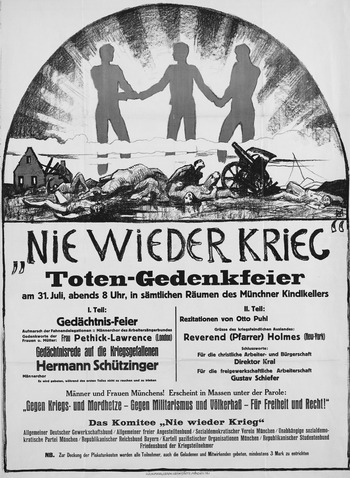
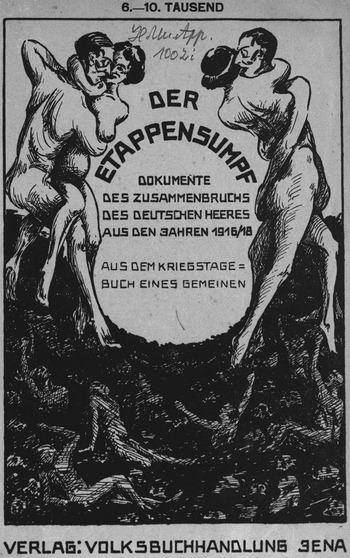

 Open access