



1 Introduction
Optimal polynomial approximants (OPAs) are polynomials which heuristically approximate the reciprocal of an element in a function space. For example, let X be a Banach space of analytic functions on a planar domain, for which polynomials are dense, that remains invariant under multiplication by polynomials. Also, let $\mathcal {P}_n$
be the set of all polynomials of degree at most n. Given
$\mathcal {P}_n$
be the set of all polynomials of degree at most n. Given $f \in X \setminus \{0\}$
and
$f \in X \setminus \{0\}$
and $n \in \mathbb {N} = \{0, 1, 2, \ldots \}$
, we say that a polynomial
$n \in \mathbb {N} = \{0, 1, 2, \ldots \}$
, we say that a polynomial $p_n$
in
$p_n$
in $\mathcal {P}_n$
is an n-th OPA to
$\mathcal {P}_n$
is an n-th OPA to $1/f$
if it minimizes
$1/f$
if it minimizes $\|1 - p f \|_X$
among all polynomials p in
$\|1 - p f \|_X$
among all polynomials p in $\mathcal {P}_n$
. Note that OPAs always exist (since
$\mathcal {P}_n$
. Note that OPAs always exist (since $f\cdot \mathcal {P}_n$
is a finite-dimensional subspace of X), but they are not necessarily uniquely determined.
$f\cdot \mathcal {P}_n$
is a finite-dimensional subspace of X), but they are not necessarily uniquely determined.
Under the name least squares inverses, Robinson [Reference Robinson40] introduced these approximants, in a restricted context, as a way to address various problems in signal processing. Chui [Reference Chui25], Chui and Chan [Reference Chui and Chan26], and Izumino [Reference Izumino36] followed the work of Robinson with related results. Fifty years later, starting with [Reference Bénéteau, Condori, Liaw, Seco and Sola6], a renewed interest in the subject arose due to significant and interesting connections to function theory, reproducing kernels, and orthogonal polynomials (see, e.g., the surveys [Reference Bénéteau and Centner5] and [Reference Seco43]). OPAs were further investigated in Dirichlet-type spaces [Reference Bénéteau, Fleeman, Khavinson, Seco and Sola8, Reference Bénéteau, Khavinson, Liaw, Seco and Simanek10], in more general reproducing kernel Hilbert spaces [Reference Fricain, Mashreghi and Seco31], in the spaces $\ell ^p_A$
[Reference Cheng, Ross and Seco24, Reference Seco and Téllez44], in
$\ell ^p_A$
[Reference Cheng, Ross and Seco24, Reference Seco and Téllez44], in $L^p$
of the unit circle [Reference Centner18], in Hilbert spaces of analytic functions on the bidisk [Reference Bénéteau, Condori, Liaw, Seco and Sola7, Reference Bénéteau, Knese, Kosiński, Liaw, Seco and Sola13] and on the unit ball [Reference Sargent and Sola41, Reference Sargent and Sola42], and in the context of free functions [Reference Arora, Augat, Jury and Sargent3]. Recently, a long-standing conjecture for OPAs in several variables was disproved in [Reference Bénéteau, Khavinson and Seco11]. See also [Reference Aguilera and Seco1, Reference Bénéteau, Ivrii, Manolaki and Seco9, Reference Bénéteau, Manolaki and Seco14, Reference Felder29, Reference Felder30] for related work.
$L^p$
of the unit circle [Reference Centner18], in Hilbert spaces of analytic functions on the bidisk [Reference Bénéteau, Condori, Liaw, Seco and Sola7, Reference Bénéteau, Knese, Kosiński, Liaw, Seco and Sola13] and on the unit ball [Reference Sargent and Sola41, Reference Sargent and Sola42], and in the context of free functions [Reference Arora, Augat, Jury and Sargent3]. Recently, a long-standing conjecture for OPAs in several variables was disproved in [Reference Bénéteau, Khavinson and Seco11]. See also [Reference Aguilera and Seco1, Reference Bénéteau, Ivrii, Manolaki and Seco9, Reference Bénéteau, Manolaki and Seco14, Reference Felder29, Reference Felder30] for related work.
In this article, we will focus on the Hardy spaces $H^p,$
which for
$H^p,$
which for $ 0 < p < \infty $
can be defined as
$ 0 < p < \infty $
can be defined as
 $$\begin{align*}H^p:= \left\{ f \in \operatorname{Hol}(\mathbb{D}) : \|f\|_p^p := \sup_{0 < r < 1} \frac{1}{2\pi} \int_0^{2 \pi} |f(r e^{i \theta})|^p \, d \theta < \infty \right\}, \end{align*}$$
where $\operatorname {Hol}(\mathbb {D})$
is the set of analytic functions on the open unit disc
$\operatorname {Hol}(\mathbb {D})$
is the set of analytic functions on the open unit disc $\mathbb {D}$
. In the case
$\mathbb {D}$
. In the case $p = \infty $
, we define
$p = \infty $
, we define
 $$\begin{align*}H^{\infty}:= \left\{ f\in\operatorname{Hol}(\mathbb{D}) : \|f\|_{\infty} := \sup_{z \in \mathbb{D}} \left|f(z)\right| < \infty \right\}. \end{align*}$$
For $ 1 \leqslant p \leqslant \infty ,$
it is well known that
$ 1 \leqslant p \leqslant \infty ,$
it is well known that $H^p$
is a Banach space and
$H^p$
is a Banach space and $H^2$
is a Hilbert space. Functions in
$H^2$
is a Hilbert space. Functions in $H^p$
have non-tangential limits almost everywhere on the unit circle
$H^p$
have non-tangential limits almost everywhere on the unit circle $\mathbb {T},$
and
$\mathbb {T},$
and $H^p$
functions restricted to their boundary values on
$H^p$
functions restricted to their boundary values on $\mathbb {T}$
can be viewed as a closed subspace of
$\mathbb {T}$
can be viewed as a closed subspace of $L^p:=L^p(\mathbb {T}, dm)$
, where
$L^p:=L^p(\mathbb {T}, dm)$
, where $dm$
is normalized Lebesgue measure on
$dm$
is normalized Lebesgue measure on $\mathbb {T}$
. Indeed,
$\mathbb {T}$
. Indeed, $H^p$
can equivalently be defined as the set of
$H^p$
can equivalently be defined as the set of $L^p$
functions with Fourier coefficients vanishing for negative frequencies. For more on
$L^p$
functions with Fourier coefficients vanishing for negative frequencies. For more on $H^p$
spaces, see, e.g., [Reference Duren27] or [Reference Hoffmann35].
$H^p$
spaces, see, e.g., [Reference Duren27] or [Reference Hoffmann35].
This work was initially motivated by the question of whether OPAs in $H^p$
(
$H^p$
( $p \neq 2$
) can have zeros in the closed unit disk, which, at the time of writing this manuscript, is still an open problem. This question arose from an interesting fact in
$p \neq 2$
) can have zeros in the closed unit disk, which, at the time of writing this manuscript, is still an open problem. This question arose from an interesting fact in $H^2$
: if
$H^2$
: if $f \in H^2$
is such that
$f \in H^2$
is such that $f(0) \neq 0$
, then the OPAs to
$f(0) \neq 0$
, then the OPAs to $1/f$
can never vanish in the closed disk [Reference Bénéteau, Khavinson, Sola, Liaw and Seco12, Reference Chui25].
$1/f$
can never vanish in the closed disk [Reference Bénéteau, Khavinson, Sola, Liaw and Seco12, Reference Chui25].
Note for $f \in H^p$
, if
$f \in H^p$
, if $f(0) = 0$
, then by subharmonicity, all OPAs in
$f(0) = 0$
, then by subharmonicity, all OPAs in $H^p$
(
$H^p$
( $1 \leqslant p \leqslant \infty $
) vanish identically. It is also worth noting that for
$1 \leqslant p \leqslant \infty $
) vanish identically. It is also worth noting that for $p = 1$
and
$p = 1$
and $p = \infty ,$
OPAs are not uniquely defined, unlike the case of
$p = \infty ,$
OPAs are not uniquely defined, unlike the case of $1<p<\infty $
. Therefore, for the rest of this work, we will consider only
$1<p<\infty $
. Therefore, for the rest of this work, we will consider only $ 1 < p < \infty $
and functions
$ 1 < p < \infty $
and functions $f \in H^p$
such that
$f \in H^p$
such that $f(0) \neq 0$
.
$f(0) \neq 0$
.
OPAs are intimately linked with the forward shift S, given by $(Sf)(z) = zf(z)$
; the projection of the unit constant function onto the subspace
$(Sf)(z) = zf(z)$
; the projection of the unit constant function onto the subspace $\operatorname {span}\{S^kf: k = 0, 1, \ldots , n \}$
is f multiplied by the OPA of degree up to n. When
$\operatorname {span}\{S^kf: k = 0, 1, \ldots , n \}$
is f multiplied by the OPA of degree up to n. When $p=2$
, this projection is an orthogonal projection and the Hilbert space structure makes computation of OPAs straightforward with linear algebra techniques. However, when
$p=2$
, this projection is an orthogonal projection and the Hilbert space structure makes computation of OPAs straightforward with linear algebra techniques. However, when $p\neq 2$
, the projection is a metric projection, which is nonlinear, and makes explicit computation of OPAs much more difficult. In this article, we find a strikingly simple expression for the limit of OPAs in
$p\neq 2$
, the projection is a metric projection, which is nonlinear, and makes explicit computation of OPAs much more difficult. In this article, we find a strikingly simple expression for the limit of OPAs in $H^p$
without calculating the OPAs explicitly. We will often use z interchangeably with S, and say a subspace M is z-invariant if
$H^p$
without calculating the OPAs explicitly. We will often use z interchangeably with S, and say a subspace M is z-invariant if $SM \subseteq M$
. If
$SM \subseteq M$
. If $f\in H^p$
has corresponding OPAs
$f\in H^p$
has corresponding OPAs $(p_n)_{n\ge 0}$
, then
$(p_n)_{n\ge 0}$
, then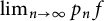 $\lim _{n \to \infty } p_nf$
can be seen as the projection of 1 onto the z-invariant subspace
$\lim _{n \to \infty } p_nf$
can be seen as the projection of 1 onto the z-invariant subspace
 $$\begin{align*}[f]_p := \overline{\operatorname{span}\{S^kf: k = 0, 1, 2, \ldots \}}^{H^p}. \end{align*}$$
It is critical for us to recall the celebrated theorem of Beurling, which describes every closed nontrivial z-invariant subspace M of $H^2$
as
$H^2$
as $M = J \cdot H^2$
, for some inner function J (a function in
$M = J \cdot H^2$
, for some inner function J (a function in $H^\infty $
is called inner if it has boundary values of unit modulus almost everywhere). Note that Beurling’s Theorem holds for all
$H^\infty $
is called inner if it has boundary values of unit modulus almost everywhere). Note that Beurling’s Theorem holds for all $0 < p < \infty $
(see, e.g., [Reference Garnett32, p. 98]) and for weak-
$0 < p < \infty $
(see, e.g., [Reference Garnett32, p. 98]) and for weak- $*$
closed subspaces of
$*$
closed subspaces of $H^{\infty }$
(see, e.g., [Reference Garnett32, Theorem 7.5, Chapter 2]). A significant focus of this work is placed on studying projections of 1 onto these subspaces.
$H^{\infty }$
(see, e.g., [Reference Garnett32, Theorem 7.5, Chapter 2]). A significant focus of this work is placed on studying projections of 1 onto these subspaces.
As we will see, these projections naturally lead to approximating (in $L^p$
) conjugates of inner functions by
$L^p$
) conjugates of inner functions by $H^p$
functions. Given an
$H^p$
functions. Given an $H^p$
function, we determine the distance between
$H^p$
function, we determine the distance between $1$
and the z-invariant subspace of
$1$
and the z-invariant subspace of $H^p$
generated by that function. In
$H^p$
generated by that function. In $H^2$
, that distance is measured via the orthogonal projection of
$H^2$
, that distance is measured via the orthogonal projection of $1$
onto the invariant subspace. Indeed, that orthogonal projection gives a scalar multiple of the generating inner function. This approach gives rise to a proof of Beurling’s Theorem for
$1$
onto the invariant subspace. Indeed, that orthogonal projection gives a scalar multiple of the generating inner function. This approach gives rise to a proof of Beurling’s Theorem for $H^2$
(see, e.g., [Reference Hoffmann35, p. 100]). Again, we note for
$H^2$
(see, e.g., [Reference Hoffmann35, p. 100]). Again, we note for $p \neq 2$
,
$p \neq 2$
, $H^p$
is not a Hilbert space but rather a Banach space and in this setting we no longer have orthogonal projections, but rather metric projections. Although these projections are non-linear, we can still discuss orthogonality in the Birkhoff–James sense. Our immediate aim is to explore several questions, including:
$H^p$
is not a Hilbert space but rather a Banach space and in this setting we no longer have orthogonal projections, but rather metric projections. Although these projections are non-linear, we can still discuss orthogonality in the Birkhoff–James sense. Our immediate aim is to explore several questions, including:
-
- What is the metric projection of $1$
onto a z-invariant subspace in
$H^p$
?
$1$
onto a z-invariant subspace in
$H^p$
? -
- Is the projection of
$1$
onto a z-invariant subspace an inner function? -
- If the projection of
$1$
onto a z-invariant subspace is not an inner function, does the projection have an inner factor which is not shared with the generating function for the subspace? -
- Given a z-invariant subspace, what is the distance between
$1$
and that invariant subspace?


When considering metric projections, the use of duality is a critical tool for the related extremal problem (see, e.g., [Reference Duren27, Reference Khavinson38]). In our context, the statement of duality is as follows. Let $1 < p < \infty $
,
$1 < p < \infty $
, $\psi \in L^p$
, and
$\psi \in L^p$
, and $q = \frac {p}{p-1}$
. Then the distance between
$q = \frac {p}{p-1}$
. Then the distance between $\psi $
and
$\psi $
and $H^p$
can be expressed as the norm of the linear functional given by
$H^p$
can be expressed as the norm of the linear functional given by $\psi $
on the annihilator of
$\psi $
on the annihilator of $H^p$
inside
$H^p$
inside $L^q,$
namely,
$L^q,$
namely,
 $$ \begin{align} \sup_{\|f\|_{q} \leqslant 1} \left| \frac{1}{2 \pi i} \int_{\mathbb{T}} f(\zeta) \psi(\zeta) \, d \zeta \right| = \inf_{\varphi \in H^p} \| \psi - \varphi \|_{L^p}. \end{align} $$
The article is organized as follows:
-
- In Section 2, we discuss the background needed to pass from the Hilbert setting to the more general Banach setting. In particular, we introduce Birkhoff–James orthogonality and state some useful inequalities, known as Pythagorean inequalities, which will be used in the subsequent sections.
-
- In Section 3, we answer the questions posed above by finding an explicit formula for the metric projection of
$1$
onto any z-invariant subspace of
$H^p$
and calculating the associated distance. This leads to several corollaries that enrich our understanding of the lattice of z-invariant subspaces of
$H^p$
. -
- In Section 4, we study the zeros of OPAs in
$H^p$
and outline a possible path to prove that those zeros always lie outside
$\mathbb {D}$
for any
$p \neq 2$
. We also consider planar disks, centered at the origin, in which OPAs cannot vanish. We establish several estimates for the radius of such a disk, depending only on p and f, for which OPAs are zero-free. -
- Finally, in Section 5, we conclude with some comments and open questions.


2 Preliminaries: Birkhoff–James orthogonality and Pythagorean inequalities
Recall that in $H^2$
, if M is a closed nontrivial z-invariant subspace of
$H^2$
, if M is a closed nontrivial z-invariant subspace of $H^2$
, then the orthogonal projection of
$H^2$
, then the orthogonal projection of $1$
onto M gives a scalar multiple of the inner function that is the generator for M. We seek to understand the properties of the analogous metric projection when
$1$
onto M gives a scalar multiple of the inner function that is the generator for M. We seek to understand the properties of the analogous metric projection when $1 < p < \infty $
. Recall that the metric projection of
$1 < p < \infty $
. Recall that the metric projection of $1$
onto a z-invariant subspace
$1$
onto a z-invariant subspace $M \subseteq H^p$
is the unique function
$M \subseteq H^p$
is the unique function $g_p^*$
minimizing
$g_p^*$
minimizing $\| 1 - g\|_p$
over all
$\| 1 - g\|_p$
over all $g \in M$
. We are particularly interested in obtaining an explicit formula for this projection and determining whether or not it is a generator of M. Since by Beurling’s Theorem, we know that
$g \in M$
. We are particularly interested in obtaining an explicit formula for this projection and determining whether or not it is a generator of M. Since by Beurling’s Theorem, we know that $M = [J]_p$
for some inner function J, we are equivalently asking if
$M = [J]_p$
for some inner function J, we are equivalently asking if $g_p^* = J \cdot G,$
where G is an outer function. To examine this question, it will be useful to have some background on metric projections.
$g_p^* = J \cdot G,$
where G is an outer function. To examine this question, it will be useful to have some background on metric projections.
Let $\mathbf {x}$
and
$\mathbf {x}$
and $\mathbf {y}$
be vectors belonging to a normed linear space
$\mathbf {y}$
be vectors belonging to a normed linear space $\mathscr {X}$
. We say that
$\mathscr {X}$
. We say that $\mathbf {x}$
is orthogonal to
$\mathbf {x}$
is orthogonal to $\mathbf {y}$
in the Birkhoff–James sense if
$\mathbf {y}$
in the Birkhoff–James sense if
 $$\begin{align*}\| \mathbf{x} + \beta \mathbf{y} \|_{\mathscr{X}} \geqslant \|\mathbf{x}\|_{\mathscr{X}} \end{align*}$$
for all scalars $\beta $
[Reference Birkhoff15, Reference James37]. In this situation, we write
$\beta $
[Reference Birkhoff15, Reference James37]. In this situation, we write $\mathbf {x} \perp _{\mathscr {X}} \mathbf {y}$
. This way of generalizing orthogonality is particularly useful in our context since it is based on an extremal condition.
$\mathbf {x} \perp _{\mathscr {X}} \mathbf {y}$
. This way of generalizing orthogonality is particularly useful in our context since it is based on an extremal condition.
If $\mathscr {X}$
is an inner product space, then the relation
$\mathscr {X}$
is an inner product space, then the relation $ \perp _{\mathscr {X}} $
coincides with the usual orthogonality relation. In more general spaces, however, the relation
$ \perp _{\mathscr {X}} $
coincides with the usual orthogonality relation. In more general spaces, however, the relation $\perp _{\mathscr {X}}$
is neither symmetric nor linear. In the case
$\perp _{\mathscr {X}}$
is neither symmetric nor linear. In the case $\mathscr {X} = L^p(\mu )$
, for a measure
$\mathscr {X} = L^p(\mu )$
, for a measure $\mu $
, let us write
$\mu $
, let us write $\perp _p$
instead of
$\perp _p$
instead of $\perp _{L^p}$
. When
$\perp _{L^p}$
. When $1<p<\infty $
, Birkhoff–James orthogonality in
$1<p<\infty $
, Birkhoff–James orthogonality in $L^p$
can be expressed as an integral condition, which will be useful later.
$L^p$
can be expressed as an integral condition, which will be useful later.
Theorem 2.1 (James [Reference James37])
Suppose that $1<p<\infty $
. If f and g are elements of
$1<p<\infty $
. If f and g are elements of $L^p$
, then
$L^p$
, then
 $$ \begin{align} {f} \perp_{p} {g} \iff \int |f|^{p - 2} \overline{f} g \,d\mu = 0, \end{align} $$
where any occurrence of “ $|0|^{p - 2} \overline {0}$
” in the integrand is interpreted as zero.
$|0|^{p - 2} \overline {0}$
” in the integrand is interpreted as zero.
For a short proof of this criterion for orthogonality in $L^p$
, see [Reference Duren and Schuster28, Theorem A, p. 124]. For an extension to more general normed spaces, see [Reference Beauzamy4]. In light of this integral orthogonality condition, we define, for a measurable function f and any
$L^p$
, see [Reference Duren and Schuster28, Theorem A, p. 124]. For an extension to more general normed spaces, see [Reference Beauzamy4]. In light of this integral orthogonality condition, we define, for a measurable function f and any $s> 0$
, the notation
$s> 0$
, the notation
 $$ \begin{align} f^{\langle s \rangle} := |f|^{s-1}\overline{f}. \end{align} $$
Note that if $f \in L^p$
for
$f \in L^p$
for $1 < p < \infty ,$
then
$1 < p < \infty ,$
then $f^{\langle p-1 \rangle } \in L^q,$
where p and q are conjugate exponents, and then for
$f^{\langle p-1 \rangle } \in L^q,$
where p and q are conjugate exponents, and then for $g \in L^p,$
 $$\begin{align*}f \perp_{p} g \iff \langle g, f^{\langle p - 1\rangle} \rangle = 0, \end{align*}$$
where $\langle \cdot \ , \cdot \rangle $
is the standard dual pairing between
$\langle \cdot \ , \cdot \rangle $
is the standard dual pairing between $L^p$
and its dual. Consequently, the relation
$L^p$
and its dual. Consequently, the relation $\perp _{p}$
is linear in its second argument, and it then makes sense to speak of a vector being orthogonal to a subspace of
$\perp _{p}$
is linear in its second argument, and it then makes sense to speak of a vector being orthogonal to a subspace of $L^p$
. In particular, if
$L^p$
. In particular, if $f \perp _p g$
for all g belonging to a subspace
$f \perp _p g$
for all g belonging to a subspace $\mathscr {M}$
of
$\mathscr {M}$
of $L^p$
, then
$L^p$
, then
 $$\begin{align*}\| f + g \|_{L^p} \geqslant \|f\|_{L^p} \end{align*}$$
for all $g \in \mathscr {M},$
and thus
$g \in \mathscr {M},$
and thus $\operatorname {dist}_{L^p}(f, \mathscr {M}) = \|f\|_{L^p}$
. In other words, the best approximation to f in
$\operatorname {dist}_{L^p}(f, \mathscr {M}) = \|f\|_{L^p}$
. In other words, the best approximation to f in $\mathscr {M}$
is
$\mathscr {M}$
is $0$
, or, using another terminology, f is badly approximable by
$0$
, or, using another terminology, f is badly approximable by $\mathscr {M}$
. In our case, we will be interested in
$\mathscr {M}$
. In our case, we will be interested in $f = 1 - g^*,$
where
$f = 1 - g^*,$
where $g^*$
is the metric projection of
$g^*$
is the metric projection of $1$
onto
$1$
onto $\mathscr {M}$
, and therefore, to identify
$\mathscr {M}$
, and therefore, to identify $g^*$
, we are looking for
$g^*$
, we are looking for $g^* \in \mathscr {M}$
such that
$g^* \in \mathscr {M}$
such that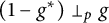 $(1-g^*) \perp _p g$
for every
$(1-g^*) \perp _p g$
for every $g \in \mathscr {M}$
.
$g \in \mathscr {M}$
.
There is a version of the Pythagorean Theorem for $L^p$
, where orthogonality is in the Birkhoff–James sense. It takes the form of a family of inequalities relating the lengths of orthogonal vectors with that of their sum.
$L^p$
, where orthogonality is in the Birkhoff–James sense. It takes the form of a family of inequalities relating the lengths of orthogonal vectors with that of their sum.
Theorem 2.2 Suppose $f \perp _p g$
in
$f \perp _p g$
in $L^p$
. If
$L^p$
. If $p \in (1, 2]$
, then
$p \in (1, 2]$
, then
 $$ \begin{align} \| f + g \|^p_{L^p} & \leqslant \|f\|^p_{L^p} + \frac{1}{2^{p-1}-1}\|g\|^p_{L^p} \end{align} $$
 $$ \begin{align} \| f + g \|^2_{L^p} & \geqslant \|f\|^2_{L^p} + (p-1)\|g\|^2_{L^p}. \end{align} $$
If $p \in [2, \infty )$
, then
$p \in [2, \infty )$
, then
 $$ \begin{align} \| f + g \|^p_{L^p} & \geqslant \|f\|^p_{L^p} + \frac{1}{2^{p-1}-1}\|g\|^p_{L^p} \end{align} $$
 $$ \begin{align} \| f + g \|^2_{L^p} & \leqslant \|f\|^2_{L^p} + (p-1)\|g\|^2_{L^p}. \end{align} $$
These inequalities originate from [Reference Bynum16, Reference Bynum and Drew17, Reference Cheng, Miamee and Pourahmadi22] (see [Reference Cheng and Ross23, Corollary 3.4] for a unified treatment with broader classes of spaces).
It will be expedient to refer to (2.3) and (2.6) as the upper Pythagorean inequalities, and (2.4) and (2.5) as the lower Pythagorean inequalities, so that the two cases depending on p can be handled together. The specific values of the positive multiplicative constants, that is, $p-1$
and
$p-1$
and $1/(2^{p-1}-1)$
, are generally unimportant, and thus they will usually be denoted simply by K.
$1/(2^{p-1}-1)$
, are generally unimportant, and thus they will usually be denoted simply by K.
3 Metric projections of
$1$
onto invariant subspaces

For $f \in H^p$
, recall that
$f \in H^p$
, recall that $[f]_p$
denotes the closure of the polynomial multiples of f in
$[f]_p$
denotes the closure of the polynomial multiples of f in $H^p$
. Colloquially, we say that
$H^p$
. Colloquially, we say that $[f]_p$
is the closed z-invariant subspace generated by f. The present section deals with solving the minimization problem
$[f]_p$
is the closed z-invariant subspace generated by f. The present section deals with solving the minimization problem
 $$\begin{align*}\inf_{g \in M} \| 1 - g\|_p, \end{align*}$$
where M is a z-invariant subspace. We will use several standard facts concerning $H^p$
functions; for example, if
$H^p$
functions; for example, if $J\in H^p$
is inner, then by Beurling’s Theorem,
$J\in H^p$
is inner, then by Beurling’s Theorem, $[J]_p = J \cdot H^p$
, a function
$[J]_p = J \cdot H^p$
, a function $f \in H^p$
is outer if and only if
$f \in H^p$
is outer if and only if $[f]_p = H^p$
, and a polynomial is outer if and only if it does not vanish in the open disk. See [Reference Duren27] for more properties of
$[f]_p = H^p$
, and a polynomial is outer if and only if it does not vanish in the open disk. See [Reference Duren27] for more properties of $H^p$
functions.
$H^p$
functions.
3.1 Extremal functions and distances
We first consider the case where the z-invariant subspace M is generated by a finite Blaschke product.
Proposition 3.1 Let $1<p<\infty $
. If J is the finite Blaschke product
$1<p<\infty $
. If J is the finite Blaschke product
 $$\begin{align*}J(z) = \prod_{k=1}^{N}\frac{ z - a_k }{ 1 - \bar{a}_k z } \end{align*}$$
with zeros $a_1, a_2,\ldots , a_N\in \mathbb {D}\setminus \{0\}$
, then
$a_1, a_2,\ldots , a_N\in \mathbb {D}\setminus \{0\}$
, then
 $$\begin{align*}\inf_{h\in H^p}\|1 - Jh\|_p \end{align*}$$
is attained when $h = h^*$
, where for
$h = h^*$
, where for $ N> 1$
,
$ N> 1$
,
 $$ \begin{align} 1 - J(z)h^*(z) = (1 - |a_1 a_2 \dots a_N|^2)^{2/p} \Bigg[ \frac{\prod_{k=1}^{d}(1 - \bar{w}_k z)}{\prod_{k=1}^{N}(1 - \bar{a}_k z)}\Bigg]^{2/p},\ z \in \mathbb{D} \end{align} $$
and the parameters $w_1, w_2,\ldots w_d \in \overline {\mathbb {D}}\setminus \{0\}$
satisfy
$w_1, w_2,\ldots w_d \in \overline {\mathbb {D}}\setminus \{0\}$
satisfy
 $$ \begin{align} 1 = (1 - |a_1 a_2 \dots a_N|^2)\frac{\prod_{k=1}^{d}(1 - \bar{w}_k a_j)}{\prod_{k=1}^{N}(1 - \bar{a}_k a_j)} \end{align} $$
for all j, $1\leqslant j \leqslant N$
, where
$1\leqslant j \leqslant N$
, where $1 \leqslant d \leqslant N-1$
. For
$1 \leqslant d \leqslant N-1$
. For $N = 1$
,
$N = 1$
,
 $$ \begin{align} 1 - J(z)h^*(z) = \Bigg[ \frac{1 - |a_1|^2}{1 - \bar{a}_1 z}\Bigg]^{2/p},\ z \in \mathbb{D}. \end{align} $$
Moreover, $\operatorname {dist}_{H^p} (1, [J]_p) = \left (1 - |J(0)|^2 \right )^{1/p}$
.
$\operatorname {dist}_{H^p} (1, [J]_p) = \left (1 - |J(0)|^2 \right )^{1/p}$
.
Proof The function
 $$\begin{align*}\overline{ a_1 a_2 \dots a_N}J(z) = \overline{ a_1 a_2 \dots a_N} \prod_{k=1}^{N}\frac{z - a_k}{1-\bar{a}_k z} \end{align*}$$
takes values in a disk of radius $|a_1 a_2 \dots a_N|<1$
. Consequently, the function
$|a_1 a_2 \dots a_N|<1$
. Consequently, the function
 $$ \begin{align*} 1 - (-1)^N\overline{ a_1 a_2 \dots a_N} \prod_{k=1}^{N}\frac{z - a_k}{1-\bar{a}_k z} = 1 - \overline{J(0)}J(z) \end{align*} $$
is outer. It remains outer if we multiply through by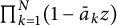 $\prod _{k=1}^{N}(1 - \bar {a}_k z)$
. That is to say,
$\prod _{k=1}^{N}(1 - \bar {a}_k z)$
. That is to say,
 $$ \begin{align} \prod_{k=1}^{N}(1 - \bar{a}_k z) - (-1)^N \overline{ a_1 a_2 \dots a_N} \prod_{k=1}^{N}(z - a_k) \end{align} $$
is an outer polynomial. In fact, the degree N terms cancel, leaving an outer polynomial of degree $d\leqslant N-1$
. If
$d\leqslant N-1$
. If $N = 1$
, we simply obtain the constant
$N = 1$
, we simply obtain the constant $1 - |a_1|^2$
and the proof is complete for that case. Otherwise, we write the outer polynomial (3.4) as
$1 - |a_1|^2$
and the proof is complete for that case. Otherwise, we write the outer polynomial (3.4) as
 $$ \begin{align} c(1 - \bar{w}_1 z)(1 - \bar{w}_2 z)\dots(1 - \bar{w}_{d}z). \end{align} $$
Because this polynomial is outer, each $w_k$
satisfies
$w_k$
satisfies $0<|w_k| \leqslant 1$
. Substituting
$0<|w_k| \leqslant 1$
. Substituting $z = a_j$
into the equation
$z = a_j$
into the equation
 $$\begin{align*}\prod_{k=1}^{N}(1 - \bar{a}_k z) - (-1)^N \overline{ a_1 a_2 \dots a_N} \prod_{k=1}^{N}(z - a_k) = c(1 - \bar{w}_1 z)(1 - \bar{w}_2 z)\dots(1 - \bar{w}_{d}z) \end{align*}$$
yields
 $$ \begin{align*} \prod_{k=1}^{N}(1 - \bar{a}_k a_j) &- (-1)^N \overline{ a_1 a_2 \dots a_N} \prod_{k=1}^{N}(a_j - a_k)\\ &= c(1 - \bar{w}_1 a_j)(1 - \bar{w}_2 a_j)\dots(1 - \bar{w}_{d}a_j) \end{align*} $$
and so
 $$ \begin{align} \prod_{k=1}^{N}(1 - \bar{a}_k a_j) -0 &= c \prod_{k=1}^{d}(1 - \bar{w}_k a_j) \nonumber \\ \implies1 &= c\frac{\prod_{k=1}^{d}(1 - \bar{w}_k a_j)}{\prod_{k=1}^{N}(1 - \bar{a}_k a_j)} \end{align} $$
for each j, $1\leqslant j\leqslant N$
. The rational expression
$1\leqslant j\leqslant N$
. The rational expression
 $$\begin{align*}\frac{\prod_{k=1}^{d}(1 - \bar{w}_k z)}{\prod_{k=1}^{N}(1 - \bar{a}_k z)} \end{align*}$$
is outer, so that its $2/p$
power is an analytic function in
$2/p$
power is an analytic function in $\mathbb {D}$
. The condition (3.6) tells us that the
$\mathbb {D}$
. The condition (3.6) tells us that the $H^p$
function
$H^p$
function
 $$ \begin{align*} 1 - \Bigg[c\frac{\prod_{k=1}^{d}(1 - \bar{w}_k z)}{\prod_{k=1}^{N}(1 - \bar{a}_k z)}\Bigg]^{2/p} = 1 - \left( 1 - \overline{J(0)} J(z) \right)^{2/p} \end{align*} $$
has zeros at $a_1, a_2,\ldots , a_N$
, and thus can be written as
$a_1, a_2,\ldots , a_N$
, and thus can be written as $Jh$
for some
$Jh$
for some $h \in H^p$
. Rearranging gives
$h \in H^p$
. Rearranging gives
 $$ \begin{align} 1 - J(z)h(z) = \Bigg[c\frac{\prod_{k=1}^{d}(1 - \bar{w}_k z)}{\prod_{k=1}^{N}(1 - \bar{a}_k z)}\Bigg]^{2/p} = \left( 1 - \overline{J(0)} J(z) \right)^{2/p}, \end{align} $$
an outer function in $H^p$
.
$H^p$
.
Recalling notation from (2.2), we have, for $|z|=1$
,
$|z|=1$
,
 $$ \begin{align} (1- J h)^{\langle p-1 \rangle}J &= \left\{ \Bigg[ c\frac{\prod_{k=1}^{d}(1 - \bar{w}_k z)}{\prod_{k=1}^{N}(1 - \bar{a}_k z)}\Bigg]^{2/p}\right\}^{\langle p-1 \rangle} \prod_{k=1}^{N}\frac{(z - a_k) }{ (1-\bar{a}_k z) } \nonumber \\ &= \left\{ \Bigg[ c\frac{\prod_{k=1}^{d}(1 - \bar{w}_k z)}{\prod_{k=1}^{N}(1 - \bar{a}_k z)}\Bigg]^{2/p}\right\}^{(p-2)/2}\nonumber\\ &\cdot\left\{\overline{ \Bigg[ c\frac{\prod_{k=1}^{d}(1 - \bar{w}_k z)}{\prod_{k=1}^{N}(1 - \bar{a}_k z)} } \Bigg]^{2/p}\right\}^{1+(p-2)/2} \prod_{k=1}^{N}\frac{(z - a_k) }{ (1-\bar{a}_k z) } \nonumber \\ &= \Bigg[ c\frac{\prod_{k=1}^{d}(1 - \bar{w}_k z)}{\prod_{k=1}^{N}(1 - \bar{a}_k z)}\Bigg]^{(p-2)/p} \bar{c}\frac{\prod_{k=1}^{d}(1 - {w}_k \bar{z})}{\prod_{k=1}^{N}(1 - {a}_k \bar{z})} \cdot\prod_{k=1}^{N}\frac{(z - a_k) }{ (1-\bar{a}_k z) } \nonumber\\ &= \Bigg[ c\frac{\prod_{k=1}^{d}(1 - \bar{w}_k z)}{\prod_{k=1}^{N}(1 - \bar{a}_k z)}\Bigg]^{(p-2)/p} \bar{c}z^{N-d} \frac{\prod_{k=1}^{d}(z - {w}_k )}{\prod_{k=1}^{N}(z - {a}_k)} \cdot\frac{ \prod_{k=1}^{N}(z - a_k) }{ \prod_{k=1}^{N}(1-\bar{a}_k z) } \nonumber \\ &= z^{N-d} \Bigg[ c\frac{\prod_{k=1}^{d}(1 - \bar{w}_k z)}{\prod_{k=1}^{N}(1 - \bar{a}_k z)}\Bigg]^{(p-2)/p} \bar{c} \frac{\prod_{k=1}^{d}(z - {w}_k )}{ \prod_{k=1}^{N}(1-\bar{a}_k z)}, \end{align} $$
which is $z^{N-d}$
, multiplied by an element of
$z^{N-d}$
, multiplied by an element of $H^q$
. Notice also that the exponent
$H^q$
. Notice also that the exponent $N-d$
is an integer greater than or equal to
$N-d$
is an integer greater than or equal to $1$
. These conditions imply that, for all
$1$
. These conditions imply that, for all $n\geqslant 0$
,
$n\geqslant 0$
,
 $$\begin{align*}\int_{0}^{2\pi} (1- J(e^{i\theta}) h(e^{i\theta}))^{\langle p-1 \rangle}J(e^{i\theta}) e^{in\theta}\,\frac{d\theta}{2\pi} = 0, \end{align*}$$
and hence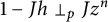 $1-Jh \perp _p J z^n$
for all indices
$1-Jh \perp _p J z^n$
for all indices $n\geqslant 0$
. We may conclude that
$n\geqslant 0$
. We may conclude that $h= h^*$
is indeed the extremal function for which we are looking.
$h= h^*$
is indeed the extremal function for which we are looking.
By comparing (3.4) and (3.5) when $z=0$
, we obtain
$z=0$
, we obtain $c = 1 - |a_1 a_2 \dots a_N|^2$
. Moreover, from (3.7),
$c = 1 - |a_1 a_2 \dots a_N|^2$
. Moreover, from (3.7),
 $$ \begin{align*} \operatorname{dist}_{H^p} (1, [J]_p) &= \| 1 - J h^*\|_p\\ &= \left\|\left( 1 - \overline{J(0)} J \right)^{2/p}\right\|_p \\ &= \| 1 - \overline{J(0)} J \|_2^{2/p} \\ &= \left(1 - |J(0)|^2 \right)^{1/p}, \end{align*} $$
as claimed.
We note that Proposition 3.1 provides explicit information about the constants $w_k$
. The solution (3.1) to the extremal problem is consistent with equation (11) on page 138 of Duren [Reference Duren27], which solves the general dual extremal problem in
$w_k$
. The solution (3.1) to the extremal problem is consistent with equation (11) on page 138 of Duren [Reference Duren27], which solves the general dual extremal problem in $H^p$
with rational kernels. The benefit of the present approach, in which the kernel arises in connection with a finite Blaschke product, is that condition (3.2) enables the direct calculation of the parameters
$H^p$
with rational kernels. The benefit of the present approach, in which the kernel arises in connection with a finite Blaschke product, is that condition (3.2) enables the direct calculation of the parameters $w_k$
,
$w_k$
, $1 \leqslant k \leqslant N-1$
, as well as the scaling factor; on the other hand, in [Reference Duren27], the determination of these parameters is left open as a “very difficult problem.” For
$1 \leqslant k \leqslant N-1$
, as well as the scaling factor; on the other hand, in [Reference Duren27], the determination of these parameters is left open as a “very difficult problem.” For $N = 1,$
the constants
$N = 1,$
the constants $w_k$
are absent and the formula (3.3) is a normalized power of the Szegö kernel.
$w_k$
are absent and the formula (3.3) is a normalized power of the Szegö kernel.
Using the following lemma, we can extend the hypotheses of Proposition 3.1 to include any inner function.
Lemma 3.2 Let $1<p<\infty $
and J be an inner function. Then there exists a sequence
$1<p<\infty $
and J be an inner function. Then there exists a sequence $(J_n)_{n\ge 0}$
of finite Blaschke products such that
$(J_n)_{n\ge 0}$
of finite Blaschke products such that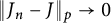 $\|J_n-J\|_p\to 0$
as
$\|J_n-J\|_p\to 0$
as $n \to \infty $
.
$n \to \infty $
.
Proof Firstly, it is known that the set of (infinite) Blaschke products is dense in the set of inner functions with respect to the $H^\infty $
norm, and thus also the
$H^\infty $
norm, and thus also the $H^p$
norm (this is a corollary of a theorem of Frostman; see [Reference Garnett32, Corollary 6.5]). Thus, it suffices to consider the case where J is an infinite Blaschke product
$H^p$
norm (this is a corollary of a theorem of Frostman; see [Reference Garnett32, Corollary 6.5]). Thus, it suffices to consider the case where J is an infinite Blaschke product
 $$\begin{align*}J(z) = \zeta\prod_{k=1}^{\infty} \frac{|a_k|}{a_k}\frac{ a_k -z }{ 1- \bar{a_k} z }, \ \ z\in\mathbb{D,} \end{align*}$$
where $\zeta \in \mathbb {T}$
and
$\zeta \in \mathbb {T}$
and $(a_k)_{k=1}^\infty $
is a Blaschke sequence in
$(a_k)_{k=1}^\infty $
is a Blaschke sequence in $\mathbb {D}$
. For
$\mathbb {D}$
. For $n\in \mathbb {N,}$
we set
$n\in \mathbb {N,}$
we set
 $$\begin{align*}J_n(z) = \zeta\prod_{k=1}^{n}\frac{|a_k|}{a_k}\frac{ a_k -z }{ 1- \bar{a_k} z },z\in\mathbb{D}. \end{align*}$$
We know that $\|J_n-J\|_2\to 0$
(see the lemma on p. 64 in [Reference Hoffmann35] and the discussion thereafter). Thus, the result follows immediately if
$\|J_n-J\|_2\to 0$
(see the lemma on p. 64 in [Reference Hoffmann35] and the discussion thereafter). Thus, the result follows immediately if $1 < p < 2$
. If
$1 < p < 2$
. If $p>2$
, then, almost everywhere on the circle, we have
$p>2$
, then, almost everywhere on the circle, we have
 $$\begin{align*}|J_n-J|^p=|J_n-J|^2\cdot|J_n-J|^{p-2}\leqslant|J_n-J|^2\cdot2^{p-2} \end{align*}$$
and so $\|J_n-J\|_p\leqslant \|J_n-J\|_2^{\frac {1}{p}}\cdot 2^{\frac {p-2}{p}}$
, which gives the desired result.
$\|J_n-J\|_p\leqslant \|J_n-J\|_2^{\frac {1}{p}}\cdot 2^{\frac {p-2}{p}}$
, which gives the desired result.
We now extend Proposition 3.1.
Theorem 3.3 Let $1<p<\infty $
. Suppose J is an inner function with
$1<p<\infty $
. Suppose J is an inner function with $J(0)\neq 0$
, and
$J(0)\neq 0$
, and
 $$ \begin{align} \inf_{h\in H^p}\|1 - Jh\|_p \end{align} $$
is attained when $h = h^*$
. Then
$h = h^*$
. Then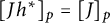 $[Jh^*]_p = [J]_p$
and, in particular,
$[Jh^*]_p = [J]_p$
and, in particular, $h^*$
is outer. Moreover,
$h^*$
is outer. Moreover,
 $$\begin{align*}\operatorname{dist}_{H^p} (1, [J]_p) = \left(1 - |J(0)|^2 \right)^{1/p}. \end{align*}$$
Proof By Lemma 3.2, we can find a sequence $(J_n)_{n\ge 0}$
of finite Blaschke products converging to J in
$(J_n)_{n\ge 0}$
of finite Blaschke products converging to J in $H^p$
. Hence, by continuity of metric projections, we have
$H^p$
. Hence, by continuity of metric projections, we have $\operatorname {dist}_{H^p} (1, [J_n]_p) \to \operatorname {dist}_{H^p} (1, [J]_p)$
as
$\operatorname {dist}_{H^p} (1, [J_n]_p) \to \operatorname {dist}_{H^p} (1, [J]_p)$
as $n\to \infty $
(see [Reference Cheng, Mashreghi and Ross21, Proposition 4.8.1]). By Proposition 3.1,
$n\to \infty $
(see [Reference Cheng, Mashreghi and Ross21, Proposition 4.8.1]). By Proposition 3.1,
 $$ \begin{align*} \operatorname{dist}_{H^p} (1, [J_n]_p) = \left(1 - |J_n(0)|^2 \right)^{1/p}, \end{align*} $$
but since $J_n \rightarrow J$
in
$J_n \rightarrow J$
in $H^p$
, certainly
$H^p$
, certainly $J_n(0) \rightarrow J(0),$
and therefore
$J_n(0) \rightarrow J(0),$
and therefore
 $$ \begin{align} \operatorname{dist}_{H^p} (1, [J]_p) = \left(1 - |J(0)|^2 \right)^{1/p}. \end{align} $$
Now let us show that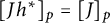 $[Jh^*]_p = [J]_p$
, that is, that
$[Jh^*]_p = [J]_p$
, that is, that $h^*$
is outer. Suppose
$h^*$
is outer. Suppose $h^* = J_1 g$
for some nontrivial inner function
$h^* = J_1 g$
for some nontrivial inner function $J_1$
and
$J_1$
and $g \in H^p$
outer. Then by the above established distance formula (3.10), and using the fact that
$g \in H^p$
outer. Then by the above established distance formula (3.10), and using the fact that $|J_1(0)| < 1$
, we obtain
$|J_1(0)| < 1$
, we obtain
 $$ \begin{align*} \| 1 - Jh^* \|_p^p &= \inf_{h \in H^p} \| 1 - Jh \|_p^p\\ &\geqslant \inf_{g \in H^p} \| 1 - J J_1 g \|_p^p\\ &= 1 - |J(0)|^2 |J_1(0)|^2\\ &> 1 - |J(0)|^2\\ &= \| 1 - Jh^* \|_p^p, \end{align*} $$
which is a contradiction, and therefore $h^*$
must be outer.
$h^*$
must be outer.
Note for $1 < p < \infty $
,
$1 < p < \infty $
, $p \neq 2$
, the distance formula in Theorem 3.3 appears to be previously unknown. This formula reveals additional information concerning the lattice of invariant subspaces of
$p \neq 2$
, the distance formula in Theorem 3.3 appears to be previously unknown. This formula reveals additional information concerning the lattice of invariant subspaces of $H^p$
in that it allows for quantitative comparison among z-invariant subspaces based on the generator of the subspace. In addition to this observation, the proof of Proposition 3.1 gives rise to a guess for the metric projection of
$H^p$
in that it allows for quantitative comparison among z-invariant subspaces based on the generator of the subspace. In addition to this observation, the proof of Proposition 3.1 gives rise to a guess for the metric projection of $1$
onto any proper invariant subspace. This observation, fortuitously, allows us to streamline the proof of a more general theorem that encompasses the previously established results of this section.
$1$
onto any proper invariant subspace. This observation, fortuitously, allows us to streamline the proof of a more general theorem that encompasses the previously established results of this section.
Theorem 3.4 Let $1 < p < \infty $
and
$1 < p < \infty $
and $f \in H^p$
,
$f \in H^p$
, $f(0) \neq 0$
. Put
$f(0) \neq 0$
. Put $f = J F$
, with J inner and F outer, and let
$f = J F$
, with J inner and F outer, and let $\hat {J} = \overline {J(0)}J$
. Let
$\hat {J} = \overline {J(0)}J$
. Let $g_p^*$
be the metric projection of
$g_p^*$
be the metric projection of $1$
onto
$1$
onto $[f]_p$
, that is,
$[f]_p$
, that is, $g_p^*$
is the unique solution to the minimization problem
$g_p^*$
is the unique solution to the minimization problem
 $$\begin{align*}\inf_{g \in [f]_p} \| 1 - g \|_p. \end{align*}$$
Then $g_p^*$
is given as
$g_p^*$
is given as
 $$\begin{align*}g_p^* = 1 - (1 - \hat{J})^{2/p}. \end{align*}$$
Moreover, $g_p^*$
has no inner factor other than J and
$g_p^*$
has no inner factor other than J and
 $$\begin{align*}\operatorname{dist}_{H^p}(1, [f]_p) = (1 - |J(0)|^2)^{1/p}. \end{align*}$$
Proof Note that for $z \in \mathbb {D}$
,
$z \in \mathbb {D}$
, $|\hat {J}(z)| \leqslant |J(0)| < 1 $
and therefore
$|\hat {J}(z)| \leqslant |J(0)| < 1 $
and therefore $1 - \hat {J}$
is non-vanishing in the disk, and so
$1 - \hat {J}$
is non-vanishing in the disk, and so $g_p^*$
is a well-defined function in
$g_p^*$
is a well-defined function in $H^p$
. We would like to show that
$H^p$
. We would like to show that $g_p^*$
is the metric projection of
$g_p^*$
is the metric projection of $1$
onto
$1$
onto $[f]_p$
. By Beurling’s Theorem for
$[f]_p$
. By Beurling’s Theorem for $H^p$
, it suffices to consider the infimum of
$H^p$
, it suffices to consider the infimum of $\|1 - g\|_p$
for
$\|1 - g\|_p$
for $g \in [J]_p$
and show that the Birkhoff–James orthogonality conditions hold:
$g \in [J]_p$
and show that the Birkhoff–James orthogonality conditions hold:
 $$\begin{align*}1 - g_p^* \perp_p z^k J \ \ \forall k \ge 0. \end{align*}$$
Observe, for $k \ge 0$
,
$k \ge 0$
,
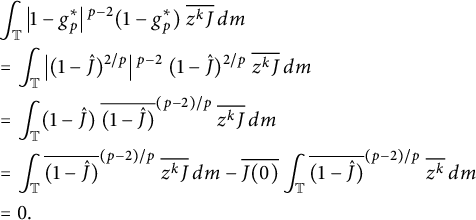 $$ \begin{align*} &\int_{\mathbb{T}}\left| 1 - g_p^* \right|{}^{p-2} (1 - g_p^*)\ \overline{z^kJ} \,dm \\ &= \int_{\mathbb{T}} \left| (1 - \hat{J})^{2/p} \right|{}^{p-2} \ (1 - \hat{J})^{2/p} \ \overline{z^kJ} \,dm\\ &= \int_{\mathbb{T}} (1 - \hat{J}) \ \overline{(1 - \hat{J})}^{(p-2)/p} \ \overline{z^kJ} \,dm\\ &= \int_{\mathbb{T}} \overline{(1 - \hat{J})}^{(p-2)/p} \ \overline{z^kJ}\,dm - \overline{J(0)}\int_{\mathbb{T}} \overline{(1 - \hat{J})}^{(p-2)/p} \ \overline{z^k} \,dm\\ &= 0. \end{align*} $$
Further,
 $$\begin{align*}\| 1 - g_p^* \|_p^p =\| (1 - \hat{J})^{2/p}\|_p^p = \| 1- \hat{J}\|_2^2 = 1 - |J(0)|^2, \end{align*}$$
that is,
 $$\begin{align*}\operatorname{dist}_{H^p}(1, [f]_p) = (1 - |J(0)|^2)^{1/p}. \end{align*}$$
Now, by the same argument as in the end of Theorem 3.3, $g_p^*$
has no additional inner factor besides J.
$g_p^*$
has no additional inner factor besides J.
3.2 Consequences and corollaries
The distance formula appearing in Theorem 3.4 tells us that an additional inner factor strictly increases the distance between 1 and the corresponding invariant subspace. Namely, we have the following.
Corollary 3.5 Let $ 1 < p < \infty $
and let M be a nontrivial closed z-invariant subspace of
$ 1 < p < \infty $
and let M be a nontrivial closed z-invariant subspace of $H^p$
. Let
$H^p$
. Let $N \subsetneq M$
be a strictly smaller invariant subspace. Then
$N \subsetneq M$
be a strictly smaller invariant subspace. Then
 $$ \begin{align*} \operatorname{dist}_{H^p}(1, N)> \operatorname{dist}_{H^p}(1, M). \end{align*} $$
Let us employ this corollary in an example.
Example 3.6 For each $n\ge 2$
, let
$n\ge 2$
, let $B_n$
be the Blaschke product having precisely a zero of multiplicity n at
$B_n$
be the Blaschke product having precisely a zero of multiplicity n at $1 - 1/n$
, and zeros nowhere else. One may check that
$1 - 1/n$
, and zeros nowhere else. One may check that $B_n$
converges pointwise to the atomic singular inner function
$B_n$
converges pointwise to the atomic singular inner function $e^{-\frac {1+z}{1-z}}$
. Moreover, it is easy to see that
$e^{-\frac {1+z}{1-z}}$
. Moreover, it is easy to see that $|B_n(0)|< |B_{n+1}(0)|$
. Therefore, the invariant subspace generated by the singular inner function is closer to
$|B_n(0)|< |B_{n+1}(0)|$
. Therefore, the invariant subspace generated by the singular inner function is closer to $1$
than any of the subspaces generated by the associated Blaschke products, which approximate the singular inner function. This is an example of a more general phenomenon, namely, the distance of
$1$
than any of the subspaces generated by the associated Blaschke products, which approximate the singular inner function. This is an example of a more general phenomenon, namely, the distance of $1$
to an invariant subspace generated by a singular inner function is often smaller, in the long run, than the distance between
$1$
to an invariant subspace generated by a singular inner function is often smaller, in the long run, than the distance between $1$
and the invariant subspaces generated by Blaschke products converging to that singular inner function. This sheds additional light on the structure of the lattice of z-invariant subspaces of
$1$
and the invariant subspaces generated by Blaschke products converging to that singular inner function. This sheds additional light on the structure of the lattice of z-invariant subspaces of $H^p$
.
$H^p$
.
We also note that if $f = J F \in H^p$
, where J is a nontrivial inner function and F is outer, then
$f = J F \in H^p$
, where J is a nontrivial inner function and F is outer, then
 $$ \begin{align*} \operatorname{dist}_{H^p}(1, [f]_p) = \inf_{g \in H^p} \| 1 - Jg \|_p^p = \inf_{g \in H^p} \| \overline{J} - g \|_{L^p}^p. \end{align*} $$
Therefore, the problem of finding the metric projection of $1$
in
$1$
in $H^p$
onto the invariant subspace generated by an inner function is the same as the problem of best approximation of the conjugate of that inner function in
$H^p$
onto the invariant subspace generated by an inner function is the same as the problem of best approximation of the conjugate of that inner function in $L^p$
by an
$L^p$
by an $H^p$
function. Theorem 3.4 tells us that the best approximation is an outer function. Phrasing the problem in this way also naturally brings in the tool of duality in extremal problems. Applying the previously mentioned duality (1.1) to this particular extremal problem, Theorem 3.4 gives rise to a highly nontrivial inequality for the dual problem, which we record now.
$H^p$
function. Theorem 3.4 tells us that the best approximation is an outer function. Phrasing the problem in this way also naturally brings in the tool of duality in extremal problems. Applying the previously mentioned duality (1.1) to this particular extremal problem, Theorem 3.4 gives rise to a highly nontrivial inequality for the dual problem, which we record now.
Corollary 3.7 Let $ 1 < q < \infty $
. If
$ 1 < q < \infty $
. If $J_1$
and
$J_1$
and $J_2$
are non-constant inner functions not vanishing at the origin, then the following strict inequality holds:
$J_2$
are non-constant inner functions not vanishing at the origin, then the following strict inequality holds:
 $$ \begin{align*} \sup_{\|g\|_q \leqslant 1} \left| \frac{1}{2 \pi i} \int_{\mathbb{T}} g \overline{J_1} \, d \zeta \right| < \sup_{\|g\|_q \leqslant 1} \left| \frac{1}{2 \pi i} \int_{\mathbb{T}} g \overline{J_1 J_2} \, d \zeta \right|. \end{align*} $$
Note that Corollary 3.7 does not hold for $q = 1$
, since by Poreda’s Theorem [Reference Poreda39] for any finite Blaschke product B,
$q = 1$
, since by Poreda’s Theorem [Reference Poreda39] for any finite Blaschke product B,
 $$ \begin{align*} \inf_{f \in H^{\infty}} \|\overline{B} - f \|_{L^{\infty}} = 1. \end{align*} $$
Then by duality, if $J_1$
and
$J_1$
and $J_2$
are finite Blaschke products, both supremum values in Corollary 3.7 are equal to one.
$J_2$
are finite Blaschke products, both supremum values in Corollary 3.7 are equal to one.
Applying Corollary 3.7 to Blaschke products, we obtain the following nontrivial inequality.
Corollary 3.8 Let $ 1 < q < \infty $
. Let
$ 1 < q < \infty $
. Let $\{ a_k\}_{k=1}^{\infty }$
be a sequence of distinct values in
$\{ a_k\}_{k=1}^{\infty }$
be a sequence of distinct values in $\mathbb {D}\setminus \{0\}$
and let
$\mathbb {D}\setminus \{0\}$
and let $n> m$
. Then the following strict inequality holds:
$n> m$
. Then the following strict inequality holds:
 $$ \begin{align*} \sup_{\|g\|_q =1} \left| \sum_{j=1}^m g(a_j) \left( \frac{\prod_{k=1}^m (1 - \overline{a_k} a_j )}{\prod_{k=1, k \neq j}^m (a_k - a_j)} \right) \right| < \sup_{\|g\|_q =1} \left| \sum_{j=1}^n g(a_j) \left( \frac{\prod_{k=1}^n (1 - \overline{a_k} a_j )}{\prod_{k=1, k \neq j}^n (a_k - a_j)} \right) \right|. \end{align*} $$
Proof Let $J_1(z) = \prod _{k=1}^m \frac {a_k -z}{1 - \overline {a_k}z}$
. Then for any
$J_1(z) = \prod _{k=1}^m \frac {a_k -z}{1 - \overline {a_k}z}$
. Then for any $g \in H^q,$
since
$g \in H^q,$
since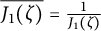 $\overline {J_1(\zeta )} = \frac {1}{J_1(\zeta )}$
for
$\overline {J_1(\zeta )} = \frac {1}{J_1(\zeta )}$
for $|\zeta | = 1$
and by the Residue Theorem,
$|\zeta | = 1$
and by the Residue Theorem,
 $$ \begin{align*} \frac{1}{2 \pi i} \int_{\mathbb{T}} g \overline{J_1} \, d \zeta = \frac{1}{2 \pi i} \int_{\mathbb{T}} g(\zeta) \left( \prod_{k=1}^m \frac{1 - \overline{a_k}\zeta}{a_k -\zeta} \right) \, d \zeta = \sum_{j=1}^m \operatorname{Res }(\tilde{g}; a_j), \end{align*} $$
where $\tilde {g}(z) = g(z) \left ( \prod _{k=1}^m \frac {1 - \overline {a_k}z}{a_k -z} \right )$
. Note that
$\tilde {g}(z) = g(z) \left ( \prod _{k=1}^m \frac {1 - \overline {a_k}z}{a_k -z} \right )$
. Note that
 $$ \begin{align*} \operatorname{Res }(g; a_j) = g(a_j) \left( \frac{\prod_{k=1}^m (1 - \overline{a_k} a_j )}{\prod_{k=1, k \neq j}^m (a_k - a_j)} \right). \end{align*} $$
Doing a similar computation for the right-hand side of the inequality yields the result.
Clearly, one can easily extend Corollary 3.8 to infinite Blaschke products $B_1$
and
$B_1$
and $B_2$
having distinct zeros and such that the zero set of
$B_2$
having distinct zeros and such that the zero set of $B_1$
is strictly contained in the zero set of
$B_1$
is strictly contained in the zero set of $B_2$
, and the zero set of
$B_2$
, and the zero set of $B_2$
does not contain the origin. When we apply Corollary 3.8 to two Blaschke factors, we obtain the following.
$B_2$
does not contain the origin. When we apply Corollary 3.8 to two Blaschke factors, we obtain the following.
Example 3.9 Suppose $a, b \in \mathbb {D} \setminus \{0\}$
are distinct and let
$a, b \in \mathbb {D} \setminus \{0\}$
are distinct and let $J_1(z) = \frac {z-a}{1-\bar {a}z}$
and
$J_1(z) = \frac {z-a}{1-\bar {a}z}$
and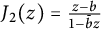 $J_2(z)=\frac {z-b}{1-\bar {b}z}$
. Then the left-hand side of the inequality in Corollary 3.8 is
$J_2(z)=\frac {z-b}{1-\bar {b}z}$
. Then the left-hand side of the inequality in Corollary 3.8 is
 $$ \begin{align*} \sup_{\|g\|_q =1} |g(a)| (1 - |a|^2). \end{align*} $$
It is easy to show using Hölder’s inequality that this supremum is equal to $(1 - |a|^2)^{\frac {1}{p}}$
(here, p is the Hölder conjugate to q) and the extremal function is
$(1 - |a|^2)^{\frac {1}{p}}$
(here, p is the Hölder conjugate to q) and the extremal function is
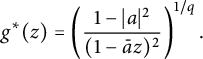 $$\begin{align*}g^*(z) = \left( \frac{1 - |a|^2}{(1 - \bar{a}z)^2}\right)^{1/q}. \end{align*}$$
On the other hand, the right-hand side of the inequality in Corollary 3.8 is
 $$ \begin{align*} \sup_{\|g\|_q =1} \left| g(a)(1-|a|^2) \frac{1 - \bar{b}a}{b-a} - g(b)(1-|b|^2)\frac{1 - \bar{a}b}{b-a} \right|. \end{align*} $$
Therefore, Corollary 3.8 states in this special case that the following strict inequality holds:
 $$ \begin{align*} (1 - |a|^2)^{1/p} < \sup_{\|g\|_q =1} \left| g(a)(1-|a|^2) \frac{1 - \bar{b}a}{b-a} - g(b)(1-|b|^2)\frac{1 - \bar{a}b}{b-a} \right|. \end{align*} $$
Curiously, even for $p = q = 2$
, we have not been able to find a direct proof of this elementary inequality for distinct arbitrary elements
$p = q = 2$
, we have not been able to find a direct proof of this elementary inequality for distinct arbitrary elements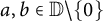 $a, b\in \mathbb {D}\setminus \{0\}$
.
$a, b\in \mathbb {D}\setminus \{0\}$
.
The metric projections discussed in the present section can also be obtained via limits of OPAs, which we discuss now.
4 Optimal polynomial approximants in
$H^p$

For $n\in \mathbb {N}$
, we denote by
$n\in \mathbb {N}$
, we denote by $\mathcal {P}_n$
the set of complex polynomials of degree at most n. Given
$\mathcal {P}_n$
the set of complex polynomials of degree at most n. Given $1<p<\infty $
and
$1<p<\infty $
and $f\in H^p$
with
$f\in H^p$
with $f(0) \neq 0$
, there exists a unique polynomial
$f(0) \neq 0$
, there exists a unique polynomial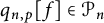 $q_{n,p}[f]\in \mathcal {P}_n$
such that
$q_{n,p}[f]\in \mathcal {P}_n$
such that
 $$\begin{align*}\|1-q_{n,p}[f]f\|_p = \inf_{q\in\mathcal{P}_n}\|1-qf\|_p. \end{align*}$$
We recall that these minimizing polynomials are called the OPAs to $1/f$
in
$1/f$
in $H^p$
. These polynomials have been extensively studied in various settings (for existence and uniqueness of OPAs in Hardy spaces, see [Reference Centner18, Section 2]; see Section 1 for references pertaining to other relevant work).
$H^p$
. These polynomials have been extensively studied in various settings (for existence and uniqueness of OPAs in Hardy spaces, see [Reference Centner18, Section 2]; see Section 1 for references pertaining to other relevant work).
It is well known that if $f\in H^2$
with
$f\in H^2$
with $f(0)\neq 0$
, then the OPAs to
$f(0)\neq 0$
, then the OPAs to $1/f$
in
$1/f$
in $H^2$
cannot vanish in the closed unit disk. This result was first established in [Reference Chui25] and later reestablished in [Reference Bénéteau, Khavinson, Sola, Liaw and Seco12]. On the other hand, a corresponding result for
$H^2$
cannot vanish in the closed unit disk. This result was first established in [Reference Chui25] and later reestablished in [Reference Bénéteau, Khavinson, Sola, Liaw and Seco12]. On the other hand, a corresponding result for $p\neq 2$
has been explored (see [Reference Centner18–Reference Cheng and Felder20]) but has yet to be fully understood. We begin with an alternative proof of this fact for
$p\neq 2$
has been explored (see [Reference Centner18–Reference Cheng and Felder20]) but has yet to be fully understood. We begin with an alternative proof of this fact for $H^2$
, which may be helpful in extending the result to the
$H^2$
, which may be helpful in extending the result to the $H^p$
setting.
$H^p$
setting.
Proposition 4.1 Let $f \in H^2$
with
$f \in H^2$
with $f(0) \neq 0$
. If J is any non-constant inner function, then there exists a constant
$f(0) \neq 0$
. If J is any non-constant inner function, then there exists a constant $c = c_{f}\in \mathbb {T}$
such that
$c = c_{f}\in \mathbb {T}$
such that
 $$ \begin{align*} \| 1 - J f \|_2> \|1 - cf\|_2. \end{align*} $$
Proof Observe:
 $$ \begin{align*} \| 1 - J f \|_2^2 &= \int_{\mathbb{T}}\left| 1 - Jf \right|{}^{2}\, dm\\ &= \int_{\mathbb{T}} (1 - Jf)\overline{(1 - Jf)}\, dm\\ &= 1+\|f\|^2-2\operatorname{Re}(J(0)f(0))\\ &\geqslant 1+\|f\|^2-2|J(0)f(0)|\\ &>1+\|f\|^2-2|f(0)|, \end{align*} $$
where the penultimate inequality holds because, by the Maximum Principle, $|J(0)|<1$
. Taking c so that
$|J(0)|<1$
. Taking c so that $cf(0)=|f(0)|$
, a simple calculation, similar to that above, shows
$cf(0)=|f(0)|$
, a simple calculation, similar to that above, shows
 $$ \begin{align*} \| 1 - c f \|_2^2=1+\|f\|^2-2|f(0)|, \end{align*} $$
which completes the proof.
A similar inequality holding in $H^p$
would allow us to deduce that OPAs in
$H^p$
would allow us to deduce that OPAs in $H^p$
cannot vanish in the disk.
$H^p$
cannot vanish in the disk.
Proposition 4.2 Let $1 < p < \infty $
. Suppose
$1 < p < \infty $
. Suppose $f \in H^p$
with
$f \in H^p$
with $f(0) \neq 0$
and let J be any non-constant inner function with
$f(0) \neq 0$
and let J be any non-constant inner function with $J(0)\neq 0$
. If there exists a constant
$J(0)\neq 0$
. If there exists a constant $c \in \mathbb {C}\setminus \{0\}$
such that
$c \in \mathbb {C}\setminus \{0\}$
such that
 $$ \begin{align*} \| 1 - J f \|_p \geqslant \|1 - cf\|_p, \end{align*} $$
then any nontrivial OPA in $H^p$
cannot vanish in the open unit disk.
$H^p$
cannot vanish in the open unit disk.
Proof Let $g \in H^p$
with
$g \in H^p$
with $g(0) \neq 0$
. Without loss of generality, assume that the degree of
$g(0) \neq 0$
. Without loss of generality, assume that the degree of $q_{n,p}[g]$
is n. If
$q_{n,p}[g]$
is n. If $q_{n,p}[g]$
has zeros in
$q_{n,p}[g]$
has zeros in $\mathbb {D},$
we write
$\mathbb {D},$
we write $q_{n,p}[g] = B_k p_n,$
where
$q_{n,p}[g] = B_k p_n,$
where $B_k$
is a Blaschke product of degree k with
$B_k$
is a Blaschke product of degree k with $1 \leqslant k \leqslant n $
and
$1 \leqslant k \leqslant n $
and $p_n$
is a polynomial of degree at most n with no zeros in the disk. Then, by hypothesis,
$p_n$
is a polynomial of degree at most n with no zeros in the disk. Then, by hypothesis,
 $$ \begin{align*} \|1 - q_{n,p}[g]g \|_p = \|1 - B_kp_ng\|_p \geqslant \|1-cp_ng\|_p \end{align*} $$
for some constant $c\in \mathbb {C}$
. However, by minimality of
$c\in \mathbb {C}$
. However, by minimality of $q_{n,p}[g]$
and since
$q_{n,p}[g]$
and since $cp_n$
has degree at most n, we get
$cp_n$
has degree at most n, we get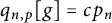 $q_{n,p}[g] = cp_n$
, which is a contradiction since
$q_{n,p}[g] = cp_n$
, which is a contradiction since $p_n$
has no zeros in the disk.
$p_n$
has no zeros in the disk.
In light of Proposition 4.1, we conjecture the following.
Conjecture 4.3 Let $1 < p < \infty $
and
$1 < p < \infty $
and $f \in H^p$
with
$f \in H^p$
with $f(0) \neq 0$
. If J is any non-constant inner function, then there exists a constant
$f(0) \neq 0$
. If J is any non-constant inner function, then there exists a constant $c = c_{f}\in \mathbb {T}$
such that
$c = c_{f}\in \mathbb {T}$
such that
 $$\begin{align*}\| 1 - J f \|_p> \|1 - cf\|_p. \end{align*}$$
By continuity, we can at least say that the desired inequality still holds for values of p which are close to 2. In particular, using [Reference Cheng and Felder20, Lemma 3.1.1], we obtain the following.
Proposition 4.4 Suppose $f \in H^{\infty }$
and
$f \in H^{\infty }$
and $f(0) \neq 0$
. Then there exists a neighborhood of
$f(0) \neq 0$
. Then there exists a neighborhood of $p=2$
such that the OPAs to
$p=2$
such that the OPAs to $1/f$
in
$1/f$
in $H^p$
do not vanish in
$H^p$
do not vanish in $\mathbb {D}$
.
$\mathbb {D}$
.
Remark 4.5 We note that, using the continuity properties of the OPAs, we can replace $\mathbb {D}$
with
$\mathbb {D}$
with $\overline {\mathbb {D}}$
in the previous result. Indeed, under the assumptions of Proposition 4.4, we know that, for any
$\overline {\mathbb {D}}$
in the previous result. Indeed, under the assumptions of Proposition 4.4, we know that, for any $n\in \mathbb {N}$
, the polynomials
$n\in \mathbb {N}$
, the polynomials $q_{n,p}[f]$
converge to
$q_{n,p}[f]$
converge to $q_{n,2}[f]$
as
$q_{n,2}[f]$
as $p\to 2$
uniformly on
$p\to 2$
uniformly on $\overline {\mathbb {D}}$
(see Lemma 3.1.1 in [Reference Cheng and Felder20]). Noting that
$\overline {\mathbb {D}}$
(see Lemma 3.1.1 in [Reference Cheng and Felder20]). Noting that $q_{n,2}[f]$
does not vanish on
$q_{n,2}[f]$
does not vanish on $\overline {\mathbb {D}}$
establishes the claim.
$\overline {\mathbb {D}}$
establishes the claim.
4.1 Behavior of OPAs and bounds on their roots
Using the results of the previous sections, we can say more about the roots of OPAs in $H^p$
. First, we get that the roots always escape any compact subset of
$H^p$
. First, we get that the roots always escape any compact subset of $\mathbb {D}$
as n increases ad infinitum, which is an improvement of Proposition 5.1 in [Reference Centner, Cheng and Felder19].
$\mathbb {D}$
as n increases ad infinitum, which is an improvement of Proposition 5.1 in [Reference Centner, Cheng and Felder19].
Proposition 4.6 Let $1 < p < \infty $
and
$1 < p < \infty $
and $f \in H^p$
with
$f \in H^p$
with $f(0) \neq 0$
. Then, for any compact subset K of
$f(0) \neq 0$
. Then, for any compact subset K of $\mathbb {D}$
, there exists
$\mathbb {D}$
, there exists $N\in \mathbb {N}$
such that the roots of
$N\in \mathbb {N}$
such that the roots of $q_{n,p}[f]$
lie outside K for all
$q_{n,p}[f]$
lie outside K for all $n\geqslant N$
.
$n\geqslant N$
.
Proof Let $f = J F$
, with J inner and F outer, and let
$f = J F$
, with J inner and F outer, and let $g_p^*$
be the metric projection of 1 on
$g_p^*$
be the metric projection of 1 on $[f]_p$
as given in Theorem 3.4. We know that
$[f]_p$
as given in Theorem 3.4. We know that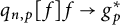 $q_{n,p}[f]f\to g_p^*$
in
$q_{n,p}[f]f\to g_p^*$
in $H^p$
(see, e.g., Proposition 3.0.1 in [Reference Cheng and Felder20]). Since the inner factor of
$H^p$
(see, e.g., Proposition 3.0.1 in [Reference Cheng and Felder20]). Since the inner factor of $g_p^*$
is J, we also get that the sequence
$g_p^*$
is J, we also get that the sequence $q_{n,p}[f]F$
converges to the outer part of
$q_{n,p}[f]F$
converges to the outer part of $g_p^*$
in
$g_p^*$
in $H^p$
which of course does not vanish in
$H^p$
which of course does not vanish in $\mathbb {D}$
. The result follows by Hurwitz’s Theorem.
$\mathbb {D}$
. The result follows by Hurwitz’s Theorem.
In [Reference Centner18], Centner gave the following lower bound: let $1 < p < \infty ,f \in H^p$
with
$1 < p < \infty ,f \in H^p$
with $f(0) \neq 0$
and
$f(0) \neq 0$
and $n\in \mathbb {N}$
, then any root of
$n\in \mathbb {N}$
, then any root of $q_{n,p}[f]$
must lie outside the open disc of radius
$q_{n,p}[f]$
must lie outside the open disc of radius $(1-\|1-q_{n,p}[f]f\|_p^p)^{1/2}$
centered at the origin (see [Reference Centner18, Proposition 5.1]). We next provide an improvement.
$(1-\|1-q_{n,p}[f]f\|_p^p)^{1/2}$
centered at the origin (see [Reference Centner18, Proposition 5.1]). We next provide an improvement.
Proposition 4.7 Let $1 < p < \infty $
and
$1 < p < \infty $
and $n\in \mathbb {N}$
. Suppose that
$n\in \mathbb {N}$
. Suppose that $f \in H^p$
has inner part J, with
$f \in H^p$
has inner part J, with $J(0) \neq 0$
. Let also
$J(0) \neq 0$
. Let also $w_1,\dots ,w_k$
be the roots (counting multiplicities) of
$w_1,\dots ,w_k$
be the roots (counting multiplicities) of $q_{n,p}[f]$
in
$q_{n,p}[f]$
in $\mathbb {D}$
. Then
$\mathbb {D}$
. Then
 $$ \begin{align} |w_1\dots w_k| \geqslant \frac{(1 - \|1 - q_{n,p}[f]f\|_p^p)^{1/2}}{|J(0)|}. \end{align} $$
Proof We have that $q_{n,p}[f]=B_kp_n$
, where
$q_{n,p}[f]=B_kp_n$
, where $B_k$
is the Blaschke product formed by the roots
$B_k$
is the Blaschke product formed by the roots $w_1,\dots ,w_k$
and
$w_1,\dots ,w_k$
and $p_n$
is a polynomial of degree at most n that does not vanish in
$p_n$
is a polynomial of degree at most n that does not vanish in $\mathbb {D}$
. Then, by Theorem 3.3, we have
$\mathbb {D}$
. Then, by Theorem 3.3, we have
 $$ \begin{align*} \|1 - q_{n,p}[f]f\|_p^p &= \|1 - B_kp_nf\|_p^p \\ &\geqslant\inf_{\varphi \in H^p} \left\| 1 - B_k J\varphi \right\|_p^p\\ &= 1 - |w_1\dots w_k J(0)|^2. \end{align*} $$
Rearranging the terms of the inequality yields the claim.
Remark 4.8 Note that since
 $$ \begin{align*} \lim_{n \rightarrow \infty} \|1 - q_{n,p}[f]f\|_p^p = \operatorname{dist}_{H^p}^p(1, [f]_p) = 1 - |J(0)|^2, \end{align*} $$
the right-hand side of (4.1) converges to 1 as n increases to $\infty $
. Thus, Proposition 4.7 can be viewed as a quantitative version of Proposition 4.6.
$\infty $
. Thus, Proposition 4.7 can be viewed as a quantitative version of Proposition 4.6.
Next, we give bounds for the roots of OPAs that depend on whether p is greater or less than 2.
Proposition 4.9 Let $1 < p < 2$
and
$1 < p < 2$
and $n\in \mathbb {N}$
. Suppose that
$n\in \mathbb {N}$
. Suppose that $f \in H^p$
has inner part J, with
$f \in H^p$
has inner part J, with $J(0) \neq 0$
. Let also
$J(0) \neq 0$
. Let also $w_1,\dots ,w_k$
be the roots (counting multiplicities) of
$w_1,\dots ,w_k$
be the roots (counting multiplicities) of $q_{n,p}[f]$
in
$q_{n,p}[f]$
in $\mathbb {D}$
, then
$\mathbb {D}$
, then
 $$\begin{align*}|w_1\dots w_k| \geqslant \frac{\left(1 - \left[1 - \frac{|f(0)|^2}{\|f\|_2^2}\right]^{p/2} \right)^{1/2}}{|J(0)|}. \end{align*}$$
In particular, if $f = J$
is inner, then
$f = J$
is inner, then
 $$\begin{align*}|w_1\dots w_k| \geqslant \frac{\left(1 - \left[1 - |J(0)|^2 \right]^{p/2} \right)^{1/2}}{|J(0)|}. \end{align*}$$
Proof We combine Proposition 4.7 with the note following Proposition 4.0.15 in [Reference Cheng and Felder20], which says that
 $$\begin{align*}\|1 - q_{n,p}[f]f\|_p \leqslant \left(1 - \frac{|f(0)|^2}{\|f\|_2^2} \right)^{1/2}. \end{align*}$$
For the case $2 < p < \infty $
, we first need the following lemma.
$2 < p < \infty $
, we first need the following lemma.
Lemma 4.10 Let $1<p<\infty $
, and let
$1<p<\infty $
, and let $f \in H^p$
. Then
$f \in H^p$
. Then
 $$\begin{align*}\|1-q_{0,p}[f]f\|_p < 1 \end{align*}$$
if and only if $f(0) \neq 0$
. In this case,
$f(0) \neq 0$
. In this case,
 $$\begin{align*}\|1-q_{0,p}[f]f\|_p^r \leqslant \frac{A^{r/(r-1)}}{(1 + A^{1/(r-1)})^r} + \frac{A}{(1 + A^{1/(r-1)})^r} < 1, \end{align*}$$
where K and r are the relevant upper Pythagorean parameters and
 $$\begin{align*}A:= K\bigg\| \frac{f-f(0)}{zf(0)} \bigg\|^r_p. \end{align*}$$
Proof There is no harm in first assuming $f(0) = 1$
, so suppose
$f(0) = 1$
, so suppose $f = 1 + z\varphi \in H^p$
, with
$f = 1 + z\varphi \in H^p$
, with $\varphi $
nonzero. Then for
$\varphi $
nonzero. Then for $0<c\leqslant 1$
, we have
$0<c\leqslant 1$
, we have
 $$\begin{align*}\int_{\mathbb{T}} (1-c)^{\langle p-1\rangle} z\varphi\, dm = 0. \end{align*}$$
Consequently,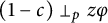 $(1-c) \perp _p z\varphi $
holds, and by Theorem 2.2, we have
$(1-c) \perp _p z\varphi $
holds, and by Theorem 2.2, we have
 $$ \begin{align} 1 - cf(z) &= (1 - c) + (-cz\varphi(z)) \nonumber \\ \|1 - cf\|_p^r &\leqslant (1-c)^r + K\|cz\varphi\|_p^r \nonumber \\ &= (1-c)^r + Kc^r \|\varphi\|_p^r, \end{align} $$
where r and K are the applicable Pythagorean parameters.
Write $A := K\|\varphi \|_p^r$
. By elementary calculus, the expression
$A := K\|\varphi \|_p^r$
. By elementary calculus, the expression
 $$\begin{align*}(1-c)^r + Ac^r \end{align*}$$
is critical when
 $$ \begin{align*} 0 &= r(1-c)^{r-1}(-1) + rAc^{r-1} \\ (1-c)^{r-1} &= Ac^{r-1} \\ c &= \frac{1}{1 + A^{1/(r-1)}}. \end{align*} $$
Thus, the expression (4.2) takes the minimum value
 $$\begin{align*}\frac{A^{r/(r-1)}}{(1 + A^{1/(r-1)})^r} + \frac{A}{(1 + A^{1/(r-1)})^r}, \end{align*}$$
and hence it suffices to show that this quantity is less than 1.
Indeed, it is elementary to see that for any $B>0,$
we have
$B>0,$
we have
 $$ \begin{align*} B^r\Big( 1 + \frac{1}{B}\Big) &< B^r\Big( 1 + \frac{1}{B}\Big)^r \\ B^{r-1} + B^r &< (1 + B)^r \\ \frac{B^{r-1} + B^r}{(1 + B)^r } &< 1. \end{align*} $$
Substituting $B = A^{1/(r-1)}$
, we conclude
$B = A^{1/(r-1)}$
, we conclude
 $$\begin{align*}\|1 - cf\|_p^r \leqslant \frac{A^{r/(r-1)}}{(1 + A^{1/(r-1)})^r} + \frac{A}{(1 + A^{1/(r-1)})^r} < 1. \end{align*}$$
More generally, for $f(0)\neq 0$
, apply the above argument to
$f(0)\neq 0$
, apply the above argument to $f(z)/f(0)$
, and make the corresponding change to the definition of A.
$f(z)/f(0)$
, and make the corresponding change to the definition of A.
Conversely, if $f(0)=0$
, then the Mean Value Property for subharmonic functions immediately yields the minimal choice
$f(0)=0$
, then the Mean Value Property for subharmonic functions immediately yields the minimal choice $c=0$
.
$c=0$
.
Proposition 4.11 Let $2 < p < \infty $
and
$2 < p < \infty $
and $n\in \mathbb {N}$
. Suppose that
$n\in \mathbb {N}$
. Suppose that $f \in H^p$
has inner part J, with
$f \in H^p$
has inner part J, with $J(0) \neq 0$
. Let also
$J(0) \neq 0$
. Let also $w_1,\dots ,w_k$
be the roots (counting multiplicities) of
$w_1,\dots ,w_k$
be the roots (counting multiplicities) of $q_{n,p}[f]$
in
$q_{n,p}[f]$
in $\mathbb {D}$
, then
$\mathbb {D}$
, then
 $$\begin{align*}|w_1\dots w_k| \geqslant \frac{1}{|J(0)|} \left(1 - \left( \frac{(p - 1)\|f - f(0)\|_p^2}{|f(0)|^2 + (p - 1)\|f - f(0)\|_p^2} \right)^{p/2} \right)^{1/2}. \end{align*}$$
Proof First note that
 $$\begin{align*}\|1 - q_{0,p}[f]f\|_p^p \geqslant \|1 - q_{n,p}[f]f\|_p^p \geqslant 1 - |w_1\dots w_kJ(0)|^2, \end{align*}$$
and apply the upper bound for $\|1 - q_{0,p}[f]f\|_p^p$
from Lemma 4.10. For
$\|1 - q_{0,p}[f]f\|_p^p$
from Lemma 4.10. For $2 < p < \infty $
, the parameters are
$2 < p < \infty $
, the parameters are $r = 2$
and
$r = 2$
and $K = p - 1$
, and the bound simplifies to
$K = p - 1$
, and the bound simplifies to
 $$\begin{align*}\|1 - q_{0,p}[f]f\|_p^{2} \leqslant \frac{A}{A + 1}, \quad \text{where } A = \frac{(p - 1)\|f - f(0)\|_p^2}{|f(0)|^2}. \end{align*}$$
Straightforward computation now yields the desired result.
5 Concluding remarks and open questions
We end with a few comments and questions.
Remark 5.1 (The cases
$0< p \le 1$
and
$p=\infty $
)


As is well known, the solution of extremal problems similar to problems considered in this article need not be unique in $H^p$
for
$H^p$
for $0 < p \leqslant 1$
and
$0 < p \leqslant 1$
and $p = \infty $
. Nevertheless, it would be interesting to see what one can say about metric projections and OPAs in those spaces. Birkhoff–James orthogonality does not hold for
$p = \infty $
. Nevertheless, it would be interesting to see what one can say about metric projections and OPAs in those spaces. Birkhoff–James orthogonality does not hold for $0 < p < 1,$
since the dual space is trivial. Along the same lines, it is natural to ask if the tools developed here can give a new unified proof of Beurling’s Theorem for all
$0 < p < 1,$
since the dual space is trivial. Along the same lines, it is natural to ask if the tools developed here can give a new unified proof of Beurling’s Theorem for all $0 < p < \infty $
, versus diverting the proof to the case
$0 < p < \infty $
, versus diverting the proof to the case $p = 2$
via factorization of
$p = 2$
via factorization of $H^p$
functions as is done in [Reference Garnett32, p. 98]. We also note that for
$H^p$
functions as is done in [Reference Garnett32, p. 98]. We also note that for $p = \infty $
, as soon as any OPA vanishes in
$p = \infty $
, as soon as any OPA vanishes in $\overline {\mathbb {D}}$
, it must vanish identically by the Maximum Principle.
$\overline {\mathbb {D}}$
, it must vanish identically by the Maximum Principle.
Remark 5.2 (Outer factor in the extremal function)
When $p = 2$
, the projection of
$p = 2$
, the projection of $1$
onto a nontrivial closed z-invariant subspace gives a constant times an inner function, while for
$1$
onto a nontrivial closed z-invariant subspace gives a constant times an inner function, while for $1 < p < \infty $
(
$1 < p < \infty $
( $p \neq 2$
), we get a non-constant outer function times an inner function. It would be interesting to gain a better understanding of why a non-constant outer function appears in the projection in the Banach space setting, versus the Hilbert space setting.
$p \neq 2$
), we get a non-constant outer function times an inner function. It would be interesting to gain a better understanding of why a non-constant outer function appears in the projection in the Banach space setting, versus the Hilbert space setting.
Remark 5.3 (Universality)
The continuity of metric projections implies that, given any compact set K, the mapping $\mathcal {Q}_n \colon H^p\setminus \{0\} \to C(K)$
, which takes a function f to its OPA
$\mathcal {Q}_n \colon H^p\setminus \{0\} \to C(K)$
, which takes a function f to its OPA $q_{n,p}[f]$
, is continuous. This was a key ingredient for establishing the existence of functions in
$q_{n,p}[f]$
, is continuous. This was a key ingredient for establishing the existence of functions in $H^2$
whose OPAs have universal approximation properties on subsets of the unit circle with zero arclength measure (see [Reference Bénéteau, Ivrii, Manolaki and Seco9, Proposition 2.1]). The second main ingredient in proving the universality result is the following formula, which describes the explicit dependence of an OPA on its outer part (see [Reference Bénéteau, Ivrii, Manolaki and Seco9, Proposition 2.2]): If g is an inner function in
$H^2$
whose OPAs have universal approximation properties on subsets of the unit circle with zero arclength measure (see [Reference Bénéteau, Ivrii, Manolaki and Seco9, Proposition 2.1]). The second main ingredient in proving the universality result is the following formula, which describes the explicit dependence of an OPA on its outer part (see [Reference Bénéteau, Ivrii, Manolaki and Seco9, Proposition 2.2]): If g is an inner function in $H^2$
and
$H^2$
and $f\in H^2\setminus \{0\}$
, then
$f\in H^2\setminus \{0\}$
, then $q_{n,2}[fg]=\overline {g(0)} q_{n,2}[f]$
. Thus, it is natural to examine the analogous result for the
$q_{n,2}[fg]=\overline {g(0)} q_{n,2}[f]$
. Thus, it is natural to examine the analogous result for the $H^p$
setting, which could provide results about universality in the
$H^p$
setting, which could provide results about universality in the $H^p$
setting.
$H^p$
setting.
Remark 5.4 (Dynamics of zeros)
It would also be interesting to study the interplay between the dynamics of the zeros of $H^p$
functions and the corresponding extremal problem (3.9). Moving a zero of a Blaschke product J closer to the circle gives rise to a smaller distance between
$H^p$
functions and the corresponding extremal problem (3.9). Moving a zero of a Blaschke product J closer to the circle gives rise to a smaller distance between $1$
and the corresponding z-invariant subspace generated by J (as seen from the distance formula in Theorem 3.3). For example, if J has zeros
$1$
and the corresponding z-invariant subspace generated by J (as seen from the distance formula in Theorem 3.3). For example, if J has zeros $a_1, a_2,\ldots $
, then
$a_1, a_2,\ldots $
, then $\inf _{h \in H^p}\|1-Jh\|_p^p = 1 - |a_1 a_2 \dots |^2$
. So if a zero
$\inf _{h \in H^p}\|1-Jh\|_p^p = 1 - |a_1 a_2 \dots |^2$
. So if a zero $a_1$
wanders closer to the unit circle, the corresponding distance decreases. Along the same lines, it would be interesting to study the zeros of the first degree OPA as p varies, for a fixed f. It is known, for instance, that if f is a bounded analytic function, then the linear OPA for
$a_1$
wanders closer to the unit circle, the corresponding distance decreases. Along the same lines, it would be interesting to study the zeros of the first degree OPA as p varies, for a fixed f. It is known, for instance, that if f is a bounded analytic function, then the linear OPA for $1/f$
varies uniformly with p [Reference Cheng and Felder20, Lemma 3.1.1]; moreover, if f is inner, then the root of this linear OPA is bounded from the origin by an amount depending only on p [Reference Centner, Cheng and Felder19, Theorem 5.1.3]. Recall also that in
$1/f$
varies uniformly with p [Reference Cheng and Felder20, Lemma 3.1.1]; moreover, if f is inner, then the root of this linear OPA is bounded from the origin by an amount depending only on p [Reference Centner, Cheng and Felder19, Theorem 5.1.3]. Recall also that in $H^2$
and in certain other Dirichlet-type Hilbert spaces, as long as
$H^2$
and in certain other Dirichlet-type Hilbert spaces, as long as $1/f$
is not analytic in the closed disk, although the zeros of the OPAs stay outside the closed unit disk, a Jentzsch-type phenomenon occurs [Reference Bénéteau, Khavinson, Liaw, Seco and Simanek10]: that is, every point on the unit circle is a limit of the zeros of the OPAs of
$1/f$
is not analytic in the closed disk, although the zeros of the OPAs stay outside the closed unit disk, a Jentzsch-type phenomenon occurs [Reference Bénéteau, Khavinson, Liaw, Seco and Simanek10]: that is, every point on the unit circle is a limit of the zeros of the OPAs of $1/f$
. Does such a Jentzsch-type phenomenon occur in
$1/f$
. Does such a Jentzsch-type phenomenon occur in $H^p$
for
$H^p$
for $p \neq 2$
?
$p \neq 2$
?
Remark 5.5 (Bergman spaces)
Finally, the notion of z-invariant subspaces and corresponding extremal problems as considered in Sections 3 and 4 can easily be reformulated for Bergman spaces of analytic functions. Recall that for $ 0 < p < \infty ,$
the Bergman space
$ 0 < p < \infty ,$
the Bergman space $A^p$
is defined as
$A^p$
is defined as
 $$ \begin{align*} A^p := \left\{ f\in \operatorname{Hol}(\mathbb{D}) : \|f\|_{A^p}^p := \int_{\mathbb{D}} |f(z)|^p\, dA(z) < \infty \right\}, \end{align*} $$
where $dA$
is the normalized area measure on the unit disk. For
$dA$
is the normalized area measure on the unit disk. For $1 \leqslant p < \infty , A^p$
is a Banach space. The lattice of z-invariant subspaces is much more complicated in
$1 \leqslant p < \infty , A^p$
is a Banach space. The lattice of z-invariant subspaces is much more complicated in $A^p$
than in
$A^p$
than in $H^p$
, and elements of this lattice are not necessarily singly-generated (see [Reference Apostol, Bercovici, Foiaş and Pearcy2, Reference Hedenmalm34]). Moreover, there is no factorization of
$H^p$
, and elements of this lattice are not necessarily singly-generated (see [Reference Apostol, Bercovici, Foiaş and Pearcy2, Reference Hedenmalm34]). Moreover, there is no factorization of $A^p$
functions as transparent as the factorization of functions in Hardy spaces. However, the notion of an inner function has been meaningfully extended to Bergman spaces: a function
$A^p$
functions as transparent as the factorization of functions in Hardy spaces. However, the notion of an inner function has been meaningfully extended to Bergman spaces: a function $G \in A^p$
is called
$G \in A^p$
is called $A^p$
-inner if for
$A^p$
-inner if for $n = 0, 1, 2, \ldots $
, we have
$n = 0, 1, 2, \ldots $
, we have
 $$ \begin{align*} \int_{\mathbb{D}} \left(|G(z)|^{p} -1 \right) z^ n \, dA(z) = 0. \end{align*} $$
Thus, if G is an $A^p$
-inner function and we consider the z-invariant subspace
$A^p$
-inner function and we consider the z-invariant subspace $M = [G]_{A^p}$
, one can investigate metric projections of
$M = [G]_{A^p}$
, one can investigate metric projections of $1$
onto M in a way that is analogous to investigating metric projections of
$1$
onto M in a way that is analogous to investigating metric projections of $1$
onto z-invariant subspaces in
$1$
onto z-invariant subspaces in $H^p$
. Following results in [Reference Hedenmalm33] for
$H^p$
. Following results in [Reference Hedenmalm33] for $p = 2$
, the orthogonal projection of
$p = 2$
, the orthogonal projection of $1$
onto
$1$
onto $[G]_{A^2}$
is given by
$[G]_{A^2}$
is given by $\overline {G(0)}\, G$
, as is true within the analogous setup in
$\overline {G(0)}\, G$
, as is true within the analogous setup in $H^2$
. Therefore, it is natural to guess that for
$H^2$
. Therefore, it is natural to guess that for $1 < p < \infty $
(
$1 < p < \infty $
( $p \neq 2$
), the metric projection of
$p \neq 2$
), the metric projection of $1$
onto
$1$
onto $[G]_{A^p}$
gives a cyclic vector times G, in analog with the conclusion of Theorem 3.4 (here, a function
$[G]_{A^p}$
gives a cyclic vector times G, in analog with the conclusion of Theorem 3.4 (here, a function $f\in A^p$
being cyclic means that
$f\in A^p$
being cyclic means that $[f]_{A^p} = A^p$
).
$[f]_{A^p} = A^p$
).



