

A free and diverse press is one of the key pillars of a functioning democracy. Independent media outlets act as watchdogs (Whitten-Woodring Reference Whitten-Woodring2009), help to keep government actors accountable (Snyder and Strömberg Reference Snyder and Strömberg2010) and reduce the likelihood of escalating state violence (Carey, González and Mitchell Reference Carey, González and Mitchell2021). It is thus not surprising that most autocracies censor the press (Stier Reference Stier2015) in order to increase regime compliance (Geddes and Zaller Reference Geddes and Zaller1989) and decrease the risk of popular unrest (Edmond Reference Edmond2013).Footnote 1 While the emergence of the internet helped news outlets to evade censorship, many authoritarian governments have increasingly begun to block news websites in recent years (Freedom House 2020).Footnote 2 A growing body of literature has begun to explore how and when authoritarian regimes censor and repress online (for an overview, see Keremoğlu and Weidmann Reference Keremoğlu and Weidmann2020). Less is known about the effectiveness of online censorship against digital news outlets. To what degree are news websites in autocracies resilient to online censorship?
Comparable to the broader literature on state repression (for an overview, see Davenport Reference Davenport2007), previous works on the consequences of online censorship are inconclusive (for overviews, see Earl, Maher and Pan Reference Earl, Maher and Pan2022; Roberts Reference Roberts2020). For one, some studies show that digital censorship events can lead to backlash effects, actually increasing interest in the censored website and content (see, for example, Nabi Reference Nabi2014). Somewhat related, Hobbs and Roberts (Reference Hobbs and Roberts2018) illustrate that a large share of users circumvented the sudden blocking of the popular social media service Instagram in China to still access the platform. Other case evidence from China, however, suggests that, in most situations, online censorship works in limiting access to information and that the majority of citizens do not try to evade censorship (Chen and Yang Reference Chen and Yang2019; Roberts Reference Roberts2018).
Explaining the aforementioned findings, Roberts (Reference Roberts2018) posits that the main mechanism of how website blocks work is to increase so-called friction costs, which make (1) information consumption and (2) information provision more costly. First, users have to rely on a virtual private network (VPN) or other tools to evade censorship, which comes with resource and time costs. Since most citizens have usually little incentive to be informed about politics (see, for example, Zaller et al. Reference Zaller1992), I expect a significant decrease in the number of visitors – commonly referred to as traffic – for blocked news outlets. Secondly, the reduction of visitors affects an outlet's advertising revenue, which is the main income for most digital outlets (Mitchelstein and Boczkowski Reference Mitchelstein and Boczkowski2009). As a consequence, outlets may decide to cease activity due to insufficient funding (see Peterson Reference Peterson2021). In addition, a potential second mechanism could also be to stop visiting outlets and/or cease activity out of the fear of reprisals (Roberts Reference Roberts2018).
This letter focuses on Egypt, where the current authoritarian Sisi regime has sought to heavily limit access to a high number of undesired online news and other websites (CPJ 2017). For one, the Egyptian case expands our knowledge beyond the well-studied and sophisticated Chinese censorship regime. Moreover, the important role media outlets played in previous democratization attempts in Egypt makes them additionally relevant to study (see, for example, Wolfsfeld, Segev and Sheafer Reference Wolfsfeld, Segev and Sheafer2013). Finally, whereas previous studies have primarily looked at the blocking of single websites, I rely on fine-grained time-series data of a sample of 145 Egyptian news outlets from 2017 to March 2021. This allows me to systematically explore: (1) how online censorship affects traffic on news websites; and (2) whether they stop activity as an important downstream effect.
The results show that censored Egyptian outlets lost, on average, 54–55 per cent of their global traffic. Related to the question of whether outlets cease activity, correlational models suggest that blocking increases the likelihood of terminating publication by 27 percentage points in the long term. Finally, heterogeneity analyses show that the loss in traffic was particularly strong for independent, Islamist opposition and larger outlets, and that permanently filtered outlets were substantially more likely to halt activity. The letter thus speaks to the broader literature on state repression and information control, and provides evidence that digital censorship efforts often reduce the consumption and provision of alternative political information (Davenport Reference Davenport2007; Earl, Maher and Pan Reference Earl, Maher and Pan2022; Edmond Reference Edmond2013; Roberts Reference Roberts2020). These efforts seem to ultimately help to demobilize political opposition and to sustain autocratic rule in the digital age (Rød and Weidmann Reference Rød and Weidmann2015; Weidmann and Rød Reference Weidmann and Rød2019).
Online Media and Censorship in Egypt
With the increasing spread of the internet in the 2000s, many independent and opposition online news outlets emerged in Egypt (Awad Reference Awad2016). Although those outlets challenged the Mubarak regime, which ruled until February 2011, Freedom House (2020) described the internet environment as relatively free during his incumbency. As documented by Wolfsfeld, Segev and Sheafer (Reference Wolfsfeld, Segev and Sheafer2013), many citizens informed themselves via online news outlets during the 2011 uprising, and the regime's tactic to shut down internet services ultimately came too late (Hassanpour Reference Hassanpour2014).
Internet resources remained relatively freely accessible during the interim government led by the Supreme Council of the Armed Forces (SCAF) and the incumbency of Muhammad Mursi of the Muslim Brotherhood, who was in office from June 2012 until he was deposed by a military coup in July 2013. The current Sisi regime seems to have learned from these previous experiences and has increased censorship efforts in recent years – a trend that aligns with generally higher levels of repression in Egypt after 2013 (Freedom House 2020; Ketchley Reference Ketchley2017).
On 24 May 2017, twenty-one news websites were suddenly blocked by Egyptian internet service providers (ISPs). This heretofore unprecedented censorship wave occurred approximately one month after Egypt was shocked by two lethal terrorist attacks against Coptic churches in April 2017 that led to the declaration of a nationwide state of emergency. Among the filtered websites were several regional outlets (such as Al-Jazeera), Egyptian-based Muslim Brotherhood-affiliated websites and independent Egyptian outlets (such as Mada Masr). The authorities justified these blocks by accusing the outlets of spreading false news and supporting terrorist organizations (CPJ 2017).
This first censorship wave was swiftly followed by more blocking of not only news outlets, but also political websites, censorship circumvention tools and other websites in 2017 and the years after. Most of the blocks were not justified, and most of the censored websites do not display a dedicated blocking page (OONI and AFTE 2018). Following the framework by Earl, Maher and Pan (Reference Earl, Maher and Pan2022), which distinguishes between overt and covert information coercion, the Egyptian regime thus seems to use a covert approach as, for the average consumer, it is not necessarily clear that websites are censored and by whom. Yet, as noted by Earl, Maher and Pan (Reference Earl, Maher and Pan2022) and Roberts (Reference Roberts2018), politically active users may be more likely aware of the blocking. Moreover, this is not to say that the regime is not also using legal and overt actions against outlets. A total of thirty-three news websites were blocked by a decision from the Inventory, Seizure and Management Committee of Muslim Brotherhood Funds and another eleven by a decision from the Supreme Council for Media Regulation, which received far-reaching competencies in 2018 (AFTE 2021; OONI and AFTE 2018). From a news provider perspective, many outlets are thus well aware of being blocked by state authorities.
Data
This section describes how I compiled the sample of news websites, gained information on blocking dates and retrieved daily traffic data.
Sample of Online News Outlets
To construct the sample of Egyptian news outlets, I relied on the news media guide ABYZ Web Links,Footnote 3 a community-based list gathered by the CitizenlabFootnote 4 and outlets collected by the Egyptian non-governmental organization (NGO) Association of Freedom of Thought and Expression (AFTE 2021). Together, this resulted in 145 collected Egyptian news outlets active in 2017. An Egypt-based research assistant then collected several variables on these outlets, including information on the scope, media type, country in which the outlet is headquartered, alternative domain names, funding source, stance regarding the Egyptian government, social media accounts and whether the outlet remains active in 2021 (for details and safety precautions, see Online Appendix A).Footnote 5
Data on Censorship
For the independent variable, I relied on information from AFTE (2021) about the first blocking date. AFTE collaborated with the Open Observatory of Network Interference (OONI), which actively measures online censorship worldwide. OONI relies on a crowdsourced network measurement approach in which users within the country check their access to specific websites, relying upon OONI's open-source software. AFTE used this software to test access to a list of websites collected by the Citizenlab and self-collected websites across multiple ISPs in Egypt, communicated with users directly, and monitored social media for censorship incidents. The determined blocking dates thus display relatively high levels of accuracy and completeness (for details, see Online Appendix B). While most censorship seems to be permanent, some websites were also blocked temporally or intermittently (AFTE 2021). Unfortunately, it was not possible to determine the blocking duration, as AFTE only reports the first blocking date and because censorship measurements are generally sparse within the OONI data. Websites that could be reached in Spring 2021 were coded as ‘potentially unblocked’ by the research assistant.
Internet Traffic Data
Internet traffic data were retrieved from Alexa, which measured daily internet traffic on websites worldwide until 1 May 2022, when it was retired. Several computer science studies use these data to measure website popularity or privacy issues (see, for example, Englehardt and Narayanan Reference Englehardt and Narayanan2016). Alexa estimated traffic on websites: (1) by relying on a global sample of internet users who have the company's toolbar installed; and (2) through measurements from websites when the website uses Alexa's Certify Code. More precisely, I downloaded the estimated ‘reach per million’ metric per website-day, which calculates how many users out of every million visited the website worldwide from January 2017 until March 2021.
Using these data comes with some limitations. For one, it is not possible to determine where traffic comes from because the data include global estimates only. Moreover, Alexa only provides data on the top 1 million visited websites per day. Traffic estimates on websites are thus missing if the website's reach is small. Besides, for some website-days the historical data lookup exhibits missing values that are likely due to post-processing issues. Finally, while one criticism of Alexa is that, due to its measurement approach, between-website comparisons may be biased, this issue is not as severe for the present study, which looks at within-website traffic differences close to blocking dates.Footnote 6
To deal with the missing values, I used linear interpolation if less than seven consecutive website-days display missing values. When the break is longer, the traffic estimate is considered to be ‘0’, as the website fell out of the top million websites per day and received negligible traffic (for details, see Online Appendix C). As sensitivity tests, I also ran analyses using the value ‘0.04’ (which is the smallest value not coded as missing), used different breaks for the linear imputation and left out smaller outlets, as they are more likely measured imprecisely (see Online Appendix D).
Descriptives
A total of sixty-four of 145 Egyptian news outlets were found to be filtered; fifty-nine encountered censorship in 2017, whereas another five did so in the following years. The targets were predominantly Islamist opposition news websites (thirty-one of thirty-one), followed by independent (twenty-one of thirty-six), sports/entertainment (five of eleven) and pro-government outlets (seven of sixty-four).Footnote 7 The list of blocked websites include several well-known outlets, such as the independent Mada Masr outlet and the Muslim-Brotherhood websites Almesryoon, Rassd News and Ikhwan Online (see Table A.1 in Online Appendix A).
Empirical Strategies and Results
In this section, I introduce the empirical strategies and results for the two outcomes of interest: traffic development and ceasing of activity.
Visitor Losses for Censored News Websites
To test the consequences of online blocking on website traffic, I used a non-parametric permutation analysis approach, following Pan and Siegel (Reference Pan and Siegel2020), and a panel interrupted time-series (ITS) analysis as an alternative modelling strategy. In the main text, I report the results of the non-parametric tests because they make no assumption about the functional form and distribution of the outcome variable. The ITS models yield similar statistically significant results (see Online Appendix D).
First, I calculated the average change before and after for all blocked websites combined, restricting the pre- and post-period to (1) one month and (2) approximately five months. I restricted attention to one month to explore consequences close to the blocking date and five months, more precisely, ±142 days, as these are the maximal number of days for which traffic data were available for all censorship events. Then, placebo tests were conducted to generate a null distribution of changes in traffic by choosing a placebo censorship date at random (with replacement) between −30 and 30 days or −142 and 142 days around the blocking date, repeating this procedure 10,000 times. This distribution was then used to determine whether the observed decrease in combined traffic fell outside of this distribution. More specifically, the p-value represents the proportion of hypothetical differences in traffic that are at least the size of the actual observed difference.Footnote 8
Figure 1 displays the results. Panel A depicts a substantial decrease in traffic in the month after the censorship event. As compared to the pre-censorship period, outlets lost on average 54 per cent in traffic. Panel B illustrates that this decrease in traffic becomes even stronger when extending the pre- and post-period to five months. Panels C and D present the results of the permutation tests. The dotted vertical line shows the actual observed decrease, and the density plot shows the hypothetically changes if the blocking occurred at random one or five months around the original blocking date, respectively. Both tests provide very high levels of confidence that the drop in traffic is attributable to the blocking event.
Traffic on blocked Egyptian outlets.
Notes: Average daily traffic per million in the month before and after the censorship event (Panel A) and five months before and after (Panel B) with LOESS-smoothed lines. Non-parametric permutation tests comparing the observed change in relative volume pre-censorship to post-censorship (dotted line) to a null distribution of changes generated by choosing placebo dates at random in one-month (Panel C) and five-month periods (Panel D). Blocking dates (red points) are left out because censorship may have been implemented at any point in time during that day.
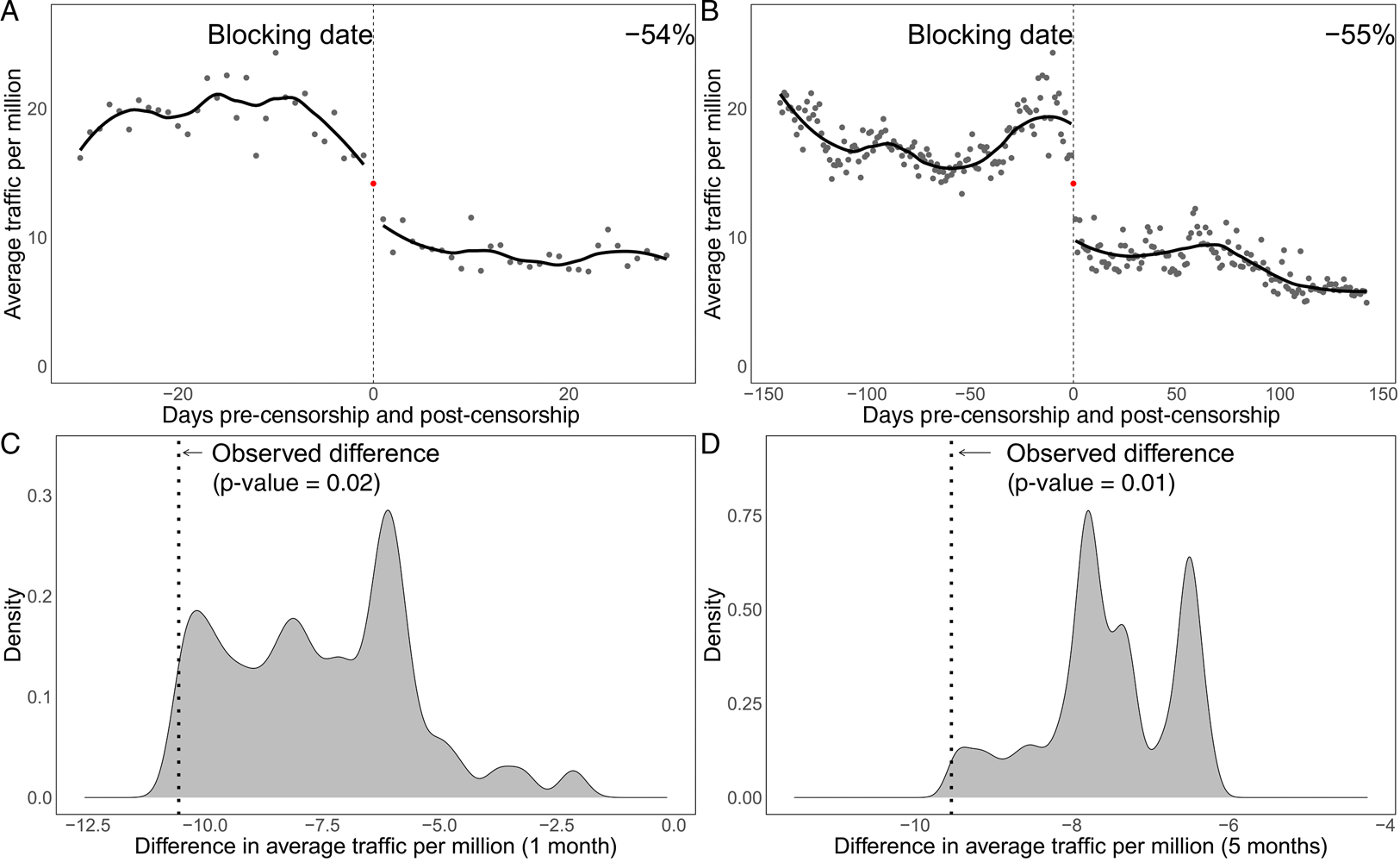
Although these findings imply that the average Egyptian news outlet still received visitors after being blocked, it is important to note that the outcome measures worldwide traffic and the large Egyptian diaspora and users from other countries can still visit the site without restrictions. The effect for users in Egypt is therefore likely stronger than the average reduction of 54–55 per cent indicated by my results. In line with my theoretical considerations, it thus seems that many Egyptians do not spend extra resources and time costs to circumvent the censoring once news websites are not reachable anymore. Another reason for a decrease in visits could also be that some of the websites were announced to be blocked and users stopped visiting out of fear. However, since the blocking of news websites was often not justified and most blocked websites do not serve a dedicated blocking page (AFTE 2021; OONI and AFTE 2018), the first explanation appears to be more likely.
In Online Appendix D, I conducted additional placebo tests investigating traffic on non-censored outlets and several sensitivity analyses that bolster confidence in the found patterns. Heterogeneity analyses show that, in particular, independent (up to −79 per cent), Islamist opposition (up to −64 per cent) and larger outlets suffered from being blocked. Leaving out censored websites that were likely unblocked increases the average traffic loss to 68 per cent in the medium term. In Online Appendix E, I explore whether like-minded news outlets experienced an increase in visitors instead, finding no evidence for large-scale substitution effects. Finally, Online Appendix G illustrates that most news outlets were not particularly successful in fending off the negative consequences of being blocked when switching to other domain names or services.
Censored News Websites Are More Likely to Halt Activity
Since most news websites generate their main income through advertising, the permanent reduction of visitors is also likely to affect an outlet's revenue (Mitchelstein and Boczkowski Reference Mitchelstein and Boczkowski2009). One important downstream effect of online filtering could be that blocked websites cease their activity due to insufficient funding (see Peterson Reference Peterson2021). In addition, the fact of being blocked may be understood as a repressive signal to the outlets that more severe consequences may follow if they do not stop publishing or alter their content (see Roberts Reference Roberts2018).
To test whether blocked outlets are more likely to halt their activity, I ran linear probability models on the aggregated outlet level using information on the outlet's status in 2021. Model 1 in Table 1 reports the results of a bivariate regression of a blocked website and the likelihood of activity ceasing. In Model 2, I add plausible confounding variables: funding, type, country of headquarter, average pre-May 2017 trafficFootnote 9 and stance towards the government to proxy censorship intent. The results suggest that, when controlling for other factors, the likelihood of halting activity increases by 27 percentage points when a website is blocked. In Model 3, I add a variable measuring whether journalists of the respective outlets have been imprisoned or killed or went missing during the study period to proxy non-digital threats against outlets (CPJ 2022). The results hold.Footnote 10 Finally, in Model 4, the blocking variable only considers outlets that were likely permanently blocked. With an increase in the likelihood to stop activity by 43 percentage points, the result becomes substantially stronger.Footnote 11
Likelihood for Egyptian news outlets to stop activity
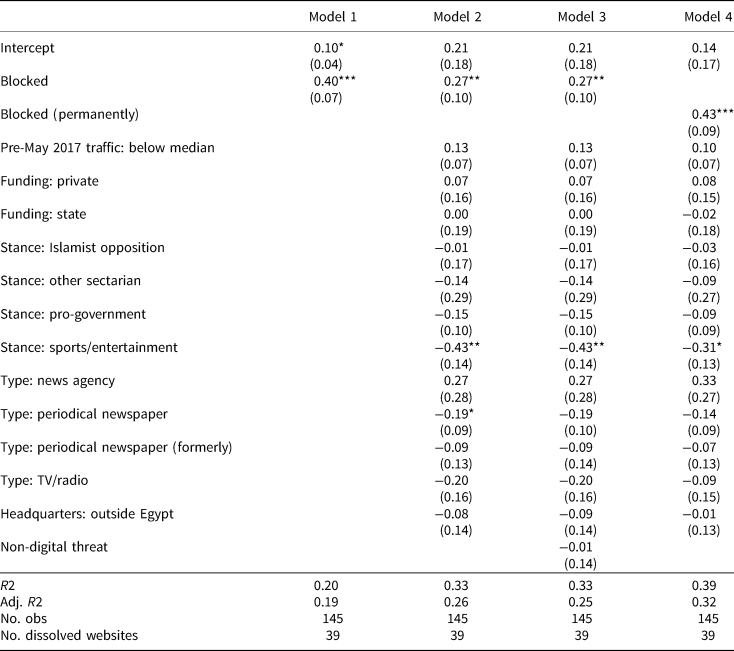
Note: *** p < 0.001; ** p < 0.01; * p < 0.05.
While this finding remains correlational, it supports qualitative accounts from news outlets. Among others, six months after its site was blocked, the Al-Qessa outlet wrote that the decision to suspend activity was due to the financial pressure caused by the obstruction. Supporting the argument that not just financial pressure led to closure, the Egypt Daily News outlet stated that they stopped publishing because they did not want to be on the same censorship list as Muslim Brotherhood websites (AFTE 2021). Other outlets supposedly stopped because staff feared being arrested (The Wire 2017). The blocking of websites may thus also serve as a means to create fear and to intimidate editors and journalists.
Conclusion
This letter has explored to what degree news outlets in autocracies are resilient to online censorship. The results indicate that blocked Egyptian outlets lost, on average, about 54–55 per cent of their global traffic and were more likely to cease existing. Additional analyses show that, in particular, larger, independent, Islamist opposition and permanently blocked outlets suffered from being filtered. In conclusion, these findings speak to the broader literature on state repression and information control, and provide evidence that digital censorship efforts often reduce the consumption and provision of alternative political information (Davenport Reference Davenport2007; Earl, Maher and Pan Reference Earl, Maher and Pan2022; Edmond Reference Edmond2013; Roberts Reference Roberts2020).
Apart from the direct consequences of censorship, experimental evidence from Russia documents that news websites are more likely overall to self-censor in repressive environments (Beazer et al. Reference Beazer2021). In addition to internet censorship, several news outlets are also facing legal and repressive actions in Egypt (RSF 2022). From the perspective of the Sisi regime, it thus seems that the attempt to censor and to control the Egyptian media landscape was largely successful, and no widespread opposition against these practices has occurred so far. More generally, the letter thus supports previous research which shows that media censorship minimizes the liberalization potential of the internet (Rød and Weidmann Reference Rød and Weidmann2015; Weidmann and Rød Reference Weidmann and Rød2019).
Nevertheless, there remain outlets that fight for access to independent information in Egypt. A total of 47 per cent of blocked Egyptian outlets relied on social media pages to provide content in 2021 (see Online Appendix G), and some experiment with newsletters or messenger groups, as well as different forms of funding, such as membership programmes or donations (Mada Masr 2019). Echoing McAdam (Reference McAdam1983), however, while some news websites adapt to censorship, state authorities ultimately have more resources at their disposal. Here, this letter also speaks to previous works which find that while adaption to repression can keep some form of opposition alive, it becomes less likely to spread (Ketchley Reference Ketchley2017; Lutscher and Ketchley Reference Lutscher and Ketchley2022; Ritter and Conrad Reference Ritter and Conrad2016). From a policy perspective, it therefore remains important that policymakers, international organizations and NGOs increase pressure on governments that censor heavily to ensure an independent and diverse media landscape.
Supplementary Material
Online appendices are available at: https://doi.org/10.1017/S0007123422000722
Data Availability Statement
Replication data for this article can be found in Harvard Dataverse at: https://doi.org/10.7910/DVN/W50QAY
Acknowledgements
I thank Molly Roberts, Karsten Donnay, Alex Dukalskis, Carl Henrik Knutsen and Anselm Hager for useful comments on this manuscript. Furthermore, I thank participants attending the 2021 European Consortium for Political Research (ECPR) panel on repression in the Middle East and participants of the November 2021 Comparative Institutions and Regimes (CIR) workshop at the University of Oslo for commenting on this work. Finally, I would like to thank the three anonymous reviewers and the editors of the BJPoLS for their constructive feedback and helpful comments.
Financial Support
This work has received funding from the European Research Council (ERC) under the European Union's Horizon 2020 research and innovation programme (Grant Agreement No. 863486).
Competing Interests
None.


 Open access

