

Applications of 3D technology are increasingly common in archaeology (Magnani et al. Reference Magnani, Douglass, Schroder, Reeves and Braun2020). Among these are projects that share 3D models of archaeological sites and artifacts with academic and public audiences (e.g., García-Bustos et al. Reference García-Bustos, Rivero, García Bustos and Mateo-Pellitero2022; Hackenbroich and Williams Reference Hackenbroich, Williams, Alberti and Mountain2022; Murray Reference Murray2023; Tanasi et al. Reference Tanasi, Cardona, Hassam, Kingsland, Kraft, Trapani and Calderone2023). Despite—or perhaps because of—the ubiquity of 3D technologies in archaeology, the best methods for sharing models with scholars, interested parties, and different segments of the public are still under exploration (Champion and Rahaman Reference Champion and Rahaman2020; Earley-Spadoni Reference Earley-Spadoni2017; Ellenberger Reference Ellenberger2017; Lloyd Reference Lloyd2016; Scopigno et al. Reference Scopigno, Callieri, Dellepiane, Ponchio and Potenziani2017). Relevant platforms for dissemination of 3D data include the commercial 3D model-sharing social media website Sketchfab, the web-based point cloud renderer Potree (Campiani et al. Reference Campiani, McAvoy, Lercari, Stuardo, Jiménez Delgado, López Mejía, Rissolo and Kuester2023; Schütz Reference Schütz2015), and the open-source alternative 3D Heritage Online Presenter (3DHOP; Potenziani et al. Reference Potenziani, Callieri, Dellepiane, Corsini, Ponchio and Scopigno2015). Champion and Rahaman (Reference Champion and Rahaman2020) provide a useful overview of both commercial and institutional repositories for 3D data and visualization, one of which is the Smithsonian’s X 3D Archive. Increasingly, online GIS platforms such as Esri’s ArcGIS Online facilitate storage of and access to 3D datasets as well (Badillo et al. Reference Badillo, Brennan, Estes, Aldrich and Emmerson2024).
Of the available platforms, Sketchfab is the most popular platform for 3D cultural heritage content, largely because of its ease of use and free tier (Garstki et al. Reference Garstki, Counts, Averett, Kansa and Kansa2020). “Cultural Heritage & History” is a sufficiently popular topic on Sketchfab to receive its own category on the website, with a great deal of high-quality 3D models of archaeological artifacts and sites posted on it. It includes content from curators of archaeology such as the British Museum, Global Digital Heritage, and the Florida Public Archaeology Network, among many others.
Unfortunately, explorable information related to the provenience of artifacts on Sketchfab is generally lacking, severely decreasing the effectiveness of models posted to the site as an educational tool (Lloyd Reference Lloyd2016). This issue is typically only addressed by the limited description and annotation text describing the context of models on the platform. This information structure does not provide a basis for the user-driven exploration of provenience or archaeological contexts. Emphasis on the exploration of attributes over context presents a fundamental challenge for cultural heritage-based scholarship and pedagogy. Archaeological knowledge generation relies not only on analysis of artifacts or the 3D structure of sites but also on the interpretation of contexts at multiple spatial and temporal scales (Butzer Reference Butzer1980). Three-dimensional models of artifacts, encountered on Sketchfab outside a structured narrative, are therefore often “disconnected objects out of place and time” (Aboulela Reference Aboulela and Obradovic2002:255, as quoted in Arora Reference Arora2021:123).
One way of framing 3D models in their context is through a “data narrative,” a storytelling model that applies data to structure or illustrate a story about the past. This structure has the potential to reshape archaeological publication (Garstki et al. Reference Garstki, Counts, Averett, Kansa and Kansa2020; Opitz Reference Opitz2018). Examples of this type of reimagined archaeological monograph include A Mid-Republican House from Gabii (Opitz et al. Reference Opitz, Terrenato and Mogetta2016) and Visualizing Votive Practice (Counts et al. Reference Counts, Averett, Garstki and Toumazou2020), both of which exemplify the potential of supporting traditional, linear narrative excavation reports with integrated 3D datasets. The former publication features a narrative written at three levels of complexity, ranging from simplified text intended for a general audience to a detailed data publication. At each level, the publication connects narrative points to detailed contextual information through hyperlinks (Opitz et al. Reference Opitz, Terrenato and Mogetta2016). This structure illustrates the way in which the authors create an argument about the site using connections to archaeological contexts to provide evidence for their claims (Opitz Reference Opitz2018). Similarly, the hybrid digital publication Visualizing Votive Practice (Counts et al. Reference Counts, Averett, Garstki and Toumazou2020) provides a basis for users to explore the objects referenced in a narrative text as 3D models published on Sketchfab. This structure also allows readers to explore the data supporting the interpretive argument presented by the authors (Garstki et al. Reference Garstki, Counts, Averett, Kansa and Kansa2020). Similar approaches can also be applied to public-facing narratives (e.g., Hackenbroich and Williams Reference Hackenbroich, Williams, Alberti and Mountain2022). Publications such as these leverage the potential of hypermedia—text, images, or other media [hyper]linked together in an open-ended network (Landow Reference Landow1997)—to more fully show the role of the author in knowledge production (Morgan and Eve Reference Morgan and Eve2012). By providing access to data that support a narrative, these monographs avoid obscuring—through overly dense and technical language—the evidence used to build an argument (Hodder Reference Hodder1989; Mickel Reference Mickel2012).
However, even data narratives do not take full advantage of the ability of hypermedia to revolutionize publication norms. Traditional archaeological publications, including those that support an argument with detailed 3D data, are almost universally structured as linear, interpretive narrative (Pluciennik Reference Pluciennik1999); the idealized structure for archaeological publication marshals evidence to support a claim (Smith Reference Smith2015, Reference Smith, Gonzalez-Perez, Martin-Rodilla and Pereira-Fariña2023). Presentation of a single narrative of the past with supporting evidence limits alternative interpretations and arguably positions the archaeologist as the authoritative voice on an objectively measured past (Pluciennik Reference Pluciennik, Van Dyke and Bernbeck2015), despite archaeological knowledge generation being inherently interpretive (Hodder Reference Hodder1991; Joyce Reference Joyce2002).
An alternative model of dissemination is to leverage hypermedia by publishing “fragments” of knowledge, connected by contextual relationships via links (Conklin Reference Conklin1987; Joyce and Tringham Reference Joyce and Tringham2007). The experience of navigating through hypermedia thus replicates that of interpretation of archaeological remains, because both models of knowledge production are based on exploring artifacts and their attributes through the lens of context at multiple scales (Joyce and Tringham Reference Joyce and Tringham2007). The reader’s ability to explore information according to their own interests and to create their own analysis of archaeological evidence results in a less hierarchical and authoritative structure that allows for multiple interpretations of the archaeological record (Holtorf Reference Holtorf2004; Morgan and Eve Reference Morgan and Eve2012). Although archaeological dissemination efforts structured in a nonlinear fashion lack the sequential form typical of most narratives, they retain the fundamental elements of characters (either individuals or collectives), events, and plot, providing the connection to chronology that defines a narrative (Pluciennik Reference Pluciennik1999). Nonlinear narrative models may also draw on non-Western and Indigenous models of knowledge to facilitate more accessible ways of interacting with the past (Duncan et al. Reference Duncan, Phillips, Winslett and Petrolito2003; Judge Reference Judge2024).
An early example of nonlinear storytelling with hypermedia is Sister Stories by Joyce and colleagues (Reference Joyce, Guyer and Joyce2000); more recent work by Moore (Reference Moore2024) and Watterson and Hillerdal (Reference Watterson and Hillerdal2020) exemplifies the potential of this narrative structure. However, in general, scholars publishing digital scholarship have not leveraged the full potential of hyperlinks for encouraging multivocal perspectives (Huggett Reference Huggett2015). This is especially true of publication of artifacts and archaeological sites in 3D, where Sketchfab pages—such as that of the British Museum, for example—provide opportunities for users to explore the physical attributes of archaeological objects but not their context (Lloyd Reference Lloyd2016). There is a great need for the publication of 3D cultural heritage objects that facilitate the exploration of context, enabling the development of new multivocal narratives about the past.
The Edom Lowlands Regional Archaeology Project
The joint University of California San Diego–Department of Antiquities of Jordan Edom Lowlands Regional Archaeology Project (ELRAP; directors Thomas E. Levy and Mohammad Najjar) has been conducting archaeological research in the Faynan region of southern Jordan since 2002 (Figure 1). A major focus is investigating the relationship between social evolution and large-scale copper production, primarily in the Iron Age but also during the Islamic period (Levy et al., eds. Reference Levy, Ben-Yosef and Najjar2014). To date, ELRAP has surveyed and excavated many of the Iron Age and Islamic smelting and mining sites throughout Faynan. Iron Age industrial metal production in the region is best represented by the copper smelting sites, like Khirbat en-Nahas (KEN) and Khirbat al-Jariya (KAJ), the copper mines, and the estimated 100,000 tons of slag (waste byproduct of copper smelting) that cover the Faynan landscape (Levy et al., eds. Reference Levy, Ben-Yosef and Najjar2014). In contrast, a brief resurgence of copper smelting during the Islamic period was concentrated at one major smelting site Khirbat Nuqayb al-Asaymir (KNA) and associated mines, and it produced only 1,500 tons of slag (Jones et al. Reference Jones, Levy and Najjar2012).
The Faynan region of Southern Jordan, with major sites presented on the Sketchfab platform highlighted.

Figure 1 Long description
The map depicts the Faynan region in Southern Jordan, highlighting elevation and key archaeological sites. Elevation is represented in meters above sea level (masl), ranging from 459 to 2807. The map includes main wadi channels, marked in gray and several sites marked with green stars: Khirbat en-Nahas, Khirbat al-Jariya, Khirbat al-Ghuwayba and Khirbat Nuqayb al-Asaymir. The inset map shows the study area′s location within a broader geographic context. The elevation gradient indicates higher elevations in the northeastern part of the map, transitioning to lower elevations in the southwest. Wadi al-Jariya, Wadi al-Ghuwayba and Wadi Fidan are labeled, with Wadi Faynan located in the southern part of the map. The scale bar indicates distances in kilometers and a north arrow provides orientation.
Since its inception, ELRAP has employed fully digital archaeological recording tools to maximize the data that could return from the field to the research institution (Levy et al. Reference Levy, Ben-Yosef, Najjar, Levy, Najjar and Ben-Yosef2014). This commitment to digital methods led to the development of a cyber-archaeology approach based around the collection of 3D and spatial data and digital context recording (Jones and Levy Reference Jones, Levy, Levy and Ian2018; Levy and Liss Reference Levy, Liss and Smith2020; Levy et al. Reference Levy, Ben-Yosef, Najjar, Levy, Najjar and Ben-Yosef2014). Critical to this methodology was the use of intensive 3D recording strategies to document ongoing excavations from multiple perspectives and scales (discussed in further detail later). For example, excavation contexts and features were regularly recorded through photogrammetry over the course of ELRAP excavations (Howland et al. Reference Howland, Kuester and Levy2014). In addition, a balloon platform with an attached DSLR camera was used to record excavation areas and entire sites in 3D from an aerial perspective (Howland et al. Reference Howland, Liss, Najjar and Levy2015; Liss et al. Reference Liss, Howland, Lorentzen, Smitheram, Najjar and Levy2020). These combined perspectives—along with the high temporal and spatial resolution—enabled extensive 3D documentation of sites and excavation contexts at ELRAP sites.
At the conclusion of a season, all data were returned to UCSD on portable hard drives and uploaded to the UCSD Levantine Archaeology Lab server for storage and processing (the server is also regularly backed up to a separate server in the UCSD Levantine Archaeology Pottery Lab for redundancy and disaster protection). This database serves as a medium-term archive of the photographs used to produce the 3D models described here; collaboration with the UCSD Geisel Library provides a more permanent archive (Lercari et al. Reference Lercari, Shulze, Wendrich, Porter, Burton and Levy2016). In addition, the Department of Antiquities of Jordan generously allowed most of the artifacts (e.g., ceramic sherds, slag, botanicals, etc.) to be shipped to UCSD for research and storage on permanent loan, facilitating further 3D recording and analysis. The collection of a great deal of spatial and 3D data on the ELRAP project for documentation and analysis provides a basis for later reuse of this data for public dissemination (Howland et al. Reference Howland, Liss, Levy and Najjar2020). Ultimately, digital datasets can provide an excellent basis for both pedagogy (Cobb et al. Reference Cobb, Cobb, Liang, Kiyama and Ng2024) and engaging interested parties (Dawson et al. Reference Dawson, Levy and Lyons2011). The project described here aims to leverage hypermedia to link a broad range of 3D datasets collected through the ELRAP project into a nonlinear narrative network. This structure is intended to facilitate the development of multivocal narratives about the archaeology of Faynan, Jordan, developed through freeform exploration of these data on Sketchfab.
Material and Methods
Collection and Processing of 3D Data
3D models recorded for the project were collected through a combination of aerial, terrestrial, and artifact photogrammetry. Aerial photogrammetry was performed using a Kingfisher Aerostat K9U balloon (cost: $1,800, net lift: about 6 kg) with a custom-built camera frame; the balloon was tethered to a reel carried by an operator; it had an 800 lb strength line. The camera is a Canon EOS 50D DSLR equipped with an 18 mm lens. Photographs were automatically captured by an intervalometer controller, with the time between photographs varying by context. The balloon was inflated with helium at the beginning of an excavation season and remained blown up and tied down throughout the campaign. Both sites and excavation areas were recorded using this aerial platform. These methods are described in greater detail elsewhere (Howland et al. Reference Howland, Kuester and Levy2014, Reference Howland, Liss, Najjar and Levy2015; Liss et al. Reference Liss, Howland, Lorentzen, Smitheram, Najjar and Levy2020).
Ground-based photogrammetry of excavation areas, units, and features was also conducted using a Canon EOS 50D DSLR equipped with an 18 mm lens. Artifact photogrammetry, especially of ceramic objects, was conducted following the approach described by Porter and colleagues (Reference Porter, Roussel and Soressi2016) using a Canon EOS 50D DSLR and lenses of varying focal length depending on the size of the artifact. Models were processed using the commercial photogrammetry software Agisoft Metashape (for details on processing workflow using this software, see Jones and Church Reference Jones and Church2020). One additional model of the Faynan region was produced through draping satellite imagery over a regional-scale ASTER digital elevation model (DEM). Photogrammetric model processing quality and specifications varied widely because of the disparate model targets (ranging from entire sites to small ceramic sherds) and data collection protocols.
More than 100 models were recorded and processed during field and lab work; a subset of 34 were chosen for initial publication based on model quality and archaeological significance. In total, models covered four scales of archaeological context that provide a basis for interpretation: region, site, excavation area/unit/feature, and artifact.
Publication on Sketchfab
The 3D models collected as part of the ELRAP project were recorded for purposes of documentation and analysis, yet with the recognition that these models could have a second life for public-oriented dissemination. Artifacts curated in a virtual environment have enormous potential for engaging nonspecialist audiences and democratizing interpretation of the past (Means Reference Means2015). We recognized ELRAP data as being potentially useful for providing a basis for pedagogy or engagement with several groups of interested parties. First, scholars of Levantine archaeology, archaeometallurgy, or both could be interested in using high-resolution 3D data of sites and artifacts from Faynan for analytical or comparative purposes. Second, students studying (Levantine) archaeology and archaeological methods could benefit from the availability of web-based reference collections (Betts et al. Reference Betts, Maschner, Schou, Schlader, Holmes, Clement and Smuin2011). Finally, this material would also be relevant to Arabic-speaking Jordanians. Although Jordanian society is characterized by diversity, with fault lines based on national origin (Jordanian, Palestinian, and increasingly, Syrian) and tribal identity (Salameh and El-Edwan Reference Salameh and El-Edwan2016), one unifying factor in attempts to construct a national identity has been its archaeological heritage (Groot Reference Groot2008). As such, narratives based on the cultural heritage of Faynan can be considered relevant not only to Arabic-speaking Jordanians as a whole but also to particular interest groups, such as the residents of Faynan, Qirayqira, and surrounding areas in the Tafilah and Ma’an Governates, as well as to Jordanians engaged in work related to cultural heritage. In this article, we focus on these Arabic-speaking Jordanian interested parties because even though a range of scholarship addresses the use of 3D data for analysis or reference, in Jordan “no thought [has been] given to how [digital cultural heritage content] might be made readily available to local audiences” (Smithies et al. Reference Smithies, Flohr, Bala’awi, Idwan, Palmer, Esposito, Mubaideen and Rababeh2023).
We chose Sketchfab as a platform to publish archaeological 3D models directed at these several particular groups for the following reasons: (1) Users can upload models for free (although paid subscriptions with additional capabilities are available, including a discounted Sketchfab Pro subscription); (2) the interface is user-friendly and intuitive, both for viewing and editing/creating content; (3) models can be viewed on any device with internet access, including smartphones; (4) models can be contextualized to a limited extent through descriptions and annotations, and these text elements provide a basis for hyperlinking to other models or websites; (5) models are downloadable with appropriate access/password; (6) models can be viewed in 3D using a personal VR viewer; (7) Sketchfab’s comment feature encourages participation and two-way communication between archaeologists and interested parties (Morgan and Eve Reference Morgan and Eve2012); and (8) it is the most popular 3D cultural heritage data-sharing platform, with a larger user base than other platforms. Sketchfab, however, should not be considered an archival solution for 3D data because of the inherent uncertainty of a commercial company’s lifespan and commitment to data storage (Garstki et al. Reference Garstki, Counts, Averett, Kansa and Kansa2020).
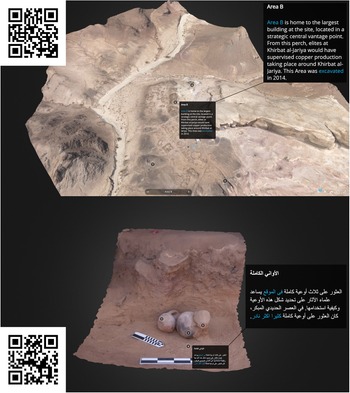
After the 34 models in this project were posted on Sketchfab, each model was provided with a brief description, and several key features of the model were annotated (Figure 2). These descriptions and annotations were written in language oriented toward the intended audiences, primarily students and descendant communities in Jordan. In practice, this meant limiting the use of jargon while providing enough detail on how technical methods (e.g., ceramic petrography) were applied to produce the knowledge described. Text descriptions were also used as the basis for considering how the context of each model might influence its interpretation. These contextual relationships were implemented into the descriptions and annotations through hyperlinks. For example, a 3D model of a ceramic sherd was provided with hyperlinks to the excavation context and archaeological site it was recovered from, to other sherds recovered from the same context, and to artifacts with a conceptual similarity or contrast to the sherd.
Models of Khirbat al-Jariya, Jordan (top), available at https://skfb.ly/oOu8V, and in situ ceramic vessels from Khirbat Nuqayb al-Asaymir (bottom), available at https://skfb.ly/p8HvW, displaying annotations in English and Arabic, respectively. Note the hyperlinks in each annotation that lead to different models. Each image is presented with a QR code linking to the model on Sketchfab.
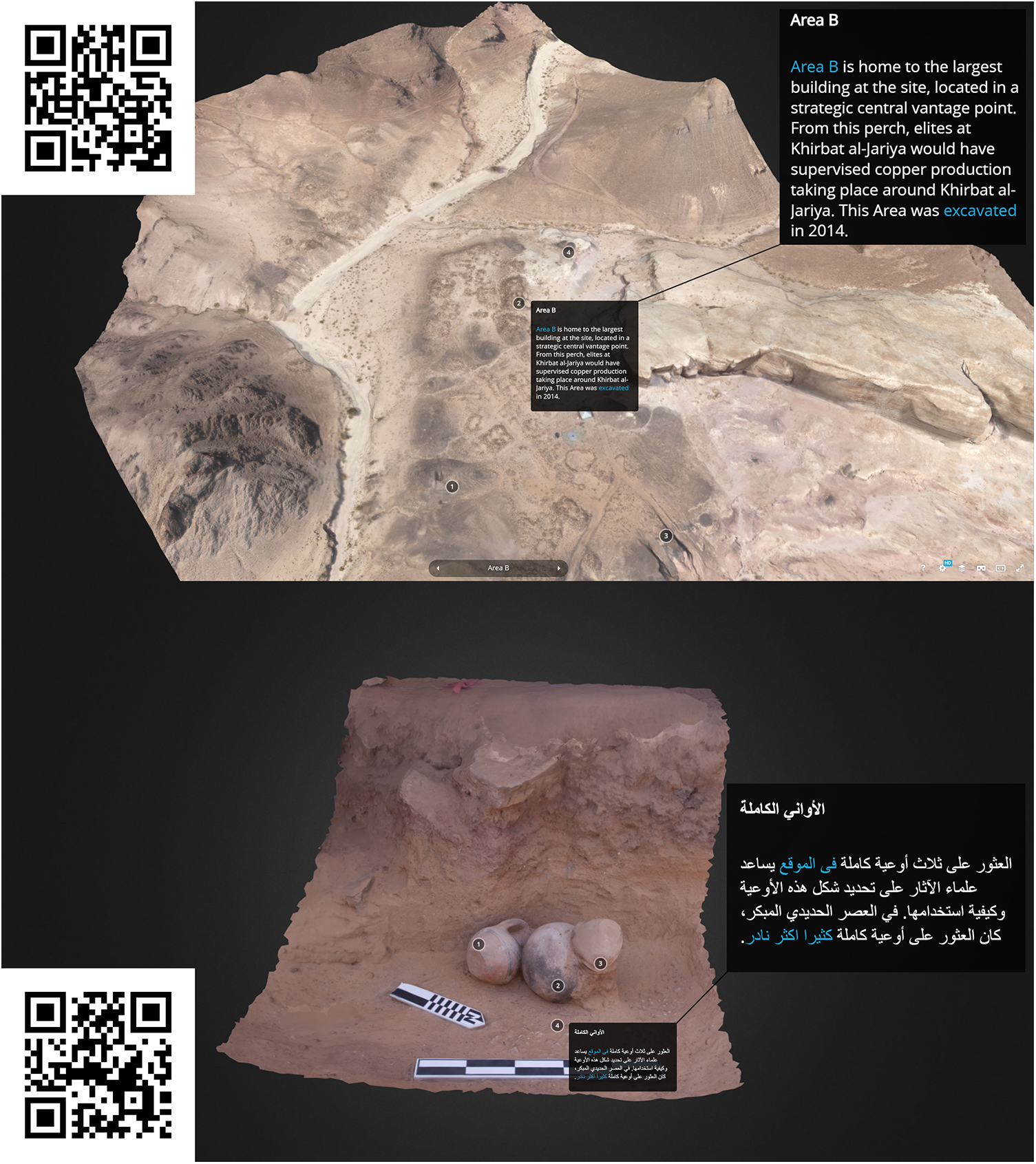
Figure 2 Long description
The image A showing a top-down view of a 3D terrain model with an on-screen callout titled “Area B.” A QR code is placed near the upper left. The callout text includes “Area B” and ends with “excavated in 2014.” A leader line points from the callout box to a location on the terrain. Several small circular numbered markers are visible on the terrain surface. A small label reading “Area B” appears near the bottom center. No legend is shown. No north arrow or orientation indicator is shown. The image B showing an oblique view into an excavation cut with a vertical soil face and a flat floor. Three ceramic vessels are visible on the floor near the soil face, each with a small circular numbered marker beside it. Two measuring scales are placed on the floor in front of the vessels. A QR code is placed near the lower left. A callout box on the right contains Arabic text, with a leader line pointing toward the vessels. No legend is shown. No north arrow or orientation indicator is shown.
Accessibility is a key consideration for digital public archaeology projects. The use of digital technologies has the potential to broaden access to archaeological knowledge, thereby facilitating increased multivocality in the field (Fitzpatrick and Boyle Reference Fitzpatrick, Boyle, Richardson and Reinhard2024). However, to achieve these worthwhile goals, one must consider the context of internet-based communications and inequalities inherent to them (Richardson Reference Richardson2013). Rather than orienting descriptions and annotations to a general audience, it is important to consider the means through which the specific intended audiences would access digital content. Interested parties in Jordan largely speak Arabic and access the internet through mobile devices rather than desktop computers: only 37% of adults have a home computer or tablet to access the internet, but a huge majority (85%) of adults have smartphones with internet access (Silver et al. Reference Silver, Smith, Johnson, Taylor, Jiang, Anderson and Rainie2019). As such, the text on each of the 34 models was published in both English and Arabic to facilitate access by both English-speaking students of archaeology and Arabic-speaking Jordanians. Models were also tested for quality control on mobile devices to ensure all text would be legible. Inequality in internet speed is another key issue for accessibility of 3D content published online (Richards-Rissetto Reference Richards-Rissetto, Watrall and Goldstein2022); this is a concern for any project providing digital access to datasets to interested parties.
Project Evaluation
Evaluation of the effectiveness of public-facing scholarship is crucial to understanding whether programs have successfully engaged interested parties. Yet, how to evaluate these projects is underresearched, and little standardization of evaluation protocols exists (Ellenberger and Richardson Reference Ellenberger and Richardson2019; King Reference King2016). Perhaps as a result, few public archaeology projects evaluate their own effectiveness (Apaydin Reference Apaydin2016). For digital projects, some reporting of quantitative data such as views, site visits, or “likes” is common. On Sketchfab, the number of times a published model has been viewed or liked is easily accessible. Yet more detailed internet analytics (such as when the views occurred or from which country a user viewed the model) are not available in the Sketchfab Basic or Pro account tiers. Moreover, view counts do not provide a qualitative perspective on whether a project has succeeded in education or engagement, and even more detailed metrics would not necessarily illustrate the depth of engagement that many public-facing projects hope to achieve (Ellenberger and Richardson Reference Ellenberger and Richardson2019). Thus, it is beneficial and arguably necessary to develop program-specific assessment methods to evaluate the extent to which a given program meets its goals and objectives (Chiarulli Reference Chiarulli2016).
For these reasons, we developed a short questionnaire in Arabic, administered via snowball sampling to visitors to the ACOR Library in Amman and to acquaintances of project participants, to evaluate the success of the ELRAP Sketchfab nonlinear narrative platform in providing an engaging experience to interested parties. This sampling strategy was intended to capture opinion from two specific interest groups: Jordanians engaged in work related to cultural heritage, who would be likely to visit the ACOR Library as part of their research activities, and a sampling of the Jordanian lay public, for whom this project might be most relevant from the perspective of the development of a national identity. This survey was loosely inspired by the questionnaire published by Thum and Troche (Reference Thum and Troche2016).
Questions address various topics related to the goals of the program (Howland Reference Howland2025). To set a baseline, users were asked about the device they used to view the project and their previous experience with the archaeology of Jordan and digital public archaeology platforms. Then, a set of questions inquired about the effectiveness of the platform and what users learned from it. These questions were intended to evaluate the extent to which different users took away different main points from the experience, thereby assessing the value of a nonlinear narrative structure in the development of multivocal knowledge production. Finally, so we could understand the level of engagement provided by this platform, we asked users about their experiences with the interactive 3D format.
Results
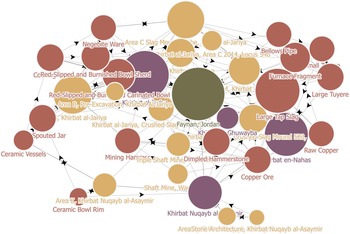
The extensive hyperlinking described earlier creates an accessible network of models, each with descriptions and annotations that both provide fragments of information and avenues to explore related or contrasting information. The 34 models have a total of 186 links, facilitating exploration of the entire network of models without directionality or an intended linear structure (Figure 3). Together, these functions allow for the development of an interlinked network of models, each appropriately framed within its archaeological and historical contexts for viewers with varying levels of knowledge and familiarity with archaeology (Lloyd Reference Lloyd2016).
Network diagram visualization of the 186 directional links between the 34 different models on the platform. Models are scaled proportionately to their significance in the network and colored according to the scale of what is represented in the model: green represents a region, purple a site, yellow an (excavation) area, and red an artifact. This nonlinear network allows users to explore the models on the Sketchfab platform freely according to their own interests without any intended directionality. An interactive version of this diagram is available at https://public.flourish.studio/visualisation/20323398/ (diagram and figure prepared by Kaitlyn E. Reis, Wichita State University Geospatial Archaeology Laboratory).
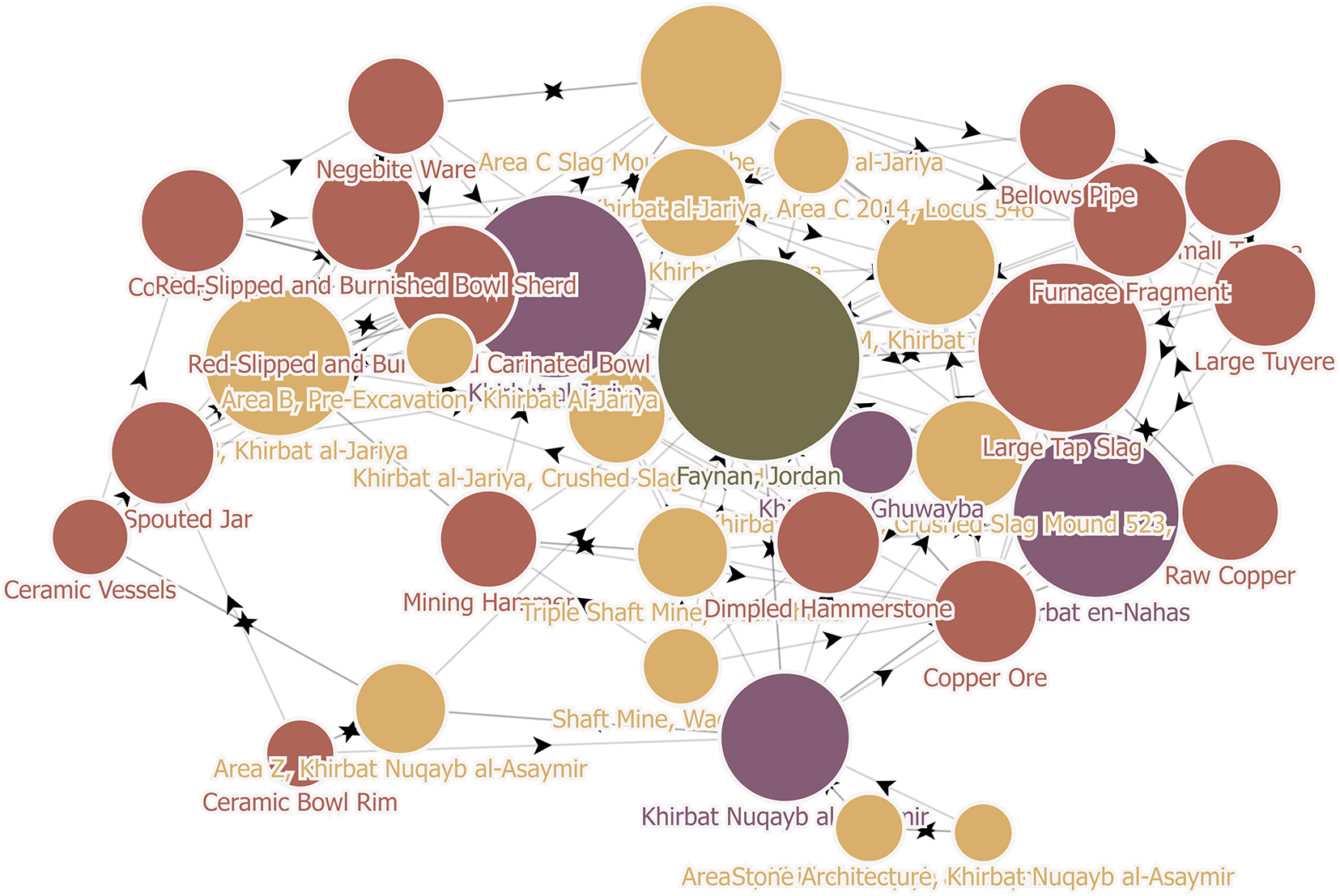
Figure 3 Long description
The infographic is a network diagram visualizing connections between 34 archaeological models and artifacts, with 186 directional links. Nodes represent items like ′Negbeite Ware′, ′Furnace Fragment′ and ′Copper Ore′. The size of each node indicates its significance within the network. Arrows show directional relationships, suggesting influence or association. The diagram is structured with a central hub surrounded by clusters, such as ceramics and metallurgical remains. Prominent nodes include ′Khirbat al-Jariya′ and ′Large Tap Slag′. The layout allows exploration of relationships without a fixed direction, emphasizing the interconnectedness of the archaeological dataset.
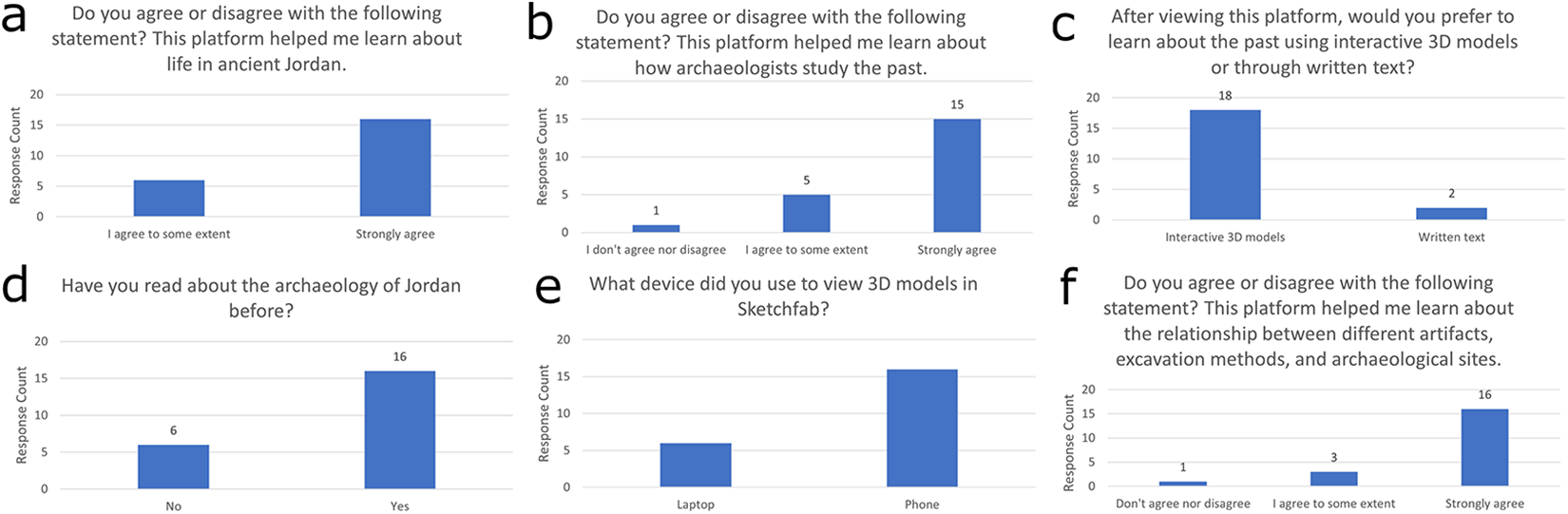
The questionnaire designed to evaluate the effectiveness of this work in engaging Arabic-speaking Jordanians was completed by 22 respondents. Results to questions with quantitative answers are shown in Figure 4, and the full responses are archived at Howland (Reference Howland2025). Broadly speaking, these results display general satisfaction with the platform and its ability to provide engaging and informative content on the archaeology of Faynan.
Responses from Arabic-speaking Jordanians to survey questions with multiple-choice responses. Not all questionnaire takers responded to every question. Qualitative responses are available at Howland (Reference Howland2025).
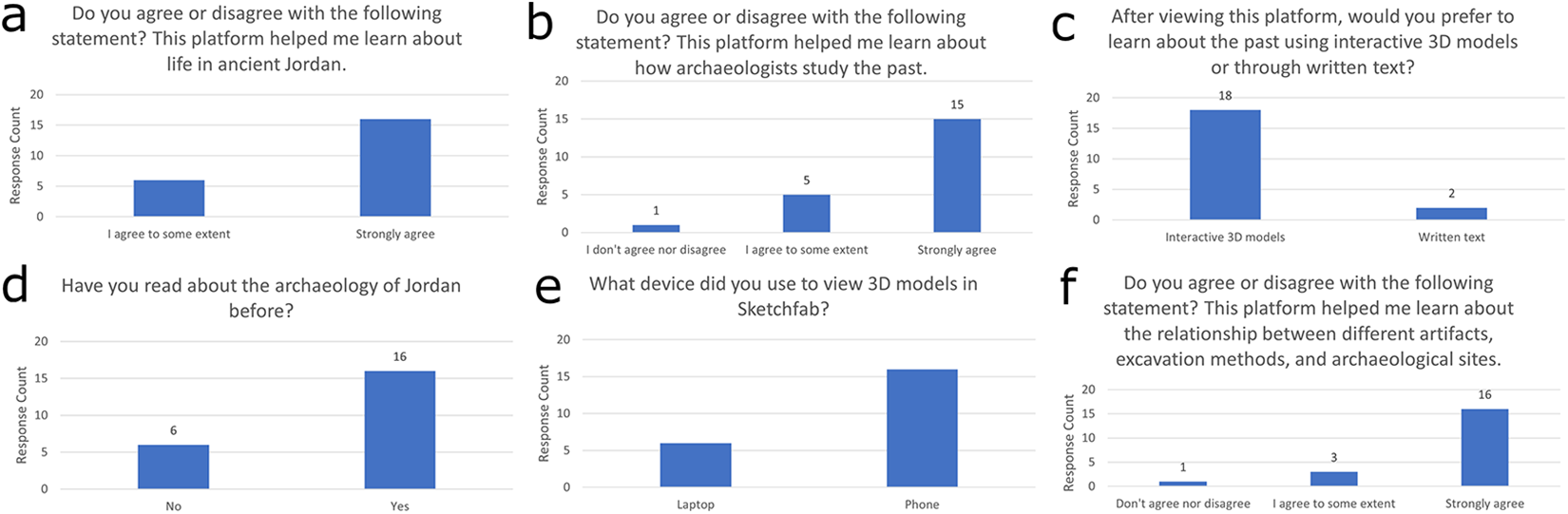
Figure 4 Long description
The image A showing the text: Do you agree or disagree with the following statement? This platform helped me learn about life in ancient Jordan. The horizontal axis categories are I agree to some extent and Strongly agree. The vertical axis label is Response Count, with a range from 0 to 20. Bar values: I agree to some extent equals 6; Strongly agree equals 16. The image B showing the text: Do you agree or disagree with the following statement? This platform helped me learn about how archaeologists study the past. The horizontal axis categories are I don’t agree nor disagree, I agree to some extent and Strongly agree. The vertical axis label is Response Count, with a range from 0 to 20. Bar values: I don’t agree nor disagree equals 1; I agree to some extent equals 5; Strongly agree equals 15. The image C showing the text: After viewing this platform, would you prefer to learn about the past using interactive 3D models or through written text? The horizontal axis categories are Interactive 3D models and Written text. The vertical axis label is Response Count, with a range from 0 to 20. Bar values: Interactive 3D models equals 18; Written text equals 2. The image D showing the text: Have you read about the archaeology of Jordan before? The horizontal axis categories are No and Yes. The vertical axis label is Response Count, with a range from 0 to 20. Bar values: No equals 6; Yes equals 16. The image E showing the text: What device did you use to view 3D models in Sketchfab? The horizontal axis categories are Laptop and Phone. The vertical axis label is Response Count, with a range from 0 to 20. Bar values: Laptop equals 6; Phone equals 16. The image F showing the text: Do you agree or disagree with the following statement? This platform helped me learn about the relationship between different artifacts, excavation methods and archaeological sites. The horizontal axis categories are Don’t agree nor disagree, I agree to some extent and Strongly agree. The vertical axis label is Response Count, with a range from 0 to 20. Bar values: Don’t agree nor disagree equals 1; I agree to some extent equals 3; Strongly agree equals 16.
Discussion
The structure of the platform we created was designed with several main goals in mind. First, we believe that a nonlinear narrative structure encourages people to develop their own meaning and narratives from their exploration of archaeological evidence. Even without an explicit sequence, nonlinear platforms such as ours still retain the fundamental elements of narrative: characters/collectivities experiencing events that are linked in a chronological sequence (i.e., a plot; Pluciennik Reference Pluciennik1999). Certain meta-narratives, however, are unavoidably embedded in our platform, because dissemination of archaeological data is inherently interpretive (Hodder Reference Hodder1991; Joyce Reference Joyce2002). For example, one implicit argument in our platform is that Iron Age elites in Faynan controlled the production of copper and exchanged this copper for wealth goods, including fineware ceramics and luxury foodstuffs; this process was experienced by characters in a sequential plot that ultimately led to an increase in social complexity in the region. This meta-narrative is not made explicit but rather requires users to read fragments of knowledge and link them into a sequence of events.
It is this action by the user that allows for the development of other narrative interpretations from the data provided, a goal of ours in line with the multiple perspective model of public archaeology (Merriman Reference Merriman2004). Practitioners of this model assume that diverse communities have valuable contributions to make in archaeological knowledge generation. Community-engaged public archaeology improves both knowledge and preservation of the archaeological record (De Vries Reference De Vries2013; Kafafi Reference Kafafi2021). In general, the meaning of archaeological sites is highly contextual based on the identity and experiences of the individual (Abu-Khafajah Reference Abu-Khafajah, Watterson and Watson2013); thus, facilitating multiple interpretations of the past is an important goal in and of itself. Public archaeology is a particularly important means of bringing multivocality into the field, because archaeologists can help the public understand that multiple, legitimate interpretations of the past can exist simultaneously (Atalay Reference Atalay, Habu, Fawcett and Matsunaga2008).
The survey results presented here suggest that our nonlinear structure is one effective approach to inviting multiple valid interpretations of the archaeological record. One hundred percent (percentages given are accurate at the time of publication) of surveyed users agreed at least to some extent that the platform helped them learn about life in ancient Jordan. When asked what was the most interesting information they gained, respondents framed their responses in different ways, including about their national heritage (“my country’s antiquities and how they are presented”Footnote 1) and the daily lives and activities of ancient people (“old work and cooking tools”Footnote 2). The variety in the contexts in which users interpret the models and text shown on this platform illustrates the value of nonlinear narrative structures that facilitate freeform exploration of archaeological datasets.
However, although the social media structure of Sketchfab theoretically provides a basis for digital community engagement through two-way communication between the ELRAP team and interested parties via the comment box enabled on each of the 34 models, no comments have yet been received on any model. This may be due to the need to create a Sketchfab account to comment. The authors have also found through experience with a previous public-oriented digital project (Howland et al. Reference Howland, Liss, Levy and Najjar2020) that comment boxes are infrequently used but that even a small number of comments provide a basis for updating project content to better address topics of interest to the public audience. In the current project, the use of a formal questionnaire enabled us to receive feedback and implement feedback from engaged users, but more work must be done to encourage and develop the kind of internet culture that facilitates participatory involvement in digital public archaeology projects (Bollwerk Reference Bollwerk2015; Morgan and Eve Reference Morgan and Eve2012). The alternative—public scholarship in which information flows in one direction from archaeologist to community members—takes on an “unavoidably authoritative, hierarchical flavor” because of the impracticality of open conversation or disagreement (McDavid Reference McDavid2002).
Moreover, the use of hypermedia to construct an original narrative through multiscalar exploration of archaeological artifacts, excavation units, and sites (Joyce and Tringham’s [Reference Joyce and Tringham2007] “fragments”) replicates the nature of the interpretive process of archaeological knowledge generation. Archaeological analysis fundamentally relies on understanding the links between an artifact and the context in which it was found. The overwhelming majority of 3D models posted on Sketchfab—and other websites that publish 3D media—close off avenues of inquiry into findspots and associations. By contrast, the nonlinear structure employed by our project invites the exploration of context through hyperlinks. This narrative framework not only improves the ability of users to develop relevant narratives about the past but also enables them to experientially learn more about the process of knowledge production as conducted by professional archaeologists (Joyce and Tringham Reference Joyce and Tringham2007). Projects employing a nonlinear, hypermedia-based narrative model are therefore well suited for pedagogical purposes, such as engaging undergraduate students of archaeology. These projects can provide a basis for learning both about the archaeology of a particular region and about the process of archaeology itself.
Surveyed users agreed that the ELRAP platform serves these purposes. About 95% of questionnaire respondents said that the platform helped them learn to some extent about how archaeologists study the past. Individual users also noted that the Sketchfab platform was “fun to read”Footnote 3 and “is based on accurate and scientific information.”Footnote 4 Importantly, 95% of respondents said that the platform helped them learn about the relationships among different artifacts, excavation methods, and archaeological sites. These results suggest that a nonlinear network is effective in helping users examine and learn about the kinds of contextual relationships that define archaeological interpretation, a major goal of the project. Unfortunately, the type of user analytics that would facilitate analysis of whether users visiting the platform clicked through a number of links during their visit (e.g., click/event tracking) are not available: analytics were limited to simple pageview tracking, which is not a useful metric for understanding the depth of user interaction (Ellenberger and Richardson Reference Ellenberger and Richardson2019). Nevertheless, this project addresses the important and still relevant call made by Clarke (Reference Clarke2004) for archaeologists to carefully consider the appropriate type of digital media and pedagogical platform used to teach about archaeology.
Finally, our project was designed to explore the accessibility of archaeological scholarship. Public-oriented publication of archaeological data and results is often a low priority for academic archaeologists, given the well-known pressures to publish in peer-reviewed journals, which is true for publication in languages other than English (Beck et al. Reference Beck, Gjesfjeld and Chrisomalis2021). We believe that archaeologists have an ethical obligation to publish their results on accessible platforms, taking into account paywalls, mode of access, and users’ languages and abilities (Fitzpatrick and Boyle Reference Fitzpatrick, Boyle, Richardson and Reinhard2024). Our project’s aim is to make ongoing research on the archaeology of Faynan, Jordan, accessible and engaging to interested parties, especially the descendant communities of Faynan and Jordan. As such, we made model descriptions and annotations available in Arabic. Moreover, given that Jordanians disproportionately access the internet on mobile devices rather than on laptop or desktop computers (Silver et al. Reference Silver, Smith, Johnson, Taylor, Jiang, Anderson and Rainie2019), we rigorously tested each component of the platform on mobile platforms for quality control. However, we also recognize that global inequalities in internet speeds also provide inherent limitations to the accessibility of 3D archaeological content online (Richards-Rissetto and von Schwerin Reference Richards-Rissetto and Schwerin2017).
Fortunately, results from our survey of Arabic-speaking Jordanians show that not only can many Jordanians access this content but also that 90% of questionnaire respondents prefer to consume information about the past in the form of interactive 3D models, rather than in text format. Survey respondents suggested that 3D content was “more interesting and exciting”Footnote 5 than text content, with one user responding that the 3D content “gives us a complete and tangible perception, as if the pieces of the past are in our hands.”Footnote 6 One Jordanian respondent, however, preferred text-based narratives about the past, noting that they provide a more holistic perspective on artifacts: “The written text explains the history of the relic, how it was discovered, its uses, and its importance.”Footnote 7 Nevertheless, when asked about areas for improvement for the Arabic-language content, users expressed broad satisfaction with the platform and even indicated a desire for expansion of the content covered: for instance, “the platform is excellent, but I prefer to add more archaeological sites.”Footnote 8
Nearly three-quarters of the Jordanian respondents had previously viewed information about archaeological sites on a digital platform; several had accessed digital platforms providing information about the well-known Jordanian heritage site Petra, and others had viewed content related to ancient ceramics from Jordan. This suggests that the platform was successful in engaging one of the key target demographics, Arabic-speaking Jordanians with a professional or personal interest in cultural heritage content.
As discussed, several Jordanian respondents interpreted the content on the platform from a perspective of pride in their national cultural heritage, reporting “it sparked my curiosity to learn more about the antiquities of my country, Jordan,”Footnote 9 and “I am Jordanian and I am proud of Jordan’s history.”Footnote 10 These responses support the idea that archaeology is a key driver in the development of a cohesive national identity in Jordan (Groot Reference Groot2008). Others focused on how specific practices in ancient Faynan could be studied through elements of material culture. In sum, the almost universally positive reception of this content suggests an existing demand for more engaging and interactive content about the past. However, a lack of participation through commenting suggests a continued need for additional, especially face-to-face, avenues of community engagement and co-creative approaches to digital public archaeology. In the context of this project, more work needs to be done to specifically engage the local groups of Faynan, Qirayqira, and the surrounding areas.
Conclusions
3D data of archaeological sites, excavation units, and artifacts provide an excellent basis for interactive and engaging digital platforms aimed at segments of the public and interested parties. However, many digital public archaeology projects making use of these data are structured as linear narratives and authored by archaeologists. This narrative structure limits the possibility of freeform exploration of archaeological data and context, thereby reducing the potential for the development of multivocal and multiple valid interpretations about the past. By implementing a hypermedia-based, nonlinear narrative structure into a collection of 3D models at multiple overlapping scales, our project facilitates exploration not only of archaeological features but also of context. In doing so, users replicate the process of archaeological knowledge generation in which contextual relationships provide meaning to artifacts, excavation units, and sites. Our questionnaire results also illustrate the value of engaging interested parties and descendant groups with interactive digital media. Yet, a lack of online engagement and participation suggests the importance of collaborative and co-creative approaches in the development of future nonlinear narrative projects.
Acknowledgments
Special thanks to the local Bedouin of Qirayqira and Faynan, especially from the Azazma tribe, for their assistance in the field and the lab, as well as Dr. M. Jamhawi, former director general of the Department of Antiquities of Jordan. We are also grateful to Samya Khalaf Kafafi of the ACOR Library and Omar Sameer Omar Khalil for their work with Arabic text for the project. Without their invaluable assistance, this project would not have been possible. Thanks also to Dr. Neil Smith, Marc Wallace, Craig Smitheram, and Matt Vincent for assisting with the excavations and digital recording at ELRAP sites. Kendra Scheer provided critical support in producing the 3D datasets on Sketchfab. Thank you to the Lawrence T. Geraty and Douglas R. Clark Center for Near Eastern Archaeology at La Sierra University for facilitating the 3D recording of ELRAP collections. Thanks also to the Digging Up Data Program for helpful guidance and feedback in the direction of this work and to Kaitlyn E. Reis and Max Gosch for their assistance in project development. Permissions for the 2012 and 2014 excavations on which this work was based were provided by the Department of Antiquities of Jordan. The work described here was classified as Exempt from IRB review by Wichita State University IRB Number 5766.
Funding Statement
This work was supported by an AIA-NEH Grant for Archaeological Research (PI: M.D.H.); an NSF IGERT Award under grant #DGE-0966375, “Training, Research and Education in Engineering for Cultural Heritage Diagnostics” (graduate student support for B.L., I.W.N.J., and M.D.H); and funding from the AIA-Orange County Chapterand T.E.L.’s Norma Kershaw Chair, Department of Anthropology and Jewish Studies, UC San Diego. Opinions, findings, and conclusions from this study are those of the authors and do not necessarily reflect the opinions of the research sponsors.
Data Availability Statement
All 34 3D models referenced in this article are downloadable at https://sketchfab.com/ELRAP. The 22 complete responses to the questionnaire administered to Arabic-speaking Jordanians via snowball sampling are available at Howland (Reference Howland2025).
Competing Interests
The authors declare none.
 ): A Transnational Approach to Building Digital Cultural Heritage Capacity

 Open access

