1. Introduction
Identifying the formation mechanisms behind the diverse range of phenomena observed in planetary nebulae (PNe) has proven to be a particularly challenging task (Balick & Frank Reference Balick and Frank2002). Although binary interactions offer the leading explanation for many phenomena (De Marco Reference De Marco2009; Jones & Boffin Reference Jones and Boffin2017), there are some phenomena that remain particularly enigmatic. The Chandra detection of relatively hard X-ray emission with peak energies > 0.5 keV in some central stars is one such phenomenon (Guerrero et al. Reference Guerrero, Chu, Gruendl, Williams and Kaler2001, Guerrero, Chu, & Gruendl Reference Guerrero, Chu and Gruendl2011; Guerrero Reference Guerrero2012, Reference Guerrero, Hamann, Sander and Todt2015; Kastner et al. Reference Kastner2012; Freeman et al. Reference Freeman2014; Montez et al. Reference Montez2015; Montez & Kastner 2013; Montez Reference Montez2017). A wide range of explanations have been proposed (see Guerrero Reference Guerrero2012 and Montez et al. Reference Montez2015 for comprehensive discussions) and include processes that can operate from central stars on their own (shocks in the stellar wind, emission from the atmosphere, and accretion of nebular or debris disk material) or in a binary system (colliding winds, accretion onto a companion, and coronal activity from late-type companions). Some detections may be explained by coronal activity only when the presence of late-type stellar companions was already independently established (Montez et al. Reference Montez, De Marco, Kastner and Chu2010, Reference Montez2015). However, in those sources without a proven late-type companion, it is very difficult to determine which of the several possible mechanisms may produce the relatively hard X-ray emission. The most effective means we have to narrow down this list of possible mechanisms is to establish the binary status of those central stars with X-ray detections.
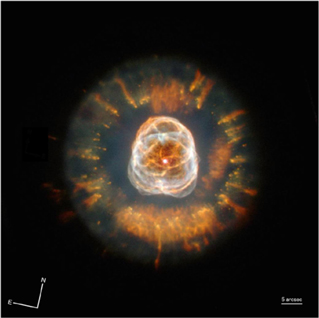
The hardest X-ray emission of any central star belongs to NGC 2392Footnote a (PN G197.8+17.3, Figure 1) which exhibits a spectrum peaking above 1 keV and a hard energy tail up to 5 keV (Guerrero Reference Guerrero2012; Montez et al. Reference Montez2015). Guerrero (Reference Guerrero2012) favoured accretion onto a compact companion to explain the X-ray spectrum. Despite considerable indirect evidence supporting such a companion in the literature, its existence has yet to be proven. Heap (Reference Heap1977) first identified a large discrepancy between the central star effective temperature (∼40 kK) and the He ii Zanstra temperature (∼70 kK), suggesting a hot white dwarf (WD) companion must be present to produce high ionisation potential nebular emission lines like [Ne v] (see also Pottasch, Bernard-Salas, & Roellig Reference Pottasch, Bernard-Salas and Roellig2008 and Danehkar et al. Reference Danehkar, Frew, Parker and De Marco2012, Reference Danehkar, Frew, De Marco and Parker2013). The central star wind has a low terminal velocity of v ∞∼ 300–400 km s−1 (Herald & Bianchi Reference Herald and Bianchi2011; Kaschinski, Pauldrach, & Hoffmann Reference Kaschinski, Pauldrach and Hoffmann2012; Hoffmann, Pauldrach, & Kaschinski Reference Hoffmann, Pauldrach and Kaschinski2016), which is much lower than expected to account for the observed diffuse (hot bubble) X-ray emission in the nebula (Steffen, Schönberner, & Warmuth Reference Steffen, Schönberner and Warmuth2008; Ruiz et al. Reference Ruiz2013). Ruiz et al. (Reference Ruiz2013) concluded that a companion is required to provide additional energy to power the X-ray emission. Prinja & Urbaneja (Reference Prinja and Urbaneja2014) studied short timescale spectroscopic variability in the central star, identifying a possible periodicity of 0.123 d from RV measurements of the N iv 6380 absorption line, but too few spectra were obtained to determine whether the variability could be due to orbital motion.
Hubble Space Telescope colour-composite image of NGC 2392 made from images taken with the filters F469N (violet), F502N (blue), F656N (green), and F658N (red). Image credits: NASA, Andrew Fruchter, and the ERO Team Sylvia Baggett (STScI), Richard Hook (ST-ECF), and Zoltan Levay (STScI).
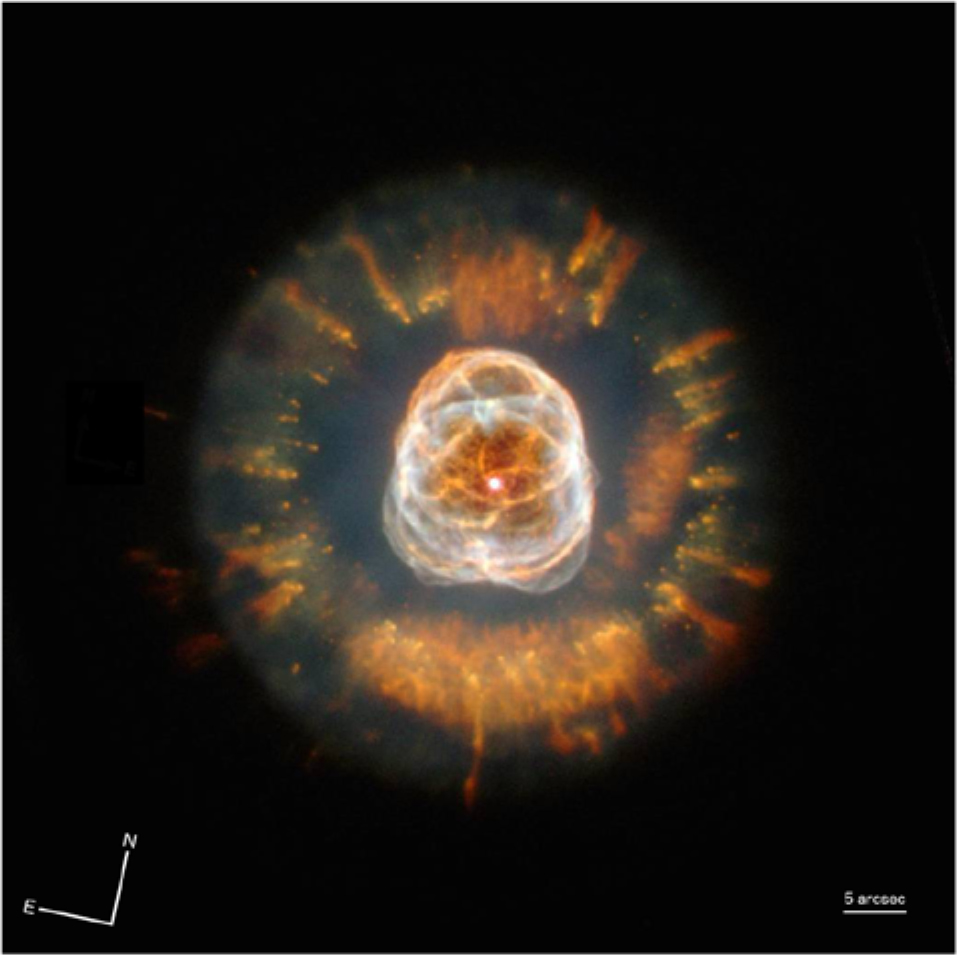
Several nebular properties also favour the presence of a companion. The nebula features a pair of collimated outflows or jets travelling up to 180 km s−1 from the central star (O’Dell & Ball Reference O’Dell and Ball1985; Gieseking, Becker, & Solf Reference Gieseking, Becker and Solf1985; García-Díaz et al. Reference García-Díaz, López, Steffen and Richer2012) and numerous low-ionisation structures (LIS; Gonçalves, Corradi, & Mampaso Reference Gonçalves, Corradi and Mampaso2001; Figure 1; García-Díaz et al. Reference García-Díaz, López, Steffen and Richer2012). Miszalski et al. (Reference Miszalski, Acker, Parker and Moffat2009) first identified jets and LIS to be the markers of PNe with post-common-envelope (post-CE) central stars, and multiple studies have since strongly corroborated this result with respect to jets (Miszalski et al. Reference Miszalski2011a, Reference Miszalski2011b; Corradi et al. Reference Corradi2011; Boffin et al. Reference Boffin2012; Tocknell, De Marco, & Wardle Reference Tocknell, De Marco and Wardle2014; Miszalski et al. Reference Miszalski, Manick, Mikołajewska, Van Winckel and Iłkiewicz2018b) and LIS (Corradi et al. Reference Corradi2011; Miszalski et al. Reference Miszalski2011b, Reference Miszalski2018a; Boffin et al. Reference Boffin2012; Manick, Miszalski, & McBride Reference Manick, Miszalski and McBride2015; Jones et al. Reference Jones2014, Reference Jones2015, Reference Jones2019; García-Segura, Ricker, & Taam Reference García-Segura, Ricker and Taam2018). Post-CE PNe also seems to exhibit very high abundance discrepancy factors (ADF; Wesson et al. Reference Wesson, Jones, García-Rojas, Boffin and Corradi2018 and references therein), and Tsamis et al. (Reference Tsamis, Barlow, Liu, Storey and Danziger2004) determined an ADF(C2+) in the range of 7–24 based on the observations by Barker (Reference Barker1991). However, Pottasch et al. (Reference Pottasch, Bernard-Salas and Roellig2008) found no discrepancy in the carbon abundance, and Zhang et al. (Reference Zhang2012) found a low ADF(O2+) of 1.65. Méndez et al. (Reference Méndez, Urbaneja, Kudritzki and Prinja2012) highlighted that the central star abundances (Pauldrach, Hoffmann, & Méndez Reference Pauldrach, Hoffmann and Méndez2004; Herald & Bianchi Reference Herald and Bianchi2011; Méndez et al. Reference Méndez, Urbaneja, Kudritzki and Prinja2012) of He and N are higher than the nebular abundances (see, e.g. Pottasch et al. Reference Pottasch, Bernard-Salas and Roellig2008), whereas C and O are lower than in the nebula. Méndez et al. (Reference Méndez, Urbaneja, Kudritzki and Prinja2012) interpreted this to be indicative of H-depleted, CNO processed material that was exposed following an interaction with a close binary companion that may have removed the outer layers of the star.
The indirect evidence supporting a potential binary nucleus in NGC 2392 inspired us to conduct radial velocity (RV) monitoring of its central star. Section 2 describes the spectroscopic observations and presents the RV measurements. Analysis of the measurements in Section 3 reveals the spectroscopic binary nature of the central star and the orbital parameters are determined. We discuss the results in Section 4 in the context of multi-wavelength observations of NGC 2392 and we conclude in Section 5.
2. Observations and RV measurements
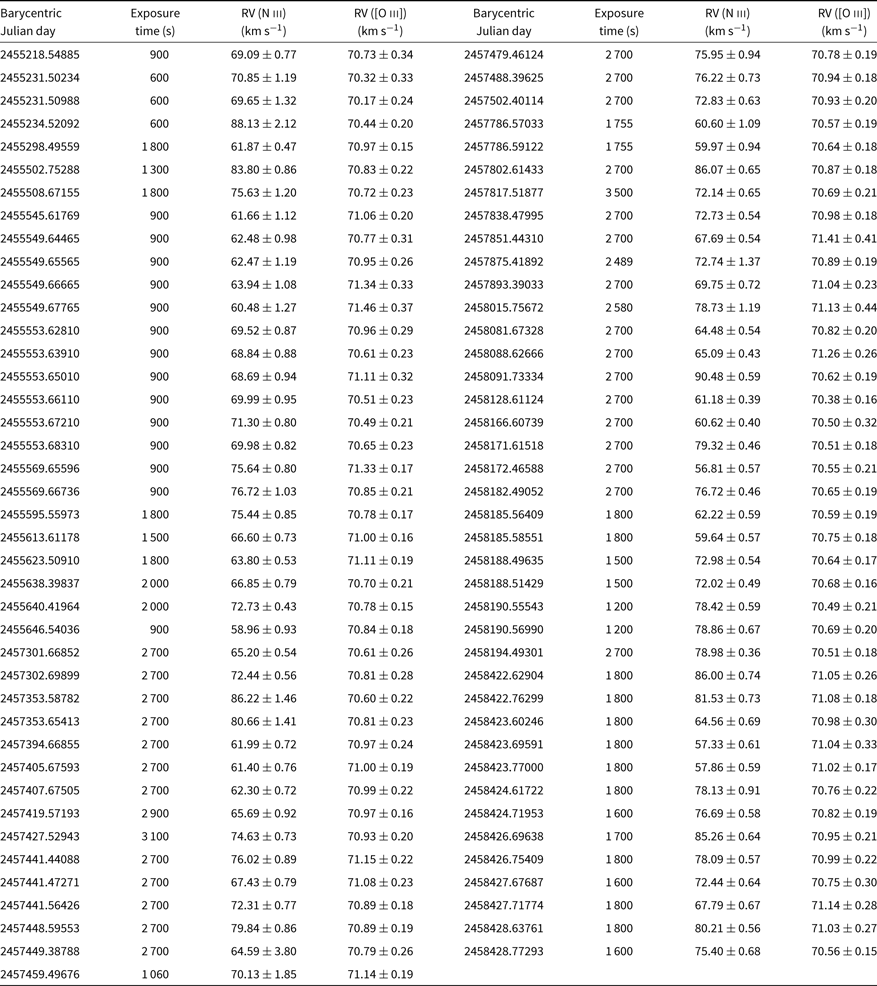
We have obtained 81 observations of the bright central star of NGC 2392 (V = 10.63 mag; Ciardullo et al. Reference Ciardullo1999) with the highly efficient, fibre-fed échelle spectrograph HERMES on the Flemish 1.2 m Mercator telescope (Raskin et al. Reference Raskin2011). Table 1 presents a log of the observations which utilised the high-resolution science fibre to give spectra with R = λ / Δλ = 85000 and a wavelength coverage of 377–900 nm. The data were reduced using the HERMES pipeline (Raskin et al. Reference Raskin2011) which produces spectra with a logarithmic wavelength scale corrected for barycentric motion. The Barycentric Julian day in Table 1 represents the midpoint of each exposure. The observations were made irregularly with most taken during the period Oct 2015 to Nov 2018, with some also taken during 2010–2011. The high resolution and stability of the HERMES spectra are ideally suited to detecting low RV amplitudes associated with long orbital period binary central stars of PNe (Van Winckel et al. Reference Van Winckel2014; Jones et al. Reference Jones, Van Winckel, Aller, Exter and De Marco2017). The discovery of spectroscopic binary central stars of PNe via periodogram analysis of multiple RV measurements is now a well-established technique (e.g. Boffin et al. Reference Boffin2012; Van Winckel et al. Reference Van Winckel2014;Manick et al. Reference Manick, Miszalski and McBride2015; Jones et al. Reference Jones, Van Winckel, Aller, Exter and De Marco2017; Miszalski et al. Reference Miszalski2018a, Reference Miszalski, Manick, Mikołajewska, Van Winckel and Iłkiewicz2018b).
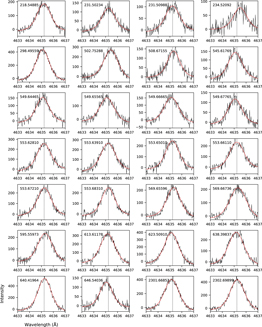
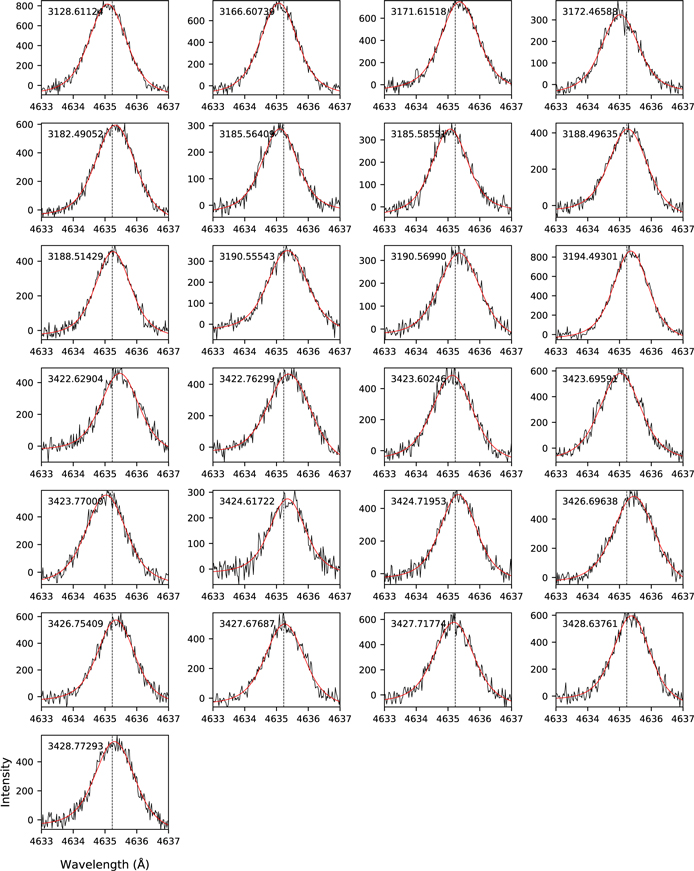
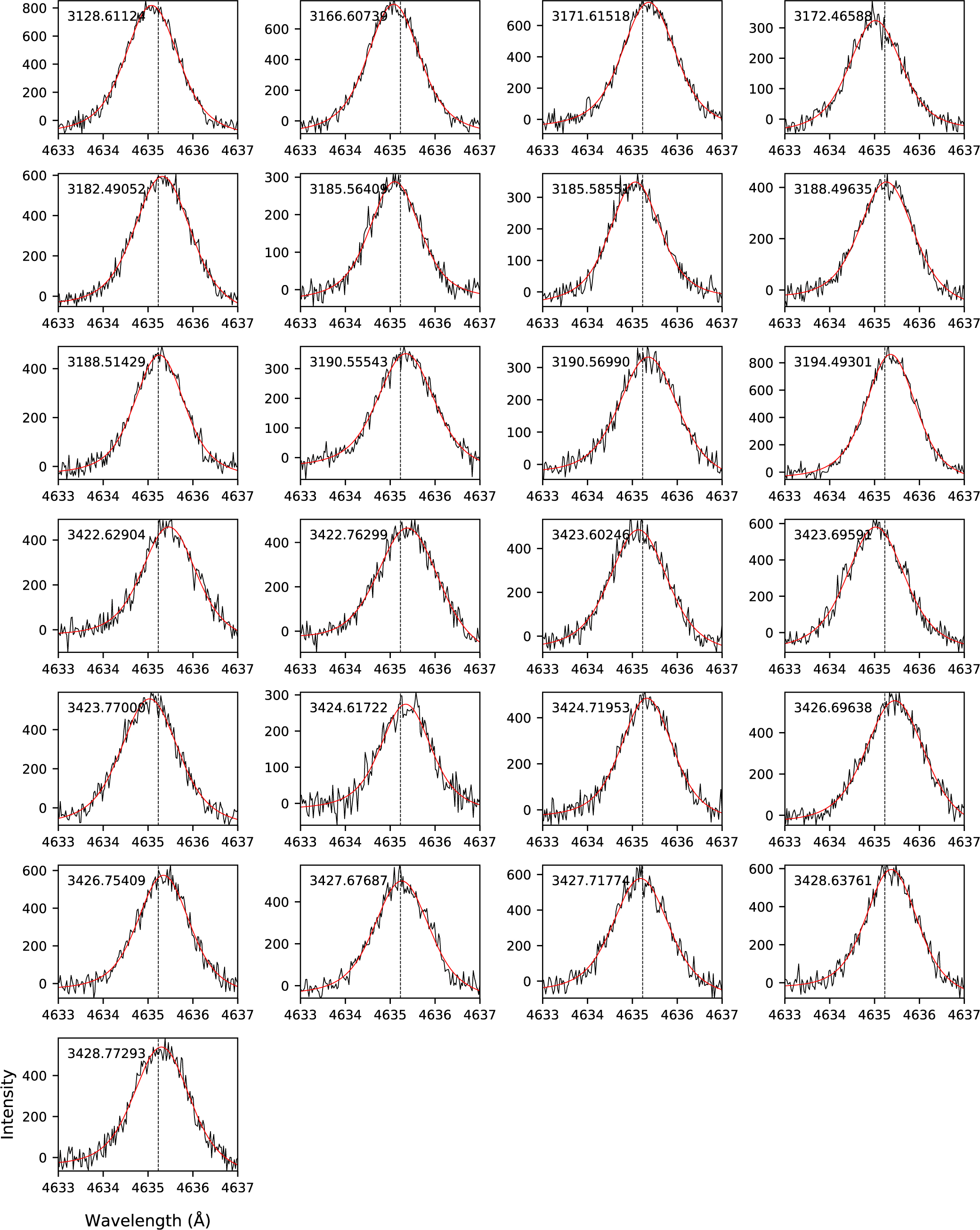
The Of(H)-type central star of NGC 2392 (Mendez 1991) has been extensively studied in the literature (see, e.g. Pauldrach et al. Reference Pauldrach, Hoffmann and Méndez2004; Kaschinski et al. Reference Kaschinski, Pauldrach and Hoffmann2012; Herald & Bianchi Reference Herald and Bianchi2011; Méndez et al. Reference Méndez, Urbaneja, Kudritzki and Prinja2012; Prinja & Urbaneja Reference Prinja and Urbaneja2014; Hoffmann et al. Reference Hoffmann, Pauldrach and Kaschinski2016). Features in the optical wavelength range are mostly due to He and N (see Herald & Bianchi Reference Herald and Bianchi2011; Prinja & Urbaneja Reference Prinja and Urbaneja2014), and Prinja & Urbaneja (Reference Prinja and Urbaneja2014) found variability on timescales as short as 30 min in many of these features. Here we utilise the N iii λ 4634.14 emission line to measure the RV of the central star in each spectrum. Table 1 records the RV measurements made by fitting models consisting of a Voigt function and a straight line for the continuum to the N iii line profile using the lmfit package (Newville et al. Reference Newville2016). Figures A1, A2, and A3 display the resultant fits. The same approach was used by Miszalski et al. (Reference Miszalski, Manick, Mikołajewska, Van Winckel and Iłkiewicz2018b) to successfully detect orbital motion in the Of(H) central star of the PN MyCn 18. Also included in Table 1 are RV measurements of the nebular emission line [O iii] λ 5006.84. The inner core of the complex [O iii] profile was fit with a single Gaussian profile, and the mean value of 70.84 ±0.25 km s−1 agrees very well with the nebula systemic velocity of 70.5 km s−1 determined by García-Díaz et al. (Reference García-Díaz, López, Steffen and Richer2012).
Log of Mercator HERMES observations of NGC 2392. Radial velocity measurements were obtained from fitting profiles of the emission lines N iii λ4634.14 (stellar) and [O iii] λ 5006.84 (nebular).
3. Results and analysis
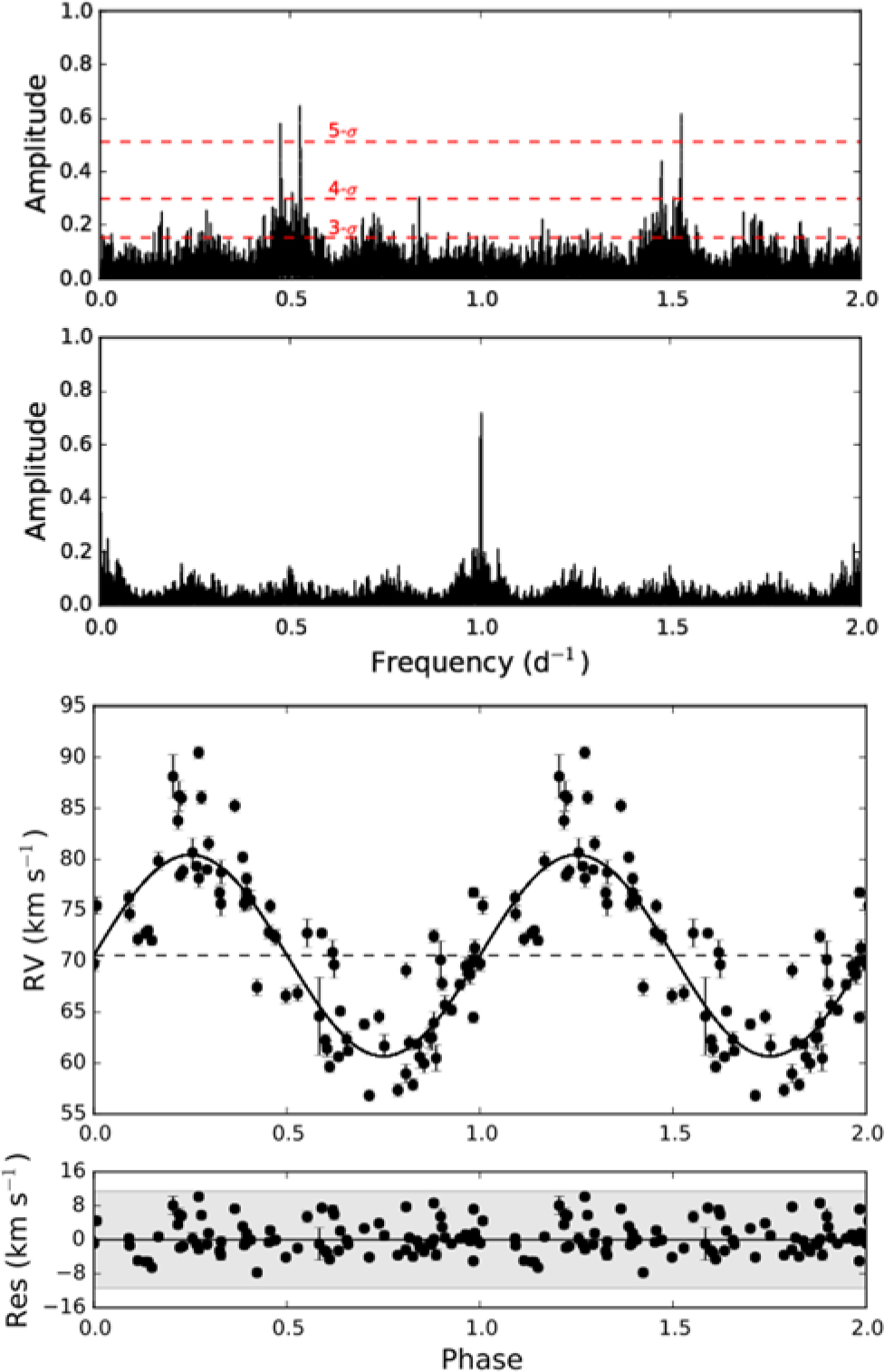
Analysis of the RV measurements in Table 1 using a Lomb–Scargle periodogram (Press et al. Reference Press, Teukolsky, Vetterling and Flannery1992) reveals the strongest peak to be located at 1.902208 ± 0.000013 d (Figure 2). This period is significant at greater than the 5σ level and the next strongest peak is its 1 + f alias. We find no other features in the periodogram after subtracting the strongest peak, and we do not detect the 0.123 d period reported by Prinja & Urbaneja (Reference Prinja and Urbaneja2014).Footnote b We used the 1.9 d period as the basis for a Keplerian orbit model that was built using a least-squares minimisation method applied to the phase-folded data. Figure 2 shows the RV measurements phased with the orbital period, the Keplerian orbit fit, and the residuals.
(Top panel) Lomb–Scargle periodogram of the HERMES N iii λ4634.14 RV measurements (top half) and the window function (bottom half). The strongest peak at f = 0.5257 d−1 corresponds to the orbital period and the next strongest peak is its 1 + f alias. (Bottom panel) HERMES RV measurements phased with the orbital period. The solid line represents the Keplerian orbit fit and the dashed line indicates the systemic velocity γ = 70.45 ± 0.13 km s−1. The shaded region indicates the residuals are within 3σ of the fit where σ = 3.8 km s−1.
The data prove the long-suspected binary nature of NGC 2392, and the relatively short orbital period makes it clear that it experienced a CE interaction (Ivanova et al. Reference Ivanova2013). Inspection of dynamic spectra phased with the orbital period shows that all spectroscopic features of the central star follow the motion derived from analysis of N iii RV shifts. No features that could be attributed to a companion are visible.
Table 2 presents the orbital parameters of the Keplerian orbit fit determined using Monte Carlo simulations in which the eccentricity was fixed to be zero (for details, see Miszalski et al. Reference Miszalski2018a). The current data do not support an eccentric orbit since the standard Lucy & Sweeney (Reference Lucy and Sweeney1971) diagnostic test results in a probability p = 0.48, significantly higher than the 0.05 threshold below which an orbit can be considered significantly eccentric. The root-mean-square residuals of the Keplerian fit are relatively high at 3.8 km s−1 and this most likely reflects the documented erratic variability of the fast wind on timescales as short as 30 min (Prinja & Urbaneja Reference Prinja and Urbaneja2014). We lack the sufficient temporal coverage to study such variability in greater detail than Prinja & Urbaneja (Reference Prinja and Urbaneja2014), but we note that such behaviour is to be expected due to the clumpy and turbulent nature of the fast winds exhibited by central stars of PNe (e.g. Grosdidier, Acker, & Moffat Reference Grosdidier, Acker and Moffat2000, Reference Grosdidier, Acker and Moffat2001). Comparable levels of residuals are also observed in the binary nuclei of NGC 5189 (Manick et al. Reference Manick, Miszalski and McBride2015; Miszalski, Manick, & McBride Reference Miszalski, Manick, McBride, Hamann, Sander and Todt2015) and MyCn 18 (Miszalski et al. Reference Miszalski, Manick, Mikołajewska, Van Winckel and Iłkiewicz2018b) which also demonstrate fast winds.
The systemic velocity of the orbit (70.45±0.13 km s−1) is in excellent agreement with the systemic velocity of the nebula (70.5 km s−1, García-Díaz et al. Reference García-Díaz, López, Steffen and Richer2012). The orbital inclination is likely to be close to the nebula orientation of 9° determined from spatio-kinematic modelling of the nebula (García-Díaz et al. Reference García-Díaz, López, Steffen and Richer2012), since other post-CE PNe show remarkably close agreement between the orbital and nebula inclinations (Hillwig et al. Reference Hillwig2016). García-Díaz et al. Reference García-Díaz, López, Steffen and Richer(2012) did not provide an estimate of the uncertainty in the nebula orientation.
Orbital parameters of the best-fitting Keplerian orbit to the N iii λ4634.14 RV measurements of NGC 2392.
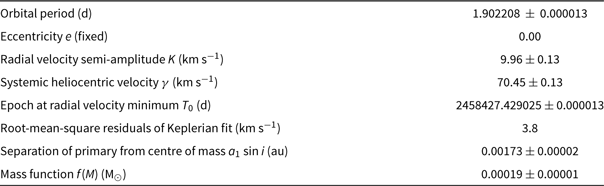
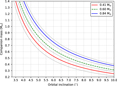
Figure 3 depicts companion masses permitted by the mass function for a range of plausible orbital inclinations and primary masses. The primary masses were selected from model atmosphere studies which adopt different strategies to modelling the UV and optical spectra of the central star. The values of 0.41 ± 0.10 and 084 ± 0.10 M⊙ appear in Hoffmann et al. (Reference Hoffmann, Pauldrach and Kaschinski2016), whereas Herald & Bianchi (Reference Herald and Bianchi2011) assume a canonical 0.6 M⊙ We do not favour any particular value for the primary mass given the complexities associated with the model atmosphere analyses of the central star of NGC 2392 (see Hoffmann et al. Reference Hoffmann, Pauldrach and Kaschinski2016 for a detailed review and discussion).
Companion masses permitted by the mass function in Table 2 for primary masses of 0.41 M⊙ and 0.84 M⊙ (Hoffmann et al. Reference Hoffmann, Pauldrach and Kaschinski2016), as well as a canonical primary mass of 0.60 M⊙ for reference. The grey dotted lines indicate the companion masses for the 0.1 M⊙ uncertainties in the Hoffmann et al. (Reference Hoffmann, Pauldrach and Kaschinski2016) masses.

We can also determine whether the primary may experience Roche lobe overflow based on the orbital parameters. This occurs if the radius of the star fills its Roche lobe radius (R L) which Eggleton (1983) defines as: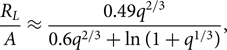 ${{{R_L}} \over A} \approx {{0.49{q^{2/3}}} \over {0.6{q^{2/3}} + \ln (1 + {q^{1/3}})}},$
where A is the orbital semimajor axis (a 1 sin i in Table 2) and q = M 1 / M 2. Adopting radii and masses determined from model atmosphere analyses of the primary, we find that the primary radius R 1 does indeed reach RL for i ≥ 4.5° (M 1 = 0.41 M⊙ and R 1 = 1.5 R⊙, Hoffmann et al. Reference Hoffmann, Pauldrach and Kaschinski2016), i ≥ 4.0° (M 1 = 0.84 M⊙ and R 1 = 2.4 R⊙, Hoffmann et al. Reference Hoffmann, Pauldrach and Kaschinski2016), and i ≥ 5.0° (M 1 = 0.60 M⊙ and R 1 = 1.5 R⊙, Herald & Bianchi Reference Herald and Bianchi2011). It is therefore probable that the primary is currently filling its Roche lobe.
4. Discussion
4.1. The WD companion as a possible Type Ia Supernova progenitor
The presence of highly ionised nebular emission lines such as [Ne v] (e.g. Pottasch et al. Reference Pottasch, Bernard-Salas and Roellig2008) strictly requires the companion to be a hot WD. Typically this WD would have a mass ≳ 0.6 M⊙ and this is satisfied by the mass function for I ≲ 7° (Figure 3), with the minimum inclination determined by the Chandrasekhar limit of 1.4 M⊙. It may be possible to further refine the orbital inclination if the low-amplitude photometric variability of Handler (Reference Handler1996, Reference Handler2003) represents orbital motion; however, this may be unlikely given the very low inclination and double-degenerate (DD) nature of the binary (e.g. Boffin et al. Reference Boffin2012).
Alternative means to constrain the companion properties may therefore be required and photoionisation modelling is one approach. Danehkar et al. (Reference Danehkar, Frew, Parker and De Marco2012, Reference Danehkar, Frew, De Marco and Parker2013) modelled NGC 2392 with a companion mass of ∼ 1.0 M⊙ and effective temperature of 250 kK, leading the authors to suggest that if a close binary nucleus was present, with a total mass exceeding the Chandrasekhar limit, then the DD binary could potentially merge to form a Type Ia Supernova (e.g. Maoz, Mannucci, & Nelemans Reference Maoz, Mannucci and Nelemans2014). Unfortunately, the 1.9 d orbital period (Table 2) firmly rules out this possibility as the binary cannot merge within a Hubble time (Napiwotzki et al. Reference Napiwotzki2005).
Since the visible star likely fills its Roche lobe (Section 3), there is the possibility that mass transfer can occur onto the WD companion. If the accretion rate of H-rich matter falls within the steady burning regime (e.g. Nomoto et al. Reference Nomoto, Saio, Kato and Hachisu2007), this could potentially lead to a single-degenerate (SD) pathway to a Type Ia supernova (e.g. Maoz et al., Reference Maoz, Mannucci and Nelemans2014). Even though the wind of the visible star is H-rich (Herald & Bianchi Reference Herald and Bianchi2011), the mass-loss rate of the visible star does not appear to be high enough to support this outcome (Herald & Bianchi Reference Herald and Bianchi2011; Hoffmann et al. Reference Hoffmann, Pauldrach and Kaschinski2016); however, Wolf–Rayet central stars can have higher mass-loss rates exceeding $\dot M$
∼ 10−7 M⊙ yr−1 (Crowther Reference Crowther2008). PNe with central stars that have fast, H-rich winds and WD companions might therefore be promising donors in the SD scenario. Accreting WD companions could be identified via hard X-ray spectra in the absence of late-type companions.
$\dot M$
∼ 10−7 M⊙ yr−1 (Crowther Reference Crowther2008). PNe with central stars that have fast, H-rich winds and WD companions might therefore be promising donors in the SD scenario. Accreting WD companions could be identified via hard X-ray spectra in the absence of late-type companions.
4.2. The X-ray spectrum of the binary nucleus
Previous spectral fitting of the X-ray spectrum of the central star of NGC 2392 involved fitting optically thin thermal plasmas (Guerrero Reference Guerrero2012; Montez et al. Reference Montez2015). The orbital parameters of the newly discovered binary (Section 3) provide some additional insights into the mechanisms behind the X-ray emission. The X-ray spectrum consists of two apparent components: a mostly soft component peaking just after 1 keV and a hard X-ray tail of up to 5 keV (Guerrero Reference Guerrero2012). Such a configuration most closely resembles that seen in the X-ray spectra of symbiotic stars (Muerset, Wolff, & Jordan Reference Muerset, Wolff and Jordan1997; Luna et al. Reference Luna, Sokoloski, Mukai and Nelson2013).Footnote c In the classification scheme of Muerset et al. (Reference Muerset, Wolff and Jordan1997), extended by Luna et al. (Reference Luna, Sokoloski, Mukai and Nelson2013), the soft component of NGC 2392 bears close resemblance to the β-type sources, whereas the hard component is similar to the δ-type sources.
The X-ray spectra of β-types appear soft with energies less than ∼2.4 keV and are thought to be caused by the collision of winds from the WD and red giant components (Luna et al. Reference Luna, Sokoloski, Mukai and Nelson2013). We do not find unambiguous evidence of colliding winds in our spectra, but colliding winds will be present if models of the diffuse X-ray emission in the nebula are powered by a strong stellar wind from the companion (see Section 4.3). The high plasma temperature of 3.3 × 10⁷ K (Guerrero Reference Guerrero2012; Montez et al. Reference Montez2015) is consistent with the plasma temperatures of ∼107 K expected for colliding winds (Guerrero Reference Guerrero2012).
In δ-types the hard X-ray component above ∼2.4 keV is likely produced in an accretion-disk boundary layer (Luna et al. Reference Luna, Sokoloski, Mukai and Nelson2013). Guerrero (Reference Guerrero2012) favoured accretion onto a compact companion as the main explanation for the X-ray spectrum of the central star of NGC 2392. As the visible star likely fills its Roche lobe (Section 3), the most likely explanation for the hard X-ray tail is indeed accretion, especially when considering the similarity with δ-type X-ray sources in symbiotic stars. If accretion is indeed active in NGC 2392, then we might also anticipate flickering to be present (e.g. Luna et al. Reference Luna, Sokoloski, Mukai and Nelson2013).
4.3. The diffuse X-ray emission and jets
Spatially resolved, diffuse X-ray emission is observed in the nebula of NGC 2392 (Guerrero et al. Reference Guerrero, Chu, Gruendl and Meixner2005; Ruiz et al. Reference Ruiz2013) and several other PNe (e.g. Kastner et al. Reference Kastner2012; Freeman et al. Reference Freeman2014). The apparent low wind mechanical luminosity ${L_{{\rm{wind}}}} = 1/2\dot Mv_\infty ^2$
of NGC 2392 is inconsistent with models of the diffuse emission (Steffen et al. Reference Steffen, Schönberner and Warmuth2008; Ruiz et al. Reference Ruiz2013). This is particularly evident when L
wind is compared against the unabsorbed X-ray luminosity LX
of the diffuse emission in the 0.3–2.0 keV energy range (Figure 5c of Ruiz et al. Reference Ruiz2013). Ruiz et al. (Reference Ruiz2013) concluded that NGC 2392 was the only object for which the stellar wind of the central star could not explain the diffuse X-ray emission. A binary companion with a higher L
wind was one explanation proposed by Ruiz et al. (Reference Ruiz2013). Figure 4 gives an overview of possible values of
${L_{{\rm{wind}}}} = 1/2\dot Mv_\infty ^2$
of NGC 2392 is inconsistent with models of the diffuse emission (Steffen et al. Reference Steffen, Schönberner and Warmuth2008; Ruiz et al. Reference Ruiz2013). This is particularly evident when L
wind is compared against the unabsorbed X-ray luminosity LX
of the diffuse emission in the 0.3–2.0 keV energy range (Figure 5c of Ruiz et al. Reference Ruiz2013). Ruiz et al. (Reference Ruiz2013) concluded that NGC 2392 was the only object for which the stellar wind of the central star could not explain the diffuse X-ray emission. A binary companion with a higher L
wind was one explanation proposed by Ruiz et al. (Reference Ruiz2013). Figure 4 gives an overview of possible values of $\dot M$
and v ∞ for the stellar wind of the companion. The contours indicate constant values of log LX / L
wind calculated using the quantities tabulated in Ruiz et al. (Reference Ruiz2013).
$\dot M$
and v ∞ for the stellar wind of the companion. The contours indicate constant values of log LX / L
wind calculated using the quantities tabulated in Ruiz et al. (Reference Ruiz2013).
Possible mass-loss rates ( $\dot M$
) and terminal velocities (v ∞) for the stellar wind of the companion to the central star of NGC 2392. The black contours indicate constant values of log LX / L
wind (Ruiz et al. Reference Ruiz2013), and the green shaded region encompass models of Ruiz et al. (Reference Ruiz2013). If the companion produces the diffuse X-ray emission, its stellar wind is expected to be consistent with the green region. Points indicate the location of the visible central star of NGC 2392 (red, Ruiz et al. Reference Ruiz2013) and possible companion locations if we assume it shares the parameters of the central stars of NGC 6543 (blue, Ruiz et al. Reference Ruiz2013) and IC 4663 (green, Miszalski et al. Reference Miszalski2012). The red line corresponds to constant
$\dot M$
) and terminal velocities (v ∞) for the stellar wind of the companion to the central star of NGC 2392. The black contours indicate constant values of log LX / L
wind (Ruiz et al. Reference Ruiz2013), and the green shaded region encompass models of Ruiz et al. (Reference Ruiz2013). If the companion produces the diffuse X-ray emission, its stellar wind is expected to be consistent with the green region. Points indicate the location of the visible central star of NGC 2392 (red, Ruiz et al. Reference Ruiz2013) and possible companion locations if we assume it shares the parameters of the central stars of NGC 6543 (blue, Ruiz et al. Reference Ruiz2013) and IC 4663 (green, Miszalski et al. Reference Miszalski2012). The red line corresponds to constant $\dot M{v_\infty }$
for NGC 2392.
$\dot M{v_\infty }$
for NGC 2392.
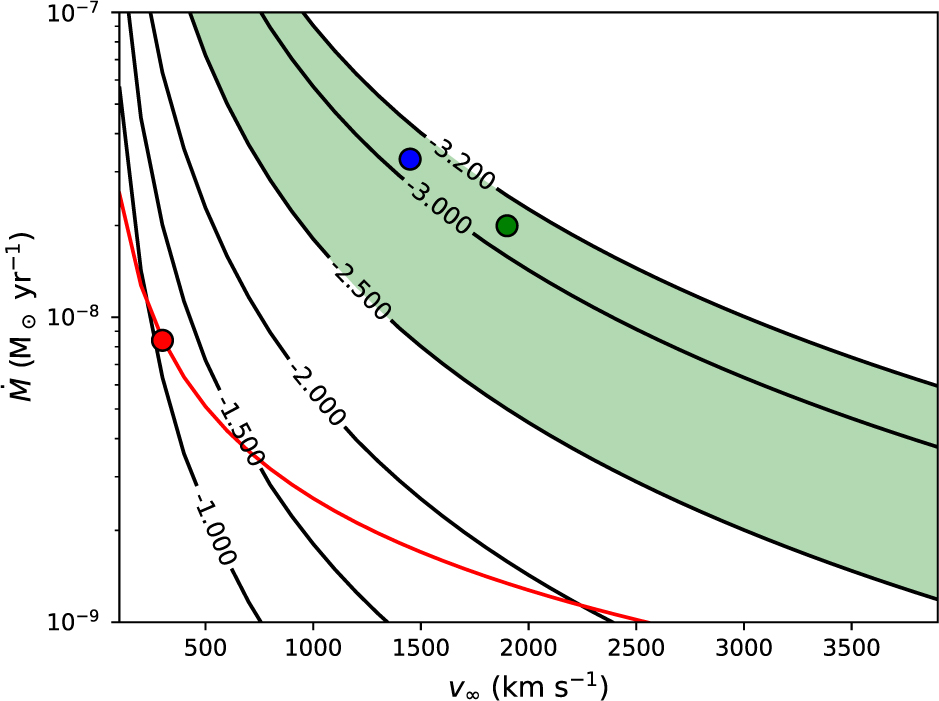
If the stellar wind of the companion is to power the diffuse X-ray emission, then its position in Figure 4 must be confined to the green shaded region corresponding to the approximate range covered by the Ruiz et al. (Reference Ruiz2013) models (i.e. −3.2 <log LX / Lwind <−2.5). In this case the companion is likely to have an Of/Of-WR (Méndez, Herrero, & Manchado Reference Méndez, Herrero and Manchado1990) or Wolf–Rayet (Crowther, De Marco, & Barlow Reference Crowther, De Marco and Barlow1998) spectral type. The companion could therefore potentially resemble NGC 6543 (Herald & Bianchi Reference Herald and Bianchi2011) or IC 4663 (Miszalski et al. Reference Miszalski2012), both of which have stellar winds that would place them in the acceptable region (Figure 4). An expected consequence of such a companion would be the generation of colliding winds, resulting in the formation of a shock cone around the visible central star. This would occur for all companion parameters above the red line in Figure 4. The presence of colliding winds would help explain the softer component of the X-ray spectrum of the central star.
An alternative explanation raised by Ruiz et al. (Reference Ruiz2013) could be that the jets in NGC 2392 (García-Díaz et al. Reference García-Díaz, López, Steffen and Richer2012) were responsible for the X-ray emission (Akashi, Meiron, & Soker Reference Akashi, Meiron and Soker2008). If we assume that only the jets are responsible, then the requirement for the companion parameters to satisfy the Ruiz et al. (Reference Ruiz2013) models is relaxed. In this scenario the companion parameters may fall below the red line in Figure 4 and accretion onto the companion would be easier. A more realistic scenario is one where both the jets and stellar wind contribute to the X-ray emission (e.g. Montez & Kastner Reference Montez and Kastner2018). Asymmetries in the surface brightness distributions of diffuse X-ray emission in PNe (Kastner et al. Reference Kastner2012; Ruiz et al. Reference Ruiz2013; Freeman et al. Reference Freeman2014) strongly suggest that jets may help power the diffuse X-rays.
If accretion is currently active in NGC 2392, as the hard X-ray tail of the central star spectrum suggests, then we could interpret the spatial extent of the jets originating directly from the central star position (García-Díaz et al. Reference García-Díaz, López, Steffen and Richer2012) as evidence for the first active jets in a post-CE PN. The jets of NGC 2392 could therefore potentially provide direct and unique insights into the mechanisms behind jet formation that other post-CE PNe with dormant jets cannot provide (Tocknell et al. Reference Tocknell, De Marco and Wardle2014). There is currently no evidence for magnetically confined accretion, and spectropolarimetric studies of the visible star find an upper limit of only 450 G for the longitudinal magnetic field (e.g. Steffen et al. Reference Steffen2014).
In summary, the observed properties of the binary nucleus of NGC 2392 may provide additional valuable constraints on models of diffuse X-ray emission in PNe. The strongest constraints would come from a determination of the stellar parameters of the companion.
5. Conclusions
We have obtained and analysed high-resolution, multi-epoch observations of the central star of NGC 2392 taken with the HERMES spectrograph of the Mercator 1.2 m telescope (Raskin et al. Reference Raskin2011). We summarise our findings as follows:
The Of(H)-type central star of NGC 2392 is a single-lined spectroscopic binary with an orbital period of 1.9 d, proving the long-suspected binary nature of NGC 2392 (e.g. Heap Reference Heap1977) and making NGC 2392 a post-CE PN. The systemic velocity of the binary (γ = 70.45 ± 0.13 km s−1) is in excellent agreement with the nebula systemic velocity of 70.5 km s−1 (García-Díaz et al. Reference García-Díaz, López, Steffen and Richer2012).
Highly ionised nebular emission lines firmly require the companion to be a hot WD (e.g. Pottasch et al. Reference Pottasch, Bernard-Salas and Roellig2008). A typical WD mass of M 2 ≳ 0.6 M⊙ is satisfied by the mass function for i ≲7°, in good agreement with the nebula orientation of 9° determined by spatio-kinematic analysis (García-Díaz et al. Reference García-Díaz, López, Steffen and Richer2012).
Even if the combined mass of both WDs exceeds the Chandrasekhar limit, as suggested by photoionisation modelling of the nebula (Danehkar et al. Reference Danehkar, Frew, Parker and De Marco2012, Reference Danehkar, Frew, De Marco and Parker2013), the orbital period of 1.9 d excludes the possibility of a binary merger to form a Type Ia supernova (Napiwotzki et al. Reference Napiwotzki2005).
The radius of the visible central star determined from model atmosphere analyses indicates that it likely fills its Roche lobe radius for i ≳ 4 −5°. Accretion onto the companion is therefore a plausible origin of the hard X-ray tail up to 5 keV in the X-ray spectrum of the central star (Guerrero Reference Guerrero2012; Montez et al. Reference Montez2015).
The accretion rate onto the WD companion would likely fall below the steady burning regime required for a SD Type Ia supernova (e.g. Nomoto et al. Reference Nomoto, Saio, Kato and Hachisu2007); however, other H-rich central stars with fast winds and WD companions may be promising progenitors for the SD Type Ia supernova channel. In the absence of a late-type companion, a hard X-ray spectrum could be a powerful indicator of an accreting WD companion to other central stars of PNe.>
If the stellar wind of the companion powers the diffuse X-ray emission in the nebula of NGC 2392, then it must have a stronger wind mechanical luminosity than the visible central star. This does not necessarily imply a luminous companion, e.g. IC 4663 (Miszalski et al. Reference Miszalski2012) could be hidden against the much brighter visible central star of NGC 2392. This would imply colliding winds are present, which may help explain the softer component of the X-ray spectrum of the central star.
Alternatively, the jets may contribute most of the power to the diffuse X-ray emission (e.g. Akashi et al. Reference Akashi, Meiron and Soker2008), which is supported by the asymmetric surface brightness distribution of diffuse X-ray emission in many PNe (Kastner et al. Reference Kastner2012; Ruiz et al. Reference Ruiz2013; Freeman et al. Reference Freeman2014). In this case the companion may have a weaker wind mechanical luminosity, and it would be easier for the companion to host an accretion disk that could launch jets.
The jets may be the only currently active jets amongst post-CE PNe, and their further study could provide unique insights into the jet formation physics of post-CE PNe (e.g. Tocknell et al. Reference Tocknell, De Marco and Wardle2014).
Appendix A. Emission line fits
The observed N iii λ4634.14 Å profiles (black lines) with the Voigt function and straight line model fits (red lines). The dashed line represents the expected position of N iii at the 70.5 km s−1 systemic velocity of the nebula (García-Díaz et al. Reference García-Díaz, López, Steffen and Richer2012). Each panel is labelled with the Barycentric Julian day minus 2455000 d.
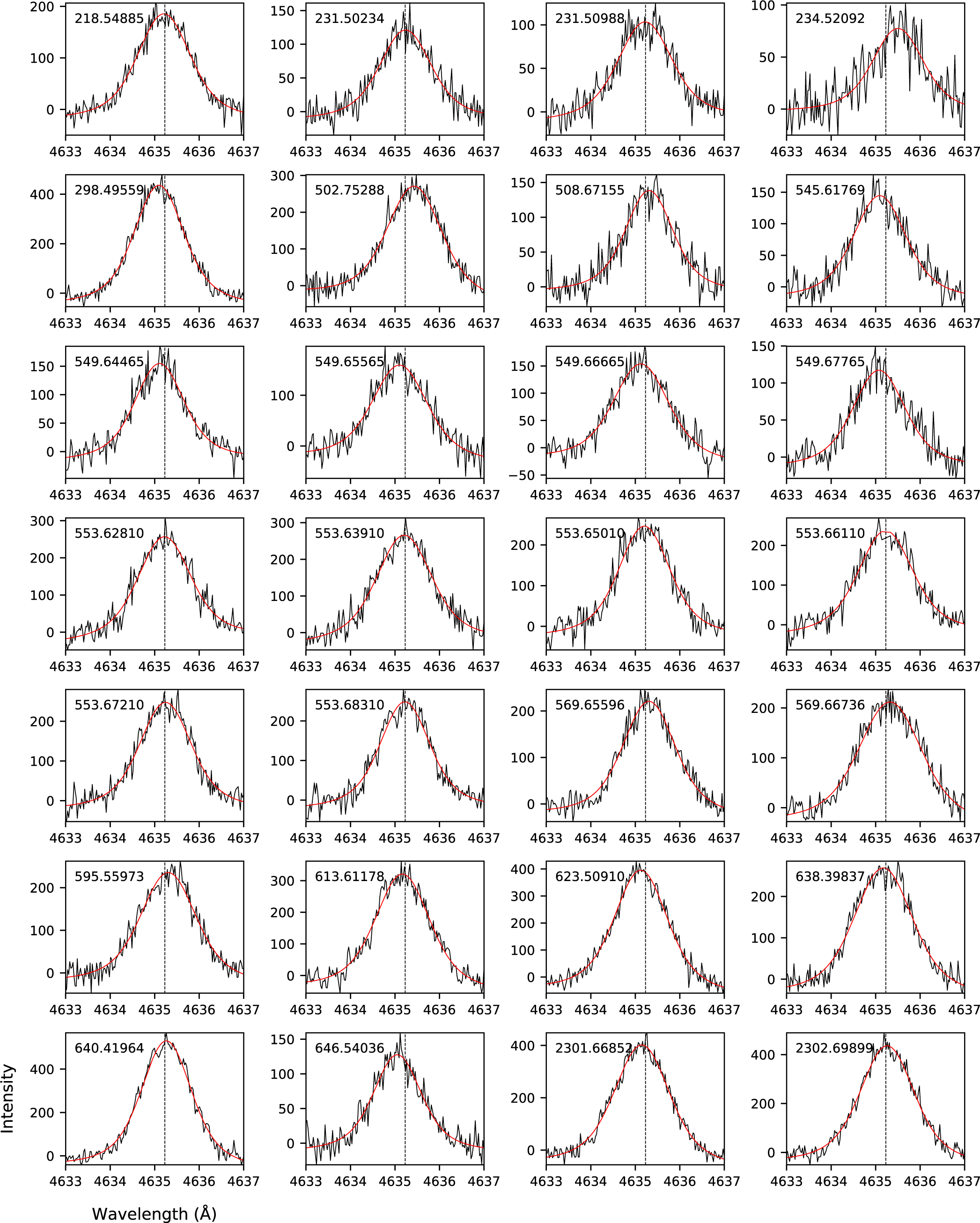
Figure A1 continued.
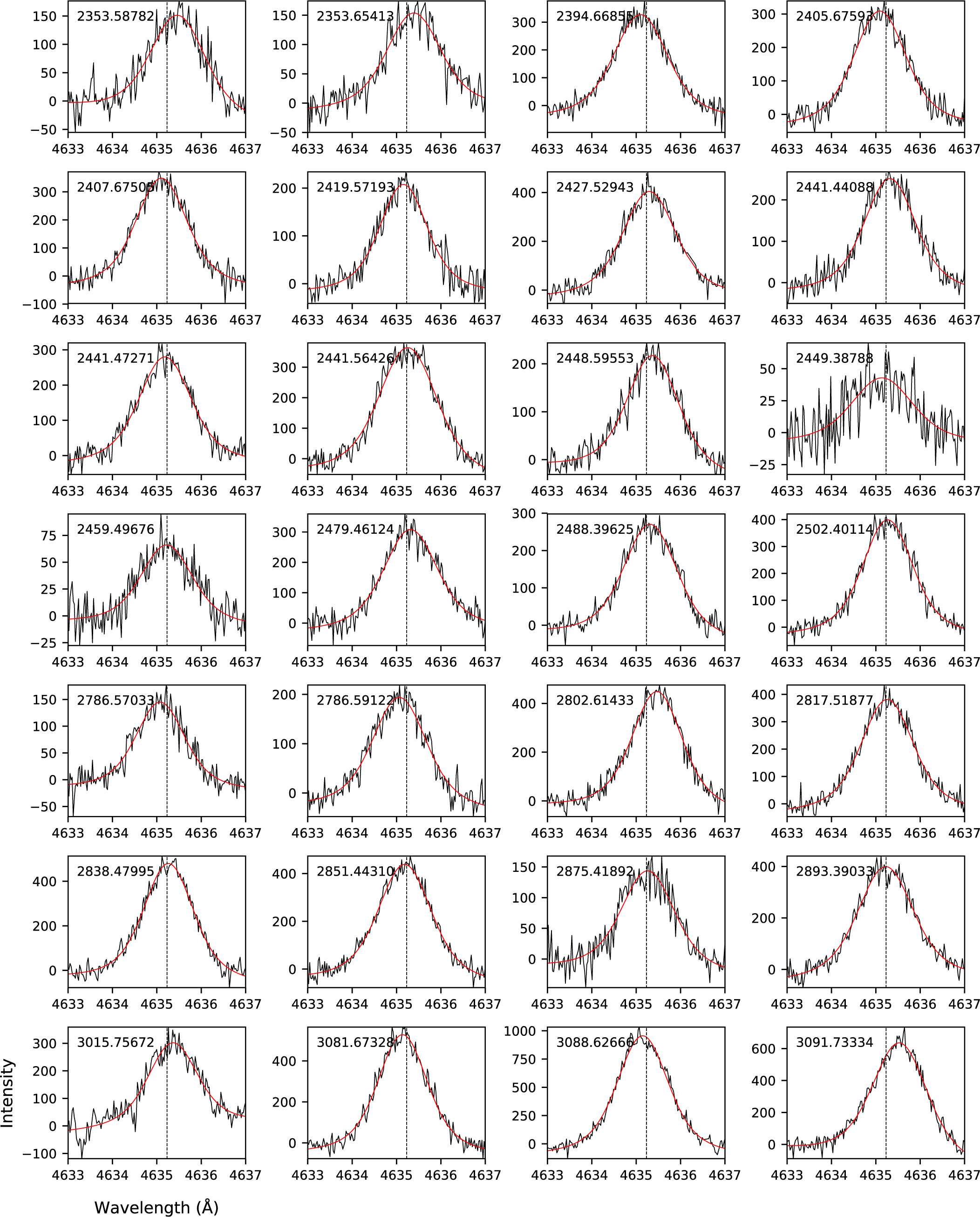
Figure A1 continued.
Author ORCIDs
B. Miszalski https://orcid.org/0000-0003-2561-6306
Acknowledgements
BM thanks the Institute of Astronomy at KU Leuven for their generous hospitality during the visits in which this work was conducted. We thank Anthony F. J. Moffat for helpful discussions and an anonymous referee for a constructive report. BM acknowledges support from the National Research Foundation (NRF) of South Africa. HVW and RM acknowledge support from the Belgian Science Policy Office under contract BR/143/A2/STARLAB. AE acknowledges support from the Fonds voor Wetenschappelijk Onderzoek Vlaanderen (FWO) under contract ZKD1501-00-W01. HVW acknowledges additional support from the Research Council of K.U. Leuven under contract C14/17/082. IRAF is distributed by the National Optical Astronomy Observatory, which is operated by the Association of Universities for Research in Astronomy (AURA) under a cooperative agreement with the National Science Foundation.