





1 Introduction
Nonuniqueness of crepant resolutions is conjectured to be addressed by an equivalence at the level of derived categories [Reference Bondal and OrlovBO], [Reference KawamataKaw]. It is then natural to ask what algebraic structure on derived categories arises from a resolution of singularities. One approach is that of [Reference KuznetsovKuz1], where categorical resolutions were defined in the following manner. A resolution $\pi :\widetilde X\to X$
gives rise to adjoint functors
$\pi :\widetilde X\to X$
gives rise to adjoint functors

and when X has rational singularities $\pi _*\circ \pi ^*$
is naturally isomorphic to the identity on
$\pi _*\circ \pi ^*$
is naturally isomorphic to the identity on ${\mathfrak {Perf}}(X)$
. Kuznetsov then defined a categorical resolution of singularities to be a smooth triangulated category
${\mathfrak {Perf}}(X)$
. Kuznetsov then defined a categorical resolution of singularities to be a smooth triangulated category $\mathscr {C}$
replacing
$\mathscr {C}$
replacing $D^b(\widetilde X)$
in the above diagram, with functors
$D^b(\widetilde X)$
in the above diagram, with functors $\pi _*$
and
$\pi _*$
and $\pi ^*$
having these same properties.
$\pi ^*$
having these same properties.
It was argued in [Reference Kuznetsov and LuntsKL] that this definition is reasonable even when X has irrational singularities, where $D^b(\widetilde X)$
actually fails to give a categorical resolution. The authors constructed an enlargement of
$D^b(\widetilde X)$
actually fails to give a categorical resolution. The authors constructed an enlargement of $D^b(\widetilde X)$
which does satisfy the definition, even for nonreduced irrational singularities (in characteristic 0).
$D^b(\widetilde X)$
which does satisfy the definition, even for nonreduced irrational singularities (in characteristic 0).
As an example, consider the case of a nodal curve $X=\{xy=0\}\subset \mathbb {A}^2$
, with normalization
$X=\{xy=0\}\subset \mathbb {A}^2$
, with normalization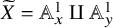 $\widetilde X=\mathbb {A}^1_x\amalg \mathbb {A}^1_y$
. The categorical resolution from [Reference Kuznetsov and LuntsKL] is equivalent to a module category
$\widetilde X=\mathbb {A}^1_x\amalg \mathbb {A}^1_y$
. The categorical resolution from [Reference Kuznetsov and LuntsKL] is equivalent to a module category $D^b(\mathcal {A})$
over the Auslander order
$D^b(\mathcal {A})$
over the Auslander order $\mathcal {A}=H^0\operatorname {\mathrm {End}}_X(\mathcal {O}_X\oplus \pi _*\mathcal {O}_{\widetilde X})$
, introduced as a resolution for nodal and cuspidal curves in [Reference Burban and DrozdBD]. It is well-known that this resolution is not minimal, containing two exceptional objects which can be contracted to give (equivalent) smaller resolutions; cf. [Reference KuznetsovKuz2, §3.5], [Reference Lekili and PolishchukLP1, §4.5].
$\mathcal {A}=H^0\operatorname {\mathrm {End}}_X(\mathcal {O}_X\oplus \pi _*\mathcal {O}_{\widetilde X})$
, introduced as a resolution for nodal and cuspidal curves in [Reference Burban and DrozdBD]. It is well-known that this resolution is not minimal, containing two exceptional objects which can be contracted to give (equivalent) smaller resolutions; cf. [Reference KuznetsovKuz2, §3.5], [Reference Lekili and PolishchukLP1, §4.5].
Our main observation is that these two contractions match the behaviour of the functors involved in a 3-fold flop, forming a categorical structure which has already been studied for that reason (e.g., [Reference BarbacoviBar, §4]). Identical structures were described for higher-dimensional nodes in [Reference KuznetsovKuz3, Proposition 3.15], using spinor bundles. We find the same phenomena occurring for curves, even though the general methods break down; categorical resolutions extend the behaviour of ‘nice’ geometric resolutions to these more degenerate irrational singularities, supporting the philosophy of [Reference Kuznetsov and LuntsKL].
1.1 Overview
The smaller resolutions come from partial versions of $\mathcal {A}$
:
$\mathcal {A}$
:
 $$ \begin{align*} \mathcal{A}_x = H^0\operatorname{\mathrm{End}}_{\mathcal{O}_X}(\mathcal{O}_X\oplus\pi_*\mathcal{O}_{\mathbb{A}^1_x}) \quad \text{and} \quad \mathcal{A}_y = H^0\operatorname{\mathrm{End}}_{\mathcal{O}_X}(\mathcal{O}_X\oplus\pi_*\mathcal{O}_{\mathbb{A}^1_y}), \end{align*} $$
over which $\mathcal {A}$
is a roof via certain bimodules:
$\mathcal {A}$
is a roof via certain bimodules:

We can then consider the push-pull composition

and this turns out to be a derived equivalence. Composing with the reversed version gives an autoequivalence of $D^b(\mathcal {A}_x)$
, which is the twist around a spherical object.
$D^b(\mathcal {A}_x)$
, which is the twist around a spherical object.
For comparison, recall the Atiyah flop over a 3-fold node $Y=\{uv=st\}\subset \mathbb {A}^4$
. This has two crepant resolutions
$Y=\{uv=st\}\subset \mathbb {A}^4$
. This has two crepant resolutions $V_u=\operatorname {\mathrm {Bl}}_{\{u=s=0\}}Y$
and
$V_u=\operatorname {\mathrm {Bl}}_{\{u=s=0\}}Y$
and $V_v=\operatorname {\mathrm {Bl}}_{\{v=s=0\}}Y$
, with the roof
$V_v=\operatorname {\mathrm {Bl}}_{\{v=s=0\}}Y$
, with the roof $V=\operatorname {\mathrm {Bl}}_0Y$
giving a derived equivalence:
$V=\operatorname {\mathrm {Bl}}_0Y$
giving a derived equivalence:

The flop-flop autoequivalence on $D^b(V_u)$
is the twist around a spherical object, given by a line bundle on the exceptional divisor.
$D^b(V_u)$
is the twist around a spherical object, given by a line bundle on the exceptional divisor.
Remark 1.1. One interpretation of $\mathcal {A}_x$
,
$\mathcal {A}_x$
, $\mathcal {A}_y$
and
$\mathcal {A}_y$
and $\mathcal {A}$
is as ‘noncommutative blowups’. For a ring R and ideal I one can define such a thing by the algebra
$\mathcal {A}$
is as ‘noncommutative blowups’. For a ring R and ideal I one can define such a thing by the algebra $\operatorname {\mathrm {End}}_R(R\oplus I)$
, as in [Reference LeuschkeLeu, §R]. We apply this to the two branches of the node and also their intersection, in analogy with
$\operatorname {\mathrm {End}}_R(R\oplus I)$
, as in [Reference LeuschkeLeu, §R]. We apply this to the two branches of the node and also their intersection, in analogy with $V_u$
,
$V_u$
, $V_v$
and V.
$V_v$
and V.
Remark 1.2. As described in [Reference Bondal, Kapranov and SchechtmanBKS] for the geometric situation, these diagrams of categories can be seen as giving examples of perverse schobers on $\mathbb {C}$
with one marked point, which categorify perverse sheaves on the hyperplane arrangement
$\mathbb {C}$
with one marked point, which categorify perverse sheaves on the hyperplane arrangement $(\mathbb {C},0)$
.
$(\mathbb {C},0)$
.
1.2 Landau–Ginzburg models
The above resolutions are also equivalent to categories of B-branes on partial compactifications of a Landau–Ginzburg model, from the ‘exoflop’ construction of [Reference AspinwallAsp]. These LG-models were already described in the context of mirror symmetry in [Reference Lekili and PolishchukLP2], and we briefly sketch an A-side picture of the flop in § 4.4. The geometry of these LG-models suggests a version of the flop for smooth curves using root stacks, which we outline in Remark 4.3.
It also explains the crepancy properties of the resolutions. Kuznetsov defined weak and strong notions of crepancy for categorical resolutions, both equivalent to usual crepancy when $\mathscr {C}=D^b(\widetilde X)$
. They are characterized by the behaviour of a relative Serre functor on the resolution, which for the LG-models is given by the canonical bundle. Strong crepancy asks for the canonical bundle to be globally trivial, while weak crepancy only requires it to be trivial on a certain open set, so categorical resolutions from compactifications of LG-models are typically weakly crepant; see [Reference Favero and KellyFK].
$\mathscr {C}=D^b(\widetilde X)$
. They are characterized by the behaviour of a relative Serre functor on the resolution, which for the LG-models is given by the canonical bundle. Strong crepancy asks for the canonical bundle to be globally trivial, while weak crepancy only requires it to be trivial on a certain open set, so categorical resolutions from compactifications of LG-models are typically weakly crepant; see [Reference Favero and KellyFK].
In particular, all the above resolutions (including the roof) are weakly crepant. On the other hand, they are not strongly crepant; the partial compactifications are not Calabi–Yau. This confirms that weak crepancy is too weak to ensure minimality of the resolution, since $D^b(\mathcal {A})$
is clearly not minimal. Kuznetsov conjectured that strongly crepant resolutions are minimal, although here we see that what is presumably the minimal resolution,
$D^b(\mathcal {A})$
is clearly not minimal. Kuznetsov conjectured that strongly crepant resolutions are minimal, although here we see that what is presumably the minimal resolution, $D^b(\mathcal {A}_x)$
, fails to be strongly crepant.
$D^b(\mathcal {A}_x)$
, fails to be strongly crepant.
Motivated by this, we introduce an intermediate condition (Definition 3.7): that the kernel subcategory $\ker (\pi _*)$
is Calabi–Yau with respect to the relative Serre functor, that is, the relative Serre functor restricts to a homological shift on
$\ker (\pi _*)$
is Calabi–Yau with respect to the relative Serre functor, that is, the relative Serre functor restricts to a homological shift on $\ker (\pi _*)$
. This is strictly in-between weak and strong crepancy, and seems effective at identifying minimal resolutions. Optimistically, one could conjecture that it identifies minimal categorical resolutions in general; see § 3.2 for further discussion.
$\ker (\pi _*)$
. This is strictly in-between weak and strong crepancy, and seems effective at identifying minimal resolutions. Optimistically, one could conjecture that it identifies minimal categorical resolutions in general; see § 3.2 for further discussion.
1.3 Generalizations
The algebra $\mathcal {A}$
was shown to give a categorical resolution for any nodal or cuspidal curve singularity in [Reference Burban and DrozdBD], and we show that a diagram with the same properties as Eq. (1.1) exists for any nodal curve in § 3.3. As mentioned above, the roof also has a geometric analogue using root stacks (Remark 4.3).
$\mathcal {A}$
was shown to give a categorical resolution for any nodal or cuspidal curve singularity in [Reference Burban and DrozdBD], and we show that a diagram with the same properties as Eq. (1.1) exists for any nodal curve in § 3.3. As mentioned above, the roof also has a geometric analogue using root stacks (Remark 4.3).
It would be nice to unify our results with [Reference KuznetsovKuz3, Proposition 3.15], including for example the Atiyah flop. A preliminary remark in this direction: $\mathcal {A}$
and
$\mathcal {A}$
and $\mathcal {A}_x$
seem to fit into the higher Auslander–Reiten theory of [Reference IyamaIya, §3] as 1- and 2-Auslander algebras, so a good understanding of the results in [Reference Burban, Iyama, Keller and ReitenBIKR] may suffice to conclude that similar pictures exist for simple curve singularities of type
$\mathcal {A}_x$
seem to fit into the higher Auslander–Reiten theory of [Reference IyamaIya, §3] as 1- and 2-Auslander algebras, so a good understanding of the results in [Reference Burban, Iyama, Keller and ReitenBIKR] may suffice to conclude that similar pictures exist for simple curve singularities of type $A_n$
with n odd and
$A_n$
with n odd and $D_m$
with m even – perhaps also in higher dimensions.
$D_m$
with m even – perhaps also in higher dimensions.
Conventions
We work over $\mathbb {C}$
. Functors will be derived without changing notation. Modules are right modules, and quiver representations are contravariant.
$\mathbb {C}$
. Functors will be derived without changing notation. Modules are right modules, and quiver representations are contravariant.
2 Background
We recall some of [Reference KuznetsovKuz1]. Experienced readers may prefer to skip straight to § 3.
Definition 2.1. A weak categorical resolution of singularities for a variety X is a (dg-enhanced) triangulated category $\mathscr {C}$
with (quasi-)functors
$\mathscr {C}$
with (quasi-)functors

where $\iota $
is the inclusion
$\iota $
is the inclusion ${\mathfrak {Perf}}(X)\subseteq D^b(X)$
, satisfying three conditions:
${\mathfrak {Perf}}(X)\subseteq D^b(X)$
, satisfying three conditions:
-
1. $\pi ^*$
and
$\pi _*$
are adjoint, in the sense that as (quasi-)functors on
$$ \begin{align*} \operatorname{\mathrm{Hom}}_{\mathscr{C}}(\pi^*(-),-) \simeq \operatorname{\mathrm{Hom}}_{D^b(X)}(\iota(-),\pi_*(-)) \end{align*} $$
${\mathfrak {Perf}}(X)^{\mathrm {op}}\otimes \mathscr {C}$
,
$\pi ^*$
and
$\pi _*$
are adjoint, in the sense that as (quasi-)functors on
$$ \begin{align*} \operatorname{\mathrm{Hom}}_{\mathscr{C}}(\pi^*(-),-) \simeq \operatorname{\mathrm{Hom}}_{D^b(X)}(\iota(-),\pi_*(-)) \end{align*} $$
${\mathfrak {Perf}}(X)^{\mathrm {op}}\otimes \mathscr {C}$
,
-
2.
$\pi _*\circ \pi ^*\simeq \iota $
, so that
$\pi ^*$
is fully faithful, and -
3.
$\mathscr {C}$
is smooth.





It is weakly crepant if $\pi ^*$
is also a right adjoint for
$\pi ^*$
is also a right adjoint for $\pi _*$
in the sense of (1).
$\pi _*$
in the sense of (1).
Remark 2.2. We say $\mathscr {C}$
is smooth if
$\mathscr {C}$
is smooth if $\mathscr {C}\simeq {\mathfrak {Perf}}(A)$
where A is a smooth dg-algebra, that is, the diagonal bimodule A is a perfect complex over
$\mathscr {C}\simeq {\mathfrak {Perf}}(A)$
where A is a smooth dg-algebra, that is, the diagonal bimodule A is a perfect complex over $A^e=A^{\mathrm {op}}\otimes _{\mathbb {C}} A$
. This is independent of choices, and equivalent to
$A^e=A^{\mathrm {op}}\otimes _{\mathbb {C}} A$
. This is independent of choices, and equivalent to $\operatorname {\mathrm {gl.dim}}{}<\infty $
if
$\operatorname {\mathrm {gl.dim}}{}<\infty $
if $A=H^0(A)$
[Reference LuntsLun, §3].
$A=H^0(A)$
[Reference LuntsLun, §3].
Example 2.3. If $\pi :\widetilde X\to X$
is a geometric resolution of a variety X with rational singularities, meaning that
$\pi :\widetilde X\to X$
is a geometric resolution of a variety X with rational singularities, meaning that $\mathcal {O}_X\simeq \mathbf {R}\pi _*\mathcal {O}_{\widetilde X}$
, then
$\mathcal {O}_X\simeq \mathbf {R}\pi _*\mathcal {O}_{\widetilde X}$
, then $D^b(\widetilde X)$
with the usual functors
$D^b(\widetilde X)$
with the usual functors $\pi ^*$
and
$\pi ^*$
and $\pi _*$
gives a categorical resolution of X by the projection formula. If
$\pi _*$
gives a categorical resolution of X by the projection formula. If $\pi $
is also crepant, then the categorical resolution is weakly crepant; the adjoints to
$\pi $
is also crepant, then the categorical resolution is weakly crepant; the adjoints to $\pi _*$
differ iff the relative canonical bundle is nontrivial:
$\pi _*$
differ iff the relative canonical bundle is nontrivial: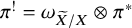 $\pi ^!=\omega _{\widetilde X/X}\otimes \pi ^*$
.
$\pi ^!=\omega _{\widetilde X/X}\otimes \pi ^*$
.
In [Reference LuntsLun] it is proved in broad generality that the category $D^b(X)$
is smooth. It follows that
$D^b(X)$
is smooth. It follows that $\mathscr {C}=D^b(X)$
,
$\mathscr {C}=D^b(X)$
, $\pi ^*=\iota $
,
$\pi ^*=\iota $
,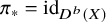 $\pi _*=\mathrm {id}_{D^b(X)}$
is a universal weakly crepant categorical resolution unless we make further restrictions on the behaviour of
$\pi _*=\mathrm {id}_{D^b(X)}$
is a universal weakly crepant categorical resolution unless we make further restrictions on the behaviour of $\mathscr {C}$
.
$\mathscr {C}$
.
Example 2.4. For $X=\operatorname {\mathrm {Spec}}\mathbb {C}[w]/w^2$
we have a strong generator
$X=\operatorname {\mathrm {Spec}}\mathbb {C}[w]/w^2$
we have a strong generator $D^b(X)=\langle \mathcal {O}_X/w\rangle $
, so
$D^b(X)=\langle \mathcal {O}_X/w\rangle $
, so $D^b(X)\simeq {\mathfrak {Perf}}(A)$
for
$D^b(X)\simeq {\mathfrak {Perf}}(A)$
for $A=\operatorname {\mathrm {Ext}}^*_X(\mathcal {O}_X/w,\mathcal {O}_X/w)=\mathbb {C}[\theta ]$
with
$A=\operatorname {\mathrm {Ext}}^*_X(\mathcal {O}_X/w,\mathcal {O}_X/w)=\mathbb {C}[\theta ]$
with $|\theta |=1$
. This is classical Koszul duality. Here A is smooth, but with unbounded cohomology; it fails to give a relatively proper resolution, being far from finite over
$|\theta |=1$
. This is classical Koszul duality. Here A is smooth, but with unbounded cohomology; it fails to give a relatively proper resolution, being far from finite over $\mathbb {C}[w]/w^2$
.
$\mathbb {C}[w]/w^2$
.
Various strengthenings of the definition exist. A key idea is that the category $\mathscr {C}$
should be local on X, formalized by requiring
$\mathscr {C}$
should be local on X, formalized by requiring $\mathscr {C}$
to be a module for the monoidal category
$\mathscr {C}$
to be a module for the monoidal category ${\mathfrak {Perf}}(X)$
– in the affine case just an
${\mathfrak {Perf}}(X)$
– in the affine case just an $\mathcal {O}_X$
-linear dg-category with
$\mathcal {O}_X$
-linear dg-category with $(\pi ^*,\pi _*)$
being
$(\pi ^*,\pi _*)$
being $\mathcal {O}_X$
-linear – as introduced in [Reference KuznetsovKuz1]. This is one step towards having the structure of a noncommutative resolution à la Van den Bergh [Reference Van den BerghVdB].
$\mathcal {O}_X$
-linear – as introduced in [Reference KuznetsovKuz1]. This is one step towards having the structure of a noncommutative resolution à la Van den Bergh [Reference Van den BerghVdB].
With this structure one obtains relative versions of properties of $\mathbb {C}$
-linear derived categories, by using the
$\mathbb {C}$
-linear derived categories, by using the $\mathcal {O}_X$
-module structure on
$\mathcal {O}_X$
-module structure on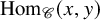 $\operatorname {\mathrm {Hom}}_{\mathscr {C}}(x,y)$
. For example
$\operatorname {\mathrm {Hom}}_{\mathscr {C}}(x,y)$
. For example $\mathscr {C}$
is proper relative to X if the
$\mathscr {C}$
is proper relative to X if the $\mathcal {O}_X$
-linear chain complex
$\mathcal {O}_X$
-linear chain complex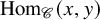 $\operatorname {\mathrm {Hom}}_{\mathscr {C}}(x,y)$
gives an element of
$\operatorname {\mathrm {Hom}}_{\mathscr {C}}(x,y)$
gives an element of $D^b(X)$
for all
$D^b(X)$
for all $x,y\in \mathscr {C}$
.
$x,y\in \mathscr {C}$
.
Definition 2.5. Assume X is affine and Gorenstein. We will call categorical resolutions which are $\mathcal {O}_X$
-linear and relatively proper in the above sense strong categorical resolutions. In this setting
$\mathcal {O}_X$
-linear and relatively proper in the above sense strong categorical resolutions. In this setting ${S:\mathscr {C}\to \mathscr {C}}$
is a relative Serre functor for
${S:\mathscr {C}\to \mathscr {C}}$
is a relative Serre functor for $\mathscr {C}$
if we have a natural isomorphism
$\mathscr {C}$
if we have a natural isomorphism

Kuznetsov defined the resolution to be strongly crepant if the identity is a relative Serre functor.
Remark 2.6. By [Reference KuznetsovKuz1, Lemma 3.6] we then get $S\circ \pi ^*$
as a right adjoint for
$S\circ \pi ^*$
as a right adjoint for $\pi _*$
, so weak crepancy of a strong categorical resolution is equivalent to S restricting to the identity on
$\pi _*$
, so weak crepancy of a strong categorical resolution is equivalent to S restricting to the identity on $\pi ^*({\mathfrak {Perf}}(X))$
.
$\pi ^*({\mathfrak {Perf}}(X))$
.
Example 2.7. If $\pi :\widetilde X\to X$
is a resolution of rational singularities, then
$\pi :\widetilde X\to X$
is a resolution of rational singularities, then $D^b(\widetilde X)$
is a strong categorical resolution with relative Serre functor
$D^b(\widetilde X)$
is a strong categorical resolution with relative Serre functor $\omega _{\widetilde X/X}\otimes -$
, and hence is strongly crepant iff
$\omega _{\widetilde X/X}\otimes -$
, and hence is strongly crepant iff $\pi $
is a crepant resolution. In this case strong and weak crepancy are equivalent.
$\pi $
is a crepant resolution. In this case strong and weak crepancy are equivalent.
Example 2.8. Revisiting $X=\operatorname {\mathrm {Spec}}\mathbb {C}[w]/w^2$
, there is a strong categorical resolution given by the graded Kronecker quiver
$X=\operatorname {\mathrm {Spec}}\mathbb {C}[w]/w^2$
, there is a strong categorical resolution given by the graded Kronecker quiver

where $|\theta |=1$
.Footnote
1
We can embed
$|\theta |=1$
.Footnote
1
We can embed ${\mathfrak {Perf}}(X)$
as the subcategory generated by
${\mathfrak {Perf}}(X)$
as the subcategory generated by

since ${\mathbf {R} \text {Hom}}(G,G)=\mathbb {C}[w]/w^2$
. This quiver is derived equivalent to the Auslander algebra
${\mathbf {R} \text {Hom}}(G,G)=\mathbb {C}[w]/w^2$
. This quiver is derived equivalent to the Auslander algebra $H^0\operatorname {\mathrm {End}}_X(\mathcal {O}_X\oplus \mathcal {O}_X/w)$
, coming from a full exceptional collection described in [Reference Kuznetsov and LuntsKL, Example 5.16] and [Reference Kuznetsov and ShinderKS1, §3]. It hence has an
$H^0\operatorname {\mathrm {End}}_X(\mathcal {O}_X\oplus \mathcal {O}_X/w)$
, coming from a full exceptional collection described in [Reference Kuznetsov and LuntsKL, Example 5.16] and [Reference Kuznetsov and ShinderKS1, §3]. It hence has an $\mathcal {O}_X$
-linear structure, giving a strong categorical resolution with a relative Serre functor S as in Eq. (3.2). One can compute that
$\mathcal {O}_X$
-linear structure, giving a strong categorical resolution with a relative Serre functor S as in Eq. (3.2). One can compute that $S(G)=G$
, so the resolution is weakly crepant, but it is not strongly crepant since
$S(G)=G$
, so the resolution is weakly crepant, but it is not strongly crepant since $\operatorname {\mathrm {Hom}}(P_1,P_0)=0\ne \operatorname {\mathrm {Hom}}(P_0,P_1)$
.
$\operatorname {\mathrm {Hom}}(P_1,P_0)=0\ne \operatorname {\mathrm {Hom}}(P_0,P_1)$
.
3 Flops and crepancy
We return to the notation from the introduction, where $X=\{xy=0\}\subset \mathbb {A}^2$
. To aid computations, write
$X=\{xy=0\}\subset \mathbb {A}^2$
. To aid computations, write $\mathcal {A}$
as the path algebra of a quiver with relations:
$\mathcal {A}$
as the path algebra of a quiver with relations:

Then $\mathcal {A}_x$
and
$\mathcal {A}_x$
and $\mathcal {A}_y$
are obtained by omitting vertex projectives:
$\mathcal {A}_y$
are obtained by omitting vertex projectives:
 $$ \begin{align*} \mathcal{A}_x &= \operatorname{\mathrm{End}}_{\mathcal{A}}(P_X\oplus P_x), & \mathcal{A}_y &= \operatorname{\mathrm{End}}_{\mathcal{A}}(P_X\oplus P_y). \end{align*} $$
The functors of Eq. (1.1) come from the bimodules $P_X\oplus P_x$
and
$P_X\oplus P_x$
and $P_X\oplus P_y$
, together with
$P_X\oplus P_y$
, together with $P_X$
mapping down to
$P_X$
mapping down to $D^b(X)$
.
$D^b(X)$
.
It follows that ${\mathfrak {Perf}}(\mathcal {A}_x)$
and
${\mathfrak {Perf}}(\mathcal {A}_x)$
and ${\mathfrak {Perf}}(\mathcal {A}_y)$
are identified with the subcategories
${\mathfrak {Perf}}(\mathcal {A}_y)$
are identified with the subcategories

orthogonal in ${\mathfrak {Perf}}(\mathcal {A})$
to simple modules at the omitted vertices. These simple modules have the following projective resolutions:
${\mathfrak {Perf}}(\mathcal {A})$
to simple modules at the omitted vertices. These simple modules have the following projective resolutions:
 $$ \begin{align} P_y\xrightarrow{i_y}P_X\xrightarrow{q_x}P_x&\to S_x, & P_x\xrightarrow{i_x}P_X\xrightarrow{q_y}P_y&\to S_y, \end{align} $$
from which one computes that they are exceptional objects, so we will refer to them as  and
and  . It follows that
  and
and  are admissible subcategories of $D^b(\mathcal {A})$
, defined by the semiorthogonal decompositions
$D^b(\mathcal {A})$
, defined by the semiorthogonal decompositions

Proposition 3.1. The categories $D^b(\mathcal {A})$
,
$D^b(\mathcal {A})$
, $D^b(\mathcal {A}_x)$
and
$D^b(\mathcal {A}_x)$
and $D^b(\mathcal {A}_y)$
give strong categorical resolutions of X with relative Serre functors.
$D^b(\mathcal {A}_y)$
give strong categorical resolutions of X with relative Serre functors.
Proof. We have $\operatorname {\mathrm {gl.dim}}(\mathcal {A})=2$
by [Reference Burban and DrozdBD, Theorem 2.6], so
$\operatorname {\mathrm {gl.dim}}(\mathcal {A})=2$
by [Reference Burban and DrozdBD, Theorem 2.6], so ${\mathfrak {Perf}}(\mathcal {A})=D^b(\mathcal {A})$
is smooth by [Reference LuntsLun, Proposition 3.8]. The admissible subcategory
${\mathfrak {Perf}}(\mathcal {A})=D^b(\mathcal {A})$
is smooth by [Reference LuntsLun, Proposition 3.8]. The admissible subcategory ${\mathfrak {Perf}}(\mathcal {A}_x)$
is smooth by [Reference Lunts and SchnürerLS, Theorem 3.24], and hence also
${\mathfrak {Perf}}(\mathcal {A}_x)$
is smooth by [Reference Lunts and SchnürerLS, Theorem 3.24], and hence also ${\mathfrak {Perf}}(\mathcal {A}_x)=D^b(\mathcal {A}_x)$
. The same holds for
${\mathfrak {Perf}}(\mathcal {A}_x)=D^b(\mathcal {A}_x)$
. The same holds for $\mathcal {A}_y$
. These give
$\mathcal {A}_y$
. These give $\mathcal {O}_X$
-linear categories which are relatively proper as categorical resolutions, since the algebras are coherent over
$\mathcal {O}_X$
-linear categories which are relatively proper as categorical resolutions, since the algebras are coherent over $\mathcal {O}_X$
.
$\mathcal {O}_X$
.
Serre functors for such algebras are given by a formal construction. We define
 $$ \begin{align} S : D^b(\mathcal{A}) \xrightarrow{\operatorname{\mathrm{Hom}}_{\mathcal{A}}(-,\mathcal{A})} D^b(\mathcal{A}^{\mathrm{op}}) \xrightarrow{\operatorname{\mathrm{Hom}}_X(-,\mathcal{O}_X)} D^b(\mathcal{A}), \end{align} $$
which is a Serre functor by tensor-hom adjunction:
 $$ \begin{align*} \operatorname{\mathrm{Hom}}_X(\operatorname{\mathrm{Hom}}_{\mathcal{A}}(M,N),\mathcal{O}_X) &\simeq \operatorname{\mathrm{Hom}}_X(N\otimes_{\mathcal{A}}\operatorname{\mathrm{Hom}}_{\mathcal{A}}(M,\mathcal{A}),\mathcal{O}_X) \\ &\simeq \operatorname{\mathrm{Hom}}_{\mathcal{A}}(N,\operatorname{\mathrm{Hom}}_X(\operatorname{\mathrm{Hom}}_{\mathcal{A}}(M,\mathcal{A}),\mathcal{O}_X)). \end{align*} $$
The same construction works over $\mathcal {A}_x$
and
$\mathcal {A}_x$
and $\mathcal {A}_y$
.
$\mathcal {A}_y$
.
Remark 3.2. From Eq. (3.1) we find $S(E_x)=E_y[1]$
,
$S(E_x)=E_y[1]$
, $S(E_y)=E_x[1]$
. Moreover
$S(E_y)=E_x[1]$
. Moreover
 $$ \begin{align*} \operatorname{\mathrm{Hom}}_{\mathcal{A}}(-,E_*)^{\vee_X} = \operatorname{\mathrm{Hom}}_{\mathcal{A}}(-,E_*)^{\vee_{\mathbb{C}}}[-1] \end{align*} $$
for $*\in \{x,y\}$
, since
$*\in \{x,y\}$
, since $\operatorname {\mathrm {Hom}}_X(\mathcal {O}_0,\mathcal {O}_X)=\mathcal {O}_0[-1]$
. So
$\operatorname {\mathrm {Hom}}_X(\mathcal {O}_0,\mathcal {O}_X)=\mathcal {O}_0[-1]$
. So $S[1]$
is close to being a Serre functor over
$S[1]$
is close to being a Serre functor over $\mathbb {C}$
.
$\mathbb {C}$
.
3.1 Spherical twists
The functor $\Phi $
of Eq. (1.2) is the restriction to
$\Phi $
of Eq. (1.2) is the restriction to  of the projection to the admissible subcategory
  in
in $D^b(\mathcal {A})$
. It is an equivalence:
$D^b(\mathcal {A})$
. It is an equivalence:
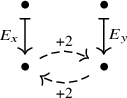
Lemma 3.3. Let $F:D^b(\mathbb {C})\oplus D^b(\mathbb {C})\to D^b(\mathcal {A})$
be the functor mapping
$F:D^b(\mathbb {C})\oplus D^b(\mathbb {C})\to D^b(\mathcal {A})$
be the functor mapping $\mathbb {C}\oplus 0$
and
$\mathbb {C}\oplus 0$
and $0\oplus \mathbb {C}$
to
$0\oplus \mathbb {C}$
to $E_x$
and
$E_x$
and $E_y$
respectively (Fig. 1). Then F is spherical, and
$E_y$
respectively (Fig. 1). Then F is spherical, and $\Phi $
is obtained by restricting the associated dual twist
$\Phi $
is obtained by restricting the associated dual twist $T^{-1}:D^b(\mathcal {A})\to D^b(\mathcal {A})$
to
$T^{-1}:D^b(\mathcal {A})\to D^b(\mathcal {A})$
to  .
.
The spherical functor F.

Proof. The right adjoint of F is $R=\operatorname {\mathrm {Hom}}(E_x,-)\oplus \operatorname {\mathrm {Hom}}(E_y,-)$
, and as a consequence of Remark 3.2 there is also a left adjoint
$R=\operatorname {\mathrm {Hom}}(E_x,-)\oplus \operatorname {\mathrm {Hom}}(E_y,-)$
, and as a consequence of Remark 3.2 there is also a left adjoint $L=RS[1]$
. The cotwist
$L=RS[1]$
. The cotwist $C=\operatorname {\mathrm {cone}}(1\to RF)[-1]$
is the following bimodule over
$C=\operatorname {\mathrm {cone}}(1\to RF)[-1]$
is the following bimodule over $\mathbb {C}\oplus \mathbb {C}$
:
$\mathbb {C}\oplus \mathbb {C}$
:
 $$ \begin{align*} \begin{bmatrix} 0 & \operatorname{\mathrm{Hom}}(E_x,E_y) \\ \operatorname{\mathrm{Hom}}(E_y,E_x) & 0 \end{bmatrix} = \begin{bmatrix} 0 & \mathbb{C}[-2] \\ \mathbb{C}[-2] & 0 \end{bmatrix}. \end{align*} $$
This is a shift of the symmetry swapping the two points – an autoequivalence – and satisfies $R=CL[1]$
because
$R=CL[1]$
because
 $$ \begin{align*} \operatorname{\mathrm{Hom}}(E_x,-) &= \operatorname{\mathrm{Hom}}(-,S(E_x))^{\vee_X} \\ &= \operatorname{\mathrm{Hom}}(-,E_y[1])^{\vee_X} = \operatorname{\mathrm{Hom}}(E_y,S(-))[-1]. \end{align*} $$
Hence F is spherical by the two-out-of-four theorem [Reference Anno and LogvinenkoAL, Theorem 1.1].
It follows that the twist $T=\operatorname {\mathrm {cone}}(FR\to 1)$
is an autoequivalence, with inverse the dual twist
$T=\operatorname {\mathrm {cone}}(FR\to 1)$
is an autoequivalence, with inverse the dual twist $T^{-1}=\operatorname {\mathrm {cone}}(1\to FL)[-1]$
. As
$T^{-1}=\operatorname {\mathrm {cone}}(1\to FL)[-1]$
. As $L=RS[1]$
, this is given by
$L=RS[1]$
, this is given by
 $$ \begin{align*} T^{-1}(G) = \operatorname{\mathrm{cone}}\biggl(G \to \bigl(\operatorname{\mathrm{Hom}}(G,E_x)^{\vee_{\mathbb{C}}}\otimes E_x\bigr) \oplus\bigl(\operatorname{\mathrm{Hom}}(G,E_y)^{\vee_{\mathbb{C}}}\otimes E_y\bigr)\biggr)[-1], \end{align*} $$
which agrees with the projection to  when
when  .
.
Hence $\Phi $
is an equivalence, as
$\Phi $
is an equivalence, as $T^{-1}$
is an autoequivalence. By symmetry the same functor
$T^{-1}$
is an autoequivalence. By symmetry the same functor $T^{-1}$
also gives the other direction of the flop. We write
$T^{-1}$
also gives the other direction of the flop. We write $\Phi =T^{-1}$
for this extension of both functors as a slight abuse of notation.
$\Phi =T^{-1}$
for this extension of both functors as a slight abuse of notation.
By [Reference BarbacoviBar, Theorem 4.1.3] there is a simple way of expressing the flop-flop autoequivalence $\Phi ^2|_{D^b(\mathcal {A}_x)}$
as a spherical twist. Since
$\Phi ^2|_{D^b(\mathcal {A}_x)}$
as a spherical twist. Since $D^b(\mathcal {A}_x)\subset D^b(\mathcal {A})$
is the complement of an exceptional object, it is the dual twist around a spherical object: the image of
$D^b(\mathcal {A}_x)\subset D^b(\mathcal {A})$
is the complement of an exceptional object, it is the dual twist around a spherical object: the image of $E_x$
in
$E_x$
in  . Similar holds for $D^b(\mathcal {A}_y)$
. Explicitly, these spherical objects are
$D^b(\mathcal {A}_y)$
. Explicitly, these spherical objects are  and
and  .
.
Remark 3.4. The kernel of $D^b(\mathcal {A})\to D^b(X)$
is generated by
$D^b(\mathcal {A})\to D^b(X)$
is generated by $E_x$
and
$E_x$
and $E_y$
, and its image in
$E_y$
, and its image in $D^b(\mathcal {A}_x)$
is the kernel of
$D^b(\mathcal {A}_x)$
is the kernel of $D^b(\mathcal {A}_x)\to D^b(X)$
, which is therefore just
$D^b(\mathcal {A}_x)\to D^b(X)$
, which is therefore just $\langle F_x\rangle $
. This is in line with results for other nodal singularities [Reference SungSun], [Reference CattaniCGL+
], [Reference Kuznetsov and ShinderKS1].
$\langle F_x\rangle $
. This is in line with results for other nodal singularities [Reference SungSun], [Reference CattaniCGL+
], [Reference Kuznetsov and ShinderKS1].
Here $F_x$
is 3-spherical, even though X is 1-dimensional, and the disparity means that
$F_x$
is 3-spherical, even though X is 1-dimensional, and the disparity means that $D^b(\mathcal {A}_x)$
cannot be strongly crepant. On the other hand
$D^b(\mathcal {A}_x)$
cannot be strongly crepant. On the other hand $D^b(\mathcal {A})$
and
$D^b(\mathcal {A})$
and $D^b(\mathcal {A}_x)$
are weakly crepant, since the kernels are Serre invariant [Reference Kuznetsov and ShinderKS2, Lemma 5.8].
$D^b(\mathcal {A}_x)$
are weakly crepant, since the kernels are Serre invariant [Reference Kuznetsov and ShinderKS2, Lemma 5.8].
Remark 3.5. Despite being spherical in their respective subcategories, $F_x$
and
$F_x$
and $F_y$
are not spherical in
$F_y$
are not spherical in $D^b(\mathcal {A})$
. Indeed, we find
$D^b(\mathcal {A})$
. Indeed, we find $S(F_x)=F_y[1]$
; this is not a shift of
$S(F_x)=F_y[1]$
; this is not a shift of $F_x$
. They satisfy the sphere-cohomology part of the definition of a spherical object, but fail the Serre-invariance condition.
$F_x$
. They satisfy the sphere-cohomology part of the definition of a spherical object, but fail the Serre-invariance condition.
Remark 3.6. It turns out that $\Phi =S$
. This is almost certainly a formal consequence of
$\Phi =S$
. This is almost certainly a formal consequence of $S(E_x)=E_y[1]$
and
$S(E_x)=E_y[1]$
and $S(E_y)=E_x[1]$
, together with the description of
$S(E_y)=E_x[1]$
, together with the description of $\Phi $
in terms of mutations, but we have not been able to find a proof in that vein. It can be deduced indirectly from the equivalence with Landau–Ginzburg models outlined in § 4, by matching Remark 4.5 with Lemma 3.3. A rather involved proof of the analogous claim for the nodal cubic was given in [Reference SungSun, §3].
$\Phi $
in terms of mutations, but we have not been able to find a proof in that vein. It can be deduced indirectly from the equivalence with Landau–Ginzburg models outlined in § 4, by matching Remark 4.5 with Lemma 3.3. A rather involved proof of the analogous claim for the nodal cubic was given in [Reference SungSun, §3].
One consequence is that the Serre functor on $D^b(\mathcal {A}_x)$
is the restriction of
$D^b(\mathcal {A}_x)$
is the restriction of $S^2$
, which explains how
$S^2$
, which explains how $F_x$
becomes spherical in the subcategory:
$F_x$
becomes spherical in the subcategory: $S^2(F_x)=F_x[2]$
.
$S^2(F_x)=F_x[2]$
.
3.2 Crepancy
In view of Remarks 3.2 and 3.4, we make the following definition.
Definition 3.7. Suppose $(\mathscr {C},\pi _*,\pi ^*)$
is a strong categorical resolution of X, with a relative Serre functor S. We say it is fairly crepant if
$(\mathscr {C},\pi _*,\pi ^*)$
is a strong categorical resolution of X, with a relative Serre functor S. We say it is fairly crepant if $S(\ker (\pi _*))\subset \ker \pi _*$
and there is some n such that
$S(\ker (\pi _*))\subset \ker \pi _*$
and there is some n such that $S|_{\ker (\pi _*)}=[n]$
. We call n the index of crepancy.
$S|_{\ker (\pi _*)}=[n]$
. We call n the index of crepancy.
Recall that strong crepancy was the condition $S=\mathrm {id}_{\mathscr {C}}$
, while weak crepancy is the condition that
$S=\mathrm {id}_{\mathscr {C}}$
, while weak crepancy is the condition that $S(\ker (\pi _*))\subset \ker (\pi _*)$
by [Reference Kuznetsov and ShinderKS2, Lemma 5.8], provided we revise our definition of ‘strong categorical resolution’ to also require
$S(\ker (\pi _*))\subset \ker (\pi _*)$
by [Reference Kuznetsov and ShinderKS2, Lemma 5.8], provided we revise our definition of ‘strong categorical resolution’ to also require $\pi _*$
to be a categorical contraction [Reference Kuznetsov and ShinderKS2, Definition 5.1]. It is then clear that strong crepancy implies fair crepancy with index 0, and fair crepancy of any index implies weak crepancy. The reverse implications do not hold in general.
$\pi _*$
to be a categorical contraction [Reference Kuznetsov and ShinderKS2, Definition 5.1]. It is then clear that strong crepancy implies fair crepancy with index 0, and fair crepancy of any index implies weak crepancy. The reverse implications do not hold in general.
Example 3.8. Consider the categorical resolution of $X=\operatorname {\mathrm {Spec}}\mathbb {C}[w]/w^2$
given by the graded Kronecker quiver from Example 2.8. The kernel is generated by
$X=\operatorname {\mathrm {Spec}}\mathbb {C}[w]/w^2$
given by the graded Kronecker quiver from Example 2.8. The kernel is generated by $\operatorname {\mathrm {cone}}(P_0[-d]\xrightarrow {w}P_1)$
, which is a
$\operatorname {\mathrm {cone}}(P_0[-d]\xrightarrow {w}P_1)$
, which is a $2$
-spherical object, so this resolution is fairly crepant of index
$2$
-spherical object, so this resolution is fairly crepant of index $2$
.
$2$
.
For a nontrivial grading $|w|=d$
of
$|w|=d$
of $\mathbb {C}[w]/w^2$
we can still consider categorical resolutions, as the definitions given above for affine schemes generalize immediately to graded algebras. (One can even define categorical resolutions for more general dg-categories [Reference Kuznetsov and ShinderKS2, §5]). After setting
$\mathbb {C}[w]/w^2$
we can still consider categorical resolutions, as the definitions given above for affine schemes generalize immediately to graded algebras. (One can even define categorical resolutions for more general dg-categories [Reference Kuznetsov and ShinderKS2, §5]). After setting $|\theta |=1-d$
the graded Kronecker quiver still gives a categorical resolution which is fairly crepant of index
$|\theta |=1-d$
the graded Kronecker quiver still gives a categorical resolution which is fairly crepant of index $2-d$
.
$2-d$
.
When $d=2$
this resolution is fairly crepant of index 0, but it is not strongly crepant by the same argument as in Example 2.8. Hence fair crepancy of index 0 is weaker than strong crepancy, at least in this more general context. (We are not aware of a geometric example of the distinction; cf. Remarks 3.12 and 3.13).
$d=2$
this resolution is fairly crepant of index 0, but it is not strongly crepant by the same argument as in Example 2.8. Hence fair crepancy of index 0 is weaker than strong crepancy, at least in this more general context. (We are not aware of a geometric example of the distinction; cf. Remarks 3.12 and 3.13).
Example 3.9. From Remark 3.2 we have that $D^b(\mathcal {A})$
is weakly crepant but not fairly crepant, while
$D^b(\mathcal {A})$
is weakly crepant but not fairly crepant, while $D^b(\mathcal {A}_x)$
is fairly crepant of index 2 from Remark 3.4 (cf. Remark 3.6). The index is the discrepancy between the dimension of the spherical object in the kernel (in this case 3) and that of the base variety X (in this case 1).
$D^b(\mathcal {A}_x)$
is fairly crepant of index 2 from Remark 3.4 (cf. Remark 3.6). The index is the discrepancy between the dimension of the spherical object in the kernel (in this case 3) and that of the base variety X (in this case 1).
If we assume that $\mathscr {C}$
is suitably birational, so that
$\mathscr {C}$
is suitably birational, so that $\operatorname {\mathrm {Hom}}_{\mathscr {C}}(x,y)$
for
$\operatorname {\mathrm {Hom}}_{\mathscr {C}}(x,y)$
for $x,y\in \ker (\pi _*)$
is a module supported at the singularity in X, then for an isolated Gorenstein singularity the relative Serre functor on
$x,y\in \ker (\pi _*)$
is a module supported at the singularity in X, then for an isolated Gorenstein singularity the relative Serre functor on $\ker (\pi _*)$
is a shift of the absolute Serre functor (as in Remark 3.2). In this situation fair crepancy of index n is equivalent to requiring that
$\ker (\pi _*)$
is a shift of the absolute Serre functor (as in Remark 3.2). In this situation fair crepancy of index n is equivalent to requiring that $\ker (\pi _*)$
is
$\ker (\pi _*)$
is $(n+\dim X)$
-Calabi–Yau, implying that
$(n+\dim X)$
-Calabi–Yau, implying that $\ker (\pi _*)$
has no nontrivial semiorthogonal decompositions. The resolution then cannot be made smaller via semiorthogonal decomposition, assuming
$\ker (\pi _*)$
has no nontrivial semiorthogonal decompositions. The resolution then cannot be made smaller via semiorthogonal decomposition, assuming $\mathscr {C}$
is connected, so we find it reasonable to expect that fairly crepant categorical resolutions do not factor nontrivially through further categorical resolutions. Note that ‘minimal’ categorical resolutions are conjectured to have a universal factorization property [Reference Bondal and OrlovBO], and in particular should be unique, although the correct definitions to ensure this are unclear.
$\mathscr {C}$
is connected, so we find it reasonable to expect that fairly crepant categorical resolutions do not factor nontrivially through further categorical resolutions. Note that ‘minimal’ categorical resolutions are conjectured to have a universal factorization property [Reference Bondal and OrlovBO], and in particular should be unique, although the correct definitions to ensure this are unclear.
Questions.
-
1. Does the index of crepancy reduce to a known numerical invariant?
-
2. In what generality do fairly crepant categorical resolutions exist?
-
3. Are they universal minimal resolutions? In particular, are they unique?
Assuming uniqueness, nonvanishing of the index of crepancy would be a sufficient nonexistence criterion for (geometric) crepant resolutions of rational singularities, and also other strongly crepant categorical resolutions, such as NCCRs. We find results consistent with this prediction in Remarks 3.12 and 3.13.
3.3 General nodal curves
It was shown in [Reference Burban and DrozdBD] that $\mathcal {A}$
gives a categorical resolution for any nodal or cuspidal curve. We briefly note that exceptional objects with the same properties as
$\mathcal {A}$
gives a categorical resolution for any nodal or cuspidal curve. We briefly note that exceptional objects with the same properties as $E_x$
and
$E_x$
and $E_y$
exist in
$E_y$
exist in $D^b(\mathcal {A})$
for all nodal curves.
$D^b(\mathcal {A})$
for all nodal curves.
Indeed, suppose X is a curve with a node at p, and take the normalization $\pi :\widetilde X\to X$
. Then
$\pi :\widetilde X\to X$
. Then $\pi ^{-1}(p)$
consists of two reduced points
$\pi ^{-1}(p)$
consists of two reduced points $q_1$
and
$q_1$
and $q_2$
, and these give simple modules
$q_2$
, and these give simple modules $E_1=\pi _*\mathcal {O}_{q_1}$
and
$E_1=\pi _*\mathcal {O}_{q_1}$
and $E_2=\pi _*\mathcal {O}_{q_2}$
over
$E_2=\pi _*\mathcal {O}_{q_2}$
over $\mathcal {A}=\operatorname {\mathrm {End}}_X(\mathcal {O}_X\oplus \pi _*\mathcal {O}_{\widetilde X})$
.
$\mathcal {A}=\operatorname {\mathrm {End}}_X(\mathcal {O}_X\oplus \pi _*\mathcal {O}_{\widetilde X})$
.
Proposition 3.10. We have the following:
-
1.
$E_1$
and
$E_2$
are exceptional objects in
$D^b(\mathcal {A})$
. -
2.
$S(E_1)=E_2[1]$
and
$S(E_2)=E_1[1]$
, where S is as in Eq. (3.2).




In particular, the results of § 3.1 apply to  .
.
Proof. We assume without loss of generality that X is affine. The algebra $\mathcal {A}$
has projective modules
$\mathcal {A}$
has projective modules $P_X$
and
$P_X$
and $P_{\widetilde X}$
, with
$P_{\widetilde X}$
, with
 $$ \begin{align} \begin{aligned} \operatorname{\mathrm{End}}(P_X) &= \mathcal{O}_X, \qquad \operatorname{\mathrm{Hom}}(P_X,P_{\widetilde X}) = \mathcal{O}_{\widetilde X}, \\ \operatorname{\mathrm{End}}(P_{\widetilde X}) &= \mathcal{O}_{\widetilde X}, \qquad \operatorname{\mathrm{Hom}}(P_{\widetilde X},P_X) = \mathcal{I}. \end{aligned} \end{align} $$
Here $\mathcal {I}$
is the ideal cutting out
$\mathcal {I}$
is the ideal cutting out $\operatorname {\mathrm {Sing}}(X)$
, equal to the conductor
$\operatorname {\mathrm {Sing}}(X)$
, equal to the conductor $\operatorname {\mathrm {Ann}}_X(\mathcal {O}_{\widetilde X}/\mathcal {O}_X)$
. This is all from [Reference Burban and DrozdBD, Proposition 2.2]. The points
$\operatorname {\mathrm {Ann}}_X(\mathcal {O}_{\widetilde X}/\mathcal {O}_X)$
. This is all from [Reference Burban and DrozdBD, Proposition 2.2]. The points $q_i\in {\widetilde X}$
are divisors
$q_i\in {\widetilde X}$
are divisors $\{s_i=0\}$
, and
$\{s_i=0\}$
, and $g=s_1s_2$
satisfies
$g=s_1s_2$
satisfies $\mathcal {I}=\mathcal {O}_{\widetilde X}\cdot g$
. We then have the following resolutions:
$\mathcal {I}=\mathcal {O}_{\widetilde X}\cdot g$
. We then have the following resolutions:
 $$ \begin{align*} &P_{\widetilde X} \xrightarrow{(-g,\,s_2)^T} P_X\oplus P_{\widetilde X} \xrightarrow{(1,\,s_1)} P_{\widetilde X} \to E_1, \\ &P_{\widetilde X} \xrightarrow{(-g,\,s_1)^T} P_X\oplus P_{\widetilde X} \xrightarrow{(1,\,s_2)} P_{\widetilde X} \to E_2, \end{align*} $$
with maps understood via Eq. (3.3). Using these (1) is a direct computation, and we also find that $(E_i)^{\vee _{\mathcal {A}}}=E_j[-2]$
, where
$(E_i)^{\vee _{\mathcal {A}}}=E_j[-2]$
, where $\{i,j\}=\{1,2\}$
and
$\{i,j\}=\{1,2\}$
and $E_j$
is viewed as a left-module. Then (2) follows from
$E_j$
is viewed as a left-module. Then (2) follows from $\operatorname {\mathrm {Hom}}_X(\mathcal {O}_p,\mathcal {O}_X)=\mathcal {O}_p[-1]$
.
$\operatorname {\mathrm {Hom}}_X(\mathcal {O}_p,\mathcal {O}_X)=\mathcal {O}_p[-1]$
.
Corollary 3.11. For any isolated nodal curve singularity X, there is a categorical resolution with kernel generated by a single 3-spherical object.
Such a resolution is fairly crepant of index 2, but not strongly crepant since $2\ne 0$
. This extends the description of [Reference CattaniCGL+
] for
$2\ne 0$
. This extends the description of [Reference CattaniCGL+
] for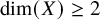 $\dim (X)\ge 2$
, continuing the pattern of 2- or 3-spherical objects by parity of dimension.Footnote
2
The zero-dimensional node also follows this pattern; see Example 3.8.
$\dim (X)\ge 2$
, continuing the pattern of 2- or 3-spherical objects by parity of dimension.Footnote
2
The zero-dimensional node also follows this pattern; see Example 3.8.
Remark 3.12. In particular, fairly crepant resolutions exist for isolated nodal singularities of all dimensions. The indices of these resolutions are displayed in Table 1. Note that the index is 0 in exactly the two dimensions where geometric crepant resolutions exist; the constructed categorical resolutions are equivalent to the geometric resolutions in these cases, and are therefore strongly crepant.
Indices of crepancy for categorical resolutions of nodes.

Remark 3.13. In [Reference FietzFie], a description of the kernels of certain categorical resolutions of simple hypersurface singularities of type $A_2$
is given. They appear to be fairly crepant of index
$A_2$
is given. They appear to be fairly crepant of index $2-d$
, where d is the dimension.Footnote
3
Again, this index vanishes iff a geometric crepant resolution exists.
$2-d$
, where d is the dimension.Footnote
3
Again, this index vanishes iff a geometric crepant resolution exists.
4 Landau–Ginzburg models
Recall that a Landau–Ginzburg model (following [Reference SegalSeg1]), at least on the B-side, is a smooth variety U with a superpotential $W\in H^0(U,\mathcal {O}_U)$
, together with an action of a rank one torus
$W\in H^0(U,\mathcal {O}_U)$
, together with an action of a rank one torus $\mathbb {C}^*_R$
on U called the R-charge, satisfying
$\mathbb {C}^*_R$
on U called the R-charge, satisfying
-
1.
$\{\pm 1\}\subset \mathbb {C}^*_R$
acts trivially on U, and -
2. W has weight 2 for the
$\mathbb {C}^*_R$
action.


There is then an associated dg-enhanced triangulated category $D^b(U,W)$
of matrix factorizations of W, or B-branes, whose objects are
$D^b(U,W)$
of matrix factorizations of W, or B-branes, whose objects are $\mathbb {C}^*_R$
-equivariant sheaves with an endomorphism d of weight 1 satisfying
$\mathbb {C}^*_R$
-equivariant sheaves with an endomorphism d of weight 1 satisfying $d^2=W$
, having a suitable notion of quasi-isomorphism by [Reference OrlovOrl].
$d^2=W$
, having a suitable notion of quasi-isomorphism by [Reference OrlovOrl].
4.1 The exoflop
We apply the idea of [Reference AspinwallAsp] to our situation as follows. The derived category of $X=\{xy=0\}$
is equivalent to a category of matrix factorizations
$X=\{xy=0\}$
is equivalent to a category of matrix factorizations $D^b(\mathbb {A}^3,xyz)$
, where the R-charge weights are
$D^b(\mathbb {A}^3,xyz)$
, where the R-charge weights are $|x|=|y|=0$
and
$|x|=|y|=0$
and $|z|=2$
. This is an instance of Knörrer periodicity ([Reference KnörrerKnö], cf. [Reference ShipmanShi]), which relates the derived category of a complete intersection – or more generally factorizations on a complete intersection – to factorizations on the associated vector bundle. Now
$|z|=2$
. This is an instance of Knörrer periodicity ([Reference KnörrerKnö], cf. [Reference ShipmanShi]), which relates the derived category of a complete intersection – or more generally factorizations on a complete intersection – to factorizations on the associated vector bundle. Now $\widetilde X$
lies inside the blowup
$\widetilde X$
lies inside the blowup $\operatorname {\mathrm {Tot}}_{\mathbb {P}^1_{x:y}}\mathcal {O}(-1)$
of the plane, cut out by the section
$\operatorname {\mathrm {Tot}}_{\mathbb {P}^1_{x:y}}\mathcal {O}(-1)$
of the plane, cut out by the section $xy$
of
$xy$
of $\mathcal {O}(2)$
, and by Knörrer periodicity it is also derived equivalent to an LG-model. We get a square
$\mathcal {O}(2)$
, and by Knörrer periodicity it is also derived equivalent to an LG-model. We get a square

where z is the coordinate on $\mathcal {O}(-2)$
. This LG-model has a weighted flip:
$\mathcal {O}(-2)$
. This LG-model has a weighted flip:

with $\mathbb {P}^{1:2}$
viewed as an orbifold. By [Reference Ballard, Favero and KatzarkovBFK] there is a decomposition
$\mathbb {P}^{1:2}$
viewed as an orbifold. By [Reference Ballard, Favero and KatzarkovBFK] there is a decomposition
 $$ \begin{align} D^b(\overline U,xyz) = \langle D^b(\mathrm{pt}),D^b(\widetilde X)\rangle, \end{align} $$
where the exceptional object is the sheafy matrix factorization $\mathcal {O}_{\mathbb {P}^{1:2}}(-1)$
on the zero section.Footnote
4
Here
$\mathcal {O}_{\mathbb {P}^{1:2}}(-1)$
on the zero section.Footnote
4
Here $D^b(\widetilde X)$
is embedded via Knörrer periodicity followed by the flip.
$D^b(\widetilde X)$
is embedded via Knörrer periodicity followed by the flip.
The key observation is that $\overline U$
is a partial compactification of the original LG-model
$\overline U$
is a partial compactification of the original LG-model $(\mathbb {A}^3,xyz)$
, which is the open set
$(\mathbb {A}^3,xyz)$
, which is the open set $\{w\ne 0\}$
. Restriction to this open set gives a functor
$\{w\ne 0\}$
. Restriction to this open set gives a functor $D^b(\overline U,xyz)\to D^b(X)$
, and the adjoint pushforward is defined for factorizations supported at
$D^b(\overline U,xyz)\to D^b(X)$
, and the adjoint pushforward is defined for factorizations supported at $\{z=0\}$
, which corresponds to
$\{z=0\}$
, which corresponds to ${\mathfrak {Perf}}(X)$
under Knörrer periodicity. Restriction and pushforward compose to the identity, and
${\mathfrak {Perf}}(X)$
under Knörrer periodicity. Restriction and pushforward compose to the identity, and $D^b(\overline U,xyz)$
is smooth (from compactification of the critical locus, or just Eq. (4.1)), so this is a categorical resolution. It can be checked to be equivalent to
$D^b(\overline U,xyz)$
is smooth (from compactification of the critical locus, or just Eq. (4.1)), so this is a categorical resolution. It can be checked to be equivalent to $D^b(\mathcal {A})$
.Footnote
5
$D^b(\mathcal {A})$
.Footnote
5
Remark 4.1. Notice how three completely different constructions – that of [Reference Kuznetsov and LuntsKL], [Reference Burban and DrozdBD], and [Reference AspinwallAsp] – all produce the same categorical resolution $D^b(\mathcal {A})$
. This kind of coincidence can be seen as evidence for the conjectural existence of a universal minimal categorical resolution, even though we expect there to be no strongly crepant resolution in this case. One slightly odd point is that the nonminimal resolution
$D^b(\mathcal {A})$
. This kind of coincidence can be seen as evidence for the conjectural existence of a universal minimal categorical resolution, even though we expect there to be no strongly crepant resolution in this case. One slightly odd point is that the nonminimal resolution $D^b(\mathcal {A})$
seems to crop up more naturally than the minimal one
$D^b(\mathcal {A})$
seems to crop up more naturally than the minimal one $D^b(\mathcal {A}_x)$
.
$D^b(\mathcal {A}_x)$
.
4.2 Removing orbifold points
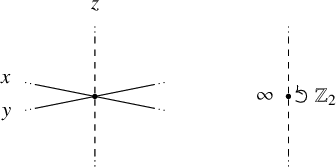
To better understand these LG-models, we should consider the critical locus of the superpotential (Fig. 2). For $(\mathbb {A}^3,xyz)$
this is the node itself in the plane
$(\mathbb {A}^3,xyz)$
this is the node itself in the plane $\{z=0\}$
, together with a vertical
$\{z=0\}$
, together with a vertical $\mathbb {A}^1_z$
branch through the singularity, with positive R-charge. This indicates the unbounded Ext groups supported at the singularity of X; indeed, the open set
$\mathbb {A}^1_z$
branch through the singularity, with positive R-charge. This indicates the unbounded Ext groups supported at the singularity of X; indeed, the open set $\{z\ne 0\}$
of the LG-model is equivalent by Knörrer periodicity to
$\{z\ne 0\}$
of the LG-model is equivalent by Knörrer periodicity to $D^b(\mathbb {A}^1_z-\{0\})$
, where
$D^b(\mathbb {A}^1_z-\{0\})$
, where $|z|=2$
is positively graded. The nontrivial part of the compactification lies in this open set, and if we apply Knörrer periodicity to
$|z|=2$
is positively graded. The nontrivial part of the compactification lies in this open set, and if we apply Knörrer periodicity to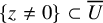 $\{z\ne 0\}\subset \overline U$
we instead get
$\{z\ne 0\}\subset \overline U$
we instead get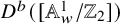 $D^b([\mathbb {A}^1_w/\mathbb {Z}_2])$
, because the branch
$D^b([\mathbb {A}^1_w/\mathbb {Z}_2])$
, because the branch $\mathbb {A}^1_z$
has been compactified to an orbifold
$\mathbb {A}^1_z$
has been compactified to an orbifold $\mathbb {P}^{1:2}$
. This compactification of the positively graded part of the critical locus is why we get a relatively proper categorical resolution.
$\mathbb {P}^{1:2}$
. This compactification of the positively graded part of the critical locus is why we get a relatively proper categorical resolution.
A more obvious compactification just uses $\mathbb {P}^1$
. We can achieve it algebraically by removing an exceptional object, motivated by the decomposition
$\mathbb {P}^1$
. We can achieve it algebraically by removing an exceptional object, motivated by the decomposition $D^b([\mathbb {A}^1_w/\mathbb {Z}_2])=\langle \mathcal {O}_0,\mathcal {O}\rangle =\langle D^b(\mathrm {pt}),D^b(\mathbb {A}^1_{w^2})\rangle $
for the chart
$D^b([\mathbb {A}^1_w/\mathbb {Z}_2])=\langle \mathcal {O}_0,\mathcal {O}\rangle =\langle D^b(\mathrm {pt}),D^b(\mathbb {A}^1_{w^2})\rangle $
for the chart $\{z\ne 0\}$
. There are two choices, since there are two twists of the skyscraper sheaf in
$\{z\ne 0\}$
. There are two choices, since there are two twists of the skyscraper sheaf in $[\mathbb {A}^1/\mathbb {Z}_2]$
, giving two exceptional objects
$[\mathbb {A}^1/\mathbb {Z}_2]$
, giving two exceptional objects $\mathcal {O}_{\{x=w=0\}}$
and
$\mathcal {O}_{\{x=w=0\}}$
and $\mathcal {O}_{\{y=w=0\}}$
in
$\mathcal {O}_{\{y=w=0\}}$
in $D^b(\overline U,xyz)$
. Their orthogonal complements give two smaller categorical resolutions, matching § 3.
$D^b(\overline U,xyz)$
. Their orthogonal complements give two smaller categorical resolutions, matching § 3.
The critical locus of $(\mathbb {A}^3,xyz)$
, and a chart near
$(\mathbb {A}^3,xyz)$
, and a chart near $z=\infty $
for the partial compactification with an orbifold point.
$z=\infty $
for the partial compactification with an orbifold point.

Remark 4.2. The smaller resolutions are also equivalent to factorizations on another LG-model: $(\operatorname {\mathrm {Tot}}_{\mathbb {P}^1_{w:z}}(\mathcal {O}_x\oplus \mathcal {O}(-1)_y),xyz)$
. Here the critical locus is the obvious compactification. This LG-model description appears in [Reference Lekili and PolishchukLP2].
$(\operatorname {\mathrm {Tot}}_{\mathbb {P}^1_{w:z}}(\mathcal {O}_x\oplus \mathcal {O}(-1)_y),xyz)$
. Here the critical locus is the obvious compactification. This LG-model description appears in [Reference Lekili and PolishchukLP2].
Remark 4.3. These descriptions suggest the following distillation of the essence of the flop: for a smooth point p on a curve C, the derived category of the root stack $\sqrt [2]{p/C}$
has an exceptional object, the skyscraper sheaf at p, with orthogonal complement the pullup of
$\sqrt [2]{p/C}$
has an exceptional object, the skyscraper sheaf at p, with orthogonal complement the pullup of $D^b(C)$
. It can be twisted by the
$D^b(C)$
. It can be twisted by the $\mathbb {Z}_2$
-isotropy, giving a different subcategory equivalent to
$\mathbb {Z}_2$
-isotropy, giving a different subcategory equivalent to $D^b(C)$
and a diagram like Eq. (1.2). The flop-flop autoequivalence on
$D^b(C)$
and a diagram like Eq. (1.2). The flop-flop autoequivalence on $D^b(C)$
is then
$D^b(C)$
is then $-\otimes \mathcal {O}(p)$
. We are looking at an analogue of this construction for the noncommutative curve
$-\otimes \mathcal {O}(p)$
. We are looking at an analogue of this construction for the noncommutative curve $\mathcal {A}_x$
.
$\mathcal {A}_x$
.
This is an example of the general principle that root stacks behave a lot like blowups, especially when viewed through the lens of derived categories; see [Reference Bergh, Lunts and SchnürerBLS, §4].
Example 4.4. When $C=\mathbb {A}^1$
and
$C=\mathbb {A}^1$
and $p=0$
the root stack is
$p=0$
the root stack is $[\mathbb {A}^1/\mathbb {Z}_2]$
, which was the affine patch at infinity for the critical locus of the LG-model considered above.
$[\mathbb {A}^1/\mathbb {Z}_2]$
, which was the affine patch at infinity for the critical locus of the LG-model considered above.
4.3 Canonical bundles
The Serre functor on the LG-model is just given by the canonical bundle $\mathcal {O}(-1)$
, by a local version of [Reference Favero and KellyFK, Theorem 1.2]. Weak crepancy holds since the line bundle is trivial near
$\mathcal {O}(-1)$
, by a local version of [Reference Favero and KellyFK, Theorem 1.2]. Weak crepancy holds since the line bundle is trivial near $\{z=0\}$
, using Remark 2.6 together with the fact that
$\{z=0\}$
, using Remark 2.6 together with the fact that ${\mathfrak {Perf}}(X)$
corresponds to factorizations supported at
${\mathfrak {Perf}}(X)$
corresponds to factorizations supported at $\{z=0\}$
. Of course, this local condition does not imply global triviality (i.e., strong crepancy). The orbifold point at
$\{z=0\}$
. Of course, this local condition does not imply global triviality (i.e., strong crepancy). The orbifold point at $\{z=\infty \}$
locally obstructs strong crepancy, contributing a local nontriviality to the canonical bundle, but there is also the global obstruction that the toric compactifications of
$\{z=\infty \}$
locally obstructs strong crepancy, contributing a local nontriviality to the canonical bundle, but there is also the global obstruction that the toric compactifications of $(\mathbb {A}^3,xyz)$
are not Calabi–Yau, so the smaller resolution is still not strongly crepant (cf. Remark 4.2).
$(\mathbb {A}^3,xyz)$
are not Calabi–Yau, so the smaller resolution is still not strongly crepant (cf. Remark 4.2).
The kernel subcategory consists of factorizations which restrict to zero on the open set $\{z\ne 0\}$
, that is, those with support at
$\{z\ne 0\}$
, that is, those with support at $\{z=\infty \}$
, and so fair crepancy is equivalent to local triviality of the canonical bundle near
$\{z=\infty \}$
, and so fair crepancy is equivalent to local triviality of the canonical bundle near $\{z=\infty \}$
. This fails only for the orbifold compactification, where the isotropy group gives an obstruction.
$\{z=\infty \}$
. This fails only for the orbifold compactification, where the isotropy group gives an obstruction.
Remark 4.5. As a line bundle, the Serre functor is the inverse twist along the spherical functor given by the divisor $\{w=0\}$
with ideal sheaf
$\{w=0\}$
with ideal sheaf $\mathcal {O}(-1)$
. The source category is the restricted LG-model
$\mathcal {O}(-1)$
. The source category is the restricted LG-model $D^b([\mathbb {A}^2/\mathbb {Z}_2],xy)$
, which is equivalent by Knörrer periodicity to
$D^b([\mathbb {A}^2/\mathbb {Z}_2],xy)$
, which is equivalent by Knörrer periodicity to $D^b([\mathrm {pt}/\mathbb {Z}_2])=D^b(\mathrm {pt})\oplus D^b(\mathrm {pt})$
, recovering the spherical functor F.Footnote
6
$D^b([\mathrm {pt}/\mathbb {Z}_2])=D^b(\mathrm {pt})\oplus D^b(\mathrm {pt})$
, recovering the spherical functor F.Footnote
6
4.4 The A-side
Let us briefly sketch an equivalent picture under homological mirror symmetry. For more details, the reader should consult [Reference Lekili and PolishchukLP1] and [Reference Lekili and PolishchukLP2].
Our starting point is a standard result, that the LG-model $(\mathbb {A}^3,xyz)$
is equivalent to a wrapped Fukaya category
$(\mathbb {A}^3,xyz)$
is equivalent to a wrapped Fukaya category $\mathcal {W}(\Sigma )$
, where
$\mathcal {W}(\Sigma )$
, where $\Sigma $
is the pair-of-pants surface.Footnote
7
It was further shown in [Reference Lekili and PolishchukLP1] that the categorical resolution
$\Sigma $
is the pair-of-pants surface.Footnote
7
It was further shown in [Reference Lekili and PolishchukLP1] that the categorical resolution $D^b(\mathcal {A})$
is equivalent to a partially wrapped Fukaya category
$D^b(\mathcal {A})$
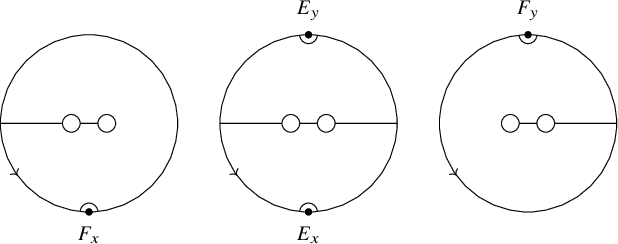
is equivalent to a partially wrapped Fukaya category $\mathcal {W}(\Sigma ;\Lambda )$
, where two stops
$\mathcal {W}(\Sigma ;\Lambda )$
, where two stops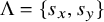 $\Lambda =\{s_x,s_y\}$
have been added to one of the boundary components (the one with positive grading). Generators realizing the equivalence with
$\Lambda =\{s_x,s_y\}$
have been added to one of the boundary components (the one with positive grading). Generators realizing the equivalence with $D^b(\mathcal {A})$
are horizontal lines in Fig. 3. The forgetful functor
$D^b(\mathcal {A})$
are horizontal lines in Fig. 3. The forgetful functor $\mathcal {W}(\Sigma ;\Lambda )\to \mathcal {W}(\Sigma )$
is a localization, which contracts two exceptional objects (
$\mathcal {W}(\Sigma ;\Lambda )\to \mathcal {W}(\Sigma )$
is a localization, which contracts two exceptional objects ( $E_x$
and
$E_x$
and $E_y$
) given by small arcs bounding the two stops (also depicted).
$E_y$
) given by small arcs bounding the two stops (also depicted).
The two smaller resolutions then correspond to removing just one of these stops, giving the equivalent categories $\mathcal {W}(\Sigma ;s_x)$
and
$\mathcal {W}(\Sigma ;s_x)$
and $\mathcal {W}(\Sigma ;s_y)$
, with
$\mathcal {W}(\Sigma ;s_y)$
, with $\mathcal {W}(\Sigma ;\Lambda )$
providing a roof via the forgetful functors. Adjoint to these forgetful functors are the inclusions as admissible subcategories, which can be described on objects (purely algebraically) by choosing a lift to the roof, and then projecting to the orthogonal complement of the relevant exceptional object via a mapping cone. This reproduces the spherical twists of § 3; the arcs near the stop in the single-stopped case are spherical objects, and in the double-stopped case they are the exceptional objects of Lemma 3.3.
$\mathcal {W}(\Sigma ;\Lambda )$
providing a roof via the forgetful functors. Adjoint to these forgetful functors are the inclusions as admissible subcategories, which can be described on objects (purely algebraically) by choosing a lift to the roof, and then projecting to the orthogonal complement of the relevant exceptional object via a mapping cone. This reproduces the spherical twists of § 3; the arcs near the stop in the single-stopped case are spherical objects, and in the double-stopped case they are the exceptional objects of Lemma 3.3.
Objects in $\mathcal {W}(\Sigma ;s_x)$
,
$\mathcal {W}(\Sigma ;s_x)$
, $\mathcal {W}(\Sigma ;\Lambda )$
and
$\mathcal {W}(\Sigma ;\Lambda )$
and $\mathcal {W}(\Sigma ;s_y)$
.
$\mathcal {W}(\Sigma ;s_y)$
.

These spherical twists are examples of the ‘wrap-once’ autoequivalence for a swappable stop from [Reference SylvanSyl], which is always the twist for a natural associated spherical functor – the Orlov functor – and is defined in terms of a ‘swapping’ self-isotopy of the stopping divisor. This is a full circuit around the boundary for our single-stopped surface, but can be a half twist in the double-stopped case (swapping the two stops), which explains why one autoequivalence is the square of the other.
Acknowledgements
I thank my supervisor Ed Segal for his invaluable guidance and encouragement, without which this note would not have been written. I am also grateful to Yankı Lekili for a number of helpful conversations, and to the anonymous referee for useful suggestions of improvements to the exposition.
Competing interests
The author has no competing interests to declare.
Financial support
This work was supported by the Engineering and Physical Sciences Research Council [EP/S021590/1], the EPSRC Centre for Doctoral Training in Geometry and Number Theory (The London School of Geometry and Number Theory), University College London.











 Open access

