


Junior psychiatry doctors have diverse responsibilities both in their day-to-day work and in their role as an on-call doctor. They are usually responsible for the physical health of their patients who often have comorbid medical conditions and vascular risk factors such as smoking and diabetes. There has been renewed interest in excess morbidity due to cardiovascular events (Reference Brown and BarracloughBrown & Barraclough, 2000) and the role that psychiatric interventions, particularly atypical antipsychotics, have in increasing risk (Reference Lambert and ChapmanLambert & Chapman, 2004). The interaction between psychotic illness, metabolic syndrome and antipsychotic drugs is of particular concern (Reference Anai-OtongAnai-Otong, 2004).
Most individuals require a baseline electrocardiogram (ECG) on admission, often in anticipation of antipsychotic use. Special groups such as older adults, individuals with eating disorders and those receiving above maximum British National Formulary guideline doses often require more intensive ECG monitoring. A common on-call experience is attending to an individual with chest pain, who needs an urgent ECG to exclude cardiac origin. Electrocardiogram interpretation is usually the remit of the attending junior doctor. Psychiatric junior doctors often come from diverse backgrounds with varying prior general medical experience. Little is known about their general medical skills (such as ECG interpretation) which are rarely assessed during their psychiatric training.
Method
An ECG skills questionnaire was devised involving the interpretation of five electrocardiograms. For each, the doctor was asked whether the ECG was normal or abnormal and, if abnormal, to state the abnormality. The five ECGs were as follows:
-
(1) left bundle branch block
-
(2) atrial fibrillation
-
(3) inferior myocardial infarction
-
(4) paced ventricular rhythm
-
(5) normal.
Respondents were also asked to identify their senior house officer level as a psychiatry trainee year 1, 2, 3, 3+ or as a General Practice Vocational Training Scheme trainee.
Junior psychiatry doctors at three hospitals in London were approached in person to complete the test. At two sites participants were ‘captured’ on the first day of induction and at the third site before a tutorial in their formal teaching program. Questionnaires were completed anonymously and collected as a batch the same day.
Results
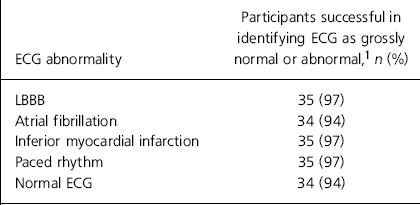
The overall response rate was 65% (n=36/55). A previous pilot at one site relying on ECG questionnaires being sent back resulted in dismal response rate of 10%. The success rates of participants being able to identify each ECG correctly as grossly normal or abnormal without having to specify the diagnosis is outlined in Table 1.
Participants’ success rates in identifying grossly normal or abnormal ECG
| ECG abnormality | Participants successful in identifying ECG as grossly normal or abnormal,1 n (%) |
|---|---|
| LBBB | 35 (97) |
| Atrial fibrillation | 34 (94) |
| Inferior myocardial infarction | 35 (97) |
| Paced rhythm | 35 (97) |
| Normal ECG | 34 (94) |
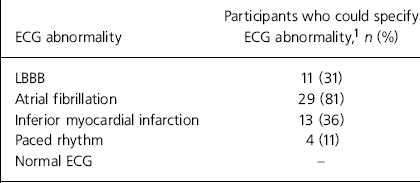
Most junior doctors were highly accurate in identifying whether an ECG was normal or abnormal, with a total average success rate of approximately 97%. The two abnormalities misinterpreted as normal were left bundle branch block and atrial fibrillation. Interpretation accuracy falls dramatically, however, if participants are judged on their ability to name the ECG abnormality precisely. Success rates for this exercise are shown in Table 2.
Participants’ success rates in identifying an ECG abnormality
| ECG abnormality | Participants who could specify ECG abnormality,1 n (%) |
|---|---|
| LBBB | 11 (31) |
| Atrial fibrillation | 29 (81) |
| Inferior myocardial infarction | 13 (36) |
| Paced rhythm | 4 (11) |
| Normal ECG | – |
Beyond the recognition of atrial fibrillation (80% success rate), doctors struggled with identifying the other abnormalities of an inferior myocardial infarction (36%), left bundle branch block (31%), and the paced rhythm (11%). However, if more approximate answers were accepted (e.g. ‘bundle branch block’ or ‘conduction abnormality’ for left bundle branch block or a more general term of ‘ischaemia’ for inferior myocardial infarction), interpretation ‘accuracy’ for inferior myocardial infarction and left bundle branch block improved to 83% (n=30/36) and 58% (n=21/36) respectively. The overall interpretation accuracy was 40%.
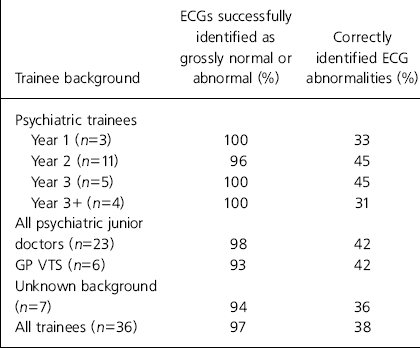
Results stratified by trainee level/background are shown in Table 3. Average accuracies for identifying ECG as grossly normal or abnormal and naming ECG abnormality correctly are shown.
Relationship between participants’ medical background and their success rates in identifying and naming ECG abnormalities
| Trainee background | ECGs successfully identified as grossly normal or abnormal (%) | Correctly identified ECG abnormalities (%) |
|---|---|---|
| Psychiatric trainees | ||
| Year 1 (n=3) | 100 | 33 |
| Year 2 (n=11) | 96 | 45 |
| Year 3 (n=5) | 100 | 45 |
| Year 3+ (n=4) | 100 | 31 |
| All psychiatric junior doctors (n=23) | 98 | 42 |
| GP VTS (n=6) | 93 | 42 |
| Unknown background (n=7) | 94 | 36 |
| All trainees (n=36) | 97 | 38 |
There were no marked differences noted when considering the effect of trainee background on interpretation accuracy. General practitioner trainees scored no better than their psychiatry colleagues at ECG interpretation and in this sample were marginally worse at identifying whether an ECG was grossly normal or abnormal.
Discussion
Overall, psychiatry junior doctors appeared reasonably competent at identifying an ECG as grossly normal or abnormal but much less accurate at making exact ECG diagnoses. Perhaps the most important skill is to know when to seek advice in situations of uncertainty. Most consultants would hope that their juniors would autonomously seek expert help when needed but it is unclear how often these subjects are explicitly discussed in supervision (Reference CottrellCottrell, 1999). Computer-generated ECG reports cannot be relied on to help as they do not appear to reduce interpretation errors in junior doctors (Reference Goodacre and WebsterGoodacre & Webster, 2001).
There is little consensus about minimum acceptable standards in ECG reporting in psychiatric trainees. The new Member of the Royal College of Psychiatrists (MRCPsych) curriculum and work-based assessments generally ignore this competency. On the face of it, these results appear fairly respectable for a cohort of psychiatry trainees. Casualty senior house officers, by comparison, are known to have high error rates when interpreting ECGs (Reference Goodacre and WebsterGoodacre & Webster, 2001). A 97% success rate is, of course, no consolation if you are the patient who has had their ECG misread. In this study, both left bundle branch block and atrial fibrillation were misinterpreted as normal on one occasion each. If, for example, arrhythmia were the acute result of a myocardial infarction or some other serious pathology, the error could be fatal.
Most patients (and consultants) would obviously hope for complete accuracy but the way to strive for and achieve this is uncertain. Many junior doctors during the study said they would welcome formal training or refresher courses in ECG reading. Such courses are available nationally but they are expensive. Moreover, their effectiveness is uncertain and there is no evidence-based minimum number of ECG interpretations that is considered ideal for maintaining interpretation skills (Reference Salerno and AlguireSalerno & Alguire, 2003). Local tutorials conducted by local cardiologists could be a good accessible starting point.
Shared care arrangements for patients are another possible solution in reducing the ‘burden’ of preserving ECG interpretation (and other medical skills) in psychiatric doctors. Primary care involvement and shared care is encouraged in National Institute for Health and Clinical Excellence guidance for the monitoring of physical health of individuals with schizophrenia. Lester (Reference Lester2005, p. 134) suggested that, ‘Clear roles and responsibilities around mental and physical healthcare within a shared care approach… might lead to better quality physical care and eventually to a reduction in morbidity and mortality rates’. An opposing view would be that this arrangement can lead to medical de-skilling of psychiatrists.
Limitations
This study has several limitations. The absolute number of respondents is low and results would have been amenable to formal statistical analysis if a larger group could have been tested. The response rate of 65% also makes a responder bias likely with the possibility of weaker trainees not returning their surveys and inflating interpretation accuracy rates. It was apparent during our survey that many psychiatric junior doctors were very nervous and reluctant to be tested on ‘rusty’ medical skills.
Despite these limitations, we have shown that psychiatry trainees appear to be reasonably competent in detecting whether an ECG is grossly abnormal, but are much less competent in specifying exact ECG diagnoses. It is likely that trainees will be exposed to more ECGs in the future as part of a greater appreciation of the need to screen for physical illnesses in our patient groups. This increasing need should be reflected in postgraduate specialty curriculums.
Declaration of interest
None.


 Open access


eLetters
No eLetters have been published for this article.