





1 Introduction
A subset of $\omega _1$
is said to be nonstationary if there exists a club
$\omega _1$
is said to be nonstationary if there exists a club $C \subseteq \omega _1$
disjoint from it. It follows that the ideal
$C \subseteq \omega _1$
disjoint from it. It follows that the ideal $\textsf {NS}_{\omega _1}$
of nonstationary subsets of
$\textsf {NS}_{\omega _1}$
of nonstationary subsets of $\omega _{1}$
is
$\omega _{1}$
is $\Sigma _1$
-definable in the parameter
$\Sigma _1$
-definable in the parameter $\omega _1$
. [Reference Hoffelner, Larson, Schindler and Wu3, Theorem 1.3] shows that in the presence of
$\omega _1$
. [Reference Hoffelner, Larson, Schindler and Wu3, Theorem 1.3] shows that in the presence of $\textsf {BPFA}$
(the Bounded Proper Forcing Axiom)
$\textsf {BPFA}$
(the Bounded Proper Forcing Axiom) $\textsf {NS}_{\omega _1}$
may also be
$\textsf {NS}_{\omega _1}$
may also be $\Pi _1$
-definable in the parameter
$\Pi _1$
-definable in the parameter $\omega _1$
. On the other hand, Martin’s Maximum and Woodin’s axiom (*) each imply that
$\omega _1$
. On the other hand, Martin’s Maximum and Woodin’s axiom (*) each imply that $\textsf {NS}_{\omega _1}$
cannot be
$\textsf {NS}_{\omega _1}$
cannot be $\Pi _1$
-definable over
$\Pi _1$
-definable over $H_{\aleph _{2}}$
in any parameter from
$H_{\aleph _{2}}$
in any parameter from $H_{\aleph _2}$
, cf. [Reference Hoffelner, Larson, Schindler and Wu3, Theorem 2.3] and [Reference Schindler and Sun11]. The current paper strengthens [Reference Hoffelner, Larson, Schindler and Wu3, Theorem 1.3] by proving the following theorem.
$H_{\aleph _2}$
, cf. [Reference Hoffelner, Larson, Schindler and Wu3, Theorem 2.3] and [Reference Schindler and Sun11]. The current paper strengthens [Reference Hoffelner, Larson, Schindler and Wu3, Theorem 1.3] by proving the following theorem.
Theorem 1.1. If there exists a supercompact cardinal, then there exists a proper forcing extension in which $\textsf {PFA}$
holds and
$\textsf {PFA}$
holds and $\textsf {NS}_{\omega _{1}}$
is
$\textsf {NS}_{\omega _{1}}$
is $\Pi _{1}$
-definable in a parameter from
$\Pi _{1}$
-definable in a parameter from $H_{\aleph _{2}}$
.
$H_{\aleph _{2}}$
.
Theorem 1.1 follows from Theorem 3.5 below. The parameter cannot be removed from Theorem 1.1, as [Reference Lücke, Schlicht and Schindler9, Corollary 4.13] shows that under PFA, $\textsf { NS}_{\omega _1}$
is not
$\textsf { NS}_{\omega _1}$
is not $\Pi _1$
-definable in the parameter
$\Pi _1$
-definable in the parameter $\omega _1$
.
$\omega _1$
.
The overall strategy of the proof is as follows. First the parameter A (a partition of $\omega _{1}$
into
$\omega _{1}$
into $\aleph _{1}$
-many pieces) is added generically by countable approximations. This is followed by a countable support iteration which interleaves a certification forcing at successor stages with the standard
$\aleph _{1}$
-many pieces) is added generically by countable approximations. This is followed by a countable support iteration which interleaves a certification forcing at successor stages with the standard $\textsf {PFA}$
iteration at limit stages (due to Baumgartner; see [Reference Foreman, Magidor and Shelah1] for the corresponding iteration for Martin’s Maximum). The entire iteration (including the first step adding A) is proper, although the tails of the iteration are only semi-proper over the nontrivial initial extensions. One potentially novel aspect of the construction is that the bookkeeping used in the certification part of the iteration is chosen with some care, in order to enable the construction of suitably generic conditions. The certification mechanism used is not tied closely to the nonstationary ideal, and could be used to code other ideals.
$\textsf {PFA}$
iteration at limit stages (due to Baumgartner; see [Reference Foreman, Magidor and Shelah1] for the corresponding iteration for Martin’s Maximum). The entire iteration (including the first step adding A) is proper, although the tails of the iteration are only semi-proper over the nontrivial initial extensions. One potentially novel aspect of the construction is that the bookkeeping used in the certification part of the iteration is chosen with some care, in order to enable the construction of suitably generic conditions. The certification mechanism used is not tied closely to the nonstationary ideal, and could be used to code other ideals.
In the model produced, $\textsf {NS}_{\omega _{1}}$
is not saturated (and in fact Canonical Function Bounding (CFB) fails, see Theorem 3.5). It remains open whether
$\textsf {NS}_{\omega _{1}}$
is not saturated (and in fact Canonical Function Bounding (CFB) fails, see Theorem 3.5). It remains open whether $\textsf {PFA}$
plus the saturation of
$\textsf {PFA}$
plus the saturation of $\textsf {NS}_{\omega _{1}}$
(or CFB) is consistent with the
$\textsf {NS}_{\omega _{1}}$
(or CFB) is consistent with the $\Pi _{1}$
-definability of
$\Pi _{1}$
-definability of $\textsf {NS}_{\omega _{1}}$
relative to a subset of
$\textsf {NS}_{\omega _{1}}$
relative to a subset of $\omega _{1}$
.
$\omega _{1}$
.
2 A coding machinery
We write $\mathrm {otp}(a)$
for the ordertype of a set a of ordinals. Given a set
$\mathrm {otp}(a)$
for the ordertype of a set a of ordinals. Given a set $A \subseteq \omega _{1}$
,
$A \subseteq \omega _{1}$
, $\tilde {A}$
(“A-tilde”) is the set of
$\tilde {A}$
(“A-tilde”) is the set of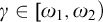 $\gamma \in [\omega _{1}, \omega _{2})$
for which there is a bijection
$\gamma \in [\omega _{1}, \omega _{2})$
for which there is a bijection $b \colon \omega _{1} \to \gamma $
such that
$b \colon \omega _{1} \to \gamma $
such that $\{ \alpha < \omega _{1} : \mathrm {otp}(b[\alpha ]) \in A\}$
contains a club (see [Reference Larson6, Reference Woodin13]).
$\{ \alpha < \omega _{1} : \mathrm {otp}(b[\alpha ]) \in A\}$
contains a club (see [Reference Larson6, Reference Woodin13]).
Let A be a subset of $\omega _{1}$
, and let
$\omega _{1}$
, and let $\gamma \geq \omega _{1}$
be an ordinal. We let
$\gamma \geq \omega _{1}$
be an ordinal. We let $Q(A,\gamma )$
denote the natural partial order to force
$Q(A,\gamma )$
denote the natural partial order to force $\gamma $
into
$\gamma $
into $\tilde {A}$
. That is, conditions in
$\tilde {A}$
. That is, conditions in $Q(A, \gamma )$
are sequences
$Q(A, \gamma )$
are sequences
 $$\begin{align*}p = \langle a_{\alpha} : \alpha \leq \zeta \rangle, \end{align*}$$
for some countable ordinal $\zeta $
, such that
$\zeta $
, such that
-
• for all $\alpha \leq \zeta $
,
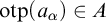
$a_{\alpha } \in [\gamma ]^\omega $
and
$\mathrm {otp}(a_{\alpha }) \in A$
,
$\alpha \leq \zeta $
,
$a_{\alpha } \in [\gamma ]^\omega $
and
$\mathrm {otp}(a_{\alpha }) \in A$
, -
•
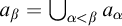
$a_{\alpha } \subsetneq a_{\beta }$
when
$\alpha < \beta \leq \zeta $
, and -
•
$a_{\beta } = \bigcup _{\alpha < \beta } a_{\alpha }$
when
$\beta \leq \zeta $
is a limit ordinal.





The order on $Q(A, \gamma )$
is defined by setting
$Q(A, \gamma )$
is defined by setting $q \leq p$
to hold if q end-extends p.
$q \leq p$
to hold if q end-extends p.
We will use partial orders of the form $Q(A, \gamma )$
only in the the case where
$Q(A, \gamma )$
only in the the case where $\gamma $
is a measurable cardinal. In doing so, we will be using the following standard fact, which appears in many places, including [Reference Larson7, Lemma 1.1.21]. We include a proof for the convenience of the reader.
$\gamma $
is a measurable cardinal. In doing so, we will be using the following standard fact, which appears in many places, including [Reference Larson7, Lemma 1.1.21]. We include a proof for the convenience of the reader.
Lemma 2.1. Suppose that $\kappa $
is a measurable cardinal,
$\kappa $
is a measurable cardinal, $\theta> 2^{\kappa }$
is a regular cardinal,
$\theta> 2^{\kappa }$
is a regular cardinal, $A \subseteq \omega _{1}$
is stationary and
$A \subseteq \omega _{1}$
is stationary and $X \prec H_{\theta }$
is countable with
$X \prec H_{\theta }$
is countable with $\kappa \in X$
. Then there exists a countable
$\kappa \in X$
. Then there exists a countable $Y \prec H_{\theta }$
such that
$Y \prec H_{\theta }$
such that
-
•
$X \subseteq Y$
, -
•
$X \cap \omega _{1} = Y \cap \omega _{1}$
, and -
•
$\mathrm {otp}(Y \cap \kappa ) \in A$
.



Proof. Let $U \in X$
be a normal measure on
$U \in X$
be a normal measure on $\kappa $
. For any countable
$\kappa $
. For any countable $Z \prec H_{\theta }$
with
$Z \prec H_{\theta }$
with $U \in Z$
, if
$U \in Z$
, if
 $$ \begin{align*} \eta \in \bigcap (U \cap Z) \end{align*} $$
and if $Z'$
is the set of values
$Z'$
is the set of values $f(\eta )$
for f a function in Z with domain
$f(\eta )$
for f a function in Z with domain $\kappa $
, then
$\kappa $
, then $Z' \prec H_{\theta }$
,
$Z' \prec H_{\theta }$
, $Z \subseteq Z'$
, and
$Z \subseteq Z'$
, and $Z' \cap \kappa $
end-extends
$Z' \cap \kappa $
end-extends $Z \cap \kappa $
, i.e.,
$Z \cap \kappa $
, i.e., $Z \cap \kappa = Z' \cap \mathrm {sup}(Z\cap \kappa )$
.
$Z \cap \kappa = Z' \cap \mathrm {sup}(Z\cap \kappa )$
.
We may then form a continuous chain $\langle X_{\alpha } \colon \alpha <\omega _1\rangle $
of countable elementary substructures of
$\langle X_{\alpha } \colon \alpha <\omega _1\rangle $
of countable elementary substructures of $H_\theta $
such that
$H_\theta $
such that $X_0 = X$
and
$X_0 = X$
and $X_{\alpha } \cap \kappa = X_{\beta } \cap \mathrm {sup}(X_{\alpha }\cap \kappa )$
for all
$X_{\alpha } \cap \kappa = X_{\beta } \cap \mathrm {sup}(X_{\alpha }\cap \kappa )$
for all $\alpha \leq \beta < \omega _{1}$
. It follows that
$\alpha \leq \beta < \omega _{1}$
. It follows that $\{ \mathrm {otp}(X_{\alpha } \cap \kappa ) : \alpha < \omega _{1}\}$
is a club subset of
$\{ \mathrm {otp}(X_{\alpha } \cap \kappa ) : \alpha < \omega _{1}\}$
is a club subset of $\omega _{1}$
. As A is stationary, there is then some
$\omega _{1}$
. As A is stationary, there is then some $\alpha <\omega _1$
such that setting
$\alpha <\omega _1$
such that setting $Y = X_{\alpha }$
, Y is as desired.
$Y = X_{\alpha }$
, Y is as desired.
Our first application of Lemma 2.1 is the following.
Lemma 2.2. Let A be a stationary subset of $\omega _{1}$
and let
$\omega _{1}$
and let $\kappa $
be a measurable cardinal. Then
$\kappa $
be a measurable cardinal. Then $Q(A, \kappa )$
is semi-proper and forces the statement “
$Q(A, \kappa )$
is semi-proper and forces the statement “ $\kappa \in \tilde {A}$
.”
$\kappa \in \tilde {A}$
.”
Proof. To see that $Q(A, \kappa )$
is semi-proper, let
$Q(A, \kappa )$
is semi-proper, let $\theta> 2^{\kappa }$
be a regular cardinal and let
$\theta> 2^{\kappa }$
be a regular cardinal and let $X \prec H_{\theta }$
be countable with
$X \prec H_{\theta }$
be countable with $A, \kappa \in X$
. Applying Lemma 2.1, let
$A, \kappa \in X$
. Applying Lemma 2.1, let $Y \prec H_{\theta }$
contain X, with
$Y \prec H_{\theta }$
contain X, with $X \cap \omega _{1} = Y \cap \omega _{1}$
, and
$X \cap \omega _{1} = Y \cap \omega _{1}$
, and $\mathrm {otp}(Y \cap \kappa ) \in A$
. Then the union of any
$\mathrm {otp}(Y \cap \kappa ) \in A$
. Then the union of any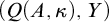 $(Q(A, \kappa ), Y)$
-generic filter is a condition in
$(Q(A, \kappa ), Y)$
-generic filter is a condition in $Q(A, \kappa )$
. That
$Q(A, \kappa )$
. That $Q(A, \kappa )$
forces
$Q(A, \kappa )$
forces $\kappa $
into
$\kappa $
into $\tilde {A}$
follows by a standard genericity argument.
$\tilde {A}$
follows by a standard genericity argument.
Let us say that ${\vec A}= \langle A_{\alpha } \colon \alpha <\omega _1 \rangle $
splits
${\vec A}= \langle A_{\alpha } \colon \alpha <\omega _1 \rangle $
splits $\omega _1$
into stationary sets if
$\omega _1$
into stationary sets if
-
• each
$A_{\alpha }$
is a stationary subset of
$\omega _1$
, -
•
$\omega _1 = \bigcup _{\alpha <\omega _1} A_\alpha $
, and -
•
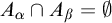
$A_\alpha \cap A_{\beta } = \emptyset $
for all
$\alpha < \beta < \omega _{1}$
.




Given such a $\vec {A}$
, and a set
$\vec {A}$
, and a set $S \subseteq \omega _{1}$
, we will write
$S \subseteq \omega _{1}$
, we will write $\vec {A}(S)$
for
$\vec {A}(S)$
for $\bigcup _{\alpha \in S}A_{\alpha }$
. Given an ordinal
$\bigcup _{\alpha \in S}A_{\alpha }$
. Given an ordinal $\gamma $
, we will say that S is certified at
$\gamma $
, we will say that S is certified at $\gamma $
(modulo
$\gamma $
(modulo ${\vec A}$
) if
${\vec A}$
) if $\gamma $
is in the tilde of
$\gamma $
is in the tilde of $\vec {A}(S)$
, i.e., if there exists a sequence
$\vec {A}(S)$
, i.e., if there exists a sequence $\langle a_{\alpha } \colon \alpha < \omega _1 \rangle $
such that
$\langle a_{\alpha } \colon \alpha < \omega _1 \rangle $
such that
-
• for all
$\alpha < \omega _{1}$
$a_{\alpha } \in [\gamma ]^\omega $
and
$\mathrm {otp}(a_{\alpha }) \in \vec {A}(S)$
, -
•
$a_{\alpha } \subsetneq a_{\beta }$
for all
$\alpha < \beta < \omega _{1}$
, -
•
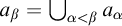
$a_{\beta } = \bigcup _{\alpha < \beta } a_{\alpha }$
when
$\beta <\omega _1$
is a limit ordinal, and -
•
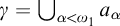
$\gamma = \bigcup _{\alpha <\omega _1} a_{\alpha }$
.






Note that if S is certified at $\gamma $
then so is every superset of S.
$\gamma $
then so is every superset of S.
Given an ordinal $\gamma $
in the interval
$\gamma $
in the interval $[\omega _{1}, \omega _{2})$
, a canonical function for
$[\omega _{1}, \omega _{2})$
, a canonical function for $\gamma $
is a function
$\gamma $
is a function $f \colon \omega _{1} \to \omega _{1}$
such that, for some bijection
$f \colon \omega _{1} \to \omega _{1}$
such that, for some bijection $\pi \colon \omega _{1} \to \gamma $
,
$\pi \colon \omega _{1} \to \gamma $
, $f(\alpha )$
is the ordertype of
$f(\alpha )$
is the ordertype of $\pi [\alpha ]$
for each
$\pi [\alpha ]$
for each $\alpha < \omega _{1}$
. Fixing such an f, and S and
$\alpha < \omega _{1}$
. Fixing such an f, and S and $\vec {A}$
as above, we say that S is coded at
$\vec {A}$
as above, we say that S is coded at $\gamma $
(modulo
$\gamma $
(modulo ${\vec A}$
) if for all
${\vec A}$
) if for all $\alpha <\omega _1$
,
$\alpha <\omega _1$
,
 $$ \begin{align*} \alpha \in S \Leftrightarrow \{ \beta <\omega_1 \colon f(\beta) \in A_\alpha \} \mbox{ is stationary.} \end{align*} $$
Since any two canonical functions for $\gamma $
agree on a club subset of
$\gamma $
agree on a club subset of $\omega _{1}$
, this definition does not depend on the choice of f.
$\omega _{1}$
, this definition does not depend on the choice of f.
Canonical Function Bounding ( $\textsf {CFB}$
) is the statement that for each function
$\textsf {CFB}$
) is the statement that for each function $f \colon \omega _{1}\to \omega _{1}$
there is a canonical function
$f \colon \omega _{1}\to \omega _{1}$
there is a canonical function $g \colon \omega _{1} \to \omega _{1}$
for some
$g \colon \omega _{1} \to \omega _{1}$
for some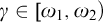 $\gamma \in [\omega _{1}, \omega _{2})$
such that the set
$\gamma \in [\omega _{1}, \omega _{2})$
such that the set $\{ \alpha <\omega _{1} : f(\alpha ) < g(\alpha )\}$
contains a club. It is a standard fact that
$\{ \alpha <\omega _{1} : f(\alpha ) < g(\alpha )\}$
contains a club. It is a standard fact that $\textsf {CFB}$
follows from the saturation
$\textsf {CFB}$
follows from the saturation $\textsf {NS}_{\omega _{1}}$
(the proof starts by noting that if
$\textsf {NS}_{\omega _{1}}$
(the proof starts by noting that if ${\textsf {NS}}_{\omega _{1}}$
is saturated, then forcing with
${\textsf {NS}}_{\omega _{1}}$
is saturated, then forcing with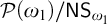 $\mathcal {P}(\omega _{1})/{\textsf {NS}_{\omega _{1}}}$
cannot collapse
$\mathcal {P}(\omega _{1})/{\textsf {NS}_{\omega _{1}}}$
cannot collapse $\omega _{2}$
, which means that the identity function on
$\omega _{2}$
, which means that the identity function on $\omega _{1}$
must represent
$\omega _{1}$
must represent $\omega _{2}^{V}$
in any induced generic ultrapower).
$\omega _{2}^{V}$
in any induced generic ultrapower).
Lemma 2.3. Suppose that $\vec {A}= \langle A_{\alpha } : \alpha < \omega _{1} \rangle $
splits
$\vec {A}= \langle A_{\alpha } : \alpha < \omega _{1} \rangle $
splits $\omega _{1}$
into stationary sets, and that
$\omega _{1}$
into stationary sets, and that $S \subseteq \omega _{1}$
is nonempty. Let
$S \subseteq \omega _{1}$
is nonempty. Let $\kappa $
be a measurable cardinal. Suppose that
$\kappa $
be a measurable cardinal. Suppose that $\vec {a} = \langle a_\alpha \colon \alpha <\omega _1 \rangle $
is
$\vec {a} = \langle a_\alpha \colon \alpha <\omega _1 \rangle $
is $Q(\vec {A}(S), \kappa )$
-generic over V. Then, in
$Q(\vec {A}(S), \kappa )$
-generic over V. Then, in $V[\vec {a}]$
,
$V[\vec {a}]$
,
-
1. S is certified at
$\kappa $
modulo
$\vec {A}$
, and -
2. S is coded at
$\kappa $
, modulo
$\vec {A}$
.


Proof. The first part of the lemma follows from the second part of Lemma 2.2. The second follows similarly, by a genericity argument, as follows. The function $f \colon \omega _{1} \to \omega _{1}$
defined by letting
$f \colon \omega _{1} \to \omega _{1}$
defined by letting $f(\beta )$
be
$f(\beta )$
be $\mathrm {otp}(a_{\beta })$
is a canonical function for
$\mathrm {otp}(a_{\beta })$
is a canonical function for $\kappa $
. If
$\kappa $
. If $\alpha \in \omega _{1} \setminus S$
, then
$\alpha \in \omega _{1} \setminus S$
, then $\{ \beta <\omega _1 \colon \mathrm {otp}(a_{\beta }) \in A_\alpha \} = \emptyset $
. We thus only need to see that if
$\{ \beta <\omega _1 \colon \mathrm {otp}(a_{\beta }) \in A_\alpha \} = \emptyset $
. We thus only need to see that if $\alpha \in S$
, then
$\alpha \in S$
, then $\{ \beta <\omega _1 \colon \mathrm {otp}(a_{\beta }) \in A_\alpha \}$
is stationary in
$\{ \beta <\omega _1 \colon \mathrm {otp}(a_{\beta }) \in A_\alpha \}$
is stationary in $V[g]$
.
$V[g]$
.
Let $p \in {\mathbb P}$
and
$p \in {\mathbb P}$
and ${\dot C} \in V^{\mathbb P}$
be such that
${\dot C} \in V^{\mathbb P}$
be such that $p \Vdash {\dot C}$
is a club subset of
$p \Vdash {\dot C}$
is a club subset of $\omega _1$
. Let
$\omega _1$
. Let $\theta> 2^{\kappa }$
be a regular cardinal and let X be a countable elementary submodel of
$\theta> 2^{\kappa }$
be a regular cardinal and let X be a countable elementary submodel of $H(\theta )$
with p and
$H(\theta )$
with p and $\dot {C}$
as members. Applying Lemma 2.1, let
$\dot {C}$
as members. Applying Lemma 2.1, let $Y \prec H_{\theta }$
contain X, with
$Y \prec H_{\theta }$
contain X, with $X \cap \omega _{1} = Y \cap \omega _{1}$
, and
$X \cap \omega _{1} = Y \cap \omega _{1}$
, and $\mathrm {otp}(Y \cap \kappa ) \in A_{\alpha }$
. Then the union of any
$\mathrm {otp}(Y \cap \kappa ) \in A_{\alpha }$
. Then the union of any $(Q(\vec {A}(S), \kappa ), Y)$
-generic filter is a condition in
$(Q(\vec {A}(S), \kappa ), Y)$
-generic filter is a condition in $Q(\vec {A}(S), \kappa )$
forcing that
$Q(\vec {A}(S), \kappa )$
forcing that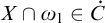 $X \cap \omega _{1} \in \dot {C}$
and
$X \cap \omega _{1} \in \dot {C}$
and $a_{X \cap \omega _{1}} = Y \cap \kappa $
, so
$a_{X \cap \omega _{1}} = Y \cap \kappa $
, so $\mathrm {otp}(a_{X \cap \omega _{1}}) \in A_{\alpha }$
.
$\mathrm {otp}(a_{X \cap \omega _{1}}) \in A_{\alpha }$
.
Note that being certified via $\vec {A}$
at a given ordinal is
$\vec {A}$
at a given ordinal is $\Sigma _1$
in
$\Sigma _1$
in $\omega _{1}$
, so absolute to outer models. The property of being coded modulo
$\omega _{1}$
, so absolute to outer models. The property of being coded modulo $\vec {A}$
is
$\vec {A}$
is $\Sigma _1$
in
$\Sigma _1$
in $\textsf { NS}_{\omega _{1}}$
and
$\textsf { NS}_{\omega _{1}}$
and $\vec {A}$
, and therefore absolute to models preserving stationary subsets of
$\vec {A}$
, and therefore absolute to models preserving stationary subsets of $\omega _{1}$
.
$\omega _{1}$
.
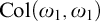
In what follows, we write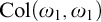 $\mathrm {Col}(\omega _1,\omega _1)$
for the partial order consisting of all functions
$\mathrm {Col}(\omega _1,\omega _1)$
for the partial order consisting of all functions $p \colon \zeta \rightarrow \omega _1$
, for some countable ordinal
$p \colon \zeta \rightarrow \omega _1$
, for some countable ordinal $\zeta $
, ordered by end-extension. If g is
$\zeta $
, ordered by end-extension. If g is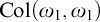 $\mathrm {Col}(\omega _1,\omega _1)$
-generic over V, then we confuse g with
$\mathrm {Col}(\omega _1,\omega _1)$
-generic over V, then we confuse g with $\bigcup g$
, a function from
$\bigcup g$
, a function from $\omega _1$
to
$\omega _1$
to $\omega _1$
, and also write it as g.
$\omega _1$
, and also write it as g.
Given a function $g \colon \omega _{1} \to \omega _{1}$
, we let the partition of
$g \colon \omega _{1} \to \omega _{1}$
, we let the partition of $\omega _{1}$
induced by g be the sequence
$\omega _{1}$
induced by g be the sequence $\langle A_{\alpha } : \alpha < \omega \rangle $
such that each
$\langle A_{\alpha } : \alpha < \omega \rangle $
such that each $A_{\alpha }$
is the set
$A_{\alpha }$
is the set $\{ \beta < \omega _{1} : g(\beta )= \alpha \}$
. The proof of the following standard fact is elementary.
$\{ \beta < \omega _{1} : g(\beta )= \alpha \}$
. The proof of the following standard fact is elementary.
Lemma 2.4. If $g \colon \omega _1 \to \omega _1$
is
$g \colon \omega _1 \to \omega _1$
is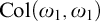 $\mathrm {Col}(\omega _1,\omega _1)$
-generic over V then in
$\mathrm {Col}(\omega _1,\omega _1)$
-generic over V then in $V[g]$
the partition of
$V[g]$
the partition of $\omega _{1}$
induced by g splits
$\omega _{1}$
induced by g splits $\omega _1$
into stationary sets.
$\omega _1$
into stationary sets.
In the rest of the paper we will write $P(S, \gamma , g)$
for the partial order
$P(S, \gamma , g)$
for the partial order $Q(\vec {A}(S), \gamma )$
, where S is a subset of
$Q(\vec {A}(S), \gamma )$
, where S is a subset of $\omega _{1}$
,
$\omega _{1}$
, $\gamma \geq \omega _{1}$
is an ordinal, and
$\gamma \geq \omega _{1}$
is an ordinal, and $\vec {A}$
is the partition of
$\vec {A}$
is the partition of $\omega _{1}$
induced by g.
$\omega _{1}$
induced by g.
3 The forcing iteration
We are now ready to define our forcing iteration. In order to facilitate the discussion, let us introduce an ad hoc term for the kind of iterations which we will be interested in.
Definition 3.1. Let $\langle {\mathbb P}_\eta , {\dot {\mathbb Q}}_\xi \colon \eta \leq \delta , \xi < \delta \rangle $
be a countable support iteration of forcings. We call this iteration appropriate if
$\langle {\mathbb P}_\eta , {\dot {\mathbb Q}}_\xi \colon \eta \leq \delta , \xi < \delta \rangle $
be a countable support iteration of forcings. We call this iteration appropriate if ${\mathbb P}_0 = \mathrm {Col}(\omega _1,\omega _1)$
and there exists a sequence
${\mathbb P}_0 = \mathrm {Col}(\omega _1,\omega _1)$
and there exists a sequence
 $$\begin{align*}\langle \dot{S}_{\xi}, \alpha_{\xi}, \kappa_{\xi} : \xi < \delta \rangle\end{align*}$$
such that, for all $\xi> 0$
, either
$\xi> 0$
, either
-
1.
$\dot {\mathbb Q}_\xi $
is a
$\mathbb {P}_{\xi }$
-name for a proper forcing or -
2.
$\dot {S}_{\xi }$
is a
$\mathbb {P}_{\xi }$
-name for a stationary subset of
$\omega _{1}$
with
$\alpha _{\xi }$
as a member,
$\kappa _{\xi }$
is a measurable cardinal greater than
$|\mathbb {P}_{\xi }|$
and, letting
$\dot {g}_{0}$
be a
$\mathbb {P}_{0}$
-name for the generic function from
$\omega _{1}$
to
$\omega _{1}$
added by
$\mathbb {P}_{0}$
,
$\Vdash _{{\mathbb P}_\xi } {\dot {\mathbb Q}}_\xi = P(\dot {S}_{\xi },\check {\kappa }_{\xi }, \dot {g}_0).$



In what follows we let $\dot {g}_{\xi }$
(for some ordinal
$\dot {g}_{\xi }$
(for some ordinal $\xi $
, relative to an appropriate iteration) denote the canonical name for the generic filter for
$\xi $
, relative to an appropriate iteration) denote the canonical name for the generic filter for $\mathbb {P}_{\xi }$
, and when talking of a particular generic filter
$\mathbb {P}_{\xi }$
, and when talking of a particular generic filter $g \subseteq \mathbb {P}_{\delta }$
, let
$g \subseteq \mathbb {P}_{\delta }$
, let $g_{\xi }$
denote the restriction of g to
$g_{\xi }$
denote the restriction of g to $\mathbb {P}_{\xi }$
.
$\mathbb {P}_{\xi }$
.
Lemma 3.2. Let $\bar {\mathbb {P}}= \langle {\mathbb P}_\eta , {\dot {\mathbb Q}}_\xi \colon \eta \leq \delta , \xi < \delta \rangle $
be an appropriate iteration, as witnessed by
$\bar {\mathbb {P}}= \langle {\mathbb P}_\eta , {\dot {\mathbb Q}}_\xi \colon \eta \leq \delta , \xi < \delta \rangle $
be an appropriate iteration, as witnessed by $W = \langle \dot {S}_{\xi }, \alpha _{\xi }, \kappa _{\xi } : \xi < delta \rangle $
. Let
$W = \langle \dot {S}_{\xi }, \alpha _{\xi }, \kappa _{\xi } : \xi < delta \rangle $
. Let $\rho < \delta $
be nonzero, let
$\rho < \delta $
be nonzero, let $\theta> 2^{|\mathbb {P}|}$
be a regular cardinal and let X be a countable elementary substructure of
$\theta> 2^{|\mathbb {P}|}$
be a regular cardinal and let X be a countable elementary substructure of $H_\theta $
with
$H_\theta $
with $\bar {\mathbb {P}}$
, W and
$\bar {\mathbb {P}}$
, W and $\rho $
in X. Suppose that q,
$\rho $
in X. Suppose that q, ${\dot p}$
are such that
${\dot p}$
are such that
-
1.
$q \in {\mathbb P}_\rho $
is
$(X,{\mathbb P}_\rho )$
-generic, -
2. for each
$\xi \in X \cap \delta $
,
$q(0)(\mathrm {otp}(X \cap \kappa _{\xi })) = \alpha _{\xi }$
, -
3.
${\dot p} \in V^{{\mathbb P}_\rho }$
, and -
4.
$q \Vdash _{{\mathbb P}_\rho } {\dot p} \in {\mathbb P}_\delta \cap X \wedge {\dot p} \upharpoonright \rho \in {\dot G}_\rho $
.





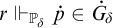
Then there is a condition $r \in \mathbb {P}_{\delta }$
such that
$r \in \mathbb {P}_{\delta }$
such that
-
• r is
$(X,{\mathbb P}_\delta )$
-generic, -
•
$r \upharpoonright \rho = q$
, and -
•
$r \Vdash _{{\mathbb P}_\delta } {\dot p} \in {\dot G}_\delta $
.


Proof. The proof is by induction on $\delta $
. If
$\delta $
. If $\delta $
is a limit ordinal, then this is by the usual proper forcing argument, see e.g., the proof of [Reference Jech4, Lemma 31.17]. If
$\delta $
is a limit ordinal, then this is by the usual proper forcing argument, see e.g., the proof of [Reference Jech4, Lemma 31.17]. If $\delta $
is a successor, then we may assume that
$\delta $
is a successor, then we may assume that $\delta =\rho +1$
. If
$\delta =\rho +1$
. If $\Vdash _{{\mathbb P}_\rho } {\dot {\mathbb Q}}_\rho $
is proper, then this is again by the usual proper forcing argument, see e.g., [Reference Jech4, Lemma 31.18]. Let us thus assume that
$\Vdash _{{\mathbb P}_\rho } {\dot {\mathbb Q}}_\rho $
is proper, then this is again by the usual proper forcing argument, see e.g., [Reference Jech4, Lemma 31.18]. Let us thus assume that $\dot {S}_{\rho }$
,
$\dot {S}_{\rho }$
, $\alpha _{\rho }$
and
$\alpha _{\rho }$
and $\kappa _{\rho }$
are as in the second case of Definition 3.1.
$\kappa _{\rho }$
are as in the second case of Definition 3.1.
Suppose now that $g_{\rho }$
is
$g_{\rho }$
is ${\mathbb P}_{\rho }$
-generic over V with
${\mathbb P}_{\rho }$
-generic over V with $q \in g_{\rho }$
. We have that
$q \in g_{\rho }$
. We have that
-
•
${\dot {\mathbb Q}}_{\rho , g_{\rho }}= P(\dot {S}_{\rho , g_{\rho }}, \kappa _{\alpha }, g_0)$
; -
•
$\dot {S}_{\rho , g_{\rho }}$
is in
$X[g_{\rho }]$
and stationary in
$V[g_{\rho }]$
; -
•
$\kappa _{\rho }$
is in X and measurable in
$V[g_{\rho }]$
; -
•
$g_0(\mathrm {otp}(X \cap \kappa _{\rho })) = \alpha _{\rho }$
and
$\alpha _{\rho } \in \dot {S}_{\rho , g_{\rho }}$
; -
•
${\dot p}_g \in X[g_{\rho }]$
.






We may then produce in a standard fashion, in much the same way as in the proof of Lemma 2.2, some $s \in P(\dot {S}_{\rho , g_{\rho }}, \kappa _{\rho }, g_0)$
such that
$s \in P(\dot {S}_{\rho , g_{\rho }}, \kappa _{\rho }, g_0)$
such that
-
•
$s <_{P(\dot {S}_{\rho , g_{\rho }}, \kappa _{\rho }, g_0)} {\dot p}_{g_{\rho }}(\rho )$
, -
•
$\mathrm {dom}(s) = (X \cap \omega _1) +1= (X[g] \cap \omega _1) +1$
, -
• for each
$D \in X[g_{\rho }]$
which is dense in
$P(\dot {S}_{\rho , g_{\rho }}, \kappa _{\rho }, g_0)$
there is some with
$$\begin{align*}{\bar s}>_{P(\dot{S}_{\rho, g_{\rho}}, \kappa_{\rho}, g_0)} s\end{align*}$$
${\bar s} \in D \cap X[g]$
, and
-
•
$s(X \cap \omega _1)=X \cap \kappa _{\rho }$
.






In particular, s is $(X[g_{\rho }],P(\dot {S}_{\rho , g_{\rho }}, \kappa _{\rho }, g_0))$
-generic.
$(X[g_{\rho }],P(\dot {S}_{\rho , g_{\rho }}, \kappa _{\rho }, g_0))$
-generic.
By fullness, there is then some ${\mathbb P}_\rho $
-name
${\mathbb P}_\rho $
-name ${\dot s}$
such that q forces that
${\dot s}$
such that q forces that ${\dot s} \in {\dot {\mathbb Q}}_{\rho }$
is
${\dot s} \in {\dot {\mathbb Q}}_{\rho }$
is $(X[{\dot g}_{\rho }],{\dot {\mathbb Q}}_{\rho })$
-generic and
$(X[{\dot g}_{\rho }],{\dot {\mathbb Q}}_{\rho })$
-generic and ${\dot s} <_{\mathbb {Q}_{\rho }} {\dot p}(\rho )$
. It follows that
${\dot s} <_{\mathbb {Q}_{\rho }} {\dot p}(\rho )$
. It follows that $r = q^{\frown } {\dot s}$
is as desired.
$r = q^{\frown } {\dot s}$
is as desired.
Lemma 3.2 (plus the ability to choose $(X, \mathbb {P}_{0})$
-generic q satisfying the hypothesis of the lemma in case
$(X, \mathbb {P}_{0})$
-generic q satisfying the hypothesis of the lemma in case $\rho = 0$
with respect to any given
$\rho = 0$
with respect to any given $\dot {p}$
) gives the following.
$\dot {p}$
) gives the following.
Theorem 3.3. If $\langle {\mathbb P}_\eta , {\dot {\mathbb Q}}_\xi \colon \eta \leq \delta ,\, \xi < \delta \rangle $
is an appropriate iteration then for every
$\langle {\mathbb P}_\eta , {\dot {\mathbb Q}}_\xi \colon \eta \leq \delta ,\, \xi < \delta \rangle $
is an appropriate iteration then for every $\eta \leq \delta $
,
$\eta \leq \delta $
, ${\mathbb P}_\eta $
is proper.
${\mathbb P}_\eta $
is proper.
Remark 3.4. Since appropriate iterations are proper, they preserve the property of having uncountable cofinality. It follows that the tails of appropriate iterations also preserve uncountable cofinality. Each iterand in an appropriate iteration is semi proper (this follows from Lemma 2.2 in the second case). A Revised Countable Support (RCS) iteration of semi-proper forcings is semi-proper [Reference Fuchs2, Reference Miyamoto10, Reference Shelah12]. However, an RCS iteration of partial orders is equivalent to the corresponding countable support iteration if it preserves uncountable cofinalities. It follows then that the tails of appropriate iterations are semi-proper, and in particular preserve stationary subsets of $\omega _{1}$
.
$\omega _{1}$
.
To complete the proof of the main theorem, suppose that $\delta $
is a supercompact cardinal. By a Laver function for
$\delta $
is a supercompact cardinal. By a Laver function for $\delta $
we mean some
$\delta $
we mean some $R \colon \delta \rightarrow V_\delta $
such that for all
$R \colon \delta \rightarrow V_\delta $
such that for all $X \in V$
there are
$X \in V$
there are ${\bar \delta } < {\bar \theta } < \delta $
and
${\bar \delta } < {\bar \theta } < \delta $
and $\theta> \delta $
together with an elementary embedding
$\theta> \delta $
together with an elementary embedding
 $$ \begin{align*} j \colon H_{\bar \theta} \rightarrow H_\theta \end{align*} $$
such that
-
•
$\mathrm {crit}(j) = {\bar \delta }$
, -
•
$j({\bar \delta }) = \delta $
, -
•
$X \in H_\theta $
, and -
•
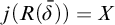
$j(R({\bar \delta })) = X$
.


As every supercompact cardinal has a Laver function [Reference Laver8], we fix a Laver function R for $\delta $
. We also fix a function
$\delta $
. We also fix a function $\pi \colon \delta \to \delta \times \omega _{1}$
, with component functions
$\pi \colon \delta \to \delta \times \omega _{1}$
, with component functions $\pi _{0}$
and
$\pi _{0}$
and $\pi _{1}$
, such that
$\pi _{1}$
, such that
-
•
$\pi _{0}(\xi ) \leq \xi $
for all
$\xi < \delta $
, and -
• for each pair
$(\eta , \alpha ) \in \delta \times \omega _{1}$
,
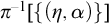
$\pi ^{-1}[\{ (\eta , \alpha )\}]$
contains
$\delta $
many successor ordinals.




We then define an appropriate iteration
 $$\begin{align*}\langle {\mathbb P}_\eta , {\dot {\mathbb Q}}_\xi \colon \eta \leq \delta , \xi < \delta\rangle \end{align*}$$
of length $\delta +1$
having properties (1)–(3) below. In doing so we fix for each
$\delta +1$
having properties (1)–(3) below. In doing so we fix for each $\eta < \delta $
a wellordering
$\eta < \delta $
a wellordering $\leq _{\eta }$
of the set
$\leq _{\eta }$
of the set $N_{\eta }$
consisting of the nice
$N_{\eta }$
consisting of the nice $\mathbb {P}_{\eta }$
-names for stationary subsets of
$\mathbb {P}_{\eta }$
-names for stationary subsets of $\omega _{1}$
(nice in the sense of [Reference Kunen5]; there will be less than
$\omega _{1}$
(nice in the sense of [Reference Kunen5]; there will be less than $\delta $
-many such names, and each stationary subset of
$\delta $
-many such names, and each stationary subset of $\omega _{1}$
in the
$\omega _{1}$
in the $\mathbb {P}_{\eta }$
-extension will be the corresponding realization of one of them). Given
$\mathbb {P}_{\eta }$
-extension will be the corresponding realization of one of them). Given $(\eta , \alpha ) \in \delta \times \omega _{1}$
, let
$(\eta , \alpha ) \in \delta \times \omega _{1}$
, let $N_{\eta , \alpha }$
be the set of
$N_{\eta , \alpha }$
be the set of $\dot {S} \in N_{\eta }$
such that
$\dot {S} \in N_{\eta }$
such that $\Vdash _{\mathbb {P}_{\eta }} \check {\alpha } \in \dot {S}$
. Note then that if
$\Vdash _{\mathbb {P}_{\eta }} \check {\alpha } \in \dot {S}$
. Note then that if $g_{\eta }$
is V-generic for
$g_{\eta }$
is V-generic for $\mathbb {P}_{\eta }$
,
$\mathbb {P}_{\eta }$
, $S \in V[g_{\eta }]$
is a stationary subset of
$S \in V[g_{\eta }]$
is a stationary subset of $\omega _{1}$
and
$\omega _{1}$
and $\alpha \in S$
, then S is the realization via
$\alpha \in S$
, then S is the realization via $g_{\eta }$
of some element of
$g_{\eta }$
of some element of $N_{\eta , \alpha }$
.
$N_{\eta , \alpha }$
.
Now we fix the following iteration.
-
1. We let
${\mathbb P}_0$
be
$\mathrm {Col}(\omega _1,\omega _1)$
; -
2. If
$\xi \in (0, \delta )$
is a limit ordinal, then
${\dot {\mathbb Q}}_\xi = R(\xi )$
, provided that
$\Vdash _{{\mathbb P}_\xi } "R(\xi )$
is a proper forcing”;
${\dot {\mathbb Q}}_\xi $
is trivial otherwise; -
3. If
$\xi < \delta $
is a successor ordinal, and
$\kappa $
is the least measurable cardinal strictly above
$|{\mathbb P}_\xi |$
, then
${\dot {\mathbb Q}}_\xi = P(\dot {S}, \check {\kappa }, \dot {g}_{0})$
and
$\dot {S}$
is the
$\leq _{\pi _{0}(\xi )}$
-least
$\mathbb {P}_{\pi _{0}(\xi )}$
-name such that-
•
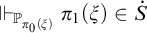
$\Vdash _{\mathbb {P}_{\pi _{0}(\xi )}} \pi _{1}(\xi ) \in \dot {S}$
and -
• the realization of
$\dot {S}$
by
$g_{\pi _{0}(\xi )}$
is stationary and not certified at any member of
$\omega _{2}^{V[g_{\xi }]}$
via the partition of
$\omega _{1}$
induced by the realization of
$\dot {g}_{0}$
,
if such a
$\dot {S}$
exists; otherwise we let
$\dot {S}$
be
$\check {\omega }_{1}$
. -








Note then that this iteration is appropriate, with each $\kappa _{\xi }$
being the least measurable cardinal above
$\kappa _{\xi }$
being the least measurable cardinal above $|\mathbb {P}_{\xi }|$
, each
$|\mathbb {P}_{\xi }|$
, each $\alpha _{\xi }$
being
$\alpha _{\xi }$
being $\pi _{1}(\xi )$
and each
$\pi _{1}(\xi )$
and each $\dot {S}_{\xi }$
being a name built from the two possibilities above for
$\dot {S}_{\xi }$
being a name built from the two possibilities above for $\dot {S}$
for successor
$\dot {S}$
for successor $\xi $
(and
$\xi $
(and $\check {\omega }_{1}$
when
$\check {\omega }_{1}$
when $\xi $
is
$\xi $
is $0$
or a limit ordinal).
$0$
or a limit ordinal).
Theorem 1.1 then follows from the following theorem.
Theorem 3.5. Let $\langle {\mathbb P}_\eta , {\dot {\mathbb Q}}_\xi \colon \eta \leq \delta ,\, \xi < \delta \rangle $
be the iteration defined above, let g be
$\langle {\mathbb P}_\eta , {\dot {\mathbb Q}}_\xi \colon \eta \leq \delta ,\, \xi < \delta \rangle $
be the iteration defined above, let g be ${\mathbb P}_\delta $
-generic over V, and let
${\mathbb P}_\delta $
-generic over V, and let $\vec {A}$
be the partition of
$\vec {A}$
be the partition of $\omega _{1}$
induced by
$\omega _{1}$
induced by $g(0)$
. Then the following hold in
$g(0)$
. Then the following hold in $V[g]$
.
$V[g]$
.
-
1. For all
$S \subseteq \omega _1$
and
$\gamma < \delta $
, S is certified at
$\gamma $
modulo
$\vec {A}$
if and only if there is a successor
$\xi < \delta $
such that
$\dot {S}_{\xi , g_{\xi }} \subseteq S$
and
$\gamma = \kappa _{\xi }$
, -
2. For all
$S \subseteq \omega _{1}$
, S is stationary if and only if there is a
$\gamma < \delta $
such that S is certified at
$\gamma $
modulo
$\vec {A}$
, -
3.
$\textsf {PFA} + \neg \textsf {CFB}$
$+$
“
$\textsf {NS}_{\omega _1}$
is
$\Pi _1$
-definable in a parameter from
$H_{\aleph _{2}}$
.”





Proof. The reverse direction of part (1) follows from Lemma 2.2, and the fact that being certified at some $\gamma $
modulo some
$\gamma $
modulo some $\vec {A}$
is upwards absolute. For the forward direction of (1), fix
$\vec {A}$
is upwards absolute. For the forward direction of (1), fix
-
• a
$\mathbb {P}_{\delta }$
-name
$\dot {S}$
for a subset of
$\omega _{1}$
, -
•
$\gamma < \delta $
, -
• a condition
$p \in \mathbb {P}_{\delta }$
forcing that there does not exist a successor
$\xi < \delta $
such that
$\dot {S}_{\xi } \subseteq \dot {S}$
and
$\gamma = k_{\xi }$
, -
• a
$\mathbb {P}_{\delta }$
-name
$\dot {C}$
for a club subset of
$\omega _{1}$
, and -
• a
$\mathbb {P}_{\delta }$
-name
$\dot {b}$
for a bijection between
$\omega _{1}$
and
$\gamma $
.


We will show that p forces that the realization of $\dot {S}$
is not certified at
$\dot {S}$
is not certified at $\gamma $
modulo
$\gamma $
modulo $\vec {A}$
. Let
$\vec {A}$
. Let $\theta $
be a regular cardinal greater than
$\theta $
be a regular cardinal greater than $2^{|\mathbb {P}_{\delta }|}$
and let X be a countable elementary submodel of
$2^{|\mathbb {P}_{\delta }|}$
and let X be a countable elementary submodel of $H_{\theta }$
with all the objects named above in X. Every
$H_{\theta }$
with all the objects named above in X. Every $(X, \mathbb {P}_{\delta })$
-generic condition forces that
$(X, \mathbb {P}_{\delta })$
-generic condition forces that $\omega _{1} \cap X$
is in
$\omega _{1} \cap X$
is in $\dot {C}$
and
$\dot {C}$
and $\dot {b}[\omega _{1} \cap X] = X \cap \gamma $
. It suffices to find, under the assumption that either (Case 1)
$\dot {b}[\omega _{1} \cap X] = X \cap \gamma $
. It suffices to find, under the assumption that either (Case 1) $\gamma $
is not equal to any
$\gamma $
is not equal to any $\kappa _{\xi }$
and p forces some
$\kappa _{\xi }$
and p forces some $\beta $
not to be in
$\beta $
not to be in $\dot {S}$
or (Case 2)
$\dot {S}$
or (Case 2) $\gamma $
is equal to some
$\gamma $
is equal to some $\kappa _{\xi }$
and p forces some
$\kappa _{\xi }$
and p forces some $\beta $
to be in
$\beta $
to be in $\dot {S}_{\xi }\setminus \dot {S}$
, an
$\dot {S}_{\xi }\setminus \dot {S}$
, an $(X, \mathbb {P}_{\delta })$
-generic condition
$(X, \mathbb {P}_{\delta })$
-generic condition $r \leq p$
forcing that
$r \leq p$
forcing that $g(0)(\mathrm {otp}(X \cap \gamma )) \not \in \dot {S}$
. Since the proofs of the two cases are similar we do them simultaneously.
$g(0)(\mathrm {otp}(X \cap \gamma )) \not \in \dot {S}$
. Since the proofs of the two cases are similar we do them simultaneously.
Fix $q <_{{\mathbb P}_0} p(0)$
such that
$q <_{{\mathbb P}_0} p(0)$
such that
-
1. q is
$(X,{\mathbb P}_0)$
-generic, -
2.
$\mathrm {dom}(q) = \mathrm {otp}(X \cap \delta )$
, -
3. for each
$\xi \in X \cap \delta $
, if
$\kappa _{\xi } \neq \gamma $
then
$q(\mathrm {otp}(X \cap \kappa _{\xi })) = \alpha _{\xi }$
, and -
4.
$q(\mathrm {otp}(X \cap \gamma ))=\beta $
.






Construing p as $(p(0), \dot {p})$
, we have that hypotheses (1) through (4) of Lemma 3.2 are satisfied. Then any r as given by the conclusion of Lemma 3.2 is as desired.
$(p(0), \dot {p})$
, we have that hypotheses (1) through (4) of Lemma 3.2 are satisfied. Then any r as given by the conclusion of Lemma 3.2 is as desired.
The reverse direction of part (2) follows from part (1) and the construction, and the fact that the tails of the iteration are semi-proper (see Remark 3.4). The forward direction is by our bookkeeping. For each stationary $S \subseteq \omega _{1}$
in
$S \subseteq \omega _{1}$
in $V[g]$
there exist
$V[g]$
there exist $\eta _{*} < \delta $
and
$\eta _{*} < \delta $
and $\alpha _{*} < \omega _{1}$
(any member of S) such that S is the
$\alpha _{*} < \omega _{1}$
(any member of S) such that S is the $g_{\eta _{*}}$
-realization of some element
$g_{\eta _{*}}$
-realization of some element $\dot {S}$
of
$\dot {S}$
of $N_{\eta _{*}, \alpha _{*}}$
. Working by induction, it suffices to suppose that the realization of each member of
$N_{\eta _{*}, \alpha _{*}}$
. Working by induction, it suffices to suppose that the realization of each member of $N_{\eta _{*}, \alpha _{*}}$
which is
$N_{\eta _{*}, \alpha _{*}}$
which is $\leq _{\eta _{*}}$
-below
$\leq _{\eta _{*}}$
-below $\dot {S}$
is certified in
$\dot {S}$
is certified in $V[g]$
. We may then let
$V[g]$
. We may then let $\rho \in [\xi _{*}, \delta )$
be such that all of these certifying sets exist in
$\rho \in [\xi _{*}, \delta )$
be such that all of these certifying sets exist in $V[g \upharpoonright \mathbb {P}_{\rho }]$
. For cofinally many successor ordinals
$V[g \upharpoonright \mathbb {P}_{\rho }]$
. For cofinally many successor ordinals $\xi < \delta $
,
$\xi < \delta $
, $\pi (\xi ) = (\eta _{*}, \alpha _{*})$
. For any such
$\pi (\xi ) = (\eta _{*}, \alpha _{*})$
. For any such $\xi \geq \rho $
, we have by Lemma 2.3 that S is certified at
$\xi \geq \rho $
, we have by Lemma 2.3 that S is certified at $\kappa _{\xi }$
in
$\kappa _{\xi }$
in $V[g \upharpoonright (\xi + 1)]$
.
$V[g \upharpoonright (\xi + 1)]$
.
For part (3), that $V[g]$
is a model of
$V[g]$
is a model of $\textsf {PFA}$
follows by the standard consistency proof for
$\textsf {PFA}$
follows by the standard consistency proof for $\textsf {PFA}$
. The boldface
$\textsf {PFA}$
. The boldface $\Pi _1^{H_{\aleph _2}}$
-definability of
$\Pi _1^{H_{\aleph _2}}$
-definability of $\textsf {NS}_{\omega _1}$
in
$\textsf {NS}_{\omega _1}$
in $V[g]$
follows from (2), the parameter being
$V[g]$
follows from (2), the parameter being $g(0)$
(or the partition of
$g(0)$
(or the partition of $\omega _{1}$
induced by
$\omega _{1}$
induced by $g(0)$
). The failure of
$g(0)$
). The failure of $\textsf {CFB}$
(in particular, the fact that
$\textsf {CFB}$
(in particular, the fact that $g(0)$
is not bounded by a canonical function in
$g(0)$
is not bounded by a canonical function in $V[g]$
) follows by adding
$V[g]$
) follows by adding $q(X \cap \omega _{1})> \mathrm {otp}(X \cap \delta )$
to the argument for the forward direction of (1). To avoid contradicting item 4 from that argument, note that we may assume that
$q(X \cap \omega _{1})> \mathrm {otp}(X \cap \delta )$
to the argument for the forward direction of (1). To avoid contradicting item 4 from that argument, note that we may assume that $\gamma> \omega _{1}$
there, since only club subsets of
$\gamma> \omega _{1}$
there, since only club subsets of $\omega _{1}$
have
$\omega _{1}$
have $\omega _{1}$
in their tildes.
$\omega _{1}$
in their tildes.
As noted in the introduction, the argument provided here isn’t tied to the nonstationary ideal. We could code any subset of ${\mathcal P}(\omega _1)$
in the fashion above, as long as the subset is closed under supersets and has a definition which is absolute to extensions preserving stationary subsets of
${\mathcal P}(\omega _1)$
in the fashion above, as long as the subset is closed under supersets and has a definition which is absolute to extensions preserving stationary subsets of $\omega _{1}$
.
$\omega _{1}$
.
Funding
The research of the first author was funded in part by the Austrian Science Fund (FWF) Grant-DOI 10.55776/P37228. The first and third authors were funded by the Deutsche Forschungsgemeinschaft (DFG, German Research Foundation) under Germany’s Excellence Strategy EXC 2044 390685587, Mathematics Münster: Dynamics–Geometry–Structure. The third author is also funded by the DFG grant SCHI 484/10-1.The fourth author is supported by NSFC No.12371002.


 Open access

