


Introduction
Strategic change involves activities by firms to redefine their strategic courses and act upon those new directions (Acciarini, Boccardelli & Peruffo, Reference Acciarini, Boccardelli and Peruffo2024; Helfat & Martin, Reference Helfat and Martin2015; Rajagopalan & Spreitzer, Reference Rajagopalan and Spreitzer1997). By redefining their business, firms can timely address the changing business environment that can affect their profitability and competitiveness (Klarner, Yu, Yoshikawa & Hitt, Reference Klarner, Yu, Yoshikawa and Hitt2023; Müller & Kunisch, Reference Müller and Kunisch2018). In the fast-changing business environment, firms that can overcome internal inertia and constantly transform themselves can increase their survival rate and succeed in market competition (D’Aveni, Dagnino & Smith, Reference D’Aveni, Dagnino and Smith2010). On the contrary, firms that cannot reconfigure their internal factors to keep up with the external change are frequently left behind in the global economy (Klarner et al., Reference Klarner, Yu, Yoshikawa and Hitt2023; Le & Kroll, Reference Le and Kroll2017). Therefore, it is undeniable that strategic change is one of the most critical issues that has drawn great attention from academic scholars and business practitioners during the past few decades (Kunisch, Bartunek, Mueller & Huy, Reference Kunisch, Bartunek, Mueller and Huy2017).
Existing literature posits that the key drivers influencing firms to engage in strategic change often stem from the business environment (Goll, Johnson & Rasheed, Reference Goll, Johnson and Rasheed2007), such as industry change, industry munificence, government policy, and institutional development (Barker & Duhaime, Reference Barker and Duhaime1997; Chittoor, Sarkar, Ray & Aulakh, Reference Chittoor, Sarkar, Ray and Aulakh2009). On the other hand, the major drivers of strategic change can originate from the organizational context, ranging from CEOs (Haynes & Hillman, Reference Haynes and Hillman2010; Herrmann & Nadkarni, Reference Herrmann and Nadkarni2014; Kalasin, Reference Kalasin2024; Le & Kroll, Reference Le and Kroll2017), top management teams (TMTs) (Kalasin, Reference Kalasin2021; Kirtley & O’Mahony, Reference Kirtley and O’Mahony2023), prior performance (Müller & Kunisch, Reference Müller and Kunisch2018), firm size (Kelly & Amburgey, Reference Kelly and Amburgey1991; Skorodziyevskiy, Sherlock, Su, Chrisman & Dibrell, Reference Skorodziyevskiy, Sherlock, Su, Chrisman and Dibrell2024), organizational inertia (Kelly & Amburgey, Reference Kelly and Amburgey1991; Omidvar, Safavi & Glaser, Reference Omidvar, Safavi and Glaser2023), and organizational resources (Kraatz & Zajac, Reference Kraatz and Zajac2001; Wiedner, Barrett & Oborn, Reference Wiedner, Barrett and Oborn2016).
Furthermore, existing research examines the impact of corporate governance on strategic change (Klarner et al., Reference Klarner, Yu, Yoshikawa and Hitt2023; Oehmichen, Schrapp & Wolff, Reference Oehmichen, Schrapp and Wolff2017). Specifically, the board of directors of firms greatly influences strategic change of a firm (Golden & Zajac, Reference Golden and Zajac2001; Haynes & Hillman, Reference Haynes and Hillman2010; Klarner et al., Reference Klarner, Yu, Yoshikawa and Hitt2023). The corporate board frequently initiates, approves, and reviews strategic change of a corporation (Jensen & Zajac, Reference Jensen and Zajac2004). As a result, the board of directors’ characteristics can influence the strategic direction (Boesso, Cerbioni, Menini & Parbonetti, Reference Boesso, Cerbioni, Menini and Parbonetti2017; Jensen & Zajac, Reference Jensen and Zajac2004) and strategic change of firms (Klarner et al., Reference Klarner, Yu, Yoshikawa and Hitt2023; Lungeanu & Zajac, Reference Lungeanu and Zajac2019; Oehmichen et al., Reference Oehmichen, Schrapp and Wolff2017)
However, noticeably absent is the influence of board internationalization or board nationality heterogeneity on strategic change, practices that have become prevalent over the past decades (Hooghiemstra, Hermes, Oxelheim & Randøy, Reference Hooghiemstra, Hermes, Oxelheim and Randøy2019; Miletkov, Poulsen & Wintoki, Reference Miletkov, Poulsen and Wintoki2017; Oxelheim, Gregorič, Randøy & Thomsen, Reference Oxelheim, Gregorič, Randøy and Thomsen2013). Since executive and director movements are an increasing phenomenon (Estélyi & Nisar, Reference Estélyi and Nisar2016; Miletkov et al., Reference Miletkov, Poulsen and Wintoki2017; Ruigrok & Greve, Reference Ruigrok, Greve and Oxelheim2008), firms around the world have increasingly adopted the practice of board internationalization (Hooghiemstra et al., Reference Hooghiemstra, Hermes, Oxelheim and Randøy2019; Miletkov et al., Reference Miletkov, Poulsen and Wintoki2017; Usman, Javed & Yin, Reference Usman, Javed and Yin2020). Despite this growing trend, we still know little about the importance of board internationalization in various strategic decision-making. Specifically, the impact of board internationalization and its characteristics on strategic change remains unclear. We are still in the early stages to understand how the coalition of local and foreign directors from various countries affects the evaluating, consulting, and controlling functions of the corporate board toward the strategic change within a firm (Miletkov et al., Reference Miletkov, Poulsen and Wintoki2017). Prior studies indicate that various board characteristics influence firms to initiate strategic change (Klarner et al., Reference Klarner, Yu, Yoshikawa and Hitt2023; Lungeanu & Zajac, Reference Lungeanu and Zajac2019; Padilla-Angulo, Reference Padilla-Angulo2020). Yet, the existing literature has overlooked the impact of board internationalization, whose insights can also affect firms’ choice to embark on strategic change.
In addition, this study further explores the role of board internationalization that can counteract the inertia caused by large board size. According to conventional wisdom, large board size per se frequently associates with inertia and slow decision-making (Hoppmann, Naegele & Girod, Reference Hoppmann, Naegele and Girod2019; Kota & Tomar, Reference Kota and Tomar2010). With increasing size, strategic decision-making is more likely to be slow and time consuming, resulting in the status quo of firms. Hence, the majority of existing literature emphasizes the passive role and inertial characteristics of the corporate board (Boivie, Bednar, Aguilera & Andrus, Reference Boivie, Bednar, Aguilera and Andrus2016). However, the existing literature underexplores the positive impact of large board size, particularly an international one. Large international boards may be very active in performing their functions including advising, monitoring, and controlling (Miletkov et al., Reference Miletkov, Poulsen and Wintoki2017). However, we still know little about how a large international board can influence a firm to engage in strategic change. Therefore, these two related concepts raise the following research question: How do board internationalization and board size jointly affect strategic change of firms?
To address this theoretical gap, this study draws on resource dependency theory (Jiang, Luo, Xia, Hitt & Shen, Reference Jiang, Luo, Xia, Hitt and Shen2023; Pfeffer & Salancik, Reference Pfeffer and Salancik1978). It proposes that foreign directors can provide their knowledge, prior international experiences, and external overseas networks to influence the strategic choices of a firm (Haynes & Hillman, Reference Haynes and Hillman2010). This knowledge, and expertise, together with international perspectives are a great asset to emerging market firms (EM firms) in transforming the resource base, developing capabilities, and catching up with major players in the global economy (Kalasin, Dussauge & Rivera-Santos, Reference Kalasin, Dussauge and Rivera-Santos2014). The major role of the board of directors frequently includes evaluating and monitoring the managers of a company (Harjoto, Laksmana & Lee, Reference Harjoto, Laksmana and Lee2015). The corporate board also pursues a supervising role and provides external resources to support the internal organization (Carpenter, Pollock & Leary, Reference Carpenter, Pollock and Leary2003; Hillman & Dalziel, Reference Hillman and Dalziel2003). Accordingly, this study explores the influences of foreign board members and their characteristics on the strategic change of a firm. Specifically, it proposes that the diverse nationality of the board of directors can provide external networks, broad perspectives and insights (Haynes & Hillman, Reference Haynes and Hillman2010; Thams, Kelley & Von Glinow, Reference Thams, Kelley and Von Glinow2018), influencing the top managers to reconfigure the business operations of EM firms. Through previous working experience and external foreign networks, board internationalization can provide advice and suggestions for managers to improve their corporations (Lungeanu & Zajac, Reference Lungeanu and Zajac2019). They can provide business ties and external network opportunities for EM firms to expand their markets (Haynes & Hillman, Reference Haynes and Hillman2010).
In addition, this study proposes the idea that inertia from large board sizes can be attenuated by board internationalization. It further predicts that board internationalization can overcome the status quo that originated from large board size. Accordingly, it examines the interaction effect of the two constructs that can affect the strategic change of firms. While board size per se has a negative impact on strategic change, the board internationalization and board size can jointly foster firms to engage in strategic change.
The author examines 255 firms from 9 emerging countries. Because of pro-market reforms and the growing proportion of EM firms in the global economy, there is an increasing trend that these firms follow the practices of board internationalization, providing an appropriate setting to investigate the strategic change of the firm. The author investigates firms that are active in the chemical, machinery, and electronic component industries for the 2014–2018 financial years. The results provide support to the hypotheses.
The study contributes to four research areas. First, this study enhances the knowledge of strategic change by revealing board internationalization as a key driver that leads firms to overcome organizational inertia and adopt a new direction (Usman et al., Reference Usman, Javed and Yin2020). It emphasizes the active role of board composition in strategic change. In this study, the author asserts that board internationalization fosters strategic change of firms by providing new ideas and insights to EM firms. A higher proportion of international diversity can overcome organizational inertia and the status quo, helping firms undertake strategic change.
Second, the current study sheds new light on the relationship between board size and strategic change. According to conventional wisdom, a large board size per se frequently possesses a high degree of inertia and needs a high amount of time to reach consensus in strategic decision-making (Boone, Casares Field, Karpoff & Raheja, Reference Boone, Casares Field, Karpoff and Raheja2007; Goodstein, Gautam & Boeker, Reference Goodstein, Gautam and Boeker1994). Instead, this study puts forth the notion that the status quo caused by large board size can be offset by board internationalization. In other words, large boards with high nationality heterogeneity can foster strategic change of EM firms. Therefore, with the right ingredients, a large international board can be an asset rather than a liability in the strategic change context.
Third, this study contributes to the literature on international executives and directors (Greve, Biemann & Ruigrok, Reference Greve, Biemann and Ruigrok2015). This study explores an increasing trend of internationalization and diversity in the workplace around the world (Tzeng, Reference Tzeng2018). There are foreigners who work at multiple levels of companies, not only as front-line employees, and company executives, but also on the board of directors (Estélyi & Nisar, Reference Estélyi and Nisar2016; Oxelheim et al., Reference Oxelheim, Gregorič, Randøy and Thomsen2013). In this study, the author explores how foreign directors interact with local directors to act beyond their current norms and practices. Specifically, the author investigate how board internationalization (Hooghiemstra et al., Reference Hooghiemstra, Hermes, Oxelheim and Randøy2019; Usman et al., Reference Usman, Javed and Yin2020) can be a major catalyst for firms to embark on strategic change.
Finally, the current study contributes to the research area of corporate governance in emerging markets (Claessens & Yurtoglu, Reference Claessens and Yurtoglu2013). Since existing research heavily investigates the impact of board internationalization in European and North American contexts (Estélyi & Nisar, Reference Estélyi and Nisar2016; Hooghiemstra et al., Reference Hooghiemstra, Hermes, Oxelheim and Randøy2019; Oxelheim et al., Reference Oxelheim, Gregorič, Randøy and Thomsen2013; Oxelheim & Randøy, Reference Oxelheim and Randøy2003; Van Veen & Marsman, Reference Van Veen and Marsman2008), studies that probes this relationship in emerging market contexts is extremely limited (Usman et al., Reference Usman, Javed and Yin2020). EM firms are in the initial phase of appointing foreign directors to their corporate boards. In doing so, this study aims to provide mechanisms that uncover how board internationalization shapes the strategic direction of EM firms.
Literature review: board characteristics and strategic change
The major roles of the board of directors are to oversee strategic formulation and execution of managers (Åberg, Bankewitz & Knockaert, Reference Åberg, Bankewitz and Knockaert2019; Bankewitz, Reference Bankewitz2018; Perrault & McHugh, Reference Perrault and McHugh2015). The corporate board is an instrument of shareholders to advise, monitor, and control the management process of a company (Bonn & Pettigrew, Reference Bonn and Pettigrew2009; Lungeanu & Zajac, Reference Lungeanu and Zajac2019).
Furthermore, the corporate board is a vital factor that influences firms’ capacity to adapt to the foreseeable business environment (Carpenter et al., Reference Carpenter, Pollock and Leary2003; Klarner et al., Reference Klarner, Yu, Yoshikawa and Hitt2023; Ruigrok et al., Reference Ruigrok, Peck and Keller2006). Typically, the managers of a firm are considered to be conservative and risk-averse (Jensen & Meckling, Reference Jensen and Meckling1976; Jensen & Zajac, Reference Jensen and Zajac2004). When an executive is reluctant to pursue changes, the corporate board has the responsibility to influence the manager to undertake a new course of action (Carpenter et al., Reference Carpenter, Pollock and Leary2003; Pugliese et al., Reference Pugliese, Bezemer, Zattoni, Huse, Van den Bosch and Volberda2009). Therefore, one of the major roles for the corporate board is to govern strategic change (Klarner et al., Reference Klarner, Yu, Yoshikawa and Hitt2023; Oehmichen et al., Reference Oehmichen, Schrapp and Wolff2017). Nevertheless, different board characteristics and determinants can promote, deter, or have no influence on strategic change (Lungeanu & Zajac, Reference Lungeanu and Zajac2019). The next section demonstrates the progress of existing literature that investigates the impact of the corporate board on the strategic change of firms.
The relationship between board characteristics and strategic change has been examined over the past decades (Hoppmann et al., Reference Hoppmann, Naegele and Girod2019). There are several board determinants that can affect strategic change (Klarner et al., Reference Klarner, Yu, Yoshikawa and Hitt2023). First, the expertise of the directors can be a great asset to a company in guiding strategic change (Oehmichen et al., Reference Oehmichen, Schrapp and Wolff2017). Functional expertise and industry experience equip directors with knowledge to spot areas of improvement or set a new direction for a firm (Kang, Kim & Lu, Reference Kang, Kim and Lu2018). Additionally, a breadth of skills and experiences plays an important role in enabling directors to perform their tasks effectively (Haynes & Hillman, Reference Haynes and Hillman2010; Lungeanu & Zajac, Reference Lungeanu and Zajac2019).
Second, board power and board capital play an important role in driving strategic change (Golden & Zajac, Reference Golden and Zajac2001; Haynes & Hillman, Reference Haynes and Hillman2010; Kor & Sundaramurthy, Reference Kor and Sundaramurthy2008). These two constructs exhibit the capacity of directors to control the management process of a corporation. With a powerful corporate board in relation to CEO and managers, directors can use multiple means to influence and shape a firm’s strategy (Baldenius, Melumad & Meng, Reference Baldenius, Melumad and Meng2014; Zajac & Westphal, Reference Zajac and Westphal1996). In the same fashion, the breadth and depth of social capital demonstrate the valuable resources that directors can provide to the firms (Hillman & Dalziel, Reference Hillman and Dalziel2003; Johnson, Schnatterly & Hill, Reference Johnson, Schnatterly and Hill2013). With these valuable resources and networks, firms gain new exposure to knowledge and opportunities (Barroso-Castro, Villegas-Periñan & Casillas-Bueno, Reference Barroso-Castro, Villegas-Periñan and Casillas-Bueno2016; Geletkanycz & Hambrick, Reference Geletkanycz and Hambrick1997). As a result, these firms can improve their current business operations and redirect their courses of actions (Chang & Wu, Reference Chang and Wu2020; Haynes & Hillman, Reference Haynes and Hillman2010).
Third, the relationship between board independence and strategic change is equivocal (Klarner et al., Reference Klarner, Yu, Yoshikawa and Hitt2023). On the one hand, independent directors are active and provide knowledge and suggestions to managers (Basco & Voordeckers, Reference Basco and Voordeckers2015; Brunninge, Nordqvist & Wiklund, Reference Brunninge, Nordqvist and Wiklund2007). These outside directors are responsible for their own board roles, providing advice to managers and other board members to shape the strategy of firms (Lu & Wang, Reference Lu and Wang2015; Miletkov et al., Reference Miletkov, Poulsen and Wintoki2017). On the contrary, independent directors normally do not engage in day-to-day operations, resulting in limited knowledge and power (Luan & Tang, Reference Luan and Tang2007) to foster strategic change (Hoppmann et al., Reference Hoppmann, Naegele and Girod2019). As a result, the board composition that has a large proportion of independent directors tends to perform monitoring and controlling functions more than advising and shaping strategy (Castro, De La Concha, Gravel & Periñan, Reference Castro, De La Concha, Gravel and Periñan2009; Miletkov et al., Reference Miletkov, Poulsen and Wintoki2017).
Finally, another stream of research investigates the impact of board demographic factors on strategic change. This stream of research relates to relevant theories of top executives and managers – the upper echelon theory (Hafsi & Turgut, Reference Hafsi and Turgut2013; Hambrick & Mason, Reference Hambrick and Mason1984). According to the upper echelon theory, an organization is significantly influenced by the executive backgrounds, values, and beliefs of top managers, shaping their strategic decisionmaking and organizational outcomes (Hambrick, Reference Hambrick2007). Although this stream of research focuses on the top executives and managers, some studies link strategic decision-making of firms to the board demographic factors and their backgrounds (Hafsi & Turgut, Reference Hafsi and Turgut2013). These demographic factors range from the average age (Golden & Zajac, Reference Golden and Zajac2001; Jonson, McGuire, Rasel & Cooper, Reference Jonson, McGuire, Rasel and Cooper2020), cultural diversity (Zaman, Asiaei, Nadeem, Malik & Arif, Reference Zaman, Asiaei, Nadeem, Malik and Arif2024), gender diversity (Galbreath, Reference Galbreath2011; Gutiérrez-Fernández, Gallego-Sosa & Fernández-Torres, Reference Gutiérrez-Fernández, Gallego-Sosa and Fernández-Torres2024; Sidhu, Feng, Volberda & Van Den Bosch, Reference Sidhu, Feng, Volberda and Van Den Bosch2021; Triana, Miller & Trzebiatowski, Reference Triana, Miller and Trzebiatowski2014), occupations (Rao & Tilt, Reference Rao and Tilt2016), and racial minorities (Cook & Glass, Reference Cook and Glass2015).
In conclusion, the existing literature focuses on the impact of board characteristics and composition on strategic change. These characteristics arise from the knowledge and expertise of the corporate board, their power and social capital, the level of board independence, and the demographic factors of board composition. From the literature review, the clear absence is the importance of board internationalization in driving strategic change. Board internationalization is a notably underexplored research area. To fill this research gap, this study explores the impact of board internationalization on strategic change. It further investigates the role of board internationalization in mitigating the negative effect of board size on driving strategic change.
Hypotheses development
In this section, this study proposes that board internationalization and board size influence strategic change in opposite directions. Nevertheless, their interaction effect positively influences the strategic change of EM firms.
Board internationalization
Board internationalization captures directors who are not citizens or residents of the country where the parent firm is headquartered or incorporated (Hooghiemstra et al., Reference Hooghiemstra, Hermes, Oxelheim and Randøy2019; Oxelheim & Randøy, Reference Oxelheim and Randøy2003). Board internationalization reflects the diversity of national backgrounds, cultures, and perspectives among board members, which can influence their cognitive and behavioral processes (Hambrick, Reference Hambrick2007; Hambrick & Mason, Reference Hambrick and Mason1984), as well as their interactions and decision-making (Nielsen & Nielsen, Reference Nielsen and Nielsen2013; Van Veen & Marsman, Reference Van Veen and Marsman2008). By appointing multiple board members from foreign countries, firms demonstrate their intention to become an organization with a global reach and perspective (Greve et al., Reference Greve, Biemann and Ruigrok2015). Foreign directors frequently possess past experiences in multinational enterprises (MNEs).
They possess management expertise and foreign-market information, as they gain management skills and business practices from their previous firms (Lee & Park, Reference Lee and Park2008; Nielsen, Reference Nielsen2010; Nielsen & Nielsen, Reference Nielsen and Nielsen2013). Therefore, these directors frequently bring different perspectives, experiences, networks, and skills to the board and tend to apply these insights to change EM firms (Levitt & March, Reference Levitt and March1988; Lungeanu & Zajac, Reference Lungeanu and Zajac2019). In other words, board internationalization can provide valuable resources, industry expertise and external international networks to EM firms (Haynes & Hillman, Reference Haynes and Hillman2010; Xia, Ma, Lu & Yiu, Reference Xia, Ma, Lu and Yiu2014). Although one can argue that homogeneous boards can also influence managers to undertake strategic change, this study proposes that the impact of homogeneous boards should be lower than that of diverse ones. Particularly, local directors tend to be familiar with the prevailing system of governance in emerging markets and may thus be reluctant to promote changes in a corporation (Daily & Dalton, Reference Daily and Dalton1994; Johnson, Hoskisson & Hitt, Reference Johnson, Hoskisson and Hitt1993; Usman et al., Reference Usman, Javed and Yin2020). The implementation of strategic change may face obstacles from inertial forces that oppose change (Ginsberg & Abrahamson, Reference Ginsberg and Abrahamson1991; Thams et al., Reference Thams, Kelley and Von Glinow2018).
The law of variety suggests that having directors with different national backgrounds can enhance creativity and produce various new insights in the boardroom (Miller, Chiu, Wesley, Vera & Avery, Reference Miller, Chiu, Wesley, Vera and Avery2022; Oxelheim et al., Reference Oxelheim, Gregorič, Randøy and Thomsen2013). National heterogeneity frequently leads to cognitive diversity (Estélyi & Nisar, Reference Estélyi and Nisar2016; Hambrick, Reference Hambrick2007). Each director brings to the board differing values, attitudes, expertise, and insights acquired from their respective countries of origin (Hassan & Marimuthu, Reference Hassan and Marimuthu2018; Lee & Park, Reference Lee and Park2008), addressing the uncertainty and complexity of the changing business environment (Rindova, Reference Rindova1999; Thams et al., Reference Thams, Kelley and Von Glinow2018). Moreover, the diverse nationalities of board members frequently adopt a new approach to address non-routine problems (An, Chen, Wu & Zhang, Reference An, Chen, Wu and Zhang2021; Un, Reference Un2016; Zaman et al., Reference Zaman, Asiaei, Nadeem, Malik and Arif2024). Since strategic change represents non-routine and uncertain situations, greater heterogeneity with respect to nationality should shape firms to adopt strategic change.
Hypothesis 1: Board internationalization positively relates to strategic change of EM firms.
Board size
Board size has been considered a key construct in corporate governance research (Klarner et al., Reference Klarner, Yu, Yoshikawa and Hitt2023). The impact of board size on organizations has been widely discussed but yields inconclusive results. On the one hand, a large board can enhance the monitoring and controlling function of the board by spotting areas of improvement to ensure that strategic change is necessary (Castro et al., Reference Castro, De La Concha, Gravel and Periñan2009). In this role, the directors are active agents who influence the top management team to enhance the competitive advantage of a firm (Carpenter et al., Reference Carpenter, Pollock and Leary2003). Additionally, a large board represents extensive areas of functions and activities, leading to multiple areas of change. It also reduces CEO power and domination, allowing the monitoring and controlling functions of the corporate board to become more effective (Pearce & Zahra, Reference Pearce and Zahra1992).
In contrast, a large board size typically has negative side effects on firms (Jensen, Reference Jensen1993; Yermack, Reference Yermack1996). Typically, a large board tends to slow down the decision-making process of firms (Oehmichen et al., Reference Oehmichen, Schrapp and Wolff2017), since this involves multiple directors reviewing strategic decisions (Goodstein et al., Reference Goodstein, Gautam and Boeker1994). A series of communications and adjustments are needed to fine-tune individual board members’ expectation to reach mutual decisions (Golden & Zajac, Reference Golden and Zajac2001). Because of its lengthy process, strategic decision-making in a large board tends to be ineffective and time-consuming (Boone et al., Reference Boone, Casares Field, Karpoff and Raheja2007), leading to the status quo within the organization (Goodstein et al., Reference Goodstein, Gautam and Boeker1994). A large board frequently imposes bureaucracy and complexity, escalating coordination and communication malfunctions. Apart from decisionmaking processes and group polarization among board members, additional rules and regulations are introduced to deal with a large number of people in the group, undermining board effectiveness and heightening agency costs (Eisenberg, Sundgren & Wells, Reference Eisenberg, Sundgren and Wells1998). Moreover, a large board size increases the likelihood of polarization among board members, initiating cognitive biases and groupthink in strategic decision-making (Zhang, Ma, Chen & Lan, Reference Zhang, Ma, Chen and Lan2023). Board polarization reduces board effectiveness, undermining firm value (Hoang, Ngo & Zhang, Reference Hoang, Ngo and Zhang2025). Since different directors tend to have dissimilar approaches to strategic thinking, many directors may form factions to polarize their thoughts to increase their power, dominating the strategic decisionmaking of the corporate board (Zhu, Reference Zhu2013). Furthermore, if there are multiple polarized factions, this will raise CEO power to dominate the corporate board (Jensen, Reference Jensen1993; Zhang et al., Reference Zhang, Ma, Chen and Lan2023).
For these reasons, the author expects that board size prevents firms from engaging in strategic change.
Hypothesis 2: Board size negatively relates to strategic change of EM firms.
The interaction effect of board internationalization and board size
According to previous discussions, board internationalization and board size provide conflicting effects on strategic change. On the one hand, board internationalization has a positive impact on the strategic change of a firm. Board nationality heterogeneity can enhance cognitive diversity (Hambrick, Reference Hambrick2007; Miller et al., Reference Miller, Chiu, Wesley, Vera and Avery2022) and the information-processing capacity of the board (Khanna, Jones & Boivie, Reference Khanna, Jones and Boivie2014), which can lead to non-routine solutions to complex and uncertain situations, such as strategic change (Nielsen & Nielsen, Reference Nielsen and Nielsen2013; Usman et al., Reference Usman, Javed and Yin2020). On the other hand, board size negatively affects the strategic change of a firm. With a large board size, the decision-making process is likely to be slow and normally passes through multiple rounds of consideration and clarification, resulting in status quo in many situations (Goodstein et al., Reference Goodstein, Gautam and Boeker1994; Johnson et al., Reference Johnson, Schnatterly and Hill2013).
From these two opposing perspectives between board internationalization and board size, the author further examines the joint effect of the two to uncover the interconnected mechanism behind their joint effect. The author proposes that the interaction effect between the two factors can promote the strategic change of a firm.
At a high level of board internationalization within a large board size, there are a large proportion of foreign directors who have foreign backgrounds and life experiences (Miletkov et al., Reference Miletkov, Poulsen and Wintoki2017). This setting represents the extensive breadth and depth of the board internationalization dimension in the corporate board (García-Meca, García-Sánchez & Martínez-Ferrero, Reference García-Meca, García-Sánchez and Martínez-Ferrero2015; Oxelheim et al., Reference Oxelheim, Gregorič, Randøy and Thomsen2013). Since board internationalization reflects how comprehensive directors’ perspectives are when they seek to make strategic decisions (Sanders & Carpenter, Reference Sanders and Carpenter1998), a large international board brings cognitive diversity, diverse perspectives, expertise, and experiences (Estélyi & Nisar, Reference Estélyi and Nisar2016; Harjoto et al., Reference Harjoto, Laksmana and Lee2015; Miller et al., Reference Miller, Chiu, Wesley, Vera and Avery2022), which can enhance multiple areas to improve or set a new course of action, leading to a higher degree of strategic change. National heterogeneity results in diverse cognitions that are shaped by values, beliefs, and backgrounds of individual foreign directors (Van Veen & Marsman, Reference Van Veen and Marsman2008). Accordingly, board internationalization represents a repertoire of mental models, enabling a thorough evaluation of the strategic decision-making of the corporate board (Estélyi & Nisar, Reference Estélyi and Nisar2016). The cognitive diversity in a large international board enhances the capacity of the corporate board to interpret, evaluate, and respond to the complexity of the business environment (Miller et al., Reference Miller, Chiu, Wesley, Vera and Avery2022). In addition, with a large international board, many directors can find sufficient time to advise and monitor the implementation of strategic change (Khanna et al., Reference Khanna, Jones and Boivie2014). Foreign directors frequently possess international experience from their former employers, providing external knowledge and experience to managers (Athanassiou & Nigh, Reference Athanassiou and Nigh2002; Zaman et al., Reference Zaman, Asiaei, Nadeem, Malik and Arif2024). As a result, managers can learn and gain insightful suggestions from foreign directors to improve their current operations (Banerjee, Prabhu & Chandy, Reference Banerjee, Prabhu and Chandy2015). It is expected that with a large international board, directors tend to have a mutual view of what a contemporary organization should be (Usman et al., Reference Usman, Javed and Yin2020). The key decisions of the corporate board are geared toward international norms and standards rather than a local approach (Kalasin et al., Reference Kalasin, Dussauge and Rivera-Santos2014). As a result, directors in a large international board can form understanding and collaboration (Miletkov et al., Reference Miletkov, Poulsen and Wintoki2017) to influence the strategic change of organizations. Therefore, a large international board should be able to lead and influence managers to embark on strategic change (Un, Reference Un2016).
At a low level of board internationalization within a large board size, the corporate board is frequently dominated by local directors, who may be familiar with the local context (Un, Reference Un2016; Yoo & Sung, Reference Yoo and Sung2015). This setting represents the limited breadth and depth of the internationalization dimension in the corporate board, resulting in limited cognitive diversity (Thams et al., Reference Thams, Kelley and Von Glinow2018). With a low level of cognitive diversity, it becomes more difficult for the corporate board to thoroughly interpret, assess, and address industry dynamism (Miller et al., Reference Miller, Chiu, Wesley, Vera and Avery2022; Padilla-Angulo, Reference Padilla-Angulo2020). Without a fresh perspective, the board may face difficulty in proposing different and new initiatives to foster changes (Nielsen, Reference Nielsen2010; Padilla-Angulo, Reference Padilla-Angulo2020). Because of a low level of cognitive diversity, a large local board may struggle to find a radically new idea or to spot areas of improvement (Hoppmann et al., Reference Hoppmann, Naegele and Girod2019; Zona, Reference Zona2014). Without appropriate insights, a large local board may suffer from slow or no progress in decision-making, resulting in the status quo of limited strategic change (Boivie et al., Reference Boivie, Bednar, Aguilera and Andrus2016). Furthermore, with a local mindset and limited experiences in a new way of thinking and taking action, a large local board may lack confidence and insights in making a decision that deviates from their routines and current approaches (Omidvar et al., Reference Omidvar, Safavi and Glaser2023), reinforcing organizational inertia and avoiding changes (An et al., Reference An, Chen, Wu and Zhang2021; Un, Reference Un2016).
In conclusion, a more homogeneous board with respect to nationality is more inclined to preserve tradition and harmony inside the organization (Huang, Gibson, Kirkman & Shapiro, Reference Huang, Gibson, Kirkman and Shapiro2017), resulting in limited strategic change (Tihanyi, Ellstrand, Daily & Dalton, Reference Tihanyi, Ellstrand, Daily and Dalton2000). On the contrary, a more heterogeneous board with respect to nationality can profit from well-rounded intelligence and perspectives (Harjoto et al., Reference Harjoto, Laksmana and Lee2015). In the face of new directions and initiatives, a large international board can bring creative and innovative potential to the decision-making process (An et al., Reference An, Chen, Wu and Zhang2021; Un, Reference Un2016; Yoo & Sung, Reference Yoo and Sung2015), stimulating strategic change of firms.
Hypothesis 3: The interaction effect between board internationalization and board size positively relates to strategic change of EM firms.
Methodology
Research setting and estimation method
The research setting for this study focuses on firms from emerging countries that are listed in the MSCI emerging market index. The author selected firms from emerging economies because these firms are relatively required to develop their resource base and upgrade their capabilities to survive in global competition (Xia et al., Reference Xia, Ma, Lu and Yiu2014). In relation to those from advanced economies, EM firms have a larger gap and more areas to improve their capabilities, resulting in a higher urgency for knowledge sourcing and new business practices (Banerjee et al., Reference Banerjee, Prabhu and Chandy2015). Hence, emerging economies are an appropriate laboratory for studying the strategic change of firms that aim to compete in advanced economies or international markets .
This study focuses on publicly listed companies that are engaged in the (1) chemical, (2) machinery, and (3) electronic component industries, since these industries reflect the necessity to integrate into the global economy. To address the external challenges, firms from these industries need to change and upgrade themselves to compete against global competitors in the international market, providing a suitable setting to investigate strategic change. The list of companies was obtained from the Osiris database. These companies are listed firms in the national stock market, resulting in data availability and reliability.
The observation period is the 2013–2018 financial year. This timeframe of this study was selected to avoid the impact of the Covid-19 pandemic on the strategic change of firms. The Covid-19 started in the last quarter of 2019 in China and subsequently spread across the world. The pandemic lasted for 3–4 years from its starting point and ended in May 2023 (World Health Organization, 2023). If this period is included, it can bias the results of this study, since the sample includes firms from China and other countries nearby. Strategic changes caused by the pandemic could distort the findings and implications.
To estimate the model, this study employed panel data econometrics to test the hypotheses. In the robustness check, (1) multilevel analysis and (2) logistic regression for panel data were adopted to provide robustness tests and to check whether the results from these three methods are aligned. The sources to obtain the data are from various databases including Osiris, Bloomberg, and the annual reports of companies. The sources of firm-level data are the Osiris and Bloomberg databases, while the sources of board composition and individual board members are from company annual reports and the Bloomberg database. Since the executive profiles are extremely limited in emerging markets, the final sample of this study includes 255 firms with 1024 observations from nine emerging markets. The sample covers firms from Asia (China, India, Thailand, Malaysia, and the Philippines), Eastern Europe (Russia and Hungary), and other continents (Chile and South Africa).
To address the issue of reverse causality, the current study adopted a one-year lag. Specifically, the author uses the data of the 2013–2017 financial years for the explanatory variables, and the 2014–2018 financial years for the dependent variable.
Measure
Dependent variable
Strategic Change. Following existing research (Oehmichen et al., Reference Oehmichen, Schrapp and Wolff2017; Wiersema & Bantel, Reference Wiersema and Bantel1992; Zhang & Rajagopalan, Reference Zhang and Rajagopalan2010), this variable was captured by a composite measure, comprising changes in (1) Property, Plant, and Equipment (PP&E); (2) Nonproductive expenses to sales (SG&A/Sales); (3) Inventory to sales; and (4) Debt-to-equity ratio. These data were obtained from the Osiris database.
Explanatory variables
Board internationalization. In this study, the author followed Blau (1977) to capture board nationality heterogeneity. The equation for calculation is expressed below.
Nationality Heterogeneity of BOD = (1 – ∑pi 2),
where pi denotes the ratio of the it nationality of the board.In a robustness test, the author further employed the number of nationalities on the board of directors to operationalize this variable.
Board size. To capture this variable, the author employed the natural logarithmic value of the number of directors on a firm’s board (Oehmichen, Firk, Wolff & Maybuechen, Reference Oehmichen, Firk, Wolff and Maybuechen2021). The data source for board internationalization and board size is the annual reports of companies.
Control variables
The author further controlled for the following factors that can influence firms to engage in strategic change.
(1) Firm size: large firms are more likely to possess organizational inertia, leading to the status quo of firms. To control for firm size, the natural logarithmic value of total assets was computed.
(2) Prior performance: superior returns frequently indicate that a firm’s direction and operations are on the appropriate path. Therefore, firms with high performance are less likely to engage in risky projects. The author captured this variable by using the return-on-sales ratio (ROS ratio).
(3) TMT size: large TMT sizes represent diversity, including working experiences, cognitive structures, and risk-taking behavior among top managers. On top of that, a higher number of TMT can help firms execute strategic change more effectively. The author captured this variable by calculating the natural logarithmic value of the number of top managers at the level of vice presidents and CEO.
(4) Slack resources: excessive slack resources frequently lead to organizational inertia and suboptimal decision-making. The author operationalized this variable by computing the cash-to-sales ratio.
(5) Firm efficiency: Highly efficient organizations tend to focus on incremental improvement rather than strategic shifts in firms’ strategy and direction. The author captured this variable by employing the asset turnover ratio.
(6) Firm liquidity. The liquidity of a firm reflects the ability to manage money flow inside the organization. This variable was captured by using the current ratio of firms.
(7) Traditionalism: Tradition frequently associates with the status quo and inertia. This variable was operationalized by Schwartz’s traditionalism index.
(8) Country size: Large country size reflects domestic consumption and the opportunities for firms to grow. Accordingly, firms in large economies place emphasis on growth rather than changes. This variable was operationalized by the natural logarithm of the gross domestic product (GDP) of a country. The source of data is from the World Bank.
With respect to the data source of firm-level data, the author retrieved data from the Osiris and Bloomberg databases. TMT size was collected from firms’ annual reports. The raw data of each variable is transformed to the standardized value for regression analyses.
Result
The descriptive statistics of the dependent and explanatory variables and their correlations are shown in Table 1. To assess the multicollinearity problem, the variance inflation factors (VIFs) were calculated. The mean VIF value is 1.36, while the values for each individual variable are less than two, suggesting that the multicollinearity risk is considerably low.
Descriptive statistics and correlation

Hypotheses testing
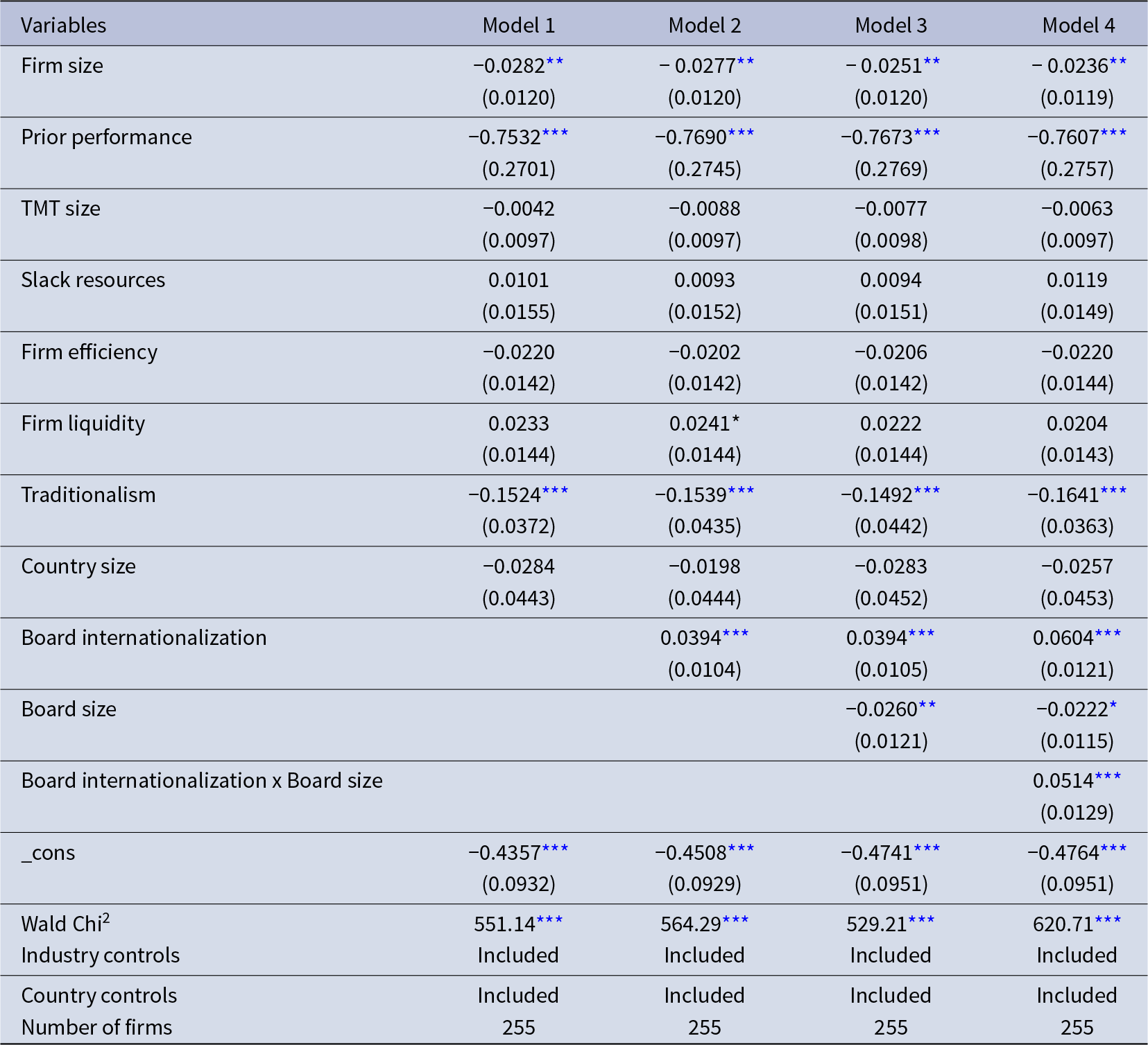
The results of the main analysis are shown in Table 2. Model 1 exhibits the baseline model, which shows the influences of various control variables on strategic change. The coefficient of firm size is negative and significant (β = – 0.0282, P = 0.0187), indicating that large corporations develop organizational inertia and are slow to adapt to external change. With respect to prior financial performance, the coefficient is negative and significant (β = – 0.7532, P = 0.0053), revealing that low financial profitability drives companies to embark on strategic change to aim for better future financial returns. The coefficient of company liquidity is positive and significant (β = 0.0233, P = 0.1048), signaling that swift cash conversion reflects the flexibility and speed of companies to embark on strategic change. For traditionalism, the coefficient is negative and significant (β = – 0.1524, P = 0.0000), implying that companies originating from preserved traditional cultures tend to opt for the status quo rather than undertake strategic change.
Panel data regressions
* Legend: P < 0.1; **P < 0.05; *** P < 0.01, Standard errors are given in parentheses under the coefficient.
Dependent variable: strategic change.
According to hypothesis 1, board internationalization promotes heterogeneity and diversity that can influence strategic change. Consistent with this prediction, the coefficient of board internationalization in Model 2 is positive and significant (β = 0.0394, P = 0.0002). With more national diversity, the board can address multiple perspectives to embark on strategic change.
Hypothesis 2 proposed that board size deters companies from embarking on strategic change. The coefficient of board size in Model 3 is negative and significant (β = –0.0261, P = 0.0313), supporting Hypothesis 2. Consistent with conventional wisdom, board size is a source of organizational inertia.
With respect to Hypothesis 3, the interaction effect of board internationalization and board size positively relates to strategic change. Confirming the prediction, the coefficient of the interaction effect between board size and board internationalization in Model 4 is positive and significant (β = 0.0514, P = 0.0001). Board internationalization can negate the status quo nature of the large board.
The author further interpreted and compared the coefficients for the key constructs from Model 4, which is a full model. Among the three hypotheses, the standardized coefficient for board internationalization possesses the highest value (β = 0.0604). Meanwhile, the moderating effect of board internationalization (β = 0.0514) comes second and has a higher value than the direct effect of board size (β = –0.0222), implying that the moderating effect of board internationalization can cancel out and even overcome the negative direct effect of board size. Consequently, board internationalization directly influences strategic change and can act against the inertia that occurs from a large board size at the board level.
Robustness tests
In this section, the author further employed multilevel analysis to provide robustness checks. Specifically, the author employed four nested clusters, which are the country of origin, industry, firm, and year of observation. According to Table 3, the results for the key constructs exhibit a similar pattern to those in Table 2. Model 8 is the full model of multilevel analysis that includes all the variables in the estimation. The coefficient of board internationalization is positive and significant (β = 0.0606, P = 0.0000), supporting Hypothesis 1. Board internationalization encourages firms to embark on strategic change. Similar to the previous result in Table 2, The coefficient of board size is negative and significant (β = –0.0220, P = 0.0506), supporting Hypothesis 2. The empirical results support the idea that board size hinders firms from changing. Lastly, the interaction effect between board internationalization and board size is positive and significant (β = 0.0522, P = 0.0007), providing support to Hypothesis 3. Board internationalization offsets the negative impact of board size on strategic change. In summary, the results of multilevel analyses confirm the previous results of panel data regressions.
Multilevel analysis

* Legend: P < 0.1; **P < 0.05; *** P < 0.01, Standard errors are given in parentheses under the coefficient.
Dependent variable: strategic change.
To further check for robustness, the author operationalized board internationalization by employing the number of nationalities on the board. Specifically, the author counted the number of nationalities of individual directors to capture this variable. Table 4 displays the results of this robustness check, in which Model 12 is the full model that includes every variable in the estimation. According to Model 12, the coefficient of board internationalization is positive and significant (β = 0.0501, P = 0.0000). The empirical results provide strong support to Hypothesis 1. Moreover, the coefficient of board size is negative and significant (β = –0.0280, P = 0.0157), providing support to Hypothesis 2. Lastly, the coefficient of the interaction effect between board internationalization and board size is positive and significant (β = 0.0308, P = 0.0132), supporting Hypothesis 3.
Robustness check

* Legend: P < 0.1; **P < 0.05; *** P < 0.01, Standard errors are given in parentheses under the coefficient.
Dependent variable: strategic change board internationalization: number of nationalities.
Finally, this study employed a different measure for strategic change, a binary variable. Specifically, if the strategic change of a firm is higher than the average value, the variable was coded as ‘1’, otherwise as ‘0’. Since the dependent variable is a binary variable, a different regression method was adopted to estimate the model. In the estimation, logistic regression for panel data was employed. According to Model 16 in Table 5, the empirical results from this robustness check provide full support for the proposed hypotheses. Specifically, the coefficient of board internationalization is positive and significant (β = 0.4172, P = 0.0000), in line with Hypothesis 1. Additionally, the coefficient of board size is negative and significant (β = –0.1504, P = 0.0790), in line with Hypothesis 2. Finally, the interaction effect of board internationalization and board size is positive and significant (β = 0.3934, P = 0.0000), in line with Hypothesis 3.
Robustness check – logistic regression for panel data

* Legend: P < 0.1; **P < 0.05; *** P < 0.01, Standard errors are given in parentheses under the coefficient.
Dependent variable: dummy variable of strategic change.
All in all, the empirical results from the robustness checks provide full support to every hypothesis. With respect to Hypothesis 1, board internationalization has a strong effect on strategic change. For Hypothesis 2, board size prevents firms from engaging in strategic change. Large board size may find it difficult to collaborate and communicate, resulting in the status quo of firms. For Hypothesis 3, the robustness checks provide full support to the notion that board heterogeneity can overcome inertial attributes in a large board size and can jointly lead firms in embracing strategic change.
Endogeneity check
To check for endogeneity, this study employs instrument variables (IVs) and ran a twostage least square (2SLS) regression. This study checked the presence of endogeneity for two focal variables, board internationalization and board size.
For board internationalization, this study employed the following three instrument variables: (1) population growth, (2) political stability, and (3) regulatory quality. A higher level of these variables indicates economic prosperity and security issues for foreigners to live and work in a selected host country. The source of data is from the World Bank. The author further checked the validity of these instrument variables. According to the relevance condition, the value of the first-stage F-statistic is 19.40. This value is higher than the 9.08 cut-off point, recommended by Stock and Yogo (Reference Stock, Yogo, Andrews and Stock2005). Hence, the instrument variables meet the relevance condition. Subsequently, the author checked the exogeneity conditions. According to the model, the P-value of the Hansen J statistics is 0.4228. Furthermore, the P-value of the C statistics (Difference-in-Sargan statistics) is higher than the 0.1 cut-off point. Specifically, the P-values of the C statistics of these three instruments are 0.2686 for population growth, 0.2905 for political stability and 0.3364 for regulatory quality. Lastly, to further check for the exogeneity conditions, the Durbin component of the Durbin-Wu-Hausman test was computed (Bascle, Reference Bascle2008). The value of this indicator is 0.3338, confirming that board internationalization is not an endogenous variable.
For board size, the following instrument variables were employed: (1) population growth, (2) regulatory quality, and (3) voice and accountability. A higher level of these variables reflects economic growth and country governance, implying the level of board size and the quality of monitoring functions. The author obtained these data from the World Bank. With respect to the relevance condition, the value of the first-stage F-statistic is 14.78, which is higher than the 9.08 cut-off point (Stock & Yogo, Reference Stock, Yogo, Andrews and Stock2005). Accordingly, the instrument variables meet the relevance condition. For the exogeneity condition, the P-value of the Hansen J statistics is 0.4812. In addition, the P-values of the C statistics (Difference-in-Sargan statistics) of these three instruments are 0.2615 for population growth, 0.9228 for regulatory quality, and 0.2265 for voice and accountability. Finally, the P-value of the Durbin component of the Durbin–Wu–Hausman test is 0.6422. From these tests, it can be concluded that board size is not an endogenous regressor.
In conclusion, the author used instrument variables to check for the presence of an endogeneity issue for the focal variables. These instruments meet the relevancy and exogeneity conditions. According to the results, the focal variables – board internationalization and board size – are not endogenous regressors. Therefore, results from these tests suggest that an IV regression is not an appropriate regression method in this study (Bascle, Reference Bascle2008).
Supplementary analyses
The author further ran sub-sample regressions to probe the role of industry effects that may influence strategic change of firms. Specifically, the author individually ran subsample regressions for (1) the chemical industry, (2) the machinery industry, and (3) the electronic component industry, respectively.
With respect to the chemical industry, the empirical results provide full support to every hypothesis. The coefficient of board internationalization is positive and significant (β = 0.0652, P = 0.0006), in line with Hypothesis 1. The coefficient of board size is negative and significant (β = −0.0316, P = 0.0332), in line with Hypothesis 2. Additionally, the interaction effect of board internationalization and board size is positive and significant (β = 0.0521, P = 0.0220), in line with Hypothesis 3.
For the machinery industry, the results similarly provide full support to every hypothesis. Specifically, the coefficient of board internationalization is positive and significant (β = 0.0883, P = 0.0008), in line with Hypothesis 1. The coefficient of board size is negative and significant (β = −0.0718, P = 0.0012), in line with Hypothesis 2. The interaction effect of board internationalization and board size is positive and significant (β = 0.0748, P = 0.0016), in line with Hypothesis 3.
Finally, for the electronic component industry, the empirical results provide support only to Hypothesis 1. The coefficient of board internationalization is positive and significant (β = 0.0797, P = 0.0160). However, the results are not in line with Hypothesis 2 and Hypothesis 3. The coefficient of board size is negative but not significant (β = −0.0067, P = 0.8186), while the interaction effect of board internationalization and board size is negative but not significant (β = −0.0114, P = 0.6223). From these results, the author further examines the average number of directors of firms in this industry. The average value of total directors for firms in the electronic component industries is 9.054, while the standard deviation is 1.78. In contrast, the average number of total directors for firms active in the chemical industry is 9.56 with a standard deviation of 2.41. Finally, the average number of total directors of firms operating in the machinery industry is 9.81 with a standard deviation of 2.29. These descriptive statistics imply that board size in the electrical and electronic component industries is relatively smaller with a lower variation than their counterparts. Accordingly, the board inertia is lowest among the focal industries explored in this study. Therefore, when the subsample regression for this industry is conducted, the impact of board size is limited for both direct and interaction effects. Nevertheless, board internationalization remains a strong, important factor in driving strategic change, in line with Hypothesis 1.
Discussion and conclusion
Board internationalization can be considered as one of the choices to promote knowledge transfer among corporate elites (Estélyi & Nisar, Reference Estélyi and Nisar2016; Oettl & Agrawal, Reference Oettl and Agrawal2008). Accessing managerial knowledge and governing skills from abroad can enhance the competitive advantage of EM firms. Until recently, both practitioners and academic researchers have shown growing interest in this phenomenon (Nielsen & Nielsen, Reference Nielsen and Nielsen2013; Usman et al., Reference Usman, Javed and Yin2020; Van Veen & Marsman, Reference Van Veen and Marsman2008), as it can foster cross-border knowledge spillovers and set a new course of action for an EM firm (Banerjee et al., Reference Banerjee, Prabhu and Chandy2015).
Accordingly, this research explores how the presence of foreign directors influences the choices of EM firms to engage in strategic change. This is an important topic because some firms develop organizational inertia and opt for the status quo (Kelly & Amburgey, Reference Kelly and Amburgey1991). As a result, many of these rigid organizations become victims of technological change and business environmental uncertainty (Furr & Kapoor, Reference Furr and Kapoor2018). Drawing on the theories of resource dependency (Jiang et al., Reference Jiang, Luo, Xia, Hitt and Shen2023; Pfeffer & Salancik, Reference Pfeffer and Salancik1978), this study proposes that board internationalization promotes firms to undertake strategic change. Furthermore, this study found that board internationalization can offset the inertial nature of large board size.
According to the existing literature, board size has a negative impact on strategic change. However, this study proposes and assesses empirically that board size together with board internationalization can foster strategic change of firms. It puts forth the notion that board internationalization not only attenuates but also overcomes the negative impact of board size on strategic change.
The author tested this prediction on a sample of 255 firms originating from nine emerging markets for the 2013–2018 financial years. The results provide full support to hypotheses 1, predicting the positive relationship between board internationalization and strategic change. Furthermore, the empirical results provide full support to hypothesis 2, projecting the negative relationship between board size and strategic change. Finally, the empirical results provide full support to hypothesis 3. The interaction effect between board internationalization and board size is positive and significant.
Contribution
The contributions of this study to the existing literature are as follows. First, this study puts forth the importance of board internationalization as a major driver to address board inertia (Boivie et al., Reference Boivie, Bednar, Aguilera and Andrus2016; Hoppmann et al., Reference Hoppmann, Naegele and Girod2019) and engage in strategic change. Based on prior research that used resource dependency theory, this study stresses the importance of board internationalization as a change agent (Carpenter et al., Reference Carpenter, Pollock and Leary2003; Klarner et al., Reference Klarner, Yu, Yoshikawa and Hitt2023). This study, therefore, assists in refining the existing debates on the roles of board composition that can affect strategic change of EM firms.
Second, this study illuminates a new understanding of board size. It proposes the notion that board size per se has a negative impact on strategic change (Boivie et al., Reference Boivie, Bednar, Aguilera and Andrus2016). However, the picture changes when board internationalization is introduced into the equation. Specifically, a large international board fosters firms to embark on strategic change.
Third, the current study contributes to the research area of international mobility, especially at the executive level (Greve et al., Reference Greve, Biemann and Ruigrok2015) and at the board of directors (Thams et al., Reference Thams, Kelley and Von Glinow2018; Usman et al., Reference Usman, Javed and Yin2020). Building upon resource dependency theory, it elaborates how variation in board members’ national backgrounds can influence the inclination of firms to undertake strategic change. Individual cognition is a key determinant of behavior, judgment, and choices (Hayton & Cholakova, Reference Hayton and Cholakova2012). International knowledge, industry expertise, and external networks are critical for EM firms to upgrade their capabilities and explore new market opportunities (Haynes & Hillman, Reference Haynes and Hillman2010).
Finally, this study contributes to research in corporate governance of EM firms (Claessens & Yurtoglu, Reference Claessens and Yurtoglu2013). Most of the existing research on board internationalization focuses heavily on firms from Western nations, especially in Europe. Studies investigating board internationalization in emerging markets are still relatively scarce. This study aims to discover the effect of board internationalization in emerging markets, where corporate governance is still developing and less efficient than that of developed economies (Oehmichen, Reference Oehmichen2018).
Limitation
Every research study has its own limitations. In this section, the author lists out the potential limitations of this study. First, this study focuses on firms from emerging markets. It focuses on firms that aim to compete in the international market. Hence, there is latitude for EM firms to adopt new business practices and improve their capabilities (Brouthers, O’Donnell & Hadjimarcou, Reference Brouthers, O’Donnell and Hadjimarcou2005; Chittoor et al., Reference Chittoor, Sarkar, Ray and Aulakh2009). The author expects that the degree of strategic change required by firms from advanced economies may be lower. (Banerjee et al., Reference Banerjee, Prabhu and Chandy2015). Therefore, the generalization of this study to firms from advanced economies is possible to a certain degree but not fully generalizable. Future research can examine the impact of board heterogeneity and board size on strategic change in the context of advanced economies.
Along the same line of arguments, the focal industries employed in this study are technologically intensive. As a result, generalizability can be extended to industries that need to respond to external change (Girod & Whittington, Reference Girod and Whittington2017). Static industries such as infrastructure, water utility, tobacco, hotel and resort, to name a few, may experience a lower urgency and necessity for change (Richard, Wu, Markoczy & Chung, Reference Richard, Wu, Markoczy and Chung2019). Therefore, the impact of board internationalization in static industries may be lower than that in the focal industries of this study. With static-industry setting, monitoring and controlling functions of the corporate board may be more important than driving strategic change. Therefore, future research can investigate the impact of board internationalization and board size in static industries to see if the results hold. Additionally, it can further examine the monitoring and controlling roles of the corporate board. Particularly, future research can examine the relationship between board internationalization and financial misconduct and financial reporting quality.
Finally, this study does not capture differences in subcultures within the same nations (Zaman et al., Reference Zaman, Asiaei, Nadeem, Malik and Arif2024). For example, directors from the northern part of a country may behave differently from those from the southern part of the same country. Alternatively, religious beliefs, norms, and values can differ for directors who come from different backgrounds, even though they are from the same country of origin (Cook & Glass, Reference Cook and Glass2015; Hassan & Marimuthu, Reference Hassan and Marimuthu2018). Future research can examine the impact of within-country subcultures and minorities that can affect the strategic decision-making of firms (Thams et al., Reference Thams, Kelley and Von Glinow2018).
Future research
A potential avenue for future research is the impact of board internationalization on different corporate outcomes. Since the board internationalization research area is still in its early phase, we still know little about its impact on financial performance or various strategic decision-making. These research areas can cover topics such as the scope of firms, corporate entrepreneurship, and risk-taking behavior, to name a few. In this light, scholars can employ a mixed method that integrates qualitative insight with quantitative strength to discover the mechanisms of board internationalization that may play a significant role in strategic decisionmaking of firms.
Second, future research can explore the diminishing resource provision of foreign directors to EM firms. As time passes, EM firms can learn from foreign directors to engage in strategic change and build their capabilities. As a result, the resource provision benefits of foreign directors may be eroded. At the beginning, there are several areas that need to be improved and changed. After all these changes, firms are inclined to be stable and static again, forming another inertia. Future research may examine the specific types of knowledge and skills of foreign directors that dissipate very quickly while some expertise can persist for a prolonged period.
Third, future research can discover the influence of host country characteristics on the cognitive structure of foreign directors. Over time, foreign directors can absorb local culture, beliefs, and norms, and become more local. Since the cognitive structure of foreign directors is one of the sources of creativity and innovation (An et al., Reference An, Chen, Wu and Zhang2021; Usman et al., Reference Usman, Javed and Yin2020). Hence, future research can investigate how the duration or length of stay can affect the beliefs and behaviors of foreign directors. Longer periods in a local country may significantly change those of foreign directors, making them think and act like local directors (Zaheer & Mosakowski, Reference Zaheer and Mosakowski1997). In this light, longitudinal studies of foreign directors are highly needed. They will help to tease out the importance of board internationalization on firms’ short-term adaptations and long-term courses of actions.
Finally, working experiences in multiple countries may enrich the breadth of knowledge that foreign directors attain. Consequently, the cognitive structure of foreign board members may be influenced differently by distinct sets of local insights and multiple foreign sources and countries. Therefore, future research may investigate the breadth of international experiences that might affect the strategic decision-making of firms. Longitudinal studies of individual directors will paint a clearer picture of their impact on strategic decision-making of firms. Particularly, a mixed research method will help to balance insights and rigor in future studies that examine this phenomenon.
In conclusion, this study emphasizes the importance of board internationalization in the corporate governance research stream. Building upon resource dependency theory, it sheds light on its effectiveness in overcoming organizational inertia and promoting strategic change. The current study also counters conventional wisdom about the negative impact of board size on strategic change. Specifically, the current study shows and tests empirically that board internationalization together with board size can promote firms to embark on strategic change. A large international board can help firms foster change. The author really expects that this study will signify the importance of board internationalization in management research.



 Open access

