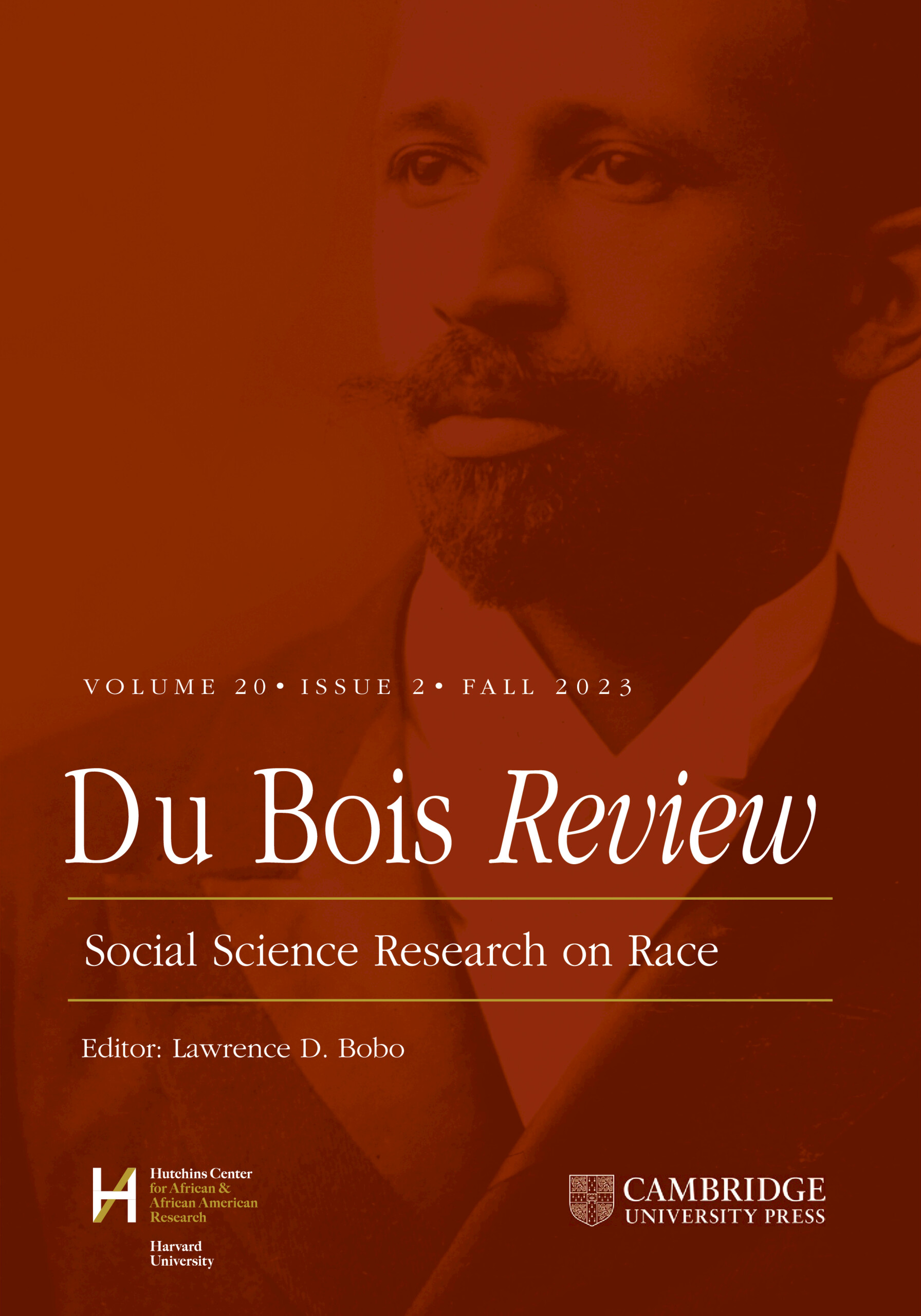


It is fitting that in the same issue that we present a previously unpublished article by W. E. B. Du Bois and host a symposium reviewing new major works on his political philosophy, we also present major essays debating the contours of the color line in the twenty-first century. Immigration and a strong rightward movement in American society are rapidly remaking the demographic and political configuration of the color line in the United States. Several essays in this issue debate critical aspects of this reconfiguration such as the relative importance of cultural versus structural causes of continued racial disparities; the role, if any, that racialization plays in shaping the modern immigrant incorporation into U.S. society; and, the legacy of the Moynihan report. Complementing these essays is a symposium on two major new books that provide fresh takes on the philosophical and theoretical relevance of Du Bois's thought for our times. We are also proud, for the first time anywhere, to publish Du Bois's essay, “The Social Significance of Booker T. Washington,” with an accompanying analytical introduction by Robert Brown.
In our Special Feature entitled “Du Bois as Political Philosopher: A Symposium on New Books by Robert Gooding-Williams and Lawrie Balfour,” the work of the prime twentieth theoretician of the color line is reexamined by political theorists and philosophers. As Jack Turner, special editor for this symposium and a political theorist, stated it is past time that political theory catches up. The racial order, theorists increasingly understand, is a constitutive part of modernity. Thus, any reasonable theory of modernity must take into account race, and therefore must take into account Du Bois's oeuvre. Unlike the work of some earlier generations of scholarship on Du Bois, the essays in this volume of DBR put Du Bois into conversation not only with Euro-American and other major Western canonical figures such as de Tocqueville and Aristotle, but with important figures within Afro-American political thought such as Frederick Douglass. An impressive array of theorists is assembled to provide critiques of Balfour's and Gooding-Williams' recent books on Du Bois's thought, and Gooding-Williams and Balfour both respond to the thoughtful critiques.
The Symposium's reconsideration of Du Bois's work is much enhanced by our introduction to the public of his essay—“The Social Significance of Booker T. Washington.” As Robert Brown's introduction argues, this essay is important both in its own right as a concise statement of Du Bois's mature analysis of the differences between the two critical approaches to Black leadership and struggle, as well as for providing insights into Du Bois's own difficult negotiation of the hurdles he faced in his personal, public, and intellectual life in 1935. Brown also considers what lessons this essay, that examines the transition from one era in Black politics and Black leadership to the next, might have for our times as we find ourselves amidst the difficult and arguably failing transition from the Civil Rights Era to our own.
Marek D. Steedman's “Walk with Me in White” also uses political theory to examine what the history of the formation of the Du Bois-era color line can tell us about the current dominant “anti-transformative” political coalition. He strongly argues that examination of the rhetoric and justifications used by Southern progressives in the early twentieth century exhibit the same Weberian logic that is used today—and that both racial orders are based on a concept of mastery that has at its heart racial domination. He begins his theoretical reconsideration of American apartheid at its beginning by examining a city that Washington and Du Bois both knew well—Atlanta between 1880 and 1910. Steedman's sober analysis unfortunately provides further evidence of how enduring the trenches of the color line are in the United States despite constant assaults on and the evolutionary reconfiguration of the racial order.
If in many ways Du Bois's academic work shaped both philosophical and empirical racial studies to a significant degree during the first half of the twentieth century, the Moynihan Report strongly influenced empirical research on race—particularly on the origins of racial inequality vis à vis African Americans—during the second half of the twentieth century. Herbert Gans' essay, “The ‘Moynihan Report’ and its Aftermaths: A Critical Analysis” strongly argues that in our times the content of the actual report has been badly misinterpreted. The report, Gans argues, has serious shortcomings as both social science and social policy. Gans approvingly reminds us that Moynihan was a social liberal. Gans disapproves of Moynihan's use of the now fashionable analysis that combines structural and cultural explanations for the sources of racial inequality. It is Moynihan's use of culturalist explanations with which Gans finds fault. To address structural problems Moynihan called for employment, proto-affirmative action programs, policies to redress low Black wages, and the need for a jobs program. He also assailed what he called the cultural roots of racial disparities—the “tangle of pathology,” such as single parent, female-headed households, that Moynihan identified as a source of racial disparities. Gans strongly criticizes Moynihan's cultural analysis. Shortcomings that Gans identifies include claims that Moynihan ignored existing research and that his claims were based on empirically problematic findings. Gans also argues that the Report's social policy section was not sufficiently developed, particularly with respect to jobs programs; although Gans reminds us that Moynihan implicitly called for programs that would lead to equality of results between Blacks and Whites.
Into the fray between structuralists and those who argue for cultural roots of racial inequality charge several eminent authors. William Darity, Jr., offers an even more structuralist approach to these questions than Gans. In his review of William Julius Wilson's More than Race: Being Black and Poor in the Inner City, Darity makes the extremely strong claim that there is no evidence whatsoever for cultural explanations of Black poverty and inequality. One need not subscribe to Darity's attribution of Wilson's motives for the latter's adaptation of a synthetic view of the origins of contemporary racial disparities to take seriously Darity's social scientific critique of Wilson's work. Indeed, I believe that the enterprise of ascribing motives is an often unfortunate exercise as was the case of many of the critiques of the late Manning Marable's (Reference Marable2011) recent book on Malcolm X.Footnote 1 Darity, in his review, offers ample and solid empirical evidence that provides extremely solid ground for the continued support for a structuralist approach to explaining racial disparities, including evidence for an unfortunately wide range of types of devastating forms of labor market discrimination aimed at Blacks. While providing much less evidence for the claim of the insufficiency of cultural causes, he does show some evidence to suggest that some purported deficiencies such as a “rational” lower commitment to higher education are shown to be empirically false.
Mark Gould also argues that Wilson does not adequately acknowledge structural and political factors in explaining racial inequality. Gould argues, “Wilson does not stress sufficiently that these economic and political changes have led to a profound increase of income inequality in the United States, nor that this income inequality has resulted in an increase in the gap between Whites and Blacks because Blacks are concentrated among those groups that have lost ground economically over the past two generations.” Gould, unlike Darity, does not dismiss cultural arguments out of hand, but asks the question of how culture works.
Not surprisingly, but it is our good fortune, Wilson provides a spirited reply to his critics. Wilson dismisses Darity's claims about lack of empirical evidence for cultural factors. There may be more agreement between the two authors than either would admit to; for example Wilson (Reference Wilson2009) states, “I conclude: ‘structural explanations of the economic woes of low-skilled Black men are far more significant than cultural arguments, even though structural and cultural forces jointly restrict Black male progress in some situations'” (p. 31). Wilson also argues that he and Gould agree more than Gould recognizes. Our readers will have much to contemplate as they sift through the authors’ arguments about the relative importance of, and evidence for, structural and cultural explanations of the persistence of racial inequality.
Edward E. Telles' and Vilma Ortiz's Generations of Exclusion: Mexican Americans, Assimilation, and Race provides another opportunity for the authors and our reviewers to engage in debate about the contours of the color line in the twenty-first century. Lawrence Bobo's largely favorable review points to the enormous effort and attention to detail found in all phases of Telles' and Ortiz's research. The authors address a critical question: Across several generations, to what degree are Mexican-American families being incorporated into American society? Their data cover several life cycles and include hundreds of interviews with parents and children across four generations. Telles and Ortiz remind us that Latinos comprise the largest minority group and that Mexican Americans the largest Latino group, following only Blacks in size of single racial groups. According to Bobo, the authors balance empirical work with theory testing. Specifically, their evidence tests both assimilationist and racialization models of the immigrant experience and seriously undermine assimilationist explanations of the Mexican American experience. Bobo has a few critiques which he argues should only be taken in the context of an overwhelmingly positive reaction to the book. First, they could have hammered assimilation theories harder; second, they have something of a structuralist bias. Bobo argues, “To wit, as I would state the more general theoretical implication of this observation, social-psychological and cultural processes are constitutive, not structurally derivative, aspects of racialized social inequality. Ideas, attitudes, beliefs, and cultural notions about Mexicans and Mexican Americans can exert important autonomous effects on group status and the trajectory of group relations. These processes remain sorely under theorized in sociological literature generally.” While I disagree with Bobo about the tilt, I do agree that the conversation needs to be better engaged by all of us. Bobo also thinks that Telles and Ortiz could have pushed their conclusions more strongly when he argues “Yet, they stop well short of criticizing the deep cultural racism in the United States and the spread of economic hardship and marginalization under the neo-liberal state. Their own evidence, I believe, provides Telles and Ortiz a basis of not just a more searching critique of assimilation theory, but in fact could sustain a direct commentary on larger ills in American society.”
José Itzigsohn agrees with Bobo that Generations of Exclusion presents “research at its best” and also praises its extraordinarily “rich data” and meticulous empirical research. Also like Bobo, Itzigsohn is strongly supportive of the authors' dismantling of various versions of assimilation theory as he concludes that Telles and Ortiz conclusively demonstrate that across generations, Mexican Americans by and large “do not join the mainstream” of American society. Itzigsohn also wishes the authors would have more strongly pursued the implications of their theory, particularly with respect to assimilation theory. Itzigsohn explicitly links his review and analysis to Du Bois's sociological tradition—the best empirical sociology is embedded in the “structural experience and lived experience” of the groups under study. Like Du Bois, Itzigsohn would like sociologists and, more generally, serious students of race to link their careful research more carefully to the mechanism and politics of policy change. Our research can and should, where appropriate, influence policy changes that lead to a better life, particularly for the disadvantaged communities of our society. This requires, Itzigsohn argues, in addition to the finest research and sensitivity to the political nuances of policy change, “moral appeals to ideas of a good society.”
Telles and Ortiz generally agree with both Bobo's and Itzigsohn's comments in that we “need to move beyond assimilation theory.” They argue that the analysis they provide can be used for activist organizing for social justice, but also argue that their primary aim was to shape their presentation of their findings in a way that would be most likely to also convince those who might be initially “skeptical” of their arguments and findings. Bottom line, they argue that “We cannot settle for a theory [of Latino immigration and incorporation] whose explanation of the largest and longest immigration in the United States is inadequate to the realities of that immigration”—theories that inadequately take into account the process of the racialization of those of Mexican descent.
The empirical offerings from this issue are rounded out by two contributions which enhance our understanding of how state policies can help or impede the overcoming of the racial inequalities that are the result of the current configuration of the color line. Kimberly S. Johnson in her article “Political Hair” demonstrates how outcomes from a specific regulatory regime, one in this case that disadvantages providers of hair care to Black women, cannot be explained by “traditional economic theories,” but require instead theoretical approaches that incorporate the impact of the intersection of race and gender into the analysis. De Bodman's and Bennett's “Mr. Secretary, Tear Down This Wall” analyzes housing segregation and specifically the Gautreaux public housing program, to make a case for renewed effort at the national level to comprehensively launch an assault on one of the most enduring features of the color line—the debilitating and widespread disparities that are the result of continued racial segregation in housing.
Thomas Pettigrew's review essay, “Did Brown Fail?,” continues an analysis of the efficacy of state policies reputedly designed to provide remedies for racial inequalities by examining two recent works that evaluate the impact of the landmark decision Brown v. The Board of Education of Topeka Kansas. His review of Martha Minow's In Brown's Wake and Wells and colleagues' Both Sides Now argues that in many important ways Brown was a success. Overall however, Brown did not succeed in contributing to the large scale dismantling of the color line for at least two major reasons. First, Pettigrew argues that “the rest of the nation's institutions, save the military services, did not engage in comparable changes.” Desegregating the nation's public schools could never have succeeded by itself without similar transformations of housing, markets, and major public and private institutions. Second, what success Brown did have, or even the threat of success, was sufficient in promoting a backlash that was fully visible and terrible in its effects as an increasingly “reactionary” Supreme Court, often embodied in the decisions of Justice Thomas, made it impossible to use Brown or other judicial remedies as policy levers to attempt the partial dismantling of segregation and racial equalities in our educational system.
Finally, as we know, Du Bois considered the color line a global phenomenon—as it must be—if it is a constitutive feature of modernity. Tanya Golash-Boza reviews books by Juliet Hooker and Stanley Bailey to consider the quest for racial justice in Nicaragua and Brazil. The diverse findings of these two books suggest the need to not only move beyond U.S.-based analyses of the racial order when analyzing other societies (upon which the authors agree), but also the need for the careful analysis of the particular. The two authors' findings about the salience of racial groups within each society are quite divergent. Bailey's findings are different not only from those of Hooker, but also from those of other students of Brazil such as Michael Hanchard. It would be interesting to see how these different findings, including Golash-Boza's findings on Peru, which she mentions, are due if at all to different research strategies (case studies and ethnographies vs. survey research). In any case, the review strongly reconfirms both the complexity of the emerging reconfiguration of the color line and the need to continue to follow Du Bois's example of applying the most rigorous theoretical and empirical tools available to the study of the global racial order.


