


1. Introduction
Additive manufacturing opens new possibilities for product design, offering an increased capacity to leverage design complexity. Engineers can utilise the manufacturing capabilities offered by AM to realise product requirements that would be difficult, if not impossible, to achieve using conventional manufacturing methods (Reference Prabhu, Simpson, Miller, Cutler and MeiselPrabhu et al., 2023). A key challenge in leveraging these potentials in industrial practice remains identifying suitable products for AM (Reference Günther, Tüzün, Kreimeyer and KochGünther et al., 2025). To facilitate product identification for AM, a viable approach is to examine products that place heightened demands on conventional manufacturing processes. Conventional product design and manufacturing face particular challenges in cases where conflicting requirements result in opposing relationships between design parameters, such as the need for both high strength and low weight. The increased design freedom of DfAM provides additional options for resolving such contradictions through design (Reference Spreafico, Zefinetti, Landi and RegazzoniSpreafico et al., 2022). Consequently, combining the capabilities of AM with a methodological approach to contradiction resolution in product design to generate innovative designs attracts research interest (Reference Gross, Park and KremerGross et al., 2018; Reference Renjith, Park and Okudan KremerRenjith et al., 2020). The TRIZ theory for inventive problem solving offers a tool for systematic contradiction analysis and resolution. To enable the effective application of TRIZ contradiction analysis in DfAM, research has examined methodological and contextual synergies between TRIZ and DfAM (Reference Lang, Gazo, Segonds, Mantelet, Jean, Guegan, Buisine, Benmoussa, de Guio, Dubois and KoziołekLang et al., 2019; Reference Linhao, Abdul Kadir, Humaira Mazlan, Sudin, Sirat and Akhmal NgadimanLinhao et al., 2025; Reference Mazlan, Abdul Kadir, Deja, Zieliński and AlkahariMazlan et al., 2022) and has reported case studies demonstrating successful use of contradiction analysis for additively manufactured components (Reference Kanagalingam, Shepherd, Fernandez-Vicente, Wimpenny and Thomas-SealeKanagalingam et al., 2019; Reference Mawale, Kuthe, Mawale and DahakeMawale et al., 2018). However, the academic discourse on integrating TRIZ with DfAM currently constitutes a self-referential niche. Relevant studies indexed in Scopus (TITLE-ABS-KEY (“additive manufacturing” AND “TRIZ”); 32 initial results; 17 full-text analyses after screening) as of October 2025 indicate that prescriptive approaches predominantly rely exclusively on DfAM sources that already incorporate TRIZ concepts. Apart from Reference Spreafico, Zefinetti, Landi and RegazzoniSpreafico et al. (2022), who relies on general literature on AM rather than specific TRIZ&AM sources, the field remains insulated. Our contribution disrupts this insularity by introducing empirically grounded qualitative evidence from interviews with 11 AM research projects, thereby reorienting the debate from a literature driven loop to a practice-informed discourse on the synergistic use of the TRIZ contradiction analysis for DfAM. We address fundamental uncertainties that persist regarding the applicability of TRIZ’s empirical knowledge for DfAM. This paper delivers a systematic assessment of the suitability of the engineering parameters (EP) and inventive principles (IP) employed in TRIZ contradiction analysis for the purposes of DfAM, thereby deriving promising directions for future research.
2. Theoretical background
2.1. Design for additive manufacturing
Design for additive manufacturing (DfAM) comprises methods and methodologies to leverage the manufacturing capabilities of AM in product design (opportunistic DfAM) while accounting for process-specific constraints (restrictive DfAM) (Reference Laverne, Segonds, Anwer and Le CoqLaverne et al., 2015). These methodical approaches are based on the four complexity dimensions defined by Reference Gibson, Rosen, Stucker and KhorasaniGibson et al. (2021): geometric, functional, hierarchical, and material complexity (Reference Linhao, Abdul Kadir, Humaira Mazlan, Sudin, Sirat and Akhmal NgadimanLinhao et al., 2025). On this basis, opportunistic methods such as part consolidation become feasible, while the resulting constraints such as build orientation and support removal must be considered to realise the design potential in the product (Reference Gibson, Rosen, Stucker and KhorasaniGibson et al., 2021). While DfAM was initially addressed primarily within academia, the industrialization of AM is driving demand for AM-specific development methodology, leading to the incorporation of methodological DfAM knowledge into internationally recognised technical standards (Reference Günther and KochGünther & Koch, 2024).
2.2. TRIZ theory of inventive problem solving
The core idea of TRIZ is the systematisation of the innovation process. The theory is grounded in extensive patent analyses, revealing that over 99% of technical solutions make use of already known solution principles (Reference Koltze and SouchkovKoltze & Souchkov, 2017). TRIZ posits that technical problems are rooted in contradictions and overcoming them enables a comprehensive solution. For practical implementation, TRIZ offers both a collection of tools and methods for the systematic analysis of technical problems and an extensive, empirical knowledge base for formulating and resolving contradictions. (Reference WenzkeWenzke, 2003). Engineering contradiction analysis is a specific TRIZ tool that comprises three core elements, namely the contradiction matrix, engineering parameters (EP) and inventive principles (IP). The contradiction matrix itself is a design-structure matrix that juxtaposes the EP in its rows and columns. The EP are used to represent a specific design problem as an abstract engineering contradiction between two distinct parameters. The cells list the IP that, according to empirical evidence, are considered suitable for resolving specific contradictions through design. (Reference Linhao, Abdul Kadir, Humaira Mazlan, Sudin, Sirat and Akhmal NgadimanLinhao et al., 2025) TRIZ differentiates two types of contradictions by the number of affected parameters. The technical contradiction arises when improving one system parameter degrades another, so the conflict involves two different parameters. The second type, called physical contradiction, occurs when the same parameter must simultaneously assume opposing values. (Reference WenzkeWenzke, 2003) In contrast to technical contradictions, physical contradictions are resolved not by optimising the parametric trade-off, but by decoupling the conflicting requirements through separation. Four separation principles (separation in space, in time, by condition and by system level) are available for this purpose, which can be concretised using the same IP that are applied to resolve technical contradictions. (Reference Souchkov and ChechurinSouchkov, 2016)
3. Research approach
3.1. Problem statement and research approach
TRIZ contradiction analysis provides designers with a methodological approach comprising a design structure matrix called contradiction matrix and an associated method for abstracting technical problems through the formulation of contradictions. Furthermore, experience-based knowledge for resolving contradictions by applying inventive principles is offered. The significance of the contradiction analysis as a tool therefore exceeds the purely methodological aspect, as its content substantially influences the proposed solutions. Therefore, a fundamental content-based and contextual assessment of this TRIZ tool’s suitability for DfAM purposes is necessary. The TRIZ theory codifies heuristic experiential knowledge that emerged decades before the industrial use of AM technologies (Reference Mazlan, Abdul Kadir, Deja, Zieliński and AlkahariMazlan et al., 2022). TRIZ-related DfAM publications therefore typically follow the approach of adapting TRIZ tools such as contradiction analysis to fit specific applications and proposing new prescriptive approaches on this basis. Common prescriptive approaches in DfAM include adaptations of the contradiction matrix (Reference Gross, Park and KremerGross et al., 2018; Reference Kandukuri, Günay, Al-Araidah and Okudan KremerKandukuri et al., 2021; Reference Linhao, Abdul Kadir, Humaira Mazlan, Sudin, Sirat and Akhmal NgadimanLinhao et al., 2025). Content-based comparisons with DfAM have been conducted for the inventive principles (Reference Kamps, Gralow, Schlick and ReinhartKamps et al., 2017; Reference Kretzschmar, Chekurov and KatalinicKretzschmar & Chekurov, 2018; Reference Lang, Gazo, Segonds, Mantelet, Jean, Guegan, Buisine, Benmoussa, de Guio, Dubois and KoziołekLang et al., 2019; Reference Mazlan, Abdul Kadir, Deja, Zieliński and AlkahariMazlan et al., 2022), less frequently for the engineering parameters (Reference Linhao, Abdul Kadir, Humaira Mazlan, Sudin, Sirat and Akhmal NgadimanLinhao et al., 2025). Criticisms include that DfAM-adapted contradiction analyses predominantly use the original engineering parameters, which are inadequate for the DfAM context (Reference Linhao, Abdul Kadir, Humaira Mazlan, Sudin, Sirat and Akhmal NgadimanLinhao et al., 2025); the original inventive principles being unsuitable for capturing all possibilities offered by AM (Reference Mazlan, Abdul Kadir, Deja, Zieliński and AlkahariMazlan et al., 2022); and a generally ineffective contextualisation of TRIZ and DfAM, as the contradiction formulation is too abstract to be coupled with equally abstract DfAM methods for generating concrete AM design solutions (Reference Spreafico, Zefinetti, Landi and RegazzoniSpreafico et al., 2022). It is evident that research identifies potential in using TRIZ contradiction analysis to promote the generation of innovative designs (Reference Gross, Park and KremerGross et al., 2018; Reference Renjith, Park and Okudan KremerRenjith et al., 2020). However, the applicability of TRIZ content beyond purely methodological aspects remains controversial and a systematic and comprehensive evaluation is still pending. We share the view of several previously mentioned works that the TRIZ inventive principles exhibit inherent content-related overlaps with certain DfAM methods and can serve as a suitable link between both TRIZ and DfAM. However, we identify a gap in existing research in that the data basis for developing prescriptive approaches relies exclusively on theoretical considerations based on literature, with no empirical data from actual AM projects being incorporated. To close this gap, this contribution examines the parameters and inventive principles of the TRIZ contradiction analysis in the DfAM context based on empirical qualitative data gathered from various research projects on additive manufacturing. We base our research on the hypothesis, that technical problem-solving has not fundamentally changed since the foundation of TRIZ theory, but that modern manufacturing processes such as AM and associated design methodologies like DfAM offer expanded design possibilities for resolving engineering contradictions. If this holds true, the content elements of the contradiction analysis, i.e. the EP and IP, should also be represented and applicable in the field of DfAM. The research question (RQ) is therefore: To what extent are the engineering parameters and inventive principles of TRIZ represented in the field of DfAM?
3.2. Semi-structured interviews
To answer the RQ, this study evaluates the suitability of TRIZ contradiction analysis for DfAM, focusing not only on its methodological application through the contradiction matrix, but also on the adequacy of its content-related elements, namely the EP and IP, within the context of DfAM. Since this cannot be achieved through literature alone for the reasons outlined above, empirical data had to be obtained from expert interviews. The ideal interview partner in this respect would be a DfAM expert who already uses TRIZ contradiction analysis. However, this subset of DfAM experts is presumably rare. For this reason, an open interview situation that allows for individual follow-up questions depending on the interviewee’s perceptions and understanding of the topic is essential, for which semi-structured interviews are particularly suitable (Reference Adams, Newcomer, Hatry and WholeyAdams, 2015). A total of 11 semi-structured guided interviews were conducted. The interviewees are leading research associates (doctoral candidates and postdocs) of eleven different university research projects in the field of additive manufacturing (Chapter 3.2.3). Each interview lasted between 20 and 30 minutes. The interviews were conducted by at least two interviewers, one of whom, in addition to the audio recording, kept a manual written protocol. During the interview, participants were also provided with a printed copy of the 48 engineering parameters, which the interviewers used to guide the discussion and to anchor the participants’ statements to specific content. Transcripts were analysed according to Mayring’s qualitative content analysis (Reference Mayring, Fenzl, Baur and BlasiusMayring & Fenzl, 2019). A deductive coding system was used to map interview passages to TRIZ inventive principles or TRIZ engineering parameters (Chapter 3.2.2). The methodological approach is explained below, starting with the formulation of the interview guide.
3.2.1. Interview guide
When formulating the interview guide used in this study, it was important to consider that the projects to be interviewed do not explicitly work according to TRIZ theory and that the interviewees may not be familiar with the respective terminology of contradiction analysis. Each interview began with a brief introduction to TRIZ and contradiction analysis. Subsequent questions avoided using TRIZ-specific terminology. The three open questions aimed to identify instances where AM had been used to achieve contradictory or opposing objectives (Table 1). The second question placed project-specific knowledge in the context of contradiction resolution. The third question used the list of 48 TRIZ parameters (Reference Mann and DewulfMann & Dewulf, 2003), which was available to the interviewees, to contextualise the described cases regarding this specific element of the contradiction analysis.
Interview guide

1 The 48 TRIZ engineering parameters were reviewed with the interviewees
3.2.2. Interview analysis
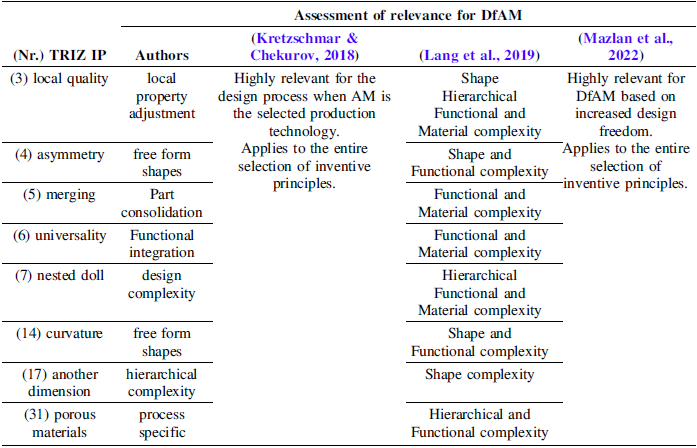
A total of three independent coders were involved in the transcript coding process (one PhD student and two bachelor’s students). Inter-coder reliability was ensured through a series of meetings held immediately after the interviews, during which the criteria for coding were developed and refined using concrete examples from the interview data. The inventive principles and engineering parameters of TRIZ represent the deductive codes in the qualitative content analysis. Whilst each of the 48 EP corresponds to a deductive code, only a preselected subset of 8 out of the original 40 IP is used as deductive codes (Table 2). This selection was made in line with three independent studies by (Reference Kretzschmar, Chekurov and KatalinicKretzschmar & Chekurov, 2018), (Reference Lang, Gazo, Segonds, Mantelet, Jean, Guegan, Buisine, Benmoussa, de Guio, Dubois and KoziołekLang et al., 2019) and (Reference Mazlan, Abdul Kadir, Deja, Zieliński and AlkahariMazlan et al., 2022), all of which attribute a specific DfAM relevance to these eight inventive principles. This delimitation was made because the aim of this study is to evaluate the content-related elements of TRIZ contradiction analysis within the context of DfAM, with the conceptual proximity of certain DfAM methods to the TRIZ IP serving as a key motivation. This selection does not imply that other TRIZ IP are irrelevant in the context of DfAM.
Pre-selection of inventive principles with conceptual proximity to DfAM methods

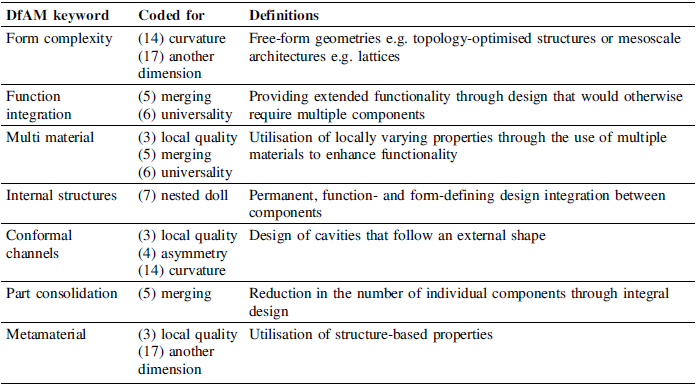
It must be noted that the projects examined did not adhere to the theory of TRIZ. Therefore, the original TRIZ terminology (i.e. deductive codes) can be concealed under other terms and keywords. Table 3 presents the mapping of relevant DfAM keywords to the corresponding deductive codes, in this case the inventive principles. The 48 EP were processed analogously. A detailed presentation is omitted due to the limited scope of this paper. The following working definitions are provided to delineate the content of individual IP’s in the context of DfAM: IP (17) ‘another dimension’ is not a mathematical notion of extra spatial dimensions, but a metaphor for an expanded design space that extends beyond classical product attributes, spanning multiple coupled layers and degrees of freedom. This definition aligns with the concept of hierarchical complexity proposed by (Reference Gibson, Rosen, Stucker and KhorasaniGibson et al., 2021). IP (7) ‘nested doll’ denotes a permanent, function- and form-defining design integration between components or between parts of a component. To ensure unambiguous coding, it is defined that a nested component (i.e. sub-component) cannot be replaced without modifying the structure of the super-component. An internal channel embedded in the structure is not nested. Although it cannot be removed without modifying the super component and thus meets the stated definition for IP (7), as a designed cavity it exists solely by virtue of the super component’s geometry. If the integrated channel, for example, provides a cooling function, the corresponding passage is assigned to functional integration and thus coded for IP (5) merging and (6) universality.
Deductive coding guide for inventive principles

3.2.3. Participant characteristics
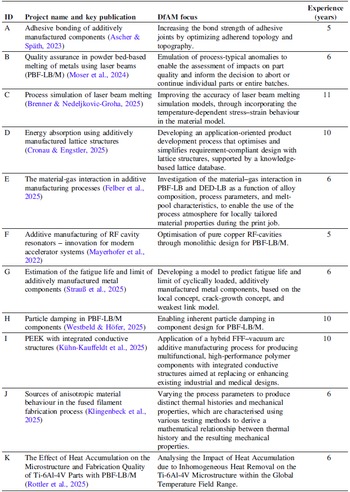
Table 4 presents the projects examined in this study, from which the empirical qualitative dataset is derived. Each project features a unique interview ID, the interviewee’s AM experience in years, and a brief description of the project’s DfAM focus. When selecting the projects, it was important to ensure a clear connection to a real product application, as a purely theoretical topic would deviate too far from the practical nature of the TRIZ contradiction analysis.
4. Results
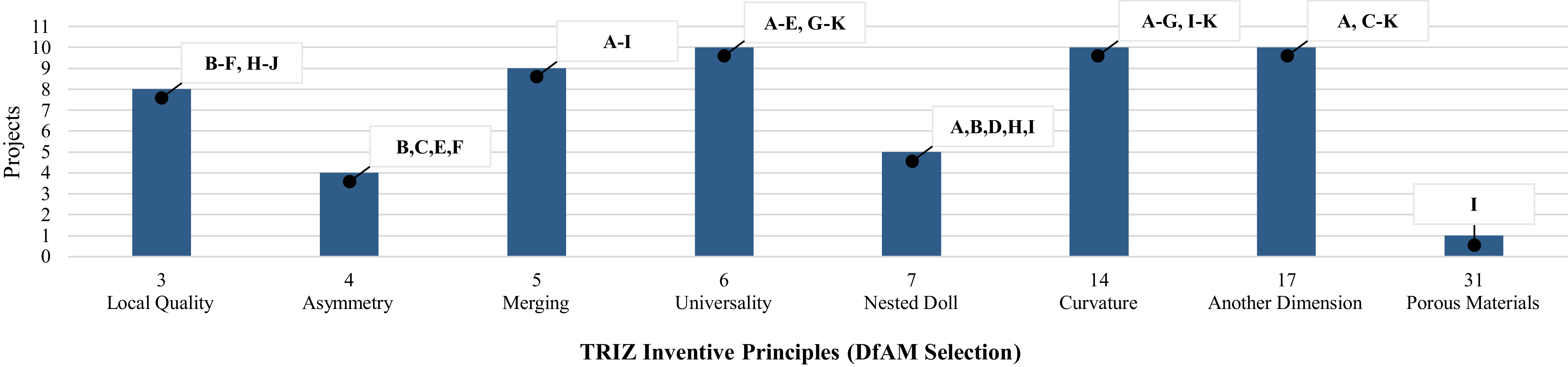
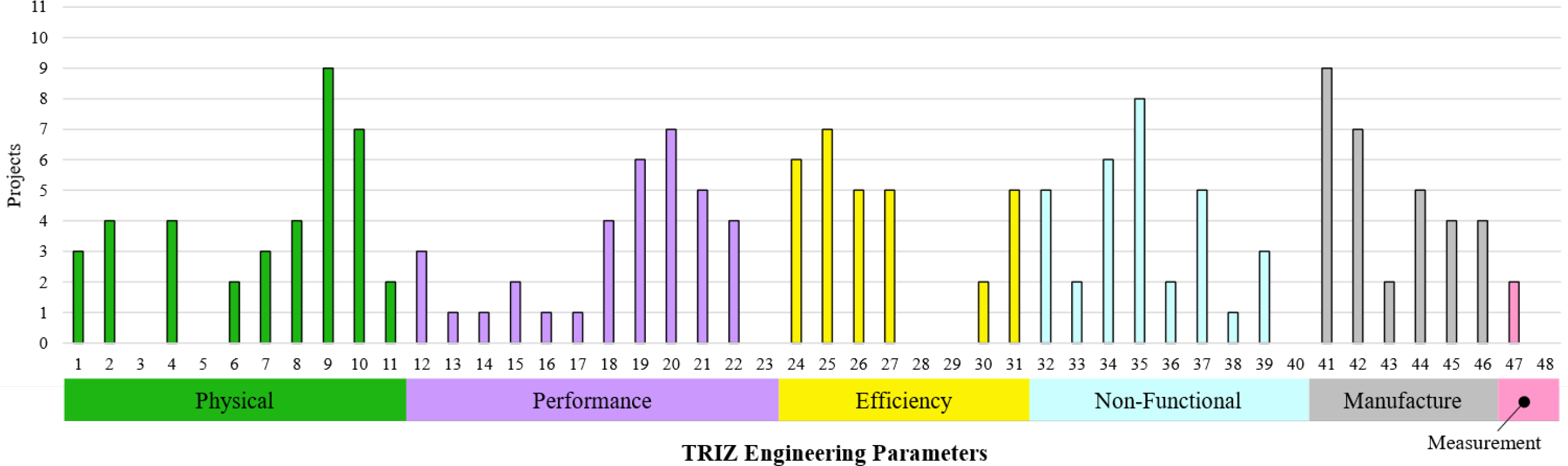
The results of the qualitative content analysis are presented below. The histograms show in how many of the 11 projects (Table 4) the deductive codes for TRIZ IP (Figure 1) and TRIZ EP (Figure 2) could be identified in the interview material. The numbering and designation of the IP and EP in this paper correspond to the updated 48x48 contradiction matrix (Reference Mann and DewulfMann & Dewulf, 2003).
Overview of the interviewed projects

Deductive coding for the eight selected inventive principles across all interviews

Deductive coding for the 48 TRIZ engineering parameters across all interviews

During the analysis, additional codes were inductively derived from the interview material. The codes on inventive principles presented below are part of the 40 original IPs but were not included in the initial selection for which a considerable content overlap with DfAM was hypothesised. This applies specifically to the design-based anticipation of deformations caused by residual stresses during the PBF-LB/M process, which was coded as (9) ‘preliminary anti-action’ and (11) ‘beforehand cushioning’ (interview C). This also applies to the approach pursued in the project on particle damping in PBF-LB/M components (interview H), which encloses the process-inherent powder within the structure to be manufactured. This approach matches the definition used for (7) ‘nested doll’ and can likewise be coded as (25) ‘self-service’ when considering the manufacturing process itself. In addition, inductive codes were also created for DfAM-relevant design parameters that are not included in TRIZ’s original list or could not be clearly assigned to any of the original 48 EPs. This concerns parameters that capture the influence of process variables such as laser power, scan speed, or hatch spacing on the target part geometry, mediated by intermediate quantities such as melt pool size in the PBF-LB/M process.
5. Discussion
It can be observed that the IP could be identified in the interviews, which is confirming the assumed and previously explained thematic proximity of the IP and DfAM methods. An analysis of the prominence of individual inventive principles in the conducted interviews shows that (6) universality, (14) curvature, and (17) another dimension stand out particularly, as they are each relevant in all but one project (see Figure 1). Similarly, (3) local quality and (5) merging were frequently mentioned, which is understandable given that these inventive principles are terminologically very similar to the corresponding DfAM methods. Less frequently coded were (4) asymmetry and (7) nested doll. However, it could be argued that asymmetry is a subset of curvature. Furthermore, the adopted working definition of ‘nested doll’ may have biased the coding toward (5) ‘merging’ and (6) ‘universality’ rather than (7), as interviewees frequently described nesting primarily in the sense of functional integration. Notably, apart from one project (Interview I), (31) ‘porous materials’ was never addressed. One possible explanation is that porosity is generally discussed as a problem rather than a solution in the AM context. Only projects with a specific focus deliberately exploit porosity to achieve certain product properties. Nevertheless, as such use cases do exist, this IP is still relevant to DfAM, even though it was coded only once. Inductive coding showed that, beyond the eight inventive principles hypothesised to overlap significantly with DfAM (Table 2), additional IP align with the interviewed projects’ solution approaches. In these cases, the principles concern the characteristics of the manufacturing process itself. Interviewee C describes how residual stresses – typically a negative characteristic of PBF-LB/M – can be mitigated through predictive design solutions in accordance with the IP (9) ‘preliminary anti-action’ and (11) ‘beforehand cushioning’: ‘The deformation predicted by the simulation is first reversed, but the deformation still occurs, because it cannot be entirely prevented – residual stresses will be present in one way or another. By anticipating the deformation in this way, the component effectively bends itself into the correct geometry’. Similarly, Interviewee H leverages the process-intrinsic properties of the powder bed as a design advantage for products: ‘In the design, certain areas are deliberately left as cavities, which remain filled with powder during the build process. (…) I want a specific region within the component to retain the powder. When the entire part is subjected to vibration, for instance, because it is mounted in an engine, a washing machine, (…) this powder is intended to dissipate energy through friction or inelastic collisions, thereby damping the vibrations.’ Both accounts indicate that the application of inventive principles extends beyond product feature design to higher-dimensional design parameters. Given the evidenced thematic presence of the inventive principles in the interviews, we do not find the literature’s claim (Reference Mazlan, Abdul Kadir, Deja, Zieliński and AlkahariMazlan et al., 2022) that the inventive principles inadequately cover the possibilities of additive manufacturing to be substantiated. However, we recognise certain aspects of the criticism regarding the suitability of TRIZ parameters for the DfAM context (Reference Linhao, Abdul Kadir, Humaira Mazlan, Sudin, Sirat and Akhmal NgadimanLinhao et al., 2025), which we detail in the following. The original TRIZ theory lacks parameters that adequately reflect the significance of process parameters (laser power, scan speed, hatch spacing, etc.) and process design (e.g., scan strategies) for part design, particularly in PBF-LB/M. Therefore, it can be concluded that the parameters do not fully capture the multidimensionality of the design process for additive manufacturing technologies. Although these DfAM-specific parameters are fundamental to the development of components for AM, they can rarely be expressed specifically through a distinct TRIZ parameter. This makes it challenging to define engineering contradictions concerning the design of product features and their associated process parameters, such as wall thickness and laser power. Interviewees also reported that DfAM can help to resolve physical contradictions. A typical and illustrative case arises from the inherent constraint of limited build volumes. Ideally, components should be as small as possible during fabrication to fit within the available build space, yet applications often demand component dimensions that exceed the build volumes of industrial AM systems, thereby requiring components to be as large as necessary for the application. Interviewee A highlighted that DfAM can mitigate the build-volume constraint by segmenting large components and optimising adhesive joints in topology and topography. This design adaptation was discussed in terms of complexity reduction, as depending on the process, exploiting geometric freedom makes components increasingly difficult to post-process: ‘(…) a large additively manufactured component is highly complex. If I print it, I need a lot of support structures and I may have difficulties removing the residual powder’. The solution described by Interviewee A constitutes a separation of the contradictory requirement in space and time: ‘If I separate [the part] and then re-join it afterwards, I have two individual parts that I can print, and I can position them differently within the build space’. Coding separation principles was not a focus of this work (but they were part of inductive coding), as they are not technology-specific and, unlike the inventive principles, have no substantive intersection with the context of DfAM. Nonetheless, this example illustrates how even this highly abstract concept from TRIZ theory is reflected in concrete DfAM applications.
6. Conclusion and further work
This work shows that TRIZ contradiction analysis and the DfAM design paradigm exhibit thematic and methodological intersections. Both can be coupled synergistically by applying contradiction analysis directly to DfAM tasks and by developing TRIZ-based methods specifically tailored to DfAM purposes. The general suitability of this coupling was evidenced by qualitative data from eleven additive manufacturing research projects, whose problem structures and solution patterns can be mapped to the core elements of the TRIZ contradiction analysis, namely EP and IP. Returning to the research question, it can be concluded that subsets of TRIZ IP are clearly reflected and applied within the DfAM solution space, even when practitioners do not explicitly follow TRIZ. This conclusion also supports hypotheses in the literature regarding the unconscious application of IP in the context of AM and highlights the natural contextual overlap between DfAM and TRIZ (Reference Kretzschmar, Chekurov and KatalinicKretzschmar & Chekurov, 2018). We addressed critiques in the literature concerning the integration of TRIZ and DfAM. Our findings do not support the claim that TRIZ IP fail to sufficiently capture the solution space offered by AM. However, we partially concur with reservations about the suitability of the original TRIZ EP for DfAM. The 48 EP examined in this study insufficiently represent the multidimensional nature of DfAM in certain scenarios. In particular, the incorporation of process parameters of AM technologies into contradiction analysis would offer great potential, since the properties of additively manufactured components can be significantly influenced by these parameters in addition to purely design-related ones. Industrial relevance is given in this context, as TRIZ training courses are popular among engineers, and further potential could be realised together with progressing industrialisation of additive manufacturing.
Acknowledgement
This work was funded by the European Union’s program NextGenerationEU and dtec.bw as part of the project FLAB-3Dprint.


 Open access

