


14.1 Introduction
Switzerland is widely perceived as a climate policy ‘pusher’ (Liefferink and Wurzel Reference Liefferink and Wurzel.2017). However, the climate change performance index 2022 ranks Switzerland 15th, behind European countries like Denmark, Sweden, Norway, or the UK (Burck et al. Reference Burck, Uhlich and Bals2021, 7). This comparatively low position reflects the lack of Swiss ambition on renewable energy development; the tendency to compensate CO2 emissions abroad instead of achieving reductions at home; and the failure to reduce emissions in transport (Kammerer et al. Reference Kammerer, Ingold, Dupuis., Wurzel, Andersen and Tobin2021). Although Switzerland’s climate policy goes back to the early 1990s and comprises a mix of different measures in all relevant sectors, the 20 per cent reduction in CO2 (compared to 1990) emission reduction target specified in the 2013 CO2-Act has not yet been achieved, and a more ambitious version of the CO2-Act was rejected in a referendum in June 2021 (Swissvotes 2021). Thus, while Switzerland genuinely pushes for stronger climate policies in international negotiations and during the UN Framework Convention on Climate Change Conferences of the Parties (UNFCCC COP; see Ingold & Pflieger Reference Ingold and Pflieger2016), in terms of domestic regulation it tends to wait for, and align itself with, the positions of the European Union (EU). In fact, rather than a climate ‘pusher’, Switzerland is more accurately described as a ‘follower’ of the EU on climate matters (Kammerer et al. Reference Kammerer, Ingold, Dupuis., Wurzel, Andersen and Tobin2021).
This chapter aims to unpack a further paradox, namely the one relating to the advantages and disadvantages offered by the Swiss federal structure as both enabling and hindering effective and sustainable climate governance (see also Casado-Asensio and Steurer Reference Casado-Asensio and Steurer2016; Reich Reference Reich2021). We show that the fragmented nature of the Swiss polity, with its twenty-six constituent units (cantons) and some 2,000 municipal polities with each more or less autonomy in key policy areas, is not in itself an obstacle. However, tackling the complexity arising from such a multilevel structure is time consuming, at best. The short answers to the questions posed in Chapter 1 read as follows:
1. Swiss federalism is very decentralized. This has facilitated locally tailored solutions and policy innovation, especially in terms of climate change adaptation, but inter-jurisdictional learning is limited. Moreover, the resulting patchwork of regional and local policies does not compensate for the absence of an ambitious climate mitigation policy at national level.
2. The nature of Swiss federalism is such that lower levels of government can indeed compensate for the inaction or failures of the next higher level, meaning that municipalities can tackle climate change where ‘their’ cantons do not, and cantons can similarly act if they perceive the federal government as too slow or lax. However, both lower levels (cantonal and municipal) lack one of the most important instruments to properly address climate change, since all major indirect taxation powers (on fuel or flight tickets, for instance) fall within the jurisdiction of the federal government. In turn, the domestic backseat position of the federal government is not due to federalism, but instead has to do with the many veto points offered by direct democracy and the overall rather conservative preferences of the electorate.
3. Because climate change is not treated as its own policy field but cuts across a number of primarily subnational domains (notably environment, buildings, transport, and spatial planning), there is a conspicuous lack of coordination both across levels of government and across policy domains. While there does exist a coordination body, the ‘tripartite conference’ (meaning the federal government, the cantons, and the municipalities), it has not so far been discussing climate change as such.1 The full potential of Swiss federalism as a laboratory of ideas and innovation is not, therefore, harnessed.
What is more, federalism not only plays a role through the vertical division of powers (degrees of de/centralization), but also by specifying the operational model. In fact, unlike dual federations such as the USA or Canada, in Switzerland the twenty-six cantons are in charge of implementing (most) federal decisions (administrative federalism; on which, see Mueller and Fenna Reference Mueller and Fenna.2022). If we further distinguish between climate change mitigation and adaptation, the matrix shown in Table 14.1 is obtained.
| Mitigation | Adaptation | |
|---|---|---|
| Confederation | De jure: legislative powers based on Art. 74 (environmental protection) and 89 (energy policy) of the Federal Constitution De facto: CO2-Act with rather unambitious goals and instruments (e.g., import restrictions on certain cars), 2021 revisions rejected in referendum | De jure and de facto: subsidiary role (e.g., project-specific matching grants for infrastructure, general-purpose fiscal equalization and other transfers) National Climate Change Adaptation Strategy2 as guiding document but without binding force |
| 26 Cantons | Implementation duties for most federal legislation (except those relating to customs and indirect taxes) Policy design competences deriving from the national CO2-Act in the energy and building sector (cantons can go beyond, e.g., imposing a ban on oil heating) Ownership over natural resources on their territory (incl. wind, water, geothermal) No major indirect tax powers (minor competences with regards to car registrations, for instance) | Overall climate change adaptation and risk management on their territory Inter-cantonal coordination through Energy, Landscape, Transportation, Planning and Environment Agriculture, Economy (incl. tourism) and Finance conferences (but no cross-cutting ‘climate change conference’) |
| ca. 2,000 municipalities | Implementation duties for most federal and cantonal legislation Significant own powers in building and spatial planning (e.g., power to approve renewable energy projects on their territory; building permits) | Primary responsibility for natural disaster prevention (floods, avalanches, landslides) Implementation duties for most cantonal legislation |
Consequently, national guidelines are implemented in a variety of ways across the cantons. Focusing on that subnational variety, this chapter asks how that variety is shaped. What factors determine the cantonal formulation of climate change adaptation strategies (see Wieser Reference Wieser2018), on the one hand, and the municipal adoption of climate change mitigation policies, on the other – specifically when it comes to the adoption of the ‘gold standard’ of the Energy Citylabel (see Schmid Reference Schmid2018)? In doing so, we highlight the role of inter-cantonal conferences (coordinating bodies of cantonal ministers) and their potential to provide opportunities for the diffusion of best practices and joint learning. We also discuss the pitfalls and potentials for climate policymaking in a strongly decentralized system, more generally. In the USA, for example, ‘boomerang federalism’ (Fisher Reference Fisher2013) and a lack of national commitment has led to stronger climate change regulation at the subnational level, with subsequent spillover effects for national policymaking. In Switzerland, the situation is quite different. While climate change adaptation benefits from decentralized and tailor-made solutions at the regional level, for climate mitigation a ‘healthy competition’ among decentralized entities has so far been largely missing. Our case studies thus provide evidence for both the advantages and disadvantages of (Swiss) federalism: experimentation, innovation, and responsiveness to local needs with regards to adaptation; but an incoherent, haphazard, and only slowly evolving national mitigation strategy.
14.2 Climate Change in Switzerland
Switzerland has already experienced some pronounced effects of climate change, due to its alpine geography. Measurements dating back more than 150 years show that near-surface air temperatures have increased in all regions of Switzerland by an average of 2.1°C (MeteoSwiss 2020). That is more than double the average global increase. Moreover, mean temperature deviations across the country reveal a persistent warming over the last thirty years. This warming has already led to an upward shift in the tree line by 300–400 m; a decrease in the alpine glaciers volume by 60 per cent since the 1850s; and up to 50 per cent fewer snow-days in the lower elevation regions (NCCS 2018). Even if the UNFCCC goal of limiting global warming to a 2°C increase is achieved, Switzerland will have experienced a warming of between 2.1 and 3.4°C by the end of the twenty-first century. In an even grimmer scenario (RCP 8.5 model), temperatures could increase by up to 6.9°C (NCCS 2018). When it comes to precipitation, varying regional patterns have been observed, but overall, rain is expected to decrease in the warmer seasons and increase in the colder ones. This presents growing disaster risks as winter precipitation will increasingly be in liquid rather than solid form (leading to flooding, debris fall, rock avalanches, and landslides), while in summer droughts are likely to be more frequent (MeteoSwiss 2020; NCCS 2018).
Even though Switzerland covers only a small land area, it is geographically diverse and different regions face different challenges in coping with climate change. Varying socio-economic conditions and uneven degrees of urbanization add to these diversified effects. Paradoxically, while it is here that federalism offers its most beneficial contribution in permitting locally tailored solutions in adaptation, the regionally varying effects (both in type, time, and intensity) reduce the political pressure for a common mitigation strategy. For instance, the country’s largest cities – Zurich, Basel, and Geneva – are the ones most strongly affected by the health risks of more hot days and nights during summertime (a spatial planning problem), while in the alpine regions, climate change heavily affects winter tourism and thus leads to reduced income (an economic problem). Moreover, climate change also presents different opportunities to different regions, such as increasing summer tourism, extended vegetation periods for agriculture, and decreasing winter heating needs (NCCS 2018).
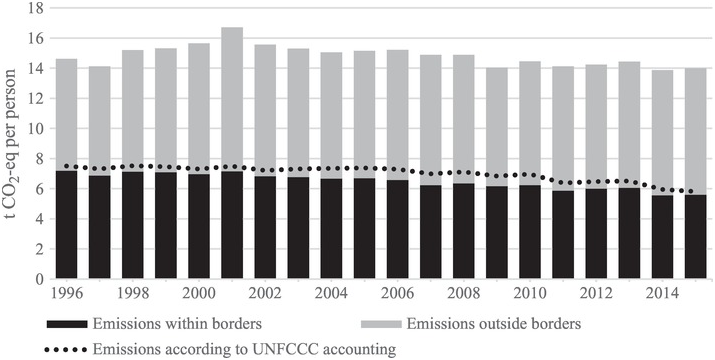
What is more, although Switzerland accounts for less than 0.2 per cent of greenhouse gas (GHG) emissions worldwide, it has comparably high per capita emissions. In 2018, average per capita GHG emissions amounted to 5.4 tonnes of CO2 equivalents – slightly above the global average, but below that of the OECD (see Figure 14.1).
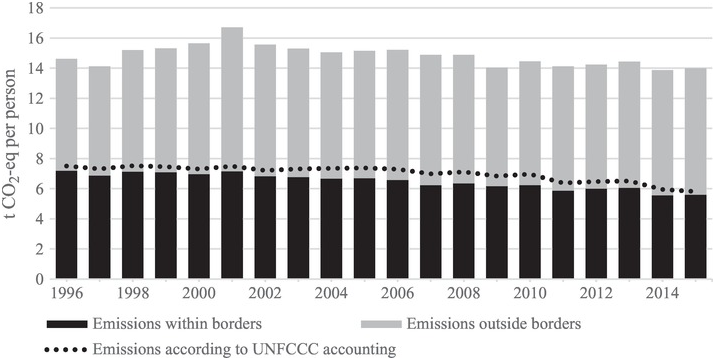
As is visible from Figure 14.1, GHG emissions have decreased. Switzerland did meet its 8 per cent GHG reduction commitment under the Kyoto Protocol’s first commitment period (2008–12). However, only half of this was accounted for by domestic emissions reduction; the rest resulted from the purchase of emission reduction certificates abroad and local forest sinks (FOEN, 2014).3
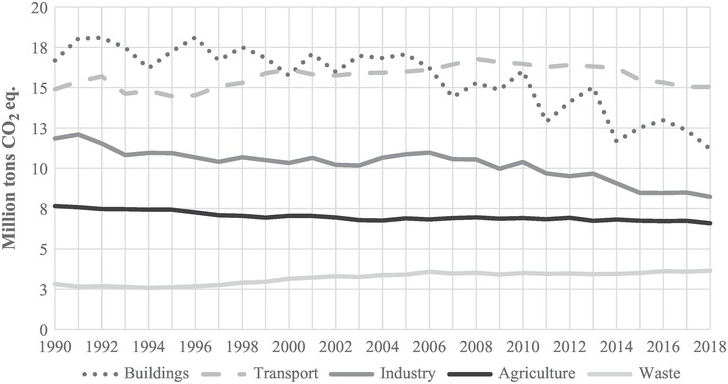
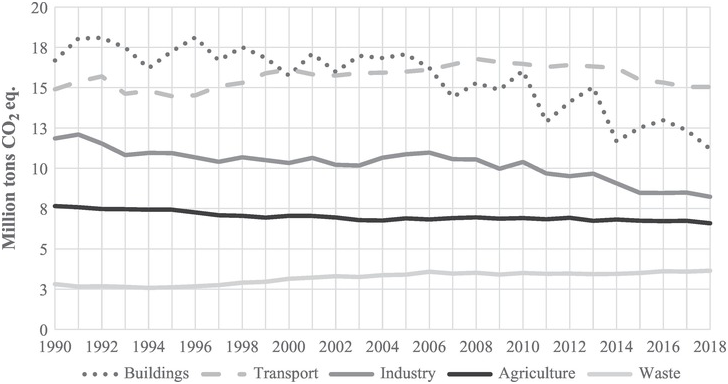
Within Switzerland, by far the largest part of greenhouse gas emissions (77.2 per cent in 2017) stem from transport and heating of buildings (FOEN 2020c). Emissions from domestic electricity generation remain low in comparison to other OECD states as a majority of Switzerland’s supply is (still) based on hydro- and nuclear power. Figure 14.2 provides the developments of GHG emissions per specific sector in 2018 since 1990. The main contributors to the decrease in total emissions are industry, buildings, and agriculture – a consequence of improved thermal insulation and energy efficiency, as well as declining livestock and reduced fertiliser use, respectively (FOEN 2020c). Of further note is the fact that Switzerland is credited with negative emissions (−3.4 per cent) in the UNFCCC category ‘land use, land-use change and forestry’ due to its growing forest area (since 1902, a Federal Act has forbidden a reduction in total forest size; see, Dardanelli and Mueller Reference Dardanelli and Mueller.2019; supplementary data, 27).
In sum, considering its vulnerability, its substantial grey emissions, its high GDP, and its depiction of a role model at the international scale, Switzerland might be expected to invest heavily in climate change mitigation measures. That it fails to do so is not, however, primarily federalism’s fault; in fact, federalism has enabled subnational polities – cantons and municipalities alike – to go beyond national targets. However, the cantons, but more so the municipalities as the lowest level, are limited in how far they can go through the lack of indirect tax powers and their own political considerations. Upscaling of ambitious regional and local policies to the national level has been impeded by direct democracy, the strength of certain lobby groups, and the overall rather conservative nature of the Swiss electorate (e.g., Swissvotes 2021).
14.3 Climate Policy in the Swiss Confederation
14.3.1 Swiss Federalism in a Nutshell
In its modern form, the Swiss federation dates to 1848, when after a brief civil war, the constitutional framework was agreed upon as a compromise between liberal centralizers and conservative regional autonomists (Linder and Mueller Reference Linder and Mueller2021; Vatter Reference Vatter2018). Although since then the federal government has steadily acquired increased powers, the cantons continue to wield significant legislative, administrative, and especially fiscal authority (Dardanelli and Mueller, Reference Dardanelli and Mueller.2019). The roughly 2,000 local governments also exercise significant powers and control own-source revenue (Ladner et al. Reference Ladner, Keuffer, Baldersheim and Hlepas2019; Mueller Reference Mueller2015). Most importantly, Switzerland has moved strongly towards an administrative division of powers whereby the lower levels generally implement the decisions of the higher level(s) as well, of course, as their own. For this reason, the federal government only disposes of a very small administrative workforce: fewer than 35,000 full-time equivalents (EPA 2019) while, by comparison, the city of Zurich alone has 23,000 (Statistik Stadt Zürich 2017, 289).
Three core principles define the workings of Swiss federalism: symmetry, diversity, and subsidiarity (Vatter Reference Vatter2018). Symmetry means that despite immense differences between the cantons and communes in terms of size, resources, and state capacity, all are treated alike by both the federal government and each other. Legally speaking, all cantons are equal, and legislation does not generally distinguish between cities, conurbations, or rural and mountain communes. Diversity, in turn, refers to a largely accepted consequence of cantonal and local autonomy, namely that in non-centralized policy areas such as education, energy, or environmental protection, there may well be very different types and levels of public services. The same is true for the degree of local autonomy, which varies from one canton to the other: generally speaking, eastern municipalities have the most, western ones the least amount of autonomy (Mueller Reference Mueller2015).
The third and final principle, subsidiarity, amounts to a basic presumption of responsibility in favour of lower levels. In other words, a higher level of government is only entitled to intervene if the lower level cannot – or is no longer willing to – fulfil a public task. That counts as much for the division of powers between local and cantonal governments as for that between cantonal governments and the federation. One consequence of this is the ‘enumeration principle’: a higher level of government can only legislate in a given policy area once a constitutional clause (at federal level for the Confederation, at cantonal level for the cantons) explicitly enables it to do so. One effect of this is slower policy change, since every constitutional change has to be approved in a referendum at the corresponding level; at federal level, constitutional change is even harder since a majority of voters and a majority of cantons must agree. In turn, the principle entails considerable room for experimentation at lower levels of government. The potential for policy experimentation is further enhanced by still substantial degrees of subnational fiscal autonomy, both in terms of own-source revenue (direct taxation mainly occurs at cantonal and local level) and expenditures. However, in Switzerland fiscal autonomy also generally means fiscal responsibility and the need to find the appropriate funding sources, which in turn must pass their own referendum test. In the city of Bern, for instance, the ordinary budget is subject to a mandatory referendum every year.
14.3.2 Swiss Climate Policy in the Federal Context
Regarding climate policies, cantons are not only in charge of implementing national decisions in environment, energy, and transport, but they can also take their own decisions in these and related areas. While climate change mitigation policy may well be defined at the national level (though implementation is largely left in the hands of the cantons), adaptation policy is even less centralized.4
14.3.2.1 Mitigation
Mitigation is strongly affected by international agreements and the Conferences of the Parties (COPs), and the decisions therein, related to the UNFCCC (United Nations Framework Convention on Climate Change). It is thus the central government’s responsibility, and the federal parliament’s final decision, to comply with international commitments and design domestic policies accordingly (Ingold and Pflieger Reference Ingold and Pflieger2016). For instance, the key legal document, the federal CO2-Act of 2013, defines an overall national CO2 emissions reduction target and introduces some core instruments for its implementation at national level.5 These include a CO2 tax on combustibles, tradable permits (CO2 certificates), import restrictions for some vehicles, and a technology fund to support clean-tech innovations. To comply with its own nationally determined contribution (NDCS) to the 2015 Paris Agreement, Switzerland needs to revise that Act. A first version contained a tax on flight tickets and further CO2 reduction measures for the finance sector. However, the reform failed narrowly in a binding referendum in June 2021, so the old CO2-Act is prolonged over the next years with many core policy instruments phasing out in 2022. A new proposal was published by the Swiss government in December 2021, but it will most likely again have to overcome the referendum hurdle once through parliament. In consequence, the next version most likely will pursue a focus on fundings instruments instead of taxes and levies.
However, climate policy is far from completely centralized since the two key sub-sectors most heavily contributing to national CO2 emissions are almost exclusively in cantonal hands: building and transport (see also Figure 14.2). Together with policy autonomy, huge differences therefore exist across the Swiss territory: each one of the twenty-six cantons defines and implements its own standards relating to building insulation, energy efficiency, heating, and public transport, but also in terms of renewable energy promotion. Moreover, not only the legal and administrative, but also the fiscal capacities vary significantly: while Swiss residents pay income and property tax to all three levels of government, the lion’s share of direct taxes either stays at subnational level or is transferred back to it. The federal government, in turn, mainly disposes of income from indirect taxation such as VAT, tariffs, alcohol and tobacco duties, and other specialized levies. A sophisticated system of fiscal equalization, last fully revised in 2008, ensures that even the poorest cantons are equipped with exactly 86.5 per cent of the Swiss-wide average of fiscal resources. The system is funded both vertically, by the federal level, and horizontally, by the richer cantons. Most cantons have established similar fiscal equalization systems for their local governments. However, such transfers – although unconditional in nature – are generally used to cover running administrative costs or for debt service and investments into basic infrastructure, so that there is not much left to engage in costly environmental innovation even if beneficiary jurisdictions had the political will to do so.
An important pillar of Swiss climate and energy policy is the support and promotion of renewable energy. Here, differences across the cantons could not be bigger. After the 2011 nuclear catastrophe in Fukushima, the federal government decided to phase out nuclear energy, which at that time produced some 40 per cent of all electricity consumed. To reach this goal, in 2018 a new energy policy entered into force with the aim of shutting down all nuclear power plants within the next few decades, reducing overall energy consumption, and increasing the production from renewable sources. Since Switzerland almost reached the peak of its potential in hydropower production (BFE 2019), the focus is on other renewables such as solar, geothermal, and wind power.
However, the great variation in geographical and political conditions of the cantons has resulted in very different implementation. Some cantons prefer to increase the output from hydropower. But landscape and environmental protection are not always compatible with requests of the new energy strategy. This also holds true for wind power. The potential in Switzerland is not huge and wind park projects often face local opposition by landscape or bird protectionists. Finally, some cantons and municipalities wish to promote solar panels, which need different types of regulation (incentives and promotional measures, through such mechanisms as tax deductions or project grants) than wind or hydropower (a spatial planning problem). In sum, the different cantons face different challenges, like physical power, local opposition, or lacking policy instruments to support the local energy source (Kammermann Reference Kammermann2018; Stadelmann-Steffen et al. Reference Stadelmann-Steffen and Dermont2018). Thus, not all cantons would or should rely on the same policy portfolio, as each source or context requires diverse and tailor-made policies and instruments (Stadelmann-Steffen and Dermont Reference Stadelmann-Steffen and Dermont2018).
14.3.2.2 Adaptation
Adaptation, meanwhile, is characterized by strong non-centralization, and most design and implementation powers are in the hands of the cantons – or even, depending on the canton, the municipalities. This has both historic and pragmatic reasons. On the one hand, certain climate change adaptation sectors such as flood prevention or landscape protection belong to the oldest regulated fields in Switzerland. Sectoral policies developed long before something ‘unifying’ called ‘climate change’ or ‘climate change adaptation’ even existed. On the other hand, given Switzerland’s territorial fragmentation and socio-economic diversity, non-centralization and tailored adaptation are justified by the different needs of the twenty-six cantons in land use and economic development, with tourism being the main factor in the mountains.
Nonetheless, even though climate change adaptation is heterogeneous and non-centralized, the Swiss government released an action plan for 2014–19 that defined specific goals, challenges, and measures. It was updated to a new action plan for 2020–5. To guide the implementation of the strategy at cantonal and local levels, an advisory pilot programme and a guideline for climate-adapted settlement development was launched by the Federal Office for the Environment (FOEN), the designated national authority for climate policy. However, only very few monitoring mechanisms and no sanctions are laid out – which is why the concrete design and introduction of measures as well as their implementation remain at the mercy of lower levels of government (see also Table 14.1).
In principle, a political system composed of some 2,000 local, twenty-six cantonal, and one federal government, all largely disposing of their own powers and resources, might seem prone to end up in a race-to-the bottom competition and excessive policy fragmentation. However, unlike US federalism for instance, competition is accompanied by a strong sense of within- and between-canton solidarity (Linder and Mueller Reference Linder and Mueller2021). In addition, the different levels of government generally refrain from encroaching onto each other’s policy spheres. Instead, there are a great number of vertical and horizontal cooperation bodies, both general and policy-specific, as well as hundreds of binding inter-cantonal treaties (Vatter Reference Vatter2018). Despite its dual origins, the Swiss federation today is much closer to the German administrative model (Mueller and Fenna Reference Mueller and Fenna.2022).
Furthermore, the federal level typically lacks the political will, legal basis, and/or the revenue to become active in areas already occupied by the cantons. It thus takes a concerted effort by cantonal governments or significant public pressure for the national level, for instance through a popular initiative, to amend the federal constitution or to take away powers from the cantons. At the same time, most cantons are very small – twenty of the twenty-six cantons have fewer than 500,000 inhabitants (BFS 2019) – and equally modest is what they can, or want to, have managed publicly, while spillover effects abound. Political and policy cooperation is also practised within cantons, given that no cantonal executive is formed by a single party (BFS, 2019), and inter- and intra-cantonal cooperation reinforce each other (Bolleyer Reference Bolleyer2009; Mueller and Hechter Reference Mueller and Hechter2019). The net effect of all these structural features is, on the one hand, that public action is endowed with great degrees of democratic, bottom-up legitimacy. On the other hand, the need to build consensus and to cooperate across political parties and territorial borders slows down policy innovation and exacerbates differences. The following section explores these differences analytically.
14.4 Janus-Faced Swiss Federalism? Cantonal Adaptation and Municipal Mitigation
To test whether and to what extent Swiss federalism permits local innovation and experimentation, this section compares the Swiss cantons and selected municipalities in view of developing their own climate change policies. The intuitive explanation would be a polity’s degree of vulnerability or exposure. Because of topographic or physical reasons, some cantons are more exposed to climate change effects than others, which in turn might explain why they act faster and/or more comprehensively.
At the municipal level, in turn, we investigate climate change mitigation and the adoption of the ‘energy city’ label, including climate-friendly measures and the promotion of the 2000-Watt society.6 For both analyses, we rely on two master’s theses defended at the University of Bern (Schmid Reference Schmid2018; Wieser Reference Wieser2018) under the supervision of one of the co-authors. Disentangling the socio-economic, political, and institutional factors for differences in subnational climate policy provides us with a look deep inside the actual workings and deficiencies of Swiss federalism. The method used in both studies is QCA (see Box 14.1); the technical details of the results are explained in Boxes 14.2 and 14.3. For an overview of factors studied, see Table 14.2.
Different from a regression analysis that accounts for the causality between an independent and a dependent variable and maybe some interaction effects or control variables, QCA is strong in explaining outcomes (dependent variables) via the combination of conditions (independent variables). It thus follows the Boolean logic and investigates if (a) a factor is a necessary or a sufficient condition for an outcome to occur, and (b) if the presence and absence of certain factors is important for this outcome (see Dusa Reference Dusa2019; also ‘SetMethods’ in Medzihorsky et al. Reference Medzihorsky, Oana, Schneider and Quaranta.2018). In our cases, the outcome is either the adoption of a climate change adaptation strategy at the cantonal level or the adoption of a gold standard energy label at the municipal level. The conditions are the six factors discussed above (Table 14.1).
Table 14.2 Factors potentially explaining cantonal climate adaptation and municipal climate change mitigation
| Cantonal level: climate change adaptation | Municipal level: climate change mitigation | ||
|---|---|---|---|
| ALPS | High percentage of coverage with Alps | PERFORMANCE | High energy efficiency performance |
| PERCEPTION | Cantonal citizens perceive climate change as a threat (above and below the Swiss mean) | EXTERNAL CHANGE | Changes in energy policy at the cantonal level |
| GOAL ADAPTATION | Climate change adaptation mentioned as a legislative goal | GOAL ENERGY | Energy city gold standard defined as a legislative goal |
| MITIGATION | Climate change mitigation is supported by the canton | ENERGY SUPPLY | City has its own energy supply company |
| LEFT | Head of department from left or green party | LEFT | Head of department from left or green party |
| ADMIN | Size of cantonal administration | LEGISLATIVE | Proportion of left-green seats in municipal parliament |
14.4.1 Subnational Diversity in Climate Change Adaptation
Twelve cantons currently have an ambitious or even very ambitious climate change adaptation strategy.7 The other fourteen do not have a proper legislative document, and most of them do not even explicitly aim at adapting to climate change. What are the necessary and sufficient conditions (factors) that lead to the adoption of a climate change adaptation strategy at the cantonal level? To assess this question, we looked at six different conditions: (1) As seen above, cantons with a high percentage of coverage with ALPS tend to be more vulnerable to climate change, rendering adaptation action more likely. (2) Naturally, this is spurred by a high PERCEPTION of climate change being a threat by cantonal citizens.8 Furthermore, cantons show greater ambition in climate change adaptation if (3) such adaptation is already mentioned as a legislative goal (GOAL ADAPTATION), (4) the federal climate change MITIGATION policy is supported by the canton, and (5) the head of government is from a LEFT or green party.
No single condition was evaluated as necessary (Wieser Reference Wieser2018). The only condition coming close to the degree of necessity (Ragin Reference Ragin2008) is MITIGATION, or the explicit support of national mitigation targets (e.g., CO2 reduction). In other words, most cantons that support the national mitigation targets also introduce a cantonal adaptation strategy. But, generally, the situation of when and why cantons adopt an adaptation strategy is more complex (see Box 14.2). Some conditions are sometimes present and sometimes absent (like MITIGATION or the support of a LEFT department head), yet still an adaptation strategy was introduced. Nevertheless, we can still infer some generalities. Climate change adaptation anchored as a GOAL in the cantonal legislature, and an explicit support of national MITIGATION targets are never present together at the same time. But we can conclude that both their independent presences can be a condition that leads, in combination with other conditions, to the adoption of climate change adaptation policies. Furthermore, the vulnerability of a canton (ALPS) seems to make a difference, also for the other conditions that need to be present. In alpine regions, GOAL or MITIGATION, the latter together with strong citizens’ PERCEPTION of the problem, lead to the adoption of a climate change adaptation strategy. In contrast, in non-alpine regions it is additionally the presence of a LEFT department head that seems decisive. We thus find an interesting mix of the degree of affectedness, politics, and policy that jointly leads to the climate adoption of climate change adaptation policy at the cantonal level. What this means for Swiss federalism is discussed below, after having looked at the municipal level.
| Consistency | PRI | Raw coverage | Unique coverage | Cases | |
|---|---|---|---|---|---|
| mitigation*GOAL | 1 | 1 | 0.325 | 0.191 | AG, BL, ZH, UR, GR |
| MITIGATION*LEFT*alps | 1 | 1 | 0.189 | 0.189 | BS, SH |
| GOAL*left*ALPS | 1 | 1 | 0.189 | 0.054 | UR, TI |
| MITIGATION*left*ALPS*PERCEPTION | 0.846 | 0.638 | 0.209 | 0.15 | VD, VS |
Note. Consistency of 1 is a maximal consistency of the result. PRI is the proportional reduction in consistency. Coverage indicates how much this combination of conditions covers in comparison to all possible combinations. This is also related to the number of cases explained.
The first column in Table 14.2 indicates the four pathways that lead to an adoption of a cantonal adaptation strategy. Five cantons have a strategy (AG, BL, ZH, UR, and GR) that is explained by the combination of the absence of mitigation support and the presence of an adaptation goal set for the legislature. So, in QCA language, the presence of a condition is always indicated via capitals, and the combination is indicated through a *. In other words, the * reads like an ‘and’. The other three pathways combine (a) MITIGATION support at the national level with a left department head and the absence of alpine regions; (b) the climate change adaptation GOAL formulation, the absence of a left department head, and the presence of alpine regions (ALPS) in the canton; and (c) the support of national MITIGATION targets, the absence of a left department head, and the presence of both alpine regions and a high climate perception amongst the cantonal population (ALPS and PERCEPTION).
There are no deviant cases where one of these combinations would also be true for a canton that does not adopt an adaptation strategy. However, two cantons, Solothurn and Geneva, are not explained via either of these consistent pathways.
14.4.2 Climate Change Mitigation at the Municipal Level
Although only a small country, Switzerland has more than 2,000 municipalities that possess considerable autonomy, the capacity to undertake policy actions, and act as innovative entrepreneurs. One example for local innovations are labels such as ‘Energy City’ (Energiestadt). Schmid (Reference Schmid2018) investigated the drivers for nineteen medium-size Swiss cities to make a strong commitment to climate change and energy efficiency (gold standard energy label). Ten of them adopted the ‘gold standard’, nine did not. Box 14.3 summarizes the four pathways that lead to the adoption of a municipal energy label (see Table 14.4). Generally speaking, at the local level a ‘race to the top’ – to greener and more ambitious climate change mitigation policy – characterized those cities that had already paved their way beforehand. These exhibit remarkable energy performance and have not much to add to fulfil the standard’s requirements, receive incentives from the national or other cantonal subsystems, or have already made up their mind in terms of defining their own energy efficiency goals. While this is again good news for Swiss federalism in terms of not holding back the local climate pushers, it does little for the rest for the country and may even act as an excuse for the federal level not to get (too) involved (see also Keeler Reference Keeler2007, 354).
| Consistency | PRI | Raw coverage | Unique coverage | Cases | |
|---|---|---|---|---|---|
| PERFORMANCE*ENERGY SUPPLY*LEGISLATIVE | 0.922 | 0.922 | 0.368 | 0.251 | Uster, Neuchâtel, Schaffhausen, Frauenfeld |
| CHANGE*GOAL*LEFT | 1 | 1 | 0.349 | 0.079 | Dietikon, Zug, Köniz, Montreux, Frauenfeld |
| CHANGE*LEGISLATIVE*LEFT | 1 | 1 | 0.313 | 0.067 | Vernier, Köniz, Montreux, Frauenfeld |
| PERFORMANCE*CHANGE*GOAL*ENERGY SUPPLY | 1 | 1 | 0.199 | 0.058 | Riehen Frauenfeld |
Note. Consistency of 1 is a maximal consistency of the result. PRI is the proportional reduction in consistency. Coverage indicates how much this combination of conditions covers in comparison to all possible combinations. This is also related to the number of cases explained.
Again, there is no deviant case, and this time, there is even no case that stays unexplained. So, the ten positive cases (i.e., cities with the gold standard energy label) are all explained via one or more of the four pathways presented in Table 14.3. Interestingly, the conditions are always positive: no absence of a condition together with other conditions lead to a positive outcome. The first pathway is in the sense of the Multiple Streams framework and combines three indicators from each stream: first, high PERFORMANCE. This means that there is evidence that the energy performance of the city is rather high and not much effort needed anymore to comply with the gold standard requirements. This effectively seems to ease the adoption of the label, together with an own ENERGY SUPPLY company (policy stream), and the LEGISLATIVE in the hands of the left-wing parties. The second and third pathway include the presence of a LEFT department head (politics stream) together with CHANGES occurring in other subsystems (such as incentives coming from the national energy subsystem; problem stream). Additionally, the second pathway includes a policy stream factor: the GOAL formulation (the city makes climate change mitigation a local goal to respect); whereas the third pathway again a political indicator: the LEGISLATIVE in the hands of the left. The fourth pathway then combines PERFORMANCE; with external CHANGE; GOAL and an own ENERGY SUPPLY company present in the city.
More particularly, at the local level political factors play a decisive role. The energy department and/or the municipal parliament in the hands of the left are two conditions present in three out of four pathways explaining ambitious local climate change mitigation policy. Also, external changes and evidence as well as energy goals facilitate the introduction of the label. Finally, and this is a consistent finding with other studies (Kammermann Reference Kammermann2018), economic factors and local entrepreneurship induce innovative action. This is why the presence of an own energy supply company in a town also spurs adopting more ambitious energy standards.
14.4.3 Synthesis of the Two Case Studies
Swiss federal climate policy, albeit modest in ambitions and held in check as recently as June 2021, does at least allow regional and local governments to become climate pioneers and adopt both adaptation and mitigation strategies in their own right. Swiss federalism permits both innovation and experimentation. However, the climate policy field is quite different from other areas such as education or health (see Füglister Reference Füglister2012; Maggetti and Gilardi Reference Maggetti and Gilardi2016). There, different diffusion mechanisms and also intensive inter-cantonal competition can be observed that lead to the willingness of some cantons to provide best practice examples and learn from each other. Cantons rely extensively on inter-cantonal cooperation bodies (interkantonale Direktoren-Konferenzen, see Vatter Reference Vatter2018, 73ff.), where the respective department heads meet to exchange experiences in such best practices. While there does indeed exist a Conference of Cantonal Energy Directors (EnDK), it seems that there is administrative coordination, but no real regulatory competition between or diffusion among the cantons about climate change policies (see also Sprinz and Weiss Reference Sprinz, Weiss., Luterbacher and Sprinz2001). Thus, while innovation does occur, it is less likely to translate into a diffusion of best practices or even a coherent national and binding strategy.
That climate change is such a cross-cutting policy area definitely does not help either, since there are separate Conferences for Landscape (KWL), Transportation (KöV), Planning and Environment (BPUK), Agriculture (LDK), and, of course, Economy (VDK) and Finance (FDK) (Vatter Reference Vatter2018, 76). By consequence, it seems unlikely that higher energy or environmental protection standards get promoted jointly (see Casado-Asensio and Steurer Reference Casado-Asensio and Steurer2016). Moreover, and with relevance mainly for climate change adaptation, climate effects also vary a lot across cantons: every canton seems best served in compiling its own portfolio of measures to fight climate change and does not compete with or rely upon experiences made in other cantons.
Finally, neither the cantons nor the cities have so far come under pressure from the central government to adopt ambitious adaptation or mitigation targets and policies. There also seems to be very little competition between the cantons and cities in this regard. At both levels, there are several cantons and cities that have introduced climate policies, but there are at least as many that have not. Our results show that climate policies are easiest to introduce when left-wing parties (Socialists or Greens) are leading the respective cantonal or municipal department or hold majorities in the parliament. Besides this political condition, existing policies also matter: as soon as the canton or city supports already formulated targets at the national level, or introduces its own targets at cantonal or municipal level, adaptation and mitigation policies are more likely to materialize. Finally, problem perception and affectedness are also part of the mix of conditions that lead to regional and local climate action. Yet vulnerability and affectedness amount to neither a sufficient nor a necessary condition: it is only in combination with being prepared (through policy goals) and having the ‘optimal’ leader or political support (left-wing) that regional or local climate policy materializes. But what is great news for Swiss federalism as decentralization is bad news for overall Swiss climate change governance.
14.5 Conclusions: Enhancing Intercantonal Coordination
Swiss cantons and cities only occasionally collaborate and exchange experiences when it comes to climate change adaptation and mitigation. Put differently, it is not through ‘learning from others’ that they start engaging in more ambitious climate change policies. This is also true for measures on energy efficiency and the promotion of renewable energies. Every canton has its own geo-topographical specificity which affects its energy portfolio as well as its vulnerability to climate change. This in turn makes some steering mechanisms more suitable or acceptable than others (Stadelmann-Steffen et al. Reference Stadelmann-Steffen, Rieder and Strotz.2020). In other words, every canton is affected differently by climate change and also possesses a different potential to promote renewables. As a result, every canton needs a different portfolio of steering mechanisms and implementation arrangements to achieve the set targets in both climate change mitigation and adaptation (Kammermann and Ingold Reference Kammermann, Ingold., Stadelmann-Steffen, Ingold and Rieder2019).
While this would indeed offer a favourable context for experimental policymaking, so far federalism has created a fragmented patchwork of different regional climate policies rather than a joint learning from innovative solutions and best practices. The plethora of cantonal and local solutions can also obstruct national policymaking in that not only are national directives implemented differently in the different cantons, but centralization steps are generally harder to take given the obstacle of direct democracy in combination with a still deeply ingrained federal political culture. Paradoxically, subnational pioneers can also be misused as an excuse for further delaying action at federal level: if they can do it, why should we? This feeds into a wider default-reaction against further centralization: ‘The combination of federalism with direct democracy … gives the cantons high veto power and amounts to a considerable obstacle for federal innovation. One of the most common arguments against national policies is mistrust of the federal government and defence of cantonal autonomy’ (Linder and Mueller Reference Linder and Mueller2021, 82).
Nevertheless, our research has shown that there is ample room for intensified diffusion and exchange: there do exist institutionalized platforms such as the Conference of Cantonal Energy Ministers, where experiences can be shared and evidence-based problem perception about climate change effects developed. This is even truer for the municipal level: unlike the cantons, Swiss cities face very similar challenges in this area, and thus the exchange of experiences would be even more effective at this level. In short, so that subnational policy innovations become elements of experimental learning their existence must be communicated and discussed and their effects assessed and compared.9
Linking the acceptance of subsidiarity as bottom-up policymaking to the role of politics identified in this chapter, leads to the conclusion that local decision-makers especially from left–green parties are able to fill the void created by both the reluctant national level and insufficient subnational coordination. At the same time, we see the price to be paid for the excessive levels of both local and regional autonomy still present in Switzerland: subnational units can afford not to learn from each other. Or rather, they can be left to believe so.

 Open access