

Introduction
Building on the success of the International Ancient Egyptian Mummy Tissue Bank established in Manchester in 1996 (Reference Lambert-ZazulakLambert-Zazulak 2000: 44; Reference DavidDavid 2008: 240), the Ancient Egyptian Animal Bio Bank is a centralised database for ancient animal remains in collections outside Egypt. The Bio Bank contains acquisition records, geographic provenance and date, measurements and descriptions, photographs, radiographic images (X-ray and CT scans) where possible, and results from previous studies. It also provides a safe location for the storage of small samples removed from such specimens, providing an unparalleled resource for use by future researchers.
The Bio Bank can be viewed alongside research currently underway at international institutions, such as the Animal Mummy Project at the Cairo Museum (Ikram & Iskander 2002; Reference IkramIkram 2005), and previous work by the authors (Reference OwenOwen 2000, 2001; Reference McknightMcKnight 2010). These projects strive to enhance our understanding of these specimens, the treatment of animals in the ancient world, and the complex belief system they belonged to.
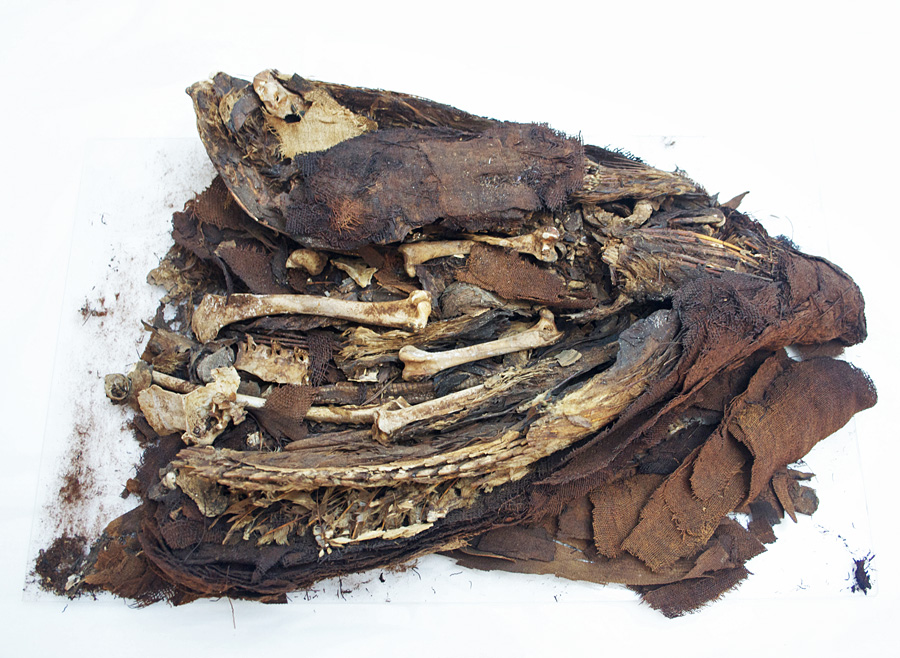
The dissected remains of a mummified hawk showing the poor levels of preservation often encountered when dealing with material of this type ( Kirklees Museums and Galleries; photograph: L. McKnight).

Work to date
An initial mailing to institutions in northern England known or suspected to hold mummified animal material was conducted to gauge the level of response we could expect when the geographical scope of the project was widened. Initially, museums were visited, the specimens were fully recorded and a photographic record was created. Existing radiographic images were collected for incorporation into the database. Through a partnership with the Clinical Radiology team at the Central Manchester Teaching Hospital, the project offers radiological analysis to museums with limited resources. It remains the responsibility of the participating institutions to arrange transport and insurance. Specimens deemed too fragile to be transported were sampled on site at this stage by the Bio Bank team.
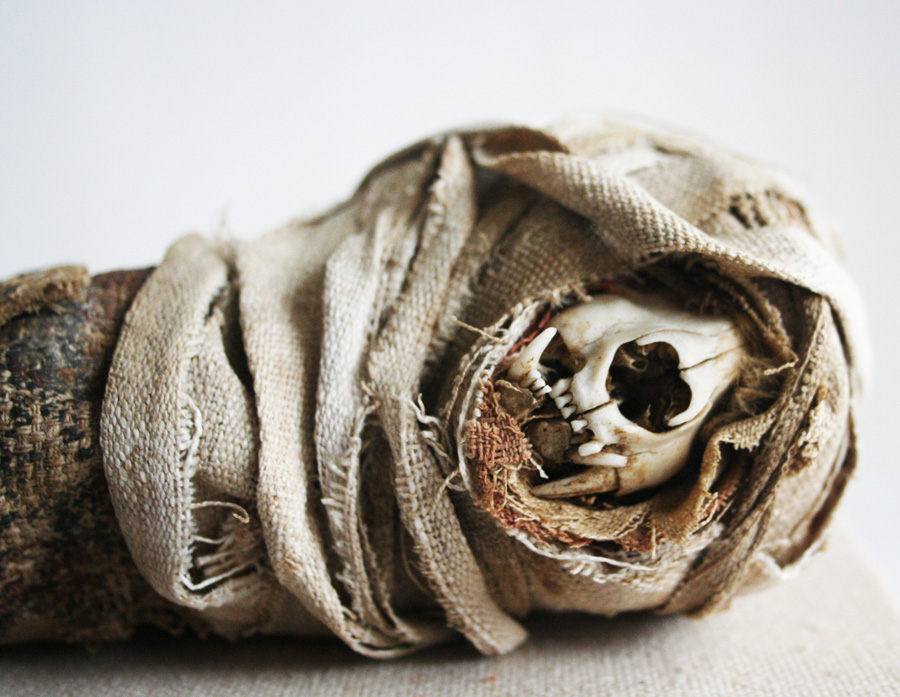
A mummified cat from the Derby City Museum collection displaying full access to the facial area due to lack of bandaging ( Derby City Museum; photograph: L. McKnight).
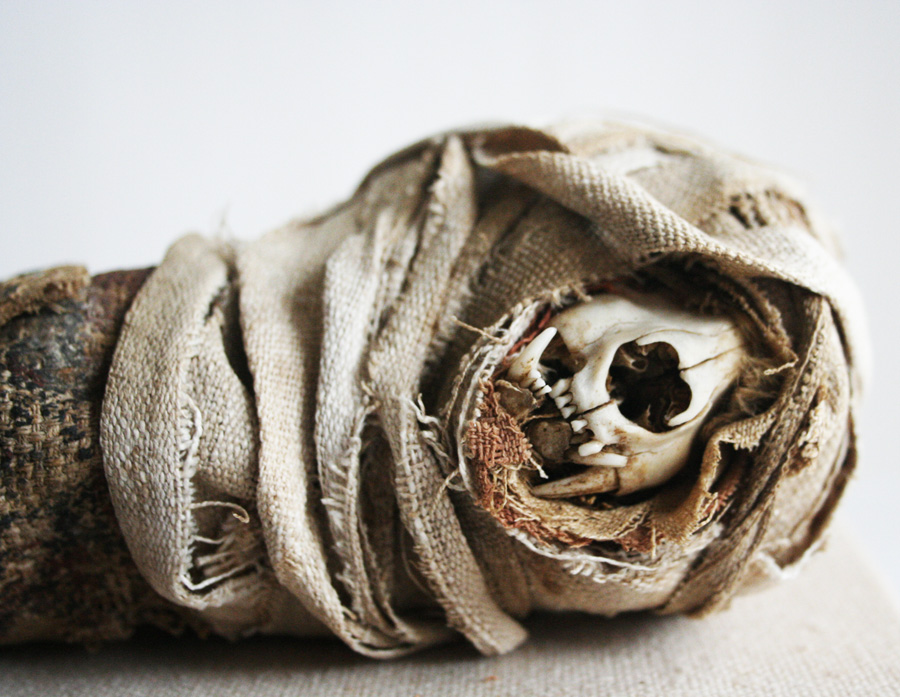
Invasive sampling was conducted on poor quality specimens — those in a fragmented state or those that had suffered damage since their excavation, such as the remains of a mummified hawk (Figure 1). A few specimens had been dissected which allowed direct access into the core and to the skeletal remains. It is difficult to give the sample sizes required for the Bio Bank without first seeing the specimen and conducting an initial assessment including the state of preservation, levels of decoration (the aesthetic appearance) and limitations of access to the contents of the bundle, as shown for example by a mummified cat with missing bandaging around its face (Figure 2).
The rationale behind invasive sampling was to gather material to form the basis of the research against which our aims and objectives would be tested using modern biomedical techniques. Aside from allowing research by the KNH Centre for Biomedical Egyptology, the Bio Bank will provide a resource for international research. Applications from scholars in the field of Egyptology will be welcome; they will be required to submit comprehensive research proposals on how they plan to use the information and samples. Full results of any such research will be stored in the Bio Bank for the use of future generations, thus preventing the duplication of destructive analysis.
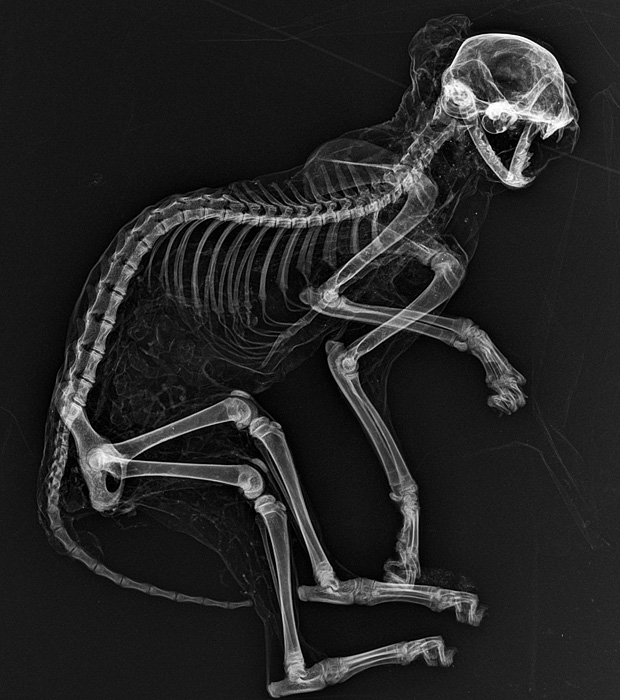
The naturally desiccated mummy of a domestic cat discovered in the bricked up chimney of a house in Ponty Pridd, Wales ( National Museum of Wales, Cardiff/Central Manchester University Teaching Hospitals NHS Foundation Trust).

The project also collects information on modern animal mummies (Figure 3). These specimens are vitally important to the project. They are an excellent resource on which scientific techniques can be investigated and methods fine-tuned, without using the more culturally valuable ancient material.
Prospects
The Bio Bank is a conservation resource: the results of research projects arising from it will be used to update specimen records, providing museums with accurate information on their collections. Institutions will receive copies of all images and results and will be fully cited in future publications, giving them valuable aids for education and display. The implications of establishing the Bio Bank are far-reaching and it is hoped that through its inception and continued use, our knowledge of the role of animals in ancient Egypt will be vastly increased.
The team would be very pleased to hear from institutions who hold collections of mummified animal and skeletal material of any size and who would like to become part of the Bio Bank project. Comparative material from any context or provenance would also be welcomed. Similarly, institutions conducting research on their collections can contact us and have the information stored in the Bio Bank. Contact details will be found at the bottom of this page.
Acknowledgements
The authors would like to express their gratitude to the museums that have supported the project. Particular thanks go to the staff at Bolton Museum and Archive Service, Bristol Museum, Manchester Museum and the School of Archaeology, Classics and Egyptology, University of Liverpool. We thank Professor Judith Adams and the radiography team at the Central Manchester University Teaching Hospitals NHS Foundation Trust for their valued time and dedication to the project. We would also like to thank our fellow colleagues at the KNH Centre for their inspiration and support.