


10.1 Introduction
In the late 1990s, Social Democrats governed twelve of the then fifteen European Union states, and their electoral successes often correlated with Third Way–style ideological moderation to the center (Blair and Schröder Reference Blair and Schröder2000; Keman Reference Keman2011). Yet the first two decades of the twenty-first century have been considerably less kind to Social Democracy at the ballot box (Benedetto et al. Reference Benedetto, Hix and Mastrorocco2020). To what extent does moderation in ideological positioning by social democratic parties affect their short- and long-term electoral fortunes in contemporary advanced democracies? Do the electorates of the major moderate left parties treat these parties differently when they moderate their positions on the economic or cultural dimension?
The ability of citizens to express their preferences by voting for parties with the most congruent policy positions is a fundamental feature of representation (Soroka and Wlezien Reference Soroka and Wlezien2010; Budge et al. Reference Budge, Keman, McDonald and Pennings2012; Rohrschneider and Whitefield Reference Rohrschneider and Whitefield2012). Studying if and how citizens respond to the ideological moderation of major moderate left parties helps clarify if and when party leaders can shape public opinion, and whether citizens approve of or otherwise react to the positional changes of major political parties. It therefore directly addresses the contemporary connection between parties and voters, a cornerstone of representative democracy.
In their analysis of the British electorate between 1983 and 2010, Evans and Tilley (Reference Evans and Tilley2012a: 974) find that “[l]eft-right ideology matters to voters’ party choices, but it matters a lot less when parties are offering policy options that do not differ ideologically from one another.” We extend this supply-side explanation to other party systems of Western Europe to address the fact that “[a]lthough extensive research analyzes the factors that motivate European parties to shift their policy positions, there is little cross-national research that analyzes how voters respond to parties’ policy shifts” (Adams et al. Reference Adams, Ezrow and Somer-Topcu2011: 370). In this chapter, we therefore test competing and complementary ideas about the electoral effects of ideological moderation using a range of social democratic parties over a longer time span with individual-level data.
Our chapter also addresses the rise of sociocultural political competition and the impact of mainstream party policy positions on minor (or previously minor) party successes and failures in elections across Europe (Meguid Reference Meguid2008; van der Brug and van Spanje Reference Van der Brug and van Spanje2009; Pardos-Prado Reference Pardos-Prado2015; Abou-Chadi and Wagner Reference Abou-Chadi and Wagner2020; Spoon and Klüver Reference Spoon and Klüver2020). If supporters of moderate left parties respond to moderation in a similar fashion, a common theoretical framework could help us understand if ideological repositioning by these political parties facilitates challenger party successes and increased party competition over sociocultural issues (Hobolt and Tilley Reference Hobolt and Tilley2016; Spoon and Klüver Reference Spoon and Klüver2019; De Vries and Hobolt Reference De Vries and Hobolt2020).
We make three interrelated contributions to knowledge in these areas: First, the chapter suggests that citizens do respond to changes in the policy positions of social democratic parties. Moderation has driven some voters away from these parties but also helped them retain other voters – though at lower rates. Second, our multidimensional perspective allows us to report additional information about the economic and cultural dimensions of electoral competition. More specifically, social democratic party moderation on the economic left–right dimension decreases the propensity of previous voters to stay with that party in the subsequent election. Whereas for the sociocultural dimension, moderation does not seem to penalize these parties down the road, at least in relation to retaining existing party supporters. Finally, we illustrate that supplementing aggregate-level analysis with individual-level data is crucial to capturing the dynamic relationship between a party’s shift to the center and electoral support. Our compilation and use of individual-level data to carefully track citizen responses to party policy shifts allows us to show that while moderation could pay off in the short run, it may also reduce the chances that voters stick with social democratic parties at subsequent elections. These differences would not be observable in aggregate analysis.
10.2 Explaining How Voters Respond to Shifts in Party Positions
There is strong empirical evidence that parties update and adjust their positions in response to shifts in citizen preferences, presumably in an attempt to enhance their electoral prospects (Adams et al. Reference Adams, Clark, Ezrow and Glasgow2006; Ezrow et al. Reference Ezrow, de Vries, Steenbergen and Edwards2011; Lehrer Reference Lehrer2012; Schumacher et al. Reference Schumacher, de Vries and Vis2013; Abou-Chadi and Orlowski Reference Abou-Chadi and Orlowski2016).Footnote 1 However, the relatively few cross-national studies that examine if citizens systematically react to parties’ policy shifts in real-world multiparty electoral competition provide less consistent evidence (see, e.g., Adams Reference Adams2012; Meyer Reference Meyer2013). A particularly influential and provocative study found little to no responsiveness from voters to shifts in party policy statements (Adams et al. Reference Adams, Ezrow and Somer-Topcu2011). Respecifying some key components of this research, others report that election platforms and campaigns produce at least small changes in voter perceptions of party positions (Fernandez-Vazquez Reference Fernandez-Vazquez2014). Still others found that while voters do not respond to shifts as captured in party manifestos, they are responsive to coalition participation as a heuristic for ideological changes (Fortunato and Stevenson Reference Fortunato and Stevenson2013; Fortunato and Adams Reference Fortunato and Adams2015; Adams et al. Reference Adams, Ezrow and Wlezien2016), or respond to other highly visible real-world changes from parties (Seeberg et al. Reference Seeberg, Slothuus and Stubager2017).Footnote 2 For the purposes of this chapter, the lack of consensus about voter responsiveness to the policy shifts of parties as reported in election manifestos is the key takeaway from this debate.
Despite the ongoing discussion about whether or not voters are attentive to and affected by party policy shifts, there is surprisingly more agreement that ideological moderation enhances a party’s vote share, at least initially. Yet much of the empirical evidence suggests that this effect is rather small substantively. The results of Ezrow (Reference Ezrow2005) indicate that the vote shares of Western European political parties increase the closer they are to the middle of the voter distribution on the left–right dimension. Policy moderation as a strategy to expand parties’ vote share is grounded in the spatial voting model (Downs Reference Downs1957a; Enelow and Hinich Reference Enelow and Hinich1984; Lin et al. Reference Lin, Enelow and Dorussen1999). Assuming that the electorate can be aligned along a single dimension and that the distribution of voters on this dimension peaks in the center (see Ezrow Reference Ezrow2005 for cross-country support of the latter proposition),Footnote 3 the optimal strategy of non-extremist parties is to move to the middle, where most voters are located.
Although the expected convergence on the median voter position is based in models of two party competition, Adams and Somer-Topcu (Reference Adams and Somer-Topcu2009b) assert that the Downsian model anticipates party gains from moderation even in elections with four or more competitors, increasing its applicability to Western European democracies.Footnote 4 Beyond vote-seeking centripetal forces, office-seeking parties (Strøm and Müller Reference Strøm, Müller, Müller and Strøm1999) in democracies where coalitions are the norm have additional reasons to take more moderate positions. A party that positions itself near the central tendency of the electorate could increase its flexibility in the formation of government coalitions or its attractiveness to other government formateurs (Ezrow Reference Ezrow2008; Lehrer Reference Lehrer2012). Taken together, the implication is that parties can successfully focus on the political center while maintaining a core base. Kirchheimer (Reference Kirchheimer, LaPalombara and Weiner1966) famously expected that moderate right and moderate left parties would moderate their policy positions in pursuit of the median voter; we follow his terminology here and refer to this as the “catchall argument.”
Adams and Somer-Topcu (Reference Adams and Somer-Topcu2009b) extend on the finding of Ezrow (Reference Ezrow2005) with evidence of a lagged policy moderation benefit for parties in postwar democracies. Aggregate voter support at the current election increased (again by rather small amounts) when left-wing parties moved right or when right-wing parties moved left in the previous election. These authors draw on studies of issue evolution and macro partisanship from the United States (Carmines and Stimson Reference Carmines and Stimson1989; Erikson et al. Reference Erikson, MacKuen and Stimson2002) to make the case that there can be a substantial time lag between when a party elite’s behavior changes, for example, positional shifts, and when voters fully pick up on and respond to these changes.
In contrast to those that find short or longer-term electoral benefits from moderation, others argue that focusing on the center exposes parties to attacks from smaller, more ideologically extreme parties, particularly in proportional electoral systems (Allen Reference Allen2009; Arndt Reference Arndt2014; Schwander and Manow Reference Schwander and Manow2017). This research emphasizes a different aspect of the catchall thesis, namely, the loss of distinctiveness in mainstream party ideologies and longer-term damage this may cause for party brands.Footnote 5 This approach is also consistent with the argument that parties cannot suddenly and costlessly move from point to point in the policy space but are also constrained by activists, organizations, and ideological histories (see, e.g., Meyer Reference Meyer2013; Kitschelt and Rehm Reference Kitschelt, Rehm, Beramendi, Häusermann, Kitschelt and Kriesi2015; Hooghe and Marks Reference Hooghe and Marks2018).
In prior work, we attempted to combine these competing perspectives in an analysis of social democratic electoral performance during the 1980s–2000s in three countries with institutional differences structuring party competition (Karreth et al. Reference Karreth, Polk and Allen2013). After adopting more centrist stances Social Democrats in Germany, Sweden, and the United Kingdom received an anticipated increase in support from centrist voters. These same parties, however, went on to lose voters from the center and the Left in elections that took place more than one electoral cycle after moderation. The moderating moves of Social Democrats in the 1990s, “while initially successful, contributed to their losing power by the early to mid-2000s” (Allen Reference Allen2009: 636). We argued that the influx of centrist support receded because this voting bloc was less attached to Social Democrats and just as willing to vote for other parties or abstain. Over time, programmatic moderation also alienated left-leaning, former supporters as well. In this chapter, we continue to refer to this as the “catch-and-release argument.”
A surge and decline in post-moderation electoral support could result from a combination of political-economic, electoral, and organizational dilemmas faced by most contemporary social democratic parties (Kitschelt Reference Kitschelt1994, Reference Kitschelt, Kitschelt, Lange, Marks and Stephen1999; Green-Pedersen and van Kersbergen 2002; Oesch and Rennwald Reference Oesch and Rennwald2018). The growth and diversification of the service sector encouraged Social Democrats to appeal to more professional workers in addition to the working class (Gingrich and Häusermann Reference Gingrich and Häusermann2015; Häusermann Reference Häusermann, Manow, Palier and Schwander2018).Footnote 6 More market-oriented economic stances and increasingly liberal positions on sociocultural issues were adopted as a means of appealing to these voters (Kitschelt Reference Kitschelt1994; Giddens Reference Giddens1998; Blair and Schröder Reference Blair and Schröder2000). However, the shifts to culturally liberal and market-oriented policy stances that attracted emerging post-material voting groups simultaneously generated tensions within the rank-and-file electoral base of social democratic parties (Rennwald and Evans Reference Rennwald and Evans2014; Oesch and Rennwald Reference Oesch and Rennwald2018). Many core social democrat supporters expect protection of the welfare state and job creation rather than economic moderation and spending cuts (Bremer Reference Bremer2018; Horn Reference Horn2021); when confronted with austerity policies from social democratic governments, these supporters could abstain or defect to competitor leftist parties (Kitschelt Reference Kitschelt, Kitschelt, Lange, Marks and Stephen1999: 324). It therefore remains an important question how the repositioning of social democratic parties on the economic and cultural dimensions of politics has affected electoral outcomes for these parties. Our chapter complements this research by answering calls for cross-national explorations of the electoral effects of policy shifts (Tavits Reference Tavits2007; Adams Reference Adams2012), and by including the fuller range of social democratic parties in a long-term analysis.
Up to this point, we have focused on two interrelated questions: (1) Do voters respond to shifts in party positions over time? and (2) Are mainstream moderate left parties electorally rewarded or punished for ideological moderation? Implicit within this discussion has been the additional complicating factor that party competition in Western Europe is increasingly multidimensional. The importance of a second, sociocultural dimension to contemporary European party politics has been extensively documented by a range of scholars (see, e.g., Kitschelt Reference Kitschelt1994; Kriesi et al. Reference Kriesi, Grande, Lachat, Dolezal, Bornschier and Frey2008; Hooghe and Marks Reference Hooghe and Marks2009; van der Brug and van Spanje Reference Van der Brug and van Spanje2009; Bornschier Reference Bornschier2010; Beramendi et al. Reference Beramendi, Häusermann, Kitschelt, Kriesi, Beramendi, Häusermann, Kitschelt and Kriesi2015).Footnote 7
Changes to the political economies of European democracies pushed many social democratic parties to more culturally liberal policies in the latter part of the twentieth century. At the same time or just slightly later, the anti-immigration positions of the Radical Right presented a challenge on the cultural dimension for the parties of both the Moderate Right (Bale Reference Bale2003, Reference Bale2008; de Lange Reference De Lange2012; Pardos-Prado Reference Pardos-Prado2015) and the Moderate Left (Bale et al. Reference Bale, Green-Pedersen, Krouwel, Luther and Sitter2010; Hinnfors et al. Reference Hinnfors, Spehar and Bucken-Knapp2012). Throughout Europe mainstream moderate left parties face incentives to respond to environmental and/or immigration politics in ways that alter their policy positions on the cultural dimension (Spoon et al. Reference Spoon, Hobolt and de Vries2014; Abou-Chadi Reference Abou-Chadi2016). Recently, Wagner and Meyer (Reference Wagner and Meyer2017) report evidence of an authoritarian shift on the cultural dimension for mainstream parties across the party systems of Europe, and Abou-Chadi and Krause (Reference Abou-Chadi and Krause2020) highlight that radical right party success leads to more culturally protectionist positions from mainstream political parties. Overall, this suggests substantial positional changes on the cultural dimension for the major left parties of Europe, but scholarship examining voter responsiveness to shifts on this dimension has only recently come into sharper focus (but see Plescia and Staniek Reference Plescia and Staniek2017 for related research).
The potential promise of “rightward” shifts by social democratic parties on immigration issues has received particular attention in public and scholarly discourse. An experiment involving Danish citizens in the context of the 2019 parliamentary elections finds that the social democratic party taking more anti-immigration positions attracts anti-immigration voters and repels pro-immigration voters, but that the latter tend to defect to supporting parties of the Left, thus increasing overall support for a social democratic-led government (Hjorth and Larsen Reference Hjorth and Vinæs Larsen2022). In a comparative study, Spoon and Klüver (Reference Spoon and Klüver2020) further report that shifts in an anti-immigration direction provide electoral benefits for mainstream left parties. Alternatively, Abou-Chadi and Wagner (Reference Abou-Chadi and Wagner2020) report no evidence for the expectation that taking more authoritarian/nationalist and anti-EU positions increases electoral support for social democratic parties and find that social democratic parties can win votes by focusing on investing in citizens’ productivity when they also take more liberal sociocultural positions and are not opposed by strong unions (Abou-Chadi and Wagner Reference Abou-Chadi and Wagner2019). Connecting to this line of research, we therefore test our arguments on both the economic and cultural dimensions of party competition – but unlike other work, we focus on the longer-term impact of moderation and right-ward shifts by examining voter responses one election after major left parties moderated their platform.
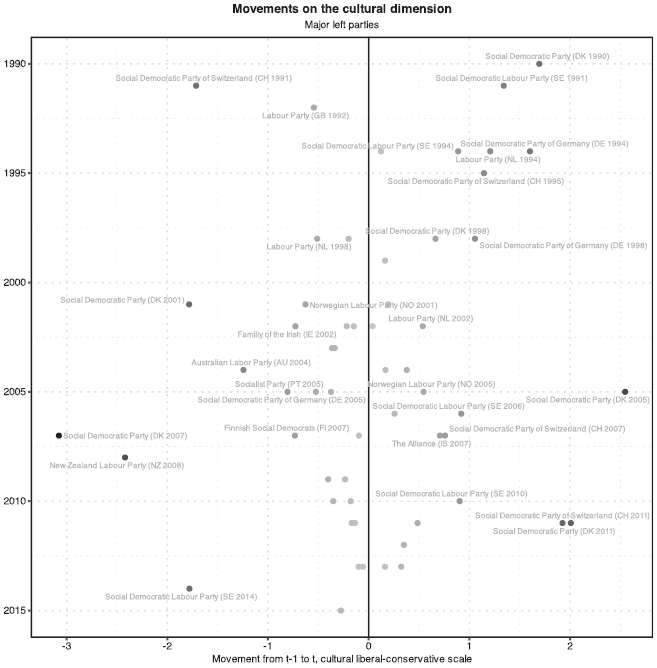
Does the impact of moderation on repeat voting vary between the economic and cultural dimension? While disentangling the separate effects of economic and cultural preferences on vote choice is difficult (Stoetzer and Zittlau Reference Stoetzer and Zittlau2020), we highlight the historical importance of the economic dimension for the social democratic party. Using a measure of relative salience between the economic and cultural dimensions for the party families of Western Europe with manifesto data, Koedam (Reference Koedam2022) reports that social democratic parties attribute more weight to the economic dimension relative to the cultural dimension than do any other party family. Thus, not only should Social Democrats be more rooted and ideologically constrained on their dominant dimension (Hooghe and Marks Reference Hooghe and Marks2018), here economic left–right, but the electoral effects of positional changes on the dominant dimension (positive or negative) should also be stronger than changes on the subordinate dimension. On the sociocultural dimension, the party family should have more positional flexibility (Rovny Reference Rovny2013; Koedam Reference Koedam2022), but could also expect relatively less electoral impact from their positional changes. Any expected electoral gains from moderation on the sociocultural dimension by social democratic parties are further complicated by the existence of “new left” and “new right” competitor parties with substantial and rather durable ownership of issues like the environment and immigration that feature prominently in the cultural dimension (Abou-Chadi Reference Abou-Chadi2016; Seeberg Reference Seeberg2017). In the hypotheses that follow, we therefore anticipate moderation on the economic dimension to have a larger impact on repeat votes for Social Democrats than moderation on the sociocultural dimension. This is also the case because, as Figure 10.4 shows, more pronounced moves on the cultural dimension happened in the later periods of our dataset, implying that any voters who may have been attracted to social democratic parties because of these moves would not yet appear in our data as prior social democratic voters.
10.3 Hypotheses on the Longer-Term Impact of Moderation
Drawing on arguments in the existing literature that highlight the benefits and drawbacks of catchall strategies, we test the following hypotheses. The catchall argument can be extended to suggest that voters reward moderation beyond the immediate preelection period (Adams and Somer-Topcu Reference Adams and Somer-Topcu2009b). Therefore, a successful catchall strategy implies that voters are more likely to vote again for social democratic parties in consecutive elections if these parties have moderated in the previous election cycle, compared to parties that did not moderate (H1).
The counterargument, outlined in Karreth et al. (Reference Karreth, Polk and Allen2013) but also with roots in standard spatial theory (e.g., Häusermann and Kitschelt, this volume) suggests the opposite: Voters may be more likely to vote for social democratic parties that moderated in the election immediately following moderation (compared to parties that did not moderate), but they will be less likely to vote for the same social democratic party again in the subsequent election (H2).
In our analyses in this chapter, we compare three different vote choices associated with these hypotheses: continued voting for major left parties (vs. any other party or abstention), switching to minor left parties (vs. any other party or abstention), and switching to parties on the right (vs. any other party or abstention). As we discuss in more detail in Section 10.4, our empirical strategy focuses on the effects of social democratic moderation on retaining prior supporters of the party family. For methodological reasons, we do not test here if moderation results in the expected influx of centrist voters, a dynamic for which we have found some evidence in our prior work (Karreth et al. Reference Karreth, Polk and Allen2013). We stress that attracting such centrist voters through moderation would also be consistent with the literature and doing so is the intended goal of moderation in the first place. We do, however, note that subsequently switching to parties on the right (the third set of our analyses) would be a likely outcome for any centrist voters picked up by moderation but with only weak or no enduring bond to social democratic parties.
The present chapter is particularly well-suited to examining the response of social democratic electorates to positional moderation in the form of vote switching to minor left challenger parties within the same ideological bloc, a scenario highlighted as a pressing concern for contemporary Social Democracy (Allen Reference Allen2009; Arndt Reference Arndt2014; Schwander and Manow Reference Schwander and Manow2017).
10.4 Empirical Strategy
This chapter makes three main contributions; the research design reflects each. First, distinct from most studies in this area as well and continuing an idea outlined in Karreth et al. (Reference Karreth, Polk and Allen2013), we broaden our focus from immediate movements (directly prior to an election) to movements one period before the election in order to capture possible mid-to longer-term effects of moderation and test whether voters respond differently to these than to more recent party position movements. Second, following studies exploring the impact of Downsian moderation strategies at the aggregate level of vote shares (see, e.g., Ezrow Reference Ezrow2005; Adams and Somer-Topcu Reference Adams and Somer-Topcu2009b), we focus on the individual level of analysis and explore the impact of movements in parties’ positions on individual vote choice, following cues from prior studies (e.g., Tavits Reference Tavits2007: 161). Finally, reflecting the growing importance of multidimensional political competition in European democracies, we track party moderation on both the economic left–right and cultural liberal–conservative dimensions.
The unit of analysis for this study is the individual voter who had previously voted for a major left party. We obtain information on these individuals from a number of election studies. These studies cover elections in up to sixteen countries during the years from 1996 to 2013, with varying coverage by country. Table 10.1 lists all elections covered in the analyses discussed later. This time period comports well with the trend that motivates this chapter: major left parties’ move to the center in the 1990s and our interest in estimating longer-term effects of these moves.
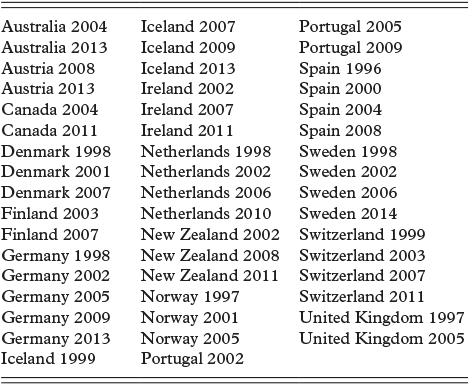
Sources for the individual-level data include four modules of the Comparative Study of Electoral Systems (The Comparative Study of Electoral Systems 2015a, 2015b, 2015c, 2017) as well as national election studies from Denmark (Andersen Reference Andersen2007, Stubager et al. Reference Stubager, Andersen and Hansen2013), Germany (Berger et al. Reference Berger, Jung and Roth1999), Great Britain (Clarke et al. Reference Clarke2006, Fieldhouse et al. Reference Fieldhouse, Green, Evans, Schmitt, van der Eijk, Mellon and Prosser2016), the Netherlands (Todosijević et al. Reference Todosijević, Aarts and van der Kaap2010), Norway (Aardal 2016), Sweden (Holmberg and Oscarsson Reference Holmberg and Oscarsson2012, Reference Holmberg and Oscarsson2017), and Switzerland (Selects 2013).Footnote 8 We then match information on party positions and their movements to survey respondents’ vote choices. This information comes from the Comparative Manifesto Project (Volkens et al. Reference Volkens, Lehmann, Matthieß, Merz and Regel2016).Footnote 9 For the majority of our analyses, a voter enters the sample if they voted for a major left party at t − 1, the election prior to the election that is the focus of the respective survey. This important choice reflects our interest in whether any voters gained (or retained) after moderation at t − 1 will continue to vote for major left parties or defect at t. Our research design thus captures the longer-term impact of moderation strategies on retaining old and new voters. The question of whether moderation can attract new voters (at t − 1, following our notation) is the subject of other studies (e.g., Arndt Reference Arndt2014; Schwander Reference Schwander2019; Polacko Reference Polacko2022; Rennwald and Pontusson Reference Rennwald and Pontusson2021) and not of primary interest for this chapter.
10.4.1 Key Variables
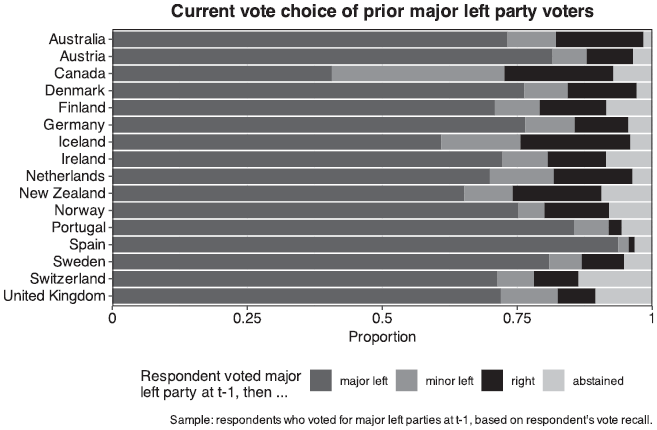
Vote choice with regard to social democratic parties is the main outcome of interest in this study. For the previous election (at time t − 1), we use vote choice for major left parties to define our sample of voters who previously chose major left parties. We then distinguish between multiple choices at time t: voting for the major left party (again), for a minor left party, for a (major or minor) party on the right, or abstention. These choices are coded for the current election (at time t, the election on which the respective election study is focused) and are shown in Figure 10.1. For the regressions reported later, we then generate three outcome variables: continued voting for major left parties (vs. any other party or abstention), switching to minor left parties (vs. any other party or abstention), and switching to parties on the right (vs. any other party or abstention). Information about the prior vote comes from a recall question, asking respondents who they voted for at the previous (parliamentary) election.Footnote 10
Distribution of current vote choices of voters who had chosen major left parties at t − 1. n = 42,506 respondents
As major left parties, we define political parties that have been the major (formateur) party in non-caretaker governments at least once before they enter our analysis. We use this criterion to ensure that all parties considered major parties have at least once held primary governing responsibility. To identify left parties, we use the party family classification from the Manifesto Project Dataset (Budge et al. Reference Budge, Klingemann, Volkens, Bara and Tanenbaum2001; Klingemann et al. Reference Klingemann, Volkens, Bara, Budge and McDonald2006; Volkens et al. Reference Volkens, Lehmann, Matthieß, Merz and Regel2016). We require parties to have competed in at least three elections to be included in this list. The full classification scheme is available in Table 10.A1.
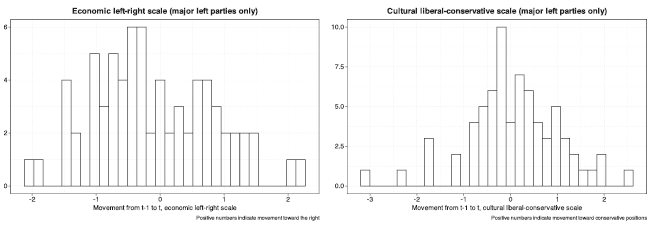
Changes in parties’ programmatic positions drive vote choice per the arguments explored in this study. In line with much of the literature, we consider shifts in party positions from one election manifesto to the next as an appropriate indicator for programmatic changes that might drive vote choice.Footnote 11 We obtain measurements of party positions from the Comparative Manifesto Project (Lowe et al. Reference Lowe, Benoit, Mikhaylov and Laver2012; Volkens et al. Reference Volkens, Lehmann, Matthieß, Merz and Regel2016) and focus on the two main dimensions of political contestation: the economic left–right dimension (stateconomy) and the cultural liberal–conservative dimension (loglibcons). For each party, we calculate movements on each dimension over the period before the preceding election, that is, from t − 2 to t − 1. As an example, for a survey fielded in the United Kingdom for the 1997 election, we measure the movement of parties between the 1987 and 1992 elections. These movements are measured in the logit scale discussed in Lowe et al. (Reference Lowe, Benoit, Mikhaylov and Laver2011). Movements are nearly symmetrically centered around 0, as illustrated in Figure 10.2. For the analyses discussed later, we standardize these movement indicators into a measure of moderation, so that a movement of 1 is equivalent to moving to the center (i.e., to the right for left parties) by one standard deviation. Moderation for left parties, thus, means a move to the right, regardless of the party’s programmatic position before it released a new manifesto. To identify how these movements relate to vote choice, we map each respondent’s choice (in current and prior elections) to that party’s movement in the relevant time period on the respective dimension.Footnote 12
Distribution of movements between prior and current election, all major left parties in the data. Movements calculated on CMP data (stateconomy and loglibcons variables)
In the regression analyses in this chapter, we use a basic set of control variables at the individual level: respondents’ self-placement on the left–right scale as well as the squared term of that measure to account for respondents at extreme ends of the scale and their age (coded in four categories: 29 or below, 30–44 as the baseline category, 45–64, and 65 or older). At the party level, we control for a party’s incumbency status in the period prior to the relevant election. At the system level, we use a polarization measure from Dalton (Reference Dalton2008) to account for the availability of alternative choices. This variable “measures how parties are dispersed along an ideological continuum” (Dalton Reference Dalton2008, 915). Higher polarization suggests closer proximity of parties on the same side of the spectrum, which could make switching easier. But a depolarized party system also diminishes the differences between left–right ideological blocs (Evans and Tilley Reference Evans and Tilley2012b), potentially facilitating switching between mainstream parties. In either scenario, the polarization measure is an important systemic contextual variable for our analyses of switching.
We limit control variables to these in order to maximize the sample of respondents across elections; this is necessary because our focus on voters who had previously voted for major left parties cuts down the observations available in the election studies we use. Using these control variables allows us to recover the equivalent to an average causal effect of party position movements, where control variables remove the other most prominent determinants of vote choice as potential confounders of the effect of party position movements.Footnote 13 In other words, this specification aims to simulate a panel study that allows us to estimate the effect of party positions on otherwise identical respondents (voters) at different time points. In addition, we estimate all models without control variables on the same samples and find substantively consistent results (not reported here). In further analyses reported later, we use additional control variables and geographic subsets to explore how institutional context and class-based dynamics impact the relationship between moderation and vote choice.
10.4.2 Statistical Method
The evidence in this chapter is based on regression analyses of the vote choice variables discussed earlier. These analyses yield an average effect of moderation on individual vote choice. To capture the influence of country-specific or election-specific factors on our estimates of the effect of moderation, we fit multilevel logistic regression models with varying intercepts for countries and election years. In general terms, these models take the following (simplified) form:

where i is an index for individuals, j is an index for countries, t is an index for years, k is an index for major left parties, X is a matrix of control variables, δj[i] is a varying intercept (random effect) for countries, and ηt[i] is a varying intercept for years. Moderation measures the change in the position of the party of interest k in each analysis.
Previewing a benchmark for effect estimates for moderation, vote switching is not a frequent observation in the survey data used in this study. About 3 percent of respondents switched from a major left to a minor left party (see Table 10.2). Therefore, even a one-percentage point change in one individual’s propensity to stay with a major party (or switch to a minor party or abstain) is a meaningful quantity. For these comparisons, we assume that shifts in respondents’ vote propensities translate into changes in vote shares and, more generally, that respondent i’s predicted probability of voting for a party k translates into party k’s vote share by the following formula:

where n is the number of respondents in the sample (or voters in the population, for extrapolation).
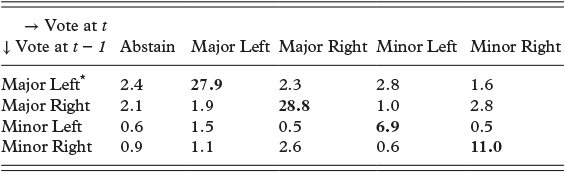
Cell entries are percentages based on the full sample of voters in our individual-level data (n = 113,134 respondents). Repeat voters are highlighted in bold.
* These voters define the sample for our regression analyses in this chapter.
10.5 Movements of Party Positions: Descriptive Information
We first describe trends in moderation of major parties on the Left in the countries analyzed in this study. This description clarifies which parties have moderated their position (or moved away from the center). It also shows that parties’ moderation strategies are not always executed on both (economic left–right and cultural liberal–conservative) dimensions in parallel.
Most major parties in the sixteen countries in this study have moved their party positions, as measured in their manifestos, substantially between elections. Some major parties on the Left (Figure 10.3) moved to the right considerably in the 1990s. Here, social democratic parties in Germany, Great Britain, Sweden, Denmark, and the Netherlands form a noticeable cluster, consistent with the conventional wisdom about the “Third Way” narrative’s influence on other social democratic parties at the time. Others moved toward the Left in the early 2000s. Movements on the cultural liberal–conservative scale have been slightly more centered around the middle but are noticeable as well (Figure 10.4). Overall, this shows considerable variation in left parties’ moderation strategies, our key explanatory variable.
Movement from t − 1 to t on the economic left–right scale
Notes: Movements are based on the Comparative Manifesto Project (using raw scores) for major left parties. Only parties moving by more than 0.5 points are labeled. Years in parentheses refer to the election at time t, that is, the election for which the party changed its (manifesto-based) position.

Movement from t − 1 to t on the cultural liberal−conservative scale
Notes: Movements are based on the Comparative Manifesto Project (using raw scores) for major left parties. Only parties moving by more than 0.5 points are labeled.
Because it is difficult to discern from Figures 10.3 and 10.4, we show separately that major parties did not move in parallel on the economic left–right and cultural liberal–conservative scale. Among major parties on the Left, several moderated on the economic scale, but moved further away from the center on the cultural scale. Similarly, some parties moved away from the center on the economic dimension, but moderated on the cultural dimension. The correlation between these movements is too low to warrant conflating both dimensions (Figure 10.5).
Comparing movements from t − 1 to t, economic left–right and cultural liberal−conservative scales
Notes: Only parties with residuals higher than 1 are labeled. The correlation coefficient (r) between movements on the two dimensions is 0.08.

Having demonstrated (a) variation in moderation strategies within and between major parties on the Left and (b) that movements on economic and cultural dimensions are different, we turn to evaluating the evidence on how voters respond to moderation in the long run.
10.6 The Longer-Term Impact of Moderation
In the following analyses, vote choice is coded into several binary variables. These distinguish between:
1. voting for the same (major) left party twice, versus any other party or abstention;
2. voting for a major left party, then voting for a minor left party, versus voting for any other party or abstention;
3. voting for a major left party, then voting for a right party, versus any other choice.
The catchall hypothesis is consistent with no (or a positive) association between prior movement and current choice in (1) and a negative (or no) association between prior movement and current choice in (2) and (3). The catch-and-release hypothesis would suggest that moderation at a prior point is negatively associated with voting for the same party again in the present (1) and a positive association with switching to other parties (2) and (3).
The individual-level evidence presented here varies by the dimension of contestation.Footnote 14 Previewing our main findings, on the economic left–right dimension, moderation is consistent with catch-and-release arguments. Moderation before the prior election reduces the propensity of voters to choose the moderating party again – one election after the party moderated initially. Moderation also drives voters to minor left parties, and at a slightly lower rate to parties on the right. On the cultural dimension, moderation does not penalize parties at the same level; voters are more likely to continue supporting major left parties, but some defect to minor left parties.
10.6.1 Voting for the Same Major Left Party Twice
First, Figure 10.6(a) shows differences in respondents’ propensity to vote for major left parties after those parties moderated one period before the current election.Footnote 15 We find that after one election cycle, previous voters of a major left party that moderated on the economic left–right dimension voted at lower rates for that party – a decrease of close to four percentage points. Interpreting this difference as a potential decline of that party’s vote share of four percentage points, this is a substantial finding. On the cultural dimension, the data show the opposite, though weaker effect. Moderation on that dimension, that is, moving toward more culturally conservative positions, is associated with a higher propensity of voters staying with this party, just below two percentage points.
Moderation in prior cycle and subsequent vote choice of survey respondents who had voted for major left parties in the prior cycle.
Notes: Estimates show the difference between two individuals’ propensity to vote for a major left party at t − 1 and the respective choice at t, where in one case the major left party had moderated in the prior cycle and in other it had not. Full results printed in Tables 10.A2–10.A4; (n = 19,033 respondents).

For all analyses in this section and later, control variables perform as one would expect. Younger voters are more mobile, whereas more older voters voted for the same party twice in a row. The further to the right a voter, the less they voted for the same major left party twice. Incumbency status was associated with fewer repeat votes. In more polarized systems with more options close to the previous choice, voters moved away from major left parties more frequently.
Substantively, these results suggest that based on individual-level survey data, catchall strategies do not pay off in the longer term – on the economic dimension. This is consistent with Karreth et al. (Reference Karreth, Polk and Allen2013) and others that stress the importance of a distinctive economic profile for social democratic parties (Bremer Reference Bremer2018; Berman and Snegovaya Reference Berman and Snegovaya2019). On the cultural dimension, these results are consistent with evidence for the success of catchall strategies, though our results reported later show a more nuanced picture.
10.6.2 Switching to Minor Left Parties
We also evaluate whether moderation in the prior period increases vote switching to minor parties on the same side of the political spectrum or abstentions down the road, one facet of the arguments discussed in Karreth et al. (Reference Karreth, Polk and Allen2013). This is slightly different from the abovementioned analyses, which conflated all non-repeat votes into one category, including switches from major left parties to minor parties on the opposite side of the spectrum (i.e., major left to minor right). The results (see Figure 10.6(b)) lead to similar conclusions. Voters switched to minor left parties when major left parties moderated on the economic dimension. After moderation on the cultural dimension, some voters also defected to minor left parties, at marginally lower rates. The finding on the economic dimension is again consistent with a catch-and-release argument. Immediately after moderation, voters may put their hopes into a major left party, possibly due to its track record on economic policy. After one cycle, a considerable share of these voters defects to minor left parties that may offer economic policies more in line with the earlier platforms of major left parties before they moderated. Similarly, the pattern on the cultural dimension is consistent with a catch-and-release argument inasmuch as the turn toward the right on the cultural dimension may have been tolerable for some voters for one election, but not twice.
10.6.3 Switching to Parties on the Right
We track whether (former) voters of major left parties switch to parties on the right (Figure 10.6(c)). Centrist or “fickle” voters in particular may be drawn to parties on the right after voting for a moderated major left party once. Figure 10.6(c) suggests that switching to right parties indeed happens, at a rate of just below 1 percent, after major left parties moderate on the economic dimension. In combination with increased switching to minor left parties (shown in Figure 10.6(b)), we conclude that the catch-and-release dynamic associated with major left parties’ moderation on the economic dimension loses voters to the Left and the Right. Further analyses to explore a conditional effect of moderation depending on economic performance or other factors would require statistical power that the surveys we use cannot provide. We note, however, that moderation leading to voters leaving not only for minor left parties but also parties on the Right, is consistent with centrist voters leaving Social Democrats (Table 10.A4 and, in a different analysis, Abou-Chadi and Wagner, this volume).
On the cultural dimension, we find that moderation is associated with less switching to right parties. This is consistent with a successful catchall strategy; major left parties may avoid losing voters to parties on the Right with a more conservative profile. However, we note that this dynamic in particular may be sensitive to the composition of voter groups. Other contributions to this volume address this point more explicitly, whereas our chapter only disaggregates this dynamic by ideology and class below and does not address varying effects by gender, age, or race.
10.7 Electoral Institutions and Contexts Can Shape the Impact of Moderation
Because our initial sample combines a variety of electoral contexts and party systems, and in keeping with recent research emphasizing the importance of welfare state configuration for Social Democracy (Manow et al. Reference Manow, Palier and Schwander2018; Loxbo et al. Reference Loxbo, Hinnfors, Hagevi, Blombäck and Demker2021), we report in Table 10.3 separate analyses for the following country groups: Nordic and Northwestern European democracies with proportional representation (PR) and more available choices for voters (and postindustrial structures); Anglo-Saxon First-Past-The-Post (FPTP) systems with fewer choices and limited welfare states; and Mediterranean democracies with political contestation aligned along industrial society lines (during the time period of this study).
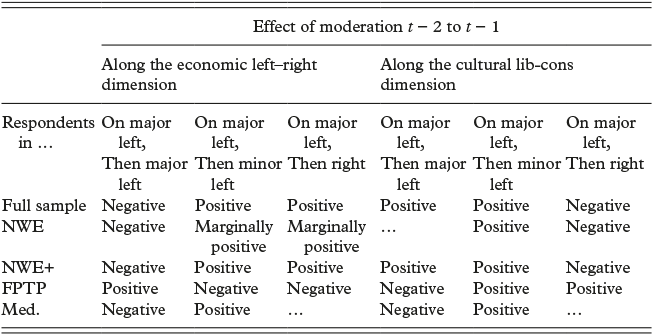
Notes: This table summarizes results from regressions with our main specification (Tables 10.A2–10.A4) estimated on the respective subset.
Abbreviations: NWE: Nordic and NW European PR democracies; NWE+: NWE plus ICE, IRL, NZD; FPTP: AUS, CND, UK; Med: ESP, PRT.
…: no meaningful difference in vote propensity.
In Nordic and Northwestern European democracies with PR,Footnote 16 we find evidence for the catch-and-release dynamic (H2) on the economic dimension. Moderation on the economic dimension is associated with individual voters deserting major left parties one election later and switching to left (or right) parties. After moderation on the cultural dimension, we find evidence for the catchall effect (H1) inasmuch as voters are more likely to stay with major left parties and less likely to switch to parties on the Right, but we also find that voters do leave for minor left parties (though at lower rates). The menu of available choices in these PR democracies and rise of postindustrial structures are well aligned with the theoretical argument for moderation as a losing strategy, that is, the catch-and-release dynamic.
By contrast, the Anglo-Saxon FPTP systems offer fewer choices and should be less prone to the exhibit voter movements and catch-and-release dynamics as suggested in the PR context. Indeed, our analyses in the smaller samples of these FPTP systems show the inverse: Moderation on the economic dimension was not associated with a declining rate of repeat votes for major left parties, but with a higher rate of repeat votes instead. Conversely, voters were less likely to desert to minor left or right parties. After moderation on the cultural dimension, however, we find evidence for movements of prior major left voters toward minor left and right parties. Due to the smaller sample size in surveys covering these FPTP systems, we consider these findings more preliminary. But we note that they are consistent with a catch-and-release argument on the cultural dimension, whereas the lack of alternatives especially on the economic dimension may help major left parties retain voters at least for two rounds after moderation.
In the two Mediterranean democracies in our data, we observe a catch-and-release dynamic on the economic dimension and on the cultural dimension as well. Even more than in the case of the FPTP cases, small sample sizes preclude more robust conclusions, but the presence of more alternatives than in FPTP systems – despite potentially more durable ties between voters and parties in industrial societies – may lead to the result of a catch-and-release dynamic as observed here.
10.8 Left and Centrist Voters Respond Differently to Moderation
The results so far analyze the payoff or penalty of moderation strategies for voters across the board. But from the vantage point of examining the composition of a party’s electorate and the role of different groups of voters, ranging from those with solidly left identities to those in the political center, understanding the differential impact of moderation on different types of voters is crucial. We conduct this analysis only for all countries and the Northwestern European subsamples due to the geographic focus of this volume and sample size considerations.
In these analyses (Table 10.4), we find evidence that more leftist,Footnote 17 or “core,” voters are more likely to desert major left parties and switch to minor left parties one round after major left parties moderated on the economic dimension. This dynamic appears in all three samples with sufficient observations. Contrarily, more centrist voters did not respond systematically to moderation. This is consistent with a “release” dynamic for left voters and, potentially, a catchall dynamic for more centrist voters. Additionally, the heterogeneity of these findings highlights the value and importance of differentiating between voting groups that is only possible with individual-level analysis. On the cultural dimension, we find no systematic differences between how more leftist and centrist voters responded to moderation.
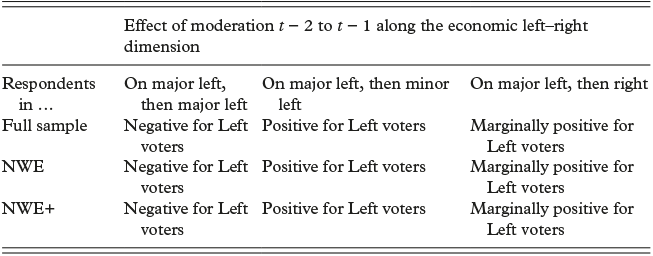
Notes: This table summarizes results from regressions with our main specification (Tables 10.A2–10.A4) but with an interaction term between moderation and a binary indicator for left voters, estimated on the respective subset.
Abbreviations: NWE: Nordic and NW European PR democracies; NWE+: NWE plus ICE, IRL, NZD.
Subsamples for FPTP and Mediterranean democracies not estimated due to small subsample size.
10.9 Moderation and Voting for all Left Parties
As we note earlier in this chapter, catch-and-release dynamics can be damaging for individual major left parties but may also have less impact on policy outcomes if major left parties lose voters only to other left parties and, therefore, any “release” of voters does not weaken coalitions of left parties. In fact, moderation of one major left party may be a winning strategy for left coalitions if it can attract voters from outside this coalition (Hjorth and Larsen 2022). In Table 10.5, we explore part of this possibility in separate analyses with a different sample and outcome variable.
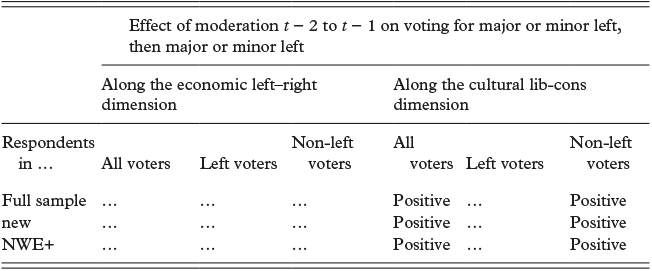
Notes: This table summarizes results from regressions with our main specification (Tables 10.A2−10.A4), but with a different outcome variable: voting for any major or minor left party at t − 1 and again at t.
Abbreviations: NWE: Nordic and NW European PR democracies; NWE+: NWE plus ICE, IRL, NZD.
Subsamples for FPTP and Mediterranean democracies not estimated due to small subsample size.
Here, we define our sample as those survey respondents who voted for any left party at t − 1 (and not just the major left party in the respective country). The outcome of interest is also voting for any left party at t. We find that major parties’ moderation on the economic dimension does not lead to voters abandoning the Left. This applies to all voters and the subgroups of left and centrist voters alike. On the cultural dimension, however, we find that moderation may indeed pay off for the Left as a whole: Parties that moderated on this dimension did not lose voters, but in comparison to those parties that did not moderate, moving to the center increased the odds that non-left voters stayed with the Left overall.
10.10 Additional Analyses and Benchmarking
In addition to distinguishing between left and non-left (or centrist) voters, we also repeat our main analyses (Tables 10.A2–10.A4) with an additional control variable for party attachment. We find the same evidence on catch-and-release dynamics mostly after moderation on the economic left–right dimension. Party attachment may be too closely related to our outcome variable of vote choice because higher attachment likely predicts a more correct recall of prior votes, this additional result serves to mitigate concerns about omitted variable bias.
We also subset the data by class to probe whether working-class voters are less prone to switching than nonworking-class voters with more post-materialist priorities. Small subset samples make these results noisier and less robust. We do find some evidence that moderation on the economic dimension is associated with nonworking-class voters leaving major left parties in Northwestern Europe, but not in the FPTP countries. Working class voters do not respond negatively to moderation on this dimension and were more likely to stay with major left parties in the FPTP countries compared to settings where these parties did not moderate. On the cultural dimension, we find some weak evidence that moderation reduced defection to the Right among lower-income voters.
Our main results show a small negative incumbency effect for major left parties; voters penalized major left parties across the board during the time period of this study. We probe the nature of this effect further by conditioning incumbency effects on economic performance.
These analyses in Table 10.6 mostly reveal that negative incumbency effects are due to incumbents presiding over periods of low economic growth. Once again, small sample sizes do not allow for more robust subgroup analyses or exploring the impact of moderation in different growth scenarios. But the available results suggest that holding all else constant, poor economic performance drives former voters away from major left parties, and high economic performance under major left parties does not equally work to keep voters with these parties. In combination with our findings on moderation, this pattern invites additional research to tease out the role of moderation under low and high growth conditions.
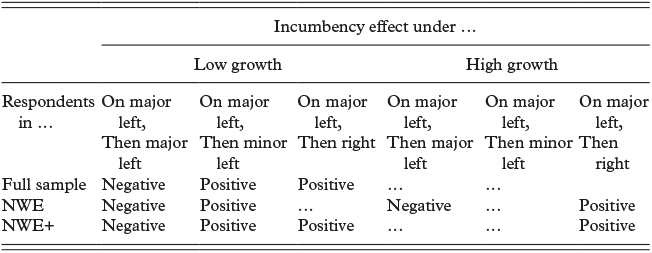
Notes: This table summarizes results from regressions with our main specification (Tables 10.A2−10.A4), but with an interaction term between incumbency and a binary indicator for below (vs. above) average economic growth in the year preceding the election.
Abbreviations: NWE: Nordic and NW European PR democracies; NWE+: NWE plus ICE, IRL, NZD.
Subsamples for FPTP and Mediterranean democracies not estimated due to small subsample size.
In substantive terms, and when statistically distinguishable from 0, we find point estimates for the impact of moderation on vote choice to be mostly around two to four percentage points. This is not a trivial change. If about 9 percent of respondents in the data switched from a major left to a different party or abstained (see Table 10.2), then about one-third of this group can be attributed due to a change in party positions. Similarly, a three-percentage point change in a party’s vote share (following the benchmarking previous discussion) due to moderation is considerable given (a) the other potential influences on changes in parties’ vote share and (b) the typical range of changes in vote shares of several percentage points.
10.11 Summary
The analyses reported in this chapter provide some new, nuanced evidence about the effect of moderation strategies for major social democratic parties in industrialized and postindustrial societies in the past decades. We find the following:
The longer-term impact of moderation appears to hurt major left parties. We find evidence mostly for a catch-and-release dynamic (H2). Moderation on the economic dimension decreased the propensity of previous voters to stay with that party in the subsequent election, consistent with the catch-and-release hypothesis.
Moderation along the cultural dimension hurts major parties less but also drives voters away to minor left parties.
Party systems matter: Moderation hurts major left parties more when voters can choose from a larger menu of competitive parties on the Left.
Left (core) voters are more susceptible to catch-and-release dynamics, but more centrist voters do not respond positively enough to moderation to make up for the loss of left voters.
Catch-and-release dynamics for major left parties do not usually lead to a net positive for the Left overall.
These results mostly support the catch-and-release hypothesis. They also strongly suggest that analyses of voter responses to parties’ repositioning should consider effects beyond the election immediately following a change in parties’ positions. At the same time, the findings open the door for more fine-grained analyses and additional research, to which we turn next.
10.12 Limitations
The findings reported earlier contribute evidence to long-standing debates about benefits and costs of moderation strategies and the importance of longer-term dynamics in studying voter behavior. At the same time, this version of our study is limited by a number of factors that offer a path forward for future research.
First, the findings reported here treat parties’ moderation strategies in isolation from each other. In our empirical specification, a party’s moderation directly influences whether voters choose this party. But party competition takes place in a relational environment, where voters evaluate one party’s position as relative to other parties’ position. We try to address this to some extent by including a measure of party system polarization in our models as well as conducting separate analyses for different electoral systems (PR vs. FPTP). Following research which finds that the relative ideological distinctiveness of rival parties affects vote choice (Green Reference Green2015), levels of class voting (Evans and Tilley Reference Evans and Tilley2012a, Reference Evans and Tilley2012b; Jansen et al. Reference Jansen, Evans and Dirk de Graaf2013), and party attachments (Lupu Reference Lupu2016), other current studies, such as Spoon and Klüver (Reference Spoon and Klüver2019), focus on convergence of parties rather than individual party positions. Merging these two approaches – incorporating relational positions while still maintaining a focus on individual party strategies – would extend this research and offer more nuanced insights in the effects of moderation strategies.
Second, our analyses as reported do not incorporate other contextual factors at the level of partisan competition or at the country level. Such factors may include the strength of unions, international constraints on policy, or other economic factors beyond growth and unemployment that might influence vote choice. The data used in our analyses also largely precede the 2015–16 increase in asylum applications in many European countries, which facilitated heightened attention to the sociocultural dimension among many parties in the region.
Third, vote choice in our analyses is structured as a binary choice between voting for major parties and select “other” choices. Recent electoral trends, though, support the notion that party systems are more fluid than our rigid distinction between major and minor parties allows.
Lastly, and partly due to sample size consideration, this chapter only explores a small selection of subgroup effects. It is likely that not all voters respond to moderation the same way. We explore such subgroups only with regard to left and more centrist voters, but other contributions to this volume and recent studies such as Abou-Chadi and Hix (Reference Abou-Chadi and Hix2021) suggest that there are several other types of groups that might structure responses to party moderation: gender, age, race, occupational class, or union membership all are important to examine in more depth.
10.13 Discussion and Outlook
This chapter is motivated by the observation that social democratic parties suffered at the polls following catchall moderation strategies in the 1990s even though research in political science suggests that moderation is a beneficial strategy for major parties. Our goal is to evaluate whether an approach that is more sensitive to temporal dynamics and individual voting behavior could reconcile this perceived trend with conventional wisdom about party competition. The findings suggest that voters – as captured in election studies – likely punish major left parties for moderation in the second election after parties moderated, and thus are both attentive and responsive to shifts in parties’ positions. Moderation can elicit different changes depending on the dimension of contestation, though. Voters’ punishment appears to be a response to moderation on the economic dimension, the neoliberal turn of social democratic parties. In the data analyzed in this chapter, we see no punishment for moderation on the cultural dimension; instead, during the time period under consideration, moderation on the cultural dimension may retain new voters.
This insight should serve as a starting point for future research investigating how voters respond to changes in party positions over time, and whether these changes create long-term adjustments in perception and, subsequently, behavior in (potential) voters. A key challenge for such research is a lack of data on how the same individuals view and respond to parties at different points in time, beyond just two electoral cycles. The current chapter is limited to exploring whether voters stayed with, or switched away from, a party in two consecutive elections. Yet, recent reports from elections around Western Europe abound with stories of voters who turned away from parties for which they had voted for a long time. This has materialized, for instance, in unprecedented dramatic losses of social democratic parties in the Netherlands, France, and Germany in 2017. While the approach chosen in this chapter does not yet allow us to show definitively whether moderation drives individual voters away from major parties in the longer run, and especially if parties recalibrate their positions, it still offers a first glimpse into when and for which voter groups the benefits of moderation wear off.
Our findings also resonate with many of the conclusions in other chapters of this volume, not least in illustrating the complex trade-offs involved in social democratic parties’ choice of electoral programs (Abou-Chadi, Häusermann, et al., this volume) and the ramifications of these programmatic decisions for a party’s broader strategic objectives (Häusermann and Kitschelt, this volume). Moderation on the economic dimension by Social Democrats in our analyses sheds former voters to green and radical left parties slightly more than it does to the Radical Right. This reinforces the significance of “new left” competitors for voters in the left sector (Abou-Chadi and Wagner, this volume; Bischof and Kurer, this volume). It is also consistent with Abou-Chadi and Wagner’s finding that those who switched away from major left parties were disproportionately centrist (which we also find in our estimates for ideology in Tables 10.A2–10.A4).
We also stress the risks of vote loss in relation to moderation on the economic dimension of competition, if the goal is vote maximization as a party (e.g., Bremer, this volume). However, as the editors note in the introduction (Häusermann and Kitschelt, this volume), in some scenarios social democratic parties may opt to pursue a programmatic package that increases the electoral size of the left bloc as a whole, which requires consideration of the broader strategic context across party systems. But even here, the findings we report in Table 10.5 do not generally recommend programmatic moderation as a strategy for the left bloc. Our chapter illustrates that the programmatic choices of the present continue to resonate with social democratic partisans beyond the immediate electoral cycle.


 Open access