





Introduction
Global increases in pediatric mental health problems have moved prevention and early intervention efforts to the forefront of policy agendas (Benton, Boyd, & Njoroge, Reference Benton, Boyd and Njoroge2021; Keyes & Platt, Reference Keyes and Platt2023). Investigations into modifiable or preventable underpinnings of child mental health problems are critical for such efforts. Intergenerational transmission of the effects of stress during pregnancy has been supported in prior work, including evidence of preconception adversity (Su, D’Arcy, & Meng, Reference Su, D’Arcy and Meng2022) and stress during pregnancy (Van den Bergh et al., Reference Van den Bergh, van den Heuvel, Lahti, Braeken, de Rooij, Entringer and Schwab2020) in association with offspring neurodevelopment (Bush, Reference Bush2024; Monk, Lugo-Candelas, & Trumpff, Reference Monk, Lugo-Candelas and Trumpff2019). Etiologic links between these factors are consistent with the Developmental Origins of Health and Disease (DOHaD) and prenatal programming theories. Whereas elevated physiological activity in response to stress can be adaptive by supporting coping (Epel & Prather, Reference Epel and Prather2018), traumatic or chronic stress responses may alter biological functioning in an effort to contend with perceived environmental demands (Anda et al., Reference Anda, Felitti, Bremner, Walker, Whitfield, Perry and Giles2006; Buss et al., Reference Buss, Entringer, Moog, Toepfer, Fair, Simhan and Wadhwa2017; Glover, O’Connor, & O’Donnell, Reference Glover, O’Connor and O’Donnell2023; Hentges, Graham, Plamondon, Tough, & Madigan, Reference Hentges, Graham, Plamondon, Tough and Madigan2019; Racine, Plamondon, Madigan, McDonald, & Tough, Reference Racine, Plamondon, Madigan, McDonald and Tough2018; Van den Bergh et al., Reference Van den Bergh, van den Heuvel, Lahti, Braeken, de Rooij, Entringer and Schwab2020).
Using a developmental psychopathology framework, maternal exposures to stress may constitute a risk factor in the offspring’s development of psychopathology (Doyle & Cicchetti, Reference Doyle and Cicchetti2018). This intergenerational transmission likely occurs through both direct pathways (e.g. biological changes during gestation) and indirect pathways (e.g. changes in maternal behavior) (Moog et al., Reference Moog, Heim, Entringer, Simhan, Wadhwa and Buss2022). Exposures to various forms of stress and adversity appear to be particularly important to offspring neurodevelopment during ‘sensitive periods’, such as childhood and the perinatal period (Knudsen, Reference Knudsen2004) – a time when multiple biological systems undergo rapid changes and are more malleable (Davis & Narayan, Reference Davis and Narayan2020; Entringer, Buss, & Wadhwa, Reference Entringer, Buss and Wadhwa2012; Loman & Gunnar, Reference Loman and Gunnar2010). These changes can include alteration of reproductive biology and fetal development, which not only potentially facilitates infant phenotypes that promote survivability (e.g. hypervigilance and highly responsive temperaments) but also can increase the risk for the development of psychopathology (Hartman & Belsky, Reference Hartman and Belsky2018). For example, recent epidemiological findings indicate that maternal history of childhood maltreatment is related to greater internalizing mental health problems in offspring, such as depression and anxiety, in addition to autism spectrum disorder and diagnostic patterns reflecting multimorbidity (Bush, Reference Bush2024; Moog et al., Reference Moog, Cummings, Jackson, Aschner, Barrett, Bastain and Buss2023). Additionally, maternal stress during pregnancy is associated with externalizing mental health conditions in offspring, such as attention-deficit/hyperactivity disorder (Ahmad et al., Reference Ahmad, Shih, LeWinn, Rivera, Graff, Mason and Bush2022; Szekely et al., Reference Szekely, Neumann, Sallis, Jolicoeur-Martineau, Verhulst, Meaney and Wazana2021; Tung et al., Reference Tung, Hipwell, Grosse, Battaglia, Cannova, English and Foust2023). Together, these findings emphasize the potential for two key sensitive periods – maternal childhood and pregnancy – during which maternal stress exposures may increase the risk for the transmission of effects across generations.
A few recent studies have included stress exposures during both sensitive periods in intergenerational transmission models of child mental health problems, but this research has yielded mixed evidence and has limitations (Bush et al., Reference Bush, Noroña-Zhou, Coccia, Rudd, Ahmad, Loftus and LeWinn2023; Noroña-Zhou et al., Reference Noroña-Zhou, Coccia, Sullivan, O’Connor, Collett, Derefinko and Bush2023). For example, these studies did not include a comprehensive assessment of maternal childhood adversity and did not assess offspring externalizing mental health problems or outcomes into adolescence. Moreover, extant findings suggested that biological parents exposed to early childhood adversity may be more sensitized to stress experienced during pregnancy, leading to stronger effects of prenatal stress on offspring (Bush et al., Reference Bush, Noroña-Zhou, Coccia, Rudd, Ahmad, Loftus and LeWinn2023); however, this requires replication and further study. Adverse childhood experiences (ACEs) represent a broad, multidomain assessment of childhood adversity and have been widely used in health research, given the association between ACEs and overall health and the translatability of ACEs into policy initiatives and healthcare contexts (Felitti et al., Reference Felitti, Anda, Nordenberg, Williamson, Spitz, Edwards and Marks1998; Shonkoff et al., Reference Shonkoff, Garner, Siegel, Dobbins, Earls, McGuinn and Wegner2012). ACE measures typically include exposures such as physical violence by a parent or other adult in the household, separation or divorce, or substance abuse by a household member. Overall, findings demonstrate a significant association between the number of ACEs experienced and higher levels of mental health problems (Hughes et al., Reference Hughes, Bellis, Hardcastle, Sethi, Butchart, Mikton and Dunne2017; Sahle et al., Reference Sahle, Reavley, Li, Morgan, Yap, Reupert and Jorm2022; Zeanah & Sonuga-Barke, Reference Zeanah and Sonuga-Barke2016). A smaller body of work also shows an association between maternal ACEs and child mental health problems (Racine et al., Reference Racine, Deneault, Thiemann, Turgeon, Zhu, Cooke and Madigan2023). Large-scale epidemiological studies that consider multiple sensitive periods of intergenerational risk are lacking but are necessary to pinpoint effective prevention and intervention efforts. Indeed, few studies have simultaneously examined the effect of maternal ACEs and pregnancy stress exposure on offspring mental health, let alone in large, sociodemographically diverse samples; fewer still have examined these intergenerational associations into adolescence.
Current study
This study leveraged the National Institutes of Health-funded Environmental influences on Child Health Outcomes (ECHO) Cohort, a large, racially, socioeconomically, and geographically diverse sample with data from 69 pregnancy and pediatric cohort sites across the United States (Blaisdell et al., Reference Blaisdell, Park, Hanspal, Roary, Arteaga, Laessig and Gillman2022; Knapp et al., Reference Knapp, Kress, Parker, Page, McArthur and Gachigi2023). In the present study, we used data from 34 unique sites to assess associations between maternal ACE exposure, pregnancy stress, and offspring mental health problems to determine whether higher levels of maternal stress exposure occurring during a mother’s own childhood and/or pregnancy were associated with offspring mental health problems (Aim 1; see Supplementary Figure S1). Based on previous evidence demonstrating that maternal exposure to adversity during one’s own childhood was associated with stronger positive associations between pregnancy stress and offspring mental health problems (Bush et al., Reference Bush, Noroña-Zhou, Coccia, Rudd, Ahmad, Loftus and LeWinn2023), we also examined whether parental history of ACE exposure moderated the association between pregnancy stress and offspring mental health problems (Aim 2). Additionally, although meta-analytic reviews have concluded a lack of sex moderation for some of the associations tested (e.g. Tung et al. (Reference Tung, Hipwell, Grosse, Battaglia, Cannova, English and Foust2023) in predicting children’s externalizing symptoms), given the broader mixed evidence on sexually dimorphic associations between maternal stress exposures and offspring mental health problems (Hodes & Epperson, Reference Hodes and Epperson2019; McCarthy, Reference McCarthy2019; Sandman, Glynn, & Davis, Reference Sandman, Glynn and Davis2013; Sutherland & Brunwasser, Reference Sutherland and Brunwasser2018; Tung et al., Reference Tung, Hipwell, Grosse, Battaglia, Cannova, English and Foust2023), we also used two-way interactions to assess whether associations between prenatal stress or ACE exposure and offspring mental health were moderated by child sex (Aim 3). Consistent with a developmental psychopathology perspective (Hawes & Allen, Reference Hawes and Allen2023; Rutter, Reference Rutter1996), child age can be a key determinant of whether and how risk factors manifest as mental health problems. Given the wide age range of children in the present study, and given the complex manner in which child psychopathology can develop and manifest over time, we also evaluated two-way interactions assessing whether the associations between prenatal stress or ACE exposure and child mental health problems were moderated by child age (Aim 4). Also aligned with developmental psychopathological perspectives, these maternal stress exposures are likely associated with multifinal presentations of offspring mental health problems, and they may have a stronger impact on specific domains of psychopathology (Garber & Bradshaw, Reference Garber and Bradshaw2020). We thus conducted secondary analyses to evaluate whether associations between maternal stress exposures and offspring internalizing and externalizing mental health problems examined separately provided unique information beyond the examination of total problems, which has been suggested by some prior research (e.g. Letourneau et al., Reference Letourneau, Dewey, Kaplan, Ntanda, Novick, Thomas and Giesbrecht2019; Moog et al., Reference Moog, Cummings, Jackson, Aschner, Barrett, Bastain and Buss2023; Noroña-Zhou et al., Reference Noroña-Zhou, Coccia, Sullivan, O’Connor, Collett, Derefinko and Bush2023; Roubinov et al., Reference Roubinov, Browne, LeWinn, Lisha, Mason and Bush2022), although rarely tested in the same study. Finally, to enhance the clinical utility of our findings, we tested whether maternal stress exposures distinguished risk for offspring mental health problems at lower versus clinically elevated levels.
Methods
Study design, participants, and procedure
We conducted analyses using data from the prospective, longitudinal ECHO Cohort. Detailed information regarding ECHO and its study enrollment, protocol, and procedures is available elsewhere (see https://echochildren.org/) (Blaisdell et al., Reference Blaisdell, Park, Hanspal, Roary, Arteaga, Laessig and Gillman2022; Knapp et al., Reference Knapp, Kress, Parker, Page, McArthur and Gachigi2023). This study included 6,513 biological parent–child dyads enrolled in 34 ECHO sites from 19 US states, Washington, DC, and Puerto Rico (for details, see Supplement 1, page 3). For the present study, birthing parents (biological mothers) were recruited during pregnancy, and they and their offspring were then prospectively followed into childhood or adolescence. While visit schedule and protocol varied across cohort sites within ECHO, study protocols typically included a schedule of several prenatal visits, data collection to characterize birth and immediate postnatal outcomes (e.g. medical record review), and multiple postnatal visits with parent–child dyads. The study protocol was approved by the single ECHO institutional review board, WCG IRB. Written informed consent or parent’s/guardian’s permission was obtained, along with child assent as appropriate, for the ECHO Cohort Data and Biospecimen Collection Protocol participation and for participation in specific study sites.
The inclusion criteria consisted of (a) at least one measure of maternal stress exposure (perceived stress during pregnancy or ACEs) and (b) at least one measure of caregiver-reported child behavior from the Child Behavior Checklist (CBCL) or Strengths and Difficulties Questionnaire (SDQ). For families with more than one child enrolled in ECHO, one sibling was randomly selected to be included (see Supplementary Figure S1). Cohort sites were restricted to those with available data for at least five parent–child dyads. Participants in the present study were categorized into three groups for analytical purposes: those who provided information on maternal ACEs only (number of cohorts = 13), those who provided information on perceived stress during pregnancy only (number of cohorts = 14), and those who provided information on both exposures (number of cohorts = 7).
Measures
Maternal ACEs
Birthing parents reported on ACEs during their first 18 years of life using one of two versions of the ACE questionnaire utilized within ECHO (see Supplements 2 and 3) (Felitti et al., Reference Felitti, Anda, Nordenberg, Williamson, Spitz, Edwards and Marks1998). Using near-identical language, both versions of the questionnaire capture the same 10 experiences of childhood adversity: physical abuse, emotional abuse, sexual abuse, physical neglect, emotional neglect, abuse of mother, separation or divorce of parents, substance abuse by a household member, mental illness of a household member, and incarceration of a household member. One version asks for responses to each of the 10 individual exposures separately, while the other requests a total count for seven exposures (with a maximum of ‘5 or more’ to protect privacy) and the remaining three individual exposures separately. To optimize sample size and combine data available across forms, endorsed items were summarized into a pseudo-continuous variable count score, ranging from 0 to 5 (with a score of 5 indicating 5 or more ACEs). In order to compare effect sizes between the two exposure variables and across samples, the ACE measure was mean-centered and standardized for analysis (for additional information, see Supplement 1, page 3).
Maternal prenatal stress
Birthing parents reported on stress during pregnancy via the Perceived Stress Scale (PSS) (Cohen, Kamarck, & Mermelstein, Reference Cohen, Kamarck and Mermelstein1983). The PSS measures an individual’s perceived feelings of stress over the past month (e.g. ‘How often have you felt difficulties were piling up so high that you could not overcome them?’). Perceived stress is rated on a five-point Likert scale, ranging from (1) Never to (5) Very often. ECHO utilized three different versions of the PSS, including the 14-, 10-, and 4-item versions. Raw scores were converted to T-scores based on item response theory, with a mean of 50 and a standard deviation (SD) of 10, and were mean-centered and standardized for analysis. Evidence suggests that stress later in gestation may be more strongly associated with offspring emotional and behavioral problems (Weinstock, Reference Weinstock2008); therefore, when multiple prenatal assessments were available, we included the questionnaire completed at the latest gestation time point.
Child mental health problems
Child mental health problems were reported by a parent or caregiver via two widely used measures: (a) the CBCL Preschool-Age form (1.5 to <6 years) or CBCL School-Age form (6 to <18 years) (Achenbach & Rescorla, Reference Achenbach and Rescorla2001, Reference Achenbach and Rescorla2000) or (b) the SDQ-2 (2 to <4 years), SDQ-4 (6 to <11 years), or SDQ-11 (11 to <18 years) (Goodman, Reference Goodman1997). Raw CBCL and SDQ scores were converted into age- and sex-specific CBCL T-scores that have been harmonized for analyses within ECHO (Mansolf, Blackwell, Cummings, Choi, & Cella, Reference Mansolf, Blackwell, Cummings, Choi and Cella2022). While using a single measure of child mental outcomes may offer certain methodological advantages (e.g. reducing systematic error), leveraging ECHO’s harmonization across two measures provides substantial benefits through increased data coverage. When children had multiple assessments, the latest questionnaire completed was selected for analyses to advance the evidence base on intergenerational stress transmission in older children, given the paucity of research examining associations between these maternal stress exposures and outcomes in older children and adolescents. Ninety-six percent of information on child behavior was provided by biological mothers, with 2% provided by biological fathers and 2% by another caregiver. Primary analyses utilized the Total Problems score. Secondary analyses examined Externalizing Problems and Internalizing Problems scores separately. We also examined effects for children below versus at or above T-scores of 60, which is considered to be in the borderline or clinically at-risk range.
Covariates
Using the literature on intergenerational stress transmission, we selected maternal and child covariates that may confound or function as mechanistic variables, accounting for the association between maternal stress exposures and child mental health outcomes. Variables were obtained from prenatal, birth, and postnatal assessments. The following self-reported parental covariates were included: prenatal smoking (yes/no), prenatal alcohol use (yes/no), and age at delivery. Self-reported education, marital status, household income, and depressive symptoms (from the harmonized NIH Patient-Reported Outcomes Measurement Information System [PROMIS] Depressive Symptoms Scale [Blackwell et al., Reference Blackwell, Tang, Elliott, Thomes, Louwagie, Gershon and Cella2021]) were assessed at the time point closest to the child outcome assessment. Child covariates included gestational age at birth, child sex assigned at birth (male and female), and child’s age at the time of the outcome assessment.
Statistical analyses
Among the 34 cohorts contributing data to these analyses, three subsamples were created (Table 1 and Supplementary Figure S1). Two subsamples were created for participants with maternal ACE data (N = 2,906 from 20 cohorts) or maternal PSS data (N = 4,441 from 21 cohorts). A third subsample was created to assess the potential joint effects of prenatal stress and ACE exposures on child mental health and the moderating effect of prenatal stress on the association of ACEs with child mental health. This third subsample comprised those cohorts with both ACE and PSS data (N = 834 from 7 cohorts).
Demographic information across study subsamples (N, % with data)

Note: In accordance with ECHO’s publication and data use policy, cell sizes <5 are suppressed for privacy. ACEs = adverse childhood experiences; ECHO = Environmental influences on Child Health Outcomes; PSS = Perceived Stress Scale; SD = standard deviation.
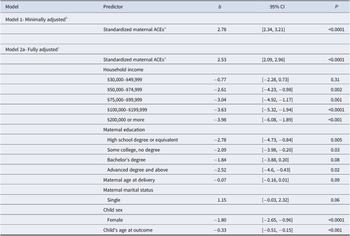
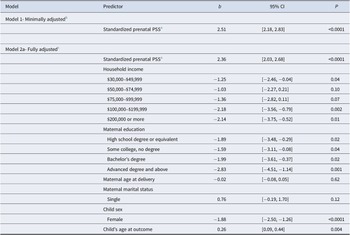
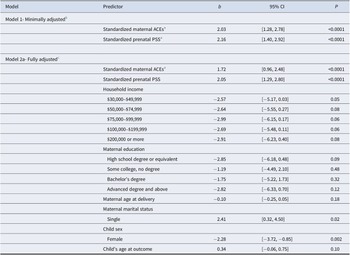
Separate linear mixed-effects regression models were employed utilizing our continuous outcome variables to investigate the associations between maternal exposures and child outcomes within each of the three subsamples: maternal ACEs only (Table 2), maternal PSS only (Table 3), and maternal ACEs and PSS (Table 4). Similar to previous work (Bush et al., Reference Bush, Noroña-Zhou, Coccia, Rudd, Ahmad, Loftus and LeWinn2023; Noroña-Zhou et al., Reference Noroña-Zhou, Coccia, Sullivan, O’Connor, Collett, Derefinko and Bush2023), we used a three-step model-building approach within each of these samples to include covariates into our models. Model 1 included only exposure variables (ACEs and/or PSS) with random intercepts for cohort site membership. Model 2 provided the main model for testing the primary aim of the study (i.e. assessing maternal ACEs and prenatal stress exposures independently and jointly) and included adjustments for income, education, age at delivery, marital status, child sex, and child age at outcome, which are either potential confounds or precision covariates necessary for isolating associations between maternal stress and child mental health (see also Lund et al., Reference Lund, Brooke-Sumner, Baingana, Baron, Breuer, Chandra and Saxena2018; Tien, Lewis, & Liu, Reference Tien, Lewis and Liu2020). Model 3 included all covariates in Model 2 and covariates of frequent interest to the scientific community that could be considered ‘on the mechanistic path’ between maternal exposure and child outcome, including adjustments for prenatal smoking and alcohol use, child gestational age at birth, and maternal depressive symptoms (Supplement 1, Supplementary Tables S2–S10). We further assessed the odds of these maternal stress exposures being associated with offspring risk for mental health problems in the borderline or clinically significant range using mixed-effects logistic regressions predicting T-score cutoffs, including all Model 2 covariates, to determine the relation between each exposure and the odds of a child having problems at or above the borderline range. Missing data ranged from 0 to 12.4% in our primary model (Model 2) and from 1 to 39% in our extended model (Model 3). Missing covariates and confounders were imputed 25 times using the ‘mice’ package with a maximum of 10 iterations, with all study variables being included in the imputation model. Regression estimates and conditional/marginal R 2 values were pooled and calculated by applying Rubin’s Rule.
Regression models of maternal adverse childhood experiences and child total problems score, N = 2,906

Note: ECHO cohort study site included as random intercept in all models. Unless noted (i.e. maternal ACEs), b values are unstandardized beta coefficients. ACEs = adverse childhood experiences; CI = confidence interval; ECHO = Environmental influences on Child Health Outcomes.
a Maternal ACEs are standardized (β).
b Minimally adjusted model accounted for 16% of variance in child Total Problems score.
c Fully adjusted model accounted for 21% of variance in child Total Problems score.
Regression models of maternal prenatal stress and child total problems, N = 4,437

Note: ECHO cohort study site included as random intercept in all models. Unless noted (i.e. maternal ACEs), b values are unstandardized beta coefficients. CI = confidence interval; ECHO = Environmental influences on Child Health Outcomes; PSS = Perceived Stress Scale.
a Maternal ACEs are standardized (β).
b Minimally adjusted model accounted for 10% of variance in child Total Problems score.
c Fully adjusted model accounted for 11% of variance in child Total Problems score.
Regression models of maternal adverse childhood experiences, maternal prenatal stress, and child total problems, N = 834

Note: ECHO cohort study site included as random intercept in all models. Unless noted (i.e. maternal ACEs), b values are unstandardized beta coefficients. ACEs = adverse childhood experiences; CI = confidence interval; ECHO = Environmental influences on Child Health Outcomes; PSS=Perceived Stress Scale.
a Maternal ACEs are standardized (β).
b Minimally adjusted model accounted for 11% of variance in child Total Problems score.
c Fully adjusted model accounted for 15% of variance in child Total Problems score.
To test whether the association between maternal prenatal stress and child outcomes was moderated by maternal history of ACEs (Aim 2), we ran an additional set of models, extending Model 2 to include an interaction term between ACEs and PSS (‘prenatalstressXACEs’). To test whether the association between maternal exposures and child outcomes differed by child sex (Aim 3), we included either ‘prenatalstressXsex’ or ‘ACEsXsex’ interaction terms in relevant models. Similarly, for Aim 4, given the wide age range of children in this study, we assessed whether associations between maternal stress exposures and child outcomes (as represented in Model 2) were moderated by child age by adding either a ‘prenatalstressXage’ or ‘ACEsXage’ interaction term in the models. Finally, building on Aim 2, given the mixed evidence that the effects of stress in utero might have differential mental health outcomes for offspring based on sex, a three-way interaction between ‘ACEsXprenatalstressXsex’ was also examined.
Secondary analyses were also conducted for the following conditions. First, ACE exposure was examined as a categorical variable to evaluate the dose–response association between maternal ACEs and child outcome to enhance clinical utility. Second, to further aid in interpretability with extant research, we assessed whether both maternal stress exposures were uniquely associated with child Internalizing Problems and Externalizing Problems by examining these domain-specific outcomes in separate models. Finally, given the variation in cohorts that provided data for this study, we performed a leave-one-out analysis. All analyses were completed in R version 4.1.0 (R Foundation for Statistical Computing, Vienna, Austria).
Results
Demographic characteristics are presented in Table 1. Supplementary Figure S2 illustrates the geographic location of participants. Overall, the demographic characteristics across subsamples were similar, and subsamples were sociodemographically diverse. Approximately 58–78% of participants self-identified as White, 10–19% as Black, 3–9% as Asian, 3–5% as multiple races, 2–8% as another racial category, 1% or fewer as American Indian/Alaska and Native Hawaiian or other Pacific Islander, and 19–39% of participants self-identified as Hispanic. About half of the parents (48–60%) reported having a bachelor’s or advanced degree, and 19–23% reported having a high school degree or less. Combined annual household income was variable: 23–26% of families earned <$30,000, and 11–13% earned ≥$200,000. Consistent with global prevalence estimates (Madigan et al., Reference Madigan, Deneault, Racine, Park, Thiemann, Zhu and Neville2023), ~64% of parents reported experiencing at least one ACE; almost 30% reported experiencing three or more ACEs. Child ages ranged from 1.5 to 18 years (mean age = 4.9–8.6 years across the three subsamples; see Supplementary Figure S3).
Correlations between key variables within each subsample can be found in Supplementary Tables S1A–S1C. In the ACEs + PSS subsample, maternal ACEs and prenatal stress were weakly correlated with each other (r = 0.22), thus limiting concerns for multicollinearity.
Maternal stress exposures and child mental health problems
Maternal ACEs and prenatal stress were independently associated with child mental health problems (Aim 1), with findings consistent across Total Problems (Tables 2–4 and Supplementary Tables S2–S4), as well as in secondary analyses separating Externalizing Problems (Supplementary Tables S5–S7) and Internalizing Problems (Supplementary Tables S8–S10), such that exposure to more ACEs and prenatal stress were each associated with higher levels of child psychopathology. In the primary model (Model 2), maternal ACE exposure was significantly positively associated with child Total Problems (B = 2.53 [95% confidence interval [CI]: 2.09, 2.96], p < 0.0001; Table 2). Similarly, maternal prenatal stress was significantly positively associated with child Total Problems (B = 2.36 [95% CI: 2.03, 2.68], p < 0.0001; Table 3). For the subsample with data on maternal ACEs and prenatal stress, maternal ACEs (B = 1.72, 95% CI: [0.96, 2.48], p < 0.0001) and prenatal stress (B = 2.05, 95% CI: [1.29, 2.80], p < 0.0001) were independently and positively associated with child Total Problems (Table 4, Model 2). Supplementary Figure S4 provides an illustration of the dose–response relation between maternal ACEs and child Total Problems, adjusting for prenatal stress. Notably, associations between maternal ACEs and prenatal stress with child outcomes remained significant in extended models that adjusted for covariates considered ‘on the mechanistic path’ (e.g. maternal depressive symptoms; Supplementary Tables S2–S4, Model 3).
In our secondary analyses, we first assessed the relation between maternal stress exposures and the odds of a child scoring in the borderline or clinical problems range for Total Problems. For each additional maternal ACE, there was a 22% higher odds of a child having a Total Problems score above the borderline threshold (adjusted odds ratio [aOR] = 1.22, 95% CI: [1.16, 1.29], p < 0.0001). Similarly, for a 1−SD increase (10 points) in the maternal prenatal PSS T-score, there was a 4% higher odds of a child having a Total Problems score above the borderline threshold (aOR = 1.04, 95% CI: [1.03, 1.05], p < 0.0001). Moreover, in mutually adjusted models that included maternal prenatal stress, a one-unit increase in maternal ACEs was associated with a 17% higher odds of a child having a Total Problems score above the borderline threshold (Supplementary Table S11). Figure 1 provides an illustration of the dose–response relation between maternal ACEs and the dichotomous child outcome based on a fully adjusted logistic regression model. Next, we assessed associations between both maternal stress exposures and child Externalizing or Internalizing Problems in separate models in order to better understand potential domain specificity. Overall, we observed similar results across those models (Supplementary Tables S1–S13). Finally, in sensitivity analyses for our primary aim, leave-one-out analyses indicated that results were robust to individual cohorts being removed from the sample.
Effects of maternal adverse childhood experiences (ACEs) on odds of child mental health problems above the borderline threshold. Reference group = 0 ACEs. Findings are based on covariates in the fully adjusted model (Model 2) using ACEs as a categorical variable.

Tests of moderation
For Aim 2, we found no evidence that maternal history of ACEs moderated the association between prenatal stress and child Total Problems (Model 2d; Supplement 1, Supplementary Table S4), Externalizing Problems (Supplementary Table S7), or Internalizing Problems (Supplementary Table S10). Regarding Aims 3 and 4, we did not find significant interactions with child sex (Model 2b; Supplement 1, Supplementary Table S2–S4) or child age (Model 2c; Supplement 1, Supplementary Tables S2–S4). Finally, our test of a three-way interaction among maternal ACEs, maternal prenatal stress, and child sex in the prediction of child Total Problems was not statistically significant (B = 1.05, 95% CI: [−0.52, 2.62], p = 0.19).
Discussion
A substantial body of research has documented the mental health impact of ACEs and stress across the lifespan. A smaller but growing body of work highlights the intergenerational impact of maternal ACEs and pregnancy stress on offspring mental health. Few studies have tested the unique and potentially interactive contribution of maternal adversity experienced during childhood and pregnancy on offspring mental health outcomes. This large-scale examination leveraged a sociodemographically and geographically diverse sample of over 30 ECHO sites across 21 US states and territories. Consistent with DOHaD and prenatal programming theoretical frameworks and empirical evidence (see Bush, Reference Bush2024, for a review), we found that maternal exposure to stress during two key sensitive periods in the mother’s own development – childhood and pregnancy – were independently associated with offspring mental health problems. Importantly, these two maternal stress exposures were only modestly correlated, indicating that they represent unique constructs. Notably, these associations were found in a sample of children across a broad age range, and they remained robust even after accounting for important factors, such as maternal postnatal depression and major social drivers of health (e.g. family socioeconomic position) that may lie on the mechanistic path or serve as confounders.
Our findings replicate, advance, and expand extant evidence for the potential etiological role maternal historical stress exposures play in the development of her children’s psychopathology, suggesting that maternal social experiences during key sensitive periods of their own development can leave a cumulative, lasting impact on offspring. Indeed, one pathway by which maternal ACEs could influence child mental health is through prenatal stress effects (e.g. altered maternal biological functioning and/or mental health), including during pregnancy. By examining both maternal ACEs and prenatal stress and finding independent effects, this analysis suggests that maternal ACEs are associated with offspring mental health above and beyond their potential mediating effects through perceived stress levels in pregnancy. Notably, ACE measures combine exposure types across a variety of childhood traumas (and do not account for timing, chronicity, or severity), so it is useful to remember that specific exposures likely have distinct effects on individual outcomes (e.g. brain development, stress reactivity, and mental health) (Jiang, Li, Jin, & Liang, Reference Jiang, Li, Jin and Liang2025; Narayan, Lieberman, & Masten, Reference Narayan, Lieberman and Masten2021; Negriff, Reference Negriff2020) and intergenerational processes – contributing to multifinality for offspring mental health.
Further, both maternal exposures – independently and in mutually-adjusted models – were associated with a greater odds of children having clinically significant mental health problems. However, contrasting a prior finding that maternal childhood adversity amplified the effects of pregnancy stress on young children’s mental health problems (Bush et al., Reference Bush, Noroña-Zhou, Coccia, Rudd, Ahmad, Loftus and LeWinn2023), we did not find evidence that maternal ACE exposure moderated those associations, although our subsample of participants with data on both stress exposures was notably smaller than our samples with data on either exposure. Although our primary focus was on overall child psychopathology, our secondary analyses indicated that maternal stress exposures were associated with greater child risk in both of the two broad domains of child psychopathology – externalizing and internalizing problems. Our findings extend evidence beyond that from previous studies that have found some of the associations tested here – in either outcome domain – but not tested in the same sample (Noroña-Zhou et al., Reference Noroña-Zhou, Coccia, Sullivan, O’Connor, Collett, Derefinko and Bush2023; Tung et al., Reference Tung, Hipwell, Grosse, Battaglia, Cannova, English and Foust2023). Findings align with the two known studies that previously examined both dimensions of child psychopathology in relation to maternal exposure to childhood and pregnancy stress in smaller, less diverse samples, suggesting maternal histories of stress affect children across a range of dimensions of psychopathology – in line with multifinality principles (Cicchetti & Rogosch, Reference Cicchetti and Rogosch1996). Maternal stress during pregnancy has been documented to affect the mother’s biology and behavior in a manner that changes the gestational milieu and alters fetal neurological development and subsequent psychopathology risk (Entringer, Buss, & Wadhwa, Reference Entringer, Buss and Wadhwa2015; Monk et al., Reference Monk, Lugo-Candelas and Trumpff2019). Although evidence is more sparse given this area is a newer focus of investigation, maternal adversities during the mother’s own childhood are understood to affect her biology in a manner that is potentially sustained through her life course, affecting her own pubertal development and pregnancy functioning (Aschbacher et al., Reference Aschbacher, Hagan, Steine, Rivera, Cole, Baccarella and Bush2021; Bush, Reference Bush2024; Mamun et al., Reference Mamun, Biswas, Scott, Sly, McIntyre, Thorpe and Callaway2023; McDonald et al., Reference McDonald, Madigan, Racine, Benzies, Tomfohr and Tough2019) and subsequently her offspring’s health. Although histories of adversity can also affect postnatal rearing behaviors and environment, animal models and findings adjusted for postnatal factors suggest that some of the risk for child psychopathology is transmitted in utero.
Our findings advance the evidence in other important ways, as the outcome timepoint in this study encompassed a broad range of child ages (including over 600 adolescents). Importantly, no variation in associations by child age were observed, enhancing our understanding of the potential impact of these maternal exposures across both childhood and adolescence, suggesting that effects extend throughout child development (Tung et al., Reference Tung, Hipwell, Grosse, Battaglia, Cannova, English and Foust2023). This consistency in associations for both maternal exposures across children at differing developmental stages is particularly notable given the increasingly large role that broader environmental factors (e.g. school, peer relations, extracurricular influences, and social media) play in shaping adolescent outcomes (Cooke et al., Reference Cooke, Deneault, Devereux, Eirich, Fearon and Madigan2022; Giletta et al., Reference Giletta, Choukas-Bradley, Maes, Linthicum, Card and Prinstein2021; Messena & Everri, Reference Messena and Everri2023; Pinquart, Reference Pinquart2017; Yue & Rich, Reference Yue and Rich2023), suggesting these influences can be longstanding.
Despite the study being well-powered to assess interactions, we found no evidence that associations between maternal ACEs or pregnancy stress and offspring mental health differed by child sex. This lack of moderation aligns with recent evidence in large, diverse samples and in meta-analyses (Bush et al., Reference Bush, Noroña-Zhou, Coccia, Rudd, Ahmad, Loftus and LeWinn2023; Noroña-Zhou et al., Reference Noroña-Zhou, Coccia, Sullivan, O’Connor, Collett, Derefinko and Bush2023; Tung et al., Reference Tung, Hipwell, Grosse, Battaglia, Cannova, English and Foust2023). These results were also strengthened by leave-one-out analyses showing that the findings were not driven by particular cohorts.
Using a large sample broadly representing families across the United States, this study contributes to a growing body of knowledge regarding the intergenerational impact of maternal stress exposures during two key sensitive periods of the mother’s life on offspring mental health. Research on child and adolescent health and development has increasingly focused on the preconception or prenatal environment; however, our study highlights the importance of collectively considering both of these sensitive periods in a biological parent’s life when examining the intergenerational impact on offspring mental health. Such exposures can influence offspring health through maternal biological changes in the preconception and prenatal periods (e.g. hormones and immune function) and through psychosocial factors postnatally (e.g. maternal mental health, which is a strong risk factor for child mental health). These findings, therefore, underscore the importance of detection, prevention, and early intervention efforts (indeed, even before pregnancy) to promote the well-being of pregnant individuals and their children.
This study has several strengths, including the use of a large, sociodemographically and geographically diverse sample and the inclusion of two distinct and important intergenerational maternal risk factors for offspring mental health. We also assessed the association between these maternal stress exposures and internalizing and externalizing mental health problems in children and adolescents, whereas much extant research has focused on only one domain of child psychopathology or only in infancy/childhood. Some limitations are noteworthy. First, measurement of maternal exposures and child outcomes, although evaluated using well-established measures, was based primarily on biological mothers’ report. Future studies would benefit from including other sources for both risk exposures (i.e. paternal ACEs) and child behavior (child self-report or teacher report), especially since these latter informants become more important during later childhood and adolescence. Second, although our study included a broad range of child ages, our sample of adolescents was relatively small, and future studies would benefit from assessing these associations in large post-puberty samples to better unpack the consistency of effects across development. Further, future longitudinal studies with repeated outcome assessments are needed to determine whether these intergenerational effects of maternal stress are stronger near pregnancy or become amplified (or attenuated) as offspring mental health problems unfold across adolescence. The present study also did not explore the effects of the timing of prenatal stressors on child outcomes (e.g. first vs. second or third trimester of pregnancy); future studies may benefit from examining such timing effects. Finally, this study focused on the intergenerational impacts of maternal ACEs and prenatal stress. Expansion in future studies to include maternal stress experiences postnatally would allow for the examination of more proximal measures of stress exposure and their associations with offspring mental health.
Although emerging evidence suggests that caregivers can help buffer the intergenerational transmission of maternal stress (Ahmad et al., Reference Ahmad, Shih, LeWinn, Rivera, Graff, Mason and Bush2022; Jones-Mason et al., Reference Jones-Mason, Coccia, Alkon, Melanie Thomas, Laraia, Adler and Bush2023; Ma et al., Reference Ma, Biaggi, Sacchi, Lawrence, Chen, Pollard and Dazzan2022), future research should continue to investigate the buffering potential of parenting (especially very understudied father factors) and other malleable psychosocial factors across both sensitive periods of maternal risk. The assessment of resilience-promoting factors is critical for the prevention and mitigation of mental health problems in children and adolescents.
The findings from this study provide support for the intergenerational impact of maternal ACEs and prenatal stress on child and adolescent mental health. These findings suggest that early screening and prevention efforts, even before childbirth, would have a two-generational benefit. Additionally, given that these intergenerational associations appear through adolescence, early childhood interventions may provide longer-term benefits for offspring. Providing early support to parents and families is key in prevention efforts, and although this compelling body of science has sparked some recent policy shifts – including specific state’s efforts screening for ACEs to identify children and families who may benefit from early intervention in primary care contexts (California Department of Health Care Services, n.d.) – additional policy efforts are sorely needed. Increasing screening for ACE exposure and current social needs in pregnant populations and enhancing access to prenatal psychosocial interventions that reduce maternal distress (e.g. Epel et al., Reference Epel, Laraia, Coleman-Phox, Leung, Vieten, Mellin and Adler2019; Roubinov, Epel, et al., Reference Roubinov, Epel, Coccia, Coleman-Phox, Vieten, Adler and Bush2022) may promote two-generation mental health (Bush, Reference Bush2024; Noroña-Zhou et al., Reference Noroña-Zhou, Coccia, Epel, Vieten, Adler, Laraia, Jones-Mason, Alkon and Bush2022). In addition to supporting individuals, it is essential to restructure systems that are responsible for adversity exposure (Chater & Loewenstein, Reference Chater and Loewenstein2023). As summarized in the Prenatal-to-3 Policy Clearinghouse (https://pn3policy.org/pn-3-state-policy-clearinghouse/), numerous effective interventions exist – many of which target mechanisms underlying adversity exposure – to support the health of families with young children. For example, expanding paid family and medical leave and increasing access to childcare subsidies may reduce maternal stress and promote two-generation health. Given the global burden of disease associated with mental health problems (Vigo, Thornicroft, & Atun, Reference Vigo, Thornicroft and Atun2016; Whiteford et al., Reference Whiteford, Degenhardt, Rehm, Baxter, Ferrari, Erskine and Vos2013), such supports and early intervention efforts should be a public health priority.
Supplementary material
The supplementary material for this article can be found at http://doi.org/10.1017/S0033291725103127.
Access to data and data sharing
Marie L. Churchill attests that she had full access to the data and takes responsibility for the analysis.
Abbreviations
ACE: adverse childhood experience; ADHD: attention-deficit/hyperactivity disorder; aOR: adjusted odds ratio; CI: confidence interval; DASH: Data and Specimen Hub; DCRI: Duke Clinical Research Institute; DOHaD: Development Origins of Health and Disease; ECHO: Environmental influences on Child Health Outcomes; HBCD: HEALthy Brain and Child Development; NIH: National Institutes of Health; OSMB: Observational Study Monitoring Board; OTIS: Organization of Teratology Information Specialists; PROMIS: Patient-Reported Outcomes Measurement Information System; PSS: Perceived Stress Scale; SD: standard deviation; SDQ: Strengths and Difficulties Questionnaire.
Data availability statement
Select de-identified data from the ECHO Program are available through NICHD’s Data and Specimen Hub (DASH). Information on study data not available on DASH, such as some Indigenous datasets, can be found on the ECHO study DASH webpage.
Acknowledgements
The authors wish to thank our ECHO colleagues; the medical, nursing, and program staff; and the children and families participating in ECHO. The authors also wish to thank Brooke Walker, MS, and Diana Steele Jones, PhD, of the Duke Clinical Research Institute (DCRI), Durham, NC, for editorial assistance in preparing this manuscript. Ms. Walker and Dr. Steele Jones did not receive compensation for their contributions, apart from their employment at the institution in which this study was conducted.
Author contribution
SIA and NRB conceived and conceptualized the study. SIA and ADWS conducted the literature search. MLC performed data curation and contributed to methodology. RMC contributed to data curation. MLC analyzed the data and produced the figures and tables. MLC and RMC accessed and verified the data underlying the study. ESB, RJS, LDL, JLA, DD, ALD, AF, AEH, ANA, KL, DKM, TGO, EO, HPS, RJW, KZL, and NRB acquired funding for the study or were responsible for the research and investigation process in the individual cohorts. SIA, ADWS, MLC, RMC, and NRB wrote the original draft of the manuscript. All authors reviewed or edited the manuscript and were responsible for the decision to submit for publication.
Funding statement
Research reported in this publication was supported by the Environmental influences on Child Health Outcomes (ECHO) Program, Office of the Director, National Institutes of Health, under Award Numbers U2COD023375 (Coordinating Center), U24OD023382 (Data Analysis Center), U24OD023319 with co-funding from the Office of Behavioral and Social Science Research (Measurement Core), U24OD035523 (Lab Core), ES0266542 (HHEAR), U24ES026539 (HHEAR, Barbara O’Brien), U2CES026533 (HHEAR, Lisa Peterson), U2CES026542 (HHEAR, Patrick Parsons and Kannan Kurunthacalam), U2CES030859 (HHEAR Manish Arora), U2CES030857 (HHEAR, Timothy R. Fennell, Susan J. Sumner, and Xiuxia Du), U2CES026555 (HHEAR, Susan L. Teitelbaum), U2CES026561 (HHEAR, Robert O. Wright), U2CES030851 (HHEAR, Heather M. Stapleton, P. Lee Ferguson), UG3/UH3OD023251 (Akram Alshawabkeh), UH3OD023320 and UG3OD035546 (Judy Aschner), UH3OD023332 (Clancy Blair, Leonardo Trasande), UG3/UH3OD023253 (Carlos Camargo), UG3/UH3OD023248 and UG3OD035526 (Dana Dabelea), UG3/UH3OD023313 (Daphne Koinis Mitchell), UH3OD023328 (Cristiane Duarte), UH3OD023318 (Anne Dunlop), UG3/UH3OD023279 (Amy Elliott), G3/UH3OD023289 (Assiamira Ferrara), UG3/UH3OD023282 (James Gern), UH3OD023287 (Carrie Breton), UG3/UH3OD023365 (Irva Hertz-Picciotto), UG3/UH3OD023244 (Alison Hipwell, Kate Keenan), UG3/UH3OD023275 (Margaret Karagas), UH3OD023271 and UG3OD035528 (Catherine Karr, Nicole Bush, Kaja LeWinn, Sheela Sathyanarayna, Qi Zhao), UH3OD023347 (Barry Lester), UG3/UH3OD023389 (Leslie Leve), UG3/UH3OD023344 (Debra MacKenzie), UH3OD023268 (Scott Weiss), UG3/UH3OD023288 (Cynthia McEvoy), UG3/UH3OD023342 (Kristen Lyall), UG3/UH3OD023349 (Thomas O’Connor), UH3OD023286 and UG3OD035533 (Emily Oken), UG3/UH3OD023348 (Mike O’Shea), UG3/UH3OD023285 (Jean Kerver), UG3/UH3OD023290 (Julie Herbstman), UG3/UH3OD023272 (Susan Schantz), UG3/UH3OD023249 (Joseph Stanford), UG3/UH3OD023305 (Leonardo Trasande), UG3/UH3OD023337 (Rosalind Wright), UG3OD035508 (Sheela Sathyanarayana), UG3OD035509 (Anne Marie Singh), UG3OD035513 and UG3OD035532 (Annemarie Stroustrup), UG3OD035516 and UG3OD035517 (Tina Hartert), UG3OD035518 (Jennifer Straughen), UG3OD035519 (Qi Zhao), UG3OD035521 (Katherine Rivera-Spoljaric), UG3OD035527 (Emily S Barrett), UG3OD035540 (Monique Marie Hedderson), UG3OD035543 (Kelly J Hunt), UG3OD035537 (Sunni L Mumford), UG3OD035529 (Hong-Ngoc Nguyen), UG3OD035542 (Hudson Santos), UG3OD035550 (Rebecca Schmidt), UG3OD035536 (Jonathan Slaughter), UG3OD035544 (Kristina Whitworth). This research is partially supported by the National Institute of Mental Health T32MH018261 (Jessica Arizaga). The content is solely the responsibility of the authors and does not necessarily represent the official views of the National Institutes of Health.
Competing interests
RJS has received funding to support the MARBLES Study from the Simons Foundation (SFARI #863967, RJS). RJS received funding support for MARBLES and CHARGE studies from the Bia-Echo Foundation. RJS consulted for the Beasley Law Firm and Linus Technology, Inc. RJS has received travel support to present at the 35th Annual Meeting of the Organization of Teratology Information Specialists (OTIS) and the Society for Birth Defects Research and Prevention 64th Annual Meeting, to serve on the Observational Study Monitoring Board (OSMB) for HEALthy Brain and Child Development (HBCD) Study. The other authors have no conflicts of interest to disclose.
Ethical standard
The authors assert that all procedures contributing to this work comply with the ethical standards of the relevant national and institutional committees on human experimentation and with the Helsinki Declaration of 1975, as revised in 2008.
A. Appendix
ECHO collaborator




 Open access

