

Introduction
Government is an important supplier of environmental public goods, thus, a clear division of power between governments is a prerequisite for cracking environmental problems. It has been agreed in the academia that a unclear and irrational division of power and expenditure responsibility between governments will affect the supply of public goods in many fields such as the environment. Based on the framework of fiscal federalism, it is always a research hot-spot to discuss the optimal allocation of the power of environmental governance among different government levels. Extensive studies have concluded that the distribution of power within the Chinese government is skewed downward: lower-level governments are assigned disproportionately more duties compared to their fiscal capacity and authority, and this structural imbalance, characterized by “fiscal recentralization coupled with devolution of responsibilities,” has been widely identified as a fundamental institutional constraint hindering effective environmental governance in China (Zhang Reference Zhang2020).
But how is the allocation of power of environmental protection between the central and local governments in China for a long time? To answer this question, existing studies initially measured the degree of decentralization through fiscal decentralization, i.e., the share of resources (financial, tax, and environmental protection manpower) invested or spent by the central and local governments, such as the decentralization of fiscal revenues and the decentralization of expenditures (Li and Li Reference Li and Li2024; Pang and Wang Reference Pang and Wang2025), the degree of fiscal freedom (Yang and Gao Reference Yang and Gao2021), and the proportion of hierarchical allocations stipulated in government documents (Xie et al. Reference Xie, Xi and Huang2016). However, fiscal decentralization focuses more on the division of economic rights (or political rights) among local governments, and it is difficult to accurately measure the fact of the division of power in environmental governance, but it reflects more the environmental decentralization in terms of the division of power among local governments in environmental governance, which has become a proxy variable for the division of power in environmental governance. However, constructing environmental decentralization indicators based on environmental protection system personnel (Jiang et al. Reference Jiang, Wu, Brenya and Wang2023) not only still cannot avoid the endogeneity problem (Ma et al. Reference Ma, Hu and Zhao2022), but also suffers from the limitation of data availability. Scholars have gradually moved to use policy event shocks (Wang et al Reference Wang, Yan and Zhang2022) as a proxy variable for the division of power in environmental governance to judge the direction of change and to give a judgment on the upward or downward shift of power. However, due to the different targets of environmental governance, different data sources and different research methods, the results of quantitative decentralization measurements vary greatly, and the policy shocks are limited to a certain time period.
To clarify the starting point of the question, i.e., is China’s central-local environmental governance centralized or decentralized? Unlike existing studies that construct decentralization indices based on resource inputs or outputs, and in order to more comprehensively examine the impacts and development of environmental governance policies in different periods, this paper adopts case study approach, to classify powers into legislative, administrative and supervisory powers based on the “power constraints under the centralized regime” and further analyses the stages and basic characteristics of power division between central and local governments in China’s environmental governance from 1973 to 2023. This paper introduces a novel trichotomous categorization of environmental governance authority, while providing an unprecedented long-term observation of authority division between central and local governments in China over the past 50 years. The study yields significant theoretical and practical implications for understanding intergovernmental power dynamics in environmental governance.
Theoretical background and research perspectives
Theoretical background: the limited application of fiscal federalism in the division of environmental power in China
Fiscal federalism serves as a critical analytical framework for examining decentralization and the division of governmental responsibilities among governmental tiers (Millimet Reference Millimet2003). However, constrained by institutional path dependence, whether from the perspective of legal principle or empirical facts, the decentralization logic of fiscal federalism does not fully apply to the decentralization of the central government under China’s “administrative centralization.” In practice, China’s division of power is more influenced by path dependence, political regime and interest games
From the perspective of the logical relationship between centralization and decentralization, fiscal federalism prioritizes “Decentralization,” and only the parts that local governments are unable to deal with will be transferred to the central government (Yao et al Reference Yao, Yan and Li2018). However, under China’s political system, the premise of decentralization is to ensure the “dominant position” of the central government, and the “maintenance of central authority” is the premise of Chinese decentralization. According to the Constitution of the People’s Republic of China (PRC), the State Council “to exercise unified leadership over the work of local organs of state administration at various levels throughout the country, and to formulate the detailed division of functions and powers between the Central Government and the organs of state administration of provinces, autonomous regions, and municipalities directly under the Central Government;”…… The central government takes the form of “administrative regulations, decisions and orders” to adjust the pattern of decentralization and centralization within the scope of the law. In 2016, Guiding Opinions of the State Council on Advancing the Reform of the Division of Financial Powers and Expenditure Responsibilities between the Central and the Local Governments made it clear that “Adhering to the decision of the Central Government on financial powers……Disputes over the division of financial powers between the Central Government and the local governments shall be ruled by the Central Government.”
In terms of political institutions, Chinese practice deviates from fiscal federalism. First, under fiscal federalism, “all levels of government are financially independent, there is no unified national budget, and the central budget does not include local government budgets” (Liu Reference Liu2008), and local government finances are often subject to the risk of “bankruptcy” under the complete “budgetary constraint.” However, under China’s fiscal system, when local government finances are in crisis, the central government may “save the day” through transfer payments, and there also exist a binding relationship between central and local finances. Secondly, China apply the principle of democratic centralism, which has centralized and unified leadership, and “local governments in China do not have institutionalized legislative power or fully independent financial power” (Boix and Stokes Reference Boix and Stokes2009).What local governments have is mostly the right to perform its obligation, and decentralization or centralization is all about the upward and downward of specific power and the authority to arrange government budgets autonomously (Yao et al Reference Yao, Yan and Li2018). Finally, unlike fiscal federalism where government power constraints come from elections, China’s top-down appointment and dismissal mechanism for officials has obvious constraints on the implementation of the division of power, which will in turn affect the division of power.
Research perspectives: power constraints under the centralized regime
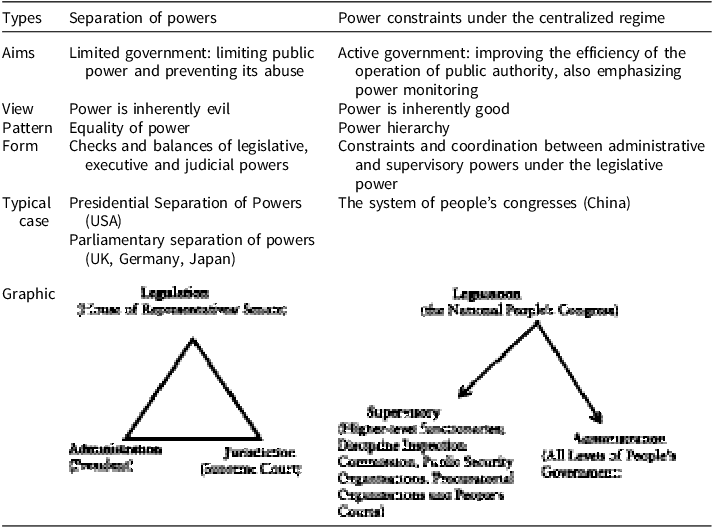
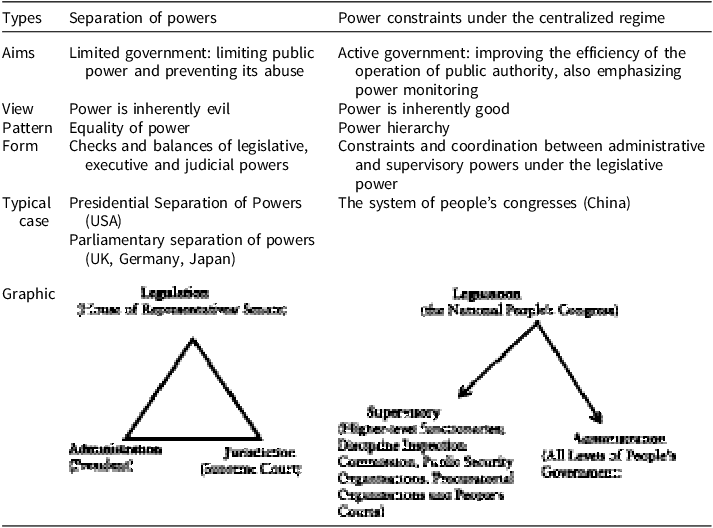
Most academics agree that the power is the responsibility of the state to provide public services, which has the obvious attribute of public authority (Liu et al Reference Liu and Hou2017). According to this logic, the division of power is manifested in the structural configuration of public authority. In terms of the development of the separation of powers, China has embraced the idea of checks and balances in the separation of powers, but has also explored “power constraints under the centralized regime” under the current framework, with a view to achieving supervision and coordination under a differentiated pattern of power, and to enhancing the efficiency of governance through the division of authority and cooperation (Table 1).
From “separation of powers” to “power constraints under the centralized regime”
Source: Own presentation.
The separation of powers stems from the assumption of power as evil, and its core idea is that the legislative, administrative and judicial powers are separate from each other and are subject to checks and balances. History has shown that people with power tend to abuse it (Karl 1967). “If the same people have both the power to make laws and the power to execute them, it is difficult for them to resist the temptation of seizing power for personal gain” (Locke Reference Locke2022). To prevent “Leviathan- style “state domination, the separation of powers safeguards the realization of constitutional values such as the rule of law and individual liberty through checks and balances among state institutions. This system fundamentally presupposes equal constitutional status for all branches of government, with its core focus being how legislative, administrative, and judicial bodies mutually constrain and oversee one another. While the separation of powers mechanism effectively constrains governmental overreach through its system of mutual restraints, critical scholarship has revealed its paradoxical consequences: the stabilization of hierarchical power structures (Pan Reference Pan2011) and the emergence of governance paralysis through circular decision-making processes (Wang and Cui Reference Wang and Cui2019). The presidential system of separation of powers in the United States is a model, with the Senate and House of Representatives in Congress, the Supreme Court, and the president representing the legislative, judicial, and executive branches, respectively. At one point in American history, Congress, the courts, and the president have all temporarily occupied supreme power (Henry Reference Henry2009). After World War II, executive power expanded rapidly, even to the point where an “administrative state” emerged (Dwight Reference Dwight2017). Competition for supreme power generates “internal conflict” and may also lead to prevarication that constrains responsibilities.
While inheriting the idea of power checks and balances, China has explored “power constraints under the centralized regime” (Jing Reference Jing2017). First, based on the positive view of power, China’s “Centralized system” is manifested in the adoption of democratic centralism, which emphasizes centralization and effective exercise of authority. To meet societal expectations and demands for public authority while enhancing governance efficiency, China has adopted the People’s Congresses and practices democratic centralism-an approach deeply rooted in the traditional Chinese concept of “grand unification” (Pan Reference Pan2011) and shaped by the contemporary reality of party-led state building (Chen and Huang Reference Chen and Huangfu2020). China’s top-down authorization system emphasizes the maintenance of centralization and unity, where all subnational authority flows from the center, with the center retaining absolute control over both legislative authorization and dispute adjudication in central-local relations. Second, “power constraints” are reflected in both centralized and decentralized systems. On the one hand, due to the absence of multi-party competition, the Communist Party of China (CPC) attempts to self-domesticate and self-restrain political rights under the framework of the centralized system based on the assumption that power is inherently good (Jing Reference Jing2017), metaphorically “locking power in institutional cages” of its own design. On the other hand, in the decentralize system, power checks and balances are explored through party-controlled cadres, centralized inspections, and auditing and assessment. Third, under the “power constraints under the centralized regime,” China’s state institutions exhibit a hierarchical power differential pattern (Huang Reference Huang2020). The National People’s Congress (NPC) as the supreme organ of state power, unifies the exercise of state power, and the constitution and laws it deliberates and adopts are the supreme authority in China’s public governance. This institutional design creates a subordinate relationship between the NPC and derivative administrative/supervisory bodies. Operationally, China’s centralized leadership allocates public authority across three functional domains-decision-making, implementation, and supervision-while mandating all state institutions to conduct their respective duties independently within constitutional and legal parameters.
In summary, according to the power constraints under the centralized regime, this paper divides China’s power of environmental governance into legislative power, administrative power and supervisory power. The legislative power is vertically upstream and downstream from the administrative and supervisory powers.
Research design
The evolutionary logic of public affairs and its transformation patterns constitute the analytical foundation for evaluating the intergovernmental allocation of environmental governance responsibilities. Drawing on institutional reforms and functional distributions within China’s environmental governance, this paper examines the policy documents of China’s governmental power reform in the field of environmental governance (1973–2023) through the case study method, systematically analyzing the developmental stages and defining characteristics of central-local power distribution in this domain.
Research methodology
This paper adopts a case study approach to systematically investigate the reform of environmental governance authority within China’s central-local dynamic. The case study methodology aims to provide a comprehensive and nuanced examination of China’s environmental governance authority reforms. Compared with quantitative analyses, the analytical generalization from case to theory demonstrates greater empirical validity, aligning more closely with the research objectives. As China’s environmental governance authority reforms have gone through a long time cycle, the case study methodology enables comprehensive contextual understanding across longitudinal frames, identification and tracking of emerging innovative practices, and systematic characterization of phase-specific institutional features (Pettigrew Reference Pettigrew1990).
Identification of key constructs: governmental power
In political theory, governmental power is conceptualized as “state power of a coercive and institutional nature” (Yao et al Reference Yao, Yan and Li2018), while its division constitutes “a process of establishing both legitimacy and normative authority” (Yu Reference Yu2016). The Common Program of the Chinese People’s Political Consultative Conference (CPPCC) defines “governmental power” as “the authority between the Central People’s Government and the local governments, stipulated by decree of the Central People’s Government Committee (CPGC) and allocated according to the nature of administrative affairs.” Official documents primarily characterize governmental power through administrative power and public affairs. For this study, governmental power refers specifically to the government’s responsibility for public goods provision and the accompanying management power.
Based on “power constraints under the centralized regime,” this paper examines China’s environmental governance authority reforms by categorizing governmental power into three distinct types – legislative, administrative and supervisory-from an empirical perspective that integrates existing research, China’s administrative system reform, and expenditure budgeting realities. (i) Legislative power refers to the authority of the NPC and its Standing Committee to formulate, amend, supplement, interpret or repeal laws and regulations, of which the central legislation also includes the environmental administrative regulations formulated by the State Council. (ii) Administrative power encompasses the decision-making, management and law-enforcement authority exercised by the people’s government in accordance with the law, including: formulating environmental policies and standards, energy conservation and emission reduction, environmental monitoring, pollution prevention and control, soil environment restoration and treatment, and ecological restoration and protection. (iii) Supervisory power involves the oversight exercised by superior functional departments and specialized institutions (e.g., disciplinary commissions, supervisory commissions, courts and procuratorates) to ensure environmental compliance, including: monitoring the implementation of environmental policies, investigating and penalizing environmental violations, and supervising environmental monitoring and assessment activities.
Data collection
This paper examines China’s environmental governance authority reforms through an analysis of policy texts from 1973 to 2023. The document collection process employed a rigorous two-stage methodology: (i) Keyword search protocol. Using the Peking University Law Database (https://www.pkulaw.com), we conducted Boolean searches with systematically paired keywords, including conceptual terms, “environment”/“ecology” combined with “power”/“legislation”/“monitoring”/“supervision”) and domain-specific terms covering all major environmental elements (water, soil, wildlife, forest, grassland, etc.). (ii) Screening criteria. We applied four strict screening criteria: (a) temporal scope: limited to 1973 (commencing with China’s inaugural environmental policy) through December 2023; (b) institutional level: exclusively central government-issued documents; (c) document types: only laws, administrative regulations, departmental rules/regulations and internal party regulations, excluding circulars and judicial interpretations, etc.; (d) version control: careful version control that excluded obsolete documents with irrelevant modifications while retaining those with substantive governance changes. This methodological approach ensures the dataset’s comprehensiveness while maintaining focus on core governance authority issues. After screening, we obtained 4,948 policy documents as research objects.
Data analysis
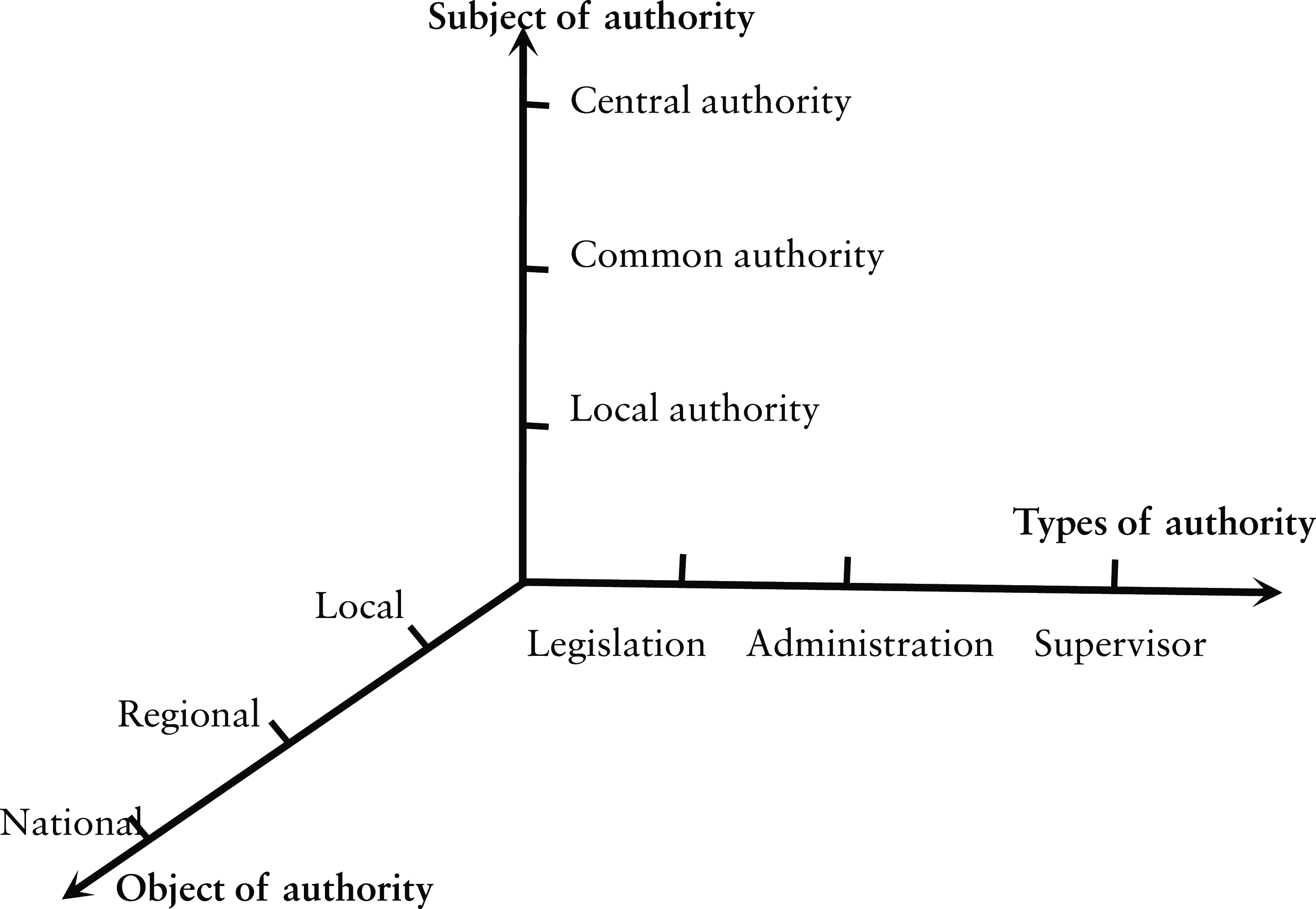
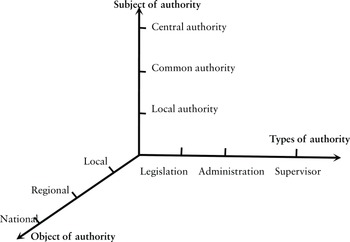
This paper employs NVIVO 12.0 software (Nordling and Pugh Reference Nordling and Pugh2019) to conduct a comparative analysis of China’s environmental governance authority reforms across both horizontal dimensions and longitudinal time scales, supplemented by textual typology construction. The analytical process follows a rigorous three-phase methodology: First, we establish core analytical units, including (a) policy-issuing authorities’ administrative levels and institutional types, (b) the tripartite framework of governance authority (subjects, objects, and types) (Figure 1). Second, we implement structured coding to create a hierarchical “parent node-child node-reference point” system, where parent nodes represent macro-categories (e.g., “legislative authority”), child nodes capture thematic subcategories (e.g., “environmental standard-setting”), and reference points contain specific policy provisions. Finally, through typological construction and pattern recognition (Kuckartz Reference Kuckartz2017), we identify multidimensional configurations among these nodes, revealing the complex interplay between different authority types and their evolution across China’s environmental governance reforms.
Node structure of China’s environmental governance authority reform under the three-dimensional framework.
Source: Own presentation.
The reliability and validity of data analysis were ensured through multiple verification approaches: (a) Triangulation Verification. Government documents (approvals, replies and responses) were cross-validated with news to establish triangulation. (b) Inter-coder reliability check. To minimize individual coding bias, a team-based coding strategy was adopted. Two researchers with relevant training conducted back-to-back coding on randomly selected sample materials. The reliability of the textual analysis was 92.6%, indicating that the results were objective and reliable. (c) Expert and stakeholder feedback. Preliminary analytical findings were reviewed and refined through consultations with environmental governance scholars and industry practitioners, ensuring both academic rigor and practical relevance.
China’s environmental governance authority reforms (1973-2023): selective decentralization under the centralization trend
Conditional decentralization of legislative power
Gradual decentralization of environmental governance legislation power from point to surface
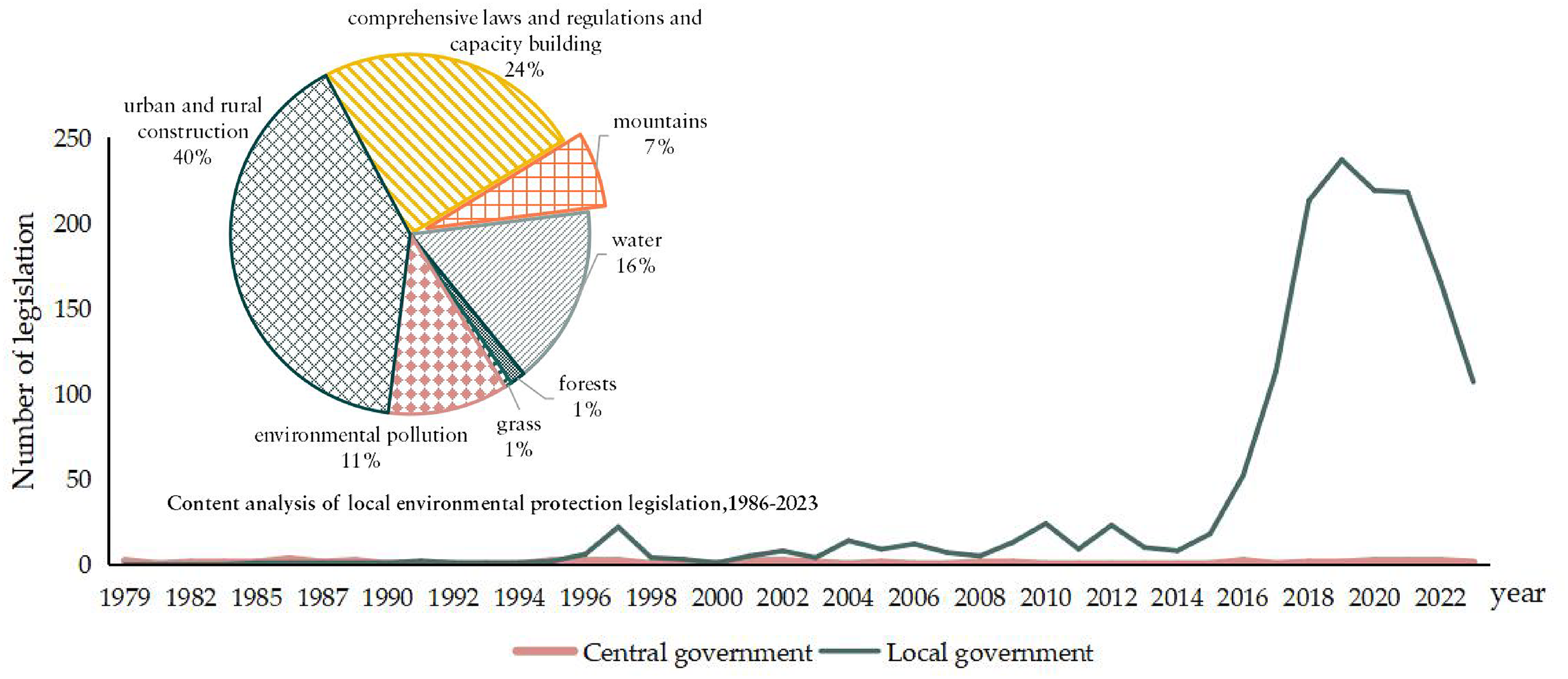
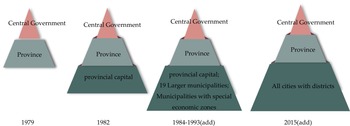
The devolution of China’s environmental legislative authority has undergone two distinct phases of progressive decentralization, with 2015 marking a pivotal turning point (Figure 2).
Decentralization of legislative power in China’s environmental governance.
Source: Policy texts of China’s environmental governance reform (1973-2023), compiled by the author.
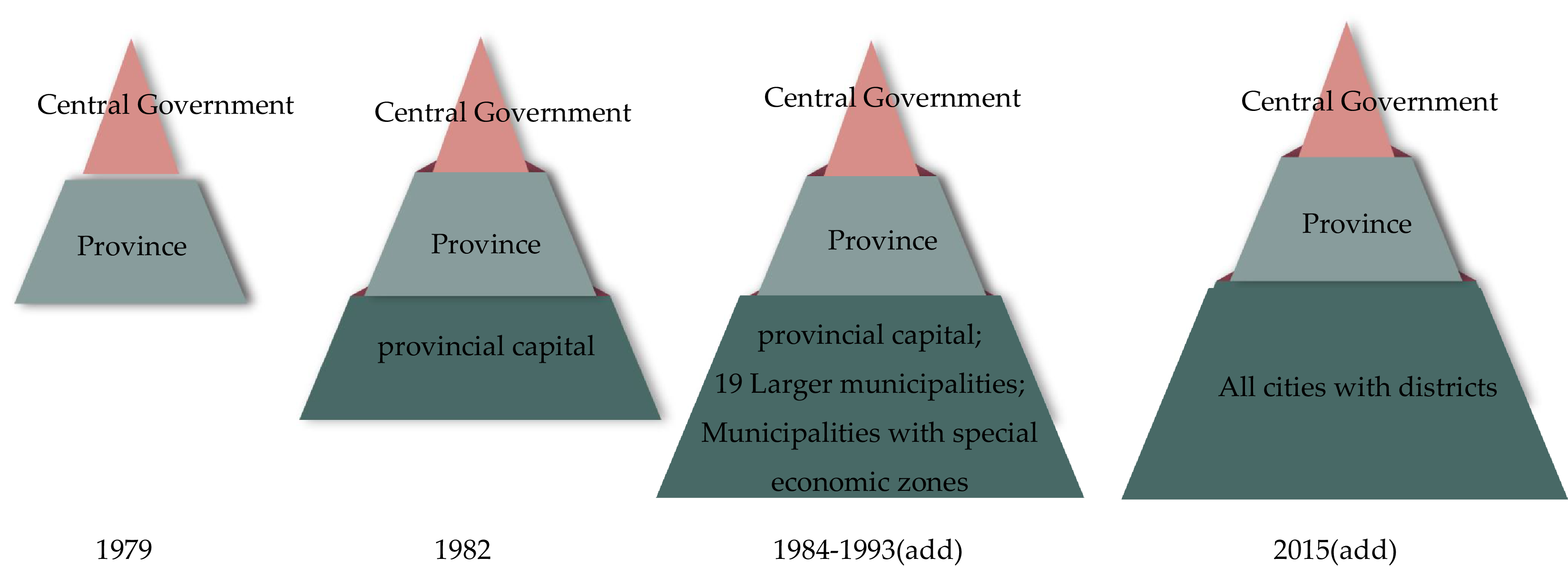
Phase I: Selective devolution (1973–2014). China’s environmental legislative authority gradually transitioned from high centralization to a two-tier decentralized structure, and gradually extending to 49 designated larger municipalities. In 1978, provincial-level people’s congress standing committees granted the authority to enact local regulations. In 1982, the capital cities of provinces/autonomous regions and State Council-approved “larger cities” obtained legislative drafting authority. Between 1984 and 1993, the system expanded to include: 19 officially cities designated “larger cities,” 4 special economic zones and 27 provincial capitals.
Phase II: Comprehensive devolution (2015–present). The 2015 legislative reform triggered exponential growth in local environmental legislation. Legislative reforms granted all prefecture-level cities lawmaking powers, dramatically increasing the number of local environmental legislative entities to 354 nationwide.
Conditional decentralization of environmental legislative power
The decentralization of environmental legislation in China operates within a clearly defined central framework, characterized by four key institutional constraints:
-
(1) Centralized control over legislative allocation. To maintain the unity of the legal system, the central government retains full control over the allocation of environmental legislation power. It can independently adjust the local legislative entities and the scope of legislative authority without needing local consent. Given China’s vast territory and significant differences in local environmental governance, the central government has gradually decentralized environmental legislative power. However, as a “unitary state” with a strong central authority, China’s legislative power is relatively centralized at the central level, and the local environmental legislative power originates entirely from central authorization. The central government has complete control over the decentralization of environmental legislative power and holds exclusive legislative power, which gives it both the power to empower and control local environmental legislation. On the one hand, the central government has full control over the entity and affairs of local environmental legislative power, as evidenced by the provision that “the National People’s Congress and its Standing Committee may, according to the needs of reform and development, decide to authorize the temporary adjustment or suspension of certain legal provisions in specific areas for a certain period.” On the other hand, when it is difficult to clarify the central and local environmental legislative power, the central government tends to adopt vague expressions, providing space for the central government to take or leave the local environmental legislation authority as needed.
-
(2) The “non-compliance” principle in local environmental legislation. The exercise of local environmental legislative authority is strictly bound by the “non-conflict” principle, as institutionalized in the Legislation Law of the PRC (2015 Amendment). This principle operationalizes central oversight through two key mechanisms: (a) Local environmental legislation must conform to the Constitution and align with existing the central government’s environmental laws. It cannot expand or reduce the scope of the prohibitions, increase or decrease the obligations, adjust or change the authority, responsibilities, and enforcement provisions of environmental protection agencies. (b) The legitimacy of the legislative process. Procedurally, local environmental legislation must be reported to the higher-level People’s Congress and its Standing Committee for the record or approval.
-
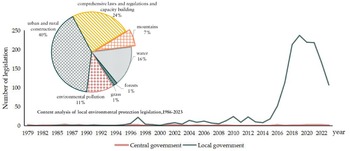
(3) Local environmental legislation follows the central legislative model while focusing on local environmental public goods provision, serving as an important supplement to central environmental laws. (i) Alignment with central legislative trends. Local environmental legislation has evolved from single-issue laws to watershed-based legislation, mirroring the central government’s approach. Initially adopting the central “one issue, one law” model targeting discrete environmental elements (e.g., separate regulations for lakes, water resources, water pollution, air pollution, and rural environments), local legislation has shifted toward integrated watershed governance following the central enactment of landmark laws like the Yangtze River Protection Law (2020) and the Yellow River Protection Law (2022). (ii) Complementary role in public goods provision. Analysis of 1,329 local regulations (1986–2023) reveals a strong emphasis on addressing region-specific environmental public goods, the legislative content shows the pattern of “urban and rural construction > comprehensive regulations and capacity building > water > environmental pollution > mountains > forest and grass” (Figure 3).
Figure 3.Comparison of the number of environmental governance legislation between central and local in China, 1979–2023.
Source: Policy texts of China’s environmental governance reform (1973-2023), compiled by the author.

-
(4) Encouraging local environmental legislation to be stricter than the central level. (i) Emission standards: since Article 10 of the Environmental Protection Law of the PRC (1989 Amendment) authorized provincial governments to set stricter local emission standards than national baselines, this delegated authority has been actively utilized. For instance, the 2016 Shandong Provincial Air Pollution Prevention and Control Regulations stipulate that the provincial government may “formulate air quality standards, air pollutant emission standards, and coal-fired fuel quality standards that are stricter than national standards, and expand the scope of implementation of special emission limits for air pollutants.” (ii) Administrative penalties: The authority to tighten standards inherently includes the power to enhance enforcement measures. Many localities have accordingly raised penalty ceilings and expanded the scope of punishable violations in their implementing rules.
Centralization of administrative power
De facto decentralization (1973–2015)
Since Environmental Protection Law of the PRC (For Trial Implementation) (1979) delineated responsibilities for environmental agencies at the State Council and local government levels, initiating a two-tiered governance framework. During 1973–2015, environmental administrative authority de facto devolved to the local governments.
Local governments as primary responsibility bearers. Most environmental administrative mandates were assigned to local governments, including environmental infrastructure construction, comprehensive management of key river basins, nuclear and radiation safety, rural pollution control, construction of nature reserves and important ecological functional areas, and environmental supervision capacity building. The institutional logic behind this arrangement is the proximity principle, where local governments still dominate in implementation despite insufficient task funding.
Strategic ambiguity in central government’s role. Most allocations of responsibilities were vaguely framed as “the central government (national level) ……” or “local governments at all levels (local level) ……,” with overlapping or similar tasks designated as shared obligations between central and local authorities. At the same time, the actual responsibilities assigned to the central government were often phrased in non-committal terms, such as “the central government will prioritize support for…” or “the central government may provide appropriate subsidies for….” In environmental governance, the central government’s role was frequently characterized as “symbolic,” “ideological,” or “advisory” rather than “substantively jurisdictional.” This ambiguous delineation of central and local environmental responsibilities – both in allocation and in the definition of the central government’s scope – created numerous overlapping or undefined areas where jurisdiction could shift. Under the political pressure of central authority, shared responsibilities were highly likely to devolve into local obligations. Consequently, many “normatively central” duties ended up being shouldered by local governments in practice.
Gradual clarification of the three categories of power and attempts to quantify shared authority (2016–2023)
In 2016, the State Council issued Guiding Opinions of the State Council on Advancing the Reform of the Division of Financial Powers and Expenditure Responsibilities between the Central and the Local Governments (the Guiding Opinions), marking China’s first systematic attempt to reconfigure the vertical allocation of public authority. This document initiated a new phase of environmental governance reform, characterized by a gradual upward shift of administrative responsibilities to the central level, and established the power reform principles of “moderately strengthening central power,” “guaranteeing local implementation of power” and “reducing and regulating shared authority.”
-
(1) Institutionalization of a three-tier authority framework. Based on the scope of benefits and the complexity of information, the Guidelines introduced a groundbreaking classification system, distinguishing: (a) Central authority: matters with national strategic significance (e.g., transboundary river/lake governance, strategic natural resource management); (b) Shared authority: cross-provincial environmental protection (e.g., air pollution control spanning multiple regions); (iii) Local authority: region-specific issues requiring localized knowledge (e.g., municipal waste management). The practice of the three types of powers is marked by the establishment of a “shared power transfers” subject in the central government in 2019, which reflects the central government’s expenditure responsibility for common fiscal powers.
-
(2) Recentralization with clear accountability. With the gradual clarification of the scope of the central government’s power, certain functions related to the exercise of the central government’s power have been added, and financial guarantees for the performance of the power have been clarified to limit the actual transfer of power. (i) Expansion of central responsibilities. For example, “key watersheds and nuclear safety,” which were previously mainly undertaken by local authorities, have been included in the scope of the central power; it has been clarified that the construction of the Sanjiangyuan National Park is “in principle an affair for the central power”; and it has been requested that the exercise of ownership of the national park’s universally-owned natural resource assets “be gradually transferred from the national park to the provincial government.” (ii) Full implementation of central authority. For example, the national ecological environment monitoring power belongs to the central power, and the Ministry of Ecology and Environment implemented the centralization of national surface water quality monitoring power in 2017, and completed the construction of the first 2,050 national surface water assessment section water quality automatic stations in 2018.
-
(3) Refinement of local authority through the “locality principle.” (i) While retaining jurisdiction over local environmental public goods provision, the reform introduced stricter delineation criteria that effectively reduced the scope of local authority. Examples include: ecological damage caused by historical reasons or public interests, wetlands damaged by major natural disasters, restoration of geological environment in mines where the duty bearer for governance has disappeared, etc. are recognized as part of local responsibility. The scope of local power has been divided into more detailed categories, which is a factual narrowing of the scope. (ii) Horizontal ecological compensation is clearly defined as a local power and is supported in a refined way through centralized transfer payment compensation to guarantee local performance of duties. For areas under local jurisdiction within key ecological function areas, ecological protection red lines, and important nature reserves such as national parks, national and provincial nature reserves, etc. delineated in the national land spatial planning that belongs to the local governance, the central government compensates for development and ecological protection costs by purchasing public welfare ecological products and services through fiscal transfer payments.
-
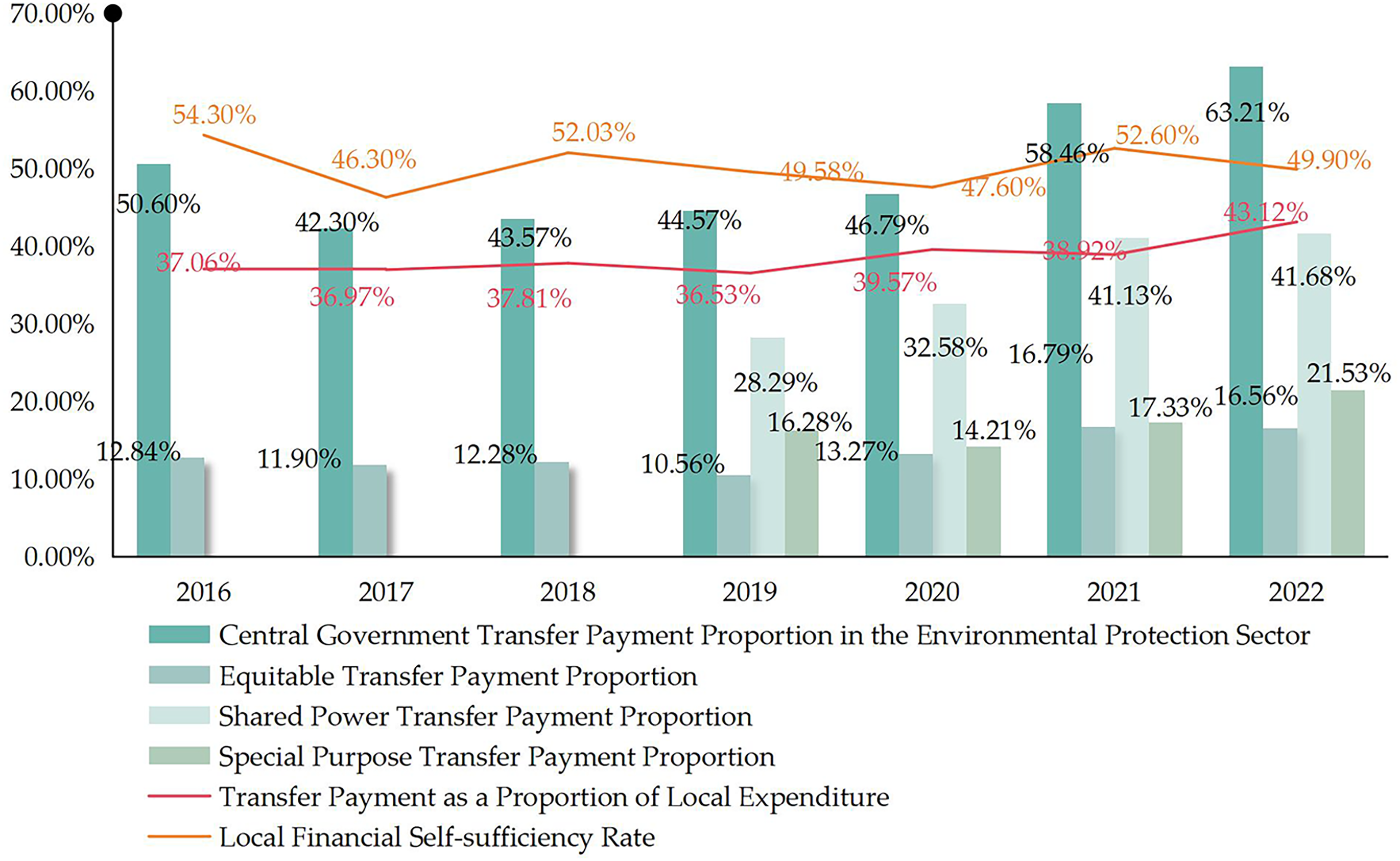
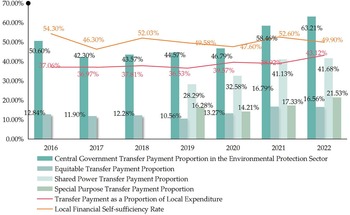
(4) Standardization and quantification of shared authority. The reform has systematically clarified and quantified joint central-local environmental responsibilities, transforming the previously vague two-tier division into a “strong central guidance with secured local capacity” framework. Key developments include: (a) Expansion of shared authority scope. Building on the 2014 precedent of locust control as shared responsibility, based on the principle that “cross-provincial (autonomous regions and municipalities) …… are jointly responsible by the central government and local authorities,” the shared authority now encompasses: major ecological function zones (previously local-dominated), Yangtze River basin and Yellow River headwaters conservation, integrated ecosystem protection (“mountain-water-forest-farmland-lake-grassland-ice” systems), rehabilitation of abandoned industrial/mining lands, national park infrastructure and ecological restoration, etc. (b) Precision in fiscal responsibility allocation. Shared authority ongoing efforts to quantify the share of central and local powers, which is mainly reflected in central budget investments: agricultural non-point source pollution in Yangtze Economic Belt/Yellow River basin: ≤50% central funding; Yangtze biodiversity projects: tiered central support (East: 40%, Central: 50%, West: 60% of approved costs). Most shared responsibilities are financed through shared transfer payments and special transfer payments. As evidenced in figure 4, the progressive centralization of environmental governance authority has been accompanied by a consistent annual increase in the central government’s fiscal contribution to local environmental protection expenditures, reaching 63.21% of total local energy-saving and environmental protection budgets by 2022. Notably, shared transfer payments exceed 40% of local environmental spending, emerging as the cornerstone in supporting local environmental governance.
Figure 4.The proportion of central government transfer payments in local energy-saving and environmental protection expenditure from 2016 to 2022.
Source: Ministry of Ecology and Environment of China and Ministry of Finance of China, compiled by the author.
Note: From 2016 to 2019, the central government transfer for environmental governance were mainly special-purpose transfers. Since the establishment of shared transfers in 2019, fiscal support has primarily been provided through a dual mechanism combining both shared and special-purpose transfers.
Centralization of supervisory power
Supervisory system from territorial to vertical management
Between 1973 and 2023, China’s environmental supervision system evolved from a model of local dominance to one of vertical dominance, concurrently accompanied by a steady centralization of regulatory power at the national level.
-
(1) Phase I: Localized governance with weak central oversight (1973–2004). China’s environmental supervision during this period was fundamentally structured around territorial management, where environmental responsibilities were allocated according to administrative boundaries, designating local governments (provincial/municipal) as the primary actors and supervisors in pollution control, including water, air, and solid waste management. This framework was legally codified in the Environmental Protection Law, which mandated that “local environmental protection bureaus implement unified supervision.” However, the central government’s vertical oversight faced significant constraints under the territorial management system. Two vertical oversight mechanisms existed but were weakened: (a) the administrative system, where the 1984 decentralization of cadre management authority severely limited the central environmental administration’s capacity to influence provincial environmental governance through personnel appointments; and (b) the judicial system, where courts and procuratorates maintained nominal oversight that was effectively undermined by de facto local control. This institutional paradox created a conflict of interest where local governments essentially served as both “players and referees” in environmental governance, resulted in a “fragmented enforcement” system that permitted local protectionism to routinely override central directives, thereby undermining cohesive environmental governance.
-
(2) Phase II: Centralization via vertical management (2002–Present). The period from 2002 to present has witnessed the establishment of Regional Supervision Centers for Environmental Protection (RSCEP) and the implementation of the Central Environmental Protection Inspection (CEPI), marking the formation of a vertical environmental supervision system characterized by “strong vertical (tiao) and weak horizontal (kuai)” management. This vertical management system, deriving its authority from superior departments, possesses inherent power advantages—particularly in conducting operational supervision of local environmental governance performance. The continuous deepening of centralized vertical management has become a defining feature of China’s environmental inspection authority reforms during this era (2002–present).
The establishment of RSCEP marked China’s initial shift from horizontal to vertical environmental governance, representing a gradual centralization of environmental oversight authority. Beginning in 2006, these centers operated under the delegation of the State Environmental Protection Administration (SEPA), and were tasked with monitoring local environmental policy implementation, major pollution incidents, and transboundary environmental issues. However, their operational effectiveness was fundamentally constrained by limited enforcement capacities – while empowered to investigate violations, they lacked penalty imposition authority (“investigate but not punish”), severely undermining their ability to ensure local compliance. A paradigmatic case highlighting these institutional deficiencies occurred in January 2012, when the South China RSCEP completed a routine inspection of heavy metal pollution controls in Guangxi Zhuang Autonomous Regions, merely four days post-inspection, the Longjiang River cadmium contamination crisis erupted. This incident not only exposed critical gaps in the supervision system but also precipitated widespread public skepticism regarding the central government’s capacity to overcome local protectionism in environmental enforcement.Footnote 1
The RSCEP proved ineffective in combating “local protectionism,” prompting the central government to reclaim authority through the formal launch of the CEPI system in 2016. To date, three nationwide inspection rounds have been conducted across all provinces and municipalities. China’s early environmental oversight functions were primarily coordinated by the Ministry of Environmental Protection. The CEPI represents an unprecedented top-down transmission of supreme political authority, transforming environmental inspections from a departmental operation into a national campaign through three mechanisms: (a) The Presence of Supreme Political Authority. As China’s ruling party and highest political authority, the CPC institutionalized the CEPI through the Trial Implementation Plan for Environmental Protection Inspection (2015). This shifted leadership from the Ministry of Environmental Protection to direct central control, with the CEPI’s organizational authority deriving from the Central Committee of the CPC – the apex of political power. (b) Power Consolidation. Through joint Party-government directives, environmental supervision was elevated to a Party-level priority, enhancing its political status. In contrast to the previous environmental governance model primarily led by the Ministry of Environmental Protection, the CEPI system represents a significant institutional upgrade, with its operations directly overseen by then-standing members of the Political Bureau of the CPC Central Committee. This organizational structure achieves a “dual-leadership” model (political authority + technical expertise): inspection team leaders are ministerial-level officials centrally appointed, creating institutional dominance over provincial governments, with high-level configuration ensuring political weight in enforcement actions; deputy ministerial-level environmental specialists from national agencies provide technical leadership, combining policy enforcement with professional environmental governance. (c) Momentum Building. Following the gradual rollout of the CEPI, major central and national media outlets launched intensive publicity campaigns. They tracked and reported on the significant developments, progress, accountability, and achievements. This coverage helped to release the high-level political pressure inherent in environmental policies, thereby inducing or catalyzing local officials to implement these policies effectively.
Supervision object shifted from enterprise supervision to joint party-government accountability
From 1973 to 2023, China’s environmental supervision system has fundamentally transformed its oversight targets, expanding beyond enterprises to hold local Party and government leadership accountable. This strategic shift, embedded within China’s Party-managed cadre system, effectively centralizes environmental oversight authority at the highest levels. In parallel with this redefined scope of accountability, the system’s purview has broadened from pollution control to encompass comprehensive ecological governance.
-
(1) Phase I: Enterprise-centric supervision (1973–2013). During this period, environmental oversight primarily targeted enterprises, emphasizing their pollution control responsibilities. From the viewpoint of policy design, local governments and polluting enterprises were both subject to supervision, but enforcement focused on corporate compliance. The government is the “arrow,” the enterprise is the “target,” pollution-emitting entities within jurisdiction have always been the key focus of environmental protection supervision. At this stage, environmental protection supervision has overemphasized the responsibilities of enterprises. Once enterprises are named and shamed, they face administrative penalties or even suspension of production. To strengthen supervisory effectiveness, the main responsible persons may also be held accountable for administrative violations. Nevertheless, this name-and-shame mechanism itself may be undermined by collusion between government and enterprises. A case in point is the Yingkou Paper Mill in Liaoning Province, where municipal government backing rendered sanctions from higher provincial and ministerial authorities ineffective.Footnote 2
-
(2) Phase II: Joint party-government accountability (2014–Present). A brief transitional phase (“supervision of enterprises and government, with supervision of government as the first priority”) gave way to the CEPI system, which institutionalized joint Party-government accountability, and the environmental supervision power was rapidly centralized.
First, the principle of “joint Party-government accountability” represents a pivotal shift in China’s environmental oversight framework by directly targeting local Party committees – the core decision-making bodies in China’s political system. Given the CPC absolute authority over cadre management, previous “government-focused supervision” proved insufficient in ensuring enforcement efficacy, as it excluded Party organs from environmental liability. In 2015, the General Office of the CPC Central Committee and the General Office of the State Council clearly stated that “local Party committees and governments share equal and primary responsibility for ecological and resource protection, with top leaders bearing personal accountability.” For the first time, Party committees were formally bound to environmental performance, closing the “accountability loophole” in China’s party-state system. In 2019, the Provisions on the Work of the Central Ecological Environment Protection Supervision explicitly expanded inspection targets to “relevant departments of the State Council with important responsibilities for ecological environment protection, relevant central enterprises with a large impact on the ecological environment, and other units that the central government requires to be supervised.” So far, the inclusion of Party committees ensures oversight of the “critical few” -the handful of top leaders who control personnel and resources.
Second, the scope of oversight has expanded from fragmented pollution control to comprehensive ecosystem protection and restoration. China’s environmental supervision primarily targeted industrial pollution-reflecting the country’s then-prevailing growth-at-all-costs development model. However, the CEPI system has dramatically broadened its purview to encompass the holistic conservation of “mountain-water-forest-farmland-lake-grassland-desert” ecosystems. In the two rounds of CEPI from 2016 to 2022, the Ministry of Ecology and Environment publicly released 262 typical cases, involving ecological destruction and sustainable development issues such as biodiversity, wetlands, forests, grasslands, oceans, watersheds, ecological red lines, and nature reserves, accounting for 33.2%.Footnote 3
The effectiveness of China’s environmental governance power reform
From 1973 to 2023, the reform of power of China’s environmental governance has gradually moved towards selective decentralization under the trend of centralization. Whether this institutional reform has achieved effective implementation at subnational levels and generated measurable enhancements in environmental governance performance remains unclear. This paper further explores these questions based on China’s practice.
-
(1) The decentralization of legislative authority has emerged as an effective approach to enhancing ecological and environmental governance in China by empowering local governments with greater autonomy. First, it facilitates participatory policymaking that yields context-specific regulations, as exemplified by Hubei Province’s Water Pollution Prevention and Control Regulations (2014), which incorporated expertise from over 60 specialists and feedback from 200,000 citizens through four legislative reviews.Footnote 4 Second, it enables precision-targeted local legislation, with jurisdictions adopting nimble “small incision” approaches—such as Wuhan’s 2017 graduated penalties on phosphorus detergents and Hunan’s 2021 geographically limited restrictions for critical watersheds- that balance environmental protection with economic realities. Third, it fosters cross-jurisdictional legislative coordination, demonstrated by the groundbreaking 2021 synchronized passage of the Chishui River Basin Protection Regulations across three provinces, establishing China’s first regional co-legislation framework for watershed management.Footnote 5 Together, these mechanisms illustrate how strategic decentralization can enhance regulatory responsiveness through local knowledge incorporation while maintaining central oversight of national environmental priorities, offering a replicable model for environmental federalism in large, diverse nations.
However, the decentralization of environmental legislative authority has, in some cases, produced unintended consequences due to local governments’ non-compliance with the fundamental principle of legislative consistency with central laws, thereby undermining environmental governance effectiveness. This regulatory failure is epitomized by the ecological degradation in Gansu’s Qilian Mountains National Nature Reserve. The Regulations of the People’s Republic of China on Nature Reserves (1994) explicitly prohibits ten activities within protected areas: “logging, grazing, hunting, fishing, herb collecting, land reclamation, burning, mining, quarrying, and sand excavation.” In contravention of these provisions, the Gansu Qilian Mountains National Nature Reserve Management Regulations, despite three successive amendments (2002, 2010, 2016) since its 1997 promulgation, has persistently narrowed the scope of prohibited activities to merely “hunting, land reclamation, and burning.” This selective regulatory approach presents a critical paradox: while maintaining restrictions on activities with relatively limited environmental impact, it systematically eliminated prohibitions on precisely those activities with the most significant ecological consequences. The resultant proliferation of exploration and mining operations has caused severe environmental degradation, including extensive vegetation destruction, accelerated soil erosion, and substantial land subsidence within this ecologically sensitive area.
-
(2) The centralization of environmental administrative authority has enhanced ecological governance through strategic resource allocation. Following the vertical reassignment of environmental governance responsibilities from local to central authorities, the central government has implemented a comprehensive fiscal transfer system comprising shared-responsibility transfers, special-purpose allocations, and general transfer payments to support local conservation efforts. The Three-River-Source ecological restoration project in Qinghai Province exemplifies this approach. Between 2018 and 2023, central fiscal transfers exceeding 60 billion yuan were allocated to Qinghai for ecological management, representing a growth rate that substantially outpaced the national average.Footnote 6 This targeted investment has yielded measurable ecological improvements: annual water conservation capacity increased by 6% on average, while grassland coverage and forage production rose by 11% and 30% respectively compared to baseline measurements from a decade prior.Footnote 7 Notably, the initiative has facilitated the recovery of multiple endangered species populations, including Tibetan antelopes (Pantholops hodgsonii), snow leopards (Panthera uncia), clouded leopards (Neofelis nebulosa), Tibetan foxes (Vulpes ferrilata), and black-necked cranes (Grus nigricollis).
Nevertheless, critical gaps remain in the central government’s assumption of environmental governance responsibilities, particularly regarding national-level environmental public goods. The conservation of Asian elephants (Elephas maximus) illustrates this institutional shortcoming. Despite compelling arguments based on wildlife sovereignty, conservation objectives, and interregional equity that support central government leadership, the existing legal and policy framework fails to clearly define central fiscal responsibilities. Yunnan Province continues to bear the primary governance burden, despite receiving only limited central support: an annual 5 million yuan general transfer payment for human-elephant conflict compensation since 2006,Footnote 8 supplemented by targeted allocations of 30.8 million yuan in 2020 (for Asian elephant and green peafowl conservation)Footnote 9 and 100 million yuan in 2021 (for pilot Asian elephant management zones).Footnote 10 These contributions remain disproportionate to Yunnan’s annual expenditure of 25.78 million yuan on wildlife liability insurance since 2011,5 creating an unsustainable governance model where enhanced conservation outcomes paradoxically increase local fiscal pressures. This structural imbalance underscores the urgent need for formalized central government responsibility in national-level environmental public goods.
-
(3) The upward shift of supervisory authority has enhanced ecological and environmental governance through rigorous accountability mechanisms. When environmental oversight responsibilities are centralized at the national level, the “top-down” political pressure creates formidable momentum for coordinated action. A case in point is the long-standing water pollution dispute between Wujiang in Jiangsu and Jiaxing in Zhejiang, where upstream textile industry pollution clashed with downstream aquaculture. The tensions culminated in 2001 when affected residents blockaded waterways to protest pollution levels, sparking major social unrest. In 2003, the East China RSCEP conducted a surprise visit to the Huai River Basin, and was even refused by the local public security department to equip it with warning lights and surrounded by polluting enterprises.Footnote 11 However, with the deepening of CEPI in 2017, cross regional river pollution has been effectively addressed. The principle of “joint Party and government accountability” has further realigned environmental governance priorities. In 2019, the Party Secretary and Governor of Henan were jointly reprimanded for failing to meet air pollution control targets—marking the first time China’s top provincial leaders were held simultaneously accountable for environmental issues.Footnote 12 This accountability yielded measurable improvements: by 2020, Henan’s average PM10 and PM2.5 concentrations had dropped by 13.5% and 11.9% year-on-year to 83 μg/m3 and 52 μg/m³, respectively.Footnote 13
While CEPI has driven environmental progress, the socioeconomic costs remain unaccounted for. Take Baiyangdian Lake’s restoration as an example. As North China’s largest freshwater wetland, it became a key focus of CEPI since 2017. By 2021, major water quality indicators – chemical oxygen demand (COD), permanganate index, and total phosphorus – had declined by 16.8%, 16.1%, and 30.4% year-on-year, respectively, with overall water quality improving from below Grade V to Grade III, making it one of China’s cleanest lakes.Footnote 14 This achievement, however, came at tremendous public cost. From 2014 to 2017, Baoding City invested 560 million yuan in Baiyangdian’s ecological restoration, with plans for an additional 24.582 billion yuan.Footnote 15 In 2019, the Xiongan New Area allocated approximately 18.6 billion yuan,Footnote 16 and in 2021, the central government disbursed 3.95 billion yuan in fiscal funds.Footnote 17 Beyond public expenditures, industrial costs were equally staggering. By 2015, nearly all upstream leather and nonferrous metal processing plants had been shut down, with fewer than 50% of down feather processing factories remaining operational.Footnote 18 Moreover, the rising cost of living due to industrial closures has yet to be factored into cost assessments.
Conclusion and discussion
This study examines China’s environmental governance reforms (1973–2023) through the lens of “power constraints under centralized authority,” categorizing responsibilities into legislative, administrative, and supervisory domains. By analyzing 4,948 policy documents, we find that China’s environmental governance has evolved toward centralized authority with selective decentralization, a strategy designed to adapt to the dynamic boundaries of environmental public goods provision. This research demonstrates how authoritarian environmentalism can balance central control with local flexibility, use political hierarchy to overcome bureaucratic fragmentation, and scale successful local experiments into national policy.
-
(1) The division of environmental legislative power between the central and local governments has continued the conditional and continuous devolution, which can be divided into three phases: (a) 1973–1978, China had a long-term central-level legislative system, with the National People’s Congress as the sole institution exercising the state’s legislative power; (b) 19792014, China’s environmental legislative power was changed to a second-level legislative system; (c) 2015–present, the environmental legislation power of local government has been rapidly expanded to “cities with districts.”
The delegation of legislative authority in environmental governance has demonstrated significant potential for enhancing ecological protection through localized empowerment. In China, effective decentralization of environmental legislative power depends on four fundamental principles guiding local legislation: compliance with superior laws, avoidance of redundancy, distinctive local relevance, and practical enforceability. This structured approach enables local jurisdictions to develop customized solutions to regional environmental challenges while maintaining harmony with national legislative frameworks. This multi-tiered legislative model reflects established global practices in environmental governance, where higher-level laws provide the constitutional foundation while subordinate regulations offer implementation specifics and contextual adaptations. A comparable example can be found in the UK’s regulatory framework for building energy efficiency. The higher-level law “Building Act” (Chapter 1) establishes the basic legal authorization, while the lower-level law “Building Regulations” stipulate detailed minimum performance standards for energy conservation, renewable energy integration, and carbon reduction, and are accompanied by technical specifications for various building components.
In addition, the decentralization of environmental legislative authority has enabled local governments to conduct policy experimentation through innovative regulations, creating valuable precedents for subsequent national legislation. For example, the Jilin Provincial Black Land Protection Regulations (2018), China’s first local regulations on black land protection, laid the groundwork for the enactment of the Black Land Protection Law of the People’s Republic of China in 2022, thereby elevating black land protection to a national priority. This process exemplifies how local initiatives can shape national policy under China’s democratic centralism, where regional “first-mover” laws are systematically evaluated for broader adoption.
China’s approach to public participation in environmental legislation has undergone a significant transformation, evolving from post-facto consultation to proactive engagement in legislative drafting-a progression that mirrors global trends in participatory governance. The traditional model of “end-of-pipe” public involvement, limited to reacting to environmental damage after its occurrence, has gradually given way to a “prevention-oriented” paradigm that institutionalizes citizen input from the initial stages of policy formulation. This shift is exemplified by the landmark public consultation process. Nevertheless, the implementation of multi-stakeholder participation remains uneven across different policy domains. In sectors with stronger governmental oversight such as urban construction management, transportation planning, and municipal sanitation services- all of which have significant environmental implications – social organizations’ involvement in bill drafting is intermittent. These areas continue to demonstrate what might be termed “selective participation,” where the depth and frequency of non-governmental involvement fluctuates depending on the perceived sensitivity of the policy issue.
-
(2) The environmental administrative power has shown a trend of centralization, from a blurred two-tier division of powers to a clear and quantifiable categorization into three types of powers. (a) 1973–2015, the actual government power has decentralized under the blurring of the two-level separation of powers between the central government and the local government. (b) 2016–2023, the central government and local government reform of environmental administrative power gradually subdivided into three types. This transition has moved beyond the previous era of ambiguous central-local jurisdictional boundaries toward clearer delineation of three distinct authority categories and initial attempts at quantifying shared responsibilities. The continuous concentration of environmental administrative power aims to meet the demand for national environmental public goods provided by the central government and regional environmental public goods jointly provided by the central government.
The recentralization of administrative authority has enhanced environmental governance through strategic resource reallocation. A landmark institutional innovation occurred in 2019 when China first established the “shared fiscal responsibility transfer payment” category in central transfer payments to centrally reflect the shared responsibilities undertaken by the central government. This approach draws on international experience from Germany’s fiscal equalization system, with the principle of “proportional sharing” in fulfilling shared responsibilities aligning with Germany’s categorized management approach to shared responsibilities (Bundesrepublik Deutschland 2006). Meanwhile, China’s shared fiscal responsibility transfer payments also emphasize the allocation of funds based on actual governance conditions. For instance, in the case of cross-provincial river basin governance, the central government provides precise compensation to local governments for environmental governance based on the water quality category or characteristic factor concentrationFootnote 19 at the river basin boundary section, similar to Canada’s practice of formula-based fund allocation (Department of Finance Canada 2025).
Building on this framework, China has further developed shared responsibility mechanisms in environmental governance by integrating centralized authority and national strategic priorities. First, regarding policy objectives, China’s environmental transfer payments emphasize “strategic priorities” rather than the equalization goals commonly seen internationally, focusing on supporting major national strategies like ecological conservation of the Three Rivers Source, Yangtze River, Yellow River, etc. Second, in determining central-local cost-sharing ratios, China employs a centrally-guided approach rather than the negotiated process typical of federal systems. While this enhances policy implementation efficiency by circumventing protracted intergovernmental bargaining, it simultaneously creates challenges of excessive local dependence on central funding. Third, concerning implementation mechanisms, China’s environmental shared responsibilities are predominantly project-oriented, contrasting with the unconditional policy linkages found in many international systems. Funding allocation emphasizes precision and project-specific targeting, with dynamic policy adjustments also being project-driven – as exemplified by development of the “integrated protection and restoration project of mountains, rivers, forests, farmlands, lakes, grasslands, and deserts” that propel shared environmental responsibility initiatives.
-
(3) The environmental supervision power has long been a two-tier system, showing a tendency to centralize, as evidenced by the following: (a) the supervisory system has shifted from territorial management to vertical management; (b) the object of supervision has shifted from enterprise supervision to joint party-government accountability, and the scope of the supervision has gradually expanded from environmental pollution control to the large-scale environmental protection construction of the “mountains, waters, forests, fields, lakes, grasses, and sands” community of life. From departmental action to national action, the environmental supervision has been supported by the highest political forces in China.
The upward shift of supervisory authority has enhanced environmental governance through mechanisms such as “high-level authorization” and the “joint Party-government accountability” system, which help realign ecological governance objectives, reduce information asymmetry, trigger inter-jurisdictional environmental competition, and promote institutional innovations for long-term governance. However, excessive reliance on political authority may undermine policy sustainability. First, the effectiveness of the CEPI is partially constrained by misaligned incentives between central and local governments. China’s long-standing practice of tying local officials’ career advancement primarily to economic indicators (particularly GDP growth) creates inherent conflicts when economic development competes with environmental protection. This institutional setup systematically biases local governments toward prioritizing short-term economic gains, while the possibility of environmental cost externalization and free-riding behavior further exacerbates governance challenges. Second, Within China’s constitutional framework, the NPC serves as the supreme state organ with nominal oversight authority over government operations. However, in practice, the NPC’s role in the national power structure has not been fully utilized. For instance, in the recall of government officials, NPC procedures typically follow the ruling Party’s recommendations rather than acting independently, which limits its substantive supervisory and constraining power over government officials. However, the internal accountability mechanism within administrative agencies has inherent limitations in self-monitoring, often resulting in a limited number of accountability cases and relatively light punishments, thereby weakening the effectiveness and deterrent power of the supervision mechanism. Additionally, although Chinese law grants citizens the right to file administrative lawsuits against government actions, the administrative litigation system still faces challenges, particularly in environmental protection. Public interest environmental lawsuits remain underdeveloped.
It is noteworthy that the costs of mobilizing administrative resources through the CEPI system under top-down political pressure may be difficult to quantify (Liu et al. Reference Liu, Lo, Zhan and Wang2015). While precise estimates remain unavailable, the CEPI’s costs demonstrably include: (a) operational inspection expenditures (evidence gathering, inspection procedures, accountability mechanisms, rectification measures, and effectiveness assessments); (b) local governments’ compliance costs; (c) corporate restructuring or closure expenses; and (d) public oversight and reporting expenditures. Empirical case studies confirm these interventions have generated significant adverse economic consequences, including widespread job losses and substantial economic contraction (An Reference An2024). While environmental governance undoubtedly benefits long-term economic development, most current projects lack scientific cost-benefit analysis. Government work reports and news media consistently avoid addressing this issue. As the primary funder of environmental governance, local governments prioritize political achievements over cost-effectiveness and environmental returns when allocating resources, potentially leading to resource misallocation and crowding-out effects.
Supplementary material
The supplementary material for this article can be found at https://doi.org/10.1017/S0143814X25100846.
Data availability statement
This study does not employ statistical methods and no replication materials are available. All policy texts can be found in the Peking University Law Database (https://www.pkulaw.com).
Acknowledgments
We are grateful to the anonymous reviewers who provided extensive and helpful comments on an earlier version of this manuscript.
Funding statement
This research was funded by the Yunnan Provincial Philosophy and Social Science Planning Key Project (ZX2025ZD06); the Yunnan Minzu University Talent Introduction Research Project (101520250000023).
Competing interests
The authors declare none.


 Open access

