


Psychotherapy training for general psychiatrists
A recent article in the Bulletin (Reference ReesRees, 2000) suggests that cognitive—analytic therapy (CAT) “may emerge as the preferred form of psychotherapy within the NHS”. I would question Rees' claim that CAT “uses an understandable language and straightforward techniques”. For many patients — and therapists — it is too ridden with jargon and complex diagrams. Moreover, as he admits, “formal CAT training is long [2 years for basic qualification]… this is impractical for most psychiatrists”. In addition, “research has yet to provide a robust evidence base for its effectiveness”. CAT in expert hands is an attractive and powerful model, but does not suit the needs of junior psychiatrists striving to rapidly acquire and integrate broad effective psychotherapeutic techniques. I suggest that another of the ‘newer’ therapies, interpersonal theray (IPT), would fit the bill better.
Background to IPT
The IPT of Klerman et al (Reference Klerman, Weissman and Rounsaville1984) is both flexible and integrative. It is a time-limited, structured psychotherapy designed pragmatically but with theoretical roots in attachment theory. It has been manualised as a treatment for depression and for bulimia nervosa (Reference Fairburn, Garner and GarfinkelFairburn, 1997), and extended as a group treatment for binge eating disorder (Reference Wilfley, Agras and TelchWilfley et al, 1993). Recent work has modified and extended the model for treatment of anxiety, dysthymia, primary care disorders, chronic fatigue, mood disorders associated with HIV, somatisation, adolescent disorders and depression of later life, and for use with couples and groups (all described in Reference Weissman, Markowitz and KlermanWeissman et al, 2000).
IPT, although relatively new to Britain, is welcomed enthusiastically by both patients and multi-disciplinary professionals. Unlike CAT, it has already been subject to large-scale randomised controlled trials involving CBT and medication, so it fits into mainstream medical research and evidence-based practice.
The model incorporates psychoeducation, it is ‘medication friendly’ and agrees with a medical model of psychiatric illness. Its rationale sits well with family and other systemic models of psychotherapy, and indeed offers a way of accessing systemic resources within individual therapy. Like CBT, it is structured and open, using a collaborative therapeutic relationship without invoking transference issues. Rating scales monitor each patient's progress. IPT does not involve formal ‘homework’ or rely on extensive paperwork. However, patients are encouraged to develop skills and experiment actively with these between sessions.
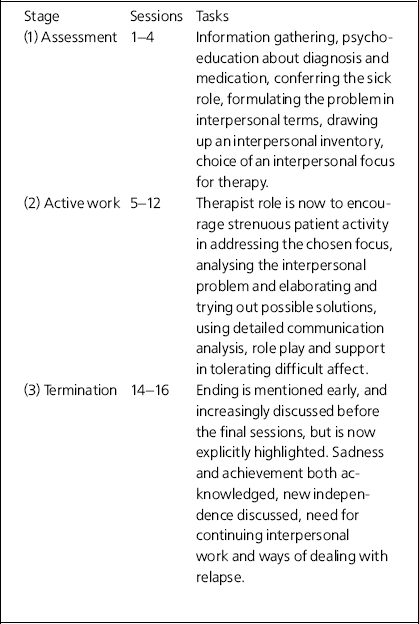
A full description is beyond the scope of this article (see Reference Klerman and WeissmanKlerman & Weissman, 1993; http://www.interpersonal psychotherapy.org ), but therapy (12-20 sessions, contracted in advance) has three parts, see Box 1. The first stage closely matches a standard psychiatric assessment. The medical model of depression is emphasised to the point of prescribing ‘the sick role’ to the patient. A key feature is the compiling of an interpersonal inventory that lists and examines all the patient's relationships. This is charted on rating scales or as a ‘spider’ diagram, which becomes a key resource for future therapy. By session four, one of four prescribed foci is selected: grief, role transitions, role disputes or interpersonal deficits.
Stages of a 16-session course of interpersonal psychotherapy
| Stage | Sessions | Tasks |
| (1) Assessment | 1-4 | Information gathering, psychoeducation about diagnosis and medication, conferring the sick role, formulating the problem in interpersonal terms, drawing up an interpersonal inventory, choice of an interpersonal focus for therapy. |
| (2) Active work | 5-12 | Therapist role is now to encourage strenuous patient activity in addressing the chosen focus, analysing the interpersonal problem and elaborating and trying out possible solutions, using detailed communication analysis, role play and support in tolerating difficult affect. |
| (3) Termination | 14-16 | Ending is mentioned early, and increasingly discussed before the final sessions, but is now explicitly highlighted. Sadness and achievement both acknowledged, new independence discussed, need for continuing interpersonal work and ways of dealing with relapse. |
The second and longest stage comprises active work on the chosen focus. The therapist becomes less active but holds the focus, relates symptom change to interpersonal events and encourages the patient to devise and experiment with new interpersonal strategies. Whereas CBT may conceptualise painful feelings as symptoms, and expect these to diminish when negative cognitions are challenged, IPT helps patients to identify and deliberately tolerate feelings.
The final sessions are devoted to termination, review, relapse prevention, grief over ending and the transition to independence. There is an explicit expectation — backed by research — that the full benefits of IPT do not appear immediately, but after a lag.
Application of IPT to general psychiatric practice
IPT is a suitable brief psychotherapeutic intervention for general clinics with economic constraints and need for measurable effectiveness. It has already been manualised, and lent itself readily to modifications, making it attractive for research and audit. It is so medication-friendly that its first stage could work as a form of compliance therapy. For a reasonably experienced clinician the training for IPT is brief — courses typically last 4-5 days — and for those trained in other models of psychotherapy, such as CBT, systemic therapies or dynamic therapy, there is no clash.
Elements of IPT may be usefully incorporated piecemeal into ordinary clinics. Explicit structuring of patient contact offers a clarity and expectation of progress too often missing, particularly when junior doctors simply ‘inherit’ patients without a clear agenda. The psychoeducational aspect of IPT is helpful in liaison or primary care settings, and extending this to ‘giving the sick role’ may help validate a psychiatric diagnosis for patients and their families. Many clinicians who have trained in IPT now incorporate an interpersonal inventory into standard patient assessments. This richly enhances understanding of the quality of an individual's life and identifies both potential resources and obstacles to treatment. Practice in helping patients to identify and tolerate feelings is another useful psychotherapeutic skill.
Attention to termination is unusual outside the rarefied analytic environment. In general psychiatric settings patients are passed from hand to hand as doctors rotate through training schemes, and contact is open-ended, with ad hoc discharge when the patient seems well enough. Open discussion of time-limits allows realistic planning of what can be achieved, the use of a focus and humane discussion of the issues involved in ending or changing doctor. Acknowledging a time limit also imposes a useful pressure to work hard for improvement.
Strengths and limitations
IPT is particularly accessible to patients who find dynamic approaches mystifying, or the ‘homework’ demands of CBT daunting. IPT has been specially modified for adolescents (Reference Mufson, Moreau and WeissmanMufson et al, 1993), who may find CBT too much like school work, whereas IPT addresses relationships — a primary concern. IPT is abstemious in its use of technical jargon — a bonus for those who distrust ‘psychobabble’. Fairburn (Reference Fairburn, Garner and Garfinkel1997) reports that both patients and therapists in his bulimia studies expressed a preference for IPT over CBT. This may have implications for compliance and therapist morale.
For general psychiatrists the major limitation of IPT is that the model has not so far been modified for the management of psychoses. However, this is true of most psychotherapies. The CBT model requires such expertise for use with this patient group that it would be a rash trainee who attempted its use without expert training and support.
IPT and psychiatric training
In contrast to dynamic psychotherapy, CAT or even CBT, formal training in IPT involves a relatively short-time commitment, so could be available to consultants from general and liaison psychiatry as well as juniors. This would enable the IPT approach to be disseminated more widely, and trainees could be well supported and supervised in their therapeutic work after their initial training.
Markowitz (Reference Markowitz1998) usefully describes teaching IPT to psychiatric residents in North American teaching hospitals. In Edinburgh we have incorporated some IPT principles and skills into our introductory psychotherapy seminars for new senior house officers and they have been received with enthusiasm. We are now offering them fuller IPT training and would strongly recommend its consideration as a model for psychotherapy training within general psychiatry.


 Open access


eLetters
No eLetters have been published for this article.