

1. Introduction
Thermobarometry utilizing inclusions enclosed in robust minerals within metamorphic rocks has been applied over several decades (e.g. Kumar and Chacko, Reference Kumar and Chacko1994; Engvik and Andersen, Reference Engvik and Andersen2000). However, its use has recently accelerated thanks to the developments of trace element-based geothermometers and elastobarometry (e.g. Kohn et al. Reference Kohn, Mazzucchelli and Alvaro2023). P-T determinations based on inclusions trapped inside porphyroblasts, mostly garnet (Ferrero and Angel, Reference Ferrero and Angel2018), offer a powerful tool to decipher the evolution of the rocks. Moreover, it has been demonstrated that quartz-in-garnet (QuiG) barometry coupled with Zr-in-rutile (ZiR) and/or Ti-in-quartz (TitaniQ) thermometry can be applied successfully even to rocks that have experienced partial re-equilibration (e.g. Gilio et al. Reference Gilio, Scambelluri, Angel and Alvaro2022; Jeanneret et al. Reference Jeanneret, Klonowska, Barnes, Majka, Holmberg, Gilio, Nachlas, Alvaro, Kośmińska, Lorenz, Zack, Ladenberger and Koyi2023).
In addition to establishing spatial P-T gradients through field-based studies, the thermal-tectonic regime of subduction systems has been predicted through the application of computational geodynamic models (e.g. Syracuse et al. Reference Syracuse, van Keken and Abers2010). Although there are discrepancies between models and data derived from exhumed rocks (Penniston-Dorland et al. Reference Penniston-Dorland, Kohn and Manning2015; van Keken and Wilson, Reference van Keken and Wilson2023 and references therein), both approaches seem to yield comparable results for the highest P (>2.5 GPa), providing a good reference basis for new studies on subduction processes. However, single studies rarely encompass numerous samples of similar lithology distributed across a (ultra)high-pressure ((U)HP) terrain and apply a coherent set of P-T tools. Thus, rigorous comparisons of the empirical and modelled data have been lacking. An excellent target to acquire consistent empirical data is the Western Gneiss Region (WGR). As it is a mass of continental crust subducted during the terminal stage of closure of the Iapetus Ocean (e.g. Andersen et al. Reference Andersen, Jamtveit, Dewey and Swensson1991), rather than a common oceanic crust subduction regime, the available comparable model data are even scarcer. The last regional studies in the WGR focused on P-T conditions were performed around 20 years ago (Cuthbert et al. Reference Cuthbert, Carswell, Krogh-Ravna and Wain2000; Labrousse et al. Reference Labrousse, Jolivet, Andersen, Agard, Hubert, Maluski and Shurer2004; Young et al. Reference Young, Hacker, Andersen and Corfu2007). Recent studies focus on specific localities or smaller areas rather than considering the WGR as a whole (e.g. Vrijmoed et al. Reference Vrijmoed, Van Roermund and Davies2006; Engvik et al. Reference Engvik, Andersen and Wachmann2007; Cutts and Smith, Reference Cutts and Smit2018; Simon et al. Reference Simon, Pitra, Yamato and Poujol2023), and some of them apply differing methods that may be difficult to compare. Hence, the large-scale metamorphic evolution of the WGR, the archetypal (U)HP terrain worldwide remains unclear, and a more consistent approach to studying the area is needed to decipher processes recorded in UHP terrains.
We performed a regional P-T study of nine eclogite bodies along the western border of WGR using a combination of garnet–clinopyroxene–(phengite) (Grt-Cpx-(Phe)), Zr-in-rutile, Ti-in-quartz, and quartz-in-garnet thermobarometers to evaluate the thermal regime of the subducting continental slab and compare it with steady-state oceanic subduction. Despite the availability of previous research results, our goal was to create a consistent dataset to clarify any ambiguities arising from internally inconsistent methodologies. Our results show an increase in P and T from south to north along the 190 km traverse (not in the subduction direction; however, it is assumed that the slab was consistent in dip and strike, hence not affecting the P-T gradient) enabling calculation of a geothermal gradient (in P-T space). Moreover, the spatial distribution of P-T from eclogites in map view most likely indicates that the WGR rocks have undergone post-UHP tectonic reorganization.
2. Geological background
The WGR lies within the Caledonian orogen of southern Norway (Figure 1), which formed as a consequence of the closure of the Iapetus ocean and collision of Baltica and Laurentia in the late Ordovician to Devonian (e.g. Andersen et al. Reference Andersen, Jamtveit, Dewey and Swensson1991; Gee et al. Reference Gee, Janák, Majka, Robinson and van Roermund2013). It has been a well-studied eclogite-facies terrain since the seminal work of Eskola (Reference Eskola1921) and the discovery of coesite by Smith (Reference Smith1984). The WGR mainly comprises reworked parautochthonous Fennoscandian basement outcropping in a tectonic megawindow (Roberts et al. Reference Roberts, Thon, Gee and Stephens1981). It is built mostly of felsic gneisses with widespread bodies of eclogite (Griffin, Reference Griffin1987) and also exhibits infolded belts of tectonically superimposed (i.e. allochthonous) metasediments and metavolcanics (Tveten et al. Reference Tveten, Lutro and Thorsnes1998). In the south and east of the WGR, eclogites lack evidence for the presence of coesite, and previous studies indicated that they were quartz-stable (Engvik and Andersen, Reference Engvik and Andersen2000; Foreman et al. Reference Foreman, Andersen and Wheeler2005). UHP eclogites and rare coesite-bearing schists and gneisses crop out in an extensive area between Nordfjord and Molde (e.g. Wain, Reference Wain1997; Spengler et al. Reference Spengler, Włodek, Zhong, Loges and Cuthbert2023; Figure 1). The WGR is segmented into three major tectonostratigraphic units bounded by shear zones (Young, Reference Young2018; Wiest et al. Reference Wiest, Jacobs, Fossen, Ganerød and Osmundsen2021). Our traverse passes through the Fjordane Complex, ‘mixed rocks’ of the Lower Allochthon and the Western Gneiss Complex. Geochronology obtained for various eclogites in the WGR (c. 397–420 Ma) suggests slow subduction of a large block of relatively thick crust (e.g. Kylander-Clark et al. Reference Kylander-Clark, Hacker, Johnson, Beard and Mahlen2009). Peak P-T conditions of eclogites increase towards the northwest (Krogh, Reference Krogh1977; Hacker et al. Reference Hacker, Andersen, Johnston, Kylander-Clark, Peterman, Walsh and Young2010 and references therein) with a c. 5°C/km geothermal gradient (Cuthbert et al. Reference Cuthbert, Carswell, Krogh-Ravna and Wain2000).
Map of SW Norway with sample locations; tectonic contacts after Tveten et al. (Reference Tveten, Lutro and Thorsnes1998), UHP domain after Spengler et al. (Reference Spengler, Włodek, Zhong, Loges and Cuthbert2023).

In this study, the selected (U)HP eclogites from Drøsdal, Vårdalsneset, Verpeneset, Halnes, Saltaneset, Grytting, Ulsteinvik, Korveneset and Solholmen (Figure 1) are part of a transect encompassing the P-T range recognized in previous works (see Supplementary Material (SM) for coordinates of each locality). At the southern end of our transect, near Hyllestad in Sunnfjord, the Drøsdal eclogite lies within the Parautochthon. It is an exceptionally well-preserved lensoid massif, outcropping over c. 3 km2. The whole body was folded under eclogite-facies conditions and subsequently stretched into detached lenses (Foreman et al. Reference Foreman, Andersen and Wheeler2005).
The eclogite body at Vårdalsneset, near Askvoll in Sunnfjord, also outcrops in the high-pressure (HP) domain. It is exposed along c. 0.8 km of the north coast of Dalsfjord, but this may be part of a much larger, tabular body that extends across the fjord (Cuthbert, Reference Cuthbert1985; Engvik and Andersen, Reference Engvik and Andersen2000). It comprises strongly lineated eclogite tectonites, locally mylonitic, interlayered with felsic gneiss. Much of the body has been overprinted with an amphibolite-facies foliation, within which are preserved lenses of less altered eclogite (Engvik and Andersen, Reference Engvik and Andersen2000).
The Verpeneset eclogite is a smaller, but superbly preserved, body exposed on the northern coast of Nordfjord near Måløy within a belt of metasediments in the Parautochthon (Bryhni, Reference Bryhni1966). Evidence for UHP conditions, such as polycrystalline quartz, is well preserved in this body (Root et al. Reference Root, Hacker, Mattinson and Wooden2004; Kylander-Clark et al. Reference Kylander-Clark, Hacker, Johnson, Beard, Mahlen and Lapen2007), which is the southernmost known occurrence of coesite in the WGR, hence providing a point defining a ‘coesite-in’ line roughly along the north coast of Nordfjord (Cuthbert et al. Reference Cuthbert, Carswell, Krogh-Ravna and Wain2000). This eclogite exhibits two types of compositional layering: a coarse-grained variety with zoned garnet porphyroblasts (Krogh, Reference Krogh1982), clinopyroxene, phengite, kyanite, and zoisite, and a variety with smaller garnets, quartz, clinopyroxene, and zoisite. Forward modelling of garnet zoning based upon a subduction-like P-T path has yielded patterns that closely reproduce the inclusion, major element and trace element zoning patterns observed in eclogites from this area (Konrad-Schmolke et al. Reference Konrad-Schmolke, O’Brien, de Capitani and Carswell2008 a, b).
The eclogite body at Halnes, Vågsøy, also near Måløy in Møre og Romsdal county, lies in the same belt of metasediments in the Parautochthon that host the Verpeneset body, also within the UHP domain. Besides eclogites in the outer Nordfjord region, mantle-derived peridotites and serpentinites approximately mark the boundary between the UHP and HP zones (Cuthbert et al. Reference Cuthbert, Carswell, Krogh-Ravna and Wain2000; Brueckner et al. Reference Brueckner, Carswell, Griffin, Medaris, Van Roermund and Cuthbert2010).
The Saltaneset eclogite body is located between Barmsundet and Moldefjorden, just south of Selje. It measures c. 20 × 3–5 m (DesOrmeau et al. Reference DesOrmeau, Gordon, Kylander-Clark, Hacker, Bowring, Schoene and Samperton2015) and is characterized by a distinctive fine interlayering of very fresh eclogite and phengite-garnet schists. UHP conditions during eclogite-facies metamorphism are confirmed by the presence of coesite (Wain, Reference Wain1997; Carswell et al. Reference Carswell, Tucker, O’Brien and Krogh2003 a; Renedo et al. Reference Renedo, Nachlas, Whitney, Teyssier, Piazolo, Gordon and Fossen2015).
The eclogites at Grytting on the southeast shore of the Stadlandet peninsula near Selje lie within the Nordfjord UHP domain. In this area, eclogite occurs as pods varying in size from a few metres up to more than 500 m, concentrated in up to 15 km long trails in a belt of pelitic gneiss close to adjacent to granitoid orthogneiss (Lappin and Smith, Reference Lappin and Smith1978; Krabbendam and Wain, Reference Krabbendam and Wain1997). These eclogite bodies include the pod in which coesite was first discovered in Norway (Smith, Reference Smith1984) and the adjacent ‘pegmatitic’ enstatite eclogite described in the classic article of Eskola (Reference Eskola1921).
Further north in the Sørøyane archipelago, the very large (5 × 4 km2) Hareidlandet eclogite massif (Mysen and Heier, Reference Mysen and Heier1972; Carswell et al. Reference Carswell, Tucker, O’Brien and Krogh2003 a, b) is centred on the town of Ulsteinvik, forming a major lithological unit within an envelope of metapelitic gneiss and amphibolite that together are interpreted to belong to the Blåhø Nappe (Middle Allochthon, Bryhni, Reference Bryhni1991). This quartz-bearing eclogite is modally layered on the centimetre scale, with either garnet or clinopyroxene predominating and quartz layers of probable magmatic origin in the protolith. The characteristic feature of those eclogites is pervasive retrogression to clinopyroxene–plagioclase–amphibole symplectite. Coesite is present as relics, sometimes included in zircon (Carswell et al. Reference Carswell, Tucker, O’Brien and Krogh2003 a; DesOrmeau et al. Reference DesOrmeau, Gordon, Kylander-Clark, Hacker, Bowring, Schoene and Samperton2015).
In the northernmost part of the transect the small enstatite eclogite bodies at Korveneset and Solholmen are located on Otrøya in the northernmost part of the UHP domain within the Parautochthon, here referred to as the Ulla Gneiss and Augen Orthogneiss units of the ‘Baltica Basement’ (Harvey, Reference Harvey1983; Terry and Robinson, Reference Terry and Robinson2003). These eclogites have been previously described by Carswell et al. (Reference Carswell, Krogh, Griffin, Sturt and Gee1985, Reference Carswell, van Roermund and de Vries2006).
3. Methods
3.a. Electron microprobe
Mineral chemistry was determined by wavelength-dispersive spectrometry (WDS) using electron microprobes (EMPs): JEOL JXA-8530F Hyperprobe at the Department of Earth Sciences, Uppsala University, Sweden, and JEOL JXA-8230 Superprobe at the Faculty of Geology, Geophysics and Environmental Protection at AGH University of Krakow, Poland. The analytical conditions for spot analyses were set as follows: accelerating voltage of 15 kV, beam current of 20 nA, and beam size of 1–5 μm, depending on the analysed mineral. Natural and synthetic standards were used for the calibration. JEOL JXA-8530F Hyperprobe at Uppsala University was used for collecting X-ray compositional maps with an accelerating voltage of 15 kV, a beam current of 40 nA, a dwell time of 100 ms, and an analytical spot size of 3 or 5 μm correlated with the 3 × 3 μm or 5 × 5 μm grid (depending on the garnet size). Additional maps were obtained using the JEOL Superprobe at AGH University of Krakow with the following analytical conditions: an accelerating voltage of 15 kV, a beam current of 100 nA, a dwell time of 100 ms and a step size of 5–10 μm.
Analyses of Zr concentration in rutile and Ti in quartz have been performed using the JEOL JXA-8230 Superprobe at AGH University of Krakow. The operating conditions were as follows: 15 kV accelerating voltage, 120 nA beam current for Zr and 200 nA for Ti, 1 μm beam size. The counting times were 300 s on peak and 150 s on background positions for Zr in rutile measurements, and 600 s on peak and 150 s on background for Ti in quartz analyses. The calculated detection limit is 45 ppm for Zr in rutile and 6 ppm for Ti in quartz.
The end members of garnet were calculated as follows: Alm=Fe2+/(Fe2++Ca+Mg+Mn)·100; Sps=Mn/(Fe2++Ca+Mg+Mn)·100; Prp=Mg/(Fe2++Ca+Mg+Mn)·100; Grs=Ca/(Fe2++Ca+Mg+Mn)·100. X Fe and X Na values for pyroxene were calculated as X Fe = Fe2+/Fe2++Mg and X Na = Na/Na+Ca, respectively.
3.b. Raman spectroscopy
Raman spectroscopy analyses were performed at the Experimental Mineralogy Lab at the Department of Earth and Environmental Sciences, University of Pavia, Italy. Quartz spectra were collected using a Horiba LabRAM HR Evolution instrument at room temperature. A 532 nm laser and 1800 groove/mm grating were used. The full Raman spectra in the range of 15–1000 cm−1 were collected with an acquisition time of 30 s and four accumulations. The spectrometer was calibrated with silicon to the Raman peak at 520.6 cm−1. A free quartz standard was measured before and after each measurement session, four times a day (under the same conditions, except for a 15 s acquisition time). The calculated analytical uncertainty is 0.35 cm−1.
3.c. P-T estimates
Garnet–clinopyroxene–phengite geothermobarometry has been applied using a garnet–clinopyroxene Fe2+–Mg exchange thermometer (Krogh Ravna, Reference Cuthbert, Carswell, Krogh-Ravna and Wain2000) and the net-transfer reaction 6diopside+3muscovite=3celadonite+2grossular+pyrope geobarometer (Krogh Ravna and Terry, Reference Krogh Ravna and Terry2004). The following solution models were used in P-T calculations: phengite (Holland and Powell, Reference Holland and Powell1998), clinopyroxene (Holland, Reference Holland1990) and garnet (Ganguly et al. Reference Ganguly, Cheng and Tirone1996). Depending on the mineral composition of the eclogite, the garnet–phengite–clinopyroxene–kyanite–SiO2 or garnet–clinopyroxene–phengite assemblage was used. These calculations were applied to the silica-rich eclogites from the south. For the more mafic eclogites, only the Grt-Cpx thermometer was applied because of the lack of phengite. To minimize the uncertainties related to the amount of Fe3+ in clinopyroxene, the equation of the Grt-Cpx thermometer based on Mg end members (Krogh Ravna and Terry, Reference Krogh Ravna and Terry2004) has been used. Calculations were made on representative WDS analyses selected from the whole set of results based on the textural position. Since the cores of garnet contain scarce clinopyroxene and phengite inclusions too small for the location of EMP spot, only garnet rim analyses, together with clinopyroxene and phengite from the matrix, were used. Results showing retrograde diffusional re-equilibration (e.g. slightly Fe-richer thin rim in garnet, see Figure 3d and h) were avoided. Garnet with the highest grossular content, clinopyroxene with maximum jadeite content and phengite with the highest Si apfu (atom per formula unit) were paired (for the details see the discussion in Cuthbert et al. Reference Cuthbert, Carswell, Krogh-Ravna and Wain2000). In the samples where garnet is zonal and does not contain clinopyroxene inclusions, rim analyses were selected for the calculations. This method gives uncertainties of ±65°C and ±0.32 GPa (Krogh Ravna and Terry, Reference Krogh Ravna and Terry2004).
Zr-in-rutile (ZiR; Tomkins et al. Reference Tomkins, Powell and Ellis2007) and Ti-in-quartz (TitaniQ; Osborne et al. Reference Osborne, Thomas, Nachlas, Angel, Hoff and Watson2022) thermometers were applied to constrain P-T conditions based on their intersections, as the TitaniQ equation is very P-dependent. The expanded volume (Vex) solubility model applied in the latest calibration of TitaniQ with the RTln $X\,_{Ti{O_2}}^{quartz}$
=−55.287 − [P · (−2.625 + 0.0403P)] + RT
$X\,_{Ti{O_2}}^{quartz}$
=−55.287 − [P · (−2.625 + 0.0403P)] + RT $lna\,_{Ti{O_2}}^{rutile}$
(R – gas constant; T – temperature in K; P – pressure in kbar;
$lna\,_{Ti{O_2}}^{rutile}$
(R – gas constant; T – temperature in K; P – pressure in kbar; $X_{Ti{O_2}}^{quartz}$
– mole fraction of TiO2 in quartz;
$X_{Ti{O_2}}^{quartz}$
– mole fraction of TiO2 in quartz; $a_{Ti{O_2}}^{rutile}$
– activity of TiO2) equation (Osborne et al. Reference Osborne, Thomas, Nachlas, Angel, Hoff and Watson2022) was used. Two equations were used to determine the temperature with ZiR thermometry as the expected results would possibly range across the α-quartz or coesite stability fields. For the lower-pressure part of the P-T diagram, the equation takes the form of
$a_{Ti{O_2}}^{rutile}$
– activity of TiO2) equation (Osborne et al. Reference Osborne, Thomas, Nachlas, Angel, Hoff and Watson2022) was used. Two equations were used to determine the temperature with ZiR thermometry as the expected results would possibly range across the α-quartz or coesite stability fields. For the lower-pressure part of the P-T diagram, the equation takes the form of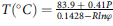 $T{\left( {^\circ C} \right)} = {{{83.9 \;+ \;0.41P}}\over{{0.1428 - Rln\varphi }}}$
– 273 (
$T{\left( {^\circ C} \right)} = {{{83.9 \;+ \;0.41P}}\over{{0.1428 - Rln\varphi }}}$
– 273 ( $\varphi $
- Zr in rutile in ppm) and
$\varphi $
- Zr in rutile in ppm) and $T\left( {^\circ C} \right) = {{{88.1\; + \;0.206P}}\over{{0.1412 \;-\; Rln\varphi }}}$
– 273 above the quartz-coesite reaction line (Tomkins et al. Reference Tomkins, Powell and Ellis2007). The uncertainties are 13°C and 0.065 GPa for TitaniQ (Osborne et al. Reference Osborne, Thomas, Nachlas, Angel, Hoff and Watson2022) and 30°C for ZiR (Tomkins et al. Reference Tomkins, Powell and Ellis2007). The combination of these two thermometers makes it possible to estimate the P-T conditions of crystallization when the minerals co-crystallized (Osborne et al, Reference Osborne, Thomas, Nachlas, Angel, Hoff and Watson2022) (see SM for comments).
$T\left( {^\circ C} \right) = {{{88.1\; + \;0.206P}}\over{{0.1412 \;-\; Rln\varphi }}}$
– 273 above the quartz-coesite reaction line (Tomkins et al. Reference Tomkins, Powell and Ellis2007). The uncertainties are 13°C and 0.065 GPa for TitaniQ (Osborne et al. Reference Osborne, Thomas, Nachlas, Angel, Hoff and Watson2022) and 30°C for ZiR (Tomkins et al. Reference Tomkins, Powell and Ellis2007). The combination of these two thermometers makes it possible to estimate the P-T conditions of crystallization when the minerals co-crystallized (Osborne et al, Reference Osborne, Thomas, Nachlas, Angel, Hoff and Watson2022) (see SM for comments).
The measurements of Zr in rutile and Ti in quartz were performed on inclusions within garnet. Inclusions with the highest concentrations of Zr were used for calculations measured in places distant from ilmenite or zircon inclusions. Measurements of Ti in quartz were performed on inclusions within the garnet core, rim and mantle. Both core and rim analyses were used for TitaniQ thermometer calculations. However, if it was impossible to find a proper inclusion in the rim, an inclusion within the very outer garnet mantle was used. To obtain the temperature at peak pressure, inclusions with the lowest Ti concentration were used for calculations.
Quartz-in-garnet, QuiG, elastic barometry (Kohn, Reference Kohn2014; Thomas and Spear, Reference Thomas and Spear2018; Bonazzi et al. Reference Bonazzi, Tumiati, Thomas, Angel and Alvaro2019) was performed on four samples containing quartz inclusions in garnet, which are suitable for elastobarometry. Other eclogites contain very few or fractured inclusions in garnet or are quartz-free. Inclusions within the garnet rim are very scarce and usually fractured, whereas cores contain widespread quartz inclusions. Only inclusions within the garnet core and mantle met the analytical criterion, so the results of this method provide only prograde conditions. One population of quartz inclusions was recognized in each sample based on their shift in stress. Therefore, the isomekes were calculated as an average for each sample. The inclusion pressure (Pinc) has been calculated using the Raman shifts of three main peak positions: 128, 206 and 464 cm−1, applying the elastic tensor approach (Bonazzi et al. Reference Bonazzi, Tumiati, Thomas, Angel and Alvaro2019; Gonzalez et al. Reference Gonzalez, Thomas, Baldwin and Alvaro2019). The changes in the wave numbers were further processed in the stRAinMAN program (Angel et al. Reference Angel, Murri, Mihailova and Alvaro2019) to calculate the strains, which were converted into stress with a quartz elastic tensor (Wang et al. Reference Wang, Mao, Jiang and Duffy2015). Based on the obtained stresses, isomekes were prepared with the EosFit-Pinc program (Angel et al. Reference Angel, Mazzucchelli, Alvaro and Nestola2017 a) with the application of quartz (Angel et al. Reference Angel, Alvaro, Miletich and Nestola2017 b) and almandine (Angel et al. Reference Angel, Gilio, Mazzucchelli and Alvaro2022) equations of state (EoS) together with equation Pinc = –(σ1 + σ2 + σ3)/3. The inclusions of quartz encapsulated in garnet have been measured in ∼80 µm thick sections. The analysed inclusions were spherical, fully surrounded by garnet, crack-free and located >3 radii away from other inclusions.
We do not perform thermodynamic modelling, which is a widespread approach in modern petrological studies. The results would be difficult to compare between the localities due to different boundary conditions and would reflect greater complexity.
4. Results
4.a. Mineral chemistry
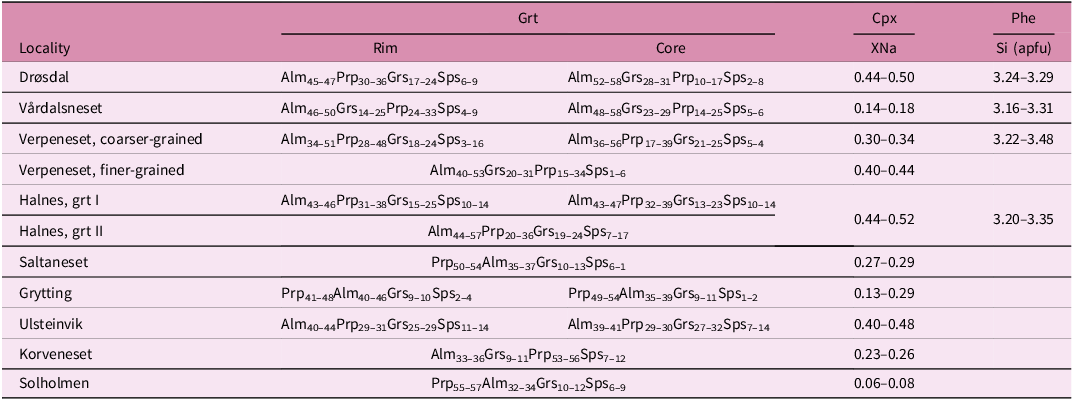
Samples chosen for this work belong to well-studied localities and include the best preserved eclogites available (Figures 2 and 3; see sample locations and petrographic descriptions in SM). Their main mineral assemblages differ in the amount of garnet, clinopyroxene, phengite, quartz, amphibole, kyanite, zoisite and orthopyroxene. Samples lying southwards from Halnes and Saltaneset contain phengite and quartz, which disappear towards the north. Coesite was documented at the Saltaneset locality (Figures 1 and 2). The representative analyses are listed in the SM Tables 3–5 and additional X-ray compositional maps of garnets in Figures S1–S8. A summary of the results is provided in Table 1.
Representative photomicrographs of studied samples: (a) garnet (Grt) porphyroblast in contact with phengite (Ph) and clinopyroxene (Cpx) with small rutile (Rt) crystals, Drøsdal; (b) garnet porphyroblast overgrown by secondary amphiboles (Amp), Vårdalsneset; (c) garnet in contact with clinopyroxene, small hornblende (Hbl) crystals in the matrix, Verpeneset; (d) common rutile inclusions in garnet, clinopyroxene and quartz (Qz) Verpeneset; (e) garnet porphyroblast overgrown by secondary amphiboles and symplectites at contact with clinopyroxene, Halnes; (f) small garnet crystals in contact with quartz, clinopyroxene and rutile, Saltaneset; (g) Clinopyroxene and garnet with secondary hornblende (Hbl) rims, Grytting; (h) symplectites (Sym) and secondary amphiboles in garnet–clinopyroxene matrix, Ulsteivik; (i) garnet in contact with clinopyroxene and biotite, Korveneset; (j) coarse grained garnet–clinopyroxene matrix and rutile inclusions, Solholmen.

Representative X-ray compositional maps (a–c, f–g) and chemical composition profiles (d, e; marked on backscattered electron images) of garnet from (a) Drøsdal, (b) Vårdalsneset, (c) Verpeneset – fine-grained variety, (d) Verpeneset coarse-grained variety, (e) Saltaneset, (f) Halnes – garnet-II, (g) Halnes – garnet-I, (h) Solholmen; warmer colours in the X-ray maps indicate higher concentration of the element.

Analyses of garnet, clinopyroxene and phengite

4.a.1. Drøsdal
The eclogite from Drøsdal is composed of garnet, clinopyroxene, phengite, kyanite, carbonate minerals, quartz and smaller amounts of rutile, zoisite, and zircon. Garnet forms idioblastic porphyroblasts rich in quartz, kyanite, amphibole, rutile, and zoisite inclusions. The rim of the garnet is partially replaced by potassic-pargasite amphibole. Its average chemical composition changes from Alm52–58Grs28–31Prp10–17Sps2–8 in the core through Alm47–55Grs23–30Prp15–28Sps3–2 in the mantle to Alm45–47Prp30–36Grs17–24Sps6–9 in the rim. Decreasing from the core to the rim, Fe is partially replaced by Mg, forming a radial structure resembling channels leading from the rim to the mantle (Figure 3a). Clinopyroxene is omphacite. The X Fe value differs between 0.15 and 0.19, usually with a slightly higher value in the core. Similarly, X Na is rather stable with a value between 0.44 and 0.50. Likewise, clinopyroxene has c. Jd0.45 end member. White mica is phengite with a Si content that varies within a very limited range of 3.24–3.29 apfu.
4.a.2. Vårdalsneset
The sample from Vårdalsneset contains garnet, clinopyroxene, phengite, quartz, zoisite and kyanite. Garnet forms large porphyroblasts (up to 2.2 mm in diameter) that show varying degrees of alteration and amount of quartz, apatite, rutile and zircon inclusions. The composition of the rim is Alm46–50Grs14–25Prp24–33Sps4–9, while the core is Alm48–58Grs23–29Prp14–25Sps5–6. The rim of the garnet is very thin and is characterized by increased Mg and decreased Ca and Fe (Figure 3b). Clinopyroxene is omphacite with c. Jd0.48. X Fe and X Na values vary slightly from 0.14–0.18 and 0.46–0.51, respectively. White mica is phengite with Si content between 3.16 and 3.31 apfu. The higher amount of Si is usually present in the rim of the matrix phengite.
4.a.3. Verpeneset
Garnet, clinopyroxene, phengite, amphibole, kyanite, zoisite and rutile are present in the coarser-grained variety of eclogite from Verpeneset. Garnet is rich in inclusions of clinopyroxene, amphibole and rutile. Quartz inclusions are widespread in the garnet core related to the Fe-rich irregular zones in the inner part of the garnet. Rutile can be found in both the garnet core and rim, usually occurring together with ilmenite and zircon or monomineralic clusters of inclusions. Garnet shows a patchy distribution of elements (Figure 3d). The end member composition in the core is Alm36–56Prp17–39Grs21–25Sps5–4 and Alm34–51Prp28–48Grs18–24Sps3–16 in the rim. Clinopyroxene is homogeneous omphacite with c. Jd0.35. The X Fe is low, in the range of 0.07–0.10. X Na varies within a range of 0.30–0.34. White mica is classified as phengite. Si content is high, ranging from 3.22 to 3.48 apfu. The highest Si concentration occurs in the phengite rim in the matrix.
The finer-grained variety of eclogite from Verpeneset consists of garnet, clinopyroxene, quartz, rutile, zoisite and kyanite. Garnet contains a high number of inclusions, mostly situated in the core and mantle. The main inclusion phase is quartz, forming quite densely populated areas surrounded by an almost inclusion-free garnet. The distribution of inclusions varies throughout the grain. The garnet core is dominated by quartz inclusions together with titanite and clinozoisite, whereas towards the rims, titanite is replaced by rutile (although a few inclusions of rutile are present in the core as well), and zircon and apatite are also present. Garnet has an average composition of Alm40–53Grs20–31Prp15–34Sps1–6. Pyrope content rises from the core to the rim. The compositional map shows a channel-like distribution of Mg in the garnet mantle similar to that observed in the sample from Drøsdal (Figure 3c). Clinopyroxene is classified as an omphacite with c. Jd0.41. X Fe is rather low, varying from 0.12 to 0.17 and X Na is within the range of 0.40 to 0.44.
4.a.4. Halnes
The samples from Halnes contain garnet, clinopyroxene, phengite, quartz and rutile. There are two generations of garnet. Garnet-I is present in the matrix and forms ribbon-like aggregates. It is smaller than garnet-II and rich in ilmenite, rutile, apatite and zircon inclusions; quartz is not part of the inclusion assemblage. Garnet-I is zonal with patchily distributed domains of higher Fe, Mg and Mn content and enrichment in Ca content in the mantle (Figure 3g). The average composition of this generation of garnet is Alm43–47Prp32–39Grs13–23Sps10–14, whereas in the Ca-rich domain it changes to Alm43–46Prp31–38Grs15–25Sps10–14. Garnet-II (Figure 3f) occurs within wide veins filled with symplectites. It is bigger than the other generation and amphibolitized in the rim by potassic-pargasite. Quartz inclusions typically occur in this garnet generation, along with a significant amount of inclusions indicating higher pressure conditions, such as kyanite, rutile and zoisite. Average composition of garnet-II is Alm44–57Prp20–36Grs19–24Sps7–17. Moreover, there is a thin zone of Mn enrichment in the mantle. Clinopyroxene is omphacite c. Jd0.42–0.52. X Fe varies in a small range of 0.13–0.17 and X Na varies between 0.44 and 0.52. White mica is phengite with a c. 0.56 fraction of muscovite, c. 0.38 of celadonite, and c. 0.06 of pyrophyllite. Although a few analyses revealed different compositions, they occur together in the matrix. The Si content also differs in these two kinds of white mica. In the typical phengite, it varies in the range of 3.20–3.35 apfu, whereas in the other one is much lower, varying from 3.02 to 3.09 apfu.
4.a.5. Saltaneset
In the eclogite from Saltaneset, the major phases are clinopyroxene, quartz and garnet. Garnet displays a relatively homogeneous composition across the grains Prp50–54Alm35–37Grs10–13Sps6–1 (Figure 3e). The inclusions are scarce and comprise quartz, coesite, rutile, zircon and minor clinopyroxene. Some of the SiO2 inclusions were identified as coesite via Raman spectroscopy, which forms relatively large (c. 30 μm) crystals surrounded by fractures. Rutile is also present in most of the garnet blasts. Clinopyroxene is omphacite c. Jd0.27. X Fe varies in the range 0.12–0.14, and X Na shows a range of 0.27–0.29.
4.a.6. Grytting
Our Grytting eclogite sample is characterized by clinopyroxene, garnet and biotite with minor rutile. The composition of the garnet is Prp49–54Alm35–39Grs19–11Sps1–2 that changes to Prp41–48Alm40–46Grs9–10Sps2–4 in the very thin rims. Most of the inclusions are clinopyroxene and zircon, but rutile is also present in both the core and the rim of garnet. Clinopyroxene is omphacite c. Jd0.28. X Fe is low 0.14–0.15, and X Na ranges from 0.13 to 0.29. The lowest XNa values are present in the rim, whereas the highest are in the inclusions within the garnet.
4.a.7. Ulsteinvik
The Ulsteinvik eclogite is composed of garnet, clinopyroxene and small amounts of rutile, ilmenite and carbonates. Garnet forms blasts with uneven edges and comprises abundant inclusions of clinopyroxene, zircon and rutile. It contains fractures filled with kelyphite. The average composition of the core is Alm39–41Prp29–30Grs27–32Sps7–14 while the rim is Alm40–44Prp29–31Grs25–29Sps11–14. Clinopyroxene is omphacite c. Jd0.45. X Fe is rather uniform in most of the grains, varying within a range of 0.17–0.22. Similarly, X Na decreases from the core (0.48) towards the rim (0.40).
4.a.8. Korveneset
Eclogite from Korveneset consists of garnet, clinopyroxene and orthopyroxene. Garnet is rich in clinopyroxene inclusions. Rutile commonly occurs in the core and the rim. Garnets are compositionally quite homogeneous (Alm33–36Grs9–11Prp53–56Sps7–12). Clinopyroxene jadeite-poor omphacite (c. Jd0.22) with X Fe = 0.12–0.14 and X Na = 0.23–0.26. Two analyses are classified as diopside and augite.
4.a.9. Solholmen
At Solholmen the eclogite is composed of garnet, clinopyroxene, amphibole, orthopyroxene and rutile. Garnet forms large, heavily fractured porphyroblasts that are intergrown with pyroxenes and rutile. Garnets are compositionally homogenous (Figure 3h) (Prp55–57Alm32–34Grs10–12Sps6–9). Clinopyroxene is diopside with low XFe and XNa showing very limited ranges of 0.09–0.10 and 0.06–0.08, respectively.
4.b. P-T estimates
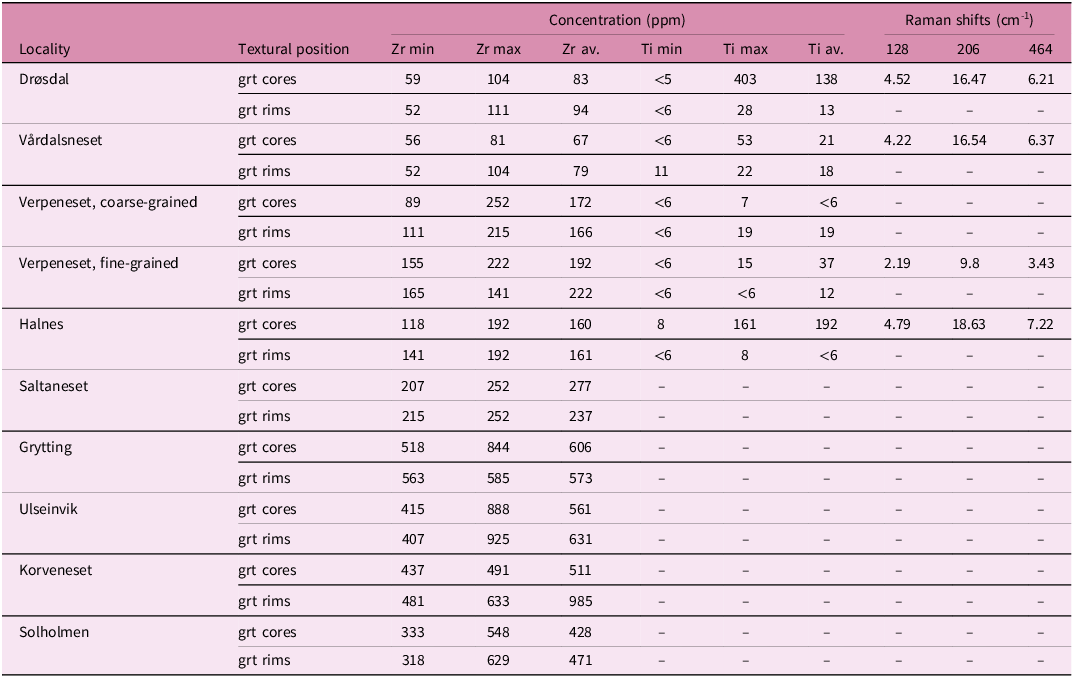
The metamorphic evolution has been constrained with conventional Grt-Cpx-Phe thermobarometry (Krogh Ravna and Terry, Reference Krogh Ravna and Terry2004), ZiR (Tomkins et al. Reference Tomkins, Powell and Ellis2007) and TitaniQ thermometry (Osborne et al. Reference Osborne, Thomas, Nachlas, Angel, Hoff and Watson2022) and QuiG barometry (Kohn et al. Reference Kohn, Mazzucchelli and Alvaro2023). The choice of the geothermobarometers depends on the petrography and the presence of suitable inclusions. The analytical details and individual P-T paths for each locality are included in the SM. Results of analyses are presented in Table 2.
Results of Zr in rutile, Ti in quartz and Raman shifts analyses used for thermobarometry

Grt-Cpx-Phe for the Drøsdal eclogite yielded 704 ± 65°C and 2.7 ± 0.3 GPa. Zr in rutile varies from 59 to 104 ppm in garnet cores and 52–111 ppm in the rims. Quartz inclusions in garnet cores have an average (av.) Ti content of 138 ppm (max 403 ppm), whereas inclusions in the rims have an av. of 13 ppm (<6–28 ppm). Raman spectra of quartz inclusions in garnet cores show shifts in the 128, 206 and 464 cm−1 bands of up to 4.52 ± 0.35, 16.47 ± 0.35 and 6.21 ± 0.35 cm−1, respectively. The combination of Grt-Cpx-Phe, ZiR, TitaniQ and QuiG methods defines P-T conditions of 1.6 ± 0.2 GPa at 597 ± 30°C for garnet core growth and peak P-T conditions of 2.7 ± 0.3 GPa at 643 ± 30°C (Figures 4 and S10).
(a) P-T peak conditions along WGR with literature data (see references in Table S2); subduction model after Syracuse et al. Reference Syracuse, van Keken and Abers2010 and van Keken et al., Reference van Keken, Wada, Abers, Hacker and Wang2018; forbidden zone after Liou et al. Reference Liou, Hacker and Zhang2000; quartz-coesite transition after Osborne et al. Reference Osborne, Thomas, Nachlas, Angel, Hoff and Watson2022; graphite-diamond after Day, Reference Day2012; metamorphic facies after Okamoto and Maruyama (Reference Okamoto and Maruyama1999) – simplified; (b) correlation of P-T peak results.

Figure 4. Long description
A: Scatter plot of pressure (Y axis) and temperature (X axis) conditions results from the literature, marked as smaller dots and from this stud, marked as larger dots. Boundaries of metamorphic facies and transition curves of quartz-coesite and graphite-diamond in the background. Blue triangle in the upper left half indicate conditions not possible on the Earth. B: Scatter plot of depth (Y axis) vs temperature (X axis) results of this study in a positive trend.
P-T conditions of Vårdalsneset eclogite are 682 ± 65°C at 2.8 ± 0.3 GPa using Grt-Cpx-Phe thermobarometry. Zr content in rutile included in garnet cores has an av. 56 ppm (67–81 ppm), and in rims av. 79 ppm (52–104 ppm). Quartz inclusions yield a higher Ti content, av. 21 ppm (<6–53 ppm) in the garnet core, than in the rim, 18 ppm (11–22 ppm). Quartz inclusions in garnet show shifts in the Raman spectra of the 128, 206 and 464 cm−1 peaks up to 4.22 ± 0.35, 16.54 ± 0.35 and 6.37 ± 0.35 cm−1 respectively. Results of Grt-Cpx-Phe, ZiR, TitaniQ and QuiG yield prograde conditions estimated at 1.7 ± 0.2 GPa at 582 ± 31°C with the peak at 2.7 ± 0.3 GPa at 639 ± 30°C (Figures 4 and S11).
Two varieties of Verpeneset eclogite have been studied. Grt-Cpx-Phe thermobarometry applied to the coarser-grained variety yields P-T of 696 ± 65°C at 3.3 ± 0.3 GPa. Rutile inclusions in garnet cores contain av. 172 ppm (89–252 ppm) of Zr, whereas in the rim yield an av. of 166 ppm (111–215 ppm). Ti content in quartz inclusions in garnet cores is often below the detection limit, whereas in rim reaches up to 19 ppm (av. 10 ppm). Inclusions suitable for QuiG barometry have not been found in the coarser-grained variety. Phengite is absent in the fine-grained eclogite; thus, only the Grt-Cpx thermometer has been used, resulting in 593 ± 65°C at a fixed P of 1.0 GPa, and 721 ± 65°C at 3.5 GPa. Rutile in garnet cores has av. Zr of 192 ppm (155–222 ppm), and in rims av. 165 ppm (141–222 ppm). Quartz inclusions from garnet cores have Ti with av. 15 ppm (<6–37 ppm), whereas inclusions in rims are poorer in Ti with av. of <6 and 12 ppm. Quartz inclusions in garnet show the shift of the bands 128, 206 and 464 cm−1 in the Raman spectra up to 2.19 ± 0.35, 9.80 ± 0.35, 3.43 ± 0.35 cm−1. Results for both samples give the conditions of garnet growth at 1.1 ± 0.2 GPa at 627 ± 31°C up to the peak P-T conditions of 688 ± 30°C at 3.3 ± 0.3 GPa (Figures 4 and S12).
Eclogite from Halnes yields a P-T of 706 ± 65°C at 2.85 ± 0.32 GPa applying Grt-Cpx-Phe thermobarometry. Rutile from garnet cores has an av. Zr content of 160 ppm (118–192 ppm) and inclusions from the rim yielded 161 ppm (141–192 ppm). Quartz inclusions in garnet cores have an av. Ti content of 88 ppm (8–156 ppm). Inclusions from the rim show Ti content around the detection limit (8 ppm). Based on Grt-Cpx-Phe, ZiR and TitaniQ prograde conditions were 1.8 ± 0.2 GPa and 639 ± 30°C, and peak conditions were 2.8 ± 0.3 GPa and 691 ± 30°C (Figures 4 and S13).
The Grt-Cpx thermometer applied to the Saltaneset eclogite yields 583 ± 65 °C at P fixed at 1.0 GPa and 739 ± 65°C at 3.5 GPa. Rutile inclusions from garnet cores reveal a Zr content of 227 ppm (207–252 ppm) and rim inclusions 237 ppm (215–252 ppm). The combined approach with ZiR yields 3.2 (–0.4, +2.3) GPa at 721 ± 30°C (Figures 4 and S14; see comments on the uncertainties in the SM and overlap of thermometers in Figures S19 and S20).
The Grytting eclogite gives P-T conditions of 631 ± 65°C at 1.0 GPa and 796 ± 65°C at 3.5 GPa obtained by Grt-Cpx thermometer. The Zr content of rutile in garnet cores ranges from 518 to 844 ppm (av. 606 ppm), whereas inclusions from the rim yield 563–585 (av. 573) ppm. ZiR and Grt-Cpx constrain peak P-T conditions of 3.8 (–0.9, +2.3) GPa at 813 ± 30°C (Figures 4 and S15).
Grt-Cpx thermometry for the Ulsteinvik eclogite massif constrains the P-T of 727 ± 65°C at 1.0 GPa and 869 ± 65°C at 3.5 GPa. Inclusions of rutile in garnet cores are poorer in Zr (av. 561 ppm, range 415–888 ppm) than inclusions in the rims (av. 631 ppm, 407–925 ppm). The P-T estimates yield peak conditions of 846 ± 30°C at 3.1 (–0.2, +2.9) GPa (Figures 4 and S16).
Results for the Korveneset orthopyroxene eclogite are 659 ± 65°C at 1.0 GPa and 827 ± 65°C at 3.5 GPa using Grt-Cpx thermometry. Rutile from garnet cores displays Zr content of 491 ppm (437–511 ppm), whereas inclusions from the rims have 633 ppm (481–985 ppm). The peak P-T conditions are estimated at 4.3 (–1.4, +2.3) GPa and 882 ± 30°C (Figures 4 and S17).
The northernmost eclogite, from Solholmen, gives 599 ± 65°C at P = 1.0 GPa and 718 ± 65°C at 3.5 GPa defined by Grt-Cpx thermometer. Rutile inclusions in the garnet core have av. Zr of 428 ppm (333–548 ppm), whereas the rim inclusions 471 ppm (318–629 ppm). The peak P-T metamorphic conditions are 5.4 (–2.3, +2.6) GPa at 840 ± 30°C (Figures 4 and S18).
5. Discussion and conclusions
The results presented above allow for the reconstruction of a P-T gradient for the WGR. The recorded peak P-T conditions increase from the south (Drøsdal c. 2.74 GPa at 704°C) to the north (c. 5.40 GPa at 840°C, Solholmen). Peak P-T conditions in this study have been estimated on a consistent basis, making them comparable on the regional scale (see the comparison with previous studies and P-T paths in the SM). Our results highlight the importance of using a multimethod approach as a universal toolbox to reconstruct the P-T evolution of a subduction system. Although previous works show reviews and summaries of the spatial P-T within the WGR (e.g. Hacker et al. Reference Hacker, Andersen, Johnston, Kylander-Clark, Peterman, Walsh and Young2010; Simon et al. Reference Simon, Pitra, Yamato and Poujol2023, and references therein), it is difficult to find precise patterns among results obtained using diverse methods that may not be easily comparable. Also, the proposed P-T paths relied upon connecting average pre-UHP conditions with the peak P-T conditions (Hacker et al. Reference Hacker, Andersen, Johnston, Kylander-Clark, Peterman, Walsh and Young2010). Here, we provide a precise, calculated geothermal gradient based on a consistent approach applied to eclogites from several localities along a ∼190 km traverse.
The peak P-T results for Drøsdal, Vårdalsneset, Verpeneset, Halnes, Saltaneset, Grytting, and Korveneset lie along a trend line with a coefficient of determination (R 2) equal to 0.949 (Figure 4). The Ulsteinvik eclogite was not included as it is interpreted to belong to an allochthonous unit (Blåhø Nappe) and may record a different subduction history. The Solholmen eclogite also does not fit the trend and possibly shows a local anomaly or disruption of the geothermal trend. The trend line in P-T space gives a gradient of 4.7°C/km on the basis of lithostatic pressure (Figure 4), in agreement with Carswell et al. (Reference Carswell, Cuthbert and Krogh Ravna1999) and Cuthbert et al. (Reference Cuthbert, Carswell, Krogh-Ravna and Wain2000), who estimated it only for phengite-bearing eclogites. The newly calculated gradient can be applied from south to north on a wider portion of the crust up to Otrøya Island (Figure 4). Moreover, the estimated prograde conditions fit with the general trend, providing more reliable points of reference for the suggested P-T path.
Along our N-S transect, the calculated P-T values increase from each sample site to the next one. The consistent gradient in P-T space admits that the sampled eclogites belonged to a single, coherent, subducting continental crustal slab as originally proposed by Krogh (Reference Krogh1977) and further resolved by Hacker et al. (Reference Hacker, Andersen, Johnston, Kylander-Clark, Peterman, Walsh and Young2010). The azimuth of our transect probably does not correspond to the actual subduction vector – it was chosen to maximize the availability of good exposure and choice of high-quality samples. The subduction vector could be estimated as being perpendicular to the orogenic front, which in southern Norway trends approximately NE–SW indicating thrusting of nappes to the SE (Gee et al. Reference Gee, Janák, Majka, Robinson and van Roermund2013) and hence subduction below them to the NW, which is consistent with SE-trending lineations in the Main Caledonian Thrust Zone (Fossen, Reference Fossen1992). However, the vector of final nappe emplacement by thrusting may have been modified by plate rotation during the final stages of collision and early stages of exhumation (Bottrill et al. Reference Bottrill, Hunen, Cuthbert, Brueckner and Allen2014) and may not exactly correspond to the subduction vector. Nevertheless, eclogite-facies shear fabrics in the northern WGR also suggest SE-directed thrust motion (Terry and Robinson, Reference Terry and Robinson2004). Furthermore, contouring the spatial distribution of P-T conditions across the WGR by Krogh (Reference Krogh1977) and Hacker et al. (Reference Hacker, Andersen, Johnston, Kylander-Clark, Peterman, Walsh and Young2010) indicates isotherms and isobars trending mainly NE–SW (allowing for the distortion caused by subsequent large-scale upright folding), again suggesting subduction broadly towards the NW. Hence our transect lies oblique to the probable subduction vector. If it is assumed that the subducting slab was essentially planar, lacking major distortions along strike, the P-T conditions calculated at points along our transect can be taken to represent the conditions to their SW and NE along the slab, given assumptions (discussed below) about their relative ages and that P was lithospheric. Hence, our deduced gradient in P-T space represents changes in physical conditions along the actual subduction vector, towards the NW.
Although the gradient in P-T space is highly consistent, the geospatial distribution of P and T along the traverse is not, with inconsistent shifts in P and T between sampled eclogite locations, e.g. 0.54 GPa between Verpeneset and Grytting (c. 20 km distance) and 0.45 GPa between Grytting and Korveneset (c. 100 km distance). This was also noted by Cuthbert et al. (Reference Cuthbert, Carswell, Krogh-Ravna and Wain2000) on a similar transect. These anomalies might be explained by tectonic disruption of a coherent slab following HP-UHP metamorphism, imbrication of the slab at depth in the subduction zone under HP, possible preservation of different stages of subduction (probable due to the release of fluid from hydrous minerals while they became unstable) or UHP conditions or pressure deviating from the lithostatic gradient. The WGR is known to be divided into lithotectonic units separated by major shear zones that are both SE-vergent and foreland-directed (thrusting) and W-vergent accommodating late-orogenic ‘extension’ or ‘collapse’ (Wiest et al. Reference Wiest, Jacobs, Fossen, Ganerød and Osmundsen2021). Terry and Robinson (Reference Terry and Robinson2004) recognized Scandian HP-eclogite-facies shearing between Baltica basement units and the supracrustal Blåhø Nappe. On a much larger scale, Young (Reference Young2018) recognized two regional-scale shear zones that separate three major lithotectonic units, from structurally lowest to highest the Western Gneiss Complex, Fjordane Complex and Tafjord Complex. The supracrustal allochthonous allocations generally coincide with the major shear zones and were termed ‘mixed rocks’. Our traverse did not sample the Tafjord Complex, which outcrops well to the east and is thought to have detached from the subducting slab early and stagnated relatively high in the channel as subduction of the other two units continued to deeper levels (Young, Reference Young2018), so it has a separate evolution to that revealed by the present study. In the structural framework of Young (Reference Young2018), our traverse spans, from south to north, the Western Gneiss Complex (Drøsdal and Vårdalsneset) as far as Nordfjord, the Fjordane Complex (Verpeneset, Halneset, Salta, Grytting and Ulsteinvik) and back into the Western Gneiss Complex north of Moldefjord (Solholmen and Korveneset). There is evidence that the shear zone separating the Western Gneiss Complex and Fjordane Complex (the Sandane Shear Zone) operated under HP eclogite conditions (Young, Reference Young2018); hence, the slab began to be dismembered relatively deep in the subduction zone. Similar conclusions were reached by Blatchford et al. (Reference Blatchford, Whitney, Teyssier, Gordon, Dektar and Kylander-Clark2026) for shear of basement gneisses in Oterøya, possibly a northern extension of the Sandane Shear Zone (Young, Reference Young2018). However, the difference in eclogite P and T in these tectonic units across the Sandane Shear Zone is relatively small, leading Young (Reference Young2018) to conclude that relative motion between the Western Gneiss Complex and Fjordane Complex was relatively small at peak and post-peak conditions. Hence, we may conclude that the WGR continental crustal slab was subducted as a mainly coherent slab but underwent some imbrication during continued subduction of the Baltica Plate lithosphere, commencing under HP eclogite conditions. This would have been sufficient to slightly modify a previously established spatial pattern of eclogite P and T. Further disruption could have been caused by the late orogenic west-vergent tectonics (Wiest et al. Reference Wiest, Jacobs, Fossen, Ganerød and Osmundsen2021) and relative vertical motions associated with large-scale E-W folding.
Although some degree of local overpressure or differences in local kinetics cannot be completely ruled out, as may be the case for the Solholmen locality, we argue that it would have had a negligible impact on the region as a whole. If a significant overpressure phenomenon and/or differences in local kinetics were responsible for such observed P shifts, the P-T results should be scattered and not so perfectly aligned with the gradient derived here. Therefore, we suggest that these new results, especially the inconsistent shifts in P-T conditions between localities, imply that the entire WGR has been tectonically shortened. Such shortening may have resulted from the segmentation of the WGR slab into several large slices rather than exhuming as a single coherent tectonic block, which would be consistent with the structural models of Gee (Reference Gee1980), Robinson et al. (Reference Robinson, Roberts, Gee and Solli2014) and Young (Reference Young2018).
As the P-T gradient of a subducting slab is a time-based capture, or a synoptic view of the thermal pattern with depth, it is crucial that selected eclogites are coeval. Although the chronological results obtained by previous researchers (Kylander-Clark et al. Reference Kylander-Clark, Hacker, Johnson, Beard and Mahlen2009 and references therein) show a long span of ages (>20 Ma), they rather suggest prolonged exposure of the subducted continental crust to the (U)HP conditions than different timing of equilibration of each locality (Kylander-Clark et al. Reference Kylander-Clark, Hacker, Johnson, Beard and Mahlen2009). DesOrmeau et al. (Reference DesOrmeau, Gordon, Kylander-Clark, Hacker, Bowring, Schoene and Samperton2015), based upon a large compilation of isotopic ages, concluded that there is no easily resolvable difference in ages for HP or UHP metamorphism between the Western Gneiss Complex and Fjordane Complex, reinforcing the proposal for a coherent crustal amalgamation at the time of eclogite equilibration. This also argues against HP–UHP metamorphism at distinctly different times in separate lithotectonic packages during subduction. This is consistent with the coeval equilibration of eclogites along the transect, making the obtained gradient geologically valid. Notwithstanding the complexities outlined above and assuming a continuous subduction of a continental slab, the general models for WGR formation, presented by Krogh (Reference Krogh1977), Andersen et al. (Reference Andersen, Jamtveit, Dewey and Swensson1991), Hacker et al. (Reference Hacker, Andersen, Johnston, Kylander-Clark, Peterman, Walsh and Young2010) and Cuthbert et al. (Reference Cuthbert, Harvey and Carswell1983), are consistent with this study.
This gradient at depths >80 km corresponds to the cold subduction gradient presented by Penniston-Dorland et al. (Reference Penniston-Dorland, Kohn and Manning2015). Our prograde P-T results are in agreement with Penniston-Dorland et al. (Reference Penniston-Dorland, Kohn and Manning2015) but suggest higher T than predicted by the model of Syracuse et al. (Reference Syracuse, van Keken and Abers2010). The mismatch in T between the results obtained by the models vs P-T estimates on rocks was extensively discussed (e.g. thermal buoyancy, hydrothermal alteration, change in geodynamic setting, diapiric, rarity and brevity of exhumation of subducted rocks) by Penniston-Dorland et al. (Reference Penniston-Dorland, Kohn and Manning2015) and Wang et al. (Reference Wang, Wang, He and Zhang2023). An alternative explanation could be a local thermal anomaly surviving from the Rodinia rifting. An intriguing outcome of our results is that at great depths the continental subduction gradient recorded by the rocks is similar to oceanic subduction. It suggests that the continental slab can be driven to converge thermally towards the oceanic steady-state regime due to the previously cooled subduction channel. This may be aided by a low radiogenic heat output caused by the fact that vast volumes of the WGR crust were old granulite depleted in heat-producing elements. After subduction, continental crust is more easily exhumed than oceanic crust, and thus, it is more likely to preserve records of processes taking place at >100 km depth (Gilotti et al. Reference Gilotti, McClelland, Cao and Coble2024). Hence, it can be used as a proxy to uncover deep processes in subduction systems in general.
Supplementary material
The supplementary material for this article can be found at https://doi.org/10.1017/S001675682610082X.
Acknowledgements
This study was funded by the National Science Centre Poland (K.K., Project Sonata no. 2021/43/D/ST10/02305). Craig Storey and David Young are thanked for the constructive reviews and Randell Stephenson for editorial handling.
Competing interests
The authors declare none.




 Open access

