


Introduction
Depression is common and over 80% of cases are managed solely within primary care (Timonen and Liukkonen, Reference Timonen and Liukkonen2008). In 2004, the National Institute for Health and Clinical Excellence (NICE) produced guidelines for the management of depression in adults (NICE, 2004). These were distributed to health professionals, including all general practitioners (GPs) in England and Wales. NICE reissued these guidelines in April 2007, unchanged except for updated advice about prescribing venlafaxine.
Research into the implementation and effectiveness of NICE guidelines is in its infancy (Middleton et al., Reference Middleton, Shaw, Hull and Feder2005). A previous study of 45 primary care practices in the United States found that adherence to depression guidelines was associated with fewer symptoms and a lower risk of persistent depression (Hepner et al., Reference Hepner, Rowe, Rost, Hickey, Sherbourne, Ford, Meredith and Rubenstein2007). However, clinicians adhered well to only one-third of the recommendations. Many did not provide longer-term treatment such as reviewing medication. Moreover, this study was a secondary analysis of existing data. Causality between guideline concordance and outcomes cannot be assumed.
In Britain, the Quality and Outcomes Framework (QOF) of the general medical services contract also seeks to influence GPs to follow the evidence base by using financial incentives (NHS Confederation, 2006). In 2006, the QOF specified two targets for depression: assessing severity in newly diagnosed cases using a validated assessment tool (eg the Patient Health Questionnaire (PHQ-9)), and ‘two-question’ screening (Arroll et al., Reference Arroll, Khin and Kerse2003) of patients with diabetes and coronary heart disease (CHD).
This paper describes a questionnaire survey of primary care services in the York area. It aimed to assess whether GPs follow NICE guidelines in their management of depression. We also examined whether concordance with NICE guidelines, and global impact, is related to a doctor’s gender, time since qualification, previous psychiatric training, possession of Membership of the Royal College of General Practitioners (MRCGP), clinical confidence and partnership size.
Method
The setting was the York and Selby locality of North Yorkshire and York Primary Care Trust. We used the National Health Service (NHS) and Trust websites to identify 38 GP partnerships. Each surgery was contacted by telephone to cross check the accuracy of names of practicing GPs. In May 2007, we posted the questionnaire with a covering letter and stamped addressed envelope to all 215 partnered and salaried GPs. Locums, GP registrars and trainees were excluded. Non-responders were sent reminder letters with a repeat copy of the questionnaire 12 weeks later. GPs were aware that all responses were anonymized. One unique number identified each questionnaire. Data were stored in accordance with the Data Protection Act 1998.
Questionnaire
The questionnaire (see supplementary information online at http://journals.cambridge.org/phc) was designed to assess GPs’ adherence to the quick reference version of NICE Clinical Guideline 23 for managing depression (NICE, 2004). It focused on key priorities for implementation in primary care, including the audit criteria listed in Appendix D. We asked about screening, medication and non-drug approaches such as exercise and cognitive behaviour therapy (CBT). GPs provided information about their training, experience and confidence in treating depression. They also rated the impact of both NICE guidelines and QOF guidance (depression indicators within the 2006–2007 General Medical Services contract) upon their detection, management and recording of the care of depressed patients.
Scoring
We calculated a global score for each GP that summarized their reported adherence to measurable criteria within NICE guidelines (see web-based supplementary information). GPs scored one point for ‘do’s (eg ‘watchful waiting’) and lost one point for ‘don’ts’ (such as prescribing dosulepin first line). This produced a ‘NICEdrug’ score out of 11 for antidepressant prescribing and a ‘NICEtalk’ score out of 20 for screening and psychosocial interventions. Adding NICEdrug to NICEtalk scores yielded a NICE Depression Overall Concordance (‘NICEDOC’) total score out of 31.
Statistical analysis
Data were analyzed using the Statistical Package for Social Sciences of Windows, version 16.0. Based on 95% confidence limits, we calculated that 90 questionnaire responses would be required for a margin of error of 10%. Dichotomous variables were analyzed using the χ 2 test. Differences in proportions with 95% confidence limits were calculated using standard formulae (Gardner, Reference Gardner1991). Ordinal and continuous variables were analyzed using non-parametric tests (Mann–Whitney U and Spearman’s correlation coefficient). We used multivariate regression modeling to examine which variables best-predicted GPs’ adherence to guidelines (‘NICEDOC’ scores). The model of best fit was established using backwards-stepwise regression.
Results
The response rate was 67% (143/215 GPs). Percentages below are of GPs who replied. Half (71, 50%) were male, 71 (50%) had previously worked in psychiatry for at least six months, and 115 (80%) possessed the MRCGP. The mean number of years since medical qualification was 22 (SD 8.5, range 5–36). Median practice size was seven (mode five, range 1–16). GPs rated their confidence at treating depression as ‘high’ in 74 (52%) cases, ‘fair’ in 69 (48%) and ‘low’ in no cases.
Screening
The number of GPs who reported screening for depression within specified risk groups was 68 (48%) for patients with a history of depression, 97 (68%) for other mental health problems (eg dementia), 135 (94%) for CHD and 137 (96%) for diabetic patients. The ‘two question approach’ (recommended by both NICE and QOF) was used by 107 (75%) GPs and a formal rating scale (specified in the QOF for assessing severity) by 90 (63%) GPs. The majority (111 GPs, 78%) also stated that they used ‘clinical judgement’ to identify depressed patients.
Self help and psychological approaches
Table 1 lists the non-pharmacological interventions recommended by NICE in the management of mild depression. Although 71 (50%) GPs reported using seven or more approaches (median 6.5, interquartile range, IQR 5.0–7.75), only two (1%) GPs made use of all 12.
Non-pharmacological approaches used by GPs in managing depression

GPs = general practitioners; CBT = cognitive behaviour therapy.
*In watchful waiting, mean time before reviewing = 2 weeks.
We asked GPs whether they used ‘cognitive behaviour therapy’ as part of their management of depression: 59 GPs (41%) did so and 64 (45%) reported they did not. Another 20 GPs (14%) stated they did not personally practice CBT but referred to someone who could (often a primary care mental health worker). Most GPs (109, 78%) offered explanations for their answer. The main reasons for not using CBT were GPs’ lack of skills and training (41 replies), no time within the consultation (35) and poor local access with long waiting lists (15). The commonest reasons why some GPs did use CBT were the evidence base (17 replies), patient preference (13) and clinical effectiveness (nine). Only six respondents believed they had ‘CBT skills’; another nine stated they practiced ‘basic CBT’.
Antidepressant medication
The degree of depression for which GPs normally prescribed antidepressant medication was as follows: mild 8 (6%), moderate 119 (83%) and severe 143 (100%). NICE does not recommend antidepressants routinely in mild depression. Only 88 (62%) GPs would prescribe for moderate or severe depression, which had a ‘clear and understandable’ cause (eg physical illness or social problems), although NICE guidelines do not suggest withholding medication simply because depression is ‘understandable’.
We asked GPs to give their reason(s) for choosing a particular antidepressant. Most popular was ‘patient acceptability’ (easy to use and well tolerated), cited by 83 (59%) GPs followed by ‘effectiveness’ (60, 43%), ‘low cost’ (45, 32%), ‘experience with use’ (37, 26%), ‘anxiolytic or sedative effects’ (27, 19%) and ‘safety in overdose’ (22, 16%). Only 13 (9%) GPs believed their antidepressant choice was affected by ‘guidelines’ (NICE, local primary care trust or other). However, almost all (142, 99%) followed NICE guidelines in prescribing a selective serotonin reuptake inhibitor (SSRI) as their first line option. Generic fluoxetine (75 GPs, 52%) and citalopram (62 GPs, 43%) were prescribed most often. The commonest second line preference was also an SSRI (117 GPs, 85%), followed by dosulepin (seven GPs, 5%), which NICE no longer recommends initiating in primary care. The usual treatment dosage GPs specified was suboptimal (under 20 mg fluoxetine equivalent) in 10% (28/284) cases.
We asked GPs to state the minimum period of time, following initial recovery, for which they routinely advise patients to continue taking antidepressants. Table 2 shows that after one depressive episode, 63 GPs (44%) specified less than the recommended six months. For recurrent depression (defined by NICE as ‘two or more episodes in the recent past’), 106 GPs (76%) stop medication before the two-year period that NICE suggests. However, 18 GPs (13%) routinely advise patients to continue antidepressants indefinitely.
Minimum time period GPs advise patients to continue taking antidepressants after initial recovery
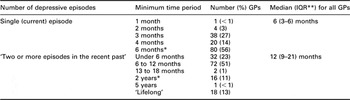
GPs = general practitioners.
*Advised by National Institute for Health and Clinical Excellence.
**IQR = interquartile range.
Referral to other services
The professionals that GPs most commonly involved in managing depression were: a practice counselor or independent counsellor (120 GPs, 84%), a community mental health team professional such as a community psychiatric nurse (97, 68%) and a primary mental health care worker (67, 47%). GPs used non-NHS agencies (eg, Citizens Advice Bureau and Relate) in 63 (44%) cases, and community addiction services in 45 (31%) cases. Respondents rarely involved a psychologist (six cases), health visitor (two) or practice nurse (one GP).
The ‘Stepped Care Model’ recommends when GPs should refer to specialist secondary mental health services (NICE, 2004). NICE includes patients at ‘significant risk’ of suicide or self neglect, ‘treatment-resistant, recurrent, atypical and psychotic depression’, those with ‘significant co-morbidities’ and individuals needing ‘complex psychological interventions’, ‘combined treatments’, crisis team input, inpatient care or electro-convulsive therapy. GPs generally followed these guidelines (Table 3). Although 47 (33%) GPs routinely refer severe depression, NICE suggests uncomplicated cases could be managed within primary care.
Main reasons for referral to secondary care mental health

GPs = general practitioners; CBT = cognitive behaviour therapy.
Impact of guidelines
GPs remembered reading QOF guidance (2006–2007) in 110 (77%) cases and NICE depression guidelines in 88 (62%) cases (difference in proportions = 15%, 95% CI 8.4%–21.5%). Over half felt that both NICE and QOF had made little or no impact upon their detection and clinical management (Table 4). However, compared to QOF, significantly more GPs rated NICE guidelines as having a moderate impact on management (46 GPs, 32% versus 24 GPs, 17%, difference in proportions = 15%, 95% CI 4.7%–25.3%). The degree of impact of NICE on management was greater for younger GPs (Spearman’s r for time since qualification = −0.20, P = 0.031) and doctors in larger practices (r for partnership size = 0.18, P = 0.052). Conversely, compared to NICE guidelines, more GPs believed that QOF had achieved a moderate or substantial impact upon their detection of depression (58 GPs, 41% versus 40 GPs, 29%, difference in proportions = 12%, 95% CI 2.4%–21.7%). GPs were also more likely to rate QOF rather than NICE guidelines as having a substantial impact on their recording of management (65 GPs, 46% versus 5 GPs, 4%, difference in proportions = 42%, 95% CI 31.3%–52.9%). The impact of QOF upon GPs’ recording of care correlated significantly with practice size (r = 0.30, P = 0.001).
Impact of guidelines on GPs’ care of depressed patients

GPs = general practitioners; NICE = National Institute for Health and Clinical Excellence; QOF = quality and outcomes framework.
Barriers to implementation
We asked GPs to specify what they saw as the greatest barriers to implementing the NICE depression guidelines. Table 5 summarizes the views of 110 (84%) respondents.
Barriers to implementation of NICE guidelines

NICE = National Institute for Health and Clinical Excellence; GPs = general practitioners; CBT = cognitive behaviour therapy.
*n = 110.
Adherence to guidelines
GPs’ median score for following NICE guidelines was seven out of 11 (IQR 6–9) for NICEdrug prescribing, 13/20 (IQR 11–14) for NICEtalk approaches and 20/31 (IQR 18–22) for total NICEDOC scores (Figure 1). GPs with previous psychiatric training were significantly more likely to adhere than other respondents (median NICEDOC scores 20/31 versus 19/31, Mann–Whitney U = 1891.5, P = 0.007). This difference was accounted for by their greater use of psychological and self help approaches (median NICEtalk scores 13/21 versus 12/21, Mann–Whitney U = 1807.5, P = 0.002).
Frequency distribution of NICE Depression Overall Concordance (NICEDOC) Scores

NICEDOC scores fell with time since medical qualification (r = −0.18, P = 0.034). Older GPs used non-drug approaches less often (r for NICEtalk = −0.18, P = 0.035).
Total NICEDOC scores were significantly related to a GP’s perceived impact of NICE guidelines upon managing depression (Spearman’s r = 0.174, P = 0.05), but not to having read NICE guidelines, gender, practice size or possessing the MRCGP.
GPs who expressed a ‘high’ (compared to ‘fair’) level of confidence in managing depression had higher NICEDOC scores (median 20/31 versus 19/31, Mann–Whitney U = 1940.5, P = 0.013). Highly confident GPs were twice as likely to report using CBT themselves (42/74, 56.8% versus 17/69, 24.6%) and to refer patients to other professionals for CBT (13/69, 18.8% versus 7/74, 9.5%, χ 2 15.3, df = 2, P < 0.001). Clinical confidence was not significantly associated with gender, time since qualification, psychiatric experience, possessing MRCGP, practice size, nor with simply having read NICE guidelines.
When we examined predictors of adherence to depression guidance NICEDOC scores using a multivariate regression analysis, the strongest predictors were having spent six months in psychiatry (P = 0.022) and confidence in treating depression (P = 0.011) – see Table 6.
Predictors of adherence to NICE guidance

NICE = National Institute for Health and Clinical Excellence; GPs = general practitioners; MRCGP = Membership of the Royal College of General Practitioners; QOF = quality and outcomes framework.
*Multivariate regression analysis of predictors of adherence to NICE guidance as measured by NICEDOC scores.
**Significant at P < 0.05 in backwards stepwise selection.
Discussion
Summary of main findings
In this survey, reported adherence to the NICE guidelines for depression was variable. GPs reliably screened patients with diabetes and CHD. However, only half screened individuals with a history of depression, despite recurrence rates of 40%–75% (Timonen and Liukkonen, Reference Timonen and Liukkonen2008; Angst, Reference Angst1997). In mild depression, most GPs offered written information, advice on sleep, problem solving and referral for counseling. Yet under half reported using basic CBT techniques such as activity scheduling and thought diaries as part of a guided self-help programme. Inadequate training, skills and consultation time were the reasons identified for this. In moderate-to-severe depression, GPs appropriately chose SSRI antidepressants. However, many were reluctant to prescribe when depression had an identifiable cause, and GPs often did not advise patients to continue medication for the recommended length of time.
GPs rated NICE guidelines as having a modest effect upon how they manage depression, whilst QOF’s more prescriptive targets achieved a greater impact upon detection and recording, especially in larger practices. Being younger, highly confident and having previous psychiatric experience were linked to increased adherence to NICE guidelines, mainly through a greater use of non-drug approaches.
Strengths and limitations of the study
There has been little evaluation of the impact and effectiveness of NICE guidelines on the management of depression in primary care. This study achieved a good response rate in an urban/ semi-rural location. Using new assessment tools – NICEtalk and NICEdoc – we were able to generate quantitative measures of guideline adherence. However, the findings might not generalize to non-responders, or to partnerships in larger inner cities. Where concordance occurred, we do not know whether NICE guidelines influenced this directly. In addition, our research did not explore the merits versus drawbacks of following guidelines. NICE advises professionals to exercise clinical judgement when applying its recommendations to individual patients. An important limitation is that this was a survey of reported rather than actual practice. Dowrick and colleagues (Reference Dowrick, Gask, Perry, Dixon and Usherwood2000) examined the link between GPs’ attitudes towards depression and observed behaviour in 1436 patients. GPs’ assessment of their ability to identify depression (using the Depression Attitudes Questionnaire) bore no relationship to observed ability. However, GPs’ observed diagnostic ability was significantly associated with a belief in successful treatment, ease in managing depression, and a preference for psychotherapy. Our study reinforces this by confirming significant associations between GPs’ clinical confidence in managing depression, their increased use of psychological treatments and their adherence to NICE guidelines.
Comparison with existing literature
We found that GPs still regard ‘clinical judgement’ as an important part of routine screening for depression. Qualitative research in three other UK centres has reported that GPs remain more cautious than patients about the validity of depression questionnaires, and value their own clinical wisdom more highly (Dowrick et al., Reference Dowrick, Leydon, McBride, Howe, Burgess, Clarke, Maisey and Kendrick2009). Scores on depression severity questionnaires (such as PHQ-9) predict antidepressant prescribing and referral to secondary care mental health services (Kendrick et al., Reference Kendrick, Dowrick, McBride, Howe, Clarke, Maisey, Moore and Smith2009). However, they do not agree well with doctors’ global assessments of severity.
A previous study of adherence to depression guidelines (Paykel and Priest, Reference Paykel and Priest1992) found that most GPs underused psychological approaches, two-thirds stopped medication within three months, and younger GPs adhered to guidelines more often (Blenkiron, Reference Blenkiron1998). Other research confirms that recently qualified GPs are less likely to prescribe antidepressants as their first treatment response in mild depression (Mental Health Foundation, 2005). Limited evidence supports the effectiveness of psychiatric training in improving how depression is managed: case managers with a mental health background achieve better outcomes in primary care than non-mental health professionals (Bower et al., Reference Bower, Gilbody, Richards, Fletcher and Sutton2005). Our study found that gender had no significant effect upon the use of psychological approaches. This contrasts with secondary care where female physicians have longer consultations, engage in more emotionally focused talk and counsel more psychosocially than male specialists (Roter et al., Reference Roter, Hall and Aoki2002).
Implications for future practice
GPs identified a lack of prompt access to CBT as the biggest obstacle to following NICE guidance. This finding confirmed elsewhere in the UK (Ward et al., Reference Ward, Polizzi, Giovanni and Milovanovic2008) supports the Improving Access to Psychological Therapies (IAPT) programme. Up to 2010, £173 million of funding is committed to train large numbers of therapists in effective interventions for anxiety and depression (Department of Health, 2007).
How may doctors ensure that the evidence base is not ‘lost in translation’ to front-line services? Making community psychiatry a requirement of basic GP training could increase skills and confidence in applying psychological approaches to depression. Older GPs and those in smaller practices might need more support in following NICE recommendations. A recent study of brief CBT training for primary care practitioners (one workshop plus four case discussion sessions) found significant improvements in formally assessed declarative and procedural knowledge (Maunder et al., Reference Maunder, Milne and Cameron2008). GPs also reported transferring new skills into everyday clinical practice. However, trying to improve adherence to depression guidelines using educational interventions alone is ineffective and costly (Thompson et al., Reference Thompson, Kinmouth and Stevens2000; Gask et al., Reference Gask, Dowrick and Dixon2004). One option is to extend collaborative care and case management, for example, via telephone-based input from a mental health worker, or closer liaison between GPs, pharmacists and psychiatrists (Gilbody et al., Reference Gilbody, Bower and Whitty2006). Another is to modify incentives provided through the QOF so that GPs focus on the most cost-effective outcomes (Wald, Reference Wald2007). In April 2009, NICE took on the role of managing and developing future measures that are to be incorporated into the QOF – including an annual ‘menu’ of evidence-based indicators (NICE, 2009).
Supplementary information
Additional information (GP questionnaire and NICEDOC concordance scoring) accompanies this paper at http://journals.cambridge.org/phc.
Funding body
North Yorkshire Alliance Research and Development Unit granted research governance approval (NYY-P0906). North Yorkshire and York Primary Care Trust acted as project sponsor. The North Yorkshire Psychiatric Training Scheme funded administrative costs.
Ethics committee
York Research Ethics Committee classified this study as a service evaluation under NHS research governance arrangements (REC 07/Q1108/31).
Competing interests
None declared.
Acknowledgements
The authors thank Professor Simon Gilbody (Department of Health Sciences, York University) and Christine Davy (North Yorkshire Research and Development Alliance) for their statistical advice, and all general practitioners in the York area who contributed to this study.



