


Introduction
Entering a currency union is a risky bet. The potential gains are obvious. Currency unions eliminate nominal exchange rate risk. This should stabilize the expectations of transnational economic actors, reduce their liquidity preference, and, as a consequence, increase their readiness to trade and invest. The more credible, reliable, and trustworthy the fixed exchange rate regime is, the more such effects should occur.
The most credible form of a fixed exchange rate regime is the currency union. However, currency unions eliminate not only the uncertainty about nominal exchange rates, but also the availability of nominal exchange rate adjustments as decisive macroeconomic policy tools. Member states cannot opt for nominal devaluations and revaluations anymore once inflation divergences occur. The crucial precondition for a well-functioning currency union is, therefore, the capacity to synchronize price inflation. Given the close relationship between the inflation of nominal unit labor costs (hereafter NULCs) and price inflation, synchronization of price inflation in turn presupposes synchronization of NULC inflation.
The euro crisis indicates that the Eurozone has lost the bet. Since the introduction of the euro in 1999, substantial differences have arisen with regard to NULC inflation and price inflation, with Austria and Germany positioned at the stagnating end of the scale and the Southern economies positioned at the inflating end. In the context of these distortions of the real exchange rate, the nonavailability of the nominal de- and revaluation tool has become a problem.Footnote 1 In 2012, for example, a Goldman Sachs study indicated that the German economy needed a revaluation of about 25% and the Portuguese economy a devaluation of about 35%, with all other euro members positioned inbetween these two extremes.Footnote 2 If the option of adjusting the nominal exchange rate had been available since the mid-2000s, it would have undoubtedly been used. This study sheds light on why the bet was lost in the first place, thereby highlighting a piece of the explanation that political science can and should add to the standard economic interpretation of the euro crisis.
A brief review of the debate
In 2012, Lo wrote a fascinating literature review on the emergence of the financial crisis. He read and reviewed 21 books and came to the conclusion that the books offered no less than 21 different causal narratives (Lo, Reference Lo2012). The situation is not very different when we turn to the euro crisis. A variety of causal interpretations coexist, and, although different, they each possess internal plausibility. In order to clarify our starting point and our contribution, we will concentrate in the following not on the differences, but on the common economic core within one particular strand of the literature: the strand that interprets the euro crisis not mainly as an outcome of irresponsible budget policies of certain European governments, but as a symptom of deeper macroeconomic imbalances (Rebooting Consensus Authors, 2015).
According to this view, the problem of today’s crisis countries is not mainly their public indebtedness, but rather the real appreciation of their (virtual) currencies that deprived them of their competitiveness – a point on which, interestingly, the neoclassical scholar Sinn (Reference Sinn2014b: Ch. 4) as well as the Marxist and Post-Keynesian co-authors Flassbeck and Lapavitsas (Reference Flassbeck and Lapavitsas2015) fully agree. It is not relevant here whether the current account imbalances during the first 10 euro years (before the crisis) were mainly the product of heterogeneous wage and price developments [as Flassbeck and Lapavitsas (Reference Flassbeck and Lapavitsas2015) as well as Bofinger (Reference Bofinger2015) argue], mainly the product of heterogeneous demand developments [as Storm and Naastepad (Reference Storm and Naastepad2015), Storm (Reference Storm2016), and Wyplosz (Reference Wyplosz2013) argue], or both. In any case, now that the crisis has occurred, the Southern overvaluation contributes to its persistence and confronts the respective economies with a dilemma. If they conduct real devaluation (i.e. put pressure on wages and prices), they destroy their internal demand even more, while if they do not devalue, every boost of internal demand is likely to result in even larger current account deficits (Scharpf, Reference Scharpf2014: 11–15).
So, how could NULC and prices develop so differently among Eurozone members? Most accounts, like the one of the Rebooting Consensus Authors (2015), point to the endogenous nature of NULC developments and start their narratives with the availability of cheap credit in the South. In Southern Europe, the euro facilitated the availability of cheap credit for two reasons: risk premia on government bonds declined because the risk linked to the nominal exchange rate was eliminated, and ex ante higher inflation rates led to dysfunctionally low real interest rates.Footnote 3 Regardless of whether debt was mainly issued by the state (as in Greece) or by private actors (as in Spain), the result was a debt-driven boom during which labor costs rose faster than productivity, and prices followed accordingly (Sinn, Reference Sinn2014b: Ch. 2). A close-by variant of this account assumes that cheap credit in the South fueled growth and consumption, those then fueled inflation, and inflation led to higher nominal wage demands (Wyplosz, Reference Wyplosz2013). In this account, nominal wage pressure is not only an inflation driver, but also a consequence of inflation (we will control for this possibility in the empirical section). These close-by variants are, however, extremely difficult to distinguish. Most accounts argue that differential growth drove both wages and prices, with no particular causal hierarchy among the latter.
While we agree with the essence of these accounts, we will show that substantively more variance can be explained by bringing the heterogeneity of wage-bargaining regimes in. We concentrate on the causes of heterogeneous NULC increases. While our data will confirm that growth (and inflation) differentials have indeed contributed to the divergences in NULC inflation, we will show that the heterogeneity of inner-European labor and wage-bargaining regimes had an independent effect on NULC inflation. This insight has consequences for the prospects of convergence in the Eurozone. Due to the stickiness of labor regime institutions, we have reasons to believe that the Eurozone will maintain a structurally determined need for flexibility in nominal exchange rates and that it may have to pay a significant price for having left this macroeconomic policy tool behind.
By emphasizing the role of wage-bargaining institutions, we confirm a point that has been made by Collignon, Höpner, Ramskogler, and, in particular, Hancké and colleagues (Collignon, Reference Collignon2009; Johnston, Reference Johnston2012; Hancké, Reference Hancké2013a, Reference Hanckéb; Höpner, Reference Höpner2013; Ramskogler, Reference Ramskogler2013; Johnston et al., Reference Johnston and Regan2014).Footnote 4 To date, Hancké’s (Reference Hancké2013b) book is the most elaborated account of how wage-bargaining regimes shaped the macroeconomic imbalances in the Eurozone. He argues that two different logics applied in the exposed and the sheltered sectors of Eurozone countries. In the exposed sectors, international market pressures had sufficient power to contain high wage demands. Therefore, exposed-sector NULC remained more or less stable in all Eurozone countries. But in the sheltered sectors, especially in the public sectors, international market pressures were absent. It depended on the overall coordination of the wage-bargaining system whether or not wage restraint in exposed sectors could be transmitted to the rest of the national economy. As a consequence, wage increases in sheltered and exposed sectors remained in line in the coordinated economies but fell apart in the countries with uncoordinated wage-bargaining regimes.
According to Hancké’s narrative, the effect of the regime type should occur mainly in the sheltered sector, but not in the internationally exposed sector. For a number of reasons, we wonder whether theoretical reasoning justifies this expectation:
-
1. Exposed-sector employees may have an interest in nominal disinflation vis-à-vis trading partners (not to be confused with an interest in real wage losses), an interest that employees in the sheltered sector lack. But this interest is collective in kind, rather than individual. Imagine an economy that is entirely exposed. All insights of the corporatism literature (which we will discuss in detail in the third section) still apply. Once individual workforces expect other wage bargainers to engage in inflationary wage settlements, it becomes irrational to stick to the collective interest. In other words, even the exposed sector should require a coordination tool to bring about NULC restraint.
-
2. Even if we assume that rising firm-level NULC directly translates into job losses in the respective firm, the coordination problem does not vanish entirely. If trade unions are divided along ideological lines, the collective action dilemma reoccurs at the firm level. If we assume that NULC disinflation is unpopular, at least in the short run, then restraining nominal wage demands will be irrational in such a situation.
-
3. Consider now what is likely to happen if exposed-sector unions overcome their coordination dilemma but fail to transmit NULC restraint to the rest of the economy. Assume again that their preference for NULC disinflation does not imply a preference for real wage loss. In such a situation, exposed-sector unions must choose between two undesired outcomes: real wage losses and losses in competitiveness. Since we have no reason to believe that export unions will choose competitiveness entirely at the expense of real wage losses, we should assume that they partially converge to the wage policies of the nonexposed sector. Again, this leads us to expect that the amount of wage coordination should matter not only for the overall economy, but also for the exposed sector.
In this paper, we will analyze data from the 12 founding members of the Eurozone in order to shed light on the determinants of NULC developments during the first 10 euro years (until the emergence of the crisis). We will look at both economy-wide developments and at the manufacturing sector (serving as a proxy for the exposed sector). In accordance with Hancké (Reference Hancké2013b), we will confirm that NULC increases in manufacturing were indeed lower than the respective increases in the overall economy. Interestingly, the variance of nominal wage pressure was higher, rather than lower, in manufacturing than it was in the overall economy. In other words, we do not find the convergence of NULC increases in the exposed sectors that we might expect with respect to Hancké’s narrative. Applying regression techniques, a variety of wage-coordination indicators and numerous controls, we will show that wage coordination-shaped NULC both economy-wide and in manufacturing, irrespective of the actual wage-coordination indicator chosen.
Before we turn to the quantitative part of our study, we first revisit the comparative political science insights into wage bargaining in more detail and discuss whether they are likely to apply to fixed exchange rate regimes such as the euro.
Applying the wage-bargaining literature to the Eurozone
The main insight of the comparative literature on wage bargaining is that wage restraint capacity is endogenous to the degree of coordination in the system of labor relations. If wage bargaining takes place in a decentralized and uncoordinated manner (i.e. each unit bargains on its own), then each unit has to be concerned about the inflationary wage deals of other units. Therefore, it is rational to add an anticipated inflation surplus to one’s own wage demand. If this happens in every unit, anticipated inflation does actually occur. However, uncertainty about the wage deals of other units disappears if wage bargaining is coordinated (through centralization or horizontal signaling). Nominal wage pressures are thus likely to vary inversely with the degree of coordination in wage bargaining.Footnote 5
The view of a linear–inverse relationship between wage coordination and wage pressure has been challenged by Calmfors and Driffill (Reference Calmfors and Driffill1988), who have argued that market pressure may act as a functional equivalent to wage-bargaining centralization. Therefore, they expected the relationship between wage-bargaining centralization and wage pressure to be hump shaped rather than linear. The empirical evidence for this hypothesis remained weak, and it became even weaker the more wage-bargaining research focused on functional coordination rather than formal centralization (Soskice, Reference Soskice1990). Note, however, that the theories behind the linear and the hump shape hypotheses are not logically contradictive. Both logics may apply at the same time. If this held true, the relationship between wage coordination and wage pressure should have the form of an inclined hump (Driffill, Reference Driffill2006).
The linear hypothesis has focused on a particular dysfunction of uncoordinated wage-bargaining regimes (the anticipated inflation surplus) without taking into consideration the strategic capacities of coordinated wage bargaining. Since the late 1990s, however, the debate on comparative wage bargaining has concentrated on the institutional preconditions that allow wage bargainers to act strategically and to take into account the moves of other macroeconomic ‘players’. This is most evident in the literature on the interaction between wage and monetary policy, which argues that conservative central banks work better in interaction with coordinated wage bargaining. Only if wage bargaining is coordinated can central banks impose wage restraint by simply threatening to impose higher interest rates (Hall and Franzese, Reference Hall and Franzese1998; Soskice and Iversen, Reference Soskice and Iversen1998; Franzese, Reference Franzese1999: 687). The decisive point for our analysis is that this literature ascribes a certain capacity for long term, foresighted, strategic action to coordinated wage bargainers, a capacity that uncoordinated wage bargainers lack.
Yet another insight into the preconditions and functions of coordinated wage bargaining comes from the comparative literature on production regimes (Streeck, Reference Streeck1991; Hall and Soskice, Reference Hall and Gingerich2001; Jackson and Deeg, Reference Jackson and Deeg2008). This literature theorizes the interaction of production-related institutions. For example, strategic wage restraint may become possible when not only wage bargaining is coordinated, but when employees are also institutionally protected against dismissals and when employers grant codetermination rights to employees. Both features should provide employees with a long-term perspective inside the firm and should therefore encourage forms of strategic cooperation that pay off only in the middle run. If this holds true, the institutions of wage bargaining, layoff-protection, and codetermination are – in the language of production regime theorists – functionally complementary. The decisive point for our empirical analysis is that this insight shifted the focus from the coordination capacity of isolated institutions to the overall coordination of entire production regimes (Hall and Gingerich, Reference Hall and Soskice2009).
Let us now consider whether the insights discussed above should apply to the Eurozone. To begin with, the heterogeneity of wage-bargaining regimes has not vanished in the ongoing process of globalization and European integration, neither in the EU-28 nor in the Eurozone-19 (Hay, Reference Hay2004: section 3; Höpner and Schäfer, Reference Höpner and Schäfer2012). Labor relations in Europe differ with respect to a multitude of dimensions. Among them are membership levels in trade unions and employers’ associations, organizational degrees of fragmentation along political and profession lines, the presence of central collective agreements, vertical centralization and horizontal signaling, state intervention in wage bargaining, minimum wages, and inflation indexation, just to mention a few (Du Caju et al., Reference Du Caju, Gautier, Momferatou and Ward-Warmedinger2008). We should therefore expect the capacity to minimize the uncertainty about inflationary wage deals of other wage-bargaining units to be unevenly distributed not only among industrialized countries in general, but also among the Eurozone-19.
As we have seen above, a strand of literature has additionally ascribed a certain capability for long-term oriented, strategic wage policy to coordinated wage bargaining. Should the readiness to exert strategic wage restraint remain in place under conditions of fixed exchange rates? For two reasons, we argue that such readiness should be even more pronounced when the exchange rate is fixed. Let us first imagine an exposed-sector trade union in a nonfixed (entirely flexible or adjustable) exchange rate regime, and let us suppose that this trade union has the choice between a wage policy that is in line with productivity progress and a strategy of wage moderation. We assume that the latter strategy has the disadvantage of being unpopular among members, at least in the short run, but it may depress export prices, generate trade surpluses, back up export-sector job security, and perhaps establish a basis for higher wages in the future. In such a situation, the export-sector union should be reluctant to consider the unpopular choice, because trade partners may devalue their currency and therefore thwart the social partners’ moderation strategy.
But what happens if the exchange rate regime shifts? If trade partners cannot devalue, it becomes more likely that nominal wage restraint will actually result in the enhancement of price competitiveness not only in the short, but also in the middle run. Accession to a fixed currency regime should, therefore, gradually alter the relative weight of considerations on the basis of which exposed-sector trade unions choose their wage demands.Footnote 6 For precisely this reason, some scholars expected that the introduction of the euro would be followed by a trend of gradual convergence toward coordinated wage bargaining (e.g. Pérez, Reference Pérez2002; Enderlein, Reference Enderlein2006: 1200).Footnote 7 In sum, there is no reason to believe that wage coordination should forfeit its functional significance under conditions of fixed exchange rates.
Data and methods
Dependent variables and points of observation
We will test whether the heterogeneity of European labor and wage-bargaining regimes contributed to the NULC divergences that emerged during the first 10 euro years. For this purpose, we analyze yearly data of the 11 countries that introduced the euro as deposit money in 1999 and as hard cash in 2002, plus Greece, which joined the Eurozone in 2001.Footnote 8 , Footnote 9 Our last year of investigation is 2008 due to the unfolding of the euro crisis and the emergence of the Troika regime (later the ‘institutions’) in the subsequent years. In other words, we aim at shedding light on the period in which the tensions evolved and assume that different logics applied when the crisis and the international interventions set in (but see additional tests in the fifth section, in which we include the post-crisis years as well).
Our dependent variables are annual NULC changes (percentage change from previous year) in the overall economy and in the manufacturing sector, the latter serving as a proxy for the exposed sector (OECD, 2015c).Footnote 10 , Footnote 11 Note that (nominal or real) unit labor costs are not labor cost per se, but labor cost relative to general productivity (sectoral productivity in the case of NULC manufacturing). Unit labor costs are therefore affected by both changes of labor cost and by changes of all factors that directly or indirectly affect productivity, such as changes of product quality, supply difficulties, corruption, labor peace, obstacles due to bureaucracy, infrastructure, employees’ health, and so on. We choose NULC because they, rather than nominal labor cost, determine firms’ cost levels. However, in order to control for the possibility that NULC changes are purely driven by differential productivity developments, we also include yearly changes in productivity per hour worked as a control variable (see below).
Independent variables
Our substantial independent variables shall test whether the wage-regime hypothesis sheds light on the part of the NULC variance that remains unexplained by variance in growth. Rather than just showing results for one wage-regime variable, we will separately test a set of 10 variables which, in different ways and from different theoretical angles, cover features of European wage bargaining, labor relations, and production regimes. The variables can be divided into five groups:
-
1. The first three variables are not constructed indices but direct measures of features of the national wage-bargaining regimes. The variables are defined as (1) union density rate, in percent (net union membership as a proportion of wage and salary earners in employment); (2) employers’ organization density, defined as the net percentage of employees whose employers are members of the respective associations; (3) bargaining coverage, in percent. This is the percentage of employees covered by wage-bargaining agreements as a fraction of all wage and salary earners in employment, adjusted for possible sectors without the right to bargain. All three variables vary over time. Missing years have been interpolated from given years per country. The data source is the latest version of the ICTWSS database, version 5.0 (Visser, Reference Visser2015).
-
2. This group consists of two variables on the modes of wage formation. Such variables take into account the insight that formal membership and coverage levels do not necessarily determine coordination capacities. The first one is a time-varying index on wage coordination, initially constructed by Kenworthy (Reference Kenworthy2002) and expanded by Visser (Reference Visser2015), 1 stands for fragmented wage bargaining, 3 for industry-wide coordination, and 5 for nationally encompassing coordination (with 2 and 4 being mix types). The second one is the OECD’s five-scale index of wage centralization (taken from OECD, 2004: 151), 1 stands for company- and plant-level, 3 for industry-level, and 5 for central-level wage agreements (2 and 4 being mix types).Footnote 12
-
3. The third group consists of two ‘classical’ corporatism indicators, constructed for time periods before the euro. The first one is Schmidt’s (Reference Schmidt1983) corporatism measure, which applies to the 1970s and early 1980s. The measure takes the value 5 for countries with strong corporatism and 1 for weak or totally absent corporatism (data source Siaroff, Reference Siaroff1999: table 1). The second one is Siaroff’s (Reference Siaroff1999: table 4c) ‘integrated economy’ index. It covers the 1990s and measures the extent of social partnership in a multitude of spheres (in particular, wage coordination, conflict intensity of wage bargaining, codetermination, concertation).
-
4. We have seen in the third section that a part of the literature has shifted the focus from the coordination capacity of single institutions to the overall coordination of entire production regimes. The next two variables aim at measuring such overall coordination. Both indicators cover the 1990s and have missing data for Greece and Luxembourg. Hall and Gingerich’s ‘coordinated capitalism’ index combines data on labor market fluctuation, wage-bargaining coordination, shareholders’ rights, diffused firm ownership, and stock market size (source Hall and Gingerich, Reference Hall and Soskice2009: 453–460). Höpner’s ‘organized capitalism’ index consists of data on firm ownership held by the state and by other firms, on employees’ codetermination rights, and on the density of trade unions and employers’ associations (Höpner, Reference Höpner2007: 12–17).
-
5. The last variable covers the extent of employees’ codetermination rights at the board level of large firms and serves as a proxy for firm-based productivity coalitions (i.e. coordination at the company level). This index covers the 2000s. 4 stands for more than one-third of board seats being distributed to the employee side, 3 for up to one-third of seats for the employee side, 2 for employees’ participation without voting power, and 1 for the absence of board-level codetermination (this index was first published in Höpner, Reference Höpner2004: 40).
Controls
Beside these predictor variables, we use growth of real GDP (measured as percentage change from the previous year) as the main alternative predictor variable, since we expect NULC to rise more when the economy booms (see the second section). Data is taken from Armingeon et al. (Reference Armingeon, Isler, Knöpfel, Weisstanner and Engler2015). In order to rule out other possible influences on the dependent variable, we include a battery of control variables. These include controls for possible (1) sociodemographic, (2) economic, (3) political, and (4) time-trend effects.
-
1. Four sociodemographic variables control for possible effects caused by country differences in population size, unemployment, and demographic and sectoral characteristics that might impact NULC changes [all data taken from Armingeon et al. (Reference Armingeon, Isler, Knöpfel, Weisstanner and Engler2015)]: population is the size of the total population (in thousands). Unemployment rate is the percentage of unemployed civilians in the total labor force. Service sector is the total number of people working in the service sector of civilian employment as a percentage of the total civilian labor force. Elderly is the population over the age of 65 as a percentage of total population.Footnote 13
-
2. In addition to GDP growth, the models include yearly changes in GDP per hour worked (source OECD, 2015a) in order to rule out the possibility that NULC changes are mainly driven by diverging productivity developments. Furthermore, we also include a lagged inflation variable, in order to control for the possibility that wage increases partially or entirely followed previous price increases, rather than the other way around (source Armingeon et al., Reference Armingeon, Isler, Knöpfel, Weisstanner and Engler2015). Given that we also use NULC in the manufacturing sector as a dependent variable, the inclusion of the inflation variable also controls for the possibility that sheltered sector wage increases drove the overall price level and those in turn shaped exposed sector NULC (without any direct wage-coordination effect on exposed sector NULC).Footnote 14
-
3. A party-political control variable shall rule out possible effects due to the party composition of the government: left government is the cabinet portfolio held by social-democratic and other left parties as a percentage of total cabinet posts at time point t. Data source is again Armingeon et al. (Reference Armingeon, Isler, Knöpfel, Weisstanner and Engler2015). In order to rule out effects due to differences in the political regulation of employment, and as a potential factor that may impact employees’ negotiation power, we also control for the level of employment protection per country-year (source OECD, 2015b).
-
4. Time trend: we include time as logged number of years from 1999 to 2008 in order to capture possible unobserved heterogeneity due to time trends affecting both the dependent and independent variables.
The online Appendix provides tables with variable definitions and sources (Table A1), summary statistics (Table A2), and a correlation matrix (Table A3) of all dependent and independent variables used in this study.
Analytical approach
Our country-year panel data set has a pooled time-series–cross-section structure with the yearly data of 12 countries between 1999 and 2008. In order to account for a possible simultaneity bias, all time-varying independent variables are lagged by 1 year (Beck et al., Reference Beck and Katz2006: 28). Since the dependent variable has a clear metric scale and can take negative as well as positive values, linear panel regression is the appropriate specification technique. Specifically, since we have relatively small number of cases and time points (12 countries, 10 years), we fit models with panel-corrected standard errors, as suggested by Beck and Katz (Reference Beck, Gleditsch and Beardsley1995). These models account for country-wise heteroscedasticity and possible violations of independence assumption. This approach offers a ‘between-country’ interpretation of the coefficients, known from random-effects modeling. Contrary to a fixed-effects approach, it allows the estimation of time-invariant covariates. Since some of our main predictor variables do not change over time and others vary only slightly with time, a fixed-effects approach is unidentifiable or misleading for those variables. Moreover, from our theoretical perspective, we have empirical and theoretical reasons to assume that coordination regimes are rather ‘sticky’ and do not change substantially across time. Hence, this approach allows us to estimate how differences between countries regarding their types of coordination regimes affect differences between countries’ NULC changes.
Results
Before turning to the results of the regression analysis, we provide information on the overall structure of our dependent variables, our most important control variable (growth), and a number of variables that are causally related to our dependent variables (data source OECD). Table 1 displays the cumulated changes of NULC (economy wide and manufacturing), growth, and inflation over our period of observation, 1999–2008. We first look at the cumulated economy-wide NULC changes. Between 1999 and 2008, and taking all countries in our sample into account, NULC rose by +24.5%. If we interpret the European Central Bank’s (ECB) 2% price inflation target as an implicit wage inflation target, it turns out that, on average, the target was almost met: +24.5% is not far away from the +21.9% to which a yearly rise of 2.0% cumulates after 10 years. However, the average hides huge variance. In Germany and Austria, NULC remained more or less stable, while NULC rose by almost 30% in Portugal and about 36–49% in Greece, Ireland, and Spain – which are precisely the countries, besides Cyprus (not in our sample because it only introduced the euro later) that had to join the euro rescue fund. The average deviation from the average +24.5% NULC increase is ±13.8 percentage points. The two countries closest to the average (and therefore to the ECB target) are France and Belgium.
Overview of selected variables
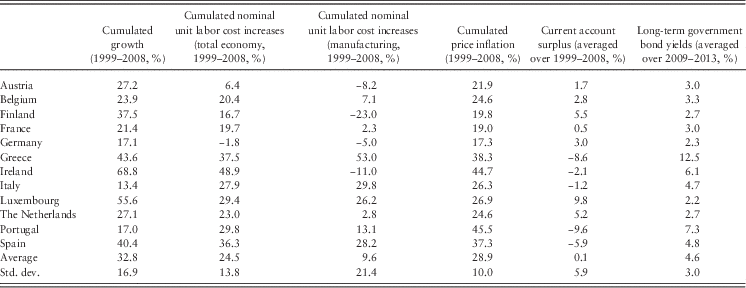
Authors’ own calculations from OECD sources.
Let us move on by comparing this information to the NULC changes in manufacturing. In this sector, NULC rose more moderately than in the overall economy (+9.6%). This clearly confirms the point made by Hancké and his colleagues: it was not the exposed sectors but the sheltered sectors that were the main drivers of nominal wage pressure (Hancké, Reference Hancké2013b; Johnston et al., Reference Johnston and Regan2014). However, interestingly, the variance behind this average was larger than in the overall economy. The average deviation from the mean of +9.6% was ±21.4 percentage points. It should not surprise us that, despite these differences, the cumulated NULC changes in the overall economy and in manufacturing are positively correlated (r=0.45).
Now recall that much of the literature interpreted diverging NULC as an outcome of the largely credit-driven (and therefore demand-driven) growth divergences. Visible to the naked eye, growth and NULC changes in the overall economy were indeed closely related (with r=0.64, according to the data in Table 1). But it is also easy to see that the differing growth rates leave parts of the variance in NULC increases unexplained. Two pairwise comparisons illustrate this nicely: Germany and Portugal suffered from nearly identical low growth between 1999 and 2008, but their overall NULC increases differed sharply. Finland and Spain were fairly similar with regard to their higher growth in the respective period, but again, their overall NULC increases differed significantly. Shedding light on these unexplained parts of the variance will be the purpose of the subsequent regression analysis.
The data in Table 1 also show that there is indeed a close relationship between economy-wide NULC inflation and price inflation.Footnote 15 Furthermore, Table 1 displays data on the average current account balances between 1999 and 2008. We see that exchange rate distortions and current account imbalances were indeed connected (the correlation between inflation and current account deficits is r=−0.74).Footnote 16 The last column illustrates that the countries with high NULC increases (especially in manufacturing), high inflation, and current account deficits between 1999 and 2008 were precisely the countries that suffered from high risk premia on state debt in the subsequent crisis period, 2009–13 (see also Chang and Leblond, Reference Chang and Leblond2015; Johnston et al., Reference Johnston and Regan2014: 1778–1779).Footnote 17
Let us now turn to the regression results. We present the results of a set of regressions for the two dependent variables, NULC for the total economy (Table 2) and NULC for the manufacturing sector (Table 3). Beside GDP growth and the full set of control variables, each model includes one of the substantial regime-type variables. All 10 regime measures are conceptually and theoretically different, capture different aspects of contemporary political economies, but naturally share common ground and are therefore interrelated (see correlation matrix, Table A3). For this reason, we test the independent effect of each regime variable separately, which results in 10 models for the 10 predictors.
Regression results for nominal unit labor cost (NULC) total economy
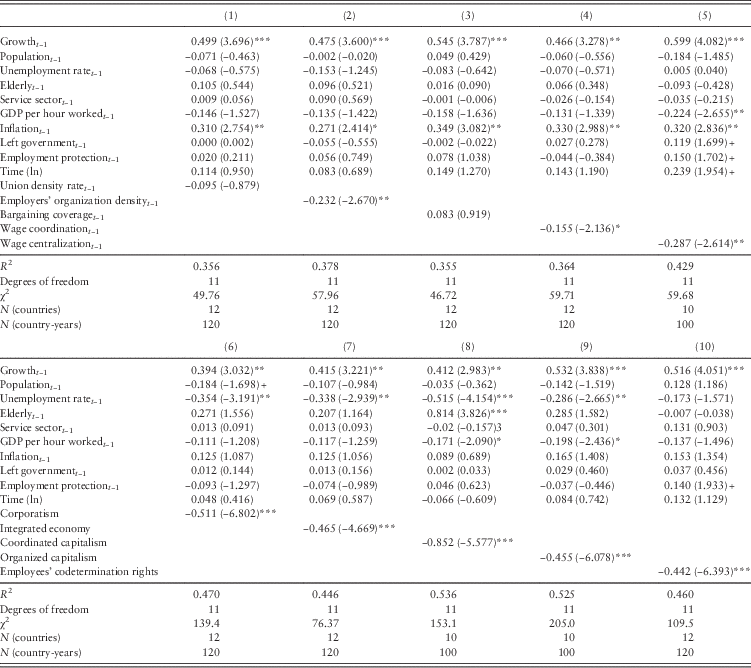
Regression with panel-corrected standard errors on NULC total economy, pre-crisis years (1999–2008). Standardized β coefficients; t statistics in parentheses;+P<0.1, *P<0.05, **P<0.01, ***P<0.001 (two-tailed tests). Definitions and sources of variables: see appendix (Table A1).
Regression results for nominal unit labor cost (NULC) manufacturing
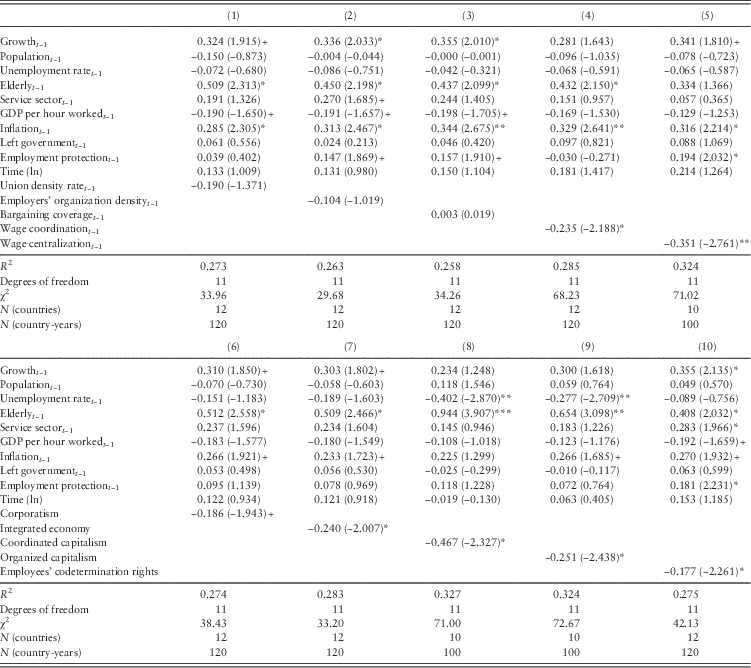
Regression with panel-corrected standard errors on NULC manufacturing, pre-crisis years (1999–2008). Standardized β coefficients; t statistics in parentheses;+P<0.1, *P<0.05, **P<0.01, ***P<0.001 (two-tailed tests). Definitions and sources of variables: see appendix (Table A1).
For the overall economy (Table 2), the results are as follows: growth shows a significant positive effect throughout all equations, which clearly supports the view of the Rebooting Consensus Authors (2015) briefly introduced in the second section. In substantial terms, this result shows that, if there is a 1% increase in GDP (as compared with the previous year), the expected NULC increase is between 0.4 and 0.5% (depending on the model).Footnote 18 Furthermore, as we have argued, the regime-type variables impart independent negative effects on NULC increases. Eight out of ten measures show highly significant coefficients in the expected direction; another one points in the expected direction but is not significant. In six cases (wage centralization, corporatism, integrated economy, coordinated capitalism, organized capitalism, and company-level codetermination), the regime effect outperforms the growth effect, which supports our claim that our understanding of the exchange rate distortions in the Eurozone must stand on two legs, an economic and a political-institutional one.
Let us also consider why the remaining variables – bargaining coverage and union density – have very low effects and no sufficient explanatory power. Formal bargaining coverage and union density do not necessarily indicate coordination. Collective agreement coverage is below average in Germany, but these statistics hide a substantial number of firms without formal coverage that nevertheless use such agreements as orientation. Also, high degrees of coverage can go hand in hand with wage bargainers who compete along ideological lines or who lack the institutional preconditions for intersectoral wage leveling. The same holds true for the share of union members among all employees.
Table 3 reports the results for the manufacturing sector, which we treat as a proxy for the internationally exposed sector. Recall that the average wage increases were lower in this sector than in the overall economy, but the deviation from the mean was even larger here than in the overall economy (see Table 1). What explains this variance? The growth variable shows relatively small effects across all models. Only in three out of ten models is growth significant at the 5% level. In all other models, the effect of growth is insignificant, but its positive sign still points in the expected direction.
In six out of ten cases, we find significant regime-type effects. This holds true for wage coordination, wage centralization, integrated economy, coordinated capitalism, organized capitalism, and company-level social partnership. Among the remaining variables, union density and employers’ organization density point in the expected direction but lack significance, while corporatism is significant at the 10% level. In sum, and in line with the reasoning in the second section, we find support for the view that wage restraint is more pronounced in the exposed sector than in the overall economy. International exposure provides incentives for mercantilism, irrespective of the growth context and of wage-bargaining institutions. However, even in the exposed sectors, NULC inflations are higher when the wage-bargaining regimes lack coordination. Wage bargainers therefore face difficulties to overcome their collective action dilemma.
As for the control variables, the following variables show significant effects (both Tables 2 and 3): among the sociodemographic covariates, the unemployment rate has negative effects on NULC increase. The higher a country’s unemployment rate, the lower the increases in NULC are. Given that growth is already controlled for, we interpret this result as the presence of an additional Kaleckian effect, indicating that the wage negotiation power of labor goes up under conditions of low unemployment. Similarly, the variable elderly, the population over 65 as a percentage of the total population, shows the expected positive effects in a few models, especially for the exposed sector. The inclusion of demographic controls is therefore adequate and constitutes a harder test of the substantial variables. The political controls show no substantial effects but are important in ruling out possible differences due to partisan effects and political-constitutional structures. Given the respective results, it is fair to conclude that the Eurozone suffered and still suffers from the heterogeneity of production regimes (with wage-bargaining institutions in their core), but not from the heterogeneity of political systems and parties in government. In explaining the macroeconomic imbalances in the Eurozone, in other words, ‘varieties of capitalism’ trump over political factors.
As expected, productivity growth, measured by yearly changes in GDP per hour worked indicates a negative trend. This finding confirms the necessity to control for the possibility that a part of the NULC divergences is due to differences in productivity developments (the denominator of the NULC calculation) rather than to differences in nominal wage developments (the enumerator). Also, lagged inflation is associated with NULC increases, which confirms the necessity to control for the possibility that NULC simply follows inflation. But note that all substantial variables remain significant even under statistical control for growth, unemployment, productivity changes, and inflation.
In addition to the equations shown here, we also estimated a quadratic, nonlinear relationship between wage coordination and NULC increases. The results, however, showed no statistical significance (available upon request). The idea of a hump-shaped relationship between wage coordination and wage pressure fails to shed additional light on the macroeconomic imbalances within the Eurozone. This result is interesting with respect to the interventions of the ‘institutions’ (the former Troika) into the wage-bargaining regimes of the crisis countries, which assume that the capacity for wage moderation increases as the wage-bargaining regimes become less coordinated; we will come back to this in the conclusion.
We also checked whether the results remain stable when we add the crisis years 2009–14 to the observed time period. As stated earlier, we chose the first 10 euro years in order to understand how the tensions that led to the euro crisis evolved and assumed that different causal logics apply for the period in which the crisis broke out and the international interventions set in. When we extend the period, the results remain stable (see Table A4 in the online Appendix). However, when we look at the crisis years only or solely at the exposed sector, the statistical impact of the wage-bargaining institutions vanishes (results are not shown, but available upon request). This is hardly surprising given the fact that many of the institutions’ interventions precisely aim at breaking the internal wage dynamics. Therefore, the findings confirm that different logics apply in the pre-crisis and in the crisis periods.
In sum, the results of this analysis largely confirm the paper’s argument: regime-type variables have an independent effect on differences in NULC increases, controlled for GDP growth and other relevant sociodemographic, economic, and political-institutional factors.
Conclusion: a choice among bad options
In this paper, we have shown that the heterogeneity of European labor relations regimes had a significant impact on the diversity of NULC inflations among euro members and, therefore, on the emergence of distortions of the real exchange rates from which the Eurozone suffers. This wage-regime effect was at least as large as the effect that derived from the heterogeneity of growth rates, and it turned out that the type of labor regime mattered for the exposed sector as well as for the overall economy. Given the strong relationship between wage and price inflations and given that the synchronization of price inflation rates is essential for a fixed currency regime, the regime-type effect is among the factors that undermine a smooth functioning of the euro.
Should the wage-regime effect substantially alter our thinking about the euro, apart from the fact that standard economic interpretations need a political science complement? Let us imagine that the wage-regime effect was absent, and let us go back to the causal narrative which we suggested as the common core among those who perceive the euro crisis not only as a debt crisis, but also as a macroeconomic imbalances crisis (see the second section). Under conditions of a single nominal interest rate determined by the ECB and diverging inflation rates, booming countries will be confronted with the decline of real interest rates, and busting countries will suffer from the increase of real interest rates, which should additionally fuel both booms and busts, respectively. This dysfunctional extension of both booms and busts will, however, not go on forever, because the interest-rate effect will be complemented by a cost effect that unfolds in the middle run. NULC inflation and price inflation will cause a cost crisis among the booming countries – in the course of which financial market participants are likely to doubt the sustainability of balance-of-payment deficits – and will bring the boom to an end.
This scenario is symmetric – in the sense that all participating countries should sometimes find themselves on the side of the dysfunctionally enlarged boom and sometimes on the side of the dysfunctionally enlarged bust. In a widely cited presentation, former IMF chief economist Blanchard has labeled this scenario as ‘rotating slumps’ (Blanchard, Reference Blanchard2007; see also Eichengreen, Reference Eichengreen2010). The wage-regime effect, however, suggests that the symmetry thesis might not hold. The symmetry can only occur if wage formation works similarly in similar situations. But this is not the case. Rather, it is likely that certain countries will for most of the time or even permanently run surpluses against others and therefore export unemployment to their neighbors.Footnote 19
Is the heterogeneity of inner-European wage-bargaining regimes a fate that will last forever? In principle, the steering capacity of Southern wage-bargaining institutions could be enhanced if those countries adapted Northern-style labor coordination. This may be possible in the long run, perhaps triggered by an unprecedented integration spillover (Lefkofridi and Schmitter, Reference Lefkofridi and Schmitter2015). But in the short to the middle run, the likelihood that this will happen is very low. The attempts of Southern Europe and Ireland to effectively enlarge the coordination capacity of their wage regimes did not survive the immediate pre-euro years.Footnote 20 Under conditions of the euro, under-average NULC increases occurred only in countries in which social partnership had deep historical roots, in which wage coordination was strongly institutionalized, and which had been classified as ‘corporatist’ for decades. In other words, we have reason to believe that the institutions of wage coordination are eminently sticky and cannot be designed or transferred in the short to medium run.Footnote 21 Even in Germany, coordinated wage bargaining, if it were to erode, would not reoccur under today’s conditions of socioeconomic change, de-industrialization, individualization, and a weakened labor movement (see on the erosion thesis the study by Hassel, Reference Hassel1999).
Today, any speculation about the transfer of Northern-style wage coordination to the South would be cynical anyway, since the interventions by the ‘institutions’ (the former Troika) pushed and still push Southern wage bargaining in precisely the opposite direction. As excellently documented by Schulten and Müller (Reference Schulten and Müller2013), these interventions aim at weakening trade unions and at strengthening company-based wage bargaining to the disadvantage of sectoral and nationwide wage bargaining. These reforms will clearly not increase the steering capacity of wage policy that is urgently needed under conditions of the euro. Paradoxically, therefore, the European interventions push the Eurozone even further away from the institutional preconditions of optimum currency areas.
Furthermore, the heterogeneity of European wage-bargaining regimes not only constrained a smooth functioning of the euro until the euro crisis, but also constrains a fair burden share today, in a situation in which diverging price levels among euro members need to be realigned. Keynesian economists like Krugman (Reference Krugman2011a, Reference Krugmanb) and Flassbeck and Lapavitsas (Reference Flassbeck and Lapavitsas2015) ask Germany to inflate labor costs in order to free the Southern European countries from some of the pressure to deflate labor costs.Footnote 22 The logic of this appeal is straightforward. But is this likely to happen? For reasons that Hall (Reference Hall2012, Reference Hall2014), Iversen and Soskice (Reference Iversen and Soskice2013), and Baccaro and Pontusson (Reference Baccaro and Simoni2016) have described in detail, coordinated wage bargaining underwrites the export structure of Germany’s political economy. Nominal wage inflation would not only raise prices vis-à-vis other Eurozone members, but also vis-à-vis the United States, Eastern Europe, and Asia (at least in the short run).Footnote 23 Even if trade unions could commit themselves to such a strategy, wage restraint would presumably be undermined by company-based social pacts. What has emerged in Germany is not only a dual structure featuring strong unions in the public sector and manufacturing and weak unions in the modestly productive service sector (Palier and Thelen, Reference Palier and Thelen2010), but also a two-level system in which strong works councils are prepared to trade wage increases for job security (Hassel and Rehder, Reference Hassel and Rehder2001). The feasibility of a strategy aiming to intentionally shrink the export sector may be rather unlikely everywhere, but particularly unlikely in Germany. The logic rather goes the other way around: once job security in the export sector diminishes, German wage bargainers perform wage restraint. Iversen and Soskice (Reference Iversen and Soskice2013) have even argued that Germany might rather leave the Eurozone than intentionally inflate.
Given that inner-European wage formation fails to deliver the outcomes needed by the fixed exchange rate regimes, the authoritarian sanctioning of wage policies seems to be the only option left. The European institutions have demonstrated that it is, in principle, possible to impose harsh interventions that bring NULC down, notwithstanding the cost in terms of de-industrialization, loss of democratic quality, and above all, growing social deprivation. Only in the formerly called Troika countries did NULC fall between 2010 and 2015: by around 12% in Greece, 6% in Cyprus, 6–7% in Spain, and 6% in Portugal (data source Eurostat).Footnote 24 Harsh interventions work – at the expense of social partner autonomy in wage bargaining and democratic self-determination in all policy fields that indirectly affect wages. Under conditions of both fixed exchange rates and huge political-economic heterogeneity, autonomy in wage bargaining and social policy may become ideas of the past.
Acknowledgments
The authors thank Lena Ehret for research assistance and Lothar Krempel, Florian Rödl, Fritz W. Scharpf, Armin Schäfer, Eric Seils, Wolfgang Streeck, three anonymous reviewers of the European Political Science Review, and Annika Wederhake for helpful comments.
Supplementary material
To view supplementary material for this article, please visit http://dx.doi.org/10.1017/S1755773916000217



