


Introduction
To convince the public about an issue, according to William Riker (Reference Riker1986), political actors may apply two analytically distinct strategies: rhetoric and heresthetic. While rhetoric is persuasion by eloquence or argument, heresthetic aims to change decisions with a given set of voter preferences through manipulating decision-making situations, i.e., ‘the structure of tastes and alternatives within which decisions are made’ (Riker, Reference Riker1983, p. 55). Heresthetic is pervasive since the loser of the political struggle is motivated ‘to find an issue that cleaves the winners’ and to generate a new majority (Riker, Reference Riker1982). From Riker’s five different types of heresthetic, in this research, we bring the change of the dimension of judgement (CDJ) into the focus. CDJ means formulating counterarguments in a dimension different from the original. To bring these concepts closer to the context of framing research, by rhetoric we mean arguments formulated within the given issue frame (Wedeking, Reference Wedeking2010, p. 619), while by heresthetic we mean arguments that use an alternative frame, i.e., a new dimension of judgement.Footnote 1 Taking, for example, a policy proposal to cut public expenditure to reduce budget deficit, one can argue against it within the given budget policy frame, i.e., applying a rhetorical strategy, by referring to unintended consequences, like a negative impact on economic growth and its spillover effect on budget revenues. Alternatively, applying a heresthetical strategy, one can argue against the proposal bringing in a new perspective (i.e., by CDJ) like social justice, recalling the potentially negative social impacts of austerity measures.
Riker argues that the CDJ may be an effective means of shaping public opinion, although he does not provide clues as to which factors determine the success of such a manoeuvre. As he argues, ultimately heresthetic is a trial and error method, i.e., ‘an art, not a science’ (Riker, Reference Riker1986, p. IX). In this paper, we challenge Riker’s assumption and aim to uncover the factors determining the effect of different framing strategies, with a special focus on the determinants of a successful heresthetical manoeuvre, i.e., CDJ. We investigate the effect of counterarguments formulated in the original dimension (i.e., rhetoric), and in a different dimension compared to the original frame (i.e., heresthetic) as two different strategies that can be applied as alternative means of winning a debate. Footnote 2
We continue the research started by Jennifer Jerit (Reference Jerit2008) and Justin Wedeking (Reference Wedeking2010) to reveal the effectiveness of rhetoric and heresthetic (CDJ) in shaping public opinion. We investigate the conditions under which counterarguing is successful in changing public opinion using either rhetorical or heresthetical means. Drawing on a survey experiment we carried out in Hungary in 2020, we focus on the potentials and constraints of using rhetoric and heresthetic on citizens’ political preferences and attitudes. That is, we unfold the elements of a successful counterframing activity in a survey experiment that models a Rikerian policy debate.
The results show that both rhetoric and heresthetic frames have a significant impact on decision preferences. However, subgroup analyses indicate that partisanship also has an exceptionally strong moderator effect on preferences. The research brings two major contributions. First, introducing a conceptual distinction between open and trade-off framing situations, it demonstrates that the structure of the situation matters: while heresthetic has robust effect in a trade-off situation, rhetoric may have a strong impact in open framing situations. Second, regarding heresthetic as Riker’s theoretical solution to the question of whether citizens’ preferences are fundamentally fixed or flexible, the paper solves the paradox empirically as well: it deconstructs the notion of ‘preferences’ used in the theoretical literature through a clear conceptual differentiation between attitudes and decision-making preferences.
The structure of framing situations
Framing experiments generally assume two- or multidimensional issues when a policy choice is to be made. Nevertheless, we can make an important distinction between two kinds of framing situations: the trade-off and the open framing situation. In the former, there is a strong trade-off between the impact of the argument in one or, alternatively, in the other dimension of an issue, since the two considerations are of a cross-cutting nature. Recall the classical hate group rally experiment (Nelson et al., Reference Nelson, Clawson and Oxley1997; Sniderman and Theriault, Reference Sniderman and Theriault2004; Chong and Druckman, Reference Chong and Druckman2007) in which respondents in treatment groups, which receive the issue in different frames (one in a freedom of speech the other one in a public security frame), are asked whether they would support the permission for a rally of a hate group, even if there is a risk of violence. Experimental results reveal that deliberating within a freedom of speech frame induces an argument to permit the rally, while thinking within the public security frame naturally stimulates a move towards the opposite direction, i.e., to prohibiting the rally. Changing the frame, i.e., CDJ, therefore, automatically serves the interests of the opposite side in the debate, since the only argument that makes sense in the competing dimension is the one supporting the opposite policy-direction. It is noteworthy that most authors doing research on cases in trade-off framing situations do not even consider the possibility of counter-arguments formulated in the prevailing dimension, assuming that it would be against common sense. Quite understandably, who would argue for the prohibition of a rally in the name of free speech? One can argue for permitting the rally in one, or against it in the other dimension of consideration, but using the same dimension as the opponent, i.e., engaging in a rhetorical debate, seems futile. In these kinds of situations, the argument for a certain choice is so overwhelming in the prevailing frame that to give a chance for an opposite view, the dimension of judgement is to be changed, i.e., re- or counter-framing (i.e., heresthetic) is required. Therefore, these are ideal cases to demonstrate the robust framing effect, i.e., heresthetic in this case.
In contrast, an open framing situation works differently. In this situation, arguments for and against can be presented with a fair chance of impact on citizens’ views within each dimension (i.e., there is no trade-off), since neither of them seems to be irrational nor contradicting common sense (we assume a two-dimensional situation here). For example, environmentalist arguments may be presented both for and against the enlargement of a nuclear power station at the same time; or in Jerit’s (Reference Jerit2008) example of Bill Clinton’s health-care reform plan, there were arguments in favour and opposed to the reform formulated in four different dimensions. Footnote 3 Open framing situations enable us to test the effect of both heresthetic and rhetoric as two alternative strategies of shaping public opinion.
Trade-off and open framing situations are taken as ideal types. They are not dichotomous categories with a clear borderline between them in the empirical reality, but there may be some overlap, i.e., concrete cases may be closer to one or the other type.
In our research, we continue the research started by Jerit (Reference Jerit2008) to study the role of rhetoric besides heresthetic in policy debate. However, unlike Jerit (Reference Jerit2008), who conducted a content analysis of Clinton’s health care reform plan, we carry out an experimental research. In contrast to the experiments of the last two decades, which focused exclusively on heresthetic, we include rhetoric as an alternative strategy and compare the effect of heresthetic and rhetoric in shaping public opinion.
Research questions and hypotheses
Heresthetic vs. rhetoric
Riker’s (Reference Riker1982, Reference Riker1983) theory of heresthetic is that CDJ may be an effective means of shaping public opinion. Early framing experiments reinforced the overwhelming effect of framing and/or heresthetic on public opinion. Drawing on Riker’s (Reference Riker, Mueller, Calvert and Wilson1996, p. 6) dominance principle and the theory of issue-ownership (Petrocik et al., Reference Petrocik, Benoit and Hansen2003; Jerit, Reference Jerit2008; Budge, Reference Budge2015), studies on framing predicted that opposing sides of a political debate would emphasize different considerations, leading them in effect to ‘talk past’ one another (Sniderman and Theriault, Reference Sniderman and Theriault2004; Chong and Druckman, Reference Chong and Druckman2007), which signals the potential role of heresthetic. In the contemporary literature, however, a caveat is entered: investigations by Jerit (Reference Jerit2008) and Wedeking (Reference Wedeking2010) unfold that issue ownership and heresthetic do not necessarily crowd out rhetoric as inefficient. Investigating simultaneously the heresthetical and rhetorical (Jerit labels them as framing and engagement) strategies that political actors applied during the 1993–1994 health care reform in the USA, Jerit (Reference Jerit2008, 2) first shows that heresthetic has certain limitations and ‘there also are conditions under which elites have an incentive to engage their opponent in a dialogue’ (i.e., to apply rhetoric), and, second, that under certain conditions, engaging the other side, i.e., rhetoric, may be a more effective way to maintain public support than heresthetic.
Our first research question (RQ1) follows from the arguments above: What is more effective in shaping public opinion: changing the dimension of judgement (heresthetical argument) or arguing in the original dimension (rhetorical argument)?
The order of frames
In cases of multiple frames, the literature suggests that the order and dynamics of framing have an important role, although there are mixed expectations and evidence about it. Chong and Druckman (Chong, Reference Chong2013, p. 118; Chong and Druckman, Reference Chong and Druckman2013) argue that in the case of receiving competing frames, the effect of earlier frames tends to decay, leading us to the conclusion that respondents are more strongly influenced by the most recent frame they have received. However, when theorizing about the possible effects of the order of arguments, we must also cite the ‘continued influence effect’ reported by social psychologists investigating the difficulties of correcting for misinformation and fake news. The continued influence effect is supported by evidence that explicit retractions of information rarely eliminate the effect of the retracted statement, meaning that the effect of previous messages often lasts for longer, making it hard to overwrite a piece of information with a new one (for a review, see Lewandowsky et al., Reference Lewandowsky, Ecker, Seifert, Schwarz and Cook2012; Chan et al., Reference Chan, Jones, Hall Jamieson and Albarracín2017). Taking into consideration these competing expectations and results, we formulate our second research question (RQ2) as follows: Does the order of frames have a significant effect on respondents’ decision-making preferences?
Beyond the endogeneity/exogeneity paradox of preferences
While public choice and mainstream political science research assume that citizens’ preferences are fixed, or ‘exogenously given’ (Dahl, Reference Dahl1956; Downs, Reference Downs1957), both interpretative social science and political communication research claim that in the political process they are shaped by elite discourse endogenously (Disch, Reference Disch2011; Chong and Druckman, Reference Chong and Druckman2013). We argue that this paradox about the fixed or flexible nature of citizens’ preferences is transcended or solved, in a conceptual-theoretical sense, by Riker’s invention of heresthetic. Although the condition of preference exogeneity fits most types of Rikerian heresthetic, including the introduction of new alternatives, agenda-setting, manipulation of voting procedures or strategic voting, the change of the dimension of judgement (CDJ), as Riker himself acknowledges (Reference Riker1983, p. 65), turns out to be an exception. Not only the way and therefore the result of preference aggregation, but (indirectly) individuals’ preferences are also manipulated through CDJ, which suggests that they are flexible. The concept of saliency is crucial for us both on a theoretical and on an empirical level to understand this riddle, as it will be unfolded below.
It is the strength of saliency of the issue dimension and not the preference as such (i.e., the preference isolated from the context) that is changed through framing, as we know from Riker’s examples or the rally experiment of contemporary literature. However, what happens ‘in the manipulation of alternatives is that as a consequence the salience (and hence the content) of preferences are also changed’, as Riker concludes (Riker, Reference Riker1983, p. 65). This means it is the manipulation of the decision-making alternative (the context), i.e., the dimension of judgement, that depreciates the relevance of certain preferences and appreciates others. Changing context through heresthetic (CDJ), therefore, produces an endogenous change of citizens’ preferences. To sum up: CDJ bridges the gap between the rationalist assumption of exogenous preferences and its endogenous formation through political actors applying heresthetic.
Drawing on Riker’s conceptual innovation and empirical research results (Zaller, Reference Zaller1992; Sniderman and Theriault, Reference Sniderman and Theriault2004), we aim to solve the exogeneity/endogeneity paradox on an empirical level through deconstructing the notion of ‘preferences’ used in the theoretical literature. In our experimental research, we make a clear conceptual differentiation between attitudes and decision-making preferences (DP). Hence, we take attitudes as relatively stable predispositions that might be changed in the long run but are fixed in the short run, while DP refers to preferences for specific policy alternatives expressed in concrete situations of choice. (In a certain sense, while attitudes give the exogenous, DP gives the endogenous ‘aspect’ of citizens’ preferences.) Consequently, the sharp dichotomy of endogeneity and exogeneity of citizens’ preferences is tamed or transcended through heresthetic and a more sophisticated approach to the concept of attitudes and preferences.
Let us explain this phenomenon in more detail. Due to the conceptual differentiation introduced, heresthetic, as well as CDJ, is distinct from rhetoric in that it is not concerned with changing individuals’ beliefs or attitudes but with manipulation of DP (Paine, Reference Paine1989). Footnote 4 The concept of saliency reveals how heresthetic can change DP, even if attitudes remain fairly stable. Heresthetic, as framing the issue in a different dimension, involves both selection and salience. In Entman’s formulation: ‘To frame is to select some aspects of a perceived reality and make them more salient in a communicating text, in such a way as to promote a particular problem definition, causal interpretation, moral evaluation, and/or treatment recommendation for the item described’ (Entman, Reference Entman1993, p. 52). To put it differently, in Druckman’s (Reference Druckman2001, p. 1042) words, ‘[a] framing effect occurs when in the course of describing an issue or event, a speaker’s emphasis on a subset of potentially relevant considerations causes individuals to focus on these considerations when constructing their opinions’. Focusing on one aspect or consideration means neglecting another, even if this other one is an important attitude. This is the reason why the change in DP can be endogenously explained, even if attitudes and values remain constant, in the case of using heresthetic. Therefore, our first hypothesis,
HYPOTHESIS 1a: is that heresthetic counterarguments significantly change decision-making preferences but do not change attitudes significantly, and,
HYPOTHESIS 1b: is that rhetorical counterarguments change both decision-making preferences and attitudes significantly.
As specified above, attitudes differ from policy preferences because attitudes are fixed in the short run, while preferences about specific policy issues to be decided (DP) are more flexible since CDJ evokes a different set of attitudes. We assume that the impact of framing will be stronger on respondents’ actual policy decisions (DP) if it supports stronger underlying attitudes. Based on the structure of framing situations, this general assumption can be deconstructed into two different hypotheses. In open framing situations, we can expect a competition also between frames that are formulated in the same dimension, while in trade-off framing situations there is a natural match between the direction and the dimension of arguments (again, who would argue for the prohibition of a rally in the name of the free speech?). That is, in open framing situations we expect that
HYPOTHESIS 2a: policy decision preference is more likely to be influenced by either Pro or Con arguments if they connect to a stronger underlying attitude than by those (either Pro or Con) that connect to a weaker attitude.
In more trade-off-like framing situations, however, different issue dimensions fit different policy outcomes, meaning that certain underlying attitudes anticipate an inclination to certain preferred outcomes. If the herestetician could find a different but stronger underlying attitude that supports its cause than the initial one, they could argue more successfully in favour of the dimension fitting that attitude. In these situations, it is plausible to expect that respondents will favour a certain issue direction based on the strength of their underlying attitudes. Thus, arguments formulated in any dimension that support that direction will be more effective. To sum up,
HYPOTHESIS 2b: is that if respondents’ stronger underlying attitudes favour outcome X, arguments formulated in any dimension supporting outcome X will be more effective compared to arguments supporting outcome Y.
The role of partisanship
In the next sections, we dedicate more attention to the role of partisan affiliation as a moderator variable that is essential to understand the dynamics of a competitive framing situation (Slothuus, Reference Slothuus2016).
Citizens’ reactions to different frames are highly contingent, but partisanship may be an influential driver of their evaluations, especially in the case of competing frames. Political parties are among the most powerful sources structuring opinion formation (Campbell et al., Reference Campbell, Converse, Miller and Stokes1960). One could argue that partisanship and voters’ issue positioning raise an endogeneity problem; however, policy positions are more likely to be subject to change than party identity. Experiments have shown that politicians are often able to induce a change in their partisans’ policy positions (Broockman and Butler, Reference Broockman and Butler2017) and that partisans seek to align their position to that of their political camp (Druckman et al., Reference Druckman, Peterson and Slothuus2013). That is, we theorize that partisan bias plays an important role in determining the efficacy of the framing process, especially in the case of competing frames. Our hypothesis is rooted in the theory of partisan motivated reasoning, which is well-documented in other fields of political science and suggests that partisan motivations have a key role in citizens’ opinion formation (Taber et al., Reference Taber, Cann and Kucsova2009; Bolsen et al., Reference Bolsen, Druckman and Cook2014; Claassen and Ensley, Reference Claassen and Ensley2016). Therefore, we hypothesize that
HYPOTHESIS 3: voters are more likely to be influenced by frames that are in line with the position of the party they support, and they are more likely to neglect frames that are against their party’s position.
The role of respondents’ sophistication in the receptivity of frames
Zaller’s (Reference Zaller1992) work is crucial concerning the receiver side of the framing process. His argument is that people who are most affected by media content are also the ones that are least likely to be exposed to it. More specifically, those with little political knowledge – and thus the least ammunition to counter media messages – also tend to be the least interested in politics, thus least likely to watch or read materials that contain political information. On the other hand, those most interested in politics and most likely to receive political media content also tend to be the most partisan, thus – in line with the minimal effects tradition – they are less likely to be swayed by media content (Zaller, Reference Zaller1992). Other authors also emphasize that the politically more interested and more informed citizens’ evaluations are harder to change or manipulate because they possess the ability to generate internal counter-arguments and their opinion about certain issues is stronger; thus, new information is less likely to surprise them (Druckman and Lupia, Reference Druckman and Lupia2000). This leads us to the hypotheses that
HYPOTHESIS 4a: less informed citizens’ decision preferences are more susceptible to the impact of rhetoric and heresthetic, and that,
HYPOTHESIS 4b: less interested citizens’ decision preferences are more susceptible to the impact of rhetoric and heresthetic.
Method
The selection and description of the issue
We designed an experiment to test the effect of different combinations of frames and counter-frames. When choosing a policy case for our experiment, we considered a set of important aspects. First, as Sniderman and Theriault argue (Reference Sniderman and Theriault2004), when investigating the effect of different frames, it is important to choose a policy question of major importance that is longstanding and competitively contested. We also aimed at evading issues that count as ‘principal battlegrounds of contemporary politics’ (Sniderman and Theriault, Reference Sniderman and Theriault2004), i.e., that are characterized either by crystallized opinions in the electorate or strong partisan divisions. Hence, we looked for a policy issue that the political community had not extensively discussed in recent months or years. Second, the multifaceted nature of the issue in terms of the underlying values and attitudes it activates was also important; i.e., we had to find a policy issue that could be supported or rejected based on arguments relying on two widely shared values. Lastly, and most challengingly, we aimed to set up an open framing situation: we looked for an issue that offered valid arguments for both support and rejection relying on both major values; i.e., we wanted an issue that would enable us to formulate both negative and positive frames in both dimensions. Considering all these aspects, we have chosen the question of the capacity enlargement of a domestic nuclear power station, framing our arguments in the dimensions of environmental aspects and economic sovereignty aspects, which offer arguments both in favour of and against enlargement.
The Hungarian nuclear power plant at Paks was built in the 1980s by the Soviet Union; its two blocks are predicted to operate until 2037. The two nuclear blocks provide approximately 45% of the country’s energy production (MVM, 2017). The ‘Paks II’ proposal about the capacity enlargement of the nuclear plant was first introduced to the public in 2014 after an Orbán-Putin summit in Moscow. The prelude to the Orbán-Putin treaty had been a 2009 law Parliament passed with a 95% majority about the country’s nuclear capacity enlargement at the time of the Socialist government before Fidesz had come into power.
In 2014, the Fidesz government led by Viktor Orbán introduced the plan to replace the old blocks and to enlarge nuclear capacity. The proposed deal was that Rosatom should build the two new nuclear blocks, and for twenty years they would provide nuclear fuel and take care of nuclear waste. The Russians were to finance 80% of the project (ten billion euros) as a long-term interstate loan and the Hungarian government would finance the rest and become the sole owner. The enlargement met with heavy criticism from the Hungarian green party LMP on the grounds of environmental protection. The Socialists and other left-wing parties criticised the Russian loan and the fact that the treaties were classified for thirty years. The government argued for the project with reasons of energy security, energy independence, and lower prices. The right-wing opposition party Jobbik supported the bill. Parliament passed the law in February 2014, three months before the elections. The election campaign was dominated by the topic of the overhead reduction program of the government, while the Paks II project was not in the spotlight, and the issue disappeared from the public agenda relatively quickly.
Checking public attitudes in representative survey data polled in the third quarter of 2017 (European Social Survey, 2017 (ESS)), we can report medium-low level support on the part of the Hungarian public for nuclear energy as an energy source, compared to low support for coal and natural gas, and high support for renewable sources. Footnote 5 Support for the use of nuclear energy is unrelated to party affiliation (considering votes for parties or coalitions that entered the legislation during the last elections, we tested the differences between groups with ANOVA, N = 763; F = 0.697; P = 0.498), it is unrelated to gender (N = 1484; F = 1.625; P = 0.203), and also to age (N = 1482; P = 0.073; r = −0.046). As we have seen, using nuclear energy had a balanced medium-low level support in Hungarian society with no significant differences considering age, gender, and party preferences.
Similarly to nuclear energy support, we used ESS survey data to check if environmental and economic sovereignty attitudes had similar support in different subgroups of the population. We used questions about how worried respondents were that Hungary was too dependent on energy imports (1–5, 1 indicates not at all worried, N = 1546, Mean = 3.05; St.D. = 0.892) and the importance to care for nature and the environment (1–6, 1 indicates very important, N = 1457; Mean = 1.98; St.D.=0.989). Based on these two variables, environmental attitudes appear to be unrelated to age and party choice (N = 730; F = 0.941; P = 0.391) and are weakly related to respondents’ gender (N = 1457; r = −0.097; P = 0.000), indicating that caring for nature and the environment is slightly more important for women. Sovereignty attitudes are weakly related to age (N = 1546; r = 0.103 P = 0.000), meaning that older people were slightly more worried about energy dependence), while unrelated to gender (N = 1546; r = 0.031; P = 0.228) and party choice (N = 794; F = 0.896; P = 0.409). While these two variables are not directly comparable to each other, as they differ both in terms of the specificity of the questions and the scales they use, their mean values suggest that environmental aspects might be more important or intelligible to Hungarian citizens than those related to economic sovereignty.
To sum up, we argue that the policy issue of the nuclear power plant enlargement in Paks shares the above-listed attributes of an ideal topic for studying the effect of competitive framing. It is a longstanding and competitively contested issue of major importance (Sniderman and Theriault, Reference Sniderman and Theriault2004), that in the last few years has been outside the main focus of Hungarian public discourse. Most importantly, the issue provided an open framing situation, i.e., arguments both for and against enlargement can be formulated using two value dimensions that are generally important for Hungarian citizens.
The design of the experiment
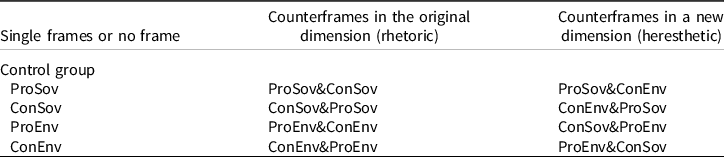
We designed our experiment to model a Rikerian strategic dilemma about the capacity enlargement of a domestic nuclear power plant. Both pro-nuclear and anti-nuclear arguments were formulated in two different dimensions, using either environmental or economic sovereignty-based arguments. This means that we used four different frames and their combinations, resulting in 12 treatment groups (four of them receiving one frame, and eight receiving both a frame and a counterframe) and a control group (not receiving arguments, just a neutral one-line description of the topic) as summarized in Table 1. The combination of frames and counterframes models either rhetorical or heresthetic debates, depending on the dimension of argument provided by the second frame. If the same dimension is used, the combination of frames models a rhetorical debate, but if a different dimension is used, it models a heresthetic debate. When formulating the four frames, we aimed at constructing similar arguments in terms of length, strength, tone, and structure (see Appendix 1).Footnote 6 Based on their direction and dimension, we use the ProEnv, ConEnv, ProSov, and ConSov labels to abbreviate the names of the four frames.
The structure of the experiment
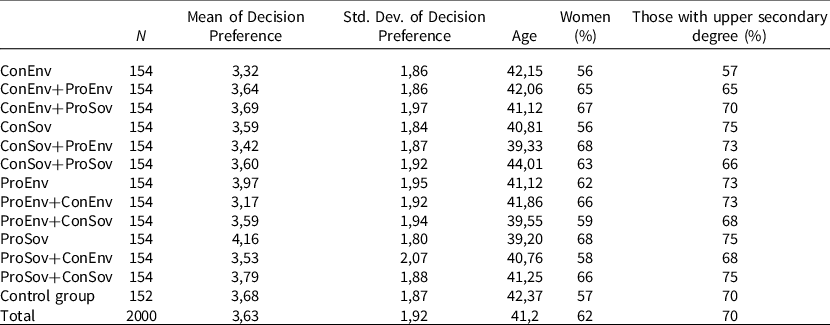
The online survey experiment was conducted in July 2020 (N = 2000) by a professional public opinion polling company (NRC, https://nrc.hu). The sample was representative of the Hungarian population that has internet access and is between 18 and 67 years of age. The mean age of respondents was 42 years; 62% were women, and 34% had a college degree. Participants were randomly assigned to the 12 treatment groups and the control group. The descriptive statistics of the sample by treatment groups are summarized in Appendix 2.
In the first part of the survey, respondents completed a short questionnaire about their demographics, political interests, political orientations, and both environmental and sovereignty attitudes. Next, they received the treatment texts according to the group they had been assigned to. After reading the short treatment texts, participants were asked about their decision preference (DP), i.e., about their opinion of nuclear power station enlargement. Respondents rated themselves on a 7-point scale (from 1 to 7), with higher scores indicating more support for enlargement. We also measured post-treatment environmental and economic sovereignty attitudes on a 7-point scale, with three questions for both aspects, that later were merged into two variables with factor analysis, indicating either environmental or economic sovereignty attitudes. Footnote 7
The independent variables we used in the analysis were gender, age of respondents (in years), place of residence (1-village; 2-town; 3-capital city), political interest (ranging from 1 – no interest to 4 – strong interest), daily political news consumption (measured in 30-minute blocks; ranging from 1- no time to 5 – more than 90 minutes). Due to the bipolar dynamics of Hungarian party competition, we recoded data on partisan preference into a dummy variable (0 – opposition parties’ voters; 1 – government parties’ voters). While in some models we included non-voters as well, in these cases we used a variable with three outcomes (voting intentions recoded into a nominal variable; 0 – no voting intentions or no answer; 1 – opposition parties’ voters; 2 – government parties’ voters). References categories are always indicated in the analysis.
Results of the experiment
Descriptive results
Irrespective of the frames they received, older respondents and women expressed less support for nuclear capacity enlargement, while the differences between people consuming more or less news, having more or less interest in politics, and completing primary, secondary, or tertiary levels of education was insignificant. We also examined the links between respondents’ position on nuclear capacity enlargement and pre-test attitudes in both attitude dimensions. Pre-test environmental attitudes were negatively correlated (r = −0.086; P = 0.000), while pre-test economic sovereignty attitudes were positively correlated to support for enlargement (r = 0.055; P = 0.014). These weak correlations suggest that DP on this specific policy issue might be quite loosely related to relevant underlying attitudes. This means that our case is more of an open framing situation than a trade-off situation.
In our experiment, the ordering of frames had no effect on DP. Compared to the control group, there was no significant difference in support for nuclear capacity enlargement between those receiving a pro-nuclear frame first and those receiving an anti-nuclear frame first. This result is in line with former findings of the literature (Lecheler and de Vreese, Reference Lecheler and de Vreese2013) showing that the ordering of frames affects evaluations in overtime experimental designs only. In an experimental design where the respondents have been confronted with counterarguments simultaneously, the ordering of the frames has no effect.
Lastly, while the topic of nuclear energy capacity enlargement had been given practically no attention in Hungarian public discourse in the years preceding the experiment, respondents were divided in the question along partisan lines. In the control group, we find a clear difference between government supporters, and both opposition supporters and non-voters. Government voters support enlargement much more than opposition supporters (4.9 points versus 3.13 points) and non-voters (3.44 points), while the difference between opposition supporters and non-voters is insignificant.
The impact of the single frames
We measured the effectiveness of the single frames in changing respondents’ decision preferences (DP) about the approval or rejection of nuclear power station enlargement compared to the control group.
Model 1 in Table 2 shows the results of an OLS regression estimating DP with dummy variables indicating the frames that respondents received; the reference group is the control group (for a model with all treatment groups’ effect on DP see Appendix 3). We also tested whether the impact of the four frames on DP was similar when they were received on their own to the overall effect of frames. To test this aspect, we included the four types of frames in a regression as four dummy variables, which indicated whether the respondent received that specific frame (1) or not (0), irrespective of whether the respondents received other frames, and which one (Model 2 in Table 2). Model 2 shows that, analysing all groups together, three out of the four frames significantly influenced DP.
The impact of single frames on respondents’ decision preferences
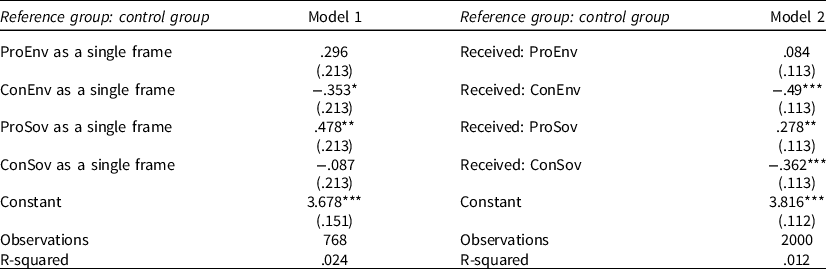
OLS regression estimating DP. Entries are regression coefficients; standard errors are in parentheses.
***p < .01, **p < .05, *p < .1.
While we made efforts to construct frames of the same structure and strength, respondents clearly did not appreciate these arguments to the same extent. Out of the four frames, two have a moderate impact on DP, while two frames have no significant effect compared to the control group. These results imply that pro-nuclear positions may be better represented in an economic sovereignty frame, while anti-nuclear arguments are more effective in an environmentalist frame.
The impact of heresthetic and rhetorical counterframes on DP and relevant attitudes
In the groups receiving two different frames, we measured the effect of both rhetorical and heresthetical counterarguments compared to that of the original frame we challenged. That is, we compare the impact of the two types of counterframes to the effect of the original frame by comparing the DP (and attitudes) of those receiving a combination of frames to those receiving the first frame only.
Table 3 shows the effect of counterframes on DP when either rhetoric or heresthetic is used against the original argument. The first coefficients in all blocs show the effect of rhetorical counterframes (e.g., ProEnv+ConEnv or ProSov+ConSov frames), that is, when the challenger remains in the same dimension of judgement, while the second coefficients show the effect of heresthetical counterframes (e.g., ProEnv+ConSov or ProSov+ConEnv frames), i.e., CDJ.
The effect of receiving a specific frame on post-test sovereignty and environmental attitudes
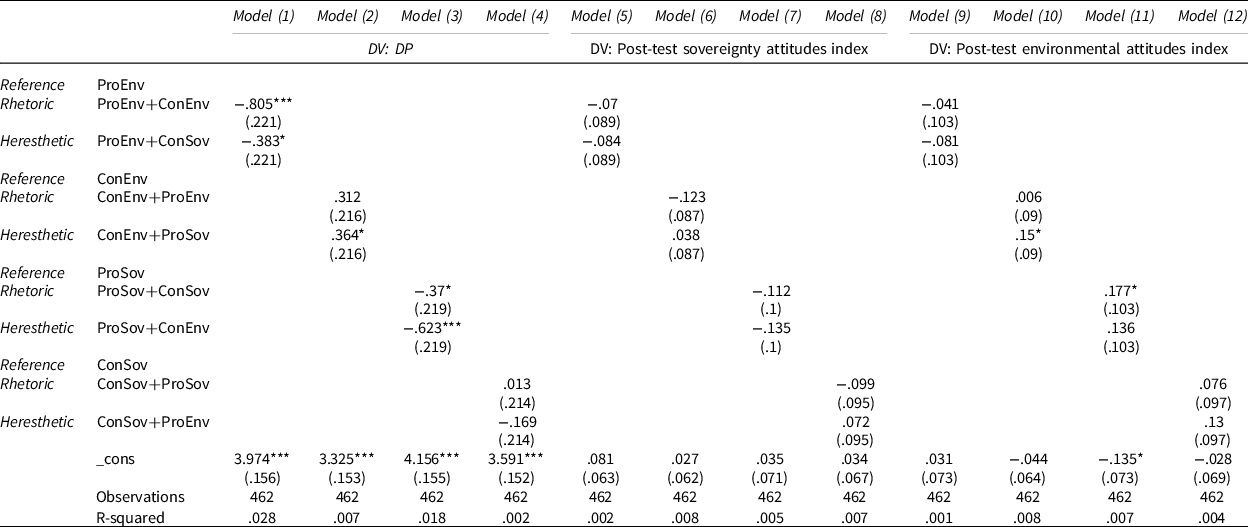
OLS regression estimating the impact of receiving counterframes on DP (Models 1 to 4) on post-test sovereignty attitudes (Models 5 to 8) and on post-test environmental attitudes (Models 9 to 12), compared to those receiving a single frame only. Entries are regression coefficients; standard errors are in parentheses.
***p < .01, **p < .05, *p < .1.
In Model 1, both rhetoric and heresthetic had a significant effect. The rhetorical argument changes DP by −0.805 points on average, while the average effect of herestethic is of −0.383 points. The difference between the two effects remains significant in a direct comparison, suggesting a stronger effect for rhetoric in this case. In Model 2, the effect of heresthetic is significant, while the effect of rhetoric is not. In Model 3, both effects are significant, while the coefficient and higher level of significance implies a stronger effect for heresthetic, while in Model 4, both effects are insignificant. All significant effects in all models point in the expected direction. These mixed effects suggest that heresthetic arguments are not unconditionally more powerful than rhetorical ones. In some cases, changing the dimension of judgement produces more effective counterframes, while in other cases it is worth staying in the original dimension of the debate.
When assessing the impact of frames on attitudes, we found almost no effect. When differentiating between the effect of rhetorical and heresthetic frames on respondents’ attitudes (H1a and H1b), no consistent pattern is observable, and both rhetoric and heresthetic frames leave attitudes largely intact, as reported in Table 3. The changes observable in Model 10 and Model 11 are somewhat surprising, as the positive shifts in environmental attitudes occurred when respondents received sovereignty-based counterframes, which is not a change that one would expect. To sum up, efficient heresthetic counterframes (ConSov after ProEnv, ProSov after ConEnv, and ConEnv after ProSov) and efficient rhetoric counterframes (ConEnv after ProEnv, and ConSov after ProSov) do not affect relevant attitudes according to the change they imply on DP. Therefore, we accept H1a, and reject H1b. These results suggest that rhetoric and heresthetic debates are not that different in their mechanisms, as a change in attitudes is not a prerequisite of a change in DP in either case.
The effect of underlying attitudes
According to H2, we investigated if respondents with different attitudes reacted similarly or differently to the four frames we used. To investigate this aspect, we transformed our variables about pretest environmental and sovereignty attitudes into a nominal variable with three outcomes, indicating that a respondent attached higher importance to environmental aspects than to sovereignty aspects (0), attached similar importance to both aspects (1), or attached higher importance to sovereignty aspects (2). The distribution of answers limits the investigation in the sense that compared to those who have stronger environmental attitudes (N = 808) and who attach equal importance to both aspects (N = 892), those who have stronger sovereignty attitudes are in a minority (N = 300).
In the case of those with stronger environmental attitudes, (H2a) predicted an influence for the ConEnv and ConSov arguments, and (H2b) predicted an influence for the ProEnv and ConEnv arguments. The results in Table 4 give support to H2b (in the case of Model 1), while none of the models support H2a.
The effect of frames in three groups of respondents according to the strength of relevant attitudes
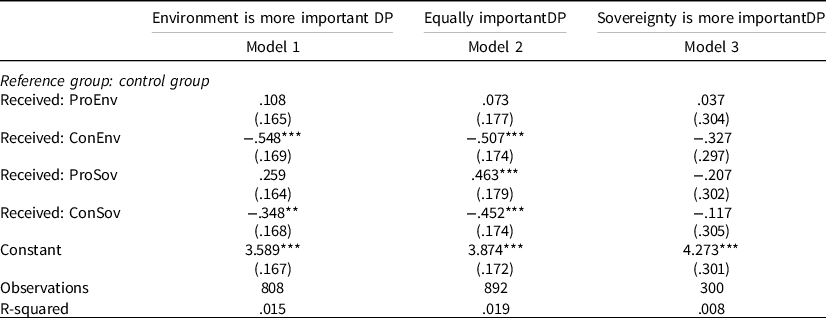
Standard errors are in parentheses.
***p < .01, **p < .05, *p < .1.
Model 1 shows that those with stronger environmental attitudes are not receptive to pro-nuclear arguments, while those with balanced environmental and sovereignty attitudes are more persuadable, as they are influenced by three of the four frames. Lastly, on this relatively small sample of respondents preferring sovereignty over environmental considerations, no frame had a significant effect compared to the control group.
The effect of government/opposition partisanship
The descriptive analysis of the control group shows that government voters strongly favoured enlargement compared to independents and opposition voters without receiving any frames, even if former survey results did not show a significant difference between attitudes towards the use of nuclear energy and other relevant attitudes. Although the gap between the original positions of the two groups deserves attention, according to H3 here we focus on whether the impact of frames is different also in the two partisan groups.
As we expect different effects for government and opposition partisans, we have built different OLS models for the two groups. When investigating the effect of the four different frames (Table 5), it is striking that anti-nuclear arguments significantly move opposition voters’ opinion in a negative direction, while pro-nuclear frames have no effect on their opinion. In contrast to these effects, government voters are not influenced by anti-nuclear frames. In contrast, the pro-nuclear sovereignty-based frame has a strong and significant effect on this group’s opinion, while the effect of the pro-nuclear environmental frame is positive, yet not significant.
The overall effect of the four different frames in the groups of Fidesz-KDNP (government) voters and opposition voters
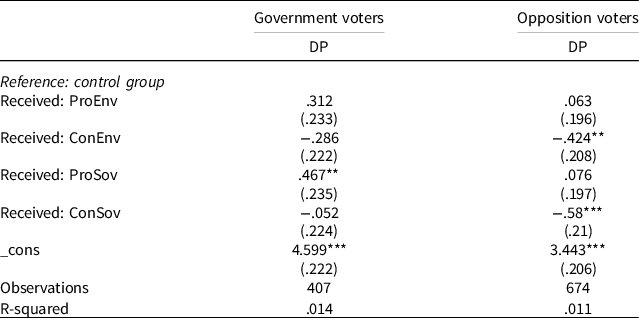
OLS regression estimating DP. Entries are regression coefficients; standard errors are in parentheses.
***p < .01, **p < .05, *p < .1.
It is worth taking a look also at how specific counterframes work in these two partisan groups, even though when analysing data in this way, the size of samples shrinks, and therefore weaker effects are unobservable. Table 6 shows the effect of counterframes in the groups receiving an environmental frame as a first frame (in the other two groups that are not reported here all effects in both groups are insignificant). As we can see, both sovereignty-based and environmental counterframes have a substantial and highly significant effect in both groups if they support the original position of one’s partisan group, while those that challenge the position of the partisan camp that they identify with are completely ineffective. As we see in Model 3 in Table 6, compared to opposition voters receiving one single ProEnv frame, opposition voters receiving any counterframes rejected nuclear capacity enlargement by roughly one point more. A similar tendency applies to government voters who received a second argument supporting the use of nuclear energy (Model 2). In these groups, government voters’ support for enlargement increases by more than one point, compared to those government voters who received an environmental anti-nuclear frame only.
The effect of counterframes on government voters and opposition voters

OLS regression estimating DP. Entries are regression coefficients; standard errors are in parentheses.
***p < .01, **p < .05, *p < .1.
The results therefore strongly support H3, suggesting that partisan-motivated reasoning was strongly present in the process of how voters evaluated different frames. Opposition supporters were open only to anti-nuclear frames, and government voters were open only to pro-nuclear frames, whether they were rhetorical or heresthetic in their structure. The initial differences between the positions of the two partisan groups were further widened when they were presented to positive and negative frames, as both groups were more than willing to shrink their position in the direction of their preferred political camp, while they resisted frames that challenged those positions.
Effect of political sophistication – political interest and news consumption
To answer H4a and H4b, we analysed the impact the frames made on more sophisticated and less sophisticated respondents. According to our hypotheses, we expected higher values and/or higher significance for the coefficients indicating the effects of different frames compared to the control group in the case of less politically informed and less interested respondents, compared to those more informed and interested. Models 1 to 4 in Table 7 summarize the overall effect of the frames. Contrary to our hypotheses, we found no evidence of a substantial difference between more and less sophisticated groups in the receptivity of frames, compared to the control group in the groups of highly informed and interested respondents (Models 3 and 1) and less informed and less interested respondents (Models 4 and 2).
The impact of frames on different groups regarding news consumption and political interest
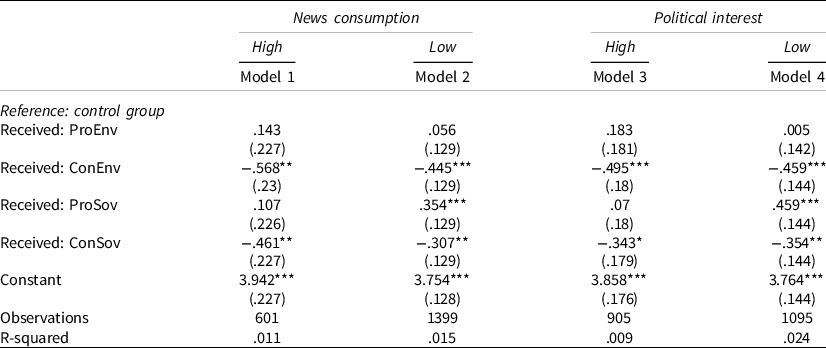
OLS regression estimating DP. Entries are regression coefficients; standard errors are in parentheses.
***p < .01, **p < .05, *p < .1.
Table 7 shows that, although being similarly receptive to anti-nuclear frames as their more interested and informed counterparts, less informed and less interested people are receptive to a pro-nuclear sovereignty-based frame, while more interested and more informed people are not. This means that we can detect some differences between more and less sophisticated groups. However, this is not exactly what we hypothesized as it is limited to one specific frame; in the case of the other three frames, we find no similar patterns. Hence, our data does not give strong support to H4a and H4b, as a generally stronger effect of frames in the case of less interested and less informed subjects cannot be observed.
Summarizing the empirical results, the type of counterarguments (heresthetic or rhetoric) was not an important predictor of the effectiveness of frames, meaning that heresthetic may be an effective tool in persuading citizens, although in other cases rhetoric appears to be even more effective. In the cases of single frames, some frames have been found to be more effective. More specifically, ProSov and ConEnv on their own were stronger than the others, suggesting a trade-off situation. However, the analysis of competing situations offers a less clear picture because ConSov and ProSov arguments had similar effects. Contrasting the effects of rhetoric and heresthetic has produced ambiguous results, suggesting that in some cases rhetoric, while in some other cases heresthetic is the more successful strategy. In answer to our second research question, (RQ2) the order of the frames had no significant effect, i.e., there was no difference between respondents who received a pro-nuclear argument first and respondents who received an anti-nuclear argument first. Turning to our hypotheses about the role of underlying attitudes, while pre-tested underlying attitudes determined the preference for nuclear enlargement only loosely (stronger environment attitudes meaning less support, and stronger sovereignty attitudes meaning more support), the receptiveness of different frames was contingent on underlying attitudes, giving partial support to H2b, while no support to H2a. We have found that news consumption and political interest did not influence the effect of the framing process in six of the eight cases (H4a and H4b). This means that the role of sophistication in the receptivity of new information might not be as important as former research had suggested.
Lastly, partisanship has proved to be the most important moderator that determines the effect of specific frames, giving strong support to H3. The analysis shows a strong division according to partisan lines, both in terms of the original position of the two partisan groups and their receptivity to the different frames. Government supporters reported more pro-enlargement preferences, while opposition supporters and non-voters were more markedly against it. Among the different frames, those who supported pre-existing partisan positions had strong effects, while arguments against the preferred party’s opinion had no significant effect. In the case of competing frames, the partisan division between groups widened further.
Discussion
We have learned from the Rikerian theory that, although both rhetoric and heresthetic are ubiquitous phenomena in the process of public opinion formation, there are no general rules to specify their efficacy: they are ‘art, not science’. The robust role of contingency is highlighted through the art metaphor. Yet, formulating the dominance principle, Riker (Reference Riker, Mueller, Calvert and Wilson1996) made efforts to reveal patterns or regularities in this process. Jerit (Reference Jerit2008) and Wedeking (Reference Wedeking2010) went further in specifying the conditions that ensure higher efficiency for rhetoric or for heresthetic. Our paper intends to contribute to this line of literature by offering more insights about the conditions and constraints of shaping citizens’ public policy decisions with rhetorical or heresthetical arguments. Before turning to the contributions of our paper, we must articulate some limitations of this study. First, although we aimed to offer a comprehensive analysis about a carefully selected case, the present research remains a single case study. Second, our focus on the role of different issue dimensions and directions in the argumentation involved relatively long and complex treatment texts, which may contribute to noisier outcomes (Liu and Wronski, Reference Liu and Wronski2018). This may explain the scarce significance of some coefficients. Therefore, future studies on different cases and samples would be required to refine or specify our findings.
Our first major theoretical contribution is that we have made a conceptual distinction between open and trade-off framing situations. That is, our research has demonstrated that the structure of the situation matters. This conceptual distinction has proved to be beneficial in giving an answer to our first research question (RQ1). The structurally different framing situations provide different ‘opportunity structures’ for rhetoric and heresthetic and give a retrospective clue for the ambiguous results of previous research (Chong and Druckman, Reference Chong and Druckman2013). While experimental research designed in trade-off situations showed the robust effect of heresthetic, i.e., counterframing in a new dimension (e.g., the rally-experiment), our research has revealed that in an open framing situation, rhetoric may have a strong impact instead of, or along with heresthetic, due to contingent factors like the strength of frames or the underlying attitudes and partisan identity of target groups (see the substantial change in decision-making preferences (DP) in the case of respondents who received the ProEnv+ConEnv combination of frames). Thus, our experiment also reinforces Jerit’s and Wedeking’s results that heresthetic does not have an almighty effect.
In our experimental research, the results have only partly justified our assumption that the case constructed for our experiment was indeed an open situation. When considering the links between pre-test attitudes and DP, the results suggest that there was only a weak association between initial attitudes and preference in the specific policy issue (that would imply an open situation). When turning to the overall effects of frames (Model 2 in Table 2), the effects of environmental frames modelled more of a trade-off situation (that is, it is futile to use an environmental frame if one is for nuclear capacity enlargement). In the case of the sovereignty dimension, however, the situation was indeed mostly like an ideal open framing situation, as both ProSov and ConSov arguments appeared to be similarly effective.
A second major contribution of our research is that through distinguishing between attitudes and DP we aimed to transcend the endogeneity/exogeneity paradox of citizens’ preferences. The review of the answers given to our first three hypotheses shows that this was a fruitful distinction. We assumed that efficient heresthetic frames changed DP while attitudes remained unchanged (H1a), while in the case of rhetoric, the change in DP implied a change in relevant attitudes (H1b). The results reveal no differences between rhetoric and heresthetic in this regard; the change in DP did not imply a change in relevant attitudes in either of the two cases. This means that DP is shaped endogenously in the political process and that in this respect rhetoric and heresthetic arguments function similarly to each other. We assumed in our second hypothesis (H2b) that arguments connected to stronger underlying values or attitudes would be more effective. This hypothesis has received partial support, as we have found that people with stronger environmental attitudes are only receptive to anti-nuclear arguments, and those with balanced attitudes are receptive to all arguments except for ProEnv (which left respondents’ opinions intact in all groups). This partial support for H2b reinforces the exogenous nature of preferences.
To sum up: our assumption that the endogenity/exogenity paradox of citizens’ preferences is transcended by Riker’s concept of heresthetic and by the conceptual distinction we have made in this research has been substantiated on an empirical level: according to our research results, both endogenous and exogenous factors have an important role. While DP is shaped inherently endogenously by framing, attitudes remain constant.
Third, we have concluded that the impact of partisanship as an exogenous factor in the formation of preferences has also been confirmed. Partisan differences have proved to be more important in moderating the effect of frames. Partisanship constrains but, paradoxically, also reinforces the effect of framing and counterframing. Partisanship reinforces the effect of framing if it is concordant with the group’s ‘original’ position, but constrains if it contradicts it (see Table 6) showing that both confirmation and disconfirmation biases are strongly present in partisans’ information processing. This supports former theories and evidence that exposure to competing positions in a debated question does not automatically lead to more balanced arguments (Lodge and Taber, Reference Lodge, Taber, Lupia, McCubbins and Popkin2000; Redlawsk, Reference Redlawsk2002).
As the issue of nuclear enlargement has not been in the focus of party competition in recent years, and in former surveys related attitudes were similar across partisan groups, the fact that partisan attachments have an exceptionally strong effect might be explained by the divided character of current Hungarian politics. In a European comparison, Hungary is characterized by a high level of partisan polarization (Patkós, Reference Patkós2019), which means that most political performance and public policy questions display a high degree of partisan disagreement. The impact of party identification on opinion formation is contingent in time and place. Therefore, it seems likely that the results can be generalized to cases of policy questions that have at least some minimal partisan relevance in divided countries, or to issues with strong partisan relevance in less divided countries.
Competing interests
The authors declare none.
Funding
This work was supported by the National Research, Development and Innovation Fund [K 128139]. Veronika Patkós is a recipient of the Bolyai János Research Fellowship of the Hungarian Academy of Sciences [grant number: BO/419/19].
Appendix 1
Treatment Texts
Control group:
Nuclear power production has been ongoing in Hungary for decades and plays a major role in domestic energy production. We would like to know your views on nuclear power generation in Hungary.
Treatment groups:
[…but first we ask you to read the following text carefully.
Some people argue that…
‘text X’
Conversely, others believe that…
‘text Y’]
(ProEnv)
Nuclear power is one of the most efficient and environmentally friendly ways of generating energy. Domestic production is completely safe due to strict international safeguards. Expanding domestic nuclear power production would bring important health and environmental benefits. It could help replace the operation of inefficient, highly polluting coal-fired power plants that are very badly polluting the air and damaging our living waters.
(ConEnv)
The operation of nuclear reactors, and the storage of the nuclear waste they produce, pose serious risks. European countries are closing down their nuclear power plants because of the health and environmental risks. Nuclear accidents around the world have resulted in deaths, serious damage to health, and significant damage to the natural environment, the flora, and fauna.
(ProSov)
Domestic nuclear energy production is key because it makes the country much less dependent on gas and oil from other countries. We do not need to fear that war or other crises will prevent Hungary from receiving the necessary energy to meet domestic needs. It is crucial for our self-sufficiency and independence that we are not at the mercy of foreign energy companies.
(ConSov)
We must strive to produce as much of our energy as possible within our borders, using domestic raw materials. It is wrong to invest in nuclear power plant development because importing the materials needed to run nuclear power plants increases our dependence on other countries. It is of the utmost importance for self-sufficiency and independence that we are not vulnerable to political and economic crises in the world.
Appendix 2. Descriptive statistics of the sample by treatment groups
Appendix 3. The effect of the 13 treatments on the decision preference of respondents
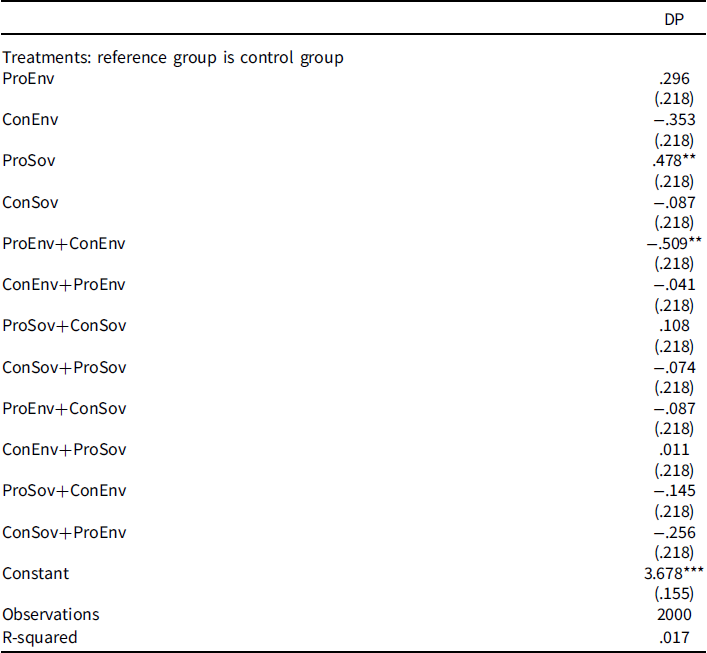
OLS regression estimating DP. Entries are regression coefficients, standard errors are in parentheses.
***p < .01, **p < .05, *p < .1.


 Open access

