


Drug use among psychiatric patients frequently goes undetected (Reference Ananth, Vandewater and KamalAnanth et al, 1989; Reference Shaner, Khalsa and RobertsShaner et al, 1993; Reference Condren, O'Connor and BrowneCondren et al, 2001), the rate being as high as 72% at acute admission (Reference Galletly, Field and PriorGalletly et al, 1993). Lack of detection can lead to misdiagnosis, inappropriate medication and failure to use appropriate interventions (Reference Drake, Mercer Mcfadden, Lehman and DixonDrake & Mercer McFadden, 1995). As there is little or no published data in the UK, the aims of the study were to identify the incidence and types of drug use proximal to acute psychiatric admission to a district general hospital acute psychiatric unit; and to determine the ability of routine in-patient clinical practice to detect drug use, as compared with urine drug screening, which has been shown to detect drug use that is not revealed by patients (Reference Ananth, Vandewater and KamalAnanth et al, 1989).
Routine clinical practice in UK psychiatric hospitals incorporates aspects of diagnostic interview, clinical examination and collateral reports (Reference GoldbergGoldberg, 1997). On the basis of previous research, the following predictions were made: (a) routine clinical practice would fail to detect a sizeable proportion of cases found by urinalysis; and (b) cannabis would be the most common drug detected.
The study
Following ethical approval and a 2-week pilot, the study was conducted at the acute in-patient psychiatric unit for South Devon Healthcare Trust, Torquay, Devon. All acute admissions were eligible apart from planned admissions for drug detoxification, patients transferred from another hospital and patients who stayed for less than 24 hours. Informed consent to participate in the research and a urine sample were sought within 24 hours of admission.
A 20-30 ml urine sample was analysed by enzyme immunoassay, testing for amphetamines, barbiturates, benzodiazepines, cannabis, cocaine, methadone and opiates. Staff were unaware that the patient records would be providing data for the study.
Data extraction from patient records
The medical and nursing records for the relevant admission were examined by the authors, who were blind to the laboratory test results. The medical records include the psychiatric admission interview routinely used by clerking doctors, which has a question on drug history to be asked of all patients (Reference GoldbergGoldberg, 1997). The nursing notes summarise details about the patient's admission and also record daily care, conversations and events. Data were extracted from both of these sources on whether or not a lifetime drug history and drug use proximal to admission had been recorded. Any specific drugs mentioned were noted, as were age, gender, ICD-10 diagnosis (World Health Organization, 1992), prescription of opiates and/or benzodiazepines at admission; source of information on drug use (e.g. patient report or other source); and police involvement, violence and use of the Mental Health Act.
Data were analysed using SPSS for Windows, version 10. Age was compared using an independent t-test. Associations between categorical variables were examined with either Pearson's χ2 (using exact tests in cases with small cell counts) or Fisher's exact test. Confidence intervals (CIs) were calculated to estimate the sensitivity of the notes in detecting drug use.
Findings
Response
There were 173 admissions during the research period. Of these, 25 admissions were ineligible. Of the eligible sample of 148, there were 20 refusals. For 16 admissions, the person was not asked to take part because of staff non-compliance with the survey.
One hundred and twelve urine samples were collected and analysed (response 112/148=76%). There was no significant difference in age between the sample and those who refused or those who were not asked to take part, nor any association with gender, use of the Mental Health Act or diagnosis. However, a greater proportion of women than men were not asked to take part (χ2=8.68, d.f.=1, P=0.01).
Sample
The achieved sample of 112 had a mean age of 38 years (s.d.=12 years) and 58% were male. The primary diagnoses were affective disorders (32%); schizophrenia and related disorders (23%); mental and behavioural disorders due to substance use (18%); personality disorders (18%); neurotic disorders (4%); organic mental disorder (3%); and other (3%). Police were involved in 21%, violence was recorded in 5% and the Mental Health Act was used in 13% of admissions.
Results of urinalysis
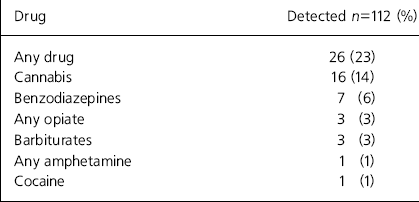
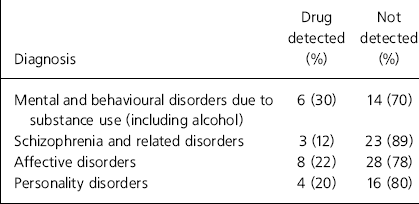
The results of the laboratory analysis are shown in Table 1. Overall prevalence and the figures for opiates and benzodiazepines exclude cases where there was evidence that these drugs were prescribed and taken on or around admission. Table 1 shows that our prediction for the predominance of cannabis use was confirmed. There was no association between the detection of drug use and the four largest diagnostic groups (Table 2). There was no significant difference between patients where a drug had been detected and those where a drug was not detected for any of the variables collected from the notes.
Drugs found by urine analysis
| Drug | Detected n=112 (%) |
|---|---|
| Any drug | 26 (23) |
| Cannabis | 16 (14) |
| Benzodiazepines | 7 (6) |
| Any opiate | 3 (3) |
| Barbiturates | 3 (3) |
| Any amphetamine | 1 (1) |
| Cocaine | 1 (1) |
Laboratory detection and diagnosis (four main groups only)
| Diagnosis | Drug detected (%) | Not detected (%) |
|---|---|---|
| Mental and behavioural disorders due to substance use (including alcohol) | 6 (30) | 14 (70) |
| Schizophrenia and related disorders | 3 (12) | 23 (89) |
| Affective disorders | 8 (22) | 28 (78) |
| Personality disorders | 4 (20) | 16 (80) |
Routine clinical practice in recording drug use
Drug history was indicated in 82 records (73%). In 78% of those cases, the information had been recorded in both the medical and nursing notes. In a further 13% the information came from the medical notes only and in 6% (5 cases) drug history was indicated only in the nursing notes. The primary source of information on drug use was patient report (98%). Of the 82 records with some information, 41 (50%) indicated illicit drug use at some time during the patient's life. Proximal drug use was indicated in 45 records (40% of the total sample). Of these 45, 19 records indicated that the person had used drugs recently. Those who were asked about any drug history were significantly younger than those who were not asked (mean age 35 v. 45 years: t=-3.83, d.f.=110, P=0.001). Similarly those who were asked about proximal drug use were younger than those who were not asked (mean age 33 v. 41 years: t=-3.54, d.f.=110, P=0.001). There was no association between gender and any recorded drug history but for proximal drug use the analysis approached significance, with fewer women being asked (χ2=3.64, d.f.=1, P=0.056).
Differences between laboratory detection and information from patient records
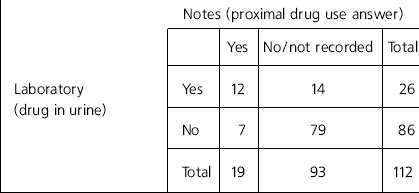
In 17 of the 26 cases (65%) where a drug was detected in the urine, there was an indication that the patient had been asked about drug use proximal to admission. Of those 17, there were five instances where drug use was denied by the patient. Table 3 indicates drug use detected by the laboratory and proximal drug use identified in the notes. More than half (54%) of the cases of drug use positively identified by the laboratory were not identified in the notes. The 95% Cl demonstrating the sensitivity of the notes in detecting actual drug users was 27.0-65.3%.
Drug use detected by the laboratory and proximal drug use identified in the notes
| Notes (proximal drug use answer) | ||||
| Laboratory (drug in urine) | Yes | No/not recorded | Total | |
| Yes | 12 | 14 | 26 | |
| No | 7 | 79 | 86 | |
| Total | 19 | 93 | 112 | |
Discussion
Study limitations
There may be an underestimate of drug use owing to unsupervised urine samples and the use of urine analysis, which can detect cannabis within 3 weeks of use but cannot detect other drugs after 48 hours. To compensate for this problem we required the urine to be taken within 24 hours of admission. Clinical staff did not know that the patient records would be used in the study. However, it is possible that awareness of the study increased staff attention to drug use, which in turn influenced routine history taking. If this was the case, then the levels of detection in the notes may be an overestimate of normal practice. Pre-study base rates of recording drug history and recent drug use would have given some indication of routine practice, but was beyond the scope of this study.
Prevalence
On the basis of the urinalysis, the prevalence of 23% for any drug of misuse in our sample of in-patients is similar to that reported by other UK surveys of recent drug use in community samples, for example Menezes et al (Reference Menezes, Johnson and Thornicroft1996) 21%; Cantwell et al (Reference Cantwell, Brewin and Glazebrook1999) 20%; and Weaver et al (Reference Weaver, Rutter and Madden2001) 24%. Two studies conducted in the US and Ireland on current misuse/dependence among in-patients both reported rates of 19% (Reference Fischer, Owen and CuffelFischer et al, 1996; Reference Kamali, Kelly and GervinKamali et al, 2000). All the above studies were of patients with psychotic disorders, whereas the prevalence rates from our study cover a wider range of diagnoses. We did not find elevated rates of drug use among those with a diagnosis of schizophrenia, lending support to arguments put forward by Farrell et al (Reference Farrell, Howes and Taylor1998) and Modestin et al (Reference Modestin, Nussbaumer and Angst1997) that more attention should be paid to substance use among those with other diagnoses. The preponderance of cannabis is consistent with the research cited above and with patterns of drug use in the general UK population (Reference Ramsay and SpillerRamsay & Spiller, 1997; Reference Farrell, Howes and TaylorFarrell et al, 1998).
Underdetection
The main analysis shows that routine practice was poor at detecting drug use in an acute psychiatric in-patient setting. The drug use of 54% of patients with positive urines was not detected, confirming the major concern of this study. For 35% of these undetected cases, there was a statement in the notes that there had been no drug use. This may be because clinical signs of drug use were missed or because of patient confusion or denial on questioning. For the remaining 65% of undetected cases no information had been recorded, a similar proportion to that of the whole sample, despite prompts in the admission schedule and numerous opportunities during the patients' stay to do so. It may be that some hospital staff are not alert to the issue of substance use or do not consider substance use to be important in psychiatric care (Reference Appleby, Dyson and LuchinsAppleby et al, 1997). In addition, we found evidence of a bias operating. Those who were not asked were significantly older and a higher proportion were female, although this did not quite reach significance.
Implications for practice
All patients should be asked about drug use, as detection is a necessary precursor to the identification of misuse through further specialised assessment. We found that where there was information in the notes relating to drug use, this was accurate for 73% of cases, indicating that recording recent drug use in the notes is worthwhile. However, the wide Cls show that current practice should be improved by closer adherence to the psychiatric admission interview (Reference GoldbergGoldberg, 1997) and the possible inclusion of screening questionnaires (Reference Appleby, Dyson and LuchinsAppleby et al, 1997).
Implications for future research
This study could be replicated at other in-patient units. Base-rate recording of normal practice in recording drug use would strengthen the design and provide the basis of audit of the effectiveness and clinical usefulness of routine detection of recent drug use by psychiatric in-patients.
Declaration of interest
None.


 Open access


eLetters
No eLetters have been published for this article.