

1. Introduction
The geological record of Britain and Ireland describes a rich history of events spanning almost 3 Gyr but no unequivocal impact structures have yet been identified. Evidence for impact events has been proposed at three stratigraphic levels: the Mesoproterozoic Stac Fada Member impact ejecta unit in the Stoer Group, northwestern Scotland (Amor et al. Reference Amor, Hesselbo, Porcelli, Thackrey and Parnell2008), which contains, for example, the high-pressure polymorph of zircon, reidite (Reddy et al. Reference Reddy, Johnson, Fischer, Rickard and Taylor2015); a deposit of reworked microtektites in the Triassic Mercia Mudstone Group of southwestern England, from which multiple orientations of planar deformation features (PDFs) in shocked quartz have been documented and measured (Walkden et al. Reference Walkden, Parker and Kelley2002; Kirkham, Reference Kirkham2003); and a purported Palaeogene impact ejecta layer on the Isle of Skye, Scotland (Drake et al. Reference Drake, Beard, Jones, Brown, Fortes, Millar, Carter and Baca2017) that awaits confirmation with unequivocal documentation of shock features. Only the microtektite-bearing Triassic deposit has been linked to a known impact structure – the approximately 100 km diameter Manicouagan impact structure, Quebec, Canada (Thackrey et al. Reference Thackrey, Walkden, Indares, Horstwood, Kelley and Parrish2009). The impact structure associated with the Stac Fada Member has yet to be identified, but various lines of evidence have been used to suggest possible source locations for the material, even prior to its recognition as being related to an impact. These include sedimentary features, thickness variations and an anisotropy of magnetic susceptibility study (Lawson, Reference Lawson1972; Stewart, Reference Stewart2002; Young, Reference Young2002; Amor et al. 2008, Reference Amor, Taylor, Hesselbo and MacNiocaill2011; Simms, Reference Simms2015). Most recently, Simms (Reference Simms2015) proposed that a geophysical anomaly known as the Lairg Gravity Low, which has a diameter of about 40 km and is centred approximately 50 km east of the Stac Fada Member outcrops, may indicate the location of the now-buried structure. Despite a lack of consensus on the likely location or size of the impact structure associated with the Stac Fada Member, it presently represents the best prospect for the first identification of an impact structure in Britain or Ireland. In this context, we report the results of a detrital zircon and apatite U–Pb provenance study of sedimentary rocks of the Stac Fada Member and wider Stoer Group with the aim of testing whether there was a change in sediment source contemporaneous with the impact that might yield information on the possible location of the impact structure.
2. Study setting
2.a. Regional setting
The Stac Fada Member occurs within the Stoer Group, an approximately 2 km thick sequence that is the oldest of three groups of alluvial, lacustrine and aeolian sediments (Stoer, Sleat and Torridon groups) that are collectively termed the ‘Torridonian.’ During the late Mesoproterozoic and early Neoproterozoic eras, the Torridonian was deposited on the edge of the Laurentian Shield, near the approximately contemporaneous Grenville orogenic belt (Stewart, Reference Stewart2002). The sedimentary succession was deposited unconformably upon the high-grade metamorphic basement of the Lewisian Gneiss Complex. The Lewisian is composed of a number of Archaean terranes with differing protolith ages, which have experienced a range of metamorphic events. The polyphase metamorphic history is reflected in the complex pattern of Lewisian zircon U–Pb ages distributed along the concordia between c. 3.0 Ga and the time of granulite facies metamorphism at c. 2.5 Ga (Whitehouse & Kemp, Reference Whitehouse, Kemp, Law, Butler, Holdsworth, Krabbendam and Strachan2010). Some zircon grains also record older Archaean events in the form of inherited cores dated to c. 3.1 Ga and c. 3.5 Ga (Kinny & Friend, Reference Kinny and Friend1997). The Proterozoic history of the Lewisian is dominated by c. 1.9 Ga felsic igneous activity in a magmatic arc setting, for example, the South Harris Complex of the Outer Hebrides (e.g. Whitehouse & Bridgwater, Reference Whitehouse and Bridgwater2001; Mason et al. Reference Mason, Parrish and Brewer2004), the Ben Stack granites near Loch Laxford, north of Stoer (Goodenough et al. Reference Goodenough, Crowley, Krabbendam and Parry2013), and the Ard gneiss in the Gairloch area, south of Gruinard Bay (Park et al. Reference Park, Tarney and Connelly2001). The final assembly of various terranes composing the Lewisian is recorded by c. 1.7 Ga Laxfordian metamorphism (e.g. Heaman & Tarney, Reference Heaman and Tarney1989; Waters et al. Reference Waters, Cohen, O’Nions and O’Hara1990; Corfu et al. Reference Corfu, Heaman and Rogers1994; Kinny & Friend, Reference Kinny and Friend1997; Zhu et al. Reference Zhu, O’Nions, Belshaw and Gibb1997; Love et al. Reference Love, Friend and Kinny2010). However, zircon of this age is relatively rare and mainly found in pegmatites (Park et al. Reference Park, Tarney and Connelly2001). Detrital zircon grains in sedimentary rocks of the Stoer Group have reported ages corresponding to those known from the Lewisian (Rainbird et al. Reference Rainbird, Hamilton and Young2001; Kinnaird et al. Reference Kinnaird, Prave, Kirkland, Horstwood, Parrish and Batchelor2007). This is consistent with the original interpretation that detritus in the Stoer Group was primarily sourced from the Lewisian (e.g. Stewart, 1982, 1990, Reference Stewart2002; Van de Kamp & Leake, Reference Van de Kamp and Leake1997). Later deformation in the region included the thrusting of younger Moine metamorphic rocks westwards over the unmetamorphosed Torridonian during the Caledonian Orogeny. However, the Torridonian escaped significant deformation, and today the Stac Fada Member crops out approximately 20 km west of the Moine Thrust Zone (Fig. 1).
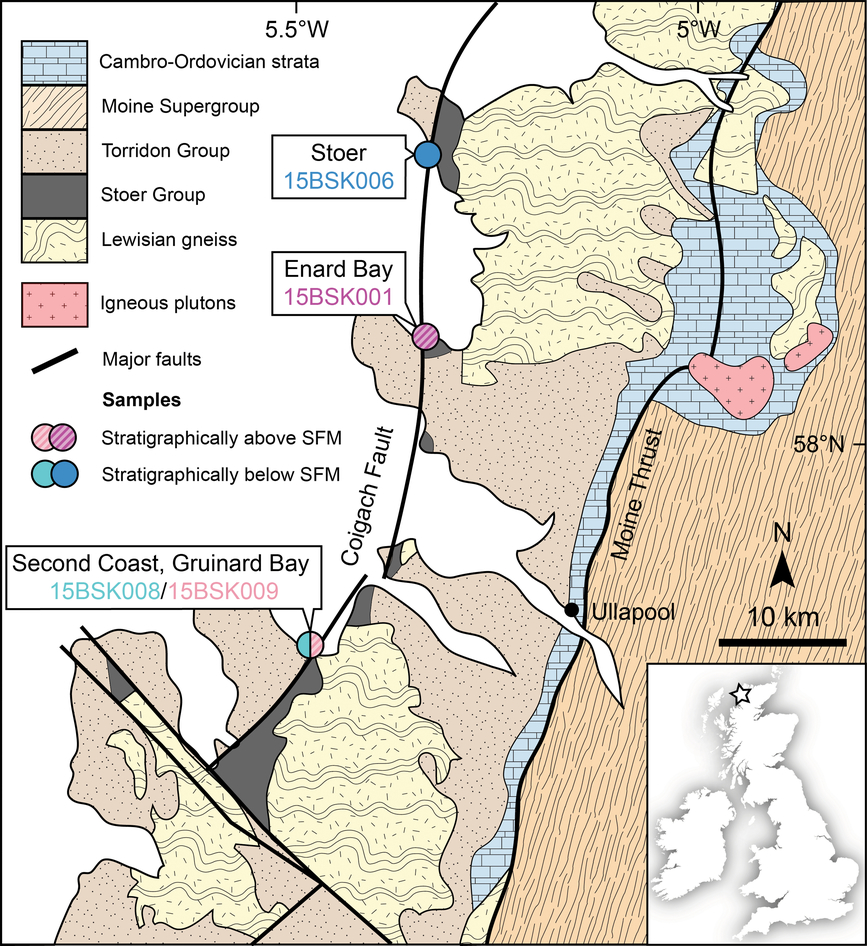
Regional geology of NW Scotland with sample locations for this study. Map modified from Simms (Reference Simms2015). Note that the Torridonian comprises the Stoer and Torridon groups, as well as the Sleat Group which is exposed south of this area. Sample 15BSK_X_SFM is a combination of rocks from the Stac Fada Member (SFM) at all three localities. The Minch basin, proposed as a possible location of the Stac Fada Member-related impact structure by Amor et al. (Reference Amor, Hesselbo, Porcelli, Thackrey and Parnell2008), lies offshore (i.e. where the legend is situated on the map), whereas the centre of the Lairg gravity low, suggested as a possible impact site by Simms (Reference Simms2015), lies approximately 30 km east of the Moine Thrust.
2.b. The Stac Fada Member
The Stac Fada Member, which is usually c. 10 m thick and can be traced along-strike for more than 50 km (Fig. 1), has a distinctive appearance with fragments of dark green, vesicular, devitrified glass accompanying mudstone, sandstone and gneiss clasts up to 0.5 m across in a poorly sorted sand matrix (Stewart, Reference Stewart2002). Sandstone rafts reach 15 m in length at the type locality of the unit at Stac Fada, near the village of Stoer (Stewart, Reference Stewart2002). The Stac Fada Member was previously interpreted as a mudflow, or series of mudflows, related to endogenic volcanic processes (e.g, Lawson, Reference Lawson1972; Sanders & Johnston, Reference Sanders and Johnston1989; Stewart, Reference Stewart1990; Young, Reference Young2002), but the identification of PDFs in quartz led to its reinterpretation as an ejecta deposit associated with a bolide impact (Amor et al. Reference Amor, Hesselbo, Porcelli, Thackrey and Parnell2008). Arguably the best evidence that the deposition of the Stac Fada Member was related to a hypervelocity impact is the presence of shock-metamorphosed zircon with lamellae of the high-pressure ZrSiO4 polymorph, reidite (Reddy et al. Reference Reddy, Johnson, Fischer, Rickard and Taylor2015).
Following its reinterpretation as an impact-related deposit, the Stac Fada Member has been divided into three distinct units at the Enard Bay section (Branney & Brown, Reference Branney and Brown2011). The lowermost stratigraphy, which varies in thickness from 4 to 10 m, comprises a massive suevite with matrix-supported devitrified melt fragments as well as gneiss and mudstone clasts. This grades into a similar unit, distinguished by its abundant matrix-supported whole and broken accretionary lapilli up to 15 mm in diameter and the onset of stratification near its top. The uppermost portion of the Stac Fada Member comprises a thin (≤ 3 cm) layer of clast-supported dust pellets (aggregates of ash which lack the distinct internal structure of accretionary lapilli) < 5 mm in diameter. The two lower units are interpreted to have formed from a decelerating granular density current that rapidly waxed and then waned, whereas the thin layer of pellets is interpreted to represent direct fallout from a residual atmospheric dust plume (Branney & Brown, Reference Branney and Brown2011).
2.c. Locating the impact site
Various lines of evidence have been put forward in attempts to constrain the location and proximity of the source material for the Stac Fada Member, but there is no current consensus. The most pertinent points are noted below.
Upon interpreting the Stac Fada Member as an impact-related unit, Amor et al. (Reference Amor, Hesselbo, Porcelli, Thackrey and Parnell2008) suggested that the relatively thick and distinctively continuous nature of the unit over tens of kilometres is indicative of quite a proximal source location, although no distance was specified. However, the lack of seismites or any significant soft-sediment deformation in the underlying succession has been interpreted as suggesting that the impact structure was still a significant distance away, “perhaps tens of kilometres” (Simms, Reference Simms2015, p. 755).
Variations in thickness and lithology along the effectively linear outcrop trace of the Stac Fada Member (Fig. 1) have been cited as indicative of proximal-distal changes. The greater thickness of the deposit in the more northerly outcrops (c. 10–15 m thick at Stoer and Enard Bay compared with 4–6 m thick further south; Simms, Reference Simms2015) has been interpreted as tentative evidence that the southern sites may be more distal to the impact (Amor et al. Reference Amor, Hesselbo, Porcelli, Thackrey and Parnell2008; Simms, Reference Simms2015). The abundance of accretionary lapilli in the Stac Fada Member at Enard Bay (and their absence further south) has also been proposed as evidence that this is the most proximal presently exposed outcrop (e.g. Simms, Reference Simms2015).
The Stac Fada Member is largely massive and was emplaced without significant erosion of underlying material. This means that there is a paucity of sedimentary structures that could indicate the direction from which it was deposited. Wedge-shaped intrusions of melt-bearing breccia into the strata beneath the Stac Fada Member have been regarded as among the few potential indicators, but different authors have interpreted them as indicating different directions of movement. Lawson (Reference Lawson1972), working before the unit was recognized as an impact-related deposit, and Amor et al. (Reference Amor, Hesselbo, Porcelli, Thackrey and Parnell2008) proposed that material was moving from west to east, leading Amor et al. (Reference Amor, Hesselbo, Porcelli, Thackrey and Parnell2008) to suggest that the impact structure may be offshore beneath the Minch Basin. Conversely, Stewart (Reference Stewart2002) interpreted the same folds and upturned beds as indicating movement from east to west. Sanders & Johnston (Reference Sanders and Johnston1989, figs 2, 3) described the wedge-shaped geometry of the base of the Stac Fada Member at Stoer and documented thinning to the north and west. Young (Reference Young2002) interpreted small-scale asymmetrical folds and flame structures in sandstones within the Stac Fada Member as evidence for movement of material from two opposing directions, one from the SSW and the other from the NNE.
With the recognition that the Stac Fada Member was impact-derived (Amor et al. Reference Amor, Hesselbo, Porcelli, Thackrey and Parnell2008), it follows that the deposit must originate from a single location. Simms (Reference Simms2015) suggested that the directional variability reported by Young (Reference Young2002) may be due to rotation of the sandstone rafts during transportation, an interpretation supported by the apparently random palaeomagnetic orientations of the rafts (Irving & Runcorn, Reference Irving and Runcorn1957; Stewart, Reference Stewart2002). Most recently, Simms (Reference Simms2015, fig. 5) has interpreted the wedge-shaped intrusions of melt-bearing breccia into the strata beneath the Stac Fada Member as evidence for emplacement from a source to the east and argued that because the oversteepened sandstone beds above the intrusive wedges are anchored into the pre-impact stratigraphy they preserve a more robust record of the emplacement direction of the ejecta.
Other sedimentary features that may indicate transport directions have been documented at Enard Bay. These include planar cross-beds and lapilli long axes in the upper part of the Stac Fada Member, as well as gently plunging troughs subsequently incised into the lapilli beds. Simms (Reference Simms2015) interpreted all of these features to indicate that material was broadly moving from east to west during deposition. Further south, Simms (Reference Simms2015) documented curved fractures on the upper surface of the Stac Fada Member and suggested that these may be related to the transport direction, with their convex-westwards configuration indicating the direction of flow. Similarly, if the concave-up surfaces documented by Simms (Reference Simms2015) within the Stac Fada Member can be interpreted as thrust planes within a viscous flow, they would also be consistent with movement from the east.
In a non-peer-reviewed abstract, Amor et al. (Reference Amor, Taylor, Hesselbo and MacNiocaill2011) reported the results of an anisotropy of magnetic susceptibility study of the Stac Fada Member that supported an impact structure lying to the west of the present Stac Fada Member outcrops.
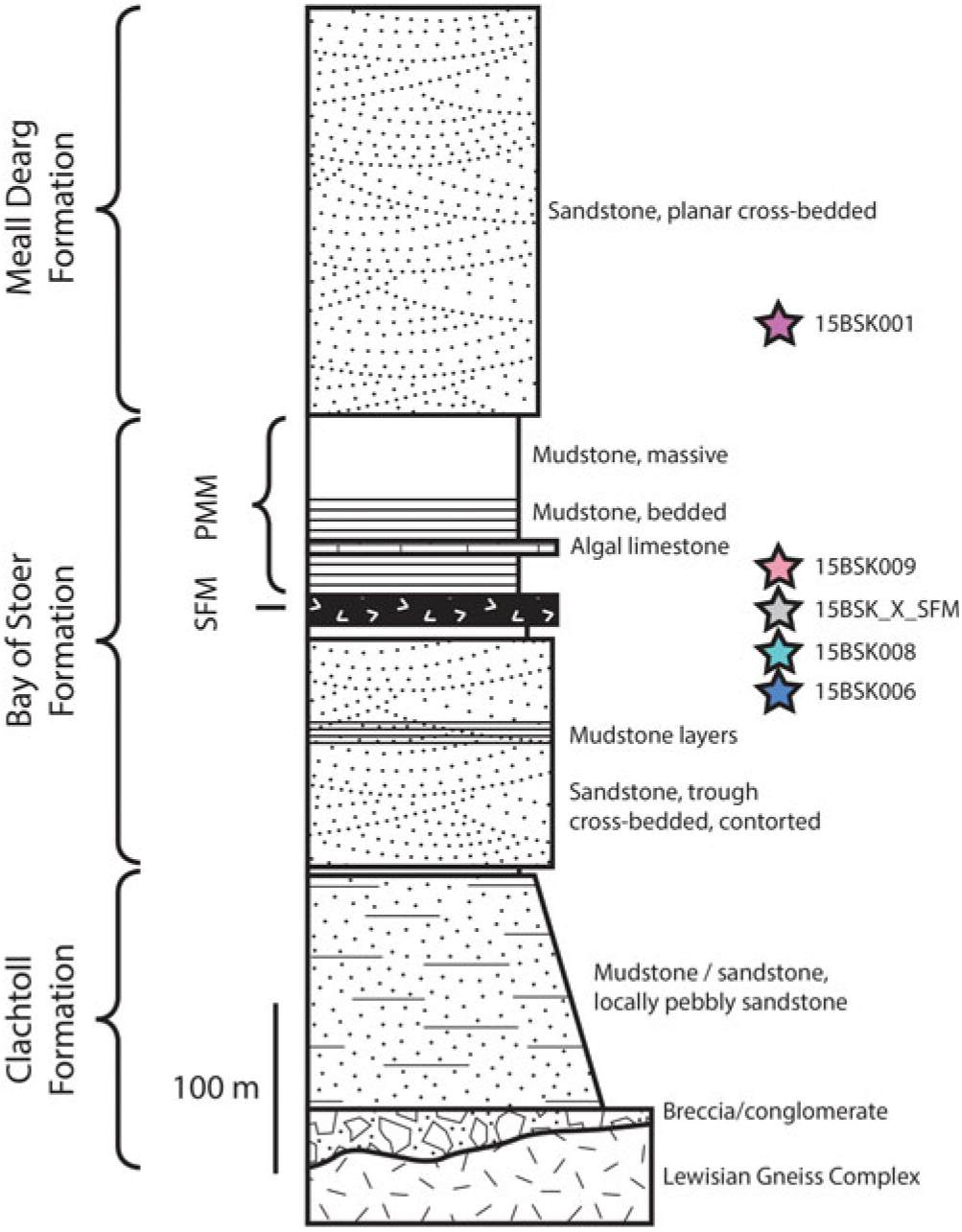
In light of the varying interpretations of the evidence within the Stac Fada Member itself, the overlying succession has also been studied with the aim of elucidating a possible source location for the impact ejecta material. The Stac Fada Member is succeeded by up to 100 m of lacustrine, plane-bedded sedimentary rocks (the Poll à Mhuilt Member; Fig. 2) at all but the most southerly sites (Stewart, Reference Stewart2002; Simms, Reference Simms2015) before fluvial and aeolian deposition commences in the Meall Dearg Formation. These two lithostratigraphic units provide evidence of a dramatic reconfiguration of the regional drainage pattern following deposition of the Stac Fada Member (Stewart, Reference Stewart2002). The Poll à Mhuilt Member was interpreted as a post-impact lake by Amor et al. (Reference Amor, Hesselbo, Porcelli, Thackrey and Parnell2008). Ripple cross-lamination (Stewart, Reference Stewart2002) and cross-bedding (Simms, Reference Simms2015) indicate that flow into the lakes was broadly from the west, suggesting that eastwards-flowing rivers were dammed by debris located east of the present outcrops (Simms, Reference Simms2015).
Generalized stratigraphic column for the Stoer Group at Stoer. Modified from Goodenough & Krabbendam (Reference Goodenough and Krabbendam2011, fig. 32). Note that only sample 15BSK006 was taken at this locality and the stratigraphic location of the other samples are indicative on a relative time basis. There is significant lateral lithology variation within the Stoer Group (Stewart, Reference Stewart2002). PMM – Poll à Mhuilt Member; SFM – Stac Fada Member.
In contrast to the variable palaeocurrent azimuths of the pre-Stac Fada Member succession, fluvial sediments in the Meall Dearg Formation consistently record flow to the west (Stewart, Reference Stewart2002; Simms, Reference Simms2015; Lebeau & Ielpi, Reference Lebeau and Ielpi2017) but with evidence for a broadly radial drainage configuration centred on a focal point to the east (Simms, Reference Simms2015, fig. 6). Stewart (Reference Stewart2002) had interpreted this palaeoflow configuration as related to tectonic uplift on the eastern flank of the basin but, in light of the impact evidence, Simms (Reference Simms2015) reinterpreted the apparently radial drainage system of the Meall Dearg Formation as a consequence of post-impact regional doming.
Geophysical data can play a key role in the study of impact structures once unambiguous evidence for an impact has already been documented (such as the identification of shatter cones, PDFs in quartz, or shock microtwins or reidite in zircon). This is particularly relevant to structures that are not, or are only partially, exposed at the Earth’s surface (e.g. the Chicxulub structure buried on the Yucatán Peninsula, Mexico; Hildebrand et al. Reference Hildebrand, Pilkington, Ortiz-Aleman, Chavez, Urrutia-Fucugauchi, Connors, Graniel-Castro, Camara-Zi, Grady, Hutchison, McCall and Rothery1998). A common geophysical anomaly associated with impact structures is a broadly concentric gravity low which in larger structures (diameter > 30 km) is likely to contain a central gravity high (Grieve & Pilkington, Reference Grieve and Pilkington1996; Morgan & Rebolledo-Vieyra, Reference Morgan, Rebolledo-Vieyra, Osinski and Pierazzo2013). Simms (Reference Simms2015) proposed that a significant gravity low centred near the village of Lairg in northern Scotland, approximately 50 km east of the Stac Fada Member outcrops, may represent the impact structure from which the Stac Fada Member material was derived, which is consistent with his interpretation of directional data from the Stac Fada Member and the overlying succession. Previous interpretations have ascribed this gravity low to a Caledonian granite pluton, an Archaean granite in the basement, a buried wedge of Torridonian sedimentary rocks and/or a region of thickened Moine Supergroup rocks (see discussion in Leslie et al. Reference Leslie, Krabbendam, Kimbell, Strachan, Law, Butler, Holdsworth, Krabbendam and Strachan2010). Arguably the most plausible explanation for the gravity low was offered by Leslie et al. (Reference Leslie, Krabbendam, Kimbell, Strachan, Law, Butler, Holdsworth, Krabbendam and Strachan2010), who ascribed it to a package of Moine rocks of 5–6 km thickness on the basis of detailed mapping and modelling. There is also a conspicuous gravity low to the west of the Stac Fada Member outcrops in the Minch Basin, which was proposed as the impact site by Amor et al. (2008, Reference Amor, Taylor, Hesselbo and MacNiocaill2011). However, the thick post-Palaeozoic sediment fill there (Binns et al. Reference Binns, McQuillin, Fannin, Kenolty, Ardus and Woodland1975) provides the most plausible explanation of this feature.
Despite the numerous lines of investigation there is no consensus on the location of the impact structure associated with the Stac Fada Member.
3. A new approach
We investigate the possible location of the impact structure through a detrital zircon and apatite U–Pb provenance investigation of five samples from below, within and above the impact-related unit (Fig. 2). Zircon is a physically and chemically robust mineral that is readily dateable by the U–Pb method and is almost ubiquitous in clastic sediments; it is a well-established and powerful tool in provenance studies (e.g. Thomas, Reference Thomas2011). Recent advances in U–Pb dating of common Pb-bearing minerals (e.g. Chew et al. Reference Chew, Sylvester and Tubrett2011, 2014; Thomson et al. Reference Thomson, Gehrels, Ruiz and Buchwaldt2012) mean that it is now possible to complement detrital zircon analyses with data from other U-bearing heavy minerals. The utility of including apatite in detrital studies (e.g. O’Sullivan et al. Reference O’Sullivan, Chew and Samson2016) stems from the fact that it crystallizes in significant volumes in a much wider range of igneous rock types than zircon (as a result of the limited ability of rock-forming minerals to accept into their structure the amount of phosphorus that occurs in most rocks; Piccoli & Candela, Reference Piccoli and Candela2002) and, unlike zircon, it crystallizes in significant volumes in metamorphic rocks of all grades and most protolith types (Spear & Pyle, Reference Spear and Pyle2002). Secondly, apatite is more likely than zircon to represent first-cycle detritus as it is prone to dissolution at source by acidic meteoric and pedogenic waters (Morton & Hallsworth, Reference Morton and Hallsworth1999). Despite being prone to dissolution at source (Joosu et al. Reference Joosu, Lepland, Kreitsmann, Üpraus, Roberts, Paiste, Martin and Kirsimäe2016) apatite is found in non-trivial abundance in nearly all Quaternary sediments (Nechaev & Isphording, Reference Nechaev and Isphording1993) and, because it is stable during diagenesis (due to the liberation of organic P and P adsorbed onto the surface of clay minerals; e.g. Bouch et al. Reference Bouch, Hole, Trewin, Chenery and Morton2002), the detrital apatite signal is likely to be preserved once buried. These factors result in detrital apatite U–Pb data (i) being able to record events such as magma-poor orogenesis that are not well represented in the detrital zircon record (O’Sullivan et al. Reference O’Sullivan, Chew and Samson2016), and (ii) having a greater likelihood of recording relatively recent tectonic events than the detrital zircon U–Pb system, which is more likely to be dominated by plentiful polycyclic detritus. It is important to note that although apatite can record events not visible in the zircon record, a single geological event can often produce contrasting zircon and apatite age distributions; this is because the lower closure temperature of the U–Pb system in apatite (c. 375–450°C) compared with that of zircon (> 900°C) means that the former may record prolonged cooling. Inversely, the disparity of the U–Pb closure temperatures of the two minerals means that a relatively low-temperature event may reset apatite U–Pb ages without affecting the zircon ages in the same rock.
Although the Stoer Group has previously been studied in terms of detrital zircon U–Pb analysis (Rainbird et al. Reference Rainbird, Hamilton and Young2001; Kinnaird et al. Reference Kinnaird, Prave, Kirkland, Horstwood, Parrish and Batchelor2007), we build on this work with a high-analysis-number, coupled zircon and apatite U–Pb study. Our specific aims are to understand: (i) whether there are new U–Pb age populations in the succession overlying the impact-related unit that might reflect the presence of previously unexposed rocks brought to the Earth’s surface by the impact event; (ii) whether there is an absence of any specific U–Pb age populations in the lacustrine sediments (Poll à Mhuilt Member) above the Stac Fada Member, which may reflect specific source terrain(s) being cut-off as a consequence of impact-related drainage reconfiguration; (iii) whether there is any discernible difference between the heavy mineral assemblages of the fluvial sediments underlying the Stac Fada Member (which were sourced from multiple directions) and those of the fluvial sediments above the Stac Fada Member (which were sourced solely from the east), and whether this might indicate a possible location of the impact structure; and (iv) whether detrital apatite in the Stoer Group records different ages and events compared with detrital zircon, and if the former might have additional utility for recording stratigraphic changes through its ability to highlight a wide range of events and/or its increased likelihood of representing first-cycle detritus.
4. Materials and methods
4.a. Samples
Five samples were processed for zircon and apatite U–Pb analysis. Two were collected from stratigraphically beneath the Stac Fada Member, one from the Stac Fada Member itself, and two from stratigraphically above the impact-related layer (Fig. 2). The samples are listed below in stratigraphic order from lowest to highest, relative to the Stac Fada Member.
Sample 15BSK006 (Stoer; 58.20134° N, 5.34757° W; Fig. 1) is a well-bedded sandstone from the pre-impact fluvial succession. It was sampled approximately 10 m stratigraphically below the base of the Stac Fada Member at the Bay of Stoer in what is mapped as undivided Bay of Stoer Formation (British Geological Survey, 2002).
Sample 15BSK008 (Second Coast, Gruinard Bay; 57.86136° N, 5.49697° W) is a sandstone similar to sample 15BSK006 and was collected immediately below the Stac Fada Member, where the sediment was disturbed by ballistically emplaced boulders of country rocks.
Sample 15BSK_X_SFM is composed of green, devitrified glass-bearing Stac Fada Member material from all three sample sites (Fig. 1). Collection from the Stac Fada Member was primarily focused on obtaining small hand specimens with the freshest possible vitric products for a petrological study. For heavy mineral separation, the leftovers of these hand specimens were later combined to provide sufficient material for a statistically meaningful number of analyses.
Sample 15BSK009 (Second Coast, Gruinard Bay; 57.86107° N, 5.49795° W) is a well-sorted, fine-grained sandstone of the Poll à Mhuilt Member lacustrine sequence immediately overlying the Stac Fada Member.
Sample 15BSK001 (Enard Bay; 58.07096° N, 5.35579° W) is a trough cross-bedded sandstone and is the stratigraphically highest sample. It was collected from the Meall Dearg Formation, which represents a return to fluvial sedimentation above the Poll à Mhuilt Member of the Bay of Stoer Formation.
4.b. Analytical methods
Zircon and apatite grains were separated from whole-rock samples using crushing, milling, wet shaking table, heavy liquid and magnetic separation techniques at Trinity College Dublin. A selection of zircon grains from each sample were placed on conducting carbon tabs and their exteriors were imaged in backscatter electron (BSE) mode on a Tescan Mira XMU Field Emission Scanning Electron Microscope (SEM) at the Irish Centre for Research in Applied Geosciences (iCRAG) laboratory at Trinity College Dublin. A larger number of zircon and apatite grains were picked and were mounted in 2.5 cm diameter epoxy mounts. The mounts were polished with 6 and 1 μm diamond polishing paste to reveal the grain midsections. After application of a carbon coat of c. 10 nm thickness to the mounts, all zircon grains were imaged in cathodoluminescence (CL) mode using a KE Developments Centaurus system attached to the SEM. An accelerating voltage of 10 kV and working distance of c. 10 mm were used. Following removal of the carbon coat with a very brief (c. 30 s) polish using 1 μm diamond polishing paste, the zircon and apatite grains underwent laser ablation inductively coupled plasma mass spectrometry (LA-ICP-MS) U–Th–Pb analysis.
All zircon analyses were conducted on a Photon Machines Analyte Excite 193 nm ArF Excimer laser coupled to a Thermo Scientific iCAP-Qc ICP-MS at the Department of Geology, Trinity College Dublin, in a single analytical period (December 2015). The methodology closely followed that of Rodrigues et al. (Reference Rodrigues, Chew, Jorge, Fernandes, Veiga-Pires and Oliveira2015). The laser produced a circular spot 30 μm in diameter and operated with a nominal fluence of 2.5 J cm–2 for 180 shots at a 4 Hz laser repetition rate. Nine isotopes were measured during the analyses (88Sr [3], 91Zr [3], 202Hg [2.5], 204Pb [50], 206Pb [50], 207Pb [70], 208Pb [50], 232Th [20] and 238U [40], where the numbers in square brackets represent the dwell time in milliseconds for each isotope; total cycle time of 288.5 ms). The 91500 standard zircon – 206Pb/238U isotope dilution thermal ionization mass spectrometry (ID-TIMS) age of 1062.4 ± 0.8 Ma (all uncertainties in the text are quoted at the 2σ level unless otherwise stated; Wiedenbeck et al. Reference Wiedenbeck, Allé, Corfu, Griffin, Meier, Oberli, Quadt and Roddick1995) – was used as the calibration reference material (RM). Temora 2 – 206Pb/238U TIMS age of 416.78 ± 0.33 Ma (Black et al. Reference Black, Kamo, Allen, Davis, Aleinikoff, Valley, Mundil and Campbell2004) – was analysed as a quality control material (QCM). Zircon QCM data for all sessions are shown in online Supplementary Appendix 1 (available at http://journals.cambridge.org/geo). The raw isotope data were reduced using the VizualAge data reduction scheme (DRS; Paton et al. Reference Paton, Woodhead, Hellstrom, Hergt, Greig and Maas2010; Petrus & Kamber, Reference Petrus and Kamber2012) in the IOLITE package (v. 2.5) of Paton et al. (Reference Paton, Hellstrom, Paul, Woodhead and Hergt2011). Processed data were plotted in the Isoplot 4.15 add-in (Ludwig, Reference Ludwig2012) for Microsoft Excel.
Apatite U–Pb analyses were conducted over two separate analytical periods (December 2015 and September 2016). The analyses performed during the first analytical period (on samples 15BSK001 and 15BSK009) were conducted on the same LA-ICP-MS system as described above, following the procedure of Chew et al. (Reference Chew, Petrus and Kamber2014). A circular spot of 60 μm diameter was ablated for 225 shots at 5 Hz. The analyses performed during the second analytical period (on samples 15BSK006, 15BSK008 and 15BSK_X_SFM) were conducted on the same laser ablation system, which was on this occasion coupled to an Agilent 7900 ICP-MS. For these analyses, a circular spot 60 μm in diameter was used and the laser operated with a fluence of 3.25 J cm–2 for 280 shots at a 10 Hz laser repetition rate. During the first analytical period, 34 isotopes were measured during the analyses (24Mg [10], 31P [5], 35Cl [30], 43Ca [25], 51V [10], 55Mn [10], 71Ga [10], 73Ge [10], 75As [10], 88Sr [20], 89Y [5], 90Zr [10], 139La [5], 140Ce [5], 141Pr [5], 146Nd [5], 147Sm [10], 153Eu [10], 157Gd [10], 159Tb [10], 163Dy [10], 165Ho [10], 166Er [10], 169Tm [10], 172Yb [10], 175Lu [10], 182W [10], 202Hg [10], 204Pb [25], 206Pb [60], 207Pb [65], 208Pb [10], 232Th [20] and 238U [40], where the numbers in square brackets represent the dwell time in milliseconds for each isotope; total dwell time of 515 ms). During the second analytical period, 29 isotopes were measured (as above, but excluding 24Mg, 31P,71Ga, 73Ge and182W). Apatite rare earth element abundance data are provided alongside U–Pb data in online Supplementary Appendix 1. For all apatite analyses, a crystal of Madagascar apatite of size c. 1 cm (Thomson et al. Reference Thomson, Gehrels, Ruiz and Buchwaldt2012; an in-house aliquot of fragments of this crystal has yielded a weighted average ID-TIMS concordia age of 473.5 ± 0.7 Ma) was used as the RM, and McClure Mountain apatite (207Pb/235U TIMS age of 523.51 ± 1.53 Ma; Schoene & Bowring, Reference Schoene and Bowring2006) was analysed as a QCM. Apatite QCM data for all sessions are provided in online Supplementary Appendix 1. The raw isotope data were reduced using the VizualAge_UcomPbine DRS (Chew et al. Reference Chew, Petrus and Kamber2014) in Iolite (Paton et al. Reference Paton, Hellstrom, Paul, Woodhead and Hergt2011).
Unlike zircon, which excludes common (i.e. initial or non-radiogenic) Pb (Pbc) during crystallization, apatite often has considerable Pbc contents that can result in significant discordance in the U–Pb system. This is coupled with generally low U contents resulting in apparent lesser accumulation of radiogenic Pb (Pb*), hence resulting in high Pbc/Pb* ratios that might hinder the dating of certain grains. Pbc in the Madagascar apatite RM was corrected for using a 207Pb-based method employing the known 207Pb/206Pb ratio (Chew et al. Reference Chew, Petrus and Kamber2014). However, detrital apatite has by definition been isolated from co-genetic low-U phases that might have been used to estimate the initial Pb isotopic composition of the grain; the initial Pb isotopic composition must therefore be estimated from Pb evolution models. In this study, variable Pbc in individual detrital apatite grains was corrected for by: (i) using a starting estimate for the age of the grain; (ii) calculating its corresponding initial Pb isotopic composition in the model of Stacey & Kramers (Reference Stacey and Kramers1975); and then (iii) adopting an iterative approach utilizing a 207Pb correction, based on the procedure of Chew et al. (Reference Chew, Sylvester and Tubrett2011).
5. Results
5.a. Shock features in zircon
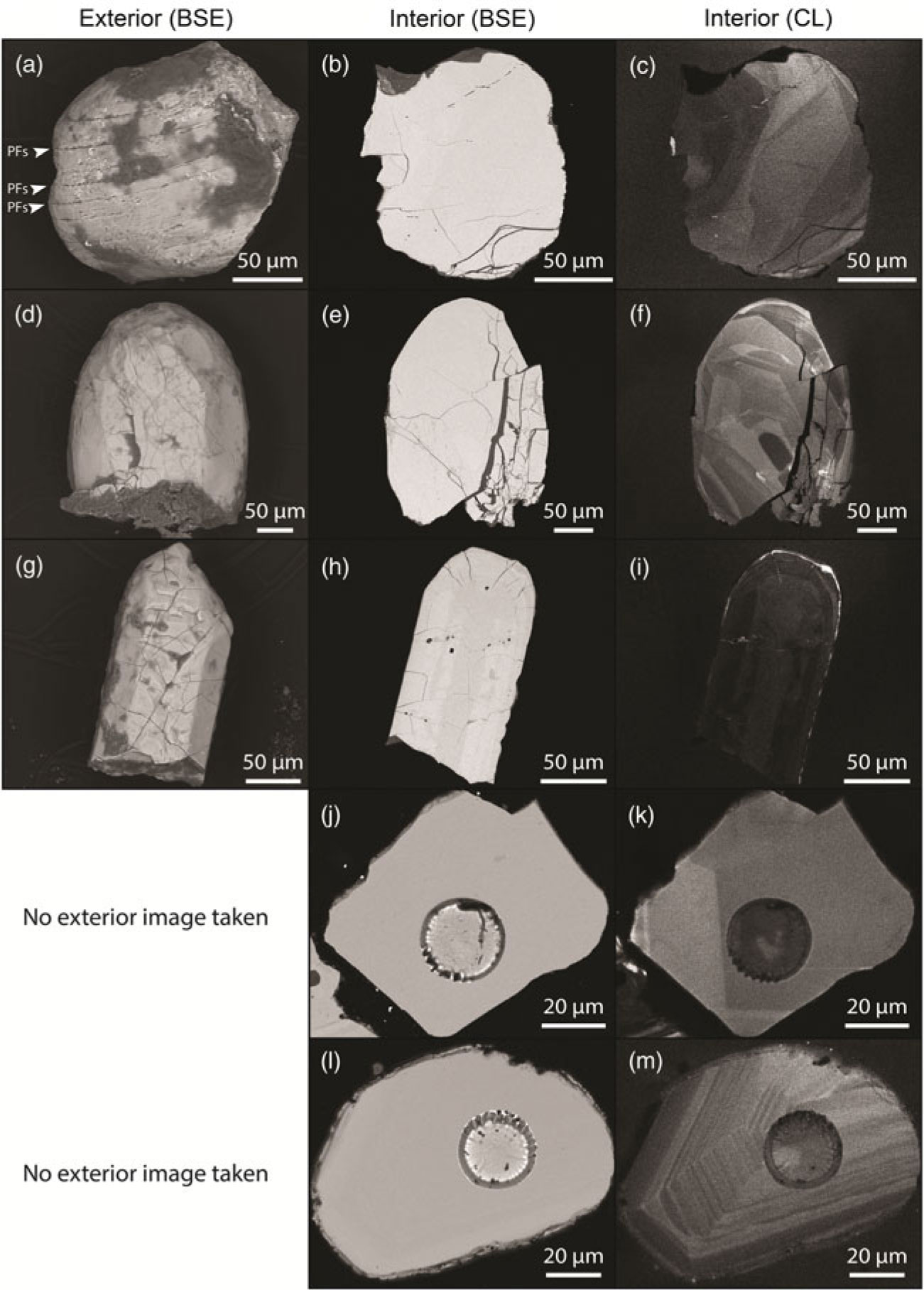
External and internal imaging of zircon grains from all samples showed little evidence of potential shock features. A single grain in sample 15BSK001, stratigraphically above the Stac Fada Member, displayed planar microstructures that may be impact-related (Fig. 3a–c). In zircon, no neoblasts or granular textures, potentially related to impact-induced recrystallization, were observed. Such features have been shown to record the impact age at a number of impact structures (e.g. Vredefort, South Africa, Moser, Reference Moser1997; Moser et al. Reference Moser, Cupelli, Barker, Flowers, Bowman, Wooden and Hart2011; Cavosie et al. Reference Cavosie, Erickson, Timms, Reddy, Talavera, Montalvo, Pincus and Gibbon2015; Sudbury, Canada, Kenny et al. Reference Kenny, Morales, Whitehouse, Petrus and Kamber2017; Nicholson Lake, Canada, McGregor et al. Reference McGregor, McFarlane and Spray2018; Lappajärvi, Finland, Kenny et al. Reference Kenny, Schmieder, Whitehouse, Nemchin, Morales, Buchner, Bellucci and Snape2019) and would provide an opportunity to obtain the first direct U–Pb age for the impact event related to the Stac Fada Member deposits if they could be identified. The apparent rarity of shock features in zircon in the samples studied here is consistent with the observation of Osinski et al. (Reference Osinski, Preston, Ferriere, Prave, Parnell, Singleton and Pickersgill2011) that some samples of the Stac Fada Member contain no shocked quartz and, in general, the unit appears to contain an order of magnitude less shocked material than proximal impact melt-bearing ejecta layers (such as suevite from the Ries impact structure, Germany; e.g. Engelhardt, Reference Engelhardt1997).
Zircon imaging. (a–c) Zircon grain from sample 15BSK001 (taken from stratigraphically above the Stac Fada Member) which shows potentially impact-related planar microstructures on its exterior. (d–i) Two zircon grains that not did not display any potentially impact-related textures (typical of most grains in this study). Both are from the Stac Fada Member itself. (j–m) The two youngest detrital zircon grains in the Stoer Group: grain 15BSK009/Z/41 (j, k) and grain 15BSK_X_SFM/Z/82 (l, m). Circular features are laser ablation U–Pb analysis pits. BSE – backscattered electron; CL – cathodoluminescence; PFs – planar fractures.
5.b. Zircon U–Pb age data
All zircon and apatite U–Pb data from this study can be found in online Supplementary Appendix 1. Studies of detrital zircon generally exclude analyses with discordance greater than an arbitrary cut-off value from consideration (e.g. Fedo et al. Reference Fedo, Sircombe and Rainbird2003); here, analyses that were > 10% discordant (grey ellipses in Fig. 4) were not considered further.
Concordia diagrams for detrital zircon (left panels) and apatite U–Pb data (right panels). For zircon data, grey ellipses represent analyses that are more than 10% discordant. For apatite data, grey ellipses represent analyses for which the 2σ uncertainty on the 207Pb-corrected age was greater than 5%. Number of concordant (for zircon) or low uncertainty (for apatite) analyses v. total number of grains analysed given for each sample.
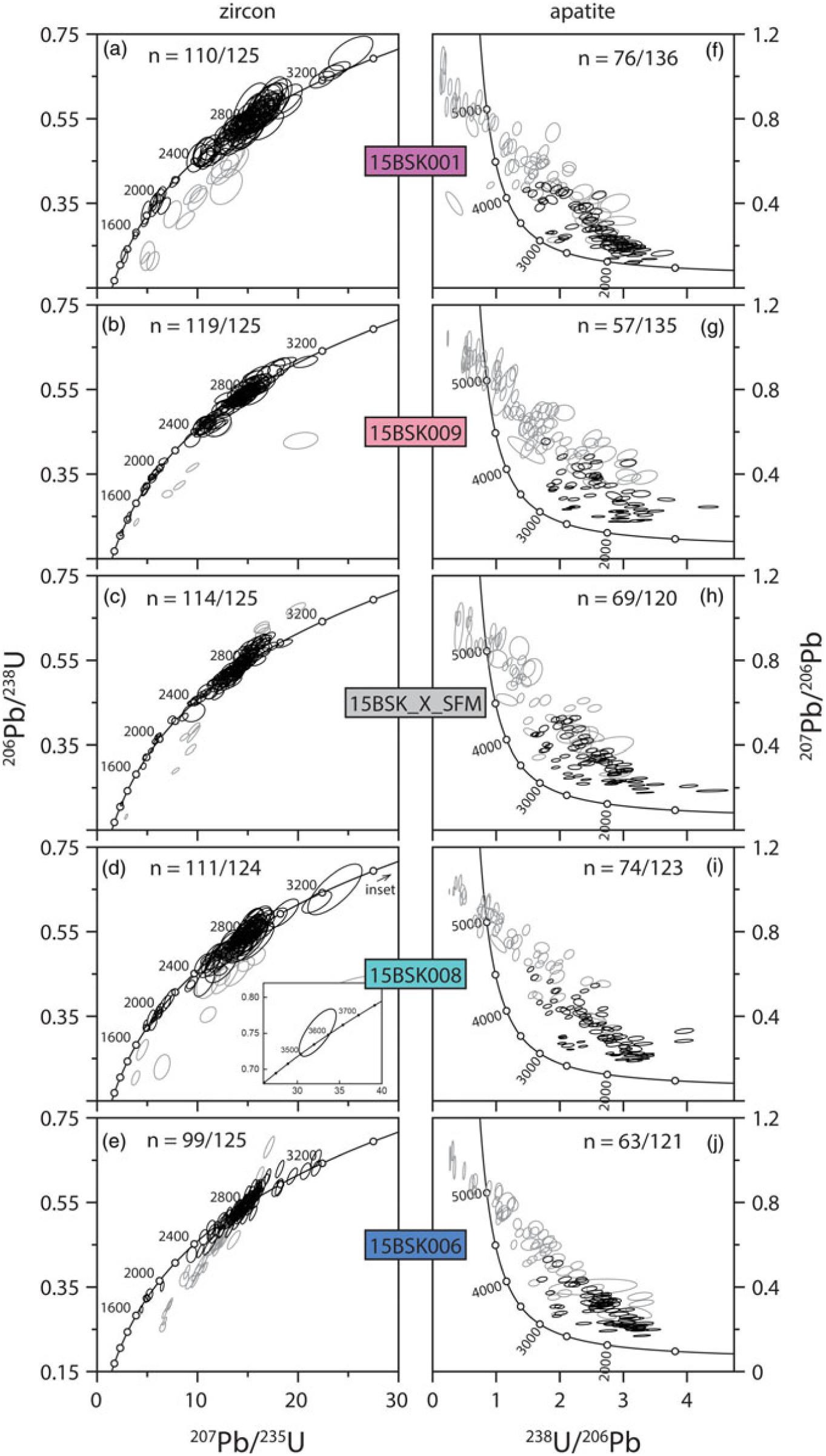
The five analysed samples of the Stoer Group display very similar zircon age distributions (Figs 4–6). Their age populations are all dominated by a major peak at 2.9–2.7 Ga with minor populations at c. 3.2–3.1 Ga, c. 2.5 Ga, c. 2.4 Ga, c. 1.9 Ga and c. 1.75 Ga (Figs 4, 5). The youngest concordant analyses are from two grains in sample 15BSK009, which have 206Pb/238U ages of 1.43 ± 0.02 Ga and 1.23 ± 0.02 Ga, and a grain in sample 15BSK_X_SFM, which has a 206Pb/238U age of 1.24 ± 0.01 Ga. Overall, the detrital zircon U–Pb distributions for the Stoer Group reported here are very similar to those reported by Rainbird et al. (Reference Rainbird, Hamilton and Young2001) and Kinnaird et al. (Reference Kinnaird, Prave, Kirkland, Horstwood, Parrish and Batchelor2007); however, the higher number of analyses here (a total of 553 analyses that were < 10% discordant, compared with 127 and 16, respectively, in the previous studies) has allowed additional insights. For example, the youngest detrital zircon ages encountered here are significantly younger than the > 1.7 Ga ages reported previously. However, we note that caution should be applied when interpreting single detrital zircon analyses, particularly in the interpretation of youngest ages as, for example, post-sedimentation Pb loss may result in erroneously young ages (Nelson, Reference Nelson2001). Additionally, this study confirms the presence of a distinct c. 3.2–3.1 Ga population (which was previously represented by only a single < 10% discordant analysis) and reports the first Palaeoarchaean age for a zircon grain from the Stoer Group; the oldest concordant analysis in this study has a 207Pb/206Pb age of 3529 ± 30 Ma (Fig. 4d inset; online Supplementary Appendix 1). With a total of 696 < 10% discordant zircon U–Pb analyses for the Stoer Group from this and previous studies (Rainbird et al. Reference Rainbird, Hamilton and Young2001; Kinnaird et al. Reference Kinnaird, Prave, Kirkland, Horstwood, Parrish and Batchelor2007; Fig. 7), there is now 95% confidence that no fractions of the zircon population composing ≥ 1.2% of the total have been missed (cf. Vermeesch, Reference Vermeesch2004).
Detrital zircon and apatite U–Pb age distributions. Zircon data are 207Pb/206Pb ages for analyses which were less than 10% discordant, whereas apatite data are 207Pb-corrected apatite U–Pb ages which had 2σ age uncertainties less than 5% (black ellipses in Fig. 4). Kernel density estimates were plotted using the DensityPlotter program of Vermeesch (Reference Vermeesch2012), in which the optimal bandwidth is calculated according to the method of Botev et al. (Reference Botev, Grotowski and Kroese2010). SFM – Stac Fada Member.
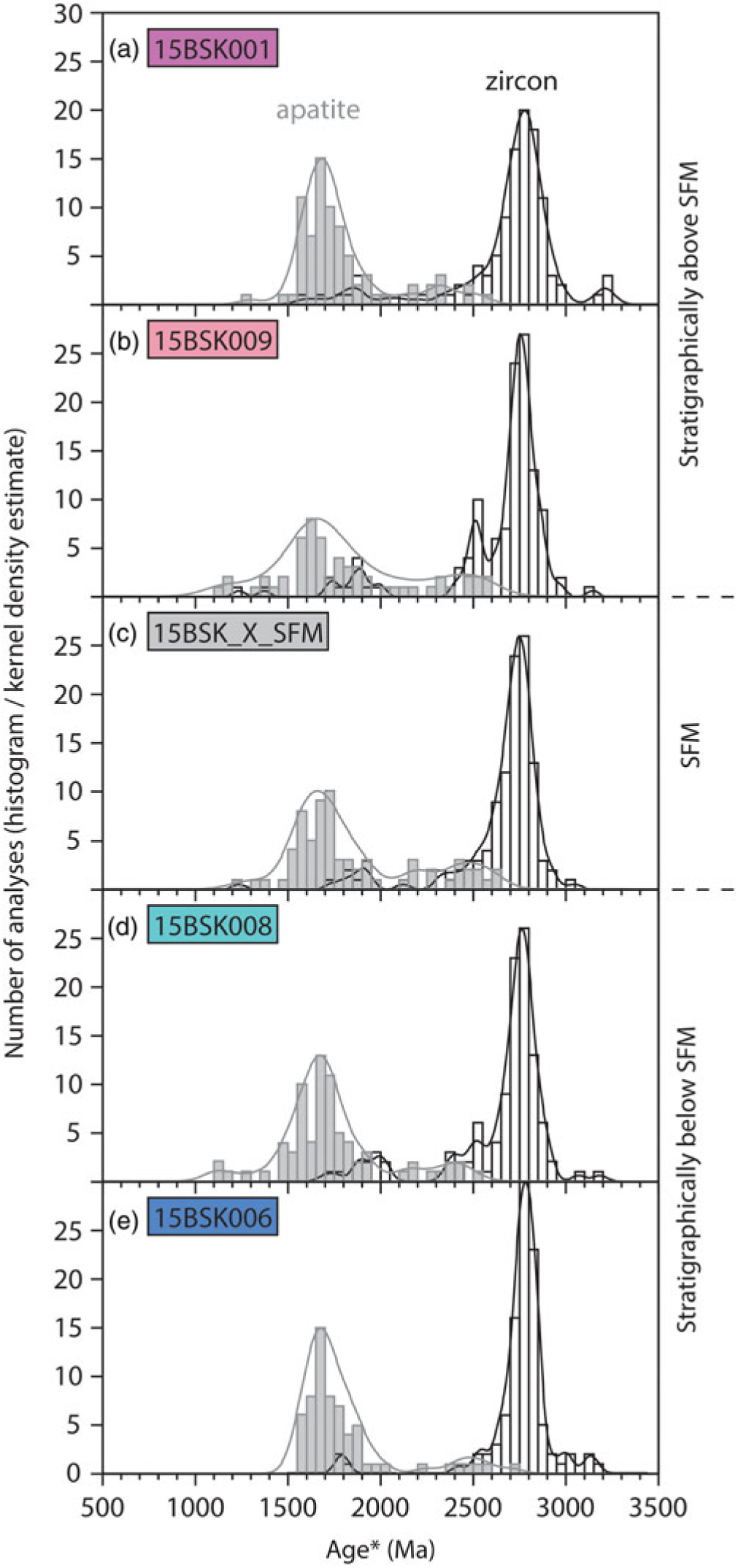
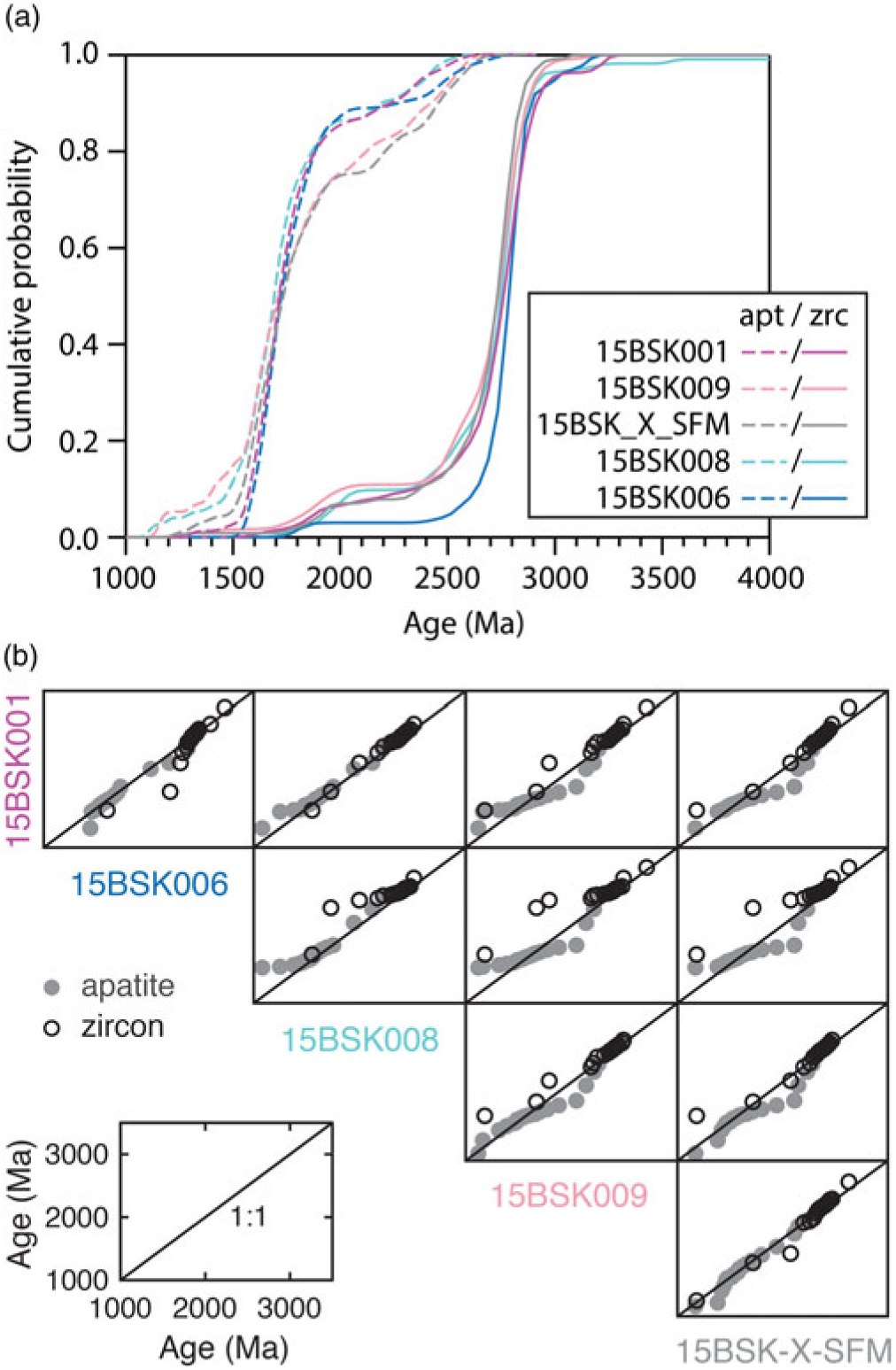
Visual comparison of the samples on histograms and kernel density estimates (Fig. 5), as well as cumulative distribution function (CDF) and quantile-quantile (QQ) plots (Fig. 6), show that 15BSK006 (the stratigraphically lowest and geographically most northern sample) is the single sample with a noticeable, although still only slight, difference in zircon age distribution. This observation is supported by the results of a Kolmogorov–Smirnoff (K-S) statistical test which demonstrates that only sample 15BSK006 is statistically likely (at a 95% confidence level) to have been sourced from a different population than any of the other samples (online Supplementary Appendix 2, Table S1A, available at http://journals.cambridge.org/geo). We note that in this study the K-S test results support observations that were first made by visual inspection but that, in general, the P value of the K-S test may be considered a poor measure of dissimilarity between samples due to the strong dependence of results on sample size (Vermeesch, Reference Vermeesch2013). The reason that sample 15BSK006 appears to be distinct is largely as a result of it lacking the c. 1.9 Ga age population observed in all other samples.
Cumulative distribution function (CDF) and quantile-quantile (QQ) plots for detrital zircon 207Pb/206Pb ages and detrital apatite 207Pb-corrected ages. (a) apt – apatite; zrc – zircon. (b) Dots represent the 0, 5, 10, …, 95 and 100 percentiles (or quantiles) of the samples whose names are shown on the x- and y-axis, respectively. A pair of samples have identical distributions if their percentiles fall on the 1:1 line (Vermeesch, Reference Vermeesch2013).
5.c. Apatite U–Pb age data
Due to the nature of the 207Pb-based correction for common Pb, no apatite U–Pb age data can be excluded on the basis of discordance. Instead, grains with 207Pb-corrected 2σ age uncertainties above a certain threshold value (which may be absolute and/or a percentage) are not considered further (e.g. Zattin et al. Reference Zattin, Andreucci, Thomson, Reiners and Talarico2012; Mark et al. Reference Mark, Cogné and Chew2016; O’Sullivan et al. Reference O’Sullivan, Chew and Samson2016). Here, this value was set at 5%. This corresponds to an absolute age threshold similar to that employed in studies of mostly Phanerozoic-aged apatite grains, which are typically screened at 20% (e.g. O’Sullivan et al. Reference O’Sullivan, Chew, Morton, Mark and Henrichs2018).
Similar to the zircon data, the five samples display comparable apatite age distributions (Figs 4–6). Visual inspection of the data on histograms and kernel density plots (Fig. 5), as well as CDF and QQ plots (Fig. 6), is again supported by K-S test results indicating no statistically significant difference in age distributions between samples (online Supplementary Appendix 2, Table S2). However, the age peaks are different to those in the zircon record; all samples display a range of ages between c. 2.6 and c. 2.15 Ga and a broad and dominant peak between c. 1.8 and c. 1.55 Ga, and most samples also have minor peaks centred at c. 1.4 and c. 1.15 Ga (Fig. 5). Sample 15BSK006, which appeared to be the most distinctive in terms of zircon U–Pb age distribution, is the only sample that lacks apatite grains younger than 1500 Ma.
Two apatite grains in the filtered dataset (339 grains in five samples) have 207Pb-corrected U–Pb ages (1101 ± 38 Ma and 1109 ± 40 Ma) that are younger than the current estimate for the deposition of the Stac Fada Member: a 1177 ± 5 Ma 40Ar/39Ar age for authigenic K-feldspar which precipitated in degassing structures in the Stac Fada Member itself (Parnell et al. Reference Parnell, Mark, Fallick, Boyce and Thackrey2011). Both of these grains are from sample 15BSK008, which was taken from stratigraphically above the Stac Fada Member (Fig. 2). The two grains which gave ages younger than the currently accepted age of deposition for the unit may be explained by, for example, (i) subtle Pb loss from these two crystals; or (ii) inaccuracy in the 40Ar/39Ar age. The latter appears unlikely given the robust nature of the 40Ar/39Ar results from samples from a number of localities. Regardless, the presence of shock metamorphosed zircon in the unit (Reddy et al. Reference Reddy, Johnson, Fischer, Rickard and Taylor2015) suggests that there may also be the possibility for future studies to obtain a direct U–Pb age for the impact event through analysis of shocked accessory phases such as zircon (e.g. Bohor et al. Reference Bohor, Betterton and Krogh1993; Krogh et al. Reference Krogh, Kamo and Bohor1993a ,Reference Krogh, Kamo, Sharpton, Marin and Hildebrands b ; Kamo et al. Reference Kamo, Reimold, Krogh and Colliston1996; Moser, Reference Moser1997; Moser et al. Reference Moser, Cupelli, Barker, Flowers, Bowman, Wooden and Hart2011; Cavosie et al. Reference Cavosie, Erickson, Timms, Reddy, Talavera, Montalvo, Pincus and Gibbon2015; Kenny et al. 2017, Reference Kenny, Schmieder, Whitehouse, Nemchin, Morales, Buchner, Bellucci and Snape2019; McGregor et al. Reference McGregor, McFarlane and Spray2018), monazite (e.g. Erickson et al. Reference Erickson, Timms, Kirkland, Tohver, Cavosie, Pearce and Reddy2017) or baddeleyite (e.g. White et al. Reference White, Darling, Moser, Reinhard, Prosa, Bullen, Olson and Larson2017).
6. Discussion
6.a. Stratigraphic variation
The lack of significant stratigraphic variations in zircon or apatite U–Pb age distributions through the Stoer Group, NW Scotland, may be interpreted as evidence that there was no major change in the source of detritus during Stoer Group deposition. Alternatively, there may have been a significant change in sediment source, but it could not be detected as the different source regions shared similar apatite and zircon U–Pb age populations.
The polycyclic nature of zircon and the ability of intermediate repositories to overwhelm local provenance (e.g. Sircombe & Freeman, Reference Sircombe and Freeman1999) mean that changes in sedimentary provenance throughout a succession may not necessarily result in any major change in the detrital zircon age distribution. Apatite, by contrast, is more likely to represent first-cycle detritus (Morton & Hallsworth, Reference Morton and Hallsworth1999) and may therefore be more likely than zircon to record major shifts in provenance throughout a succession. The relatively constant nature of detrital apatite U–Pb age distributions across the Stac Fada Member may therefore lend support to the first explanation, that is, there was no major shift in drainage pattern.
Consistency in detrital zircon and apatite U–Pb age distributions throughout a stratigraphic section could conceivably be related to extensive reworking of underlying sediments. The lower part of the Stoer Group appears to have been deposited in a series of narrow, high-gradient bedrock and alluvial valleys that were only partially connected, whereas the younger parts of the Stoer Group appear to have been deposited in broader, low-gradient alluvial settings, with aeolian processes on-going in areas far from basement highs (Ielpi et al. Reference Ielpi, Ventra and Ghinassi2016). It has been suggested that this transition in the Stoer Group led to more mature and hydrologically open drainage that was capable of remobilizing fine-grained detritus, with “mobilization and reworking of sandy detritus in extra-channel areas also enhanced by the absence of plant rooting” (Went, Reference Went2005; Ielpi et al. Reference Ielpi, Ventra and Ghinassi2016, p. 309).
The zircon and apatite U–Pb age results need to be considered in the context of palaeocurrent data for the Stoer Group. The well-documented changes in flow direction throughout the unit – from variable palaeocurrent directions below the Stac Fada Member, to broadly eastwards movement in the up to 100 m thick lacustrine sedimentary rocks of the Poll à Mhuilt Member immediately overlying the Stac Fada Member, to broadly westwards flow directions in the post-Poll à Mhuilt Member (Stewart, Reference Stewart2002; Simms, Reference Simms2015) – indicate that there was at least some change in the regional drainage network coincident with the deposition of the Stac Fada Member.
Regardless of whether the relatively constant age distributions of heavy minerals in the Stoer Group can be interpreted as indicative of a lack of major shift in sediment source, they do not provide independent evidence that the impact associated with the Stac Fada Member: (i) brought previously unexposed rocks to the Earth’s surface; (ii) cut off specific source terrain(s); or (iii) resulted in any major change in the regional Stoer Group sedimentary system that might indicate a location of the impact structure.
The very minor differences between the U–Pb age spectra may be related to geographic or stratigraphic factors. For example, the lack of c. 1.9 Ga zircon grains in sample 15BSK006 may be related to this sample’s northernmost location (Fig. 1) or its lowermost stratigraphic position of the five studied samples (Fig. 2). Interestingly, Rainbird et al. (Reference Rainbird, Hamilton and Young2001) identified two c. 1.9 Ga zircon grains (207Pb/206Pb ages of 1866 ± 62 and 1912 ± 30 Ma) in samples from even lower in the Stoer Group stratigraphy at the relatively southern location of Gruinard Bay. This may indicate that the absence of c. 1.9 Ga zircon grains in sample 15BSK006 is not related to stratigraphic position and may, more conceivably, be related to the sample’s geographic location. Additionally, intrusions of c. 1.9 Ga age are mainly found close to Lewisian terrane boundaries, for example, the Ard gneiss in the Gairloch area to the south (Park et al. Reference Park, Tarney and Connelly2001) and the Ben Stack granites near Loch Laxford to the north (Goodenough et al. Reference Goodenough, Crowley, Krabbendam and Parry2013). Sample 15BSK006 is the sample most distal to these known c. 1.9 Ga intrusions, and we suggest that this is the most likely reason for its lack of grains of this age.
6.b. Provenance
6.b.1. Detrital zircon
The new zircon U–Pb data for the Stoer Group are consistent with the U–Pb data of Rainbird et al. (Reference Rainbird, Hamilton and Young2001) and Kinnaird et al. (Reference Kinnaird, Prave, Kirkland, Horstwood, Parrish and Batchelor2007) and earlier interpretations that the detritus was largely derived from local Lewisian Gneiss Complex basement (e.g. Stewart, 1982, 1990, Reference Stewart2002; Van de Kamp & Leake, Reference Van de Kamp and Leake1997). Rainbird et al. (Reference Rainbird, Hamilton and Young2001) noted that the major detrital zircon age peak at 2.9–2.7 Ga corresponds to protolith ages for rocks of the Lewisian Gneiss Complex in the Gruinard Bay area (Whitehouse et al. Reference Whitehouse, Claesson, Sunde and Vestin1997; Corfu et al. Reference Corfu, Crane, Moser and Rogers1998) as well as high-grade metamorphic events in the north–central part of the Lewisian. However, recent work has shown that complex polyphase metamorphism of the Lewisian has resulted in zircon U–Pb ages distributed along the concordia between c. 3.0 Ga and c. 2.5 Ga; it is therefore difficult to ascribe specific protolith ages within this time (Whitehouse & Kemp, Reference Whitehouse, Kemp, Law, Butler, Holdsworth, Krabbendam and Strachan2010; MacDonald et al. Reference MacDonald, Goodenough, Wheeler, Crowley, Harley, Mariani and Tatham2015). We observe this broad spread of data in the Stoer Group (Figs 4, 5). The zircon peak at c. 2.5 Ga (Fig. 7b) corresponds to the 2490–2480 Ma Inverian event of the Lewisian central region (Humphries & Cliff, Reference Humphries and Cliff1982; Corfu et al. Reference Corfu, Heaman and Rogers1994) and the peak at c. 1.9 Ga corresponds to felsic magmatism and metamorphism at a number of localities in the Lewisian at approximately this time, including the South Harris Complex, the Ben Stack granites and the Ard gneiss (e.g. Park et al. Reference Park, Tarney and Connelly2001; Whitehouse & Bridgwater, Reference Whitehouse and Bridgwater2001; Mason et al. Reference Mason, Parrish and Brewer2004; Goodenough et al. Reference Goodenough, Crowley, Krabbendam and Parry2013). Rare zircon grains with ages of c. 1.7 Ga are likely related to pegmatites that intruded into most of the Lewisian at this time (e.g. Park et al. Reference Park, Tarney and Connelly2001). It is also possible that there was a small contribution of material from distal sources to the west, which became more prevalent by the time of deposition of the Sleat and Torridon groups (Fig. 7a; Krabbendam et al. Reference Krabbendam, Bonsor, Horstwood and Rivers2017).
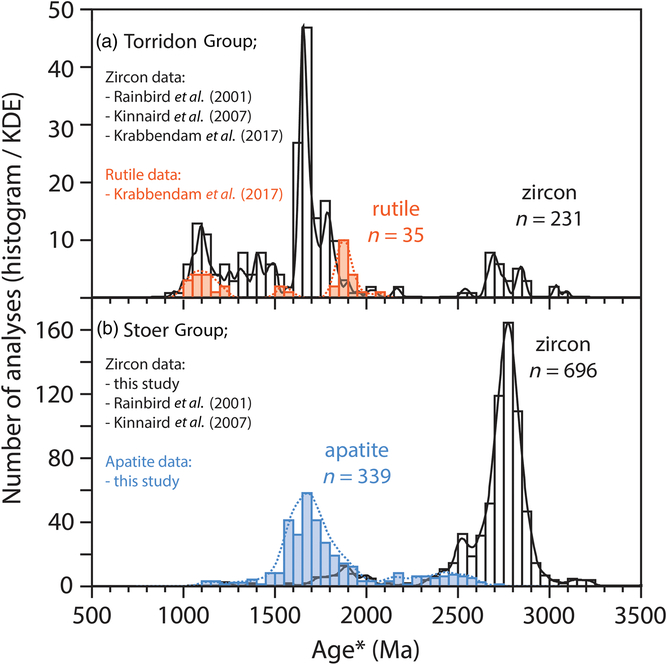
Compiled detrital zircon, apatite and rutile U–Pb age distributions for the Stoer and Torridon groups. Note that zircon and rutile data for the Torridon Group from Krabbendam et al. (Reference Krabbendam, Bonsor, Horstwood and Rivers2017) are only from sample ZY320 (which was taken at Gruinard Bay, near sample GY96-56 of Rainbird et al. Reference Rainbird, Hamilton and Young2001; Krabbendam et al. Reference Krabbendam, Bonsor, Horstwood and Rivers2017, p. 76), and therefore do not include data for sample ZY327 of Krabbendam et al. (2017), which was taken approximately 60 km further south. Zircon and rutile data are 207Pb/206Pb ages for analyses that were less than 10% discordant, whereas apatite data are 207Pb-corrected apatite U-Pb ages that had 2σ age uncertainties less than 5%. KDE – kernel density estimate.
The detrital populations in the Stoer Group not previously identified (including grains at c. 3.5 Ga and c. 3.2–3.1 Ga, as well as Mesoproterozoic ages) can also be attributed to sources in the Lewisian Gneiss Complex. The Palaeoarchaean ages reported from the Stoer Group (3529 ± 30 Ma) may be related to the c. 3550 Ma inherited core found in a grain from the northern part of the Lewisian Gneiss Complex (Kinny & Friend, Reference Kinny and Friend1997). Similarly, the few c. 3.2–3.1 Ga analyses may be related to the 3115 ± 18 Ma analysis on a zircon core from the central region of the Lewisian Gneiss Complex (Kinny & Friend, Reference Kinny and Friend1997).
6.b.2. Detrital apatite
The U–Pb age distribution of detrital apatite in the Stoer Group contrasts starkly with that of zircon (Fig. 7). Some of the apatite ages are likely to be related to rocks and events known from the zircon record (with the former potentially offset to younger ages due to the lower closure temperature of its U–Pb system), but others are likely related to previously unrepresented events.
The main apatite age peak, centred at c. 1.7 Ga, represents cooling from amphibolite-facies metamorphism of the Laxfordian event, which is recorded in the Lewisian Gneiss Complex by titanite and rutile ages (Heaman & Tarney, Reference Heaman and Tarney1989; Corfu et al. Reference Corfu, Heaman and Rogers1994; Kinny & Friend, Reference Kinny and Friend1997; Love et al. Reference Love, Friend and Kinny2010), as well as rare zircon rims (Kinny & Friend, Reference Kinny and Friend1997). This event is not well-represented in zircon in the Stoer Group (Fig. 7), consistent with it being a low-temperature metamorphic event but, as noted above, the few c. 1.7 Ga zircon grains we observed may have been sourced from pegmatites associated with Laxfordian metamorphism (Park et al. Reference Park, Tarney and Connelly2001).
Considering the broad distribution of apatite ages between 2.6 and 2.1 Ga, it is noteworthy that zircon, by contrast, is relatively scarce between 2.4 and 2.1 Ga but represented by a clear peak at c. 2.5 Ga (Fig. 7b). Some of the younger apatite ages may be related to discrete events not recorded by zircon (e.g. at c. 2.15 Ga), but others most likely represent prolonged cooling and exhumation after the 2490–2480 Ma high-grade Inverian metamorphism in the central region of the Lewisian Gneiss Complex.
Finally, the almost complete absence of > 2.5 Ga apatite ages in the Stoer Group, despite the abundance of zircon of this age, is most easily explained by the resetting of the U–Pb system in apatite by relatively low-grade metamorphic events having affected the source rocks. Rocks with Archaean zircon U–Pb ages may yield Proterozoic apatite U–Pb ages if they are heated to temperatures above the partial retention window for Pb in apatite (c. 375–450°C), but not sufficiently high to reset the zircon U–Pb systematics.
6.b.3. Youngest detrital grains
Considering the youngest detrital mineral ages measured in the Stoer Group, the two zircon grains which gave c. 1.25 Ga ages (and are within 2σ analytical uncertainty of the 1177 ± 5 Ma 40Ar/39Ar age for authigenic K-feldspar in the Stac Fada Member; Parnell et al. Reference Parnell, Mark, Fallick, Boyce and Thackrey2011) are likely to represent the same source as the small number of apatite grains with c. 1.2 Ga ages (Fig. 7b). The two youngest zircon grains lack any evidence for shock features typical of impact-induced age resetting (Fig. 3j–m), such as granular textures (e.g. Bohor et al. Reference Bohor, Betterton and Krogh1993; Krogh et al. Reference Krogh, Kamo and Bohor1993a ,Reference Krogh, Kamo, Sharpton, Marin and Hildebrands b ; Kamo et al. Reference Kamo, Reimold, Krogh and Colliston1996; Moser, Reference Moser1997; Moser et al. Reference Moser, Cupelli, Barker, Flowers, Bowman, Wooden and Hart2011; Cavosie et al. Reference Cavosie, Erickson, Timms, Reddy, Talavera, Montalvo, Pincus and Gibbon2015; Kenny et al. 2017, Reference Kenny, Schmieder, Whitehouse, Nemchin, Morales, Buchner, Bellucci and Snape2019; McGregor et al. Reference McGregor, McFarlane and Spray2018). Together with the lack of evidence for impact-related U–Pb discordance in the dataset in general (Fig. 4), this suggests that these youngest ages are not related to Pb loss or recrystallization associated with the Stac Fada Member impact event itself. In addition to inducing shock deformation and age resetting in zircon, medium to large impact events can also crystallize new igneous zircon and apatite in slowly cooled impact melts (e.g. at Vredefort, South Africa, Kamo et al. Reference Kamo, Reimold, Krogh and Colliston1996; Sudbury, Canada, Davis, Reference Davis2008; Manicouagan, Canada, Hodych & Dunning, Reference Hodych and Dunning1992; Morokweng, South Africa, Hart et al. Reference Hart, Andreoli, Tredoux, Moser, Ashwal, Eide, Webb and Brandt1997; Koeberl et al. Reference Koeberl, Armstrong and Reimold1997; and Mistastin Lake, Canada, Sylvester et al. Reference Sylvester, Crowley and Schmitz2013). However, to the best of our knowledge, zircon which crystallized from impact melt has not previously been reported in distal impact deposits and, given the time required for zircon to first crystallize from an impact melt, such an occurrence seems unlikely. Although it cannot be ruled out entirely, an impact melt origin appears similarly unlikely for the single c. 1.25 Ga zircon grain in the overlying Poll à Mhuilt Member (Fig. 5d).
We note that the Stoer Group is generally considered to have been deposited prior to the Grenville Orogeny in Scotland (Stewart, Reference Stewart2002), which is dated to c. 1.1–1.0 Ga (e.g. Sanders et al. Reference Sanders, Van Calsteren and Hawkesworth1984; Brewer et al. Reference Brewer, Storey, Parrish, Temperley and Windley2003), and the youngest detrital grains are therefore unlikely to be related to even very early Grenvillian orogenesis. However, ages of between 1.1 and 1.3 Ga have previously been reported from the Lewisian Gneiss Complex – early Rb–Sr and K–Ar biotite ages fall in the range of c. 1148–1169 Ma (Giletti et al. Reference Giletti, Moorbath and Lambert1961; Moorbath & Park, Reference Moorbath and Park1972) – and there are a number of more distal possible sources for the c. 1.25 Ga grains (e.g. the Gardar Province of South Greenland; Upton et al. Reference Upton, Emeleus, Heaman, Goodenough and Finch2003). In conclusion, there is no single clear source for the youngest detrital grains in the Stoer Group.
7. Conclusions
Minimal evidence for shock metamorphism or associated Pb loss in zircon or apatite was encountered in this study. Despite extensive efforts at SEM imaging, potentially impact-related planar fractures were only identified on the exterior of a single zircon grain. Although a number of zircon and apatite grains in the Stoer Group yielded U–Pb ages within uncertainty of the 1177 ± 5 Ma 40Ar/39Ar depositional age constraint for the Stac Fada Member, neither of the two such zircon grains displayed textures indicative of shock metamorphism and, overall, there was no clear evidence for impact-induced Pb loss in the dataset.
The new zircon U–Pb data for the Stoer Group reported here are consistent with earlier interpretations that the detritus was derived largely from local Lewisian Gneiss Complex basement, but the larger number of analyses in this study resulted in the identification of ages previously undocumented in the Stoer Group; these include grains at c. 3.5 Ga (the first Palaeoarchaean ages reported from the Stoer Group) and c. 3.2–3.1 Ga, as well as Mesoproterozoic ages.
Detrital zircon and apatite in the Stoer Group display contrasting age distributions. The first apatite age data for the Stoer Group highlights events either underrepresented in or absent from the zircon record, with the apatite record dominated by the c. 1.7 Ga Laxfordian event. Conversely, detrital apatite U–Pb fails to record events older than c. 2.5 Ga, indicating that all rocks in the sediment source regions older than 2.5 Ga have been heated above the closure temperature of the apatite U–Pb system (c. 375–450°C).
Neither zircon nor apatite recorded significant changes in U–Pb age distribution across the impact-related Stac Fada Member of the Stoer Group, NW Scotland. The U–Pb systems in detrital apatite and zircon assemblages do not provide independent support for a major shift in regional drainage patterns associated with the Stac Fada Member impact event, and as such, do not yield any information on the likely location of the impact structure.
Supplementary material
To view supplementary material for this article, please visit https://doi.org/10.1017/S0016756819000220.
Author ORCIDs
Gavin Kenny, 0000-0001-8683-3860
Acknowledgements
This research was supported by an Irish Research Council EMBARK Initiative scholarship (GGK) and funding from Science Foundation Ireland (SFI) (BSK, grant no. SFI/12/ERC/E2499). The U–Pb data in this publication were obtained on infrastructure supported in part by a research grant from SFI (grant no. 13/RC/2092) and co-funded under the European Regional Development Fund and industry partners of the Irish Centre for Research in Applied Geosciences (iCRAG). The SEM data in this publication were obtained on infrastructure supported in part by a research grant from SFI (BSK, grant no. SFI/RI/3227). We thank reviewers Kathryn Goodenough and Maarten Krabbendam for their constructive feedback and Chad Deering for efficient editorial handling.
Declaration of interest
None.


 Open access

