

Location map: Megiddo and the Early Bronze 1b Egyptian Colony at Canaan. The core area of the colony is in black, and its periphery in grey shades.

During 1925-1939 an expedition of the Chicago Oriental Institute conducted large-scale excavations at the ancient site of Megiddo in northern Palestine of that time (Figure 1; Reference LoudLoud 1948).
Reaching stratum XIX they exposed a structure, which was interpreted as a temple and dated to the end of the fourth millennium BC (Early Bronze 1b). The excavation indicated that the temple was approached from the east through a large courtyard delimited by a wall. This courtyard was paved with irregularly shaped flat limestone slabs preserved in some clusters. One of the observations the excavators made was that on many of the slabs were 'scratched and incised drawings of human figures and animals along with a great many designs which were either pure fancy or possibly signs and letters now undecipherable' (Reference LoudLoud 1948: 61). Consequently these graffiti gave the temple's courtyard floor the name in which it has been known ever since in Levantine archaeological literature: 'the Picture Pavement'.
Since the Picture Pavement's discovery a few archaeologists have attempted an analysis of its motives and offered various interpretations for its meaning (detailed in Yekutieli in prep). Apparently, all these studies were based on reproductions of the graffiti drawn by the artists of the Megiddo report (Reference LoudLoud 1948: Pls.271-82). Nevertheless, a close examination of the photographs of the slabs in the same report reveals that the reproductions overlook large part of the evidence. Apparently the graffiti are much more elaborate than the report facsimiles suggest.
This realisation prompted me to re-examine the photographs. As the work progressed a simple procedure for the analysis of the incised slabs had emerged, which might be of interest for similar cases elsewhere. This procedure allowed new readings and interpretations of the graffiti (presented in Yekutieli in prep).
The starting point for the re-examination was a comment made by Aharon Kempinski, that the slab depicted in Reference LoudLoud 1948, pl.272, includes many superimposed incisions (Reference KempinskiKempinski 1989: 173). My investigation of the photographs of the other slabs revealed that this observation is essentially valid to most of them.
Superimposed incisions are not uncommon in ancient rock art (Reference AnatiAnati 1968), but the Megiddo slabs are unique in two aspects: firstly, they are dateable due to the fact that they were sealed within an archaeological stratum, and secondly, it appeared that most of the superimposed layers in each slab were essentially related to those below them. The overlaying layers erase earlier signs, emphasise certain previous features, and in some cases add additional images. Thus apparently a short time (in the range of days, months or years) had elapsed between the applications of additional incised surfaces (unlike open air graffiti where hundreds or even thousands of years might have separated the drawing events; Reference AnatiAnati 1968: 5, 178-9).
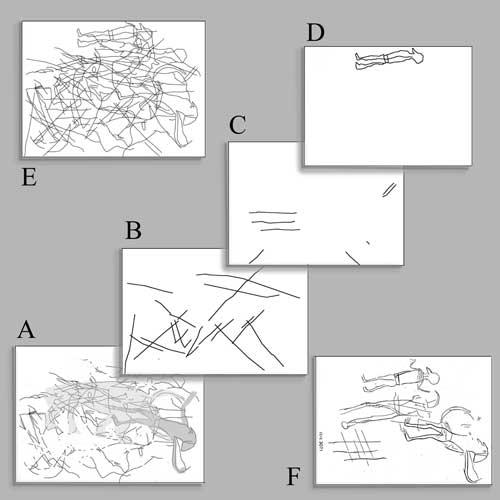
Deconstruction of slab Reference LoudLoud 1948, Pl.272. A-E drawn by the author, F copied from the excavation report (Reference LoudLoud 1948: Pl.272, c334).

The concept applied to the study of the Megiddo graffiti was thus based on peeling off the later layers in order to retrieve the original illustrations. After that, I aimed to explain the initial scene, and then attempted to interpret how and why was it changed through the subsequent layers. Hence, a deconstruction of the incised record is followed by its reconstruction, and both processes are used for the goal of interpreting each slab, and ultimately the overall significance of the Picture Pavement (detailed in Yekutieli in prep).
Slab 4 (Reference LoudLoud 1948, pl.272), offers the best example for the applied method. The slab reveals four incision phases, which are, from the lowest (earliest) upwards (Figure 2): A. Drawing of four headless human figures similar, as noted by earlier researchers (Reference KempinskiKempinski 1989:170-174), to a scene within the contemporaneous Egyptian Narmer Palette (Petrie 1953: pls. J25, K26). B. A net pattern covering the complete surface of the slab. C. Small incisions on the stone's edges. D. Blunt bumps in two concentric ellipses on top of the earlier markings. The combination of the four layers gives the final effect of the slab (Figure 2E), of which the Megiddo report artists reproduced much (Figure 2F), but certainly not all.
Slab Reference LoudLoud 1948: Pl.277:16. A-C: The slab's 'stratigraphy'. D: The slab with its complete incised record (A-D drawn by the author). E: The slab's drawing in the excavation report (Reference LoudLoud 1948: Pl. 277: d284). The shaded are in layer A suggests the make-up of the original scene.

Slab Reference LoudLoud 1948, Pl.271:1. A-D: The slab's 'stratigraphy'. E: The slab with its complete incised record (A-E drawn by the author). F: The slab's drawing in the excavation report (Reference LoudLoud 1948: Pl. 271: c307). The shaded are in layer A suggests the make-up of the original scene.

Slab Reference LoudLoud 1948, Pl.274:8. A-D: The slab's 'stratigraphy'. E: The slab with its complete incised record (A-E drawn by the author). F: The slab's drawing in the excavation report (Reference LoudLoud 1948: Pl. 274: c320).

The phenomenon noted on slab 4 is not restricted to that piece. Examination of the photographs of the stones proves that the complex situation is common to many other slabs as well (Figures 3-5). The idea of a rectilinear net superimposed on an earlier design recurs on many stones; multiple cut marks are engraved on the perimeters of quite a few of them, and some slabs display blunt blows that left irregular scars on the their faces.
After applying the method it appeared that the earliest incised layer on many of the 'stratified' slabs features scenes expressing Egyptian royal power symbolisms. The study of the subsequent layers strongly suggests that the Egyptian scenes were erased or changed by later incisions, which manipulated them to convey messages challenging the original ones. In my view this iconoclastic activity, in the context of an encroaching Egyptian colony (Van den Brink & Levy 2002) at the threshold of Megiddo (Figure 1), implies resistance of the local population to the Egyptian colonisers.