

Introduction
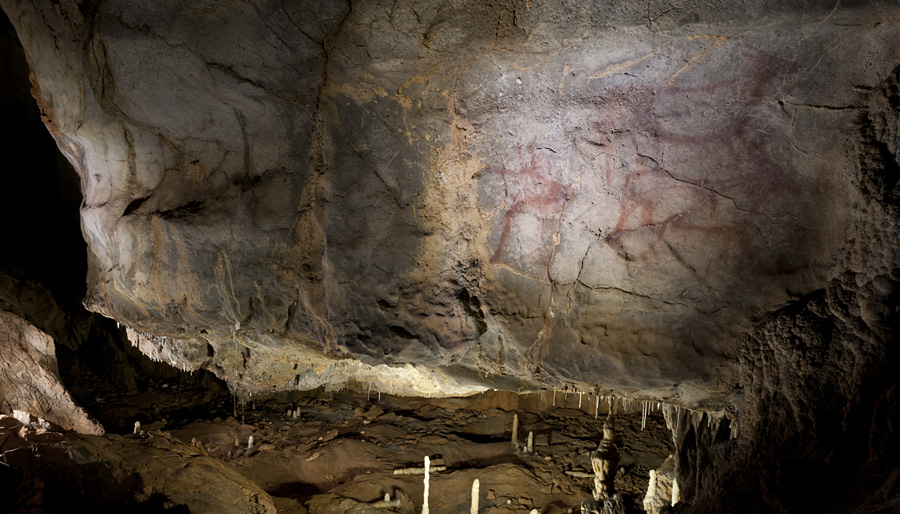
Throughout human evolution, carnivores have played an important role in the shaping of human behaviour (Reference BrainBrain 1981) and some scholars even talk about a co-evolutionary process shared by genus Homo and large carnivores (e.g. Reference BrantinghamBrantingham 1998). During the Pleistocene, hominids interacted with large carnivores in a variety of ways, such as dependency (scavenging) (Reference BlumenschineBlumenschine 1988), confrontation (hunting) (Reference Chase, Dibble and Montet-WhiteChase 1988), competition for the use of caves as dwellings, the exploitation of common prey (Reference PettittPettitt 1997) and, eventually, domestication (Germonpré et al. 2012) (Figure 1). In this sense, a profound analysis of the interaction between hominids and carnivores is a positive way of studying the evolution of human behaviour, as previous studies have proved (e.g. Reference StinerStiner 2002).
Image of Zone IV in the Lower Gallery of La Garma Cave (Omoño, Cantabria). It is possible to observe in the same picture (due to the preservation of the Lower Gallery, where there is no sedimentation) how carnivores and humans have used caves for different purposes, such as hibernation in the case of bears or for painting in the case of human groups during the Magdalenian. Alternation in the use of caves is one of the most common forms of interaction during the Pleistocene. (Picture by L. Teira/IIIPC)

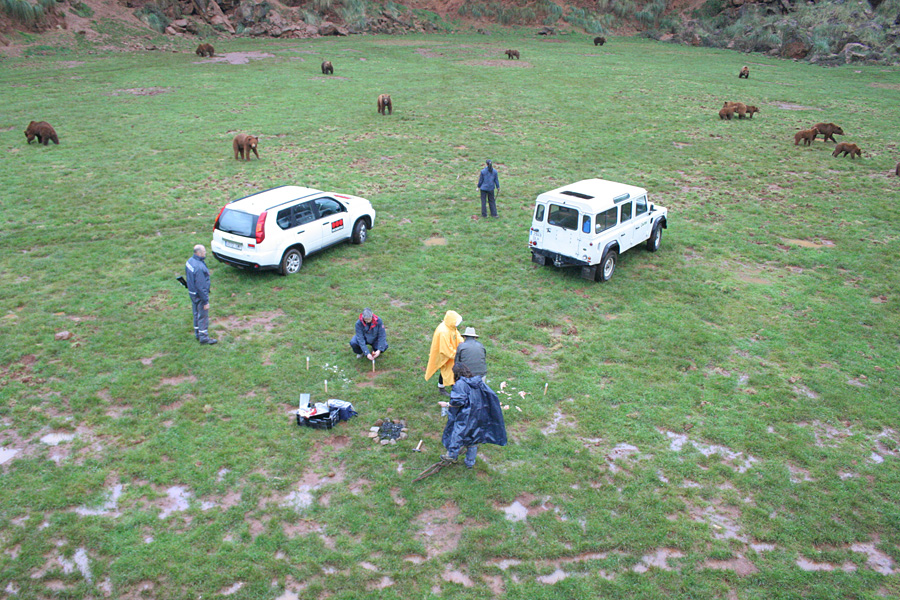
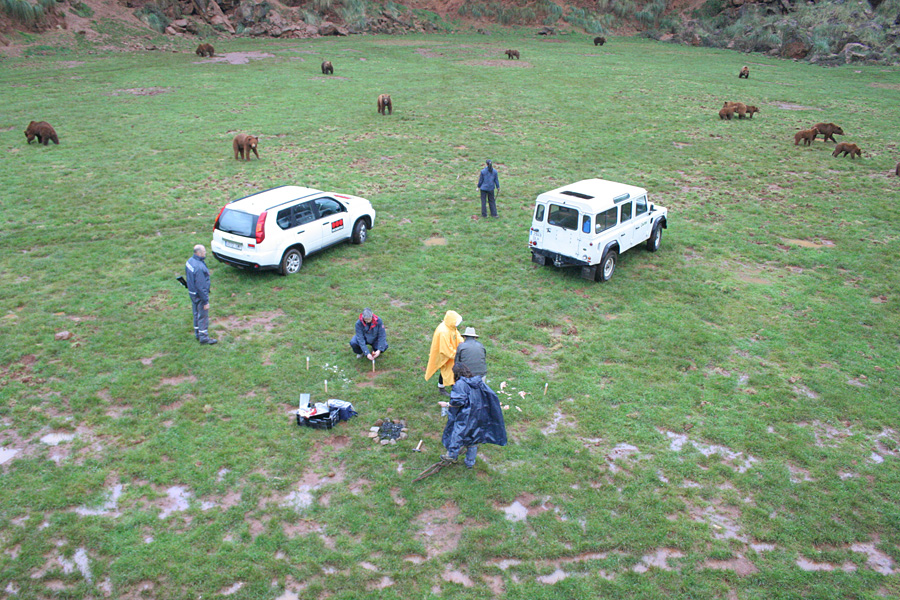
The research team inside the bears' enclosure preparing an experiment to investigate how large carnivores modify anthropic spatial contexts.
The project: objectives and approaches
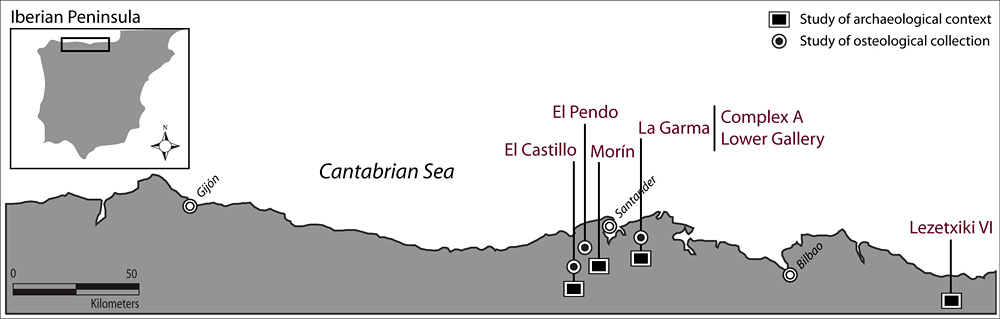
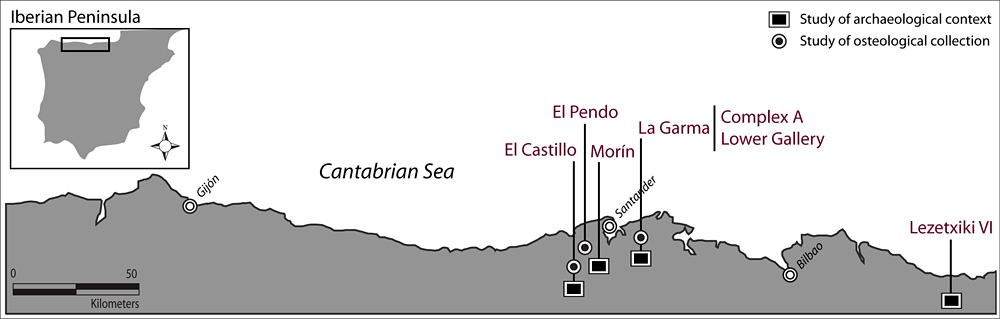
The project entitled 'Development of new methodologies for the study of Neanderthal behaviour through hominid-carnivore interactions' aims to generate methodologies for the analysis of human behaviour by studying the relationship between hominids and large carnivores. To achieve this, we have designed experiments with extant large carnivores such as bears, hyenas, lions and wolves in Cabárceno Nature Park (Santander, Cantabria, Spain) with the aim of recreating potential Pleistocene scenarios of hominid-carnivore interaction (Figure 2). From the results, we will build a methodology with which Palaeolithic archaeological contexts can be better understood. Experimentation will address spatial aspects of complex human behaviour, e.g. the systematic use of fire, the development of scavenging or hunting strategies, direct confrontation between hominids and carnivores, or the achievement of modern cognition related to inhumation rituals. The project also studies osteological collections and archaeological contexts from northern Spain (Figure 3) in order to test the results obtained in the experimental phase.
The Cantabrian coastline with the location of archaeological sites involved in the project.
Preliminary results: erased behaviour
The study of human evolution towards modern behaviour is closely related to intra-site spatial analysis. Through the study of artefact distributions, it is possible to reconstruct spatial organisation and thus behaviour. In Lower and Middle Palaeolithic sites, this is important because there is the possibility of observing modern cognition through such spatial patterning. For example, the presence of a hearth reveals the specific organisation of social activity around it (Reference BinfordBinford 1978) and indicates a formal conception of domestic space (McBrearty & Brooks 2000). Therefore, the identification of spatial patterns is central to understanding human behaviour and evolution (Vaquero & Pastó 2001). In particular, spatial analysis is an important element for the study of when and how complex behaviour and modern cognition develops. In this sense, spatial analysis is an essential tool for debates on those periods when the presence of modernity and complexity is questioned.
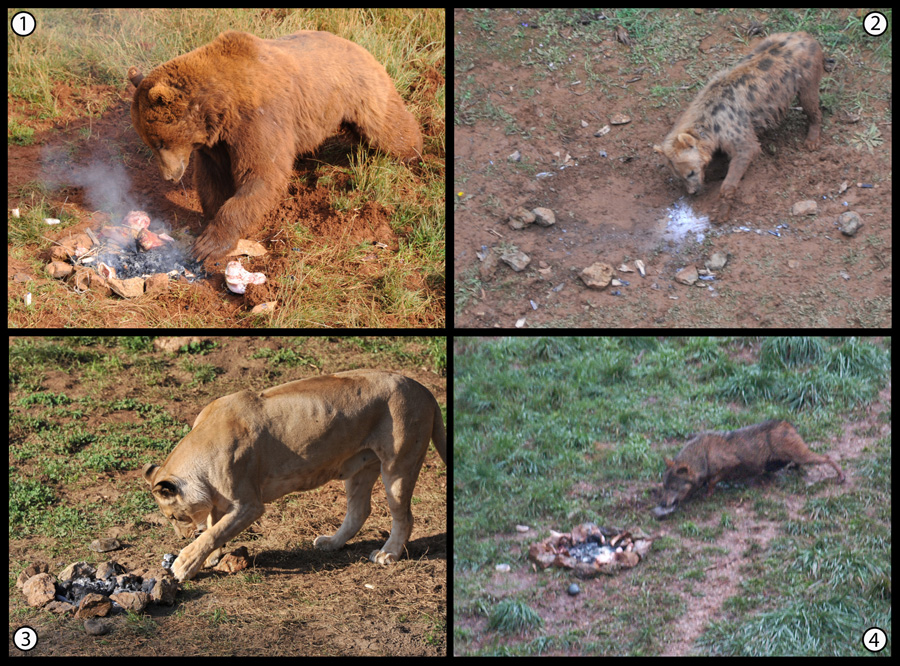
Images of how carnivores modified spatially structured scenarios during experiments, in this case complex combustion structures. A: Ursus arctos; B: Crocuta crocuta; C: Panthera leo; D: Canis lupus.

However, are there any taphonomic agents capable of erasing such evidence of complex human behaviour? There are many. Most of them relate to geological or sedimentological processes such as water erosion and bioturbation. Anthropic processes such as trampling, intentional re-cycling or cleaning activities can also modify or erase spatial patterns. Carnivores, however, have never been directly considered as taphonomic agents capable of the modification of structured human spaces. Due to varied hominid-carnivore interactions, we argue that large carnivores can act as agents of taphonomic modification and erase some or all of the anthropic evidence of modern and complex spatial organisation during the Pleistocene (Figure 4).
For example, one of our experiments aimed to analyse how carnivores (bears, hyenas, lions and wolves), in their alternation with hominids in the use of caves, may have modified anthropic contexts. Through previous studies, we assumed that the most common situation since the Middle Pleistocene was that carnivores arrived at a cave after human groups had abandoned it (Blasco & Rosell 2009). Our research has proved experimentally that when carnivores interact with such abandoned structured spaces (including hearths) they are capable of modifying them to a point where no spatial patterns can be recognised (Camarós et al. 2013). This suggests that carnivores' actions could be responsible for perceptions of hominid behaviour during the Palaeolithic. This could be the reason why, for example, Neanderthals are considered by some scholars as a hominid with the same essential spatial patterns as carnivores (i.e. non-human ones) (Reference PettittPettitt 1997).
Understanding the processes by which carnivores may have modified archaeological evidence may help us to recover the evidence of modern human behaviour in the Pleistocene. This can be done by statistically modelling carnivores' actions based on our experimentation and comparing the results with known archaeological patterns. As our first results show, the experimental and archaeological study of hominid-carnivore interaction is a positive approach for the development of new methodologies to demonstrate and understand human behaviour and complexity during the Pleistocene.
Acknowledgements
The project is owned and managed by Institut Català de Paleoecologia Humana i Evolució Humana (IPHES) and Instituto Internacional de Investigaciones Prehistóricas de Cantabria/Universidad de Cantabria (IIIPC/UC), in cooperation with Sociedad de Ciencias Aranzadi (SCA), the Gibraltar Museum (TGM), Parque de la Naturaleza de Cabárceno (Cantur, S.A.) and Project HAR 2010-19957 (MINECO), and is supported by the Government of Cantabria. Project members are E. Camarós (Project leader, IPHES), M. Cueto (Project leader, IIIPC), R. Blasco (TGM), F. Rivals (IPHES), J. Rosell (URV-IPHES) and L. Teira (IIIPC/UC). We would like to thank M. Cubas (SCA), J. Tapia (SCA) and P. Arias (IIIPC/UC) for their support.