


1. Introduction
E-commerce is expected to grow significantly in the next couple of years (Reference Barthel, Faraldi, Robnett, Darpö, Tordjman, Derow and ErnstBarthel et al., 2023) and this is driving increasing demand for logistics services (Reference Vlachos and PolichronidouVlachos & Polichronidou, 2023). The logistics industry is a fragmented and notoriously competitive environment (Reference Wallenburg and KnemeyerWallenburg & Knemeyer, 2022). Moreover, increasing operating costs and limited warehouse space pressures logistics service providers (LSPs) to offer more competitive services in terms of performance and price (Reference Baruffaldi, Accorsi, Manzini and FerrariBartman et al., 2022; Reference Bartman, Dragendorf, McConnell, Murnane and PanBaruffaldi et al., 2020).
One of the major challenges for LSPs is balancing customization to customers with the coordination of several customers (Reference Hertz and AlfredssonHertz & Alfredsson, 2003). Today’s challenges in the logistics industry are calling for changes in how LSPs conduct business. LSPs need to accommodate more demand from e-tailers as well as perform better than competitors in the e-commerce market. The answer can be more efficient multi-client operations to save costs from sharing resources between e-tailers. These are radical changes in some LSPs’ business models and require standard services that customers can combine along with reorganization of the entire business (Reference Bartman, Dragendorf, McConnell, Murnane and PanBartman et al., 2022). Standardized service offerings also call for new ways of approaching customers and the sales process. Manufacturing companies have years of experience with applying IT tools such as product configurators and configure-price-quote (CPQ) systems to support the sales process (Reference RainsbergerAbbasi et al., 2013; Reference Hvam, Mortensen and RiisHvam et al., 2008; Reference Abbasi, Hubaux, Acher, Boucher, Heymans, Salinesi, Norrie and PastorRainsberger, 2023). These systems guide sales managers through the process of configuring products and generating prices and quotes to ensure offers are correct and quotes are error-free (Reference RainsbergerHvam et al., 2008; Reference Hvam, Mortensen and RiisRainsberger, 2023). Although these systems have shown favorable results in the manufacturing industry (Reference Hvam, Mortensen and RiisHaug et al., 2019; Reference Haug, Shafiee and HvamHvam et al., 2008), and a few studies suggest that these could support service activities (e.g., Hellström et al. Reference Hellström, Wikström, Gustafsson and Luotola(2016); Mueller et al. Reference Mueller, Mortensen, Hvam, Haug and Johansen(2022)), they have not been adopted in the logistics industry.
This study seeks to investigate the feasibility of applying configuration systems to the sales process in LSPs. This is done through a case study in a world-leading LSP. Through this study, a set of challenges and opportunities related to the use of sales configurators in the warehousing industry are identified.
The remainder of the paper is organized as follows. First, relevant literature is reviewed. Next, the research method is described. Hereafter, the development and test of the configurator are described, followed by a summary of the results. These results are discussed along with research limitations and considerations for future research.
2. Literature review
2.1. Challenges and opportunities in the warehousing industry
LSPs manage logistics activities on behalf of their customers (Reference Hertz and AlfredssonHertz & Alfredsson, 2003). Warehouse services include activities related to receiving, storing, and shipping goods. Material handling is labor-intensive and both labor costs and investments in material handling equipment are significant elements of the total logistics cost (Reference Bowersox, Closs, Bixby Cooper and BowersoxBowersox et al., 2020). E-commerce is putting more pressure on material handling with millions of unique items that need to be stored and large volumes of single-line orders with variable daily order volumes. Another challenge is scarcity in space for warehouses. These providers therefore need to increase efficiency of operations, e.g., by implementing automated solutions (Reference Azadeh, De Koster and RoyAzadeh et al., 2019). Multi-client warehouses are beneficial to e-tailers, because small and medium-sized companies with limited resources or companies with seasonal demand can share warehousing costs without making large investments. However, it is challenging to allocate resources and there are several trade-offs on operational performance (Reference Jamili, van den Berg and de KosterJamili et al., 2024).
Today’s challenges correspond with Hertz & Alfredsson (Reference Hertz and Alfredsson2003, p. 139) who described a main challenge “is to balance between an ability of high adaptation to individual customers and organizing the systems and the business for coordination of several customers”. They stated that this balance determines the strategic development of LSPs and is of essential importance for the needed resources, activities, and core competence development. Hertz & Alfredsson Reference Hertz and Alfredsson(2003) classified LSPs according to their general problem-solving ability and customer adaptability. Lower levels of problem-solving ability and customer adaptability indicate LSPs offer standard services from modular systems and imply a larger number of customers while higher levels indicate more complex and consultative services with fewer customers. Several studies have investigated modularity in logistics services and agree that it could benefit LSPs (Reference Bask, Lipponen, Rajahonka and TinniläBask et al., 2011; Pekkarinen & Ulkuniemi, Reference Pekkarinen and Ulkuniemi2008; Reference Ponsignon, Davies, Smart and MaullPonsignon et al., 2021; Reference RajahonkaRajahonka, 2013).
2.2. Configuration systems in service-based companies
Configuration systems are closely related to modularization and standardization. A configured product or system is combined from standard modules according to a set of rules (Reference Hvam, Mortensen and RiisHellström et al., 2016; Reference Hellström, Wikström, Gustafsson and LuotolaHvam et al., 2008). The development of configuration systems may be preceded by a modularization or standardization project to ensure the readiness of the product program. Alternatively, a sales configuration system can be the starting point for determining which variants to offer customers (Reference Hvam, Mortensen and RiisHvam et al., 2008).
A limited number of studies focus on the development of configuration systems in service-based companies. These include Hellström et al. Reference Hellström, Wikström, Gustafsson and Luotola(2016), who developed a service configurator to support value-based selling of project services based on three identified design criteria for a service configurator: (1) must address problems, (2) must take uncertainty and the co-creative nature of the service sales process into account, and (3) must be based on a modular service architecture. Later, Campo Gay & Hvam Reference Campo Gay and Hvam(2022) used the 7-phase procedure presented by Hvam et al. Reference Hvam, Mortensen and Riis(2008) to develop a configurator to support physicians during the process of prescribing drugs. This procedure entails: (1) development of specification processes, (2) analysis of product range, (3) object-oriented modeling, (4) object-oriented design, (5) programming, (6) implementation, and (7) maintenance and further development. Finally, Mueller et al. Reference Mueller, Mortensen, Hvam, Haug and Johansen(2022) developed an approach for developing and implementing commissioning service configurators in engineer-to-order companies, which consists of five steps: (1) scoping of the commissioning configuration project, (2) commissioning service analysis, (3) modeling of the knowledge base, (4) implementation of the commissioning configurator, and (5) operation, documentation, and maintenance.
3. Research method
A case study approach (Reference YinYin, 2017) was chosen to investigate the feasibility of the use of warehouse sales configurators. The sales configurator project in focus was carried out in a world-leading LSP. The company offers different logistics solutions, including transportation and warehouse services. The company wants to gain a stronger presence and be a leader in the e-commerce market and has developed an e-commerce strategy to reach a larger group of e-tailers. This strategy includes a standard set of warehouse services with limited customization options. The warehouse layout and operations are standard, and prices are pre-defined. This enables the company to create standard contracts, standard operating procedures (SOPs), and service level agreements (SLAs). The solution is offered in some European countries and is to be rolled out in several more.
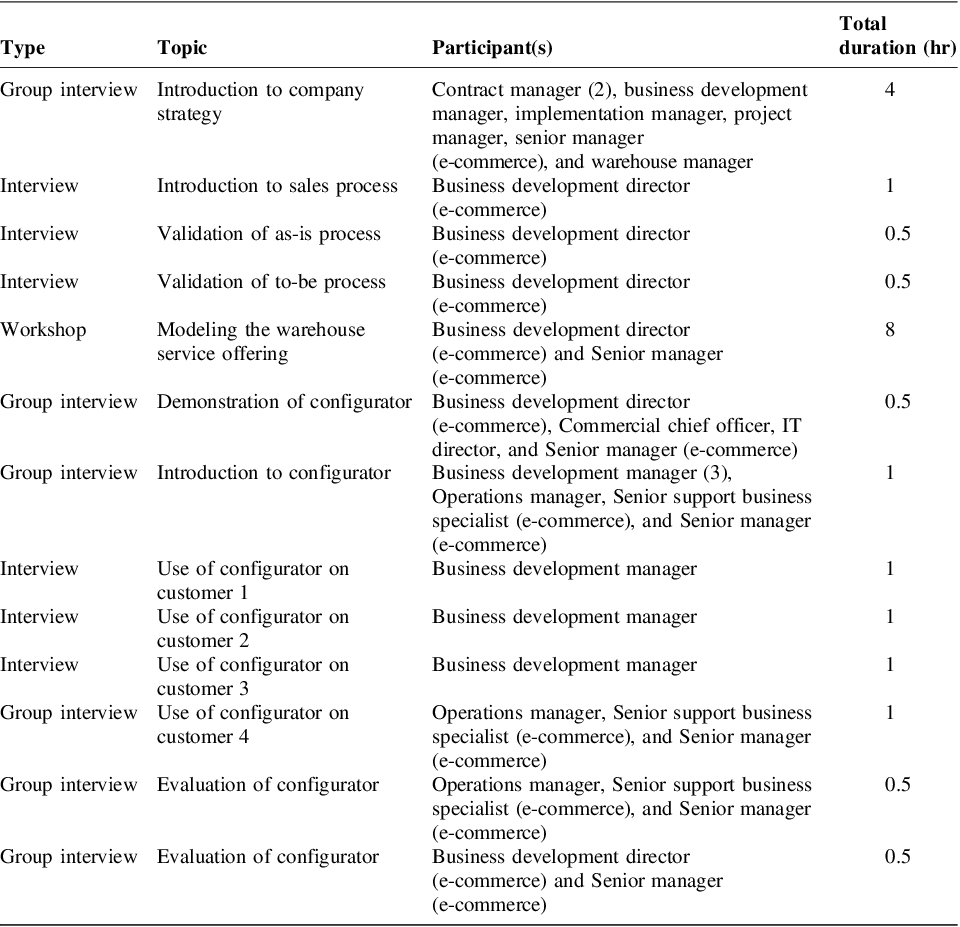
Data was collected through a series of interviews and workshops in the case company (see Table 1) and case material, i.e., presentations describing the company’s strategy and documentation in the sales process. The interviews and workshops were completed over a period of 13 months. Interviews were semi-structured, while workshops included discussions and collaboration between the researchers and the participants.
Interviews and workshops

The configurator was evaluated by assigning three business development managers, also referred to as sales managers, an operations manager, a senior support business specialist (e-commerce), the business development director (e-commerce), and the senior manager (e-commerce) to use the configurator. The evaluation period was initiated with an introductory meeting with the participants to present the POC. Afterwards, three individual meetings of one hour were scheduled with the three business development managers and one meeting with the operations manager, senior support business specialist (e-commerce), and senior manager (e-commerce) to evaluate the configurator with four existing customers. The users were then given one month to freely use the system. Feedback from the business development managers were collected by the business development director of e-commerce, and feedback from the remaining participants was collected by the researchers.
4. Development of proof of concept
4.1. Background
The sales process in the case company was supported by spreadsheets, which had several limitations. The project board showed an interest in digitalizing the sales process but was unfamiliar with configuration systems. The development of a configurator as proof of concept (POC) was initiated to showcase how configuration could support warehouse service design during the sales process. This was carried out by two researchers in close collaboration with the business development director of e-commerce, who is a senior user in the project board, and a senior manager in e-commerce, responsible for warehouse operations in the project.
4.2. As-is and to-be process
The as-is and the to-be processes were mapped in a flow chart to gain an overview of the current process and to identify processes that could be eliminated or replaced by the configurator (see Figure 1). The as-is process is initiated by the customer that contacts the sales manager to receive an offer on warehouse services. They discuss the customers’ requirements, and the sales manager completes a customer questionnaire in a spreadsheet saved locally. The sales manager uses this information to complete the customer validation, also in a spreadsheet saved locally. This validation contains several questions that can be answered with yes or no. Based on these answers, conditional statements determine if an opportunity is either standard, needs assessment, or bespoke. Standard opportunities can be offered the standard e-commerce solution, which the customer can choose to accept or decline. Opportunities that need assessment have minor deviations from the standard solution and need to be assessed by operations to determine if the standard solution still can be offered. Bespoke opportunities continue with the normal sales process in the company.
The as-is and to-be process

Several challenges were apparent from analyzing the as-is process. Firstly, the sales manager must answer the same questions in the customer questionnaire and the customer validation. However, these spreadsheets are not connected. Secondly, the use of spreadsheets is impractical. These are saved locally and need to be distributed by the sales manager. Furthermore, the questionnaires have limited functionality, e.g., in terms of user interface (UI) elements and dynamic fields. Lastly, the customer must provide information multiple times during the sales process, which is time-consuming. This overview showed that the use of both spreadsheets was superfluous. These spreadsheets could be combined, and the subsequent decision could be made from only using the customer questionnaire, thereby eliminating redundancy and reducing the time spent on communicating with the customer. The configurator would replace the customer questionnaire and the decision process (colored blue) as well as eliminate the process of customer validation and both spreadsheets (colored red).
4.3. Modeling the warehouse service offering
The warehouse service offering that was to be incorporated in the configuration system was modeled with an adaptation of the technique, product variant master (PVM), based on the Domain Theory (Reference Andreasen, Howard, Bruun, Blessing and ChakrabartiAndreasen et al., 2014). The model was limited to the customer view, because the POC focused on the features and characteristics in the customer’s interest in the customer questionnaire (see Figure 2). This model follows the terminology of the PVM and consists of a part-of and kind-of structure. Each class consists of attributes in square brackets, a description, and constraints, either expressed as conditional statements or tables. Cardinalities indicate the number of “parts”, e.g., the customer can choose one type of IT integration, either public or customer standard.
First level of part-of classes and one example of kind-of classes

The model was developed with the business development director and senior manager of e-commerce. The starting point of the model was the two spreadsheets. The classes were identified from the customer questionnaire and constraints were found in the customer validation. Essentially, the purpose of the modeling was to connect the two spreadsheets in one overview of the warehouse service offering. Figure 2 has been simplified due to confidentiality and shows the first level of part-of classes and one example of kind-of classes.
4.4. Building the configuration system
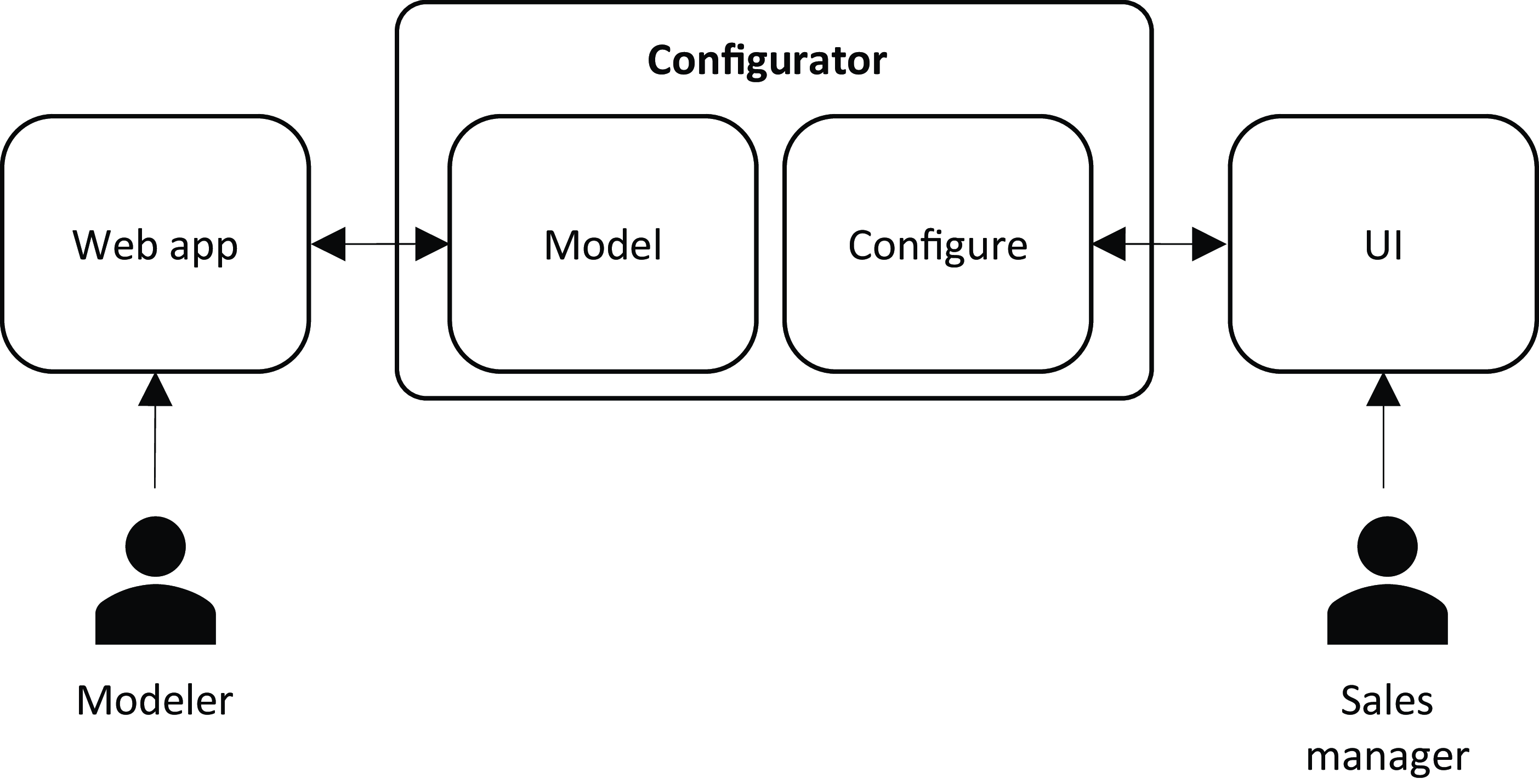
The configurator was built in external configuration software. The software consists of two parts: (1) a model module and (2) a configure module (see Figure 3). The model module is connected to a web application with a graphical user interface (GUI), where the warehouse service offering is modeled and maintained. The configure module is connected to an online UI for the sales manager.
Overview of the configuration system

The system’s interaction with the users is visualized with a use case diagram (see Figure 4). The sales manager opens the UI and selects the scope. The scope includes the build date and the preferred market, which determines what services are available at the given time in the selected market. Based on the scope, the sales manager answers a series of questions to determine which warehouse services the customer requires. Once the customer questionnaire is completed and all mandatory questions are answered, the sales manager can view a summary of the customer data and the result of the validation, i.e., whether the opportunity is standard, bespoke, or needs assessment. This decision is based on the constraints from the model of the warehouse service offering (see Figure 2). This page can then be printed, saved as a PDF file, and sent to implementation managers or operations (see Figure 1). The sales UI is not connected to a database; therefore customer data cannot be saved in the POC. In another web application, the modeler models the warehouse service offering by creating a library with classes, attributes, and constraints and designing the sales UI. It is also in this web application that the modeler maintains the warehouse service offering, e.g., adding or removing services or updating the constraints.
Use case diagram of the configurator

The development of the configurator was an iterative process. Initially, the modeled warehouse service offering was incorporated in the configurator. This was reviewed by the business development director and senior manager of e-commerce and both the model of the warehouse service offering and the configurator were adjusted accordingly.
5. Results
The general feedback of the configurator was that it was user-friendly as questions were structured and organized in sections. There was consensus that this is a favorable approach compared to spreadsheets because the configurator guides the user through a sale, data is up to date, and the configurator is more dynamic. The suggestions for improvements mainly concern the definitions and descriptions in the sales UI.
Based on the tests for four customers and free use of the configurator, the sales managers estimated potential savings of 50-80% in customer communication and 80-90% of errors during the process of customer validation (see Table 2).
Estimated savings based on the POC

1 Depends on the complexity of customer needs.
2 Human errors, such as inconsistencies in information, exclusions, or miscommunication.
The savings in customer communication could be attributed to the improved customer questionnaire. This questionnaire contains all relevant questions to both validate opportunities and determine the warehouse services to offer the customer. Thus, the sales manager will save time on customer communication because questions are more precise, and they are asked at the appropriate time. Likewise, the reduction in errors also relates to the improved customer questionnaire. The questionnaire is based on the model of the warehouse service offering, which contains all service knowledge, and this ensures that important questions are not forgotten during the sales process. Furthermore, the design of the UI is more intuitive because of the sections and features, such as mandatory and dynamic fields, that remind the sales manager of important questions.
6. Discussion and conclusion
This study investigated the development and application of configuration systems to support the sales process of warehouse services. This was done through a POC in a LSP, which was tested by sales managers and operations. The study showed that the warehouse service offerings can be modeled and incorporated into a configuration system. One benefit of this modeling approach concerns the visualization aspect in the sense that model could be used as a tool during meetings and discussions and thus aid the collaborative design. Furthermore, the modeling approach produces an overview, ensuring that services and constraints are connected. The test of the configuration system showed that the configurator is a favorable approach compared to using spreadsheets. Specifically, the evaluation of the configurator showed potential savings of 50-80% in customer communication and 80-90% of errors during the process of customer validation. Thus, the study points to a new application area for configurators, which neither the industry nor academia has given much focus.
One of the major benefits of utilizing a configurator is the enhanced transparency of deliverable services. Warehouse services are customer-specific and are typically designed during the sales process, which is a joint effort between sales managers and the specific warehouse. A sales configurator can bridge the gap by providing warehouse service knowledge to the sales managers. This can enhance collaboration between sales and warehouse operations by reducing both the time spent on the sales process and disagreements arising from uncertainties about service deliverability. Additionally, the GUI for modeling warehouse service offerings allows individuals without programming expertise to use the configurator. Consequently, warehouse employees can maintain the service offering, ensuring that the service portfolio is up to date and that sales managers only sell services that are deliverable.
Several challenges and opportunities for using sales configurators in the warehousing industry were identified during the study. One of the major challenges is the level of service standardization. The participants in the study estimated that only a small number of opportunities fit the standard solution (around 10%). Thus, most opportunities will still be bespoke. These customers will be more challenging because the warehouse service offering must be more extensive. Therefore, future research should focus on developing this offering while balancing customization and standardization. Another challenge related to the development of the sales configurator is the number and formulation of questions. The study showed that it was difficult to determine which questions to ask and when because this depends on the customers’ available data. Furthermore, the questions must be generic, which also relates to the modeling of the warehouse service offering in terms of how customers are described.
One of the opportunities of using sales configurators is increased efficiency, which was evident from the test. The LSP’s ability to service customers faster and with fewer errors could increase customer satisfaction and position the LSP better in the logistics industry. Additionally, this could also enable the LSP to provide offers to a larger number of customers. Furthermore, LSPs can be more competitive in terms of lead time and price if services are more standardized. However, more studies of LSPs are needed to learn more about the general applicability of the service sales configurators. There is a need to understand the possibilities of logistics service standardization better so that adequately extensive service solution spaces can be established. If LSPs succeed in this, the findings of this paper suggest that they would be able to reap significant benefits by using service sales configurators.





 Open access

