Hostname: page-component-77f85d65b8-pztms Total loading time: 0 Render date: 2026-04-14T07:06:03.690Z Has data issue: false hasContentIssue false

How Genomic and Structural Context Could Shape JAK-STAT Variant Pathogenicity

Published online by Cambridge University Press:  31 March 2026

Markus Hoffmann*
Affiliation:
Department of Biochemistry and Molecular & Cellular Biology, Georgetown University Medical Center, Washington, DC, USA
Hye Kyung Lee
Affiliation:
National Institute of Diabetes, Digestive and Kidney Diseases (NIDDK), US National Institutes of Health, Bethesda, MD, USA
*
Corresponding author: Markus Hoffmann; Email: mh2437@georgetown.edu

Abstract

The Janus kinase (JAK)-Signal Transducer and Activator of Transcription (STAT) pathway is essential for cellular signal transduction, regulating immune responses, hematopoiesis, and cell proliferation. Dysregulation of JAK-STAT signaling due to genetic variations, particularly missense mutations, has been implicated in autoimmune disorders, cancers, and hematological malignancies. This study investigates missense mutations in JAK and STAT genes, focusing on disease-associated single nucleotide polymorphisms (SNPs) and ClinVar benign variants identified in the All of Us and COSMIC databases. We analyzed the distribution of these mutations across functional domains, their structural localization, and biochemical properties. We identified mutation hotspots within specific domains, highlighting their correlation with disease phenotypes. Structural mapping revealed that disease-associated SNPs predominantly localize in linker regions and at the boundaries of secondary structures, suggesting a significant impact on folding, stability, and function of JAK and STAT proteins. Additionally, we examined the genomic context of mutations and identified vulnerable sequences; for example, ‘GATC’. Furthermore, our analysis found no predominant association between potential CRISPR-Cas9 target sites and ClinVar benign/disease-associated SNPs. The analysis of amino acid sequence patterns surrounding mutations uncovered an enrichment of hydrophobic residues leucine (Leu), isoleucine (Ile), methionine (Met), and phenylalanine (Phe) in close proximity to disease-associated mutations. Our findings emphasize the importance of structural and biochemical context in determining pathogenicity. In this study, we provide a bioinformatic strategy for refining variant classification and understanding the roles of JAK-STAT pathway mutations in disease.

Information

Type
Article
Creative Commons
Creative Common License - CCCreative Common License - BY
This is an Open Access article, distributed under the terms of the Creative Commons Attribution licence (https://creativecommons.org/licenses/by/4.0/), which permits unrestricted re-use, distribution and reproduction, provided the original article is properly cited.
Copyright
© The Author(s), 2026. Published by Cambridge University Press on behalf of International Society for Twin Studies

The Janus kinase (JAK)-Signal Transducer and Activator of Transcription (STAT) signaling pathway is crucial for gene regulation in common and lineage-specific genetic programs (Suppl. Fig. 1) (Brooks & Putoczki, Reference Brooks and Putoczki2020; X. Hu et al., Reference Hu, Li, Fu, Zhao and Wang2021; Jankowski et al., Reference Jankowski, Lee, Wilflingseder and Hennighausen2021; Lee et al., Reference Lee, Jung and Hennighausen2021; Shillingford, Reference Shillingford2002; Xue et al., Reference Xue, Yao, Gu, Shi, Yuan, Chu, Bao, Lu and Li2023). Four known JAKs (JAK1, JAK2, JAK3, and TYK2) and seven STATs (STAT1, STAT2, STAT3, STAT4, STAT5A, STAT5B, and STAT6) collectively form the JAK and STAT gene families. The members of these gene families have crucial functions such as immune modulation, cell proliferation, and hematopoiesis (Brooks & Putoczki, Reference Brooks and Putoczki2020; X. Hu et al., Reference Hu, Li, Fu, Zhao and Wang2021; Lee et al., Reference Lee, Jung and Hennighausen2021; Xue et al., Reference Xue, Yao, Gu, Shi, Yuan, Chu, Bao, Lu and Li2023). The JAK and STAT genes carry mutations, such as single nucleotide polymorphisms (SNPs), representing the most prevalent form of genetic variation among individuals (L. X. Shen et al., Reference Shen, Basilion and Stanton1999). These variations are characterized based on their genomic location and/or their potential influence on gene expression or function (Chu & Wei, Reference Chu and Wei2019). In noncoding regions, such as promoters and enhancers, SNPs can play essential roles in gene regulation (Hecker et al., Reference Hecker, Lauber, Behjati Ardakani, Ashrafiyan, Manz, Kersting, Hoffmann, Schulz and List2023; Hoffmann et al., Reference Hoffmann, Trummer, Schwartz, Jankowski, Lee, Willruth, Lazareva, Yuan, Baumgarten, Schmidt, Baumbach, Schulz, Blumenthal, Hennighausen and List2023, Reference Hoffmann, Vaz, Chhatrala and Hennighausen2025; Lee et al., Reference Lee, Willi, Shin, Liu and Hennighausen2018; Peña-Martínez & Rodríguez-Martínez, Reference Peña-Martínez and Rodríguez-Martínez2024). Within coding regions, SNPs are further classified into synonymous variants, which preserve the amino acid sequence and are functionally silent and evolutionarily neutral, and nonsynonymous (missense) variants, which change amino acids and can influence protein structure and/or function (Chu & Wei, Reference Chu and Wei2019; Lio et al., Reference Lio, Düz, Hoffmann, Willruth, Baumbach, List and Tsoy2025; Tsoy et al., Reference Tsoy, Ameling, Franzenburg, Hoffmann, Liv-Willuth, Lee, Knabl, Furth, Voelker, Hennighausen, Baumbach, Kacprowski and List2024). It is well established that dysregulation of the JAK and STAT genes, through amino acid changes and altered regulatory element activity, can cause diverse pathophysiological outcomes such as autoimmune diseases, cancer, and infectious diseases (Erdogan et al., Reference Erdogan, Qadree, Radu, Orlova, de Araujo, Israelian, Valent, Mustjoki, Herling, Moriggl and Gunning2022; Hennighausen & Lee, Reference Hennighausen and Lee2020; Hoffmann, Willruth et al., Reference Hoffmann, Willruth, Dietrich, Lee, Knabl, Trummer, Baumbach, Furth, Hennighausen and List2024). Missense mutations drive functional changes of proteins by altering protein stability, disrupting protein-protein interactions, or compromising enzymatic functions, thus serving as potent drivers of disease (Teng et al., Reference Teng, Srivastava, Schwartz, Alexov and Wang2010).

Some mutations on JAK and STAT genes frequently lead to constitutive activation of the JAK-STAT pathway, a hallmark of various hematological malignancies. A well-known example is the JAK2Val617Phe/V617F mutation, which is highly prevalent in myeloproliferative neoplasms, occurring in approximately 90–95% of polycythemia vera (PV) cases and 50–60% of individuals with essential thrombocythemia and primary myelofibrosis (Perner et al., Reference Perner, Perner, Ernst and Heidel2019; Rampal et al., Reference Rampal, Al-Shahrour, Abdel-Wahab, Patel, Brunel, Mermel, Bass, Pretz, Ahn, Hricik, Kilpivaara, Wadleigh, Busque, Gilliland, Golub, Ebert and Levine2014). This gain-of-function mutation enhances JAK-STAT signaling even in the absence of cytokine stimulation, thereby driving uncontrolled cell proliferation and survival. Similarly, activating mutations in JAK1 and JAK3 have been identified in T-cell acute lymphoblastic leukemia (T-ALL), where they contribute to persistent JAK-STAT pathway activation (Girardi et al., Reference Girardi, Vereecke, Sulima, Khan, Fancello, Briggs, Schwab, de Beeck, Verbeeck, Royaert, Geerdens, Vicente, Bornschein, Harrison, Meijerink, Cools, Dinman, Kampen and De Keersmaecker2018; Waldmann, Reference Waldmann2017). Beyond hematological malignancies, dysregulation of the JAK-STAT pathway has been implicated in solid tumors and autoimmune diseases, underscoring its broader significance in human pathology (Łączak et al., Reference Łączak, Kuczyńska, Grygier, Andrzejewska, Grochowska, Gulaczyk and Lewandowski2022; O’Shea et al., Reference O’Shea, Schwartz, Villarino, Gadina, McInnes and Laurence2015). Mutations in STAT3, for instance, are linked to increased tumor invasiveness and poor clinical outcomes across multiple cancer types (Deng et al., Reference Deng, Li, Li, Mao, Ke, Liang, Lei, Lau and Mao2022; Klein et al., Reference Klein, Stoiber, Sexl and Witalisz-Siepracka2021).

In our previous work (Hoffmann & Hennighausen, Reference Hoffmann and Hennighausen2025), we conducted a large-scale survey of missense mutations within the JAK and STAT genes across two major repositories — the All of Us database (The All of Us Research Program Genomics Investigators et al., Reference Bick, Metcalf, Mayo, Lichtenstein, Rura, Carroll, Musick, Linder, Jordan, Nagar, Sharma, Meller, Basford, Boerwinkle, Cicek, Doheny, Eichler and Gabriel2024), which captures a broad range of genetic variation from the general but mostly healthy population in the United States, and the COSMIC (Bamford et al., Reference Bamford, Dawson, Forbes, Clements, Pettett, Dogan, Flanagan, Teague, Futreal, Stratton and Wooster2004; Sondka et al., Reference Sondka, Dhir, Carvalho-Silva, Jupe, McLaren, Starkey, Ward, Wilding, Ahmed, Argasinska, Beare, Chawla, Duke, Fasanella, Neogi, Haller, Hetenyi, Hodges and Teague2024) database, a leading resource for somatic mutations in cancer. Our investigation identified hundreds of unique amino acid–changing variants, some of which had been reported as disease-associated. This analysis provided a resource cataloging the breadth and frequency of missense mutations in JAK-STAT genes. Building on these findings, this study aims to focus explicitly on the identified disease-causing (by literature) SNPs and ClinVar (Landrum et al., Reference Landrum, Lee, Riley, Jang, Rubinstein, Church and Maglott2014) benign/likely benign SNPs and their distribution among specific functional domains of JAK and STAT proteins. We assess whether certain functional domains are more frequently affected and how these mutations correlate with disease. By mapping the structural distribution of disease-associated SNPs, we determine whether they predominantly occur on the protein surface or within its core. Additionally, we analyze specific target sequences, CRISPR target proximity, and amino acid composition patterns to identify shared vulnerabilities between disease-causing and ClinVar benign SNPs that may explain why specific regions are more mutation- or disease-prone.

Materials and Methods

All of Us Data Explorer

The All of Us Research Program gathers health and genomic data from participants residing in the U.S. We accessed the All of Us Controlled Tier Dataset v7 (All of Us Research Program Genomics Investigators et al., Reference Bick, Metcalf, Mayo, Lichtenstein, Rura, Carroll, Musick, Linder, Jordan, Nagar, Sharma, Meller, Basford, Boerwinkle, Cicek, Doheny, Eichler and Gabriel2024) (encompassing 413,000 participants) through the Data Browser to examine SNPs. We focused on missense mutations in the JAK-STAT gene families, specifically SNPs that alter amino acids, and we analyzed their frequency across various demographic groups. All data were anonymized according to program protocols. In accordance with All of Us guidelines, we included only missense mutations (excluding all other SNP types) identified in at least 20 participants and previously associated with a disease in the literature. The cut-off of 20 is dictated by the policy of All of Us due to privacy concerns. We focused only on missense mutations because they change one amino acid to another and therefore could have a significant impact on protein function (Pal & Moult, Reference Pal and Moult2015).

COSMIC (Catalogue of Somatic Mutations in Cancer)

The Catalogue of Somatic Mutations in Cancer (COSMIC) database (https://cancer.sanger.ac.uk/cosmic; Bamford et al., Reference Bamford, Dawson, Forbes, Clements, Pettett, Dogan, Flanagan, Teague, Futreal, Stratton and Wooster2004; Sondka et al., Reference Sondka, Dhir, Carvalho-Silva, Jupe, McLaren, Starkey, Ward, Wilding, Ahmed, Argasinska, Beare, Chawla, Duke, Fasanella, Neogi, Haller, Hetenyi, Hodges and Teague2024) tracks somatic mutations identified in cancer. Using COSMIC v100 (>1,000,000 tumor samples), we examined missense mutations in the JAK-STAT pathway, focusing on those found in cancer samples. COSMIC details the mutational spectrum, tissue distribution, and associated cancers for each SNP, enabling direct comparison with findings from the All of Us cohort. We extracted mutations using COSMIC’s online tools, filtering by mutation type. For each SNP, we noted the number of samples carrying the mutation and referenced disease associations from existing literature. To align with the All of Us approach, we included only missense mutations (excluding all other SNP types) present in at least 20 tumor samples and that were previously associated with a disease in the literature. We used the cut-off of 20 as dictated by the policy of All of Us due to privacy concerns to have a consistent filter between the two databases.

Obtaining SNPs That are Disease-Associated in the Published Literature and SNPs Classified as Benign in ClinVar

We used the identified SNPs and literature from Hoffmann and Hennighausen (Reference Hoffmann and Hennighausen2025). We used the Athena – OHDSI Vocabularies Repository database (https://athena.ohdsi.org/search-terms/start) to generalize disease terms (Figure 1, Suppl. Table 1) (Reich et al., Reference Reich, Ostropolets, Ryan, Rijnbeek, Schuemie, Davydov, Dymshyts and Hripcsak2024).

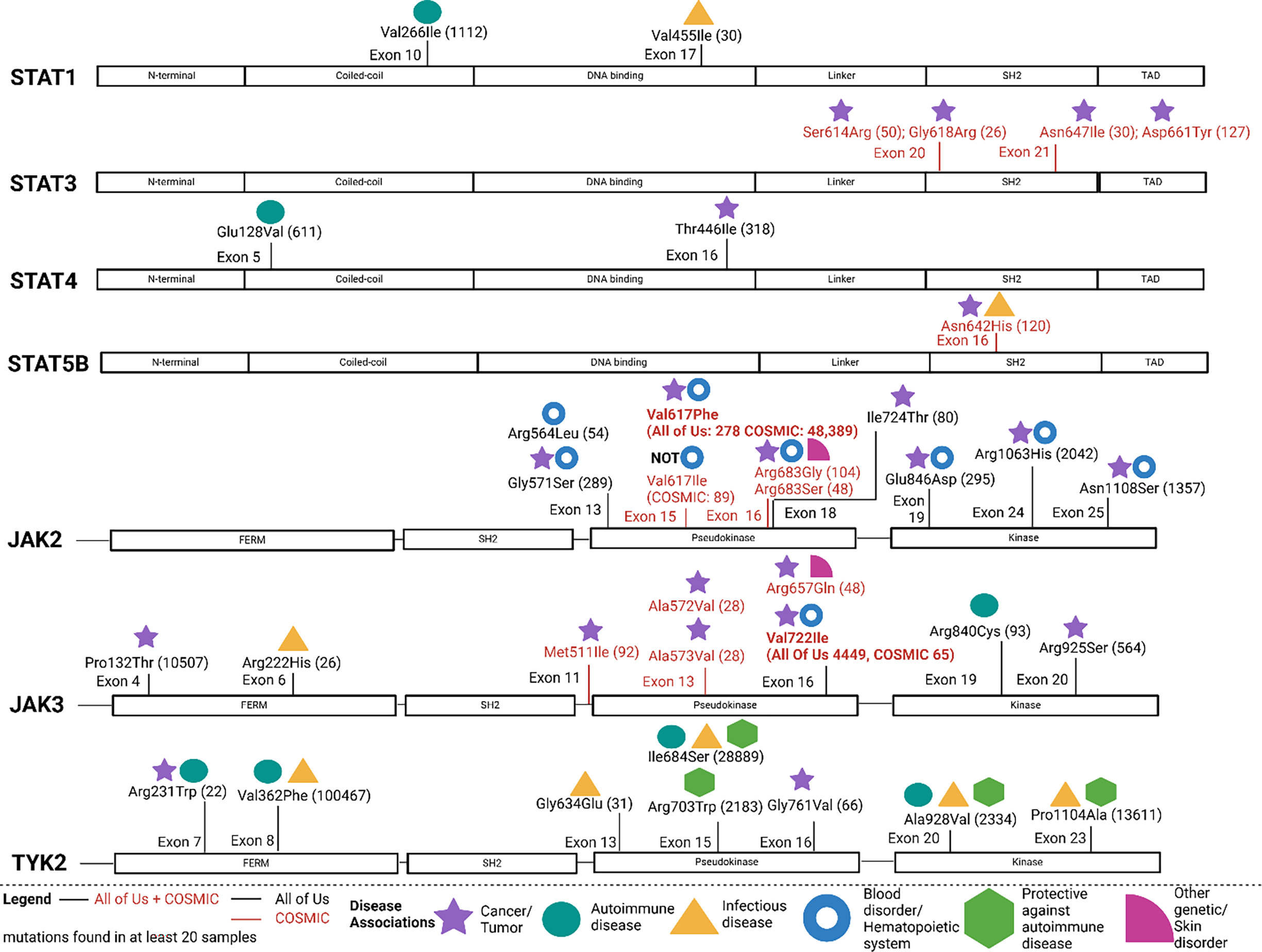
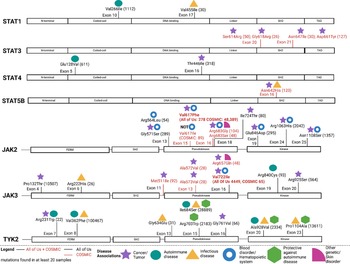
Figure 1. Domain-specific distribution of missense mutations in JAK and STAT proteins and their associations with disease. The schematic representation of JAK (JAK2, JAK3, TYK2) and STAT (STAT1, STAT3, STAT4, STAT5B) proteins highlights the locations of missense mutations identified in the All of Us and COSMIC databases. Symbols indicate disease associations, including autoimmune diseases (turquoise circles), cancer/tumor (purple stars), infectious diseases (yellow triangles), blood disorders/hematopoietic system involvement (blue donuts), protective mutations against autoimmunity (green hexagons), and other genetic disorder order skin disorder (dark pink quarter of a circle). Mutations found in at least 20 individuals are labeled, with mutations found in All of Us (black font) or COSMIC (red font) and mutations found in All of Us and COSMIC are highlighted in bold red. This visualization provides insight into mutation clustering within functional domains. Protein domains are annotated as follows: STAT proteins include the N-terminal, coiled-coil, DNA-binding, linker, Src homology 2 (SH2), and transactivation (TAD) domains, while JAK proteins include the FERM (For protein 4.1, Ezrin, Radixin, and Moesin), SH2, pseudokinase, and kinase domains.
We used the NCBI Entrez E-utilities API (https://eutils.ncbi.nlm.nih.gov/entrez/eutils/esearch.fcgi, with parameter “db”: “clinvar”) to filter all missense mutations from All of Us and COSMIC for only mutations categorized as benign by ClinVar.

The Python code can be found at GitHub: https://github.com/Firestar93/JAKSTAT_missenseSNPs_properties

Enzyme Cut Sites and CRISPR Sites on the Nucleotide Sequence and Amino Acid Composition Analysis on the Amino Acid Sequences

We downloaded the mRNA sequences from the CCDS database (Farrell et al., Reference Farrell, O’Leary, Harte, Loveland, Wilming, Wallin, Diekhans, Barrell, Searle, Aken, Hiatt, Frankish, Suner, Rajput, Steward, Brown, Bennett, Murphy, Wu and Pruitt2014; Harte et al., Reference Harte, Farrell, Loveland, Suner, Wilming, Aken, Barrell, Frankish, Wallin, Searle, Diekhans, Harrow and Pruitt2012; Pruitt et al., Reference Pruitt, Harrow, Harte, Wallin, Diekhans, Maglott, Searle, Farrell, Loveland, Ruef, Hart, Suner, Landrum, Aken, Ayling, Baertsch, Fernandez-Banet, Cherry, Curwen and Lipman2009; Pujar et al., Reference Pujar, O’Leary, Farrell, Loveland, Mudge, Wallin, Girón, Diekhans, Barnes, Bennett, Berry, Cox, Davidson, Goldfarb, Gonzalez, Hunt, Jackson, Joardar, Kay and Pruitt2018) for the following genes: STAT1 (CCDS2309.1), STAT3 (CCDS32656.1), STAT4 (CCDS2310.1), STAT5B (CCDS11423.1), JAK2 (CCDS6457.1), JAK3 (CCDS12366.1), and TYK2 (CCDS12236.1).

We used a house-made Python script to detect enzyme cut sites (using the Biopython package, specifically the Bio. Restriction module (Cock et al., Reference Cock, Antao, Chang, Chapman, Cox, Dalke, Friedberg, Hamelryck, Kauff, Wilczynski and de Hoon2009)) and the following CRISPR-Cas sites: SpCas9 recognizes the 5“-NGG-3” sequence, while SaCas9 targets 5“-NNGRRT-3”. NmCas9 requires the 5“-NNNNGATT-3” PAM, and St1Cas9 recognizes 5“-NNAGAAW-3”. Similarly, St3Cas9 targets 5“-NGGNG-3”, and CjCas9 recognizes the 5“-NNNNACA-3” sequence. FnCas9 operates with a 5“-YG-3” PAM, whereas TdCas9 exhibits specificity for 5“-NAAAW-3”. SpCas9-NG (SpG) has a relaxed PAM requirement of 5“-NG-3”, broadening its targeting scope. Lastly, SpRY functions as a near-PAM-less variant, with a preference for NRN sequences. To associate enzyme sites and CRISPR sites to a mutation, we stretch a window of 20 bps in each direction of the mutation since it was reported that 20 bps ensures that any potential restriction sites are adequately captured (Wang, Reference Wang2018). We used the UpSet Python library for visualizations (Lex et al., Reference Lex, Gehlenborg, Strobelt, Vuillemot and Pfister2014).

We used house-made Python scripts to detect amino acid combinations close (3 amino acids upstream and downstream) to ClinVar benign and disease-associated mutations using the Biopython package.

The code can be found at GitHub: https://github.com/Firestar93/JAKSTAT_missenseSNPs_properties

Visualization of the Protein Structures

We used the ChimeraX tool for the visualization of the protein structures (Goddard et al., Reference Goddard, Huang, Meng, Pettersen, Couch, Morris and Ferrin2018; Meng et al., Reference Meng, Goddard, Pettersen, Couch, Pearson, Morris and Ferrin2023; Ucsf Chimerax Pettersen et al., Reference Pettersen, Goddard, Huang, Meng, Couch, Croll, Morris and Ferrin2021). We used ALPHAFOLD MONOMER V2.0 (Jumper et al., Reference Jumper, Evans, Pritzel, Green, Figurnov, Ronneberger, Tunyasuvunakool, Bates, Žídek, Potapenko, Bridgland, Meyer, Kohl, Ballard, Cowie, Romera-Paredes, Nikolov, Jain, Adler and Hassabis2021) predicted structures for the following proteins: STAT1 (AF-P42224-F1-model_v4), STAT3 (AF-P40763-F1-model_v4), STAT4 (AF-Q14765-F1-model_v4), STAT5B (AF-P51692-F1-model_v4), JAK2 (AF-O60674-F1-model_v4), JAK3 (AF-P52333-F1-model_v4), and TYK2 (AF-P29597-F1-model_v4). ChimeraX files for interactive visualization can be found at figshare: https://doi.org/10.6084/m9.figshare.28597121.

Results

To better understand the characteristics of JAK and STAT mutations in terms of their location within the nucleotide and amino acid sequence, we focused on their distribution across protein domains and disease associations for STAT1, STAT3, STAT4, STAT5B, JAK2, JAK3, and TYK2. We could not identify any missense variants in STAT2, STAT5A, STAT6, and JAK1 that satisfied the All of Us requirements of at least 20 individuals harboring them. We identified domains particularly susceptible to disease-related alterations. We further assessed where they are located to evaluate their effects on protein structure and stability. Beyond structural localization, we analyzed the genomic context of these mutations, examining their proximity to specific feasible sequences and CRISPR target sites to assess potential regulatory influences and editing feasibility. Finally, we investigated conserved amino acid sequence patterns near disease-associated mutations to identify motifs contributing to mutation susceptibility.

Mutation Hotspots in JAK-STAT Proteins and Their Disease Relevance

We visualized mutations that were disease-associated with autoimmune disease, cancer, chronic disease, etc. (Figure 1, Suppl. Table 1) and ClinVar benign (Suppl. Fig. 2) from the All of Us and COSMIC database and investigated distinct patterns in the distribution of disease-associated SNPs across JAK and STAT proteins to highlight specific domains linked to various diseases. Autoimmune disorders were mainly associated with mutations in the coiled-coil domains of STAT1 (Uzel et al., Reference Uzel, Sampaio, Lawrence, Hsu, Hackett, Dorsey, Noel, Verbsky, Freeman, Janssen, Bonilla, Pechacek, Chandrasekaran, Browne, Agharahimi, Gharib, Mannurita, Yim, Gambineri and Holland2013) and STAT4 (Saevarsdottir et al., Reference Saevarsdottir, Stefansdottir, Sulem, Thorleifsson, Ferkingstad, Rutsdottir, Glintborg, Westerlind, Grondal, Loft, Sorensen, Lie, Brink, Ärlestig, Arnthorsson, Baecklund, Banasik, Bank and Bjorkman2022) critical for dimerization and transcriptional activity. In contrast, cancer-related mutations were predominantly found in the SH2 domains of STAT3 (Cheon et al., Reference Cheon, Xing, Moosic, Ung, Chan, Chung, Toro, Elghawy, Wang, Hamele, Hardison, Olson, Tan, Feith, Ratan and Loughran2022; D. Kim et al., Reference Kim, Park, Huuhtanen, Ghimire, Rajala, Moriggl, Chan, Kankainen, Myllymäki and Mustjoki2021; Kristensen et al., Reference Kristensen, Larsen, Rewes, Frederiksen, Thomassen and Møller2014; Olson et al., Reference Olson, Moosic, Jones, Larkin, Olson, Toro, Fox, Feith and Loughran2020; Ramsey et al., Reference Ramsey, Sabatini, Watson, Chawla, Ko and Sakhdari2023; Rivero et al., Reference Rivero, Mozas, Jiménez, López-Guerra, Colomer, Bataller, Correa, Rivas-Delgado, Bastidas, Baumann, Martínez-Trillos, Delgado, Giné, Campo, López-Guillermo, Villamor, Magnano and Matutes2021; M. Shen, Reference Shen2023; Yan et al., Reference Yan, Olson, Nyland, Feith and Loughran2015) and STAT5B (Freiche et al., Reference Freiche, Couronné, Bruneau and Hermine2022; Z. Hu et al., Reference Hu, Medeiros, Xu, Yuan, Peker, Shao, Tang, Mai, Thakral, Rios, Hu and Wang2023; Yin et al., Reference Yin, Tam, Walker, Kaur, Ouseph, Xie, Weinberg, Li, Zuo, Routbort, Chen, Medeiros, George, Orazi, Arber, Bagg, Hasserjian and Wang2023), suggesting that alterations in these key signaling interfaces contribute to tumorigenesis. Hematological malignancies and blood disorders are strongly associated with SNPs in the Pseudokinase (Arai et al., Reference Arai, Yoshimitsu, Otsuka, Ito, Miyazono, Nakano, Obama, Nakashima, Hanada, Owatari, Nakamura, Tokunaga, Kamada, Utsunomiya, Haraguchi, Hayashida, Fujino, Odawara, Tabuchi and Ishitsuka2023; Delio et al., Reference Delio, Bryke, Mendez, Joseph and Jassim2023; Eichstaedt et al., Reference Eichstaedt, Verweyen, Halank, Benjamin, Fischer, Mayer, Guth, Wiedenroth, Egenlauf, Harutyunova, Xanthouli, Marra, Wilkens, Ewert, Hinderhofer and Grünig2020; Haji Paiman et al., Reference Haji Paiman, Mat Nasir, Miptah, Saidon and Abdul Monir2024; Krah et al., Reference Krah, Miotke, Li, Patel, Bowen, Pomicter and Patel2023; Panovska-Stavridis et al., Reference Panovska-Stavridis, Eftimov, Ivanovski, Pivkova-Veljanovska, Cevreska, Hermouet and Dimovski2016) and kinase (Kapralova et al., Reference Kapralova, Horvathova, Pecquet, Fialova Kucerova, Pospisilova, Leroy, Kralova, Milosevic Feenstra, Schischlik, Kralovics, Constantinescu and Divoky2016; Maaziz et al., Reference Maaziz, Garrec, Airaud, Bobée, Contentin, Cayssials, Rimbert, Aral, Bézieau, Gardie and Girodon2023; Tun et al., Reference Tun, Buka, Graham and Dyer2022) domains of JAK2, regions essential for modulating JAK-STAT signaling. We can also observe a plethora of literature associating the JAK2 Pseudokinase (Bahar et al., Reference Bahar, Barton and Kini2016; Bourrienne et al., Reference Bourrienne, Loyau, Faille, Gay, Akhenak, Farkh, Ollivier, Solonomenjanahary, Dupont, Choqueux, Villeval, Plo, Edmond, Ho-Tin-Noé, Ajzenberg and Mazighi2024; Carreño-Tarragona et al., Reference Carreño-Tarragona, Varghese, Sebastián, Gálvez, Marín-Sánchez, López-Muñoz, Nam-Cha, Martínez-López, Constantinescu, Sevilla and Ayala2021; Choi et al., Reference Choi, Messali, Uda, Abu-Zeinah, Kermani, Yabut, Lischer, Castillo Tokumori, Erdos, Lehmann, Sobas, Rao and Scandura2024; Gupta, Varma, Kumar et al., Reference Gupta, Varma, Kumar, Naseem, Sachdeva, Sreedharanunni, Binota, Bose, Khadwal, Malhotra and Varma2023; Gupta, Varma, Sreedharanunni et al., Reference Gupta, Varma, Sreedharanunni, Abdulkadir, Naseem, Sachdeva, Binota, Bose, Malhotra, Khadwal and Varma2023; Hassan et al., Reference Hassan, Abdellateif, Radwan, Hameed, Desouky, Kamel and Gameel2022; Krah et al., Reference Krah, Miotke, Li, Patel, Bowen, Pomicter and Patel2023; Lin et al., Reference Lin, Nebral, Gertzen, Ganmore, Haas, Bhatia, Fischer, Kuhlen, Gohlke, Izraeli, Trka, Hu, Borkhardt, Hauer and Auer2019; Mambet et al., Reference Mambet, Babosova, Defour, Leroy, Necula, Stanca, Tatic, Berbec, Coriu, Belickova, Kralova, Lanikova, Vesela, Pecquet, Saussoy, Havelange, Diaconu, Divoky and Constantinescu2018; Pace et al., Reference Pace, Guadagno, Russo, Gencarelli, Carlea, Di Spiezio, Bertuzzi, Mascolo, Grimaldi and Insabato2023; Patchell et al., Reference Patchell, Keohane, O’Shea and Langabeer2024; Puli’uvea et al., Reference Puli’uvea, Immanuel, Green, Tsai, Shepherd and Kalev-Zylinska2024; Roncero et al., Reference Roncero, López-Nieva, Cobos-Fernández, Villa-Morales, González-Sánchez, López-Lorenzo, Llamas, Ayuso, Rodríguez-Pinilla, Arriba, Piris, Fernández-Navarro, Fernández, Fraga, Santos and Fernández-Piqueras2016; Schulze et al., Reference Schulze, Stengel, Jaekel, Wang, Franke, Roskos, Schneider, Niederwieser and Al-Ali2019; Skoczen et al., Reference Skoczen, Stepien, Mlynarski, Centkowski, Kwiecinska, Korostynski, Piechota, Wyrobek, Moryl-Bujakowska, Strojny, Rej, Kowalczyk and Balwierz2020; Veitia & Innan, Reference Veitia and Innan2022; R. Z. Xu et al., Reference Xu, Karsan, Xu and Berry2022; Yongchao Zhang et al., Reference Zhang, Zhao, Liu, Zhang and Zhang2024) and kinase (Benton et al., Reference Benton, Boddu, DiNardo, Bose, Wang, Assi, Pemmaraju, Kc, Pierce, Patel, Konopleva, Ravandi, Garcia-Manero, Kadia, Cortes, Kantarjian, Andreeff and Verstovsek2019; Kapralova et al., Reference Kapralova, Horvathova, Pecquet, Fialova Kucerova, Pospisilova, Leroy, Kralova, Milosevic Feenstra, Schischlik, Kralovics, Constantinescu and Divoky2016; Mambet et al., Reference Mambet, Babosova, Defour, Leroy, Necula, Stanca, Tatic, Berbec, Coriu, Belickova, Kralova, Lanikova, Vesela, Pecquet, Saussoy, Havelange, Diaconu, Divoky and Constantinescu2018; Schulze et al., Reference Schulze, Stengel, Jaekel, Wang, Franke, Roskos, Schneider, Niederwieser and Al-Ali2019) domains to cancer. Similarly, cancer-related mutations were frequently observed in the Pseudokinase domain of JAK3 (Agarwal et al., Reference Agarwal, MacKenzie, Eide, Davare, Watanabe-Smith, Tognon, Mongoue-Tchokote, Park, Braziel, Tyner and Druker2015; Bergmann et al., Reference Bergmann, Schneppenheim, Seifert, Betts, Haake, Lopez, Maria Murga Penas, Vater, Jayne, Dyer, Schrappe, Dührsen, Ammerpohl, Russell, Küppers, Dürig and Siebert2014; Bouchekioua et al., Reference Bouchekioua, Scourzic, de Wever, Zhang, Cervera, Aline-Fardin, Mercher, Gaulard, Nyga, Jeziorowska, Douay, Vainchenker, Louache, Gespach, Solary and Coppo2014; de Martino et al., Reference de Martino, Gigante, Cormio, Prattichizzo, Cavalcanti, Gigante, Ariano, Netti, Montemurno, Mancini, Battaglia, Gesualdo, Carrieri and Ranieri2013; Ehrentraut et al., Reference Ehrentraut, Schneider, Nagel, Pommerenke, Quentmeier, Geffers, Feist, Kaufmann, Meyer, Kadin, Drexler and MacLeod2016; Koo et al., Reference Koo, Tan, Tang, Poon, Allen, Tan, Chong, Ong, Tay, Tao, Quek, Loong, Yeoh, Yap, Lee, Lim, Tan, Goh, Cutcutache and Lim2012; Rivera-Munoz et al., Reference Rivera-Munoz, Laurent, Siret, Lopez, Ignacimouttou, Cornejo, Bawa, Rameau, Bernard, Dessen, Gilliland, Mercher and Malinge2018; Sato et al., Reference Sato, Toki, Kanezaki, Xu, Terui, Kanegane, Miura, Adachi, Migita, Morinaga, Nakano, Endo, Kojima, Kiyoi, Mano and Ito2008; Sim et al., Reference Sim, Kim, Kim, Jeon, Nam, Ahn, Keam, Park, Kim, Kim and Heo2017; L. Xu et al., Reference Xu, Wilson, Laetsch, Oliver, Spunt, Hawkins and Skapek2016), reinforcing its role in malignant transformation. Infectious diseases, on the other hand, appeared to be linked to mutations in the FERM domain of JAK3 (Zhong et al., Reference Zhong, Wang, Ma, Gou, Tang and Song2017), the DNA binding domain of STAT1 (Uzel et al., Reference Uzel, Sampaio, Lawrence, Hsu, Hackett, Dorsey, Noel, Verbsky, Freeman, Janssen, Bonilla, Pechacek, Chandrasekaran, Browne, Agharahimi, Gharib, Mannurita, Yim, Gambineri and Holland2013), and all over TYK2 (Kerner et al., Reference Kerner, Laval, Patin, Boisson-Dupuis, Abel, Casanova and Quintana-Murci2021, Reference Kerner, Ramirez-Alejo, Seeleuthner, Yang, Ogishi, Cobat, Patin, Quintana-Murci, Boisson-Dupuis, Casanova and Abel2019; Ogishi et al., Reference Ogishi, Arias, Yang, Han, Zhang, Rinchai, Halpern, Mulwa, Keating, Chrabieh, Lainé, Seeleuthner, Ramírez-Alejo, Nekooie-Marnany, Guennoun, Muller-Fleckenstein, Fleckenstein, Kilic, Minegishi and Boisson-Dupuis2022), which play a crucial role in cytokine receptor binding and immune response regulation. Interestingly, mutations were associated with autoimmunity (Li et al., Reference Li, Gakovic, Ragimbeau, Eloranta, Rönnblom, Michel and Pellegrini2013; López-Isac et al., Reference López-Isac, Campillo-Davo, Bossini-Castillo, Guerra, Assassi, Simeón, Carreira, Ortego-Centeno, García de la Peña, Beretta, Santaniello, Bellocchi, Lunardi, Moroncini, Gabrielli, Riemekasten, Witte, Hunzelmann and Martín2016; Motegi et al., Reference Motegi, Kochi, Matsuda, Kubo, Yamamoto and Momozawa2019) and protective against autoimmunity (Diogo et al., Reference Diogo, Bastarache, Liao, Graham, Fulton, Greenberg, Eyre, Bowes, Cui, Lee, Pappas, Kremer, Barton, Coenen, Franke, Kiemeney, Mariette, Richard-Miceli, Canhão and Plenge2015; Enerbäck et al., Reference Enerbäck, Sandin, Lambert, Zawistowski, Stuart, Verma, Tsoi, Nair, Johnston and Elder2018; Jensen et al., Reference Jensen, Attfield, Feldmann and Fugger2023; Motegi et al., Reference Motegi, Kochi, Matsuda, Kubo, Yamamoto and Momozawa2019) in TYK2, suggesting that variations in these regions may provide resilience against autoimmune diseases, which is an ongoing field of study (Molitor et al., Reference Molitor, Hayashi, Lin, Dunn, Peterson, Poston, Kurnellas, Traver, Patel, Akgungor, Leonardi, Lewis, Segales, Bennett, Truong, Dani, Naphade, Wong, McDermott and Rassoulpour2025; Syed et al., Reference Syed, Ballew, Lee, Rana, Krishnan, Castela, Weaver, Chalasani, Thomaidou, Demine, Chang, Coomans de Brachène, Alvelos, Vazquez, Marselli, Orr, Felton, Liu, Kaddis and Evans-Molina2025).

Examining the Relationship Between Structural Alterations in JAK-STAT Proteins and the Pathogenic Potential of Mutations

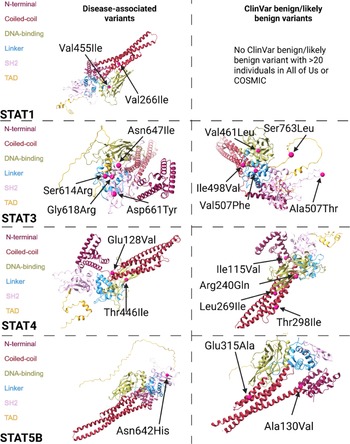
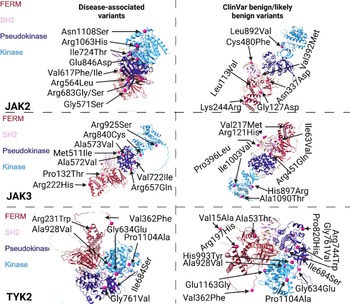
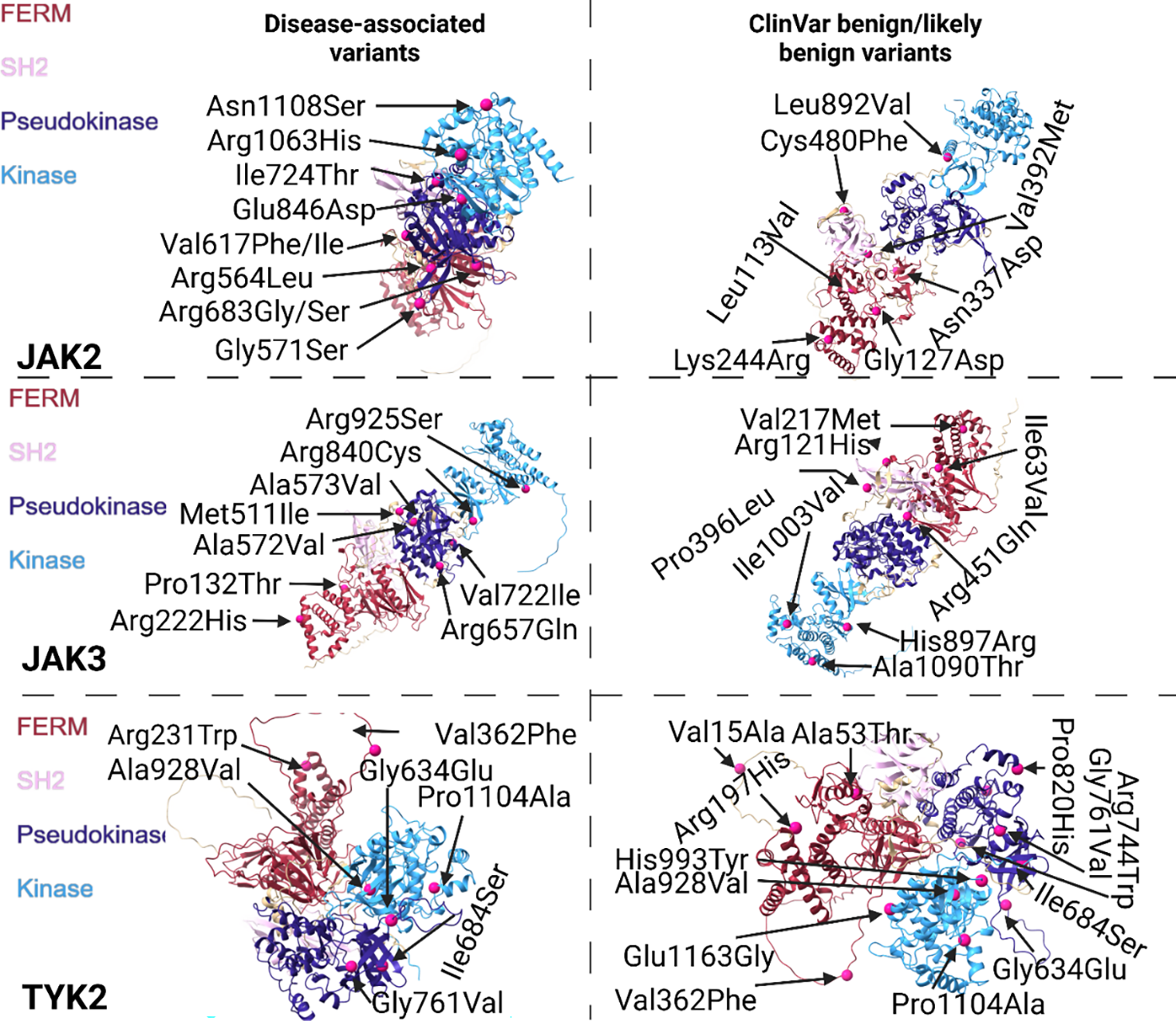
Next, we investigated the protein structure using the AlphaFold3 AI-predicted model to determine where the mutations impact structural alterations. We observed that disease-associated SNPs were more frequently found in linker regions connecting secondary structural elements, such as between alpha helices and beta sheets. When these mutations occurred within an alpha helix or beta sheet, they were predominantly located at the boundary of the structure, with only rare occurrences in the middle (Figure 2, Figure 3). This suggests that mutations in transition regions may have a more significant impact on protein dynamics and function, potentially altering folding, stability, or interactions with other molecules. In contrast, benign mutations were more often embedded within well-defined secondary structures, but rarely in linker regions. Furthermore, we observed that disease-associated mutations were predominantly located within the interior of the protein’s 3D structure, suggesting that these variants may impact structural integrity or disrupt key protein-protein interactions. Conversely, benign mutations were more commonly found on surface-exposed regions of the protein (i.e., an amino acid that faces the outside of the protein) (Suppl. Fig. 3).

Figure 2. Structural analysis of disease-associated and ClinVar benign missense variants in the STAT proteins. The panel illustrates the secondary structure localization of disease-associated (left) and benign/likely benign (right) mutations mapped onto AlphaFold predicted protein structures.
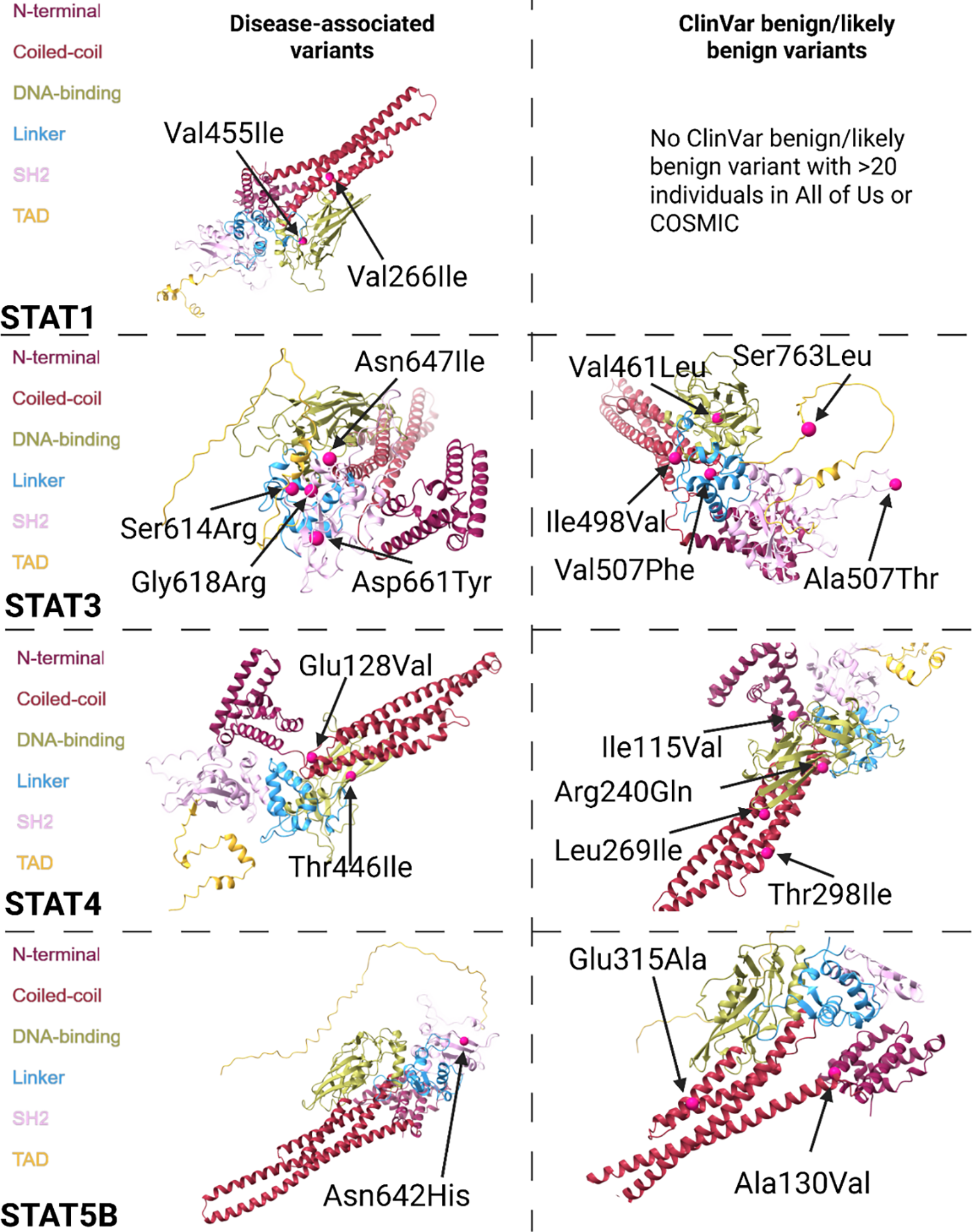
Figure 3. Structural analysis of disease-associated and ClinVar benign missense variants in the JAK proteins. The panel illustrates the secondary structure localization of disease-associated (left) and benign/likely benign (right) mutations mapped onto AlphaFold predicted protein structures.
Conserved Amino Acid Patterns in Proximity to Disease-Associated and ClinVar Benign Variants

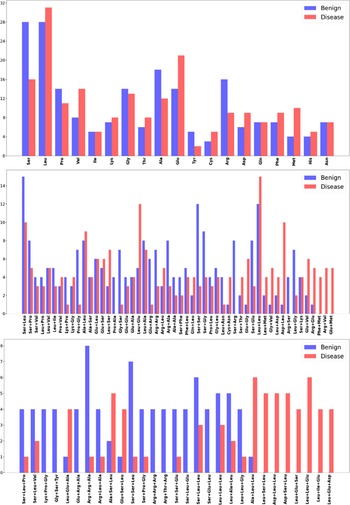
We further compared amino acid patterns surrounding the ClinVar benign and disease-associated mutations (three amino acids upstream and three amino acids downstream of the mutated site (see Materials and Methods, Figure 4). This comparative analysis of amino acid patterns in benign and disease-associated variants revealed distinct compositional differences across disease-associated and ClinVar benign variants. In the single-residue analysis (top panel), certain amino acids, such as valine (Val), glutamic acid (Glu), and methionine (Met), exhibited higher frequencies in proximity to disease-associated variants compared to benign variants, while others, such as serine (Ser), alanine (Ala), tyrosine (Tyr), and arginine (Arg), appeared more frequently in benign variants.

Figure 4. Comparative analysis of amino acid patterns (one amino acid, two amino acid combinations, and three amino acid combinations out of three upstream and three downstream of the variant in All of Us or COSMIC) in benign and disease-associated variants. Amino acid compositions for benign variants are blue, and disease variants are red.
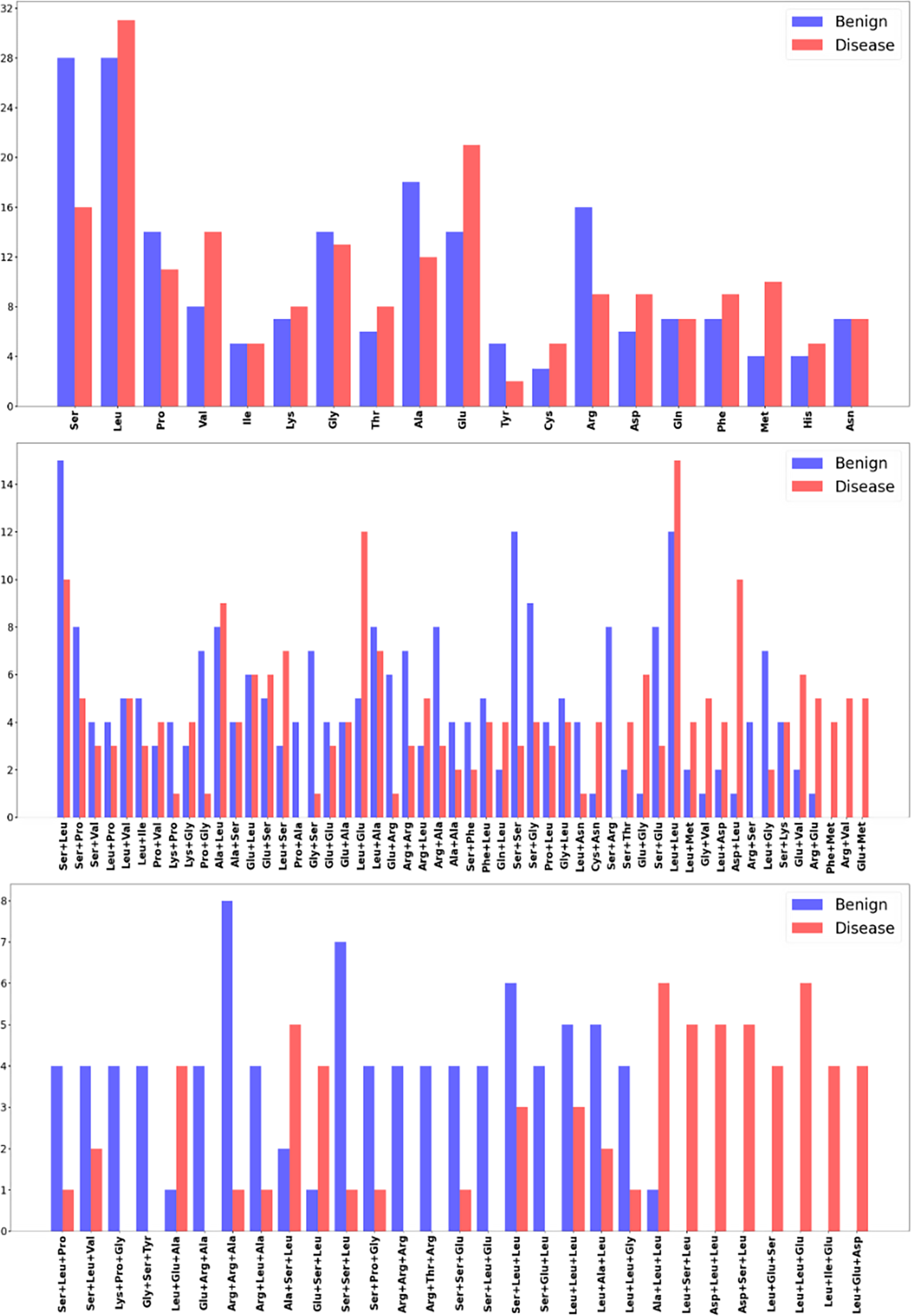
At the dipeptide level (second panel), several combinations were more prominent in proximity to disease-associated mutations such as (1) leucine and glutamic acid (Leu+Glu), (2) leucine and leucine (Leu+Leu), (3) aspartic acid and leucine (Asp, Leu), and (4) arginine and glutamic acid (Arg+Glu). Some combinations were uniquely present close to disease-associated variants: (1) phenylalanine and methionine (Phe+Met), (2) arginine and valine (Arg+Val), and (3) glutamic acid and methionine (Glu+Met).

Expanding to combinations of three amino acids out of six surrounding amino acids (third panel), we observed some combinations that are uniquely in proximity to disease-associated variants: (1) leucine, serine, leucine (Leu+Ser+Leu), (2) aspartic acid, leucine, leucine (Asp+Leu+Leu), (3) aspartic acid, serine, leucine (Asp, Ser, Leu), (4) leucine, leucine, glutamic acid (Leu+Leu+Glu), (5) leucine, isoleucine, glutamic acid (Leu+Ile+Glu), and (6) leucine, glutamic acid, aspartic acid (Leu+Glu+Asp). On the other hand, we detected the following combinations only close to benign variants (1) lysine, proline, glycine (Lys+Pro+Gly), (2) glycine, serine, tyrosine (Gly+Ser+Tyr), (3) arginine, arginine, arginine (Arg+Arg+Arg), and (4) arginine, threonine, arginine (Arg+Thr+Arg).

The observed differences in amino acid compositions surrounding disease-associated and benign variants suggest underlying structural and functional constraints that contribute to pathogenicity. A key trend is the enrichment of hydrophobic residues, particularly leucine (Leu), isoleucine (Ile), methionine (Met), and phenylalanine (Phe), in proximity to disease-associated variants. The frequent occurrence of Leu+Leu, Leu+Glu, and Leu+Glu+Asp combinations suggests that these mutations often occur within hydrophobic cores, where they may disrupt protein stability or alter packing interactions. Similarly, the presence of methionine (Met) in disease-associated motifs, such as Glu+Met and Phe+Met, points to potential disruptions in hydrophobic regions, particularly in proteins involved in enzymatic activity or membrane function. Conversely, benign variants appear to favor polar and flexible residues, with an overrepresentation of serine (Ser), glycine (Gly), and threonine (Thr). The exclusive presence of Gly+Ser+Tyr and Lys+Pro+Gly in benign variants suggests that these substitutions predominantly occur in solvent-exposed loops or linker regions, where flexibility and structural adaptability mitigate the effects of mutation. Additionally, the recurrent occurrence of arginine-rich motifs (Arg+Arg+Arg and Arg+Thr+Arg) in benign variants indicates that these substitutions are likely involved in electrostatic interactions or protein-protein binding sites that can accommodate mutational changes without significant functional consequences. A second striking pattern is the enrichment of negatively charged residues (glutamic acid, Glu, and aspartic acid, Asp) near disease-associated variants, suggesting potential disruptions in salt-bridge interactions and protein stability. The presence of Arg+Glu, Asp+Leu+Leu, and Leu+Glu+Asp in disease-associated variants indicates that these mutations may destabilize electrostatic interactions or affect protein folding. In contrast, the benign variants tend to retain positively charged arginine (Arg), which is commonly involved in stabilizing protein structures or mediating protein-protein interactions. Taken together, these findings suggest that disease-associated variants frequently occur in structurally constrained regions, where mutations disrupt core hydrophobic interactions, electrostatic balance, or functional interfaces. In contrast, benign variants are more likely to appear in flexible or surface-exposed regions, where mutations are better tolerated due to the preservation of local structural dynamics. The distinct differences in amino acid preferences between disease and benign variants provide insights into the physicochemical constraints that contribute to pathogenicity and may aid in refining predictive models for variant classification.

Analyzing the Nucleotide Sequence Near Benign and Disease-Associated Variants

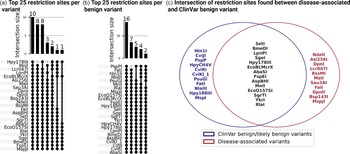
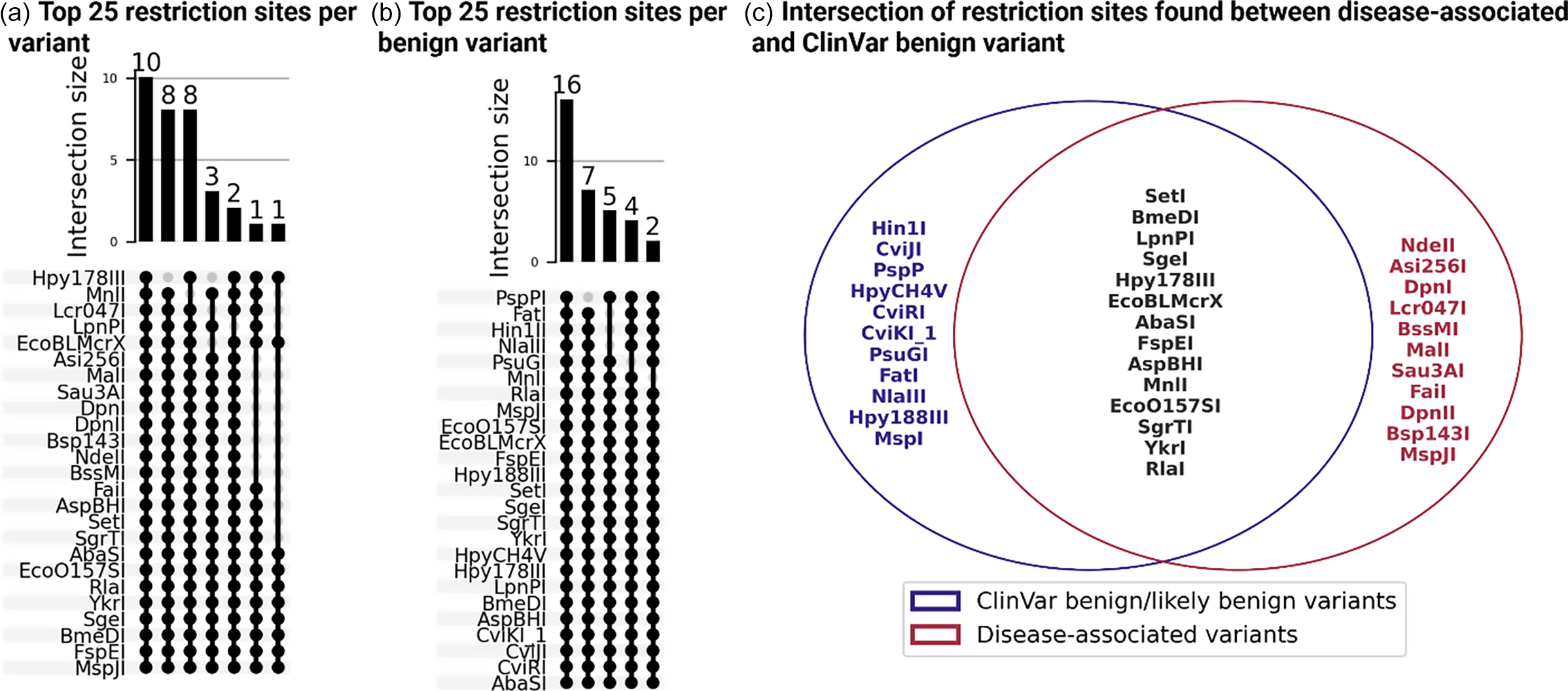
To explore the genomic context of disease-associated and ClinVar benign mutations, we analyzed the nucleotide sequences surrounding these variants, focusing on a 20 bp region around each mutation. The first part of our investigation aimed to identify patterns of nucleotide sequences and assess whether specific sequences are preferentially found near disease-associated or benign mutations (Figure 5, Suppl. Fig. 4). Our analysis identified nucleotide sequences of 625 restriction enzyme sites out of a total of 1,088 within the examined regions. Notably, several nucleotide sequences were exclusively present near disease-associated mutations but absent in ClinVar benign variants. These included the nucleotide sequences of DpnI, Asi256I, DpnII, MalI, Lcr047I, NdeII, Bsp143I, Sau3AI, FaiI, MspJI, and BssMI. We found that the nucleotide sequence ‘GATC’ was predominantly present near disease-associated mutations but was entirely absent in the vicinity of ClinVar benign mutations.

Figure 5. Enzyme restriction site analysis in proximity to disease-associated and ClinVar benign variants in JAK and STAT genes. (a,b) The top 25 restriction enzymes identified near disease-associated and benign variants, respectively. (c) Venn diagram illustrating the overlap of restriction sites found near disease-associated variants (red) and ClinVar benign variants (blue).
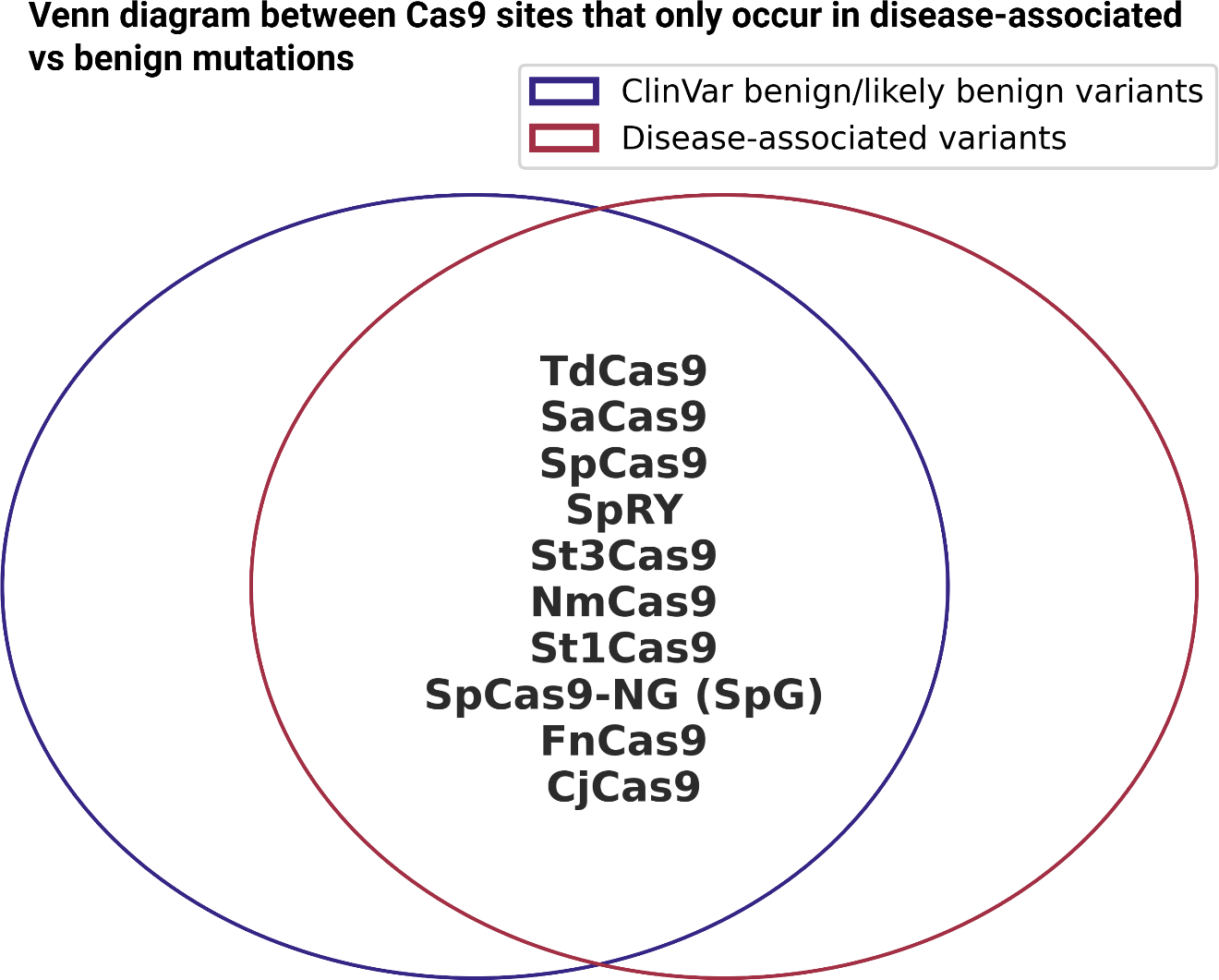
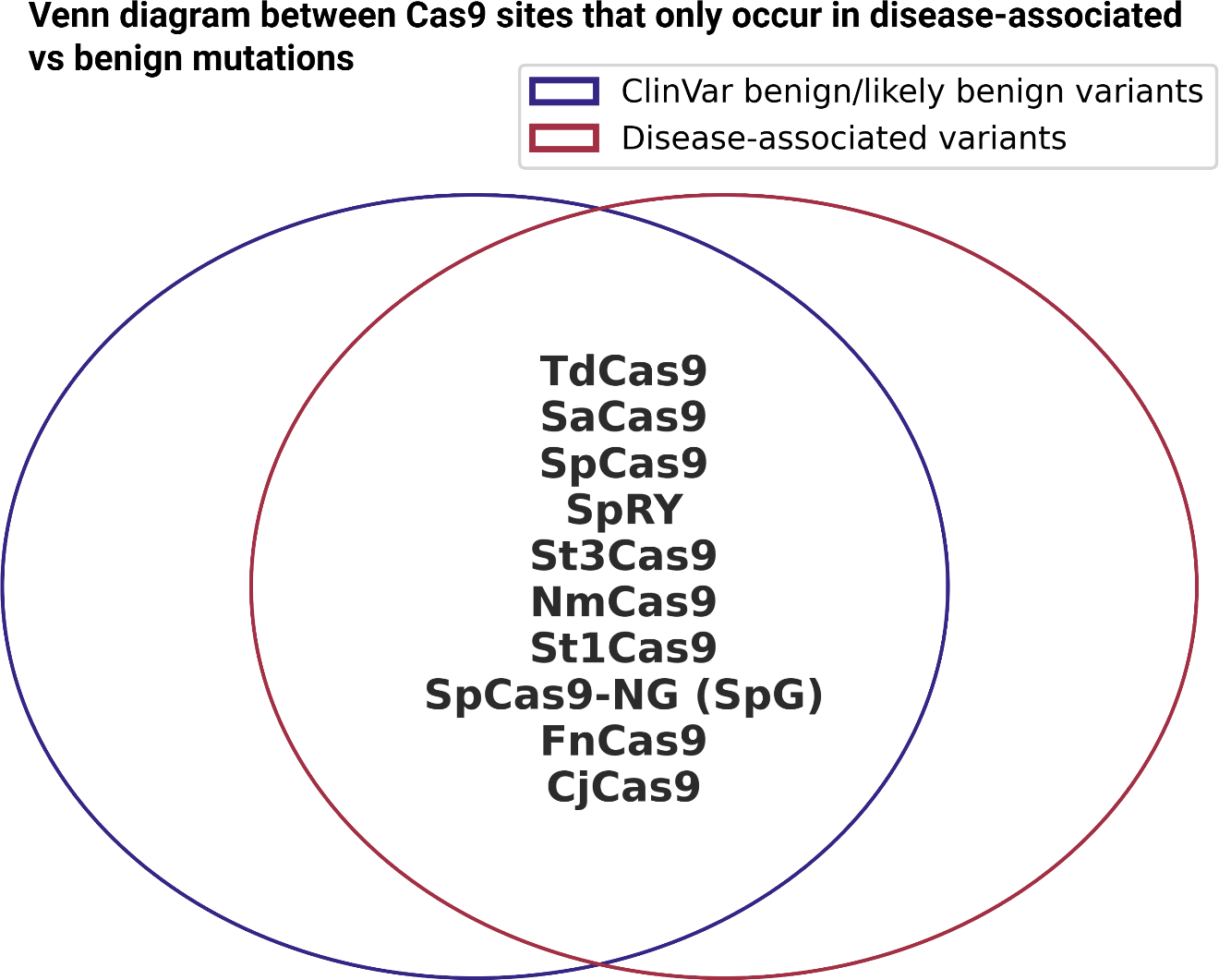
The second part of this analysis is to assess whether multiple Cas9 enzymes preferentially target sequences near disease-associated or ClinVar benign mutations; we analyzed the presence of Cas9 recognition sites within a 20 bp region surrounding these mutations (Figure 6, Suppl. Fig. 5). We examined a range of Cas9 enzymes, including SpCas9, SaCas9, NmCas9, St1Cas9, St3Cas9, CjCas9, FnCas9, TdCas9, xCas9, SpCas9-NG (SpG), SpRY, HiFi Cas9 (HF1), eSpCas9 (1.1), and HypaCas9 that recognized different PAM sequences (Suppl. Table 2) (Acharya et al., Reference Acharya, Ansari, Kumar Das, Hirano, Aich, Rauthan, Mahato, Maddileti, Sarkar, Kumar, Phutela, Gulati, Rahman, Goel, Afzal, Paul, Agrawal, Pulimamidi, Jalali and Chakraborty2024; Du et al., Reference Du, Zhu, Qian, Xue, Zheng and Huang2023; Guo et al., Reference Guo, Ren, Zhu, Tang, Wang, Zhang and Huang2019; Hibshman et al., Reference Hibshman, Bravo, Hooper, Dangerfield, Zhang, Finkelstein, Johnson and Taylor2024; Hou et al., Reference Hou, Zhang, Propson, Howden, Chu, Sontheimer and Thomson2013; Ikeda et al., Reference Ikeda, Fujii, Sugiura and Naito2019; H. K. Kim et al., Reference Kim, Lee, Kim, Park, Min, Choi, Huang, Yoon, Liu and Kim2020; Liang et al., Reference Liang, Zhang, Li, Yang, Fei, Liu and Qin2022; Müller et al., Reference Müller, Lee, Gasiunas, Davis, Cradick, Siksnys, Bao, Cathomen and Mussolino2016; Schmidheini et al., Reference Schmidheini, Mathis, Marquart, Rothgangl, Kissling, Böck, Chanez, Wang, Jinek and Schwank2024; Slaymaker et al., Reference Slaymaker, Gao, Zetsche, Scott, Yan and Zhang2016; Vakulskas et al., Reference Vakulskas, Dever, Rettig, Turk, Jacobi, Collingwood, Bode, McNeill, Yan, Camarena, Lee, Park, Wiebking, Bak, Gomez-Ospina, Pavel-Dinu, Sun, Bao, Porteus and Behlke2018; Wu et al., Reference Wu, Tang and Tang2020; Yifei Zhang et al., Reference Zhang, Zhang, Xu, Wang, Chen, Wang, Wu, Tang, Wang, Zhao, Gan and Ji2020). Our analysis did not reveal a strong preference for any Cas9 protein’s cut site being predominantly located near disease-associated mutations, but absent in ClinVar benign mutations. These findings suggest that while CRISPR/Cas9 target sites are present around the variants, there is no clear enrichment in disease-associated sites that would indicate preferential targetability.

Figure 6. CRISPR cut site analysis in proximity to disease-associated and benign mutations. Venn diagram illustrating the overlap of Cas9 cut sites uniquely occurring in either disease-associated (red) or benign (blue) mutations.
Discussion

This study provides a comprehensive analysis of missense mutations in the JAK-STAT pathway, highlighting differences between disease-associated and ClinVar benign variants regarding structural localization, biochemical properties, and genomic context. By integrating mutation data from the All of Us and COSMIC databases, we identified properties that may help explain why specific variants contribute to disease while others remain functionally neutral. Our findings suggest that disease-associated mutations frequently disrupt core hydrophobic interactions, electrostatic balance, or functional interfaces, whereas benign variants are more commonly found within secondary structures like helices and sheets and also in surface-exposed regions, where structural constraints are less restrictive. These observations reinforce the notion that pathogenicity is not merely a function of amino acid substitution alone but is heavily influenced by protein architecture and nearby context on the nucleotide and amino acid level.

Our current understanding of disease-associated mutations is largely based on the analysis of individual SNPs, whereas real-world genetic variation often involves combinations of mutations that may interact in yet unknown ways. The lack of experimental data on epistatic interactions is a major limitation (Suppl. Text 1: Limitations and considerations) in mutation interpretation, as the functional impact of a given variant may depend on the presence of additional mutations within the same gene or pathway (Blumenthal et al., Reference Blumenthal, Baumbach, Hoffmann, Kacprowski and List2020; Hernández-Lorenzo et al., Reference Hernández-Lorenzo, Hoffmann, Scheibling, List, Matías-Guiu and Ayala2022; Hoffmann, Poschenrieder et al., Reference Hoffmann, Poschenrieder, Incudini, Baier, Fritz, Maier, Hartung, Hoffmann, Trummer, Adamowicz, Picciani, Scheibling, Harl, Lesch, Frey, Kayser, Wissenberg, Schwartz, Hafner and Blumenthal2024). While our stringent inclusion criteria (minimum 20 occurrences due to All of Us policy) allowed for robust analysis of more prevalent variants, it is important to acknowledge that rare yet highly pathogenic mutations, especially those associated with rare inherited disorders, might not be captured by this approach.

The GATC sequence is well known in bacteria as a recognition site for DNA adenine methyltransferase (Dam) and plays key roles in DNA repair, replication timing, and gene regulation (Flusberg et al., Reference Flusberg, Webster, Lee, Travers, Olivares, Clark, Korlach and Turner2010). In E. coli, for example, GATC sites guide mismatch repair machinery to correct errors on the newly synthesized DNA strand (Horton et al., Reference Horton, Zhang, Blumenthal and Cheng2015). Although human cells do not use the same bacterial repair system, recent work shows that sequence context, including short motifs like GATC, can influence where replication errors occur and how repair systems handle them (Hasenauer et al., Reference Hasenauer, Barreto, Lotton and Matic2025). GATC-like sequences can also be recognized by certain transcription factors or occur in open chromatin regions, meaning changes nearby could alter gene expression (Mardenborough et al., Reference Mardenborough, Nitsenko, Laffeber, Duboc, Sahin, Quessada-Vial, Winterwerp, Sixma, Kanaar, Friedhoff, Strick and Lebbink2019).

Future work could explore whether selected missense variants influence STAT dimer formation by combining state-aware structural hypotheses with independent computational estimates of interface perturbation and focused experimental validation, recognizing that dimerization is conformation-dependent and not fully captured by static structural predictions alone.

Understanding genetic variation requires considering not only individual mutations but also their broader structural and functional context. As data and experimental tools improve, distinguishing ClinVar benign from disease-associated variants will become more precise. Addressing gaps such as epistatic interactions and underreported mutations will clarify how JAK-STAT variants affect health. Integrating computational models of protein–protein interactions with high-throughput experiments could systematically investigate multi-variant and epistatic effects. In vivo studies introducing predicted single or combined SNPs into homozygous mouse lines, then crossbreeding and applying RNA-seq, ChIP-seq, and allergenic challenge assays (Gad, Reference Gad1994), could reveal how complex mutation patterns shape pathway function. Clinical sample analysis will be critical to assess whether variants labeled as benign may contribute to disease in certain contexts, with our curated references offering a starting point for prioritization. Examining noncoding regulatory regions for pathogenic mutations may uncover additional mechanisms, but current datasets (All of Us, COSMIC) lack matched transcriptomic or epigenomic data, and patient samples were unavailable for this study. Future integration of genomic variation with matched expression and chromatin profiles will be essential for linking regulatory mutations to function. Combining large-scale genomics with advanced experimental systems offers a path to further investigate JAK-STAT variation and translate these insights into future therapeutic advances.

Supplementary material

To view supplementary material for this article, please visit https://doi.org/10.1017/thg.2026.10054.

Data availability

This study used data from the All of Us Research Program’s controlled Tier Dataset v.7, available to authorized users on the Researcher Workbench (https://databrowser.researchallofus.org/). Data from COSMIC v100 is available at (https://cancer.sanger.ac.uk/cosmic). The Python code can be found at: https://github.com/Firestar93/JAKSTAT_missenseSNPs_properties. Intermediate results and files can be found at: https://doi.org/10.6084/m9.figshare.28597121.

Acknowledgments

The authors want to thank Jakub Jankowski, Lothar Hennighausen, Priscilla A. Furth, and the members of the Laboratory of Cell & Molecular Biology (LCMB), NIDDK, NIH, for their valuable input. The figures were created with Biorender.com. Parts of the figures include icons from Flaticon.com under a paid license. The text was partly rephrased using ChatGPT version 4, Grammarly, and scite.ai under a paid license. Paperpile, under a paid license, was used to collect references in the correct format. We gratefully acknowledge All of Us participants for their contributions, without whom this research would not have been possible. We also thank the National Institutes of Health’s All of Us Research Program for making available the participant data, samples, and cohort examined in this study.

Author contributions

M.H. planned the project, executed the analysis, and wrote the manuscript. H.K. conceptualized the project and revised the manuscript. All authors read and approved the final version of the manuscript.

Funding

This research was supported by the Intramural Research Programs (IRPs) of the National Institute of Diabetes and Digestive and Kidney Diseases (NIDDK) within the National Institutes of Health (NIH). The contributions of the NIH author(s) were made as part of their official duties as NIH federal employees, are in compliance with agency policy requirements, and are considered Works of the United States Government. However, the findings and conclusions presented in this paper are those of the author(s) and do not necessarily reflect the views of the NIH or the U.S. Department of Health and Human Services. Funding support is in part from Georgetown University Medical Center.

Competing interests

The authors declare no competing interests.
References

Acharya, S., Ansari, A. H., Kumar Das, P., Hirano, S., Aich, M., Rauthan, R., Mahato, S., Maddileti, S., Sarkar, S., Kumar, M., Phutela, R., Gulati, S., Rahman, A., Goel, A., Afzal, C., Paul, D., Agrawal, T., Pulimamidi, V. K., Jalali, S., … Chakraborty, D. (2024). PAM-flexible engineered FnCas9 variants for robust and ultra-precise genome editing and diagnostics. Nature Communications, 15, 5471. https://doi.org/10.1038/s41467-024-49233-w CrossRefGoogle ScholarPubMed
Agarwal, A., MacKenzie, R. J., Eide, C. A., Davare, M. A., Watanabe-Smith, K., Tognon, C. E., Mongoue-Tchokote, S., Park, B., Braziel, R. M., Tyner, J. W., & Druker, B. J. (2015). Functional RNAi screen targeting cytokine and growth factor receptors reveals oncorequisite role for interleukin-2 gamma receptor in JAK3-mutation-positive leukemia. Oncogene, 34, 29912999. https://doi.org/10.1038/onc.2014.243 CrossRefGoogle ScholarPubMed
All of Us Research Program Genomics Investigators, Bick, A. G., Metcalf, G. A., Mayo, K. R., Lichtenstein, L., Rura, S., Carroll, R. J., Musick, A., Linder, J. E., Jordan, I. K., Nagar, S. D., Sharma, S., Meller, R., Basford, M., Boerwinkle, E., Cicek, M. S., Doheny, K. F., Eichler, E. E., Gabriel, S., … NIH All of Us Research Program Staff. (2024). Genomic data in the All of Us Research Program. Nature, 627, 340346. https://doi.org/10.1038/s41586-024-07031-8 Google Scholar
Arai, A., Yoshimitsu, M., Otsuka, M., Ito, Y., Miyazono, T., Nakano, N., Obama, K., Nakashima, H., Hanada, S., Owatari, S., Nakamura, D., Tokunaga, M., Kamada, Y., Utsunomiya, A., Haraguchi, K., Hayashida, M., Fujino, S., Odawara, J., Tabuchi, T., … Ishitsuka, K. (2023). Identification of putative noncanonical driver mutations in patients with essential thrombocythemia. European Journal of Haematology, 110, 639647. https://doi.org/10.1111/ejh.13928 CrossRefGoogle ScholarPubMed
Bahar, B., Barton, K., & Kini, A. R. (2016). The role of the Exon 13 G571S JAK2 mutation in myeloproliferative neoplasms. Leukemia Research Reports, 6, 2728. https://doi.org/10.1016/j.lrr.2016.08.001 CrossRefGoogle ScholarPubMed
Bamford, S., Dawson, E., Forbes, S., Clements, J., Pettett, R., Dogan, A., Flanagan, A., Teague, J., Futreal, P. A., Stratton, M. R., & Wooster, R. (2004). The COSMIC (Catalogue of Somatic Mutations in Cancer) database and website. British Journal of Cancer, 91, 355358. https://doi.org/10.1038/sj.bjc.6601894 CrossRefGoogle ScholarPubMed
Benton, C. B., Boddu, P. C., DiNardo, C. D., Bose, P., Wang, F., Assi, R., Pemmaraju, N., Kc, D., Pierce, S., Patel, K., Konopleva, M., Ravandi, F., Garcia-Manero, G., Kadia, T. M., Cortes, J., Kantarjian, H. M., Andreeff, M., & Verstovsek, S. (2019). Janus kinase 2 variants associated with the transformation of myeloproliferative neoplasms into acute myeloid leukemia. Cancer, 125, 18551866. https://doi.org/10.1002/cncr.32004 CrossRefGoogle ScholarPubMed
Bergmann, A. K., Schneppenheim, S., Seifert, M., Betts, M. J., Haake, A., Lopez, C., Maria Murga Penas, E., Vater, I., Jayne, S., Dyer, M. J. S., Schrappe, M., Dührsen, U., Ammerpohl, O., Russell, R. B., Küppers, R., Dürig, J., & Siebert, R. (2014). Recurrent mutation of JAK3 in T-cell prolymphocytic leukemia. Genes, Chromosomes & Cancer, 53, 309316. https://doi.org/10.1002/gcc.22136 CrossRefGoogle ScholarPubMed
Blumenthal, D. B., Baumbach, J., Hoffmann, M., Kacprowski, T., & List, M. (2020). A framework for modeling epistatic interaction. Bioinformatics. https://doi.org/10.1093/bioinformatics/btaa990 Google Scholar
Bouchekioua, A., Scourzic, L., de Wever, O., Zhang, Y., Cervera, P., Aline-Fardin, A., Mercher, T., Gaulard, P., Nyga, R., Jeziorowska, D., Douay, L., Vainchenker, W., Louache, F., Gespach, C., Solary, E., & Coppo, P. (2014). JAK3 deregulation by activating mutations confers invasive growth advantage in extranodal nasal-type natural killer cell lymphoma. Leukemia, 28, 338348. https://doi.org/10.1038/leu.2013.206 CrossRefGoogle ScholarPubMed
Bourrienne, M.-C., Loyau, S., Faille, D., Gay, J., Akhenak, S., Farkh, C., Ollivier, V., Solonomenjanahary, M., Dupont, S., Choqueux, C., Villeval, J.-L., Plo, I., Edmond, V., Ho-Tin-Noé, B., Ajzenberg, N., & Mazighi, M. (2024). Impaired fibrinolysis in JAK2V617F-related myeloproliferative neoplasms. Journal of Thrombosis and Haemostasis. https://doi.org/10.1016/j.jtha.2024.07.031 CrossRefGoogle ScholarPubMed
Brooks, A. J., & Putoczki, T. (2020). JAK-STAT signalling pathway in cancer. Cancers, 12, 1971. https://doi.org/10.3390/cancers12071971 CrossRefGoogle ScholarPubMed
Carreño-Tarragona, G., Varghese, L. N., Sebastián, E., Gálvez, E., Marín-Sánchez, A., López-Muñoz, N., Nam-Cha, S., Martínez-López, J., Constantinescu, S. N., Sevilla, J., & Ayala, R. (2021). A typical acute lymphoblastic leukemia JAK2 variant, R683G, causes an aggressive form of familial thrombocytosis when germline. Leukemia, 35, 32953298. https://doi.org/10.1038/s41375-021-01298-0 CrossRefGoogle ScholarPubMed
Cheon, H., Xing, J. C., Moosic, K. B., Ung, J., Chan, V. W., Chung, D. S., Toro, M. F., Elghawy, O., Wang, J. S., Hamele, C. E., Hardison, R. C., Olson, T. L., Tan, S.-F., Feith, D. J., Ratan, A., & Loughran, T. P. Jr. (2022). Genomic landscape of TCRαβ and TCRγδ T-large granular lymphocyte leukemia. Blood, 139, 30583072. https://doi.org/10.1182/blood.2021013164 CrossRefGoogle ScholarPubMed
Choi, D. C., Messali, N., Uda, N. R., Abu-Zeinah, G., Kermani, P., Yabut, M. M., Lischer, H. E. L., Castillo Tokumori, F., Erdos, K., Lehmann, T., Sobas, M., Rao, T. N., & Scandura, J. M. (2024). JAK2V617F impairs lymphoid differentiation in myeloproliferative neoplasms. Leukemia. https://doi.org/10.1038/s41375-024-02388-3 CrossRefGoogle ScholarPubMed
Chu, D., & Wei, L. (2019). Nonsynonymous, synonymous and nonsense mutations in human cancer-related genes undergo stronger purifying selections than expectation. BMC Cancer, 19. https://doi.org/10.1186/s12885-019-5572-x CrossRefGoogle Scholar
Cock, P. J. A., Antao, T., Chang, J. T., Chapman, B. A., Cox, C. J., Dalke, A., Friedberg, I., Hamelryck, T., Kauff, F., Wilczynski, B., & de Hoon, M. J. L. (2009). Biopython: Freely available Python tools for computational molecular biology and bioinformatics. Bioinformatics, 25, 14221423. https://doi.org/10.1093/bioinformatics/btp163 CrossRefGoogle ScholarPubMed
de Martino, M., Gigante, M., Cormio, L., Prattichizzo, C., Cavalcanti, E., Gigante, M., Ariano, V., Netti, G. S., Montemurno, E., Mancini, V., Battaglia, M., Gesualdo, L., Carrieri, G., & Ranieri, E. (2013). JAK3 in clear cell renal cell carcinoma: Mutational screening and clinical implications. Urologic Oncology, 31, 930937. https://doi.org/10.1016/j.urolonc.2011.07.011 CrossRefGoogle ScholarPubMed
Delio, M., Bryke, C., Mendez, L., Joseph, L., & Jassim, S. (2023). JAK2 mutations are rare and diverse in myelodysplastic syndromes: Case series and review of the literature. Hematology Reports, 15, 7387. https://doi.org/10.3390/hematolrep15010008 CrossRefGoogle ScholarPubMed
Deng, M., Li, Y., Li, Y., Mao, X., Ke, H., Liang, W., Lei, X., Lau, Y.-L., & Mao, H. (2022). A novel STAT3 gain-of-function mutation in fatal infancy-onset interstitial lung disease. Frontiers in Immunology, 13, 866638. https://doi.org/10.3389/fimmu.2022.866638 CrossRefGoogle ScholarPubMed
Diogo, D., Bastarache, L., Liao, K. P., Graham, R. R., Fulton, R. S., Greenberg, J. D., Eyre, S., Bowes, J., Cui, J., Lee, A., Pappas, D. A., Kremer, J. M., Barton, A., Coenen, M. J. H., Franke, B., Kiemeney, L. A., Mariette, X., Richard-Miceli, C., Canhão, H., … Plenge, R. M. (2015). TYK2 protein-coding variants protect against rheumatoid arthritis and autoimmunity, with no evidence of major pleiotropic effects on non-autoimmune complex traits. PLOS ONE, 10, e0122271. https://doi.org/10.1371/journal.pone.0122271 CrossRefGoogle ScholarPubMed
Du, W., Zhu, H., Qian, J., Xue, D., Zheng, S., & Huang, Q. (2023). Full-length model of SaCas9-sgRNA-DNA complex in cleavage state. International Journal of Molecular Sciences, 24, 1204. https://doi.org/10.3390/ijms24021204 CrossRefGoogle ScholarPubMed
Ehrentraut, S., Schneider, B., Nagel, S., Pommerenke, C., Quentmeier, H., Geffers, R., Feist, M., Kaufmann, M., Meyer, C., Kadin, M. E., Drexler, H. G., & MacLeod, R. A. F. (2016). Th17 cytokine differentiation and loss of plasticity after SOCS1 inactivation in a cutaneous T-cell lymphoma. Oncotarget, 7, 3420134216. https://doi.org/10.18632/oncotarget.9107 CrossRefGoogle Scholar
Eichstaedt, C. A., Verweyen, J., Halank, M., Benjamin, N., Fischer, C., Mayer, E., Guth, S., Wiedenroth, C. B., Egenlauf, B., Harutyunova, S., Xanthouli, P., Marra, A. M., Wilkens, H., Ewert, R., Hinderhofer, K., & Grünig, E. (2020). Myeloproliferative diseases as possible risk factor for development of chronic thromboembolic pulmonary hypertension — A genetic study. International Journal of Molecular Sciences, 21, 3339. https://doi.org/10.3390/ijms21093339 CrossRefGoogle ScholarPubMed
Enerbäck, C., Sandin, C., Lambert, S., Zawistowski, M., Stuart, P. E., Verma, D., Tsoi, L. C., Nair, R. P., Johnston, A., & Elder, J. T. (2018). The psoriasis-protective TYK2 I684S variant impairs IL-12 stimulated pSTAT4 response in skin-homing CD4+ and CD8+ memory T-cells. Scientific Reports, 8. https://doi.org/10.1038/s41598-018-25282-2 CrossRefGoogle ScholarPubMed
Erdogan, F., Qadree, A. K., Radu, T. B., Orlova, A., de Araujo, E. D., Israelian, J., Valent, P., Mustjoki, S. M., Herling, M., Moriggl, R., & Gunning, P. T. (2022). Structural and mutational analysis of member-specific STAT functions. Biochimica et Biophysica Acta: General Subjects, 1866, 130058. https://doi.org/10.1016/j.bbagen.2021.130058 CrossRefGoogle ScholarPubMed
Farrell, C. M., O’Leary, N. A., Harte, R. A., Loveland, J. E., Wilming, L. G., Wallin, C., Diekhans, M., Barrell, D., Searle, S. M. J., Aken, B., Hiatt, S. M., Frankish, A., Suner, M.-M., Rajput, B., Steward, C. A., Brown, G. R., Bennett, R., Murphy, M., Wu, W., … Pruitt, K. D. (2014). Current status and new features of the Consensus Coding Sequence database. Nucleic Acids Research, 42, D865D872. https://doi.org/10.1093/nar/gkt1059 CrossRefGoogle ScholarPubMed
Flusberg, B. A., Webster, D. R., Lee, J. H., Travers, K. J., Olivares, E. C., Clark, T. A., Korlach, J., & Turner, S. W. (2010). Direct detection of DNA methylation during single-molecule, real-time sequencing. Nature Methods, 7, 461465. https://doi.org/10.1038/nmeth.1459 CrossRefGoogle ScholarPubMed
Freiche, V., Couronné, L., Bruneau, J., & Hermine, O. (2022). Comment on kieslinger et al. A recurrent STAT5BN642H driver mutation in feline alimentary T cell lymphoma. Cancers 2021, 13, 5238. Cancers, 14, 4593. https://doi.org/10.3390/cancers14194593 Google Scholar
Gad, S. C. (1994). The mouse ear swelling test (MEST) in the 1990s. Toxicology, 93, 3346. https://doi.org/10.1016/0300-483X(94)90163-5 CrossRefGoogle ScholarPubMed
Girardi, T., Vereecke, S., Sulima, S. O., Khan, Y., Fancello, L., Briggs, J. W., Schwab, C., de Beeck, J. O., Verbeeck, J., Royaert, J., Geerdens, E., Vicente, C., Bornschein, S., Harrison, C. J., Meijerink, J. P., Cools, J., Dinman, J. D., Kampen, K. R., & De Keersmaecker, K. (2018). The T-cell leukemia-associated ribosomal RPL10 R98S mutation enhances JAK-STAT signaling. Leukemia, 32, 809819. https://doi.org/10.1038/leu.2017.248 CrossRefGoogle ScholarPubMed
Goddard, T. D., Huang, C. C., Meng, E. C., Pettersen, E. F., Couch, G. S., Morris, J. H., & Ferrin, T. E. (2018). UCSF ChimeraX: Meeting modern challenges in visualization and analysis. Protein Science, 27, 1425. https://doi.org/10.1002/pro.3235 CrossRefGoogle ScholarPubMed
Guo, M., Ren, K., Zhu, Y., Tang, Z., Wang, Y., Zhang, B., & Huang, Z. (2019). Structural insights into a high fidelity variant of SpCas9. Cell Research, 29, 183192. https://doi.org/10.1038/s41422-018-0128-9 CrossRefGoogle ScholarPubMed
Gupta, D. G., Varma, N., Kumar, A., Naseem, S., Sachdeva, M. U. S., Sreedharanunni, S., Binota, J., Bose, P., Khadwal, A., Malhotra, P., & Varma, S. (2023). Genomic and proteomic characterization of Philadelphia-like B-lineage acute lymphoblastic leukemia: A report of Indian patients. Cancer, 129, 12171226. https://doi.org/10.1002/cncr.34661 CrossRefGoogle ScholarPubMed
Gupta, D. G., Varma, N., Sreedharanunni, S., Abdulkadir, S. A., Naseem, S., Sachdeva, M. U. S., Binota, J., Bose, P., Malhotra, P., Khadwal, A., & Varma, S. (2023). Evaluation of adverse prognostic gene alterations and MRD positivity in BCR::ABL1-like B-lineage acute lymphoblastic leukaemia patients in a resource-constrained setting. British Journal of Cancer, 129, 143152. https://doi.org/10.1038/s41416-023-02252-2 CrossRefGoogle Scholar
Haji Paiman, N. S., Mat Nasir, N., Miptah, H. N., Saidon, N., & Abdul Monir, M. (2024). Challenges in diagnosing polycythemia Vera in primary care: A 55-year-old Malaysian woman with atypical presentation. The American Journal of Case Reports, 25, e944202. https://doi.org/10.12659/AJCR.944202 CrossRefGoogle ScholarPubMed
Harte, R. A., Farrell, C. M., Loveland, J. E., Suner, M.-M., Wilming, L., Aken, B., Barrell, D., Frankish, A., Wallin, C., Searle, S., Diekhans, M., Harrow, J., & Pruitt, K. D. (2012). Tracking and coordinating an international curation effort for the CCDS Project. Database: The Journal of Biological Databases and Curation, 2012, bas008. https://doi.org/10.1093/database/bas008 CrossRefGoogle ScholarPubMed
Hasenauer, F. C., Barreto, H. C., Lotton, C., & Matic, I. (2025). Genome-wide mapping of spontaneous DNA replication error-hotspots using mismatch repair proteins in rapidly proliferating Escherichia coli . Nucleic Acids Research, 53. https://doi.org/10.1093/nar/gkae1196 CrossRefGoogle ScholarPubMed
Hassan, N. M., Abdellateif, M. S., Radwan, E. M., Hameed, S. A., Desouky, E. D. E., Kamel, M. M., & Gameel, A. M. (2022). Prognostic significance of CRLF2 overexpression and JAK2 mutation in Egyptian pediatric patients with B-precursor acute lymphoblastic leukemia. Clinical Lymphoma, Myeloma & Leukemia, 22, e376e385. https://doi.org/10.1016/j.clml.2022.01.006 CrossRefGoogle ScholarPubMed
Hecker, D., Lauber, M., Behjati Ardakani, F., Ashrafiyan, S., Manz, Q., Kersting, J., Hoffmann, M., Schulz, M. H., & List, M. (2023). Computational tools for inferring transcription factor activity. Proteomics, e2200462. https://doi.org/10.1002/pmic.202200462 CrossRefGoogle ScholarPubMed
Hennighausen, L., & Lee, H. K. (2020). Activation of the SARS-CoV-2 receptor Ace2 through JAK/STAT-dependent enhancers during pregnancy. Cell Reports, 32, 108199. https://doi.org/10.1016/j.celrep.2020.108199 CrossRefGoogle ScholarPubMed
Hernández-Lorenzo, L., Hoffmann, M., Scheibling, E., List, M., Matías-Guiu, J. A., & Ayala, J. L. (2022). On the limits of graph neural networks for the early diagnosis of Alzheimer’s disease. Scientific Reports, 12, 17632. https://doi.org/10.1038/s41598-022-21895-8 CrossRefGoogle ScholarPubMed
Hibshman, G. N., Bravo, J. P. K., Hooper, M. M., Dangerfield, T. L., Zhang, H., Finkelstein, I. J., Johnson, K. A., & Taylor, D. W. (2024). Unraveling the mechanisms of PAMless DNA interrogation by SpRY-Cas9. Nature Communications, 15. https://doi.org/10.1038/s41467-024-45858-6 CrossRefGoogle ScholarPubMed
Hoffmann, M., & Hennighausen, L. (2025). Spotlight on amino acid changing mutations in the JAK-STAT pathway: From disease-specific mutation to general mutation databases. Scientific Reports, 15. https://doi.org/10.1038/s41598-025-xxxx-x CrossRefGoogle ScholarPubMed
Hoffmann, M., Poschenrieder, J. M., Incudini, M., Baier, S., Fritz, A., Maier, A., Hartung, M., Hoffmann, C., Trummer, N., Adamowicz, K., Picciani, M., Scheibling, E., Harl, M. V., Lesch, I., Frey, H., Kayser, S., Wissenberg, P., Schwartz, L., Hafner, L., … Blumenthal, D. B. (2024). Network medicine-based epistasis detection in complex diseases: Ready for quantum computing. Nucleic Acids Research, 52, 1014410160. https://doi.org/10.1093/nar/gkae620 CrossRefGoogle ScholarPubMed
Hoffmann, M., Trummer, N., Schwartz, L., Jankowski, J., Lee, H. K., Willruth, L.-L., Lazareva, O., Yuan, K., Baumgarten, N., Schmidt, F., Baumbach, J., Schulz, M. H., Blumenthal, D. B., Hennighausen, L., & List, M. (2023). TF-Prioritizer: A Java pipeline to prioritize condition-specific transcription factors. GigaScience, 12, giad026. https://doi.org/10.1093/gigascience/giad026 Google Scholar
Hoffmann, M., Vaz, T., Chhatrala, S., & Hennighausen, L. (2025). Data-driven projections of candidate enhancer-activating SNPs in immune regulation. BMC Genomics, 26. https://doi.org/10.1186/s12864-025-11374-7 CrossRefGoogle ScholarPubMed
Hoffmann, M., Willruth, L.-L., Dietrich, A., Lee, H. K., Knabl, L., Trummer, N., Baumbach, J., Furth, P. A., Hennighausen, L., & List, M. (2024). Blood transcriptomics analysis offers insights into variant-specific immune response to SARS-CoV-2. Scientific Reports, 14. https://doi.org/10.1038/s41598-024-55686-2 CrossRefGoogle ScholarPubMed
Horton, J. R., Zhang, X., Blumenthal, R. M., & Cheng, X. (2015). Structures of Escherichia coli DNA adenine methyltransferase (Dam) in complex with a non-GATC sequence: Potential implications for methylation-independent transcriptional repression. Nucleic Acids Research, 43, 42964308. https://doi.org/10.1093/nar/gkv207 CrossRefGoogle ScholarPubMed
Hou, Z., Zhang, Y., Propson, N. E., Howden, S. E., Chu, L.-F., Sontheimer, E. J., & Thomson, J. A. (2013). Efficient genome engineering in human pluripotent stem cells using Cas9 from Neisseria meningitidis . Proceedings of the National Academy of Sciences, 110, 1564415649. https://doi.org/10.1073/pnas.1313587110 CrossRefGoogle Scholar
Hu, X., Li, J., Fu, M., Zhao, X., & Wang, W. (2021). The JAK/STAT signaling pathway: From bench to clinic. Signal Transduction and Targeted Therapy, 6, 402. https://doi.org/10.1038/s41392-021-00791-1 CrossRefGoogle ScholarPubMed
Hu, Z., Medeiros, L. J., Xu, M., Yuan, J., Peker, D., Shao, L., Tang, Z., Mai, B., Thakral, B., Rios, A., Hu, S., & Wang, W. (2023). T-cell prolymphocytic leukemia with t(X;14)(q28;q11.2): A clinicopathologic study of 15 cases. American Journal of Clinical Pathology, 159, 325336. https://doi.org/10.1093/ajcp/aqac163 CrossRefGoogle Scholar
Ikeda, A., Fujii, W., Sugiura, K., & Naito, K. (2019). High-fidelity endonuclease variant HypaCas9 facilitates accurate allele-specific gene modification in mouse zygotes. Communications Biology, 2, 371. https://doi.org/10.1038/s42003-019-0627-8 CrossRefGoogle ScholarPubMed
Jankowski, J., Lee, H. K., Wilflingseder, J., & Hennighausen, L. (2021). JAK inhibitors dampen activation of interferon-activated transcriptomes and the SARS-CoV-2 receptor ACE2 in human renal proximal tubules. iScience, 24, 102928. https://doi.org/10.1016/j.isci.2021.102928 CrossRefGoogle ScholarPubMed
Jensen, L. T., Attfield, K. E., Feldmann, M., & Fugger, L. (2023). Allosteric TYK2 inhibition: Redefining autoimmune disease therapy beyond JAK1–3 inhibitors. EBioMedicine, 97, 104840. https://doi.org/10.1016/j.ebiom.2023.104840 CrossRefGoogle ScholarPubMed
Jumper, J., Evans, R., Pritzel, A., Green, T., Figurnov, M., Ronneberger, O., Tunyasuvunakool, K., Bates, R., Žídek, A., Potapenko, A., Bridgland, A., Meyer, C., Kohl, S. A. A., Ballard, A. J., Cowie, A., Romera-Paredes, B., Nikolov, S., Jain, R., Adler, J., … Hassabis, D. (2021). Highly accurate protein structure prediction with AlphaFold. Nature, 596, 583589. https://doi.org/10.1038/s41586-021-03819-2 CrossRefGoogle ScholarPubMed
Kapralova, K., Horvathova, M., Pecquet, C., Fialova Kucerova, J., Pospisilova, D., Leroy, E., Kralova, B., Milosevic Feenstra, J. D., Schischlik, F., Kralovics, R., Constantinescu, S. N., & Divoky, V. (2016). Cooperation of germ line JAK2 mutations E846D and R1063H in hereditary erythrocytosis with megakaryocytic atypia. Blood, 128, 14181423. https://doi.org/10.1182/blood-2016-03-706093 CrossRefGoogle ScholarPubMed
Kerner, G., Laval, G., Patin, E., Boisson-Dupuis, S., Abel, L., Casanova, J.-L., & Quintana-Murci, L. (2021). Human ancient DNA analyses reveal the high burden of tuberculosis in Europeans over the last 2,000 years. The American Journal of Human Genetics, 108, 517524. https://doi.org/10.1016/j.ajhg.2021.02.009 CrossRefGoogle ScholarPubMed
Kerner, G., Ramirez-Alejo, N., Seeleuthner, Y., Yang, R., Ogishi, M., Cobat, A., Patin, E., Quintana-Murci, L., Boisson-Dupuis, S., Casanova, J.-L., & Abel, L. (2019). Homozygosity for TYK2 P1104A underlies tuberculosis in about 1% of patients in a cohort of European ancestry. Proceedings of the National Academy of Sciences of the United States of America, 116, 1043010434. https://doi.org/10.1073/pnas.1903561116 CrossRefGoogle Scholar
Kim, D., Park, G., Huuhtanen, J., Ghimire, B., Rajala, H., Moriggl, R., Chan, W. C., Kankainen, M., Myllymäki, M., & Mustjoki, S. (2021). STAT3 activation in large granular lymphocyte leukemia is associated with cytokine signaling and DNA hypermethylation. Leukemia, 35, 34303443. https://doi.org/10.1038/s41375-021-01208-0 CrossRefGoogle ScholarPubMed
Kim, H. K., Lee, S., Kim, Y., Park, J., Min, S., Choi, J. W., Huang, T. P., Yoon, S., Liu, D. R., & Kim, H. H. (2020). High-throughput analysis of the activities of xCas9, SpCas9-NG and SpCas9 at matched and mismatched target sequences in human cells. Nature Biomedical Engineering, 4, 111124. https://doi.org/10.1038/s41551-019-0505-0 CrossRefGoogle ScholarPubMed
Klein, K., Stoiber, D., Sexl, V., & Witalisz-Siepracka, A. (2021). Untwining anti-tumor and immunosuppressive effects of JAK inhibitors—A strategy for hematological malignancies? Cancers, 13, 2611. https://doi.org/10.3390/cancers13112611 CrossRefGoogle ScholarPubMed
Koo, G. C., Tan, S. Y., Tang, T., Poon, S. L., Allen, G. E., Tan, L., Chong, S. C., Ong, W. S., Tay, K., Tao, M., Quek, R., Loong, S., Yeoh, K.-W., Yap, S. P., Lee, K. A., Lim, L. C., Tan, D., Goh, C., Cutcutache, I., … Lim, S. T. (2012). Janus kinase 3–activating mutations identified in natural killer/T-cell lymphoma. Cancer Discovery, 2, 591597. https://doi.org/10.1158/2159-8290.CD-12-0028 CrossRefGoogle ScholarPubMed
Krah, N. M., Miotke, L., Li, P., Patel, J. L., Bowen, A. R., Pomicter, A. D., & Patel, A. B. (2023). JAK2 R683S mutation resulting in dual diagnoses of chronic eosinophilic leukemia and myelodysplastic/myeloproliferative overlap syndrome. Journal of the National Comprehensive Cancer Network, 21, 12181223. https://doi.org/10.6004/jnccn.2023.7068 CrossRefGoogle ScholarPubMed
Kristensen, T., Larsen, M., Rewes, A., Frederiksen, H., Thomassen, M., & Møller, M. B. (2014). Clinical relevance of sensitive and quantitative STAT3 mutation analysis using next-generation sequencing in T-cell large granular lymphocytic leukemia. The Journal of Molecular Diagnostics, 16, 382392. https://doi.org/10.1016/j.jmoldx.2014.03.005 CrossRefGoogle ScholarPubMed
Łączak, M., Kuczyńska, M., Grygier, J., Andrzejewska, D., Grochowska, W., Gulaczyk, H., & Lewandowski, K. (2022). JAK and STAT gene mutations and JAK-STAT pathway activation in lympho- and myeloproliferative neoplasms. Hematology in Clinical Practice, 12, 89104.10.5603/HCP.a2021.0013CrossRefGoogle Scholar
Landrum, M. J., Lee, J. M., Riley, G. R., Jang, W., Rubinstein, W. S., Church, D. M., & Maglott, D. R. (2014). ClinVar: Public archive of relationships among sequence variation and human phenotype. Nucleic Acids Research, 42, D980D985. https://doi.org/10.1093/nar/gkt1113 CrossRefGoogle ScholarPubMed
Lee, H. K., Jung, O., & Hennighausen, L. (2021). JAK inhibitors dampen activation of interferon-stimulated transcription of ACE2 isoforms in human airway epithelial cells. Communications Biology, 4, 654. https://doi.org/10.1038/s42003-021-02222-w CrossRefGoogle ScholarPubMed
Lee, H. K., Willi, M., Shin, H. Y., Liu, C., & Hennighausen, L. (2018). Progressing super-enhancer landscape during mammary differentiation controls tissue-specific gene regulation. Nucleic Acids Research, 46, 1079610809. https://doi.org/10.1093/nar/gky955 Google ScholarPubMed
Lex, A., Gehlenborg, N., Strobelt, H., Vuillemot, R., & Pfister, H. (2014). UpSet: Visualization of intersecting sets. IEEE Transactions on Visualization and Computer Graphics, 20, 19831992. https://doi.org/10.1109/TVCG.2014.2346248 CrossRefGoogle ScholarPubMed
Li, Z., Gakovic, M., Ragimbeau, J., Eloranta, M.-L., Rönnblom, L., Michel, F., & Pellegrini, S. (2013). Two rare disease-associated Tyk2 variants are catalytically impaired but signaling competent. The Journal of Immunology, 190, 23352344. https://doi.org/10.4049/jimmunol.1202368 CrossRefGoogle ScholarPubMed
Liang, F., Zhang, Y., Li, L., Yang, Y., Fei, J.-F., Liu, Y., & Qin, W. (2022). SpG and SpRY variants expand the CRISPR toolbox for genome editing in zebrafish. Nature Communications, 13, 110. https://doi.org/10.1038/s41467-022-29750-2 CrossRefGoogle ScholarPubMed
Lin, M., Nebral, K., Gertzen, C. G. W., Ganmore, I., Haas, O. A., Bhatia, S., Fischer, U., Kuhlen, M., Gohlke, H., Izraeli, S., Trka, J., Hu, J., Borkhardt, A., Hauer, J., & Auer, F. (2019). JAK2 p.G571S in B-cell precursor acute lymphoblastic leukemia: a synergizing germline susceptibility. Leukemia, 33, 23312335. https://doi.org/10.1038/s41375-019-0423-1 CrossRefGoogle ScholarPubMed
Lio, C. T., Düz, T., Hoffmann, M., Willruth, L.-L., Baumbach, J., List, M., & Tsoy, O. (2025). Comprehensive benchmark of differential transcript usage analysis for bulk and single-cell RNA sequencing. NAR Genomics and Bioinformatics, 7, lqaf117. https://doi.org/10.1093/nargab/lqaf117 CrossRefGoogle Scholar
López-Isac, E., Campillo-Davo, D., Bossini-Castillo, L., Guerra, S. G., Assassi, S., Simeón, C. P., Carreira, P., Ortego-Centeno, N., García de la Peña, P., the Spanish Scleroderma Group, Beretta, L., Santaniello, A., Bellocchi, C., Lunardi, C., Moroncini, G., Gabrielli, A., Riemekasten, G., Witte, T., Hunzelmann, N., … Martín, J. (2016). Influence of TYK2 in systemic sclerosis susceptibility: a new locus in the IL-12 pathway. Annals of the Rheumatic Diseases, 75, 15211526. https://doi.org/10.1136/annrheumdis-2015-207570 CrossRefGoogle ScholarPubMed
Maaziz, N., Garrec, C., Airaud, F., Bobée, V., Contentin, N., Cayssials, E., Rimbert, A., Aral, B., Bézieau, S., Gardie, B., & Girodon, F. (2023). Germline JAK2 E846D substitution as the cause of erythrocytosis? Genes, 14, 1066. https://doi.org/10.3390/genes14051066 CrossRefGoogle Scholar
Mambet, C., Babosova, O., Defour, J.-P., Leroy, E., Necula, L., Stanca, O., Tatic, A., Berbec, N., Coriu, D., Belickova, M., Kralova, B., Lanikova, L., Vesela, J., Pecquet, C., Saussoy, P., Havelange, V., Diaconu, C. C., Divoky, V., & Constantinescu, S. N. (2018). Cooccurring JAK2 V617F and R1063H mutations increase JAK2 signaling and neutrophilia in myeloproliferative neoplasms. Blood, 132, 26952699. https://doi.org/10.1182/blood-2018-05-848002 CrossRefGoogle ScholarPubMed
Mardenborough, Y. S. N., Nitsenko, K., Laffeber, C., Duboc, C., Sahin, E., Quessada-Vial, A., Winterwerp, H. H. K., Sixma, T. K., Kanaar, R., Friedhoff, P., Strick, T. R., & Lebbink, J. H. G. (2019). The unstructured linker arms of MutL enable GATC site incision beyond roadblocks during initiation of DNA mismatch repair. Nucleic Acids Research, 47, 1166711680. https://doi.org/10.1093/nar/gkz1020 CrossRefGoogle ScholarPubMed
Meng, E. C., Goddard, T. D., Pettersen, E. F., Couch, G. S., Pearson, Z. J., Morris, J. H., & Ferrin, T. E. (2023). UCSF ChimeraX: Tools for structure building and analysis. Protein Science, 32, e4792. https://doi.org/10.1002/pro.4792 CrossRefGoogle ScholarPubMed
Molitor, T. P., Hayashi, G., Lin, M.-Y., Dunn, C. J., Peterson, N. G., Poston, R. G., Kurnellas, M. P., Traver, D. A., Patel, S., Akgungor, Z., Leonardi, V., Lewis, C., Segales, J. S., Bennett, D. S., Truong, A. P., Dani, M., Naphade, S., Wong, J. K., McDermott, A. E., … Rassoulpour, A. (2025). Central TYK2 inhibition identifies TYK2 as a key neuroimmune modulator. Proceedings of the National Academy of Sciences of the United States of America, 122, e2422172122. https://doi.org/10.1073/pnas.2422172122 CrossRefGoogle ScholarPubMed
Motegi, T., Kochi, Y., Matsuda, K., Kubo, M., Yamamoto, K., & Momozawa, Y. (2019). Identification of rare coding variants in TYK2 protective for rheumatoid arthritis in the Japanese population and their effects on cytokine signalling. Annals of the Rheumatic Diseases, 78, 10621069. https://doi.org/10.1136/annrheumdis-2018-214639 CrossRefGoogle ScholarPubMed
Müller, M., Lee, C. M., Gasiunas, G., Davis, T. H., Cradick, T. J., Siksnys, V., Bao, G., Cathomen, T., & Mussolino, C. (2016). Streptococcus thermophilus CRISPR-Cas9 systems enable specific editing of the human genome. Molecular Therapy, 24, 636644. https://doi.org/10.1038/mt.2015.218 CrossRefGoogle ScholarPubMed
Ogishi, M., Arias, A. A., Yang, R., Han, J. E., Zhang, P., Rinchai, D., Halpern, J., Mulwa, J., Keating, N., Chrabieh, M., Lainé, C., Seeleuthner, Y., Ramírez-Alejo, N., Nekooie-Marnany, N., Guennoun, A., Muller-Fleckenstein, I., Fleckenstein, B., Kilic, S. S., Minegishi, Y., … Boisson-Dupuis, S. (2022). Impaired IL-23–dependent induction of IFN-γ underlies mycobacterial disease in patients with inherited TYK2 deficiency. The Journal of Experimental Medicine, 219. https://doi.org/10.1084/jem.20220094 CrossRefGoogle ScholarPubMed
Olson, K. C., Moosic, K. B., Jones, M. K., Larkin, P. M. K., Olson, T. L., Toro, M. F., Fox, T. E., Feith, D. J., & Loughran, T. P. Jr. (2020). Large granular lymphocyte leukemia serum and corresponding hematological parameters reveal unique cytokine and sphingolipid biomarkers and associations with STAT3 mutations. Cancer Medicine, 9, 65336549. https://doi.org/10.1002/cam4.3294 CrossRefGoogle ScholarPubMed
O’Shea, J. J., Schwartz, D. M., Villarino, A. V., Gadina, M., McInnes, I. B., & Laurence, A. (2015). The JAK-STAT pathway: Impact on human disease and therapeutic intervention. Annual Review of Medicine, 66, 311328. https://doi.org/10.1146/annurev-med-051113-024537 CrossRefGoogle ScholarPubMed
Pace, M., Guadagno, E., Russo, D., Gencarelli, A., Carlea, A., Di Spiezio, A., Bertuzzi, C., Mascolo, M., Grimaldi, F., & Insabato, L. (2023). Myeloid sarcoma of the breast as blast phase of JAK2-mutated (Val617Phe Exon 14p) essential thrombocythemia: A case report and a systematic literature review. Pathobiology, 90, 123130. https://doi.org/10.1159/000528607 CrossRefGoogle ScholarPubMed
Pal, L. R., & Moult, J. (2015). Genetic basis of common human disease: Insight into the role of missense SNPs from genome-wide association studies. Journal of Molecular Biology, 427, 22712289. https://doi.org/10.1016/j.jmb.2015.04.014 CrossRefGoogle ScholarPubMed
Panovska-Stavridis, I., Eftimov, A., Ivanovski, M., Pivkova-Veljanovska, A., Cevreska, L., Hermouet, S., & Dimovski, A. J. (2016). Essential thrombocythemia associated with germline JAK2 G571S variant and somatic CALR type 1 mutation. Clinical Lymphoma, Myeloma & Leukemia, 16, e55e57. https://doi.org/10.1016/j.clml.2016.02.025 CrossRefGoogle ScholarPubMed
Patchell, D., Keohane, C., O’Shea, S., & Langabeer, S. E. (2024). Incidence and impact of non-canonical JAK2 p.(Val617Phe) mutations in myeloproliferative neoplasm molecular diagnostics. Journal of Clinical Pathology. https://doi.org/10.1136/jcp-2023-209276 Google Scholar
Peña-Martínez, E. G., & Rodríguez-Martínez, J. A. (2024). Decoding non-coding variants: Recent approaches to studying their role in gene regulation and human diseases. Frontiers in Bioscience, 16, 4. https://doi.org/10.31083/j.fbs1601004 CrossRefGoogle ScholarPubMed
Perner, F., Perner, C., Ernst, T., & Heidel, F. H. (2019). Roles of JAK2 in aging, inflammation, hematopoiesis and malignant transformation. Cells, 8, 854. https://doi.org/10.3390/cells8080854 CrossRefGoogle ScholarPubMed
Pruitt, K. D., Harrow, J., Harte, R. A., Wallin, C., Diekhans, M., Maglott, D. R., Searle, S., Farrell, C. M., Loveland, J. E., Ruef, B. J., Hart, E., Suner, M.-M., Landrum, M. J., Aken, B., Ayling, S., Baertsch, R., Fernandez-Banet, J., Cherry, J. L., Curwen, V., … Lipman, D. (2009). The consensus coding sequence (CCDS) project: Identifying a common protein-coding gene set for the human and mouse genomes. Genome Research, 19, 13161323. https://doi.org/10.1101/gr.080531.108 CrossRefGoogle ScholarPubMed
Pujar, S., O’Leary, N. A., Farrell, C. M., Loveland, J. E., Mudge, J. M., Wallin, C., Girón, C. G., Diekhans, M., Barnes, I., Bennett, R., Berry, A. E., Cox, E., Davidson, C., Goldfarb, T., Gonzalez, J. M., Hunt, T., Jackson, J., Joardar, V., Kay, M. P., … Pruitt, K. D. (2018). Consensus coding sequence (CCDS) database: A standardized set of human and mouse protein-coding regions supported by expert curation. Nucleic Acids Research, 46(D1), D221D228. https://doi.org/10.1093/nar/gkx1031 CrossRefGoogle ScholarPubMed
Puli’uvea, C., Immanuel, T., Green, T. N., Tsai, P., Shepherd, P. R., & Kalev-Zylinska, M. L. (2024). Insights into the role of JAK2-I724T variant in myeloproliferative neoplasms from a unique cohort of New Zealand patients. Hematology, 29. https://doi.org/10.1080/16078454.2023.2297597 CrossRefGoogle ScholarPubMed
Rampal, R., Al-Shahrour, F., Abdel-Wahab, O., Patel, J. P., Brunel, J.-P., Mermel, C. H., Bass, A. J., Pretz, J., Ahn, J., Hricik, T., Kilpivaara, O., Wadleigh, M., Busque, L., Gilliland, D. G., Golub, T. R., Ebert, B. L., & Levine, R. L. (2014). Integrated genomic analysis illustrates the central role of JAK-STAT pathway activation in myeloproliferative neoplasm pathogenesis. Blood, 123, e123e133. https://doi.org/10.1182/blood-2013-11-536003 CrossRefGoogle ScholarPubMed
Ramsey, M. C., Sabatini, P. J. B., Watson, G., Chawla, T., Ko, M., & Sakhdari, A. (2023). Case report: Identification of a novel STAT3 mutation in EBV-positive inflammatory follicular dendritic cell sarcoma. Frontiers in Oncology, 13. https://doi.org/10.3389/fonc.2023.1266897 CrossRefGoogle ScholarPubMed
Reich, C., Ostropolets, A., Ryan, P., Rijnbeek, P., Schuemie, M., Davydov, A., Dymshyts, D., & Hripcsak, G. (2024). OHDSI standardized vocabularies—a large-scale centralized reference ontology for international data harmonization. Journal of the American Medical Informatics Association, 31, 583590. https://doi.org/10.1093/jamia/ocad247 CrossRefGoogle ScholarPubMed
Rivera-Munoz, P., Laurent, A. P., Siret, A., Lopez, C. K., Ignacimouttou, C., Cornejo, M. G., Bawa, O., Rameau, P., Bernard, O. A., Dessen, P., Gilliland, D. G., Mercher, T., & Malinge, S. (2018). Partial trisomy 21 contributes to T-cell malignancies induced by JAK3-activating mutations in murine models. Blood Advances, 2, 16161627. https://doi.org/10.1182/bloodadvances.2018018161 CrossRefGoogle ScholarPubMed
Rivero, A., Mozas, P., Jiménez, L., López-Guerra, M., Colomer, D., Bataller, A., Correa, J., Rivas-Delgado, A., Bastidas, G., Baumann, T., Martínez-Trillos, A., Delgado, J., Giné, E., Campo, E., López-Guillermo, A., Villamor, N., Magnano, L., & Matutes, E. (2021). Clinicobiological characteristics and outcomes of patients with T-cell large granular lymphocytic leukemia and chronic lymphoproliferative disorder of natural killer cells from a single institution. Cancers, 13, 3900. https://doi.org/10.3390/cancers13153900 CrossRefGoogle ScholarPubMed
Roncero, A. M., López-Nieva, P., Cobos-Fernández, M. A., Villa-Morales, M., González-Sánchez, L., López-Lorenzo, J. L., Llamas, P., Ayuso, C., Rodríguez-Pinilla, S. M., Arriba, M. C., Piris, M. A., Fernández-Navarro, P., Fernández, A. F., Fraga, M. F., Santos, J., & Fernández-Piqueras, J. (2016). Contribution of JAK2 mutations to T-cell lymphoblastic lymphoma development. Leukemia, 30, 94103. https://doi.org/10.1038/leu.2015.224 CrossRefGoogle ScholarPubMed
Saevarsdottir, S., Stefansdottir, L., Sulem, P., Thorleifsson, G., Ferkingstad, E., Rutsdottir, G., Glintborg, B., Westerlind, H., Grondal, G., Loft, I. C., Sorensen, S. B., Lie, B. A., Brink, M., Ärlestig, L., Arnthorsson, A. O., Baecklund, E., Banasik, K., Bank, S., Bjorkman, L. I., … The Danish RA Genetics Working Group. (2022). Multiomics analysis of rheumatoid arthritis yields sequence variants that have large effects on risk of the seropositive subset. Annals of the Rheumatic Diseases, 81, 10851095. https://doi.org/10.1136/annrheumdis-2021-221527 CrossRefGoogle ScholarPubMed
Sato, T., Toki, T., Kanezaki, R., Xu, G., Terui, K., Kanegane, H., Miura, M., Adachi, S., Migita, M., Morinaga, S., Nakano, T., Endo, M., Kojima, S., Kiyoi, H., Mano, H., & Ito, E. (2008). Functional analysis of JAK3 mutations in transient myeloproliferative disorder and acute megakaryoblastic leukaemia accompanying Down syndrome. British Journal of Haematology, 141, 681688. https://doi.org/10.1111/j.1365-2141.2008.07079.x CrossRefGoogle ScholarPubMed
Schmidheini, L., Mathis, N., Marquart, K. F., Rothgangl, T., Kissling, L., Böck, D., Chanez, C., Wang, J. P., Jinek, M., & Schwank, G. (2024). Continuous directed evolution of a compact CjCas9 variant with broad PAM compatibility. Nature Chemical Biology, 20, 333343. https://doi.org/10.1038/s41589-023-01448-7 CrossRefGoogle ScholarPubMed
Schulze, S., Stengel, R., Jaekel, N., Wang, S.-Y., Franke, G.-N., Roskos, M., Schneider, M., Niederwieser, D., & Al-Ali, H. K. (2019). Concomitant and noncanonical JAK2 and MPL mutations in JAK2V617F- and MPLW515L-positive myelofibrosis. Genes, Chromosomes & Cancer, 58, 747755. https://doi.org/10.1002/gcc.22763 CrossRefGoogle Scholar
Shen, L. X., Basilion, J. P., & Stanton, V. P. Jr. (1999). Single-nucleotide polymorphisms can cause different structural folds of mRNA. Proceedings of the National Academy of Sciences of the United States of America, 96, 78717876. https://doi.org/10.1073/pnas.96.14.7871 CrossRefGoogle ScholarPubMed
Shen, M. (2023). A case report of T-LGL leukemia-associated pure red cell aplasia harboring STAT3, TNFAIP3, and KMT2D mutation. Translational Cancer Research, 12, 10541059. https://doi.org/10.21037/tcr-22-2590 CrossRefGoogle ScholarPubMed
Shillingford, J. M. (2002). Jak2 is an essential tyrosine kinase involved in pregnancy-mediated development of mammary secretory epithelium. Molecular Endocrinology, 16, 563570. https://doi.org/10.1210/mend.16.3.0785 CrossRefGoogle Scholar
Sim, S. H., Kim, S., Kim, T. M., Jeon, Y. K., Nam, S. J., Ahn, Y.-O., Keam, B., Park, H. H., Kim, D.-W., Kim, C. W., & Heo, D. S. (2017). Novel JAK3-activating mutations in extranodal NK/T-cell lymphoma, nasal type. The American Journal of Pathology, 187, 980986. https://doi.org/10.1016/j.ajpath.2016.12.008 CrossRefGoogle ScholarPubMed
Skoczen, S., Stepien, K., Mlynarski, W., Centkowski, P., Kwiecinska, K., Korostynski, M., Piechota, M., Wyrobek, E., Moryl-Bujakowska, A., Strojny, W., Rej, M., Kowalczyk, J., & Balwierz, W. (2020). Genetic signature of acute lymphoblastic leukemia and netherton syndrome co-incidence—first report in the literature. Frontiers in Oncology, 9, 1477. https://doi.org/10.3389/fonc.2019.01477 CrossRefGoogle ScholarPubMed
Slaymaker, I. M., Gao, L., Zetsche, B., Scott, D. A., Yan, W. X., & Zhang, F. (2016). Rationally engineered Cas9 nucleases with improved specificity. Science, 351, 8488. https://doi.org/10.1126/science.aad5227 CrossRefGoogle ScholarPubMed
Sondka, Z., Dhir, N. B., Carvalho-Silva, D., Jupe, S., Madhumita, McLaren, K., Starkey, M., Ward, S., Wilding, J., Ahmed, M., Argasinska, J., Beare, D., Chawla, M. S., Duke, S., Fasanella, I., Neogi, A. G., Haller, S., Hetenyi, B., Hodges, L., … Teague, J. (2024). COSMIC: a curated database of somatic variants and clinical data for cancer. Nucleic Acids Research, 52, D1210D1217. https://doi.org/10.1093/nar/gkad984 CrossRefGoogle Scholar
Steri, M., Orrù, V., Sidore, C., Mulas, A., Pitzalis, M., Busonero, F., Maschio, A., Serra, V., Dei, M., Lai, S., Virdis, F., Lobina, M., Loizedda, A., Marongiu, M., Masala, M., Floris, M., Curreli, N., Balaci, L., Loi, F., … Zoledziewska, M. (2025). TYK2 :P.Pro1104Ala variant protects against autoimmunity by modulating immune cell levels. Immunology, 174, 462469. https://doi.org/10.1111/imm.13902 CrossRefGoogle ScholarPubMed
Syed, F., Ballew, O., Lee, C.-C., Rana, J., Krishnan, P., Castela, A., Weaver, S. A., Chalasani, N. S., Thomaidou, S. F., Demine, S., Chang, G., Coomans de Brachène, A., Alvelos, M. I., Vazquez, E. M., Marselli, L., Orr, K., Felton, J. L., Liu, J., Kaddis, J. S., … Evans-Molina, C. (2025). Pharmacological inhibition of tyrosine protein-kinase 2 reduces islet inflammation and delays type 1 diabetes onset in mice. EBioMedicine, 117, 105734. https://doi.org/10.1016/j.ebiom.2025.105734 CrossRefGoogle ScholarPubMed
Teng, S., Srivastava, A. K., Schwartz, C. E., Alexov, E., & Wang, L. (2010). Structural assessment of the effects of amino acid substitutions on protein stability and protein-protein interaction. International Journal of Computational Biology and Drug Design, 3, 334349. https://doi.org/10.1504/IJCBDD.2010.038396 CrossRefGoogle ScholarPubMed
Tsoy, O., Ameling, S., Franzenburg, S., Hoffmann, M. D., Liv-Willuth, L., Lee, H. K., Knabl, L., Furth, P. A., Voelker, U., Hennighausen, L., Baumbach, J., Kacprowski, T., & List, M. (2024). RNA sequencing depth guidelines for the study of alternative splicing. bioRxiv. https://doi.org/10.1101/2024.10.09.617406 Google Scholar
Tun, P. W. W., Buka, R. J., Graham, J., & Dyer, P. (2022). Heterozygous, germline JAK2 E846D substitution as the cause of familial erythrocytosis. British Journal of Haematology, 198, 923926. https://doi.org/10.1111/bjh.18304 CrossRefGoogle Scholar
Pettersen, E. F., Goddard, T. D., Huang, C. C., Meng, E. C., Couch, G. S., Croll, T. I., Morris, J. H., & Ferrin, T. E. (2021). UCSF ChimeraX: Structure visualization for researchers, educators, and developers. Protein Science, 30, 7082. https://doi.org/10.1002/pro.3943 CrossRefGoogle ScholarPubMed
Uzel, G., Sampaio, E. P., Lawrence, M. G., Hsu, A. P., Hackett, M., Dorsey, M. J., Noel, R. J., Verbsky, J. W., Freeman, A. F., Janssen, E., Bonilla, F. A., Pechacek, J., Chandrasekaran, P., Browne, S. K., Agharahimi, A., Gharib, A. M., Mannurita, S. C., Yim, J. J., Gambineri, E., … Holland, S. M. (2013). Dominant gain-of-function STAT1 mutations in FOXP3 wild-type immune dysregulation-polyendocrinopathy-enteropathy-X-linked-like syndrome. Journal of Allergy and Clinical Immunology, 131, 16111623. https://doi.org/10.1016/j.jaci.2012.11.015 CrossRefGoogle ScholarPubMed
Vakulskas, C. A., Dever, D. P., Rettig, G. R., Turk, R., Jacobi, A. M., Collingwood, M. A., Bode, N. M., McNeill, M. S., Yan, S., Camarena, J., Lee, C. M., Park, S. H., Wiebking, V., Bak, R. O., Gomez-Ospina, N., Pavel-Dinu, M., Sun, W., Bao, G., Porteus, M. H., & Behlke, M. A. (2018). A high-fidelity Cas9 mutant delivered as a ribonucleoprotein complex enables efficient gene editing in human hematopoietic stem and progenitor cells. Nature Medicine, 24, 12161224. https://doi.org/10.1038/s41591-018-0137-0 CrossRefGoogle ScholarPubMed
Veitia, R. A., & Innan, H. (2022). Pathogenic ‘germline’ variants associated with myeloproliferative disorders in apparently normal individuals: Inherited or acquired genetic alterations? Clinical Genetics, 101, 371374. https://doi.org/10.1111/cge.14121 CrossRefGoogle ScholarPubMed
Waldmann, T. A. (2017). JAK/STAT pathway directed therapy of T-cell leukemia/lymphoma: Inspired by functional and structural genomics. Molecular and Cellular Endocrinology, 451, 6670. https://doi.org/10.1016/j.mce.2017.02.040 CrossRefGoogle ScholarPubMed
Wang, Y. (2018). Identification of SNPs and their association with disease traits in a large population. Genetics Research, 100. https://doi.org/10.1017/S0016672318000012 Google Scholar
Wu, J., Tang, B., & Tang, Y. (2020). Allele-specific genome targeting in the development of precision medicine. Theranostics, 10, 31183137. https://doi.org/10.7150/thno.42234 CrossRefGoogle ScholarPubMed
Xu, L., Wilson, R. A., Laetsch, T. W., Oliver, D., Spunt, S. L., Hawkins, D. S., & Skapek, S. X. (2016). Potential pitfalls of mass spectrometry to uncover mutations in childhood soft tissue sarcoma: A report from the Children’s Oncology Group. Scientific Reports, 6, 33429. https://doi.org/10.1038/srep33429 CrossRefGoogle ScholarPubMed
Xu, R. Z., Karsan, A., Xu, Z., & Berry, B. R. (2022). A rare de novo pure erythroid leukemia with JAK2 R683S mutation. Annals of Hematology, 101, 921922. https://doi.org/10.1007/s00277-021-04727-5 CrossRefGoogle ScholarPubMed
Xue, C., Yao, Q., Gu, X., Shi, Q., Yuan, X., Chu, Q., Bao, Z., Lu, J., & Li, L. (2023). Evolving cognition of the JAK-STAT signaling pathway: autoimmune disorders and cancer. Signal Transduction and Targeted Therapy, 8, 124. https://doi.org/10.1038/s41392-023-01334-6 CrossRefGoogle Scholar
Yan, Y., Olson, T. L., Nyland, S. B., Feith, D. J., & Loughran, T. P. Jr. (2015). Emergence of a STAT3 mutated NK clone in LGL leukemia. Leukemia Research Reports, 4, 47. https://doi.org/10.1016/j.lrr.2014.12.002 CrossRefGoogle ScholarPubMed
Yin, C. C., Tam, W., Walker, S. M., Kaur, A., Ouseph, M. M., Xie, W., Weinberg, O. K., Li, P., Zuo, Z., Routbort, M. J., Chen, S., Medeiros, L. J., George, T. I., Orazi, A., Arber, D. A., Bagg, A., Hasserjian, R. P., & Wang, S. A. (2023). STAT5B mutations in myeloid neoplasms differ by disease subtypes but characterize a subset of chronic myeloid neoplasms with eosinophilia and/or basophilia. Haematologica, 109. https://doi.org/10.3324/haematol.2023.284311 CrossRefGoogle Scholar
Zhang, Y., Zhang, H., Xu, X., Wang, Y., Chen, W., Wang, Y., Wu, Z., Tang, N., Wang, Y., Zhao, S., Gan, J., & Ji, Q. (2020). Catalytic-state structure and engineering of Streptococcus thermophilus Cas9. Nature Catalysis, 3, 813823. https://doi.org/10.1038/s41929-020-00500-9 CrossRefGoogle Scholar
Zhang, Y., Zhao, Y., Liu, Y., Zhang, M., & Zhang, J. (2024). New advances in the role of JAK2 V617F mutation in myeloproliferative neoplasms. Cancer. https://doi.org/10.1002/cncr.35559 Google ScholarPubMed
Zhong, L., Wang, W., Ma, M., Gou, L., Tang, X., & Song, H. (2017). Chronic active Epstein–Barr virus infection as the initial symptom in a Janus kinase 3 deficiency child. Medicine, 96, e7989. https://doi.org/10.1097/MD.0000000000007989 CrossRefGoogle Scholar
Figure 0

Figure 1. Domain-specific distribution of missense mutations in JAK and STAT proteins and their associations with disease. The schematic representation of JAK (JAK2, JAK3, TYK2) and STAT (STAT1, STAT3, STAT4, STAT5B) proteins highlights the locations of missense mutations identified in the All of Us and COSMIC databases. Symbols indicate disease associations, including autoimmune diseases (turquoise circles), cancer/tumor (purple stars), infectious diseases (yellow triangles), blood disorders/hematopoietic system involvement (blue donuts), protective mutations against autoimmunity (green hexagons), and other genetic disorder order skin disorder (dark pink quarter of a circle). Mutations found in at least 20 individuals are labeled, with mutations found in All of Us (black font) or COSMIC (red font) and mutations found in All of Us and COSMIC are highlighted in bold red. This visualization provides insight into mutation clustering within functional domains. Protein domains are annotated as follows: STAT proteins include the N-terminal, coiled-coil, DNA-binding, linker, Src homology 2 (SH2), and transactivation (TAD) domains, while JAK proteins include the FERM (For protein 4.1, Ezrin, Radixin, and Moesin), SH2, pseudokinase, and kinase domains.

Figure 1

Figure 2. Structural analysis of disease-associated and ClinVar benign missense variants in the STAT proteins. The panel illustrates the secondary structure localization of disease-associated (left) and benign/likely benign (right) mutations mapped onto AlphaFold predicted protein structures.

Figure 2

Figure 3. Structural analysis of disease-associated and ClinVar benign missense variants in the JAK proteins. The panel illustrates the secondary structure localization of disease-associated (left) and benign/likely benign (right) mutations mapped onto AlphaFold predicted protein structures.

Figure 3

Figure 4. Comparative analysis of amino acid patterns (one amino acid, two amino acid combinations, and three amino acid combinations out of three upstream and three downstream of the variant in All of Us or COSMIC) in benign and disease-associated variants. Amino acid compositions for benign variants are blue, and disease variants are red.

Figure 4

Figure 5. Enzyme restriction site analysis in proximity to disease-associated and ClinVar benign variants in JAK and STAT genes. (a,b) The top 25 restriction enzymes identified near disease-associated and benign variants, respectively. (c) Venn diagram illustrating the overlap of restriction sites found near disease-associated variants (red) and ClinVar benign variants (blue).

Figure 5

Figure 6. CRISPR cut site analysis in proximity to disease-associated and benign mutations. Venn diagram illustrating the overlap of Cas9 cut sites uniquely occurring in either disease-associated (red) or benign (blue) mutations.

Supplementary material: File

Hoffmann and Lee supplementary material 1

Hoffmann and Lee supplementary material
Download Hoffmann and Lee supplementary material 1(File)
File 2.3 MB
Supplementary material: File

Hoffmann and Lee supplementary material 2

Hoffmann and Lee supplementary material
Download Hoffmann and Lee supplementary material 2(File)
File 34.3 KB