



No CrossRef data available.
Article contents
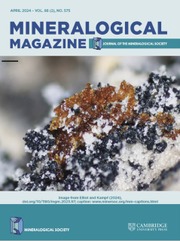
Nancyrossite, FeGeO6H5, a new hydroxyperovskite
Published online by Cambridge University Press: 18 February 2025
Abstract
Nancyrossite, ideally FeGeO6H5, is a new hydroxyperovskite from Tsumeb. It probably formed by the oxidation and partial dehydrogenation of stottite, FeGe(OH)6, with which it is associated intimately. The structure of nancyrossite has been determined in tetragonal space group P42/n: a = 7.37382(12) Å, c = 7.29704(19) Å, V = 396.764(16) Å3, Z = 4, R1(all) = 0.034, wR2(all) = 0.051 and GoF = 1.057. Empirical formulae of two crystals have almost end-member compositions, Fe3+1.01Zn0.03Ge0.98O6H5 and Fe3+1.01Zn0.04Ge0.98O6H5. Structure determination indicates that 88% of the Fe is ferric. The chemical formula proposed here for nancyrossite recognises that although H atoms form OH groups, writing the formula as FeGeO(OH)5 implies that one of the six oxygen atoms is very underbonded, with a bond-valence sum of only ∼1.2 valence units. As such, H in nancyrossite may have novel crystal chemistry. For example, the five H atoms may be distributed dynamically over the six O atoms, a phenomenon that would be averaged by X-ray diffraction, and so go undetected. Nancyrossite is the Ge-analogue of jeanbandyite. By analogy with nancyrossite, we propose revision of the ideal formula of jeanbandyite from FeSnO(OH)5 (Welch and Kampf, 2017) to FeSnO6H5.
Keywords
Information
- Type
- Article
- Information
- Copyright
- © The Author(s), 2025. Published by Cambridge University Press on behalf of The Mineralogical Society of the United Kingdom and Ireland.
Footnotes
Guest Editor: Robert F. Martin
This paper is part of a collection in tribute to the work of Edward Grew at 80
References
Brese, N.E. and O’Keeffe, M. (1991) Bond-valence parameters for solids. Acta Crystallographica, B47, 192–197.CrossRefGoogle Scholar
Degen, T., Sadki, M., Bron, E., König, U. and Néner, G. (2014) The HighScore suite. Powder Diffraction, 29 (Supplement 2), S13–S18.CrossRefGoogle Scholar
Evans, H.A. Wu, Y. Seshadri, R. and Cheetham, A.K. (2020) Perovskite-related ReO3 materials. Nature Reviews Materials, 5, 196–213.CrossRefGoogle Scholar
Gunter, M.E., Bandli, B.R., Bloss, F.D., Evans, S.H., Su, S.C. and Weaver, R. (2004) Results from a McCrone spindle stage short course, a new version of EXCALIBR, and how to build a spindle stage. The Microscope, 52, 23–39.Google Scholar
Jena, H., Kutty, K.V.G. and Kutty, T.R.N. (2004) Ionic transport and structural investigations of MSn(OH)6 (M = Ba, Ca, Mg, Co, Zn, Fe, Mn). Materials Chemistry and Physics, 88, 167–179.CrossRefGoogle Scholar
Kampf, A.R. (1982) Jeanbandyite, a new member of the stottite group from Llallagua, Bolivia. Mineralogical Record, 13, 235–239.Google Scholar
Kampf, A.R., Désor, J., Welch, M.D., Ma, C. and Möhn, G. (2025) Zincostottite, the zinc analogue of stottite from Tsumeb, Namibia. Mineralogical Magazine, doi:10.1180/mgm.2024.81Google Scholar
Kleppe, A.K., Welch, M.D., Crichton, W.A. and Jephcoat, A.P. (2012) Phase transitions in hydroxyperovskites: a Raman spectroscopic study of stottite, FeGe(OH)6 to 21 GPa. Mineralogical Magazine, 76, 949–962.CrossRefGoogle Scholar
Lafuente, B., Yang, H. and Downs, R.T. (2015) Crystal structure of tetrawickmanite Mn2+Sn(OH)6. Acta Crystallographica, E71, 234–237.Google Scholar
Mitchell, R.H., Welch, M.D. and Chakmouradian, A.R. (2017) Nomenclature of the perovskite supergroup: A hierarchical system of classification based on crystal structure and composition. Mineralogical Magazine, 81, 411–461.CrossRefGoogle Scholar
Nakayama, N., Kosuge, K. and Kach, S. (1977) Magnetic properties of FeSn(OH)6 and its oxidation product FeSnO(OH)5. Materials Research Bulletin, 13, 17–22.CrossRefGoogle Scholar
Robinson, K., Gibbs, G.V. and Ribbe, P.H. (1971) Quadratic elongation: a quantitative measure of distortion in coordination polyhedra. Science, 172, 567–570.CrossRefGoogle ScholarPubMed
Sheldrick, G.M. (2015) Crystal structure refinement with SHELXL. Acta Crystallographica, C71, 3–8.Google Scholar
Welch, M.D., Crichton, W.A. and Ross, N.L. (2005) Compression of the perovskite-related mineral bernalite Fe(OH)3 to 9 GPa and a reappraisal of its structure. Mineralogical Magazine, 69, 309–315.CrossRefGoogle Scholar
Welch, M.D. and Kampf, A.R. (2017) Stoichiometric partially-protonated states in hydroxyperovskites: the jeanbandyite enigma revisited. Mineralogical Magazine, 81, 297–303.CrossRefGoogle Scholar
Welch, M.D. and Kleppe, A.K. (2016) Polymorphism of the hydroxyperovskite Ga(OH)3 and possible proton-driven transformational behaviour. Physics and Chemistry of Minerals, 43, 515–526.CrossRefGoogle Scholar
Welch, M.D., Najorka, J., Kleppe, A.K., Kampf, A.R. and Spratt, J. (2024a) Nancyrossite, IMA 2024-033. CNMNC Newsletter 81. European Journal of Mineralogy, 36, 917–923, https://doi.org/10.5194/ejm-36-917-2024Google Scholar
Welch, M.D., Najorka, J. and Wunder, B. (2024b) Crystal structure, hydrogen bonding, and high-pressure behaviour of the hydroxyperovskite MgSi(OH)6: A phase relevant to the deep subduction of hydrated oceanic crust. American Mineralogist, 109, 255–264.CrossRefGoogle Scholar
Wilson, A.J.C. (editor) (1992) Mathematical, Physical and Chemical Tables. International Tables for Crystallography, Volume C. Kluwer Academic Publishers, Dordrecht, The Netherlands.Google Scholar
Wright, S.E., Foley, J.A. and Hughes, J.M. (2000) Optimization of site occupancies in minerals using quadratic programming. American Mineralogist, 85, 524–531.CrossRefGoogle Scholar

Welch et al. supplementary material
Welch et al. supplementary material

File
418.4 KB