

What is our stereotype of an object? What is our exemplar of a thing? We might begin by enumerating some examples: hammers, chairs, and tables; houses, bridges, and bicycles; maybe even rocks, flowers, and chickens. Such entities have many properties we could consider “objective.” Following Whitehead (Reference Whitehead1920), they are continuously present to the senses. Borrowing some terms from Gibson (Reference Gibson1986), they consist of a substance enclosed by a surface that is surrounded by a medium. They are relatively detachable from context and transportable across contexts—spatially, temporally, and personally. And they are suitably scaled to the size, strength, shape, and senses of people. In short, they are whats that can be sensed and moved by whos.
To say that an entity is an object is to take part in several philosophical traditions. On the one hand, we have Descartes, for whom objects are contrasted with subjects, the former having spatial extension (res extensa) and the latter having mental representations (res cogitans). On the other hand, we have Kant, for whom things are contrasted with people, the former being means for ends and the latter being ends in themselves. In both traditions, there is contrast (extension versus representation, means versus ends) and complementarity (subject and objects, as well as people and things, are intrinsically interrelated). All of the entities enumerated above are both Cartesian objects and Kantian things. Indeed, they were explicitly cast in experiential terms, relative to the subject or person who beholds them.
In the first part of this essay, I will be concerned with several alternative theories of the relation between subjects and objects, or persons and things. The first two sections review Aristotle on causality and Marx on production. Loosely speaking, rather than reducing such entities to their sensual presence, as experienced by subjects (e.g., the qualia that one is conscious of), these theories treat such entities as recursively reticulated and radically nonportable, ensembles of causes and effects themselves mainly outside of the awareness of subjects. Through the lens of Hobbes, the following section shows some of the classic stakes of such theories: what the discrepancy between an agent’s horizon and an entity’s worldline entails for issues of power, knowledge, fetishization, and the unconscious. And the subsequent section is concerned with Heidegger’s account of worldliness and thus a turn to phenomenology. I will show Heidegger’s Aristotelian roots, the way his interpretation of things is grounded in Aristotle’s understanding of causes and thus complements Marx’s theory of production.
In the second part of this essay I begin to retheorize the same phenomena from a semiotic stance and thus develop an ontology that turns on signs, objects, and interpretants instead of causes and effects and thus the categories of Peirce instead of the categories of Aristotle, Marx, or Heidegger. In addition, I demonstrate how such modes of relatively instrumental meaning relate to other kinds of meaning, such as the price of a commodity and the propositional content of an utterance. In these ways, I figure a set of key concerns: (1) the relation between use value, exchange value, truth value, and deontic value; (2) the way such forms of value mediate the relation between people and things; and (3) the nature of allegedly modern forms of such mediation, in which the values in question become enclosed as much as disclosed and thereby made to appear highly objective, portable, or context free. More generally, building on Peirce’s notion of the “ground” (qua embedded and embodied assumptions about possible sign-object patterns), I show the way ontologies—whether they belong to Marx and Heidegger, or my mom and the man down the street—are both condition for, and consequence of, semiotic processes.
Aristotle’s Understanding of Causes
In his Physics (Reference McKeon2001b, bk. 2, chap. 2), Aristotle theorized four kinds of causes that may underlie a thing.Footnote 1 There is the substantive cause: the material out of which something is made (say, clay). There is the formal cause: the shape, or ideal attributes, given to material (say, half-spherical and hardened). There is the final cause: that for the sake of which shape is given to material (say, a bowl used as a means to serve cookies). And there is the efficient cause: that which gives shape to material for the sake of function (say, the potter and the kiln). In short, the material cause is what is shaped; the formal cause is how it is shaped; the final cause is why it was shaped; and the efficient cause is whatever or whoever shaped it. Looking ahead to Marx’s theory of the production of use values, we might say that laborers (and their instruments) give form to substance for the sake of function. More broadly, a given thing may have many different causes of each type, insofar as it incorporates different substances, involves a range of different qualities and forms, is the result of many different efficient forces, and may serve many different functions (see fig. 1).
The causes of a thing

Quite provocatively, while Aristotle understood efficient causes mainly in terms of actors and instruments, he also noted that such causes could include chance and spontaneity. These are particularly wonderful causes for a variety of reasons. While they may give form to material, they may not do this for the sake of function—think, for example, of the effect of a lightning bolt striking a tree or the role of chance in natural selection. They are often a source of motivation: speculative capital, gambling, and so on. And, looking ahead to Hobbes, and the fetish more generally, many forms of chance are reinterpreted in relatively human-specific intentional terms: we assume that such efficient causes are oriented toward final causes. Notwithstanding their name, then, causes are not necessarily, or even usually, intentional or telic, even though subjects are often prone to construe them this way.
Following Aristotle’s suggestion, we may take things to be their causes. Moreover, we should realize that the causes of a thing may themselves be things with their own causes, and so on indefinitely. For example, an efficient cause (say, the kiln) may itself be a thing and, hence, a formed and functional substance created by a prior efficient cause (such as an industrial factory). And a material cause (such as clay) may itself be a thing and, hence, a formed and functional substance created by a prior efficient cause (such as a laborer who mixed sand, dirt, and water). Indeed, the bowl itself—as a thing—may go on to serve as the material or efficient cause of another thing. It is thus tempting to suggest that things are not only their causes but also their effects. That is, one and the same entity or event may be understood retentively (as the effect of prior causes) or protentively (as a cause with subsequent effects).
Indeed, pushing past Aristotle, labor itself—or the laborer understood as one kind of efficient cause—may be understood as a formed-functional substance, itself the product of prior reproductive processes. In this extreme analogy, the substance is human being (as the biological individual, itself also mediated by manifold causality of the kind just described). The form includes social statuses and mental states and, hence, an ensemble of social relations and cognitive representations, inter alia. The function is the role played by such relations and representations—for example, mediating between selves and others, or mediating between minds and worlds. The laborer is parents, teachers, foremen, and police (i.e., those who bear and rear, educate and discipline, socialize and train); and the instruments used by the laborers may be schools and books, prisons and factories, carrots and sticks, gold stars and varsity letters, mathematical principles and moral allegories. In short, not only are “things” their causes and effects (and causes and effects are things), but “people” are things (as well as the causes and effects of things, as well as of people). Hence, the process is necessarily recursive and indefinitely reticulated (see fig. 2).
Causal interrelations among people and things
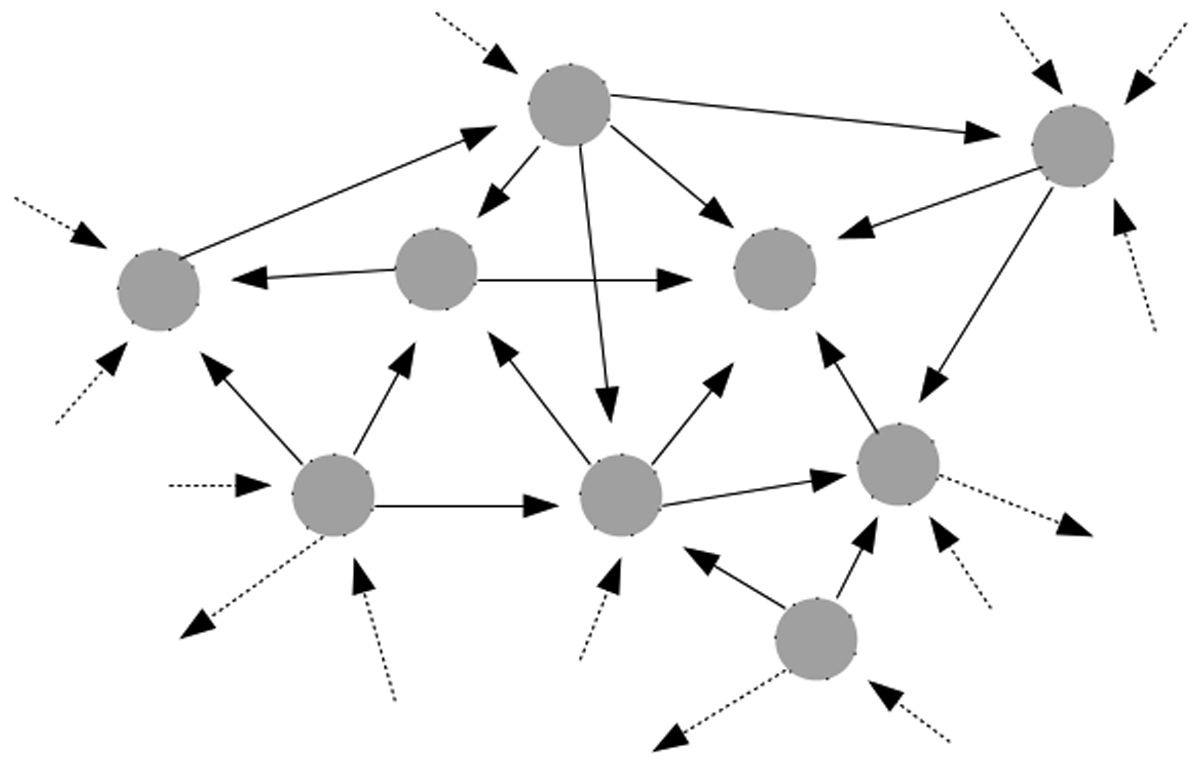
Finally, while Aristotle’s term “cause” has been kept and paired with its usual complement “effect,” it is probably better to speak in terms of “sources” and “destinations,” as well as “paths,” and thereby avoid any mechanistic assumptions. Only in the case of black boxes, such as logic gates (and not even then, as it turns out), are destinations (qua “outputs”) relatively determined by sources (qua “inputs”), such that there seems to be a deterministic or entirely predictable path from cause to effect. In contrast, for the kinds of things of interest here, there is usually no one-to-one relation between source and destination. Rather, there are many paths from the same source, and there are many paths to the same destination. And any place along a path, from a source to a destination, may itself be the source or destination of other paths. Indeed, the best analogy is probably roots and fruits, as mediated through recursively reticulated relations, and as thwarted and intercepted by parasites (Serres Reference Serres2007; Kockelman Reference Kockelman2010). In the idiom of Peirce (Reference Peirce and BuchlerPWP, 74–97, 98–119), paths are grounded in firstness (e.g., possibility, contingency, imagination) and thirdness (e.g., necessity, obligation, convention), as much as secondness (e.g., actuality, causality, contiguity). In such a reading, things are their sources and destinations, or roots and fruits, however complex or contingent. People are “things” (which is not to say that they are only things, as will be discussed below). And rather than focus on sources and destinations (as precipitates or relata), the focus should be on the potentially slippery and serendipitous paths that link sources and destinations (as processes or relations), as well as the conditions that lead to such grounds being overlooked, such that the precipitates and relata can be so easily and erroneously excerpted as figures (see fig. 3).
Excerpting from causal infrastructure

Marx’s Theory of Production
Marx’s (Reference Marx, Moore and Aveling[1867] 1967) understanding of things has two complementary dimensions. Sometimes his focus is on products (qua “commodities”), and sometimes his focus is on processes (qua “production”). With respect to either processes or products, sometimes his focus is relatively concrete and qualitative (“use value” and “concrete labor”), and sometimes his focus is relatively abstract and quantitative (“exchange value” and “abstract labor”). To be sure, it can be difficult to disentangle the two dimensions from each other (process and product versus abstract and concrete); and it can be difficult to separate the poles of each dimension (process versus product, abstract versus concrete). Following the lead of Aristotle, this section thereby focuses on Marx’s account of concrete processes, as the production of use values. However, given such conceptual inseparability, it will necessarily make reference to the production of exchange value (or value per se)—and hence to both the qualitative and quantitative dimensions of things.Footnote 2
The essence of the industrial production process, as understood by Marx in volume 1 of Capital, is relatively easy to describe (see fig. 4):
Commodity production as concrete causality

The capitalist takes a certain amount of money (M) and uses this to buy a commodity (C), which consists of two parts: on the one hand, there are means of production (MP), which consist of subjects of labor (or what is worked on: iron, cotton, flour) and instruments of labor (or what is worked with: forge, loom, oven); and, on the other hand, there is labor power (LP), which consists of people with the mental and physical capacity to work (smiths, weavers, bakers). When this labor power is put to work utilizing these means of production, the production process (P) results in another commodity (C′). And assuming all goes well for the capitalist, this may be sold for a certain amount of money (M′), which is equal to the original sum of money advanced (M) plus a surplus (s).
A commodity, then, is anything that has both use value and value—where the former bears the latter, and where the latter is expressed in its exchange value: other commodities (or money) that this commodity could be exchanged for. And while capital alternatively appears in the guise of commodities (C) or money (M), in essence it is self-expanding value—and hence requires the entire circuit just discussed to illuminate. In some sense, and in terms of the last section, the path itself is capital, rather than any of the steps—qua sources or destinations—along the way.
Focusing on the production process (P), Marx’s ontology of concrete labor consists of the repeated embedding of a binary distinction into itself and thus a very simple kind of recursive reticulation (Reference Marx, Moore and Aveling[1867] 1967, 173–80). As may be seen from figure 5, concrete labor, as the top-most node, breaks down into objective factors (or the means of production) and subjective factors (or labor power in use). For example, objective factors might include all the instruments and ingredients necessary for cooking; and subjective factors might include all the actions and thoughts required of cooks. In relation to figure 4, these categories map onto MP and LP, respectively.
Marx’s ontology of concrete labor
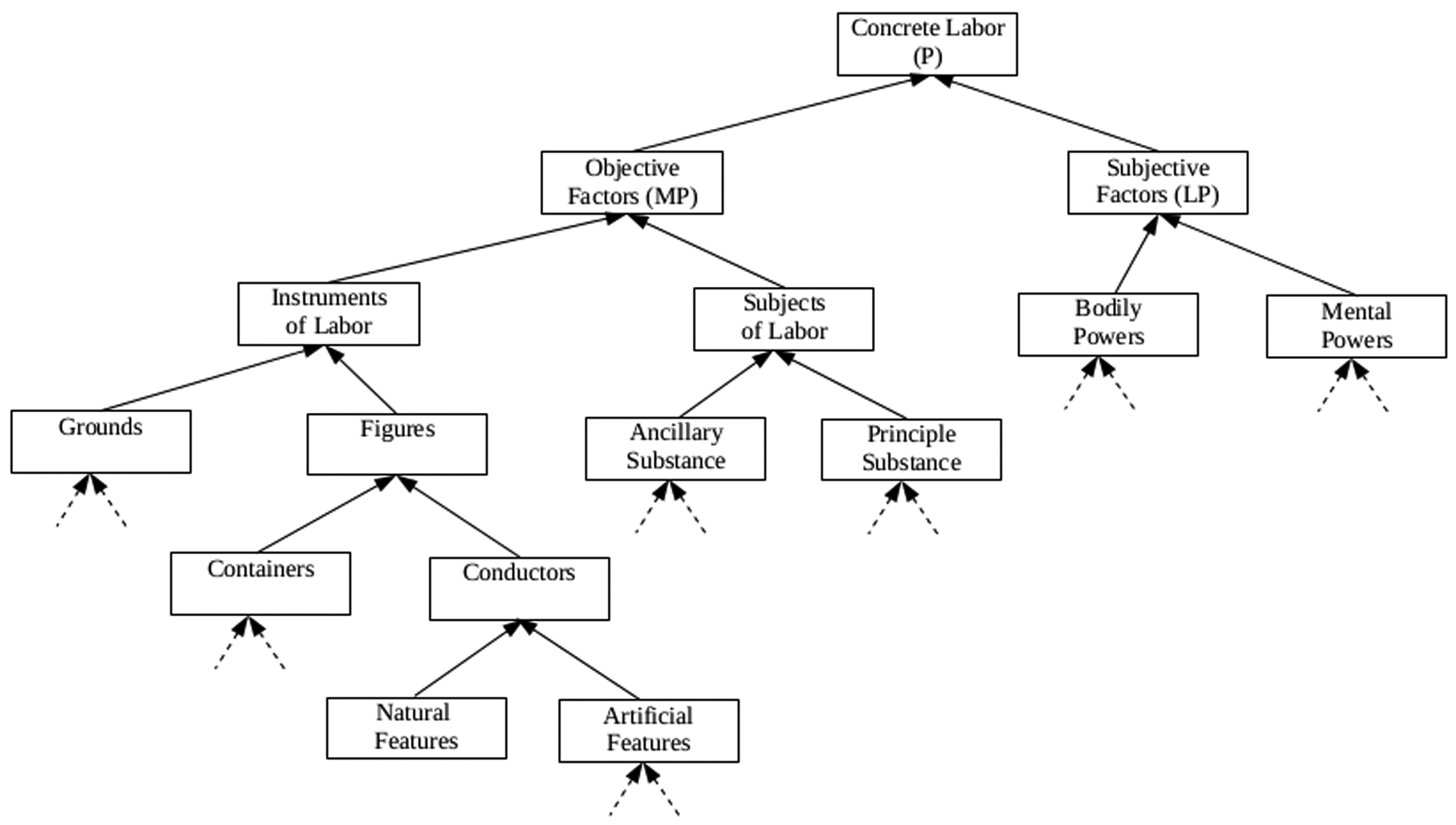
Moving down tier by tier and from left to right in figure 5, objective factors break down into instruments of labor (or what is worked with) and subjects of labor (or what is worked on). For example, instruments of labor might include all the kitchen utensils marshaled for a meal; and subjects of labor might include all the ingredients required by a recipe. And subjective factors break down into bodily powers (when exercised) and mental powers (when exercised). For example, the exercise of bodily powers might include the toil of mixing, and the exercise of mental powers might include decisions regarding how long to mix. Instruments of labor break down into grounds (or what is required to labor on the subject) and figures (or what is used to transfer labor to the subject).Footnote 3 For example, grounds might include the kitchen counter and sink, if not the kitchen itself; and figures might include mixing bowls, cookie trays, spatulas, and wooden spoons. Subjects of labor break down into accessories (or relatively ancillary features of what is worked on) and principal substances (or relatively essential features of what is worked on). For example, accessories might include raisins, chocolate chips, and walnuts; and principle substances might include flour, milk, eggs, salt, baking soda, and sugar. (Opinions may differ.) Figures break down into containers (or whatever holds the subject of labor) and conductors (or whatever shapes the subject of labor). For example, containers might include mixing bowls and cookie trays; and conductors might include wooden spoons and ovens.
Finally, each of the ultimate seven categories (grounds, containers and conductors, accessories and principal substances, bodily and mental powers) breaks down into natural features (or whatever is not the product of prior human labor) and artificial features (or whatever is the product of prior human labor). For example, bodily labor might be broken down into relatively natural elements (such as brute strength and coordination) and relatively artificial elements (such as discipline, or techniques of the body). And mental labor might be broken down into relatively natural elements (such as a linguistic capacity, or a representational capacity) and relatively artificial elements (such as education, or techniques of the mind)—and so on, for the other categories. To say that some feature is natural, rather than artificial, is simply to say that it is not the result of a prior process of production. In this way, the output (fruits, or “finished product”) of one production process can become the input (roots, or “raw material”) of another production process, and so forth, indefinitely. In other words, nature—including human nature—gets constituted as that which is not the product or end of a prior production process or as that which has no human agent underlying any of its efficient or telic causes.
In short, Marx’s understanding of the production process, in its concrete framing, involves a recursively reticulated structure that is reminiscent of Aristotle’s understanding of causality. In particular, the “factors of production” for any use value may be understood as its causes: laborers (whoever works); subjects of labor (whatever is worked on), and instruments of labor (whatever is worked with)—where these instruments are themselves composed of conductors (whatever shapes the subject), containers (whatever holds the subject while shaped), and context (wherever this shaping and holding takes place). As may be seen, as we move from the right-hand side to the left-hand side in figure 5, as we move from the leftmost branchings of such an ontological cascade to the rightmost branchings, we move from causes that are the most enclosing (e.g., res extensa, or “context”) to causes that are the most enclosed (e.g., res cogitans, or “cognition”), from those causes that are most like means to those causes that are most like ends, from value distributed across space to value deployed over time.
Returning to figure 4, it should be stressed that the focus so far has been on the creation of one commodity (C′) from another commodity (C, which is really a set of commodities) through production (P). Or, more generally, the emphasis has been on the creation of one use value out of other use values. The use value created can itself go on to help create other use values (as a means of production), or it can be consumed and thereby go on to help create that which creates other use values (as labor power). More generally, it behooves us to take the foregoing ontological cascade as a cause-effect chain, or source-destination path: all the many little causes give rise to one big effect. And that big effect may, in turn, go on to be one of the many little causes that gives rise to another big effect—and so on, indefinitely. Returning to Aristotle, to describe a “thing” (qua use value), it is necessary to describe the causal relations, past and future, of any relatum in this diagram, which themselves lead to and follow from other relata, and hence other relations.
Finally, just as the factors of production, understood concretely, may be successively embedded into each other indefinitely, so too may the production process understood abstractly, as the creation and realization of value. For example, just as we may take the factors of production (MP and LP, as a set of Cs) to be the more immediate causes of a thing (C′), so too may we take the money that purchases these factors of production (M) to be a more distal cause of the thing. Moreover, the money (M′) that the commodity (C′) will realize when sold is also a cause. Indeed, surplus (s), as the difference between M′ and M, is perhaps the ultimate cause in a capitalist economy (in the guise of profit). Keeping within an Aristotelian idiom, these might be understood as the abstract (or quantitative) causes and effects of a thing (qua exchange value), in parallel to the concrete (or qualitative) causes and effects of a thing (qua use value). Not only, then, is there recursive reticulation when production is framed concretely (the factors of production of each C are themselves Cs with their own factors of production), there is also recursive reticulation when production is framed abstractly (the money M that purchases the factors for one production process is itself the result of having sold the final products of other production processes) (see fig. 6).
Capital as abstract causality

In short, in a capitalist economy, abstract causality—qua recapitalized surplus value—may be framed as the “final cause” of the entire system. Indeed, the last part of Marx’s Capital, on the secret of primitive accumulation, is an attempt to get to the initial causes of this ongoing, and seemingly never-ending, chain. Such an attempt is perhaps best understood to lie somewhere between a Hegelian history (qua origins) and a Nietzschean genealogy (qua sources), though it also has elements of a Freudian dream and a Weberian ideal type.
The Fetish according to Hobbes
Hobbes had a succinct definition of the fetish: “Ignorance of remote causes disposeth men to attribute all events to the causes immediate and instrumental; for these are all the causes they perceive” (Reference Hobbes[1668] 1994, 61–62). That is, the fetish is the misconstrual of causality due to the limits of perception. In terms of Aristotle’s categories, this means two things. First, we focus on efficient causes and forget about material, formal, and final causes. Second, we focus only on immediate causes and forget about distal causes. Loosely speaking, we only go so far down a causal path, and only in a certain direction. This is for the simple reason that causes further down and in other directions are more likely to be outside of our experience.
Pushing further, we might account for a range of phenomena in similar terms. For example, we might forget about the role of chance as efficient cause and focus only on instruments and actors. Indeed, we might even forget about the role of instruments and focus only on actors. We might assume everything has a final cause, construed in terms of the purpose of a putative actor who caused it (say, god and the cosmos). This, surely, is a more canonical definition of the fetish. In a Nietzschean vein, we might treat the current function of a thing as its original purpose. In other words, we see how something is currently used, and we assume that was the reason it was originally created. Moving from Aristotle’s categories to those of Marx, we might focus only on means of production and forget about labor power. Or, within means of production, we might focus only on subjects of labor and forget about instruments of labor. Or, within instruments of labor, we might focus only on conductors and forget about containers or context. Similarly, we might focus on the sources of something (the causes it is an effect of) and forget about its destinations (the effects it is a cause of). And we might focus on concrete causality and forget about abstract causality, analyzing the production of use value without reference to the production of exchange value, and so on, and so forth. There are as many ways of misconstruing causality as there are limits on our perception.
Indeed, to get back to our original definition of an “object” and “thing,” we might focus only on formal cause (say, that which is immediately perceivable and relatively static) and only on such res extensa so far as it presents itself to res cogitans (e.g., as qualia). In this interpretation, what Hobbes is really offering is an account of why complex entities (qua recursively reticulated relations) are reduced to our original stereotypes of objects and exemplars of things—that which impinges on the senses of the passive subject: bare form, or mere qualities.
So why is it so terrible that we misconstrue the nature of causality, that we reduce multidimensional entities to objects and things? To answer this we need to turn from objects and things to subjects and people. Here we might take another quote from Hobbes: “Anxiety for the future time disposeth men to inquire into the causes of things, because the knowledge of them maketh men the better able to order the present to their best advantage” (Reference Hobbes[1668] 1994, 62). Fleshing out this passage in a Baconian vein, we might say the following: knowledge is the discovery of causes; and power is the directing of causes. And thus the fetish is a key limit on our knowledge and power, a key limit on our ability to organize the present for the sake of the future and thereby stave off this anxiety in the present. Indeed, we might go so far as to define the unconscious as follows: whatever the subject has not discovered about the causes that direct it.
In short, a thing is its causes and effects, or sources and destinations, understood in either Aristotelian or Marxist terms. The original characterization of a thing or object—the experiential stereotype or exemplar—gets it exactly wrong. And this error may be an effect of the Hobbesian fetish: reducing causal processes to static forms, multidimensional entities to monodimensional objects. Moreover, not only is the essence of a thing its causes and effects, but most of these causes and effects are themselves things with causes and effects, and so on ad infinitum. Finally, people are things—or, rather, have all the properties of things in addition to their particular properties as people.
Indeed, we may think of three classic ways of defining subjects and persons and thereby distinguishing them from objects and things.Footnote 4 First, there is the Enlightenment tradition: people are different from things in that they are autotechnic and autotelic; they are their own efficient and final cause; they wield themselves for the sake of themselves; they are self-caring and self-conscious creatures. Second, there is also an anti-Enlightenment tradition, which might be defined as follows: people are those things whose limited knowledge of, and power over, their own causes is their principal cause. As will be seen in the next section, both of these traditions are present in Heidegger’s understanding of Dasein: that which orients to references (qua causes), that which is the one of the references oriented to, and that which is unaware of the very orientation that constitutes it.
Heidegger’s Account of References
In offering his account of worldliness in Being and Time (Reference Heidegger and Stambaugh[1927] 1996, 59–106), Heidegger begins by focusing on practical things, or “equipment,” such as crowbars and shoes.Footnote 5 To understand such things, he introduced the concept of “references” (die Verweisungen), which may be loosely understood as the relation things have to each other by virtue of being caught up in practical concerns. For example, the way a nail only makes sense “in reference to” a hammer. On the one hand, references are similar to Aristotle’s causes understood in human terms, or relative to a network of means and ends. On the other hand, references are similar to Marx’s factors of production, understood from the standpoint of an engaged user rather than a detached observer, or even understood from the standpoint of a laborer rather than a capitalist (or critical theorist).
With his theory of references, Heidegger was critiquing a tradition that focused on representations, those defining predicates of the “subject.” Representations are usually understood as mental states: beliefs, intentions, perceptions, memories, and plans. But they may also be extended to include speech acts: assertions, questions, commands, promises, and apologies. Such entities have propositional contents that represent the world in ways that may correspond with the world or not. For example, beliefs may be true or false, perceptions may be veridical or illusory, intentions may be fulfilled or unfulfilled. In this tradition, the ego or subject is that which has representations: whoever believes, intends, and perceives. While at the center of representations, however, the ego is not itself directly represented. Instead, it is usually only apperceived, or indirectly represented; rather than being center stage, it is only lurking in the wings as the I think that accompanies every thought. In short, this tradition posits subjects and objects, themselves connected by representations; these representations may or may not correspond to reality (as that which has extension); and while objects are directly represented, that which has representations (the subject) is usually only indirectly represented.Footnote 6 As will be seen in what follows, references were for Heidegger a more originary mode of meaning than representations: they were not meant to replace them so much as displace them. In this way, representations are one widespread way of erroneously enclosing references and thus rendering residence in the world in terms of representations of the world.
To understand references, as the relations things have to each other by virtue of being caught up in human concerns, we may focus on “instruments.” An instrument refers to the action it is used to undertake (what Heidegger called its “in-order-to”). For example, a hammer makes reference to the action of pounding in a nail. An instrument refers to the other instruments that complement it (“in-terms-of”). For example, a hammer makes reference to nails and wood, as well as vices and benches. And an instrument refers to the work it will create (“what-for”), itself often another instrument. For example, a hammer makes reference to the desk that the actor is making. This work, in turn, refers to whoever will use it, as an actor (“for-whom”). For example, the desk makes reference to one’s son or daughter, as the person who will one day sit there. This work refers to whatever materials it incorporates, themselves often other instruments (“from-what”). For example, the desk makes reference to legs and a surface, lumber and paint, struts and joints. And this work refers, after a potentially long chain of intermediate works, to a final work (“for-the-sake-of-which”). For example, the work makes reference to the role of the actor—say, as a carpenter, inhabiting a workspace with familiar tools. And, more distally, the work makes reference to the identity of the actor—say, as a father, incorporating the role of carpenter, while making a desk for one’s son or daughter, for the sake of being a good parent (see fig. 7).
Heidegger’s references

(Needless to say, this example is meant to be reflexively critical by keeping with Heidegger’s romantic, premodern, and folksy imaginary; itself in stark contrast to Marx’s realist description of social conditions under capitalist production. But that said, while Heidegger is often critiqued as focusing on a practical orientation, as opposed to a theoretical orientation, the orientation he describes easily shifts and scales to understand decidedly “nonpractical” and “nontraditional” orientations [Kockelman Reference Kockelman2011b]: the structure of texts and scientific citations, ritual practices and discursive interactions, networks of channels and other kinds of infrastructure, the internal structure of complex technologies and organic bodies, and much else besides.)
As per Aristotle’s account of the causes of things and Marx’s account of the factors of production, Heidegger’s references are recursively reticulated. For example, the instrument may itself be the work created by a prior action, and the work may itself be the instrument wielded by a subsequent action. Similarly, the materials may themselves be the work created by prior actions, and the work may itself be the material incorporated by a subsequent work. Finally, the user may herself be the actor who wields the work as an instrument, and the actor was herself the user of the work created by a previous action. For Heidegger, coherence of references (the way affordances, instruments, actions, roles, and identities make sense in the context of each other) is more originary than correspondence of representations (the way a subject is adequate to an object, in the sense of having true beliefs, veridical perceptions, or sated intentions).
Notice, then, the temporal relations at issue in each and every reference: the actor simultaneously wields an instrument (retention) to create a work (protention); the work is simultaneously made from some materials (retention) and for some user (protention); and so on for more distal reticulations. That is, each and every reference makes sense only in reference to other references, either protentively (pointing forward to them) or retentively (pointing backward to them). Any present, then, is referentially thick with its past and future. As William James (Reference James and Sherover1975) would put it, the now is not a knife edge but rather a saddle back, on which we sit perched looking in two directions at once. In this way, the retention and protention of references, qua in-order-to (or from-which) and what-for (or for-whom), is more originary than the past and future of representations, qua perceptions (or memories) and intentions (or plans). When Heidegger speaks of a more originary form of temporality than our allegedly abstract, mathematical, modern clock time—such as the kind often taken to govern abstract labor and economic value (Kockelman and Bernstein Reference Kockelman and Bernstein2012)—he means such referentially constituted modes of temporality, such protentive and retentive references.
Notice that this recursive reticulation of references may “bottom out” at one end and “top in” at the other. At some point, the materials incorporated, or the instruments wielded, are not themselves the work of another actor. Nature, qua means that are not themselves ends, is constituted by this bottoming out. Similarly, at some point, the work is not itself the instrument used to create another work. Personhood, qua ends that are not themselves means, is constituted by this topping in. (This point too has its origins in Aristotle [Reference McKeon2001a, bk. 5, chap. 5], who theorized “felicity” [eudemonia], or the highest of human values [sometimes rendered into Latin as the summum bonum], as that end that is not itself a means to another end.) Heidegger, then, does not start with nature (qua objects) and persons (qua subjects); they are, rather, residual categories—Cartesian and Kantian end points or ways we represent the limits of referential relations.
Indeed, even the nature of persons—human nature—is constituted by a different sense of ends than the ones Kant had in mind: not ends qua goals but rather ends qua (in)finitude. On the one hand, as individuals, we end; and this termination, or death, is a ground of meaning. Recall Hobbes’s account of anxiety in the face of the future: with Heidegger this anxiety is in the face of the certain future (death) rather than an uncertain future (privation or scarcity). On the other hand, as communities, we are limitless as to the kinds of references we might be implicated in: and this limitlessness, in von Humboldt’s sense (means without ends), is a ground of meaning. Heidegger’s facticity thereby resonates with Boasian relativity: while we often acknowledge that second nature could be otherwise (there, then, and among them), we often feel that it must be this way (here, now, and among us). Witness the infinite range of human cultures and the fierce identification of any people with their own particular culture.
Heidegger’s term for that which is both oriented to references and the ultimate reference oriented to is Dasein. Dasein, as the name we give to that who that may take a stand on one of the possibilities of its being, is not a self (anima) that senses and moves in the Aristotelian way but rather a someone who is always already with others, insofar as references are so often normatively established and insofar as references only makes sense in terms of those who refer. This someone attends to references—either via circumspection (orienting itself to the references) or by association (orienting the references to itself). These words—circumspection and association—are particularly salient. Just as Heidegger lexically switches from the world (Welt) to the environment (Umwelt), he switches from seeing (sehen) to circumspection (umsehen), and from movement (gehen) to association (umgehen). The Cartesian ego perceives and intends via representations, whereas Dasein circumspects and associates via references.Footnote 7
Indeed, it is not even strong enough to say that references are to Dasein what water is to fish, as the medium in which it senses and moves. For Dasein is itself the ultimate reference, almost the medium per se, as an ensemble of references. In this way, just as a Cartesian theory of the subject understands the subject as being apperceived with each representation, Heidegger’s Dasein is codisclosed with each reference. It sees itself not reflectively but reflexively in those objects—qua affordances, instruments, actors, roles, and identities—that it has given itself over to. In this way, orienting to such references, or “caring” [sorgen] for everyday things, is the being of the being that discloses being: Dasein.
Crucially, Heidegger delimits a series of precedence hierarchies—when one type of reference, or mode of meaningfulness, is prior to another (as ground to figure, or presumption to proposition), thereby constituting a prius. For example, what is prior to the instrument is our mode of using it. In this way, actually wielding an instrument is our most originary mode of knowing it. (The interpretation is prior to the sign or object.) What is prior to a single instrument is an ensemble of complementing instruments. (The whole is prior to the part.) What is prior to the instrument itself is the work it will create, or what it is being used to create. (The what-for, qua end, is prior to the in-order-to, qua means.) What is prior to the instrument, its usage, and the whole of instruments, is the ensemble of references it only makes sense in terms of—affordances, instruments, actions, roles, and identities. (Worldliness is prior to the world.) Moreover, as mentioned above, practical temporality (or reference-mediated protention and retention) is prior to abstract temporality. And references are themselves prior to representations. All of this is a way to interpret what Heidegger means when he says that being is prior to beings: the latter are but enclosed (and thereby excerpted) versions of the former; residence in the world is reduced to representations of the world.
This sense of priority in Heidegger is often, in part, a critique of other analyses—those undertaken by philosophers and layfolk alike—as having failed to grasp the prius. Indeed, the logic of Heidegger’s critique almost runs in the opposite direction of that of Hobbes: it is not distance but rather proximity, that conceals. That is, rather than the misrepresentation of causality due to the limits of experience, Heidegger argues that we get representationalist understandings of the world, as opposed to referentialist understandings of experience, due to the proximity of references. Proverbially, nothing is so far away as the glasses on one’s nose; fish would be the last to discover water; grounds of experience are seldom figured in experience.
Crucially, Heidegger is not claiming that humans do not meaningfully relate to the world via representations. Rather, he is claiming that there is a more originary mode of meaning—references. The issue, then, is not how we suture the subject and object (via true representations, or some kind of dialectic entangling) but rather what ruptures coherence (qua disturbances of reference) and thereby gives rise to representations (in actors) or representationalist philosophies (by analysts) and, thus, ontological distinctions like subject and object or person and thing.
The difference between references and representations (as two kinds of meaningfulness, practical and theoretical, engaged and disengaged) should be compared with the difference between use value and exchange value (as two kinds of meaningfulness, qualitative and quantitative, transhistorical and historically specific).Footnote 8 For Marx and Heidegger, respectively, modernity is a sociohistorical formation or worldview that frames objects and things in a quantitative and representational idiom—one that achieves a radical kind of portability, itself a condition for extreme forms of agency, but only at the expense of having lost touch with more originary qualitative and referential relations. It can disclose (in the sense of wielding power over, having knowledge about, or deriving profit from), but only by means of having enclosed (in the sense of reducing and uprooting, excerpting and defruiting).Footnote 9
From Flatland to Textureville
The previous four sections focused on the “meaning” something has by virtue of being caught up in an ensemble of relations, themselves alternately framed in terms of Aristotle’s causes, Marx’s factors, and Heidegger’s references. And they focused on means-ends-fulness as a particular species of meaningfulness, one that has been ignored or repressed in most theories of meaning insofar as it is either erroneously conflated with various forms of functionalism or incorrectly contrasted with relatively simplistic understanding of meaning. Through such a reading, it framed entities and events in terms of their recursively reticulated relations to other entities and events. And it framed objects and things (as well as subjects and people), in their Cartesian and Kantian senses, as particularly pernicious precipitates of (and projections onto) relational processes. Such philosophical kinds were the effects of enclosing particular swatches of relationality, erroneously excerpting them from other relations, such that they might seem like relatively self-sufficient and context-independent wholes.
Phrased another way, Cartesian “objects” and Kantian “things” depend on flattenings of texture, removals of detail, and losses of meaning. They are ways of radically cutting away at the inherent relationality of the world. To borrow an example from language, they are equivalent to taking a concrete utterance—say, mother!—and removing from it not only its meaning (qua conceptual structure) and interpretation (qua addressee’s understanding) but also its situational and discursive context (where and when was it said, by whom and to whom, in response to what), and much much else besides, such that its key properties are reduced to bare acoustics: /ˈmə-thər/. A complex enchaining of processes, themselves turning on form, meaning, effect, and interrelationality, is reduced to the bare sensuous experience of a detached subject or deterministic person. Indeed, even this framing is optimistic if one takes seriously Boas’s (Reference Boas and Stocking[1910] 1990) understandings of “apperception”—the way perception is mediated by convention, habit, mood, and much else beside, such that the bare phonological form may be heard as a different word altogether, if not music, gibberish, or noise. Or if one takes seriously Gibson’s (Reference Gibson1986) ecological understandings of perception—the way experience is mediated by action and thus agent-specific ways of inhabiting the world.
The rest of this essay is about the relation between meaning and various understandings of “value.” The next section delves into the analytic details of semiotic processes understood from a broadly Peircean framework. It retheorizes “objects” from the standpoint of semiotic objects, themselves understood in terms of “objections” and contrasted with “objectivity.” The following section builds on these claims, retheorizing “tools” from such an explicitly semiotic stance. It retheorizes Heidegger’s references in terms of semiotic processes and thereby reframes worldliness in terms of embeddedness. The third section uses this framing of use value to better understand (exchange) value in Marx, and (representational) value in Heidegger. It shows that these are all species of a more general kind of meaning. And the last section shows how such generalized semiotic processes are grounded in decidedly non-Cartesian and non-Kantian ontologies, as both condition and consequence.
Objects, Objections, Objectivity, and Objectification
Returning to our discussion of objects and things, we might say that such stereotypic understandings focused on the sign-component, or expressive form, of an entity: where the object or thing meets the senses of the subject or person. But to introduce a sign component is to presuppose a semiotic process; and such processes should be (minimally) defined in terms of three components (Reference Peirce and BuchlerPWP, 98–119). There are “signs” (whatever stands for something else). There are “objects” (whatever is stood for by a sign). And there are “interpretants” (whatever a sign creates insofar as it is taken to stand for an object).
For example, in gaze following, the sign is the parent’s directional gaze, the object is whatever is being gazed at, and the interpretant is the child’s change in attention (from looking at the parent to looking at what the parent is looking at). More generally, as George Herbert Mead famously theorized (Reference Mead and Morris1934), any interaction is a semiotic process: the sign component of an action is a controlled behavior, the object component of an action is a purpose, and a canonical interpretant of an action is another’s reaction. For example, if I pull back my fist (first phase of an action, or the sign), you duck (reaction, or the interpretant)— insofar as my next move (second phase of action, or the object) would be to punch you. As Richard Parmentier nicely put it, “I am avoiding just what you are intending because I ‘read’ your first gesture as a sign.”Footnote 10
Any semiotic process relates these three components in the following way: a sign stands for its object, on the one hand, and its interpretant, on the other, in such a way as to make the interpretant stand in relation to the object corresponding to its own relation to the object (Reference Peirce, Hartshorne, Weiss and BurksCP 8.332) (see fig. 8).Footnote 11 What is at issue in meaningfulness, then, is not one relation between a sign and an object (qua standing for) but rather a relation between two such relations (qua correspondence). Note, then, that talk about the importance of relations per se is silly; everything is related somehow. For such a slogan to be meaningful, much less valuable, requires that we focus on relations between relations.
Semiotic process

Indeed, just as Marx, building on Aristotle, theorized value as a relation between people mediated by a relation between things, Saussure theorized “value” (valeur, qua meaning) not as a relation between a “signifier” (qua sound pattern, or sign more generally) and a “signified” (qua concept, or object more generally) but as relations between signifiers in relation to relations between signifieds. So this is a very general point: not just semiotic processes but also semiological structures and social relations, partake of a similar principle. In particular, all these thinkers went past “relations” in similar and consequential ways. And, in each case, it is a key reason for the distinctiveness and importance of their arguments.
Shifting back to Peirce, each of the three components of any semiotic process may itself be related to any of the components of other semiotic processes. For example, the interpretant component of one semiotic process may be the sign component of a subsequent semiotic process; or an entire semiotic process may be the object component of a metasemiotic process, and so on, and so forth. Building on our discussion of Aristotle’s causes, semiotic processes are thereby recursively reticulated relations between relations (see fig. 9).Footnote 12
Semiotic processes recursively reticulated

Indeed, in further reference to our discussion of Aristotle’s account of things, signs relate to interpretants (and objects relate to signs) not as causes to effects (in the narrow, deterministic sense) but as sources to destinations, or rather roots in relation to fruits, where this relation is itself in relation to perturbations and parasites of all genera. That is, the sign (qua origin) gives rise to the interpretant (qua destination) not in a simple dyadic relation but through some kind of reference to the object. Indeed, it is sometimes best to think of the object as an “objection” and thus as that which the interpretant is, in part, forced to contend.Footnote 13
And just as the interpretant only relates to the object through the sign, the object only relates to the sign through the interpretant—so there is, in some sense, always a double contention. In other words, the foregoing point can easily be reframed: the sign (qua origin) gets to the object (qua destination), not in a simple dyadic relation, but only by reference to an interpretant. To be sure, a given cause-effect relation may be radically unmediated, direct, dyadic, or brute; but it will not count as a sign-object relation (or an object-sign relation) unless it is mediated through an interpretant.
From our examples of gaze following and interaction, one should see that many signs and interpretants are relatively objective or thing-like in the stereotypic sense: they can be sensed at a particular spatial-temporal location by agents who are often frameable as subjects or persons. In contrast, many semiotic objects, in the technical sense (such as the purposes of actions, or the functions of instruments), are relatively nonobjective and non-thing-like. A semiotic object is often usefully understood as that which organizes the range of normatively appropriate and effective (or causally feasible and efficacious) interpretants of a sign. In some cases (such as the tree the parent gazes at), it may seem relatively objective. In other cases (such as the punch that has yet to land), it may seem putative or latent or possible. And in other cases (such as the function of an instrument, or the kind of a substance), it may seem quite immaterial or abstract.
Objects, then, may be usefully framed as correspondence-preserving projections. They may be more or less objective or thing-like (again, in the stereotypic sense); they may be more or less precisely delimited (allowing for narrower or wider leeway of interpretation); they may be more or less intersubjectively shared (being more or less normatively spread across a population); and they may be more or less mediated by propositional contents (and hence logical and linguistic relations, or representations more generally). In short, semiotic objects may be more or less enclosed as stereotypic objects in semiotically specifiable ways. Do not conflate semiotic objects with their stereotypic counterparts, be they subject to objectification (qua the hammer, as grasped by the hand) or objectivity (qua the referent, as grasped by the concept). They only ever really match up with such stereotypes as the limit points of very particular processes and as the outcomes of very peculiar practices.
Such an understanding of meaning maximally contrasts with the stereotypic definition of a sign—say, the Saussurean pairing of a signifier and a signified, whether understood as internally articulated (a pairing between a sound image and a concept, as types) or externally articulated (a pairing between a word and a thing, as tokens).Footnote 14 Indeed, the usual focus on sign-object relations (or signifiers and signifieds), at the expense of sign-interpretant relations, and this concomitant understanding of objects as “objective” and interpretants as “subjective” (if the latter are invoked at all), is arguably parasitic on, if not presupposed by, the Cartesian framing of subjects and objects that was at the heart of Heidegger’s critique of representation. But that said, it is impossible to undertake any kind of careful scholarship without attending to the relations between sign-object relations (itself another key mode of relations between relations). Indeed, Saussure—like Marx—was the perhaps the most explicit and prescient theorist of the immanent critique, offering us a way to describe (and decry) a system in terms of its own categories and commitments.Footnote 15
Utility, Worldliness, and Embedded Interpretants
Let us return, then, to the most stereotypic, and seemingly ubiquitous, of things—tools, instruments, use values, and equipment.Footnote 16 To say that instruments are semiotic processes is to say that they consist of signs, objects, and interpretants. Suppose, for example, that the instrument is a hammer. The sign component of a hammer is the artificed entity itself: some assemblage of wood and steel that is at least partially available to the senses of some user. One important object component of such a sign is its function—in this case, whatever that assemblage of wood and steel may be used to do, whether in the eyes of the artificer (whoever created the hammer) or in the eyes of the user (whoever wields the hammer).Footnote 17 And one basic interpretant of a hammer is the action of wielding it to pound in a nail, itself an incipient semiotic process whose sign is a controlled behavior and whose object is a purpose. While Heidegger would say such an instrument “refers” to such an action (that is, it only makes sense “in reference to” it), we will say that such an action is an interpretant of such an instrument. In this way, the phenomenological cannot be contrasted with the semiotic, any more than the semiotic can be contrasted with the material.
There are, to be sure, other ways of interpreting hammers, even in regards to their most basic functioning. Peirce, for example, usefully contrasted four different kinds of interpretants (Reference Peirce and BuchlerPWP, 269–89; and for extended discussions, see Kockelman Reference Kockelman2005, Reference Kockelman2011b, Reference Kockelman2013a). Loosely speaking, there are affective (or “emotional”) interpretants—for example, blushing when teased about one’s embarrassing behavior. There are energetic interpretants—for example, turning to look when someone points. There are representational (or “logical”) interpretants—for example, a belief or assertion that represents the world in a way that may be true or false. And there are ultimate representational interpretants—for example, the habits one has (in the sense of embodied dispositions to act) insofar as one is committed to the truth of some particular representation. From the standpoint of such categories, to fear for one’s fingers when hammering is to provide an affective interpretant of a hammer. To wield a hammer by pounding in a nail is to provide an energetic interpretant of it. To call an instrument a “hammer” is to provide a representational interpretant of it. And to habitually interact with hammers in particular ways, insofar as one believes that they serve certain functions, afford particular actions, or potentiate particular injuries, is to provide an ultimate representational interpretant of them.
Crucially, there are many other practical interpretants of instruments besides the actions that wield them (or the ways we affectively react to them, or habitually interact with them), which may be compared with Heidegger’s typology of references (Kockelman Reference Kockelman2013a). For example, a nail provides a complementing interpretant of a hammer: as another instrument, it points to the function of a hammer as surely as the action of hammering and as surely as the assemblage of wood and steel (as the sign component of such a semiotic process). Loosely speaking, hammers make sense only in the context of, or by reference to, nails. (To be sure, hammers can serve many other functions [e.g., brandished as a warning, used as a weapon, retooled to weight a plumb line], but even then they are usually complemented by other kinds of instruments and interpreted by other kinds of actions—and so these very same points hold.)Footnote 18 Similarly, locks are complementing interpretants of keys, swords are complementing interpretants of sheaths, and so forth. Such semiotic processes relate to each other as figure to ground, assertion to assumption, item to accessory, hand to handle, and so forth.
Or, for example, a wheel provides an incorporating interpretant of a spoke: its sign component relates to the sign component of a spoke (qua artificed entity) as whole to part; and its object component relates to the object component of a spoke (qua function) as ends to means. Indeed, just as a wheel provides an incorporating interpretant of a spoke, a bicycle provides an incorporating interpretant of a wheel. Similarly, a hammer provides an incorporating interpretant of wood and steel, and a book provides an incorporating interpretant of ink and paper and glue. Such semiotic processes relate to each other as means to ends and parts to wholes.
Indeed, the process can work the other way and thus be temporally retentive as much as protentive. One instrument can be a created interpretant of another instrument if it is an objectification of the function of that instrument. That is, the things that people create provide interpretants of the instruments used in their acts of creation. For example, an oven (as an instrument with a function) helps to create a pie (as another instrument with a different function), and thus pies are interpretants of ovens.
In this way, a single instrument can incorporate, complement, and create other instruments (and thereby relate to them as interpretant to sign); and it can be incorporated, complemented, and created by other instruments (and thereby relate to them as sign to interpretant). Note, then, that while many scholars contrast “utility” with “meaning,” or want to argue that one is prior to the other, utility is really just one species of meaning among many.Footnote 19 Moreover, instruments can both interpret and be interpreted by a wide range of other semiotic processes—such as affordances, actions, roles, and identities (not to mention representations in the stereotypic sense). Indeed, it is really the range of such potential interpretants that ultimately delimits the function (qua semiotic object) of an instrument or any other human-specific meaning or value more generally. And such interpretants are regimented in their potentiality not only by cultural norms (what is appropriate and effective in the eyes of others) but also by natural causes (what is feasible and efficacious in a physical environs, regardless of who is watching).
Indeed, given our discussion of the recursive reticulation of causes (Aristotle), factors (Marx), and references (Heidegger), each of these modes of mediation is usually itself grounded, at some degree of remove, in the other. Indeed, this fact is one essential characteristic of infrastructure.Footnote 20 Or, to return to Hobbes’s definition of the fetish, this means that distinctions like norm versus cause (as well as similar distinctions: symbolic versus material, institution versus instinct, mediary versus intermediary, imagination versus infrastructure, etc.) often break down as soon as one examines more distal, or less perceivable, relations (in all their recursive reticulatedness). That is to say, notwithstanding how easy it is to talk about regimentation by seconds (causes) or regimentation by thirds (norms), the functioning of most things is tied into the functioning of so many other things that it is difficult to say where causes end and norms begin.
Note, then, that just as one must move past representational interpretants (be they encoded in language or enminded in cognition) to affective, energetic, and ultimate interpretants, the foregoing points move us past such relatively embodied interpretants to relatively embedded interpretants (turning on creation, incorporation, and complemention). Such interpretants might be loosely understood as the precipitates (residues or traces) of past, ongoing, or even potential semiotic processes.Footnote 21 In the terms of the first part of this essay, just as Heidegger argued that representations are usually foregrounded at the expense of references (by both philosophers and layfolk alike), we now see that representational interpretants—which seem to objectify states of affairs in terms of the propositional contents of speech acts and mental states—usually trump affective and energetic interpretants and certainly trump embedded interpretants, in most accounts of culture. Pace Clifford Geertz and the whole hermeneutic tradition, (embedded and embodied) interpretants in culture, or at least in situ, are far more important than (representational) interpretations of culture. In some sense, then, the world is its own best interpretant.
Use Value, Truth Value, Exchange Value, and Moral Value
There are many ways we can interpret a thing and thereby construe it in terms of meaning or value. As was the focus above, we may wield it and thereby frame it in terms of a network of functions and purposes: actually pounding in a nail. Going back to Heidegger’s favorite foil, we can represent it with a mental state or describe it with an utterance and thereby frame it in terms of the propositional content and conceptual structure of language and thought: saying or thinking “that is a hammer.” And, going back to Marx, and political economy more generally, we can exchange it and thereby frame it in terms of supply and demand, labor time or utility, desire or scarcity: giving or receiving another commodity for it. Each interpretive framing involves a different species of conditional relationality. We might call these “instrumental relationality” (turning on feasible ends of a given means or possible effects of a given cause); “semantic relationality” (turning on inferable conclusions of a given premise or possible descriptions of a given state of affairs); and “economic relationality” (turning on proportional quantities of an underlying quality). While these modes of conditional relationality constitute only three dimensions in what is really a multidimensional space, and while they constitute radical objectifications of dimensions that need not be so strongly reified, they nevertheless constitute three critically important frames of value (see fig. 10).
Many objects of same sign, many interpretants of same sign-object relation

In the case of use values, we examined a variety of highly embedded and relatively instrumental interpretants—turning on incorporation (qua part to whole), complementation (qua figure to ground), and creation (qua condition to consequence). A similar move could be made for truth values and exchange values. That is, we could examine how the value of representations and commodities are related to the value of other representations and commodities via processes similar to incorporation, complementation, and creation.Footnote 22
For example, focusing on economic relationality, we may note that the price of a good (such as a drill) turns on the price of the goods it incorporates (e.g., such as metal and plastic), as well as the price of the goods that it complements (e.g., such as bits and screws), as well as the price of the goods it helps create (e.g., such as desks and chairs), and so on. Focusing on semantic relationality, we may note that the meaning of a representation (such as the propositional content of an assertion) turns on the meaning of the representations that it incorporates (such as the conceptual structure of the words it is composed with), the meaning of the representations it presumes (such as auxiliary assumptions necessary to ground an inference), and the meanings of the inferences it licenses (such as the logical conclusions it allows one to leap to).
Moreover, we could examine the ways modes of instrumental, semantic, and economic relationality enable and constrain each other—the ways means and ends, premises and conclusions, and qualities and quantities interrelate as concomitant phenomena. For example, money is simultaneously caught up in all three modalities (and much else besides): as tool, as measure, as representation. Similarly, speech acts are simultaneously representational, functional, and valuable. Similarly, the functions of tools are caught up in the price they will fetch as much as the conceptual structure of the words that refer to them.Footnote 23
This last set of points may be usefully summarized from the vantage of the path metaphor that was introduced in the first part of this essay during our discussion of Aristotle. Framing sign-interpretant relations in terms of paths that are beset by objections and hemmed in by objectifications, some paths move through relatively semantic landscapes, some move through relatively economic landscapes, and some move through relatively instrumental landscapes. That is, the source (qua sign) may relate to the destination (qua interpretant) as premise to conclusion, means to end, or offer to return. (Where, as usual, the source may itself have been a destination for one or more sources, and the destination may itself serve as a source for one or more destinations, such that the process may exhibit precisely the recursively reticulated relationality discussed above.) Again, it must be stressed that such paths are grounded in a wide variety of processes and that we are hereby just flagging three relatively well-flagged and often-trod paths. In particular, such potential sign-interpretant (and object-sign) paths can turn on abuse value as much as use value, poetry as much as grammar, iconicity as much as inference, fantasy as much as necessity, norms as much as causes, inaction as much as transaction, value in display as much as value in use, troped meanings as much as typical meanings, deonticity as much as semanticity, and parasites as much as purposes. Indeed, perhaps most importantly, it is always useful to remember that the essence of a path is arguably all the ways it may go awry and thereby lead a traveler (or interpreter) astray. That is, the functioning of such (Peircean) thirds is best understood in terms of their possibility to “fail,” but now in a very generalized sense: all the little ways they can “malfunction,” in the sense of being of “novel avail” as much as of “no avail.”
Finally, we can examine the ways each of these modes of conditional relationality gets reworked in seemingly “modern” social formations (as well as in social formations that seem to be pre-, post-, and paramodern). In particular, we can examine the ways relatively fleeting and singular means (e.g., functions), ends (e.g., desires), and meanings (e.g., concepts) get enclosed as use values, exchange values, and truth values. We can examine the ways value in use becomes regimented (and reconfigured) by “technology,” value in exchange becomes regimented by “economy,” and value in truth becomes regimented by “science.” We can examine the way each of these domains is then understood to give rise to a kind of overarching value (power, profit, or knowledge) that is itself understood to trump the eudaimonia (happiness, or human flourishing) of Aristotle, coming to reign over man in an almost Frankenstein fashion (and thus as daimon, or “demon”). And we can examine the ways this last process is derided and decried in terms of various kinds of moral value, or what one “ought” to do as an ethical subject or political actor. Such values are simultaneously hero and anti-hero, source and scourge, in most narratives of “the modern” and its “doubles.”
To return to our image of Aristotle’s argument, now seen in a Peircean light, we would reframe each potential interpretant of a sign as itself a potential sign, with its own object and with its own ensemble of interpretants—where each such interpretant (as well as each such object) is, in turn, reframeable as a sign, with its own object and with its own ensemble of interpretants, and where each such mode of interpretation is simultaneously mediated by various modes of conditional relationality (and not just the economic, instrumental, and semantic kinds but many others besides).
From this view, things are the recursively reticulated, heterogeneously regimented, and conditionally related semiotic processes they are caught up in—be it as products (signs, objects, interpretants), producers (signers, “objectors,” interpreters), or processes (signification, objectification, interpretation). In this wide framing, any kind of sign, object, or interpretant is a “value”; any kind of signer, objector, or interpreter is a “value-oriented agent”; and any practice of signification, objectification, or interpretation is a “value-producing process.” Note, then, how impoverished traditional theories of value are, in that they only focus on a small range of highly reified values: value in use, value in exchange, or value in representation. All are just three species of a much larger genus.
From Figure to Ground, from Interpretation to Intervention
In a preliminary sense, we might define an agent’s “ontology” as all the signs, objects, and interpretants (or values, as just characterized) that constitute the semiotic processes that constitute its residence in, and representations of, the world. Crucially, to engage in such semiotic processes—themselves as material as they are meaningful—requires that such agents have sensitivities to and assumptions regarding: (1) the qualities entities have, (2) the causes and contiguities qualifiable entities enter into with each other, and (3) the conventional entities agents share for pointing to (contiguity) and providing information about (quality) themselves, each other, and the world. And so such sensibilities and assumptions also constitute a key part of any agent’s ontology. In particular, such sensibilities to, and assumptions about, qualitative, causal, and conventional relations—however real or imagined—allow such agents to make the connections that drive, and derive from, semiotic processes insofar as they relate signs, objects, and interpretants to each other.Footnote 24
For example, just as the word apple can only stand for a piece of fruit to an agent who recognizes such a conventional encoding, smoke can only stand for fire to an agent who can project such a cause-effect relation, and a swatch of red can only stand for a patch of blood to an agent who can attend to redness as a quality. In particular, only insofar as a semiotic agent like Sherlock Holmes (or Sigmund Freud) is attentive to particular qualities, causes or conventions can they link disparate entities and events, treating one as sign and the other as object (through their interpretants). And, insofar as different agents, and collectivities of agents, have different sensibilities and assumptions as to possible qualities, causes, and conventions, their semiotic potentials—that is, their capacities, and propensities, to engage in particular semiotic processes—are different.
In short, semiotic processes only proceed insofar as such connections are made; and so the values that constitute such semiotic processes (qua relatively foregrounded signs, objects, and interpretants) are themselves constituted by values (qua relatively backgrounded sensibilities to, and assumptions about, qualities, causes, and conventions). And both sets of values are ontologically inseparable—relating to each other, in relatively reversible ways, as process to precipitate as much as figure to ground.
In particular, while such sensibilities and assumptions are closely related to “grounds,” following Peirce’s (Reference Peirce and BuchlerPWP, 98–119; and see Parmentier Reference Parmentier1994) terminology, they may also be figured by semiotic processes.Footnote 25 For example, one can point to, and talk about, the qualities, causes, and conventions that one presumes when one points and talks. In other words, for some semiotic agents, the sensibilities and assumptions that constitute their ontologies may be explicitly articulated through semiotic processes as much as implicitly embedded in semiotic processes. Conversely, semiotic processes themselves constitute key patterns in the world, themselves as qualitative and causal as they are conventional. That is, signs, objects and interpretants are things in the world and so exhibit patterned connections; and such connections (as projected as they are perceived) may be used as the ground of other interpretations. Indeed, one agent’s making of such connections may constitute precisely some of the key patterns in the world that another agent attends to when making connections.Footnote 26
Note, then, that my interest here is not the stereotypically Peircean one—say, identifying particular sign-object relations as more or less symbolic (i.e., grounded in conventions), indexical (i.e., grounded in causality and/or contiguity), or iconic (i.e., grounded in qualities of resemblance). That move, to be sure, has been incredibly useful insofar as it makes scholars consider all the other semiotic modalities out there besides the symbolic. My focus, rather, is on the assumptions and abilities agents must have in order to be sensitive to particular qualities, causalities, and conventions, such that they can draw connections between otherwise unconnected entities and events through their semiotic processes. For example, a new medium (such as a telescope or a drone) allows one to perceive indices one couldn’t have perceived before. A new paradigm (such as special relativity) or a new tool (such as a satellite) allows one to engage with causal pathways one couldn’t have engaged with before. A new law, or form of infrastructure (where you can travel and where you cannot; what is in the public domain and what is not), allows one to experience new conventions and changes the conventions that one can experience.
My interest is also not in linguistic or semiotic ideologies—the particular beliefs (usually “false” if we are to believe much of the literature that has come out of this paradigm) that semiotic agents have as to the nature of language or signs in the stereotypic sense (e.g., “speakers of language X are like this”; “gesture serves this function”; “speakers of that dialect have these qualities”; “emotion is indexed by intonation”; etc.).Footnote 27 Rather, each and every one of us, like Sherlock Holmes and Sigmund Freud, is able to engage in amazing semiotic feats, such as quotidian instances of inference and identification, not because of our beliefs about signs but because of our assumptions about the world (which includes our assumptions about signs, as a tiny subset, to be sure). And, with many caveats, the majority of these assumptions are more or less “truthful” in the pragmatist sense of “useful,” in the sense of capturing the salient parameters of actually occurring patterns, however singular, idiosyncratic or transitory, such that our interpretive actions and affects are in touch with them, if not in tune with them. For example, our understanding of local weather conditions, traffic patterns, and our friends’ moods; our assumptions about, and sensitivities to, the physical, social, and psychological worlds we live in, however implicit; expert assumptions, often our own, about the inner workings and manifest behavior of various technologies, personalities, economies, eras, orders, and so on. This is where all the action is because this is where all our intuitions are (Kockelman Reference Kockelman2013b).Footnote 28
Note, by the way, that what really matters about different kinds of “media” is certainly not our changing beliefs about them, especially when such beliefs are treated as error-prone ideologies of the semiotic kind. Rather, from the standpoint of semiotic processes, what really matters about media is twofold. First, there are the new assumptions such media bring about via the content of the representations they mediate. Marshall McLuhan (Reference McLuhan1964) famously argued against this, but he was dead wrong from the standpoint being pushed here: the contents of the books you read and the images you see and the theories your equations demonstrate and the ideas your diagrams illustrate have radically important effects on your assumptions about, and abilities to attend to, possible qualities, causes, and conventions and, hence, have radically important effects on your semiotic processes insofar as such processes proceed in reference to such assumptions and abilities.
Second, and even more importantly, are the changes media make in what one can sense (and instigate), in the causal flows one intuits (and through which one intuits), and in the contiguities and conventions one is caught up in that relate to them as condition and consequence insofar as these changes in qualities, causes, and conventions transform semiotic grounds and, therefore, transform the semiotic processes of those who signify, objectify, and interpret in reference to such grounds and, thereby, transform the selfhood (reflexivity/reflectivity), subjectivity (fallibility/representability), and agency (flexibility/accountability) of such semiotic agents.Footnote 29 This point is in the spirit of McLuhan, to be sure, but only as radically reinterpreted through the foregoing arguments.
Indeed, what was the entire first half of this essay about? Infinitely (or at least indefinitely) recursive and reticulated relationalities, and hence an enormous web of possible ways of relating practices and processes, entities and events, causes and effects, factors and references, signs and interpretants, qualities and quantities, modalities of time and distributions in space, “subjects” and “objects,” and much else besides, such that, to an agent aware of such interrelations, any two relata within such a web can be framed in terms of a sign-object relation. We focused on instrumental relationalities, qua “built environment,” but saw that economic and semantic relationalities, and any other kind of relationality as well, also hold. All of these relations, so far as one can attend to them, or has assumptions about them, enable and constrain semiotic processes (and are, often enough, semiotic processes themselves), insofar as they relate to such semiotic processes as grounds to figure. This is one reason why Hobbes’s fetish was so important: if one is unaware of such relations, one cannot use them to ground semiotic processes. That is, the fetish is bad not so much because one is unconscious of such relations but because—insofar as one is unconscious of them—one is unable to use them to interpretively move from one relata to another relata through such a web, such that there are whole swatches of qualitative-causal-conventional worlds (including one’s own inner worlds, populated as they are with inner demons) that are undiscovered and undirectable and thus outside of one’s knowledge and power.
Indeed, one way of reading scholars like Aristotle, Marx, and Heidegger (not to mention Freud) is that they offered causal (qualitative and conventional) ontologies of the world, radically redrawing what the possible grounds could be and thereby radically reconfiguring the semiotic processes of those who ground their interpretations in them. Conversely and concomitantly, these theorists understood that semiotic processes themselves constituted a key part of the worlds they were trying to understand. And so, if one takes seriously Marx’s account of the origins of value, for example, one can begin to read the world (and how its inhabitants read themselves) in new ways.Footnote 30 Similarly, if one takes seriously Freud’s account of the origins of consciousness, one can begin to interpret people (as well as their interpretations of themselves and their selves) in new ways. Of course, such accounts invite (and demand) intervention in, and through, such webs as much as interpretation of, and through, such webs.Footnote 31 Indeed, and crucially, given how interpretants were theorized in this essay, turning on embeddedness and embodiedness as much as enmindedness and encodedness, interpretations are interventions as much as interventions are interpretations. Our worlds do not just constitute interpretations and interventions, they demand them.



