


1. Introduction
The COVID-19 pandemic profoundly impacted countries and economies worldwide, exacerbating vulnerabilities and creating unprecedented challenges for governments and ordinary citizens (Asep et al., Reference Asep, Kurniawan and Purba2020; Lenzen et al., Reference Lenzen, Li, Malik, Pomponi, Sun, Wiedmann and Yousefzadeh2020; Bargain and Aminjonov, Reference Bargain and Aminjonov2021). However, beyond being a global health emergency, the pandemic was also a major test of governance (Devine et al., Reference Devine, Gaskell, Jennings and Stoker2020; Gaspar et al., Reference Gaspar, Mühleisen and Weeks-Brown2020; Hale et al., Reference Hale, Angrist, Goldszmidt, Kira, Petherick, Phillips, Webster, Cameron-Blake, Hallas, Majumdar and Tatlow2021). Governments were required to mobilise substantial resources with unprecedented urgency, under conditions of uncertainty and limited oversight (Gallego et al., Reference Gallego, Prem and Vargas2021; Rose-Ackerman, Reference Rose-Ackerman2021). In this context, politicians and bureaucrats exercised unusually broad discretion over resource allocation, as emergency procurement procedures were fast-tracked and oversight mechanisms weakened (Rose-Ackerman and Palifka, Reference Rose-Ackerman and Palifka2016; Rose-Ackerman, Reference Rose-Ackerman2021). These conditions created heightened opportunities for corruption – what we term crisis-induced corruption: the misuse of public resources that emerges in emergency settings where urgent spending collides with fragile oversight. Unlike systemic corruption, which reflects entrenched institutional weaknesses, crisis-induced corruption is linked to the temporary but intense demands of crisis management, which can amplify existing vulnerabilities and generate new risks (Rose-Ackerman, Reference Rose-Ackerman2021).
The scale of this problem became evident across the globe (Nemexis, 2020). In Africa, an IMF audit revealed misuse of more than US$300 million in Cameroon’s emergency funds, Kenya’s Medical Supplies Authority allegedly misappropriated some US$400 million in medical procurement, and South Africa’s Minister of Health was suspended over contracts worth more than US$10 million. In Uganda, officials were arrested for inflating food relief prices, while Nigerian ministries faced allegations of massively overpriced medical supplies and irregular distribution of cash and food aid (Transparency International, 2021; Gaspar et al., Reference Gaspar, Mühleisen and Weeks-Brown2020; Aikins, Reference Aikins2022; Igwe, Reference Igwe2022).
However, Afrobarometer Round 9 data reveal striking cross-national variation in perceptions of COVID-19 corruption: in Nigeria (94%), Cameroon (93%), and Gabon (92%), more than nine in ten respondents judged that pandemic resources were lost to corruption, whereas in Tanzania (45%), Seychelles (34%), and Sierra Leone (46%), fewer than half expressed this view (see Figure 1). This divergence underscores that corruption was a broadly shared concern, but its intensity varied across countries. Comparable scandals also emerged beyond the African region: Malaysia’s anti-corruption authorities investigated 25 pandemic-related procurement cases (Cepeda Cuadrado, Reference Cepeda Cuadrado2022), while similar allegations surfaced in Brazil, Vietnam, Afghanistan, Kyrgyzstan, and Bolivia (Cepeda Cuadrado, Reference Cepeda Cuadrado2022).
Country-by-country perceptions of COVID-19 corruption in Africa. (The question measuring COVID-19 corruption asks: Considering all of the funds and resources available to the government for combating and responding to the COVID-19 pandemic, how much do you think was lost or stolen due to corruption? The response options are a lot (1), some (2), a little (3), and none (4). We then recoded these responses into a binary variable, where a lot, some, and a little were grouped together as a high COVID-19 corruption assessment, while none was categorised as a low/no COVID-19 corruption assessment).
Notes: Afrobarometer survey data (Round 9, 2023).

Although the pandemic created opportunities for corruption globally, the stakes were especially high in Africa. Weak or absent welfare systems (The Economist, 2019) left citizens heavily dependent on state relief, while external aid flows and limited administrative capacity heightened vulnerability (Economic Report on Africa, 2021). At the same time, restricted civic space reduced the ability of civil society organisations to monitor government performance and hold leaders accountable (Mullard and Aarvik, Reference Mullard and Aarvik2020). These conditions provide analytical leverage for studying crisis-induced corruption: citizens’ reliance on state action, combined with systemic governance fragility, heightens the salience of corruption perceptions and amplifies their potential impact on evaluations of government performance.
Yet scholarly knowledge remains limited about how pandemic-related corruption shaped citizens’ evaluations of government response, and whether such effects varied across institutional contexts. In particular, we know little about whether stronger corruption control dampens or intensifies these dynamics. This article addresses these gaps by asking: (1) How are perceptions of COVID-19-related corruption associated with citizens’ evaluations of government responses to the pandemic? and (2) To what extent does a country’s level of corruption control moderate this relationship? By answering these questions, the study contributes to research on corruption, governance, and political trust in the context of crises. More broadly, it shows how crisis-specific corruption interacts with institutional integrity, offering lessons for managing emergency resources and sustaining public trust in future emergencies.
2. Previous research: corruption, government effectiveness, and trust
Corruption is widely recognised as a complex and evolving challenge in global governance, with profound implications for development, public trust, democratic governance, and institutional performance (Podobnik et al., Reference Podobnik, Shao, Njavro, Ivanov and Stanley2008; Holmberg and Rothstein, Reference Holmberg and Rothstein2011; Bentzen, Reference Bentzen2012; Charron et al., Reference Charron, Dykstra and Lapuente2014; Andersson and Anechiarico, Reference Andersson and Anechiarico2019; Tambe Reference Tambe2021, Tambe and Monyake, Reference Tambe and Monyake2023; Martinsson, Reference Martinsson2021; Barrington et al., Reference Barrington, David-Barrett, P and Garrod2024; Warren Reference Warren2004). Although corruption occurs at various levels of society – including among politicians, bureaucrats, businesses, and individuals – this article focuses on political and bureaucratic corruption, as state actors play a pivotal role in crisis management and the allocation of public resources. Following Fisman and Golden (Reference Fisman and Golden2017: 25–30), we define corruption as exploitative behaviour by politicians and bureaucrats for private gain, where public officials leverage their positions for personal interests over the public good. Building on this, we introduce the concept of crisis-induced corruption – the misuse of public resources that arises specifically in emergency contexts, when urgent spending collides with fragile oversight (Rose-Ackerman, Reference Rose-Ackerman2021). Unlike systemic corruption, which reflects enduring institutional weaknesses, crisis-induced corruption is tied to the extraordinary pressures and discretionary power of crisis response. The COVID-19 pandemic created conditions that made this form of corruption especially visible and politically salient, as vast resources were mobilised at speed, often under conditions of weak oversight. To situate our argument, we proceed in three steps. First, we review research on the relationship between corruption and government effectiveness. Second, we examine studies linking corruption to institutional trust. Finally, we develop our theoretical framework, outlining how perceptions of pandemic-related corruption shape citizen evaluations of government responses and how these effects vary across institutional contexts.
2.1. Corruption and government effectiveness
Corruption is widely acknowledged as a key factor undermining government effectiveness, particularly the capacity to formulate and implement policies efficiently (Mauro, Reference Mauro1995, Reference Mauro1997; La Porta et al., Reference La Porta, Lopez-de-Silanes, Shleifer and Vishny1997; Worldwide Governance Indicators, 2024). Mauro (Reference Mauro1995) shows that corruption reduces the efficiency of government expenditures by diverting resources meant for public services, such as health and education, into private hands. This misallocation diminishes service delivery and reduces the provision of public goods, ultimately weakening state capacity. Montes and Paschoal (Reference Montes and Paschoal2015) further demonstrate that countries with lower perceived corruption–measured by Transparency International’s Corruption Perception Index and the World Bank’s Control of Corruption Index – tend to have more effective governments.
Rothstein and Teorell (Reference Rothstein and Teorell2008) define good governance as the ability of governments to implement sound policies transparently and effectively. Kaufmann et al. (Reference Kaufmann, Kraay and Mastruzzi2010) argue that citizens’ perceptions of government effectiveness shaped by service quality, transparency, and accountability – influence their trust and engagement with political institutions. During COVID-19, these dynamics were magnified: governments were required to mobilise vast resources under conditions of uncertainty and fragile oversight. The scale of emergency spending, combined with the visibility of procurement scandals (Cepeda Cuadrado, Reference Cepeda Cuadrado2022) and inequities in relief distribution, created distinctive opportunities for crisis-induced corruption. In contexts where citizens rely heavily on state provision – as in many African countries with fragile welfare systems and limited oversight – perceptions of such corruption are likely to resonate especially strongly (Morris and Klesner, Reference Morris and Klesner2010).
2.2. Corruption and institutional trust
Research also establishes a strong link between corruption and institutional trust. Uslaner (Reference Uslaner2002, p. 2) describes corruption as illegal or quasi-legal conduct by political elites aimed at manipulating state affairs for private gain. Public trust, conversely, reflects citizens’ belief in the integrity, fairness, and competence of governmental institutions (You, Reference You and Uslaner2017). Comparative studies across regions show that corruption erodes trust: in Latin America (Schneider, Reference Schneider, Lauth, Becker and Pickel2001; Seligson, Reference Seligson2002), Asia (Chang and Chu, Reference Chang and Chu2006), and post-communist Europe (Mishler and Rose, Reference Mishler and Rose2001), higher corruption correlates with lower institutional trust. Similar patterns hold in Western Europe (Della Porta, Reference Della Porta, Pharr and Putnam2000) and a broad range of established democracies (Anderson and Tverdova, Reference Anderson and Tverdova2003).
Building on this evidence, we argue that crisis-induced corruption, particularly during COVID-19, can have profound effects on public trust. In times of crisis, citizens expect effective management and equitable distribution of resources. When corruption permeates these processes, it not only diverts resources but also undermines institutional competence and perceived legitimacy. The visibility of corruption during the pandemic was heightened by both traditional and social media, and because it involved life-and-death resources such as health services and relief assistance, it carried greater political weight than in routine governance. Public health crises also shape attitudes and behaviours, influencing citizens’ confidence in the state’s capacity to respond effectively (Albertson and Gadarian, Reference Albertson and Gadarian2015). In African states, where systemic corruption already constrains trust, the visibility of pandemic scandals likely compounded pre-existing scepticism, reinforcing negative evaluations of government performance (Rothstein, Reference Rothstein2011).
3. Theory and hypotheses
Taken together, prior research suggests that corruption undermines both government effectiveness and institutional trust, but less is known about how these dynamics unfold during crises. We contend that the COVID-19 pandemic created a unique governance environment, marked by urgency, scale, and visibility, that heightened both the opportunities for crisis-induced corruption and its consequences for public perceptions. Citizens’ evaluations of such corruption– and the way these perceptions shape evaluations of government mismanagement – are influenced by broader institutional context, particularly corruption control. Variations in perceptions of pandemic-related corruption may reflect differing levels of accountability and transparency across national settings. Since the onset of the pandemic, studies have examined the effectiveness of government responses (Haug et al., Reference Haug, Geyrhofer, Londei, Dervic, Desvars-Larrive, Loreto, Pinior, Thurner and Klimek2020; Chisadza et al., Reference Chisadza, Clance and Gupta2021; Dergiades et al., Reference Dergiades, Milas, Mossialos and Panagiotidis2022), as well as how factors such as age, gender, political orientation, and socio-economic background influence compliance and attitudes (Daoust, Reference Daoust2020; Stockemer and Niemann, Reference Stockemer, Plank and Niemann2021; Ferrín, Reference Ferrín2022; Burni et al., Reference Burni, Stockemer and Hackenesch2023). Some research has also considered the pandemic’s impact on political engagement (Belchior, Reference Belchior2024). Yet relatively little empirical work explores how citizens’ perceptions of corruption during crises shape evaluations of government mismanagement, or whether these effects are moderated by institutional quality.
Citizen evaluations are central to democratic legitimacy and institutional trust (Bargain and Aminjonov, Reference Bargain and Aminjonov2020; Devine et al., Reference Devine, Gaskell, Jennings and Stoker2020). They influence compliance with state directives, political engagement, and perceptions of state capacity (Rothstein and Teorell, Reference Rothstein and Teorell2008; Hetherington and Husser, Reference Hetherington and Husser2012; Cheibub et al., Reference Cheibub, Hong and Przeworski2020). Africa provides a particularly valuable setting for this inquiry. Weak oversight, systemic corruption, and reliance on external aid magnify the salience of corruption perceptions. The pandemic further exposed gaps in fragile welfare systems, making corruption especially consequential for citizen evaluations of government mismanagement. Institutional quality, particularly corruption control, further conditions this relationship. One perspective suggests that strong corruption control buffers governments by assuring citizens that misconduct will be detected and punished (Rothstein and Teorell, Reference Rothstein and Teorell2008). An alternative view highlights the role of expectations: in high-control contexts, citizens may be less tolerant of corruption precisely because they expect higher standards (Chang and Chu, Reference Chang and Chu2006; Uslaner, Reference Uslaner2008). Under such conditions, even limited scandals may amplify, rather than weaken, negative evaluations of government performance. Based on this framework, we propose the following hypotheses:
H1: Individuals who perceive high levels of corruption related to COVID-19 will evaluate their government’s pandemic response more negatively.
H2: The negative association between perceived COVID-19 corruption and evaluations of government response will be weaker in countries with stronger corruption control.
4. Data, indicators, and empirical strategy
4.1. Data
This article aims to investigate how the perceptions of COVID-19 corruption impact citizens’ views on their government’s pandemic response and to what extent this relationship is shaped by the general control of corruption within the country. To test our hypothesis, we utilise data from the Afrobarometer (AB) survey. The Afrobarometer is a well-established public opinion research project that gathers data on the political, economic, and social attitudes of citizens across Africa. Its large sample sizes and extensive geographic reach make it a valuable resource for studying public responses to crises, such as the COVID-19 pandemic. Although the Afrobarometer has completed 9 rounds of data collection, this study focuses on Round 9, which was conducted between 2021 and 2023 across 39 African countries and released in 2023. This round is uniquely suited to our study because it includes questions on COVID-19-related corruption as well as citizens’ evaluations of government handling of the pandemic (see Table A1 in the online appendix for the list of countries included in the study).
4.2. Dependent variables
In this study, our core dependent variable is citizens’ evaluations of government response during the COVID-19 pandemic, measured as perceived government mismanagement. This captures whether citizens evaluated their government as having handled the crisis competently and fairly. We measure this using two Afrobarometer items:
-
1. “Government Management of COVID-19 Response: This variable is based on the question: How well or badly would you say the current government has managed the response to the COVID-19 pandemic?” Responses were coded as very badly (1), fairly badly (2), fairly well (3), and very well (4). We inverted the scale so that 0 = very well and 3 = very badly.
-
2. “Government Distribution of COVID-19 Relief Assistance: This measure is based on the question: Do you think that the distribution of government support during the COVID-19 pandemic—for example, food packages or cash payments—has been fair or unfair?” Responses were coded as very unfairly (1), somewhat unfairly (2), somewhat fairly (3), and very fairly (4). We inverted the scale so that 0 = very fairly and 3 = very unfairly.
While both items are central to how citizens evaluate state responses in crises, they capture distinct dimensions of government mismanagement during the pandemic: administrative effectiveness and distributive fairnessFootnote 1 . In emergencies such as COVID-19, governments are judged not only on their ability to manage the health crisis but also on whether relief is distributed fairly. We therefore combine the two recoded items into a composite index ranging from 0 (effective management and fair distribution) to 3 (poor management and unfair distribution). To assess whether the items reflect a single underlying construct, we conducted a principal component factor analysis (see Table A2 in the online appendix). Both items loaded strongly onto a single factor (loading = 0.76; eigenvalue = 1.165), which explained 58% of the variance. Reliability analysis yielded a Cronbach’s alpha of 0.28. Although this falls below conventional thresholds, alpha is known to underestimate reliability in two-item scales. Taken together, the results suggest that the items are related but not redundant. Accordingly, we treat the composite index as a broad indicator of government mismanagement, capturing both administrative competence and distributive fairness. For robustness, we also estimate models using the two items separately, with results reported in the supplementary materials (online appendix).
4.3. Independent variables
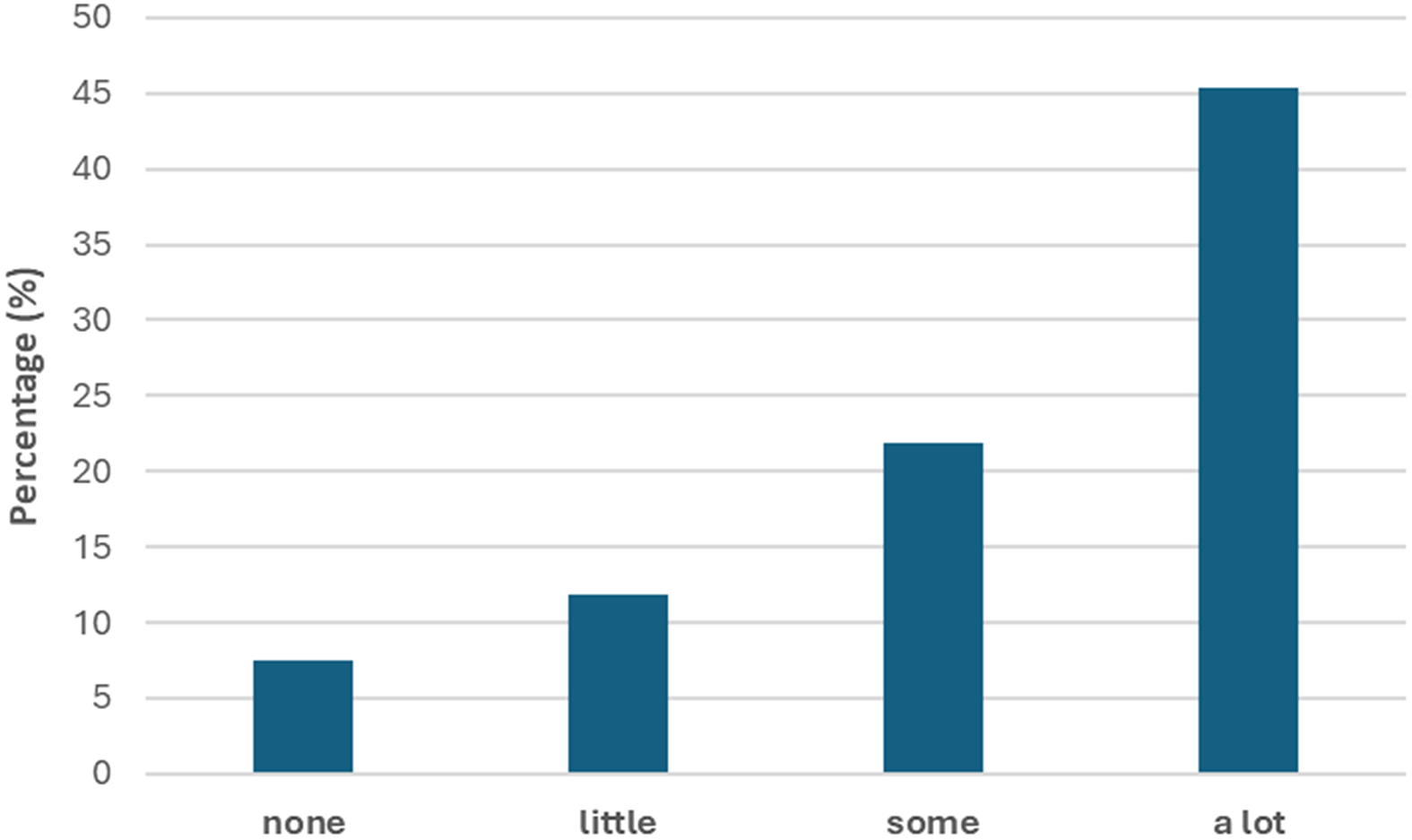
Our primary explanatory variable is citizens’ perceptions of COVID-19-related corruption. Respondents were asked: Considering all of the funds and resources available to the government for combating and responding to the COVID-19 pandemic, how much do you think was lost or stolen due to corruption? Response options were a lot (1), some (2), a little (3), and none (4). We reversed the scale so that higher values indicate greater perceived corruption (0 = none, 1 = a little, 2 = some, 3 = a lot). As shown in Figure 2, only 7.5% of respondents reported no corruption, while 11.8%, 21.9%, and 45.4% indicated a little, some, and a lot, respectively. These patterns suggest that the majority of African citizens perceived at least some corruption in their government’s pandemic response. Although this measure reflects subjective evaluations rather than verified instances of corruption, such perceptions are politically meaningful because they shape how citizens judge government legitimacy and trust.
Level of COVID-19 corruption perception across 39 African countries.
Notes: Afrobarometer survey data (Round 9, 2023).

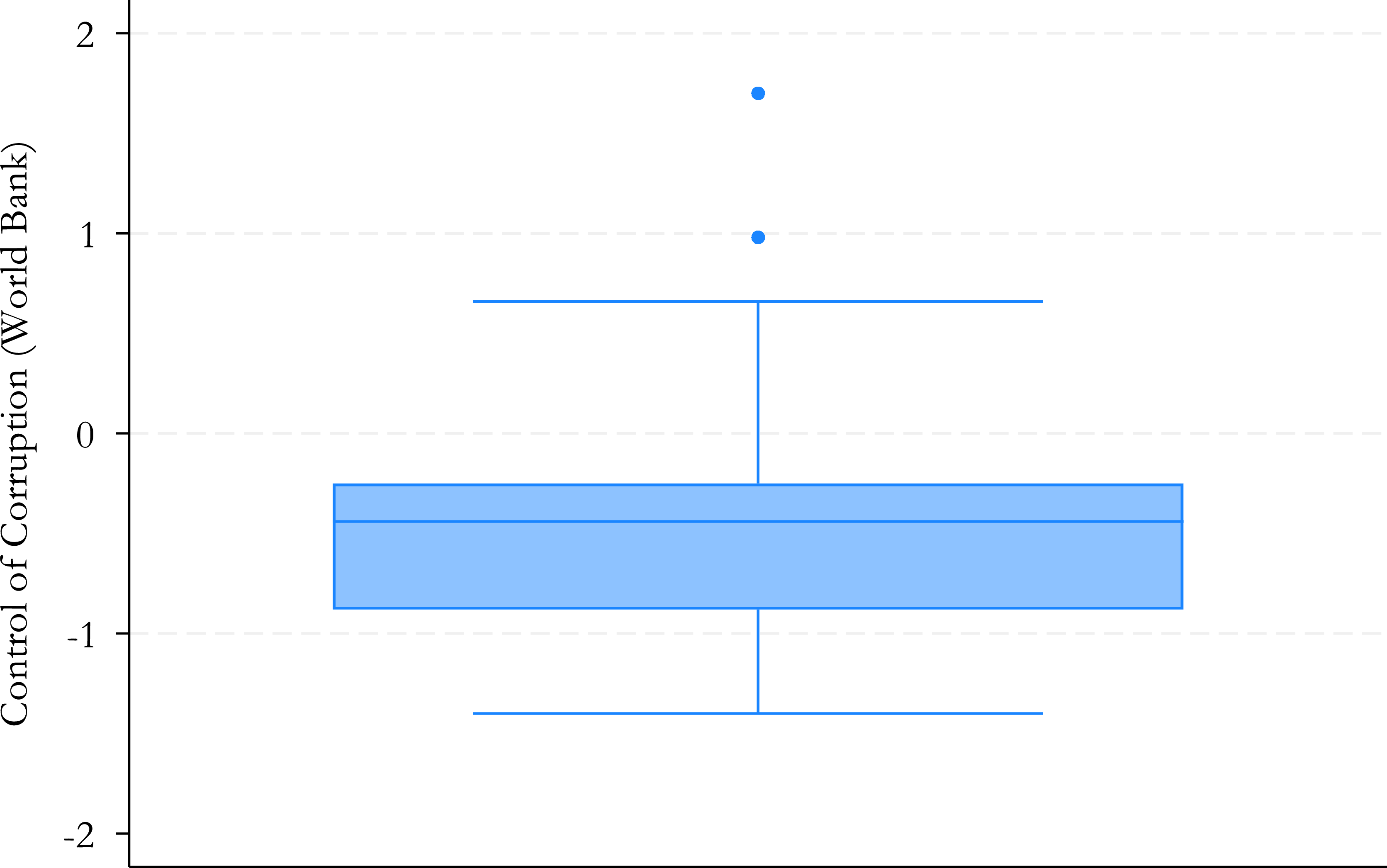
Our second key explanatory variable is the World Bank’s Control of Corruption, which we use to assess whether the broader institutional context shapes the effect of perceived COVID-19 corruption. The control of corruption measures the extent to which public power is exercised for private gain, based on expert assessments and survey data, and the score ranges from – 2.5 (weak control) to +2.5 (strong control)Footnote 2 . For each country, the corresponding corruption control score is taken from the period when the Afrobarometer survey was conducted (2021–2023). Figure 3 shows the distribution of corruption control scores across the 39 countries in our sample. Scores range from −1.4 – 1.7, all below the global benchmark of 2.5 associated with strong corruption control. Even the best performers – Seychelles, Cape Verde, and Botswana – fall short of this threshold (see Figure A1 in the appendix for country-specific values). Despite generally low levels of control across the region, the observed variation provides important leverage for testing whether stronger institutions mitigate – or amplify – the political costs of perceived COVID-19 corruption.
Box plot of control of corruption (World Bank).

4.4. Control variables
To address potential confounding, we include a comprehensive set of individual- and country-level controls. Demographic factors–age, gender, and place of residence–are included because prior studies show they systematically shape political attitudes and perceptions of corruption (Anderson and Tverdova, Reference Anderson and Tverdova2003; Chang and Chu, Reference Chang and Chu2006; Daoust, Reference Daoust2020). Socio-economic characteristics, including education, lived poverty, and income loss due to COVID-19, capture differences in resource levels and vulnerability that may influence both pandemic experiences and evaluations of government performance (Bargain and Aminjonov, Reference Bargain and Aminjonov2021; Chisadza et al., Reference Chisadza, Clance and Gupta2021). We also control for direct and generalised corruption experiences, specifically personal bribery and overall perceptions of government corruption, which strongly condition political trust and performance evaluations (Mishler and Rose, Reference Mishler and Rose2001; Morris and Klesner, Reference Morris and Klesner2010). Because evaluations of government response may also be shaped by attitudes towards political authority, we include measures of trust in the president, the ruling party, and local government officials (Hetherington and Husser, Reference Hetherington and Husser2012; Bol et al., Reference Bol, Giani, Blais and Loewen2021). To separate pandemic-specific evaluations from broader economic dissatisfaction, we add perceptions of the national economy relative to the previous year (Lewis-Beck and Stegmaier, Reference Lewis-Beck and Stegmaier2000; Brodeur et al., Reference Brodeur, Grigoryeva and Kattan2021; De Vries et al., Reference De Vries, Bakker, Hobolt and Arceneaux2021).
At the country level, we account for institutional variation in democratic quality using the V-Dem Liberal Democracy Index (Holmberg and Rothstein, Reference Holmberg and Rothstein2011). These controls help isolate the effect of COVID-19 corruption perceptions from broader political, economic, and institutional factors, thereby enhancing the robustness of our estimates. Full details on operationalisation, wording, coding schemes, and descriptive statistics are provided in the supplementary materials (Tables A3–A4 in the online appendix). To assess multicollinearity, we calculated variance inflation factors (VIFs). All values were well below conventional thresholds (mean VIF ≈ 1.3; maximum = 2.17), and tolerance values exceeded 0.4, indicating that multicollinearity is not a concern in our models (see Table A5 in the online appendix).
4.5. Estimation strategy
We employ mixed-effects linear regression to account for the hierarchical structure of the Afrobarometer data, in which individuals are nested within countries. Multilevel modelling allows us to incorporate both individual- and country-level predictors while accounting for unobserved heterogeneity across contexts. Ignoring this clustering would risk biased standard errors and misleading inferences. As a diagnostic step, we estimated an empty (null) model with only a random intercept for countries. Results indicate significant between-country variance in the dependent variable (government mismanagement during COVID-19) (σ2 = 0.058, SE = 0.013). The intraclass correlation coefficient (ICC) is 0.10 (SE = 0.021; 95% CI = 0.066–0.149), meaning that roughly 10% of the variation in citizen evaluations of government mismanagement during COVID-19 is attributable to cross-national differences. A likelihood ratio test strongly rejects the linear specification in favour of the multilevel model (χ²(1) = 4796.7, p < 0.001). This confirms that a multilevel framework is appropriate for the analysis.
Building on this baseline, we estimate a sequence of multilevel models with government mismanagement as the dependent variable. The first model includes only the key explanatory variable – citizens’ perceptions of COVID-19 corruption. The second model adds individual-level controls capturing demographics, socio-economic status, corruption experiences, political trust, and retrospective economic evaluations. The third model introduces country-level predictors, specifically the V-Dem Liberal Democracy Index and the World Bank’s Control of Corruption. Finally, the fourth model incorporates a cross-level interaction between individual perceptions of COVID-19 corruption and the Control of Corruption index, allowing us to assess whether institutional quality moderates the association between corruption perceptions and evaluations of government mismanagement. This step-by-step specification is designed to progressively isolate the contribution of COVID-19 corruption perceptions, showing whether their effect persists once alternative explanations at both the individual and country level are considered. It also reflects our theoretical expectation that perceptions of COVID-19-related corruption are associated with higher evaluations of government mismanagement, and that this relationship may vary systematically with broader control of corruption.
5. Results
To test our hypothesis of how citizens’ perceptions of COVID-19-related corruption shape government mismanagement during the pandemic, and to what extent corruption control conditions this relationship, we begin with descriptive patterns at the country level. Figure 4 plots the average perception of COVID-19 corruption in each country against the World Bank’s Control of Corruption score. The fitted line slopes downward, indicating a modest negative association: countries with stronger corruption control tend to show somewhat lower levels of perceived COVID-19 corruption.
Scatter plot between aggregated country means of COVID-19 corruption perceptions and the World Bank Corruption Control.

The scatterplot reveals four broad patterns. First, high corruption perceptions combined with weak corruption control are evident in countries such as Nigeria, Cameroon, Sudan, and Gabon, where citizens report widespread losses of pandemic resources. Second, middling corruption perceptions despite relatively stronger corruption control scores appear in Botswana and Mauritius, suggesting that even stronger institutions did not fully shield governments from suspicion. Third, comparatively low perceptions of corruption are observed in Seychelles and Cape Verde, which cluster at the high end of institutional quality. Finally, countries such as Tanzania, Ethiopia, and Benin show low citizen perceptions of corruption despite weak control of corruption scores, highlighting contexts where governance fragility does not automatically translate into heightened suspicion. Taken together, these patterns support the expectation that stronger corruption control is generally associated with lower perceived corruption but also underscore the limits of this association. Outliers and mismatched cases suggest that institutional quality (corruption control) alone does not determine whether citizens perceive corruption. This descriptive result, therefore, highlights the need to examine not only whether institutional quality dampens corruption perceptions but also how it shapes the political consequences of these perceptions.
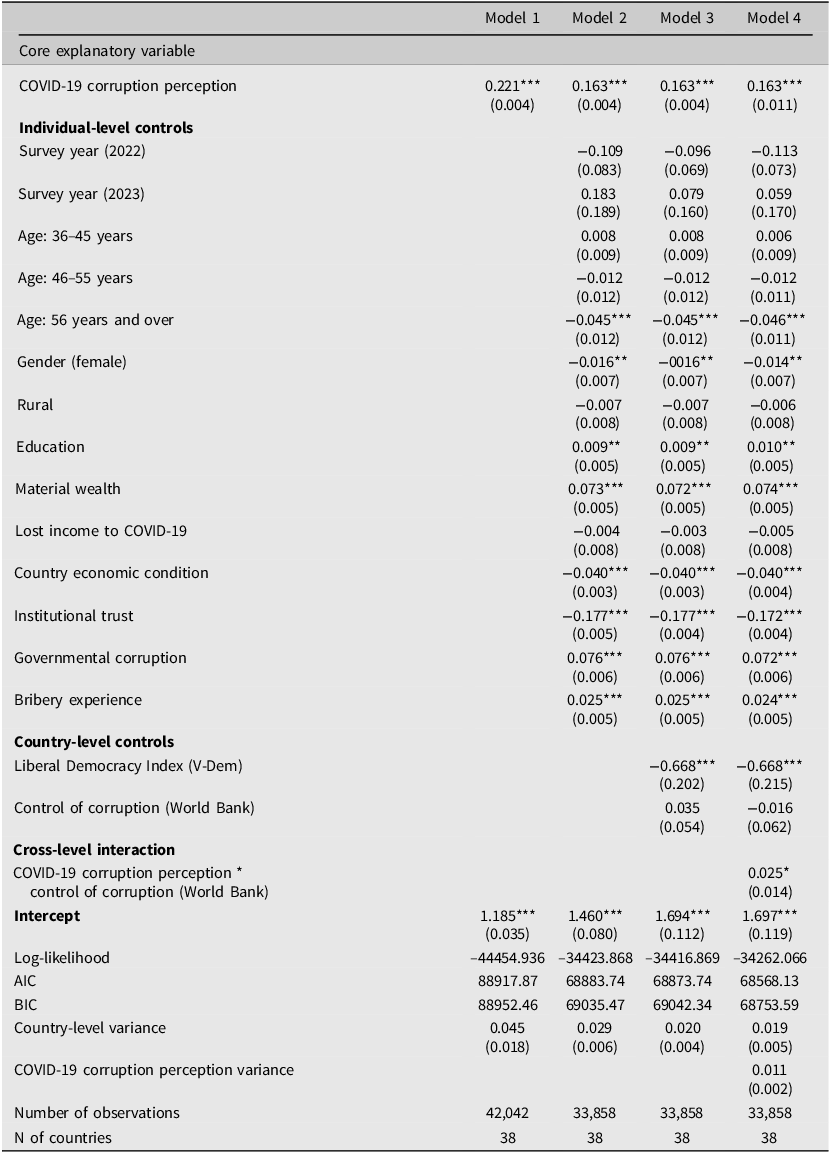
To move beyond descriptive patterns, we estimate a series of mixed-effects linear models (Table 1). This strategy allows us to assess whether perceptions of COVID-19-related corruption are systematically linked to citizens’ evaluations of government mismanagement, and whether this association is conditioned by a country’s overall level of corruption control. The first model includes only the key explanatory variable – citizens’ perceptions of COVID-19 corruption – allowing us to isolate the direct association before introducing additional controls. As reported in Model 1 of Table 1, the relationship is positive and highly significant, indicating that higher perceived corruption is associated with higher reported levels of government mismanagement.
Effects of COVID-19 corruption perception and corruption control on citizens’ evaluation of government pandemic response

Note: Afrobarometer Round 9. Mixed-effect linear regressions were applied to analyse the data. Entities are the parameter estimates and standard errors, in brackets, of the mixed-effect linear regressions. Sign.: *P < 0.1, **P < 0.05, ***P < 0.01.
Figure 5 illustrates this association, presenting adjusted predictions with 95% confidence intervals across the four categories of perceived COVID-19 corruption. Substantively, citizens who perceive ‘a lot’ of corruption score government mismanagement about 0.66 points higher on the 0–3 scale compared to those who perceive no corruption. This result is consistent with prior research showing that perceptions of corruption are a strong driver of how citizens rate government mismanagement during crises (Van Ryzin, Reference Van Ryzin2013; Bargain and Aminjonov, Reference Bargain and Aminjonov2020). Overall, the evidence from Model 1 supports H1: higher perceived COVID-19 corruption is associated with greater reported government mismanagement.
Predicted effect of COVID-19 corruption perception on government mismanagement of the COVID-19 pandemic.
Notes: The estimates are from Model 1, Table 2.

Next, in Model 2, we introduce individual-level controls to test whether the relationship between perceived COVID-19 corruption and government mismanagement holds once alternative explanations are considered. These controls capture demographics, socio-economic vulnerability, direct and generalised corruption experiences, institutional trust, and retrospective evaluations of the national economy. The aim is to isolate the unique contribution of corruption perceptions from other factors that might also shape citizen evaluations. As shown in Model 2 of Table 1, perceived COVID-19 corruption remains a strong and highly significant predictor of government mismanagement. Citizens who perceived higher levels of corruption consistently rated their government’s pandemic response as more mismanaged, even after accounting for these influences. Figure 6 illustrates this effect: predicted mismanagement scores rise from 1.32 among those reporting no corruption to 1.81 among those perceiving a lot of corruption, a difference of 0.49 points on the 0–3 scale. This confirms that corruption perceptions are a central driver of how citizens judge state performance during crises, above and beyond general mistrust, economic dissatisfaction, or prior encounters with bribery. The finding aligns with research emphasising the role of perceived fairness and integrity in shaping public confidence (Kurer, Reference Kurer2005).
Predicted effect of COVID-19 corruption perception on government mismanagement of the COVID-19 pandemic.
Notes: The estimates are from Model 2, Table 1.

Although not the focus of this study, the control variables help contextualise variation in citizen evaluations of government mismanagement. Older individuals and women are somewhat less critical of government performance, while more educated respondents tend to be more demanding. Economic perceptions and institutional trust exert strong effects: citizens who believed the economy improved, or who expressed higher trust in political institutions, evaluated pandemic responses more favourably. By contrast, those experiencing greater poverty, frequent bribery, or who viewed officials as generally corrupt were more likely to report government mismanagement. These results highlight the multiple pathways shaping evaluations but reinforce that COVID-19-specific corruption perceptions remain a powerful and independent influence.
In Model 3, we extend the analysis by incorporating country-level predictors to evaluate whether institutional quality shapes citizen perceptions of government mismanagement. Specifically, we include the V-Dem Liberal Democracy Index and the World Bank’s Control of Corruption measure. This specification allows us to test whether structural differences in democracy and corruption control account for variation across countries, beyond the individual-level factors included in Model 2. The results show that perceived COVID-19 corruption remains a strong and highly significant predictor of government mismanagement, reinforcing the robustness of this relationship.
Citizens who perceive greater corruption continue to rate their governments as more mismanaging the pandemic, even when national governance characteristics are taken into account. Turning to the country-level variables, the V-Dem Liberal Democracy Index is negative and statistically significant, indicating that citizens in more democratic countries tend to report lower levels of government mismanagement. By contrast, the World Bank’s Control of Corruption measure is positive but statistically insignificant, suggesting that expert-based assessments of corruption control do not directly correspond to citizens’ evaluations of pandemic governance once individual perceptions are considered. This divergence hints at a potential gap between structural indicators and lived experiences of corruption – a gap we return to in Model 4 with the cross-level interaction. Finally, the inclusion of country-level predictors reduces the variance attributed to between-country differences (from 0.029 in Model 2 to 0.020 in Model 3). This decline suggests that institutional quality helps explain part of the cross-national variation in government mismanagement. Nevertheless, the strong and persistent effect of perceived COVID-19 corruption underscores that citizens’ own perceptions remain the most powerful driver of evaluations, even in more favourable governance contexts.
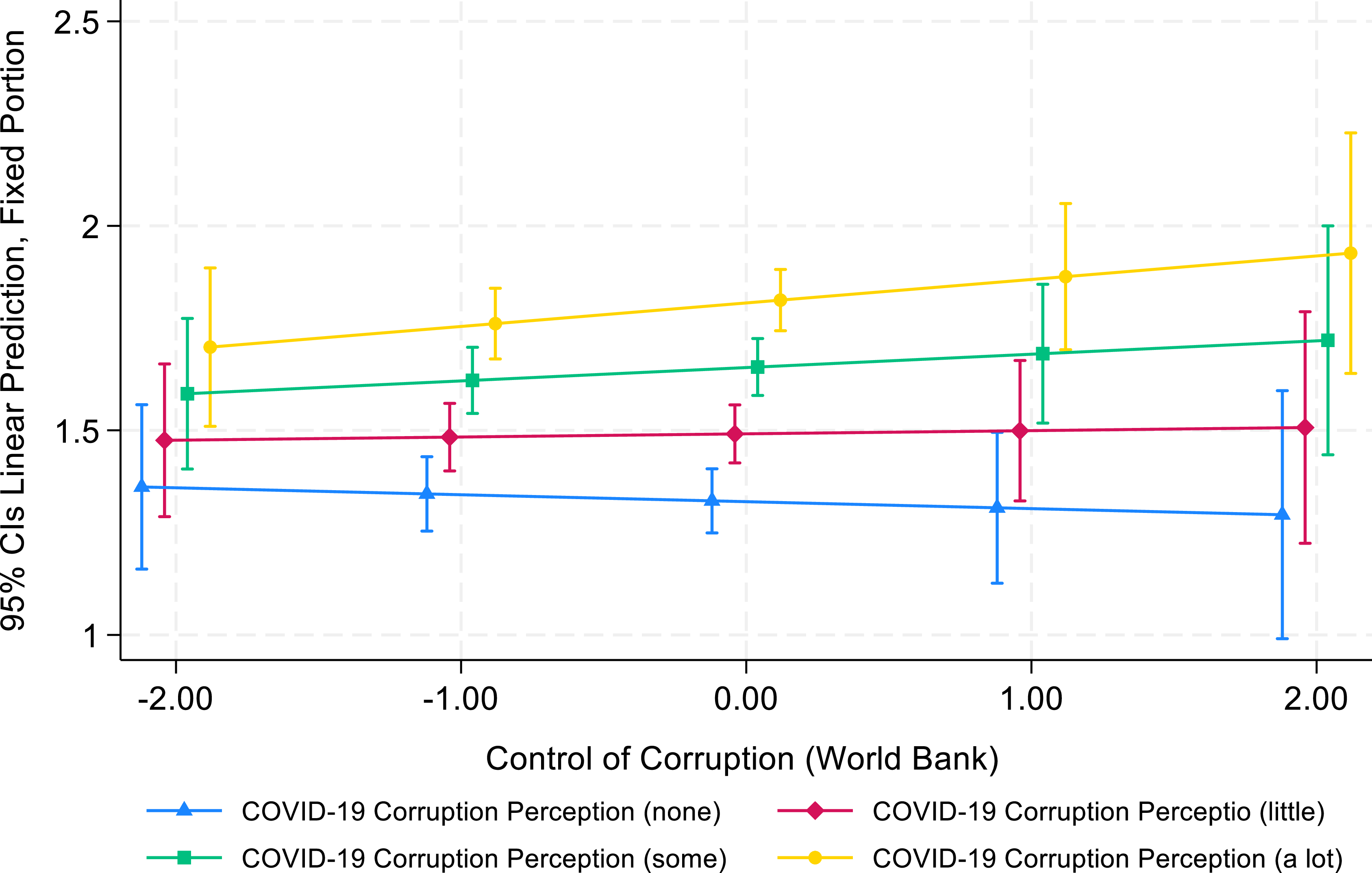
In Model 4, we test the moderating role of institutional quality by adding a cross-level interaction between individual perceptions of COVID-19 corruption and the World Bank’s Control of Corruption index. This model evaluates whether the country’s control of corruption alters the link between perceived corruption and citizen evaluations of government mismanagement. The coefficient on the interaction term is positive and marginally significant at the 0.08 level, indicating that the negative association of perceived corruption on government evaluations becomes stronger in countries with higher levels of corruption control rather than weakening as we have hypothesised. Figure 7 visualises this interaction by plotting predicted values of government mismanagement across levels of perceived corruption at different values of the control of corruption. For transparency, Table A6 (online appendix) reports the full marginal effects with predicted values and 95% confidence intervals for each interaction point. The slopes diverge clearly: in countries with weak corruption control, predicted mismanagement scores remain relatively low (around 1.3) even when corruption is perceived as high. By contrast, in stronger-control contexts, perceptions of corruption translate into much higher mismanagement scores. For example, citizens who perceive ‘a lot’ of corruption score governments at roughly 1.6 in weak-control settings, but closer to 2.0 where corruption control is strong.
Interaction effect, COVID-19 corruption perception and corruption control on evaluation of government response to the COVID-19 pandemic.
Notes: The estimates are from Model 4, Table 1.

This pattern directly rejects our second hypothesis (H2), which expected stronger corruption control to buffer governments against the negative consequences of corruption perceptions. Instead, the evidence suggests that in stronger institutional contexts – such as Mauritius or Cape Verde – citizens may hold governments to higher standards, interpreting perceived corruption as especially damaging. Under such conditions, even limited scandals may amplify rather than mitigate negative evaluations of government performance (Chang and Chu, Reference Chang and Chu2006; Uslaner, Reference Uslaner2008). In sum, Model 4 shows that perceptions of COVID-19 corruption are consistently associated with higher levels of government mismanagement. Moreover, the positive interaction term indicates that institutional integrity can amplify rather than buffer the political costs of perceived corruption. This complicates conventional assumptions about the protective role of governance quality, suggesting that higher expectations in strong-institutional settings may intensify reputational risks during crises. To assess the stability of these findings, we now turn to robustness checks, examining whether alternative model specifications and measurement strategies alter the substantive conclusions.
6. Robust analysis
To assess whether our findings are sensitive to alternative operationalisations of government mismanagement, we conducted two sets of robustness checks. First, we disaggregated the composite measure into its two components: (a) government management of the COVID-19 response and (b) government distribution of COVID-19 relief assistance. This distinction allows us to test whether corruption perceptions primarily affect views of state competence in managing the pandemic, perceptions of fairness in relief delivery, or both. The results, reported in the online appendix (Tables A7–A8; Figures A2–A5), closely mirror the main findings for H1. Citizens who perceive higher levels of COVID-19-related corruption consistently report greater government mismanagement, whether measured as poor pandemic management or unfair relief distribution. Evaluations become steadily more negative as perceptions of corruption rise, confirming that the central effect is robust across both dimensions of government performance. However, the cross-level interaction between corruption perceptions and corruption control is not statistically significant in either model. While the direction of the interaction is consistent with the main results – suggesting that stronger corruption control does not buffer the negative effects of perceived corruption – these analyses provide support for H1 but not H2.
As a second robustness check, we employed two alternative indicators of government mismanagement during the pandemic. The first, trust in government to ensure vaccine safety, asked respondents: ‘How much do you trust the government to ensure that any COVID-19 vaccine developed or offered to [Nationality] citizens is safe before use in this country?’ (0 = not at all, 3 = a lot). We expected higher perceptions of corruption to be associated with lower trust. The second, satisfaction with government provision of relief, asked: ‘How satisfied or dissatisfied are you with the government’s response to COVID-19 in providing relief to vulnerable households?’ (0 = not at all satisfied, 3 = very satisfied).
Beginning with trust in vaccine safety, the results again align with H1 (see Table A9 and Figure A6, online appendix). Citizens who perceive higher levels of corruption report significantly lower trust in their government’s assurances. Figure A6 shows a clear downward gradient: trust is highest among those perceiving no corruption and declines steadily as corruption perceptions increase. The interaction with corruption control is negative but not significant. As illustrated in Figure A7, the slopes are largely parallel, indicating that stronger corruption control does not systematically alter the effect of corruption perceptions. Thus, H2 is not supported in this case. Turning to satisfaction with government relief, the findings once more support H1. Satisfaction declines as perceptions of corruption rise, with those perceiving ‘a lot’ of corruption reporting the lowest satisfaction (Table A10 and Figure A8, online appendix). The interaction, however, reveals a different dynamic. As shown in Figure A9 (online appendix), the interaction is negative and marginally significant, indicating that in countries with stronger corruption control, the effect of corruption perceptions on satisfaction is amplified rather than buffered. In other words, stronger institutional quality appears to heighten rather than mitigate the political costs of perceived corruption. This directly contradicts H2 and mirrors the pattern found in the main analysis, suggesting that citizens in stronger governance contexts may hold governments to higher standards, interpreting perceived corruption as especially damaging.
7. Conclusion
The COVID-19 pandemic has profoundly affected countries worldwide, particularly in Africa, where the absence or weakness of welfare systems heightened vulnerabilities. In response, international financial institutions provided substantial support to help African governments manage the crisis. Yet numerous audit reports, media investigations, and citizen protests over the unfair distribution of COVID-19 relief pointed to widespread allegations of corruption, undermining the intended impact of this aid. While corruption during crises is not new, the pandemic created distinctive opportunities for the misuse of public resources under conditions of urgency and weak oversight. This context provides a critical lens for examining how corruption in emergency relief shapes citizens’ evaluations of government response during crises. Although many countries have since rolled out pandemic response programmes, understanding how citizens judged these efforts remains vital for building more transparent and resilient systems in the face of future global health emergencies (Hale et al., Reference Hale, Angrist, Goldszmidt, Kira, Petherick, Phillips, Webster, Cameron-Blake, Hallas, Majumdar and Tatlow2021).
This study shows that citizens’ perceptions of government mismanagement during the pandemic are shaped by two key factors: individual perceptions of COVID-19 corruption and country-level corruption control. The findings yield several insights. First, across all specifications and robustness checks, we find consistent support for H1: citizens who perceive higher levels of COVID-19-related corruption are significantly more likely to evaluate their governments as mismanaging the pandemic. This pattern extends to both components of mismanagement (pandemic management and relief distribution) as well as alternative outcomes such as trust in vaccine safety and satisfaction with relief provision. Second, our evidence provides no support for H2. Rather than cushioning governments against the reputational costs of perceived corruption, stronger corruption control appears to sharpen those costs. In the main models, the interaction effect points in the opposite direction of our expectation: citizens in countries with stronger anti-corruption frameworks judged their governments more harshly when they believed corruption had occurred. This suggests that institutional quality may raise public expectations of probity, making any hint of misconduct especially damaging. The robustness checks largely confirm this pattern, even if the interactions were not statistically strong. Taken together, these results indicate that institutional quality does not insulate governments from criticism during crises; if anything, it can heighten public sensitivity to corruption.
These findings have both policy and academic implications. From a policy perspective, they underscore the urgent need for African governments to enhance transparency and strengthen anti-corruption mechanisms, particularly in the allocation of emergency relief. However, they also highlight a paradox: while stronger institutions are essential for effective governance, they may also heighten reputational risks if citizens perceive corruption, since higher expectations of probity make violations more damaging. From an academic standpoint, the study contributes to the literature on crisis governance by showing that institutional quality may not always buffer governments from the costs of perceived corruption; in some contexts, it can amplify them. This nuance helps explain why corruption scandals are often especially politically costly in otherwise better-governed settings.
Our study is not without limitations. First, our measure of corruption is based on perceptions rather than direct evidence. While perception-based indicators are indispensable for understanding public opinion, they may be influenced by recall bias or retrospective judgements. Still, corroborating evidence from audits and media investigations confirms that corruption concerns were widespread and salient during the pandemic. Second, our reliance on cross-sectional survey data limits the ability to track how perceptions and evaluations evolve. Future research would benefit from longitudinal designs that capture the dynamic interplay between corruption perceptions and evaluations of government mismanagement during ongoing or successive crises. Finally, although we use expert-based indices to measure corruption control, these remain perception-based proxies rather than direct measures of institutional enforcement. Nonetheless, they remain the most widely used and practical tools for cross-country analysis. In sum, our findings confirm that crisis-induced corruption profoundly increases citizens’ perceptions of government mismanagement (H1), but they also challenge the expectation that institutional quality mitigates these effects (H2). Instead, stronger corruption control may heighten the political costs of perceived corruption, underscoring the importance of transparency and responsiveness in sustaining public trust during crises. As the world prepares for future pandemics and global emergencies, strengthening governance, particularly in contexts where systems remain fragile, must be a central priority.
Supplementary material
The supplementary material for this article can be found at https://doi.org/10.1017/S1468109925100182.
Data availability statements
The authors confirm that the data generated and analysed in this study are included in the paper and are publicly available at https://www.afrobarometer.org/data/
Acknowledgements
An earlier version of this article was presented at the Higher Research Seminar in the Department of Political Science at Linnaeus University. We are grateful to the seminar participants—especially Magnus Hagevi, Joel Martinsson, Per Strömbäck, Johanna Jormfeldt, Staffan Andersson, Helena Ekelund, Kalle Ekholm, Emma Ricknell, and Fubu Ngubu—for their insightful feedback and suggestions. We also thank the editor and the three anonymous reviewers for their constructive comments.
Competing interests
The authors declare no competing interests.






 Open access

