

Introduction
European Administrative Networks (EANs) have been presented as important parts of the institutional architecture of the European Union (EU) (Bach and Ruffing Reference Bach and Ruffing2018; Mastenbroek and Martinsen Reference Mastenbroek and Martinsen2018). Their expansion across several policy areas over the years reflects the emergence of more complex policy issues, which in turn demands collective responses involving a wide array of actors. In other words, problem solving is no longer limited to national boundaries but rather relies on cooperation between national regulatory agents from diverse member states and, to a certain extent, actors at the European level (Hartlapp and Heidbreder Reference Hartlapp and Heidbreder2017). As EANs are structures that bridge the gap between national and supranational actors, they increasingly become valuable instruments in the EU’s toolbox.
While EANs may assume different structures and functions according to the policy area at hand, they have been highlighted for their ability to pool resources (Vestlund Reference Vestlund2017), promote the exchange of knowledge and expertise between diverse participants (Börzel and Heard-Lauréote Reference Börzel and Heard-Lauréote2009), and increase the autonomy of national agencies domestically (Bach and Ruffing Reference Bach and Ruffing2013; Yesilkagit Reference Yesilkagit2011). As platforms for reiterated and direct contact, EANs may also contribute to the adoption of shared practices and common standards between network participants (Hobolth and Martinsen Reference Hobolth and Martinsen2013; Maggetti and Gilardi Reference Maggetti and Gilardi2011). Consequently, they are frequently associated with the exchange of expertise and knowledge, the development of mutual trust, learning and socialization (Heidbreder Reference Heidbreder2015; Mastenbroek and Martinsen Reference Mastenbroek and Martinsen2018; Polak and Versluis 2016).
The development of network mechanisms falls under the broader umbrella of European ‘new’ governance. There have been serious concerns about the lack of coordination and cooperation between national regulators, the uneven implementation of EU legislation by very diverse member states, and the need for more policy learning (Thatcher and Coen Reference Thatcher and Coen2008). Consequently, since the early 2000s, the EU institutional architecture has increasingly been populated by more flexible and horizontal arrangements involving capacity-building activities, peer review, benchmarking and the exchange of experiences and best practices in networks (European Council 2000). These types of instruments are considered to be more efficient and effective in generating consensus and convergence around shared policies rather than more hierarchical, command-control solutions (Hobolth and Martinsen Reference Hobolth and Martinsen2013). In sum, the EU has heavily invested in the creation of new learning-oriented instruments, with networks assuming a prominent place (Zito and Schout Reference Zito and Schout2009).
While there is a vast literature on the conceptualization and categorization of (policy) learning (Dunlop and Radaelli Reference Dunlop and Radaelli2013; Gerlak et al. Reference Gerlak, Heikkila, Smolinski, Armitage, Huitema and Moore2018), there is still scarce research on the relationship between policy learning and EANs in particular (Martinsen et al. Reference Martinsen, Schrama and Mastenbroek2020a; Papadopoulos 2017). At first glance, networks present many factors that could contribute to fostering learning. They gather a group of diverse actors who are interested in and/or concerned with the same type of questions and policy issues (Berardo and Lubell Reference Berardo and Lubell2019). Furthermore, there is a widespread assumption in the EAN literature that as network members engage with each other through the exchange of knowledge, expertise, and best practices, EANs would contribute to mutual learning (Martinsen et al. Reference Martinsen, Schrama and Mastenbroek2020a; Polak and Versluis 2016; Zito and Schout 2009). Whether this is the case, however, remains an empirical question.
This paper aims to address this gap through the analysis of the learning processes of a central network in EU environmental governance – namely, the Network of the Heads of European Environmental Protection Agencies (EPA Network). More specifically, the central questions we are concerned with here are how and under which conditions European Administrative Networks are able to encourage policy learning among their members. Drawing on the conceptualization developed by Heikkila and Gerlak (Reference Heikkila and Gerlak2013), policy learning is here broadly understood as an interactive process where actors exchange expertise, concerns and knowledge on issues tied to a specific policy area of their interest. This definition will be further discussed in the next section.
As learning entails a connection and exchange between actors, the first step in this research is to identify how network participants engage with each other. Are knowledge and expertise distributed evenly across the entire network or are there more intense exchanges between specific actors? Then, we turn to uncover whether there are factors that shape the directions of such exchanges, thus conditioning the process of learning. In other words, what are the driving factors that lead a national regulatory agency to reach out to specific peers and not others in the network? These questions relate to the micro-foundations of learning, which have yet to be more empirically researched (Dunlop and Radaelli Reference Dunlop and Radaelli2017). Here, there are significant advantages in bringing insights from the literature on EANs, which has recently turned its attention to a closer analysis of the network’s structure, interaction patterns and factors that condition interactions (Martinsen et al. Reference Martinsen, Schrama and Mastenbroek2020b; Schrama et al. Reference Schrama, Martinsen and Mastenbroek2020; Vantaggiato et al. 2021).
This article builds on original data from an online survey regarding the exchange of knowledge and expertise within the EPA Network. The EPA Network is an interesting case for analyzing policy learning, as it constitutes a venue for informal cooperation in which, through plenary meetings and thematic working groups, the EPAs are able to openly share their practical experiences in implementing EU environmental policy and address challenges they are concerned with (EPA Network 2013). Furthermore, membership in the EPA Network is voluntary and self-funded. This means that the choice of national regulators to engage and take part in the exchanges of the network may be a significant indicator that the network is an important instrument to them; otherwise, they would simply not engage in it. Additionally, the coexistence of diverse approaches, instruments and environmental conditions in the EU makes the frequent exchange of knowledge and expertise a necessity to ensure environmental protection.
The findings of this paper provide support for the expectation that, indeed, learning processes are taking place in EANs through dynamic exchanges of knowledge and expertise, which are highly transitive in the EPA Network. This means that members are not only exposed to the information, best practices, and advice from their direct contacts but also to the insights from indirect partners as well. Yet, several challenges are uncovered for learning processes in EANs. First, there is considerable variation across network members in terms of their engagement, which leads to an emerging core-periphery structure in the network. Consequently, certain actors are more involved in the network exchanges than others. Second, learning processes tend to be limited to peers who present similar backgrounds in terms of the political preferences of their national governments. Therefore, while this article contributes to filling a significant gap in the learning literature by focusing on how learning processes take place in the real world (Dunlop and Radaelli Reference Dunlop and Radaelli2013), it still raises questions concerning the potential of EANs in fostering widespread learning processes.
The article is structured as follows. The next section elaborates on our understanding of learning and lays down the theoretical expectations for learning in networks. This is followed by a brief presentation of the case studied, the methods applied and the operationalization of key concepts. Then, the findings are shown, and the article concludes with a discussion of their broader implications.
Theoretical framework
There is extensive literature on learning and its implications across different disciplines, such as political science, public administration, and international relations (Dunlop and Radaelli Reference Dunlop and Radaelli2013). Likewise, across and within these theoretical approaches, it is possible to find a variety of concepts and categorisations such as organizational and social learning, single- and double-loop learning, and cognitive and reflexive learning, among others (Riche et al. Reference Riche, Aubin and Moyson2021). This has led to significant conceptual stretching, in which learning becomes this broad and abstract phenomenon.
The existing studies on learning can be divided into two broad strands – one focused on measuring the outcomes or effects of learning, such as changes in cognitive beliefs, policies, strategies and/or behaviors (Bennett and Howlett Reference Bennett and Howlett1992); and one that emphasizes the dynamic character of learning as a process (Gerlak et al. Reference Gerlak, Heikkila and Newig2020). Yet, most scholarly attention has been paid to the former rather than the latter, given the available measurement for products of learning (Dunlop and Radaelli Reference Dunlop and Radaelli2013). This article thus contributes to addressing this gap by focusing solely on learning processes.
Despite its importance, the process of policy learning has often been left entirely undefined in previous studies regarding learning (Dunlop and Radaelli Reference Dunlop and Radaelli2013). Heikkila and Gerlak (Reference Heikkila and Gerlak2013) have provided a framework where learning can be seen as a three-step process where actors acquire information through several actions (e.g. trial and error, social interaction with others, etc.), interpret or assess such information, and ultimately disseminate knowledge, information and experience across individuals in a collective environment (p. 486). It is worth noting that these steps are not necessarily linear, which points to an ongoing dynamic of active exchanges and flows of knowledge and expertise between several actors. Based on this conceptualization, this article understands policy learning as an interactive process where actors exchange expertise, concerns and knowledge on issues tied to a specific policy area of their interest.
EANs – also referred to as transnational networks (Slaughter Reference Slaughter2004) or regulatory networks (Coen and Thatcher Reference Coen and Thatcher2008; Van Boetzelaer and Princen Reference Van Boetzelaer and Princen2012) – seem particularly well-suited instruments to support such processes. EANs are networks that bring together national representatives (and in certain cases supranational actors) who are dealing with the national implementation and enforcement of EU policies (Mastenbroek and Martinsen Reference Mastenbroek and Martinsen2018). They have been previously highlighted for their role in pooling resources such as expertise, and in facilitating the gathering and transferring of information, ideas, and knowledge across diverse actors and within multiple governance levels (Börzel and Heard-Lauréote Reference Börzel and Heard-Lauréote2009; Vestlund 2017).
As EANs constitute platforms for long-term and direct interaction between diverse national and supranational actors who are interested in the same type of policy issues, they may ultimately foster learning processes. As actors participate in network meetings and activities, they are increasingly exposed to new streams of information and knowledge through their discussions and deliberations with network peers – such as how certain issues are handled in other member states or which policy instruments are being deployed. In other words, it is through interacting with others in the network that actors acquire and disseminate their ideas and knowledge – thus, becoming entangled in learning processes. The idea is that, over time, these exchanges are expected to lead to adjustments in terms of actors’ policy goals, choices, and instruments (Zito and Schout Reference Zito and Schout2009) – whether they do so, however, is outside the scope of this article.
It is important to note, however, that learning is not something that happens automatically or randomly. It requires active engagement and dialog between diverse actors (Domorenok and Zito Reference Domorenok and Zito2021). Framing this in network terms, it is not enough that national regulatory agencies are members of the same EAN. They must build relationships and present active exchanges with their network peers. This is best operationalized in the literature of social networks by the concept of transitivity.
Transitivity corresponds to the network’s tendency to close triads, which means that actors are more likely to interact with others with whom they indirectly share a connection (Goodreau et al. Reference Goodreau, Kitts and Morris2009). In a network with a high level of transitivity, actors (A) are able to learn not only from their direct contacts’ (B) knowledge and experiences but also from those of other actors (C) who are directly connected to actor B but not to actor A. The presence of a common partner (B) is key not only to reducing the uncertainty concerning the quality of the information being exchanged but also contributes to a wider circulation of knowledge and expertise across the network (Berardo and Scholtz Reference Berardo and Scholz2010; Schrama et al. Reference Schrama, Martinsen and Mastenbroek2020). This does not mean that learning processes cannot take place in networks with lower levels of transitivity as there is still significant exchange of knowledge and expertise taking place on a bilateral level between participants. Yet, if EANs – and particularly those with a more voluntary and informal nature – are established with the purpose of fostering learning among their participants (Polak and Versluis Reference Polak, Versluis, Drake and Smith2016), one would expect actors to engage in learning processes with both their direct and indirect contacts. This leads to the first hypothesis:
Hypothesis 1: Environmental protection agencies are more likely to be involved in both direct and indirect exchanges of expertise and knowledge in the EPA Network
Finally, in addition to network structure, the drivers of network interactions are also important factors to be considered when it comes to learning. First, it is necessary to acknowledge that not all national regulatory agencies participating in EANs hold the same amount of expertise, resources, or competences (Vantaggiato et al. Reference Vantaggiato, Kassim and Wright2021). This may be due to factors such as the level of development of their member state and/or the size of national regulators (Papadopoulos Reference Papadopoulos2017). Network interactions are thus strategic, as actors prioritize using their financial and human resources to establish and maintain relationships that they deem worthwhile and valuable (Vantaggiato Reference Vantaggiato2019).
This has considerable implications for the learning process. The differences across national regulators’ competences and expertise can be translated into ‘learning opportunities’ for certain actors and ‘teaching opportunities’ for other actors involved in EANs (Polak and Versluis Reference Polak, Versluis, Drake and Smith2016). This student-teacher relationship may be reflected in the structure of the network as certain actors are more sought after by their network peers while others are more active and reach out to a wide variety of actors. Consequently, certain actors may hold a considerable amount of structural power – particularly those that occupy central positions in the network (Maggetti and Gilardi Reference Maggetti and Gilardi2011). As they are the most sought after by network peers, central actors are able to not only disseminate their preferred agendas and practices, but they also shape which kind of knowledge and expertise others are being exposed to (McNutt and Rayner Reference McNutt and Rayner2018).
Considering their limited resources and with the aim of learning, regulators will seek to interact with those who can provide high-quality information and expertise (Berardo and Scholtz Reference Berardo and Scholz2010; Vantaggiato Reference Vantaggiato2019). It is often the case that these are actors coming from well-resourced agencies and/or more economically developed countries, which tend to be more experienced in dealing with a series of different policy issues. Therefore, as more experienced actors tend to have a better command of knowledge (Leifeld and Schneider Reference Leifeld and Schneider2012; Schrama et al. Reference Schrama, Martinsen and Mastenbroek2022), one could expect them to become the most sought-after in EANs thanks to their knowledge and expertise. This is reflected in the second hypothesis. However, it is worth mentioning that if these regulators are indeed central to the learning processes in EANs, further questions could be later raised concerning whether the network provides all actors with the opportunity to contribute to network discussions as expected by EANs (Slaughter Reference Slaughter2004).
Hypothesis 2: More experienced environmental protection agencies tend to be the most well-connected actors in the EPA Network
Regulators are also attentive to the recommendations and insights from those they consider as their ‘role models’ (Papadopoulos Reference Papadopoulos2017). These ‘model’ actors are known for their knowledge and expertise regarding adequate policy implementation (Polak and Versluis Reference Polak, Versluis, Drake and Smith2016). In other words, as certain national agencies come from states that perform better in implementing environmental policy, they are expected to be sought after by network participants, especially those aiming to improve their implementation practices. This leads to the third hypothesis:
Hypothesis 3: Environmental protection agencies from states with better performance in the implementation of environmental policy tend to be the most well-connected actors in the EPA Network
Still, there is a central challenge that must be acknowledged when it comes to learning, namely, that of policy actors’ preferences. At an individual level, it has been shown that actors are not perfectly rational and do not have the capacity to process the extensive amount of information they are confronted with (Moyson Reference Moyson2016). In this sense, they tend to privilege their own perspectives and beliefs rather than actively seek out information that challenges their convictions (Moyson et al. Reference Moyson, Scholten and Weible2017). Therefore, policy actors’ preferences on policy programs are significantly resistant to change. This means that actors are not willing to engage or be confronted with new knowledge and information that goes against their opinions.
The design of EANs may be able to mitigate such issues. The debates within EANs can be restricted to how to approach technical issues and the development of new benchmarks and technologies. The discussions thus take place without dealing with political factors of decision-making or imposing policy choices on network participants. Additionally, the environment of EANs is expected to insulate national regulatory agencies from potential pressures coming from their domestic settings (Coen and Thatcher Reference Coen and Thatcher2005). In this sense, national regulatory agencies may feel more at ease to exchange knowledge and expertise with each other, leading to the development of new insights that they may later infuse into their domestic settings.
Overall, it is possible to distinguish two potential scenarios here. On the one hand, national regulators may see EANs as venues where they can exchange knowledge and expertise without being subject to political pressure from either their national ministries or their governments. This would allow network participants to branch out and engage with peers who hold different perspectives and insights on policy implementation. In this context, we would expect actors who are embedded in contexts with different policy preferences to interact more with each other in the network (thus fostering learning across members in the network). This leads to the fourth hypothesis:
Hypothesis 4: Environmental protection agencies coming from states with different policy preferences regarding environmental policy tend to interact more with each other in the EPA Network
On the other hand, EANs may not be strong enough instruments to overcome the fundamental differences between national regulators and their preferences. One of the main challenges in learning processes lies in the tendency of actors to be more receptive to information and ideas that are coherent with or that legitimize their own beliefs (Heikkila and Gerlak Reference Heikkila and Gerlak2013; Moyson et al. 2017). In other words, actors are unlikely to actively branch out for information contrary to their perspectives and are more prone to only disseminate knowledge that is cohesive with their thinking. Therefore, we would expect network members that come from similar backgrounds in terms of environmental policy preferences – e.g. more ambitious environmental targets versus more lenient environmental regulations to prioritize economic development – to interact more with each other as they share the same broad interests and views regarding the direction of environmental policy. This leads to the fifth hypothesis:
Hypothesis 5: Environmental protection agencies coming from states with similar policy preferences regarding environmental policy tend to interact more with each other in the EPA Network
Methodology
The case: Network of the Heads of Environmental Protection Agencies (EPA Network)
The EPA Network is an informal network for the exchange of knowledge, experiences, and best practices on shared issues arising from the practical implementation of EU environmental policy (EPA Network 2013; Levi-Faur Reference Levi-Faur2011). Instead of focusing on the technical dimension of issues, the goal of the network is to “provide feedback to policymakers about what works ‘on the ground’” (Fawcett Reference Fawcett, Faure, De Smedt and Stas2015, p. 329). Therefore, it is expected to support learning processes not only at the network level – i.e. between national EPAs – but also at the national level with members taking network knowledge to the discussion table with domestic stakeholders, implementing actors, and policymakers.
Currently, the EPA Network brings together the directors of the EPAs across all 27 EU member states, Albania, Iceland, Kosovo (under UNSCR 1244/99), Norway, Serbia, and Switzerland, as well as a representative of the European Environmental Agency (EEA) (EPA Network n.d.). There is intense exchange of information, best practices, and expertise across the network not only via the general biannual plenary meetings but also through the work of the thematic interest groups, where members share interests and/or concerns on topics ranging from carbon capture and storage to green finance and the green circular economy. These exchanges result in the production of reports and discussion papers on EU regulation and strategy and recommendations for improving national implementation and enforcement of environmental policy.
Social network analysis and exponential graph models
In order to further understand how learning processes take place, social network analysis (SNA) is used. This approach allows us to take the bilateral interactions that make up the network structure as our unit of analysis, thus accounting for the relational nature of environmental governance. In this sense, SNA provides insights into with whom EPA Network members engage for exchanging information, best practices, and advice. The network interactions are thus mapped out, and the positions of the participating EPAs are uncovered, with a particular emphasis on those occupying more central positions, as they would have more opportunities to shape the exchanges in the network (Christopoulos and Ingold Reference Christopoulos and Ingold2015). This is done through the measurement of their degree centrality, which expresses the local connectivity of a certain actor by looking at the number of (direct) connections they have with others in the network (Robins Reference Robins2015).
Then, the hypotheses on the factors that influence the exchange of knowledge and expertise in the EPA Network are tested through exponential random graph models (ERGMs). The rationale behind this method is that networks self-organize over time, which means that the presence of a network tie influences the presence of others (Lusher and Robins Reference Lusher and Robins2013). Therefore, this approach pays attention to not only the network dependency structures but also to the effects of actors’ attributes and other variables on network interactions (Martinsen et al. Reference Martinsen, Schrama and Mastenbroek2020a; Vantaggiato Reference Vantaggiato2019). Here, ERGM allows us to assess the influence of the network’s transitivity (Hypothesis 1), of actors’ experience (Hypothesis 2) and performance (Hypothesis 3), and their political preferences towards environmental sustainability (Hypothesis 4 and Hypothesis 5) on the network interactions.
Data collection and operationalization
Dependent variable
The data on the exchanges taking place in the EPA Network was collected through an online survey conducted between October and December 2021. This survey was distributed among all members of the network, namely, the 34 national Environmental Protection Agencies and the EEA representatives in the network. The survey had a response rate of 85.7%,Footnote 1 which is considered sufficient to properly represent and model the network (Borgatti et al. Reference Borgatti, Carley and Krackhardt2006). As the heads of national EPAs have significant time constraints, there were instances in which their deputies or representatives engaging with the EPA Network provided additional answers to the survey, which resulted in multiple answers for certain member states.Footnote 2 In these cases, only the response that was more complete to the survey was considered.
The survey questions focused on the different types of interaction within the EPA Network. More specifically, participants were asked with which EPAs from other member states (or the EEA representative) they are mostly in contact with to (1) exchange information, (2) exchange best practices and (3) receive advice concerning the national application of EU environmental policies. Respondents were free to list as many or as few agencies as they wished. All exchanges are treated as nondirected network ties when developing ERGMs. This means that in the case of receiving advice, the interactions are regarded as one of advice exchange in which it is not possible to identify the origin or the recipient.
The data was collected in three distinct agency matrices, i.e. one for each type of bilateral interaction. These matrices represent the three different networks in which different resources are exchanged, and each of them is used as dependent variable.
Explanatory variables
First, to test whether the network interactions are transitive, a geometrically edgewise shared partner statistic is included in the model (Schrama et al. Reference Schrama, Martinsen and Mastenbroek2020; Snijders et al. Reference Snijders, Pattison, Robins and Handcock2006). This measure expresses the tendency of interactions to take place between actors who are indirectly related – i.e. they are both directly tied to another network participant but not to each other – rather than between two actors who do not share a common tie (Goodreau et al. Reference Goodreau, Kitts and Morris2009; Schrama et al. Reference Schrama, Martinsen and Mastenbroek2020).
To capture the experience of each network participant, the measure adopted consists of how long the agency has been a member of the network. The idea here is that it takes time to build up knowledge and expertise on the application of EU policies and to be seen as a reputable partner (Hobolth and Martinsen Reference Hobolth and Martinsen2013). Therefore, ‘older’ network members have a longer track record alongside the evolution of the network, thus constructing internal reputation, social rapport and expertise in the subjects approached by the network at different moments. This data is also measured through the survey, in which respondents responded to how long their national EPA had been a part of the EPA Network. They could indicate if they have been members of the network for periods of less than 1 year, between 1 and 3 years, between 3 and 6 years, between 6 and 9 years, between 9 and 12 years, between 12 and 15 years, and over 15 years.
The performance in the implementation of environmental regulation is taken from the 2020 results of the Environmental Performance Index (EPI) Footnote 3 by Yale University and Columbia University. This index uses data from 32 performance indicators across 11 issue categories within environmental governance ranging from environmental health and air quality to agriculture and greenhouse gas emissions per capita (Wendling et al. Reference Wendling, Emerson, de Sherbinin and Esty2020). As the EPA Network discusses a wide range of environmental topics, the indicators are aggregated into an overall EPI score for each network member.
Finally, in order to capture the political preferences surrounding EPAs at the domestic level, the positions of each state’s national government and of their Ministry of Environment regarding environmental sustainability are analyzed. At the same time that the allocation of resources to EPAs is determined by their national government, their actions are under the direct scrutiny of the ministry of environment (Soares Reference Soaresf2023). Consequently, both ministerial and governmental priorities and preferences may have significant influence over the strategy and behavior of EPAs. Yet, it is possible that these positions are incompatible with each other as there are different interests and agendas at stake. Therefore, using both measures allows us to not only capture the general influence of national political positions over network members but also to identify which national principal is most relevant when it comes to national agencies’ engagement in networks.
For states with a majoritarian government, the score of the governing political party is adopted as their corresponding position. In the case of coalition governments, the final score is a seat-weighted average of the positions of all parties in government. Meanwhile, the score attributed to the Ministry of the Environment follows that of the political party responsible for that state’s environmental portfolio – e.g. that of the Minister’s political party.Footnote 4 The data is taken from the 2019 Chapel Hill Expert Survey and the 2019 CHES Candidate Survey Footnote 5 on party positions (Bakker et al. Reference Bakker, Hooghe, Jolly, Marks, Polk, Rovny, Steenbergen and Milada2020). Lower values correspond to strong support for environmental protection, even at the expense of economic interests. Higher values, on the other hand, mean that economic growth is prioritized over environmental protection.
Control variables
The first control variable is the regulatory capacity of the state, which may influence the way in which national agencies engage in networks. This is operationalized by the indicator of government effectiveness from the 2021 Worldwide Governance Indicators Footnote 6 (Kaufmann et al. Reference Kaufmann, Kraay and Mastruzzi2010; World Bank 2021). This measurement captures both the quality of policy formulation and implementation and the credibility of governments’ commitments.
The second control variable is the level of resources dedicated to network activities. Staff size in particular has been identified as a significant driver of network interactions (Beyers and Donas Reference Beyers and Donas2014), therefore we draw data from the conducted survey on this indicator. The data was categorized as less than 1, one to two, two to three, or at least four full-time (or equivalent) employees.
The third control variable consists of EU membership, as it has been shown to be a significant factor in strong national environmental policy output (Liefferink et al. Reference Liefferink, Arts, Kamstra and Ooijevaar2009). It is likely to have an impact on network interactions, as EU membership tends to increase the communication between actors in different venues, such as international and EU-level institutions. Furthermore, member states can recognize similar challenges and problems more easily, as they share the obligation of and are under more pressure to implement EU environmental policy than candidate states. This is measured as a dummy variable.
Results
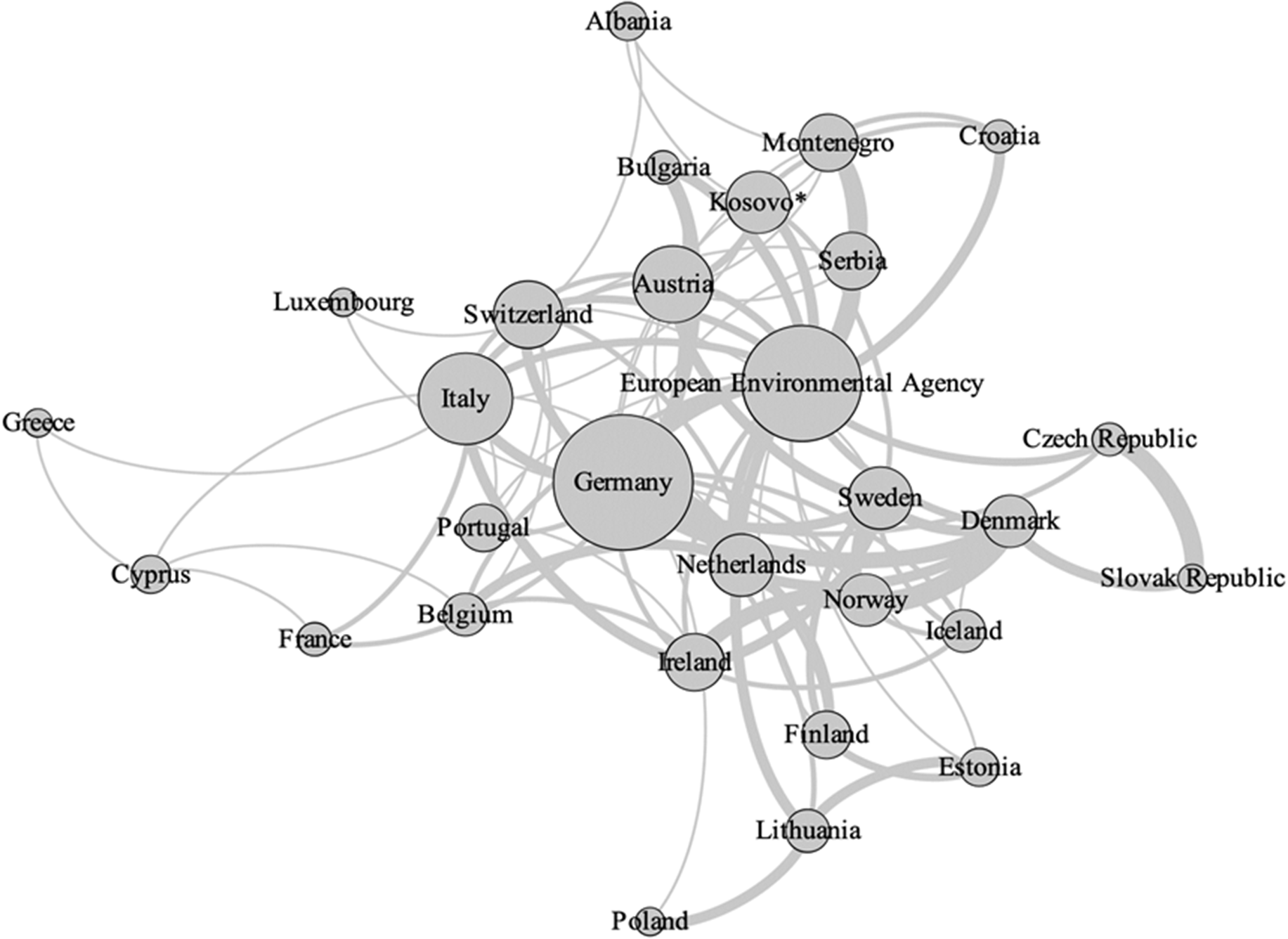
Figure 1 provides an overview of all interactions that take place in the EPA Network, namely, the exchange of information, best practices, and advice. At first glance, it is possible to note the existence of a highly interconnected center and a sparse periphery in the network. At the core of the network are two actors of central importance to the EPA Network – namely, the German EPA and the EEA. Both are the most well-connected participants across the different types of interaction, as the German EPA has 65 ties and the EEA has 58 ties with the rest of their network peers. This places them at the center of the network, which facilitates diffusing their knowledge, regulatory traditions, preferred practices, and standards into the network’s dynamics (Christopoulos and Ingold Reference Christopoulos and Ingold2015). Meanwhile, actors such as Greece, Cyprus, Poland, and Albania are positioned on the network’s periphery.
Overview of all types of network interactions in the EPA Network.
Note: The thicker the tie, the more types of interactions are shared by two network members. The larger the node, the more well-connected that member is in regard to advice, best practices and information exchange.
Another interesting insight comes from the directions of the network ties – specifically, who reaches out to whom and who is sought after for information, best practices, and advice within the network. Sending outward ties in the network has been previously noted as a possible indicator of network activism while being at the receiving end of such ties has shown the influence of certain members over others (Desmarais and Cranmer Reference Desmarais and Cranmer2012; Vantaggiato Reference Vantaggiato2019).
In this study, one can interpret that regulators receiving the most ties occupy positions of considerable influence, as they are the most sought after for exchanging information, best practices, and advice. That is the case for the EEA and the German EPA, which receive the highest number of incoming ties – 54 ties and 29 ties, respectively. In terms of network activity, the German EPA presents the highest number of outgoing ties (36 ties), followed by Denmark (19 ties).
Overall, it is clear that not only do the individual positions of participants play an important role in how learning processes unfold within a network, but also the number and direction of the network ties must be taken into consideration. Referring to the ‘teacher-student’ analogy, two considerations can be made. First, one could argue that the EEA functions as a ‘teacher of norms’, frequently serving as a reference point for regulators with lower resources or for ‘newer’ members (Papadopoulos Reference Papadopoulos2017; Versluis and Tarr Reference Versluis and Tarr2013). This is supported by the high number of incoming ties, while the European agency maintains a relatively low level of network activity (4 outgoing ties). Second, the German EPA assumes a dual role as both a teacher and a student. At the same time that several network participants seek them out for their expertise and knowledge, the German agency also actively looks for diverse sources of learning in the network.
Inferential results
To test whether certain factors are able to shape the interactions and exchanges taking place within the EPA Network, exponential random graph models are used (see Table 1). In this approach, each model estimates the effects of the hypothesized factors on the likelihood of the different types of interactions. First, in line with Hypothesis 1, the results show that network interactions take place in the form of highly transitive relations regarding the exchange of information (p < 0.001), best practices (p < 0.001) and advice (p < 0.1). There is thus a strong tendency of exchanges to take place beyond one’s immediate partners, which means that network participants are likely to interact not only at the bilateral level, but also with network peers with whom they share an indirect connection.
Exponential random graph models of drivers of EPA network interactions
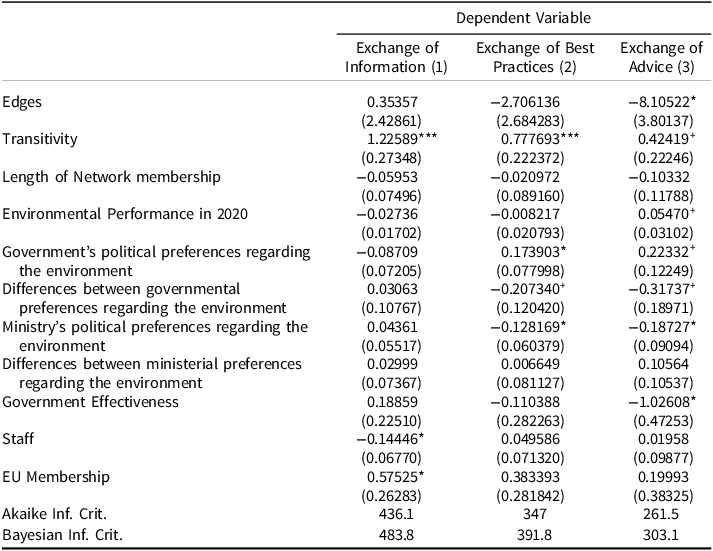
Note: +p < 0.1; *p < 0.05; **p < 0.01; ***p < 0.001.
Having accounted for the network structure and its tendencies, the actors’ attributes are now analyzed to assess whether they influence the formation of network interactions. At first glance, it becomes clear that not only are certain individual features more relevant than others, but there is also a variation in terms of their effect across the different types of exchanges in the network. The national performance in the implementation of environmental policy, for example, only has a significant positive effect (p < 0.01) on the likelihood of members to exchange advice. While this provides support to Hypothesis 3, this should be seen with a certain degree of caution given the small size of the effect.
Meanwhile, national political preferences seem to be particularly important factors in here. In both the exchange of best practices and of advice, there is a significant positive association between the political preferences of national governments and the dynamics within the EPA Network. Holding everything equal, when there is one unit increase in the political preferences of national governments regarding the environment, the likelihood to exchanging best practices increases with 19% (odds ratioFootnote 7 = 1.19) and the likelihood to exchanging advice with 24% (odds ratio = 1.24). As higher scores in the political preference scale correspond to the prioritization of economic interests even at the expense of environmental protection, this means that EPAs under more economically centered national governments tend to be keener to interact in the EPA Network.
There is also a significant but negative association between the preferences of the Ministry of the Environment and the exchanges of best practices and of advice. When increasing a unit of ministry’s political preferences regarding the environment, there is a decrease of 13% (odds ratio = 0.87) in the likelihood of exchanging best practices and of 18% (odds ratio = 0.82) in the likelihood of exchanging advice. In other words, this means that EPAs that are under Ministries that lean more towards prioritizing environmental preservation rather than economic development tend to participate and interact more in the EPA Network. Given the voluntary and informal nature of the network, this comes as no surprise as the use of resources to establish relationships within networks could be perceived by their principal – i.e. the Ministry – as an important asset to them and a way to connect to other European peers and develop new ideas (Andonova and Tuta Reference Andonova and Tuta2014).
One of the main insights of Table 1 concerns the effect of similarities or differences in political preferences on network dynamics. In line with Hypothesis 5, we find that EPAs tend to interact more with peers under national governments that share similar preferences regarding the environment. It is important to point out that this effect is found only for the exchange of best practices and of advice and it is not present in the case of the Ministry of the Environment. All else being equal, one unit increase in the difference between governmental preferences decreases the likelihood of exchanging best practices with 19% (odds ratio = 0.81) and of exchanging advice with 27% (odds ratio = 0.73). This means that regulatory agencies from states with similar priorities – either leaning towards environmental protection or towards economic development – are more likely to interact with each other than with agencies coming from states with different preferences, which rejects Hypothesis 4. This outcome is consistent with the general findings from the EAN literature, in which there is a strong tendency of homophily (Vantaggiato Reference Vantaggiato2019). This is also in line with recent insights that highlight the influence of politics and political factors on network interactions (Mastenbroek et al. Reference Mastenbroek, Schrama and Martinsen2022).
Regarding the exchange of information, neither the experience of network participants (Hypothesis 2), nor the performance of their corresponding states regarding the implementation of environmental policy (Hypothesis 3), nor the preferences of their national government and ministry (Hypothesis 4 and 5) are significant factors to the likelihood of interactions to take place. Still, the results of the analysis point to similar findings as those of previous contributions (Martinsen et al. 2020b; Vantaggiato 2019) – namely, that the level of human resources (i.e. staff) dedicated to the network and EU membership have a significant effect on network exchanges (both p < 0.05).
In the case of EU membership, the positive effect may be attributed to the fact that EU environmental legislation is legally binding to member states, who must implement and comply with its requirements. Therefore, they are more likely to face the same type of practical issues, which leads them to seek out their fellow EU-EPAs in the network. Meanwhile, there are two possible explanations for the negative association between staff level and the likelihood of exchanging information in the EPA Network. On the one hand, there may be little incentive for certain network members – especially well-resourced ones – to interact extensively in the network as they should have sufficient expertise in-house (Vantaggiato Reference Vantaggiato2019). Therefore, they may only use a minimum amount of their resources to ensure their presence in the EPA Network. On the other hand, the exchange of information and expertise in EANs may be particularly relevant for authorities with more limited resources. In other words, despite having a small staff dedicated to the network activities, these actors still greatly benefit from the pooling of resources at the network level such as the practical experiences in policy implementation, the development of common standards and product testing (Polak and Versluis Reference Polak, Versluis, Drake and Smith2016).
Conclusion
As the European Union turns towards ‘new governance’ approaches to tackle complex policy issues involving interdependent national and supranational actors, EANs become more prominent instruments in the EU governance toolbox (Zito and Schout Reference Zito and Schout2009). They are frequently framed as valuable learning mechanisms as they foster the exchange of expertise and knowledge, which is ultimately expected to lead to the development of common understandings and new and innovative policy solutions to practical issues (Polak and Versluis Reference Polak, Versluis, Drake and Smith2016). While this assumption is widespread in the EAN literature, empirical research focusing on the subject has been scarce (Martinsen et al. Reference Martinsen, Schrama and Mastenbroek2020a; Papadopoulos 2017).
In this article, the main goal was to tackle the central questions posed by the policy learning literature (Domorenok and Zito Reference Domorenok and Zito2021; Zito and Schout Reference Zito and Schout2009) – namely, how and under which conditions learning takes place in European Administrative Networks. As learning is understood here as an interactive process where actors exchange expertise, concerns, and knowledge regarding issues within a specific policy area of their shared interest, there is an explicit focus on the micro-processes of learning. Through the application of social network analysis and ERGMs on the interaction patterns between members of the EPA Network, this article contributes to filling the empirical gap of policy learning literature on how policy actors learn in real-world settings (Dunlop and Radaelli Reference Dunlop and Radaelli2013; Papadopoulos Reference Papadopoulos2017).
This article’s findings provide support to the insights from previous studies (Hobolth and Martinsen Reference Hobolth and Martinsen2013; Maggetti and Gilardi Reference Maggetti and Gilardi2011) – namely, that learning processes take place selectively as actors learn to different extents and in different manners. The network presents a clear core-periphery structure, which means that certain actors may be left out of the learning process. Nevertheless, the exchange of resources across network participants takes place both directly and indirectly, as network interactions are highly transitive, which shows that there is still a broad circulation of knowledge across the network.
The structure of the EPA Network is particularly interesting to discuss learning processes. Despite being an informal and voluntary EAN, the EPA Network presents a rather hierarchical structure. Yet, the presence of the EEA as a potential ‘teacher of norms’ is central to ensuring that a certain degree of cohesiveness is upheld concerning the knowledge and practices being shared in the network.
In line with a recent contribution by Mastenbroek et al. (Reference Mastenbroek, Schrama and Martinsen2022), the findings here have also highlighted the importance of national political features to understand the dynamics taking place within EANs. Interestingly, it becomes clear that environmental agencies under national governments that are mostly interested in economic development are more engaged in the exchange of best practices and of advice than those under environment-oriented governments. A potential explanation for this is that national EPAs aim to maximize the use of their own (limited) resources and thus are more likely to take advantage of the pooling of resources at the network level (Polak and Versluis Reference Polak, Versluis, Drake and Smith2016; Vantaggiato Reference Vantaggiato2019). At the same time, a more critical reading of this result could be that national governments use their national agencies to monitor the developments of environmental policy at the network and to pull the break on attempts to introduce higher standards or more demanding implementation measures as the recommended standard. Future research is needed to go deeper into these patterns and how national agencies cope with such pressures.
Yet, the current study also raises considerable concerns about the potential of EANs regarding learning in the context of environmental governance. The exchange of best practices and of advice are limited to network participants that present similar domestic backgrounds in terms of the national political preferences on environmental sustainability. This means that the network structure will likely be clustered between regulatory agencies coming from more ambitious and environment-focused states and national agencies from states prioritizing economic growth even at the expense of the environment. This could ultimately lead to the development of ‘echo-chambers’ in which network sub-groups are closed off to new and competing information and choose to focus only on their preferred agendas. Such a development would severely undermine the extent to which EANs may contribute to fostering learning processes. Future research is needed not only to identify which other factors may contribute or hinder the learning processes in networks such as national regulatory frameworks, noncompliance cultures, or institutional/organizational settings, but also to explore whether these patterns are also present on more formalized EANs.
Supplementary material
To view supplementary material for this article, please visit https://doi.org/10.1017/S0143814X24000011
Data availability statement
Replication materials are available in the Journal of Public Policy Dataverse at https://doi.org/10.7910/DVN/CTLGF9
Acknowledgements
I am grateful to Dorte Sindbjerg Martinsen and Reini Schrama for their valuable feedback. Previous versions of this manuscript were presented at the 2022 European Union Studies Association conference in Miami, the 11th Biennial Conference of the Standing Group on the European Union in Rome and the 2022 annual meeting of the Danish Political Science Association. I would like to thank the participants for all comments received as well as the anonymous Journal of Public Policy reviewers for their insights and suggestions.
Competing interests
The author declares none.


 Open access

