





Seeing the food forest through the trees
Close your eyes
You are walking under a lush canopy of trees. Cherries, elderberries, almonds, and olives ripen overhead as you wade through knee-high bushes of lemon balm, river mint, sage, and oregano that perfume the air as you pass. They grow richer and richer, under a warm blanket of compost. Magpie warbles echo within the urban canyon. Tawny Frogmouths watch quietly from their nearby stoops. Cockatoos might even be heard, having found a safe stopover to escape the regional bushfires. Children can be heard on the nearby playground running and laughing, filling the space with more energy.
Open your eyes
You see familiar faces and new ones crossing paths while stopping to smell the lavender or pick some herbs on journeys to or from home. The wind rushes through, giving everything in the space a burst of movement and a moment to dance. Sun starts to dapple in through the leaves of the trees above, drawing your attention down to the ground, to this land that has been cared for by First Peoples for thousands of years. Leaves cover the footpaths you now walk on in a way you might expect if you were somewhere beyond the city. For a moment, you are lost, removed from the urban environment you know, yet deeply situated by the public housing rising high on either side.
Welcome to the Kensington Food Forest, a tiny but thriving socio-ecological oasis on Wurundjeri Country, on the stolen land so-called Melbourne, Australia. Here, food production, forest growth, and grassroots activism intersect, offering both community and researchers opportunities to learn with place, each other, and more-than-human worlds. Established in 2017 within the interstitial green spaces of the Kensington public housing estates, the Food Forest has supported local food production, compost access, forest care, and leisure activities, while prompting reflection on what ‘community,’ ‘sustainability,’ and ‘regeneration’ mean. Despite its significance, such small-scale spaces of grassroots organising and co-learning remain overlooked in urban development and circular economy strategies.
In this paper, we tell the story of the Food Forest and how this community-led initiative generates situated knowledges and learning opportunities about forest ecologies, local food, circular waste, and care practices. By situating learning in embodied, relational, and place-based practices, we show how engagement with the Forest becomes a pedagogical praxis that supports emancipation and transforms socio-ecological relationships. In turn, we argue that these prefigured Food Forest Pedagogies of Praxis are essential for grounding regenerative circularity in practices of liberation.
The research took place in Kensington, a culturally diverse suburb with a high proportion of residents engaged in higher education and professional occupations, a higher-than-average median household income, and a significant presence of public housing towers (The Food Forest, APR & KCEPCG, 2025). Kensington has a rich history of community organising, with grassroots actors developing alternatives to industrialised systems and connecting local circles of food and waste. Besides the Food Forest, initiatives include monthly repair hubs, seven compost hubs across the neighbourhood, and the monthly harvest and distribution of local food from its gardens and urban farms at the Fresh Food Market.
The community initiated the research process as part of the Kensington Circular Economy Precinct (KCEP), an experimental pilot project funded by Sustainability Victoria to test circular-economy initiatives in a ‘closed’ urban environment, organised by the City of Melbourne in partnership with the self-organising Kensington Circular Economy Precinct Community Group (KCEPCG).The project aimed to explore circularity in food, waste, and repair. While the City’s evaluation framework emphasised measurable outcomes, such as materials diverted from landfill or new projects established, the KCEPCG recognised a critical gap: these metrics could not capture how community initiatives shape ecological regeneration, wellbeing, and social connection.
As researchers from The Alliance for Praxis Research (APR), we joined this project to support the KCEPCG in addressing the gaps left by conventional evaluation frameworks. Through co-creating community indicators and documenting the Food Forest’s practices, we not only captured the social, ecological, and circular impacts that are often overlooked but also noticed how deeply these initiatives are woven with processes of learning, care, and transformation. Engagement with the Forest revealed that education is inseparable from everyday practice: the material, relational, and emancipatory dimensions of knowledge are constantly intertwined with community action, decision-making, and stewardship.
From those reflections, this paper foregrounds two key concerns: first, how grassroots initiatives like the Food Forest contribute to regenerative circularity; and second, how Food Forest Pedagogies of Praxis – learning that is embodied, relational, and place-based – enable emancipatory practices essential for these transformations. By co-creating community indicators, we articulate what is often overlooked, both in everyday practice and in policy, and show how these practices enact a pedagogy of praxis that grounds regenerative circular economies.
This paper unfolds in five parts. We begin by conceptualising the need for community and regenerative lenses within the growing institutional discourse on Circular Economy. Next, we situate the Food Forest within the theoretical frameworks of environmental education. Third, we outline the methodological framework for our work with the KCEPCG and wider community. The fourth section presents vignettes and learnings of regenerative circularity through ten community indicators, highlighting instances of pedagogical praxis. Finally, we situate these findings within broader debates on circularity, sustainability transitions, grassroots organising and education.
Overlooking grassroots community initiatives of regenerative circularity
The Circular Economy (CE) has become a dominant paradigm for addressing waste and sustainability challenges in cities worldwide (Geissdoerfer et al., Reference Geissdoerfer, Savaget, Bocken and Hultink2017; Ghisellini et al., Reference Ghisellini, Cialani and Ulgiati2016). However, much of this discourse privileges technological innovation, financial returns on waste, and large-scale infrastructure investments (Savini, Reference Savini2023). Improved recycling processes, waste-to-energy facilities, and digitalising waste diversion data often take centre stage, emphasising the continuing allure of hard infrastructure as a focal point for responses to environmental management challenges (See et al., Reference See, Cuaton, Webber, Opdyke and Peja2025). In contrast, grassroots practices of reuse, repair, composting, and community food production, which are proliferating as diverse circular economies (Gibson-Graham, Cameron & Healy, Reference Gibson-Graham, Cameron and Healy2013), remain overlooked in urban policies (Ferguson, Reference Ferguson2026).
Yet, the dominant framing of hard infrastructural and technological innovation for the CE narrows what counts as being ‘circular’ and what is thus recognised as valuable. Studies show that grassroots initiatives – community gardens, repair cafés, compost collectives, urban gleaning projects – contribute to reducing waste by sharing skills, relocalising the problem, and enhancing social connection (Mellick Lopes & Gill, Reference Mellick Lopes, Gill, Kalantidou, Keulemans, Lopes, Rubenis and Gill2023; Morrow & Davies, Reference Morrow and Davies2022). Yet these impacts are often unaccounted for in standard metrics for assessing circular economy success, which tend to emphasise tonnes of materials diverted from landfill or revenue generated rather than the social innovations and infrastructure required (Marchesi & Tweed, Reference Marchesi and Tweed2021).
Scholars and practitioners thus call for the adoption of alternative values and metrics in circular and sustainable transitions that emphasise wellbeing, biodiversity, equity, and cultural exchange alongside more sustainable material flows (Petrescu et al., Reference Petrescu, Petcou, Safri and Gibson2021; Dark Matter Labs, 2023; Velenturf & Purnell, Reference Velenturf and Purnell2021). Regenerative circularity, as a CE alternative, and ways to express it were thus central to our research aims.
When we say regenerative, we speak to the processes of care by humans and more-than-humans that give back to place in ways that can repair, restore, and renew beings and relationships that have been broken or lost (Buckton et al., Reference Buckton, Fazey, Sharpe, Om, Doherty, Ball, Denby, Bryant, Lait, Bridle, Cain, Carmen, Collins, Nixon, Yap, Connolly, Fletcher, Frankowska, Gardner and Sinclair2023; Fisher & Tronto, Reference Fisher, Tronto, Abel and Nelson1990). When we say circularity, we seek to expand the notion of material and social (re)circulation beyond what’s narrowly considered in the CE to include community practices and ethics of sharing, repairing, waste avoidance, waste reduction, and outright refusal (Savini, Reference Savini2023; Velenturf & Purnell, Reference Velenturf and Purnell2021).
Community indicators of regenerative circularity, therefore, look for those practices that recirculate and redistribute material and social value to deliberately repair, restore, and renew our communities. Regeneration, as a fundamental pillar of the CE (The Ellen MacArthur Foundation, 2025), is continuously overlooked in CE strategies that favour economic objectives over ecological health (Ghisellini et al., 2016). In doing so, current CE strategies fail to recognise environmental and social restoration as the waste-eliminating processes they are (Savini, Reference Savini2023).
By (re)defining ‘indicators’ for circular economies, this research is resisting the tendency to flatten such complex realities into numbers alone. Indicators for this research, as discussed later, are not about forecasting efficiency but about surfacing relational dynamics, experiential processes, cultural exchange, and trying to sit with the messiness essential to creating more just and sustainable futures.
Here, we do this through the Kensington Food Forest while further situating our findings within wider frameworks of what’s called for in sustainable transitions from the global United Nations Sustainable Development Goals (SDGs) to the more regional Melbourne Doughnut (as delivered by Regen Melbourne, Reference Melbourne2025). Working across scales aims to connect hyper-local indicators of regenerative circularity with those shared planetary challenges and larger urban discourses. In this sense, these community indicators become tools – of both research and education – for diverse communities to reflect on what they value, how they measure change, and what futures they want to create.
Food forest pedagogies of praxis
Inviting a reflective use of indicators to make sense of deeply contextualised and interconnected actions allows us to frame the Food Forest as an embodied space for pedagogies of praxis. It produces a way to generate and share knowledge about ecology, waste, vital nutrients, lost systems, and community through the very practices that sustain it. People can learn about the stages of composting by turning piles of food scraps with neighbours, and then by adding them back to the land, taking notice of the heat of decomposition required, the smells of earth emitted, and the healthy soils and foods it produces (Morrow & Davies, Reference Morrow and Davies2022). They learn about biodiversity by observing and tending to plants, exchanging their cultural knowledge about native species, new recipes, and sustainable planting practices, and sharing local food across diverse communities at the Fresh Food Market.
These practices are clear examples of learning through contamination, as learning from participating and being dependent on collaborative networks of survival that entangle humans with(in) the processes of organic matter recirculation, microbial life, and more-than-human agents (Tsing, Reference Tsing2015). They also embody what scholars call educational praxis: pedagogies that emerge through action, storytelling, and collective care (Santos & Costa-Pinto, Reference Santos, Costa-Pinto and Ferraro-Júnior2005). Such a praxis can emancipate individuals from their ‘oppressors’ (e.g. from an industrialised, “toxic” food system), enabling social transformation - both internal and external - through reflection-action entanglements and dialogues of knowledges. By ‘dialogues of knowledges,’ we mean the iterative exchange between different ways of knowing - scientific, local, experiential, and cultural - where participants learn from each other and co-create understandings that are richer and more situated than any single perspective alone (Freire, Reference Freire2024). These processes are inherently political as they challenge dominant power structures and open up space for alternative ways of knowing and being to emerge (Guimarães, Reference Guimarães and Ferraro-Júnior2005; Floriani, Reference Floriani and Ferraro-Júnior2007; Freire, Reference Freire2024; Sykes & Treleaven, Reference Sykes, Treleaven, Ybema, Yanow, Wels and Kamsteeg2009; Lloro, Reference Lloro2021).
Such community-based forms of learning, like what happens through the Food Forest, expand and critically complicate conventional understandings of environmental education (EE). Much of the EE literature has historically been developed within formal schooling contexts – through curriculum design, structured outdoor excursions, or sustainability modules integrated into science and geography (Guimarães, Reference Guimarães and Ferraro-Júnior2005; Payne, Reference Payne2017). Indeed, many core empirical studies remain anchored in science-education frameworks and school-based settings (Zhang et al., Reference Zhang, Jung and Asari2025). However, there is a growing call among researchers for collective and community-level learning, and for research grounded in social–ecological communities rather than exclusively individual or classroom-based outcomes (Ardoin et al., Reference Ardoin, Clark and Kelsey2013). While school-based approaches remain important, they do not fully capture the everyday, relational, intergenerational and practice-based ways people learn to live with environments in community settings. Scholars of education remind us that learning is embodied, social and place-based (Freire, Reference Freire2024); Therefore, informal sites of learning need to be further incorporated into environmental education structures and research (Payne, Reference Payne2017).
Recognising the Food Forest as a site of open community learning highlights how knowledge can be generated in place and through ongoing relationships and experimentation with the plants, the people, and the processes of nature and urbanisation (Wendler, Reference Wendler2016). It also exemplifies how such learning unfolds within an intergenerational and ethnically diverse community. The knowledges produced there are not abstract or disembodied but experiential and situated, responsive and reflected upon as the Food Forest grows – or struggles to – and provides crucial learnings for how circular economies ‘actually’ function (Newton & Rocco, Reference Newton and Rocco2022). Acknowledging this value opens pathways for praxis, to co-produce indicators that recognise and respond to the relational, embodied, and care-based dimensions of community learning and, in the process, a regenerative circularity. This praxis, as we will highlight, is an important step in reimagining what counts as knowledge and value in circular and sustainability transitions.
Methodological approach: Co-creating community indicators
Our approach for this research was grounded in a participatory and mixed methods research design, working with the KCEPCG grassroots leaders and the belief that communities are not merely subjects of study but active knowledge producers. This aligns with traditions of participatory action research (Sykes et al., Reference Sykes, Treleaven, Ybema, Yanow, Wels and Kamsteeg2009; Kriti, Reference Kriti2018) and feminist methodologies that value care and reciprocity (Dombroski et al., Reference Dombroski, Conradson, Diprose, Healy and Yates2023; Fisher & Tronto, Reference Fisher, Tronto, Abel and Nelson1990). The first step involved developing indicators that would guide this research, starting in January 2024 through recurring discussions and workshops with the KCEPCG grassroots leaders – around seven community actors that came together to form the KCEPCG and who we became familiar with through previous work as participants and researchers with Transition Town Kensington and the Food Forest. Together, we identified areas of interest and knowledge gaps in our collective works for what the community wanted to know more about. In doing so, we developed ten indicators grouped under two major themes:
-
Socio-ecological landscape: biodiversity connections, more-than-human relationships, community connections, compost connections, and climate action.
-
Practices of commoning: food sovereignty, cultural inclusivity, solidarity and collectivism, partnerships for change, and community innovation.
These were the main elements of regeneration that the KCEPCG saw as goals for what was already happening within the Food Forest and the wider local food and waste circles. Each indicator was then developed further with guiding questions, possible methods of measurement, and its connection to global and regional frameworks of the SDGs and the Melbourne Doughnut (see Appendix 1). Importantly, these indicators were not designed to deliver neat percentages of success or failure. Instead, they sought to uncover the relationships, practices, and transformations often invisible in conventional project evaluations and what is usually more difficult to discern by community organisers doing the work. In doing so, these community indicators can capture more depth around the socio-ecological landscape and practices of commoning taking shape within circular waste diversion.
We then prioritised these wide-reaching indicators into actionable goals with the wider KCEP team, including the City of Melbourne, for what we all wanted to understand within the given project timeline of six months. Data collection took place from March to June 2024. We conducted one-on-one and small group interviews with community leaders from the KCEPCG and others who were previously engaged with the Food Forest. We also held a focus group workshop with the larger Food Forest Care Team, consisting of around 10 volunteers from the broader community, after one of their seasonal care days. Short survey-interviews were also administered to even more volunteers and visitors at one of the Fresh Food Markets, providing an extension of local food engagement beyond, yet directly from, the Food Forest. Overall, during our limited time, we worked with over 40 people across four focus group workshops and interviews, as well as those at the Fresh Food Market in May. Demographically speaking, participants have diverse backgrounds. Most community leaders are middle-aged and women. Participants on the care teams include children, young adults, residents of the public housing and surrounding communities, from different cultural backgrounds.
In addition to these primary sources, we gathered complementary data to provide a grounded context for our findings, including documentation from the community on initial Food Forest design and history, ongoing monthly food production measurements from the Fresh Food Market, and wider composting activities from the surrounding estate. To enrich our analysis, we further integrated demographic data, secondary sources, and spatial mapping to build a comprehensive picture of the Food Forest community’s social and ecological dynamics in Kensington.
Together, these insights contributed to what we learned about regenerative circularity through the Food Forest as a pedagogy of praxis for each of the ten community indicators. This is discussed next in two parts: those community indicators of (1) socio-ecological landscape, and (2) practices of commoning.
Community indicators for regenerative circularity: Socio-ecological landscape
Socio-ecological landscape indicators uniquely explore the interconnectedness of land, ecology, and community through the Food Forest. Together, these indicators help us understand how the Food Forest operates as ecological and social infrastructure (Schooneveldt, Reference Schooneveldt2022).
Biodiversity connections
At the microscale, multi-strata vegetation within the Food Forest improves soil health, water infiltration, and ecological processes (Figure 1). At the landscape scale, the Food Forest functions as a stepping stone between local green spaces and the Maribyrnong River corridor. There are hopes from community leaders that as the Food Forest matures, more flora and fauna will continue to appear. Yet, sightings of lorikeets, cockatoos, almonds, olives, Tawny Frogmouths, and increased insect activity already suggest positive ecological shifts from the site’s former monoculture of “grass and concrete” (Focus Group Interview, June 14, 2024).
Food forest during care day. Photo by Zheng Chin.

The food forest demonstrates how small-scale urban green spaces can nurture learning when designed for both habitat complexity and landscape connectivity. One community leader describes the initial design process as emulating the ‘architecture of a forest’, noting that: “in a forest, no one comes in to mow, fertilise, or water yet it keeps working. That’s what we aim for [in the food forest]” (Interview, march 28, 2024).
Through this process, participants have not only observed but actively learned about forest independence, agency, and the rhythms of multispecies life, reflecting on how these shape maintenance practices and care routines. By integrating over 60 plant species, including more than 25 food-producing trees, the food forest creates a complex system that supports insect, bird, and soil life. These slow, contingent processes are central to food forest pedagogies of praxis, where learning emerges through doing, observing, and negotiating the interplay of human and more-than-human needs within the ecosystem. As a community member has shared
“(…) I am still learning. We started the food forest as designers, but it’s not until you put trees in the ground and they don’t survive that you realise you made a mistake” (Interview, march 28, 2024).
More-than-human relationships
The Food Forest demonstrates how human and more-than-human wellbeing can be deeply entangled when you relate to one another. Community members describe the site as a place to learn, share, and connect with plants, soil, insects, and animals, reflecting during one of the workshops:
“Why (do I care)? Because having happy plants sort of makes me happy, having collective plants and stuff where we’re allowed to garden a bit (…) we can sort of care for the earth in that way” (Focus Group Workshop, April 13, 2024).
The Food Forest creates “a space to learn about more-than-humans” (Interview, March 28, 2024) building a greater awareness of the necessity for biodiversity, soil health, and the agency of nature for urban sustainability. Community voices, like the ones above, emphasise the restorative quality of sharing space with trees, plants, skies, and multispecies: “we create habitats for wildlife, fresh food for the whole community, a space for everyone to enjoy for their wellbeing” (Focus Group Workshop, April 13, 2024). By cultivating these relationships, the Food Forest models regenerative practices were caring for more-than-humans becomes an inseparable part of caring for ourselves and each other. Learning how to do so or what that takes comes from seasonal care days, composting, harvesting, and spending personal time in the Food Forest with the many others who live there.
Community connections
Participation in the Food Forest is also motivated by a desire for deeper community ties. As one participant explains:
“I wanted a deeper connection in my community… and to work on projects with like-minded people” (Focus Group Workshop, April 13, 2024).
What started in the Food Forest (e.g. growing local food and ecological regeneration) has catalysed other initiatives, like the Fresh Food Market and the Kensington Urban Farm Collective, to expand these practices across the neighbourhood. Community members working together in the Food Forest realised what else they could accomplish, and what more needed to be done (Focus Group Workshop, April 13, 2024). This connection and learning come through sharing in the practices of gardening, composting, monthly events, and everyday use as an evolving community.
The Food Forest is also a practice of reflection on what kind of community is being created, and possibly still excluded, in sustainable transitions. Deliberate designs of openness and inclusion are central to the Food Forest, particularly given its location within a public housing estate. Once described as a “dead space” dominated by parking and unsafe behaviours, the site now fosters encounters between diverse residents, breaking down social barriers and stigmas, and cultivating a sense of shared ownership in a neighbourhood that was previously divided by both literal and figurative fences (Focus Group Interview, June 14, 2024).
Community members highlight that the absence of fences and locks around the Food Forest creates an experiment in community trust, one that has had an impact on reversing cycles of exclusion typical in other community gardening spaces:
“We’re sharing this openly, and I think that’s [then] reciprocated… it breaks that vicious cycle [of exclusion], and actually says we are all part of this together” (Focus Group Workshop, April 13, 2024).
While foundational to the design of the Food Forest, such openness and inclusion also require ongoing commitments and action to sustain broader community connection, something the Food Forest care team acknowledges and seeks to strengthen as the community matures. Scholars recognise this as a core part of just climate and urban transitions (Faustino, Guerra-Tão, & Steele, Reference Faustino da Silva, Guerra-Tão, Steele, Ward, Bell, da Silva Faustino, von Mering, Soberón and Steele2025). Beyond navigating off-hand vandalism and maintaining unrestricted access, the Food Forest functions as a vibrant social infrastructure, where human encounters become moments of negotiation, trust, and learning. Through these processes – confronting stigmas typical of marginalised housing spaces, engaging with difference, and collectively shaping the space – participants enact emancipatory practices, learning together while simultaneously challenging and transforming broader systems of oppression (Guerra-Tão, Reference Guerra-Tão2024).
Compost connections
The community compost hubs exemplify this, linking community connection with ecological regeneration. The compost hubs at the Food Forest address inequalities in access for public housing residents to large-scale waste solutions like FOGO (Food Organics Garden Organics) collection, which collects residential organic waste but is still not available for high-rise buildings like the public housing estates. In bridging this social gap, local ecological needs are also furthered, reclaiming the value of food scraps away from FOGO removal services for local soil regeneration. Through community composting, residents experience a deeper interconnectedness with both nature and each other than they do when they drop food scraps in the FOGO bins, cultivating regenerative practices that further link human, ecological, and wellbeing to the waste and the places people (can) produce.
The practice of local composting and transforming food and organic waste into fertile soil by hand sustains the Food Forest while creating participatory, relational pathways for environmental learning. One community member reflects:
“I was doing the compost, my first time. I learned from one girl; she lived around the corner. She and I were [then] doing the compost routinely… I would put the food scraps in and put some soil on top” (Focus Group Interview, June 14, 2024).
The network of community compost hubs in Kensington not only regenerates local soil health but also strengthens social bonds. Survey responses conducted by RMIT undergraduate students highlight how local compost access improves engagement with environmental practices and fosters a sense of shared responsibility: “reminds us that we are all interdependent” and “we are part of, not separate from, nature” (RMIT Survey, May–June 2024).
Climate action
Altogether, the Food Forest shows how grassroots initiatives can deliver climate action through integrated strategies of interconnected waste management, revegetation, carbon sequestration and local food production.
By the numbers, the compost hub at the Food Forest diverted approximately 4 tonnes of organic waste during the KCEP timeline, transforming it into soil nutrients while emitting significantly less carbon than landfill or FOGO practices (Perez et al., Reference Pérez, Vergara and Silver2023). Revegetation of the once “dead space” used for car parking into a biodiverse green refuge increased vegetation coverage for the area by 5–10 percent and helps counter urban heat stress in a neighbourhood with high heat vulnerability (State Government of Victoria, 2024). The Food Forest also functions as a carbon sink, sequestering an estimated 80 kg of carbon annually in its living biomass (Lehmann et al., Reference Lehmann, Lysák, Schafer and Henriksen2019). Local food production further reduces emissions by growing 540–600 kg of fresh produce annually, avoiding the transport emissions associated with larger food miles.
Understanding these impacts, though, is not always inherent. Therefore, care days and events become important sites to communicate and action such ongoing climate action, generating learnings for the wider community on what climate action means and how they can – and already do – participate. As one participant shares at the Fresh Food Market for its impact against an industrialised food system:
“We learn a lot about food miles, transportation of food, and even water miles, how that water is contained in food and transported, transported from poorer countries to richer countries, you know, within food (…) it [therefore] means a lot to try and produce locally” (Survey-interview, May 5, 2024).
Participants across the different food and waste initiatives learn and share the hard-to-discern climate and justice dimensions of food and waste systems through local action (Li et al., Reference Li, Jia, Lenzen, Malik, Wei, Jin and Raubenheimer2022). These practices of regenerative circularity illustrate how small and experimental urban spaces can become open sites for learning about the socio-ecological landscapes in which they sit and can transform (Wendler, Reference Wendler2016), and how those learnings and their climate benefits are intimately linked to active participation in the Food Forest and its other initiatives.
Community indicators for regenerative circularity: Practices of commoning
Practices of commoning indicators highlight how communities collectively care for and sustain regenerative circular work, much of which relies on volunteer efforts. These indicators capture how sustainable transitions emerge not only through growing food or recirculating waste, but by nurturing shared relationships, knowledge, and cultural practices that ripple outward, sustaining circular action through broader practices of communing.
Food sovereignty
The Food Forest strengthens food sovereignty in the Kensington community by creating a local, community-led space for growing, sharing, and learning about food and our collective right to food (Pimbert, Reference Pimbert2015). Through the Food Forest, urban residents connect with the realities of food systems typically obscured by industrial supply chains. As noted by a community member:
“Growing your own food should be a right. The current system forces people into the corporate food market, creating waste and social inequality. If we want to eliminate it, we need to think about what to create in its place.” (Interview, March 28, 2024)
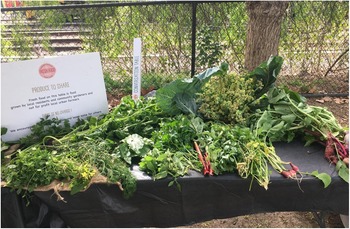
These practices exemplify Food Forest Pedagogies of Praxis in action: learning occurs through embodied, relational, and participatory activities, where community members generate knowledge about food systems, sustainability, and collective care while acting to transform them. The Food Forest works in tandem with the community-led monthly Fresh Food Market, distributing urban harvests from the Food Forest and other local gardens to residents who do not have space to grow their own food (Figure 2). Participants reflect on how these activities enable autonomy and resilience:
Fresh food market, with produce from the food forest and urban farm. Photo by Corey Ferguson.

“In terms of food security as the climate changes and there are more disruptions, like we saw during covid[-19], having access to really fresh food, especially in the inner city, that’s not so easy. We live in an apartment, so we do not have space for a garden. So [the Fresh Food Market] is really good.” (Survey-interview 2, May 5, 2024)
During the COVID-19 pandemic, the Food Forest’s production capacity enabled volunteers to harvest and distribute fresh food to 90 families in local public housing estates each fortnight, demonstrating how collective action and situated knowledge directly supported community wellbeing (Interview, March 28, 2024). These practices continue today, with the market now running monthly. One participant commented:
“I think it’s a really important thing in terms of the food front, like trying to boost that circular economy, and I think it’s a really great community connector. It sort of brings people together and shares what’s going on.” (Survey-interview 3, May 5, 2024)
In doing so, the Food Forest resituates food within community-determined values of justice and autonomy. Through these practices, they enact emancipatory pedagogies, where people free themselves from oppressive food systems through (un)learning and (un)doing, in dialectical and continuous exchange with place and people. They increase their capacity for self-determination, offering an urban model of practising food sovereignty in the face of widespread industrial dependency and its disruptions.
Cultural inclusivity
The Food Forest additionally works to express Kensington’s diverse social and cultural landscape by integrating multicultural elements into its design, plantings, and activities. The Forest facilitates learning about foods by enabling residents to grow and share culturally significant plants as well as to exchange knowledges of different food practices and native alternatives (Focus Group Interview, June 14, 2024). Situated within a socially diverse hub within the neighbourhood of the public housing estate, the Food Forest fosters cross-cultural understanding and appreciation through everyday encounters between residents, the wider community, and the plants that grow.
Yet, cultural inclusivity is an ongoing practice that still needs to be nurtured (Tzirides et al., Reference Tzirides, Cope and Kalantzis2023). Challenges such as occasional misuse of the Food Forest or conflicting values from within the diverse Food Forest community have been met by reasserting openness and shared ethics rather than imposing restrictive rules. Efforts to strengthen Indigenous connections are also visible in the planting of native species and the recognition of Indigenous lands, but with aspirations from volunteers for deeper collaboration and commitment to decolonial practice moving forward. As a community member noted:
“I often think that what we need moving forward, and it’s not talking about what you cannot, but what we can still do. In this space, we’re talking about sharing nature and everyone around us, but it’s also not our land, you know, it is Wurundjeri People’s land, so I’d like to be able to bring that into this space as well.” (Focus Group Workshop on April 13, 2024)
Each situation, including those generated from this research investigation, invites an opportunity for discussion, reflection, and action on how inclusivity should be approached and where the Food Forest can improve. This ongoing openness positions ‘inclusivity’ not as assimilation or something to achieve but as mutual recognition and exchange of (un)acceptance (Ganczarek et al., Reference Ganczarek, Hünefeldt and Olivetti Belardinelli2018; Young, Reference Young1990). Through these practices, the Forest offers a counter-model to exclusionary urban development, enacting inclusivity – and all its challenges – through cultural difference and negotiation. It thus seeks to further a practice of inclusivity through each learning that comes from sharing space.
Solidarity and collectivism
The ethics and practices of sharing and caring underpin the operation and social impact of the Food Forest. Participants express how the act of caring is inseparable from sharing: Learning to practice mutual support and collective responsibility to cultivate an ethical consciousness toward a being-in-common (Gibson-Graham et al., Reference Gibson-Graham, Cameron and Healy2013). When asked to reflect on what is being cared for and shared in the Food Forest, Food Forest carers offer:
“Knowledges, stories, opinions; human energy, so work and the effort that we all share here every time we come here; things that we found around, space with the animals. We share the atmosphere, food, plants, trees, and creatures. We share a life. We share goodwill and generosity (…) We share green spaces, we share a habitat for wildlife [and for us]” (Focus Group Workshop, April 13, 2024).
The Food Forest operates - and negotiates - as a commons, where solidarity and collectivism are cultivated through distributed labour, trust and decision-making. It’s not a siloed plot that someone looks after by themselves, but rather a collective endeavour and responsibility. As in other grassroots contexts, solidarity and collectivism situated with(in) place are key strategies to care for neglected sites, identities and materials (Faustino & Cooke, Reference Faustino and Cooke2025). This ethos transforms the food and waste practices performed into acts of commoning (Mellick Lopes & Gill, Reference Mellick Lopes, Gill, Kalantidou, Keulemans, Lopes, Rubenis and Gill2023; Morrow & Davies, Reference Morrow and Davies2022). This involves organising volunteer care days, watering schedules, planting schedules, market days and grassroots promotion, and requires skills on how to plant, harvest, weed, tend to the plants and maintain compost processes.
These are only some of the cooperative and labour-intensive practices that flow through the Food Forest, and not all of these practices are shared equally among the various groups of actors involved (Bodirsky, Reference Bodirsky2025). Importantly, these practices require different skillsets to do them effectively and offer opportunities for more people to get involved through learning. Sharing skills comes through care days of recurring practice and sharing space, as mentioned in the focus group workshop. Collectivism is thus built, not just assumed in community organising.
Solidarity, as a separate yet contingent element to collectivism, extends these shared and siloed practices beyond the volunteers, as highlighted before with the collective community response to covid-19 – between those who harvest and those who consume the fresh local foods – or through the philosophy of permaculture that guides the Food Forest carers to care for more-than-human others. Embedded within these practices is thus an ongoing dialogue of sharing and caring as education and learning (e.g. volunteers learn from market ‘customers’ what is appreciated and what are the challenges to local food). These experiences contribute to the Food Forest as an evolving pedagogical space for learning a solidarity and a collectivism within ‘community’ and ‘sustainability’, where knowledge and practice become intertwined with the making of a commons (Kruzynski, Reference Kruzynski, Dombroski and Gibson-Graham2020) and enacted through an ethics of caring and sharing.
Partnerships for change
Partnerships have also been central to the Food Forest’s capacity to grow and endure. Early collaboration with the City of Melbourne and Unison (a community housing provider) provided legitimacy and resourcing, while grassroots commitment sustained the day-to-day work. Community members note that trust has been built over time with the City and Unison, who value the Food Forest the more the community brings them along in its processes. Partnering enables learning for those involved to understand how different sectors of urban life works (i.e. public, private, and community) and how each can impact and inform the other.
Partnerships for change must go beyond just holding a relationship with others through sponsorship or funding. They require a deeper level of engagement, one of reciprocity and shared responsibility (Carlisle & Gruby, Reference Carlisle and Gruby2019). Partnerships are maintained through repeat collaboration, negotiation, and buy-in for new and existing projects. By sharing in the responsibilities and benefits of the Forest, the collective community of grassroots, government, and private actors (re)common resources through collective flows of value and stewardship.
Partnerships also extend laterally, with other food and gardening initiatives drawing inspiration and knowledge from the Forest. Such dissemination reinforces the Forest’s role as both a site and a catalyst for change. Challenges include balancing institutional requirements with grassroots autonomy, but these tensions have spurred negotiation rather than disengagement. The partnerships forged here have demonstrated how shared responsibility across levels of governance and urban sectors can enable urban commons to flourish.
Community innovation
The Food Forest fosters community innovation, prefiguring alternative futures. One member described it as: “a vision of what I believe is possible in the world… a tiny glimpse of the future we deserve” (Focus Group Workshop, April 13, 2024). Scholars describe this as prefiguration, where transformative social practices enact desired futures here and now (Leach, Reference Leach, Snow, Porta, Klandermans and McAdam2022; Tattersall & Iveson, Reference Tattersall and Iveson2024).
Innovations include collective labour systems, the Fresh Food Market, and knowledge sharing that supports satellite food forests beyond Kensington. The Forest’s design itself is an innovation: a public space that is also a food system, accessible and cared for by many. Its composting, seed saving, and collective cultivation practices embed circularity into everyday life, while community markets and shared governance create logistical infrastructures that redistribute both food and responsibility.
Recognition at state and international levels has affirmed its broader impact, but its deeper value lies in everyday transformations of participants, who describe learning new skills, building confidence, and reimagining their relationships with land and community. For many, this reimagining emerges through acts of stewardship and shared care that reshape the meaning of belonging. As one participant reflected:
“I’ve been here for 20 years and this block [of public housing] did feel quite impenetrable… But as soon as the Food Forest was put in there, it became okay for me to walk through… It does feel very much more like it’s allowed. It’s inclusive. Taking the fences down was a big barrier to remove, but also welcoming the community and saying, ‘we really need you here’” (Focus Group Interview, June 14, 2024).
This shift from exclusion to participation reveals how the Food Forest reconfigures ownership and property relations – not private or public, but collectively stewarded. In this way, it troubles dominant notions of property that often constrain the social and ecological possibilities of urban greening (Cooke, Landau-Ward, & Rickards, Reference Cooke, Landau-Ward and Rickards2019). Though challenges arise, they are embraced as part of learning in what Polletta (Reference Polletta1999) calls “free spaces.”
In this sense, the Food Forest demonstrates how grassroots innovation generates not only new practices but new subjectivities and futures. Participants stress that it operates as more than a garden: it is a prototype of how local systems connect with wider movements for social and ecological change. These innovations reveal that regenerative circularity depends on open-ended relations of care and collaboration that standard indicators rarely capture. In this sense, the Food Forest prefigures more-than-technical transitions, where learning, governance, and circularity intertwine.
Final thoughts: What we learned together
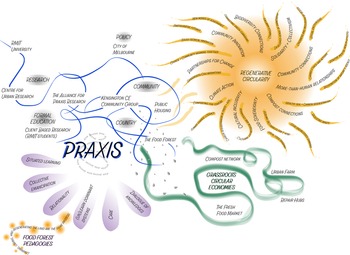
The Kensington Food Forest offers an example of how community-led initiatives can foster ecological, social, and educational outcomes in urban spaces. It demonstrates that regenerative grassroots circular economies are not only about material flows or quantitative outputs, but also about the relationships, knowledge, and care that emerge through everyday engagement (Figure 3).
Diagram showing the flows of actors, themes, indicators and principles that entangle the Food Forest Pedagogies of Praxis.

Set within the Kensington Public Housing estates on Wurundjeri Country, the Food Forest embodies what we have called Food Forest Pedagogies of Praxis – where circularity is lived and learned through collective, embodied, and relational practices. By bringing neighbours together to grow food and forest, share compost, and create a biodiverse and wellbeing refuge, it enacts circularity not as a technological fix, but as regenerative action. It demonstrates how sustainability transitions are learned from below – through ‘soft’ community infrastructures (Nogueira et al., Reference Nogueira, Ashton, Teixeira, Lyon and Pereira2020), lived experience, and the exchange of situated knowledge.
Throughout the project, learning occurred organically, via contamination (Tsing, Reference Tsing2015). Participants engaged with soil, plants, wildlife, and waste systems, observing the effects of their care and reflecting on interconnections among human and more-than-human actors. These encounters produced knowledge through dialogue, collaboration, and hands-on practice – an illustration of educational praxis (Guimarães, Reference Guimarães and Ferraro-Júnior2005; Floriani, Reference Floriani and Ferraro-Júnior2007; Freire, Reference Freire2024), where reflection and action become inseparable. In this sense, the Food Forest’s web of relations reveals how emancipatory, practice-based education fosters ecological literacy and empowers communities to act with agency.
Importantly, this research also reframes circularity itself inside a pedagogical process. Rather than a closed-loop model of material efficiency, circularity here becomes a method of learning with place and each other while actively caring for an ecological web of life, thus regenerative. In co-creating indicators of grassroots circularity, we came to see that these indicators only became possible through the embedded pedagogy of praxis that the community had already cultivated. Education is not a separate product or outcome – it is integral to how circularity is enacted. Learning, caring, and regenerating the land are the same process.
This insight also turned our attention back to our own roles as researchers and educators. It challenged us to reflect on our praxis: how we learn with communities, how we document without extracting, and how we make space for knowledge that is lived rather than codified. Education, as Freire reminds us, is about freedom and liberation – liberation from the structures that reproduce dependency and inequality. In this context, that liberation is from the industrial food system itself, from its logics of extraction, enclosure, and control. Moreover, here education takes place outside institutional confines – not in schools, or government programmes, but in the collective acts of prefiguring alternative futures. It happens in the doing, in the entanglements, and in the moments of shared reflection that transform everyday practice into collective learning.
This research also highlights how initiatives like the Food Forest reveal what is missed by metric-based framings of circularity. By co-creating indicators with the community, we captured dimensions of ecological regeneration, social connection, and collective wellbeing that conventional circular economy reporting tends to overlook. The Food Forest’s examples show that the conditions that enable grassroots experimentation – collective agency, mutual care, situated learning, and freedom to (un)learn dominant systems - are critical to sustaining regenerative practice, yet rarely recognised within dominant frameworks of measurement or policy.
At the same time, these knowledges remain vulnerable within broader urban and political contexts. The Victorian Government’s plans to demolish public housing estates, including in Kensington (Porter et al., Reference Porter, Kelly, Kunjan, Levin, Shaw and Davies2023), threaten the very social ecologies that make these regenerative practices possible. This makes it urgent to document, value, and defend the plural forms of knowledge and care that such spaces cultivate - forms that already align with the state’s own circular economy and food access goals (Petrescu et al., Reference Petrescu, Petcou, Safri and Gibson2021).
Moving forward, supporting these initiatives requires acknowledging shared responsibilities inherent in their operation. The recommendations emerging from this work are not directives imposed by researchers; they are invitations - including to ourselves - to nurture and sustain the networks, relationships, and ecological systems that already exist. This includes ongoing engagement with Indigenous communities, attention to culturally significant plantings, distributed labour and leadership, and openness to new ideas as projects evolve.
In conclusion, the Kensington Food Forest stands as a living example of regenerative circularity as praxis - where learning, care, and ecological renewal are indissociable. By documenting these processes, this research offers both a model and a method for recognising the multidimensional contributions of grassroots initiatives and of pedagogical praxis. It underscores the importance of valuing both tangible and intangible outcomes, and of supporting communities to keep building the practices, knowledges, and relationships that sustain regenerative and just futures.
Supplementary material
The supplementary material for this article can be found at https://doi.org/10.1017/aee.2025.10122.
Acknowledgements
The authors extend sincere gratitude to all individuals and organisations who contributed to the research through insightful discussions, constructive feedback, or encouragement.
Ethical statement
This study was conducted in accordance with the ethical guidelines. All participants were informed about the purpose of the research and gave their voluntary consent prior to participation. Anonymity and confidentiality were ensured, and no personal or sensitive data are published.
Financial support
The original project was made possible through the partial funding and support from the KCEPCG via City of Melbourne ($7,000), alongside the invaluable contributions of community members and APR researchers who volunteered countless in-kind hours of time and energy. This research paper was not funded.
Author Biographies
Nícolas Guerra-Tão is a transdisciplinary researcher, planner, and practitioner interested in how cities can be more just, diverse, and regenerative. He is a co-founder of APR.
Corey Ferguson is an urban researcher looking to extend pathways for better resource use, equitable redistribution, and collective sharing that feed more inclusive and connected urban communities. They are a member of APR.
Alexandre da Silva Faustino is a lecturer and vice chancellor fellow researcher in urban geography and waterscapes. His work addresses grassroots climate activism, political ecology and socio-environmental regeneration in cities. He is a co-founder of APR.
Ana Lara Heyns is a geo-anthropologist and interdisciplinary researcher whose work explores Indigenous knowledge systems, urban water ecologies, and environmental repair. She is a co-founder of APR and Research Fellow at Monash University and La Trobe.
Zheng Chin is an activist-scholar, urban planner, and industrial designer. His work seeks to address social injustice through community building and collective action. He is a co-founder of APR.
Stephanie Ochona is a Filipino transdisciplinary designer and artist whose work bridges creative research, participatory art and social design. They are a member of APR.
Benjamin Cooke is an Associate Professor and Associate Director at RMIT’s Centre for Urban Research. His research focuses on the social and political dimensions of conservation, environmental governance and urban greening.



 Open access

