

Over the millennia, and across all cultures, people have developed an intimate bond with birds and, for many, birds are their principal connection to the natural world. With so many eyes trained on the planet’s avifauna, birds provide us with a unique insight into the unfolding extinction crisis; the sixth such episode in our planet’s 4.5-billion-year history and the first to be driven by the actions of a single species – our own. Avian extinction risk is comprehensively assessed by BirdLife International using the criteria of the IUCN Red List. The situation is alarming – around the world, birds are in steady decline, with approximately one in eight species now at risk of extinction. Each year, more species slip closer to extinction, whilst even once common birds are now disappearing fast. Yet the universal appeal of birds provides cause for hope. Their plight has been a rallying point around which a large and growing conservation movement has coalesced. A century of global bird conservation has demonstrated that when sufficient effort, resources and political will are brought to bear, bird populations can rebound and their habitats can be restored. Although imminent, mass avian extinction is not (yet) inevitable, and may still be averted if we so choose.
| Recognised species | 11,162 | |
| Extant species | 11,003 | |
| Extinct species EX | 159 | |
| Extinct in the Wild EW | 5 | |
| Critically Endangered CR | 225* | globally threatened |
| Endangered EN | 447 | |
| Vulnerable VU | 773 | |
| Near Threatened NT | 1010 | |
| Least Concern LC | 8493 | |
| Data Deficient DD | 50 |
* 22 Critically Endangered species are listed as Critically Endangered (Possibly Extinct) CR(PE)
6.1 Introduction
There is a great deal that is still unknown about the natural world. Many parts of the planet, such as the deepest reaches of our oceans, remain largely unexplored. We have, for instance, formally described only a tiny fraction of living organisms. The precise number of extant species is a matter of scientific speculation, with estimates ranging from two million to tens of millions. What knowledge we do have is heavily skewed towards vertebrates – the less than 5% of described species possessing a backbone. Of these, it is birds that have ignited our collective curiosity most keenly. From Leonardo da Vinci’s captivation with avian flight and the promise it might hold for human imitation, to Charles Darwin’s reflections on the finches of the Galápagos, which led him towards his revolutionary theory, birds have been a constant source of inspiration and insight to humankind.
A ‘Web of Science’ keyword search reveals that since 1990 there have been approximately 160,000 articles in mainstream academic journals with the word ‘bird’ in the title or abstract – roughly 15 a day, on average. This vast body of academic inquiry is augmented through the findings made by legions of amateur enthusiasts. It is estimated that over 45 million Americans, roughly 14% of the population, spend time observing birds (US Department of the Interior, US Fish and Wildlife Service, and US Census Bureau, 2016), while in the UK, three million people watch birds recreationally and around half a million regularly take part in the country’s annual Big Garden Birdwatch event (www.rspb.org.uk). As early as 1916, Julian Huxley was speculating that the ‘vast army of bird-lovers and bird-watchers’ could begin providing the data scientists needed to address ‘the fundamental problems of biology’ (Huxley, Reference Huxley1916). Today, the power of the Internet enables scientists to harness the birding ‘Crowd’ as never before. For instance, eBird, an online database for birdwatchers to submit their sightings, receives more than 100 million bird records every year (ebird.org). Through this burgeoning ‘citizen science’ it is now possible to gather and analyse data on the distribution and abundance of bird species at a scale unthinkable through traditional techniques.
Put simply, birds are far better known than any other comparable group of organisms. For instance, when it comes to stating the number of bird species in the world today, we can do so far more accurately that for other classes of organism. According to BirdLife International, the official Red List Authority on birds for IUCN (see Box 6.1), 11,162 bird species are known to have inhabited the planet since the beginning of the 16th century (1500 being the earliest date after which sufficiently robust records exist). In this time, 159 species have gone extinct, and a further five are now extinct in the wild, but captive populations, and the hope that they can one day be returned to the wild, persist. A further 22 species are likely to be extinct, but, until their demise can be confirmed they remain officially classified as ‘Critically Endangered (Possibly Extinct)’. This leaves 10,976 species of bird known to be currently extant on the planet. This figure will be questioned by some, such is the contentious nature of taxonomy. It will also change over time, both through taxonomic revision and genuine new discoveries and rediscoveries, possibly even before this book is published; however, it is unlikely to change substantially under the taxonomic concepts that are most widely accepted today. Consequently, when it comes to understanding the current state of our global avifauna, we begin from the solid foundations of knowing accurately how many bird species exist.
Much of what we know about how bird species have fared globally over recent decades is down to the IUCN Red List of Threatened Species. The list is produced and maintained by IUCN, together with the Red List Partnership and Species Survival Commission (SSC), a network including more than 140 Specialist Groups, Red List Authorities and Task Forces. One key partner is BirdLife International, the official Red List Authority for birds, responsible for assessing the extinction risk of the world’s avifauna. Birds, and BirdLife, have been central to the evolution of the Red List. The task of maintaining the bird records was entrusted to the International Council for Bird Preservation (ICBP; the forerunner to BirdLife) in 1952. In 1964, the first comprehensive lists of threatened mammals and birds were compiled and published as supplements to the IUCN Bulletin (and subsequently republished in 1966 as the ‘Red Data Book’). Birds became the first group to be comprehensively assessed when, in 1988, ‘Birds to Watch: the ICBP World List of Threatened Birds’ by Nigel Collar and Paul Andrew was published. In the 1990s, IUCN established new categories and criteria with clear numeric thresholds relating to five measurable parameters concerning population and range size, and rates of population decline and range contraction. The first application of the new system was carried out by the newly christened BirdLife International in 1994, and published in ‘Birds to Watch 2: The World List of Threatened Birds’.
Since this time, BirdLife has updated the Red List annually and undertaken a comprehensive assessment of all avian species every four years (with seven assessments of all species now completed, birds are far better documented than any other taxonomic group, only five others of which have been assessed more than once, and none more than twice). Although the process is coordinated by a team of scientists from BirdLife, it involves collaboration with IUCN bird specialist groups, BirdLife Partners, other NGOs, universities, research institutes and a network of ornithologists, conservationists and bird experts from around the world. Over the years, many thousands of experts have contributed advice, evidence or recommendations; indeed the most recent comprehensive assessment synthesised the collective knowledge of a network of nearly 3000 ornithologists and conservationists. In order to survey the widest possible pool of expertise, and to ensure that decisions are transparent and consultative, all proposed changes to the Red List assessments for birds since 2002 have been posted on online forums for public scrutiny and consultation.
Birds are so well known and so ubiquitous, being found throughout the world and in virtually all habitats (with the exception of deep caves and the ocean depths), that they serve as a unique barometer of wider ecological health. They are typically mobile and highly responsive to environmental change. The insidious impacts of dichlorodiphenyltrichloroethane (DDT) pesticides were first noted in birds of prey such as the bald eagle, Haliaeetus leucocephalus LC, and peregrine falcon, Falco peregrinus, LC, whilst many of the biotic impacts of climate change observed to date have related to changes in the distribution, abundance and phenology of bird species.
6.2 A Historical Perspective: How One Species Came to Dominate All Others
Today, the fate of the world’s birds, indeed the fate of all forms of life, rests with one species: our own. Human dominion over the planet is now so total that many suggest we have entered a geological period best characterised as the Anthropocene (Steffen et al., Reference Steffen, Crutzen and McNeill2007). Indeed, it can be argued that humanity has transformed the biosphere so completely that there is now not a single biological community whose composition and structure is untouched by humankind. To understand how we arrived at this point it is necessary to understand the roots of our growing dominance and the pivotal events that have driven us to ever greater planetary supremacy.
Humans have long been a disproportionate and transformative presence within the biosphere. From the moment humankind expanded out of Africa, roughly 50,000 to 100,000 years ago, our species has had a profound and ever-growing influence on the rest of the natural world. The colonisation of Eurasia, Australasia and the Americas by anatomically modern humans, whilst perhaps not solely responsible for the extinction of the Pleistocene megafauna, certainly hastened its demise. Animals such as Mastodon, Mammoth and Megatherium would have been important keystone species with considerable influence over ecosystem structure and function. Landscapes denuded of an entire cohort of large herbivores would have been fundamentally changed, thereafter supporting radically different communities of plants and animals, including birds.
The next great change in the relationship between humanity and the rest of the natural world came with the Neolithic Revolution. Around 12,500 years ago, our species transformed from nomadic hunter-gatherers into settled agriculturalists. Humanity was no longer just a superior apex predator, but the planet’s pre-eminent ecosystem engineer. Through fire and forest clearance, early farming communities transformed large parts of the Earth’s surface. These changes would have disadvantaged species associated with intact forest, but would have favoured those dependent on more open landscapes. Indeed, pre-industrial agrarian societies may have increased species diversity overall by creating a heterogeneous landscape with far greater scope for niche separation. Humanity’s wholescale transformation of the landscape through agriculture not only altered the distribution of species, but even triggered the emergence of new ones. The spread of agriculture from the Near East into Europe enabled the house sparrow Passer domesticus LC, a species strongly associated with human settlement, to colonise the continent. When house sparrows reached the Mediterranean they came into contact with Spanish sparrows Passer hispaniolensis LC. Hybridisation of the two would eventually result in a genetically distinct population, reproductively isolated from the parental species, and now regarded as a true species in its own right – the Italian sparrow Passer italiae VU.
More ominous were advances in maritime technology, which enabled Neolithic communities to spread across the world’s seas and oceans, colonising ever-remoter islands. In so doing, they created a wave of ecological disruption and avian extinction described by Jared Diamond as a ‘biological holocaust’ (Diamond, Reference Diamond1991). Having evolved within more simplistic ecological communities, exposed to only a limited set of competitors and predators, island avifauna proved ill-prepared for exposure to humans and, more crucially, the novel organisms that accompanied them. The spread of the Pacific rat Rattus exulans in particular is likely to have been the principal driver of pre-European bird extinction in the Pacific. Indeed, it is suggested that close to 1000 species of non-passerine landbirds alone were extirpated between the initial Polynesian colonisation of the region and the arrival of the first European settlers (Duncan et al., Reference Duncan, Boyer and Blackburn2013). The comprehensive diminishment of island ecosystems intensified from the end of the fifteenth century as European explorers set out in search of new lands and resources. Whilst European settlers destroyed habitats and directly hunted island birds, the gravest impact came from the exotic animals they brought with them, most significantly stowaway house rats Rattus rattus and brown rats R. norvegicus. Flightless and fearless, it is widely believed that the dodo Raphus cucullatus EX was simply eaten to oblivion by hungry sailors. Yet in reality, it is likely that introduced pigs Sus domesticus and crab-eating macaques Macaca fascicularis were the principal culprits (Hume, Reference Hallmann, Sorg and Jongejans2017).
BirdLife International and IUCN officially record avian extinctions from 1500 onwards, a cut-off date after which contemporary records are deemed sufficiently comprehensive to provide a reasonably accurate account. Even though most bird species (>80%) live on continents, the overwhelming majority of avian extinctions (89%) have occurred on islands (Szabo et al., Reference Szabo, Khwaja, Garnett and Butchart2012). Rates of avian extinction on islands peaked in the 1800s and have subsequently slowed. Doubtless many susceptible species are now already extinct, but also the conservation interventions of the last 50 years have kept others from the abyss. Whilst the elimination of birds on small islands – involving, as it often does, evolutionarily ill-prepared species with only small populations to begin with – has been within humankind’s capacity since prehistory, it required the technological advances, and population eruption, unleashed by the Industrial Revolution to make human-driven extinction of continental bird species a reality.
Since 1850, the rate of avian extinction on continents has grown rapidly as humanity’s capacity to inflict large-scale destruction on species and habitats has intensified. An early illustration of humankind’s unrivalled capacity for industrial-scale killing is provided by the passenger pigeon Ectopistes migratorius EX. When Europeans first discovered the Americas, these pigeons may have been the most numerous bird on Earth, totalling 3 billion to 5 billion. Accounts from the middle decades of the nineteenth century describe how the skies would darken as flocks, many millions strong, passed overhead for hours at a time. But relentless persecution, which saw birds shot and trapped on a colossal scale, meant that by the final decade of the nineteenth century there were few pigeons left. The last confirmed wild bird is believed to have been shot in 1901, whilst Martha, the last captive bird, died on 1 September 1914 at Cincinnati Zoo.
The human population has grown rapidly since the Industrial Revolution, from 1 billion in 1800 to 7.9 billion today, more than doubling in the last 50 years. Of the total mammalian biomass on Earth, humans now make up 36% and livestock a further 60%, with wild mammals accounting for just 4%. For avian biomass, 70% is accounted for by domestic chickens and other poultry, while just 30% comprises wild birds (Bar-On et al., Reference Bar-On, Phillips and Milo2018). Human dominion over the Earth’s systems accelerated sharply in the second half of the twentieth century. So much so, that some authors refer to this latest period of the Anthropocene as the ‘Great Acceleration’ (McNeill, Reference McNeill2014). Perhaps nowhere epitomises the speed and magnitude of change better than China, with its rapid economic growth and burgeoning urban middle class. Between 2011 and 2013, China used more cement than the USA had used in the entire twentieth century. Since 2000, the country has built, on average, eight new civil airports every year, whilst each year since 2011 the country’s road network has grown by a further 10,000 kilometres. The relentless ascendancy of humankind has resulted in a world where 75% of the land and 66% of the oceans are now ‘severely altered’ by human actions, and where up to 1 million species are likely to be threatened with extinction as a result (IPBES, Reference Brondizio, Settele, Díaz and Ngo2019).
6.3 Birds in the Anthropocene: The Current Status of the World’s Avifauna
In December 2021, BirdLife International completed its latest update to the status of the world’s birds. It revealed that 1445 species (13% of the 11,003 extant species, roughly one in eight) are threatened with global extinction. These comprise 225 species classified as Critically Endangered (CR 2%), 447 as Endangered (EN 4%) and 773 as Vulnerable (VU 7%). An additional 1010 species are assessed as Near Threatened (NT 9%) – hence a total of 2455 species (nearly a quarter of all the world’s birds) are considered to be of significant global conservation concern. Only 50 species (<1% of the total) are deemed too poorly known to be assessed, and so are classified as Data Deficient (DD). This represents a much smaller proportion than in other taxonomic classes, such as mammals (15%), amphibians (21%), corals (19%) and sharks (19%), and is testament to the more complete knowledge that exists about birds.
Threatened species are not evenly distributed among bird groups. For instance, there are particularly high proportions of threatened species among cranes (67%, 10 out of 15), Old World vultures (69%, 11 out of 16), and albatrosses (68%, 15 out of 22). Families and genera with few species have disproportionately high numbers of threatened species (Purvis et al., Reference Purvis, Agapow, Gittleman and Mace2000), as do larger-bodied species and those with low reproductive rates (owing to small clutch sizes and long periods of parental care) (Bennett and Owens, Reference Bennett and Owens1997).
The populations of 73% (1058 species) of threatened birds (CR, EN and VU) number fewer than 10,000 mature individuals, and 40% (580 species) have fewer than 2500 mature individuals. Some 69 species have tiny populations that may support no more than 50 mature individuals worldwide. Most threatened bird species have small ranges, and island taxa continue to be disproportionately represented. Forty-six species (3%) have global ranges smaller than 10 km2, the majority on small islands. For example, the Floreana mockingbird Mimus trifasciatus EN is confined to two tiny islets totalling just 0.9 km2 in the Galapagos archipelago, while two Critically Endangered species, the millerbird Acrocephalus familiaris and the Nihoa finch Telespiza ultima, are found only on Nihoa, an island of just 0.7 km2 in the Hawaiian island chain. In total, 108 Critically Endangered or Endangered species are now restricted wholly or overwhelmingly to just one location. For example, a single remnant patch of forest on the Indonesian island of Sangihe supports four Critically Endangered species, the cerulean paradise flycatcher Eutrichomyias rowleyi, the Sangihe golden bulbul Thapsinillas platenae, the Sangihe whistler Coracornis sanghirensis and the Sangihe white-eye Zosterops nehrkorni.
Whilst many globally threatened birds are little-known species restricted to remote oceanic islands, mountaintops and forest patches, in recent years there has been a notable, and alarming, rise in the number of once-widespread and familiar species experiencing rapid population declines and now facing extinction. For instance, until recently, the yellow-breasted bunting Emberiza aureola was one of Eurasia’s most abundant bird species, breeding from Finland to Japan. However, since 1980, its population has declined by 90%, whilst its range has contracted eastwards by 5000 km – a population crash that mirrors almost exactly that undergone by the passenger pigeon Ectopistes migratorius EX in the years preceding its infamous demise (Kamp et al., Reference Kamp, Oppel and Ananin2015). The species is regarded as a delicacy in parts of China where it is known colloquially as ‘the rice bird’. Although banned in the 1990s, trapping continued on a massive scale. In the early 2000s, an estimated one million yellow-breasted buntings were being consumed nationally each year (Chan, Reference Chan2004). The species is now considered Critically Endangered.
Rampant overexploitation also lies behind the ongoing decline of the grey parrot Psittacus erithacus and its recently split sister species, the Timneh parrot P. timneh. Once abundant across the forests of equatorial Africa, these intelligent, gregarious birds are now in sharp decline. Their popularity as a pet has fuelled an illegal trade that has seen both species recently listed as globally Endangered. Celebrated in everything from Roman mythology and the Christian Bible to Christmas carols and Shakespeare sonnets, the European turtle dove Streptopelia turtur was until recently a familiar summer migrant to Europe, Central Asia and the Middle East from the Sahel zone of Africa. However, in recent decades, agricultural intensification and hunting have taken a heavy toll. Turtle doves have disappeared throughout their range, especially in western Europe, and have recently been uplisted to Vulnerable. The snowy owl Bubo scandiacus is surely one of the most widely recognised birds in much of the world, thanks to the popularity of the Harry Potter franchise. It is also widespread, occurring throughout the Arctic tundra of the Northern Hemisphere. Yet, it too is experiencing a rapid decline, most likely connected to climate change, and is now also considered Vulnerable. In the marine realm, the depletion of fish, driven by overfishing and climate change, has caused rapid declines in once-widespread seabirds such as the Atlantic puffin Fratercula arctica and the black-legged kittiwake Rissa tridactyla – both are now listed as Vulnerable to extinction.
Not so long ago, vultures were a common sight in the skies above much of southern Europe, Asia and Africa. As recently as the 1980s, an estimated 100 million vultures occurred in India alone. Indeed, the white-rumped vulture Gyps bengalensis CR was considered the most abundant bird of prey on the planet. These magnificent birds are a vital component of the natural systems in which they occur, performing an essential role in the disposal of carrion. Across their range, their populations are, however, in freefall. The IUCN Red List charts a relentless decline over recent decades. In 1994, 75% of the world’s 16 Old World vulture species were classified as Least Concern, meaning that they were not considered at risk of extinction. Only one species – the Cape vulture Gyps coprotheres – was thought to be globally threatened and was classified as Vulnerable. Today, just two species remain Least Concern. Of the rest, eight, half of all species, are classified as Critically Endangered and are at risk of imminent extinction, two are almost as imperilled and are classified as Endangered, one is Vulnerable and three are Near Threatened. Populations in South Asia were the first to collapse, with declines of around 95% between 1993 and 2000. These were principally the result of acute poisoning linked to consumption of the carcasses of livestock treated with the veterinary drug diclofenac. However, vultures are now also disappearing across vast swathes of Africa. Over a period of just 30 years, populations of seven African species have fallen by 80–97%. Here, the threats are more varied. Many are killed by carcasses laced with poison, either incidentally, where hyenas and big cats are the intended victims, or intentionally, such as by elephant poachers who kill vultures so that they do not draw attention to their illegal activities. Vultures are also killed for their body parts, which are traded for their supposed mystical properties. Other threats include habitat loss and degradation, decreasing food availability, human disturbance, collisions with wind turbines and power lines, and electrocution on electricity infrastructure. Diclofenac also seems to be affecting vultures in parts of Africa, and its recent licensing for veterinary use in some European countries is also a source of real concern, given its devastating impacts in Asia.
BirdLife has been carrying out comprehensive Red List assessments using a consistent, standardised approach for more than three decades. Consequently, the Red List provides an especially comprehensive measurement of long-term trends in avian extinction risk. Pioneered by BirdLife, the Red List Index (RLI), a metric derived from data on the movement of species between Red List categories resulting from genuine improvement or deterioration in the extinction risk of species, reveals a steady and continuing deterioration in the status of the world’s birds since the first comprehensive assessment in 1988 (Figure 6.1a). Although 68 species have improved in status since 1988 (sufficient to be downlisted to a category of lower threat), 389 have deteriorated in status (sufficient to be uplisted to a category of higher threat). One of the species most recently ‘uplisted’ is the straw-headed bulbul Pycnonotus zeylanicus, a species so prized within the Southeast Asian songbird trade it has been systematically trapped out of the region’s forests. Regarded as Near Threatened in 1988, it has risen sharply through the categories of the Red List, and in 2018 was uplisted from Endangered to Critically Endangered.
The status of the world’s birds declined between 1988 and 2016 as shown by the Red List Index (RLI) for birds. The index is based on the number of species in each Red List category and the number that have moved between categories as a result of genuine changes in status (i.e. excluding moves resulting from improved knowledge or taxonomic changes). An RLI value of 1 equates to all species being categorised as Least Concern and hence that none is expected to go extinct in the near future. An RLI value of 0 indicates that all species have gone extinct.

The RLI for selected bird groups of particular conservation concern.

The RLI can be disaggregated to show trends for different subsets of species. Birds in terrestrial, freshwater and marine ecosystems (including coastal habitats) have all declined in status over the last 30 years. Pelagic seabirds (those using the open seas) are especially threatened (with the lowest RLI values) and declining faster than other groups, owing to a combination of marine threats (notably from incidental mortality in fisheries) and threats at breeding colonies (particularly the impacts of invasive alien species). Some species groups have been impacted very seriously by human activities and have an exceptionally high proportion of species listed as globally threatened. The RLI can be used to highlight taxonomic groups of concern (Figure 6.1b). For example, Hawaii’s endemic avifauna is particularly imperilled, both substantially more threatened than birds in general, and also declining at a faster rate. In contrast, Asian songbirds are less threatened than birds overall, however, they are declining at a much faster rate, suggesting they are an emerging conservation priority.
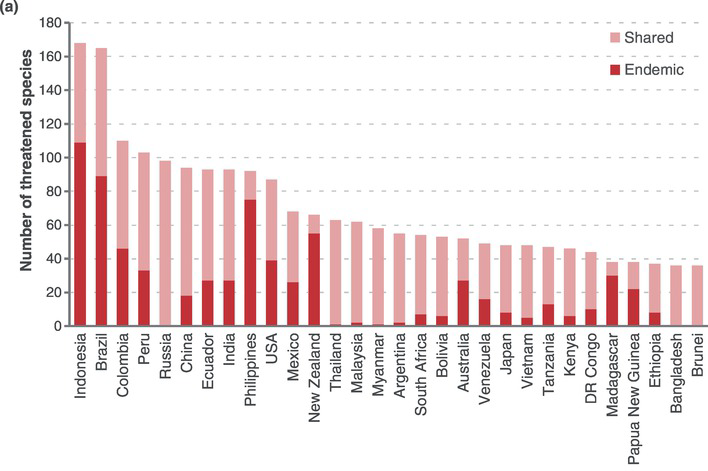
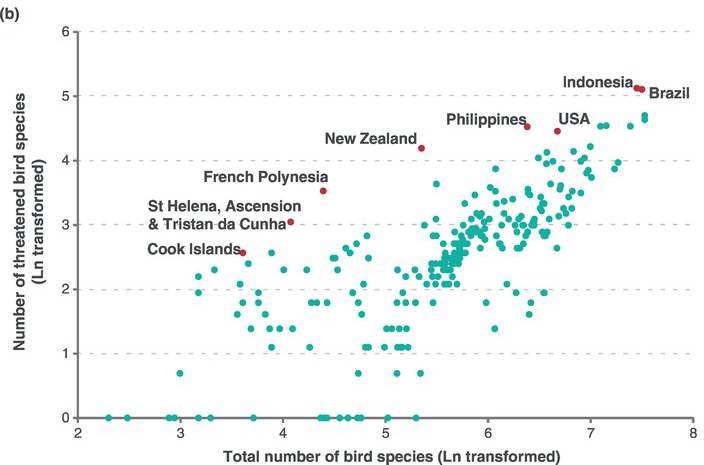
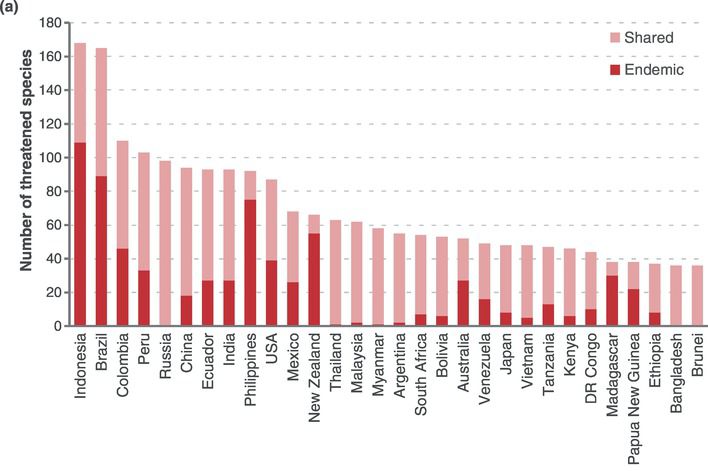
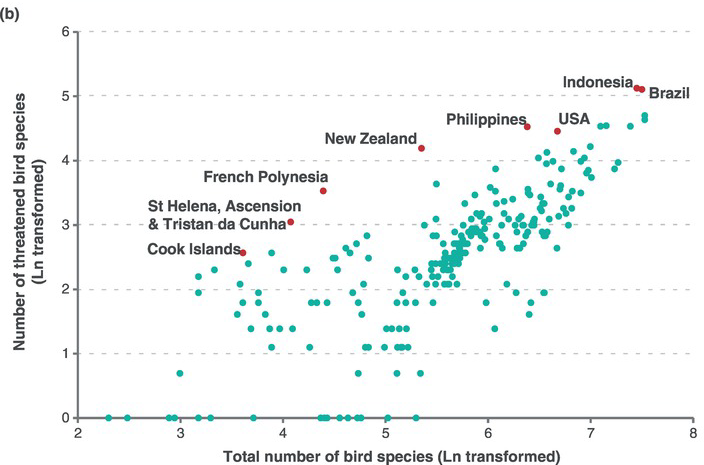
All countries host one or more globally threatened bird species, with particularly high numbers in the tropical Andes, Atlantic Forests of Brazil, eastern Himalayas, eastern Madagascar and insular Southeast Asia. The highest densities of threatened seabird species are found in international waters in the southern oceans, with a particular concentration around New Zealand. Nineteen countries have more than 50 globally threatened birds, with Indonesia and Brazil top of the list, holding 168 and 165 respectively (Figure 6.2a). In total, 975 threatened birds (67%) have breeding ranges confined to just one country, and 88 countries have one or more such endemic threatened birds. Again, Indonesia and Brazil top the list, with 109 and 89 threatened endemics, respectively, while the proportion of threatened species that are endemic is highest in New Zealand (83% of 66 species), the Philippines (82% of 92 species) and Madagascar (79% of 38 species). Conversely, the ranges of some threatened birds may cross the borders of several countries: the European turtle dove Streptopelia turtur VU occurs regularly in 93 countries (and as a vagrant to 20 others) in Europe, Asia and Africa. The avifaunas of some countries are particularly imperilled (Figure 6.2b). These include territories that have highly threatened avifaunas despite relatively low total avian diversity. For example, French Polynesia supports 81 bird species, of which 34 are globally threatened, and the Cook Islands supports 37 species, with 13 globally threatened. Some countries hold far fewer threatened species than expected. For instance, Guyana, Suriname and Congo are all large countries with avifaunas of more than 600 species, yet fortunately few bird species are currently threatened in these countries as they still hold vast tracts of largely pristine forest and host very few restricted-range species.
Even among many of those species that are still relatively widespread and abundant there is cause for concern. Analysis of avifauna, at a range of scales, suggests that between one-third and a half of birds are faring poorly. Three comprehensive assessments of the continental conservation status of all (>500) European bird species have concluded that between 38% and 43% of them are in unfavourable conservation status (Tucker and Heath, Reference Tucker and Heath1994; BirdLife International, 2004, 2017), whilst an assessment of all 1154 native bird species that occur in Canada, the continental United States and Mexico reveal that 37% are of significant conservation concern (North American Bird Conservation Initiative, 2016). Indeed, there are estimated to be three billion fewer birds in North America today than there were in 1970 (Rosenberg et al., Reference Rosenberg, Dokter and Blancher2019). BirdLife’s data indicates that 52% of bird species worldwide with a known trend have declining populations (5393). In contrast, only 6% are increasing (664), whilst 41% are stable (4240).
6.4 Birds Face a Multitude of Threats
The threats driving avian extinction are many and varied, but they are almost invariably of humanity’s making. Most species are impacted by multiple threats and many threats are inter-related. For example, land clearance for agriculture is often preceded by deforestation or wetland drainage. Similarly, many threats act to compound and intensify others: endemic birds in the Hawaiian Islands have already been severely impacted by avian malaria transmitted by introduced mosquitoes, yet climate change is expected to exacerbate the problem still further. At present, mosquitoes are restricted to the lowlands, and the region’s globally threatened forest birds, mainly honeycreepers (Drepanididae), have a malaria-free refuge within cooler, high-elevation forests. However, this refuge is under threat. It is predicted that rising temperature will ultimately enable mosquitoes, and the malaria they carry, to spread to much of the remaining montane forest (Benning et al., Reference Benning, LaPointe, Atkinson and Vitousek2002).
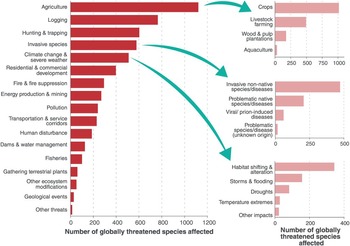
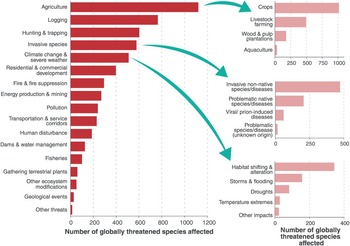
BirdLife systematically evaluates the threats facing globally threatened bird species as part of its work assessing avian extinction risk for the IUCN Red List. This provides a clear insight into the principal drivers of bird declines and extinction. Foremost among them are: agricultural expansion and intensification, which impacts 1120 globally threatened birds (78%), deforestation and logging, affecting 765 species (53%), hunting and trapping, which put 603 (42%) species at risk and invasive alien species, which threaten 578 (40%) species. Climate change, currently affecting 35% of globally threatened species, represents an emerging and increasingly serious threat (Figure 6.3).
6.4.1 Agricultural Expansion and Intensification
The expansion of agriculture, and the resultant habitat destruction, is one of the greatest threats to the world’s avifauna. The area of Earth’s land surface given over to agriculture has increased more than sixfold over the past 300 years, from less than 6% in 1700 to nearly 40% today. Since 1970 there has been a threefold increase in food production. The conversion of natural habitats to farmland is now occurring most rapidly in tropical regions – driven by cattle-ranching and global demand for commodities such as coffee, cocoa, sugar, palm oil and soya. Between 1980 and 2000, 100 million hectares of land conversion to agriculture took place in the tropics, of which half came at the expense of forest. A recent analysis found that more than 100 bird species are predicted to become extinct based on current farming practices, without conservation interventions (Marques et al., Reference Marques, Martins and Kastner2019), the vast majority of these are found in Africa, Latin America and Asia, with projected declines driven by cattle farming, forestry and increasing production of seed oils (including palm oil).
At the same time that natural habitats are being lost to agricultural expansion, formerly wildlife-rich farmland is being transformed through agricultural intensification and industrialisation. The diverse mosaic of crops and semi-natural habitats that once characterised Europe’s traditionally farmed landscapes has been replaced by vast and highly managed monocultures. It is estimated that between 1980 and 2009, 421 million individual birds of 144 common and widespread species vanished from 25 European countries at a rate close to 1% – about 10 million individuals – each and every year (Inger et al., Reference Inger, Gregory and Duffy2014). These losses have been particularly steep for farmland birds, with an overall decline of 60% between 1980 and 2016 (Gregory et al., Reference Gregory, Skorpilova and Butler2019). The impact of increasing agrochemical use is particularly apparent. Researchers in Germany report that flying insect biomass has declined by 76% (and up to 82% in midsummer) over the last 30 years (Hallmann et al., Reference Hallmann, Sorg and Jongejans2017), largely as the result of extensive pesticide use. The decimation of insect populations reverberates through the food web. Recent studies in France reveal the impact on those bird species dependent on insects for food. In less than two decades, declines in bird species are equivalent to one-third of birds disappearing from the French countryside. For some species, the declines are particularly catastrophic. The country’s grey partridge Perdix perdix LC populations have plummeted by 90%, its meadow pipits Anthus pratensis LC by 68% and its Eurasian skylarks LC Alauda arvensis, whose song is synonymous with summer throughout Europe, by 50% (Suivi Temporel des Oiseaux Communs (STOC), 2019). Even where wildlife-rich agricultural land persists, mechanisation can take a toll. Modern olive-picking techniques involving the use of vacuum-harvesting machinery at night are reported to have inadvertently killed millions of roosting birds in the Mediterranean (da Silva and Mata, Reference da Silva and Mata2019). One conservative estimated suggests that some 2.6 million birds may be killed annually in Andalusia, Spain alone (Junta de Andalucia, 2019).
6.4.2 Deforestation and Unsustainable Logging
Nearly two-thirds of bird species globally are found in forests, mainly in the tropics, and many can live nowhere else. Yet more than seven million hectares of forest are destroyed each year, driven by global demand for timber, paper and land for commodity crops and biofuels. Between 1990 and 2015, 290 million hectares of native forest cover was lost due to clearing and wood harvesting (IPBES, Reference Brondizio, Settele, Díaz and Ngo2019). Much of what remains is subject to unsustainable and unlawful forestry practices, with some 10–15% of global timber supplies being provided through illegal forestry. Selective logging degrades standing forests and almost always impoverishes bird communities. Although overall bird species richness can increase following selective logging, due to the influx of habitat generalists, the diversity of forest specialists typically dwindles. Logging activity also facilitates further disturbance, including encroachment and increased hunting pressure, which can have greater and more lasting impacts than the logging itself. For example, forest ecosystems compromised by selective logging are more susceptible than intact forests to devastating fires. Tropical deforestation also affects the world’s climate, accounting for 8% of all human-induced greenhouse gas emissions every year (Seymour and Busch, Reference Seymour and Busch2016). Indeed, if tropical deforestation were a country, it would rank third in emissions only behind China and the United States.
Deforestation and unsustainable forestry is particularly rampant in South America, South and Southeast Asia, and sub-Saharan Africa. For instance, in parts of Southeast Asia, there is now so little primary forest left that many forests will be logged for the second or third time in the near future. This is especially concerning as these regions support considerable numbers of forest-dependent bird species, including forest specialists that are entirely reliant on intact forest for their survival.
6.4.3 Overexploitation
Hunting for food or sport and trapping for the cage-bird trade has been implicated in the extinction of dozens of bird species and remains a significant and growing threat today. Overexploitation is a particular problem for some bird families, including parrots, pigeons and pheasants, and is most prevalent in Southeast Asia where more than 1000 species are traded for pets, food or traditional medicine. Songbird-keeping is a deeply entrenched pastime in many parts of the region, especially in Indonesia, the largest importer and exporter of wild birds in Asia (Nash, Reference Nash1993). A recent survey of the bird-keeping habits of households across Java, Indonesia resulted in an estimate that one-third of the Island’s 36 million households keep between 66 and 84 million cage birds (Marshall et al., Reference Marshall, Collar and Lees2019). Despite over half of all birds owned being non-native species, predominantly lovebirds (Agapornis spp.) and island canaries Serinus canaria (var. domestica), there were also huge numbers of some native songbirds, including more than three million white-rumped shamas Kittacincla malabarica LC and over two million Oriental magpie-robins Copsychus saularis LC. Of all (112) species kept, around 12% are listed as globally threatened or Near Threatened. The bird trade is now recognised as the primary threat to many of the region’s species. In 2016, BirdLife uplisted 19 Indonesian songbirds to higher threat categories, including six to Critically Endangered. Some, such as the greater green leafbird Chloropsis sonnerati (now EN) were until recently common across the country’s forests. Others, such as rufous-fronted laughingthrush Garrulax rufifrons, have gone from Near Threatened to Critically Endangered in an alarmingly short time and are now on the brink of extinction. The problem is not confined to songbirds. In 2015, the helmeted hornbill Rhinoplax vigil was uplisted from Near Threatened to Critically Endangered. As well as severe loss of its Southeast Asian forest habitat, the species is targeted by hunters for its feathers and for its solid casque, known as ‘red ivory’, which is illegally traded with China to produce handicrafts.
Illegal hunting remains a major threat to birds across the Mediterranean, Northern and Central Europe, and the Caucasus. Indeed, a staggering 12–38 million individual birds are estimated to be killed or taken illegally every year in the region, many of them on migration (Brochet et al., Reference Brochet, Van Den Bossche and Jbour2016, Reference Brochet, Van Den Bossche and Jones2019). The majority of birds killed are passerines, including 4.7 million house/Italian sparrows Passer domesticus/italiae LC, 2.9 million common chaffinches Fringilla coelebs LC and 1.9 million Eurasian blackcaps Sylvia atricapilla LC. Italy, with 5.6 million birds illegally killed per year, and Egypt, with 5.5 million killed per year, are the countries with the highest death tolls, but, in terms of killing intensity, Malta, with 343 birds killed per km2 per year, is the most deadly, followed by Cyprus and Lebanon (both with 248 birds killed per km2 per year; Figure 6.4). For some species, such as the ortolan bunting Emberiza hortulana LC, illegal and unregulated hunting is driving local populations to extinction (Jiguet et al., Reference Jiguet, Robert and Lorrillière2019). In addition to those birds killed illegally, there is considerable legal hunting. At least 52 million birds are lawfully killed, from 82 permissible quarry species, in the European Union (Hirschfeld et al., Reference Hirschfeld, Attard and Scott2019). This includes a number of declining and globally threatened species such as the European turtle dove Streptopelia turtur VU, the common pochard Aythya ferina VU and the velvet scoter Melanitta fusca VU.

Large numbers of birds are also killed unintentionally. These include hundreds of thousands of seabirds caught as incidental ‘bycatch’ in fishing gear. Commercial fisheries have expanded dramatically since the 1960s, both geographically and in their intensity. Gillnet fisheries use a ‘curtain’ of netting that hangs in the water to catch fish around the gills. They are responsible for over 400,000 seabird deaths each year, mostly of coastal and diving species (Zydelis et al., Reference Žydelis, Small and French2013). Longline fisheries are those that trail lines of baited hooks behind a fishing vessel. Globally, they are thought to cause over 160,000 seabird deaths annually, mostly of albatross and petrel species (Anderson et al., Reference Anderson, Small and Croxall2011). Trawl fisheries, in which one or two boats pull large nets through the water behind them, cause tens of thousands of seabird deaths each year, typically through collision with the warp cables, or during the setting and hauling of the nets.
6.4.4 Invasive Alien Species
Humans have been transporting animals and plants around the world for thousands of years, sometimes intentionally, as with livestock and companion animals, and sometimes accidentally, as with rats and mice that have stowed away on boats. Typically, introduced species fail to establish themselves in the wild in new locations, but, a proportion thrive and spread. Such ‘invasive alien species’ can have catastrophic impacts on ecosystems by outcompeting or predating native wildlife, or by modifying their habitat. Over the last 500 years, invasive alien species have been partly or wholly responsible for the extinction of at least 111 bird species, 69% of those known to have gone extinct, making this the most common factor contributing to recent bird extinctions.
As many as 17,000 different organisms have been documented as being established outside their natural geographical ranges as the result of human activity (Seebens et al., Reference Seebens, Blackburn and Dyer2017). For birds, the greatest risk comes from introduced mammalian predators, which often target chicks and eggs. Rats and cats have had by far the greatest effect, threatening the survival of hundreds of bird species worldwide. Many threatened birds are subject to multiple impacts from a range of non-native species. One such example is the Galápagos petrel Pterodroma phaeopygia CR, which has undergone an extremely rapid decline since the early 1980s, owing to a variety of threats, including predation by introduced rats, cats and dogs, and the destruction of breeding habitat by introduced goats and cattle. Birds on remote islands are particularly susceptible to invasive alien species: 70% of globally threatened species on oceanic islands are affected by invasives, compared with 24% on continental islands (islands geologically related to a continental shelf) and just 13% on continental landmasses. A total of 390 islands worldwide support populations of one or more Critically Endangered or Endangered bird species and one or more vertebrate invasive alien species that threatens them.
6.4.5 Climate Change
The climate of our planet is changing as a direct result of human activities, mainly the burning of fossil fuels. In the longer term, this could present the greatest challenge to the future of birds, and indeed all life. Already, many bird species are struggling to adapt to the pace of climatic changes. Rising temperatures are driving species’ distributions towards the poles and towards higher ground. Migratory and breeding cycles are changing, leading to disrupted relationships with prey, predators and competitors. In many cases, these effects have driven population declines. One recent analysis suggests that more than a fifth of globally threatened birds may have already been negatively impacted by climate change in at least part of their range (Pacifici et al., Reference Pacifici, Visconti and Butchart2017). Of those species negatively affected, declines in abundance and range size are the most common impacts. For instance, in Canada, warmer autumns have been linked to reduced breeding success in the grey jay Perisoreus canadensis LC, most likely due to increased perishing of hoarded food (Waite and Strickland, Reference Waite and Strickland2006).
More damaging than the direct impacts of rising temperatures is the disruption caused to ecological interactions, particularly through phenological mismatches. As European spring temperatures have risen, migratory common cuckoos Cuculus canorus LC returning from sub-Saharan Africa have increasingly found their host species already breeding, thus reducing their options for finding suitable nests to parasitise (Møller et al., Reference Møller, Saino and Adamík2010). Baird’s sandpipers Calidris bairdii LC, breeding in the high Arctic, time the hatching of their chicks to coincide with the peak emergence of insect prey. However, increasing temperatures have meant that insects now peak in abundance earlier. Sandpiper chicks raised outside the period of peak food availability grow significantly more slowly and are likely to have reduced survival and recruitment (McKinnon et al., Reference McKinnon, Picotin, Bolduc, Juillet and Bêty2012).
As warming continues, negative impacts will multiply and intensify. While some species may benefit from rising temperatures, it is likely that more than twice as many species will lose out. Generalist species are typically likely to increase in population and range, while specialist species are expected to decline. Results from studies around the world show that, on average, species are projected to face 10–30% declines in their geographic range sizes, with 30–70% of their current distributions projected to become unsuitable by the end of the century. In North America, modelling shows that 53% of species are projected to lose more than half of their current geographic range by the century’s end (Langham et al., Reference Langham, Schuetz, Distler, Soykan and Wilsey2015). While some may have the potential to colonise new areas, for 40% of these species, loss occurs without associated range expansion. Based on these results, the authors classify one-fifth of North American species as ‘climate endangered’, and another third as ‘climate threatened’.
Species on low-lying islands are particularly vulnerable to sea-level rise. In Oceania, seven species are entirely restricted to islands with a maximum elevation of <10 m, including the Polynesian ground dove Alopecoenas erythropterus CR, meaning that coastal flooding could have a devastating impact. Sea-level rise will also impact seabirds. For example, in Midway Atoll, Hawaii, a sea-level rise of 2 m would flood approximately 60% of albatross (Laysan Phoebastria immutabilis NT and black-footed P. nigripes NT) and 44% of Bonin petrel Pterodroma hypoleuca LC nests, displacing more than 600,000 breeding birds (Reynolds et al., Reference Reynolds, Courtot and Berkowitz2015). Extreme weather events are projected to increase in intensity and frequency, which will likely have negative impacts on many species. When Hurricane Matthew swept through the Caribbean in 2016, it devastated the Bahamas’ native pine forest, raising concerns as to whether the endemic Bahama nuthatch Sitta insularis CR had survived. Exhaustive searches suggest there may be as few as two individuals left. With Hurricane Dorian, the strongest tropical cyclone ever to strike the area, hitting in September 2019, the chances that this species has become the planet’s most recent avian extinction are high.
6.5 All is Not Lost: How Conservation Successes Reveal Ways to End the Extinction Crisis
Many dozens of bird species would have been lost were it not for the concerted efforts of dedicated conservation practitioners. Species such as the Lear’s macaw Anodorhynchus leari EN, the California condor Gymnogyps californianus CR and the Asian crested ibis Nipponia nippon EN undoubtedly owe their continued existence to the dedication and ingenuity of conservationists. Just this century, 26 species have been brought back from the brink of extinction, in so much as they have been downlisted from Critically Endangered to a lower category due to conservation action (Figure 6.5). In additional, there are many more Critically Endangered species that, although they have not yet recovered sufficiently to warrant downlisting, would have deteriorated further and perhaps even vanished altogether were it not for conservation.
Thirty bird species have been downlisted from Critically Endangered since 2000 due to conservation action.

Most of these species have been the beneficiaries of targeted recovery plans. For example, the Azores bullfinch Pyrrhula murina or priolo – once Europe’s most threatened songbird – has undergone an impressive reversal of fortune thanks to dedicated conservation action led by the Portuguese Society for the Study of Birds (SPEA, BirdLife in Portugal). After decades of decline, which saw the population fall to perhaps as few as 40 pairs, the species is now bouncing back thanks to the restoration of over 300 hectares of native laurel forest through the removal of alien species and the establishment of native plants. As a result, the Azores bullfinch was downlisted from Critically Endangered to Endangered in 2010. Work is now underway to reconnect isolated forest patches to create one large contiguous habitat. The population is now stable at around 1000 individuals. In the 2016 Red List, the species was downlisted for the second time in under a decade – this time to Vulnerable.
In the 1960s, the Seychelles warbler Acrocephalus sechellensis was one of the rarest birds on Earth, reduced to a single population on the tiny (0.3 km2) island of Cousin. The island, then a private coconut plantation, was divested of much of its natural vegetation and the prospects for the warbler were bleak. In 1968, with only 26 birds remaining, the ICBP (BirdLife’s forerunner) purchased Cousin and so began the species’ long road to recovery. Today, through the work of Nature Seychelles (BirdLife in the Seychelles) and others, Cousin Island is once more a functioning natural ecosystem with a population of over 300 Seychelles warblers. In addition, the species has been translocated to four neighbouring islands where it formerly occurred. The total population is now likely to exceed 2500 birds. In 2015, the species was reclassified as Near Threatened. Similarly impressive recoveries have been achieved for a number of the Seychelles’ other endemic birds, including the Seychelles white-eye Zosterops modestus VU and the Seychelles magpie-robin Copsychus sechellarum. The latter originally occurred on numerous islands in the Seychelles, but by 1965 just 12–15 individuals remained on the island of Frégate and the species seemed destined for extinction. Thankfully, a recovery programme has seen the species translocated to additional islands, and, in 2005, the species was downlisted from Critically Endangered to Endangered. As of 2015, the total population numbered 283 birds across five islands. Although still highly imperilled, the Seychelles magpie-robin would have certainly already been lost were it not for the intervention of conservationists.
On Mauritius, several bird species also owe their existence to the actions of conservationists; indeed no other country has averted more avian extinctions. Much of the credit resides with one man, Carl Jones, a Welsh conservation biologist who started working in Mauritius in 1979. Jones has led five successful recovery programmes, where the starting population has numbered only a handful of individuals: Mauritius kestrel Falco punctatus EN, echo parakeet Psittacula eques VU, pink pigeon Nesoenas mayeri VU, Rodrigues warbler Acrocephalus rodericanus NT and Rodrigues fody Foudia flavicans NT. The recovery of the Mauritius kestrel is perhaps the most spectacular, having started from just four wild birds (including one breeding pair) in 1974. Persistence, ingenuity and the insight gained through endless hours intimately observing the species enabled Jones to pioneer techniques in captive breeding and release such that by the end of the 1990s several hundred kestrels were living wild across the island.
Many of the birds saved from extinction over recent decades have had small populations and limited ranges, indeed, many are confined to tiny, remote islands. In such circumstances, conservation practitioners are often able to intervene at a population level and manipulate population-limiting factors, such as invasive alien species or habitat quality, within a restricted and relatively closed system. Scaling up conservation interventions to revive the futures of more widely distributed species can prove challenging, but can be achieved. The black-faced spoonbill Platalea minor EN is widely but sporadically distributed throughout coastal areas of eastern Asia. The species breeds on offshore islets in the Yellow Sea at sites in China and the Korean peninsula and winters discontinuously from Japan south to the Red River delta in Vietnam, with additional major wintering congregations in Taiwan, Hong Kong, Macau and mainland China. The pressures on coastal habitats in this part of the world are enormous – rapid economic development has driven widespread wetland loss. In addition, agricultural and industrial development creates pollution, and periodic outbreaks of botulism have inflicted a significant toll on the population. Effective conservation therefore requires collaboration, galvanising conservation action across a large area and across national borders. An action plan was published, and there have been a number of workshops involving all major range countries. In 2013, a Black-faced Spoonbill Working Group was set up under the auspices of the East Asia-Australasian Flyway Partnership with the aim to facilitate and promote international collaboration in the species’ conservation. Awareness campaigns have helped raise the profile of the species and it is now subject to an annual census of its wintering population. Most significantly, the main breeding and wintering sites have been designated as protected areas. From a low of fewer than 300 individuals in the late 1980s, the species has undergone a steady recovery. The most recent census took place in January 2019. Over 100 wintering sites were surveyed, with a total of 4463 individuals recorded. This is the highest figure yet and a 13% increase on the previous year.
Conservation measures targeted at individual species have resulted in some remarkable successes, and typically delivered wider ecological benefits, such as habitat restoration, yet ultimately the greatest impact is achieved through conservation measures that benefit suites of species and indeed entire habitats and landscapes. The principal mechanism for securing wildlife-rich landscapes is protected area designation. Since Yellowstone National Park became the world’s first major protected area in 1872, roughly 215,000 further reserves, parks and sanctuaries have been formally gazetted. The World Commission on Protected Areas (WCPA), part of the International Union for Conservation of Nature (IUCN), recognises a range of protected area types, ranging from strict nature reserves and wilderness areas, in which human intrusion is strictly controlled, through to areas created and maintained through human activity but where nature thrives. Many protected areas have been formally designated for their importance for birds, and the BirdLife Partnership manages over four million hectares of reserves globally. In the European Union, Member States are obliged under the EU Birds Directive to identify Special Protection Areas (SPAs) for the protection of threatened, rare and vulnerable birds, as well as for regularly occurring migratory species. Currently, over 840,000 km2 of the European Union are protected in this way.
Today, around 15% of the land and 7% of the sea is designated as protected areas globally. Despite this, many areas with rich, endemic or threatened avifaunas remain unprotected. BirdLife has comprehensively identified those sites globally that are significant for the persistence of avian diversity. Using standardised, objective and internationally agreed criteria, it has identified over 13,000 Important Bird and Biodiversity Areas (IBAs) in virtually all of the world’s countries and territories, both on land and at sea. Unfortunately, of these sites, 80% are inadequately covered by protected areas and one-third are entirely unprotected. Some IBAs are the only places left on Earth where a highly threatened species can be found. Alarmingly, of the 127 such IBAs, only 26 are completely protected.
Many of the problems facing birds may seem intractable, involving, as they do, often widespread and deep-rooted threats. Yet recent successes in tackling illegal hunting and fisheries bycatch demonstrate huge progress that can be achieved when there is adequate resourcing and political will. For instance, conservationists, in collaboration with the Cypriot authorities and the British military police, have instigated a surveillance programme that is starting to turn the tide on illegal bird trapping on Cyprus. For decades, Cyprus has been an epicentre of illegal bird-trapping. Songbirds, principally Eurasian blackcaps Sylvia atricapilla LC, are trapped on an industrial scale to be sold illicitly in restaurants as a local delicacy called ‘ambelopoulia’, where a dozen birds can sell for 100 Euros. The trapping, using mistnets and limesticks, is indiscriminate, with unwanted species killed and discarded. Despite being illegal since 1974, the number of birds caught has been on the rise in recent years. Much of the trapping occurs at one of the island’s two UK military Sovereign Base Areas: Dhekelia. In autumn 2016, over 880,000 songbirds were trapped on the Dhekelia base. That year, the covert surveillance operation began, and since then more than 20 trappers have been caught and prosecuted, with the Cypriot courts imposing heavy sentences and fines. The latest survey at Dhekelia SBA in autumn 2018 revealed that the number of songbirds trapped had dropped to 121,000 – an 87% reduction in two years.
Notable progress has been made in recent years in reducing the harmful impact of fisheries bycatch on seabirds. In 2005, BirdLife International and the RSPB (BirdLife in the UK) launched the Albatross Task Force, an international team of seabird conservationists tasked with reducing albatross and petrel bycatch in targeted fisheries around the world. Albatross Task Force members embed themselves in regional fisheries, work with government and industry to improve regulations and team up directly with fishermen, providing advice on simple and inexpensive techniques that prevent unintentional seabird deaths. These measures include introducing bird-scaring lines (also known as tori lines) to keep birds away from baited hooks and trawl cables, adding weights to longlines so that the baited hooks sink faster with less opportunity for seabirds to get caught, and encouraging fishing at night when seabirds are less active. One innovative solution has been the ‘Hookpod’, a device that ensures that the barb of a baited longline hook remains encased in a polycarbonate capsule during line-setting and is only released at a predetermined depth of 10 m, beyond the reach of diving seabirds. The Hookpod has been shown to radically reduce seabird mortality without affecting the catch rate of target fish species (Sullivan et al., Reference Sullivan, Kibel and Kibel2018). By promoting this range of at-sea mitigation measures, the Albatross Task Force has demonstrated that it is possible to reduce seabird bycatch drastically, typically by as much as 85% and often over 90%. Indeed, in South Africa, albatross bycatch in the hake demersal trawl fleet was reduced by 99% over six years. In Chile, modifying the nets used in the purse-seine fleet reduced bycatch by 98%, and trials in Peru have shown that net lights show promise in reducing seabird bycatch in gillnet fisheries. Following sustained work by the Albatross Task Force, Argentina and Chile have recently announced new seabird bycatch regulations, which are set to save over 10,000 black-browed albatrosses Thalassarche melanophris LC in one Argentinean fishery alone.
Examples like those above demonstrate that solutions can be found to the threats facing the world’s birds and to nature more widely. However, to end the extinction crisis we must scale up our conservation response. We must implement existing action plans for threatened species swiftly and comprehensively, especially for highly threatened groups such as vultures, and develop and implement new plans as needed. We must introduce measures to restrict the further spread of invasive alien species, and eradicate or control those that are having a detrimental effect on threatened species and important seabird colonies. We must ensure that IBAs are formally protected and effectively managed and go further by restoring and reconnecting wider degraded landscapes, especially in the forested tropics. We must adopt agricultural practices that adequately and equitably feed the world’s population, but that are also environmentally sustainable by avoiding farming practices that are resource- and carbon-intensive, limiting the use of harmful pesticides and reducing food waste. We must eliminate the illegal and unsustainable hunting and trade of birds, especially in Southeast Asia, and ensure that effective seabird bycatch mitigation measures are rolled out across all fisheries. We must tackle climate change by ending our dependency on fossil fuels and switching to clean energy sources, and help bird species to adapt to the climate change to which we are already committed. Ultimately, to achieve this, we must ensure that global investment in conservation is commensurate with the scale of the problem.
Building on data for birds, a study led by BirdLife and the RSPB (BirdLife in the UK) calculated the annual investment needed not just to prevent avian extinctions, but to avoid extinctions of all known threatened species and to protect and manage all sites of importance for nature (McCarthy et al., Reference McCarthy, Donald and Scharlemann2012). The study surveyed 236 experts in bird conservation to ascertain the financial investment needed to improve the conservation status of 211 highly threatened species. The results were modelled to allow extrapolation to all threatened bird species. This provided an estimated annual investment of roughly US$1 billion needed to halt human-driven bird extinction and improve the IUCN Red List status of all threatened bird species. Using data on how the resources needed to conserve birds compare with those required for other taxa, the authors then estimated the annual cost of preventing the extinction of all known globally threatened animals and plants at around US$4 billion. Data on the management costs of safeguarding Important Bird Areas, as well as estimates of land-purchase costs globally, allowed the authors to estimate the cost of adequately protecting and managing all terrestrial sites of global conservation significance at approximately US$76 billion per year.
Put simply, an annual investment of around US$80 billion would safeguard nature and end the extinction crisis. To put this in perspective, this is less than is spent globally each year on pet food and roughly the same as that spent by Americans annually on lottery tickets. When compared with the overall value of the global economy, estimated at $80 trillion, it is a truly trivial figure. Spending just 0.1% of global GDP on wildlife conservation would not only prevent the extinction of an estimated one million life forms, but also safeguard the natural processes on which all life depends and which underpin every aspect of human existence.