


In a comparison of professions, it is clear that health has universality over other disciplines. Although often mired in the political technicalities that easily frustrate, we must all remember Sir William Osler's 1906 declaration that “Medicine is the only world-wide profession, following everywhere the same methods, actuated by the same ambitions, and pursuing the same ends. The homogeneity, its most characteristic feature, is not shared by the law, and not by the Church, certainly not in the same degree.”Reference Osler 1 Osler does not include responsibility to humanity, but it is implied. We may indeed have greater duty when it comes to health of nations and major crises than our professional counterparts; it is a calling we can neither deny nor relinquish.
Various kinds of multiple crises over this past half century have become, in themselves, prophetic indicators of why major change in the study and practice of crisis care has necessarily evolved and modified. Not too long ago, what was once a distant conceptual study of disaster/crisis science is today experiencing a major trend toward professionalizing into a unique and separate discipline, a movement many consider an essential ingredient for global public health security. The world has moved from passively accepting the inevitable, although still an unforgiveable reality in many developing countries, to the presumption of disaster-proof societies in the most advanced of nations.
The prospects for managing and researching major crises are exciting, largely when this area may be the one in which the global community can find common accord. Those of my generation all too often couched the response to crises outside our borders as part of international health, a somewhat pejorative term that disparagingly emphasized the differentiation between them and us that existed between the have and have not nations. Today, global health is widely studied as a shared concern of all nations. Complementing the current statistics that show a remarkable 6% annual growth rate in those seeking global health careers is that the younger generation ideally view themselves less as national assets and more as global citizens who are equally attentive to advocacy and policy issues of why and not just the operational how.
Historical Perspectives
The decade before my 1984 textbook Disaster Medicine was published,Reference Burkle, Sanner and Wolcott 2 I gathered research and advice from experts on the direction the content of the text should take. Peer-reviewed studies were almost nonexistent and, when available, were primarily war related, descriptive, and anecdotal. At this time, a nation's response to disastrous events was very much focused on advanced trauma surgery and triage.
Most visible and audible proponents were well-respected military medicine specialists eager to see these advances, honed through the battlefield crucibles of World War II, the Korean War, and Viet Nam, be embraced by the civilian health sector. Unforeseen was a highly vocal element among lay experts and a few academics who passionately appealed to me to abandon all studies on “naturally occurring” disaster interventions, asserting that disasters represent acts of God not to be interfered with.
I played it safe and used an acceptable theme: immediate management and triage of civilian and military disaster victims, although admittedly one prescient chapter dealt with field sanitation and public health interventions.Reference Burkle, Sanner and Wolcott 2 In spite of that shaky and somewhat regrettable beginning, 3 decades later, readers can choose among some of the most eclectic crisis care volumes available, all prominently focused on public health emergencies. Much has changed.
Throughout those ensuing decades, the still popular “been there, done that” reports were slowly replaced by more data driven and epidemiologically based analytic tools to improve health in crises. However, this burgeoning knowledge base remained stuck within an assortment of health and nonhealth specialties. Without benefit of a dedicated disaster-specific journal, these nascent evidence-based foundations were widely scattered in hundreds of different specialty journals, with a significant number in mental health. The surgical leadership, convinced that poorly managed trauma was the major culprit of poor health outcomes in crises, strongly advocated for the development of courses on basic and advanced trauma life support that positively contributed to setting expectations for quality management and standards of care; their influence sparked like-minded courses of instruction in nonsurgical disciplines during the ensuing years.
Over time, ownership of disaster priorities was increasingly shared with the new specialty of emergency medicine, the prehospital care community, and emergency management at state, regional, and national levels, all concepts that have spread globally. Concurrent technological advances and landmark efforts by the National Library of Medicine provided the tools to effectively search and mine the diverse key peer-reviewed and gray literature studies of disasters and helped define more clearly that the study of disaster/crisis science differs from other disciplines in that, uniquely, it is at once both multi- and transdisciplinary.
In the post-Cold War 1990s, the severe humanitarian crises that proliferated throughout the developing world both redefined and widened the scope of crisis care in health and management. Modern conflicts and warfare became epidemiological laboratories in which one could witness firsthand how quickly unexpected challenges, besides violence, gained dominance and rapidly expunged what sacrosanct infrastructure protections civilizations had built for their citizens throughout the previous centuries. In prolonged crises, it was observed that the direct consequences, primarily trauma-related mortality and morbidity, were often subsumed in a short time by indirect public health infrastructure failures of water, sanitation, food, shelter, health access/availability, and/or energy. These consequences resulted in overwhelming death rates and disease burdens from vaccine-preventable outbreaks of infectious disease, severe malnutrition, exposure, mental health crises, and various causes of dire health effects from forced migrations.
Studies confirmed these outcomes as a predictable pattern of all wars, especially those that ravaged Africa in the latter part of the 20th century. Of the millions of deaths that occurred in Sudan, Eritrea and Ethiopia, the Democratic Republic of Congo, and Somalia, the percentage of all battle deaths of total war deaths rarely ranged beyond 2% to 8%.Reference Guha-Sapir, van Panhuis, Degomme and Teran 3 Health-focused nongovernmental organizations (NGOs) from the developed world that adopted established Geneva Convention humanitarian principles (humanity, neutrality, impartiality, and independence) followed in the mold of the wartime International Committee of the Red Cross field hospitals, providing health assets that greatly expanded the pool of foreign medical teams (FMTs). Unfortunately, providers were too often unprepared to handle the emerging major public health and chronic disease challenges.
In the early days, few researchers studied the emerging major public health challenges and fewer still stayed to recover and rehabilitate the destructive consequences. Attention to domestic crises in many countries led to the development of top-down strategic and tactical level planning frameworks that were based on popular Western models. These frameworks have been valuable in management at the highest level. While these systems performed well for the traditional geographically-contained disaster events, the widespread 2003 severe acute respiratory syndrome (SARS) pandemic exposed major, previously unknown deficiencies at the local level. Authors emphasized that virtually all health care operations, including public health, were undertaken only at the local or regional level. However, a “local establishment of a flexible and sustainable emergency management system” was lacking.Reference Johnson, Bone and Predy 4 This revelation prompted a major shift of responsibility, expertise, knowledge-base, and review of the capacity of the entire disaster cycle (ie, prevention, preparedness, response, recovery) beyond the response phase alone. Today, disaster risk reduction is crucial at the community level, especially in countries such as Australia, where the “prepared community” concept recognizes the discreet and unique aspects of every community.Reference Rogers 5
In the 21st century, the declared cross-border wars of the late 20th century have been replaced by highly convoluted and politically charged nondeclared unconventional warfare, social media-driven revolts of nation states, the rise of nonstate actors and terrorist groups, and increased incidents of organized armed violence fought not on ideological principles but on greed over rare earth resources.Reference Burkle, Martone and Greenough 6 Currently, half of the United Nations peacekeeping forces are deployed to situations in which control over these natural resources plays an active role in the local and often expanding conflict (eg, the second Congo War) and the weapons trade is a major industry in densely crowded and epidemiologically vacant urban conclaves.Reference Burkle, Martone and Greenough 6 For these reasons the US military now has outposts, deployments, and security cooperation agreements in every African country.Reference Turse 7
In the coming decades, acute-on-chronic crises brought about by rapid unsustainable urbanization, extreme climate change and severity of natural disasters, major biodiversity crises, and “emergencies of scarcity”Reference Evans 8 in populations lacking adequate water, food, and energy will likely evolve, causing multiple distributional conflicts or conflicts short of war.Reference Burkle 9 These emerging crises, along with unprecedented numbers of environmental refugees, will contribute to the major displacements of international populations already seen today in the Middle East, Asia, and Africa. The health care workers grappling with the Syrian level 3 emergency that has enveloped Turkey, Jordan, Iraq, and Lebanon, where safe water and sanitation are a dire priority, are well aware that the almost 2 million displaced people they serve may not return to Syria in the foreseeable future. Such aid and assistance are not indefinitely sustainable.
Health care workers, always challenged, can be understandably overwhelmed by daily circumstances that increase their personal risk, the increasing complexities of the organizational structure of assistance, the fraught influences of political and religious fervor, and the vast health care needs too frequently complicated by layered variables of severe poverty and malnutrition.
We entered the 20th century with more than 6000 cultures. While some have disappeared through natural assimilation many others were savagely eliminated through war, suggesting that in this century less than 600 cultures will remain. How many might scatter as forced environmental refugees is unknown but worrisome.
Cultures have survived over the centuries because they brought to the world public health measures that protected and ensured human security.Reference Burkle 10 This legacy raises the question whether the sudden loss of a culture from crises should be addressed as both a strategic and security issue for human kind. The current use of warfare ecologists who attempt to recover lost biodiversity areas following war (eg, Iraq) would support this conviction.Reference Machlis and Hanson 11 Unfortunately, many fledgling nations that had positive feelings about potential collaborative crisis management benefits associated with globalization before 9/11 retreated from that stance after that day to protect national sovereignty. The wars that followed skewed the thinking among many nations; they feared an emerging pattern in which Western aid was too often associated with military intervention, then war and eventual loss of their cultural identity and heritage. This distrust came at a time when many health experts in those same countries saw great advantages in joining, not retreating from, innovative and collaborative global health and crisis prevention initiatives.
Research In Disaster/Crisis Science
Most encouraging today is a palpable groundswell of valuable research on disasters and global health crises primarily published in peer-reviewed journals with disaster medicine, public health, or global health appearing somewhere in their title or tag line. Most favored studies in global health have been collaborative works across disciplines and international campuses. Malcolm MacLachlan's defining paper on global health research as a “composite” field has proved authentic, broadening opportunities for an ever-widening multidisciplinary audience.Reference MacLachlan 12 While we may claim ease with ‘trespassing professional boundaries’ in hopes of benefitting a common good, the generational reality has suggested this yearning is easier said than done. However, we should be buoyed by the fact that the human talent eagerly entering crisis care and global health research today has found MacLachlan's prescription both compelling and indispensable.
The many critical research demands ahead of us today range from Koenig's focus on clarifying a disaster lexicon that recognizes functional impact, not simple descriptors,Reference Koenig 13 to the most effective applications of information and communication technologies in managing effective response, to the integration of population data into geospatial analyses, to specific and universal data documentation and measures of effectiveness on impact. Other issues, many with political ramifications, deserve equal deliberation and discussion. Most critical is whether providers unquestionably consider health as a human right, as opposed to something that first must be earned in the context of postcrisis health care.
In a sample of attendees at my lectures on health diplomacy, I asked students for a show of hands on this issue. Attendees grounded in the humanitarian principles were perplexed to learn that they might be working beside military or governmental caretakers who might not acknowledge the same principles in their mandates but would rather adopt and defend the latter philosophy. As a major planning issue (and one that became contentious in the health care of Iraqi civilians), we cannot wait until a crisis deployment to mediate these differences.
A cause célèbre of many of today's researchers, and not worth consideration in the past, is the attention given to noncommunicable diseases (NCDs) that universally intensify during disasters as major and preventable sources of mortality and morbidity. Health security issues are increasingly being defined through health indicator decline. The urban epidemiologic transition to a greater burden of NCDs such as obesity, types 1 and 2 diabetes, hypertension and cardiovascular disease, cancer, stroke, and kidney failure with doubling of the number of patients on dialysis have engulfed emerging economies.Reference Reaves, Termini and Burkle 14 This issue alone speaks volumes to the direction many coastal areas of the world will take over the coming decades. The Pacific island nation of Kiribati, for example, has an urban population density equal to that of London but lacks safe water, sanitation, and suffers an infant mortality rate twice that of other Southeast Asian countries. 15 The plight of the Pacific Islands serves as an allegorical canary in the coal mine for transitioning nations.
In the late 1990s and throughout the next decade, efforts to train responders in operational public health were established in major schools of public health and through individual courses, degree programs, and Sphere Project standards training; these were eyed by NGO and United Nation (UN) agencies as prerequisite for deployment. Humanitarian tracks within North American and European schools of public health have evolved to incorporate academic approaches to public health in crisis not only as components of their global health curricula but as a specific research focus, providing field research capacity to NGOs and UN operational agencies.
The Professionalization Movement
My abbreviated historical and research view is a very diluted example of how the science of disasters and major crises, as experienced by the world's populations, has been forced to change in a matter of several decades. Whereas declared wars are at their lowest point than at any time in the 20th century, the number of people reporting that they live under a cloud of violence or fear from multiple threats from nature and other people is the highest ever.Reference Garfield, Polonsky and Burkle 16 While the science is better understood, the proper attention to these crises remains too often unsettled, disjointed, and inadequate.
One major failure has been the mismatching of resources across the entire disaster cycle such that prevention and preparedness have been consistently shortchanged. Another has been concerns over the inadequacy of global organizational capacities and capabilities. Although this inadequacy has generated groundswells of calls for attention through the years, the 2010 earthquake in Haiti and floods in Pakistan represented a nadir in which operational debacles drew well-deserved ire from international organizations. The UN's Office for the Coordination of Humanitarian Affairs, the World Health Organization (WHO), its regional Pan American Health Organization, and the Inter-Agency Standing Committee's Global Health Cluster met in Cuba in December 2010 demanding that actions be taken for better “coordination, accountability, transparency, stringent oversight and control, and professionalism” during and after every major crisis. 17 Health providers were not immune from criticism. Persistent questions about clinical competencies of providers and reports of unacceptable practices were raised as were the limited scope of guidelines for FMTs. 18 These observations, while a long time coming, were most welcomed and further catalyzed support to action from the broader humanitarian community.
It now appears to be an opportune time to evaluate whether organizing around a defined professional discipline of disaster medicine and public health has merit. Before 2010 the professionalization movement had already been launched by the collaborative network Enhancing Learning and Research for Humanitarian Assistance (ELHRA), an independent project in London hosted by the NGO Save the Children. ELHRA is dedicated to supporting global partnerships between higher education institutions and large humanitarian organizations with their local partners through regional hubs to facilitate this goal. 19 This global framework has established a workable platform by creating a pathway for an umbrella certification system for humanitarian workers.
Certification is currently in operation for humanitarian workers in logistics, project management, humanitarian policy and conflict, security management, and human rights law. Three major steps leading to a certification process are (1) the creation of, and affiliation with a professional body; (2) the creation of a certification system in a country; and (3) the internationalization of the certification process. 19 The North American regional hub of ELHRA assisted 14 existing academically affiliated health training centers to establish core competencies and common curriculum for humanitarian health providers, share innovative new teaching and simulation programs, and develop a system for accreditation of training programs.Reference Burkle, Walls and Heck 20 The standard route to certification is the completion of a competency-based curriculum, demonstrating competency through examination or experience, and producing a learning and development portfolio to document competency through the acquisition of experience and added training.
These programs devise certification criteria for entry, midlevel, and higher level candidates. The North American consortium of training centers, aligned under a professional association of academic training centers in humanitarian health (PAATCHH),Reference Burkle, Walls and Heck 20 works with comparable programs in the United Kingdom (UK), the European Union (EU), and Australia to build professional association hubs in less developed countries, establish competency-based educational opportunities, international standards of care and ethics, and cooperative research agendas. The EU initiative, comprising 21 academic centers, has a mandate from Brussels to ensure that all 28 member countries can manage a large-scale disaster and that the EU is prepared to field a certified FMT for global response. 21
In some institutions today, didactics are linked with practical field research experience both at the certificate and master's degree levels. The master of public health (MPH) program at école des hautes étude en santé pubique (University of Rennes, France), and the consortium-based EU's Erasmus Mundus Master's Course in Public Health and Disasters, for instance, require field research practicums with humanitarian NGOs to qualify for a master's thesis; the Humanitarian Academy's MPH track in the Harvard School of Public Health puts their students through a simulated humanitarian crisis to fully comprehend the needs for field research.
The goal of professionalization is to bring to agreement the NGOs, international organizations, host governments, and donors as they share a common interest in the professionalization process and outcome, to accept the certification it provides, and to encourage the humanitarian community to employ and deploy providers from a professional registry. 19
As differences between domestic and global crises blur, national training programs must also take a serious look at the benefits of embracing the professionalization process. Not unlike the humanitarian health academic-affiliated training centers, medical specialty colleges such as the American College of Emergency Physicians, which provide their membership courses in domestic disasters, can easily adopt a similar strategy. It is most crucial that a curriculum is competency based. Specialty colleges, as educational and certifying bodies, would develop the competencies that are necessary within a domestic crises curriculum and provide certification that then appears on a college registry where members can build their own “passport” of qualifications and experiences. Specialty colleges would monitor the academic-affiliated training centers that currently provide the colleges’ accepted training courses and ensure that the trainers are accredited to conduct this training. Domestic providers who wish to respond to global crises outside their own country must have additional training in the humanitarian core competencies. 22
Whether it is a domestic or a global disaster, a well-trained emergency physician in crisis care, while managing the large number of direct cases, will constantly seek to identify and alert authorities of any indirect cases that signal an emerging public health crisis requiring extensive primary health care. Competency-based requisite curricula have been, or are being, developed for anesthesia, rehabilitation medicine, critical care, and mental health primarily focused on adaptation of skill sets to resource poor or constrained settings. The Figure illustrates my definition of what defines a humanitarian health provider.
Steps to Certification of a Humanitarian Health Professional.

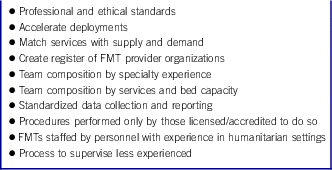
Parallel to the professionalization efforts, a review of the FMTs sponsored by the WHO Health Cluster was initiated at the same time to better “ensure quality and standardization of services provided by international surgical trauma teams” and provide “benchmarks for FMTs that they should meet when offering their services and capacities to affected countries.”Reference Norton, von Schreeb, Aitken, Herard and Lajolo 23 Catalyzed by the Haitian earthquake, Redmond and colleagues identified 10 requirements for FMTs (Table) in which the majority would not be accomplished without further professional education and training.Reference Redmond, Mardel and Taithe 24 Unfortunately, during the Tacloban, Philippines, tragedy some foreign government-sponsored FMTs were found wanting, primarily in the lack of experienced providers.
Foreign Medical Team (FMT) Requirements
Communities and decision makers will demand that the next generation of crisis providers, especially those in health, will all be professionals. The need to provide a capstone step forward to recognize disaster/crisis science for what it has accomplished should not be in question. It is imperative that those who see this science as their life's work, whether full time or part time, should actively participate. What the equation lacks is an autonomous organizational framework that would absorb the work being done in professionalization, FMTs, and other ongoing multidisciplinary efforts, including advocacy, policy and many practice and research standards and sensitive civil-military differences of opinion. Several examples of ongoing efforts in which professionalization and registry of certified providers would be a great benefit exist. One is the new Society for Disaster Medicine and Public Health (The Society), a “forum for health professionals to collaborate on issues related to the advancement of the discipline of disaster health” and where a “multidisciplinary membership participates in the creation of policies and programs that work toward global health security before, during, and after disasters.” 25 Another is the World Association for Disaster and Emergency Medicine (WADEM). Originally founded as the Club of Mainz in 1976, WADEM has long provided world class conferences for all professionals, including WHO, 26 while the highly respected UK-based Overseas Development Institute deals with many policy and development issues. 27 All 3 have complementary journals that support current practice, research, and policy initiatives.
The level of complexity and expectations surrounding disaster/crisis sciences has increased exponentially. It behooves the academically driven professionalization process, the Society, WADEM, NGOS, WHO, and WHO regional organizations and the worldwide multidisciplinary educational and training assets in social and political sciences, law, economics, civil engineering, technology, anthropology, and other disciplines to work in concert, not competitively, in advocacy, policy, practice, and science to better define this inclusive discipline. Its time has come.



