




1 Introduction
Inductive logic programming plays an important role in knowledge discovering, which has been applied in various practical applications such as natural language processing, multi-agent systems, and bioinformatics (Muggleton et al. Reference Muggleton, Raedt, Poole, Bratko, Flach, Inoue and Srinivasan2012; Gulwani et al. Reference Gulwani, Hernández-Orallo, Kitzelmann, Muggleton, Schmid and Zorn2015; Cropper et al. Reference Cropper, Dumancic, Evans and Muggleton2022). Logic programming under stable models (also known as answer set programming or ASP in short) is one of the major formalisms for representing incomplete knowledge and nonmonotonic reasoning (Gelfond and Lifschitz Reference Gelfond and Lifschitz1988; Brewka et al. Reference Brewka, Eiter and Truszczynski2011; Erdem et al. Reference Erdem, Gelfond and Leone2016). As the semantics of standard stable models is unable to handle priority and uncertain information, various extensions of ASP have been proposed in the literature, including prioritized logic programming (Schaub and Wang Reference Schaub and Wang2001; Baral Reference Baral2002) and probabilistic logic programs (Raedt and Kimmig Reference Raedt and Kimmig2015), ${LP}^{MLN}$
(Lee and Wang Reference Lee and Wang2016) among others.
${LP}^{MLN}$
(Lee and Wang Reference Lee and Wang2016) among others.
Another major extension of ASP are the possibilistic logic programs (Nicolas et al. Reference Nicolas, Garcia and Stéphan2005, Reference Nicolas, Garcia, Stéphan and Lefèvre2006; Dubois and Prade Reference Dubois and Prade2020), in which each rule is assigned a weight (also called necessity). Possibility theory has been applied in several areas (Dubois and Prade Reference Dubois and Prade2020) such as belief revision, information fusion, and preference modeling. For instance, the statement ‘if a person is a resident in New York, then they are a USA citizen with a possibility of $0.7$
’ can be conveniently expressed as a possibilistic rule below, which is a pair of a rule and a number.
$0.7$
’ can be conveniently expressed as a possibilistic rule below, which is a pair of a rule and a number.
 \begin{equation*} (citizenUSA \leftarrow residentNY, 0.7). \end{equation*}
The semantics of possibilistic logic programs is defined by an extension of stable models called possibilistic stable models or poss-stable models (Nicolas et al. Reference Nicolas, Garcia and Stéphan2005, Reference Nicolas, Garcia, Stéphan and Lefèvre2006) (see Section 2 for details). The possibilistic extension of ASP is different from probabilistic ones, as Zadeh (Reference Zadeh1999) has commented, if our focus is on the meaning of information rather than with its measure, the proper framework for information analysis is possibilistic rather than probabilistic in nature. We are not going to discuss this statement in detail but point out that possibilistic information is more on the side of representing the priority of formulas and rules. Moreover, as probability axioms are not enforced in possibilistic reasoning, it is easier for the user to manage “possibilistic” information than “probabilistic” information (Dubois et al. Reference Dubois, Nguyen and Prade2000).
Because the poss-stable models can deal with non-monotonicity and uncertainty simultaneously, they can be applied to reasoning about uncertain epistemic beliefs and possibilistic dynamic systems. In addition to analyzing the epistemic belief of a single agent, poss-stable models can be applied to reasoning about trust and belief among autonomous agents via argumentation (Maia and Alcântara Reference Maia and Alcântara2016), or to reasoning about possibilities across multiple information sources via a possibilistic multi-context systemFootnote 1 (Jin et al. Reference Jin, Wang and Wen2012; Yang et al. Reference Yang, Wang, Hu, Feng and Liu2023). Besides, a poss-NLP can also represent a dynamic system (Hu et al. Reference Hu, Wang and Inoue2025) whose dynamic characterization is depicted via the possibilistic interpretation transitions. Since an early study (Inoue Reference Inoue2011) theoretically revealed a strong mathematical relationship between the attractors/steady states of Boolean networks (BNs for short) and the stable models, some ASP-based methods (Mushthofa et al. Reference Mushthofa, Torres, Van de Peer, Marchal and De Cock2014; Khaled et al. Reference Khaled, Benhamou and Trinh2023) have been developed to find attractors in BNs such as Genetic Regulatory Networks (GRNs for short). It follows that the poss-stable models can correspond to the steady states of the dynamic system.
To our best knowledge, the problem of inductive reasoning with possibilistic logic programs has not been investigated in the literature. Informally, given a set of positive examples and a set of negative examples, the task is to induce a possibilistic logic program that satisfies these examples.
Let us consider the following example that is adapted from Examples 1 and 8 in Nicolas et al. (Reference Nicolas, Garcia, Stéphan and Lefèvre2006), which shows how possibilistic logic programs under poss-stable model semantics are used for representing quantitative priority information.
Example 1.1. Assume that a clinical expert system contains the following knowledge:
-
- If medicine A is taken, the possibility of relieving the vomiting is $0.7$
; if medicine B is taken, the possibility of relieving the vomiting is
$0.6$
.
$0.7$
; if medicine B is taken, the possibility of relieving the vomiting is
$0.6$
. -
- A physician prescribes medicine B if a vomiting patient has not taken medicine A.
-
- If medicine A is taken, pregnancy causes malnutrition with a possibility of
$0.7$
; if medicine B is taken, pregnancy causes malnutrition with a possibility of
$0.1$
.


This set of background (medical) knowledge can be expressed as the possibilistic logic program $\overline {P_{med}}$
below (under possibilistic stable models, see Section 2).
$\overline {P_{med}}$
below (under possibilistic stable models, see Section 2).
 \begin{equation*} \overline {P_{med}} = \left \{ \begin{array}{c} (\mathit{relief} \leftarrow vomiting, medA, 0.7), \\ (\mathit{relief} \leftarrow vomiting, medB, 0.6), \\ (medB \leftarrow vomiting, \textit {not } \, medA, 1), \\ (malnutrition \leftarrow medA, pregnancy, 0.7), \\ (malnutrition \leftarrow medB, pregnancy, 0.1) \end{array} \right \} \end{equation*}
Intuitively, the first rule says that if someone is vomiting and she takes the medicine A then her vomiting symptom will be relieved with the possible degree 0.7. Similarly, the second rule says that the medicine B can relieve the vomiting symptom with possible degree 0.6. These possible degrees are given by experts in this field.
Suppose that “A woman is definitely in pregnancy and she suffers from vomiting”, which can be presented as the two rules in $\overline {P_{fact}}$
.
$\overline {P_{fact}}$
.
 \begin{equation*}\overline {P_{fact}} = \{ (pregnancy \leftarrow , 1),\quad (vomiting \leftarrow , 1) \}\end{equation*}
The knowledge base expressed as program $\overline {B_{med}} = \overline {P_{fact}} \cup \overline {P_{med}}$
can be expanded further by learning new rules from new observations (examples).
$\overline {B_{med}} = \overline {P_{fact}} \cup \overline {P_{med}}$
can be expanded further by learning new rules from new observations (examples).
Let us assume that we have the following three examples:
-
$\overline {A_1}$
$\{ (pregnancy,1), (vomiting,1), (medA,1), (\mathit{relief},0.7), (malnutrition,0.7) \}$
,
-
$\overline {A_2}$
$\{ (pregnancy,1), (vomiting,1), (medB,1), (\mathit{relief},0.6), (malnutrition,0.1) \}$
,
-
$\overline {A_3}$
$\{ (pregnancy,1), (vomiting,1), (medA,0.7), (\mathit{relief},0.7) \}$






where $\overline {A_1}$
and
$\overline {A_1}$
and $\overline {A_2}$
are positive examples (possibilistic stable models), while
$\overline {A_2}$
are positive examples (possibilistic stable models), while $\overline {A_3}$
is a negative example.
$\overline {A_3}$
is a negative example. $\overline {{A_1}}$
is not a possibilistic stable model of the current
$\overline {{A_1}}$
is not a possibilistic stable model of the current $\overline {B_{med}}$
, nor is
$\overline {B_{med}}$
, nor is $\overline {A_2}$
. This means that some knowledge of the expert system is missing from the complete
$\overline {A_2}$
. This means that some knowledge of the expert system is missing from the complete $\overline {B_{med}}$
. What are the missing rules?
$\overline {B_{med}}$
. What are the missing rules?
For instance, if we add another rule
 \begin{equation*}\overline {r} = (medA \leftarrow vomiting, \textit {not }\, medB, 1)\end{equation*}
into $\overline {B_{med}}$
, then both
$\overline {B_{med}}$
, then both $\overline {A_1}$
and
$\overline {A_1}$
and $\overline {A_2}$
are possibilistic stable models of
$\overline {A_2}$
are possibilistic stable models of $\overline {B_{med}} \cup \{ \overline {r} \}$
, while
$\overline {B_{med}} \cup \{ \overline {r} \}$
, while $\overline {A_3}$
is not. How can we discover such a rule?
$\overline {A_3}$
is not. How can we discover such a rule?
Thus, in this paper we aim to establish a framework for learning possibilistic rules from a given background possibilistic program, a set of positive examples and a set of negative examples. For instance, our method will be able to generate the rule $(medA \leftarrow vomiting, \textit {not }\, medB, 1)$
from the background knowledge
$(medA \leftarrow vomiting, \textit {not }\, medB, 1)$
from the background knowledge $\overline {B_{med}}$
, positive examples
$\overline {B_{med}}$
, positive examples $E^+$
and negative examples
$E^+$
and negative examples $E^-$
. In order to set up our framework for induction in possibilistic programs, we first introduce the notion of induction tasks and then investigate its properties including useful characterizations of solutions for induction tasks. Based on these results, we present algorithms for computing solutions for induction tasks. We have also implemented and evaluated our algorithm using three randomly generated datasets.
$E^-$
. In order to set up our framework for induction in possibilistic programs, we first introduce the notion of induction tasks and then investigate its properties including useful characterizations of solutions for induction tasks. Based on these results, we present algorithms for computing solutions for induction tasks. We have also implemented and evaluated our algorithm using three randomly generated datasets.
In this paper, we will focus on the class of possibilistic normal logic programs (poss-NLPs) and our main contributions are summarized as follows.
-
• We propose a definition of induction in poss-NLPs for the first time and investigate its properties.
-
• We present two algorithms ilpsm and ilpsmmin for computing induction solutions for poss-NLPs. We show that our algorithms are sound and complete. The first algorithm computes a poss-NLP that is a solution for the given induction task, while the second one finds a minimal solution.
-
• We study two special cases of inductive reasoning for poss-NLPs. The first one is that observations are complete, that is, the given positive examples are exactly the possibilistic stable models, while all other possibilistic interpretations are negative ones. In such a special case, we obtain an elegant characterization for induction solutions in terms of poss-stable models. The other special case is when an input poss-NLP is an ordinary NLP. In this case, we show that the induction problem coincides with the standard induction for NLPs.
-
• We also generalize our definition of induction for poss-NLPs to a more general case where an interpretation is a partial interpretation. We show that this generalized induction problem can be reduced to the induction problem of poss-NLPs as defined in Definition 3.1. Thus, the algorithms ILPSM and ILPSMmin are applicable to the more general case of induction for poss-NLPs.
-
• We have implemented the algorithm ilsmmin to learn ordinal logic programs from stable models, which calls the answer set solver Clingo (Gebser et al. Reference Gebser, Kaminski, Kaufmann and Schaub2019). Comparison experimental results show that ilsmmin outperforms ilasp (Law et al. Reference Law, Russo and Broda2014) on the randomly generated tasks of inducing NLP from stable models, in which ilasp can learn non-ground answer set programs from partial interpretations.
The rest of this paper is organized as follows. In Section 2, we briefly recall some basics of possibilistic logic programs and poss-stable models. In Section 3, we propose the induction task for poss-NLPs and analyze its properties. Its two different algorithms are proposed and analyzed in Section 4. Section 5 discusses some variants of the induction for poss-NLPs. Section 6 presents an efficient implementation and reports the results of the experimental evaluation. Section 7 discusses related work. Finally, Section 8 concludes the paper. All proofs have been relegated to the appendix.
2 Preliminaries
In this section, we briefly introduce some basics of possibilistic (normal) logic programs (poss-NLPs) and fix the notations that will be used in the paper (Nicolas et al. Reference Nicolas, Garcia, Stéphan and Lefèvre2006). For a set $O$
,
$O$
, $\vert O \vert$
denotes cardinality of
$\vert O \vert$
denotes cardinality of $O$
.
$O$
.
2.1 Possibilistic logic programs
We first introduce the syntax of poss-NLPs in this subsection. We assume a propositional logic $\mathcal{L}$
over a finite set
$\mathcal{L}$
over a finite set $\mathcal{A}$
of atoms. Literals (positive and negative), terms, clauses, models, and satisfiability are defined as usual. A possibilistic formula
$\mathcal{A}$
of atoms. Literals (positive and negative), terms, clauses, models, and satisfiability are defined as usual. A possibilistic formula $\overline {\phi }$
is a pair
$\overline {\phi }$
is a pair $(\phi ,\alpha )$
with
$(\phi ,\alpha )$
with $\phi$
being a (propositional) formula of
$\phi$
being a (propositional) formula of $\mathcal L$
and
$\mathcal L$
and $\alpha$
being the weight of
$\alpha$
being the weight of $\phi$
. In general, this
$\phi$
. In general, this $\alpha$
is an element of a given lattice
$\alpha$
is an element of a given lattice $({\mathcal{Q}},\le )$
(Dubois and Prade Reference Dubois and Prade1998). In this paper,
$({\mathcal{Q}},\le )$
(Dubois and Prade Reference Dubois and Prade1998). In this paper, $({\mathcal{Q}},\le )$
is assumed to be a totally ordered set where
$({\mathcal{Q}},\le )$
is assumed to be a totally ordered set where $\mathcal{Q}$
is finite. Intuitively, every pair of weights in the finite set
$\mathcal{Q}$
is finite. Intuitively, every pair of weights in the finite set $\mathcal{Q}$
of a given induction task is comparable.
$\mathcal{Q}$
of a given induction task is comparable.
For example, ${\mathcal{Q}}= \{ 0.1, 0.6, 0.7, 1 \}$
and
${\mathcal{Q}}= \{ 0.1, 0.6, 0.7, 1 \}$
and $\leq$
is the ‘less than or equal’ relation for real numbers. The supremum of
$\leq$
is the ‘less than or equal’ relation for real numbers. The supremum of $\mathcal{Q}$
in this
$\mathcal{Q}$
in this $({\mathcal{Q}},\le )$
is
$({\mathcal{Q}},\le )$
is $1$
. Except for a finite set of decimals in
$1$
. Except for a finite set of decimals in $[0, 1]$
,
$[0, 1]$
, $\mathcal{Q}$
can also be a set of adverbs representing necessities. For instance,
$\mathcal{Q}$
can also be a set of adverbs representing necessities. For instance, ${\mathcal{Q}}= \{ slightly, highly, extremely, absolutely \}$
and
${\mathcal{Q}}= \{ slightly, highly, extremely, absolutely \}$
and $slightly \leq highly \leq extremely \leq absolutely$
. The supremum of
$slightly \leq highly \leq extremely \leq absolutely$
. The supremum of $\mathcal{Q}$
in this
$\mathcal{Q}$
in this $({\mathcal{Q}},\le )$
is
$({\mathcal{Q}},\le )$
is $absolutely$
. Hereafter, we use
$absolutely$
. Hereafter, we use $\mu$
to denote the supremum of
$\mu$
to denote the supremum of $\mathcal{Q}$
in
$\mathcal{Q}$
in $({\mathcal{Q}},\le )$
.
$({\mathcal{Q}},\le )$
.
The possibilistic formula $(\phi ,\alpha )$
intuitively states that the ordinary formula
$(\phi ,\alpha )$
intuitively states that the ordinary formula $\phi$
is certain at least to the level
$\phi$
is certain at least to the level $\alpha$
. If
$\alpha$
. If $\phi$
is an atom (resp. a literal, a clause and a term) then
$\phi$
is an atom (resp. a literal, a clause and a term) then $(\phi ,\alpha )$
is a possibilistic atom (resp. literal, clause and term). Hereafter, we use the symbol
$(\phi ,\alpha )$
is a possibilistic atom (resp. literal, clause and term). Hereafter, we use the symbol $X$
to denote the classic projection ignoring all uncertainties from its possibilistic counterpart
$X$
to denote the classic projection ignoring all uncertainties from its possibilistic counterpart $\overline {X}$
. Given a set
$\overline {X}$
. Given a set $\mathcal{A}$
of atoms and a complete lattice
$\mathcal{A}$
of atoms and a complete lattice $(\mathcal{Q}, \le )$
, a set
$(\mathcal{Q}, \le )$
, a set $\overline {I}\subseteq {\mathcal{A}}\times {\mathcal{Q}}$
of possibilistic atoms is called a possibilistic interpretation over
$\overline {I}\subseteq {\mathcal{A}}\times {\mathcal{Q}}$
of possibilistic atoms is called a possibilistic interpretation over $\mathcal{A}$
and
$\mathcal{A}$
and $(\mathcal{Q},\le )$
if
$(\mathcal{Q},\le )$
if $\vert \{ (x,\alpha ) \in \overline {I} \mid \alpha \in {\mathcal{Q}} \} \vert \leq 1$
for each
$\vert \{ (x,\alpha ) \in \overline {I} \mid \alpha \in {\mathcal{Q}} \} \vert \leq 1$
for each $x \in {\mathcal{A}}$
. Thus, for a possibilistic interpretation
$x \in {\mathcal{A}}$
. Thus, for a possibilistic interpretation $\overline {I}$
,
$\overline {I}$
, $(x,\alpha _1)\in \overline {I}$
and
$(x,\alpha _1)\in \overline {I}$
and $(x,\alpha _2)\in \overline {I}$
imply
$(x,\alpha _2)\in \overline {I}$
imply $\alpha _1=\alpha _2$
. Given a possibilistic interpretation
$\alpha _1=\alpha _2$
. Given a possibilistic interpretation $\overline {I}$
, we use
$\overline {I}$
, we use $I$
to denote the classic interpretation
$I$
to denote the classic interpretation $\{p\mid (p,\alpha )\in \overline {I} \}$
.
$\{p\mid (p,\alpha )\in \overline {I} \}$
.
Before introducing possibilistic logic programs, we recall the set operations for finite sets of possibilistic formulas.
Let $\overline {\Gamma _1}$
and
$\overline {\Gamma _1}$
and $\overline {\Gamma _2}$
be two finite sets of possibilistic formulas.
$\overline {\Gamma _2}$
be two finite sets of possibilistic formulas.
-
•
$\overline {\Gamma _1} \sqsubseteq \overline {\Gamma _2}$
if for each
$(\phi ,\alpha )\in \overline {\Gamma _1}$
there exists
$(\phi ,\beta )\in \overline {\Gamma _2}$
such that
$\alpha \le \beta$
. Consequently,
$\overline {\Gamma _1} \sqsubset \overline {\Gamma _2}$
if
$\overline {\Gamma _1} \sqsubseteq \overline {\Gamma _2}$
and
$\overline {\Gamma _1} \neq \overline {\Gamma _2}$
. -
•
$ \overline {\Gamma _1}\sqcup \overline {\Gamma _2}=\{(x, \alpha )\mid (x,\alpha )\in \overline {\Gamma _1}, x \notin \Gamma _2\}\cup \{(x,\beta )\mid (x,\beta )\in \overline {\Gamma _2},x \notin \Gamma _1\}\cup \{(x,\max \{\alpha ,\beta \})\mid (x,\alpha )\in \overline {\Gamma _1}, (x,\beta )\in \overline {\Gamma _2}\}$
. -
•
$ \overline {\Gamma _1}\sqcap \overline {\Gamma _2}=\{(x, \min \{\alpha ,\beta \})\mid (x,\alpha )\in \overline {\Gamma _1}, (x,\beta )\in \overline {\Gamma _2}\}$
.




A possibilistic normal logic program (poss-NLP for short) on a complete lattice $({\mathcal{Q}},\le )$
is a finite set of possibilistic normal rules (or rules) of the form
$({\mathcal{Q}},\le )$
is a finite set of possibilistic normal rules (or rules) of the form $\overline {r} = (r,\alpha )$
, where
$\overline {r} = (r,\alpha )$
, where
-
•
$\alpha \in {\mathcal{Q}}$
is the weight of
$\overline {r}$
, also written as
$N(\overline {r})$
, and -
•
$r$
is a classic (normal) rule of the form:(1)with
\begin{align} p_0\leftarrow p_1,\ldots , p_m,\textit {not}\, p_{m+1}, \ldots , \textit {not} \, p_n \end{align}
$n \geq 0$
and
$p_i\in {\mathcal{A}}\,(0\le i\le n)$
.



A possibilistic logic program is also referred to as a possibilistic logic knowledge base or a possibility theory in the literature.
Given a poss-NLP $\overline {P}$
, its classic counterpart, consisting of all classic rules in the poss-NLP, is denoted as
$\overline {P}$
, its classic counterpart, consisting of all classic rules in the poss-NLP, is denoted as $P$
. Let
$P$
. Let $r$
be a classic rule of the form (1). We denote
$r$
be a classic rule of the form (1). We denote $\textit {hd}(r)=p_0$
,
$\textit {hd}(r)=p_0$
, ${\textit {bd}{^+}}(r)=\{p_1,\ldots , p_m\}$
,
${\textit {bd}{^+}}(r)=\{p_1,\ldots , p_m\}$
, ${\textit {bd}{^-}}(r)=\{p_{m+1},\ldots , p_n\}$
and
${\textit {bd}{^-}}(r)=\{p_{m+1},\ldots , p_n\}$
and $\textit {bd}(r)={\textit {bd}{^+}}(r)\cup \textit {not} \,{\textit {bd}{^-}}(r)$
. Thus, the rule
$\textit {bd}(r)={\textit {bd}{^+}}(r)\cup \textit {not} \,{\textit {bd}{^-}}(r)$
. Thus, the rule $r$
can be written as
$r$
can be written as
 \begin{align*} \textit {hd}(r)\leftarrow {\textit {bd}{^+}}(r),\textit {not} \,{\textit {bd}{^-}}(r) \qquad \textit {or}\qquad \textit {hd}(r)\leftarrow \textit {bd}(r) \end{align*}
where $\textit {not} \, S=\{\textit {not} \, p\mid p\in S\}$
. The rule
$\textit {not} \, S=\{\textit {not} \, p\mid p\in S\}$
. The rule $r$
is definite if
$r$
is definite if ${\textit {bd}{^-}}(r)=\emptyset$
. For a possibilistic normal logic rule
${\textit {bd}{^-}}(r)=\emptyset$
. For a possibilistic normal logic rule $\overline {r}$
, we also denote
$\overline {r}$
, we also denote $\textit {hd}(\overline {r})=\textit {hd}(r)$
,
$\textit {hd}(\overline {r})=\textit {hd}(r)$
, ${\textit {bd}{^+}}(\overline {r})={\textit {bd}{^+}}(r)$
and
${\textit {bd}{^+}}(\overline {r})={\textit {bd}{^+}}(r)$
and ${\textit {bd}{^-}}(\overline {r})={\textit {bd}{^-}}(r)$
. A possibilistic definite (logic) program is a finite set of possibilistic definite rules.
${\textit {bd}{^-}}(\overline {r})={\textit {bd}{^-}}(r)$
. A possibilistic definite (logic) program is a finite set of possibilistic definite rules.
Two classic rules $r_1$
and
$r_1$
and $r_2$
of the form (1) are identical if
$r_2$
of the form (1) are identical if $\textit {hd}(r_1) = \textit {hd}(r_2)$
and
$\textit {hd}(r_1) = \textit {hd}(r_2)$
and $\textit {bd}(r_1) = \textit {bd}(r_2)$
. For instance, rule
$\textit {bd}(r_1) = \textit {bd}(r_2)$
. For instance, rule $p_0\leftarrow p_1, p_2,\textit {not} \, p_3, \textit {not} \, p_4$
is the same as rule
$p_0\leftarrow p_1, p_2,\textit {not} \, p_3, \textit {not} \, p_4$
is the same as rule $p_0\leftarrow p_2, p_1,\textit {not} \, p_4, \textit {not} \, p_3$
. Similar to the assumption in Possibilistic Logic, we assume that every classic rule occurs at most once in a poss-NLP.
$p_0\leftarrow p_2, p_1,\textit {not} \, p_4, \textit {not} \, p_3$
. Similar to the assumption in Possibilistic Logic, we assume that every classic rule occurs at most once in a poss-NLP.
Given two poss-NLPs $\overline {P_1}$
and
$\overline {P_1}$
and $\overline {P_2}$
, the operations
$\overline {P_2}$
, the operations $\cup$
and
$\cup$
and $-$
over poss-NLPs can be defined as follows (Garcia et al. Reference Garcia, Lefèvre, Papini, Stéphan and Würbel2018).
$-$
over poss-NLPs can be defined as follows (Garcia et al. Reference Garcia, Lefèvre, Papini, Stéphan and Würbel2018).
-
•
$\overline {P_1}\sqcup \overline {P_2}=\{(r, \alpha )\mid (r,\alpha )\in \overline {P_1}, r \notin P_2\}\cup \{(r,\beta )\mid (r,\beta )\in \overline {P_2},r \notin P_1\}\cup \{(r,\max \{\alpha ,\beta \})\mid (r,\alpha )\in \overline {P_1}, (r,\beta )\in \overline {P_2}\}$
. -
•
$\overline {P_1} - \overline {P_2} = \{ (r, \alpha ) \mid (r,\alpha )\in \overline {P_1}, r \notin P_2 \} \cup \{ (r, \alpha ) \mid (r,\alpha )\in \overline {P_1}, (r,\beta )\in \overline {P_2}, \alpha \gt \beta \}$
.


2.2 Possibilistic stable models
In this subsection, we introduce the semantics of poss-NLPs, that is, possibilistic stable models or poss-stable models (Nicolas et al. Reference Nicolas, Garcia, Stéphan and Lefèvre2006). To this end, we first recall basics of normal logic programs under stable models (Gelfond and Lifschitz Reference Gelfond and Lifschitz1988).
An atom set $S$
satisfies a definite logic program
$S$
satisfies a definite logic program $P$
, written as
$P$
, written as $S \models P$
, if
$S \models P$
, if ${\textit {bd}{^+}}(r) \subseteq S$
implies
${\textit {bd}{^+}}(r) \subseteq S$
implies $\textit {hd}(r) \in S$
for each
$\textit {hd}(r) \in S$
for each $r \in P$
.
$r \in P$
. $S$
is a stable model of
$S$
is a stable model of $P$
, written as
$P$
, written as $S \in \mathit{SM}(P)$
, if
$S \in \mathit{SM}(P)$
, if $S \models P$
and there exists no
$S \models P$
and there exists no $S' \subset S$
such that
$S' \subset S$
such that $S' \models P$
. In fact, a definite logic program
$S' \models P$
. In fact, a definite logic program $P$
has the unique stable model which is its least Herbrand model
$P$
has the unique stable model which is its least Herbrand model $\mathit{Cn}(P)$
(Lloyd Reference Lloyd2012) (the set of consequences of
$\mathit{Cn}(P)$
(Lloyd Reference Lloyd2012) (the set of consequences of $P$
).
$P$
). $\mathit{Cn}(P)$
is also the least fixpoint
$\mathit{Cn}(P)$
is also the least fixpoint $\mathit{lfp}(T_P)$
of the immediate consequence operator
$\mathit{lfp}(T_P)$
of the immediate consequence operator $T_P:2^{\mathcal{A}} \rightarrow 2^{\mathcal{A}}$
defined by
$T_P:2^{\mathcal{A}} \rightarrow 2^{\mathcal{A}}$
defined by $T_P(A)=\textit {hd}(\mathit{App}(P, A))$
, where
$T_P(A)=\textit {hd}(\mathit{App}(P, A))$
, where $\textit {hd}(P) = \{ \textit {hd}(r) \mid r \in P \}$
and
$\textit {hd}(P) = \{ \textit {hd}(r) \mid r \in P \}$
and $\mathit{App}(P, A) = \{ r \in P \mid {\textit {bd}{^+}}(r) \subseteq A \}$
. That is, for a definite logic program
$\mathit{App}(P, A) = \{ r \in P \mid {\textit {bd}{^+}}(r) \subseteq A \}$
. That is, for a definite logic program $P$
, we have
$P$
, we have $\mathit{Cn}(P) = \mathit{lfp}(T_P)$
.
$\mathit{Cn}(P) = \mathit{lfp}(T_P)$
.
The following proposition is useful for checking whether $S = \mathit{lfp}(T_P)$
for a set
$S = \mathit{lfp}(T_P)$
for a set $S$
of atoms. A definite logic program
$S$
of atoms. A definite logic program $P$
is grounded if it can be ordered as a sequence
$P$
is grounded if it can be ordered as a sequence $(r_1, \ldots , r_n)$
such that
$(r_1, \ldots , r_n)$
such that $ r_i \in \mathit{App}(P,\textit {hd}(\{ r_1, \ldots , r_{i-1} \}))$
for each
$ r_i \in \mathit{App}(P,\textit {hd}(\{ r_1, \ldots , r_{i-1} \}))$
for each $1 \leq i \leq n$
.
$1 \leq i \leq n$
.
Proposition 2.1 (Proposition 1 of Nicolas et al. (Reference Nicolas, Garcia, Stéphan and Lefèvre2006)). Let $P$
be a definite logic program and
$P$
be a definite logic program and $S$
be an atom set.
$S$
be an atom set. $S$
is a least Herbrand model of
$S$
is a least Herbrand model of $P$
if and only if
$P$
if and only if
-
•
$S = \textit {hd}(\mathit{App}(P,S))$
, and
-
•
$\mathit{App}(P,S)$
is grounded.


An atom set $S$
is a stable model of normal logic program (NLP)
$S$
is a stable model of normal logic program (NLP) $P$
if
$P$
if $S$
is the stable model of
$S$
is the stable model of $P^S$
, the reduct of
$P^S$
, the reduct of $P$
w.r.t.
$P$
w.r.t. $S$
, where
$S$
, where $P^S$
denotes the definite logic program
$P^S$
denotes the definite logic program $\{\textit {hd}(r) \leftarrow {\textit {bd}{^+}}(r) \mid r \in P, {\textit {bd}{^-}}(r) \cap S = \emptyset \}$
(Gelfond and Lifschitz Reference Gelfond and Lifschitz1988). A stable model of
$\{\textit {hd}(r) \leftarrow {\textit {bd}{^+}}(r) \mid r \in P, {\textit {bd}{^-}}(r) \cap S = \emptyset \}$
(Gelfond and Lifschitz Reference Gelfond and Lifschitz1988). A stable model of $P$
is also referred to as an answer set of
$P$
is also referred to as an answer set of $P$
. The set of all stable models for
$P$
. The set of all stable models for $P$
is denoted as
$P$
is denoted as $\mathit{SM}(P)$
.
$\mathit{SM}(P)$
.
Now we are ready to introduce the notion of poss-stable models (Dubois and Prade Reference Dubois and Prade2024), which is a generalization of the stable models for ordinary NLPs. First, we extend the definitions of reduct, rule applicability, and consequence operator to the case of poss-NLPs.
Given a possibilistic definite rule $\overline {r} = (r, \alpha )$
where
$\overline {r} = (r, \alpha )$
where $r$
is of the form
$r$
is of the form $p \leftarrow \{p_1,\ldots ,p_m$
, if there exists weights
$p \leftarrow \{p_1,\ldots ,p_m$
, if there exists weights $\alpha _1, \ldots , \alpha _m$
such that
$\alpha _1, \ldots , \alpha _m$
such that $(p_i,\alpha _i)\in \overline {A}$
for all
$(p_i,\alpha _i)\in \overline {A}$
for all $i\,(1\le i\le m)$
(
$i\,(1\le i\le m)$
( $1\le i\le m$
), then we say that
$1\le i\le m$
), then we say that $\overline {r}$
is
$\overline {r}$
is $\beta$
-applicable in a possibilistic atom set
$\beta$
-applicable in a possibilistic atom set $\overline {A}$
.
$\overline {A}$
.
A definite rule $r$
is applicable in an atom set
$r$
is applicable in an atom set $A$
if
$A$
if ${\textit {bd}{^+}}(r) \subseteq A$
. Correspondingly, a possibilistic definite rule
${\textit {bd}{^+}}(r) \subseteq A$
. Correspondingly, a possibilistic definite rule $(r,\alpha )$
with
$(r,\alpha )$
with ${\textit {bd}{^+}}(r)=\{p_1,\ldots ,p_m\}$
is
${\textit {bd}{^+}}(r)=\{p_1,\ldots ,p_m\}$
is $\beta$
-applicable in a possibilistic atom set
$\beta$
-applicable in a possibilistic atom set $\overline {A}$
with
$\overline {A}$
with $\beta =\min \{\alpha ,\alpha _1,\ldots , \alpha _m\}$
if there exists
$\beta =\min \{\alpha ,\alpha _1,\ldots , \alpha _m\}$
if there exists $(p_i,\alpha _i)\in \overline {A}$
for every
$(p_i,\alpha _i)\in \overline {A}$
for every $i\,(1\le i\le m)$
. Otherwise, it is not applicable in
$i\,(1\le i\le m)$
. Otherwise, it is not applicable in $\overline {A}$
. For a certain atom
$\overline {A}$
. For a certain atom $q \in {\mathcal{A}}$
and a possibilistic definite program
$q \in {\mathcal{A}}$
and a possibilistic definite program $\overline {P}$
, define
$\overline {P}$
, define
 \begin{align} \mathit{App}(\overline {P}, \overline {A}, q) = \{ \overline {r} \in \overline {P} \mid \textit {hd}(\overline {r}) = q,\overline {r} \mbox{is} \beta -\mbox{applicable in } \overline {A} \}. \end{align}
Additionally, $\mathit{App}(\overline {P}, \overline {A}) = \bigcup _{q \in A} \mathit{App}(\overline {P}, \overline {A}, q)$
.
$\mathit{App}(\overline {P}, \overline {A}) = \bigcup _{q \in A} \mathit{App}(\overline {P}, \overline {A}, q)$
.
Given a possibilistic definite logic program $\overline {P}$
and a possibilistic atom set
$\overline {P}$
and a possibilistic atom set $\overline {A}$
, the immediate possibilistic consequence operator
$\overline {A}$
, the immediate possibilistic consequence operator ${\mathcal{T}}_{\overline {P}}$
as Definition 9 in (Nicolas et al. Reference Nicolas, Garcia, Stéphan and Lefèvre2006) maps a possibilistic atom set
${\mathcal{T}}_{\overline {P}}$
as Definition 9 in (Nicolas et al. Reference Nicolas, Garcia, Stéphan and Lefèvre2006) maps a possibilistic atom set $\overline {A}$
to another one as follows.
$\overline {A}$
to another one as follows.
 \begin{align} {\mathcal{T}}_{\overline {P}}(\overline {A}) = &\{(q,\delta ) \mid q \in {\mathcal{A}}, \mathit{App}(\overline {P},\overline {A},q) \neq \emptyset ,\nonumber\\ \delta =&\max \{\beta \mid \overline {r} \in \mathit{App}(\overline {P},\overline {A},q)\mbox{ is $\beta $-applicable in } \overline {A}\}\}. \end{align}
Then the iterated operator ${\mathcal{T}}_{\overline {P}}^k$
is defined by
${\mathcal{T}}_{\overline {P}}^k$
is defined by ${\mathcal{T}}_{\overline {P}}^0 = \emptyset$
and
${\mathcal{T}}_{\overline {P}}^0 = \emptyset$
and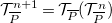 ${\mathcal{T}}_{\overline {P}}^{n+1} = {\mathcal{T}}_{\overline {P}}({\mathcal{T}}_{\overline {P}}^{n})$
for each
${\mathcal{T}}_{\overline {P}}^{n+1} = {\mathcal{T}}_{\overline {P}}({\mathcal{T}}_{\overline {P}}^{n})$
for each $n \geq 0$
. For a possibilistic definite logic program
$n \geq 0$
. For a possibilistic definite logic program $\overline {P}$
, we can compute the set
$\overline {P}$
, we can compute the set $\mathit{Cn}(\overline {P})$
of possibilistic consequences via
$\mathit{Cn}(\overline {P})$
of possibilistic consequences via $\mathit{Cn}(\overline {P}) = \mathit{lfp}({\mathcal{T}}_{\overline {P}})$
where
$\mathit{Cn}(\overline {P}) = \mathit{lfp}({\mathcal{T}}_{\overline {P}})$
where $\mathit{lfp}({\mathcal{T}}_{\overline {P}}) = \bigsqcup _{n\geq 0}{\mathcal{T}}_{\overline {P}}^n$
is the least fixpoint of the immediate possibilistic consequence operator
$\mathit{lfp}({\mathcal{T}}_{\overline {P}}) = \bigsqcup _{n\geq 0}{\mathcal{T}}_{\overline {P}}^n$
is the least fixpoint of the immediate possibilistic consequence operator ${\mathcal{T}}_{\overline {P}}$
.
${\mathcal{T}}_{\overline {P}}$
.
The possibilistic reduct of a poss-NLP $\overline {P}$
w.r.t. an atom set
$\overline {P}$
w.r.t. an atom set $S$
is the possibilistic definite logic program
$S$
is the possibilistic definite logic program
 \begin{equation*} \overline {P}^S = \{(\textit {hd}(r) \leftarrow {\textit {bd}{^+}}(r), N(\overline {r})) \mid \overline {r} \in \overline {P},{\textit {bd}{^-}}(r) \cap S = \emptyset \}. \end{equation*}
A set $\overline {S}$
of possibilistic atom is a poss-stable model (or poss-stable model) of poss-NLP
$\overline {S}$
of possibilistic atom is a poss-stable model (or poss-stable model) of poss-NLP $\overline {P}$
if
$\overline {P}$
if $\overline {S} = \mathit{Cn}(\overline {P}^S)$
. The set of all poss-stable models of
$\overline {S} = \mathit{Cn}(\overline {P}^S)$
. The set of all poss-stable models of $\overline {S}$
is denoted
$\overline {S}$
is denoted $\mathit{PSM}(\overline {P})$
.
$\mathit{PSM}(\overline {P})$
.
The following example illustrates some of the above notions for poss-NLPs.
Example 2.1.
Let ${\mathcal{A}} = \{ a,b,c \}$
,
${\mathcal{A}} = \{ a,b,c \}$
, $\overline {P} = \{(a \leftarrow \textit {not} \, b,0.6),(a \leftarrow ,0.9),(b \leftarrow , 0.6),(c \leftarrow a,b,0.8)\}$
and
$\overline {P} = \{(a \leftarrow \textit {not} \, b,0.6),(a \leftarrow ,0.9),(b \leftarrow , 0.6),(c \leftarrow a,b,0.8)\}$
and $\overline {S} = \{ (a,0.9), (b,0.6), (c,0.6) \}$
. Then
$\overline {S} = \{ (a,0.9), (b,0.6), (c,0.6) \}$
. Then $\mathit{Cn}(\overline {P}^S) = \{ (a,0.9),(b,0.6),(c,0.6) \}$
since
$\mathit{Cn}(\overline {P}^S) = \{ (a,0.9),(b,0.6),(c,0.6) \}$
since $\overline {P}^S = \{(a \leftarrow , 0.9),(b \leftarrow , 0.6),(c \leftarrow a,b,0.8)\}$
and
$\overline {P}^S = \{(a \leftarrow , 0.9),(b \leftarrow , 0.6),(c \leftarrow a,b,0.8)\}$
and
 \begin{align*} {\mathcal{T}}_{\overline {P}^S}^0 = &{\mathcal{T}}_{\overline {P}^S}(\emptyset ) = \{ (a,0.9),(b,0.6) \}, \\ {\mathcal{T}}_{\overline {P}^S}^1 = &{\mathcal{T}}_{\overline {P}^S}(\{ (a,0.9),(b,0.6) \}) = \{ (a,0.9),(b,0.6),(c,0.6) \}, \\ {\mathcal{T}}_{\overline {P}^S}^2 = &{\mathcal{T}}_{\overline {P}^S}(\{ (a,0.9),(b,0.6),(c,0.6) \}) = \{ (a,0.9),(b,0.6),(c,0.6) \} = \overline {S}. \end{align*}
As a result, $\overline {S} \in \mathit{PSM}(\overline {P})$
.
$\overline {S} \in \mathit{PSM}(\overline {P})$
.
The next proposition shows that there is a one-to-one correspondence between the set $\mathit{PSM}(\overline {P})$
of poss-stable models for
$\mathit{PSM}(\overline {P})$
of poss-stable models for $\overline {P}$
and the set
$\overline {P}$
and the set $\mathit{SM}(P)$
of stable models for
$\mathit{SM}(P)$
of stable models for $P$
.
$P$
.
Proposition 2.2 (Proposition 10 of Nicolas et al. (Reference Nicolas, Garcia, Stéphan and Lefèvre2006)). Let $\overline {P}$
be a poss-NLP.
$\overline {P}$
be a poss-NLP.
-
• If
$A$
is a stable model of
$P$
, then
$\mathit{Cn}(\overline {P}^A)$
is a poss-stable model of
$\overline {P}$
. -
• If
$\overline {A}$
is a poss-stable model of
$\overline {P}$
, then
$A$
is a stable model of
$P$
.


The immediate possibilistic consequence operator introduced in Nicolas et al. (Reference Nicolas, Garcia, Stéphan and Lefèvre2006) is for possibilistic definite logic programs only, but it can be generalized to poss-NLPs as follows. Beforehand, let us define the applicability of poss-rules in a poss-NLP.
Definition 2.1 (Poss-rule applicability). Given a possibilistic interpretation $ \overline {I}$
and a weight
$ \overline {I}$
and a weight $\beta$
, a possibilistic normal rule
$\beta$
, a possibilistic normal rule $(r,\alpha )$
is
$(r,\alpha )$
is $\beta$
-applicable in
$\beta$
-applicable in $ \overline {I}$
if the possibilistic definite rule
$ \overline {I}$
if the possibilistic definite rule $({hd}(r)\leftarrow {{bd}{^+}}(r),\alpha )$
is
$({hd}(r)\leftarrow {{bd}{^+}}(r),\alpha )$
is $\beta$
-applicable in
$\beta$
-applicable in $ \overline {I}$
and,
$ \overline {I}$
and, ${{bd}{^-}}(r)\cap I=\emptyset$
. Otherwise, it is not applicable in
${{bd}{^-}}(r)\cap I=\emptyset$
. Otherwise, it is not applicable in $\overline {I}$
.
$\overline {I}$
.
With this new definition of applicability in hand, Equation (2), the definition of $\mathit{App}(\overline {P}, \overline {A}, q)$
of applicable rules over a poss-NLP
$\mathit{App}(\overline {P}, \overline {A}, q)$
of applicable rules over a poss-NLP $\overline {P}$
, still works for poss-NLPs. Consequently, the immediate possibilistic consequence operator over a poss-NLP, Equation 3, can be easily extended to poss-NLPs as follows.
$\overline {P}$
, still works for poss-NLPs. Consequently, the immediate possibilistic consequence operator over a poss-NLP, Equation 3, can be easily extended to poss-NLPs as follows.
Definition 2.2 (Immediate possibilistic consequence operator ${\mathcal{T}}_{\overline {P}}$
). Let
${\mathcal{T}}_{\overline {P}}$
). Let $\overline {P}$
be a poss-NLP and
$\overline {P}$
be a poss-NLP and $\overline {I} \in 2^{{\mathcal{A}}\times {\mathcal{Q}}}$
be a possibilistic interpretation. We define
$\overline {I} \in 2^{{\mathcal{A}}\times {\mathcal{Q}}}$
be a possibilistic interpretation. We define ${\mathcal{T}}_{\overline {P}}: 2^{{\mathcal{A}}\times {\mathcal{Q}}}\rightarrow 2^{{\mathcal{A}}\times {\mathcal{Q}}}$
as follows.
${\mathcal{T}}_{\overline {P}}: 2^{{\mathcal{A}}\times {\mathcal{Q}}}\rightarrow 2^{{\mathcal{A}}\times {\mathcal{Q}}}$
as follows.
 \begin{align*} {\mathcal{T}}_{\overline {P}}(\overline {A}) = &\{(q,\delta ) \mid q \in {\mathcal{A}}, \mathit{App}(\overline {P},\overline {A},q) \neq \emptyset ,\\ \delta = & \max \{\beta \mid \overline {r} \in \mathit{App}(P,\overline {A},q)\mbox{ is $\beta $-applicable in } \overline {A}\}\}. \end{align*}
The following example illustrates how the reduct of a poss-NLP wrt a poss-interpretation and its least fixpoint can be computed.
Example 2.2.
Let $\overline {I}=\{(q, 0.9), (s, 0.7)\}$
be a possibilistic interpretation and
$\overline {I}=\{(q, 0.9), (s, 0.7)\}$
be a possibilistic interpretation and $\overline {P} = \{ r_1, r_2, r_3, r_4 \}$
be a poss-NLP where
$\overline {P} = \{ r_1, r_2, r_3, r_4 \}$
be a poss-NLP where
 \begin{align*} & r_1 = ( p \leftarrow q,s, 0.9),\\ &r_2 = ( p \leftarrow \textit {not} \, r, 0.9),\\ &r_3 = ( p \leftarrow \textit {not} \, s, 0.7),\\ &r_4 = ( p \leftarrow r, 0.7). \end{align*}
By Definition 2.1 , we have
-
•
$r_1$
is 0.7-applicable in
$\overline {I}$
since
${\textit {bd}{^+}}(r_1) \subseteq I$
and
${\textit {bd}{^-}}(r_1) \cap I = \emptyset$
and
$\min \{0.9, 0.7, 0.9\}=0.7$
; -
•
$r_2$
is 0.9-applicable in
$\overline {I}$
since
${\textit {bd}{^+}}(r_2) \subseteq I$
and
$\textit {bd}{^-}(r_2) \cap I = \emptyset$
and
$\min \{0.9\}=0.9$
; -
•
$r_3$
is not applicable in
$\overline {I}$
since
${\textit {bd}{^-}}(r_3) \cap I \neq \emptyset$
; -
•
$r_4$
is not applicable in
$\overline {I}$
since
$\textit {bd}{^+}(r_4) \not \subseteq I$
.













By Definition
2.2
, it follows that ${\mathcal{T}}_{\overline {P}}(\overline {I})=\{(p,0.9)\}$
as
${\mathcal{T}}_{\overline {P}}(\overline {I})=\{(p,0.9)\}$
as $\max \{0.9,0.7\}=0.9$
.
$\max \{0.9,0.7\}=0.9$
.
As the next proposition shows, the immediate consequence operator for poss-NLPs in Definition 2.2 reserves the key properties of the original immediate consequence operator for ordianry NLPs.
Proposition 2.3 (Equivalent consequence). For a given poss-NLP $\overline {P}$
and a possibilistic interpretation
$\overline {P}$
and a possibilistic interpretation $\overline {I}$
,
$\overline {I}$
, ${\mathcal{T}}_{\overline {P}^I}(\overline {I}) = {\mathcal{T}}_{\overline {P}}(\overline {I})$
.
${\mathcal{T}}_{\overline {P}^I}(\overline {I}) = {\mathcal{T}}_{\overline {P}}(\overline {I})$
.
Such an integration simplifies the reasoning and representation concerning poss-stable models. For instance, Corollary 2.1 discussed a property of a poss-stable model without directly touching upon the GL-reduct. This corollary states that a possibilistic interpretation $\overline {I}$
is still a poss-stable model of the extension of a poss-NLP
$\overline {I}$
is still a poss-stable model of the extension of a poss-NLP $\overline {P}$
when
$\overline {P}$
when $\overline {P}$
absorbs a new poss-NLP
$\overline {P}$
absorbs a new poss-NLP $\overline {B}$
such that
$\overline {B}$
such that ${\mathcal{T}}_{\overline {B}}(\overline {I}) \sqsubseteq \overline {I}$
.
${\mathcal{T}}_{\overline {B}}(\overline {I}) \sqsubseteq \overline {I}$
.
Corollary 2.1 (Absorption for a poss-stable model). Given a possibilistic interpretation $\overline {I}$
and two poss-NLPs
$\overline {I}$
and two poss-NLPs $\overline {P}$
and
$\overline {P}$
and $\overline {B}$
,
$\overline {B}$
, $\overline {I} \in \mathit{PSM}(\overline {P} \sqcup \overline {B})$
if
$\overline {I} \in \mathit{PSM}(\overline {P} \sqcup \overline {B})$
if $\overline {I} \in \mathit{PSM}(\overline {P})$
and
$\overline {I} \in \mathit{PSM}(\overline {P})$
and ${\mathcal{T}}_{\overline {B}}(\overline {I}) \sqsubseteq \overline {I}$
.
${\mathcal{T}}_{\overline {B}}(\overline {I}) \sqsubseteq \overline {I}$
.
3 Induction tasks for possibilistic logic programs
In this section, we first present the definition of induction tasks for poss-NLPs and then investigates some properties. These results will further be applied in computing (minimal) induction solutions. The necessary and sufficient condition for existing a solution for an induction task relies on the relationships such as (in)comparability and coherency among the components of the task. To solve such an induction task, we propose an algorithm ilpsm for the construction of a particular solution and further propose another algorithm ilpsmmin to identify a minimal solution. To narrow the search scope of the algorithm ilpsmmin, the concept of solution space is introduced and its properties are investigated.
Informally, assume that there is a given background knowledge base formalized as a set of possibilistic rules, and a set of (positive and negative) examples, the induction task is to extract a new poss-NLP that covers positive examples but none of the negative examples. We first formally define the notion of induction tasks for poss-NLPs in Definition 3.1.
Definition 3.1 (Induction task for poss-NLPs). Let $\mathcal{A}$
be a set of atoms and
$\mathcal{A}$
be a set of atoms and $\mathcal{Q}$
be a complete lattice. An induction task for poss-NLPs is a tuple
$\mathcal{Q}$
be a complete lattice. An induction task for poss-NLPs is a tuple $T = {\langle { \overline {B}, E^+, E^-}\rangle }$
, where the background knowledge
$T = {\langle { \overline {B}, E^+, E^-}\rangle }$
, where the background knowledge $\overline {B}$
is a poss-NLP over
$\overline {B}$
is a poss-NLP over $\mathcal{A}$
and
$\mathcal{A}$
and $\mathcal{Q}$
,
$\mathcal{Q}$
, $E^+$
and
$E^+$
and $E^-$
are two sets of possibilistic interpretations called the set of positive examples and the set of negative examples, respectively. A hypothesis
$E^-$
are two sets of possibilistic interpretations called the set of positive examples and the set of negative examples, respectively. A hypothesis $\overline {H}$
is a NLP over
$\overline {H}$
is a NLP over $\mathcal{A}$
and
$\mathcal{A}$
and $\mathcal{Q}$
. We say
$\mathcal{Q}$
. We say $\overline {H}$
is a solution of the induction task
$\overline {H}$
is a solution of the induction task $T$
if the following two conditions are satisfied:
$T$
if the following two conditions are satisfied:
 \begin{align} E^+\subseteq \mathit{PSM}(\overline {B} \sqcup \overline {H}), \end{align}
 \begin{align} E^-\cap \mathit{PSM}(\overline {B} \sqcup \overline {H})=\emptyset . \end{align}
The set of all solutions of the induction task is denoted $\mathit{ILP_{LPoSM}}(T)$
.
$\mathit{ILP_{LPoSM}}(T)$
.
For convenience, we assume that $\mathcal{A}$
and
$\mathcal{A}$
and $\mathcal{Q}$
consists of the atoms and weights occurring in the induction task
$\mathcal{Q}$
consists of the atoms and weights occurring in the induction task $T$
, receptively, unless explicitly stated otherwise.
$T$
, receptively, unless explicitly stated otherwise.
Note that Condition G1 requires only $E^+$
is a portion of the poss-stable models of
$E^+$
is a portion of the poss-stable models of $\overline {B} \sqcup \overline {H}$
. This “partiality of examples” should not be confused with the “model partiality”. The following example shows some instances of induction tasks.
$\overline {B} \sqcup \overline {H}$
. This “partiality of examples” should not be confused with the “model partiality”. The following example shows some instances of induction tasks.
Example 3.1.
For the scenario in Example
1.1
, the induction task can be represented as $T_1 = {\langle {\overline {B_{med}}, \{ \overline {A_1},\overline {A_2} \}, \{ \overline {A_3} \} }\rangle }$
where
$T_1 = {\langle {\overline {B_{med}}, \{ \overline {A_1},\overline {A_2} \}, \{ \overline {A_3} \} }\rangle }$
where
 \begin{align*} & \overline {A_1} = \{ (pregnancy,1), (vomiting,1), (medA,1), (\mathit{relief},0.7), (malnutrition,0.7) \},\\ & \overline {A_2} = \{ (pregnancy,1), (vomiting,1), (medB,1), (\mathit{relief},0.6), (malnutrition,0.1) \},\\ & \overline {A_3} = \{ (pregnancy,1), (vomiting,1), (medA,0.7), (\mathit{relief},0.7) \}. \end{align*}
Here ${\mathcal{A}} = \{ pregnancy, vomiting, medA, medB, \mathit{relief}, malnutrition \}$
and
${\mathcal{A}} = \{ pregnancy, vomiting, medA, medB, \mathit{relief}, malnutrition \}$
and ${\mathcal{Q}} = \{ 0.1,0.6,0.7,1 \}$
and
${\mathcal{Q}} = \{ 0.1,0.6,0.7,1 \}$
and $0.1 \leq 0.6 \leq 0.7 \leq 1$
. The induction task
$0.1 \leq 0.6 \leq 0.7 \leq 1$
. The induction task $T_1$
has a solution
$T_1$
has a solution $\overline {H_1} = \{ (medA \leftarrow vomiting, \textit {not} \, medB, 1) \}$
. Also,
$\overline {H_1} = \{ (medA \leftarrow vomiting, \textit {not} \, medB, 1) \}$
. Also, $\overline {H_2} = \overline {H_1} \cup \{ (\mathit{relief} \leftarrow vomiting, 0.6) \}$
is a solution of
$\overline {H_2} = \overline {H_1} \cup \{ (\mathit{relief} \leftarrow vomiting, 0.6) \}$
is a solution of $T_1$
. Let
$T_1$
. Let $\overline {P_{med}} = \overline {B_{med}} \cup \overline {H_1}$
. Then
$\overline {P_{med}} = \overline {B_{med}} \cup \overline {H_1}$
. Then $\overline {A_1}$
and
$\overline {A_1}$
and $\overline {A_2}$
are poss-stable models of
$\overline {A_2}$
are poss-stable models of $\overline {P_{med}}$
, while
$\overline {P_{med}}$
, while $\overline {A_3}$
is not.
$\overline {A_3}$
is not.
However, the induction task $T_2 = {\langle {\overline {B_{med}}, \{ \overline {A_1},\overline {A_2}, \{ (pregnancy, 0.6) \} \}, \{ \overline {A_3} \} }\rangle }$
has no solution, that is,
$T_2 = {\langle {\overline {B_{med}}, \{ \overline {A_1},\overline {A_2}, \{ (pregnancy, 0.6) \} \}, \{ \overline {A_3} \} }\rangle }$
has no solution, that is, $\mathit{ILP_{LPoSM}}(T_2) = \emptyset$
.
$\mathit{ILP_{LPoSM}}(T_2) = \emptyset$
.
For induction task $T_3 = {\langle {\emptyset , \{ \{ (p, 0.3), (q,0.3) \} \}, \emptyset }\rangle }$
, we have
$T_3 = {\langle {\emptyset , \{ \{ (p, 0.3), (q,0.3) \} \}, \emptyset }\rangle }$
, we have ${\mathcal{A}} = \{ p, q \}$
and
${\mathcal{A}} = \{ p, q \}$
and ${\mathcal{Q}} = \{ 0.3 \}$
. This induction task has more than one solution. For instance,
${\mathcal{Q}} = \{ 0.3 \}$
. This induction task has more than one solution. For instance, $\overline {H_3}$
,
$\overline {H_3}$
, $\overline {H_4}$
,
$\overline {H_4}$
, $\overline {H_5}$
,
$\overline {H_5}$
, $\overline {H_6}$
are all solutions of
$\overline {H_6}$
are all solutions of $T_3$
, that is,
$T_3$
, that is, $\{ \overline {H_3}, \overline {H_4}, \overline {H_5}, \overline {H_6} \} \subseteq \mathit{ILP_{LPoSM}}(T_3)$
, where
$\{ \overline {H_3}, \overline {H_4}, \overline {H_5}, \overline {H_6} \} \subseteq \mathit{ILP_{LPoSM}}(T_3)$
, where $\overline {H_3} = \{ (p \leftarrow , 0.3), (q \leftarrow p, 0.3) \}$
,
$\overline {H_3} = \{ (p \leftarrow , 0.3), (q \leftarrow p, 0.3) \}$
, $\overline {H_4} = \{ (p \leftarrow q, 0.3), (q \leftarrow , 0.3) \}$
,
$\overline {H_4} = \{ (p \leftarrow q, 0.3), (q \leftarrow , 0.3) \}$
, $\overline {H_5} = \{ (p \leftarrow , 0.3), (q \leftarrow , 0.3) \}$
, and
$\overline {H_5} = \{ (p \leftarrow , 0.3), (q \leftarrow , 0.3) \}$
, and $\overline {H_6} = \{ (p \leftarrow , 0.3), (q \leftarrow , 0.3), (q \leftarrow p, 0.3), (p \leftarrow q, 0.3) \}$
.
$\overline {H_6} = \{ (p \leftarrow , 0.3), (q \leftarrow , 0.3), (q \leftarrow p, 0.3), (p \leftarrow q, 0.3) \}$
.
For induction task $T_4 = {\langle { \emptyset , \{ \{ (p, 0.3), (q,0.3) \} \}, \{ \{ (p, 0.3), (q,0.3) \} \}}\rangle }$
, it is obvious that
$T_4 = {\langle { \emptyset , \{ \{ (p, 0.3), (q,0.3) \} \}, \{ \{ (p, 0.3), (q,0.3) \} \}}\rangle }$
, it is obvious that $\mathit{ILP_{LPoSM}}(T_4) = \emptyset$
.
$\mathit{ILP_{LPoSM}}(T_4) = \emptyset$
.
For induction task $T_5 = {\langle { \{ (p \leftarrow , 1) \}, \{\{(q,1),(p,1)\}\}, \{\{(q,1)\}\} }\rangle }$
, it can be checked that
$T_5 = {\langle { \{ (p \leftarrow , 1) \}, \{\{(q,1),(p,1)\}\}, \{\{(q,1)\}\} }\rangle }$
, it can be checked that $\{ (q \leftarrow , 1) \} \subseteq \mathit{ILP_{LPoSM}}(T_5)$
.
$\{ (q \leftarrow , 1) \} \subseteq \mathit{ILP_{LPoSM}}(T_5)$
.
We recall that any two stable models of a NLP are $\subseteq$
-incomparable. Namely,
$\subseteq$
-incomparable. Namely, $\mathit{SM}(P)$
of any NLP
$\mathit{SM}(P)$
of any NLP $P$
is
$P$
is $\subseteq$
-incomparable. For a poss-NLP, there is a similar property. Before formally stating the property, we note that the (in)comparability of interpretations can be similarly defined for poss-interpretations.
$\subseteq$
-incomparable. For a poss-NLP, there is a similar property. Before formally stating the property, we note that the (in)comparability of interpretations can be similarly defined for poss-interpretations.
Definition 3.2 (Incomparability for possibilistic interpretations). Let $\overline {I}$
and
$\overline {I}$
and $\overline {J}$
be two possibilistic interpretations, and
$\overline {J}$
be two possibilistic interpretations, and $\overline {S}$
be a set of possibilistic interpretations.
$\overline {S}$
be a set of possibilistic interpretations.
-
1.
$\overline {I}$
and
$\overline {J}$
are comparable, written as
$\overline {I} \parallel \overline {J}$
, if
$I\subseteq J$
or
$J\subseteq I$
. Otherwise, they are incomparable, written as
$\overline {I} \not \parallel \overline {J}$
. -
2.
$\overline {I}$
is incomparable w.r.t.
$\overline {S}$
, written as
$\overline {I} \not \parallel \overline {S}$
, if
$\overline {I} \not \parallel \overline {J}$
for every
$\overline {J}\in S$
. Otherwise,
$\overline {I}$
is comparable w.r.t.
$\overline {S}$
, written as
$\overline {I} \parallel \overline {S}$
. -
3.
$\overline {S}$
is incomparable if
$\overline {I} \not \parallel \overline {J}$
for every pair of different interpretations
$\overline {I}\in \overline {S}$
and
$\overline {J} \in \overline {S}$
. Otherwise,
$\overline {S}$
is comparable.


By the minimality of stable models, two different $\subseteq$
-comparable interpretations cannot simultaneously be poss-stable models of the same poss-NLP.
$\subseteq$
-comparable interpretations cannot simultaneously be poss-stable models of the same poss-NLP.
Proposition 3.1 (Incomparability between poss-stable models). Given two different possibilistic interpretations $\overline {I}$
and
$\overline {I}$
and $\overline {J}$
such that
$\overline {J}$
such that $\overline {I} \parallel \overline {J}$
,
$\overline {I} \parallel \overline {J}$
, $\{ \overline {I}, \overline {J} \} \not \subseteq \mathit{PSM}(\overline {P})$
for any poss-NLP
$\{ \overline {I}, \overline {J} \} \not \subseteq \mathit{PSM}(\overline {P})$
for any poss-NLP $\overline {P}$
.
$\overline {P}$
.
Intuitively, two different comparable possibilistic interpretations cannot simultaneously appear in the set of stable models of the same poss-NLP. This result are useful for optimizing the algorithms for solving induction tasks in poss-NLPs, which actually provides two heuristics for early termination of some search paths. First, the induction task has no solution if two positive examples in the given $E^+$
are comparable. Moreover, a negative example in
$E^+$
are comparable. Moreover, a negative example in $E^-$
can be ignored immediately if it is comparable with a positive example in
$E^-$
can be ignored immediately if it is comparable with a positive example in $E^+$
.
$E^+$
.
Induction task $T = {\langle { \overline {B}, E^+, E^-}\rangle }$
of poss-NLP from poss-stable models in two aspects at least. On one hand, an induction task has no solution if two positive examples in the given
$T = {\langle { \overline {B}, E^+, E^-}\rangle }$
of poss-NLP from poss-stable models in two aspects at least. On one hand, an induction task has no solution if two positive examples in the given $E^+$
are comparable as Example 3.2. On the other hand, a negative example
$E^+$
are comparable as Example 3.2. On the other hand, a negative example $\overline {e} \in E^-$
can be ignored before the solving process if
$\overline {e} \in E^-$
can be ignored before the solving process if $\overline {e}$
is comparable with a positive example in
$\overline {e}$
is comparable with a positive example in $E^+$
.
$E^+$
.
Example 3.2.
Let $\overline {S} = \{ \overline {I}, \overline {J} \}$
be a set of possibilistic interpretations, where
$\overline {S} = \{ \overline {I}, \overline {J} \}$
be a set of possibilistic interpretations, where $\overline {I} = \{ (p,0.3), (q,0.5) \}$
and
$\overline {I} = \{ (p,0.3), (q,0.5) \}$
and $\overline {J} = \{ (p,0.4), (q,0.4) \}$
. It is evident that
$\overline {J} = \{ (p,0.4), (q,0.4) \}$
. It is evident that $\overline {I} \parallel \overline {J}$
, but
$\overline {I} \parallel \overline {J}$
, but $\{ \overline {I}, \overline {J} \} \not \subseteq \mathit{PSM}(\overline {P})$
for any poss-NLP
$\{ \overline {I}, \overline {J} \} \not \subseteq \mathit{PSM}(\overline {P})$
for any poss-NLP $\overline {P}$
. Thus,
$\overline {P}$
. Thus, $T_{21} = {\langle {\emptyset , E^+, \emptyset }\rangle }$
has no solution when
$T_{21} = {\langle {\emptyset , E^+, \emptyset }\rangle }$
has no solution when $E^+ = \overline {S}$
or
$E^+ = \overline {S}$
or $E^+ = \{ \{ (p,0.3), (q,0.5) \}, \{ (p, 0.4) \} \}$
.
$E^+ = \{ \{ (p,0.3), (q,0.5) \}, \{ (p, 0.4) \} \}$
.
In the process of extracting a poss-NLP from both positive and negative examples, we are going to obtain some other necessary conditions for a solution of the induction task, which will be useful for implementation of algorithms for induction for poss-NLPs.
By Proposition 2.2, $\mathit{PSM}(\overline {P}) = \overline {S}$
implies
$\mathit{PSM}(\overline {P}) = \overline {S}$
implies $\mathit{SM}(P) = S$
, but not vice versa.
$\mathit{SM}(P) = S$
, but not vice versa.
Example 3.3.
Let $\overline {S} = \{ \overline {I}, \overline {J} \}$
and
$\overline {S} = \{ \overline {I}, \overline {J} \}$
and $\overline {P} = \{ \overline {r_1}, \overline {r_2}, \overline {r_3} \}$
where
$\overline {P} = \{ \overline {r_1}, \overline {r_2}, \overline {r_3} \}$
where $\overline {I} = \{ (p,0.3), (q,0.5) \}$
,
$\overline {I} = \{ (p,0.3), (q,0.5) \}$
, $\overline {J} = \{ (p,0.4), (r,0.4) \}$
,
$\overline {J} = \{ (p,0.4), (r,0.4) \}$
, $\overline {r_1} = (p \leftarrow ,0.3)$
, and
$\overline {r_1} = (p \leftarrow ,0.3)$
, and $\overline {r_2} = (q \leftarrow \textit {not} \, r, 0.6)$
,
$\overline {r_2} = (q \leftarrow \textit {not} \, r, 0.6)$
, $\overline {r_3} = (r \leftarrow \textit {not} \, q,0.4)$
. It is evident that
$\overline {r_3} = (r \leftarrow \textit {not} \, q,0.4)$
. It is evident that $\mathit{SM}(P) = S$
but
$\mathit{SM}(P) = S$
but $\mathit{PSM}(\overline {P}) \neq \overline {S}$
.
$\mathit{PSM}(\overline {P}) \neq \overline {S}$
.
We note that changing the weights of rules in $\overline {P}$
does not make that the resulting poss-NLP
$\overline {P}$
does not make that the resulting poss-NLP $\overline {H}$
to satisfy the condition
$\overline {H}$
to satisfy the condition $\mathit{PSM}(\overline {H}) = \overline {S}$
, here
$\mathit{PSM}(\overline {H}) = \overline {S}$
, here $H = P$
. To see this, on the contrary we assume that
$H = P$
. To see this, on the contrary we assume that $\mathit{PSM}(\overline {H}) = \overline {S}$
for some
$\mathit{PSM}(\overline {H}) = \overline {S}$
for some $\overline {H}$
obtained from
$\overline {H}$
obtained from $\overline {P}$
by updating the weights of three rules. We note that
$\overline {P}$
by updating the weights of three rules. We note that $\overline {I} \in \mathit{PSM}(\overline {H})$
and
$\overline {I} \in \mathit{PSM}(\overline {H})$
and $r_1$
is the only rule in
$r_1$
is the only rule in $P$
that supports the atom
$P$
that supports the atom $p$
. Thus, the weight
$p$
. Thus, the weight $\alpha _1$
of
$\alpha _1$
of $r_1$
has to be
$r_1$
has to be $0.3$
. On the other hand,
$0.3$
. On the other hand, $\overline {J} \in \mathit{PSM}(\overline {H})$
would imply
$\overline {J} \in \mathit{PSM}(\overline {H})$
would imply $\alpha _1 = 0.4$
for the identical rationale, a contradiction.
$\alpha _1 = 0.4$
for the identical rationale, a contradiction.
From the above example, given a collection $\overline {S}$
of poss-interpretations, an ordinary NLP
$\overline {S}$
of poss-interpretations, an ordinary NLP $H$
can be constructed from
$H$
can be constructed from $\overline {S}$
such that
$\overline {S}$
such that $\mathit{SM}(H) = S$
, but there may be no
$\mathit{SM}(H) = S$
, but there may be no $\overline {H}$
such that
$\overline {H}$
such that $\mathit{PSM}(\overline {H}) = \overline {S}$
. This shows that, due to the introduction of weights in rules, the problem of induction for poss-NLPs is not as easy as in the case of ordinary NLPs.
$\mathit{PSM}(\overline {H}) = \overline {S}$
. This shows that, due to the introduction of weights in rules, the problem of induction for poss-NLPs is not as easy as in the case of ordinary NLPs.
In the rest of this section, we will investigate some properties of induction tasks for poss-programs, especially, the existence of induction solutions. To this aim, we first introduce two notions that are used for characterizing rules that can cover a candidate model (supporting positive examples and blocking negative examples, respectively).
Let $\overline {S}$
be a set of possibilistic interpretations. We define
$\overline {S}$
be a set of possibilistic interpretations. We define
 \begin{equation} \mathit{PPE}(\overline {S}) = \bigsqcup _{\overline {I} \in \overline {S}} \mathit{PPE}(\overline {I}) \end{equation}
where $\mathit{PPE}(\overline {I}) = \{ (x \leftarrow \textit {not} \, ({\mathcal{A}} - I), \alpha ) \mid \text{ for all } (x,\alpha ) \in \overline {I} \}$
.
$\mathit{PPE}(\overline {I}) = \{ (x \leftarrow \textit {not} \, ({\mathcal{A}} - I), \alpha ) \mid \text{ for all } (x,\alpha ) \in \overline {I} \}$
.
In an induction task, if $\overline {I}$
in
$\overline {I}$
in $E^+$
, then
$E^+$
, then $\mathit{PPE}(\overline {I})$
contains the possibilistic rules that potentially cover the positive example. Thus,
$\mathit{PPE}(\overline {I})$
contains the possibilistic rules that potentially cover the positive example. Thus, $\mathit{PPE}(E^+)$
contains the rules that are potentially cover
$\mathit{PPE}(E^+)$
contains the rules that are potentially cover $E^+$
(i. e., all positive examples) if
$E^+$
(i. e., all positive examples) if $E^+$
is incomparable.
$E^+$
is incomparable.
Proposition 3.2 (Satisfiability for program $\mathit{PPE}(\overline {S})$
). For a given set
$\mathit{PPE}(\overline {S})$
). For a given set $\overline {S}$
of possibilistic interpretations,
$\overline {S}$
of possibilistic interpretations, $\mathit{PSM}(\mathit{PPE}(\overline {S})) = \overline {S}$
if
$\mathit{PSM}(\mathit{PPE}(\overline {S})) = \overline {S}$
if $\overline {S}$
is incomparable.
$\overline {S}$
is incomparable.
Example 3.4.
Let $T_{22} = {\langle {\emptyset , E^+, \emptyset }\rangle }$
be an induction task, where
$T_{22} = {\langle {\emptyset , E^+, \emptyset }\rangle }$
be an induction task, where $E^+ = \{ \{ (p, 0.5), (r, 0.5) \}, \{ (q, 0.3), (r, 0.8) \} \}$
. Then
$E^+ = \{ \{ (p, 0.5), (r, 0.5) \}, \{ (q, 0.3), (r, 0.8) \} \}$
. Then ${\mathcal{A}} = \{ p,q,r \}$
,
${\mathcal{A}} = \{ p,q,r \}$
, ${\mathcal{Q}} = \{ 0.3, 0.5, 0.8 \}$
and
${\mathcal{Q}} = \{ 0.3, 0.5, 0.8 \}$
and $0.3 \leq 0.5 \leq 0.8$
. Obviously,
$0.3 \leq 0.5 \leq 0.8$
. Obviously, $E^+$
is incomparable. It is easy to see that
$E^+$
is incomparable. It is easy to see that $\mathit{PSM}(\mathit{PPE}(E^+)) = E^+$
. So,
$\mathit{PSM}(\mathit{PPE}(E^+)) = E^+$
. So, $\mathit{PPE}(E^+) \in \mathit{ILP_{LPoSM}}(T_{22})$
, here
$\mathit{PPE}(E^+) \in \mathit{ILP_{LPoSM}}(T_{22})$
, here $\mathit{PPE}(E^+) = \{ (p \leftarrow \textit {not} \, q, 0.5), (r \leftarrow \textit {not} \, q, 0.5), (q \leftarrow \textit {not} \, p, 0.3), (r \leftarrow \textit {not} \, p, 0.8) \}$
.
$\mathit{PPE}(E^+) = \{ (p \leftarrow \textit {not} \, q, 0.5), (r \leftarrow \textit {not} \, q, 0.5), (q \leftarrow \textit {not} \, p, 0.3), (r \leftarrow \textit {not} \, p, 0.8) \}$
.
Apart from the positive examples, the impact of negative examples on the induction solution can be also handled by constructing a special poss-NLP. Let $\overline {S_N}$
and
$\overline {S_N}$
and $\overline {S_P}$
be two sets of possibilistic interpretations. We define
$\overline {S_P}$
be two sets of possibilistic interpretations. We define
 \begin{equation} \mathit{PNE}(\overline {S_N},\overline {S_P}) = \bigsqcup _{\overline {I} \in \overline {S_N}, I \neq {\mathcal{A}}, \overline {I} \not \parallel \overline {S_P}} \mathit{PNE}(\overline {I}) \end{equation}
where $\mathit{PNE}(\overline {I}) = \{ (x_0 \leftarrow I, \textit {not} \, ({\mathcal{A}} - I), \mu ) \mid \text{ for some } x_0 \in ({\mathcal{A}} - I) \}$
. Here
$\mathit{PNE}(\overline {I}) = \{ (x_0 \leftarrow I, \textit {not} \, ({\mathcal{A}} - I), \mu ) \mid \text{ for some } x_0 \in ({\mathcal{A}} - I) \}$
. Here $x_0$
is an arbitrary element in
$x_0$
is an arbitrary element in ${\mathcal{A}} - I$
and
${\mathcal{A}} - I$
and $\mu$
is the supremum of
$\mu$
is the supremum of $\mathcal{Q}$
in
$\mathcal{Q}$
in $({\mathcal{Q}},\le )$
. In other words,
$({\mathcal{Q}},\le )$
. In other words, $\mathit{PNE}(\overline {I})$
contains exactly one rule that guarantees the second condition in the definition of induction tasks is satisfied.
$\mathit{PNE}(\overline {I})$
contains exactly one rule that guarantees the second condition in the definition of induction tasks is satisfied.
For an induction task $T = {\langle {\overline {B}, E^+, E^-}\rangle }$
, it will be proved that
$T = {\langle {\overline {B}, E^+, E^-}\rangle }$
, it will be proved that $\mathit{PNE}(E^-,E^+)$
corresponds to a poss-NLP blocking some of possibilistic interpretations in
$\mathit{PNE}(E^-,E^+)$
corresponds to a poss-NLP blocking some of possibilistic interpretations in $E^-$
to become the poss-stable models. Please note that
$E^-$
to become the poss-stable models. Please note that $|\mathit{PPE(\overline S)}|\le \sum _{\overline I\in \overline S}|\overline I|$
and
$|\mathit{PPE(\overline S)}|\le \sum _{\overline I\in \overline S}|\overline I|$
and $|\mathit{PNE(\overline {S_N},\overline {S_P})}|\le |S_N|$
. Both of them can be computed in polynomial time.
$|\mathit{PNE(\overline {S_N},\overline {S_P})}|\le |S_N|$
. Both of them can be computed in polynomial time.
Proposition 3.3 (Unsatisfiability for program $\mathit{PNE}(\overline {S_N},\overline {S_P})$
). Given a poss-NLP
$\mathit{PNE}(\overline {S_N},\overline {S_P})$
). Given a poss-NLP $\overline {P}$
and two sets
$\overline {P}$
and two sets $\overline {S_N}$
and
$\overline {S_N}$
and $\overline {S_P}$
of possibilistic interpretations,
$\overline {S_P}$
of possibilistic interpretations, $\overline {I} \notin \mathit{PSM}(\mathit{PNE}(\overline {S_N},\overline {S_P}) \sqcup \overline {P})$
if
$\overline {I} \notin \mathit{PSM}(\mathit{PNE}(\overline {S_N},\overline {S_P}) \sqcup \overline {P})$
if $\overline {I} \in \overline {S_N}$
,
$\overline {I} \in \overline {S_N}$
, $I \neq {\mathcal{A}}$
, and
$I \neq {\mathcal{A}}$
, and $ \overline {I} \not \parallel \overline {S_P}$
.
$ \overline {I} \not \parallel \overline {S_P}$
.
By the above proposition, the poss-NLP $\mathit{PNE}(\overline {S_N},\overline {S_P})$
blocks some possibilistic interpretations in
$\mathit{PNE}(\overline {S_N},\overline {S_P})$
blocks some possibilistic interpretations in $\overline {S_N}$
to become poss-stable models. Consider the example below.
$\overline {S_N}$
to become poss-stable models. Consider the example below.
Example 3.5.
Let $\overline {S_N} = \{ \overline {I_1}, \overline {I_2}, \overline {I_3} \}$
and
$\overline {S_N} = \{ \overline {I_1}, \overline {I_2}, \overline {I_3} \}$
and $\overline {S_P}= \{ \overline {J} \}$
be two sets of possibilistic interpretations over
$\overline {S_P}= \{ \overline {J} \}$
be two sets of possibilistic interpretations over ${\mathcal{A}} = \{ p,q,r \}$
where
${\mathcal{A}} = \{ p,q,r \}$
where $\overline {I_1} = \{ (p, 0.3), (q, 0.3), (r, 0.5) \}$
,
$\overline {I_1} = \{ (p, 0.3), (q, 0.3), (r, 0.5) \}$
, $\overline {I_2} = \{ (p, 0.5), (r, 0.5) \}$
,
$\overline {I_2} = \{ (p, 0.5), (r, 0.5) \}$
, $\overline {I_3} = \{ (q, 0.3), (r, 0.8) \}$
and
$\overline {I_3} = \{ (q, 0.3), (r, 0.8) \}$
and $\overline {J} = \{ (p, 0.3) \}$
. It is evident that
$\overline {J} = \{ (p, 0.3) \}$
. It is evident that $I_1 = {\mathcal{A}}$
,
$I_1 = {\mathcal{A}}$
, $I_1 \supseteq J$
and
$I_1 \supseteq J$
and $I_2 \supseteq J$
. Hence,
$I_2 \supseteq J$
. Hence, $\{ \overline {I} \in \overline {S_N} \mid I \neq {\mathcal{A}}, \overline {I} \not \parallel \overline {S_P}\} = \{ \overline {I_3} \}$
. Let
$\{ \overline {I} \in \overline {S_N} \mid I \neq {\mathcal{A}}, \overline {I} \not \parallel \overline {S_P}\} = \{ \overline {I_3} \}$
. Let $\mathit{PNE}(\overline {S_N},\overline {S_P}) = \mathit{PNE}(\overline {I_3}) = \{ \overline {r} \} = \{ (p \leftarrow q, r, \textit {not} \, p, 0.8) \}$
so that
$\mathit{PNE}(\overline {S_N},\overline {S_P}) = \mathit{PNE}(\overline {I_3}) = \{ \overline {r} \} = \{ (p \leftarrow q, r, \textit {not} \, p, 0.8) \}$
so that $I_3 \not \models r$
. As a result,
$I_3 \not \models r$
. As a result, $\overline {I_3} \notin \mathit{PSM}(\mathit{PNE}(\overline {S_N},\overline {S_P}) \sqcup \overline {P})$
for any poss-NLP
$\overline {I_3} \notin \mathit{PSM}(\mathit{PNE}(\overline {S_N},\overline {S_P}) \sqcup \overline {P})$
for any poss-NLP $\overline {P}$
.
$\overline {P}$
.
Assume $\overline {S_N} = \{ \overline {I_3}, \overline {I_4} \}$
where
$\overline {S_N} = \{ \overline {I_3}, \overline {I_4} \}$
where $\overline {I_4} = \{ (r, 0.5) \}$
. When other variables remain the same, it is evident that
$\overline {I_4} = \{ (r, 0.5) \}$
. When other variables remain the same, it is evident that $I_4 \neq {\mathcal{A}}$
and
$I_4 \neq {\mathcal{A}}$
and $\overline {I_4} \not \parallel \overline {J}$
. Now we have
$\overline {I_4} \not \parallel \overline {J}$
. Now we have $\{ \overline {I} \in \overline {S_N} \mid I \neq {\mathcal{A}}, \overline {I} \not \parallel \overline {S_P}\} = \{ \overline {I_3}, \overline {I_4} \}$
. For
$\{ \overline {I} \in \overline {S_N} \mid I \neq {\mathcal{A}}, \overline {I} \not \parallel \overline {S_P}\} = \{ \overline {I_3}, \overline {I_4} \}$
. For $\overline {I_3}$
,
$\overline {I_3}$
, $\mathit{PNE}(\overline {I_3})$
must be
$\mathit{PNE}(\overline {I_3})$
must be $ \{ (p \leftarrow q, r, \textit {not} \, p, 0.8) \}$
since
$ \{ (p \leftarrow q, r, \textit {not} \, p, 0.8) \}$
since ${\mathcal{A}} - I_3 = \{ p \}$
contains only one atom. In contrast,
${\mathcal{A}} - I_3 = \{ p \}$
contains only one atom. In contrast, $\mathit{PNE}(\overline {I_4})$
can be
$\mathit{PNE}(\overline {I_4})$
can be $ \{ (p \leftarrow r, \textit {not} \, p, \textit {not} \, q, 0.8) \}$
or
$ \{ (p \leftarrow r, \textit {not} \, p, \textit {not} \, q, 0.8) \}$
or $ \{ (q \leftarrow r, \textit {not} \, p, \textit {not} \, q, 0.8) \}$
since
$ \{ (q \leftarrow r, \textit {not} \, p, \textit {not} \, q, 0.8) \}$
since ${\mathcal{A}} - I_4 = \{ p, q \}$
contains two atoms. The rule
${\mathcal{A}} - I_4 = \{ p, q \}$
contains two atoms. The rule $\overline {r_4} = (x \leftarrow r, \textit {not} \, p, \textit {not} \, q, 0.8)$
always satisfies the condition
$\overline {r_4} = (x \leftarrow r, \textit {not} \, p, \textit {not} \, q, 0.8)$
always satisfies the condition $I_4 \not \models r_4$
when
$I_4 \not \models r_4$
when $x \in {\mathcal{A}} - I_4$
. Therefore,
$x \in {\mathcal{A}} - I_4$
. Therefore, $\mathit{PNE}(\overline {S_N},\overline {S_P}) = \mathit{PNE}(\overline {I_3}) \sqcup \mathit{PNE}(\overline {I_4})$
can be
$\mathit{PNE}(\overline {S_N},\overline {S_P}) = \mathit{PNE}(\overline {I_3}) \sqcup \mathit{PNE}(\overline {I_4})$
can be $\{ (p \leftarrow q, r, \textit {not} \, p, 0.8), (p \leftarrow r, \textit {not} \, p, \textit {not} \, q, 0.8) \}$
or
$\{ (p \leftarrow q, r, \textit {not} \, p, 0.8), (p \leftarrow r, \textit {not} \, p, \textit {not} \, q, 0.8) \}$
or $\{ (p \leftarrow q, r, \textit {not} \, p, 0.8), (q \leftarrow r, \textit {not} \, p, \textit {not} \, q, 0.8) \}$
. Regardless of which of these two poss-NLPs assigned to
$\{ (p \leftarrow q, r, \textit {not} \, p, 0.8), (q \leftarrow r, \textit {not} \, p, \textit {not} \, q, 0.8) \}$
. Regardless of which of these two poss-NLPs assigned to $\mathit{PNE}(\overline {S_N},\overline {S_P})$
,
$\mathit{PNE}(\overline {S_N},\overline {S_P})$
, $\overline {S_N} \cap \mathit{PSM}(\mathit{PNE}(\overline {S_N},\overline {S_P}) \sqcup \overline {P}) = \emptyset$
for any poss-NLP
$\overline {S_N} \cap \mathit{PSM}(\mathit{PNE}(\overline {S_N},\overline {S_P}) \sqcup \overline {P}) = \emptyset$
for any poss-NLP $\overline {P}$
.
$\overline {P}$
.
As explained, the poss-NLP $\mathit{PNE}(\overline {S_N},\overline {S_P})$
only considers a part of possibilistic interpretations in
$\mathit{PNE}(\overline {S_N},\overline {S_P})$
only considers a part of possibilistic interpretations in $\overline {S_N}$
. A possibilistic interpretation
$\overline {S_N}$
. A possibilistic interpretation $\overline {G}$
such that
$\overline {G}$
such that $G = {\mathcal{A}}$
goes beyond the consideration. So we also construct another special poss-NLP
$G = {\mathcal{A}}$
goes beyond the consideration. So we also construct another special poss-NLP $\mathit{PPE}(\overline {G})$
. As Lemma 3.1 shows,
$\mathit{PPE}(\overline {G})$
. As Lemma 3.1 shows, $\mathit{PPE}(\overline {G})$
can be used to generate the poss-stable model
$\mathit{PPE}(\overline {G})$
can be used to generate the poss-stable model $\overline {G}$
under certain conditions. Intuitively, a possibilistic interpretation
$\overline {G}$
under certain conditions. Intuitively, a possibilistic interpretation $\overline {I}$
such that
$\overline {I}$
such that $I = {\mathcal{A}}$
is so particular since it is comparable to any possibilistic interpretation. Hereafter, we denote
$I = {\mathcal{A}}$
is so particular since it is comparable to any possibilistic interpretation. Hereafter, we denote $\overline {\mathbb{A}}=\{\overline I\mid \mbox{$\overline I$ is a possibilistic interpretation with $I=\mathcal{A}$}\}$
.
$\overline {\mathbb{A}}=\{\overline I\mid \mbox{$\overline I$ is a possibilistic interpretation with $I=\mathcal{A}$}\}$
.
Lemma 3.1 (Unique stable model for program $\mathit{PPE}(\overline {G})$
). Given a poss-NLP
$\mathit{PPE}(\overline {G})$
). Given a poss-NLP $\overline {B}$
and a possibilistic interpretation
$\overline {B}$
and a possibilistic interpretation $\overline {G}$
with
$\overline {G}$
with $G = {\mathcal{A}}$
, if
$G = {\mathcal{A}}$
, if ${\mathcal{T}}_{\overline {B}}(\overline {G}) \sqsubseteq \overline {G}$
, then
${\mathcal{T}}_{\overline {B}}(\overline {G}) \sqsubseteq \overline {G}$
, then $\mathit{PSM}(\overline {B} \sqcup \mathit{PPE}(\overline {G})) = \{ \overline {G} \}$
.
$\mathit{PSM}(\overline {B} \sqcup \mathit{PPE}(\overline {G})) = \{ \overline {G} \}$
.
With constructions of the above special poss-NLPs, for a given poss-interpretation $\overline {I}$
, the existence of a poss-NLP
$\overline {I}$
, the existence of a poss-NLP $\overline {G}$
with
$\overline {G}$
with $\overline {I}$
being a poss-stable mode of
$\overline {I}$
being a poss-stable mode of $\overline {G}$
is guaranteed by the closeness of
$\overline {G}$
is guaranteed by the closeness of $\overline {I}$
under the immediate consequence operator of
$\overline {I}$
under the immediate consequence operator of $\overline {G}$
.
$\overline {G}$
.
Proposition 3.4 (Existence of a program w.r.t. a poss-stable model). For a possibilistic interpretation $\overline {I}$
and a poss-NLP
$\overline {I}$
and a poss-NLP $\overline {B}$
, there exists a poss-NLP
$\overline {B}$
, there exists a poss-NLP $\overline {P}$
such that
$\overline {P}$
such that $\overline {I} \in \mathit{PSM}(\overline {B} \sqcup \overline {P})$
if and only if
$\overline {I} \in \mathit{PSM}(\overline {B} \sqcup \overline {P})$
if and only if ${\mathcal{T}}_{\overline {B}}(\overline {I}) \sqsubseteq \overline {I}$
.
${\mathcal{T}}_{\overline {B}}(\overline {I}) \sqsubseteq \overline {I}$
.
By the above proposition, we are able to state useful corollaries in the following.
Corollary 3.1.
For an incomparable set $\overline {S}$
of possibilistic interpretations and a poss-NLP
$\overline {S}$
of possibilistic interpretations and a poss-NLP $\overline {B}$
, there exists a poss-NLP
$\overline {B}$
, there exists a poss-NLP $\overline {P}$
such that
$\overline {P}$
such that $\overline {S} \subseteq \mathit{PSM}(\overline {B} \sqcup \overline {P})$
if and only if
$\overline {S} \subseteq \mathit{PSM}(\overline {B} \sqcup \overline {P})$
if and only if ${\mathcal{T}}_{\overline {B}}(\overline {I}) \sqsubseteq \overline {I}$
for each
${\mathcal{T}}_{\overline {B}}(\overline {I}) \sqsubseteq \overline {I}$
for each $\overline {I} \in \overline {S}$
.
$\overline {I} \in \overline {S}$
.
Example 3.6.
Let $T_{23} = {\langle {\overline {B}, E^+, \emptyset }\rangle }$
be an induction task, where
$T_{23} = {\langle {\overline {B}, E^+, \emptyset }\rangle }$
be an induction task, where $\overline {B} = \{ (r \leftarrow , 0.3) \}$
and
$\overline {B} = \{ (r \leftarrow , 0.3) \}$
and $E^+ = \{ \{ (p, 0.5), (r, 0.5) \}, \{ (q, 0.3), (r, 0.8) \} \}$
. Then
$E^+ = \{ \{ (p, 0.5), (r, 0.5) \}, \{ (q, 0.3), (r, 0.8) \} \}$
. Then $E^+$
is incomparable and
$E^+$
is incomparable and ${\mathcal{T}}_{\overline {B}}(\overline {I}) \sqsubseteq \overline {I}$
for each
${\mathcal{T}}_{\overline {B}}(\overline {I}) \sqsubseteq \overline {I}$
for each $\overline {I} \in E^+$
. It is easy to verify
$\overline {I} \in E^+$
. It is easy to verify $E^+ \subseteq \mathit{PSM}(\overline {B} \sqcup \mathit{PPE}(E^+))$
, where
$E^+ \subseteq \mathit{PSM}(\overline {B} \sqcup \mathit{PPE}(E^+))$
, where $\mathit{PPE}(E^+) = \{ (p \leftarrow \textit {not} \, q, 0.5), (r \leftarrow \textit {not} \, q, 0.5), (q \leftarrow \textit {not} \, p, 0.3), (r \leftarrow \textit {not} \, p, 0.8) \}$
. Namely,
$\mathit{PPE}(E^+) = \{ (p \leftarrow \textit {not} \, q, 0.5), (r \leftarrow \textit {not} \, q, 0.5), (q \leftarrow \textit {not} \, p, 0.3), (r \leftarrow \textit {not} \, p, 0.8) \}$
. Namely, $\mathit{PPE}(E^+) \in \mathit{ILP_{LPoSM}}(T_{23})$
in this case.
$\mathit{PPE}(E^+) \in \mathit{ILP_{LPoSM}}(T_{23})$
in this case.
Let $T_{24} = {\langle {\overline {B}, E^+, \emptyset }\rangle }$
, where
$T_{24} = {\langle {\overline {B}, E^+, \emptyset }\rangle }$
, where $\overline {B} = \{ (r \leftarrow , 0.8) \}$
and
$\overline {B} = \{ (r \leftarrow , 0.8) \}$
and $E^+ = \{ \{ (p, 0.5), (r, 0.5) \} \}$
.
$E^+ = \{ \{ (p, 0.5), (r, 0.5) \} \}$
. $\mathit{ILP_{LPoSM}}(T_{24}) = \emptyset$
since
$\mathit{ILP_{LPoSM}}(T_{24}) = \emptyset$
since ${\mathcal{T}}_{\overline {B}}(\{ (p, 0.5), (r, 0.5) \}) = \{ (r, 0.8) \} \not \sqsubseteq \{ (p, 0.5), (r, 0.5) \}$
.
${\mathcal{T}}_{\overline {B}}(\{ (p, 0.5), (r, 0.5) \}) = \{ (r, 0.8) \} \not \sqsubseteq \{ (p, 0.5), (r, 0.5) \}$
.
The condition ${\mathcal{T}}_{\overline {B}}(\overline {I}) \sqsubseteq \overline {I}$
is important and often referred in our subsequent discussions. Given the above corollary, it makes sense to give the definition below.
${\mathcal{T}}_{\overline {B}}(\overline {I}) \sqsubseteq \overline {I}$
is important and often referred in our subsequent discussions. Given the above corollary, it makes sense to give the definition below.
Definition 3.3 (Coherency). Let $\overline {B}$
be a poss-NLP.
$\overline {B}$
be a poss-NLP.
-
1. A possibilistic interpretation
$\overline {I}$
is coherent with poss-NLP
$\overline {B}$
if
${\mathcal{T}}_{\overline {B}}(\overline {I}) \sqsubseteq \overline {I}$
. Otherwise,
$\overline {I}$
is incoherent with
$\overline {B}$
. -
2. A set
$\overline {S}$
of possibilistic interpretations is coherent with poss-NLP
$\overline {B}$
if
$\overline {I}$
is coherent with
$\overline {B}$
for each
$\overline {I} \in \overline {S}$
. Otherwise,
$\overline {S}$
is incoherent with
$\overline {B}$
.


Given this definition, the next corollary is straightforward.
Corollary 3.2 (Existence of a solution). For an induction task $T = {\langle {\overline {B}, E^+, \emptyset }\rangle }$
,
$T = {\langle {\overline {B}, E^+, \emptyset }\rangle }$
, $\mathit{ILP_{LPoSM}}(T) \neq \emptyset$
if and only if
$\mathit{ILP_{LPoSM}}(T) \neq \emptyset$
if and only if $E^+$
is incomparable and
$E^+$
is incomparable and $E^+$
is coherent with
$E^+$
is coherent with $\overline {B}$
.
$\overline {B}$
.
In a special case when the set of positive examples may be empty, a necessary and sufficient condition for the existence of an induction solution can be provided as follows.
Proposition 3.5.
Let $T = {\langle {\overline {B}, \emptyset , E^-}\rangle }$
be an induction task and
$T = {\langle {\overline {B}, \emptyset , E^-}\rangle }$
be an induction task and $\overline {\mathbb{A}}=\{\overline I\mid \overline {I}\mbox{ is a poss-interpretation with} I={\mathcal{A}}\}$
. Then
$\overline {\mathbb{A}}=\{\overline I\mid \overline {I}\mbox{ is a poss-interpretation with} I={\mathcal{A}}\}$
. Then $\mathit{ILP_{LPoSM}}(T) = \emptyset$
if and only if the following three conditions are satisfied.
$\mathit{ILP_{LPoSM}}(T) = \emptyset$
if and only if the following three conditions are satisfied.
-
(c1)
$\mathit{lfp}(T_{B^{\mathcal{A}}}) = {\mathcal{A}}$
. -
(c2)
$\overline {\mathbb{A}} - E^- \neq \overline {\mathbb{A}}$
. -
(c3)
$\overline {\mathbb{A}} - E^- = \emptyset$
, or
${\mathcal{T}}_{\overline {B}}(\overline {G}) \not \sqsubseteq \overline {G}$
for each
$\overline {G} \in \overline {\mathbb{A}} - E^-$
.


Let us look at an example.
Example 3.7.
Let $T_{25} = {\langle {\overline {B}, \emptyset , E^-}\rangle }$
be an induction task, where
$T_{25} = {\langle {\overline {B}, \emptyset , E^-}\rangle }$
be an induction task, where $\overline {B} = \{ (p \leftarrow , 0.5), (q \leftarrow p, 0.5) \}$
and
$\overline {B} = \{ (p \leftarrow , 0.5), (q \leftarrow p, 0.5) \}$
and $E^- = \{ \{ (p, 0.5), (q, 0.5) \} \}$
. Then we have
$E^- = \{ \{ (p, 0.5), (q, 0.5) \} \}$
. Then we have ${\mathcal{A}} = \{ p,q \}$
,
${\mathcal{A}} = \{ p,q \}$
, ${\mathcal{Q}} = \{ 0.5 \}$
and
${\mathcal{Q}} = \{ 0.5 \}$
and $0.5 \leq 0.5$
. So,
$0.5 \leq 0.5$
. So, $\overline {\mathbb{A}} = \{ \{ (p, 0.5), (q, 0.5) \} \}$
. It is clear that
$\overline {\mathbb{A}} = \{ \{ (p, 0.5), (q, 0.5) \} \}$
. It is clear that $\mathit{lfp}(T_{B^{\mathcal{A}}}) = {\mathcal{A}}$
and
$\mathit{lfp}(T_{B^{\mathcal{A}}}) = {\mathcal{A}}$
and $\overline {\mathbb{A}} - E^- = \emptyset \neq \overline {\mathbb{A}}$
. Thus,
$\overline {\mathbb{A}} - E^- = \emptyset \neq \overline {\mathbb{A}}$
. Thus, $\mathit{ILP_{LPoSM}}(T_{25}) = \emptyset$
.
$\mathit{ILP_{LPoSM}}(T_{25}) = \emptyset$
.
Let $T_{26} = {\langle {\overline {B}, \emptyset , E^-}\rangle }$
be another induction task, where
$T_{26} = {\langle {\overline {B}, \emptyset , E^-}\rangle }$
be another induction task, where $\overline {B} = \{ (p \leftarrow , 0.8), (q \leftarrow p, 0.5) \}$
and
$\overline {B} = \{ (p \leftarrow , 0.8), (q \leftarrow p, 0.5) \}$
and $E^- = \{ \{ (p, 0.8), (q, 0.5) \}$
,
$E^- = \{ \{ (p, 0.8), (q, 0.5) \}$
, $\{ (p, 0.8), (q, 0.8) \} \}$
. Note that
$\{ (p, 0.8), (q, 0.8) \} \}$
. Note that ${\mathcal{A}} = \{ p,q \}$
,
${\mathcal{A}} = \{ p,q \}$
, ${\mathcal{Q}} = \{ 0.5, 0.8 \}$
and
${\mathcal{Q}} = \{ 0.5, 0.8 \}$
and $0.5 \leq 0.8$
. Consequently,
$0.5 \leq 0.8$
. Consequently, $\overline {\mathbb{A}} = \{ \{ (p, 0.5), (q, 0.5) \}, \{ (p, 0.5), (q, 0.8) \}$
,
$\overline {\mathbb{A}} = \{ \{ (p, 0.5), (q, 0.5) \}, \{ (p, 0.5), (q, 0.8) \}$
, $ \{ (p, 0.8), (q, 0.5) \}, \{ (p, 0.8), (q, 0.8) \} \}$
. It is clear that
$ \{ (p, 0.8), (q, 0.5) \}, \{ (p, 0.8), (q, 0.8) \} \}$
. It is clear that $\mathit{lfp}(T_{B^{\mathcal{A}}}) = {\mathcal{A}}$
,
$\mathit{lfp}(T_{B^{\mathcal{A}}}) = {\mathcal{A}}$
, $\overline {\mathbb{A}} - E^- \neq \overline {\mathbb{A}}$
, and
$\overline {\mathbb{A}} - E^- \neq \overline {\mathbb{A}}$
, and ${\mathcal{T}}_{\overline {B}}(\overline {G}) \not \sqsubseteq \overline {G}$
for each
${\mathcal{T}}_{\overline {B}}(\overline {G}) \not \sqsubseteq \overline {G}$
for each $\overline {G} \in \overline {\mathbb{A}} - E^-$
. Thus,
$\overline {G} \in \overline {\mathbb{A}} - E^-$
. Thus, $\mathit{ILP_{LPoSM}}(T_{26}) = \emptyset$
.
$\mathit{ILP_{LPoSM}}(T_{26}) = \emptyset$
.
By Proposition 3.5, if we consider only negative examples, the above three conditions provide some clue on the existence or nonexistence of induction solutions (even if an induction task contains positive examples). Thus, we have the follwoing definition.
Definition 3.4 (Compatibility). A set $E^-$
of possibilistic interpretations is incompatible with a poss-NLP
$E^-$
of possibilistic interpretations is incompatible with a poss-NLP $\overline {B}$
if
$\overline {B}$
if
-
(c1)
$\mathit{lfp}(T_{B^{\mathcal{A}}}) = {\mathcal{A}}$
, and
-
(c2)
$\overline {\mathbb{A}} - E^- \neq \overline {\mathbb{A}}$
, and
-
(c3)
$\overline {\mathbb{A}} - E^- = \emptyset$
, or
${\mathcal{T}}_{\overline {B}}(\overline {G}) \not \sqsubseteq \overline {G}$
for each
$\overline {G} \in \overline {\mathbb{A}} - E^-$
.


Otherwise, $E^-$
is compatible with
$E^-$
is compatible with $\overline {B}$
.
$\overline {B}$
.
Putting all these considerations together, we present Theorem 3.1. It reveals a necessary and sufficient condition for the existence of a solution for a general induction task. All indispensable relations in $\langle {\overline {B}, E^+, E^-}\rangle$
has been formally exhibited.
$\langle {\overline {B}, E^+, E^-}\rangle$
has been formally exhibited.
Now we are ready to present the major result in this section, which provides a necessary and sufficient condition for the existence of a solution for a general induction task.
Theorem 3.1 (Existence of a poss-NLP for an induction solution). For an induction task $T = {\langle {\overline {B}, E^+, E^-}\rangle }$
,
$T = {\langle {\overline {B}, E^+, E^-}\rangle }$
, $\mathit{ILP_{LPoSM}}(T) \neq \emptyset$
if and only if
$\mathit{ILP_{LPoSM}}(T) \neq \emptyset$
if and only if
-
(c1)
$E^+$
is incomparable, and
-
(c2)
$E^+$
is coherent with
$\overline {B}$
, and
-
(c3)
$E^-$
is compatible with
$\overline {B}$
, and
-
(c4)
$E^+ \cap E^- = \emptyset$
.


Example 3.8.
Let us revisit the induction tasks in Example
3.1
. For the three induction tasks $T_1$
,
$T_1$
, $T_3$
and
$T_3$
and $T_5$
, the necessary conditions for the existence of a solution are satisfied. Induction task
$T_5$
, the necessary conditions for the existence of a solution are satisfied. Induction task $T_2$
has no solution, since
$T_2$
has no solution, since $E^+$
is incoherent with
$E^+$
is incoherent with $\overline {B}$
. To see this, we note that
$\overline {B}$
. To see this, we note that ${\mathcal{T}}_{\overline {B}}(\overline {I}) = \{ (pregnancy, 1), (vomiting, 1) \} \not \sqsubseteq \overline {I}$
, where
${\mathcal{T}}_{\overline {B}}(\overline {I}) = \{ (pregnancy, 1), (vomiting, 1) \} \not \sqsubseteq \overline {I}$
, where $\overline {I} = \{ (pregnancy, 0.6) \} \in E^+$
. For induction task
$\overline {I} = \{ (pregnancy, 0.6) \} \in E^+$
. For induction task $T_4 = {\langle { \emptyset , \{ \{ (p, 0.3), (q,0.3) \} \}, \{ \{ (p, 0.3), (q,0.3) \} \}}\rangle }$
, it has no solution since
$T_4 = {\langle { \emptyset , \{ \{ (p, 0.3), (q,0.3) \} \}, \{ \{ (p, 0.3), (q,0.3) \} \}}\rangle }$
, it has no solution since $E^+ \cap E^- \neq \emptyset$
.
$E^+ \cap E^- \neq \emptyset$
.
Intuitively, $E^+$
is utilized to construct the candidate induction solution. Conversely, in a general induction task
$E^+$
is utilized to construct the candidate induction solution. Conversely, in a general induction task $T = {\langle {\overline {B}, E^+, E^-}\rangle }$
,
$T = {\langle {\overline {B}, E^+, E^-}\rangle }$
, $E^-$
is employed to eliminate unintended candidate solutions covering
$E^-$
is employed to eliminate unintended candidate solutions covering $E^+$
though. It functions akin to a hard constraint in ASP (Brewka et al. Reference Brewka, Eiter and Truszczynski2011). After a candidate solution is constructed, we check whether the candidate conflicts with
$E^+$
though. It functions akin to a hard constraint in ASP (Brewka et al. Reference Brewka, Eiter and Truszczynski2011). After a candidate solution is constructed, we check whether the candidate conflicts with $E^-$
. Then, either the candidate solution satisfy the requirements (return as a solution) or repeat this process.
$E^-$
. Then, either the candidate solution satisfy the requirements (return as a solution) or repeat this process.
In the following, we consider a special case of induction task, that is, when a fact rule is in the background knowledge.
Proposition 3.6 (Solution for induction task containing fact rules). Let $T = {\langle {\overline {B}, E^+, E^-}\rangle }$
be an induction task. If there exists
$T = {\langle {\overline {B}, E^+, E^-}\rangle }$
be an induction task. If there exists $a \in {\mathcal{A}}$
such that
$a \in {\mathcal{A}}$
such that $(a \leftarrow , \mu ) \in \overline {B}$
, then
$(a \leftarrow , \mu ) \in \overline {B}$
, then
-
(i)
$\mathit{ILP_{LPoSM}}(T) = \emptyset$
when there exists
$\overline {e} \in E^+$
such that
$(a, \mu ) \notin \overline {e}$
, and
-
(ii) for any poss-NLP
$\overline {H}$
,
$(a, \mu ) \notin \overline {e}$
implies
$\overline {e} \notin \mathit{PSM}(\overline {B} \sqcup \overline {H})$
where
$\overline {e} \in E^-$
, and
-
(iii) if
$\overline {H} \in \mathit{ILP_{LPoSM}}(T)$
and
$a \in \textit {hd}(H)$
, then there exists
$\overline {K} \in \mathit{ILP_{LPoSM}}(T)$
such that
$\vert K \vert \lt \vert H \vert$
.








Intuitively, for a special induction task $T = {\langle {\overline {B}, E^+, E^-}\rangle }$
whose background knowledge base contains a fact rule
$T = {\langle {\overline {B}, E^+, E^-}\rangle }$
whose background knowledge base contains a fact rule $(a \leftarrow , \mu )$
, the construction of an induction solution is significantly simplified.
$(a \leftarrow , \mu )$
, the construction of an induction solution is significantly simplified.
-
(i) The induction task
$T$
has no solution if we see a positive example without
$(a, \mu )$
. -
(ii) For each
$\overline {e} \in E^-$
such that
$(a, \mu ) \notin \overline {e}$
,
$\overline {e}$
can be skipped during the construction of a solution. -
(iii) When constructing a minimal solution of
$T$
(i.e., with a minimum number of rules), we can ignore the rules whose head is
$a$
.


Thus, Proposition 3.6 provides a way for computing a minimal solution (i.e., the number of rules in the induction solution is minimal).
Definition 3.5 (Minimal solution). Given an induction task $T = {\langle { \overline {B}, E^+, E^-}\rangle }$
and a poss-NLP
$T = {\langle { \overline {B}, E^+, E^-}\rangle }$
and a poss-NLP $\overline {H}$
such that
$\overline {H}$
such that $\overline {H} \in \mathit{ILP_{LPoSM}}(T)$
,
$\overline {H} \in \mathit{ILP_{LPoSM}}(T)$
, $\overline {H}$
is called a minimal solution if there exists no
$\overline {H}$
is called a minimal solution if there exists no $\overline {K} \in \mathit{ILP_{LPoSM}}(T)$
such that
$\overline {K} \in \mathit{ILP_{LPoSM}}(T)$
such that $\vert K \vert \lt \vert H \vert$
.
$\vert K \vert \lt \vert H \vert$
.
Theorem 3.1 provides a method (Algorithm 1) for checking the existence of a (minimal) solution of an induction task. It is not difficult to verify that its time complexity is $O(n^c)$
where
$O(n^c)$
where $n$
is the size of its input and
$n$
is the size of its input and $c$
is a constant.
$c$
is a constant.
Existence ${\langle {\overline {B}, E^+, E^-}\rangle }$

4 Algorithms for computing induction solutions
Theorem 3.1 not only provides a sufficient and necessary condition for the existence of an induction solution, but its proof also paves a way for constructing a particular solution. Thus, the method for computing an induction solution is formulated as Algorithm 2.
ilpsm $(\overline {B}, E^+, E^-)$
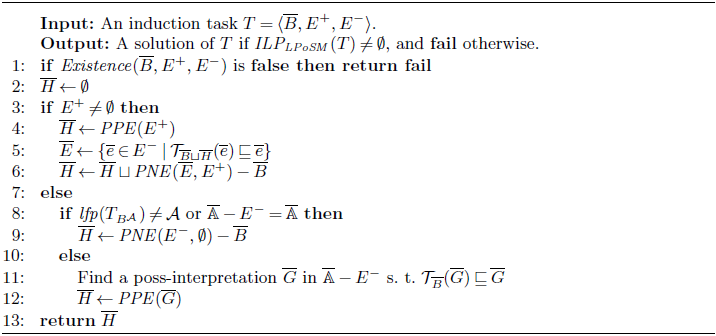
If the set of positive examples is not empty, $\mathit{PPE}(E^+)$
in line (4) and
$\mathit{PPE}(E^+)$
in line (4) and $\mathit{PNE}(\overline {E},E^+)$
in line (6) respectively ensure that condition (G1) and condition (G2) in Definition 3.1 are achieved. By Proposition 3.4, negative example satisfying
$\mathit{PNE}(\overline {E},E^+)$
in line (6) respectively ensure that condition (G1) and condition (G2) in Definition 3.1 are achieved. By Proposition 3.4, negative example satisfying ${\mathcal{T}}_{\overline {B} \sqcup \overline {H}}(\overline {e}) \not \sqsubseteq \overline {e}$
does not require further consideration. Thus, such negative examples are eliminated in line (6). When
${\mathcal{T}}_{\overline {B} \sqcup \overline {H}}(\overline {e}) \not \sqsubseteq \overline {e}$
does not require further consideration. Thus, such negative examples are eliminated in line (6). When $E^+ \neq \emptyset$
, condition (G2) in Definition 3.1 is guaranteed by either
$E^+ \neq \emptyset$
, condition (G2) in Definition 3.1 is guaranteed by either $\mathit{PNE}(E^-,\emptyset )$
in line (9) or
$\mathit{PNE}(E^-,\emptyset )$
in line (9) or $\mathit{PPE}(\overline {G})$
in line (12).
$\mathit{PPE}(\overline {G})$
in line (12).
Consider the following example.
Example 4.1.
Let $T_{31} = {\langle {\overline {B}, E^+, E^-}\rangle }$
be an induction task, where
$T_{31} = {\langle {\overline {B}, E^+, E^-}\rangle }$
be an induction task, where $\overline {B} = \{ (p \leftarrow q, 0.3), (q \leftarrow \textit {not} \, r, 0.5) \}$
,
$\overline {B} = \{ (p \leftarrow q, 0.3), (q \leftarrow \textit {not} \, r, 0.5) \}$
, $E^+ = \{ \{ (r, 0.3) \} \}$
and
$E^+ = \{ \{ (r, 0.3) \} \}$
and $E^- = \{ \{ (q, 0.3), (r, 0.5) \}, \{ (p, 0.3), (q, 0.5) \} \}$
. Then
$E^- = \{ \{ (q, 0.3), (r, 0.5) \}, \{ (p, 0.3), (q, 0.5) \} \}$
. Then ${\mathcal{A}} = \{ p,q,r \}$
,
${\mathcal{A}} = \{ p,q,r \}$
, ${\mathcal{Q}} = \{ 0.3, 0.5 \}$
and
${\mathcal{Q}} = \{ 0.3, 0.5 \}$
and $0.3 \leq 0.5$
. For the input
$0.3 \leq 0.5$
. For the input $T_{31}$
, we can trace the algorithm as follows.
$T_{31}$
, we can trace the algorithm as follows.
-
• In line (1),
$\mathit{Existence}(\overline {B}, E^+, E^-)$
returns
true
. -
• Line (4) is executed as
$E^+ \neq \emptyset$
. Then
$\overline {H}$
is assigned the poss-NLP
$\mathit{PPE}(E^+) = \{ (r \leftarrow \textit {not} \, p, \textit {not} \, q, 0.3) \}$
. -
• In line (5),
$\overline {E} = \{ (p, 0.3), (q, 0.5) \}$
. -
• In line (6), let
$\overline {H} = \{ (r \leftarrow \textit {not} \, p, \textit {not} \, q, 0.3), (r \leftarrow p, q, \textit {not} \, r, 0.3) \}$
as
$\mathit{PNE}(\overline {E},E^+) = \mathit{PNE}(\{ (p, 0.3), (q, 0.5) \})$
is assigned
$\{ (r \leftarrow p, q, \textit {not} \, r, 0.5) \}$
. -
• In line (13), the solution
$\overline {H} = \{ (r \leftarrow \textit {not} \, p, \textit {not} \, q, 0.3), (r \leftarrow p, q, \textit {not} \, r, 0.5) \}$
is returned in the end.









It is easy to see that $\{ (r \leftarrow \textit {not} \, p, \textit {not} \, q, 0.3), (r \leftarrow p, q, \textit {not} \, r, 0.5) \} \in \mathit{ILP_{LPoSM}}(T_{31})$
.
$\{ (r \leftarrow \textit {not} \, p, \textit {not} \, q, 0.3), (r \leftarrow p, q, \textit {not} \, r, 0.5) \} \in \mathit{ILP_{LPoSM}}(T_{31})$
.
We note that, in the definition of $\mathit{PNE}(\overline {E},E^+)$
in Equation (5), the head
$\mathit{PNE}(\overline {E},E^+)$
in Equation (5), the head $x$
of the rule
$x$
of the rule $(x \leftarrow I, \textit {not} \, ({\mathcal{A}} - I), \mu )$
is an arbitrary element in
$(x \leftarrow I, \textit {not} \, ({\mathcal{A}} - I), \mu )$
is an arbitrary element in ${\mathcal{A}} - I$
, which is sufficient to guarantee that the output of Algorithm 2 is an induction solution. However, for different choices of the head
${\mathcal{A}} - I$
, which is sufficient to guarantee that the output of Algorithm 2 is an induction solution. However, for different choices of the head $x$
, we may come up with different induction solutions.
$x$
, we may come up with different induction solutions.
Proposition 4.1 (Correctness of algorithm ILPSM). For an induction task $T = {\langle {\overline {B}, E^+, E^-}\rangle }$
, algorithm ilpsm returns
fail
when
$T = {\langle {\overline {B}, E^+, E^-}\rangle }$
, algorithm ilpsm returns
fail
when $\mathit{ILP_{LPoSM}}(T) = \emptyset$
. Otherwise, it returns a solution of
$\mathit{ILP_{LPoSM}}(T) = \emptyset$
. Otherwise, it returns a solution of $T$
.
$T$
.
We note that checking the existence of induction solutions and the subset relation ${\mathcal{T}}_{\overline {B} \sqcup \overline {H}}(\overline {e}) \sqsubseteq \overline {e}$
can be done in polynomial time. Also, the tasks of computing
${\mathcal{T}}_{\overline {B} \sqcup \overline {H}}(\overline {e}) \sqsubseteq \overline {e}$
can be done in polynomial time. Also, the tasks of computing $\mathit{PPE}(E^+)$
,
$\mathit{PPE}(E^+)$
, $\mathit{PNE}(\overline {E},E^+)$
are also in polynomial time. The task of line 11 can be achieved by enumerating
$\mathit{PNE}(\overline {E},E^+)$
are also in polynomial time. The task of line 11 can be achieved by enumerating $\overline G\in \overline {\mathbb A}-E^-$
and checking if
$\overline G\in \overline {\mathbb A}-E^-$
and checking if ${\mathcal{T}}_{\overline B}(\overline G)\sqsubseteq \overline G$
, which is bounded by
${\mathcal{T}}_{\overline B}(\overline G)\sqsubseteq \overline G$
, which is bounded by $O(k2^m)$
where
$O(k2^m)$
where $m=|\overline {\mathbb A}|$
and
$m=|\overline {\mathbb A}|$
and $k=|B|+|G|$
(we assume
$k=|B|+|G|$
(we assume ${\mathcal{T}}_{\overline B}(\overline G)$
is computable in linear time). Therefore, the time complexity of this algorithm is
${\mathcal{T}}_{\overline B}(\overline G)$
is computable in linear time). Therefore, the time complexity of this algorithm is $O(n2^n)$
where
$O(n2^n)$
where $n$
is the size of its input.
$n$
is the size of its input.
While algorithm ilpsm always returns an induction solution if it exists, the solution may not minimal w.r.t. the number of rules in the solution. We note that all rules in $\mathit{PPE}(E^+)$
has are negative (i. e., no positive body atoms), which causes some minimal solutions are missed in the construction process. For instance in Example 3.1, the minimal solution
$\mathit{PPE}(E^+)$
has are negative (i. e., no positive body atoms), which causes some minimal solutions are missed in the construction process. For instance in Example 3.1, the minimal solution $\overline {H_1}$
will be missed by this algorithm since the positive body of rule
$\overline {H_1}$
will be missed by this algorithm since the positive body of rule $(medA \leftarrow vomiting, \textit {not} \, medB, 1)$
is not empty.
$(medA \leftarrow vomiting, \textit {not} \, medB, 1)$
is not empty.
In the rest of this section, we introduce an algorithm that computes a minimal induction solution. This algorithm is completely different from the previous one and we need to first investigate some properties of minimal induction solutions.
Let $\alpha \in \mathcal{Q}$
and
$\alpha \in \mathcal{Q}$
and $\star \in \{\gt ,\ge , =\}$
. The
$\star \in \{\gt ,\ge , =\}$
. The $\alpha ^\star$
-relevant atoms of a possibilistic interpretation
$\alpha ^\star$
-relevant atoms of a possibilistic interpretation $\overline {I}$
, written as
$\overline {I}$
, written as ${RA}^\star (\overline {I},\alpha )$
, is defined by
${RA}^\star (\overline {I},\alpha )$
, is defined by ${RA}^\star (\overline {I},\alpha )=\{ p \mid (p,\beta )\in \overline {I}, \beta \star \alpha \}$
. Note that when
${RA}^\star (\overline {I},\alpha )=\{ p \mid (p,\beta )\in \overline {I}, \beta \star \alpha \}$
. Note that when $\star$
is the equality sign
$\star$
is the equality sign $=$
,
$=$
, ${RA}^= (\overline {I},\alpha )$
is empty if there is no atom
${RA}^= (\overline {I},\alpha )$
is empty if there is no atom $p$
such that
$p$
such that $(p,\beta )\in \overline {I}$
. So, the set
$(p,\beta )\in \overline {I}$
. So, the set ${RA}^=(\overline {I},\alpha )$
is not always be
${RA}^=(\overline {I},\alpha )$
is not always be $\{p\}$
.
$\{p\}$
.
Given a collection $A$
of sets, a set
$A$
of sets, a set $B$
is a hitting set of
$B$
is a hitting set of $A$
if
$A$
if $X \cap B \neq \emptyset$
for each
$X \cap B \neq \emptyset$
for each $X \in A$
. A hitting set
$X \in A$
. A hitting set $B$
of
$B$
of $A$
is called minimal if there exists no
$A$
is called minimal if there exists no $C \subset B$
such that
$C \subset B$
such that $C$
is still a hitting set of
$C$
is still a hitting set of $A$
. We use
$A$
. We use $\mathit{SMHS}(A)$
to denote the set of all minimal hitting sets of
$\mathit{SMHS}(A)$
to denote the set of all minimal hitting sets of $A$
. Now we can define the notion of positive solution spaces in the following definition.
$A$
. Now we can define the notion of positive solution spaces in the following definition.
Definition 4.1 (Positive solution space). Let $\overline {I}$
be a possibilistic interpretation and
$\overline {I}$
be a possibilistic interpretation and $\epsilon =(p,\alpha )$
be a poss-atom in
$\epsilon =(p,\alpha )$
be a poss-atom in $\overline {I}$
. Then
$\overline {I}$
. Then
-
1. The positive solution space of
$\epsilon$
under
$\overline {I}$
, written as
$S^+(\overline {I}, \epsilon )$
, is the following set of possibilistic rules:
(6)where
\begin{equation} \{(p\leftarrow {\textit {bd}{^+}}, \textit {not} \, {\textit {bd}{^-}}, \; \beta )\mid {\textit {bd}{^+}}\subseteq RA^\ge (\overline {I},\alpha ), {\textit {bd}{^-}}\subseteq {\mathcal{A}}-I, \text{ and for all }\beta \in W\} \end{equation}
\begin{align*} W = \left \{ \begin{array}{ll} \{ \alpha \} & , {{\textit {bd}{^+}}\cap RA^=(\overline {I},\alpha )=\emptyset ;} \\ \{ \gamma \mid \gamma \in {\mathcal{Q}}, \gamma \geq \alpha \} & , \hbox{otherwise.} \end{array} \right . \end{align*}
-
2. The positive solution space of
$\overline {I}$
, written as
$S^+(\overline {I})$
, is defined as
$\mathit{SMHS}(\{ S^+(\overline {I}, \epsilon ) \mid \epsilon \in \overline {I}\})$
.



The next propositions shows that $|P\cap S^+(\overline I,\epsilon )|=1$
for each
$|P\cap S^+(\overline I,\epsilon )|=1$
for each $P\in S^+(I)$
and
$P\in S^+(I)$
and $\epsilon \in \overline I$
.
$\epsilon \in \overline I$
.
Proposition 4.2.
Given a possibilistic interpretation $\overline {I}$
,
$\overline {I}$
, $S^+(\overline {I}) = \{ P \mid P \subseteq \cup _{\epsilon \in \overline {I}} S^+(\overline {I}, \epsilon ) \mbox{ and } \forall \epsilon \in \overline {I}, \vert P \cap S^+(\overline {I}, \epsilon ) \vert = 1 \}$
.
$S^+(\overline {I}) = \{ P \mid P \subseteq \cup _{\epsilon \in \overline {I}} S^+(\overline {I}, \epsilon ) \mbox{ and } \forall \epsilon \in \overline {I}, \vert P \cap S^+(\overline {I}, \epsilon ) \vert = 1 \}$
.
Intuitively, $S^+(\overline {I})$
is a collection of all poss-NLPs containing exactly
$S^+(\overline {I})$
is a collection of all poss-NLPs containing exactly $\vert I \vert$
rules, to which each
$\vert I \vert$
rules, to which each $\epsilon \in \overline {I}$
provides exactly one rule from
$\epsilon \in \overline {I}$
provides exactly one rule from $S^+(\overline {I}, \epsilon )$
. Please note that the size of
$S^+(\overline {I}, \epsilon )$
. Please note that the size of $S^+(\overline I,\epsilon )$
is bounded by
$S^+(\overline I,\epsilon )$
is bounded by $O(k2^n)$
where
$O(k2^n)$
where $n=|{\mathcal{A}}|$
and
$n=|{\mathcal{A}}|$
and $k=|{\mathcal{Q}}|$
since there are possibly
$k=|{\mathcal{Q}}|$
since there are possibly $2^n$
number of different
$2^n$
number of different $\textit {bd}{^+}$
and
$\textit {bd}{^+}$
and $\textit {bd}{^-}$
in Equation (6). Thus, the size of
$\textit {bd}{^-}$
in Equation (6). Thus, the size of $S^+(\overline I)$
is bounded by
$S^+(\overline I)$
is bounded by $O((n2^n)^m)=O(n^m\times 2^{nm})$
where
$O((n2^n)^m)=O(n^m\times 2^{nm})$
where $n=|\overline I|+|{\mathcal{Q}}|$
and
$n=|\overline I|+|{\mathcal{Q}}|$
and $m=|\overline I|$
.
$m=|\overline I|$
.
Let us look at some examples of $S^+(\overline {I}, \epsilon )$
and
$S^+(\overline {I}, \epsilon )$
and $S^+(\overline {I})$
.
$S^+(\overline {I})$
.
Example 4.2.
Given ${\mathcal{A}} = \{ p,q,r \}$
,
${\mathcal{A}} = \{ p,q,r \}$
, ${\mathcal{Q}} = \{ 0.3, 0.5 \}$
and
${\mathcal{Q}} = \{ 0.3, 0.5 \}$
and $0.3 \leq 0.5$
, let
$0.3 \leq 0.5$
, let $\overline {I} = \{ (r, 0.3) \}$
and
$\overline {I} = \{ (r, 0.3) \}$
and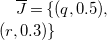 $\overline {J} = \{ (q, 0.5), (r, 0.3) \}$
. Then
$\overline {J} = \{ (q, 0.5), (r, 0.3) \}$
. Then
-
•
$S^+(\overline {I}, (r, 0.3)) = \{ (r \leftarrow r, 0.3),\ (r \leftarrow r, 0.5),\ (r \leftarrow r, \textit {not} \, p, 0.3),\ (r \leftarrow r, \textit {not} \, p, 0.5),$
$(r \leftarrow r, \textit {not} \, q, 0.3),\ (r \leftarrow r, \textit {not} \, q, 0.5),\ (r \leftarrow r, \textit {not} \, p, \textit {not} \, q, 0.3),\ (r \leftarrow r, \textit {not} \, q, \textit {not} \, q, 0.5), (r \leftarrow , 0.3), (r \leftarrow \textit {not} \, p, 0.3), (r \leftarrow \textit {not} \, q, 0.3), (r \leftarrow \textit {not} \, p, \textit {not} \, q, 0.3)$
, -
•
$S^+(\overline {J}, (q, 0.5)) = \{ (q \leftarrow q, 0.5), (q \leftarrow q, \textit {not} \, p, 0.5), (q \leftarrow , 0.5), (q \leftarrow \textit {not} \, p, 0.5) \}$
, -
•
$S^+(\overline {J}, (r, 0.3)) = \{ (r \leftarrow r, 0.3),\, (r \leftarrow r, 0.5),\, (r \leftarrow r, q, 0.3), (r \leftarrow r, q, 0.5),\, (r \leftarrow , 0.3), (r \leftarrow q, 0.3),\ (r \leftarrow r, \textit {not} \, p, 0.3),\ (r \leftarrow r, \textit {not} \, p, 0.5),\ (r \leftarrow r, q, \textit {not} \, p, 0.3),\ (r \leftarrow r, q, \textit {not} \, p, 0.5), (r \leftarrow \textit {not} \, p, 0.3), (r \leftarrow q, \textit {not} \, p, 0.3) \}$
.




As $\overline {I}$
contains exactly one element, we have
$\overline {I}$
contains exactly one element, we have $S^+(\overline {I}) = \{ \{ \overline {r} \} \mid \overline {r} \in S^+(\overline {I}, (r, 0.3)) \}$
. As
$S^+(\overline {I}) = \{ \{ \overline {r} \} \mid \overline {r} \in S^+(\overline {I}, (r, 0.3)) \}$
. As $\vert S^+(\overline {J}, (q, 0.5)) \vert = 4$
and
$\vert S^+(\overline {J}, (q, 0.5)) \vert = 4$
and $\vert S^+(\overline {J}, (r, 0.3)) \vert = 12$
,
$\vert S^+(\overline {J}, (r, 0.3)) \vert = 12$
, $S^+(\overline {J})$
has
$S^+(\overline {J})$
has $4 \times 12 = 48$
elements. For instance,
$4 \times 12 = 48$
elements. For instance, $\{ (q \leftarrow q, 0.5), (r \leftarrow r, 0.3) \} \in S^+(\overline {J})$
and
$\{ (q \leftarrow q, 0.5), (r \leftarrow r, 0.3) \} \in S^+(\overline {J})$
and $\{ (q \leftarrow q, 0.5), (r \leftarrow r, 0.5) \} \in S^+(\overline {J})$
.
$\{ (q \leftarrow q, 0.5), (r \leftarrow r, 0.5) \} \in S^+(\overline {J})$
.
The notion of positive solution space is helpful for guiding the search process for a minimal solution. The below lemma reveals a relation between the least fixpoint of a poss-definite program and the positive solution spaces.
Lemma 4.1 (Positive solution space for the least fixpoint). Let possibilistic interpretation $\overline {I}$
be the least fixpoint of a possibilistic definite logic program
$\overline {I}$
be the least fixpoint of a possibilistic definite logic program $\overline {P}$
. There exists a program
$\overline {P}$
. There exists a program $\overline {H} \subseteq \overline {P}$
such that
$\overline {H} \subseteq \overline {P}$
such that $\overline {H} \in S^+(\overline {I})$
and
$\overline {H} \in S^+(\overline {I})$
and $H$
is grounded.
$H$
is grounded.
This result can be generalized to general poss-NLPs.
Proposition 4.3 (Positive solution space for a poss-stable model). If $\overline {I} \in \mathit{PSM}(\overline {P})$
for a poss-NLP
$\overline {I} \in \mathit{PSM}(\overline {P})$
for a poss-NLP $\overline {P}$
and a possibilistic interpretation
$\overline {P}$
and a possibilistic interpretation $\overline {I}$
, then there exists
$\overline {I}$
, then there exists $\overline {H} \subseteq \overline {P}$
such that
$\overline {H} \subseteq \overline {P}$
such that $\overline {H} \in S^+(\overline {I})$
and
$\overline {H} \in S^+(\overline {I})$
and $H^I$
is grounded.
$H^I$
is grounded.
By Definition 4.1, it is straightforward to get $\overline {H} \in S^+(\overline {I})$
in Proposition 4.3. The next step is to check whether
$\overline {H} \in S^+(\overline {I})$
in Proposition 4.3. The next step is to check whether $H^I$
is grounded. As each stable model has at least one acyclic support graph (Cabalar and Muñiz Reference Cabalar and Muñiz2023),Footnote 2 Proposition 4.4 provides a default method for checking the groundness of
$H^I$
is grounded. As each stable model has at least one acyclic support graph (Cabalar and Muñiz Reference Cabalar and Muñiz2023),Footnote 2 Proposition 4.4 provides a default method for checking the groundness of $H^I$
via the positive loop in its support graph.
$H^I$
via the positive loop in its support graph.
Proposition 4.4 (Loops in grounded program). Let $\overline {I}$
be a possibilistic interpretation and
$\overline {I}$
be a possibilistic interpretation and $\overline {P}$
be a poss-NLP such that
$\overline {P}$
be a poss-NLP such that $\overline {P} \in S^+(\overline {I})$
. Then
$\overline {P} \in S^+(\overline {I})$
. Then $P^I$
is grounded if and only if the dependency graph of
$P^I$
is grounded if and only if the dependency graph of $P$
does not have a positive loop.
$P$
does not have a positive loop.
To characterize the impact of negative examples on minimal induction solutions, we introduce the notion of negative solution spaces. Informally, the negative solution space collects all potential rules that prevent $\overline {I} \in E^-$
from being a poss-stable model. While the positive solution space uses a minimal hitting set to ensure the outcome of each possibilistic atom in a poss-stable model, only one rule in the negative solution space (in a solution) can block the undesired poss-stable model. A negative solution space comprises two parts: one part leads to an existing interpretation bounded with an unacceptably higher necessity; and the other leads directly to an unacceptable new interpretation.
$\overline {I} \in E^-$
from being a poss-stable model. While the positive solution space uses a minimal hitting set to ensure the outcome of each possibilistic atom in a poss-stable model, only one rule in the negative solution space (in a solution) can block the undesired poss-stable model. A negative solution space comprises two parts: one part leads to an existing interpretation bounded with an unacceptably higher necessity; and the other leads directly to an unacceptable new interpretation.
Definition 4.2 (Negative solution space). Let $\overline {I}$
be a possibilistic interpretation and
$\overline {I}$
be a possibilistic interpretation and $\epsilon =(p,\alpha ) \in \overline {I}$
.
$\epsilon =(p,\alpha ) \in \overline {I}$
.
-
1. The negative solution space of
$\epsilon$
under
$\overline {I}$
, written as
$S^-(\overline {I}, \epsilon )$
, is the following set of possibilistic rules:
(7)
\begin{equation} \{(p\leftarrow {\textit {bd}{^+}}, \textit {not} \, {\textit {bd}{^-}}, \quad \beta )\mid {\textit {bd}{^+}}\subseteq RA^\gt (\overline {I},\alpha ), {\textit {bd}{^-}}\subseteq {\mathcal{A}}-I, \beta \in {\mathcal{Q}}, \beta \gt \alpha \}. \end{equation}
-
2. The negative solution space of
$\overline {I}$
, written as
$S^-(\overline {I})$
, is defined as
(8)
\begin{equation} \left(\bigcup _{\epsilon \in \overline {I}}S^-(\overline {I}, \epsilon )\right) \cup \{(p\leftarrow {\textit {bd}{^+}}, \textit {not} \, {\textit {bd}{^-}}, \quad \beta )\mid p \notin I, {\textit {bd}{^+}}\subseteq I, {\textit {bd}{^-}}\subseteq {\mathcal{A}}-I, \beta \in {\mathcal{Q}} \} \end{equation}


Please note that the size of $S^-(\overline I,\epsilon )$
is bounded by
$S^-(\overline I,\epsilon )$
is bounded by $O(k2^n)$
where
$O(k2^n)$
where $n=|{\mathcal{A}}|$
and
$n=|{\mathcal{A}}|$
and $k=|{\mathcal{Q}}|$
since there are
$k=|{\mathcal{Q}}|$
since there are $2^n$
number of different
$2^n$
number of different $\textit {bd}{^+}$
and
$\textit {bd}{^+}$
and $\textit {bd}{^-}$
. Thus, the size of
$\textit {bd}{^-}$
. Thus, the size of $S^-(\overline I)$
is bounded by
$S^-(\overline I)$
is bounded by $O(n2^n)$
where
$O(n2^n)$
where $n=|\overline I|+|{\mathcal{Q}}|$
.
$n=|\overline I|+|{\mathcal{Q}}|$
.
Example 4.3.
Let ${\mathcal{A}} = \{ p,q,r \}$
,
${\mathcal{A}} = \{ p,q,r \}$
, ${\mathcal{Q}} = \{ 0.3, 0.5 \}$
and
${\mathcal{Q}} = \{ 0.3, 0.5 \}$
and $0.3 \leq 0.5$
. For
$0.3 \leq 0.5$
. For $\overline {I} = \{ (r, 0.3) \}$
, we have
$\overline {I} = \{ (r, 0.3) \}$
, we have $S^-(\overline {I}, (r, 0.3)) = \{ (r \leftarrow ,0.5), (r \leftarrow \textit {not} \, p, 0.5), (r \leftarrow \textit {not} \, q, 0.5), (r \leftarrow \textit {not} \, p, \textit {not} \, q, 0.5) \}$
. Moreover,
$S^-(\overline {I}, (r, 0.3)) = \{ (r \leftarrow ,0.5), (r \leftarrow \textit {not} \, p, 0.5), (r \leftarrow \textit {not} \, q, 0.5), (r \leftarrow \textit {not} \, p, \textit {not} \, q, 0.5) \}$
. Moreover, $S^-(\overline {I}) = S^-(\overline {I}, (r, 0.3)) \cup \{ (a \leftarrow r, \beta ), (a \leftarrow r, \textit {not} \, p, \beta ), (a \leftarrow r, \textit {not} \, q, \beta ), (a \leftarrow r, \textit {not} \, p, \textit {not} \, q, \beta ), (a \leftarrow ,\beta ), (a \leftarrow \textit {not} \, p, \beta ), (a \leftarrow \textit {not} \, q, \beta ), (a \leftarrow \textit {not} \, p, \textit {not} \, q, \beta ) \}$
where
$S^-(\overline {I}) = S^-(\overline {I}, (r, 0.3)) \cup \{ (a \leftarrow r, \beta ), (a \leftarrow r, \textit {not} \, p, \beta ), (a \leftarrow r, \textit {not} \, q, \beta ), (a \leftarrow r, \textit {not} \, p, \textit {not} \, q, \beta ), (a \leftarrow ,\beta ), (a \leftarrow \textit {not} \, p, \beta ), (a \leftarrow \textit {not} \, q, \beta ), (a \leftarrow \textit {not} \, p, \textit {not} \, q, \beta ) \}$
where $\beta \in \{ 0.3, 0.5 \}$
and
$\beta \in \{ 0.3, 0.5 \}$
and $a \in \{ p,q \}$
.
$a \in \{ p,q \}$
.
For $\overline {J} = \{ (p, 0.3), (q, 0.5) \}$
,
$\overline {J} = \{ (p, 0.3), (q, 0.5) \}$
, $S^-(\overline {J})$
can be constructed similarly. For instance, we have
$S^-(\overline {J})$
can be constructed similarly. For instance, we have $\{ (p \leftarrow \textit {not} \, r, 0.5), (p \leftarrow q, 0.5), (r \leftarrow , 0.5), (r \leftarrow , 0.3) \} \subseteq S^-(\overline {J})$
.
$\{ (p \leftarrow \textit {not} \, r, 0.5), (p \leftarrow q, 0.5), (r \leftarrow , 0.5), (r \leftarrow , 0.3) \} \subseteq S^-(\overline {J})$
.
Lemma 4.2 (Incoherent interpretation for a poss-NLP). For a possibilistic interpretation $\overline {I}$
and poss-NLP
$\overline {I}$
and poss-NLP $\overline {P}$
,
$\overline {P}$
, $\overline {I}$
is incoherent for
$\overline {I}$
is incoherent for $\overline {P}$
if and only if
$\overline {P}$
if and only if $\overline {P} \cap S^-(\overline {I}) \neq \emptyset$
.
$\overline {P} \cap S^-(\overline {I}) \neq \emptyset$
.
Lemma 4.2 connects the incoherency and the negative solution space. Combining both $S^-(\overline {I})$
and
$S^-(\overline {I})$
and $S^+(\overline {I})$
, we have the following result, which provides a characterization of poss-stable models. Intuitively,
$S^+(\overline {I})$
, we have the following result, which provides a characterization of poss-stable models. Intuitively, $\overline {I}$
being a poss-stable model of
$\overline {I}$
being a poss-stable model of $\overline {P}$
if and only if (i)
$\overline {P}$
if and only if (i) $\overline {P}$
does not contain any superfluous support for
$\overline {P}$
does not contain any superfluous support for $\overline {I}$
, and (ii)
$\overline {I}$
, and (ii) $\overline {P}$
provides sufficient support for
$\overline {P}$
provides sufficient support for $\overline {I}$
.
$\overline {I}$
.
Theorem 4.1 (Conditions for a poss-stable model). Let $\overline {P}$
be a poss-NLP,
$\overline {P}$
be a poss-NLP, $\overline {I}$
a possibilistic interpretation.
$\overline {I}$
a possibilistic interpretation. $\overline {I} \in \mathit{PSM}(\overline {P})$
if and only if
$\overline {I} \in \mathit{PSM}(\overline {P})$
if and only if
-
(c1)
$\overline {P} \cap S^-(\overline {I}) = \emptyset$
, and
-
(c2) there exists
$\overline {H} \subseteq \overline {P}$
such that
$\overline {H} \in S^+(\overline {I})$
and
$H^I$
is grounded.



By Theorem 4.1, we have the following corollary.
Corollary 4.1 (Negative examples for a solution). Let $T = {\langle {\overline {B}, E^+, E^-}\rangle }$
be an induction task and
$T = {\langle {\overline {B}, E^+, E^-}\rangle }$
be an induction task and $\overline {H}$
be a poss-NLP such that
$\overline {H}$
be a poss-NLP such that $\overline {H} \in \mathit{ILP_{LPoSM}}(T)$
. If
$\overline {H} \in \mathit{ILP_{LPoSM}}(T)$
. If $\overline {P} = \overline {B} \sqcup \overline {H}$
, then the following two statements hold.
$\overline {P} = \overline {B} \sqcup \overline {H}$
, then the following two statements hold.
-
(i)
$\overline {I} \in E^-$
if and only if at least one of the two conditions (c1) or (c2) in Theorem
4.1
does not hold.
-
(ii) The condition (c2) in Theorem 4.1 does not hold when
$\overline {I} = \{ (a,\mu ) \mid a \in {\mathcal{A}} \} \in E^-$
where
$\mu$
is the supremum of
$\mathcal{Q}$
in
$({\mathcal{Q}},\le )$
.




Proposition 4.5 shows that every rule in a minimal solution must directly affect at least a positive example or a negative example. Besides, the necessity of each rule has a certain degree of freedom within the corresponding solution spaces.
Proposition 4.5 (Rules in a minimal solution). Let $\overline {H}$
be a minimal solution for an induction task
$\overline {H}$
be a minimal solution for an induction task $T = {\langle {\overline {B}, E^+, E^-}\rangle }$
. For any
$T = {\langle {\overline {B}, E^+, E^-}\rangle }$
. For any $\overline {r} \in \overline {H}$
-
(i) there exists
$\overline {I} \in E^+$
and
$\epsilon \in \overline {I}$
such that
$\overline {r} \in S^+(\overline {I}, \epsilon )$
, or
-
(ii) there exists
$\overline {J} \in E^-$
such that
$\overline {r} \in S^-(\overline {J})$
.


We are now ready to present algorithm ilpsmmin, Algorithm 3, for computing a minimal solution for an induction task (i. e. with a minimum number of rules), if there is a solution. Please note that the algorithm does not directly deal with atoms. The order in which the (positive and negative) examples are processed is not very relevant to its efficiency.
ilpsmmin $(\overline {B}, E^+, E^-)$
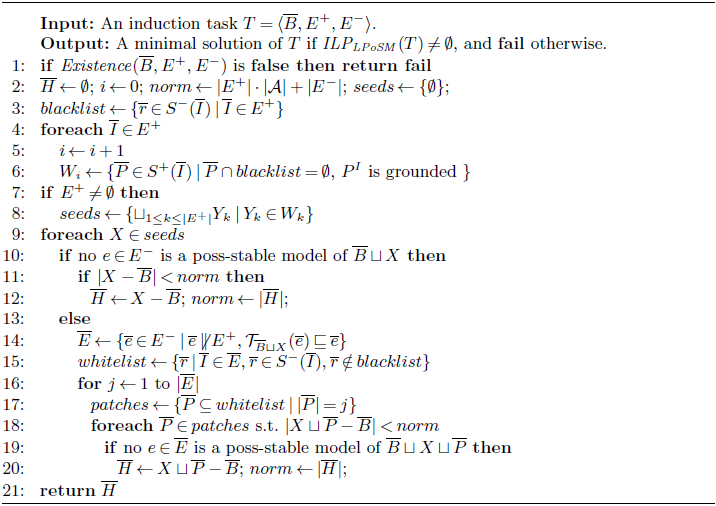
The algorithm ilpsmmin first collects poss-programs that cover positive examples in $E^+$
in lines 4–8 and then in lines 9–20, the resulting poss-programs are checked to make sure that no negative examples in
$E^+$
in lines 4–8 and then in lines 9–20, the resulting poss-programs are checked to make sure that no negative examples in $E^-$
are covered and if yes, they are expanded and the minimality is guaranteed.
$E^-$
are covered and if yes, they are expanded and the minimality is guaranteed.
Below is a legend for the variables used in the algorithm.
-
-
$\overline {H}$
: The minimal solution returned by the algorithm if it exists. -
-
$norm$
: The number of rules in the minimal solution. -
-
$seeds$
: The set of poss-NLPs supporting the set
$E^+$
of positive examples. When
$E^+ = \emptyset$
, the
$seeds$
comprises
$\emptyset$
so that the following analysis of the
$E^-$
can go on. -
-
$blacklist$
: Rules in those poss-NLPs that make a positive example uncovered. -
-
$W_i$
: The set of poss-NLPs supporting the
$i$
-th positive example. -
-
$whitelist$
: Rules in poss-NLPs that cover a negative example in
$\overline {E}$
. -
-
$patches$
: A candidate patch for a preliminary hypothesis
$X$
to block the negative examples that are covered.


We briefly explain each step in the algorithm as follows.
-
- Line 1: Checking the existence of an induction solution;
-
- Line 2: Initialize the global variables (especially,
$norm$
is set to an upper bound of the rule numbers in induction solutions); -
- Line 3: According to the negative solution space, find a set of rules that cannot appear in the induction solution and assign the set to the variable
$blacklist$
; -
- Lines 4–6: Iterate through each positive example
$\overline {I}$
in
$E^+$
, ensuring that each positive example corresponds to a set
$W_i$
of poss-NLPs that covers
$\overline {I}$
with the minimum number of rules; -
- Lines 7–8: If the set of positive examples is not empty, update the
$seeds$
by combining poss-programs that cover each positive example into a poss-program that covers the whole
$E^+$
; -
- Line 9: Iterate through each poss-NLP
$X$
in
$seeds$
; -
- Lines 10–12: If the coverage requirements of the negative examples have been met, then
$X - \overline {B}$
is an induction solution; if this induction solution has fewer rules than all other induction solutions that have been examined, set this solution as the new candidate for the minimal solution; -
- Line 13: If the coverage requirements of the negative examples have not been met, iteratively add rules in
$whitelist$
to the candidate solution in lines 14–20; -
- Line 14: Select negative examples that violate conditions w.r.t. the candidate solution.
-
- Line 15: Based in the negative examples obtained in line 14, collect those rules that can potentially be added to the candidate solution to construct a solution finally.
-
- Line 16: Iterate through the integer
$j$
from
$1$
to
$\vert \overline {E} \vert$
. -
- Line 17: Pick up only those poss-programs having exactly
$j$
rules from the
$whitelist$
; -
- Line 18: Check only those poss-programs in
$patches$
whose number of rules is less than the number of rules of the current candidate (otherwise, it is not minimal even if it can leads to a solution). -
- Line 19–20: If the condition for
$E^-$
in the definition of induction solutions is satisfied, then the current candidate solution is a solution. Moreover, if the number of rules in this solution is less than the value in
$norm$
, the new solution is set as the latest candidate for a minimal solution. -
- Line 21: Return a minimal solution
$\overline {H}$
.


Note that the operator $\sqcup$
can not be replaced by
$\sqcup$
can not be replaced by $\cup$
in the algorithm. Otherwise, the algorithm may be incorrect for some inputs. To see this, let us look at the following example.
$\cup$
in the algorithm. Otherwise, the algorithm may be incorrect for some inputs. To see this, let us look at the following example.
Example 4.4.
Consider the induction task $T = {\langle {\emptyset , E^+, \emptyset }\rangle }$
, where
$T = {\langle {\emptyset , E^+, \emptyset }\rangle }$
, where $E^+ = \{ \overline {I_1}, \overline {I_2} \} = \{ \{ (p, 0.3), (q, 0.3), (r, 0.1) \}, \{ (p, 0.3), (q, 0.3), (s, 0.5) \} \}$
. According to the algorithm ilpsmmin, we can take
$E^+ = \{ \overline {I_1}, \overline {I_2} \} = \{ \{ (p, 0.3), (q, 0.3), (r, 0.1) \}, \{ (p, 0.3), (q, 0.3), (s, 0.5) \} \}$
. According to the algorithm ilpsmmin, we can take
-
•
$Y_1 = \{ (p \leftarrow , 0.3), (q \leftarrow p, 0.3), (r \leftarrow \textit {not} \, s, 0.1) \} \in W_1$
, and
-
•
$Y_2 = \{ (p \leftarrow , 0.3), (q \leftarrow p, 0.5), (s \leftarrow \textit {not} \, r, 0.5) \} \in W_2$
.


Let $X_{sqcup} = Y_1 \sqcup Y_2$
and
$X_{sqcup} = Y_1 \sqcup Y_2$
and $X_{cup} = Y_1 \cup Y_2$
. Then we have
$X_{cup} = Y_1 \cup Y_2$
. Then we have
-
•
$X_{sqcup} = \{ (p \leftarrow , 0.3), (q \leftarrow p, 0.5), (r \leftarrow \textit {not} \, s, 0.1), (s \leftarrow \textit {not} \, r, 0.5) \}$
, and
-
•
$X_{cup} = \{ (p \leftarrow , 0.3), (q \leftarrow p, 0.3), (q \leftarrow p, 0.5), (r \leftarrow \textit {not} \, s, 0.1), (s \leftarrow \textit {not} \, r, 0.5) \}$
.


In the algorithm, we pick up $X_{sqcup} \in seeds$
rather than
$X_{sqcup} \in seeds$
rather than $X_{cup} \in seeds$
, since the rule
$X_{cup} \in seeds$
, since the rule $(q \leftarrow p, 0.3) \in X_{cup}$
is redundant for the minimal solution at last. Besides,
$(q \leftarrow p, 0.3) \in X_{cup}$
is redundant for the minimal solution at last. Besides, $X_{cup}$
is not a poss-NLP, because the classic rule
$X_{cup}$
is not a poss-NLP, because the classic rule $q \leftarrow p.$
can be only occur at most once in a poss-NLP.
$q \leftarrow p.$
can be only occur at most once in a poss-NLP.
In the following we briefly analyze the time complexity of Algorithm 3. Assume that every elements of $\mathcal{A}$
and
$\mathcal{A}$
and $\mathcal{Q}$
have occurred in its input. Let
$\mathcal{Q}$
have occurred in its input. Let $n=|\overline B|+\sum _{\overline I\in E^+\cup E^-}|I|$
.
$n=|\overline B|+\sum _{\overline I\in E^+\cup E^-}|I|$
.
-
- Construct
$blacklist$
: The search space for constructing
$S^-(\overline {I},\epsilon )$
is exponential and thus the task of constructing
$blacklist$
is exponential
$O(n^22^n)$
since
$S^-(\overline I)$
is bounded by
$O(n2^n)$
. -
- The first loop (lines 4-6) is bounded by
$O(n^{n+1}2^{n^2})$
, which is thus the upper bound of
$|\mathit{seeds}|$
, since
$S^+(\overline I)$
is bounded by
$O(n^n2^{n^2})$
. -
- In lines 10 and 19, for each poss-interpretation in
$\overline {E}$
, a poss-stable model needs to be computed, which is in exponential time
$O(2^n)$
in the worst case since the problem of deciding if a poss-NLP has a poss-stable model is NP-complete (Nicolas et al. Reference Nicolas, Garcia, Stéphan and Lefèvre2006). Note that
$|\overline E|$
at line 14 is bounded by
$n$
, the size of
$\mathit{whitelist}$
at line 15 is bounded by
$O(n^22^n)$
and the size of
$\mathit{patches}$
at line 17 is bounded by
$O(2^{n^22^n})$
. Therefore, the loop (lines 16-20) is bounded by
$O(n\times 2^{n^22^n}\times n2^n)=O(n^22^{n^22^n+n})$
. Thus, the loop (lines 9-20) is bounded by
$O(n^n2^{n^2}\times n^22^{n^22^n+n})= O(n^{n+2}2^{n^2(2^n+1)+n})$
.




Thus, the overall time complexity of Algorithm 3 is bounded by $O(n^n2^{n^2}+n^{n+2}2^{n^2(2^n+1)+n})=O(n^{n+2}2^{n^2(2^n+1)+n})$
.
$O(n^n2^{n^2}+n^{n+2}2^{n^2(2^n+1)+n})=O(n^{n+2}2^{n^2(2^n+1)+n})$
.
Example 4.5 illustrates the main process when given the same induction task as in Example 4.1, allowing us to discern the differences between these two algorithms.
Example 4.5 (Continued from Examples 4.1–4.3). Let $T_{31} = {\langle {\overline {B}, E^+, E^-}\rangle }$
where
$T_{31} = {\langle {\overline {B}, E^+, E^-}\rangle }$
where $\overline {B} = \{ (p \leftarrow q, 0.3), (q \leftarrow \textit {not} \, r, 0.5) \}$
,
$\overline {B} = \{ (p \leftarrow q, 0.3), (q \leftarrow \textit {not} \, r, 0.5) \}$
, $E^+ = \{ \{ (r, 0.3) \} \}$
and
$E^+ = \{ \{ (r, 0.3) \} \}$
and $E^- = \{ \{ (q, 0.3), (r, 0.5) \}, \{ (p, 0.3), (q, 0.5) \} \}$
. Then we have
$E^- = \{ \{ (q, 0.3), (r, 0.5) \}, \{ (p, 0.3), (q, 0.5) \} \}$
. Then we have ${\mathcal{A}} = \{ p,q,r \}$
,
${\mathcal{A}} = \{ p,q,r \}$
, ${\mathcal{Q}} = \{ 0.3, 0.5 \}$
and
${\mathcal{Q}} = \{ 0.3, 0.5 \}$
and $0.3 \leq 0.5$
. When inputting
$0.3 \leq 0.5$
. When inputting $T_{31}$
into algorithm ilpsmmin, it can yield the minimal solution
$T_{31}$
into algorithm ilpsmmin, it can yield the minimal solution $\overline {H_{32}} = \{ (r \leftarrow , 0.3) \}$
according to the analysis as follows.
$\overline {H_{32}} = \{ (r \leftarrow , 0.3) \}$
according to the analysis as follows.
-
• In line (1): The value of
$\mathit{Existence}(\overline {B}, E^+, E^-)$
is
true
, so the algorithm continues;
-
• In line (3): According to the analysis in example 4.3 , the value of
$S^-(\{ (r, 0.3) \})$
can be determined. For example,
$(r \leftarrow , 0.5) \in blacklist$
; -
• In line (4): Let
$\overline {I} = \{ (r, 0.3) \}$
be the first positive example analyzed;
-
• In line (6): According to the analysis in example 4.2 ,
$\{ \{(r \leftarrow \textit {not} \, q, 0.3)\}, \{(r \leftarrow , 0.3)\}, \{(r \leftarrow \textit {not} \, p, \textit {not} \, q, 0.3)\} \} \subseteq W_1$
; -
• In line (8):
$\{ \{(r \leftarrow \textit {not} \, q, 0.3)\}, \{(r \leftarrow , 0.3)\}, \{(r \leftarrow \textit {not} \, p, \textit {not} \, q, 0.3)\}\} \subseteq seeds$
; -
• In line (9): Assume
$\{(r \leftarrow \textit {not} \, q, 0.3)\}$
enters the loop first, that is
$X = \{(r \leftarrow \textit {not} \, q, 0.3)\}$
; -
• In line (10):
$E^- \cap \mathit{PSM}(\overline {B} \sqcup X) = \{ \{ (p, 0.3), (q, 0.5) \} \} \neq \emptyset$
, that is the condition in line (10) does not satisfy but the condition in line (13) satisfies, so lines (11-12) will be skipped and the algorithm jumps to lines (14-20);
-
• In line (14): Since
$\{ (q, 0.3), (r, 0.3) \} \parallel E^+$
,
$\overline {E}$
is assigned the value
$\{ \{ (p, 0.3), (q, 0.5) \} \}$
; -
• In line (15): Now only
$\{ (p, 0.3), (q, 0.5) \} \in \overline {E}$
, so
$\overline {I}$
can only take
$\{ (p, 0.3), (q, 0.5) \}$
. Since
$\{ (r \leftarrow , 0.5), (p \leftarrow q, 0.5), (r \leftarrow p, 0.3) \} \subseteq S^-(\overline {I})$
and
$(r \leftarrow , 0.5) \in blacklist$
, it follows that
$\{ (p \leftarrow q, 0.5), (r \leftarrow p, 0.3) \} \subseteq whitelist$
; -
• In line (16): Now
$j$
can only take the value 1, so this loop executes only once;
-
• In line (17):
$\{ \{(p \leftarrow q, 0.5)\}, \{(r \leftarrow p, 0.3)\} \} \subseteq patches$
; -
• In line (18): Assume
$\{(p \leftarrow q, 0.5)\}$
enters the loop first, that is let
$\overline {P} = \{(p \leftarrow q, 0.5)\}$
; -
• In line (19): Two conditions are both fulfilled;
-
• In line (20):
$\overline {H}$
is updated from initial
$\emptyset$
to
$\{ (r \leftarrow \textit {not} \, q, 0.3), (p \leftarrow q, 0.5) \}$
, while
$norm$
is updated from initial value to
$2$
; -
• In lines (18-20): Continue looping through the other poss-NLPs in
$patches$
, but the condition
$\vert X \sqcup \overline {P} - \overline {B} \vert \lt norm$
remains false regardless of how
$X$
is assigned afterwards. Therefore, execution jumps back to line (9) since the update operation in line (20) will not execute again until the loop ends;
-
• In line (9): Assume
$\{(r \leftarrow , 0.3)\}$
consequently enters the loop, that is let
$X = \{(r \leftarrow , 0.3)\}$
; -
• In line (10): Jump to line (11) since
$E^- \cap \mathit{PSM}(\overline {B} \sqcup X) = \emptyset$
; -
• In line (11): Jump to line (12) since
$\vert X - \overline {B} \vert = 1 \lt 2$
; -
• In line (12):
$\overline {H}$
is updated to
$\{(r \leftarrow , 0.3)\}$
, and
$norm$
is updated to
$1$
, then jump back to line (9) to continue the subsequent loop;
-
• In line (9): Jump to line (21) since the subsequent loop can no longer find a solution whose total number is less than
$1$
; -
• In line (21): Return the minimal solution
$\overline {H} = \{(r \leftarrow , 0.3)\}$
;




































It is evident that $\emptyset$
is not a solution. A minimal solution yielded by algorithm ilpsmmin contains only one rule. In contrast, the solution yielded by algorithm ilpsm contains two rules.
$\emptyset$
is not a solution. A minimal solution yielded by algorithm ilpsmmin contains only one rule. In contrast, the solution yielded by algorithm ilpsm contains two rules.
To see a more general case, let us revisit Example
3.1
. When $T_1$
is fed to algorithm ilpsmmin, it can return a minimal solution.
$T_1$
is fed to algorithm ilpsmmin, it can return a minimal solution.
 \begin{equation*} \overline {H} = \{ (medA \leftarrow vomiting, \textit {not} \, medB, 1) \} . \end{equation*}
This hypothesis means that the specialist absolutely suggests prescribing medicine A if the patient vomits and has not taken medicine B. In contrast, algorithm ilpsm must yield a solution with 10 rules. When $T_1$
is inputted into algorithm ilpsm,
$T_1$
is inputted into algorithm ilpsm, $\mathit{PPE}(E^+)$
in line (4) is constructed as the following poss-NLP
$\mathit{PPE}(E^+)$
in line (4) is constructed as the following poss-NLP
 \begin{equation*} \left \{ \begin{array}{c} (pregnancy \leftarrow \textit {not} \, medB, 1), (vomiting \leftarrow \textit {not} \, medB, 1), \\ (medA \leftarrow \textit {not} \, medB, 1), (\mathit{relief} \leftarrow \textit {not} \, medB, 0.7), \\ (malnutrition \leftarrow \textit {not} \, medB, 0.7), (pregnancy \leftarrow \textit {not} \, medA, 1), \\ (vomiting \leftarrow \textit {not} \, medA, 1), (medB \leftarrow \textit {not} \, medA, 1), \\ (\mathit{relief} \leftarrow \textit {not} \, medA, 0.6), (malnutrition \leftarrow \textit {not} \, medA, 0.1) \end{array} \right \}. \end{equation*}
After assigning $\mathit{PPE}(E^+)$
to
$\mathit{PPE}(E^+)$
to $\overline {H}$
in this step,
$\overline {H}$
in this step, $\overline {H}$
remains unchanged as
$\overline {H}$
remains unchanged as $\overline {E} = \emptyset$
and then
$\overline {E} = \emptyset$
and then $\overline {H} \sqcup \mathit{PNE}(\overline {E},E^+) - \overline {B} = \overline {H}$
.
$\overline {H} \sqcup \mathit{PNE}(\overline {E},E^+) - \overline {B} = \overline {H}$
.
As demonstrated in the example, the algorithm ilpsmmin has a certain degree of randomness such as the variable order of values in line (9). But this does not hinder the algorithm from achieving the desired goal, that is the returned poss-NLP is guaranteed to be a minimal solution of the induction task.
Proposition 4.6 (Correctness of algorithm ILPSMmin). For an induction task $T = {\langle {\overline {B}, E^+, E^-}\rangle }$
, algorithm ilpsmmin returns
fail
when
$T = {\langle {\overline {B}, E^+, E^-}\rangle }$
, algorithm ilpsmmin returns
fail
when $\mathit{ILP_{LPoSM}}(T) = \emptyset$
. Otherwise, algorithm ilpsmmin returns a minimal solution of
$\mathit{ILP_{LPoSM}}(T) = \emptyset$
. Otherwise, algorithm ilpsmmin returns a minimal solution of $T$
.
$T$
.
In this section, we have introduced two algorithms ilpsm for computing an induction solution and ilpsmmin for computing a minimal induction solution. The time complexity of algorithms ilpsm (resp. ilpsmmin) is bounded by $O(n2^n)$
(resp.
$O(n2^n)$
(resp. $O(n^{n+2}2^{n^2(2^n+1)+n})$
).
$O(n^{n+2}2^{n^2(2^n+1)+n})$
).
5 Variants of possibilistic induction tasks
In this section we study three variants of the induction task for possibilistic logic programs under stable models. In the first subsection, we consider two special cases of induction tasks. The first special case is when $\overline {\mathbb{U}} = E^+\cup E^-$
, that is, each atom is either a positive sample or a negative example. We provide a characterization of induction solutions through poss-stable models. The second special case is when input programs are only ordinary NLPs for an induction task for poss-NLPs. In this case, the definition of induction tasks for poss-NLPs collapses to the induction for ordinary NLPs. In the second subsection, we consider the generalization of induction tasks for poss-NLPs by allowing partial interpretations. Interestingly, we show that such a generalized induction task can be equivalently reduced to an induction task as defined in Definition 3.1.
$\overline {\mathbb{U}} = E^+\cup E^-$
, that is, each atom is either a positive sample or a negative example. We provide a characterization of induction solutions through poss-stable models. The second special case is when input programs are only ordinary NLPs for an induction task for poss-NLPs. In this case, the definition of induction tasks for poss-NLPs collapses to the induction for ordinary NLPs. In the second subsection, we consider the generalization of induction tasks for poss-NLPs by allowing partial interpretations. Interestingly, we show that such a generalized induction task can be equivalently reduced to an induction task as defined in Definition 3.1.
5.1 Two special cases of induction tasks for poss-NLPs
In the definition of induction tasks (Definition 3.1), we observe that the union $E^+ \cup E^-$
of positive and negative examples may not be the whole set
$E^+ \cup E^-$
of positive and negative examples may not be the whole set $\overline {\mathbb{U}}$
of atoms. However, if
$\overline {\mathbb{U}}$
of atoms. However, if $\overline {\mathbb{U}} = E^+ \cup E^-$
, we can show that the solutions of such induction tasks have a simple characterization.
$\overline {\mathbb{U}} = E^+ \cup E^-$
, we can show that the solutions of such induction tasks have a simple characterization.
Under the condition $\overline {\mathbb{U}} = E^+ \cup E^-$
, we need only to specify the set
$\overline {\mathbb{U}} = E^+ \cup E^-$
, we need only to specify the set $E^+$
of positive examples as
$E^+$
of positive examples as $E^- = \overline {\mathbb{U}} - E^+$
. Thus, we have the following definition.
$E^- = \overline {\mathbb{U}} - E^+$
. Thus, we have the following definition.
Definition 5.1 (Induction task from complete poss-stable models). An induction task from complete poss-stable models is a tuple $T = {\langle { \overline {B}, E^+}\rangle }$
where poss-NLP
$T = {\langle { \overline {B}, E^+}\rangle }$
where poss-NLP $\overline {B}$
is the background knowledge,
$\overline {B}$
is the background knowledge, $E^+$
is a set of possibilistic interpretations called the positive examples. A hypothesis
$E^+$
is a set of possibilistic interpretations called the positive examples. A hypothesis $\overline {H}$
belongs to the set of induction solutions of
$\overline {H}$
belongs to the set of induction solutions of $T$
, written as
$T$
, written as $\overline {H} \in \mathit{ILP_{LCPoSM}}(T)$
, if
$\overline {H} \in \mathit{ILP_{LCPoSM}}(T)$
, if $E^+ = \mathit{PSM}(\overline {B} \sqcup \overline {H})$
.
$E^+ = \mathit{PSM}(\overline {B} \sqcup \overline {H})$
.
Compared to the induction task in Definition 3.1, the set $E^+$
of poss-stable models in Definition 5.1 is complete, since there is no other poss-stable model outside
$E^+$
of poss-stable models in Definition 5.1 is complete, since there is no other poss-stable model outside $E^+$
. By Theorem 3.1, it follows the below Proposition 5.1, which is a necessary and sufficient condition for the existence of a solution for an induction task from complete poss-stable models.
$E^+$
. By Theorem 3.1, it follows the below Proposition 5.1, which is a necessary and sufficient condition for the existence of a solution for an induction task from complete poss-stable models.
Proposition 5.1 (Existence of a poss-NLP solution for task in Definition 5.1). For an induction task $T = {\langle {\overline {B}, E^+}\rangle }$
from Definition
5.1
,
$T = {\langle {\overline {B}, E^+}\rangle }$
from Definition
5.1
, $\mathit{ILP_{LCPoSM}}(T) \neq \emptyset$
if and only if
$\mathit{ILP_{LCPoSM}}(T) \neq \emptyset$
if and only if
-
(C1)
$E^+$
is incomparable, and
-
(C2)
$E^+$
is coherent with
$\overline {B}$
, and
-
(C3) (i)
$\mathit{lfp}(T_{B^{\mathcal{A}}}) \neq {\mathcal{A}}$
, or (ii)
$\vert {\mathcal{Q}} \vert = 1$
and
$E^+ = \{ \overline {\mathbb{A}} \}$
, or (iii)
$\overline {\mathbb{A}} \cap E^+ \neq \emptyset$
.


Let us look at the following example.
Example 5.1.
Consider Example
5.1
again. Let $T_{41} = {\langle {\overline {B}, E^+}\rangle }$
be an induction task from complete poss-stable models where
$T_{41} = {\langle {\overline {B}, E^+}\rangle }$
be an induction task from complete poss-stable models where $\overline {B} = \{ (r \leftarrow , 0.3) \}$
and
$\overline {B} = \{ (r \leftarrow , 0.3) \}$
and $E^+ = \{ \{ (p, 0.5), (r, 0.5) \}, \{ (q, 0.3), (r, 0.8) \} \}$
. Then
$E^+ = \{ \{ (p, 0.5), (r, 0.5) \}, \{ (q, 0.3), (r, 0.8) \} \}$
. Then $E^+$
is incomparable and coherent with
$E^+$
is incomparable and coherent with $\overline {B}$
. Besides,
$\overline {B}$
. Besides, $\mathit{lfp}(T_{B^{\mathcal{A}}}) \neq {\mathcal{A}}$
holds at least. Therefore,
$\mathit{lfp}(T_{B^{\mathcal{A}}}) \neq {\mathcal{A}}$
holds at least. Therefore, $T_{41}$
must have a solution. It is easy to verify that
$T_{41}$
must have a solution. It is easy to verify that $\{ (p \leftarrow \textit {not} \, q, 0.5), (r \leftarrow \textit {not} \, q, 0.5), (q \leftarrow \textit {not} \, p, 0.3), (r \leftarrow \textit {not} \, p, 0.8) \} \in \mathit{ILP_{LCPoSM}}(T_{41})$
.
$\{ (p \leftarrow \textit {not} \, q, 0.5), (r \leftarrow \textit {not} \, q, 0.5), (q \leftarrow \textit {not} \, p, 0.3), (r \leftarrow \textit {not} \, p, 0.8) \} \in \mathit{ILP_{LCPoSM}}(T_{41})$
.
An ordinary NLP can be seen as a poss-NLP in which all rules have the same weight. An induction task for poss-NLPs degenerate to induction for ordinary NLPs when the induction goal is to induce a NLP $H$
such that
$H$
such that $E^+\subseteq \mathit{SM}(B\cup H)$
and
$E^+\subseteq \mathit{SM}(B\cup H)$
and $E^-\cap \mathit{SM}(B\cup H)=\emptyset$
in which the background
$E^-\cap \mathit{SM}(B\cup H)=\emptyset$
in which the background $B$
is a NLP, and the examples in
$B$
is a NLP, and the examples in $E^+$
and
$E^+$
and $E^-$
are interpretations. For ease of discussion, we call this kind of induction task learning NLP from stable models as LSM induction task, and use
$E^-$
are interpretations. For ease of discussion, we call this kind of induction task learning NLP from stable models as LSM induction task, and use $\mathit{ILP_{LSM}}(T)$
to denote the solution of the LSM induction task
$\mathit{ILP_{LSM}}(T)$
to denote the solution of the LSM induction task $T$
. Thus, a LSM induction task can also be solved by our two induction algorithms for poss-NLPs.
$T$
. Thus, a LSM induction task can also be solved by our two induction algorithms for poss-NLPs.
Proposition 5.2 (Existence of a NLP solution for a LSM induction task). For an induction task $T = {\langle {B, E^+, E^-}\rangle }$
,
$T = {\langle {B, E^+, E^-}\rangle }$
, $\mathit{ILP_{LSM}}(T) \neq \emptyset$
if and only if
$\mathit{ILP_{LSM}}(T) \neq \emptyset$
if and only if
-
(c1)
$E^+$
is
$\subseteq$
-incomparable, and
-
(c2)
$e \models B$
for each
$e \in E^+$
, and
-
(c3)
${\mathcal{A}} \notin E^-$
or
${\mathcal{A}} \neq \mathit{lfp}(T_{B^{\mathcal{A}}})$
, and
-
(c4)
$E^+ \cap E^- = \emptyset$
.


Example 5.2.
Let $T_{42} = {\langle {B_{med}, E^+ , \emptyset }\rangle }$
where
$T_{42} = {\langle {B_{med}, E^+ , \emptyset }\rangle }$
where $E^+ = \{ A_1, A_2 \}$
, and
$E^+ = \{ A_1, A_2 \}$
, and $B_{med}$
is the NLP from Example
1.1
. It is easy to check that
$B_{med}$
is the NLP from Example
1.1
. It is easy to check that $\{ medA \leftarrow vomiting, \textit {not} \, medB. \} \in \mathit{ILP_{LSM}}(T_{42})$
.
$\{ medA \leftarrow vomiting, \textit {not} \, medB. \} \in \mathit{ILP_{LSM}}(T_{42})$
.
In contrast, let $T_{42} = {\langle {B, \emptyset , E^-}\rangle }$
where
$T_{42} = {\langle {B, \emptyset , E^-}\rangle }$
where $E^- = \{ \{ p, q \}, \{ p \} \}$
and
$E^- = \{ \{ p, q \}, \{ p \} \}$
and $B = \{ p \leftarrow . , q \leftarrow p. \}$
. Then we have
$B = \{ p \leftarrow . , q \leftarrow p. \}$
. Then we have ${\mathcal{A}} = \{ p, q \}$
so that
${\mathcal{A}} = \{ p, q \}$
so that ${\mathcal{A}} \in E^-$
and
${\mathcal{A}} \in E^-$
and ${\mathcal{A}} = \mathit{lfp}(T_{B^{\mathcal{A}}})$
. As a result,
${\mathcal{A}} = \mathit{lfp}(T_{B^{\mathcal{A}}})$
. As a result, $\mathit{ILP_{LSM}}(T_{42}) = \emptyset$
.
$\mathit{ILP_{LSM}}(T_{42}) = \emptyset$
.
An induction task $T = {\langle {B, E^+, E^-}\rangle }$
here can be solved by a revised version of algorithm ilpsmmin since it can be regarded as a subtask of the induction task as Definition 3.1. On the other side, the induction task
$T = {\langle {B, E^+, E^-}\rangle }$
here can be solved by a revised version of algorithm ilpsmmin since it can be regarded as a subtask of the induction task as Definition 3.1. On the other side, the induction task $T = {\langle {B, E^+, E^-}\rangle }$
can also be solved by algorithm ilasp (Law et al. Reference Law, Russo and Broda2014) since a stable model can be represented as a partial interpretation. In other words, an induction task
$T = {\langle {B, E^+, E^-}\rangle }$
can also be solved by algorithm ilasp (Law et al. Reference Law, Russo and Broda2014) since a stable model can be represented as a partial interpretation. In other words, an induction task $T = {\langle {B, E^+, E^-}\rangle }$
here is both a subtask of Definition 3.1 and a subtask of the induction task solved by ilasp (Law et al. Reference Law, Russo and Broda2014). It is interesting to see which approach can solve this subtask faster, although ilasp induces non-ground answer set programs from partial interpretations while ilpsmmin induces ground poss-NLP from stable models. So we discuss the implementation of our algorithm and show the experimental comparison between these two approaches in Section 6. Additionally, a brief theoretical comparison can be found in Section 7 discussing the related work.
$T = {\langle {B, E^+, E^-}\rangle }$
here is both a subtask of Definition 3.1 and a subtask of the induction task solved by ilasp (Law et al. Reference Law, Russo and Broda2014). It is interesting to see which approach can solve this subtask faster, although ilasp induces non-ground answer set programs from partial interpretations while ilpsmmin induces ground poss-NLP from stable models. So we discuss the implementation of our algorithm and show the experimental comparison between these two approaches in Section 6. Additionally, a brief theoretical comparison can be found in Section 7 discussing the related work.
5.2 Induction from partial stable models
We first extend the definition of inductive learning for poss-NLPs by allowing partial interpretation. Recall that a partial interpretation is a pair $\langle {E^{inc}, E^{exc}}\rangle$
of two sets
$\langle {E^{inc}, E^{exc}}\rangle$
of two sets $E^{inc}$
and
$E^{inc}$
and $E^{exc}$
of atoms where
$E^{exc}$
of atoms where $E^{inc} \cap E^{exc} = \emptyset$
. Intuitively, each atom in
$E^{inc} \cap E^{exc} = \emptyset$
. Intuitively, each atom in $E^{inc}$
is true, each atom in
$E^{inc}$
is true, each atom in $E^{exc}$
is false, and each element in
$E^{exc}$
is false, and each element in ${\mathcal{A}} - E^{inc} - E^{exc}$
is unknown. If
${\mathcal{A}} - E^{inc} - E^{exc}$
is unknown. If $E^{inc} \cup E^{exc} = {\mathcal{A}}$
, the partial interpretation
$E^{inc} \cup E^{exc} = {\mathcal{A}}$
, the partial interpretation $\langle {E^{inc}, E^{exc}}\rangle$
is equivalent to the interpretation
$\langle {E^{inc}, E^{exc}}\rangle$
is equivalent to the interpretation $E^{inc}$
. An interpretation
$E^{inc}$
. An interpretation $I$
extends a partial interpretation
$I$
extends a partial interpretation $E = {\langle {E^{inc}, E^{exc}}\rangle }$
, written as
$E = {\langle {E^{inc}, E^{exc}}\rangle }$
, written as $I \propto E$
, if
$I \propto E$
, if $(E^{inc} \subseteq I) \land (E^{exc} \cap I = \emptyset )$
.
$(E^{inc} \subseteq I) \land (E^{exc} \cap I = \emptyset )$
.
The generalized notion of induction tasks for poss-NLPs is formally defined as follows.
Definition 5.2 (Induction task from partial stable models). An induction task from partial stable models is a tuple $T = {\langle {B, E^+, E^-}\rangle }$
where NLP
$T = {\langle {B, E^+, E^-}\rangle }$
where NLP $B$
is the background knowledge, two sets
$B$
is the background knowledge, two sets $E^+$
and
$E^+$
and $E^-$
of partial interpretations are respectively called the positive and negative examples. A hypothesis
$E^-$
of partial interpretations are respectively called the positive and negative examples. A hypothesis $H$
belongs to the set of induction solutions of
$H$
belongs to the set of induction solutions of $T$
, written as
$T$
, written as $H \in \mathit{ILP_{LPaSM}}(T)$
, if it achieves two aims
$H \in \mathit{ILP_{LPaSM}}(T)$
, if it achieves two aims
 \begin{align} \forall e^+ \in E^+ \exists I \in \mathit{SM}(B \cup H), I \propto e^+, \end{align}
 \begin{align} \forall e^- \in E^- \nexists I \in \mathit{SM}(B \cup H), I \propto e^-. \end{align}
We borrow an Example 5.3 in Law et al. (Reference Law, Russo and Broda2014) to illustrate the above definition.
Example 5.3.
Let $T_{43} = {\langle {B, E^+, E^-}\rangle }$
where
$T_{43} = {\langle {B, E^+, E^-}\rangle }$
where $E^+ = \{ {\langle {\{ p \}, \emptyset }\rangle }, {\langle {\{ q \}, \{ p \}}\rangle } \}$
,
$E^+ = \{ {\langle {\{ p \}, \emptyset }\rangle }, {\langle {\{ q \}, \{ p \}}\rangle } \}$
, $E^- = \{ {\langle {\{ p,q \}, \emptyset }\rangle } \}$
and
$E^- = \{ {\langle {\{ p,q \}, \emptyset }\rangle } \}$
and $B = \{ q \leftarrow r. \}$
. Then we have
$B = \{ q \leftarrow r. \}$
. Then we have ${\mathcal{A}} = \{ p, q, r \}$
,
${\mathcal{A}} = \{ p, q, r \}$
, $\mathit{SM}(B \cup H_{1}) = \{ \{ p \}, \{ q, r \} \}$
and
$\mathit{SM}(B \cup H_{1}) = \{ \{ p \}, \{ q, r \} \}$
and $\mathit{SM}(B \cup H_{2}) = \{ p, q, r \}$
where
$\mathit{SM}(B \cup H_{2}) = \{ p, q, r \}$
where $H_{1} = \{ p \leftarrow \textit {not} \, r. , r \leftarrow \textit {not} \, p. \}$
and
$H_{1} = \{ p \leftarrow \textit {not} \, r. , r \leftarrow \textit {not} \, p. \}$
and $H_{2} = \{ p \leftarrow r. , r \leftarrow . \}$
. It is easy to verify that
$H_{2} = \{ p \leftarrow r. , r \leftarrow . \}$
. It is easy to verify that $\{ p \} \propto {\langle {\{ p \}, \emptyset }\rangle }$
,
$\{ p \} \propto {\langle {\{ p \}, \emptyset }\rangle }$
, $\{ q, r \} \propto {\langle {\{ q \}, \{ p \}}\rangle }$
and
$\{ q, r \} \propto {\langle {\{ q \}, \{ p \}}\rangle }$
and $\{ p, q, r \} \propto {\langle {\{ p,q \}, \emptyset }\rangle }$
. As a result,
$\{ p, q, r \} \propto {\langle {\{ p,q \}, \emptyset }\rangle }$
. As a result, $H_{1} \in \mathit{ILP_{LPaSM}}(T_{43})$
and
$H_{1} \in \mathit{ILP_{LPaSM}}(T_{43})$
and $H_{2} \notin \mathit{ILP_{LPaSM}}(T_{43})$
.
$H_{2} \notin \mathit{ILP_{LPaSM}}(T_{43})$
.
As we can see, the induction task in Definition 5.2 and a LSM induction task reflect the same requirements. The denotation of a partial interpretation $o$
is essentially the set
$o$
is essentially the set
 \begin{equation*} \mathit{de}(o) = \{ I \in 2^{\mathcal{A}} \mid I \propto o \} \end{equation*}
of interpretations. The two induction tasks can be transformed as Proposition 5.3. See Example 5.4 for more details.
Proposition 5.3 (Transformations between induction tasks). Let $T = {\langle {B, O^+, O^-}\rangle }$
be an induction task of NLP from partial stable models. A NLP
$T = {\langle {B, O^+, O^-}\rangle }$
be an induction task of NLP from partial stable models. A NLP $H$
such that
$H$
such that $H \in \mathit{ILP_{LPaSM}}(T)$
if and only if
$H \in \mathit{ILP_{LPaSM}}(T)$
if and only if $H \in \mathit{ILP_{LSM}}(T_1)$
for some
$H \in \mathit{ILP_{LSM}}(T_1)$
for some $T_1 = {\langle {B, E^+, E^-}\rangle }$
such that
$T_1 = {\langle {B, E^+, E^-}\rangle }$
such that
-
(c1)
$E^+$
is a minimal hitting set of
$\{\mathit{de}(o) \mid o \in O^+ \}$
, written as
$E^+ \in \mathit{SMHS}(\{\mathit{de}(o) \mid o \in O^+ \})$
, and
-
(c2)
$E^- = \{ J \in \mathit{de}(o) \mid o \in O^- \}$
.




Example 5.4 (Continued from Example 5.3). We have $\{\mathit{de}(o) \mid o \in E^+ \} = \{ \{ \{ p \}, \{ p,q \}, \{ p,r \}, \{ p,q,r \} \}, \{ \{ q \}, \{ q,r \} \} \}$
,
$\{\mathit{de}(o) \mid o \in E^+ \} = \{ \{ \{ p \}, \{ p,q \}, \{ p,r \}, \{ p,q,r \} \}, \{ \{ q \}, \{ q,r \} \} \}$
, $\{ J \in \mathit{de}(o) \mid o \in E^- \} = \{ \{ p,q \}, \{ p,q,r \} \}$
and
$\{ J \in \mathit{de}(o) \mid o \in E^- \} = \{ \{ p,q \}, \{ p,q,r \} \}$
and $\{ \{ p \}, \{ q, r \} \} \in \mathit{SMHS}(\{\mathit{de}(o) \mid o \in O^+ \})$
. As a result, induction task
$\{ \{ p \}, \{ q, r \} \} \in \mathit{SMHS}(\{\mathit{de}(o) \mid o \in O^+ \})$
. As a result, induction task $T_{43}$
can generate a LSM task
$T_{43}$
can generate a LSM task $T_1 = {\langle {B, \{ \{ p \}, \{ q, r \} \}, \{ \{ p,q \}, \{ p,q,r \} \}}\rangle }$
. It is evident that
$T_1 = {\langle {B, \{ \{ p \}, \{ q, r \} \}, \{ \{ p,q \}, \{ p,q,r \} \}}\rangle }$
. It is evident that $H_{1} \in \mathit{ILP_{LSM}}(T_1)$
.
$H_{1} \in \mathit{ILP_{LSM}}(T_1)$
.
According to Proposition 5.3, an induction task $T = {\langle {B, O^+, O^-}\rangle }$
from partial stable models can be transformed into
$T = {\langle {B, O^+, O^-}\rangle }$
from partial stable models can be transformed into $\vert \mathit{SMHS}(\{\mathit{de}(o) \mid o \in O^+ \}) \vert$
induction tasks
$\vert \mathit{SMHS}(\{\mathit{de}(o) \mid o \in O^+ \}) \vert$
induction tasks $T_i = {\langle {B, E^+_i, E^-}\rangle }$
where
$T_i = {\langle {B, E^+_i, E^-}\rangle }$
where
-
•
$E^+_i$
is the
$i$
-th element in
$\mathit{SMHS}(\{\mathit{de}(o) \mid o \in O^+ \})$
, and -
•
$E^- = \{ J \in \mathit{de}(o) \mid o \in O^- \}$
.




For convenience, we use $\mathit{trans}(T)$
to denote the set of all corresponding induction tasks
$\mathit{trans}(T)$
to denote the set of all corresponding induction tasks $T_i$
deriving from induction task
$T_i$
deriving from induction task $T$
. A NLP
$T$
. A NLP $H$
is a solution of
$H$
is a solution of $T$
from partial stable models if and only if there exists
$T$
from partial stable models if and only if there exists $T_i \in \mathit{trans}(T)$
such that
$T_i \in \mathit{trans}(T)$
such that $H \in \mathit{ILP_{LSM}}(T_i)$
. Formally, we have the necessary and sufficient condition as Corollary 5.1. Example 5.5 helps to illustrate this conclusion.
$H \in \mathit{ILP_{LSM}}(T_i)$
. Formally, we have the necessary and sufficient condition as Corollary 5.1. Example 5.5 helps to illustrate this conclusion.
Corollary 5.1 (Existence of a NLP solution). Let $T = {\langle {B, O^+, O^-}\rangle }$
be an induction task of NLP from partial stable models.
$T = {\langle {B, O^+, O^-}\rangle }$
be an induction task of NLP from partial stable models. $\mathit{ILP_{LPaSM}}(T) \neq \emptyset$
if and only if there exists
$\mathit{ILP_{LPaSM}}(T) \neq \emptyset$
if and only if there exists $E^+ \in \mathit{SMHS}(\{\mathit{de}(o) \mid o \in O^+ \})$
and
$E^+ \in \mathit{SMHS}(\{\mathit{de}(o) \mid o \in O^+ \})$
and $E^- = \{ J \in \mathit{de}(o) \mid o \in O^- \}$
such that
$E^- = \{ J \in \mathit{de}(o) \mid o \in O^- \}$
such that
-
(c1)
$E^+$
is
$\subseteq$
-incomparable, and
-
(c2)
$e \models B$
for each
$e \in E^+$
, and
-
(c3)
${\mathcal{A}} \notin E^-$
or
${\mathcal{A}} \neq \mathit{lfp}(T_{B^{\mathcal{A}}})$
, and
-
(c4)
$E^+ \cap E^- = \emptyset$
.


Example 5.5.
Let $T = {\langle {B, O^+, O^-}\rangle }$
where
$T = {\langle {B, O^+, O^-}\rangle }$
where $O^+ = \{ {\langle {\{ p \}, \emptyset }\rangle } \}$
,
$O^+ = \{ {\langle {\{ p \}, \emptyset }\rangle } \}$
, $O^- = \{ {\langle {\{ p,q \}, \emptyset }\rangle } \}$
and
$O^- = \{ {\langle {\{ p,q \}, \emptyset }\rangle } \}$
and $B = \{ q \leftarrow p. \}$
. Then we have
$B = \{ q \leftarrow p. \}$
. Then we have ${\mathcal{A}} = \{ p, q \}$
,
${\mathcal{A}} = \{ p, q \}$
, $\{\mathit{de}(o) \mid o \in O^+ \} = \{ \{ \{ p \}, \{ p,q \} \} \}$
,
$\{\mathit{de}(o) \mid o \in O^+ \} = \{ \{ \{ p \}, \{ p,q \} \} \}$
, $E^- = \{ J \in \mathit{de}(o) \mid o \in O^- \} = \{ \{ p,q \} \}$
and
$E^- = \{ J \in \mathit{de}(o) \mid o \in O^- \} = \{ \{ p,q \} \}$
and $\mathit{SMHS}(\{\mathit{de}(o) \mid o \in O^+ \}) = \{ \{ \{ p \} \}, \{ \{ p,q \} \} \}$
. As a consequence,
$\mathit{SMHS}(\{\mathit{de}(o) \mid o \in O^+ \}) = \{ \{ \{ p \} \}, \{ \{ p,q \} \} \}$
. As a consequence, $\mathit{trans}(T) = \{ T_1, T_2 \}$
where
$\mathit{trans}(T) = \{ T_1, T_2 \}$
where $T_1 = {\langle {B, E^+_1, E^-}\rangle }$
,
$T_1 = {\langle {B, E^+_1, E^-}\rangle }$
, $T_2 = {\langle {B, E^+_2, E^-}\rangle } \}$
,
$T_2 = {\langle {B, E^+_2, E^-}\rangle } \}$
, $E^+_1 = \{ \{ p \} \}$
and
$E^+_1 = \{ \{ p \} \}$
and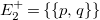 $E^+_2 = \{ \{ p,q \} \}$
. Finally,
$E^+_2 = \{ \{ p,q \} \}$
. Finally, $\mathit{ILP_{LPaSM}}(T) \neq \emptyset$
since
$\mathit{ILP_{LPaSM}}(T) \neq \emptyset$
since $\{ p \} \in E^+_1, \{ p \} \not \models B$
and
$\{ p \} \in E^+_1, \{ p \} \not \models B$
and $E^+_2 \cap E^- \neq \emptyset$
.
$E^+_2 \cap E^- \neq \emptyset$
.
6 Implementation and experiments
We have implemented a prototype for computing minimal solutions for induction tasks based on Algorithm 3. In this section, we first describe technical details of our implementation and report some preliminary experimental results, which show that our prototype significantly outperforms the baseline ilasp4 (Law Reference Law2023) when inducing ordinary NLPs.
As we have seen in the algorithm, a solver for computing poss-stable models will be called. While several algorithms for computing poss-stable models have been proposed in the literature, we have not seen any efficient implementation for computing poss-stable models. For this reason, our implementation runs only for induction tasks in ordinary NLPs. But it can be easily adapted to the case of full poss-NLPs when an efficient solver for computing poss-stable models is available.
The source code of implementation, testing datasets and experimental results are all available on Github.Footnote 3
6.1 Implementation
Our system is an implementation of the new algorithm ilpsmmin using Python 3.11.5 when all inputs are ordinary NLPs. We call this implementation as ilsmmin which is designed to solve a LSM induction task.
To describe the implementation details, let us first recall the solution space of an induction task as defined in Definitions 4.1 and 4.2. The basic idea of our algorithm is to explore various combinations of rules and find a minimal one that meets the coverage requirements for an induction task. Specifically, the algorithm is to reduce an induction task into a combinatorial optimization problem (COP for short) below.
-
• The discrete decision space
$\Omega$
of an induction task is determined by the positive solution space and negative solution space by Theorem 4.1. -
• The coverage requirements
$f(h, B, E^-) = 0$
and
$f(h, B, E^+) = \vert E^+ \vert$
act as the constraints where
$f(h, B, E) = \vert \mathit{SM}(h \cup B) \cap E \vert$
. -
• The optimization objective is to minimize
$\vert h \vert$
.





By invoking an efficient solver for computing stable models, the search process is able to efficiently discard those candidate solutions that violate some constraints or does not meet the optimization objective. The ASP solver ClingoFootnote 4 was used in our implementation.
The architecture of ilsmmin.

The architecture of our implementation is depicted in Figure 1. For an input induction task $T = {\langle {B, E^+, E^-}\rangle }$
, our algorithm consists of three main stages as follows.
$T = {\langle {B, E^+, E^-}\rangle }$
, our algorithm consists of three main stages as follows.
-
1. Check the existence of a solution by Proposition 5.2.
-
2. Compute the minimum number
$norm$
of rules that cover all positive examples by invoking Clingo only once (one shot calling). -
3. In order to satisfy all negative examples, iteratively increase the total number
$norm$
of rules by one each time. In this stage, Clingo is called for multiple times (multi-shot calling). In this way, our algorithm iteratively minimize the number of negative examples covered after explored a set of NLPs covering all positive examples. The NLP
$H$
generated in the above process is a minimal solution of
$T$
when
$f(H, B, E^-) = 0$
.



6.2 Experiment
All experiments in this section were executed on an Intel(R) CPU @ 3.60 GHz and Clingo version 5.2.2. The memory limit for each induction task is set to 5G of RAM. Similar to our algorithm ilsmmin, the contrast algorithm ilasp4 (Law Reference Law2023), as briefly discussed in Section 5.1, can also induce ordinary NLPs from stable models, although ilasp4 is originally designed to learn non-ground programs from partial interpretations.
We randomly generated three datasets of induction tasks with a total number of $440$
induction tasks. One dataset is from the medical domain (Example 3.1), where the NLP
$440$
induction tasks. One dataset is from the medical domain (Example 3.1), where the NLP $P_{med}$
represents a part of some physician’s epistemic belief. The other two datasets are from two GRNs (Arabidopsis thaliana and T-cell receptor), where the corresponding NLPs represent the dynamic systems (Inoue et al. Reference Inoue, Ribeiro and Sakama2014; Huang et al. Reference Huang, Wang, You, Zhang and Zhang2021; Ribeiro et al. Reference Ribeiro, Folschette, Magnin and Inoue2022; Hu et al. Reference Hu, Wang and Inoue2025).
$P_{med}$
represents a part of some physician’s epistemic belief. The other two datasets are from two GRNs (Arabidopsis thaliana and T-cell receptor), where the corresponding NLPs represent the dynamic systems (Inoue et al. Reference Inoue, Ribeiro and Sakama2014; Huang et al. Reference Huang, Wang, You, Zhang and Zhang2021; Ribeiro et al. Reference Ribeiro, Folschette, Magnin and Inoue2022; Hu et al. Reference Hu, Wang and Inoue2025).
The first dataset $Med$
contains
$Med$
contains $100$
randomly generated induction tasks, in which the total number
$100$
randomly generated induction tasks, in which the total number $\vert {\mathcal{A}} \vert$
of atoms ranges from
$\vert {\mathcal{A}} \vert$
of atoms ranges from $1$
to
$1$
to $6$
. A random induction task
$6$
. A random induction task $T = {\langle {B, E^+, E^-}\rangle }$
was synthesized according to the following requirements, and then we iterated this synthesis
$T = {\langle {B, E^+, E^-}\rangle }$
was synthesized according to the following requirements, and then we iterated this synthesis $100$
times.
$100$
times.
-
•
$B \subseteq P_{med}$
; -
•
$E^+ \subseteq \mathit{SM}(P_{med})$
; -
•
$E^- \subseteq 2^{hb(P_{med})}$
and
$0 \leq \vert E^- \vert \leq 5$
where
$hb(P)$
denotes the Herbrand base of NLP
$P$
.





The second dataset $Ara$
contains
$Ara$
contains $5 \times 4 \times 5 = 100$
randomly generated induction tasks, in which
$5 \times 4 \times 5 = 100$
randomly generated induction tasks, in which $\vert {\mathcal{A}} \vert$
ranges from
$\vert {\mathcal{A}} \vert$
ranges from $0$
to
$0$
to $15$
. These induction tasks derived from the NLP
$15$
. These induction tasks derived from the NLP $P_{Ara}$
representing a GRN of Arabidopsis thaliana, where
$P_{Ara}$
representing a GRN of Arabidopsis thaliana, where $\vert P_{Ara} \vert = 28$
,
$\vert P_{Ara} \vert = 28$
, $\vert hb(P_{Ara}) \vert = 15$
and
$\vert hb(P_{Ara}) \vert = 15$
and $\vert \mathit{SM}(P_{Ara}) \vert = 2$
. Each
$\vert \mathit{SM}(P_{Ara}) \vert = 2$
. Each $T = {\langle {B, E^+, E^-}\rangle }$
of these
$T = {\langle {B, E^+, E^-}\rangle }$
of these $100$
induction tasks was synthesized according to the following requirements.
$100$
induction tasks was synthesized according to the following requirements.
-
•
$B \subseteq P_{Ara}$
where
$\vert B \vert \in \{ 0, 6, 12, 18, 24 \}$
; -
•
$E^+ \subseteq {\mathit{SM}(P_{Ara})}$
; -
•
$E^- \subseteq 2^{hb(P_{Ara})}$
where
$\vert E^- \vert \in \{ 0, 1, 2, 3, 4 \}$
.





The third dataset $Tce$
contains
$Tce$
contains $10 \times 3 \times 2 \times 4 = 240$
randomly generated induction tasks, in which
$10 \times 3 \times 2 \times 4 = 240$
randomly generated induction tasks, in which $\vert {\mathcal{A}} \vert$
ranges from
$\vert {\mathcal{A}} \vert$
ranges from $22$
to
$22$
to $40$
. These induction tasks derived from the NLP
$40$
. These induction tasks derived from the NLP $P_{Tce}$
representing a GRN of T-cell receptor, where
$P_{Tce}$
representing a GRN of T-cell receptor, where $\vert P_{Tce} \vert = 45$
,
$\vert P_{Tce} \vert = 45$
, $\vert hb(P_{Tce}) \vert = 40$
and
$\vert hb(P_{Tce}) \vert = 40$
and $\vert \mathit{SM}(P_{Tce}) \vert = 1$
.
$\vert \mathit{SM}(P_{Tce}) \vert = 1$
. $10$
groups of induction tasks were iteratively generated where each group comprise
$10$
groups of induction tasks were iteratively generated where each group comprise $24$
induction tasks with different scale. Each
$24$
induction tasks with different scale. Each $T = {\langle {B, E^+, E^-}\rangle }$
of these
$T = {\langle {B, E^+, E^-}\rangle }$
of these $24$
induction tasks within one iteration was synthesized according to the following requirements.
$24$
induction tasks within one iteration was synthesized according to the following requirements.
-
•
$B \subseteq P_{Tce}$
where
$\vert B \vert \in \{ 15, 30, 45 \}$
; -
•
$E^+ \in 2^{\mathit{SM}(P_{Tce})}$
; -
•
$E^- \subseteq 2^{hb(P_{Tce})}$
where
$\vert E^- \vert \in \{ 0, 5, 10, 15 \}$
.





The experimental results are summarized in Table 1. If the program is aborted due to TO (time-out) or OOM (Out Of Memory), the test is labeled with “Fail”. If the program returns an answer “no solution” (resp., returns a solution), the test is labeled with “UNSAT” (resp., “Success”).
A comparison of ilsmmin and ilasp4 against three benchmark datasets. The id of each induction task set is in the form $D\_M\_L\_U$
where
$D\_M\_L\_U$
where $D$
is the name of the dataset,
$D$
is the name of the dataset, $M$
is the number of induction tasks with
$M$
is the number of induction tasks with $L \leq \vert {\mathcal{A}} \vert \leq U$
. Cnt(TO) (resp., Cnt(OOM)) is the number of induction tasks that the program runs out of CPU time (resp., runs out of memory)
$L \leq \vert {\mathcal{A}} \vert \leq U$
. Cnt(TO) (resp., Cnt(OOM)) is the number of induction tasks that the program runs out of CPU time (resp., runs out of memory)
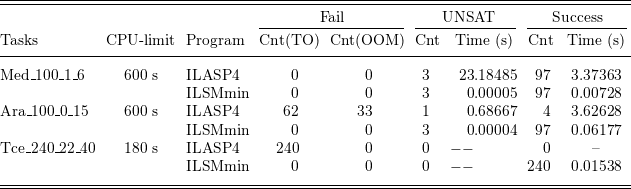
For the first induction task set $Med\_100\_1\_6$
, both ilsmmin and ilasp4 solved all induction tasks, but ilsmmin is much faster than ilasp4 for both “Success” and “UNSAT”. For the second dataset
$Med\_100\_1\_6$
, both ilsmmin and ilasp4 solved all induction tasks, but ilsmmin is much faster than ilasp4 for both “Success” and “UNSAT”. For the second dataset $Ara\_100\_0\_15$
, ilsmmin solved all
$Ara\_100\_0\_15$
, ilsmmin solved all $100$
induction tasks, but ilasp4 solved only
$100$
induction tasks, but ilasp4 solved only $5$
induction tasks. ilsmmin is also much faster than ilasp4 for both “Success” and “UNSAT”. Additinally, ilsmmin cost less memory than ilasp4, as ilasp4 is aborted due to OOM when solving the
$5$
induction tasks. ilsmmin is also much faster than ilasp4 for both “Success” and “UNSAT”. Additinally, ilsmmin cost less memory than ilasp4, as ilasp4 is aborted due to OOM when solving the $33$
induction tasks which are successfully solved by ilsmmin. For the third dataset
$33$
induction tasks which are successfully solved by ilsmmin. For the third dataset $Tce\_240\_22\_40$
, ilsmmin quickly solved all
$Tce\_240\_22\_40$
, ilsmmin quickly solved all $240$
induction tasks, but ilasp4 solved none of them.
$240$
induction tasks, but ilasp4 solved none of them.
As we know, the major cost of a ILP solver takes is from the exclusion of those logic programs that cannot be used as final solutions. Our optimization strategies helped in discarding unsolvable cases in an early stage. As a result, the solution space is significantly reduced and our system has fewer memory issues than ilasp4 .
The following example illustrates some subtle difference between the two solvers ilsmmin and ilasp4.
Example 6.1.
Induction task 11 in the set $Med\_100\_1\_6$
is
$Med\_100\_1\_6$
is $\langle {B, E^+, E^-}\rangle$
where
$\langle {B, E^+, E^-}\rangle$
where $B = \{ a \leftarrow . , d \leftarrow b, \textit {not} \, c. , f \leftarrow d,a. \}$
,
$B = \{ a \leftarrow . , d \leftarrow b, \textit {not} \, c. , f \leftarrow d,a. \}$
, $E^+ = \{ \{f, b, a, c, e\} \}$
and
$E^+ = \{ \{f, b, a, c, e\} \}$
and $E^- = \{ \{f, d, e\}, \{f, b, d, a, c, e\}, \emptyset \}$
. ilsmmin took
$E^- = \{ \{f, d, e\}, \{f, b, d, a, c, e\}, \emptyset \}$
. ilsmmin took $0.00491$
seconds to induce the minimal solution
$0.00491$
seconds to induce the minimal solution $H = \{ f \leftarrow . , e \leftarrow . , c \leftarrow . , b \leftarrow . \}$
, while ilasp4 took
$H = \{ f \leftarrow . , e \leftarrow . , c \leftarrow . , b \leftarrow . \}$
, while ilasp4 took $2.26562$
seconds for the same induction task and got the same solution.
$2.26562$
seconds for the same induction task and got the same solution.
Induction task 13 in the set $Med\_100\_1\_6$
is
$Med\_100\_1\_6$
is $\langle {B, E^+, E^-}\rangle$
where
$\langle {B, E^+, E^-}\rangle$
where $B = \{ f \leftarrow d,a. , c \leftarrow b,\textit {not} \, d. , e \leftarrow b,d. \}$
,
$B = \{ f \leftarrow d,a. , c \leftarrow b,\textit {not} \, d. , e \leftarrow b,d. \}$
, $E^+ = \{ \{f, b, a, d, e\} \}$
and
$E^+ = \{ \{f, b, a, d, e\} \}$
and $E^- = \{ \{f, c, d\}, \{a\}, \emptyset , \{f\} \}$
. ilsmmin took
$E^- = \{ \{f, c, d\}, \{a\}, \emptyset , \{f\} \}$
. ilsmmin took $0.00521$
seconds to induce the minimal solution
$0.00521$
seconds to induce the minimal solution $H_1 = \{ a \leftarrow . , d \leftarrow . , b \leftarrow a. \}$
. ilasp4 took
$H_1 = \{ a \leftarrow . , d \leftarrow . , b \leftarrow a. \}$
. ilasp4 took $1.56451$
seconds to induce the shortest solution
$1.56451$
seconds to induce the shortest solution $H_2 = \{ d \leftarrow . , b \leftarrow . , a \leftarrow . \}$
. It can be checked that
$H_2 = \{ d \leftarrow . , b \leftarrow . , a \leftarrow . \}$
. It can be checked that $H_2$
is also in the
$H_2$
is also in the $\Omega$
.
$\Omega$
.
To obtain a more reliable trend in the data, we conducted multiple runs to count the average time after removing two extreme data points. For any induction task $T = {\langle {B, E^+, E^-}\rangle }$
in induction task set
$T = {\langle {B, E^+, E^-}\rangle }$
in induction task set $Tce\_240\_22\_40$
, we can observe from the synthetic requirements that
$Tce\_240\_22\_40$
, we can observe from the synthetic requirements that
-
•
$E^+ = \emptyset$
or
$E^+ = \mathit{SM}(P_{Tce})$
, and -
•
$\vert \{ {\langle {B_1, E^+, E_1^-}\rangle } \in Tce\_240\_22\_40 \mid \vert B_1 \vert = \vert B \vert , \vert E_1^- \vert = \vert E^- \vert \} \vert = 10$
.



The experimental results are divided into two groups according to $E^+$
. For a set of execution times corresponding to
$E^+$
. For a set of execution times corresponding to $10$
induction tasks of the same scale in each group, the execution time is averaged over the remaining
$10$
induction tasks of the same scale in each group, the execution time is averaged over the remaining $8$
values after removing the highest and lowest values. Based on these
$8$
values after removing the highest and lowest values. Based on these $24$
average times, the three-dimensional subgraphs are plotted in Figure 2. As can be seen from the figure, the CPU time tends to increase with the increase of
$24$
average times, the three-dimensional subgraphs are plotted in Figure 2. As can be seen from the figure, the CPU time tends to increase with the increase of $\vert B \vert$
and
$\vert B \vert$
and $\vert E^- \vert$
when
$\vert E^- \vert$
when $E^+$
is fixed.
$E^+$
is fixed.
Runtime of algorithm ILSMmin solving induction tasks with different scales. The coordinates of the highest and lowest points are labeled in both figures. The $\vert E$
-
$\vert E$
- $\vert$
-axis indicates the scale of the negative examples.
$\vert$
-axis indicates the scale of the negative examples.
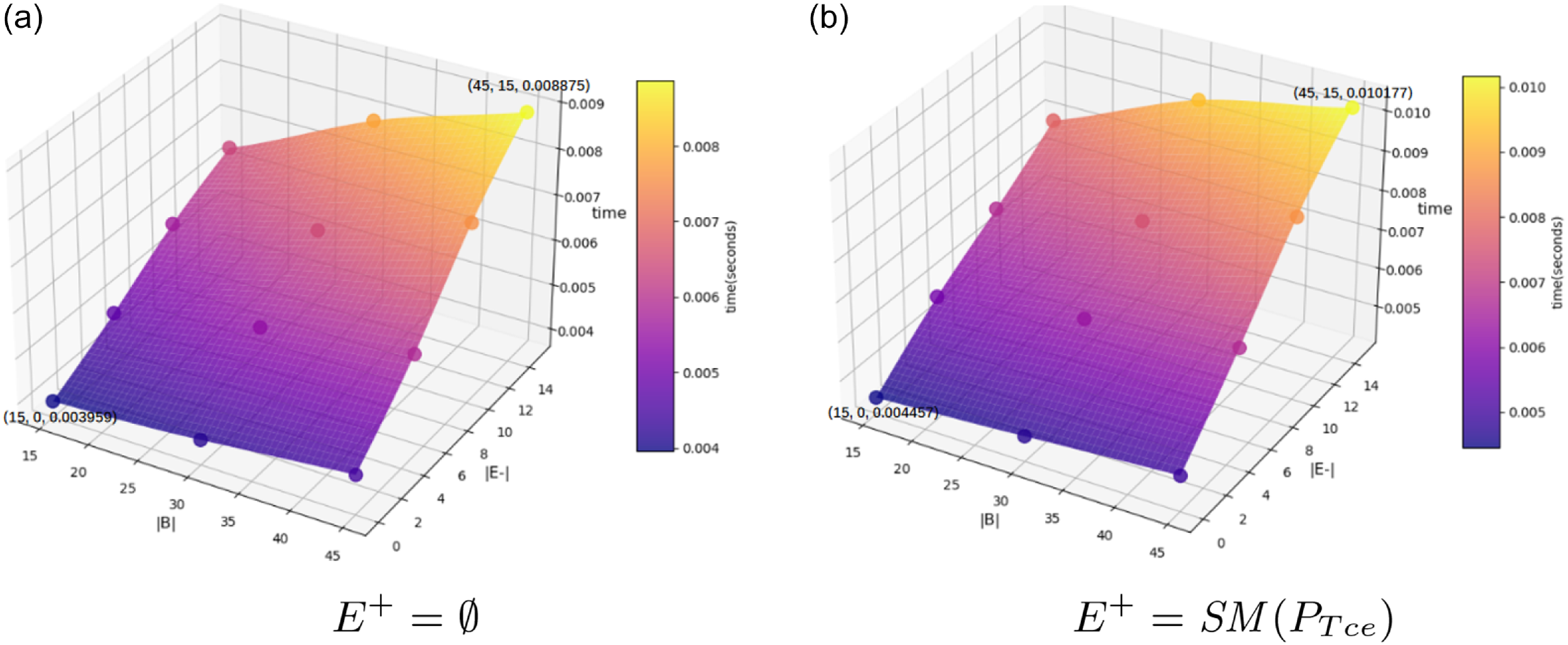
7 Related work
In this section we discuss some related work on induction under stable models for ordinary logic programs (Section 7.1) and induction for possibilistic logic programs (Section 7.2).
7.1 Induction under stable model semantics
An approach to induction in ASP is introduced by Sakama (Reference Sakama2005). Their approach aims to find a rule such that an example can flip its entailment under skeptical reasoning. Specifically, given an extended logic program $B$
as background and a ground literal
$B$
as background and a ground literal $L$
as an example, algorithm
$L$
as an example, algorithm $IAS^{pos}$
(resp.
$IAS^{pos}$
(resp. $IAS^{neg}$
) construct a rule
$IAS^{neg}$
) construct a rule $R$
such that
$R$
such that $P \cup \{ R \} \models L$
(resp.
$P \cup \{ R \} \models L$
(resp. $P \cup \{ R \} \not \models L$
) when
$P \cup \{ R \} \not \models L$
) when $P \not \models L$
(resp.
$P \not \models L$
(resp. $P \models L$
). Here,
$P \models L$
). Here, $P \models L$
means
$P \models L$
means $L \in A$
holds for each
$L \in A$
holds for each $A \in \mathit{SM}(P)$
. This cautious induction regards the observation
$A \in \mathit{SM}(P)$
. This cautious induction regards the observation $L$
as a consequence rather than an interpretation under stable model semantics. Algorithms
$L$
as a consequence rather than an interpretation under stable model semantics. Algorithms $IAS^{pos}$
and
$IAS^{pos}$
and $IAS^{neg}$
are bottom-up as the construction starts with a specific hypothesis and then gradually generalizes it. Later, Sakama and Inoue (Reference Sakama and Inoue2009) also proposed an approach to brave induction, in which a hypothesis
$IAS^{neg}$
are bottom-up as the construction starts with a specific hypothesis and then gradually generalizes it. Later, Sakama and Inoue (Reference Sakama and Inoue2009) also proposed an approach to brave induction, in which a hypothesis $H$
covers a set
$H$
covers a set $O$
of ground literals under an extended disjunctive program
$O$
of ground literals under an extended disjunctive program $B$
if there exists
$B$
if there exists $A \in \mathit{SM}(B \cup H)$
such that
$A \in \mathit{SM}(B \cup H)$
such that $O \subseteq A$
. The bottom-up algorithm
$O \subseteq A$
. The bottom-up algorithm $BRAIN^{not}$
was designed to solve such an induction task. Both cautious induction and brave induction seek a rule to meet the covering requirement for a single observation. The basic idea of these two algorithms is to construct a rule based on some necessary and sufficient conditions for induction before it is generalized. The brave induction and the cautious induction are defined in two separate frameworks.
$BRAIN^{not}$
was designed to solve such an induction task. Both cautious induction and brave induction seek a rule to meet the covering requirement for a single observation. The basic idea of these two algorithms is to construct a rule based on some necessary and sufficient conditions for induction before it is generalized. The brave induction and the cautious induction are defined in two separate frameworks.
Thus, ilasp (Inductive Learning of Answer Set Programs) aims to integrate both brave induction and cautious induction in the same framework (Law et al. Reference Law, Russo and Broda2020). Their induction task $T = {\langle {B, S_M, E^+, E^-}\rangle }$
comprises of two ASP programs
$T = {\langle {B, S_M, E^+, E^-}\rangle }$
comprises of two ASP programs $B$
and
$B$
and $S_M$
and two sets
$S_M$
and two sets $E^+$
and
$E^+$
and $E^-$
of partial interpretations. The search space
$E^-$
of partial interpretations. The search space $S_M$
allows to flexibly declare some language biases such as mode declarations and syntactic choices (i. e. normal rules, disjunctive rules, choice rules, hard constraints, weak constraints, and other common syntax used in answer set programs). After peeling away these syntactic sugar coats, the goal of their induction framework is to find an answer set program
$S_M$
allows to flexibly declare some language biases such as mode declarations and syntactic choices (i. e. normal rules, disjunctive rules, choice rules, hard constraints, weak constraints, and other common syntax used in answer set programs). After peeling away these syntactic sugar coats, the goal of their induction framework is to find an answer set program $H \subseteq S_M$
such that
$H \subseteq S_M$
such that
-
• for each
$e^+ \in E^+$
, there exists
$I \in \mathit{SM}(B \cup H)$
such that
$ I \propto e^+$
and, -
• for each
$e^- \in E^-$
, there exists no
$I \in \mathit{SM}(B \cup H)$
such that
$ I \propto e^-$
.






A meta-level approach is used in ilasp1 (Law et al. Reference Law, Russo and Broda2014) by invoking Clingo to search for the shortest hypothesis and to accelerates the search by starting from a shorter path. In a recent work (Law et al. Reference Law, Russo and Broda2020) on ilasp systems, the form of the examples is incrementally extended, such as ordered examples in ilasp2, context dependent examples in ilasp2i, and noisy examples in ilasp3. On the other hand, the performance of algorithm ilasp4 (Law Reference Law2023) peaks in these subsequent ilasp systems, as ilasp4 significantly reduces the scale of the search space in each iteration.
The comparison experiments described in the last section show that our algorithm performs better than ilasp in terms of both time and memory on the task of inducing ground NLPs from stable models. The performance improvement benefits from the theoretical results investigated in this paper including the characterizations of induction solutions.
While ILP systems like ilasp algorithms generally perform an exhaustive search to discover the best hypothesis, a heuristic-based algorithm xfold is proposed by Shakerin and Gupta (Reference Shakerin and Gupta2018) to inductively learn normal logic programs under stable models. xfold iteratively employs a refinement operator to specialize constructed rules starting from a most general rule whose body is empty until the score of these rules is acceptable. Information gain has been chosen as its heuristic score to maximize the coverage of positive examples. The greedy approach adopted in xfold makes the algorithm more efficient and noise-resilient.
Raedt and Kersting (Reference Raedt and Kersting2008) proposed an induction tasks to find out a probabilistic logic program $H^*$
such that the likelihood of the conditional probability
$H^*$
such that the likelihood of the conditional probability $Pr(E \mid H^*, B)$
is maximized, where
$Pr(E \mid H^*, B)$
is maximized, where $E$
is a set of examples,
$E$
is a set of examples, $B$
is a probabilistic logic program acting as the background theory. The examples may be definite clauses, Herbrand interpretations or proof-trees depending on the notion of “cover”. Similarly, Nickles and Mileo (Reference Nickles and Mileo2014) proposed to learn a probabilistic answer set program based on the above maximum likelihood. Lee and Wang (Reference Lee and Wang2018) proposed a weight learning task for a parameterized
$B$
is a probabilistic logic program acting as the background theory. The examples may be definite clauses, Herbrand interpretations or proof-trees depending on the notion of “cover”. Similarly, Nickles and Mileo (Reference Nickles and Mileo2014) proposed to learn a probabilistic answer set program based on the above maximum likelihood. Lee and Wang (Reference Lee and Wang2018) proposed a weight learning task for a parameterized ${LP}^{MLN}$
program
${LP}^{MLN}$
program $P$
to find the maximum likelihood estimation of the non-
$P$
to find the maximum likelihood estimation of the non- $\alpha$
weights of
$\alpha$
weights of $P$
, whose observations (or training data) are conjunction of literals. All these learning can be classified as parameters learning and thus different from our induction task in this paper.
$P$
, whose observations (or training data) are conjunction of literals. All these learning can be classified as parameters learning and thus different from our induction task in this paper.
7.2 Induction of possibilistic theories
The approaches discussed in the last subsection are proposed for ordinary logic programs. However, there are few works on induction in possibilistic logics and possibilistic logic programs. A framework for induction in possibilistic logic is proposed by Serrurier and Prade (Reference Serrurier and Prade2007), which is to use possibilities to handle exceptions in classification tasks. Given a possibilistic logic theory $B$
as the background and a set
$B$
as the background and a set $E$
of possibilistic ground facts as the examples, the induction task is to obtain a hypothesis, a possibilistic logic theory
$E$
of possibilistic ground facts as the examples, the induction task is to obtain a hypothesis, a possibilistic logic theory $H$
, such that
$H$
, such that $B \cup H \models _{\Pi } E$
, here
$B \cup H \models _{\Pi } E$
, here $\models _{\Pi }$
is the entailment relation in possibilistic logic. A possibilistic ground fact
$\models _{\Pi }$
is the entailment relation in possibilistic logic. A possibilistic ground fact $(C(x, y),\alpha )$
means that the object
$(C(x, y),\alpha )$
means that the object $x$
is assigned to the class
$x$
is assigned to the class $y$
with the certainty
$y$
with the certainty $\alpha$
. For a possibilistic formula
$\alpha$
. For a possibilistic formula $(\phi , \alpha )$
and a possibilistic logic theory
$(\phi , \alpha )$
and a possibilistic logic theory $K$
,
$K$
, $K \models _{\Pi } (\phi , \alpha )$
if and only if there exists
$K \models _{\Pi } (\phi , \alpha )$
if and only if there exists $K' \subseteq K_{\alpha }$
and
$K' \subseteq K_{\alpha }$
and $K' \not \models \bot$
such that
$K' \not \models \bot$
such that $K'$
is minimal w.r.t.
$K'$
is minimal w.r.t. $\phi$
and there exists no
$\phi$
and there exists no $K''$
minimal w.r.t.
$K''$
minimal w.r.t. $\bot$
such that
$\bot$
such that $K' \subset K'' \subseteq K_{\alpha }$
where
$K' \subset K'' \subseteq K_{\alpha }$
where $K_{\alpha } = \{ \phi \mid (\phi ,\beta ) \in K, \beta \geq \alpha \}$
. A logic theory
$K_{\alpha } = \{ \phi \mid (\phi ,\beta ) \in K, \beta \geq \alpha \}$
. A logic theory $T$
is minimal w.r.t. a formula
$T$
is minimal w.r.t. a formula $\phi$
if and only
$\phi$
if and only $T \models \phi$
and
$T \models \phi$
and $T - \{ \psi \} \not \models \phi$
for each
$T - \{ \psi \} \not \models \phi$
for each $\psi \in T$
. The corresponding induction algorithm PossILP for possibilistic logic extends the simulated annealing algorithm, but it is designed only for classification. The induction problem addressed in PossILP is different from ours. In their approach, only positive examples are provided and the condition for covering (positive) examples is also different.
$\psi \in T$
. The corresponding induction algorithm PossILP for possibilistic logic extends the simulated annealing algorithm, but it is designed only for classification. The induction problem addressed in PossILP is different from ours. In their approach, only positive examples are provided and the condition for covering (positive) examples is also different.
A transformation between possibilistic logic theories and Markov logic networks (MLNs) is proposed in Kuzelka et al. (Reference Kuzelka, Davis and Schockaert2015). This implies that the problem of learning a possibilistic logic theory is reduced to that of learning a MLN. Based on this idea, a statistical relational induction approach (Kuzelka et al. Reference Kuzelka, Davis and Schockaert2017) is introduced to induce possibilistic logic theories from relational datasets like the UWCSE dataset, which outlines relationships within the CS department at the University of Washington among students, professors, papers, subjects, terms, and projects. This method first learns Horn rules using beam search and then a greedy search assigns necessity degrees to the rules. The induction process is based on the notion of relational marginal distribution, viewed as a possibility distribution (Dubois and Prade Reference Dubois and Prade1998) since possibilistic logic can encode probability distributions as well (Kuzelka et al. Reference Kuzelka, Davis and Schockaert2016). These approaches adopt a quantitative perspective by employing product operations on possibilities akin to statistics. In contrast, our study takes a qualitative approach, where the set $\mathcal{Q}$
of necessities acts as a bounded finite linear ordinal scale. For a comprehensive discussion on the distinctions between quantitative and qualitative possibility theory, refer to Dubois and Prade (Reference Dubois and Prade2024).
$\mathcal{Q}$
of necessities acts as a bounded finite linear ordinal scale. For a comprehensive discussion on the distinctions between quantitative and qualitative possibility theory, refer to Dubois and Prade (Reference Dubois and Prade2024).
In order to develop an explainable and efficient approach to induction for possibilistic rules, the RIDDLE (Rule Induction with Deep Learning) algorithm uses artificial neural networks (ANNs) to extract possibilistic rules (Persia and Guimarães Reference Persia and Guimarães2023), which consists of two phases (ANN training and possibilistic rule extraction). It is shown that the trained ANN and the extracted possibilistic logic program are equivalent in terms of classification problems.
The approaches discussed in this subsection are proposed for possibilistic logic under classic logic semantics, instead of possibilistic logic programs under nonmonotonic semantics like stable models. Therefore, to our best knowledge, the approach proposed in this paper is the first attempt to establish an induction framework for possibilistic logic programs under nonmonotonic semantics. While ilasp is a special case of our framework, it is unclear how their algorithms can be directly extended to the inductive learning for possibilistic programs under stable models. Moreover, the theoretical results in this paper further convince that the problem of computing induction solution for possibilistic programs under stable models is challenging and novel techniques are needed to tackle the problem.
8 Concluding remarks
In this paper, we have proposed a framework for inductive reasoning in possibilistic logic programs under stable model semantics, which is based on an extension of induction tasks for ordinary logic theories (and logic programs). We have investigated formal properties of the framework, including several important characterizations for solutions of induction tasks and construction methods for possibilistic logic programs that satisfy certain conditions. Based on these results, we have proposed three algorithms for the existence of induction solutions, computing solutions and minimal solutions. In our algorithms, to narrow the search space for possibilistic rules, we introduced the notions of positive solution space and negative solution space. These notions and their construction methods significantly contribute to the efficiency of our algorithms and novelty of the whole work in this paper. We have shown the correctness of these algorithms, which are mathematically involving. Based on the algorithm ilpsmmin, we have also implemented a prototype system for computing minimal solutions of induction tasks for possibilistic logic programs under stable models. The experimental results show that our prototype outperforms ilasp when solving induction tasks of learning ordinary NLPs from stable models.
There are several interesting directions for future work. First, our approach could be extended to possibilistic logic programs that allow more general language biases, such as constraints and disjunction. Second, our approach could be adapted to some other semantics for possibilistic logic such as (Bauters et al. Reference Bauters, Schockaert, Cock and Vermeir2014). In addition, while the problem of finding solutions for a given induction task for poss-programs is hard (at least NP-complete), it is still possible to significantly lift the scalability of our system by applying latest technologies in deep learning, which is another interesting research topic in future. Besides, we only implemented one algorithm inducing NLP from stable models and conducted the corresponding experiments. Other efficient implementations and practical applications of algorithms, in particular Algorithm 3, deserve our further efforts.
Competing Interests
The authors declare none.
Appendix: Proofs
Proposition B.3 (Equivalent consequence). For a given poss-NLP $\overline {P}$
and a possibilistic interpretation
$\overline {P}$
and a possibilistic interpretation $\overline {I}$
,
$\overline {I}$
, ${\mathcal{T}}_{\overline {P}^I}(\overline {I}) = {\mathcal{T}}_{\overline {P}}(\overline {I})$
.
${\mathcal{T}}_{\overline {P}^I}(\overline {I}) = {\mathcal{T}}_{\overline {P}}(\overline {I})$
.
Proof. $(q,\delta ) \in {\mathcal{T}}_{\overline {P}}(\overline {I})$
.
$(q,\delta ) \in {\mathcal{T}}_{\overline {P}}(\overline {I})$
. $\Leftrightarrow$
By Definition 2.2, (i)
$\Leftrightarrow$
By Definition 2.2, (i) $q=\textit {hd}(r) \mbox{ for some } \overline {r} \in \mathit{App}(\overline {P},\overline {I},q)$
, and (ii)
$q=\textit {hd}(r) \mbox{ for some } \overline {r} \in \mathit{App}(\overline {P},\overline {I},q)$
, and (ii) $\delta =\max \{\beta \mid \overline {r'} \in \mathit{App}(\overline {P},\overline {I},q)$
is
$\delta =\max \{\beta \mid \overline {r'} \in \mathit{App}(\overline {P},\overline {I},q)$
is $\beta$
-applicable in
$\beta$
-applicable in $\overline {I}\}$
.
$\overline {I}\}$
. $\Leftrightarrow$
By Definition 2.1, (i)
$\Leftrightarrow$
By Definition 2.1, (i) $q=\textit {hd}(r) \mbox{ for some } \overline {r} \in \mathit{App}(\overline {P}^I,\overline {I},q)$
, and (ii)
$q=\textit {hd}(r) \mbox{ for some } \overline {r} \in \mathit{App}(\overline {P}^I,\overline {I},q)$
, and (ii) $\delta =\max \{\beta \mid \overline {r'} \in \mathit{App}(\overline {P}^I,\overline {I},q)$
is
$\delta =\max \{\beta \mid \overline {r'} \in \mathit{App}(\overline {P}^I,\overline {I},q)$
is $\beta$
-applicable in
$\beta$
-applicable in $\overline {I}$
.
$\overline {I}$
. $\Leftrightarrow$
By Definition 2.2,
$\Leftrightarrow$
By Definition 2.2,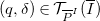 $(q,\delta ) \in {\mathcal{T}}_{\overline {P}^I}(\overline {I})$
.
$(q,\delta ) \in {\mathcal{T}}_{\overline {P}^I}(\overline {I})$
.
Corollary B.1 (Absorption for a poss-stable model). Given a possibilistic interpretation $\overline {I}$
and two poss-NLPs
$\overline {I}$
and two poss-NLPs $\overline {P}$
and
$\overline {P}$
and $\overline {B}$
,
$\overline {B}$
, $\overline {I} \in \mathit{PSM}(\overline {P} \sqcup \overline {B})$
if
$\overline {I} \in \mathit{PSM}(\overline {P} \sqcup \overline {B})$
if $\overline {I} \in \mathit{PSM}(\overline {P})$
and
$\overline {I} \in \mathit{PSM}(\overline {P})$
and ${\mathcal{T}}_{\overline {B}}(\overline {I}) \sqsubseteq \overline {I}$
.
${\mathcal{T}}_{\overline {B}}(\overline {I}) \sqsubseteq \overline {I}$
.
Proof. $\overline {I} \in \mathit{PSM}(\overline {P})$
.
$\overline {I} \in \mathit{PSM}(\overline {P})$
. $\Rightarrow$ $\overline {I} = \mathit{Cn}(\overline {P}^I)$
.
$\overline {I} = \mathit{Cn}(\overline {P}^I)$
. $\Rightarrow$ $\mathit{lfp}({\mathcal{T}}_{\overline {P}^I}) = \overline {I}$
.
$\mathit{lfp}({\mathcal{T}}_{\overline {P}^I}) = \overline {I}$
. $\Rightarrow$ ${\mathcal{T}}_{\overline {P}^I}(\overline {I}) = \overline {I}$
and
${\mathcal{T}}_{\overline {P}^I}(\overline {I}) = \overline {I}$
and $\forall \overline {J} \sqsubset \overline {I}, {\mathcal{T}}_{\overline {P}^I}(\overline {J}) \neq \overline {J}$
.
$\forall \overline {J} \sqsubset \overline {I}, {\mathcal{T}}_{\overline {P}^I}(\overline {J}) \neq \overline {J}$
. $\Rightarrow$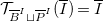 ${\mathcal{T}}_{\overline {B}^I \sqcup \overline {P}^I}(\overline {I}) = \overline {I}$
and
${\mathcal{T}}_{\overline {B}^I \sqcup \overline {P}^I}(\overline {I}) = \overline {I}$
and $\forall \overline {J} \sqsubset \overline {I}, {\mathcal{T}}_{\overline {B}^I \sqcup \overline {P}^I}(\overline {J}) \neq \overline {J}$
if
$\forall \overline {J} \sqsubset \overline {I}, {\mathcal{T}}_{\overline {B}^I \sqcup \overline {P}^I}(\overline {J}) \neq \overline {J}$
if ${\mathcal{T}}_{\overline {B}}(\overline {I}) \sqsubseteq \overline {I}$
by Proposition 2.3.
${\mathcal{T}}_{\overline {B}}(\overline {I}) \sqsubseteq \overline {I}$
by Proposition 2.3. $\Rightarrow$ $\overline {I} = \mathit{lfp}({\mathcal{T}}_{(\overline {B} \sqcup \overline {P})^I})$
.
$\overline {I} = \mathit{lfp}({\mathcal{T}}_{(\overline {B} \sqcup \overline {P})^I})$
. $\Rightarrow$ $\overline {I} \in \mathit{PSM}(\overline {B} \sqcup \overline {P})$
.
$\overline {I} \in \mathit{PSM}(\overline {B} \sqcup \overline {P})$
.
Proposition C.1 (Incomparability between poss-stable models). Given two different possibilistic interpretations $\overline {I}$
and
$\overline {I}$
and $\overline {J}$
such that
$\overline {J}$
such that $\overline {I} \parallel \overline {J}$
,
$\overline {I} \parallel \overline {J}$
, $\{ \overline {I}, \overline {J} \} \not \subseteq \mathit{PSM}(\overline {P})$
for any poss-NLP
$\{ \overline {I}, \overline {J} \} \not \subseteq \mathit{PSM}(\overline {P})$
for any poss-NLP $\overline {P}$
.
$\overline {P}$
.
Proof.
Assume $\{ \overline {I}, \overline {J} \} \subseteq \mathit{PSM}(\overline {P})$
. Then we have
$\{ \overline {I}, \overline {J} \} \subseteq \mathit{PSM}(\overline {P})$
. Then we have $\overline {I} \in \mathit{PSM}(\overline {P})$
and
$\overline {I} \in \mathit{PSM}(\overline {P})$
and $\overline {J} \in \mathit{PSM}(\overline {P})$
. Suppose
$\overline {J} \in \mathit{PSM}(\overline {P})$
. Suppose $I \subseteq J$
by Definition 2.2. There are only two cases:
$I \subseteq J$
by Definition 2.2. There are only two cases: $I = J$
or
$I = J$
or $I \subset J$
.
$I \subset J$
.
Case 1: $I = J$
.
$I = J$
. $\Rightarrow$ $\mathit{Cn}(\overline {P}^{I}) = \mathit{Cn}(\overline {P}^{J})$
when
$\mathit{Cn}(\overline {P}^{I}) = \mathit{Cn}(\overline {P}^{J})$
when $I = J$
by the definition of the possibilistic consequence of a poss-NLP.
$I = J$
by the definition of the possibilistic consequence of a poss-NLP. $\Rightarrow$ $\overline {I} = \overline {J}$
since
$\overline {I} = \overline {J}$
since $\overline {I} \in \mathit{PSM}(\overline {P})$
and
$\overline {I} \in \mathit{PSM}(\overline {P})$
and $\overline {J} \in \mathit{PSM}(\overline {P})$
.
$\overline {J} \in \mathit{PSM}(\overline {P})$
. $\Rightarrow$
Contradict to
$\Rightarrow$
Contradict to $\overline {I} \neq \overline {J}$
.
$\overline {I} \neq \overline {J}$
.
Case 2: $I \subset J$
.
$I \subset J$
. $\Rightarrow$ $I \subset J$
and
$I \subset J$
and $\{ I, J \} \subseteq \mathit{SM}(P)$
since
$\{ I, J \} \subseteq \mathit{SM}(P)$
since $\{ \overline {I}, \overline {J} \} \subseteq \mathit{PSM}(\overline {P})$
and Proposition 2.2.
$\{ \overline {I}, \overline {J} \} \subseteq \mathit{PSM}(\overline {P})$
and Proposition 2.2. $\Rightarrow$ $I \subset J$
and
$I \subset J$
and $I \not \subset J$
since
$I \not \subset J$
since $\mathit{SM}(P)$
is
$\mathit{SM}(P)$
is $\subseteq$
-incomparable.
$\subseteq$
-incomparable. $\Rightarrow$
A contradiction.
$\Rightarrow$
A contradiction.
Proposition C.2 (Satisfiability for program $\mathit{PPE}(\overline {S})$
). For a given set
$\mathit{PPE}(\overline {S})$
). For a given set $\overline {S}$
of possibilistic interpretations,
$\overline {S}$
of possibilistic interpretations, $\mathit{PSM}(\mathit{PPE}(\overline {S})) = \overline {S}$
if
$\mathit{PSM}(\mathit{PPE}(\overline {S})) = \overline {S}$
if $\overline {S}$
is incomparable.
$\overline {S}$
is incomparable.
Proof.
It is evident that $\overline {S} = \mathit{PSM}(\mathit{PPE}(\overline {S}))$
when
$\overline {S} = \mathit{PSM}(\mathit{PPE}(\overline {S}))$
when $\overline {S} = \emptyset$
. In the case of
$\overline {S} = \emptyset$
. In the case of $\overline {S} \neq \emptyset$
, it can be proved as follows.
$\overline {S} \neq \emptyset$
, it can be proved as follows.
( $\Longrightarrow$
)
$\Longrightarrow$
) $\overline {S}$
is incomparable.
$\overline {S}$
is incomparable. $\Rightarrow$ $S$
is
$S$
is $\subseteq$
-incomparable.
$\subseteq$
-incomparable. $\Rightarrow$ $I_1 \not \subset I_2$
for any two interpretations
$I_1 \not \subset I_2$
for any two interpretations $I_1 \in S$
and
$I_1 \in S$
and $I_2 \in S$
.
$I_2 \in S$
. $\Rightarrow$ $\exists y \in I_1$
such that
$\exists y \in I_1$
such that $ y \notin I_2$
for any two interpretations
$ y \notin I_2$
for any two interpretations $I_1 \in S$
and
$I_1 \in S$
and $I_2 \in S$
.
$I_2 \in S$
. $\Rightarrow$ $I_1 \cap ({\mathcal{A}} - I_2) \neq \emptyset$
for any two interpretations
$I_1 \cap ({\mathcal{A}} - I_2) \neq \emptyset$
for any two interpretations $I_1 \in S$
and
$I_1 \in S$
and $I_2 \in S$
.
$I_2 \in S$
. $\Rightarrow$
For each
$\Rightarrow$
For each $I \in S$
,
$I \in S$
, $\mathit{PPE}(\overline {S})^I = \{ (x \leftarrow , \alpha ) \mid (x,\alpha ) \in \overline {I} \}$
since
$\mathit{PPE}(\overline {S})^I = \{ (x \leftarrow , \alpha ) \mid (x,\alpha ) \in \overline {I} \}$
since $I \cap ({\mathcal{A}} - I) = \emptyset$
.
$I \cap ({\mathcal{A}} - I) = \emptyset$
. $\Rightarrow$
For each
$\Rightarrow$
For each $\overline {I} \in \overline {S}$
,
$\overline {I} \in \overline {S}$
, $\mathit{lfp}({\mathcal{T}}_{\mathit{PPE}(\overline {S})^I}) = \overline {I}$
.
$\mathit{lfp}({\mathcal{T}}_{\mathit{PPE}(\overline {S})^I}) = \overline {I}$
. $\Rightarrow$
For each
$\Rightarrow$
For each $\overline {I} \in \overline {S}$
,
$\overline {I} \in \overline {S}$
, $\overline {I} \in \mathit{PSM}(\mathit{PPE}(\overline {S}))$
.
$\overline {I} \in \mathit{PSM}(\mathit{PPE}(\overline {S}))$
. $\Rightarrow$ $\overline {S} \subseteq \mathit{PSM}(\mathit{PPE}(\overline {S}))$
.
$\overline {S} \subseteq \mathit{PSM}(\mathit{PPE}(\overline {S}))$
.
( $\Longleftarrow$
)For an possibilistic interpretation
$\Longleftarrow$
)For an possibilistic interpretation $\overline {K}$
such that
$\overline {K}$
such that $\overline {K} \notin \overline {S}$
, it is evident that
$\overline {K} \notin \overline {S}$
, it is evident that $\overline {K} \notin \mathit{PSM}(\mathit{PPE}(\overline {S}))$
when
$\overline {K} \notin \mathit{PSM}(\mathit{PPE}(\overline {S}))$
when $K$
is
$K$
is $\subseteq$
-comparable with respect to an element in
$\subseteq$
-comparable with respect to an element in $S$
because of
$S$
because of $\overline {S} \subseteq \mathit{PSM}(\mathit{PPE}(\overline {S}))$
above and Proposition 3.1. Let
$\overline {S} \subseteq \mathit{PSM}(\mathit{PPE}(\overline {S}))$
above and Proposition 3.1. Let $\overline {K}$
be an possibilistic interpretation such that
$\overline {K}$
be an possibilistic interpretation such that $K$
is
$K$
is $\subseteq$
-incomparable w.r.t. every interpretation in
$\subseteq$
-incomparable w.r.t. every interpretation in $S$
.
$S$
. $\Rightarrow$ $\forall \overline {I} \in \overline {S}, K \cap ({\mathcal{A}} - I) \neq \emptyset$
.
$\forall \overline {I} \in \overline {S}, K \cap ({\mathcal{A}} - I) \neq \emptyset$
. $\Rightarrow$ $K \cap {\textit {bd}{^-}}(r) \neq \emptyset$
for each
$K \cap {\textit {bd}{^-}}(r) \neq \emptyset$
for each $\overline {r} \in \mathit{PPE}(\overline {S})$
.
$\overline {r} \in \mathit{PPE}(\overline {S})$
. $\Rightarrow$ $\mathit{PPE}(\overline {S})^K = \emptyset$
.
$\mathit{PPE}(\overline {S})^K = \emptyset$
. $\Rightarrow$ $\mathit{lfp}({\mathcal{T}}_{\mathit{PPE}(\overline {S})^{K}}) = \emptyset$
.
$\mathit{lfp}({\mathcal{T}}_{\mathit{PPE}(\overline {S})^{K}}) = \emptyset$
. $\Rightarrow$ $\overline {K} \notin \mathit{PPE}(\overline {S})^{K}$
since
$\overline {K} \notin \mathit{PPE}(\overline {S})^{K}$
since $K \neq \emptyset$
because
$K \neq \emptyset$
because $K$
is
$K$
is $\subseteq$
-incomparable w.r.t. every interpretation in
$\subseteq$
-incomparable w.r.t. every interpretation in $S$
.
$S$
. $\Rightarrow$ $\overline {K} \notin \mathit{PSM}(\mathit{PPE}(\overline {S}))$
whenever
$\overline {K} \notin \mathit{PSM}(\mathit{PPE}(\overline {S}))$
whenever $\overline {K} \notin \overline {S}$
.
$\overline {K} \notin \overline {S}$
. $\Rightarrow$ $\mathit{PSM}(\mathit{PPE}(\overline {S})) \subseteq \overline {S}$
.
$\mathit{PSM}(\mathit{PPE}(\overline {S})) \subseteq \overline {S}$
.
Proposition C.3 (Unsatisfiability for program $\mathit{PNE}(\overline {S_N},\overline {S_P})$
). Given a poss-NLP
$\mathit{PNE}(\overline {S_N},\overline {S_P})$
). Given a poss-NLP $\overline {P}$
and two sets
$\overline {P}$
and two sets $\overline {S_N}$
and
$\overline {S_N}$
and $\overline {S_P}$
of possibilistic interpretations,
$\overline {S_P}$
of possibilistic interpretations, $\overline {I} \notin \mathit{PSM}(\mathit{PNE}(\overline {S_N},\overline {S_P}) \sqcup \overline {P})$
if
$\overline {I} \notin \mathit{PSM}(\mathit{PNE}(\overline {S_N},\overline {S_P}) \sqcup \overline {P})$
if $\overline {I} \in \overline {S_N}$
,
$\overline {I} \in \overline {S_N}$
, $I \neq {\mathcal{A}}$
, and
$I \neq {\mathcal{A}}$
, and $ \overline {I} \not \parallel \overline {S_P}$
.
$ \overline {I} \not \parallel \overline {S_P}$
.
Proof. $\overline {I} \in \overline {S_N}, I \neq {\mathcal{A}}, \overline {I} \not \parallel \overline {S_P}$
.
$\overline {I} \in \overline {S_N}, I \neq {\mathcal{A}}, \overline {I} \not \parallel \overline {S_P}$
. $\Rightarrow$
By Definition 3.2,
$\Rightarrow$
By Definition 3.2, $\overline {I} \in \overline {S_N}, I \neq {\mathcal{A}}$
, and
$\overline {I} \in \overline {S_N}, I \neq {\mathcal{A}}$
, and $I$
is
$I$
is $\subseteq$
-incomparable w.r.t. every interpretation in
$\subseteq$
-incomparable w.r.t. every interpretation in $S_P$
.
$S_P$
. $\Rightarrow$ $I \in S_N - \{ {\mathcal{A}} \}$
, and
$I \in S_N - \{ {\mathcal{A}} \}$
, and $I$
is
$I$
is $\subseteq$
-incomparable w.r.t. every interpretation in
$\subseteq$
-incomparable w.r.t. every interpretation in $S_P$
.
$S_P$
. $\Rightarrow$ $I \neq {\mathcal{A}}$ $\Rightarrow$ $I \models \textit {bd}(\mathit{PNE}(\overline {I}))$
and
$I \models \textit {bd}(\mathit{PNE}(\overline {I}))$
and $I \not \models \textit {hd}(\mathit{PNE}(\overline {I}))$
.
$I \not \models \textit {hd}(\mathit{PNE}(\overline {I}))$
. $\Rightarrow$ $I \not \models r$
where
$I \not \models r$
where $\overline {r} = \mathit{PNE}(\overline {I})$
.
$\overline {r} = \mathit{PNE}(\overline {I})$
. $\Rightarrow$ $I \not \models H$
where
$I \not \models H$
where $\overline {H} = \mathit{PNE}(\overline {S_N},\overline {S_P})$
since
$\overline {H} = \mathit{PNE}(\overline {S_N},\overline {S_P})$
since $I \in S_N - \{ {\mathcal{A}} \}$
, and
$I \in S_N - \{ {\mathcal{A}} \}$
, and $I$
is
$I$
is $\subseteq$
-incomparable w.r.t. every interpretation in
$\subseteq$
-incomparable w.r.t. every interpretation in $S_P$
.
$S_P$
. $\Rightarrow$ $I \not \models H \cup P$
where
$I \not \models H \cup P$
where $\overline {H} = \mathit{PNE}(\overline {S_N},\overline {S_P})$
.
$\overline {H} = \mathit{PNE}(\overline {S_N},\overline {S_P})$
. $\Rightarrow$ $I \notin \mathit{SM}(H \cup P)$
where
$I \notin \mathit{SM}(H \cup P)$
where $\overline {H} = \mathit{PNE}(\overline {S_N},\overline {S_P})$
.
$\overline {H} = \mathit{PNE}(\overline {S_N},\overline {S_P})$
. $\Rightarrow$ $\overline {I} \notin \mathit{PSM}(\mathit{PNE}(\overline {S_N},\overline {S_P}) \sqcup \overline {P})$
by Proposition 2.2.
$\overline {I} \notin \mathit{PSM}(\mathit{PNE}(\overline {S_N},\overline {S_P}) \sqcup \overline {P})$
by Proposition 2.2.
Lemma C.1 (Unique stable model for program $\mathit{PPE}(\overline {G})$
). Given a poss-NLP
$\mathit{PPE}(\overline {G})$
). Given a poss-NLP $\overline {B}$
and a possibilistic interpretation
$\overline {B}$
and a possibilistic interpretation $\overline {G}$
with
$\overline {G}$
with $G = {\mathcal{A}}$
, if
$G = {\mathcal{A}}$
, if ${\mathcal{T}}_{\overline {B}}(\overline {G}) \sqsubseteq \overline {G}$
, then
${\mathcal{T}}_{\overline {B}}(\overline {G}) \sqsubseteq \overline {G}$
, then $\mathit{PSM}(\overline {B} \sqcup \mathit{PPE}(\overline {G})) = \{ \overline {G} \}$
.
$\mathit{PSM}(\overline {B} \sqcup \mathit{PPE}(\overline {G})) = \{ \overline {G} \}$
.
Proof. $\mathit{PPE}(\overline {G}) = \{ (x \leftarrow , \alpha ) \mid (x, \alpha ) \in \overline {G} \}$
where
$\mathit{PPE}(\overline {G}) = \{ (x \leftarrow , \alpha ) \mid (x, \alpha ) \in \overline {G} \}$
where $G = {\mathcal{A}}$
.
$G = {\mathcal{A}}$
. $\Rightarrow$ $\mathit{PPE}(\overline {G})^G = \mathit{PPE}(\overline {G})$
.
$\mathit{PPE}(\overline {G})^G = \mathit{PPE}(\overline {G})$
. $\Rightarrow$ $\mathit{lfp}({\mathcal{T}}_{\mathit{PPE}(\overline {G})^G}) = \overline {G}$
.
$\mathit{lfp}({\mathcal{T}}_{\mathit{PPE}(\overline {G})^G}) = \overline {G}$
. $\Rightarrow$ $\overline {G} \in \mathit{PSM}(\mathit{PPE}(\overline {G}))$
.
$\overline {G} \in \mathit{PSM}(\mathit{PPE}(\overline {G}))$
. $\Rightarrow$ $\overline {G} \in \mathit{PSM}(\overline {B} \sqcup \mathit{PPE}(\overline {G}))$
since Corollary 2.1 and
$\overline {G} \in \mathit{PSM}(\overline {B} \sqcup \mathit{PPE}(\overline {G}))$
since Corollary 2.1 and ${\mathcal{T}}_{\overline {B}}(\overline {G}) \sqsubseteq \overline {G}$
.
${\mathcal{T}}_{\overline {B}}(\overline {G}) \sqsubseteq \overline {G}$
. $\Rightarrow$ $\mathit{PSM}(\overline {B} \sqcup \mathit{PPE}(\overline {G})) = \{ \overline {G} \}$
since
$\mathit{PSM}(\overline {B} \sqcup \mathit{PPE}(\overline {G})) = \{ \overline {G} \}$
since $G = {\mathcal{A}}$
and Proposition 3.1.
$G = {\mathcal{A}}$
and Proposition 3.1.
Proposition C.4 (Existence of a program w.r.t. a poss-stable model). For a possibilistic interpretation $\overline {I}$
and a poss-NLP
$\overline {I}$
and a poss-NLP $\overline {B}$
, there exists a poss-NLP
$\overline {B}$
, there exists a poss-NLP $\overline {P}$
such that
$\overline {P}$
such that $\overline {I} \in \mathit{PSM}(\overline {B} \sqcup \overline {P})$
if and only if
$\overline {I} \in \mathit{PSM}(\overline {B} \sqcup \overline {P})$
if and only if ${\mathcal{T}}_{\overline {B}}(\overline {I}) \sqsubseteq \overline {I}$
.
${\mathcal{T}}_{\overline {B}}(\overline {I}) \sqsubseteq \overline {I}$
.
Proof.
( $\Longrightarrow$
) Assume (i)
$\Longrightarrow$
) Assume (i) ${\mathcal{T}}_{\overline {B}}(\overline {I}) \not \sqsubseteq \overline {I}$
, and (ii)
${\mathcal{T}}_{\overline {B}}(\overline {I}) \not \sqsubseteq \overline {I}$
, and (ii) $\overline {I} \in \mathit{PSM}(\overline {B} \sqcup \overline {P})$
.
$\overline {I} \in \mathit{PSM}(\overline {B} \sqcup \overline {P})$
. $\Rightarrow$ ${\mathcal{T}}_{\overline {B}^I}(\overline {I}) \not \sqsubseteq \overline {I}$
by Proposition 2.3, and (ii)
${\mathcal{T}}_{\overline {B}^I}(\overline {I}) \not \sqsubseteq \overline {I}$
by Proposition 2.3, and (ii)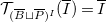 ${\mathcal{T}}_{(\overline {B} \sqcup \overline {P})^I}(\overline {I}) = \overline {I}$
.
${\mathcal{T}}_{(\overline {B} \sqcup \overline {P})^I}(\overline {I}) = \overline {I}$
. $\Rightarrow$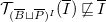 ${\mathcal{T}}_{(\overline {B} \sqcup \overline {P})^I}(\overline {I}) \not \sqsubseteq \overline {I}$
since
${\mathcal{T}}_{(\overline {B} \sqcup \overline {P})^I}(\overline {I}) \not \sqsubseteq \overline {I}$
since $(\overline {B} \sqcup \overline {P})^I = (\overline {B} \sqcup \overline {B} \sqcup \overline {P})^I = \overline {B}^I \sqcup (\overline {B} \sqcup \overline {P})^I$
.
$(\overline {B} \sqcup \overline {P})^I = (\overline {B} \sqcup \overline {B} \sqcup \overline {P})^I = \overline {B}^I \sqcup (\overline {B} \sqcup \overline {P})^I$
. $\Rightarrow$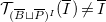 ${\mathcal{T}}_{(\overline {B} \sqcup \overline {P})^I}(\overline {I}) \neq \overline {I}$
.
${\mathcal{T}}_{(\overline {B} \sqcup \overline {P})^I}(\overline {I}) \neq \overline {I}$
. $\Rightarrow$ $\overline {I} \notin fp({\mathcal{T}}_{(\overline {B} \sqcup \overline {P})^I})$
.
$\overline {I} \notin fp({\mathcal{T}}_{(\overline {B} \sqcup \overline {P})^I})$
. $\Rightarrow$ $\overline {I} \neq \mathit{lfp}({\mathcal{T}}_{(\overline {B} \sqcup \overline {P})^I})$
since
$\overline {I} \neq \mathit{lfp}({\mathcal{T}}_{(\overline {B} \sqcup \overline {P})^I})$
since $\mathit{lfp}({\mathcal{T}}_{(\overline {B} \sqcup \overline {P})^I}) \in fp({\mathcal{T}}_{(\overline {B} \sqcup \overline {P})^I})$
.
$\mathit{lfp}({\mathcal{T}}_{(\overline {B} \sqcup \overline {P})^I}) \in fp({\mathcal{T}}_{(\overline {B} \sqcup \overline {P})^I})$
. $\Rightarrow$ $\overline {I} \notin \mathit{PSM}(\overline {B} \sqcup \overline {P})$
by the definition of a poss-stable model.
$\overline {I} \notin \mathit{PSM}(\overline {B} \sqcup \overline {P})$
by the definition of a poss-stable model. $\Rightarrow$
Contradict to the assumption (ii)
$\Rightarrow$
Contradict to the assumption (ii) $\overline {I} \in \mathit{PSM}(\overline {B} \sqcup \overline {P})$
.
$\overline {I} \in \mathit{PSM}(\overline {B} \sqcup \overline {P})$
.
( $\Longleftarrow$
) Let
$\Longleftarrow$
) Let $\overline {P} = \mathit{PPE}(\{ \overline {I} \})$
.
$\overline {P} = \mathit{PPE}(\{ \overline {I} \})$
. $\Rightarrow$ $\overline {I} \in \mathit{PSM}(\overline {P})$
by Proposition 3.2.
$\overline {I} \in \mathit{PSM}(\overline {P})$
by Proposition 3.2. $\Rightarrow$ $\overline {I} \in \mathit{PSM}(\overline {B} \sqcup \overline {P})$
since Corollary 2.1 and
$\overline {I} \in \mathit{PSM}(\overline {B} \sqcup \overline {P})$
since Corollary 2.1 and ${\mathcal{T}}_{\overline {B}}(\overline {I}) \sqsubseteq \overline {I}$
.
${\mathcal{T}}_{\overline {B}}(\overline {I}) \sqsubseteq \overline {I}$
.
Corollary C.1.
For an incomparable set $\overline {S}$
of possibilistic interpretations and a poss-NLP
$\overline {S}$
of possibilistic interpretations and a poss-NLP $\overline {B}$
, there exists a poss-NLP
$\overline {B}$
, there exists a poss-NLP $\overline {P}$
such that
$\overline {P}$
such that $\overline {S} \subseteq \mathit{PSM}(\overline {B} \sqcup \overline {P})$
if and only if
$\overline {S} \subseteq \mathit{PSM}(\overline {B} \sqcup \overline {P})$
if and only if ${\mathcal{T}}_{\overline {B}}(\overline {I}) \sqsubseteq \overline {I}$
for each
${\mathcal{T}}_{\overline {B}}(\overline {I}) \sqsubseteq \overline {I}$
for each $\overline {I} \in \overline {S}$
.
$\overline {I} \in \overline {S}$
.
Proof.
( $\Longrightarrow$
)Assume
$\Longrightarrow$
)Assume $\neg \forall \overline {I} \in \overline {S}, {\mathcal{T}}_{\overline {B}}(\overline {I}) \sqsubseteq \overline {I}$
.
$\neg \forall \overline {I} \in \overline {S}, {\mathcal{T}}_{\overline {B}}(\overline {I}) \sqsubseteq \overline {I}$
. $\Rightarrow$ $\exists \overline {I} \in \overline {S}$
such that
$\exists \overline {I} \in \overline {S}$
such that ${\mathcal{T}}_{\overline {B}^I}(\overline {I}) \not \sqsubseteq \overline {I}$
.
${\mathcal{T}}_{\overline {B}^I}(\overline {I}) \not \sqsubseteq \overline {I}$
. $\Rightarrow$ $\exists \overline {I} \in \overline {S}$
such that
$\exists \overline {I} \in \overline {S}$
such that $\overline {I} \notin \mathit{PSM}(\overline {B} \sqcup \overline {P})$
for each poss-NLP
$\overline {I} \notin \mathit{PSM}(\overline {B} \sqcup \overline {P})$
for each poss-NLP $\overline {P}$
by Proposition 3.4.
$\overline {P}$
by Proposition 3.4. $\Rightarrow$
there does not exist a poss-NLP
$\Rightarrow$
there does not exist a poss-NLP $\overline {P}$
such that
$\overline {P}$
such that $\overline {S} \subseteq \mathit{PSM}(\overline {B} \sqcup \overline {P})$
.
$\overline {S} \subseteq \mathit{PSM}(\overline {B} \sqcup \overline {P})$
. $\Rightarrow$
A contradiction.
$\Rightarrow$
A contradiction.
( $\Longleftarrow$
)
$\Longleftarrow$
) $\forall \overline {I} \in \overline {S}, \overline {I} \in \mathit{PSM}(\mathit{PPE}(\overline {S}))$
by Proposition 3.2.
$\forall \overline {I} \in \overline {S}, \overline {I} \in \mathit{PSM}(\mathit{PPE}(\overline {S}))$
by Proposition 3.2. $\Rightarrow$ $\forall \overline {I} \in \overline {S}, \overline {I} \in \mathit{PSM}(\overline {B} \sqcup \mathit{PPE}(\overline {I}))$
since Corollary 2.1 and
$\forall \overline {I} \in \overline {S}, \overline {I} \in \mathit{PSM}(\overline {B} \sqcup \mathit{PPE}(\overline {I}))$
since Corollary 2.1 and $\forall \overline {I} \in \overline {S}, {\mathcal{T}}_{\overline {B}}(\overline {I}) \sqsubseteq \overline {I}$
.
$\forall \overline {I} \in \overline {S}, {\mathcal{T}}_{\overline {B}}(\overline {I}) \sqsubseteq \overline {I}$
. $\Rightarrow$ $\overline {S} \subseteq \mathit{PSM}(\overline {B} \sqcup \mathit{PPE}(\overline {S}))$
.
$\overline {S} \subseteq \mathit{PSM}(\overline {B} \sqcup \mathit{PPE}(\overline {S}))$
. $\Rightarrow$
There exists a poss-NLP
$\Rightarrow$
There exists a poss-NLP $\overline {P}$
such that
$\overline {P}$
such that $\overline {S} \subseteq \mathit{PSM}(\overline {B} \sqcup \overline {P})$
.
$\overline {S} \subseteq \mathit{PSM}(\overline {B} \sqcup \overline {P})$
.
Corollary C.2 (Existence of a solution). For a task $T = {\langle {\overline {B}, E^+, \emptyset }\rangle }$
,
$T = {\langle {\overline {B}, E^+, \emptyset }\rangle }$
, $\mathit{ILP_{LPoSM}}(T) \neq \emptyset$
if and only if
$\mathit{ILP_{LPoSM}}(T) \neq \emptyset$
if and only if $E^+$
is incomparable and
$E^+$
is incomparable and $E^+$
is coherent with
$E^+$
is coherent with $\overline {B}$
.
$\overline {B}$
.
Proposition C.5.
Let $T = {\langle {\overline {B}, \emptyset , E^-}\rangle }$
be an induction task and
$T = {\langle {\overline {B}, \emptyset , E^-}\rangle }$
be an induction task and $\overline {\mathbb{A}}=\{\overline I\mid \overline {I}\mbox{ is a poss-interpretation with} I={\mathcal{A}}\}$
. Then
$\overline {\mathbb{A}}=\{\overline I\mid \overline {I}\mbox{ is a poss-interpretation with} I={\mathcal{A}}\}$
. Then $\mathit{ILP_{LPoSM}}(T) = \emptyset$
if and only if the following three conditions are satisfied.
$\mathit{ILP_{LPoSM}}(T) = \emptyset$
if and only if the following three conditions are satisfied.
-
(c1)
$\mathit{lfp}(T_{B^{\mathcal{A}}}) = {\mathcal{A}}$
. -
(c2)
$\overline {\mathbb{A}} - E^- \neq \overline {\mathbb{A}}$
. -
(c3)
$\overline {\mathbb{A}} - E^- = \emptyset$
, or
${\mathcal{T}}_{\overline {B}}(\overline {G}) \not \sqsubseteq \overline {G}$
for each
$\overline {G} \in \overline {\mathbb{A}} - E^-$
.


Proof.
( $\Longrightarrow$
) We will prove
$\Longrightarrow$
) We will prove $\mathit{ILP_{LPoSM}}(T) \neq \emptyset$
if
$\mathit{ILP_{LPoSM}}(T) \neq \emptyset$
if $c1 \land c2 \land c3$
does not hold. Namely, it can be proved that
$c1 \land c2 \land c3$
does not hold. Namely, it can be proved that $\neg c1 \lor \neg c2 \lor \neg c3$
implies
$\neg c1 \lor \neg c2 \lor \neg c3$
implies $\mathit{ILP_{LPoSM}}(T) \neq \emptyset$
in the following three cases.
$\mathit{ILP_{LPoSM}}(T) \neq \emptyset$
in the following three cases.
Case 1: ( $\neg c1$
) Let
$\neg c1$
) Let $\overline {H} = \mathit{PNE}(E^-,\emptyset )$
when
$\overline {H} = \mathit{PNE}(E^-,\emptyset )$
when $\mathit{lfp}(T_{B^{\mathcal{A}}}) \neq {\mathcal{A}}$
.
$\mathit{lfp}(T_{B^{\mathcal{A}}}) \neq {\mathcal{A}}$
. $\Rightarrow$ $H^{\mathcal{A}} = \emptyset$
since
$H^{\mathcal{A}} = \emptyset$
since $\forall r \in H, {\textit {bd}{^-}}(r) \cap {\mathcal{A}} \neq \emptyset$
.
$\forall r \in H, {\textit {bd}{^-}}(r) \cap {\mathcal{A}} \neq \emptyset$
. $\Rightarrow$ $\mathit{lfp}(T_{(B \cup H)^{\mathcal{A}}}) \neq {\mathcal{A}}$
since
$\mathit{lfp}(T_{(B \cup H)^{\mathcal{A}}}) \neq {\mathcal{A}}$
since $\mathit{lfp}(T_{B^{\mathcal{A}}}) \neq {\mathcal{A}}$
and
$\mathit{lfp}(T_{B^{\mathcal{A}}}) \neq {\mathcal{A}}$
and $\mathit{lfp}(T_{(B \cup H)^{\mathcal{A}}}) = \mathit{lfp}(T_{B^{\mathcal{A}} \cup H^{\mathcal{A}}}) = \mathit{lfp}(T_{B^{\mathcal{A}}})$
.
$\mathit{lfp}(T_{(B \cup H)^{\mathcal{A}}}) = \mathit{lfp}(T_{B^{\mathcal{A}} \cup H^{\mathcal{A}}}) = \mathit{lfp}(T_{B^{\mathcal{A}}})$
. $\Rightarrow$ ${\mathcal{A}} \notin \mathit{SM}(B \cup H)$
.
${\mathcal{A}} \notin \mathit{SM}(B \cup H)$
. $\Rightarrow$ $\forall \overline {e} \in E^-, e = {\mathcal{A}} \rightarrow \overline {e} \notin \mathit{PSM}(\overline {B} \sqcup \overline {H})$
by Proposition 2.2.
$\forall \overline {e} \in E^-, e = {\mathcal{A}} \rightarrow \overline {e} \notin \mathit{PSM}(\overline {B} \sqcup \overline {H})$
by Proposition 2.2. $\Rightarrow$ $\forall \overline {e} \in E^-, \overline {e} \notin \mathit{PSM}(\overline {B} \sqcup \overline {H})$
since
$\forall \overline {e} \in E^-, \overline {e} \notin \mathit{PSM}(\overline {B} \sqcup \overline {H})$
since $\forall \overline {e} \in E^-, e \neq {\mathcal{A}} \rightarrow \overline {e} \notin \mathit{PSM}(\overline {B} \sqcup \overline {H})$
by Proposition 3.3.
$\forall \overline {e} \in E^-, e \neq {\mathcal{A}} \rightarrow \overline {e} \notin \mathit{PSM}(\overline {B} \sqcup \overline {H})$
by Proposition 3.3. $\Rightarrow$ $\overline {H} \in \mathit{ILP_{LPoSM}}(T)$
.
$\overline {H} \in \mathit{ILP_{LPoSM}}(T)$
. $\Rightarrow$ $\mathit{ILP_{LPoSM}}(T) \neq \emptyset$
.
$\mathit{ILP_{LPoSM}}(T) \neq \emptyset$
.
Case 2: ( $\neg c2$
) Let
$\neg c2$
) Let $\overline {H} = \mathit{PNE}(E^-,\emptyset )$
when
$\overline {H} = \mathit{PNE}(E^-,\emptyset )$
when $\overline {\mathbb{A}} - E^- =\overline {\mathbb{A}}$
.
$\overline {\mathbb{A}} - E^- =\overline {\mathbb{A}}$
. $\Rightarrow$ $\overline {\mathbb{A}} \cap E^- = \emptyset$
.
$\overline {\mathbb{A}} \cap E^- = \emptyset$
. $\Rightarrow$ $\forall \overline {e} \in E^-, e \neq {\mathcal{A}}$
.
$\forall \overline {e} \in E^-, e \neq {\mathcal{A}}$
. $\Rightarrow$ $\forall \overline {e} \in E^-, \overline {e} \notin \mathit{PSM}(\overline {B} \sqcup \overline {H})$
by Proposition 3.3.
$\forall \overline {e} \in E^-, \overline {e} \notin \mathit{PSM}(\overline {B} \sqcup \overline {H})$
by Proposition 3.3. $\Rightarrow$ $\overline {H} \in \mathit{ILP_{LPoSM}}(T)$
.
$\overline {H} \in \mathit{ILP_{LPoSM}}(T)$
. $\Rightarrow$ $\mathit{ILP_{LPoSM}}(T) \neq \emptyset$
.
$\mathit{ILP_{LPoSM}}(T) \neq \emptyset$
.
Case 3: ( $\neg c3$
) Let
$\neg c3$
) Let $\overline {H} = \mathit{PPE}(\overline {G})$
when
$\overline {H} = \mathit{PPE}(\overline {G})$
when $\overline {\mathbb{A}} - E^- \neq \emptyset$
and
$\overline {\mathbb{A}} - E^- \neq \emptyset$
and $\exists \overline {G} \in \overline {\mathbb{A}} - E^-, {\mathcal{T}}_{\overline {B}}(\overline {G}) \sqsubseteq \overline {G}$
.
$\exists \overline {G} \in \overline {\mathbb{A}} - E^-, {\mathcal{T}}_{\overline {B}}(\overline {G}) \sqsubseteq \overline {G}$
. $\Rightarrow$ $\overline {H} \neq \emptyset$
since
$\overline {H} \neq \emptyset$
since $\overline {G} \in \overline {\mathbb{A}} - E^-$
and
$\overline {G} \in \overline {\mathbb{A}} - E^-$
and $\overline {\mathbb{A}} - E^- \neq \emptyset$
.
$\overline {\mathbb{A}} - E^- \neq \emptyset$
. $\Rightarrow$ $\mathit{PSM}(\overline {B} \sqcup \overline {H}) = \{ \overline {G} \}$
by Lemma 3.1.
$\mathit{PSM}(\overline {B} \sqcup \overline {H}) = \{ \overline {G} \}$
by Lemma 3.1. $\Rightarrow$ $\forall \overline {e} \in E^-, \overline {e} \notin \mathit{PSM}(\overline {B} \sqcup \overline {H})$
since
$\forall \overline {e} \in E^-, \overline {e} \notin \mathit{PSM}(\overline {B} \sqcup \overline {H})$
since $\overline {G} \notin E^-$
.
$\overline {G} \notin E^-$
. $\Rightarrow$ $\overline {H} \in \mathit{ILP_{LPoSM}}(T)$
.
$\overline {H} \in \mathit{ILP_{LPoSM}}(T)$
. $\Rightarrow$ $\mathit{ILP_{LPoSM}}(T) \neq \emptyset$
.
$\mathit{ILP_{LPoSM}}(T) \neq \emptyset$
.
( $\Longleftarrow$
) Assume
$\Longleftarrow$
) Assume $\mathit{ILP_{LPoSM}}(T) \neq \emptyset$
when three conditions hold simultaneously. Let
$\mathit{ILP_{LPoSM}}(T) \neq \emptyset$
when three conditions hold simultaneously. Let $\overline {H} \in \mathit{ILP_{LPoSM}}(T)$
.
$\overline {H} \in \mathit{ILP_{LPoSM}}(T)$
. $\Rightarrow$
By condition (c3), we have (i)
$\Rightarrow$
By condition (c3), we have (i) $\overline {\mathbb{A}} - E^- = \emptyset$
or (ii)
$\overline {\mathbb{A}} - E^- = \emptyset$
or (ii) $\forall \overline {G} \in \overline {\mathbb{A}} - E^-, {\mathcal{T}}_{\overline {B}}(\overline {G}) \not \sqsubseteq \overline {G}$
.
$\forall \overline {G} \in \overline {\mathbb{A}} - E^-, {\mathcal{T}}_{\overline {B}}(\overline {G}) \not \sqsubseteq \overline {G}$
. $\Rightarrow$
(i)
$\Rightarrow$
(i) $\overline {\mathbb{A}} \subseteq E^-$
or (ii)
$\overline {\mathbb{A}} \subseteq E^-$
or (ii) $\forall \overline {G} \in \overline {\mathbb{A}} - E^-, \overline {G} \notin \mathit{PSM}(\overline {B} \sqcup \overline {H})$
by Proposition 3.4.
$\forall \overline {G} \in \overline {\mathbb{A}} - E^-, \overline {G} \notin \mathit{PSM}(\overline {B} \sqcup \overline {H})$
by Proposition 3.4. $\Rightarrow$ $\forall \overline {I} \in \overline {\mathbb{A}}, \overline {I} \notin \mathit{PSM}(\overline {B} \sqcup \overline {H})$
since
$\forall \overline {I} \in \overline {\mathbb{A}}, \overline {I} \notin \mathit{PSM}(\overline {B} \sqcup \overline {H})$
since $\forall \overline {e} \in E^-, \overline {e} \notin \mathit{PSM}(\overline {B} \sqcup \overline {H})$
.
$\forall \overline {e} \in E^-, \overline {e} \notin \mathit{PSM}(\overline {B} \sqcup \overline {H})$
. $\Rightarrow$ ${\mathcal{A}} \notin \mathit{SM}(B \cup H)$
by Proposition 2.2.
${\mathcal{A}} \notin \mathit{SM}(B \cup H)$
by Proposition 2.2. $\Rightarrow$
A contradiction to
$\Rightarrow$
A contradiction to ${\mathcal{A}} \in \mathit{SM}(B \cup H)$
since
${\mathcal{A}} \in \mathit{SM}(B \cup H)$
since $\mathit{lfp}(T_{H^{\mathcal{A}}}) \subseteq {\mathcal{A}}$
and condition (c1).
$\mathit{lfp}(T_{H^{\mathcal{A}}}) \subseteq {\mathcal{A}}$
and condition (c1).
Theorem C.1 (Existence of a poss-NLP solution for task). For a task $T = {\langle {\overline {B}, E^+, E^-}\rangle }$
,
$T = {\langle {\overline {B}, E^+, E^-}\rangle }$
, $\mathit{ILP_{LPoSM}}(T) \neq \emptyset$
if and only if
$\mathit{ILP_{LPoSM}}(T) \neq \emptyset$
if and only if
-
(C1)
$E^+$
is incomparable, and
-
(C2)
$E^+$
is coherent with
$\overline {B}$
, and
-
(C3)
$E^-$
is compatible with
$\overline {B}$
, and
-
(C4)
$E^+ \cap E^- = \emptyset$
.


Proof.
( $\Longrightarrow$
) It can be proved by contrapositive as follows.
$\Longrightarrow$
) It can be proved by contrapositive as follows.
-
(1) By Proposition 3.1, comparable
$E^+$
implies
$\mathit{ILP_{LPoSM}}(T) = \emptyset$
. -
(2) By Corollary 3.1 and Definition 3.3,
$\mathit{ILP_{LPoSM}}(T) = \emptyset$
if
$E^+$
is incoherent with
$\overline {B}$
. -
(3) By Proposition 3.5 and Definition 3.4,
$\mathit{ILP_{LPoSM}}(T) = \emptyset$
if
$E^-$
is incompatible with
$\overline {B}$
. -
(4) It is evident that
$E^+ \cap E^- \neq \emptyset$
implies
$\mathit{ILP_{LPoSM}}(T) = \emptyset$
.









( $\Longleftarrow$
) When
$\Longleftarrow$
) When $E^+ = \emptyset$
,
$E^+ = \emptyset$
, $\mathit{ILP_{LPoSM}}(T) \neq \emptyset$
by Condition (C3) and Proposition 3.5. When
$\mathit{ILP_{LPoSM}}(T) \neq \emptyset$
by Condition (C3) and Proposition 3.5. When $E^+ \neq \emptyset$
, let
$E^+ \neq \emptyset$
, let $\overline {H} = \mathit{PPE}(E^+) \sqcup \mathit{PNE}(E^-,E^+)$
where
$\overline {H} = \mathit{PPE}(E^+) \sqcup \mathit{PNE}(E^-,E^+)$
where $\mathit{PPE}(E^+) \neq \emptyset$
. we need to prove Conditions (G1) and (G2) achieved by Definition 3.1.
$\mathit{PPE}(E^+) \neq \emptyset$
. we need to prove Conditions (G1) and (G2) achieved by Definition 3.1. $\forall \overline {e} \in E^+ \forall \overline {I} \in E^-, \overline {I} \not \parallel E^+ \rightarrow e \neq {\textit {bd}{^+}}(\mathit{PNE}(\overline {I}))$
.
$\forall \overline {e} \in E^+ \forall \overline {I} \in E^-, \overline {I} \not \parallel E^+ \rightarrow e \neq {\textit {bd}{^+}}(\mathit{PNE}(\overline {I}))$
. $\Rightarrow$ $\forall \overline {e} \in E^+ \forall \overline {r} \in \mathit{PNE}(E^-,E^+), e \neq {\textit {bd}{^+}}(r)$
.
$\forall \overline {e} \in E^+ \forall \overline {r} \in \mathit{PNE}(E^-,E^+), e \neq {\textit {bd}{^+}}(r)$
. $\Rightarrow$ $\forall \overline {e} \in E^+ \forall \overline {r} \in \mathit{PNE}(E^-,E^+), \overline {r}$
is not applicable in
$\forall \overline {e} \in E^+ \forall \overline {r} \in \mathit{PNE}(E^-,E^+), \overline {r}$
is not applicable in $\overline {e}$
by Definition 2.1.
$\overline {e}$
by Definition 2.1. $\Rightarrow$ $\forall \overline {e} \in E^+, {\mathcal{T}}_{\mathit{PNE}(E^-,E^+)}(\overline {e}) = \emptyset$
by Definition 2.2.
$\forall \overline {e} \in E^+, {\mathcal{T}}_{\mathit{PNE}(E^-,E^+)}(\overline {e}) = \emptyset$
by Definition 2.2. $\Rightarrow$ $\forall \overline {e} \in E^+, {\mathcal{T}}_{\mathit{PNE}(E^-,E^+)}(\overline {e}) \sqsubseteq \overline {e}$
.
$\forall \overline {e} \in E^+, {\mathcal{T}}_{\mathit{PNE}(E^-,E^+)}(\overline {e}) \sqsubseteq \overline {e}$
. $\Rightarrow$ $\forall \overline {e} \in E^+, {\mathcal{T}}_{\overline {B} \sqcup \mathit{PNE}(E^-,E^+)}(\overline {e}) \sqsubseteq \overline {e}$
by Condition (C2).
$\forall \overline {e} \in E^+, {\mathcal{T}}_{\overline {B} \sqcup \mathit{PNE}(E^-,E^+)}(\overline {e}) \sqsubseteq \overline {e}$
by Condition (C2). $\Rightarrow$
Condition (G1) holds because Corollary 2.1 and
$\Rightarrow$
Condition (G1) holds because Corollary 2.1 and $\forall \overline {e} \in E^+, \overline {e} \in \mathit{PSM}(\mathit{PPE}(E^+))$
by Proposition 3.2 and Conditions (C1) and (C2).
$\forall \overline {e} \in E^+, \overline {e} \in \mathit{PSM}(\mathit{PPE}(E^+))$
by Proposition 3.2 and Conditions (C1) and (C2). $\Rightarrow$
When
$\Rightarrow$
When $\overline {e} \in E^-$
is a possibilistic interpretation such that
$\overline {e} \in E^-$
is a possibilistic interpretation such that $\overline {e} \not \parallel E^+$
does not hold,
$\overline {e} \not \parallel E^+$
does not hold, $\overline {e} \notin \mathit{PSM}(\overline {B} \sqcup \overline {H})$
since Proposition 3.1, Definition 3.2 and Condition (C4).
$\overline {e} \notin \mathit{PSM}(\overline {B} \sqcup \overline {H})$
since Proposition 3.1, Definition 3.2 and Condition (C4). $\Rightarrow$
Condition (G2) holds because
$\Rightarrow$
Condition (G2) holds because $\forall \overline {e} \in E^-, \overline {e} \not \parallel E^+ \rightarrow \overline {e} \notin \mathit{PSM}(\overline {B} \sqcup \overline {H})$
since Proposition 3.3, Definition 3.2 and the fact
$\forall \overline {e} \in E^-, \overline {e} \not \parallel E^+ \rightarrow \overline {e} \notin \mathit{PSM}(\overline {B} \sqcup \overline {H})$
since Proposition 3.3, Definition 3.2 and the fact $\forall \overline {I} \in E^-, I \subseteq {\mathcal{A}}$
.
$\forall \overline {I} \in E^-, I \subseteq {\mathcal{A}}$
.
Proposition C.6 (Solution for induction task containing fact rules). Let $T = {\langle {\overline {B}, E^+, E^-}\rangle }$
be an induction task. If there exists
$T = {\langle {\overline {B}, E^+, E^-}\rangle }$
be an induction task. If there exists $a \in {\mathcal{A}}$
such that
$a \in {\mathcal{A}}$
such that $(a \leftarrow , \mu ) \in \overline {B}$
, then
$(a \leftarrow , \mu ) \in \overline {B}$
, then
-
(i)
$\mathit{ILP_{LPoSM}}(T) = \emptyset$
when there exists
$\overline {e} \in E^+$
such that
$(a, \mu ) \notin \overline {e}$
, and
-
(ii) for any poss-NLP
$\overline {H}$
,
$(a, \mu ) \notin \overline {e}$
implies
$\overline {e} \notin \mathit{PSM}(\overline {B} \sqcup \overline {H})$
where
$\overline {e} \in E^-$
, and
-
(iii) if
$\overline {H} \in \mathit{ILP_{LPoSM}}(T)$
and
$a \in \textit {hd}(H)$
, then there exists
$\overline {K} \in \mathit{ILP_{LPoSM}}(T)$
such that
$\vert K \vert \lt \vert H \vert$
.









Proof.
(i) $\exists \overline {e} \in E^+, (a, \mu ) \notin \overline {e}$
.
$\exists \overline {e} \in E^+, (a, \mu ) \notin \overline {e}$
. $\Rightarrow$ $\exists \overline {e} \in E^+, {\mathcal{T}}_{\overline {B}}(\overline {e}) \not \sqsubseteq \overline {e}$
since
$\exists \overline {e} \in E^+, {\mathcal{T}}_{\overline {B}}(\overline {e}) \not \sqsubseteq \overline {e}$
since $(a, \mu ) \in T_{\overline {B}}(\overline {e})$
.
$(a, \mu ) \in T_{\overline {B}}(\overline {e})$
. $\Rightarrow$
There exists
$\Rightarrow$
There exists $\overline {e} \in E^+$
such that
$\overline {e} \in E^+$
such that $\overline {e}$
is incoherent with
$\overline {e}$
is incoherent with $\overline {B}$
.
$\overline {B}$
. $\Rightarrow$ $E^+$
is incoherent with
$E^+$
is incoherent with $\overline {B}$
by Definition 3.3.
$\overline {B}$
by Definition 3.3. $\Rightarrow$ $\mathit{ILP_{LPoSM}}(T) = \emptyset$
by Corollary 3.2.
$\mathit{ILP_{LPoSM}}(T) = \emptyset$
by Corollary 3.2.
(ii) $(a, \mu ) \notin \overline {e}$
where
$(a, \mu ) \notin \overline {e}$
where $\overline {e} \in E^-$
.
$\overline {e} \in E^-$
. $\Rightarrow$ ${\mathcal{T}}_{\overline {B}}(\overline {e}) \not \sqsubseteq \overline {e}$
since
${\mathcal{T}}_{\overline {B}}(\overline {e}) \not \sqsubseteq \overline {e}$
since $(a, \mu ) \in T_{\overline {B}}(\overline {e})$
.
$(a, \mu ) \in T_{\overline {B}}(\overline {e})$
. $\Rightarrow$
By Proposition 3.4,
$\Rightarrow$
By Proposition 3.4, $\overline {e} \notin \mathit{PSM}(\overline {B} \sqcup \overline {H})$
where
$\overline {e} \notin \mathit{PSM}(\overline {B} \sqcup \overline {H})$
where $\overline {H}$
is a poss-NLP.
$\overline {H}$
is a poss-NLP.
(iii) $\overline {H} \in \mathit{ILP_{LPoSM}}(T)$
and
$\overline {H} \in \mathit{ILP_{LPoSM}}(T)$
and $a \in \textit {hd}(H)$
.
$a \in \textit {hd}(H)$
. $\Rightarrow$ $\overline {H} \in \mathit{ILP_{LPoSM}}(T)$
and
$\overline {H} \in \mathit{ILP_{LPoSM}}(T)$
and $\exists \overline {r} \in \overline {H}, \textit {hd}(r) = a$
.
$\exists \overline {r} \in \overline {H}, \textit {hd}(r) = a$
. $\Rightarrow$ $\mathit{PSM}(\overline {B} \sqcup \overline {H}) = \mathit{PSM}(\overline {B} \sqcup \overline {K})$
and
$\mathit{PSM}(\overline {B} \sqcup \overline {H}) = \mathit{PSM}(\overline {B} \sqcup \overline {K})$
and $\overline {K} \subset \overline {H}$
where
$\overline {K} \subset \overline {H}$
where $\overline {K} = \{ \overline {r} \in \overline {H} \mid \textit {hd}(r) \neq a \}$
since
$\overline {K} = \{ \overline {r} \in \overline {H} \mid \textit {hd}(r) \neq a \}$
since $(a \leftarrow , \mu ) \in \overline {B}$
.
$(a \leftarrow , \mu ) \in \overline {B}$
. $\Rightarrow$ $\overline {K} \in \mathit{ILP_{LPoSM}}(T)$
and
$\overline {K} \in \mathit{ILP_{LPoSM}}(T)$
and $\vert K \vert \lt \vert H \vert$
.
$\vert K \vert \lt \vert H \vert$
. $\Rightarrow$ $\exists \overline {K} \in \mathit{ILP_{LPoSM}}(T)$
such that
$\exists \overline {K} \in \mathit{ILP_{LPoSM}}(T)$
such that $\vert K \vert \lt \vert H \vert$
.
$\vert K \vert \lt \vert H \vert$
.
Proposition D.1 (Correctness of algorithm ILPSM). For a task $T = {\langle {\overline {B}, E^+, E^-}\rangle }$
, algorithm ilpsm returns
fail
when
$T = {\langle {\overline {B}, E^+, E^-}\rangle }$
, algorithm ilpsm returns
fail
when $\mathit{ILP_{LPoSM}}(T) = \emptyset$
. Otherwise, algorithm ilpsm returns a solution of
$\mathit{ILP_{LPoSM}}(T) = \emptyset$
. Otherwise, algorithm ilpsm returns a solution of $T$
.
$T$
.
Proof.
According to Theorem 3.1, algorithm ilpsm directly returns fail when $\mathit{ILP_{LPoSM}}(T) = \emptyset$
. Therefore, it returns
$\mathit{ILP_{LPoSM}}(T) = \emptyset$
. Therefore, it returns $\overline {H}$
only if
$\overline {H}$
only if $T$
has a solution. The solution of
$T$
has a solution. The solution of $T$
comes from two cases only.
$T$
comes from two cases only.
When $E^+ \neq \emptyset$
in line (3),
$E^+ \neq \emptyset$
in line (3), $\mathit{PPE}(E^+)$
is a solution of
$\mathit{PPE}(E^+)$
is a solution of $\langle {\overline {B}, E^+, \emptyset }\rangle$
according to Theorem 3.1. Line (5) ensures
$\langle {\overline {B}, E^+, \emptyset }\rangle$
according to Theorem 3.1. Line (5) ensures ${\mathcal{A}} \notin E$
as
${\mathcal{A}} \notin E$
as $E^+ \neq \emptyset$
. Then adding
$E^+ \neq \emptyset$
. Then adding $\mathit{PNE}(\overline {E},E^+)$
into
$\mathit{PNE}(\overline {E},E^+)$
into $\overline {H}$
achieves Condition (G2) of Definition 3.1 according to Proposition 3.3.
$\overline {H}$
achieves Condition (G2) of Definition 3.1 according to Proposition 3.3.
When $E^+ = \emptyset$
in line (7), the task becomes
$E^+ = \emptyset$
in line (7), the task becomes $\langle {\overline {B}, \emptyset , E^-}\rangle$
so that we care only covering the negative examples. According to the proof of Proposition 3.5, the constructed
$\langle {\overline {B}, \emptyset , E^-}\rangle$
so that we care only covering the negative examples. According to the proof of Proposition 3.5, the constructed $\overline {H}$
must be a solution of
$\overline {H}$
must be a solution of $T$
.
$T$
.
Proposition D.2 (Construction of $S^+(\overline {I})$
). Given a possibilistic interpretation
$S^+(\overline {I})$
). Given a possibilistic interpretation $\overline {I}$
,
$\overline {I}$
, $S^+(\overline {I}) = \{ P \mid P \subseteq \cup _{\epsilon \in \overline {I}} S^+(\overline {I}, \epsilon ) \mbox{ and } \forall \epsilon \in \overline {I}, \vert P \cap S^+(\overline {I}, \epsilon ) \vert = 1 \}$
.
$S^+(\overline {I}) = \{ P \mid P \subseteq \cup _{\epsilon \in \overline {I}} S^+(\overline {I}, \epsilon ) \mbox{ and } \forall \epsilon \in \overline {I}, \vert P \cap S^+(\overline {I}, \epsilon ) \vert = 1 \}$
.
Proof.
( $\Longrightarrow$
) Let
$\Longrightarrow$
) Let $X \in \{ P \mid P \subseteq \cup _{\epsilon \in \overline {I}} S^+(\overline {I}, \epsilon ) \mbox{ and } \forall \epsilon \in \overline {I}, \vert P \cap S^+(\overline {I}, \epsilon ) \vert = 1 \}$
.
$X \in \{ P \mid P \subseteq \cup _{\epsilon \in \overline {I}} S^+(\overline {I}, \epsilon ) \mbox{ and } \forall \epsilon \in \overline {I}, \vert P \cap S^+(\overline {I}, \epsilon ) \vert = 1 \}$
. $\Rightarrow$ $\forall \epsilon \in \overline {I}, \vert P \cap S^+(\overline {I}, \epsilon ) \vert = 1$
.
$\forall \epsilon \in \overline {I}, \vert P \cap S^+(\overline {I}, \epsilon ) \vert = 1$
. $\Rightarrow$ $X$
is a minimal hitting set of
$X$
is a minimal hitting set of $\{ S^+(\overline {I}, \epsilon ) \mid \epsilon \in \overline {I}\}$
.
$\{ S^+(\overline {I}, \epsilon ) \mid \epsilon \in \overline {I}\}$
. $\Rightarrow$ $X \in \mathit{SMHS}(\{ S^+(\overline {I}, \epsilon ) \mid \epsilon \in \overline {I}\})$
.
$X \in \mathit{SMHS}(\{ S^+(\overline {I}, \epsilon ) \mid \epsilon \in \overline {I}\})$
. $\Rightarrow$
By Definition 4.1,
$\Rightarrow$
By Definition 4.1, $X \in S^+(\overline {I})$
.
$X \in S^+(\overline {I})$
.
( $\Longleftarrow$
) Let
$\Longleftarrow$
) Let $X \in S^+(\overline {I})$
.
$X \in S^+(\overline {I})$
. $\Rightarrow$
By Definition 4.1,
$\Rightarrow$
By Definition 4.1, $X \in \mathit{SMHS}(\{ S^+(\overline {I}, \epsilon ) \mid \epsilon \in \overline {I}\})$
.
$X \in \mathit{SMHS}(\{ S^+(\overline {I}, \epsilon ) \mid \epsilon \in \overline {I}\})$
. $\Rightarrow$
(i)
$\Rightarrow$
(i) $X \subseteq \cup _{\epsilon \in \overline {I}} S^+(\overline {I}, \epsilon )$
, and (ii)
$X \subseteq \cup _{\epsilon \in \overline {I}} S^+(\overline {I}, \epsilon )$
, and (ii) $\forall \epsilon \in \overline {I}, X \cap S^+(\overline {I}, \epsilon ) \neq \emptyset$
, and (iii) no proper subset of
$\forall \epsilon \in \overline {I}, X \cap S^+(\overline {I}, \epsilon ) \neq \emptyset$
, and (iii) no proper subset of $X$
satisfies the former two conditions.
$X$
satisfies the former two conditions. $\Rightarrow$
By Definition 4.1,
$\Rightarrow$
By Definition 4.1, $\forall \{ \epsilon _1, \epsilon _2 \} \subseteq \overline {I}, S^+(\overline {I}, \epsilon _1) \cap S^+(\overline {I}, \epsilon _2) = \emptyset$
. So we have (i)
$\forall \{ \epsilon _1, \epsilon _2 \} \subseteq \overline {I}, S^+(\overline {I}, \epsilon _1) \cap S^+(\overline {I}, \epsilon _2) = \emptyset$
. So we have (i) $X \subseteq \cup _{\epsilon \in \overline {I}} S^+(\overline {I}, \epsilon )$
, and (ii)
$X \subseteq \cup _{\epsilon \in \overline {I}} S^+(\overline {I}, \epsilon )$
, and (ii) $\forall \epsilon \in \overline {I}, \vert P \cap S^+(\overline {I}, \epsilon ) \vert = 1$
.
$\forall \epsilon \in \overline {I}, \vert P \cap S^+(\overline {I}, \epsilon ) \vert = 1$
. $\Rightarrow$ $X \in \{ P \mid P \subseteq \cup _{\epsilon \in \overline {I}} S^+(\overline {I}, \epsilon ) \mbox{ and } \forall \epsilon \in \overline {I}, \vert P \cap S^+(\overline {I}, \epsilon ) \vert = 1 \}$
.
$X \in \{ P \mid P \subseteq \cup _{\epsilon \in \overline {I}} S^+(\overline {I}, \epsilon ) \mbox{ and } \forall \epsilon \in \overline {I}, \vert P \cap S^+(\overline {I}, \epsilon ) \vert = 1 \}$
.
Lemma D.1 (Positive solution space for the least fixpoint). Let possibilistic interpretation $\overline {I}$
be the least fixpoint of a possibilistic definite logic program
$\overline {I}$
be the least fixpoint of a possibilistic definite logic program $\overline {P}$
. There exists a program
$\overline {P}$
. There exists a program $\overline {H} \subseteq \overline {P}$
such that
$\overline {H} \subseteq \overline {P}$
such that $\overline {H} \in S^+(\overline {I})$
and
$\overline {H} \in S^+(\overline {I})$
and $H$
is grounded.
$H$
is grounded.
Proof. $\overline {P}$
is a possibilistic definite logic program.
$\overline {P}$
is a possibilistic definite logic program. $\Rightarrow$
Function
$\Rightarrow$
Function ${\mathcal{T}}_{\overline {P}}$
is monotone by its definition. Namely,
${\mathcal{T}}_{\overline {P}}$
is monotone by its definition. Namely, ${\mathcal{T}}_{\overline {P}}(\overline {J}) \sqsubseteq {\mathcal{T}}_{\overline {P}}(\overline {K})$
if
${\mathcal{T}}_{\overline {P}}(\overline {J}) \sqsubseteq {\mathcal{T}}_{\overline {P}}(\overline {K})$
if $\overline {J} \sqsubseteq \overline {K}$
.
$\overline {J} \sqsubseteq \overline {K}$
. $\Rightarrow$ ${\mathcal{T}}_{\overline {P}}^k \sqsubseteq {\mathcal{T}}_{\overline {P}}^{k+1}$
for
${\mathcal{T}}_{\overline {P}}^k \sqsubseteq {\mathcal{T}}_{\overline {P}}^{k+1}$
for $k \geq 0$
.
$k \geq 0$
. $\Rightarrow$
During the iteration towards
$\Rightarrow$
During the iteration towards $\bigsqcup _{n\geq 0}{\mathcal{T}}_{\overline {P}}^n$
, each
$\bigsqcup _{n\geq 0}{\mathcal{T}}_{\overline {P}}^n$
, each $\epsilon \in \overline {I}$
arises and subsequently remains unchanged since
$\epsilon \in \overline {I}$
arises and subsequently remains unchanged since $\overline {I}$
is the least fixpoint of
$\overline {I}$
is the least fixpoint of $\overline {P}$
. Along with each
$\overline {P}$
. Along with each $\epsilon \in \overline {I}$
arising for the first time, there exists one rule
$\epsilon \in \overline {I}$
arising for the first time, there exists one rule $\overline {r} \in \overline {P}$
such that
$\overline {r} \in \overline {P}$
such that $\textit {hd}(r) = p$
and
$\textit {hd}(r) = p$
and $\overline {r}$
is
$\overline {r}$
is $\alpha$
-applicable in a possibilistic interpretation
$\alpha$
-applicable in a possibilistic interpretation $\overline {J} \sqsubseteq \overline {I}$
. Put these
$\overline {J} \sqsubseteq \overline {I}$
. Put these $\vert I \vert$
rules together to form a program
$\vert I \vert$
rules together to form a program $\overline {H}$
.
$\overline {H}$
. $\Rightarrow$
There exists a program
$\Rightarrow$
There exists a program $\overline {H} \subseteq \overline {P}$
such that
$\overline {H} \subseteq \overline {P}$
such that $\overline {H} \in S^+(\overline {I})$
and
$\overline {H} \in S^+(\overline {I})$
and $H$
is grounded.
$H$
is grounded.
Proposition D.3 (Positive solution space for a poss-stable model). If $\overline {I} \in \mathit{PSM}(\overline {P})$
for a poss-NLP
$\overline {I} \in \mathit{PSM}(\overline {P})$
for a poss-NLP $\overline {P}$
and a possibilistic interpretation
$\overline {P}$
and a possibilistic interpretation $\overline {I}$
, then there exists
$\overline {I}$
, then there exists $\overline {H} \subseteq \overline {P}$
such that
$\overline {H} \subseteq \overline {P}$
such that $\overline {H} \in S^+(\overline {I})$
and
$\overline {H} \in S^+(\overline {I})$
and $H^I$
is grounded.
$H^I$
is grounded.
Proof. $\overline {I} \in \mathit{PSM}(\overline {P})$
.
$\overline {I} \in \mathit{PSM}(\overline {P})$
. $\Rightarrow$ $\overline {I} = \mathit{Cn}(\overline {P}^I)$
.
$\overline {I} = \mathit{Cn}(\overline {P}^I)$
. $\Rightarrow$ $\overline {I} = \bigsqcup _{n\geq 0}{\mathcal{T}}_{\overline {P}^I}^n$
.
$\overline {I} = \bigsqcup _{n\geq 0}{\mathcal{T}}_{\overline {P}^I}^n$
. $\Rightarrow$
By Definition 4.1 and Lemma 4.1, then there exists
$\Rightarrow$
By Definition 4.1 and Lemma 4.1, then there exists $\overline {H} \subseteq \overline {P}$
such that
$\overline {H} \subseteq \overline {P}$
such that $\overline {H} \in S^+(\overline {I})$
and
$\overline {H} \in S^+(\overline {I})$
and $H^I$
is grounded.
$H^I$
is grounded.
Proposition D.4 (Loops in grounded program). Let $\overline {I}$
be a possibilistic interpretation and
$\overline {I}$
be a possibilistic interpretation and $\overline {P}$
be a poss-NLP such that
$\overline {P}$
be a poss-NLP such that $\overline {P} \in S^+(\overline {I})$
. Then
$\overline {P} \in S^+(\overline {I})$
. Then $P^I$
is grounded if and only if the dependency graph of
$P^I$
is grounded if and only if the dependency graph of $P$
does not have a positive loop.
$P$
does not have a positive loop.
Proof.
We should only prove $P^I$
is not grounded if and only if the dependency graph of
$P^I$
is not grounded if and only if the dependency graph of $P$
has a positive loop.
$P$
has a positive loop.
The dependency graph of $P$
has a positive loop.
$P$
has a positive loop. $\Leftrightarrow$
The dependency graph of
$\Leftrightarrow$
The dependency graph of $P^I$
has a positive loop, because
$P^I$
has a positive loop, because $P^I = \{ p\leftarrow {\textit {bd}{^+}} \mid (p\leftarrow {\textit {bd}{^+}}, \textit {not} \, {\textit {bd}{^-}}, \quad \beta ) \in \overline {P} \}$
as
$P^I = \{ p\leftarrow {\textit {bd}{^+}} \mid (p\leftarrow {\textit {bd}{^+}}, \textit {not} \, {\textit {bd}{^-}}, \quad \beta ) \in \overline {P} \}$
as $\forall r \in P, {\textit {bd}{^-}}(r) \subseteq {\mathcal{A}}-I$
.
$\forall r \in P, {\textit {bd}{^-}}(r) \subseteq {\mathcal{A}}-I$
. $\Leftrightarrow$ $P^I$
is not grounded, because
$P^I$
is not grounded, because $\forall a \in P, \vert \{r \in P \mid \textit {hd}(r) = a\} \vert = 1$
as
$\forall a \in P, \vert \{r \in P \mid \textit {hd}(r) = a\} \vert = 1$
as $\overline {P} \in S^+(\overline {I})$
and by Definition 4.1.
$\overline {P} \in S^+(\overline {I})$
and by Definition 4.1.
Lemma D.2 (Incoherent interpretation with a poss-NLP). For a possibilistic interpretation $\overline {I}$
and poss-NLP
$\overline {I}$
and poss-NLP $\overline {P}$
,
$\overline {P}$
, $\overline {I}$
is incoherent with
$\overline {I}$
is incoherent with $\overline {P}$
if and only if
$\overline {P}$
if and only if $\overline {P} \cap S^-(\overline {I}) \neq \emptyset$
.
$\overline {P} \cap S^-(\overline {I}) \neq \emptyset$
.
Proof. $\overline {P} \cap S^-(\overline {I}) \neq \emptyset$
.
$\overline {P} \cap S^-(\overline {I}) \neq \emptyset$
. $\Leftrightarrow$ $\exists \overline {r} \in \overline {P}, \overline {r} \in S^-(\overline {I})$
.
$\exists \overline {r} \in \overline {P}, \overline {r} \in S^-(\overline {I})$
. $\Leftrightarrow$
There exists
$\Leftrightarrow$
There exists $\overline {r} \in \overline {P}$
such that
$\overline {r} \in \overline {P}$
such that ${\mathcal{T}}_{\{ \overline {r} \}}(\overline {I}) \not \sqsubseteq \overline {I}$
by Definition 4.2 and Definition 2.2.
${\mathcal{T}}_{\{ \overline {r} \}}(\overline {I}) \not \sqsubseteq \overline {I}$
by Definition 4.2 and Definition 2.2. $\Leftrightarrow$ $\overline {I}$
is incoherent with
$\overline {I}$
is incoherent with $\overline {P}$
by Definition 3.3.
$\overline {P}$
by Definition 3.3.
Theorem D.1 (Conditions for a poss-stable model). Let $\overline {P}$
be a poss-NLP,
$\overline {P}$
be a poss-NLP, $\overline {I}$
a possibilistic interpretation.
$\overline {I}$
a possibilistic interpretation. $\overline {I} \in \mathit{PSM}(\overline {P})$
if and only if
$\overline {I} \in \mathit{PSM}(\overline {P})$
if and only if
-
(c1)
$\overline {P} \cap S^-(\overline {I}) = \emptyset$
, and
-
(c2) there exists
$\overline {H} \subseteq \overline {P}$
such that
$\overline {H} \in S^+(\overline {I})$
and
$H^I$
is grounded.



Proof.
( $\Longrightarrow$
) By Proposition 3.4 and Definition 3.3 and Lemma 4.2, Condition (c1) holds if
$\Longrightarrow$
) By Proposition 3.4 and Definition 3.3 and Lemma 4.2, Condition (c1) holds if $\overline {I} \in \mathit{PSM}(\overline {P})$
. By Proposition 4.3, Condition (c2) holds if
$\overline {I} \in \mathit{PSM}(\overline {P})$
. By Proposition 4.3, Condition (c2) holds if $\overline {I} \in \mathit{PSM}(\overline {P})$
.
$\overline {I} \in \mathit{PSM}(\overline {P})$
.
( $\Longleftarrow$
) By Definition 3.3 and Lemma 4.2,
$\Longleftarrow$
) By Definition 3.3 and Lemma 4.2, ${\mathcal{T}}_{\overline {P}}(\overline {I}) \sqsubseteq \overline {I}$
if Condition (c1) holds. By Condition (c2),
${\mathcal{T}}_{\overline {P}}(\overline {I}) \sqsubseteq \overline {I}$
if Condition (c1) holds. By Condition (c2), $\overline {I} \sqsubseteq \bigsqcup _{n\geq 0}{\mathcal{T}}_{\overline {P}^I}^n$
. Under these two opposite restrictions, we have
$\overline {I} \sqsubseteq \bigsqcup _{n\geq 0}{\mathcal{T}}_{\overline {P}^I}^n$
. Under these two opposite restrictions, we have $\overline {I} = \bigsqcup _{n\geq 0}{\mathcal{T}}_{\overline {P}^I}^n$
. In other words,
$\overline {I} = \bigsqcup _{n\geq 0}{\mathcal{T}}_{\overline {P}^I}^n$
. In other words, $\overline {I} = \mathit{Cn}(\overline {P}^I)$
and further
$\overline {I} = \mathit{Cn}(\overline {P}^I)$
and further $\overline {I} \in \mathit{PSM}(\overline {P})$
.
$\overline {I} \in \mathit{PSM}(\overline {P})$
.
Corollary D.1 (Negative examples for a solution). Let $T = {\langle {\overline {B}, E^+, E^-}\rangle }$
be an induction task and
$T = {\langle {\overline {B}, E^+, E^-}\rangle }$
be an induction task and $\overline {H}$
be a poss-NLP such that
$\overline {H}$
be a poss-NLP such that $\overline {H} \in \mathit{ILP_{LPoSM}}(T)$
. If
$\overline {H} \in \mathit{ILP_{LPoSM}}(T)$
. If $\overline {P} = \overline {B} \sqcup \overline {H}$
, then the following two statements hold.
$\overline {P} = \overline {B} \sqcup \overline {H}$
, then the following two statements hold.
-
(i)
$\overline {I} \in E^-$
if and only if at least one of the two conditions (c1) or (c2) in Theorem
4.1
does not hold.
-
(ii) The condition (c2) in Theorem 4.1 does not hold when
$\overline {I} = \{ (a,\mu ) \mid a \in {\mathcal{A}} \} \in E^-$
where
$\mu$
is the supremum of
$\mathcal{Q}$
in
$({\mathcal{Q}},\le )$
.




Proof.
The first conclusion is evident by Theorem 4.1 and Definition 3.1. If $\overline {I} = \{ (a,\mu ) \mid a \in {\mathcal{A}} \} \in E^-$
, then
$\overline {I} = \{ (a,\mu ) \mid a \in {\mathcal{A}} \} \in E^-$
, then $S^-(\overline {I}) = \emptyset$
by Definition 4.2. We have
$S^-(\overline {I}) = \emptyset$
by Definition 4.2. We have $\overline {P} \cap S^-(\overline {I}) = \emptyset$
for any poss-NLP
$\overline {P} \cap S^-(\overline {I}) = \emptyset$
for any poss-NLP $\overline {P}$
. So the second conclusion holds too.
$\overline {P}$
. So the second conclusion holds too.
Proposition D.5 (Rules in a minimal solution). Let $\overline {H}$
be a minimal solution for an induction task
$\overline {H}$
be a minimal solution for an induction task $T = {\langle {\overline {B}, E^+, E^-}\rangle }$
. For any
$T = {\langle {\overline {B}, E^+, E^-}\rangle }$
. For any $\overline {r} \in \overline {H}$
-
(i) there exists
$\overline {I} \in E^+$
and
$\epsilon \in \overline {I}$
such that
$\overline {r} \in S^+(\overline {I}, \epsilon )$
, or
-
(ii) there exists
$\overline {J} \in E^-$
such that
$\overline {r} \in S^-(\overline {J})$
.


Proof. $\overline {H}$
is a minimal solution of
$\overline {H}$
is a minimal solution of $T = {\langle {\overline {B}, E^+, E^-}\rangle }$
.
$T = {\langle {\overline {B}, E^+, E^-}\rangle }$
. $\Rightarrow$
By Definition 3.5,
$\Rightarrow$
By Definition 3.5, $\overline {H} \in \mathit{ILP_{LPoSM}}(T)$
and
$\overline {H} \in \mathit{ILP_{LPoSM}}(T)$
and $\nexists \overline {K} \in \mathit{ILP_{LPoSM}}(T),\vert K \vert \lt \vert H \vert$
.
$\nexists \overline {K} \in \mathit{ILP_{LPoSM}}(T),\vert K \vert \lt \vert H \vert$
. $\Rightarrow$
For every
$\Rightarrow$
For every $\overline {r} \in \overline {H}$
,
$\overline {r} \in \overline {H}$
, $\overline {K} = \overline {H} - \{ \overline {r} \}$
is not a solution of
$\overline {K} = \overline {H} - \{ \overline {r} \}$
is not a solution of $T$
.
$T$
. $\Rightarrow$
For every
$\Rightarrow$
For every $\overline {K} = \overline {H} - \{ \overline {r} \}$
where
$\overline {K} = \overline {H} - \{ \overline {r} \}$
where $\overline {r} \in \overline {H}$
,
$\overline {r} \in \overline {H}$
, $\exists \overline {I} \in E^+, \overline {I} \notin \mathit{PSM}(\overline {B} \sqcup \overline {K})$
or
$\exists \overline {I} \in E^+, \overline {I} \notin \mathit{PSM}(\overline {B} \sqcup \overline {K})$
or $\exists \overline {J} \in E^-, \overline {J} \in \mathit{PSM}(\overline {B} \sqcup \overline {K})$
by Definition 3.1.
$\exists \overline {J} \in E^-, \overline {J} \in \mathit{PSM}(\overline {B} \sqcup \overline {K})$
by Definition 3.1. $\Rightarrow$
In contrast,
$\Rightarrow$
In contrast, $\overline {I} \in \mathit{PSM}(\overline {B} \sqcup \overline {H})$
and
$\overline {I} \in \mathit{PSM}(\overline {B} \sqcup \overline {H})$
and $\overline {J} \notin \mathit{PSM}(\overline {B} \sqcup \overline {H})$
since
$\overline {J} \notin \mathit{PSM}(\overline {B} \sqcup \overline {H})$
since $\overline {H} \in \mathit{ILP_{LPoSM}}(T)$
. By Theorem 4.1, this contrast implies two possibilities after removing
$\overline {H} \in \mathit{ILP_{LPoSM}}(T)$
. By Theorem 4.1, this contrast implies two possibilities after removing $\overline {r} \in \overline {H}$
. (i) There exists
$\overline {r} \in \overline {H}$
. (i) There exists $\overline {I} \in E^+$
such that Condition (c1) or Condition (c2) of Theorem 4.1 changes from true to false. Or (ii) There exists
$\overline {I} \in E^+$
such that Condition (c1) or Condition (c2) of Theorem 4.1 changes from true to false. Or (ii) There exists $\overline {I} \in E^-$
such that Condition (c1) or Condition (c2) of Theorem 4.1 changes from false to true.
$\overline {I} \in E^-$
such that Condition (c1) or Condition (c2) of Theorem 4.1 changes from false to true. $\Rightarrow$
After eliminating two impossible events, there are exactly two possibilities after removing
$\Rightarrow$
After eliminating two impossible events, there are exactly two possibilities after removing $\overline {r} \in \overline {H}$
from
$\overline {r} \in \overline {H}$
from $\overline {P} = \overline {B} \sqcup \overline {H}$
. (i) There exists
$\overline {P} = \overline {B} \sqcup \overline {H}$
. (i) There exists $\overline {I} \in E^+$
such that Condition (c2) of Theorem 4.1 changes from true to false. Or (ii) There exists
$\overline {I} \in E^+$
such that Condition (c2) of Theorem 4.1 changes from true to false. Or (ii) There exists $\overline {I} \in E^-$
such that Condition (c1) of Theorem 4.1 changes from false to true.
$\overline {I} \in E^-$
such that Condition (c1) of Theorem 4.1 changes from false to true. $\Rightarrow$
For every
$\Rightarrow$
For every $\overline {r} \in \overline {H}$
,
$\overline {r} \in \overline {H}$
, $\exists \overline {I} \in E^+ \exists \epsilon \in \overline {I}, \overline {r} \in S^+(\overline {I}, \epsilon )$
by Definition 4.1, or
$\exists \overline {I} \in E^+ \exists \epsilon \in \overline {I}, \overline {r} \in S^+(\overline {I}, \epsilon )$
by Definition 4.1, or $\exists \overline {J} \in E^-, \overline {r} \in S^-(\overline {J})$
by Lemma 4.2.
$\exists \overline {J} \in E^-, \overline {r} \in S^-(\overline {J})$
by Lemma 4.2.
Proposition D.6 (Correctness of algorithm ILPSMmin). For a task $T = {\langle {\overline {B}, E^+, E^-}\rangle }$
, algorithm ilpsmmin returns
fail
when
$T = {\langle {\overline {B}, E^+, E^-}\rangle }$
, algorithm ilpsmmin returns
fail
when $\mathit{ILP_{LPoSM}}(T) = \emptyset$
. Otherwise, algorithm ilpsmmin returns a minimal solution of
$\mathit{ILP_{LPoSM}}(T) = \emptyset$
. Otherwise, algorithm ilpsmmin returns a minimal solution of $T$
.
$T$
.
Proof.
By Theorem 3.1, algorithm ilpsmmin outputs fail if and only if $\mathit{ILP_{LPoSM}}(T) = \emptyset$
. When the algorithm does not output fail, the task
$\mathit{ILP_{LPoSM}}(T) = \emptyset$
. When the algorithm does not output fail, the task $T$
must have a solution, which implies the existence of a minimal solution, allowing the algorithm to execute the steps after line (1). The search process can be divided into two main parts: lines (4-8) ensure
$T$
must have a solution, which implies the existence of a minimal solution, allowing the algorithm to execute the steps after line (1). The search process can be divided into two main parts: lines (4-8) ensure $E^+$
covered, while lines (9-20) ensure
$E^+$
covered, while lines (9-20) ensure $E^-$
uncovered. Besides, the minimal solution must be taken into account, that is the minimality must be ensured.
$E^-$
uncovered. Besides, the minimal solution must be taken into account, that is the minimality must be ensured.
For the first part, we need to prove that
-
(c1) each poss-NLP in
$seeds$
can cover
$E^+$
; -
(c2) beyond the range of
$seeds$
, no other poss-NLP covering
$E^+$
has fewer rules.


Condition (c1) can be further subdivided into two aspects for proof, corresponding to the two conditions of Theorem 4.1.
-
• In line (3), the negative solution space is utilized to obtain the
$blacklist$
corresponding to
$E^+$
. The use of the blacklist in line (6) ensures condition (i) of Theorem 4.1. -
• Line (6) employs the positive solution space to construct candidate rules. By Proposition 4.4, the groundness has also been taken into consideration. So the condition (ii) of Theorem 4.1 is ensured.


When $E^+ \neq \emptyset$
, line (8) collects all poss-NLPs with the minimum number of rules to cover
$E^+ \neq \emptyset$
, line (8) collects all poss-NLPs with the minimum number of rules to cover $E^+$
. As a result, it can be concluded that any
$E^+$
. As a result, it can be concluded that any $X \in seeds$
satisfies that
$X \in seeds$
satisfies that $X \sqcup \overline {B}$
covers
$X \sqcup \overline {B}$
covers $E^+$
. By Definition 3.1, each poss-NLP in
$E^+$
. By Definition 3.1, each poss-NLP in $ seeds$
is a solution of
$ seeds$
is a solution of $\langle {\overline {B}, E^+, \emptyset }\rangle$
. Based on this result and Definition 3.5, condition (c2) is also satisfied since line (6) uses the minimal hitting set via the positive solution space.
$\langle {\overline {B}, E^+, \emptyset }\rangle$
. Based on this result and Definition 3.5, condition (c2) is also satisfied since line (6) uses the minimal hitting set via the positive solution space.
For the second part, we should prove that $ E^-$
are not covered while no more unnecessary rule is added into the last poss-NLP. It can be proven that the execution of two branches in lines (10-20) of the algorithm achieves both of these requirements.
$ E^-$
are not covered while no more unnecessary rule is added into the last poss-NLP. It can be proven that the execution of two branches in lines (10-20) of the algorithm achieves both of these requirements.
-
• Case one corresponds to lines (10-12). It does not add extra rules. The condition in line (10) ensures that negative examples
$ E^-$
are not covered, and the updates to
$ \overline {H}$
in lines (11-12) do not add extra rules to
$ X$
. Thereby,
$ E^-$
are not covered while added rules are as less as possible. -
• Case two corresponds to lines (13-20). Extra rules should be added. The simplification operation in line (14) figures out the set
$ \overline {E}$
of all negative examples that need further consideration. Line (15) takes the negative solution space and
$blacklist$
into account to compute
$whitelist$
where the maximal number of needed rules is
$ \vert \overline {E} \vert$
. Therefore, the loop in line (16) from 1 rule to
$ \vert \overline {E} \vert$
rules is sufficient to exclude negative examples, ensuring that the poss-NLP patches appearing in line (17) do not miss the minimal solution. Under this premise, lines (18–20) can ensure that
$ E^-$
are not covered while added rules are as less as possible, for the same reasons as in Case one.


In summary, the algorithm ilpsmmin is correct.
Proposition E.1 (Existence of a poss-NLP solution for task in Definition 5.1). For a task $T = {\langle {\overline {B}, E^+}\rangle }$
from Definition
5.1
,
$T = {\langle {\overline {B}, E^+}\rangle }$
from Definition
5.1
, $\mathit{ILP_{LCPoSM}}(T) \neq \emptyset$
if and only if
$\mathit{ILP_{LCPoSM}}(T) \neq \emptyset$
if and only if
-
(C1)
$E^+$
is incomparable, and
-
(C2)
$E^+$
is coherent with
$\overline {B}$
, and
-
(C3) (i)
$\mathit{lfp}(T_{B^{\mathcal{A}}}) \neq {\mathcal{A}}$
, or (ii)
$\vert {\mathcal{Q}} \vert = 1$
and
$E^+ = \{ \overline {\mathbb{A}} \}$
, or (iii)
$\overline {\mathbb{A}} \cap E^+ \neq \emptyset$
.


Proof.
Transform a task $T_1 = {\langle { \overline {B}, E^+}\rangle }$
from Deinition 5.1 into the LSM task
$T_1 = {\langle { \overline {B}, E^+}\rangle }$
from Deinition 5.1 into the LSM task $T_2 = {\langle { \overline {B}, E^+, E^-}\rangle }$
where
$T_2 = {\langle { \overline {B}, E^+, E^-}\rangle }$
where $E^- = \overline {\mathbb{U}} - E^+$
. Now we have
$E^- = \overline {\mathbb{U}} - E^+$
. Now we have $\mathit{ILP_{LCPoSM}}(T_1) = \mathit{ILP_{LPoSM}}(T_2)$
. By Theorem 3.1,
$\mathit{ILP_{LCPoSM}}(T_1) = \mathit{ILP_{LPoSM}}(T_2)$
. By Theorem 3.1, $\mathit{ILP_{LCPoSM}}(T_1) \neq \emptyset$
if and only if
$\mathit{ILP_{LCPoSM}}(T_1) \neq \emptyset$
if and only if
-
(1)
$E^+$
is incomparable, and -
(2)
$E^+$
is coherent with
$\overline {B}$
, and -
(3)
$E^-$
is compatible with
$\overline {B}$
, and -
(4)
$E^+ \cap E^- \neq \emptyset$
.


It is evident that $E^+ \cap E^- \neq \emptyset$
and
$E^+ \cap E^- \neq \emptyset$
and $\overline {\mathbb{A}} - E^- = \overline {\mathbb{A}} \cap E^+$
since
$\overline {\mathbb{A}} - E^- = \overline {\mathbb{A}} \cap E^+$
since $E^- = \overline {\mathbb{U}} - E^+$
. By Definition 3.4,
$E^- = \overline {\mathbb{U}} - E^+$
. By Definition 3.4, $\mathit{ILP_{LCPoSM}}(T_1) \neq \emptyset$
if and only if
$\mathit{ILP_{LCPoSM}}(T_1) \neq \emptyset$
if and only if
-
(C1)
$E^+$
is incomparable, and -
(C2)
$E^+$
is coherent with
$\overline {B}$
, and -
(C3) (vi)
$\mathit{lfp}(T_{B^{\mathcal{A}}}) \neq {\mathcal{A}}$
, or (vii)
$\overline {\mathbb{A}} \cap E^+ = \overline {\mathbb{A}}$
, or (viii)
$\overline {\mathbb{A}} \cap E^+ \neq \emptyset$
and
$\exists \overline {G} \in \overline {\mathbb{A}} \cap E^+, {\mathcal{T}}_{\overline {B}}(\overline {G}) \sqsubseteq \overline {G}$
.



To prove this proposition, we only need to prove $(ii) \Leftrightarrow (vii)$
and
$(ii) \Leftrightarrow (vii)$
and $(iii) \Leftrightarrow (viii)$
when Conditions (C1) and (C2) hold.
$(iii) \Leftrightarrow (viii)$
when Conditions (C1) and (C2) hold.
(vii) $\overline {\mathbb{A}} \cap E^+ = \overline {\mathbb{A}}$
.
$\overline {\mathbb{A}} \cap E^+ = \overline {\mathbb{A}}$
. $\Leftrightarrow$ $\overline {\mathbb{A}} \subseteq E^+$
.
$\overline {\mathbb{A}} \subseteq E^+$
. $\Leftrightarrow$
As
$\Leftrightarrow$
As $E^+$
is incomparable by Condition (C1),
$E^+$
is incomparable by Condition (C1), $E^+ = \{ \overline {\mathbb{A}} \}$
and
$E^+ = \{ \overline {\mathbb{A}} \}$
and $\vert \overline {\mathbb{A}} \vert = 1$
.
$\vert \overline {\mathbb{A}} \vert = 1$
. $\Leftrightarrow$ $E^+ = \{ \overline {\mathbb{A}} \}$
and
$E^+ = \{ \overline {\mathbb{A}} \}$
and $\vert {\mathcal{Q}} \vert = 1$
by the definition of
$\vert {\mathcal{Q}} \vert = 1$
by the definition of $\overline {\mathbb{A}}$
.
$\overline {\mathbb{A}}$
. $\Leftrightarrow$
(ii)
$\Leftrightarrow$
(ii) $\vert {\mathcal{Q}} \vert = 1$
and
$\vert {\mathcal{Q}} \vert = 1$
and $E^+ = \{ \overline {\mathbb{A}} \}$
.
$E^+ = \{ \overline {\mathbb{A}} \}$
. $E^+$
is coherent with
$E^+$
is coherent with $\overline {B}$
by Condition (C2).
$\overline {B}$
by Condition (C2). $\Rightarrow$
By Definition 3.3,
$\Rightarrow$
By Definition 3.3, $\forall \overline {e} \in E^+, {\mathcal{T}}_{\overline {B}}(\overline {e}) \sqsubseteq \overline {e}$
.
$\forall \overline {e} \in E^+, {\mathcal{T}}_{\overline {B}}(\overline {e}) \sqsubseteq \overline {e}$
. $\Rightarrow$ $\forall \overline {G} \in \overline {\mathbb{A}} \cap E^+, {\mathcal{T}}_{\overline {B}}(\overline {G}) \sqsubseteq \overline {G}$
.
$\forall \overline {G} \in \overline {\mathbb{A}} \cap E^+, {\mathcal{T}}_{\overline {B}}(\overline {G}) \sqsubseteq \overline {G}$
. $\Rightarrow$ $\exists \overline {G} \in \overline {\mathbb{A}} \cap E^+, {\mathcal{T}}_{\overline {B}}(\overline {G}) \sqsubseteq \overline {G}$
.
$\exists \overline {G} \in \overline {\mathbb{A}} \cap E^+, {\mathcal{T}}_{\overline {B}}(\overline {G}) \sqsubseteq \overline {G}$
. $\Rightarrow$ $(iii) \Leftrightarrow (viii)$
.
$(iii) \Leftrightarrow (viii)$
.
Proposition E.2 (Existence of a NLP solution for a LSM induction task). For a task $T = {\langle {B, E^+, E^-}\rangle }$
,
$T = {\langle {B, E^+, E^-}\rangle }$
, $\mathit{ILP_{LSM}}(T) \neq \emptyset$
if and only if
$\mathit{ILP_{LSM}}(T) \neq \emptyset$
if and only if
-
(c1)
$E^+$
is
$\subseteq$
-incomparable, and
-
(c2)
$e \models B$
for each
$e \in E^+$
, and
-
(c3)
${\mathcal{A}} \notin E^-$
or
${\mathcal{A}} \neq \mathit{lfp}(T_{B^{\mathcal{A}}})$
, and
-
(c4)
$E^+ \cap E^- = \emptyset$
.


Proof.
Let us view $T = {\langle {B, E^+, E^-}\rangle }$
as a special task
$T = {\langle {B, E^+, E^-}\rangle }$
as a special task $T' = {\langle {\overline {B}, O^+, O^-}\rangle }$
in which
$T' = {\langle {\overline {B}, O^+, O^-}\rangle }$
in which $\vert {\mathcal{Q}} \vert = 1$
. Then
$\vert {\mathcal{Q}} \vert = 1$
. Then $\mathit{ILP_{LPoSM}}(T') \neq \emptyset$
if and only if
$\mathit{ILP_{LPoSM}}(T') \neq \emptyset$
if and only if $\mathit{ILP_{LSM}}(T) \neq \emptyset$
. After such a transformation, we need to prove Conditions (c1-c4) here holds if and only if Conditions (C1-C4) in Theorem 3.1 hold. As these conditions correspond one to one, we will prove it via four parts.
$\mathit{ILP_{LSM}}(T) \neq \emptyset$
. After such a transformation, we need to prove Conditions (c1-c4) here holds if and only if Conditions (C1-C4) in Theorem 3.1 hold. As these conditions correspond one to one, we will prove it via four parts.
(I) $O^+$
is incomparable by Condition (C1).
$O^+$
is incomparable by Condition (C1). $\Leftrightarrow$ $\forall \overline {I} \in O^+ \forall \overline {J} \in O^+, \overline {I} \not \parallel \overline {J}$
.
$\forall \overline {I} \in O^+ \forall \overline {J} \in O^+, \overline {I} \not \parallel \overline {J}$
. $\Leftrightarrow$ $\forall I \in E^+ \forall J \in E^+$
,
$\forall I \in E^+ \forall J \in E^+$
, $I$
and
$I$
and $J$
are
$J$
are $\subseteq$
-comparable since
$\subseteq$
-comparable since $\vert {\mathcal{Q}} \vert = 1$
.
$\vert {\mathcal{Q}} \vert = 1$
. $\Leftrightarrow$
Condition (c1).
$\Leftrightarrow$
Condition (c1).
(II) $O^+$
is coherent with
$O^+$
is coherent with $\overline {B}$
by Condition (C2).
$\overline {B}$
by Condition (C2). $\Leftrightarrow$ $\forall \overline {I} \in O^+ \forall \overline {r} \in \overline {B}, {\mathcal{T}}_{\overline {B}}(\overline {I}) \sqsubseteq \overline {I}$
by Definition 3.3.
$\forall \overline {I} \in O^+ \forall \overline {r} \in \overline {B}, {\mathcal{T}}_{\overline {B}}(\overline {I}) \sqsubseteq \overline {I}$
by Definition 3.3. $\Leftrightarrow$ $\forall I \in E^+ \forall r \in B, T_{B}(I) \subseteq I$
since
$\forall I \in E^+ \forall r \in B, T_{B}(I) \subseteq I$
since $\vert {\mathcal{Q}} \vert = 1$
.
$\vert {\mathcal{Q}} \vert = 1$
. $\Leftrightarrow$ $\forall I \in E^+ \forall r \in B, I \models \textit {bd}(r) \rightarrow \textit {hd}(r) \in I$
.
$\forall I \in E^+ \forall r \in B, I \models \textit {bd}(r) \rightarrow \textit {hd}(r) \in I$
. $\Leftrightarrow$ $\forall I \in E^+ \forall r \in B, I \models r$
.
$\forall I \in E^+ \forall r \in B, I \models r$
. $\Leftrightarrow$ $\forall I \in E^+, I \models B$
.
$\forall I \in E^+, I \models B$
. $\Leftrightarrow$
Condition (c2).
$\Leftrightarrow$
Condition (c2).
(III) $O^-$
is compatible with
$O^-$
is compatible with $\overline {B}$
by Condition (C3).
$\overline {B}$
by Condition (C3). $\Leftrightarrow$
By Definition 3.4, (i)
$\Leftrightarrow$
By Definition 3.4, (i) $\mathit{lfp}(T_{B^{\mathcal{A}}}) \neq {\mathcal{A}}$
, or (ii)
$\mathit{lfp}(T_{B^{\mathcal{A}}}) \neq {\mathcal{A}}$
, or (ii) $\overline {\mathbb{A}} - O^- = \overline {\mathbb{A}}$
, or (iii)
$\overline {\mathbb{A}} - O^- = \overline {\mathbb{A}}$
, or (iii) $\overline {\mathbb{A}} - O^- \neq \emptyset$
and
$\overline {\mathbb{A}} - O^- \neq \emptyset$
and $\exists \overline {G} \in \overline {\mathbb{A}} - O^-, {\mathcal{T}}_{\overline {B}}(\overline {G}) \sqsubseteq \overline {G}$
.
$\exists \overline {G} \in \overline {\mathbb{A}} - O^-, {\mathcal{T}}_{\overline {B}}(\overline {G}) \sqsubseteq \overline {G}$
. $\Leftrightarrow$
As
$\Leftrightarrow$
As $\vert {\mathcal{Q}} \vert = 1$
, (i)
$\vert {\mathcal{Q}} \vert = 1$
, (i) $\mathit{lfp}(T_{B^{\mathcal{A}}}) \neq {\mathcal{A}}$
, or (ii)
$\mathit{lfp}(T_{B^{\mathcal{A}}}) \neq {\mathcal{A}}$
, or (ii) $\{ {\mathcal{A}} \} - E^- = \{ {\mathcal{A}} \}$
, or (iii)
$\{ {\mathcal{A}} \} - E^- = \{ {\mathcal{A}} \}$
, or (iii) $\{ {\mathcal{A}} \} - E^- \neq \emptyset$
and
$\{ {\mathcal{A}} \} - E^- \neq \emptyset$
and $\exists G \in \{ {\mathcal{A}} \} - E^-, T_{B}(G) \subseteq G$
.
$\exists G \in \{ {\mathcal{A}} \} - E^-, T_{B}(G) \subseteq G$
. $\Leftrightarrow$
(i)
$\Leftrightarrow$
(i) $\mathit{lfp}(T_{B^{\mathcal{A}}}) \neq {\mathcal{A}}$
, or (ii)
$\mathit{lfp}(T_{B^{\mathcal{A}}}) \neq {\mathcal{A}}$
, or (ii) ${\mathcal{A}} \notin E^-$
, or (iii)
${\mathcal{A}} \notin E^-$
, or (iii) $\{ {\mathcal{A}} \} - E^- = \{ {\mathcal{A}} \}$
and
$\{ {\mathcal{A}} \} - E^- = \{ {\mathcal{A}} \}$
and $\exists G \in \{ {\mathcal{A}} \}, T_{B}(G) \subseteq G$
.
$\exists G \in \{ {\mathcal{A}} \}, T_{B}(G) \subseteq G$
. $\Leftrightarrow$
(i)
$\Leftrightarrow$
(i) $\mathit{lfp}(T_{B^{\mathcal{A}}}) \neq {\mathcal{A}}$
, or (ii)
$\mathit{lfp}(T_{B^{\mathcal{A}}}) \neq {\mathcal{A}}$
, or (ii) ${\mathcal{A}} \notin E^-$
, or (iii)
${\mathcal{A}} \notin E^-$
, or (iii) ${\mathcal{A}} \notin E^-$
and
${\mathcal{A}} \notin E^-$
and $T_{B}({\mathcal{A}}) \subseteq {\mathcal{A}}$
.
$T_{B}({\mathcal{A}}) \subseteq {\mathcal{A}}$
. $\Leftrightarrow$
(i)
$\Leftrightarrow$
(i) $\mathit{lfp}(T_{B^{\mathcal{A}}}) \neq {\mathcal{A}}$
, or (ii)
$\mathit{lfp}(T_{B^{\mathcal{A}}}) \neq {\mathcal{A}}$
, or (ii) ${\mathcal{A}} \notin E^-$
, or (iii)
${\mathcal{A}} \notin E^-$
, or (iii) ${\mathcal{A}} \notin E^-$
.
${\mathcal{A}} \notin E^-$
. $\Leftrightarrow$ ${\mathcal{A}} \notin E^-$
or
${\mathcal{A}} \notin E^-$
or ${\mathcal{A}} \neq \mathit{lfp}(T_{B^{\mathcal{A}}})$
.
${\mathcal{A}} \neq \mathit{lfp}(T_{B^{\mathcal{A}}})$
. $\Leftrightarrow$
Condition (c3).
$\Leftrightarrow$
Condition (c3).
(IV) $O^+ \cap O^- \neq \emptyset$
by Condition (C4).
$O^+ \cap O^- \neq \emptyset$
by Condition (C4). $\Leftrightarrow$ $E^+ \cap E^- = \emptyset$
since
$E^+ \cap E^- = \emptyset$
since $\vert {\mathcal{Q}} \vert = 1$
.
$\vert {\mathcal{Q}} \vert = 1$
. $\Leftrightarrow$
Condition (c4).
$\Leftrightarrow$
Condition (c4).
Proposition E.3 (Transformations between induction tasks). Let $T = {\langle {B, O^+, O^-}\rangle }$
be an induction task of NLP from partial stable models. A NLP
$T = {\langle {B, O^+, O^-}\rangle }$
be an induction task of NLP from partial stable models. A NLP $H$
such that
$H$
such that $H \in \mathit{ILP_{LPaSM}}(T)$
if and only if
$H \in \mathit{ILP_{LPaSM}}(T)$
if and only if $H \in \mathit{ILP_{LSM}}(T_1)$
for some
$H \in \mathit{ILP_{LSM}}(T_1)$
for some $T_1 = {\langle {B, E^+, E^-}\rangle }$
such that
$T_1 = {\langle {B, E^+, E^-}\rangle }$
such that
-
(c1)
$E^+$
is a minimal hitting set of
$\{\mathit{de}(o) \mid o \in O^+ \}$
, written as
$E^+ \in \mathit{SMHS}(\{\mathit{de}(o) \mid o \in O^+ \})$
, and
-
(c2)
$E^- = \{ J \in \mathit{de}(o) \mid o \in O^- \}$
.




Proof.
By Definition 5.2 and a LSM induction task, we should prove $E^+\subseteq \mathit{SM}(B\cup H) \land E^-\cap \mathit{SM}(B\cup H)=\emptyset \Leftrightarrow$
a1
$E^+\subseteq \mathit{SM}(B\cup H) \land E^-\cap \mathit{SM}(B\cup H)=\emptyset \Leftrightarrow$
a1 $\land$
a2. It can be realized via a1
$\land$
a2. It can be realized via a1 $\Leftrightarrow E^+\subseteq \mathit{SM}(B\cup H)$
and a2
$\Leftrightarrow E^+\subseteq \mathit{SM}(B\cup H)$
and a2 $\Leftrightarrow E^-\cap \mathit{SM}(B\cup H)=\emptyset$
as follows.
$\Leftrightarrow E^-\cap \mathit{SM}(B\cup H)=\emptyset$
as follows. $\Leftrightarrow$ $\forall o \in O^+ \exists I \in \mathit{SM}(B \cup H), I \propto o$
.
$\forall o \in O^+ \exists I \in \mathit{SM}(B \cup H), I \propto o$
. $\Leftrightarrow$ $\forall o \in O^+ \exists I \in \mathit{SM}(B \cup H), I \in \mathit{de}(o)$
.
$\forall o \in O^+ \exists I \in \mathit{SM}(B \cup H), I \in \mathit{de}(o)$
. $\Leftrightarrow$ $\forall o \in O^+, \mathit{SM}(B \cup H) \cap \mathit{de}(o) \neq \emptyset$
.
$\forall o \in O^+, \mathit{SM}(B \cup H) \cap \mathit{de}(o) \neq \emptyset$
. $\Leftrightarrow$ $\mathit{SM}(B \cup H)$
is a hitting set of
$\mathit{SM}(B \cup H)$
is a hitting set of $\{\mathit{de}(o) \mid o \in O^+ \}$
.
$\{\mathit{de}(o) \mid o \in O^+ \}$
. $\Leftrightarrow$ $E^+ \subseteq \mathit{SM}(B \cup H)$
since Condition (c1).
$E^+ \subseteq \mathit{SM}(B \cup H)$
since Condition (c1). $\Leftrightarrow$ $E^+\subseteq \mathit{SM}(B\cup H)$
in a LSM induction task.
$E^+\subseteq \mathit{SM}(B\cup H)$
in a LSM induction task. $\Leftrightarrow$ $\forall o \in O^- \nexists I \in \mathit{SM}(B \cup H), I \propto o$
.
$\forall o \in O^- \nexists I \in \mathit{SM}(B \cup H), I \propto o$
. $\Leftrightarrow$ $\forall o \in O^- \nexists I \in \mathit{SM}(B \cup H), I \in \mathit{de}(o)$
.
$\forall o \in O^- \nexists I \in \mathit{SM}(B \cup H), I \in \mathit{de}(o)$
. $\Leftrightarrow$ $\forall o \in O^- \forall I \in \mathit{SM}(B \cup H), I \notin \mathit{de}(o)$
.
$\forall o \in O^- \forall I \in \mathit{SM}(B \cup H), I \notin \mathit{de}(o)$
. $\Leftrightarrow$ $\forall o \in O^-, \mathit{SM}(B \cup H) \cap \mathit{de}(o) = \emptyset$
.
$\forall o \in O^-, \mathit{SM}(B \cup H) \cap \mathit{de}(o) = \emptyset$
. $\Leftrightarrow$ $\mathit{SM}(B \cup H) \cap \{ J \in \mathit{de}(o) \mid o \in O^- \} = \emptyset$
.
$\mathit{SM}(B \cup H) \cap \{ J \in \mathit{de}(o) \mid o \in O^- \} = \emptyset$
. $\Leftrightarrow$ $\mathit{SM}(B \cup H) \cap E^- = \emptyset$
since Condition (c2).
$\mathit{SM}(B \cup H) \cap E^- = \emptyset$
since Condition (c2). $\Leftrightarrow$ $E^-\cap \mathit{SM}(B\cup H)=\emptyset$
in a LSM induction task.
$E^-\cap \mathit{SM}(B\cup H)=\emptyset$
in a LSM induction task.
Corollary E.1 (Existence of a NLP solution). Let $T = {\langle {B, O^+, O^-}\rangle }$
be an induction task of NLP from partial stable models.
$T = {\langle {B, O^+, O^-}\rangle }$
be an induction task of NLP from partial stable models. $\mathit{ILP_{LPaSM}}(T) \neq \emptyset$
if and only if there exists
$\mathit{ILP_{LPaSM}}(T) \neq \emptyset$
if and only if there exists $E^+ \in \mathit{SMHS}(\{\mathit{de}(o) \mid o \in O^+ \})$
and
$E^+ \in \mathit{SMHS}(\{\mathit{de}(o) \mid o \in O^+ \})$
and $E^- = \{ J \in \mathit{de}(o) \mid o \in O^- \}$
such that
$E^- = \{ J \in \mathit{de}(o) \mid o \in O^- \}$
such that
-
(c1)
$E^+$
is
$\subseteq$
-incomparable, and
-
(c2)
$e \models B$
for each
$e \in E^+$
, and
-
(c3)
${\mathcal{A}} \notin E^-$
or
${\mathcal{A}} \neq \mathit{lfp}(T_{B^{\mathcal{A}}})$
, and
-
(c4)
$E^+ \cap E^- = \emptyset$
.


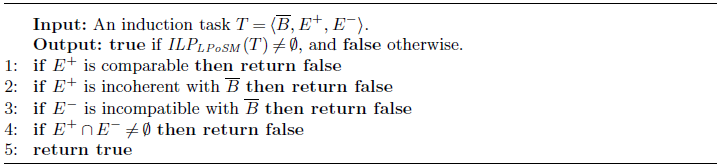

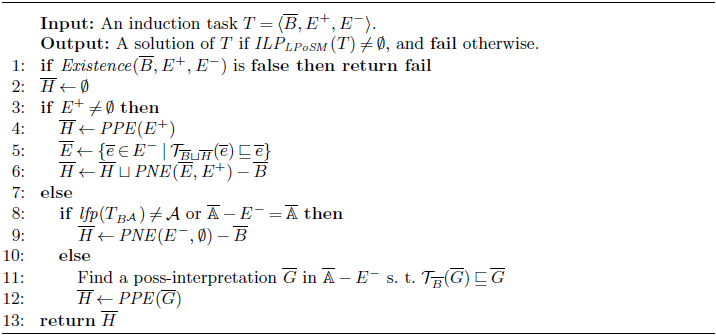

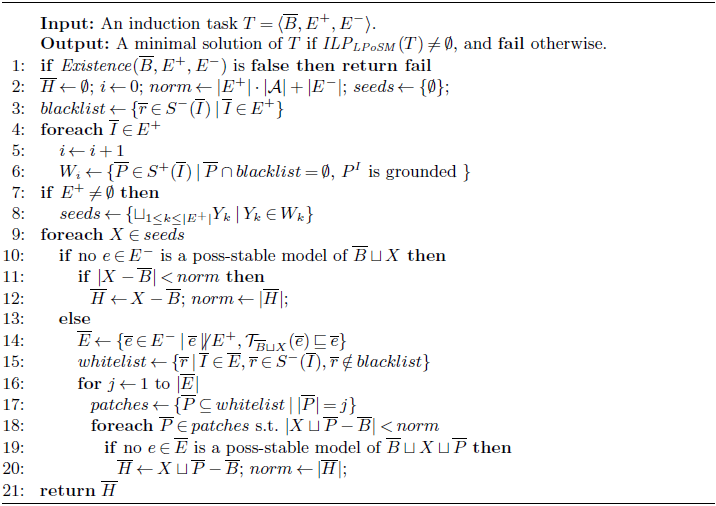


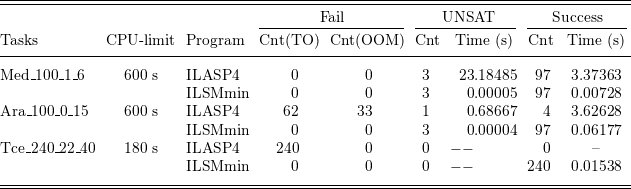


 Open access

