

Introduction
The study of trans-Saharan trade has shed considerable light on the histories of interaction between North African merchants and the complex, increasingly urban societies of the Sahel c. AD 800–1500 (Reference Stahl, Feinman and NicholasStahl 2004). Communities at the southern 'periphery' of this trans-regional trade network, however, are portrayed in written sources as hapless victims of raiding, consumers of imported commodities, or simply hospitable 'landlords' (e.g. Reference PosnanskyPosnansky 1973; Reference WilksWilks 1982; Reference BrooksBrooks 1993). In order to refine this view, my recent research (2007 to 2009) at the site of Diouboye in eastern Senegal asks how such communities may have been both globally entangled and locally grounded in processes of social reproduction and transformation (Reference SteinStein 2002). Here I briefly consider what some of the artefacts from Diouboye reveal about the practices of exchange and consumption that worked to structure daily life and cultural values within the village (see Reference OgundiranOgundiran 2002; Reference StahlStahl 2002; Reference RichardRichard 2010).
Map showing the location of Diouboye and contemporary sites in the area surveyed by the Central Falémé Archaeological Project, 2008.

Diouboye
Diouboye is located on the near-perennial Falémé River at the north-west 'gateway' to the legendary land of Bambuk whose gold supposedly enriched the empire of Ghana throughout the late first millennium AD (Reference CurtinCurtin 1973). I cannot yet ascertain whether or not people here were directly involved in trade, nor even if they produced gold or commodities for exchange, but the presence of non-local objects shows that the community did, in one way or another, take part in growing interregional networks. For this reason, I focus on how participation was structured through local institutions that can be interpreted from the material and spatial patterns of production, storage, exchange and consumption observed at the site.
During a survey of nearly 72km2 along the Falémé River in 2008 (Figure 1), some 144 sites and 67 isolated finds were identified; 29 are thought roughly contemporary with Diouboye on the basis of surface finds. The aggregation of these sites, including habitation and specialised activity areas, suggests that Diouboye formed a nexus for political, economic, and possibly ritual, institutions in the immediate region.
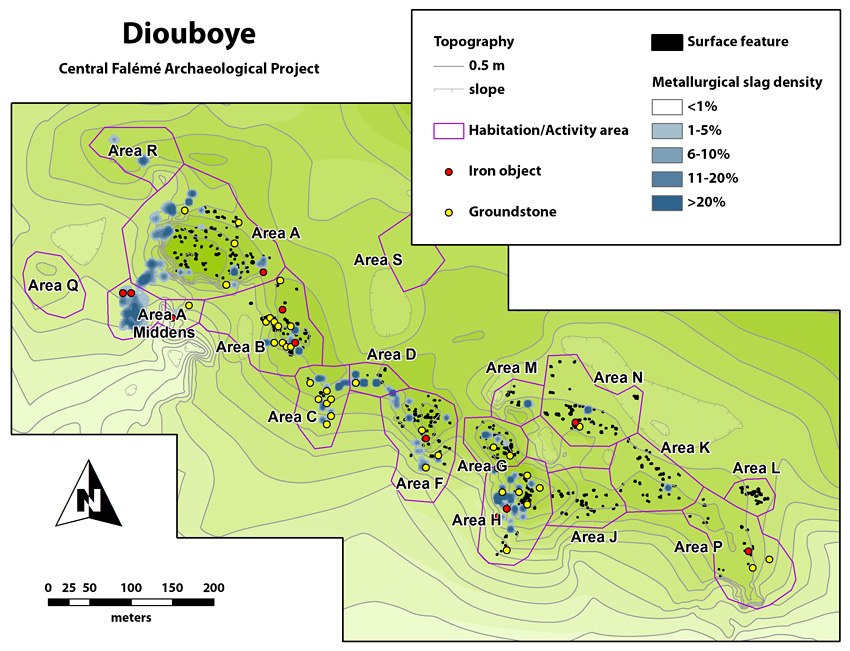
Map of Diouboye showing habitation and activity areas, relative density of slag and frequency of groundstone and iron objects.

Building upon limited prior fieldwork at the site (Opper & Reference Opper and OpperOpper 1990), my surface mapping at Diouboye revealed five low mounds and ten additional areas covered with artefacts and over 400 stone foundations (e.g. granaries, huts, pot rests). Despite potential biases in these data (see Reference CarrCarr 1984; Reference ClarkClark 2003), one can clearly distinguish areas of domestic occupation with high densities of pottery and stone features from middens and more specialised activity areas. For example, slag and groundstone from craft manufacture, and perhaps specialised food processing, were more concentrated in Areas B and C, and dense middens were located southwest of habitation Area A — signalling a possible north-south division of the settlement during its final occupation phase (Figure 2).
In order to explore the evolution of occupation, I opened three 16–24m2 units on habitation mounds (Areas A, F, G) and several smaller 1–4m2 units on other habitation and activity areas (Areas C, H, K, N, S). Most revealed deposits to a depth of 1–1.5m, with shallow hearths, mud wall stubs, sandstone foundations, borrow pits and middens. A preliminary analysis of the faunal and macrobotanical remains shows that people cultivated millet or sorghum and herded domestic cattle and sheep or goats, even as they also hunted wild ungulates, reptiles, molluscs and large fish. Analyses of craft production, distribution and consumption within the community (see below) are still in progress, but these preliminary data, alongside patterns among exotic objects, do allow for an initial interpretation of the interplay between the local social organisation of Diouboye and interregional networks.
Social organisation of craft production
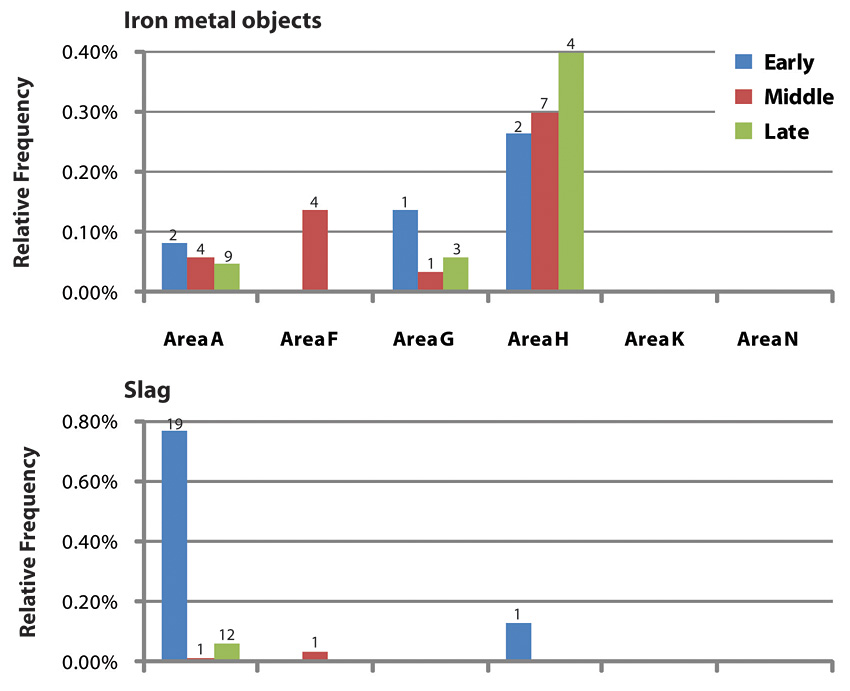
Relative frequencies of metallurgical artefacts by occupation phase at Diouboye.

An analysis of over 20 000 sherds from globular jars and cooking pots — often slipped or decorated with roulette patterns of twisted, braided and folded twine, cord-wrapped stick or carved wood — allowed me to construct a relative chronology linking units across the site into three occupation phases dated by two radiocarbon dates to late first millennium AD. Rim sherds include simple, collared and everted forms, but lack the distinctive long-collared and heavily channelled forms found along the Middle Senegal River (Reference ChavaneChavane 1985; Reference ThiawThiaw 1999; Bocoum & McIntosh 2002), while the carved roulette decoration so frequent at Diouboye seems to be confined to sites along the Upper Niger and Gambia rivers through the early second millennium AD (Reference Livingstone SmithLivingstone Smith 2007; Reference GallayGallay 2010). Although the sparseness of regional data hampers our ability to interpret the significance of this 'Mande' ceramic zone, Reference Livingstone SmithLivingstone Smith (2007) has cautiously suggested that it could correspond to an emerging supra-local network of craft specialists such as blacksmiths.
Area A generated evidence for metalworking right from the earliest Phase I occupation of Diouboye (Figure 3) when a well-oxidized hearth lined with fine white ash and some slag implies the presence of a small forge. Slag continued to occur in Area A through occupation Phases II and III — though frequencies are trivial compared to those from sites on the Middle Senegal River (Reference ChavaneChavane 1985; Reference BocoumBocoum 2000). Together with a vitrified conical crucible in the uppermost deposits, this suggests that people undertook a variety of metalworking activities in Area A. Pottery production is more difficult to pin down, but this activity may also have been confined to Area A where small finds included a sturdy and heavily worn bowl resembling the hand-wheels used by many contemporary potters and several large fragments of the granitic material that tempered over 25 per cent of the sherds at the site. This evidence, together with the greater surface concentrations of slag around Area A, suggests that craft production was generally confined to the northern sector of Diouboye. At the same time, the widespread distribution of pottery and iron tools, such as knives and harpoons, indicates that the circulation of local craft goods was fairly unrestricted within the community.
Interregional interaction
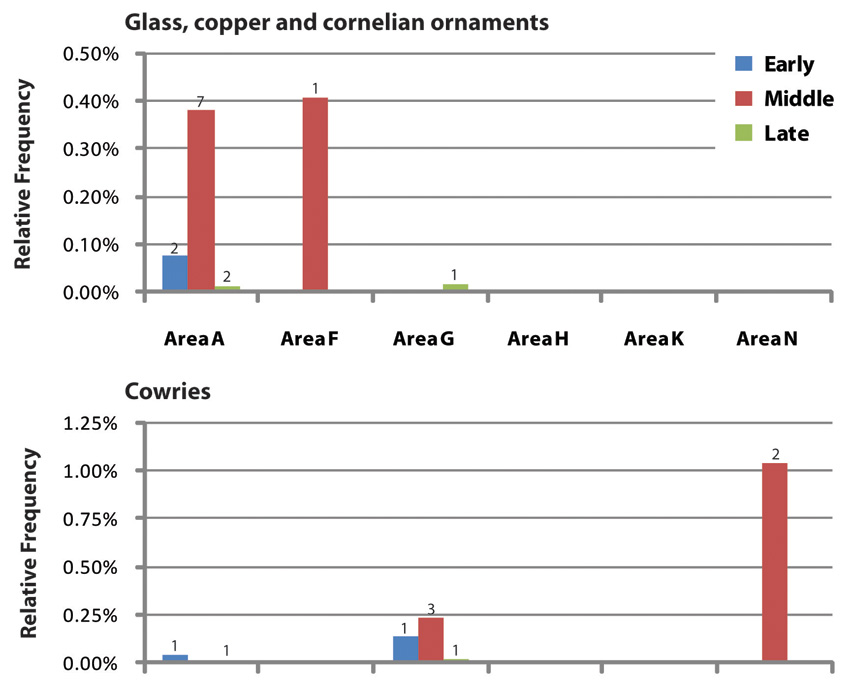
Relative frequencies of exotic items by occupation phase at Diouboye.

Objects such as glass beads, cowry shells and copper ornaments from surface and excavation contexts attest to participation in direct trade or down-the-line exchange, or both (Figure 4). Despite the extremely small sample involved, a distinct pattern has emerged: Area A yielded five glass and four cornelian beads and two copper ornaments while Areas F, G and N to the south yielded seven of the nine cowry shells recovered. It could therefore be suggested that co-residential groups at Diouboye engaged with interregional networks in different, but complementary, ways. The occupants of Area A, for example, may have maintained preferential access to copper — a metal generally associated with high status in pre-colonial Africa (Reference HerbertHerbert 1984). This finding is of particular interest since technical and ritual knowledge for specialised craft production, also associated with Area A, is often associated with low political status in historic West African societies (e.g. Reference TamariTamari 1991; Reference LavioletteLaViolette 2000). This seeming contradiction lends support to Hamady Reference BocoumBocoum's (2000) suggestion that the divergent social values attributed to iron working and copper consumption in the Senegambia have only emerged through socio-political developments and inter-cultural conjunctures in the past millennium.
A comparison of the ways in which exotic materials were used for display and consumption may also shed light on how the people of Diouboye made sense of these interregional relations and object worlds (Figure 5). The association between terracotta, quartz and ivory ornaments of relatively local manufacture with cowries, glass, cornelian and copper beads in Areas A and G suggests that the sampled deposits reflect, in part at least, the display or inadvertent loss of bodily adornment. The observed preference for glass and copper ornaments continues to hold for Area A (and F), compared with the relatively greater consumption of cowries and ivory ornaments in Area G and elsewhere across the southern part of the site.
Relative frequency of ornaments at Diouboye.

Conclusion
The data from Diouboye suggest that craft production was enmeshed within some form of community-level social distinction — though whether this was class, kinship or landlordship is currently under investigation. The association between craft production and greater access to copper and glass ornaments around Area A further suggests that these intra-community social principles also shaped engagement with supra-local networks. It is hoped that analysis of the faunal, macrobotanical and lithic remains excavated at Diouboye will clarify the social and depositional conditions which led to the presence of imported objects in the archaeological record. Although future fieldwork may alter or refine the interpretation offered here, I maintain that the local reception of imported artefacts will remain critical for exploring how small-scale communities in West Africa became entangled within increasingly global networks during the late first millennium AD.
Acknowledgements
I would like to thank Ibrahima Thiaw, Hamady Bocoum and Augustin Holl for their intellectual and logistical support of my research in Senegal. I also extend my heartfelt thanks to Aimé Kantoussan, Massal Diagne, Matar Ndiaye and Tamsir Maiga who assisted with the fieldwork. The research presented here has been financed by Fulbright IIE and by the University of Michigan International Institute, Center for Afroamerican and African Studies, Museum of Anthropology, and Department of Anthropology.