

The health and nutrition of dairy calves is inherently linked with their performance as youngstock, as well as having lasting effects on their productivity once they enter the dairy herd, and the dividends of enhanced calf care often observable in improved lifetime production (Van Amburgh et al., Reference Van Amburgh, Soberon, Karszes and Everett2014). The inclusion of fungal fermentation products in calf diets is a nutritional strategy that can have beneficial outcomes for health, growth and development (Cangiano et al., Reference Cangiano, Yohe, Steele and Renaud2020; Yerby et al., Reference Yerby, Taylor, Warren and Jonsson2025). These products can contain a suite of bioactive compounds, such as enzymes, mannans, glucans, organic acids and alkaloids, which can positively influence the gut microbiome, enhance immune function, increase the digestibility of feedstuffs and propagate the development of the gastrointestinal (GI) tract (Thomas et al., Reference Thomas, Larroche and Pandey2013; Amin and Mao, Reference Amin and Mao2021). Synergen® (Alltech Inc., Kentucky, USA) is a commercially available product of the solid-state fermentation of Aspergillus niger (ANP), containing residual enzyme activities. Supplementing mature cattle with Aspergillus fermentation products has demonstrated beneficial effects on digestibility and production responses, with effects widely attributed to the products acting as prebiotics and digestibility enhancers (Tricarico et al., Reference Tricarico, Johnston, Dawson, Hanson, McLeod and Harmon2005; Sosa et al., Reference Sosa, Marrero, González, Albelo, Moreira, Cairo and Galindo2022). Feeding Aspergillus fermentation products to calves has led to younger weaning ages, increased volatile fatty acid (VFA) production (Beharka et al., Reference Beharka, Nagaraja and Morrill1991), increased feed intake and improved feed conversion efficiency (FCE) (Anil et al., Reference Anil, Chatterjee, Singh, Yadav and Mohammad2022). Although some studies have found limited or no effects of Aspergillus product supplementation on calf performance (Yohe et al., Reference Yohe, O'diam and Daniels2015; Vaz-Ramírez et al., Reference Vaz-Ramírez, Curbelo-Rodríguez and Ortiz-Colón2021), highlighting inconsistencies in responses that have hindered the widescale industry application of these types of dietary interventions. Supplementing dairy calves with the mannan-rich fraction (MRF) of Saccharomyces cerevisiae cell walls (Alltech Inc., Kentucky, USA), has been found to be beneficial for calf immunity by interacting with macrophages and neutrophils and engulfing pathogens in the GI tract, as well as enhancing gut development and epithelial integrity (Broadway et al., Reference Broadway, Carroll and Burdick Sanchez2015; Ma et al., Reference Ma, Shah, Shao, Wang, Zou and Kang2020). To our knowledge, there is no published research examining the effects of supplementing calves with ANP and MRF in combination. We hypothesized that combining the digestibility-enhancing potential of ANP with the immunomodulating capacity of MRF, could lead to additive or synergistic effects in calves by increasing nutrient availability and the capacity of the calves to utilise those nutrients through improved gut health. The objectives of this study were to measure the effects of ANP, alone, or in combination with MRF on calf growth, health, feed intake, FCE, digestibility, VFA production and rumen development.
Materials and methods
Treatments, animals and management
All procedures in this study were approved by The University of Glasgow Research Ethics Committee (ref EA07/24). To determine minimum sample requirements, power analyses were conducted for intake, ADG, and rumen variables (α = 0.05, β = 0.1, Power = 0.8). Thirty Holstein–Friesian bull calves, age 19 ± 5 days, weight 52 kg (SD = 18), were sourced from a single farm and transported to Cochno Farm and Research Centre (Clydebank, UK) for this 70-day trial. Upon arrival, calves were blocked into six age groups, and then randomly assigned to a cull date, trial day 27 or 70, and to evenly balanced dietary treatment groups according to age. Groups were: CTRL, no treatment; ANP, 3 g/day ANP; MRF, 3 g/day ANP and 2 g/day MRF; single calf was the experimental unit in this study. For the first 7 days of the trial, calves were adapted to treatments and environment; no data collected in the adaptation period were used in analyses. On Day 3 of the adaption period, calves were vaccinated intranasally against pneumonia (Rispoval RS + PI3, Zoetis, NJ, USA). Calves were housed in a Yorkshire board barn (solid, cement block to 1.75 m height, with vertical timber slats, spaced at 50 mm intervals to 2.65 m height) and individually penned. In the pre-weaned period, pens measured 1.8 × 1.8 m and post-weaning they were expanded to 1.8 × 3.6 m. Pens were bedded with barley straw, which was top-filled daily and mucked out every 2 weeks. Calves had ad libitum access to fresh water, starter concentrates (I'Anson Early Weaner Pellets, 18% CP, 8.75 % CF, 4.25% fat, 7.5% ash) and barley straw for the duration of the trial. For the first 27 days, calves were fed 6 l of whey protein-based milk replacer (MR) [Volac Heiferlac, 26% CP, fat 16% fat, 19.7 Mj ME/kg dry matter (DM)], split into two equal feeds offered at 0700 hours and 1600 hours. MR was offered at 38–40°C at a concentration of 150 g DM milk power diluted in 0.85 l water. In the pre-weaned period, calves received treatments in the morning MR feed, which was administered using 3 l bottles. Bottles were agitated manually during feeding to keep treatments in suspension; the afternoon feed was offered in Single Teat Calf Feeders (Stockman, Belfast, UK). Milk replacer consumption was monitored at every feed, and no milk refusals were observed during the trial. On Day-27, all calves received MR in the morning, and calves assigned to the Day-70 cull were abruptly weaned. Pre-weaning, concentrate refusals were measured daily whereby calves were provided with a known quantity of concentrates in the morning and refusals were weighed using a digital balance (OHAUS, Lecesiter, UK), 24 hours later. In the weaned period, the top layer of concentrates in each calf's morning feed, was sprayed with water before the treatments were dusted on top and the bucket gently agitated to adhere treatments to pellets. Calves were initially provided with a quantity of concentrates anticipated to be lower than their daily consumption to ensure complete consumption of treatments, once all the treated concentrates had been consumed, more was offered. This approach was applied to all animals; both quantities of initial and top-up concentrates were recorded, and concentrates were weighed prior to being sprayed with water to ensure accurate DM intake calculations. The quantities offered were adjusted daily based upon consumption the previous day and no upper limit was placed upon the quantity of concentrates a calf could consume. Quantities of starter offered, refused, and consumed are recorded in the online data file associated this paper (https://doi.org/10.5525/gla.researchdata.2018). Samples of concentrates, straw and MR were taken weekly and pooled every 4 weeks for nutrient analysis.
Growth, digestibility and health measurements
In the pre-weaned period, calves were weighed on 2 consecutive days weekly and, in the weaned period, calves were weighed on 2 consecutive days every other week. Weight measurements were recorded using a calf weight crate with digital scales (Ritchie Agricultural, Angus, UK), immediately after the morning feed on both days, and the mean of the two consecutive weights was used in FCE and average daily gain (ADG) calculations. Average daily gain was calculated by dividing weight gain by the number of days since weight was last measured. FCE was calculated by dividing ADG by the daily DM intake of starter and MR. Faecal health was measured on 2 consecutive days weekly, using the Wisconsin Madison scoring system, where 0 = normal; 1 = semi-formed and pasty, 2 = loose but stays on top of bedding, 3 = watery and sifts through bedding (McGuirk, Reference McGuirk2008). On alternate weeks from Week 1 of the trial, spot samples of ≈20 g faeces were collected after faecal scoring and immediately frozen at –20°C. Following the trial, apparent total tract digestibility of DM was estimated using the acid insoluble ash (AIA) protocol of Van Keulen and Young (Reference Van Keulen and Young1977). Calculations were based on the AIA content of MR and concentrates that each calf had consumed 24 hours prior to faecal collection. Since calves were bedded on barley straw, as well as having ad lib access to straw in feeders, the level of straw intake could not be accurately quantified, as such, the AIA content of straw was not included in calculations, highlighting a potential limitation of this dataset.
Rumen variables
On Days 27 and 70, five calves from each treatment group were culled using Schedule 1 Killing, via administration of intravenous pentobarbital at a dose of 0.7 ml/kg liveweight. After confirmation of permanent cessation of circulation was verified by auscultation for heart sounds, the rumen of each calf was removed. Duplicate 10 ml samples of digesta were collected from the ventral sac of rumens and stored with 0.5 ml phosphoric acid at −80°C prior to VFA analysis using gas chromatography. The concentrations of total VFA (tVFA), acetate, propionate, butyrate, valerate, isobutyrate and isovalerate in centrifuged rumen digesta were quantified using a Vapor Fractometer and column containing 2% phosphoric acid and 20% Tween-80 (Perkin-Elmer, Waltham, Massachusetts, USA), following the protocol of Erwin et al. (Reference Erwin, Marco and Emery1961). After digesta collection, rumens were emptied, rinsed with cold phosphate-buffered saline and weighed. A 3 × 3 cm section of the ventral and dorsal sacs was removed, pinned onto cardboard and fixed in 10% formalin for 48 hours. To ensure homogeneity of sampling location, the same operator collected tissue samples from all rumens. After being fixed in formalin, a slice (3 µm thickness) of each ventral and dorsal sac sample was embedded in paraffin slides, which were then stained with haematoxylin and eosin (H&E) and scanned at ×40 magnification. Staining and scanning were performed by Veterinary Diagnostic Services at The University of Glasgow. Rumen papillae were measured using QuPath-0.5.1 (Bankhead et al., Reference Bankhead, Loughrey, Fernández, Dombrowski, McArt, Dunne, McQuaid, Gray, Murray and Coleman2017) and treatment identifiers were masked during analyses. The five longest papillae on each slide were selected for analysis; the length of each papilla was measured using a straight line from base to tip. If papillae were sufficiently bowed to prevent a single line that passes through the body of a papilla being drawn, a polyline was used. Papilla width was estimated by taking the mean of five straight lines drawn from the ventral to dorsal plane of each papilla. The first width measurement was always taken at the transection point of the papilla and lines were drawn at approximately even intervals thereafter, whilst avoiding crossing the papilla at branches, which would disproportionately skew the mean. The thickness of the stratum corneum (SC) and combined thickness of the strata basale, spinosum and granulosum (SBSG) were estimated by taking the mean of five measurements from each papilla. Lines for SC and SBSG were drawn perpendicular to the junction between the SC and the stratum granulosum (Fig. 1). The ratio of keratinized to non-keratinized epithelium of each papilla was estimated by dividing the SC thickness by the SBSG thickness at each measurement point and taking the mean of those five measurements. A slide from the ventral sac of one calf (calf 319, ANP, Week 13) was excluded from analysis due to mechanical damage that prevented accurate papillae assessment.
Measurements used to quantify rumen papillae morphology in pre-weaned and weaned dairy calves. Papillae width = average W1: W5, W1 = transection point of papilla. Papillae length (L) = straight line from W1 – tip, or polyline if a straight line that passes through the papilla cannot be drawn due to bowing. Stratum corneum (SC) thickness = average SC1: SC5. Strata basale, spinosum, granulosum (SBSG) thickness = average SBSG1: SBSG5. Lines for SC and SBSG were drawn perpendicular to the junction between SC and stratum granulosum.

Statistical analysis
Feed intake, FCE, ADG and apparent total tract DM digestibility data were analysed using repeated measures (RM) ANOVA with treatment and time as factors. Papillae length, width, SC thickness, SBSG thickness and SC: SBSG data were analysed using RM ANOVA with treatment and calf as factors. Histological data from each cull timepoint and ventral and dorsal sacs were analysed in separate models. Datasets were subjected to Shapiro Wilks normality tests, if the assumptions of the tests were not met (P < 0.05), then the data were transformed using log10 or 1/x transformations; rumen weight, VFA concentrations and proportions and body weight (BW) data were analysed using one-way ANOVA. When ANOVA indicated significant differences between groups due to treatment effects, Tukey's Honestly Significant Difference post hoc test was used to assess differences between means and significance was declared at P < 0.05. The majority of rumen histology data were non-parametric; data characteristics for each rumen variable, and the transformation used to meet normality assumptions, are summarized in the supplementary materials (Supplementary Table 1). Faecal score data were non-parametric, and no attempted transformation met normality assumptions, so differences were analysed using a Kruskall Wallis H-test. All analyses were performed in R (R Core Team, 2024), except for faecal data analysis which was performed using a statistical process control add-in for Microsoft Excel (QI Macros 2025, KnowWare International).
Results
All calves remained healthy throughout this trial, no milk refusals were observed in the pre-weaned period, and no cases of morbidity were observed throughout. Mean BW of calves was 52 kg (SD = 18) at the beginning of the trial, 73 kg (SD = 10) at weaning, and 122 kg (SD = 20) at the end of the trial. ADG in the pre-weaned period was 789 g/day (SD = 43) and 1,177 g/day (SD = 47) in the weaned period.
Intake, growth and faecal variables
Results for primary response variables: FCE, ADG, starter intake and BW are shown in Table 1. Body weight and ADG were similar among all treatments in pre-weaned and weaned periods. ANP calves consistently consumed more starter concentrates throughout the trial. In the pre-weaned period, ANP calves had a mean intake of 417 g/day, higher than the CTRL calf intake of 360 g/day (P = 0.044) and MRF calf intake of 328 g/day (P = 0.0006). In the weaned period, ANP calves had a mean starter intake of 3,398 g/day, which was significantly higher than the CTRL intake of 3,155 g/day (P = 0.021) and MRF intake of 3203 g/day (P = 0.0027). Time had a significant effect on intake across both periods (P < 0.0001) and there was no interaction between time and treatment on pre-weaned intake (P = 0.97) or weaned intake (P = 0.051). Treatments did not consistently affect FCE in the pre-weaned or weaned period although some differences between groups in weekly and bi-weekly data were apparent (Table 1). Time significantly affected FCE in the pre-weaned and weaned periods (P < 0.0001) and there was an interaction between time and treatment in the pre-weaned period (P = 0.024). Faecal score was unaffected by treatment in the pre-weaned (P = 0.82) and weaned (P = 0.14) periods; mean faecal scores for all groups in both periods was < 1. The apparent total tract digestibility of DM was estimated to be 72.2% in CTRL, 70.5% in ANP and 71.5% in MRF and was unaffected by treatment (P = 0.52), time (P = 0.32) and there was no interaction between treatment and time (P = 0.12).
Feed conversion efficiency, starter concentrate intake, average daily gain and bodyweight of Holstein Friesian bull calves fed 3 g/day Aspergillus Niger fermentation extract alone (ANP), or in combination with 2 g/day of the mannan-rich fraction of Saccharomyces cerevisiae cell wall (MRF), compared with control calves offered no treatments (CTRL)

Abbreviations: FCE = feed conversion efficiency; ADG = average daily gain; BW = bodyweight.
a,b Values not sharing a superscript are significantly different (P < 0.05).
Rumen variables
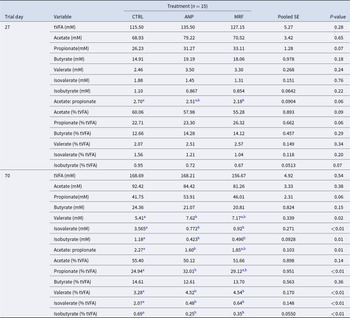
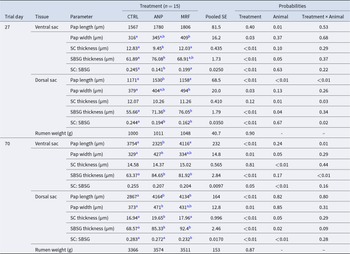
The molar concentrations and proportions of VFA in centrifuged rumen digesta collected at weeks 7 and 13 are shown in Table 2. In Week-7, the acetate: propionate ratio (Ace: Prop) in MRF was 2.18, which was significantly lower than the Ace: Prop of 2.7 in CTRL (P = 0.047). This is likely caused by a tendency for MRF to have lower acetate percentage than CTRL (55 vs. 60 %) (P = 0.071) and a higher propionate percentage than CTRL (26 vs. 23 %) (P = 0.059). There was no effect on any other VFA variable in week-7. In week-13, ANP calves had an Ace: Prop of 1.6, significantly lower than the 2.27 A: P of CTRL (P = 0.0085) and a significantly higher propionate percentage than CTRL (32 vs. 25%, P = 0.004). Differences in valerate concentrations and isoacid concentrations and proportions were also observed between groups in Week-13. The variables derived from rumen tissue are presented in Table 3. ANP calves had consistently wider ruminal papillae, in ventral and dorsal sacs, at 7 and 13 weeks. Both ANP and MRF calves had higher SGSB thickness than control calves, in both locations and at both timepoints.
Volatile fatty acid concentrations and proportions in rumen digesta collected from Holstein Friesian bull calves fed 3 g/day Aspergillus Niger fermentation extract alone (ANP), or in combination with 2 g/day of the mannan-rich fraction of Saccharomyces cerevisiae cell wall (MRF), compared with control calves offered no treatments (CTRL)

Abbreviations: tVFA = total volatile fatty acids.
a,b Values not sharing a superscript are significantly different (P < 0.05).
Rumen weights and papillae variables in Holstein Friesian bull calves fed 3 g/day Aspergillus Niger fermentation extract alone (ANP), or in combination with 2 g/day of the mannan-rich fraction of Saccharomyces cerevisiae cell wall (MRF), compared with control calves offered no treatments (CTRL)

Abbreviations: pap = papilla; SC = stratum corneum; SBSG = strata basale, spinosum and granulosum.
a,b Values not sharing a superscript are significantly different (P < 0.05).
Discussion
Supplementing dairy calves with ANP alone or in combination with MRF, did not consistently improve FCE or ADG, although ANP calves had consistently greater starter intake than both CTRL and MRF throughout the trial. There was a shift in rumen fermentation patterns towards propionate in both treatment groups, but at different stages of calf development, MRF pre-weaning and ANP post-weaning. Isoacids were also decreased and valerate was increased in MRF and ANP calves post-weaning. The layer of metabolically active cells (SBSG) in ANP papillae was thicker than CTRL at both culling timepoints, in both ventral and dorsal sacs. This effect was also measured in MRF apart from in the ventral sac at Week 7. Increases in papillae dimensions were measured in both MRF and ANP compared with CTRL, although these effects were not consistent across tissue sampling sites and culls; no additive or synergistic effects between MRF and ANP were seen for any variable.
The dominant proposed mode of action of Aspergillus fermentation products in ruminants is prebiotic, whereby feed digestibility can be increased, either through residual enzyme activity in the products, and/or the nutritional content of the product can act as a substrate to promote favourable microbial population growth in the rumen (Uwineza et al., Reference Uwineza, Parchami, Bouzarjomehr, Taherzadeh and Mahboubi2024). In the present study, ANP did not enhance calf growth or consistently improve the conversion of concentrates into BW. These results are in line with the study of Vaz-Ramírez et al. (Reference Vaz-Ramírez, Curbelo-Rodríguez and Ortiz-Colón2021), which measured no effect of A. niger and A. oryzae fermentation extract supplementation (2 g/day) on Jersey and Holstein calf growth and skeletal variables. Our study measured a significant increase in concentrate intake in calves fed ANP; increased intake, without corresponding increases in ADG or FCE, would likely be considered economically undesirable in more mature dairy or beef animals. However, given the positive impact that concentrate intake has on rumen development and the transition from milk to solid-feed in calves (Van Amburgh et al., Reference Van Amburgh, Soberon, Karszes and Everett2014), we suggest that in the timeframe of this study, the increased concentrate intake measured in ANP is a beneficial outcome given the improvements measured in rumen variables. Di Francia et al. (Reference Di Francia, Masucci, De Rosa, Varricchio and Proto2008) supplemented buffalo calves with A. oryzae and S. cerevisiae cultures at 6 g/kg and 26 g/kg DM intake, respectively, and reported similar starter intakes across treatment and control groups. However, the digestibility of DM, OM, CP and NDF was increased in calves fed cultures. As in the present study, Di Francia et al. (Reference Di Francia, Masucci, De Rosa, Varricchio and Proto2008) used AIA as an internal marker to estimate digestibility, but they quantified the amount of forage calves consumed. Not measuring straw intake is a limitation of the digestibility data produced in this study; accurate quantification of straw intake was impractical due to a condition of the ethics license for this study being that calves must be bedded on straw. If treatments affected forage intake or fibre digestibility, differences between groups may have been undetected by not including straw AIA in analyses. The faecal health of calves in this study was unaffected by treatment. We did not anticipate an effect of ANP on faecal scores; however, MRF supplementation has previously improved the faecal health of dairy calves (Heinrichs et al., Reference Heinrichs, Heinrichs and Jones2013; Spring et al., Reference Spring, Wenk, Connolly and Kiers2015). The mode of action of MRF is suggested to be prebiotic, where supplementation can promote gut integrity via the binding, and limiting colonization of, gut pathogens, including Escherichia coli and Clostridia spp., resulting in improved gut health and decreased diarrhoea incidence (Spring et al., Reference Spring, Wenk, Connolly and Kiers2015). In this study, calves remained healthy throughout, demonstrated by a mean faecal score of < 1 in all groups. Any benefits of MRF are likely to be most apparent in challenged environments, as such, conclusions on the effect of MRF on calf health should not be drawn from these data. Research performed in less hygienic conditions, where treatments can be administered earlier in life than the present study, might enhance the understanding of MRF effects when calves encounter disease stressors.
Apart from a lower Ace: Prop measured in MRF calves; rumen fermentation patterns were similar between groups pre-weaning. Decreased Ace: Prop and a tendency for increased propionate percentage in MRF is indicative of an increase in the more efficient propionate fermentation pathway. Butyrate and propionate are considered the most important VFA for rumen development in calves, providing a source of energy for the proliferation and growth of papillae (Diao et al., Reference Diao, Zhang and Fu2019). In our study, calves in all treatment groups had similar butyrate concentrations, in line with the results of Beharka et al. (Reference Beharka, Nagaraja and Morrill1991), who saw no differences in butyrate between controls and calves fed A. oryzae fermentation product. However, they noted an increase in acetate and propionate concentrations in treatment calves. The changes in fermentation pattern in MRF could have provided more energy to the rumen epithelium, leading to wider papillae, a thicker layer of metabolically active cells (SBSG) and a lower ratio of keratinized (SC) to non-keratinized (SBSG) cells, compared with CTRL, at week seven. Although ANP did not have a significantly different VFA profile to CTRL pre-weaning, we also measured improved papillae morphology in their rumens; thicker SBSG and lower SC: SBSG in both ventral and dorsal sacs, and longer papillae in the ventral sac, compared with CTRL. This is converse to the study of Yohe et al. (Reference Yohe, O'diam and Daniels2015), which found no difference in papillae length and width in Holstein bull calves treated with or without 2 g/day A. oryzae fermentation extract. The differences we measured could be associated with the increased concentrate intake measured in ANP, which would have increased their dietary energy intake. Shen et al. (Reference Shen, Seyfert, Löhrke, Schneider, Zitnan, Chudy, Kuhla, Hammon, Blum and Martens2004) proposes that VFA concentrations are not the sole driver of papillae development in young ruminants and that increased intake of metabolizable energy increases the concentration of insulin-like growth factor (IGF)-1 in the rumen and IGF-1 receptors in papillae. Thus providing a functional mechanism for papillae to metabolize the increased nutrients provided by increased concentrate intake, resulting in morphological enhancements in the developing rumen (Shen et al., Reference Shen, Seyfert, Löhrke, Schneider, Zitnan, Chudy, Kuhla, Hammon, Blum and Martens2004). The effect of SC thickness on rumen function in calves is not well defined. Keratinocytes provide a barrier against pathogenesis, increase the surface area of the rumen for digestion, and play an active and passive role in the transport of nutrients to the rumen mucosa (Baaske et al., Reference Baaske, Gäbel and Dengler2020). However, these cells do not catabolize VFA and we suggest that lower SC: SBSG measured in ANP and MRF is advantageous because it indicates a greater proportion of metabolically active cells in papillae. Notably, in the pre-weaned period, treatments were administered in milk so may not have interacted directly with rumen tissue and microbes having bypassed the reticulorumen through the oesophageal groove. Given the beneficial effects on rumen histology that were measured in treatment calves, investigation into the effects of ANP and MRF throughout the rest of the GI tract would be beneficial.
At Week 13, ANP calves had increased propionate percentage and decreased Ace: Prop compared with CTRL calves. The propionate pathway is more efficient than acetogenesis (Janssen, Reference Janssen2010), a shift towards propionate could indicate enhanced starch hydrolysis and/or increased propionate could be associated with the increased concentrate intake, leading to enhanced papillae morphology measured in ANP. Post-weaning MRF and ANP had increased valerate proportions compared with CTRL. Kristensen and Harmon (Reference Kristensen and Harmon2004) suggest that butyrate and valerate compete for the same metabolic pathway in rumen epithelium, as such, increased valerate metabolism could affect the absorption of butyrate. VFA metabolism and absorption rates cannot be quantified from a single VFA measurement, however, if butyrate absorption was limited by increased valerate in ANP and MRF, it did not negatively affect the rumen variables that we measured. In non-ruminants, increased valerate has been associated with improved intestinal barrier function (Gao et al., Reference Gao, Zhou, Wang, Ding, Zhou, Chong, Zhu, Ke, Wang and Rao2022) and increased FCE (Zhang et al., Reference Zhang, Bao, Wang, Zang and Cao2020), further research is required to investigate the effects of varying valerate concentrations in calves. In MRF and ANP, concentrations and proportions of isovalerate and isobutyrate were significantly decreased, compared with CTRL at Week 13. This effect was also measured by Beharka et al. (Reference Beharka, Nagaraja and Morrill1991) in Holstein heifer calves supplemented with A. oryzae extract. Isoacids come from the de-amination of proteins and are important substrates for cellulolytic bacteria growth (Andries et al., Reference Andries, Buysse, De Brabander and Cottyn1987); Beharka et al. (Reference Beharka, Nagaraja and Morrill1991) suggests that decreased isoacid concentrations could indicate increased isoacid assimilation by cellulolytic bacteria. Supplementing calves with exogenous isoacids has improved calf growth, feed efficiency and ruminal cellulolytic bacteria counts (Liu et al., Reference Liu, Wang, Zhang, Pei, Zhang, Wang, Zhang, Yang, Wang and Guo2016), and feed intake, papillae length and width (Wang et al., Reference Wang, Liu, Zhang, Pei, Zhang, Guo, Huo, Yang and Wang2017). However, ‘normal’ endogenous levels of isoacids in calves are undefined, so it is difficult to determine if the concentrations of isoacids in MRF and ANP would have affected cellulolytic bacteria proliferation without microbiome data. The effect of ANP and MRF on rumen microbial dynamics requires further investigation as this could provide evidence that explains the changes in fermentation patterns measured in this study. At week 13, ANP calves had shorter and wider papillae than CTRL in the ventral sac, and longer and wider papillae than CTRL in the dorsal sac; MRF had longer papillae than CTRL in the dorsal sac. This indicates that treatments could increase the surface area of papillae, although this was not consistent over the whole rumen. Similarly to Week 7, MRF and ANP had thicker layers of SBSG in both ventral and dorsal sacs. Cells in the SBSG catabolize VFA through ketogenesis, providing energy for the growth and maintenance of the rumen mucosa, and the entire animal (Baaske et al., Reference Baaske, Gäbel and Dengler2020). SBSG thickness is particularly important post-weaning, where the metabolic capacity of papillae is fundamentally linked to calf performance, with VFA providing up to 70% of ruminant energy requirements (Bergman, Reference Bergman1990). As such, increases in gross papillae structure and the thickness of the SBSG suggest increased capacity to perform VFA metabolism.
Conclusion
The changes in papillae morphology we measured in calves supplemented with ANP and ANP + MRF indicate that treatments could enhance the metabolic and absorptive capacity of the rumen in transition stage calves. These differences would be theoretically consistent with improved efficiency, but there was no evidence of a direct effect of treatment on growth and FCE metrics in this small study. Data from commercial trials using a larger number of calves, in more challenged conditions, are required to draw conclusions about the effects of treatments on calf performance.
Supplementary material
The supplementary material for this article can be found at https://doi.org/10.1017/S0022029926102143.
Acknowledgements
The authors would like to acknowledge Professor Jo-Anne Murray and Professor Peter Hastie for securing the funding for the PhD project that this study is a component of.
Funding statement
This study was supported by the University of Glasgow and Alltech as part of a PhD studentship.
Competing interests
H.W. is an employee of Alltech, which produces Synergen® and MRF, and Alltech is part funding the PhD studentship of Stefan Yerby. The funding did not influence the presentation of the reports, Alltech having given permission to publish without redaction before the study was conducted.
Ethics approval
The experiments described in this study were authorized by the University of Glasgow's School Internal Research Ethic Committee. Ethics application EA07/24, granted February 2024.
Data and model availability statement
Full data sets from this experiment are deposited in the University of Glasgow Enlighten repository: https://doi.org/10.5525/gla.researchdata.2018.
Declaration of generative AI and AI-assisted technologies in the writing process
The authors did not use any artificial intelligence assisted technologies in the writing process.




 Open access

