





Russia’s full-scale invasion of Ukraine on February 24, 2022, sparked deeply troubling dilemmas for Russians living in democratic European nations. This effect was particularly pronounced in Latvia and Estonia, where Russian speakers (henceforth, also Baltic Russophones) make up a higher share of the population than elsewhere in Europe. The invasion galvanized Baltic societies, causing what Dovilė Budrytė (Reference Budrytė2023) described as a vicarious identification with Ukraine. However, for local Russophones, the war exacerbated a question about their allegiance. This was accompanied by a noticeable surge in symbolic aggression within Latvian and Estonian political rhetoric and policy measures targeting Russian language, memory, and culture (cf. Kaprāns Reference Kaprāns2022; Hanovs Reference Hanovs2022; Vohra Reference Vohra2023; Kuczyńska-Zonik Reference Kuczyńska-Zonik2023/4; Kaljundi and Alatalu 2024). Only a small number of Russian speakers opted for an exit strategy, choosing to leave the country because of their inability to reconcile with strong support for Ukraine, as demonstrated by the Latvian and Estonian governments and titular populations. These individuals have predominantly been visible pro-Kremlin activists, who have fled or relocated to Russia since 2022 (cf. Liepiņa and Jemberga Reference Liepiņa and Jemberga2023; Spriņģe Reference Spriņģe2025).
The Russia-Ukraine war has significantly affected nation-building efforts in Latvia and Estonia, particularly in relation to the positioning of their sizable Russophone communities. The invasion not only reignited historical tensions but also prompted a critical reevaluation of national identity. Although both countries have consistently condemned Russia’s aggression, the majority of the local Russophone population has largely remained neutral, avoiding openly taking sides (Bergmane Reference Bergmane2022; Krumm, Šukevičs and Zariņš Reference Krumm, Šukevičs and Zariņš2023; Krumm, Stamberg and Strapatšuk Reference Krumm, Stamberg and Strapatšuk2023). Their public stance is often characterized by uncertainty. What explains the dominant and persistent hesitation of Baltic Russophones toward the Russia–Ukraine war? This is the central research question addressed in this exploratory article.
Attitude Certainty and the Roots of Russophone Expressed Neutrality
Russophone respondents in Latvia and Estonia, who select “support neither side” in surveys on the Russia–Ukraine war, demonstrate a form of expressed neutrality. Within the framework of attitude certainty, such neutrality can be understood as an outcome of attitude uncertainty. It may signal ambivalence, where individuals hold both positive and negative evaluations, or hesitancy, where they avoid commitment under pressure. This differs from responses such as “hard to say/no answer,” which indicate non-positioning rooted in low clarity. Expressed neutrality, by contrast, represents a more active stance shaped by uncertainty.
Building on this distinction, it is essential to situate neutrality, ambivalence, and hesitancy within the broader concept of attitude certainty, a construct widely studied in social and political psychology. Defined as “the subjective sense of confidence or conviction one has about an attitude” (Tormala and Rucker Reference Tormala and Rucker2017, 72), attitude certainty is closely linked to other contributors to attitude strength such as accessibility, importance, extremity, and intensity. Research shows that attitudes held with high certainty are more durable and more predictive of behavior (cf. Luttrell, Petty, and Briñol Reference Luttrell, Petty and Briñol2016; Rucker and Petty Reference Rucker and Petty2004; Tormala and Petty Reference Tormala and Petty2002). In contrast, tolerance for uncertainty reflects individuals’ comfort with ambiguity, and uncertain individuals sometimes defend their shaken beliefs in a compensatory manner as a strategy of self-expression and self-affirmation (Gal and Rucker Reference Gal and Rucker2010).
A crucial distinction proposed by Petrocelli, Tormala and Rucker (Reference Tormala and Rucker2017) is between attitude clarity and attitude correctness. Clarity refers to the subjective sense of knowing what one’s attitude is, while correctness refers to the belief that one’s attitude is valid or socially endorsed. These two dimensions interact: the clearer people feel about their attitudes, the more they seek validation that those attitudes are correct. Attitude clarity highlights the degree to which attitudes are discursively elaborated and reinforced, whereas correctness reflects the perceived social consensus that legitimizes them. Thus, attitude certainty is linked to intragroup cohesion (Turner et al. Reference Turner, Hogg, Oakes, Reicher and Wetherell1987; Turner Reference Turner1991), as interactions within cohesive groups transform aggregates of individuals into reference points of attitude correctness. Moreover, the perception of intragroup agreement confers greater certainty on important rather than trivial issues (Holtz and Miller Reference Holtz and Miller1985; Holtz Reference Holtz2004).
Clarity and correctness provide a valuable analytical lens for understanding the expressed neutrality of the Baltic Russophone population vis-à-vis the Russia–Ukraine war. Low clarity about the causes and consequences of Russia’s invasion can sustain non-positioning or ambivalence, while deliberate ignorance of events in Ukraine further reduces clarity. Hence, attitude clarity underpins the first two research questions of this article:
RQ1: Can the expressed neutrality of Russophones in Latvia and Estonia towards Russia’s full-scale invasion of Ukraine be explained by the lack of clear opinion about the motivations and consequences of the invasion?
RQ2: Can their expressed neutrality be explained by a lack of interest or willingness to stay informed about the war?
Attitude clarity must also be situated within broader structural conditions. Since the early 1990s, Baltic Russophones’ clarity on (geo)political issues has been shaped by a complex relational framework often described as a “quadratic nexus,” involving the kinstate, national minorities, the resident state, and international institutions (Brubaker Reference Brubaker1996; Smith 2002; Pettai Reference Pettai2006; Cheskin Reference Cheskin2015). This dynamic has produced heteronomous and translocal social spaces (Vihalemm, Seppel, and Leppik Reference Vihalemm, Seppel, Leppik, Kalmus, Lauristin, Opermann and Vihalemm2020; Platt Reference Platt2024) and reinforced cognitive polyphasia in identity and attitudes (Kaprāns and Mieriņa Reference Kaprāns and Mieriņa2019a). At the same time, it has preserved profound cleavages with the majority populations—ethnic Latvians and Estonians—most clearly manifested in divergent attitudes toward NATO and Russia’s role in the region (cf. Duvold, Berglund, and Ekman Reference Duvold, Berglund and Ekman2020; Kaprāns Reference Kaprāns, Kudors and Hermanis2020; Ekman Reference Ekman2024).
In terms of attitude correctness, expressed neutrality towards Russia’s invasion of Ukraine may itself represent an implicit group consensus, functioning as a benchmark of correctness. Yet Latvian and Estonian Russophones, while sharing an awareness of symbolic boundaries separating them from ethnic majorities, have never formed a cohesive social group in their own right. As Smith (Reference Smith1996, 207) already noted in the 1990s, their collective action was constrained by a weak sense of community, limited political leadership, and narrow political opportunities. Over time, ingroup differentiation has deepened, further restricting consensus on potentially consolidating issues. These divisions are reflected in diverse lifestyles, media consumption, integration pathways, historical memories, and structural opportunities (cf. Cheskin Reference Cheskin2015; Kaprāns and Mieriņa Reference Kaprāns and Mieriņa2019a; Vihalemm, Seppel, and Leppik Reference Vihalemm, Seppel, Leppik, Kalmus, Lauristin, Opermann and Vihalemm2020; Vihalemm and Juzefovičs Reference Vihalemm and Juzefovičs2023; Hercberga Reference Hercberga2023; Platt Reference Platt2024). To be sure, position-taking after Russia’s full-scale invasion has created new divisions and made existing boundaries even more salient, prompting questions about the very idea of Russianness. (Kangaspuro and Mieriņa Reference Kangaspuro and Mieriņa2025). These considerations inform the third research question (RQ3): Can the expressed neutrality of Latvian and Estonian Russophones towards the Russia–Ukraine war be explained by the perceived consensus in their immediate social milieu?
Attitude certainty also moderates the relationship between opinion climate and opinion expression (Matthes et al. 2010). Spiral of silence theory (Noelle-Neumann Reference Noelle-Neumann1974, Reference Noelle-Neumann1984, Reference Noelle-Neumann, Petersen and Kaid2004) argues that opinion climate, defined as the population’s general feeling as to which opinion is stronger, is largely shaped by the media. They amplify dominant positions while silencing less certain groups who fear isolation (Farjam and Loxbo Reference Farjam and Loxbo2024). Unlike ‘hardcores,’ individuals with unwavering conviction in their attitudes, ambivalent or moderate individuals are more concerned about social sanctions. This sustains a spiral whereby “the dominant camp becomes ever louder and more self-confident, whereas the other camp falls increasingly silent” (Noelle-Neumann 2004, 349). Even when social sanctions do not compel submission to majority opinion, constant monitoring of surrounding emotions can normalize tolerance of uncertainty as a way of coping with polarized climates.
Since 1991, Latvian and Estonian societies have experienced sharply antagonistic discourses over language, history, and geopolitics, shaping Russophone identity boundaries (cf. Muižnieks Reference Muižnieks2008; Muižnieks Reference Muižnieks2011; Vihalemm and Jakobson Reference Vihalemm and Jakobson2011; Cheskin Reference Cheskin2012; Nakai Reference Nakai2014; Kaprāns and Mieriņa Reference Kaprāns and Mieriņa2019b; Duvold, Berglund, and Ekman Reference Duvold, Berglund and Ekman2020; Pupcenoks, Rostoks, and Mieriņa Reference Pupcenoks, Rostoks and Mieriņa2022). In the past decade, opinion climates have hardened into concrete forms of social isolation. Individuals openly supporting Putin’s regime—especially after the annexation of Crimea (2014)—have faced detention or emigration, while criminal proceedings have been launched against many accused of glorifying war crimes (Andžāns Reference Andžāns2023; Liepiņa and Jemberga Reference Liepiņa and Jemberga2023). Security services in both states maintain heightened scrutiny, preventing public displays of support for the invasion (Latvian State Security Service 2024; Estonian Internal Security Service 2024).
In Latvia, “securitizing exclusion” has played a stronger role in policymaking (Schulze and Pupcenoks Reference Schulze and Pupcenoks2025). For instance, Latvia restricted Russian-language broadcasting and introduced stricter language requirements for Russian and Belarusian citizens, while Estonia sought to strengthen Russian-language public media. These divergent securitization approaches emanate from somewhat different societal integration policies in the two countries (Smith Reference Smith1996; Nakai Reference Nakai2014; Chereson and Estes Reference Chereson and Estes2023). Such policy choices have directly shaped the media environment, which itself exemplifies the securitization of identity boundaries (Kachuyevski Reference Kachuyevski, Makarychev and Yatsyk2017). Following the bans on Russian-controlled media in 2022, Russophone media consumption and trust in professional journalism shifted significantly. Many apolitical groups withdrew from mainstream media environments (Vihalemm and Juzefovičs Reference Vihalemm and Juzefovičs2023), while reliance on non-evidence-based notions of ‘truth’ (Ryzhova and Toepfl Reference Ryzhova and Toepfl2025) likely reinforced ambivalent worldviews. At the same time, Russian strategic narratives with a clear moral dimension have continued fostering an alienated diasporic consciousness (Rönngren Reference Rönngren2025; Bolt et al. 2024; Hoyle et al. Reference Hoyle, Wagnsson, Powell, van den Berg and Doosje2024a, Reference Hoyle, Powell, Doosje, van den Berg and Wagnsson2024b).
The previously outlined conditions characterizing both the opinion climate and social isolation practices relevant to Baltic Russophones lead to the fourth and fifth research questions:
RQ4: Do media consumption and perceived risks of social isolation explain Russophones’ expressed neutrality towards the Russia–Ukraine war?
RQ5: Do media consumption and perceived risks of social isolation better explain Russophones’ expressed neutrality in Latvia than in Estonia?
While the spiral of silence has been widely discussed, its empirical validity remains contested (Glynn and Huge Reference Glynn, Huge, Donsbach, Salmon and Tsfat2014). Often, the strongest influence on attitude certainty comes not from abstract public opinion but from reference groups shaping everyday social life. Research shows that close social environments are central to self-silencing and that reference group norms often outweigh majority opinion, particularly among uncertain individuals (Oshagan Reference Oshagan1996; Moy, Domke and Stamm Reference Moy, Domke and Stamm2001; Masullo and Duchovnay Reference Masullo and Duchovnay2022). This contrast between in-group and out-group climates frames the final research question (RQ6): Does the perceived stance of one’s reference group better explain Russophones’ attitudinal uncertainty towards the Russia–Ukraine war than general opinion climate and the perceived threat of social isolation?
In sum, the attitude uncertainty framework is particularly well suited to explain Baltic Russophones’ expressed neutrality, as it integrates both individual-level dispositions—such as clarity, correctness, and tolerance for uncertainty—and group-level processes, including consensus, reference groups, and opinion climates. Examining Russian-speakers’ non-positioning, hesitation and ambivalence at both levels is essential: although certainty and uncertainty are experienced subjectively, they are continuously shaped by collective dynamics that establish the boundaries of acceptable attitudes and the perceived risks of expressing them. This dual perspective provides the conceptual foundation for the empirical analysis that follows.
Methodology
In this exploratory article, I analyze quantitative data from nationally representative surveys conducted in Latvia (April 2023) and Estonia (May 2023) by the research companies SKDS and Turu-Uuringute, respectively (see Krumm et al. 2023a and 2023b for detailed survey methodologies). From the total sample, I identified a weighted subgroup of respondents who self-reported their nationality as ’Russian’ or ’Other’ (excluding Latvian and Estonian) and indicated that their family language was ’Russian’ or ’Russian and Latvian/Estonian.’ This subgroup, referred to as ’Russian speakers’ or ’Russophones,’ comprises 1,047 respondents, with 758 (72%) surveyed in Latvia and 289 (27%) in Estonia. The article uses weighted data for each country.
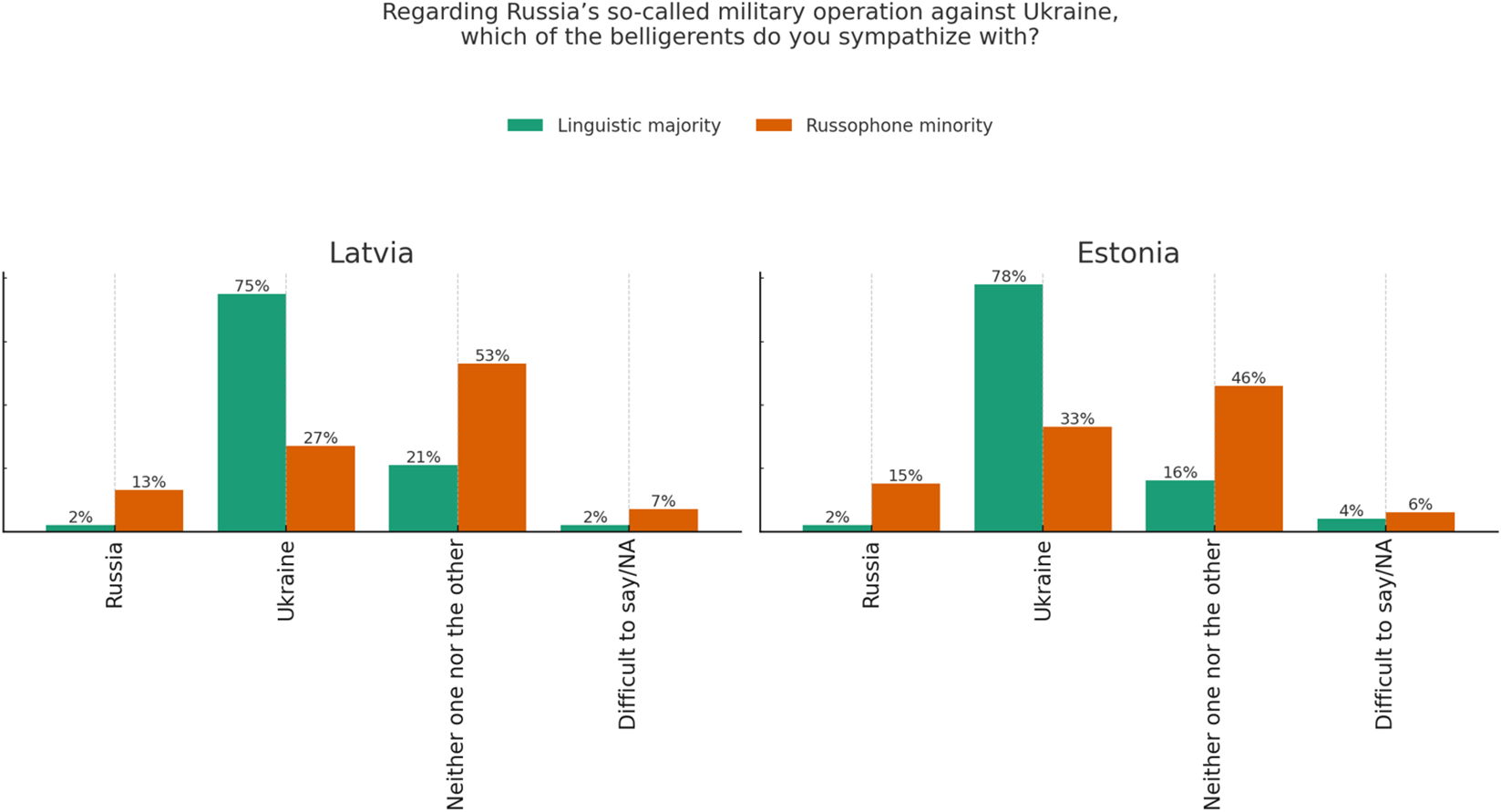
To explore expressed neutrality toward Russia’s full-scale invasion of Ukraine on February 24, 2022, I employed binary logistic regression. The dependent variable was constructed from the question “Regarding Russia’s so-called military operation against Ukraine, which of the belligerents do you sympathize with?” and coded dichotomously: respondents selecting “support neither side” were classified as neutral (1), while all other substantive responses were coded as non-neutral (0). Responses coded as “hard to say/no answer” were excluded from the analysis, as they capture a different form of non-positioning than expressed neutrality. The survey data indicate that neutrality is a prominent stance among Russophone communities, distinguishing them from the prevailing support for Ukraine observed among ethno-linguistic majorities. (Fig. 1).
Distribution of respondents’ answers to the survey question: “Regarding Russia’s so-called military operation against Ukraine, which of the belligerents do you sympathize with?”

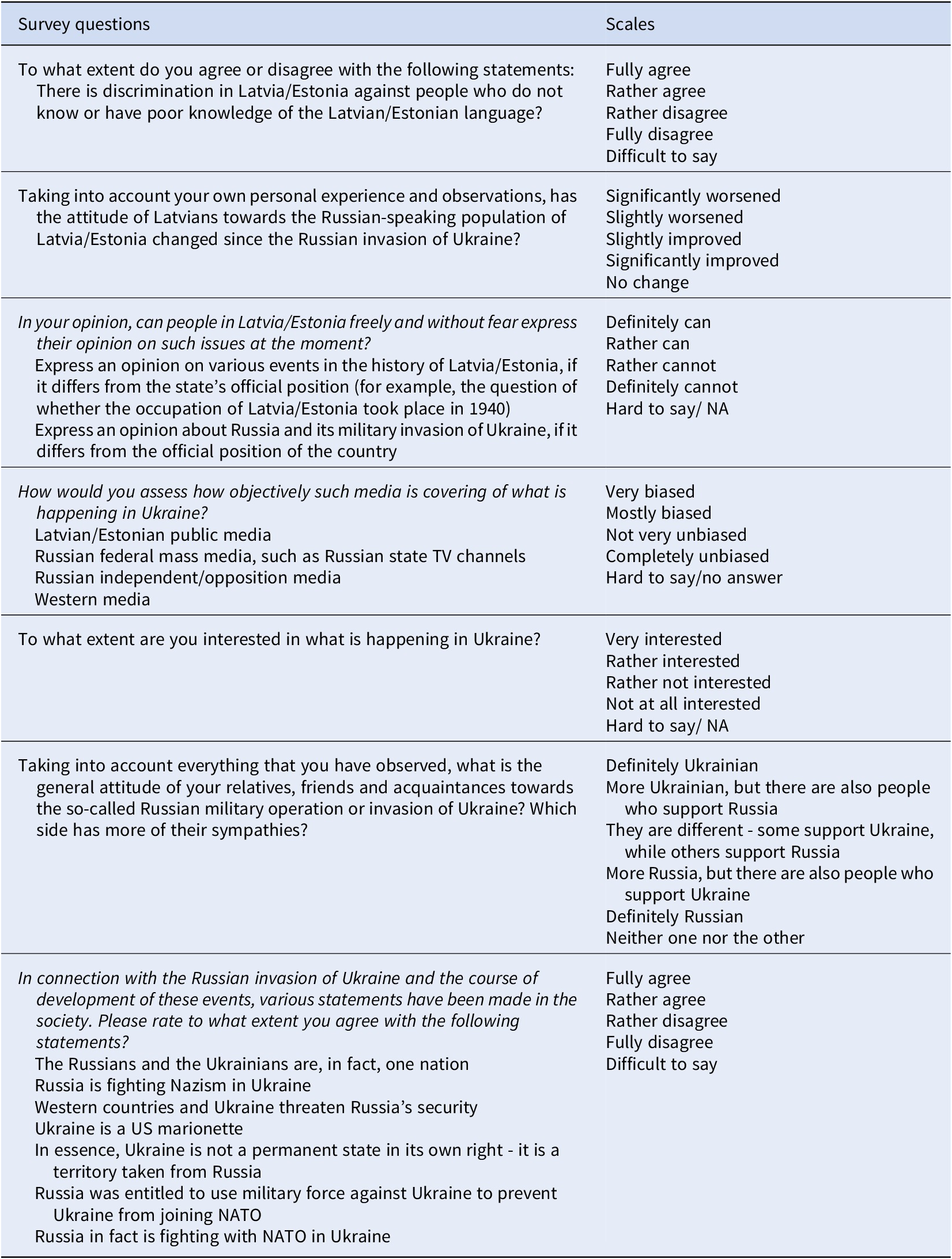
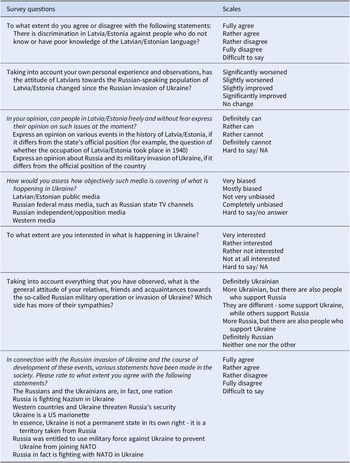
The independent variables were selected and operationalized according to the conceptual framework of attitude certainty, focusing on both individual-level dispositions and social-contextual factors (see Appendix A1). At the individual level, clarity of opinion was measured through agreement with eight statements about the Russia–Ukraine war (e.g., “Ukraine is a US marionette,” “Russia was entitled to use force”). Items were recoded and aggregated into a clarity index, with higher scores indicating greater attitudinal clarity; reliability testing confirmed high internal consistency (Cronbach’s α = .865). Interest in Ukrainian affairs, originally measured on a 5-point scale, was recoded into a binary variable distinguishing between interested and not interested, while responses coded as “Hard to say/no answer” were excluded.
Social-contextual variables captured perceptions of reference groups, opinion climate, and media trust. Reference group sympathies were measured through respondents’ assessments of the general attitudes of relatives, friends, and acquaintances, recoded into five categories (pro-Ukraine, pro-Russia, mixed, neutral, don’t know). Opinion climate and social isolation were measured through items on perceived freedom of expression regarding the Russia-Ukraine war, recoded into a dichotomous variable (can express vs. cannot express), with “hard to say” responses excluded; perceived linguistic discrimination (agree/disagree/don’t know); and perceived changes in majority attitudes toward Russophones since 2022 (improved, worsened, unchanged, don’t know). Media trust was measured by asking whether respondents considered different outlets — public media, Russian federal media, Russian independent media, and Western media — to report events objectively or in a biased way; for the final models, each item was entered separately as a categorical predictor with “objective” as the reference category. Finally, all models included standard sociodemographic controls, namely gender, age group, education, citizenship, region of residence (Latgale and Northeastern part were coded as the most Russophone regions of Latvia and Estonia, respectively), economic status, and country (Latvia vs. Estonia).
A potential concern is that perceptions of discrimination, interethnic relations, or freedom of expression may not function as independent predictors of neutrality but instead reflect deeper geopolitical orientations. To address this, all models control for attitudinal clarity, constructed from agreement with pro-Russian narratives about the war. This variable directly captures underlying pro-Russian predispositions, allowing the effects of opinion climate and isolation measures to be estimated net of respondents’ baseline orientations. While endogeneity cannot be entirely excluded, this approach reduces the risk of spurious associations and ensures that the reported effects of opinion climate variables are not merely artifacts of broader pro-Russian worldviews.Footnote 1
To complement the quantitative findings, four focus group discussions (FGDs) were conducted in Riga and Tallinn in May–June 2024. Focus group data provided a nuanced perspective, supporting critique of survey data, which often oversimplifies complex realities and overlooks “grey area” of uncertainty toward Russia’s invasion (Hercberga Reference Hercberga2024). One FGD was conducted with younger Russian-speakers (18–33) and one with older participants (45–65) in each city, yielding 24 participants in total. To ensure a balanced composition of the focus groups, the screening questionnaire included items on media use and civic engagement, in addition to socio-demographic characteristics. Recruited through the SKDS sociological panel, participants discussed identity boundary-making, political behavior, and media practices after 2022. The duration of each discussion was 120 minutes.
All FGDs were recorded, transcribed, and thematically coded in NVivo 15 using an open coding procedure informed by grounded theory (Charmaz Reference Charmaz2006). This study employs qualitative material to contextualize and problematize the survey findings, thereby illuminating the mechanisms through which neutrality, reference group pressures, and media trust are negotiated in everyday life. Specifically, the analysis is guided by the following research questions:
-
1. How do focus group participants evaluate media coverage of the Russia–Ukraine war, and in what ways does this evaluation inform their attitudes toward the conflict?
-
2. In what contexts have focus group participants encountered restrictions on freedom of expression, and how have reference groups shaped their attitudes toward the Russia–Ukraine war since 2022?
-
3. How do focus group participants conceptualize and account for neutrality in their attitudes toward the Russia–Ukraine war?
Determinants of Expressed Neutrality
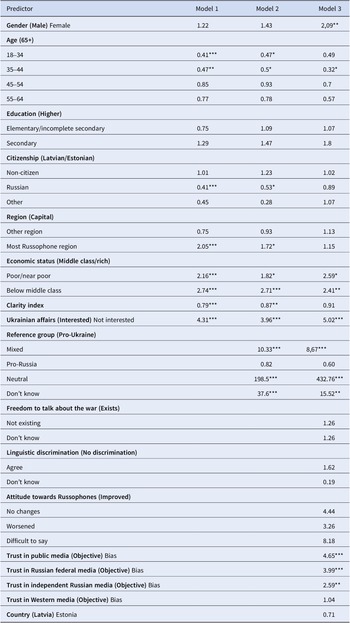
The logistic regression results indicate that Russophones’ expressed neutrality in the Russia–Ukraine war is shaped by both sociodemographic and attitudinal factors (Table 1). According to Model 1, younger respondents were significantly less likely to adopt neutrality compared to the oldest age group (18–34: OR = 0.40; 35–44: OR = .47). Neutrality was more likely to prevail among Russian citizens (OR = 0.41), those residing in predominantly Russophone regions (OR = 2.05), as well as respondents with lower economic status (below middle class: OR = 2.74; poor/near poor: OR = 2.16). By contrast, gender and education did not significantly affect neutrality. At the attitudinal level, both lower clarity of opinion (OR = 0.79) and weaker interest in what is happening in Ukraine (OR = 4.1) strongly predicted neutrality, underscoring the role of uncertainty and disengagement in shaping non-positioning.
Odds Ratios from Binary Logistic Regression

Note: Odds ratios (OR) are shown with reference categories indicated in parentheses. Significance levels: *** p ≤ 0.001, ** p ≤ 0.01, * p ≤ 0.05.
The second model (Model 2) adds reference group perceptions, which emerge as the most powerful predictors of Russophones’ neutrality. Compared to respondents who described their milieu as pro-Ukraine, those perceiving it as mixed were far more likely to adopt neutrality (OR = 10.33), while those who saw their milieu as neutral (OR = 198.5) or were uncertain (“Don’t know”) (OR = 37.6) also showed dramatically increased odds. By contrast, perceiving a pro-Russian milieu did not significantly differ from the pro-Ukraine reference category.
Sociodemographic factors remain partly relevant in Model 2. Gender approached significance, with women more likely than men to adopt neutrality. Age effects persisted, with respondents aged 18–34 (OR = 0.47) and 35–44 (OR = 0.50) less likely to be neutral compared to the oldest group, while differences among older middle-aged cohorts were nonsignificant. Economic status continued to matter, with Baltic Russophones below middle class showing more than twice the odds of neutrality (OR = 2.71) and the poor/near poor also significantly more likely to be neutral (OR = 1.82). Respondents living in the most Russophone regions of Latvia and Estonia were significantly more likely to express neutrality (OR = 1.72), whereas residing in other regions did not have a statistically significant effect. While the overall effect of citizenship was not statistically significant (p = .062), respondents with Russian citizenship showed significantly lower odds of neutrality (OR = 0.53) compared to Latvian citizens. By contrast, education remained insignificant also in this model. At the attitudinal level, clarity of opinion (OR = 0.87) and interest in what is happening in Ukraine (OR = 3.96) continued to be strong predictors, though the weight of these individual dispositions was overshadowed by the dominant role of social reference points.
The full model (Model 3), which incorporated sociodemographic, attitudinal, reference group, opinion climate, and media-related variables, further refined the predictors of expressed neutrality. These findings indicate that both structural and attitudinal factors shape expressed neutrality, with particularly strong effects observed for social-contextual and media-related variables. Among sociodemographic characteristics, female respondents were significantly more likely to express neutrality (OR = 2.09), suggesting that, in a polarized opinion climate, patterns of media consumption may render the gender dimension of neutrality more salient. Age effects were limited, although respondents aged 35–44 were less likely to be neutral compared to the oldest group (OR = 0.32, p = .013). The effect of economic vulnerability remains consistent in Model 3, as individuals who were poor or near poor (OR = 2.59) and those below middle class (OR = 2.41) exhibited higher odds of neutrality.
At the attitudinal level, interest in events in Ukraine emerged as a strong predictor, with less interested respondents being substantially more likely to adopt neutrality (OR = 5.02). By contrast, the clarity index did not reach statistical significance in this model. The most decisive effects, however, are linked to reference group perceptions. Respondents who perceived their milieu as mixed (OR = 8.67), neutral (OR = 432.76), or uncertain (OR = 15.52) were dramatically more likely to express neutrality compared to those embedded in pro-Ukraine environments.
Media trust variables also show strong and consistent effects. Respondents who perceived public media as biased were significantly more likely to be neutral (OR = 4.65), as were those who viewed Russian federal media as biased (OR = 3.99) and independent Russian media as biased (OR = 2.59). In contrast, perceptions of Western media did not significantly affect neutrality.Footnote 2 By contrast, indicators of perceived social isolation practices—such as freedom of expression, discrimination, or ethnic majority attitudes—showed weak or inconsistent associations once reference groups were controlled for. These results suggest that Russophone neutrality in the Baltic states is anchored primarily in immediate social consensus and milieu ambiguity, while broader perceptions of isolation and opinion climate play only a secondary role.
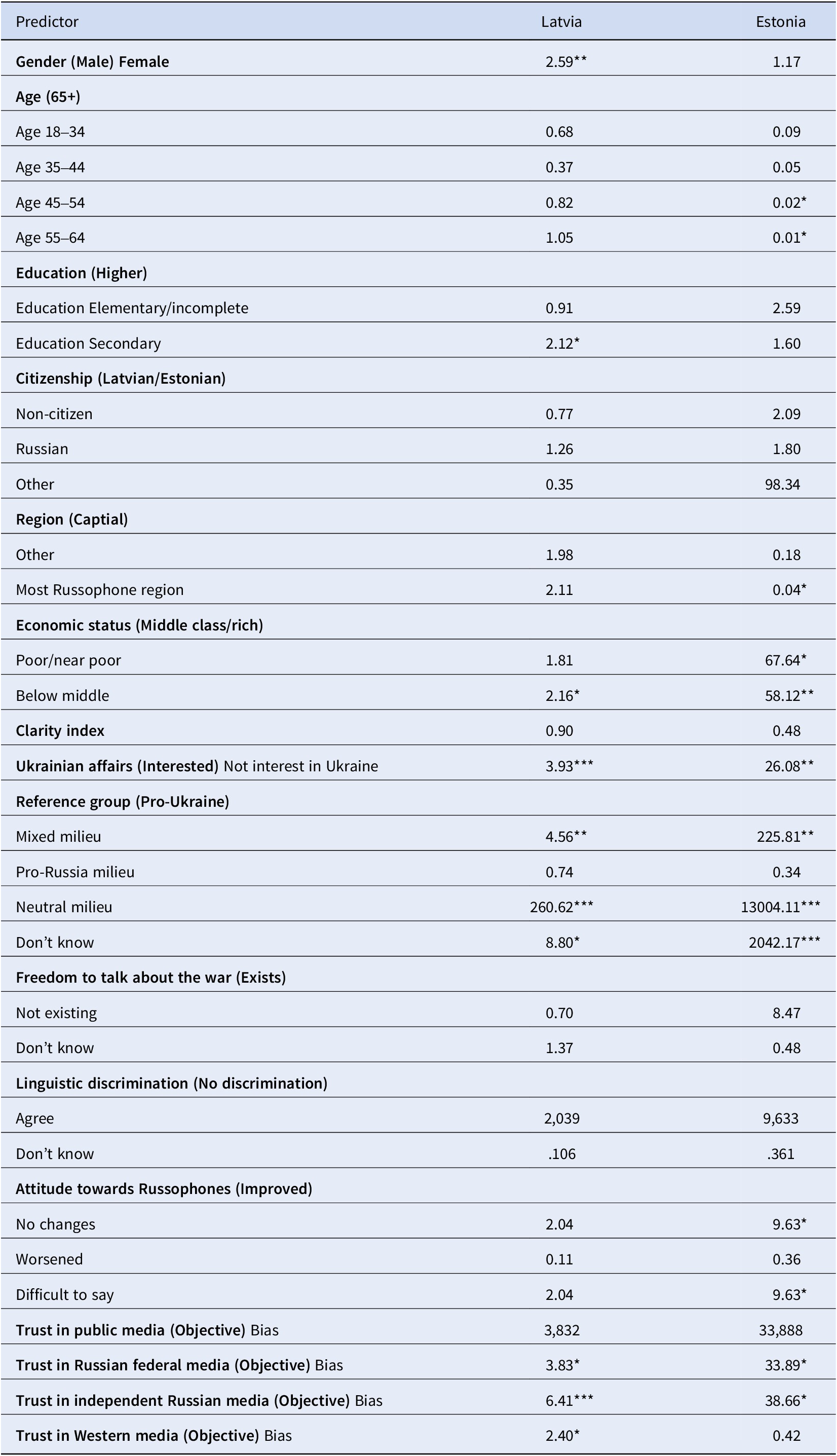
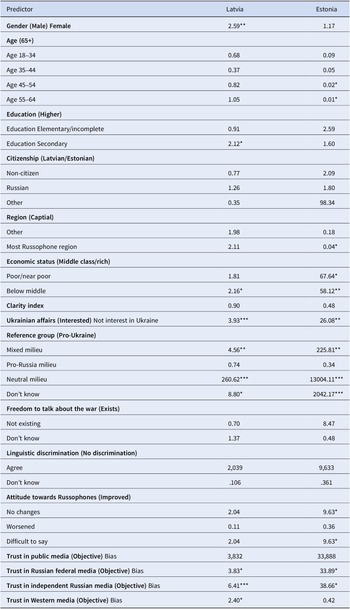
According to Model 3, country differences between Latvia and Estonia were nonsignificant once these factors were included (OR = 1.40). The country-specific models (Table 2) reveal a set of important shared mechanisms in the predictors of expressed neutrality. In both Latvia and Estonia, neutrality is strongly driven by attitudinal disengagement and social context. In particular, low interest in events in Ukraine significantly increases the likelihood of neutrality in both countries (Latvia: OR = 3.93; Estonia: OR = 26.81), although the effect is substantially stronger in Estonia. Most importantly, reference group dynamics emerge as the dominant predictor in both contexts, with respondents embedded in neutral milieus showing dramatically higher odds of neutrality, and similar, though smaller, effects for mixed milieus. These findings point to a common pattern in which neutrality is deeply embedded in social environments and perceived group consensus.
Logistic regression results (Model 3) for expressed neutrality, Latvia and Estonia
Note: Odds ratios (OR) are shown with reference categories indicated in parentheses. Significance levels: *** p ≤ 0.001, ** p ≤ 0.01, * p ≤ 0.05.
At the same time, the models diverge in the relative importance of sociodemographic and media-related factors. In Latvia, neutrality is more broadly structured by a combination of predictors: gender (female: OR = 2.59) and economic vulnerability (below middle class: OR = 2.16) are significant, and media distrust operates consistently across multiple sources, including public media (OR = 3.83) and Russian federal media (OR = 6.41). By contrast, in Estonia, sociodemographic effects are less consistent—although economic vulnerability remains highly influential (poor: OR = 67.64; below middle class: OR = 58.12)—and media effects are more selective, limited to perceptions of bias in public and Russian federal media. Instead, neutrality in Estonia appears more strongly concentrated in socially structured processes, as reflected in the much larger reference group effects. Finally, perceived risks of social isolation, such as constraints on freedom of expression, do not emerge as robust predictors in either country, though they show weak, borderline effects in Estonia (OR = 8.47, p = .06).
Across all three regression models, a layered picture of Russophone neutrality emerges. The baseline results underscored the role of individual dispositions—such as low economic security, lower clarity, and heightened interest—while the second model demonstrated the decisive weight of reference group perceptions, where ambiguous or uncertain milieus strongly amplified the odds of neutrality. The final model refined these findings by integrating opinion climate and disaggregated media evaluations. Here, neutrality proved most strongly linked not only to gender and socioeconomic vulnerability but also to social consensus and specific judgments of media credibility.
Fragmented Truths and Fragile Neutralities
In the focus group (FG) discussions held in 2024, uncertainty in attitudes toward the Russia–Ukraine war appeared frequently. It is a topic that the Russophone population of Latvia and Estonia does not avoid reflecting upon, and it becomes a unifying experience for interlocutors. In this chapter, my aim is to analyze the qualitative data obtained from these FG discussions, which both broaden and deepen the findings of the regression analysis.
Qualitative evidence shows that distrust of legacy media in the context of the war is widespread. This distrust is closely tied to perceptions of how the war is reported. Many participants argued that every media outlet—whether local, Russian, Ukrainian, or international—presents the war in a way that serves its own perspective, making it difficult to access unbiased information. Media in general is therefore described as “noise” and a threat to an imagined, morally acceptable truth. A telling example comes from a Latvian FG member (male, 62), who praised Euronews’ No Comment column, which shows footage without narration: “They take some event and show it. It’s clear that any intonation, any sentence construction can cause a positive or negative reaction.” This remark is symbolic of the broader mood.
Situated amidst antagonistic media discourses, FG participants often describe “media balancing” as their main strategy. As Vihalemma and Juzefovičs (2023) note, combining information sources is characteristic of dynamic and pluralistic Baltic Russophone audiences, for whom truth is perceived as lying somewhere in the middle, shaped by competing interests. The balancing approach, however, often justifies neutrality rather than taking a clear or extreme stance on the invasion. This response to a polarized information space is illustrated by the words of a young Estonian man (24): “Everyone writes differently. Russia writes more about itself. Our [Estonian] media writes more about Ukraine; they go in different directions, but always in the worst possible way about Russia. It’s the same with Russia. And Europe also writes however it wants. You always have to look for the middle ground.”
The downside of media balancing is growing doubt and cynicism, which eventually blurs the boundary between professional journalism and blatant propaganda. A Latvian participant (female, 50) described how her initial attempts to follow diverse perspectives left her disillusioned: “I never imagined the lying could be so extensive.” This erosion of trust led her to disengage from traditional news altogether, instead piecing together her own fragmented picture: “I take something from here, something from there, and glue together a picture for my own use.”
Such feelings of being misinformed can reinforce news avoidance over time (Hasell and Halversen Reference Hasell and Halversen2024). Some participants reported withdrawing from traditional media after the 2022 ban on Russian state-controlled channels, while others avoided legacy media because of its polarized tone. News avoidance thus emerged as a coping mechanism against disillusionment and conflict fatigue. Ambivalence and empathy for soldiers on both sides also reinforced the desire to avoid war-related coverage. A Latvian woman (33) explained that she initially followed the war very closely, but soon felt overwhelmed: “I just pulled away, because it was impossible. […] You go online and it’s coming at you from every direction, from both sides. You feel sorry for everyone, and you don’t know what to do […]. So eventually I just decided to stop following it altogether.” This detachment reflects a sense of futility in following repetitive and unresolved narratives. Still, avoidance of traditional media did not mean living in an information vacuum: participants increasingly turn to Russian bloggers (e.g. Dmitrii Puchkov, Klim Zhukov, Anatolii Sharii), social media platforms and aggregators (Telegram, Facebook, YouTube, TikTok), and family networks.
Restrictions on Russia’s state-controlled media and on opinions diverging from the official Latvian or Estonian position were also discussed in FGs. Participants widely perceived freedom of speech to have become more restricted since 2022. Sanctions and fear of condemnation made them acutely aware of “safe” versus “risky” topics. Unsurprisingly, the Russian invasion of Ukraine was consistently included among the latter. This caution reshaped not only media consumption but also behavior on social networking sites. For example, a Latvian woman (59) explained: “I don’t write on Facebook anymore and I press ‘Like’ only under neutral topics. Because I was warned, there are cases. People are now being jailed for their opinions, really. In Latvia, a friend of mine was jailed for two months a couple of weeks ago for a video on TikTok.”
The interaction between freedom of expression and social pressure appeared in more nuanced forms when participants described reference groups. Everyday social environments have become highly cautious spaces where the war is considered too sensitive to discuss. Some reported avoiding people with extreme opinions or suspicions about Russophone loyalty. In such groups, neutrality has gradually become the implicit agreement that helps to prevent tension and conflict. An Estonian man (49) explained: “And I probably already feel these notes, these messages that are transmitted to me. Well, and now I try, I don’t know, to be more neutral. And my interlocutors, friends—too. But I see that in our communication we have already developed a certain gradation: what can be discussed more, what can be discussed less.”
Participants also noted that silence about the war extended to workplaces, especially ethnically mixed ones, where political discussions were discouraged to avoid disputes. In such contexts, neutrality again was considered a safer modus operandi than advocating strong views. A Latvian man (48) recounted how discussions with Latvian-speaking friends often turned into serious arguments, including provocative questions such as: “If Russia attacks us, do you think they’ll spare you just because you’re Russian?” Such tensions prompted mutual agreements to avoid contentious topics in order to preserve friendships. These examples show how diverging war perceptions create social divides, compelling individuals to navigate identity and loyalty carefully.
Data from FG discussions suggest that Russophones’ neutrality emerges as the most acceptable and sustainable stance, serving to manage social tensions. Yet expressed neutrality can itself produce new boundaries. An Estonian woman (56) described how her consistent “middle-ground” attitude irritated a friend to the point of ending their friendship: “I really think that not everything is clear-cut, and we cannot know the whole truth. Neither from this side nor from that. And a person told me that it is time to decide after two years [of war].” Her friend labeled her a “neodnoznachnitsa” (неоднозначница)—a Russian neologism for someone who refuses to view events, such as Russia’s invasion of Ukraine, in strictly black-and-white terms.
Two motives for this indecisiveness stand out. First, there is a moral difficulty in adopting extreme positions. For instance, an Estonian woman (56) emphasized her right to remain “in the middle” because of her mixed Ukrainian–Russian heritage. Similarly, a Latvian man (62) condemned war universally without favoring either side, stressing shared human suffering and the need for compromise. His stance reflects an effort to achieve clarity by rejecting partisanship altogether. Second, indecisiveness reflects a sense of low control and limited agency. Participants often described a psychologically entrenched indifference, rooted in the awareness that they could do little about the war. A young Estonian man (25) explained how his early engagement gave way to detachment: “There’s really nothing we can do here except maybe shout loudly with a flag, which doesn’t help either.” Such remarks illustrate how prolonged exposure to conflict coverage can alienate audiences, especially Baltic Russophones who experience constant moral pressure in the surrounding opinion climate. In this context, the clearest agency neutrals demonstrate is not to resolve the conflict, but to avoid conflict in their own everyday lives.
Discussion
Leo Bogart, a prominent figure in the applied public opinion research, has argued that “The most important and accurate thing that surveys can tell us is the extent of public ignorance on matters of fact” (Bogart Reference Bogart1967, 337). In this article, I have explored whether the expressed neutrality of Baltic Russophones toward Russia’s invasion of Ukraine stems from ignorance or less visible mechanisms of attitude certainty. Taken together, the regression analysis and focus group data show that neutrality cannot be reduced to apathy or ignorance. Rather, it emerges as a negotiated position at the intersection of uncertainty, distrust, constrained agency, and social adaptation.
A first set of findings highlights the importance of attitude clarity and attitude correctness. Regression models confirmed that respondents with less clarity of opinion were initially more likely to express neutrality, although this effect diminished once media trust and reference group perceptions were introduced. The focus groups illustrate why: for many, neutrality does not signal the absence of opinion but rather the conviction that ambivalence itself is warranted. As Petrocelli, Tormala and Rucker (Reference Tormala and Rucker2017) argue, one may feel conflicted toward an issue yet be subjectively sure that this conflicted state best represents reality. Baltic Russophones frequently framed neutrality as “the only honest stance,” insisting that partisan narratives obscure the truth. Neutrality thus embodies a form of attitude correctness, where not deciding is experienced as the most ethically defensible decision.
Sociodemographic predictors help clarify who is most likely to embrace this stance. Older persons, women, and those in lower socioeconomic positions were consistently more likely to express neutrality among Latvian and Estonian Russian speakers. By contrast, regional effects do not consistently explain neutrality across the two countries. This suggests that neutrality is not simply a product of spatial clustering, but rather a broader response embedded in socially structured opinion climates that extend beyond specific regions. In line with spiral of silence theory, such climates discourage overt expressions of pro-Russian sympathy while rewarding silence or neutrality. Yet, as Hayes, Glynn, and Shanahan (Reference Hayes, Glynn and Shanahan2005) note, spiral of silence research often overlooks individual predispositions toward self-censorship. The present data cannot disentangle whether neutrality is more prevalent among Russophones predisposed to shyness, social anxiety, or concern for others’ judgments. Future work should examine how such individual differences interact with situational pressures to sustain widespread neutrality.
A consistent finding across all models is that a lack of interest in Ukraine strongly predicts neutrality. This highlights disengagement as a central mechanism of attitudinal uncertainty. Russophones who pay little attention to the war are less likely to form clear evaluative positions and are prone to adopt non-committal stances. In this respect, neutrality does not only signal ambivalence but also reflects deliberate distancing from a socially polarizing issue. This dynamic resonates with the framework of attitude certainty, as low levels of engagement weaken both the clarity and durability of attitudes, making neutrality a more attractive option. Focus group discussions reinforce this interpretation, with several participants describing fatigue with war-related coverage or a desire to “stay out of politics,” illustrating how disengagement serves as both a psychological buffer and a strategy for avoiding social risk.
Media distrust also plays a central role. Neutrality is strongest among respondents who perceive Latvian or Russian media as biased. The non-significance of Western media perceptions suggests that neutrality stems less from views of Western outlets than from contested trust in Russophone-oriented media, where identity and community stakes are greater. In focus groups, participants often described all outlets as “noise,” prompting them to engage in “media balancing” by consulting multiple sources and searching for a middle ground. This strategy, however, also reinforces cynicism and disengagement rather than producing clarity. As Vihalemm and Juzefovičs (Reference Vihalemm and Juzefovičs2023) argue, withdrawal from the media-driven environment is characteristic of apolitical Russophone segments, who may disengage either habitually or strategically. My qualitative findings confirm this dynamic: awareness of repressive measures imposed on war apologists has arguably motivated Russophones to maintain neutrality by not supporting either side of the war. In this sense, neutrality is not passive non-participation but an intentional form of non-engagement.
Structurally, these dynamics are connected to the translocality of Russophones. As Vihalemm, Seppel, and Leppik (Reference Vihalemm, Seppel, Leppik, Kalmus, Lauristin, Opermann and Vihalemm2020, 283) define it, translocality is “the life-world constituted by relationships, identities, understandings, and practices emerging from different social spaces.” Baltic Russophones consume narratives from Russian, Ukrainian, Latvian/Estonian, and Western sources, producing a pluralistic and morally relativistic engagement with the war. This translocal agency sustains uncertainty. When all perspectives are perceived as partial or manipulative, neutrality becomes a way to manage contradiction. Here, attitude correctness once again matters as many FG participants framed their conflicted stance not as confusion but as the most rational and morally defensible response given the perceived cacophony of voices they encounter.
The decisive factor, however, lies in reference groups. Regression results show that perceived milieu consensus—whether neutral, mixed, or uncertain—was by far the strongest predictor of neutrality. Focus groups shed light on the micro-mechanisms: tacit agreements in families, workplaces, and peer circles to avoid discussing the war in order to preserve social harmony. In this sense, expressed neutrality may help bridge the generational gap in media use and in the various modes of interpreting Russia’s strategic narrative that Rönngren (Reference Rönngren2025) observed in her research on young Russian speakers. Yet across Russophone milieus more broadly, uncertainty reflects more than individual hesitation; it embodies what Reicher, Spears, and Alexander (Reference Reicher, Spears, Haslam, Wetherell and Mohanty2010) call a fragile in-group consensus, balancing pressures of external assimilation with the internal drive to preserve ethnic identity. This consensus enables Russophones to navigate securitization, essentialization, and polarization discourses (Vihalemm and Juzefovičs Reference Vihalemm and Juzefovičs2022), but it also functions as a form of social control. As focus group participants suggested, neutrality can evolve into a self-sustaining ideological stance, maintained by mutual pressure to avoid extremes and reinforced through implicit sanctions in social environments.
At the same time, the boundaries between Baltic Russophones and the eponymous populations are notably flexible and porous in everyday life, facilitated by practices of horizontal citizenship, everyday integration, discursive avoidance of politics, and translocal interactions (cf. Ekmanis Reference Ekmanis2017; Jašina-Schäfer and Cheskin Reference Jašina-Schäfer and Cheskin2020; Ušča Reference Ušča2026). Neutrality therefore cannot be read solely as withdrawal from the majority society but also as part of the ongoing negotiation of belonging in shared social spaces. In this light, neutrality should also be understood as part of what Gaufman (Reference Gaufman2023) describes as everyday foreign policy: an assemblage of micro-practices and discourses through which geopolitical issues are negotiated across physical and digital spaces. By avoiding contentious media, silencing themselves on social platforms, or invoking universal pacifism and empathy, Baltic Russophones enact neutrality as a strategic micro-practice that simultaneously protects them from stigma and contributes to the everyday politics of war discourse.
The findings do not support the expectation that media consumption and perceived risks of social isolation better explain neutrality in Latvia than in Estonia. While media distrust is somewhat more consistently associated with neutrality in Latvia, its explanatory power remains secondary to reference group dynamics in both countries. In Estonia, despite weaker and less consistent media effects, neutrality is even more strongly structured by social context, particularly perceived group consensus. Moreover, perceived risks of social isolation (e.g., limited freedom of expression) do not emerge as robust predictors in either country. Taken together, these results suggest that neutrality is driven less by media consumption or fear of isolation and more by socially embedded processes of alignment within reference groups, with this mechanism being especially pronounced in Estonia.
Finally, these findings can be situated within a longer trajectory of Russophone adaptation in the Baltic states. During the post-Soviet transition, Laitin (Reference Laitin1998) argued that Russophones would eventually weigh the costs and benefits of adopting majority norms, with a tipping point leading to integration. Schulze and Pupcenoks (Reference Schulze and Pupcenoks2025) note that such cost–benefit logics continue to shape Russophone strategies, though the calculus has shifted. Neutrality toward the war may represent a contemporary form of such strategic adaptation. By not taking extreme sides, many Baltic Russophones balance the risks of marginalization against the demands of reference groups and the constraints of dominant opinion climates. In this sense, their expressed neutrality is less a silence than a precarious voice, reflecting the costs and benefits of belonging in bordered societies.
Financial support
This research was funded by Latvian Council of Science, Grant No. lzp-2023/1-0239.
Disclosure
The author declares no conflicts of interest.
Appendix
Survey questions

 Open access

