


5.1 This Chapter’s Plan
This chapter examines “opportunistic” uses of “natural” objects and shared assumptions in scientific data analyses and explores what these imply for scientists’ trust in the work of other researchers. Assuming that the world that her team observes is coherent helped Nadine to combine data (Chapter 3). As she did so, diagrams were essential tools for diagnosing trouble and for pruning her catalog (a table of measured and estimated galaxy properties; Chapter 4). These scientists resorted to what sociologist Melvin Pollner (Reference Pollner1987) called “mundane reasoning”: practices for resolving disjunctive experiences that assume a shared public and objective world. A common feature of ordinary social life, this is what Barry Barnes and coauthors (Reference Barnes, Bloor and Henry1996, 81) call a “realist strategy.”Footnote 1
This chapter examines mundane reasoning further by probing into its resources. I argue that, in data-rich science, a discipline’s objects of inquiry are not only topics of research but may also function as resources for its conduct. These objects and their relations can be resources for intersubjective coordination that become available through practices of mediation and materialization. If recognized for their task-specific affordances, these objects can be resources for analyzing data.Footnote 2 There is a trade-off between epistemic uses of stable material objects and the placement of trust. In astronomical research, the sky (while not material) is not only an ordering device for assessing and using data of various origin – it is also a resource for the partial relief from trust in data makers.
5.2 “Now We Can Show Real Science!”: Seeing the Same Things (Again)
Sociologist Harry Collins (Reference Collins1992, 19) once argued that replication is “the scientifically institutionalized counterpart to the stability of perception.” According to a popular understanding, observations and experiments are properly scientific only when they are replicable – that is, if an experiment or observation yields the same result as that done by someone else who followed the same procedures. But in science there is no simple “looking” and “seeing” with the unaided eyes. Most scientists rather “look” with complexes of technology and “see” something in elaborately processed data.Footnote 3 Consider observations in astronomy. As astronomer David W. Hogg puts it, “[a]ll of astronomy and astrophysics is built on the observation and reobservation of sources on the sky.”Footnote 4 Whether or not replication is their aim, new observations should improve on existing ones or add to them meaningfully, such as when variable objects are observed again. But for many astronomers there is not just one sky. Some of them use infrared telescopes and cameras to observe what they call the “infrared sky,” others use radio telescopes to observe the “radio sky,” and still others use x-ray telescopes to observe the “x-ray sky.”Footnote 5
One of the newest skies that astronomers study is the “microwave sky.” Observed at millimeter and centimeter radio wavelengths, its dominant component is the cosmic microwave background (CMB), a thermal radiation from all directions whose flux density is not entirely uniform, but, when mapped, exhibits subtle fluctuations.Footnote 6 Cosmologists widely agree that these fluctuations were “imprinted” on the CMB soon after the Big Bang almost 14 billion years ago. Observations of their distribution, intensity, and polarization are rich sources of information about the early universe.
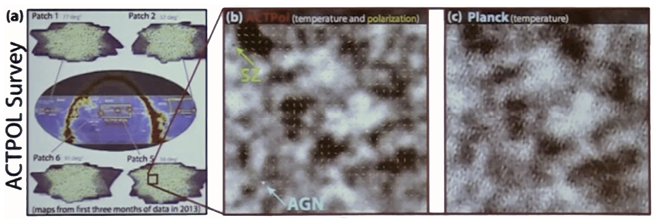
In March 2014, Princeton University astrophysicist David Spergel gave a talk on the state of CMB studies at New York University’s Physics Department.Footnote 7 Early in his presentation, Spergel compared two grayscale pixel maps of the microwave background’s fluctuation pattern in a patch of the sky (see Figure 5.1). One was based on measurements taken with the ACT in Chile using a transition-edge sensor (a sensitive semi-conducting detector); the other was made with a bolometer (a kind of sensitive thermometer) onboard the European Space Agency’s Planck spacecraft. Using a laser pointer to highlight similarities in the grayscale patterns, Spergel explains:Footnote 8
Presentation slide from David Spergel’s lecture at New York University, showing two grayscale pixel maps of the microwave background fluctuation pattern of a patch in the sky. One is based on measurements taken with the Atacama Cosmology Telescope (ACT) in Chile using a transition-edge sensor, a sensitive quantum detector (center). The other map was made using a different detector design (a bolometer) onboard the Planck spacecraft (right). The left panel shows the location of this patch on a map of the sky.
Note: The online version shows the colors of the original figure.
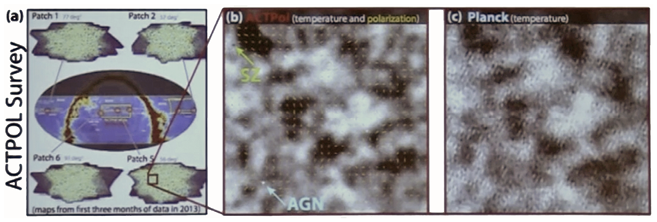
These are completely different experimental set-ups … and you see the same thing … and this is true with a host of experiments … One of the things I want you to take away from this is the remarkable agreement we have between independent experiments at this point … making these measurements. (…) So if you actually look at the same part of the sky the agreement here is really remarkably good.Footnote 9
Spergel is not surprised that the ACT and Planck teams managed to point their telescopes at the same part of the sky. Neither is he surprised that the microwave sky has not changed noticeably in between the ACT and Planck observations, which were presumably not made at the same time. Spergel thus assumes that the microwave sky is immutable, at least over a few years.Footnote 10 What Spergel finds remarkable, though, is how closely the ACT and Planck measurements agree, depicting “the same thing” despite these detectors employing different physical processes.Footnote 11 This agreement is significant beyond these ACT and Planck measurements. Mapping the CMB is a relatively new field in which members often describe their work as “doing experiments.” Until the early 2010s, these experiments did not usually enable researchers to “see the same things” on the sky. They were designed for measuring specific observables in single campaigns of observing patches on the sky that did not usually overlap.Footnote 12 By contrast, observatories now “observe and reobserve” signals from the microwave sky as an ambient environment again and again – viewed from the Earth and its vicinity as a shared vantage point. Spergel thus points to a step in the maturation of this scientific field.
Other astronomers shared Spergel’s excitement. A month after his talk, at a workshop discussion on future observations of the microwave sky, McGill University astronomer Matt Dobbs addressed fellow panelist Barth Netterfield, a physicist from the University of Toronto, thus:
We can make a measurement and other people can go out and verify that measurement and show real science … Barth! ((laughter)) … and show that that is a reproducible thing that is on the sky.Footnote 13
Like Spergel, Dobbs regards the sky as fixed and immutable on the timescale of these observations. And, as for Spergel, Dobbs’ confidence does not seem to reside in either one of these maps alone, but from comparing them and finding them in agreement. Seeing “the same sky” again using different technologies appears to make these technologies robust.
While Spergel and Dobbs do not mention it here, robustness is a notion that astronomers use in much the same way as philosophers of science. Astronomers call a result “robust” if an independent trustworthy study confirms it, especially if the latter uses different instrumentation and is done at different observing conditions. Thus, when I asked Christina, a member of the MUWAGS collaboration (see Chapter 6), about her work on weak gravitational lensing (an approach used to map invisible cosmic dark matter) and mentioned a study of the “Bullet cluster” (commonly interpreted as a merger of two galaxy clusters) that described it as “direct empirical proof of the existence of dark matter” (Clowe et al. Reference Clowe, Bradač and Gonzalez2006), she responded:
That is quite a robust analysis. There’s been that … lots of different telescopes made the same ob… observed the cluster … lots of different ((atmospheric)) seeing conditions and they see that same offset. I mean … that … There was a paper back in 2003 which has no citations … but it’s exactly the same result. But it was just one observation. And then the most recent one … with Maruša Bradač ((et al. Reference Bradač, Allen, Treu, Ebeling, Massey, Morris, von der Linden and Applegate2008)) took more observations and is much more robust.
Christina’s account implies that robustness goes together with the separability of artifacts from an observable’s “real” features. She adopts a “realist strategy” (Barnes et al. Reference Barnes, Bloor and Henry1996, 81).
Philosopher of science William Wimsatt (Reference Wimsatt2007, 43) refers to robustness as the convergence of “multiple means of determination” toward one result. This relates to Ian Hacking’s account of seeing, and recognizing, the “same” thing through different kinds of (optical, acoustic, scanning) microscopes. Confidence in its success emerges not only from understanding how these instruments rely on different physical principles, but also from the implausibility that such observations should converge accidentally.Footnote 14
What Spergel and Dobbs “look at,” “see,” and “show” are data in different forms. The microwave sky is mediated, made manifest to these researchers through representations. For them, agreements and differences are not to be found in individual perceptions and memories, but in maps and diagrams like those shown in Figure 5.1. Note that Dobbs, like Spergel and Hogg (cited earlier), talks about things “on the sky,” implicitly acknowledging the mediated nature of astronomical observation, where the “sky” is sometimes defined as “a two-dimensional distribution of intensity of electromagnetic radiation” (Léna Reference Léna, Appenzeller, Habing and Léna1989, 245).Footnote 15 It is through their uses of media that scientists regard the sky as something two-dimensional and operational, as we shall see now.
5.3 Mundane Reason as a Resource for Working with Scientific Data
Viewed from ordinary life, where we routinely agree on seeing the same things, Spergel’s and Dobbs’ wonder about the similarity of the ACT and Planck maps may seem odd. After all, we never experience the world from the same place as others. That one’s glasses are fogged, that fatigue affects someone’s attention, and that another is colorblind are three more reasons for why our perceptions may differ. But this is not something we usually worry about. Instead, we routinely resolve what sociologist Alfred Schütz called the problem of intersubjectivity: “How can two or more actors share common experiences of the natural and social world and, relatedly, how can they communicate about them?” (Heritage Reference Heritage1984, 54). Schütz argued that social actors routinely resolve the problem of intersubjectivity by assuming they share a common world and that their perspectives are reciprocal, that is, they assume that they would sense the world in the same way as another if they were in the other’s place, and if their relevancies were congruent. This is what Schütz (Reference Schütz and Natanson1962, 11–13), following Edmund Husserl, calls the “natural attitude.”
Many situations of conflicting perceptions and experiences may be resolved in this way, but there are cases when the natural attitude cannot accommodate divergent testimony: “puzzles” emerge that require “resolutions” (Pollner Reference Pollner1974b). This is often the case when the stakes are raised – such as in law courts, in psychiatric hospitals, or in scientific work.Footnote 16 As Schütz and others argued, actors could in principle adopt one of two stances: (1) that there is a single perceptible and ordered world that actors share, and that perceptual conflicts call for resolution; or that (2) there are multiple worlds, and there are no conflicts to be resolved when individual perceptions diverge.Footnote 17 Put loosely, the former is a realist stance and the latter a relativist one.
Drawing on a study of a municipal traffic court, sociologist Melvin Pollner (Reference Pollner1974b, Reference Pollner1987) examined how actors maintain a shared world even when their perceptions, experiences, or memories come into conflict, leading to a disjuncture. A driver’s speed reading may differ from a police officer’s measurement. While the driver may claim to have stayed within the speed limit, this disjuncture may be explained by the driver’s car’s tachometer being broken. Resolving such a disjuncture is contingent on participants’ mutual orientation to the assumption of an “incorrigibly objective and commonly shared world” (Pollner Reference Pollner1974b, 53), which enables members of a practice to recognize and resolve disjunctive experiences. For doing so, documents are essential resources. Reality is assumed to be coherent, determinate, and noncontradictory.Footnote 18 When interpreting perceptions, a “realist strategy” distinguishes between what is deemed “real” and what is “artefactual,” that is, what can be ascribed to issues with “the perceiving organ, instrument or apparatus” (Barnes et al. Reference Barnes, Bloor and Henry1996, 81).
Mundane reasoners commonly rely on ceteris paribus clauses: the (often tacit) assumption that an observation or experiment is replicable only if “other things are equal.” Embedded in members’ reasoning, “incorrigible propositions” (Gasking Reference Gasking and Flew1955) are resources for reflexively preserving their own validity. This insight is inspired by Edward Evans-Pritchard’s (Reference Evans-Pritchard1937) ethnographic study of the Azande (Central Africa), who used oracles for the diagnosis of misfortune. When operated properly, Azande specialists insisted, an oracle would be infallible. At times, however, Azande oracles produced outcomes that seemed contradictory to Evans-Pritchard, but his Azande interlocutors argued instead that the conditions for the oracle’s proper use must not have been met. They employed what Evans-Pritchard (Reference Evans-Pritchard1937, 319) termed “secondary elaborations of belief,” arguing, for instance, that the wrong plant had been chosen to prepare the oracular substance or that the oracle substance was too old and not efficacious anymore. Thus, they reflexively maintained the oracle’s incorrigibility.
Scientists can be in a similar position. Chemist-philosopher Michael Polanyi observed: “In my laboratory I find the laws of nature formally contradicted at every hour, but I explain this away by the assumption of experimental error” (Polanyi Reference Polanyi1964, 31). Arguably, at the end of Polanyi’s days in his laboratory, the laws of nature were always again back in place. He appears to consider the laws of nature as incorrigible, at least for his ordinary lab work, and in doing so he relies on mundane reason. In Chapter 3 we have seen this kind of reasoning in action as Nadine was guided to employ what I called an “implicit cosmology” – a description of how we see what the universe looks like when using certain technologies and media in culturally specific ways.
Douglas Gasking (Reference Gasking and Flew1955) takes the use of ceteris paribus clauses into the medium of numbers and addresses practices of counting, an elementary form of measurement in science (see also Warwick Reference Warwick and Wise1995). As a student of Ludwig Wittgenstein, Gasking is concerned with the relation of mathematics to the world. As it pertains to this book, the gist of Gasking’s argument is to make mundane reason available for discussing calculation, measurement, and the uses of digital data. Performing and interpreting a calculation like “7 + 5 = 12” is not troublesome for most quotidian uses, Gasking argues, but if one decides to experimentally align such a calculation with real worldly materials one may be challenged. For example, if one tries to add 7 drops of mercury to 5 drops of mercury in a bowl, one may count less than 12 drops of mercury in the end. Drops may have merged while counting was in progress. Likewise, making calculations with observed data coherent may force one to invoke ceteris paribus clauses.Footnote 19
Mundane reasoning is a linguistic practice, but stable features of the material world can be its resources. Pollner (Reference Pollner1987, 40–45) alludes to Maurice Merleau-Ponty’s (Reference Merleau-Ponty1968, 15) notion of the world as the “Great Object,” an idealization of the perceptible world as a “finished explicit totality in which the relations are those of reciprocal determination.” Kenneth Liberman (Reference Liberman2013) demonstrates, in intriguing case studies of how students navigate with sketched maps and play board games, that people use various embodied, material, and representational means to organize and order their affairs, often utilizing features of a setting opportunistically. Edwin Hutchins (Reference Hutchins2005) argues that uses of what he calls “material anchors” blend conceptual structure with material structure and thus stabilize the former. He calls this “an old and pervasive cognitive strategy” (Hutchins Reference Hutchins2005, 1555). Eric Livingston argues that the stability of the practices of playing checkers lies in the materiality of its culture, and he insists that different materials encountered in, say, laboratory chemistry or mathematical theorem proving, implicate different, specific forms of reasoning (Livingston Reference Livingston2006, Reference Livingston2008). Drawing on studies of girls’ hopscotch play and archaeologists’ uses of a Munsell color chart, Goodwin (Reference Goodwin2018) comes to a similar conclusion.
In data-rich science, the materiality of disciplinary objects becomes available to the virtuality of screenwork only through practices of representation and mediation. Astronomers conceive of the sky as immaterial, but it exhibits remarkably stable features that their predecessors interpreted as evidence for its materiality.Footnote 20 In screenwork its stable features become salient through their representation. Data of different origin may ostensibly be in conflict at any stage in research, and it is through media that disjunctures and disagreements become perspicuous and available for repeated inspection.Footnote 21 Different materials and media offer distinct affordances for researchers’ action, as the following two episodes illustrate.Footnote 22
5.4 Using Mundane Reasoning to Recognize Mistakes in Data Analysis
David Spergel’s March 2014 talk at New York University was scheduled as a review of recent studies of the CMB, but much of it became a commentary on a spectacular discovery that BICEP, a research collaboration led by Harvard University physicists, had announced twelve days earlier.Footnote 23 For three years, the BICEP team had operated a small radio telescope (BICEP2) and a detector array (the Keck Array) at the geographic South Pole to make sensitive measurements of the CMB and prepare maps of its intensity and polarization. Their polarization map had a greater sensitivity than any other such map made before. It revealed a swirl pattern that BICEP team members attributed to so-called B mode polarization, finding it to agree with models of inflation, a theorized phase of rapid expansion of the early universe. Its interpretation as observational evidence for inflation was a spectacular claim.
Engaging mundane reasoning, Spergel raises doubts about this interpretation. He acknowledges the importance of the discovery claim but emphasizes that, as such, it demands particular scrutiny. The BICEP2 map, of greater sensitivity than previous measurements of CMB polarization, could not be compared meaningfully with existing data. Spergel therefore turned to internal comparisons of the dataset and statistical tests that the BICEP team had presented in its discovery paper (Ade et al. Reference Ade, Aikin and Barkats2014, table I). These tests were calculated using pixel maps of data generated from scans of the sky with the BICEP2 telescope. Spergel wondered about the consistency of these data considering possible artifacts such as those caused by scattered light in the telescope. To recognize such artifacts, the BICEP team had designed its telescope to be movable around three axes, allowing it to observe a given position on the sky (defined by its celestial coordinates) in four distinct orientations. This yielded four sub-datasets which could be scrutinized and compared for consistency. The BICEP team did so using a so-called jackknife resampling technique.Footnote 24 It published its test statistic, presumably with the intention to demonstrate the reliability of its findings and the consistency of its subsamples.
Spergel, however, reads these statistics as hinting at problems in the BICEP2 analysis:
You can look at the sky … same part of the sky … at four different ((telescope)) orientations and make four independent maps … and ask … Do I see the same sky at four different orientations? And that doesn’t test all systematics … but if there was something going on where scattered light was getting in you might expect to see something different. Well … what’s a little worrying is if they do that … ((points with laser pointer to a projected slide of Table I of Ade et al. Reference Ade, Aikin and Barkats2014)) here is their EE signal at four different orientations ((of the telescope)) … the probability of finding that much difference between the two is at the 0.4 per cent level.Footnote 25
Attending to statistical confidence levels, Spergel interprets this test as suggesting that the observations in the four configurations were inconsistent and did not see the “same sky.” The BICEP team had allegedly missed this in their analysis.
Spergel next turns to examine the BICEP team’s analysis of the similarity of the BICEP2 and the Keck Array maps. The BICEP team had computed cross-correlations of these data, a mathematical technique suited for assessing the similarity of series or arrays of adjacent measurements.Footnote 26 Spergel refers to these cross-correlation as “cross” in the transcribed talk.
The amplitude of the B mean modes here ((points at a diagram on a slide)) are much higher than the theoretical prediction. And this is supposed to be due to ((gravitational)) lensing. Now some people say … “Oh don’t worry … the Keck array … the numbers get better” … It’s not really fair to play that game. I think it is better to ask … Look at the consistency test and say … they are looking at the same part of the sky. Why does the point … why … if I take Keck minus BICEP2 … which should have no signal … cross BICEP2 … I see shifts … of more than two sigma on most points … which suggests they are not seeing a consistent sky between the two experiments.Footnote 27
Interpreting differences of “more than two sigma” (standard deviations) as “not the same,” Spergel concludes that the BICEP team did not used the sky as an organizational resource to recognize its own measurement uncertainties or, worse, inconsistencies in its data analysis. Working in a domain that is removed from any human’s senses, David Spergel is persistently attentive to the sky and its uses as a diagnostic tool. In positing that the sub-datasets ought to be “the same” within statistical margins of significance he presumes an “incorrigibly objective and commonly shared world” (Pollner Reference Pollner1974b, 53). Spergel does not make use of any specific detail of the visible sky, but draws on idealizations available to all astronomers.
That Spergel’s demand for the BICEP2 subsamples to exhibit the “same sky” was worth pointing out to fellow scientists is suggested by New York University astronomer David W. Hogg, who attended Spergel’s talk and commented in his blog:
One amusing thing about Spergel’s talk was the repeated point (obvious, but often overlooked) that because all CMB experiments are observing the same, single sky, they ought to agree to better than one-sigma, especially on large scales where cosmic variance dominates.Footnote 28
Hogg’s view of Spergel’s point as “obvious, but often overlooked” suggests an implicit agreement on the proper use of the (idealized) sky as a resource to assess processed data.Footnote 29
5.5 Mundane Reasoning as a Resource for Repairing Data
Let us complement Spergel’s critique of the BICEP2 result, which draws on idealizations of the sky’s immutability and “self-sameness,” with a case in which researchers used specific “objectual” properties of the sky to repair their data. The first reflexive moment in Nadine’s PhD project (Chapter 3), in which her attempt of galaxy spectral energy distribution (SED) template fitting yielded “objects that do not exist” (Otfried), provides us with an example.
Otfried knew from his earlier work that Nadine’s questionable template-fitting results could be due to artifacts in the flatfield – the exposure of the twilight sky used to correct for sensitivity variations of the charge-coupled device chip in the digital camera. Lacking previous experience of working with such data and being new to the group’s analysis techniques, Nadine could not possibly assess this herself. Otfried explained to her that there might be artifacts in the flatfield frames that had yet to be corrected for. Like other senior scientists, he insisted that such artifacts were either additive or multiplicative. Scattered light recorded in the flatfield frames during twilight, emerging perhaps from moonlight reflected in the dome, the telescope, or the camera, is considered an additive artifact and must be subtracted. Artifacts in science frames are multiplicative and are removed by division with a flatfield exposure.
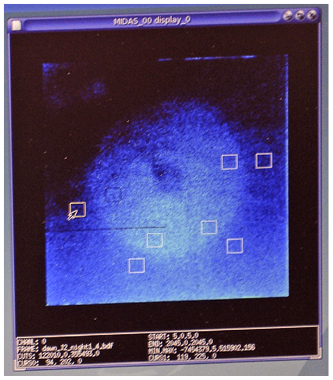
Upon closer inspection, Nadine’s flatfield seems to contain two artifacts that call for removal: a ring-like feature around the exposure’s center and a gradient across the frame (see Figure 5.2). Otfried suspects that both features are due to scattered light. To remedy their effect on Nadine’s data, she was to model the ring and the gradient and subtract them from the flatfield. To do so, Nadine needed to quantify these artifacts. Otto suggested that this might be accomplished through comparing Nadine’s photometry of stars in the field with published data. The Two Micron All Sky Survey (2MASS) seemed particularly well suited for this task, as it included many (471 million) sources on the entire sky, including some in the A2713 field that Nadine studied.Footnote 30 The 2MASS catalog includes measurements in the H band, in which Otfried and Nadine had noticed the flatfield’s ring and gradient.
False-color image of one of Nadine’s flatfields. The most conspicuous features in this flatfield are visible as a roundish structure at its center and a brightening toward the bottom of the exposure. The white rectangles denote areas of the pixel image in which she had measured the noise level.
Note: The online version shows the colors of the original figure.
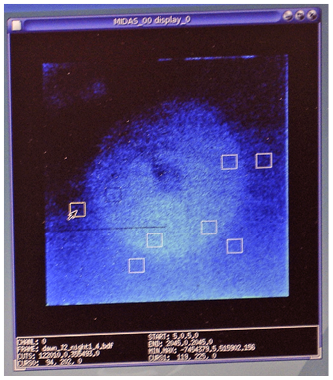
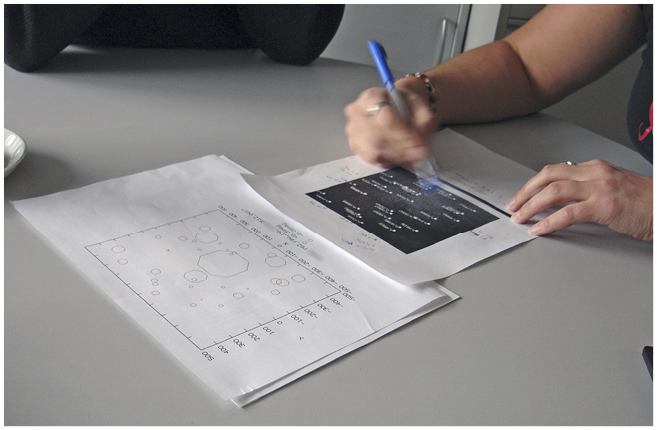
Instructed by Otto, Nadine searched the 2MASS catalog database in the field of her exposures and found thirty-one stars. Otto deemed this “not many” but “sufficient to try” comparing her photometry with those of the survey. After using the 2MASS website to generate an ASCII file of these stars’ infrared fluxes, Nadine calculated the brightness differences that Otto had specified, as well as the noise variations in the flatfield frame. Once she was done with this, Otfried asked her to summarize her measurements on a map of the field. Thus equipped, she went to see him (Figure 5.3).
Nadine briefing Otfried about her assessment of artifacts in the flatfield exposures, using paper printouts to summarize her findings.
Note: The online version shows the colors of the original figure.
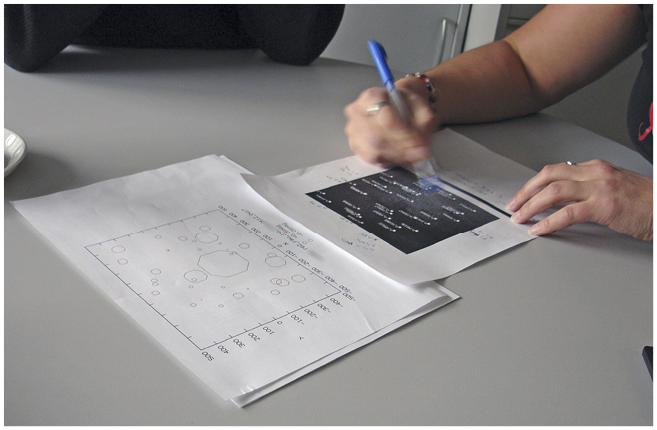
In their joint examination of the map, Otfried and Nadine agreed that the ring and gradient artifacts were noticeable as brightness differences of stars, which could be used to quantify these artifacts. Uncertain of how large a difference had to be to require correction, Nadine depended on Otfried’s judgment. He asserted that differences of up to 0.03 mag were sufficiently “the same,” whereas bigger differences had to be corrected for.Footnote 31 Otfried tried to identify a structure that is both “simple enough” to be described in a model and “good enough” to remove the artifact to proceed with the analysis.
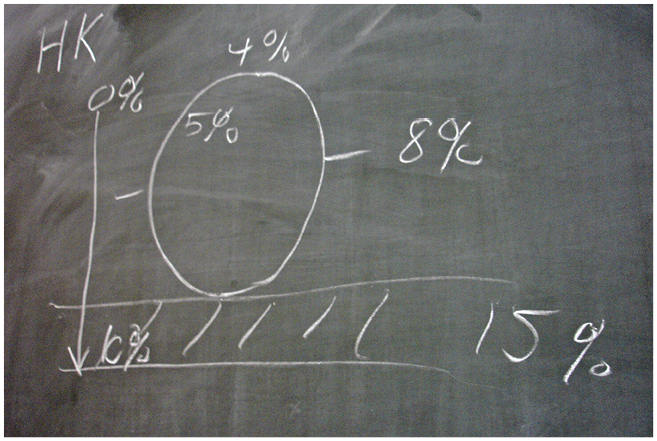
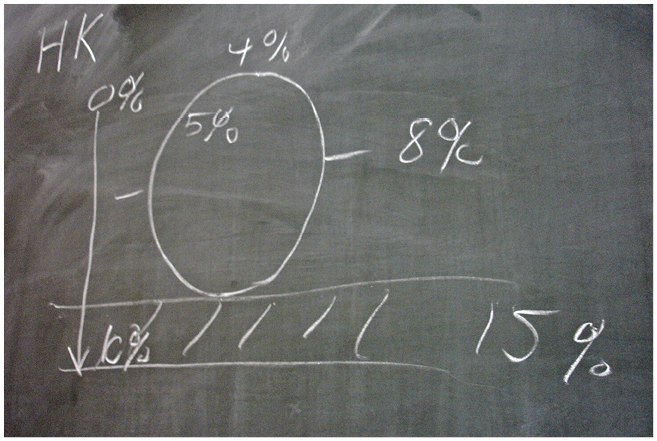
Drawing on these assessments, Otfried proceeded to sketch and quantify key elements of the flatfield model on his office blackboard (Figure 5.4). He subsequently guided Nadine to make a model that consisted of a ring and a gradient that was to be subtracted from the flatfield frames, which in turn were used to divide all science exposures anew. This model later proved to be “good enough” for Nadine’s data to show “the same sky” as the measurements of the 2MASS. No further flatfield repair was considered necessary.
Otfried’s schematic characterization and quantification of artifacts in the flatfield frames on his office blackboard.
Note: The online version shows the colors of the original figure.
This is another case of mundane reasoning (Pollner Reference Pollner1974b, Reference Pollner1987) that employs the sky as a stable structure available through uses of media. But whereas Spergel used idealizations of the sky as a resource to shed doubt on the BICEP2 analysis, Otfried, Otto, and Nadine used specific features (the position and brightness of stars) as resources to improve their data calibration. They were “practical realists” who used the sky in ways not acknowledged in their subsequent publications.Footnote 32
Note that these astronomers did not work with digital records only, but used a variety of media. Otto and Otfried first considered a set of numbers (redshifts and magnitudes), then inspected SEDs (on screen and on paper), and examined flatfield exposures represented as false-color images on Nadine’s computer terminal (see Chapters 3 and 4). After specifying possible artifacts using the 2MASS catalog, Nadine summarized her findings on paper, before Otfried sketched the flatfield model on his blackboard (Figures 5.3 and 5.4). Not constrained by precise numerical values, uses of paper and the blackboard gave Otfried and Nadine room for approximations and schematic assessments that helped formulating a simple, but “good enough” model of the artifactual ring and gradient.Footnote 33
5.6 Materiality and Mundane Reason as Resources for the Relief from Trust in Data Makers
We have examined two distinct uses of mundane reasoning engaging the mediated sky: one employing idealized properties, the other specific detail. The former provided David Spergel with resources to assess the BICEP2 data analysis beyond the information that the BICEP team had provided. The latter was Otto’s, Otfried’s, and Nadine’s creative use of the 2MASS catalog as a resource for improving their data calibration. In both episodes the mediated sky was a resource for assessing and ordering research work. I now argue that, thanks to mundane reasoning, materiality and mediation can be resources for the partial relief from trust in the work of data makers.
That trust is foundational to doing science has become a commonplace in historical, philosophical, and sociological studies. Only a small part of our knowledge draws on our own experiences and so we need to rely on others’ testimony. By placing trust, there is always a risk that one may be disappointed, but in science its promises are immense. As Steven Shapin (Reference Shapin1994, 417) notes, “scientists know so much about the natural world by knowing so much about whom they can trust.” With increasing complexity this dependence only increases (Simmel Reference Simmel1906), and it pertains as much to the data one uses as to the things one knows: “the relevant data and arguments are too extensive and too difficult to be had by any means other than testimony” (Hardwig Reference Hardwig1991, 706). Although sociologists like Niklas Luhmann (Reference Luhmann2017) and Anthony Giddens (Reference Giddens1990) have claimed that, in modern society, trust has shifted from personal relations to institutions, evaluations of persons continue to be highly important in scientific practice. But this trust is not blind. Scientists evaluate others’ work by considering the reputation of individuals and their workplaces, their track records, and the awards and grants they receive.Footnote 34
Some studies of the reuse of scientific data claim that trust in data commonly amounts to trust in data makers (Gregory et al. Reference Gregory, Groth, Cousijn, Scharnhorst and Wyatt2019; Yoon Reference Yoon2017). The reputation of data repositories and archives, as well as experiences with prior reuse, also affects users’ trust in data (Faniel and Yakel Reference Faniel, Yakel and Johnson2017). Samuelle Carlson and Ben Anderson (Reference Carlson and Anderson2007) argue that, for one’s data to be trusted, “making explicit their context of production and setting up appropriate systems of quality checks and assessment” are important (Carlson and Anderson Reference Carlson and Anderson2007, 8; see also Yakel et al. Reference Yakel, Faniel and Maiorana2019). When doing so, data makers demonstrate competence, honesty, and reliability – markers of trustworthiness (O’Neill Reference O’Neill, Morris and Vines2014). One becomes trustworthy, argues philosopher Onora O’Neill (Reference O’Neill, Morris and Vines2014), by making oneself vulnerable to others. Well-placed trust, she insists, is a response to trustworthiness.
Studies of the reuse of scientific data have examined differences between disciplines. Kathleen Gregory and coauthors (Reference Gregory, Groth, Cousijn, Scharnhorst and Wyatt2019) examine astronomy, Earth and environmental sciences, biomedicine, field archeology, and social sciences, and identify various criteria to assess the trustworthiness of data in use. They claim that in astronomy trust in data is contingent on “author reputation” and “source reputation,” whereas in biomedicine trust in data is primarily contingent on the quality of “supporting documentation” and “social networks” (Gregory et al. Reference Gregory, Groth, Cousijn, Scharnhorst and Wyatt2019, 422).Footnote 35 Ixchel Faniel and Elizabeth Yakel (Reference Faniel, Yakel and Johnson2017) examine archaeology, zoology, and social sciences to formulate a set of “trust markers” that members of the disciplines they consider share. But neither study addressed how discipline-specific objects and resources in use may partially relieve data reusers from trusting data makers.
David Spergel’s assessment of the BICEP2 result and as Otfried and Nadine’s use of the 2MASS catalog are exemplary uses of the sky as the “object” that defines astronomy as a discipline. Conceptually, the sky is a resource at every astronomer’s disposal for examining their peers’ analyses and claims.Footnote 36 Spergel uses it without access to a telescope and data of his own. His assessment of the BICEP2 result does not involve personal evaluations, say, of trusting or not trusting BICEP team members or examining their reputation and track record.Footnote 37 Otto’s suggestion to use the 2MASS catalog to formulate a model to repair the flatfield was a spontaneous act that puts to use what is to members an “obvious, but often overlooked” (Hogg) property of the sky. Otto and his colleagues, too, do not explicitly invoke personal trust or mistrust. Instead, they do what Lucy Suchman (Reference Suchman2007, 67) describes in another context: “when practices become problematic, the world can be consulted for resolution.” Different scientific disciplines have different means to do so.
In astronomy, the sky provides affordances not only to check others’ work and use data in inventive ways (such as for improving calibrations), but also to partly relieve data users from trusting data makers. As they know that other astronomers share access to the sky and can exercise mundane reasoning, data makers are relieved in part from demonstrating their trustworthiness. Astronomers’ joint access to the sky, if only as an idealization (as in Spergel’s critique), makes them vulnerable to others, and, unsurprisingly, many astronomers expect that others will inspect their work. This may prompt particular care when releasing data (see Chapter 8 and Hoeppe Reference Hoeppe2020a). Conversely, junior astronomers like Nadine become equipped with tools and practices to examine other researchers’ work and learn to demonstrate their own vulnerability (in O’Neill’s sense).
That access to shared materialities can substitute for placing trust in people echoes David Graeber’s (Reference Graeber2011) history of money and debt. Graeber notices that, in Eurasian antiquity, periods in which credit money was widely accepted alternated with periods in which gold and silver were dominant as currency. A debt is a record of trust. Credit money is useful in a society that maintains reliable and stable records, which was possible only in times of relative peace. But “accepting gold or silver in exchange for merchandise, on the other hand, need trust nothing more than the accuracy of the scales, the quality of the metal, and the likelihood that someone else will be willing to accept it” (Graeber Reference Graeber2011, 213). No wonder that mercenaries were commonly paid in gold. Gold and silver were, then, material reliefs from the challenges of trusting persons and fragile systems of accounting. There is a trade-off between uses of stable material objects and the placement of trust.Footnote 38
In scientific practice, uses of materiality as resources for relieving trust in people extend from disciplinary objects to disciplinary tools. In today’s observational astronomy, a diverse community of scientists shares a small number of telescopes, detectors, and data analysis software. Relying on their proper operation, calibration, and data management is an institutionalized form of trust (Giddens Reference Giddens1990; Luhmann Reference Luhmann2017). Note that (unlike the specialist BICEP2 telescope and Keck Array) these telescopes generate data for diverse evidential contexts (Pinch Reference Pinch1985). This reflexively asserts their calibration. Within limits, one and the same dataset (such as that of the MUWAGS collaboration described in Chapters 6, 7, and 8) can be used for projects that examine different evidential contexts. This supports the robustness of this work, but it is also a resource for the relief from trust in data makers.
5.7 Conclusion
In all sciences, the stability of reference is ultimately achieved by social work, which includes practices of standardization (Wise Reference Wise1995). Only some sciences can routinely draw on objects or environments that are widely accessible to community members. Of these, astronomy is arguably the foremost example. Musing about the origins of science, Gaston Bachelard (Reference Bachelard1985 [Reference Bachelard1934], 100) declared that “determinism descended from heaven to earth.” Alexandre Koyré (Reference Koyré1943, 333) argued that “modern physics takes its origin from the study of astronomical problems and maintains this tie throughout its history.” And William Ivins (Reference Ivins1953, 16) suggested that, besides geometry, in classical Greece only astronomy made progress, since “every clear night provides the necessary invariant image to all the world.” But there are other sciences that access shared environments and objects, including geology and other Earth sciences. Still other sciences arguably engage models and taxonomies in broadly related, reflexive ways.Footnote 39
Engaged to relieve data users’ trust in data makers, disciplinary objects function in ways otherwise ascribed to institutions and infrastructures. Writing about the use of meteorological data for documenting climate change, Paul Edwards (Reference Edwards2010, 19) notices: “Get rid of the infrastructure and you are left with claims you can’t back up, facts you can’t verify, comprehension you can’t share, and data you can’t trust.” In attending to calibration practices I have considered infrastructure not as a noun, but as a verb (Star and Bowker Reference Star, Bowker, Lievrouw and Livingstone2006), and have foregrounded otherwise backgrounded work practices in what Geoffrey Bowker (Reference Bowker1994) called “infrastructural inversion.”
That the objects of scientific research can be used for work that is broadly infrastructural has been argued before. Thus, biological materials (Clarke and Fujimura Reference Clarke and Fujimura1992), Drosophila fruit flies (Kohler Reference Kohler1994), and laboratory mice (Rader Reference Rader2004) became not only topics of research, but also resources for its conduct, as they embodied standards for comparison.Footnote 40 Made to serve as markers of pollution, a variety of West African insects became part of an infrastructure for ecotoxicological assessments (Tousignant Reference Tousignant2013). Studies of these organisms’ uses adhere to the notion that infrastructures are human-made and have network structures (of exchange, for example).
What I referred to in this chapter as “materiality” may be better called “objectivity,” provided the latter is understood not as an observer-independent “view from nowhere” (Daston Reference Daston1992), but as a capacity to object or resist. The German word Gegenständlichkeit (“standing-against-ness”), that Günter Figal (Reference Figal2006) advocates in a phenomenological study alert to Heidegger’s probing examination of language, expresses this meaning (cf. also Liberman Reference Liberman2022). What is gegenständlich is not necessarily material in a physical sense.
In this chapter my objective was to assess how “opportunistic” uses of “natural” objects and structures (Hutchins Reference Hutchins2005) matter to scientific work in which calibration and the stability of reference become topical. But properly viewed, “opportunistic” may be a misnomer in the cases that I described, since it posits a view from outside scientific practice, which inherently and essentially is about using disciplinary objects as resources for practical action.

 Open access