


1 Introduction
Reference SvensonSvenson (2008) and Reference PeerPeer (2010a,Reference Peerb) studied the time-saving bias in driving or production: the time saved by speed increases from a relatively high speed is overestimated relative to the time saved by speed increases from low original speeds. Most studies on driving speed have been paper and pen questionnaires and judgments made when the respondent was not driving, with the exception of a study by Reference Peer and SolomonPeer and Solomon (2012). Reference Peer and SolomonPeer and Solomon (2012) investigated professional taxi drivers and non-professional drivers about a journey they were currently making in a slow but not congested city traffic environment. Both groups gave biased judgments of journey time, average speeds and biased time-savings, consistent with previous questionnaire studies (Reference PeerPeer, 2010a,Reference Peerb; Reference SvensonSvenson, 1970; Reference Svenson and SaloSvenson & Salo, 2010; Reference Svenson, Eriksson, Salo and PetersSvenson et al. 2011). However, overestimations of time savings following increased driving speed among the taxi drivers were smaller than those made by the non-professionals.
The study of Reference Peer and SolomonPeer and Solomon (2012) was a field study and therefore they did not have full control in their context and they had no opportunity to ask their drivers to, for example, drive to save 10 minutes and to perceive and judge how well this target was reached. Therefore, it is an open question whether the time saving bias is valid for the situation in which drivers are actively engaged in all components involved in driving in a controlled context, including cognition, perception and motor skills.
Driving is a complex task that involves perceptual and cognitive processes and perceptual-motor skills. Drivers need to perceive distances, speed and time, and to understand their relation to one another and act accordingly (Reference GroegerGroeger, 2000). Hence, driving behaviour relies to a large extent on perceptual cues and how they are perceived and interpreted. Earlier studies have shown that perceptions of speed, distance and time are biased in many situations. In experiments where time remains constant and only speed and distance vary, it has been found that the longer distance travelled at a greater speed is perceived to have a longer duration than the same objective travel time spent on a slower and shorter trip (Reference Cohen, Ono and SkelleyCohen, Ono & Skelley, 1966). Speed perception is often more correct than distance and duration perception (Reference Cohen, Ono and SkelleyCohen, Ono & Skelley, 1966), but drivers seem to be biased towards overestimating slow speeds (lower than 32 kph) and underestimating higher speeds (above 32 kph) (Reference Cohen and CooperCohen & Cooper, 1962). Time perception has been found to be susceptible to the amount of information presented. The more stimuli that are presented during a time interval, the more time people believe, in retrospect, to have passed. This phenomenon was named the filled-duration illusion (Reference Thomas and BrownThomas & Brown, 1974).
In driving, perceived past travel time and predicted remaining travel time are important determinants of drivers’ preferred speed during the remainder of a trip. If the remaining time seems too short, drivers go faster (Reference Gabany, Plummer and GriggGabany, Plummer & Grigg, 1997; Reference McKennaMcKenna, 2005). Thus, driver’s judgments of travel time and mean speed over a journey are important factors in the choice of speed. For instance, imagine a driver who perceives the mean speed of a trip to be faster than it actually is. Towards the end of the trip, the driver would experience time pressure when realising that he or she is running late. The driver would then be tempted to speed up to ensure that the destination is reached within time, but the driver may mis-estimate the amount of time that can be saved by increasing speed (Reference SvensonSvenson, 2008). Hence, it is important to study the discrepancy between drivers’ judgments of the effect of an increase in speed on travel time and the actual effect.
Actual time savings can be calculated by the following formula:

where c is a constant enabling conversion of the distance measure to other units, D is the distance travelled, v 1 is the original speed and v 2 the higher speed. Changes of speed at lower speeds have greater impact on time savings than the same changes from higher speeds. Reference SvensonSvenson (1970) asked participants to make intuitive judgments of the difference in travel time between two speeds over the same distance. The study showed that with a short distance (13 km), the time saved was underestimated when the speed increased from a low speed whereas the time saving was overestimated when the original speed was high. Reference SvensonSvenson (1970) found that the following formula described time saving judgements:

where c and e are constants describing how perceived/cognitive distance is a function of objective distance D; v 1 is the original speed and v 2 the higher speed. The time-saving bias of equation 2 was found in another study by Reference SvensonSvenson (1973) in which participants were asked to estimate the impact of a speed increase of a physical object and the underestimation of the time saving at a lower speed was replicated. This phenomenon was later termed the time-saving bias (Reference SvensonSvenson, 2008) and support for the existence of such a bias has been found in a number of studies (Reference Fuller, Gormley, Stradling, Broughton, Kinnear and HanniganFuller et al., 2009; Reference PeerPeer, 2010a,Reference Peerb, 2011; Reference Peer and GamlielPeer & Gamliel, 2012; Reference Peer and SolomonPeer & Solomon, 2012; Reference SvensonSvenson, 1973, Reference Svenson2008, Reference Svenson2009). A relevant question is whether these types of studies are relevant for real life driving where actual distances, time and average speed are not always known, but based on the driver’s own perceptions.
In the present study, participants acted on perceptual cues or information in a well-controlled driving context. The drivers were neither given time nor distance, and they received only information about the actual instantaneous speed through the speedometer. The time-saving bias predicts that, when increasing speed from a low speed, time saving is underestimated whereas an increase from a relatively high speed is overestimated. The aim of the present study was to test this prediction in a driving simulator task where participants are asked to gain a certain amount of time (three minutes) by increasing speed from a low speed (30 kph) and a high speed (100 kph). Participants were expected to underestimate the time saved by increasing the speed from the initial low speed of 30 kph and drive faster than needed and therefore save more than the required three minutes. At an initial high speed of 100 kph, participants were expected to overestimate the effect of an increased speed and therefore save less than the required three minutes. We also included a questionnaire with problems similar to the ones used in the simulator task, in order to make direct comparisons between the average speed estimates given by the questionnaire responses and the simulator drives.
2 Method
2.1 Participants
There were 12 participants in the study, 6 men and 6 women. The participants were recruited from the participant pool of the Swedish National Road and Transport Research Institute in Linköping.Footnote 1 In each condition, there were two men and two women in each of three age groups; 25–34 (M = 27.3 years, SD=1.0), 35–44 (M = 39.5 years, SD=1.7) and 45–54 (M = 52.0 years, SD=3). All participants held a valid driver’s license for at least five years and the majority had an average annual mileage between 1000 and 1500 kilometres per year. None of the participants had an average mileage below 1000 kilometres. It should be mentioned that one of the male participants was replaced by another male in the same age group since he had driven as fast as possible in both test conditions, indicating a misunderstanding of the task.Footnote 2 Each participant was paid 500 SEK (≈$70) for participation in the study.
2.2 Apparatus
The study was conducted in an interactive fixed-base driving simulator at the Swedish National Road and Transport Research Institute in Linköping, Sweden. The simulator has a simple motion system that permits lateral and longitudinal tilting. Its visual system consists of three 40” displays that give a field of view of approximately 180 degrees. The interior corresponds to the interior of a Volvo passenger car with an automatic gearbox and all the conventional equipment such as a steering wheel, a dashboard and pedals. The participant could determine the car’s road position and speed by operating the steering wheel and gas and brake pedals.
2.3 Scenario
The simulated road environment was a rural road with two lanes. Light traffic was generated in the opposite direction, but there were no other cars visible in the direction the participant was driving. The driving distances were 8.5 and 28.3 kilometres. The same road was driven in both distances, with the shorter distance covering the first 8.5 kilometres of the longer distance.
2.4 Experimental design
A within-participant design was employed. Each participant drove each of the two distances twice. The distance of 8.5 km was first driven at a speed of 30 kph and then a second time at a speed chosen by the participant in order to gain exactly three minutes. The distance of 28.3 km was first driven at 100 kph and then at the speed chosen by the participant in order to gain three minutes. The distances were chosen in order to keep the time driven constant between conditions. Half of the participants drove the shorter distance at the lower speed first, half started with the longer distance driven at a higher speed first. The two conditions (low speed first and high speed first) were balanced by sex and age group.
2.5 Procedure
The participant was first asked to fill in a form with background information, such as age, years with driver’s license etc. Then, the participant was given written instructions for the experiment and was told that he or she first would get a practice run in order to adapt to driving in the simulator. The practice run was set to last for 15 minutes regardless of the chosen speed, and the simulated road was the same as in the experiment. Then, the participant was told to, after the practice run, first drive a distance at a specified speed and then drive the same distance again, only this time to gain exactly three minutes in travel time by driving at the speed that seemed necessary to gain the required time. This was followed by a questionnaire with questions regarding the participant’s perception of average speed during the drive and the time gained when choosing the driving speed. The procedure was thereafter repeated but for a different speed (and distance). Finally, when the participants had driven both distances, they received yet another set of questionnaires. One questionnaire addressed the usability of the speedometer in the car simulator (If the meter was easy to use, if the information displayed was clear etc.). A second questionnaire concerned the quality of the simulator (how much the auditory and visual presentation resembled a real car drive etc.).
This was followed by a questionnaire. The procedure was thereafter repeated but for a different speed (and distance). In the questionnaires following each simulator drive, the participant was asked questions regarding perceptions of average speed and the time gained when choosing the driving speed. Finally, the participant received yet another set of questionnaires. One questionnaire addressed the usability of the speedometer in the car simulator. A second questionnaire concerned the quality of the simulator.
A third questionnaire investigated time savings from a cognitive perspective and the participant was asked to solve problems corresponding to the driving problem. That is, the general task was to estimate the mean speed needed in order to gain three minutes on a distance driven at a certain initial speed. The distances were either 20 or 40 kilometres and the initial speeds were 50, 60, 70, 80, 90, 100, 110 and 120 kph. In addition, the participant was given the same distances (8.5 km and 28.3 km) and initial speeds (30 kph and 100 kph) as in the driving simulator and was asked to judge the mean speed needed to gain three minutes. Thus, these last two problem tasks corresponded exactly to the driving tasks in the simulator.
3 Results
3.1 The driving simulator task
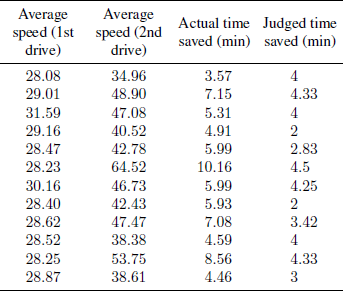
Mean speeds of the first and second drives for each of the two distances were derived from simulator data and used to calculate time gains for each participant in each distance. (See Appendix for individual measures.) Table 1 shows that, when increasing speed from 30 kph, participants gained an average of 6.14 min. This time gain was significantly higher than the target time saving of three minutes, t 11=5.853. p = 0.0001, one-tailed. Correspondingly, the average time saved from an increase from 100 kph was 2.21 minutes and significantly lower than three minutes, t 11 = −3.228, p=0.0040, one-tailed.Footnote 3 In summary, participants drove faster than necessary and gained more time than asked to when increasing speed from the low speed. They did not drive fast enough and gained less time than targeted when increasing speed from the higher speed. These findings corroborate that the time-saving bias applies not only to cognitive contexts with numerical information but also to an active driving context when the information is dynamically perceptual.

Note. All entries are expressed in minutes. Standard deviations in parentheses. Significant deviation of mean (judged) from actual time savings:
* p<.05
** p<.01
*** p<.001
Table 1 also shows how participants judged their own time gain in each scenario in relation to their actual time gain. On average, participants judged their own time savings to be close to the target of three minutes. From 30 kph, they judged their time gain to be 3.56 min which is significantly lower (t 11= −5.232, p = 0.0003, two-tailed) than their actual time gain of 6.14 min. They judged their time gain from 100 kph to 3.25 min which is significantly higher (t 11= 2.701. p = 0.0206, two-tailed) than the actual time gain of 2.21 minutes.
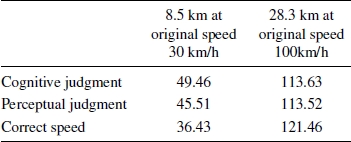
Participants’ judgments of average speeds and actual mean speeds are shown in Table 2. The average initial speeds were 28.95 kph and 98.68 kph for the target speeds of 30 and 100 kph, respectively. At both initial speeds there was a tendency for participants to drive somewhat below the target speed. The estimates of the participants’ average judged mean speed for the 30 kph distance was 46.28 kph and their actual mean speed was 45.51 kph. In order to gain three minutes on the distance, one needs to keep an average speed of 36.43 kph, which is significantly lower than 45.51 kph (t 11= 3.942, p = 0.0012, one-tailed). For the 100 kph distance, the participants’ average judged mean speed was 114.74 kph and their actual average speed was 113.52 kph. The target average speed was 121.46 kph and significantly higher than 113.52 kph (t 11= −4.084, p = 0.0009, one-tailed).

Note. All entries are expressed in kph. Standard deviations in parentheses. Significant deviation of mean (judged) from actual mean speeds: n.s p>.05 *p<.05, **p<.01 and ***p<.001.
3.2 The corresponding questionnaire task
Table 3 shows the participants’ estimates of the average speed needed to gain three minutes on a 20 and 40 kilometre long distance. As expected, the participants overestimated the average speed needed to gain the time at the lower speeds and underestimated the required average speed at higher speeds.

Note: Correct mean speeds in parentheses. Bold digits represent significant underestimations and bold italics significant overestimations of mean speed needed to gain 3 minutes at distance 20 and 40 kilometres. Significant deviation of mean from correct speed
* p < .05
** p < .01
*** p < .001
3.3 Comparison between simulator and questionnaire tasks
In Table 4, the average driving speeds in the simulator task are compared to estimated average driving speeds in the questionnaire. Both the results of the questionnaire responses and the simulator drives show that the required speed was overestimated when the initial speed was low and underestimated when following an already high speed. There was a significant correlation between the speed driven in the simulator and the speed indicated in the questionnaire when increasing from the lower speed r (9) = 0.743, p = 0.0089,Footnote 4 and from the higher speed r (10) = 0.613, p = 0.0340. Thus, the cognitive error found in previous studies was not only found again in the present study but was also shown to apply to a controlled perceptual-motor driving context. The error persists in an active driving context.
4 Discussion and conclusions
Time gain is one of the motivators for drivers to speed up and in turn, speeding increases risk for accidents (e.g. Reference Arts and van SchagenAarts & van Schagen, 2006). But do drivers understand the true relationship between speed and time gains? The present study confirms previous findings of a time-saving bias in judgments of time saved by increases in speed. It also indicates that this bias is not limited to primarily cognitive tasks, because it perseveres when the problem information is based on perceptual cues or information in active driving.
The time-saving bias found in the active driving task cannot be accounted for by a failure of appreciating the average speed since participants estimate mean speed accurately. Nor can it be explained by perception of the road distance. Participants were informed that the distance driven at a given speed was exactly the same as the following distance driven at the speed they targeted to gain the time saving of three minutes. It may be argued that a failure in appreciating the distance travelled could lead to a bias in perceived time of each distance. However, the time taken to complete the first distance would also be misperceived since the distance was constant.
The present study also shows that questionnaires can be used in studies of driver-related judgments of this kind and validates questionnaires as a valid method. Simulator studies and real life driving experiments can be costly and simpler tasks performed when not driving provide the means for studying biases thoroughly before testing its validity in real settings. The relevance and validity of simulator studies have been confirmed in numerous studies (e.g. Reference Godley, Triggs and FildesGodley, Triggs & Fildes, 2002; Reference Wang, Mehler, Reimer, Lammers, D’Ambrosio and CoughlinWang et al., 2010).
In the choice of speed, positive and negative consequences of a speed are balanced by the driver and the decision to speed up will be made if the positive outweigh the negative consequences of speeding (Reference Lawton, Parker, Stradling and MansteadLawton, Parker, Stradling & Manstead, 1997). Hence, it is important that drivers can make accurate judgments of the consequences of an increased speed, such as how much time that can be gained. According to the time-saving bias, a driver already driving at a high speed overestimates the time that can be saved by an increase in speed. How many of these drivers would make the same choice of speed if they had accurate information of the actual time gain of the speed increase? Future studies need to explore how these types of judgments can be de-biased, for example, via adequate and focused information technology in the car.
Appendix: Individual mean speed and time saving measures


 Open access

