

Introduction
Of the countless animals that died in the North American fur trade, one bird weighed on the conscience of David Thompson. The famed British fur trader and explorer called it a “white grouse.” His 1850 memoir detailed its physiology, lifecycle, and habitat, as well as its importance in provisioning the subarctic forts of the Hudson’s Bay Company (HBC). Based on Thompson’s description of this bird, those Maškēkowak families who lived in the region may have recognized it as a wâpithêw (literally translated as “white partridge”). Today, the bird is still known by its Latin name in the Linnaean classification system: lagopus lagopus. But in the eighteenth century, HBC servants were more likely to lump it together with similarly sized and equally edible ptarmigan, grouse, and pheasants under one label: partridge. Whatever its name, this bird made up the majority of those partridges consumed at York Fort, the HBC’s principal post during the eighteenth century. Possessed of a “submissive meekness” with no equal in Hudson Bay, it made for easy hunting. So easy, in fact, that Thompson paused to ask “why such an angelic bird should be doomed to be the prey of carnivorous animals and birds,” including those men in the service of the HBC.Footnote 1
Debates over how to understand the dynamics that define commodity frontiers have given Thompson’s question—why partridge?—new life. As an analytic category, the commodity frontier is a compelling framework for explaining the spread of mercantile capital, one that pays particular attention to key features of the North American fur trade: the exploitation of Indigenous peoples and natural resource extraction.Footnote 2 Despite its clear spatial dimensions, the commodity frontier is most often treated as movement. It describes, as Richard Walker and Jason W. Moore argue, “the process of going beyond the highly capitalized zones of production to secure sources of labour, food, energy, and raw materials at below the prevailing average cost.”Footnote 3 Yet a commodity frontier is not simply the drive to obtain cheap resources; it is the “audacious fetishization of nature” that presents such resources as free for the taking.Footnote 4 For all its strengths, this approach is not without critics. Privileging price, some scholars argue, renders exchange value the dominant logic at work in accounts of how capital operates; it forecloses considerations of how the specific qualities of different resources enabled different degrees of control over production.Footnote 5 What is more, a focus on fetishization effectively renders resource valuations as a matter of ideology, not a question of profitability.Footnote 6 Despite the attention paid to price, studies of commodity frontiers in this vein tend to sideline discussions of costs and how firms determine them.
This article takes the HBC as an ideal case to develop this critique of commodity frontiers and suggest new directions in their study. Rather than frame cheapness as an ideological position, it approaches fluctuations in the cost of food as tied to power struggles among participants in the eighteenth-century fur trade. The value of partridge was never reducible to its price in company account books, as reckoned in made beaver (mb): the HBC’s unique abstract unit of account.Footnote 7 Estimations of what the bird was worth were instead shaped by the specific relationships that determined who hunted and who ate partridges, in which questions of cost were bound up in questions about control. The HBC had to contend with the fact that it depended on fresh meat from Indigenous hunters, who in turn expected that the company would provide similar relief according to the principle of reciprocity: the obligation to share resources borne from a recognition of mutual dependence. Put differently, the HBC’s drive to make partridges and other animals cheap was a consequence of its desire to tilt the exchange relations and power dynamics around food in its favor.
Hunting wild animals to eat numbered among the most important tasks in the fur trade, as evidenced by its historians. The HBC’s operations depended on enormous quantities of meat; a single company servant in this subarctic environment consumed around 3 lbs of animal flesh as part of a daily diet of 4,000 calories.Footnote 8 Studies of the HBC’s provisioning system have focused on the diversity of animals that fueled the company’s inland expansion after 1774, which culminated in the incredible pemmican production complex of the Great Plains. Though the food sources that fed the fur trade changed across time and space, the HBC’s overarching policy remained consistent: limit the ability of Indigenous hunters to control the supply of food and set prices.Footnote 9 Partridges are part of this story, albeit in a different way than other animals. To account for the rise and fall of partridge at York Fort is to move beyond familiar narratives of gradual resource depletion and instead grapple with the dynamics of resource instability, including the effects of that instability on firms.Footnote 10
Partridge never had a fixed price at York Fort. Generally, the more abundant the bird, the less it cost. Such savings were largely due to an eighteenth-century technical innovation: nets. By encouraging company servants to net partridges, the HBC aimed to reduce the fort’s expenditures on shot and powder, as well as limit its dependence on Maškēkowak hunters. When partridges were either too scarce or too “wild” for netting, all hunters used guns, which drove up the cost of these birds for the HBC. Partridge population fluctuations, when coupled with a larger labor force at York Fort after 1774, thus undermined any advantage that the company derived as the sole purchaser of country provisions. Need ensured that the HBC could not unilaterally set a price for partridge.Footnote 11 Yet if high prices did not dampen the demand for partridges at York Fort, low prices did not limit supply. Indeed, the fact that Maškēkowak hunters brought in partridges seemingly independent of price fluctuations between the 1770s and 1780s suggests that this traffic did not proceed solely according to the logic of a market economy. Rather, the principle of reciprocity in food sharing led both Maškēkowak hunters and York Fort’s officials to routinely exchange food as if price mattered less than the relationships maintained through those exchanges.Footnote 12
Unable to reliably predict, let alone fix, the price for partridges, the HBC put greater emphasis on what it could denominate with more confidence: distribution. At the same time that the policy of inland expansion increased the labour force at York Fort, the HBC’s governing body, the London Committee, instituted new accounting measures. These required that forts log every provision distributed, including partridge and other country provisions. The committee hoped that this level of reporting, unparalleled in the company’s history, would enable it to “act at a distance” on otherwise local provisioning decisions.Footnote 13 But the committee’s control over distribution remained limited, due, in no small part, to opposition from company servants and officers at York Fort. Post journals continued to convey valuations of partridge that the account books failed to capture. The tumultuous tenure of Joseph Colen as factor at York Fort (1786–1798) best demonstrates these dynamics. Under Colen, outbreaks of scurvy and labour protests related to partridge shortfalls served as opportunities to expand understandings of the bird’s value beyond its mb price, ones that challenged the London Committee’s plans to reduce provisioning expenses and, in the process, break with the principle of reciprocity. Business historians have long noted that different flows and types of knowledge shape how firms like the HBC behave.Footnote 14 The fraught pursuit of cheap food reveals the politics behind that knowledge.
Provisioning Problems
York Fort was not self-sufficient, and yet it needed to give away food. Founded in 1684, the fort relied on two flows of provisions. The first came aboard ships from Europe, which transported large quantities of imports like grains, salted meats, and liquor alongside trade goods. The same liquidity concerns that made inland expansion unattractive during the first century of the company’s operations led the London Committee to keep these costs as low as possible.Footnote 15 To do so, York Fort relied on its secondary flow of food: tens of thousands of pounds of country provisions. Alongside its own servants, the HBC relied on Indigenous hunters to obtain these animals. As historian Arthur J. Ray described it, the HBC’s system of stationary forts along the bay-side represented a “revolutionary ecological strategy for northern Canada.”Footnote 16 While Indigenous communities regularly moved locations to take advantage of seasonal food surpluses, York Fort survived by getting food from a distance.
Faced with the challenge of provisioning forts in this subarctic environment, the HBC quickly adapted existing reciprocal food-sharing customs to suit its commercial strategy. In 1717, James Knight, then the governor of York Fort, entered into a treaty with those Maškēkowak families who had lived in the Hudson Bay lowlands prior to the arrival of the HBC, a people the company later called the “Homeguard Cree.” Knight agreed to share food with his treaty partners in time of distress should they cease conflict with northern Chipewyan nations and, in doing so, allow furs to flow south into the HBC’s hands.Footnote 17 In this sense, the company likely regarded the free food given to Maškēkowak families as simply the cost of doing business.Footnote 18 Still, the food provided by Maškēkowak hunters led some in the company to frame this relationship in moral terms, ones that hewed closer to the principle of reciprocity. When questioned by the London Committee about the volume of oatmeal given to Maškēkowak families in 1738, York Fort’s factor, James Isham, pointed to the fort’s need for meat, which obliged these families to stay so long that they could not reach their winter hunting grounds before the frost. As these hunters had supported the fort, Isham argued, “it would be inhuman not to support them.”Footnote 19
Maškēkowak hunters wanted more than just oatmeal from York Fort. Many received trade goods in exchange for the meat that they brought, including gunpowder and shot. Just how economically dependent these hunters and their families came to be on the HBC for their survival is the subject of an extensive scholarly literature.Footnote 20 By the 1760s, York Fort regularly distributed shot and gunpowder to Maškēkowak families in times of need; account books from the period recorded these expenditures as given to “Old Indians, Widows, Cripples, & Orphans.”Footnote 21 Yet these same entries indicate that it was not necessarily company men who used these goods to provide for vulnerable Maškēkowak individuals. During the winter of 1779–1780, for example, York Fort noted that it distributed 60 lbs of partridge shot and 20 lbs of gunpowder in order to convince capable Maškēkowak hunters “to take such [individuals] from the Fort & to [relieve] distressed starving Indians.”Footnote 22 In this sense, at least, the paternalist obligation of the HBC to provide relief to certain Maškēkowak families as part of its participation in the fur trade depended on other Maškēkowak individuals.Footnote 23 Little wonder, then, that factors during the eighteenth century readily provided Maškēkowak hunters with “Powder & Shot to Shoot Partridges for the Factory & to support their familys.”Footnote 24 Ideally, food for some meant food for all.
The composition of York Fort’s labour force during this period made a reliance on Maškēkowak hunters hard to avoid. It took time to learn how to hunt in subarctic environments. In 1719, factor Henry Kelsey was pleased to report that all but one man at York Fort knew how to shoot.Footnote 25 His successors, however, struggled to maintain this level of skill among company servants. As Humphrey Marten observed, any time allocated to train new hires to be as capable with a gun as the few remaining “old servants” meant less time spent on other “Factory duties,” such as hauling wood, preparing trade goods, and maintaining the fort.Footnote 26 Servant turnover that led to a decrease in productivity effectively undermined York Fort’s aim of increased self-reliance. For instance, Flamborough House, a provisioning outpost for York Fort established in 1749 up the Nelson River, had little choice but to engage Indigenous hunters. In the fall of 1751, its resident officer, Samuel Skrimshire, complained that the house had “no body that can hunt,” the men sent from York Fort being “new hands.”Footnote 27 By February of 1752, just one servant had marginally improved—he now knew “very little”—and Skrimshire made clear that York Fort was not to expect many partridges.Footnote 28 This skills difference can be read in hunting tallies. Maškēkowak hunters killed 5,000 of the 7,000 partridges brought to the fort in the winter of 1773–1774.Footnote 29 But some factors made the consequences of a “green” workforce even more explicit. “I shall send Indians to kill partridges,” explained Andrew Graham, “as there are very few Englishmen who have any knowledge of the gun.”Footnote 30
Officials at York Fort recognized that the skills of Maškēkowak hunters weakened its position in provision exchanges. In 1776, Marten summarized this dynamic, as well as how recourse to reciprocity strengthened the company’s bargaining power. That August, a group of Maškēkowak hunters arrived at the fort with “one hundred and thirty tongues” from as many caribou (called deer), “& not but three rumps.” Marten refused to accept the hunters’ explanation that their canoes limited the size of the haul. Rather, he observed that when “Indians can get Brandy for tongues and the deer are plenty we shall have nothing else brought in, One hundred tongues for which they get ten [made] Beaver being much lighter than a Buck deer, for which they get but three [mb].”Footnote 31 Maškēkowak hunters may not have seen anything wrong with the fact that tongues were so highly valued. Thanks to its valuable fat reserves, a caribou tongue was considered a delicacy.Footnote 32 But as Marten knew, York Fort needed cheap meat, and lots of it. Given that the company’s own standard of trade had incentivized Maškēkowak hunters away from this goal, Marten exerted pressure through the fort’s own food stores. If hunters brought only tongues, Marten promised to neither trade with these hunters for furs nor “in the winter supply them with food.”Footnote 33 For the HBC, then, reciprocity could possess a sharp edge, even outside the commercial credit relations analyzed by legal scholar Susan Dianne Brophy.Footnote 34 The promise of relief in the winter disciplined Indigenous hunters, facilitating the flow of meat to York Fort.
The capacity of reciprocity to keep provision costs low diminished further from the fort itself, a point company officials learned just as competition for furs made expansion inland certain. In 1772, Matthew Cocking, second-in-command at York Fort, reported on the viability of the HBC’s proposed move inland following his journey west, along the Saskatchewan River. Cocking warned the company that expansion promised to be costly due to the dependence of any future posts on country provisions. Rival Montreal “Pedlars purchase at a dear rate, compared with what is paid for [food] at York Factory,” he observed. Just three geese and a “middling” joint of buffalo from Indigenous hunters cost at least one mb. Footnote 35 Faced with both the logistical challenges of transporting imported provisions to these posts and the likelihood of competition for fresh meat between the HBC and rival Montreal traders, the company could not count on the power of reciprocity to keep prices low.Footnote 36 On its own, an expanded commodity frontier did little to solve the HBC’s provisioning problems. Further inland, food would cost more, not less.
Ultimately, expansion in the face of competition with those Montreal fur traders changed the role of York Fort in Hudson Bay. Reciprocity still structured the exchange of food with Indigenous trade partners. But with more men to feed and with the expectation of prohibitively expensive food prices inland, the fort transitioned from the region’s main fur depot to the leading provisions entrepôt. Nowhere was the impact of that shift more visible than in the renewed attention paid to the fort’s decisions around the distribution of provisions.
Distributing Information
Amidst concerns about the cost of feeding the fur trade in the lead up to the HBC’s expansion inland, the company also devoted greater attention to rationing decisions. Each fort’s account book gave insight into the total amount of imported European provisions consumed every year. Yet factors resisted efforts by the London Committee to secure more detailed breakdowns of a servant’s daily diet. In 1717, James Knight rebuffed his superior’s request for such information. Given that those imported provisions were barely sufficient to feed the fort’s servants for five months, Knight bristled that the company expected him to provide “a Weekly account of Every Mouth full of Victualls as is Eaten or Else I find there will be some thoughts of an Embezzillment for my part.”Footnote 37 To Knight’s mind, the fact that company servants survived was the only evidence required to prove he had fulfilled his duty as factor.
Despite Knight’s challenge, the London Committee gradually gained the insight it wanted. Knight himself synthesized a log of his men’s rations between 17 September 1716 and 12 May 1717, but only to support his claim that his predecessor had “deceived” him with respect to the abundance of edible animals around York Fort.Footnote 38 Alongside a weekly ration of 5 lbs of flour, 36 men subsisted on “English meat”—salted pork and beef—for 125 days and on country provisions for 37 days.Footnote 39 Subsequent glimpses of York Fort’s provisioning system indicate that Knight’s reliance on imported meats was an exception to the general rule in the early eighteenth century. Two accounts of provisions served out between 24 August 1721 and 13 August 1722 and between 31 July 1727 and 31 July 1728 not only record that company servants at York Fort ate more country provisions than imported meat. These accounts also did so with more specificity than Knight’s earlier synopsis.Footnote 40 In fact, the account for 1727–1728 finally conformed to the weekly reporting standard initially sought by the London Committee.
By the late 1730s, however, the London Committee expressed frustration with the quality of information conveyed in these “weekly allowance books.” The official instructions issued by the committee in 1738 to three different forts—Albany, Moose, and York—found the allowance books from the year prior to be “deficient.” All three shared the same issue: the record of provisions expended in the allowance book differed from the totals kept in each fort’s general account book.Footnote 41 While the factors promised to avoid such inconsistency in the future, the factor for Moose Fort raised some skepticism about the utility of the weekly allowance books altogether. “I will endeavour to do it in as plain a method as I am capable, not but we have so much change in our days allowance in this country that some have fish and another flesh, a third fowls,” he wrote in reply.Footnote 42 In practice, the London Committee seemed to agree. Its instructions rarely referenced the weekly allowance book, even when such information may have been useful. Complaints from York Fort’s servants about their rations in 1749 and 1751 simply prompted the committee to issue a generic order “that our Servants be Civilly used and fed with a proper allowance.”Footnote 43 Though the HBC now knew more, it does not seem that the London Committee sought to dictate the diet of its servants.
Information about food given to Maškēkowak families at York Fort likewise remained difficult to aggregate and act on. There is no indication that factors included these families in the weekly allowance books prior to the move inland. In this period, sporadic accounts of what the forts gave to Maškēkowak families instead reached the London Committee through the fort’s journals. Typically, these brief entries made no mention of quantity and instead focus on either necessity or the factor’s thrift: “Gave the Inds oatmeal and prunes to keep them quiet.”Footnote 44 Others emphasized custom, like the gift of brandy given to Maškēkowak hunters for the first caribou killed that season.Footnote 45 Perhaps the most detailed entries were the ones associated with the yearly goose hunts. When sixty-eight Maškēkowak men, women, and children drew on York Fort for a range of imported grains and country provisions in 1765, factor Ferdinand Jacobs acknowledged that the fort bore a “Heavy Expence” until the hunt began. But he also knew that Maškēkowak hunters “will make amends” for that expense by killing geese.Footnote 46 Though the London Committee may not have known how much food Maškēkowak families received, factors gave the distinct sense that the amount was either minimal or worthwhile.
The move inland motivated the London Committee to change how York Fort accounted for food. Despite the increase in men at the fort—up to around fifty-eight in a given winter—requests for more imported provisions from Europe were denied. In 1780, the London Committee explained that its ships were full.Footnote 47 Faced with this hard limit, the HBC came to rely even more heavily on country provisions, particularly to support its inland expeditions. In 1782, a series of unseasonably mild winters, coupled with starvation and a smallpox epidemic among Indigenous hunters, led the master of one inland post to refuse any more servants, “fearing that he should not be able to provide food for them, having been so distressed last year as to serve out half allowance a long time.”Footnote 48 Economy became the London Committee’s watchword in the distribution of goods, as effected by newly issued provision books. These books are first listed in the account of York Fort’s stores in 1784–1785, just two years after the London Committee issued instructions to note the consumption rate of provisions.Footnote 49 Each page in the provision book is a table for a specific month, divided into as many rows as there are days in that month. Provisions—both imported and country—are organized into columns; the amount of country provisions received each month from hunters is likewise noted. Between the row and column headings, officers sometimes noted the total number of servants fed. Less frequently, they also recorded the total number of Indigenous people fed, careful to distinguish between those who depended on the fort and those who came into trade. For the first time in the company’s history, it could determine what its forts consumed every day.
Accounting procedures are never simply about the generation of information, but about control. Friction around provisioning defined the relationship between York Fort and the London Committee until the very end of the eighteenth century. In 1794, the committee replied to complaints from officers about the “prolixity and tediousness in keeping the Account of Provisions” with a reminder of their purpose. Daily accounts were intended to provide a “constant check upon those who distribute the Provisions” and to supply the committee with “the necessary information respecting it.” This information was to be “accurate” and easily aggregated in order to empower the committee to act on York Fort’s provisioning system from a distance.Footnote 50 As seen in debates about the value of partridge, that goal proved easier to envision than execute.
Partridges and the Seasonal Round
A serviceable bird. That is how factor Andrew Graham described the partridge in 1772. Disappointed in that year’s hauls of caribou and geese, he sent hunters in “pursuit of those serviceable Birds, the Partridges.”Footnote 51 Like all HBC posts, York Fort navigated what historian George Colpitts calls the “seasonal and cyclical constraints” of hunting wild animals for food.Footnote 52 Yet partridges had a particularly important place within the fort’s provisioning system because of where it fell within the seasonal round. Whereas caribou and geese were killed in the summer, partridges were a rare winter food source, with virtually no substitute. Arriving in Hudson Bay in October to feed on the willows that grew between the shore and the pine forests, flocks grew progressively larger as the winter went on. A hunter might shoot twenty partridges in a day, observed David Thompson, after which he had to gut, pluck, and freeze his haul so it could be transported to York Fort.Footnote 53
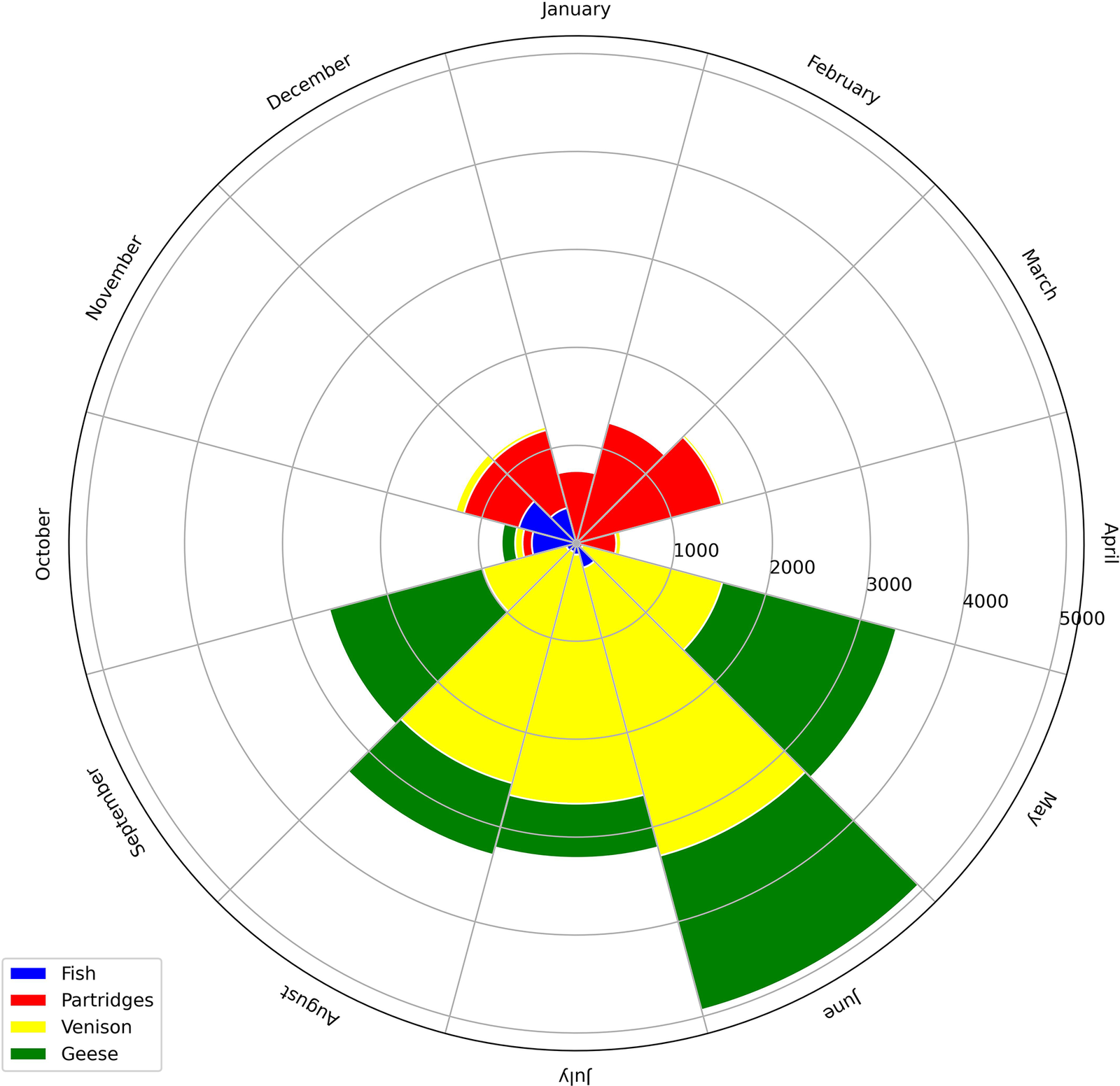
During these winter months, company servants depended on partridges for their survival. In November of 1791, Joseph Colen confessed to a fellow factor that “should partridges fail I shall be put to my shifts to supply nearly 70 men with provisions.”Footnote 54 The provision books kept for the fort from 1786 to 1798, the entirety of Colen’s time as factor, give his fear weight. In Figure 1, I reconstruct the monthly averages of the four major animals—venison (caribou), partridges, fish, and geese—received at the fort in sums greater than 100 lbs each month. As partridges and geese are recorded by number rather than by weight, I assume that one partridge yields 1 lb of edible meat and one goose yields 3.5 lbs of edible meat.Footnote 55 The round shows the seasonal migrations of caribou and geese, which were hunted between May and September. Between October and April, hunters almost exclusively brought in partridges to the fort. Thousands of these birds died to feed the fur trade.
Hunting round, monthly averages, York Fort: 1786–1798.
Sources: York Factory Provision Book: 1786–1787, B/239/d/90 & York Factory Provision Book: 1787–1791, B/239/d/92 & York Factory Provision Book: 1791–1795, B/239/d/104 & York Factory Provision Book: 1795–1801, B/239/d/122, HBCA.

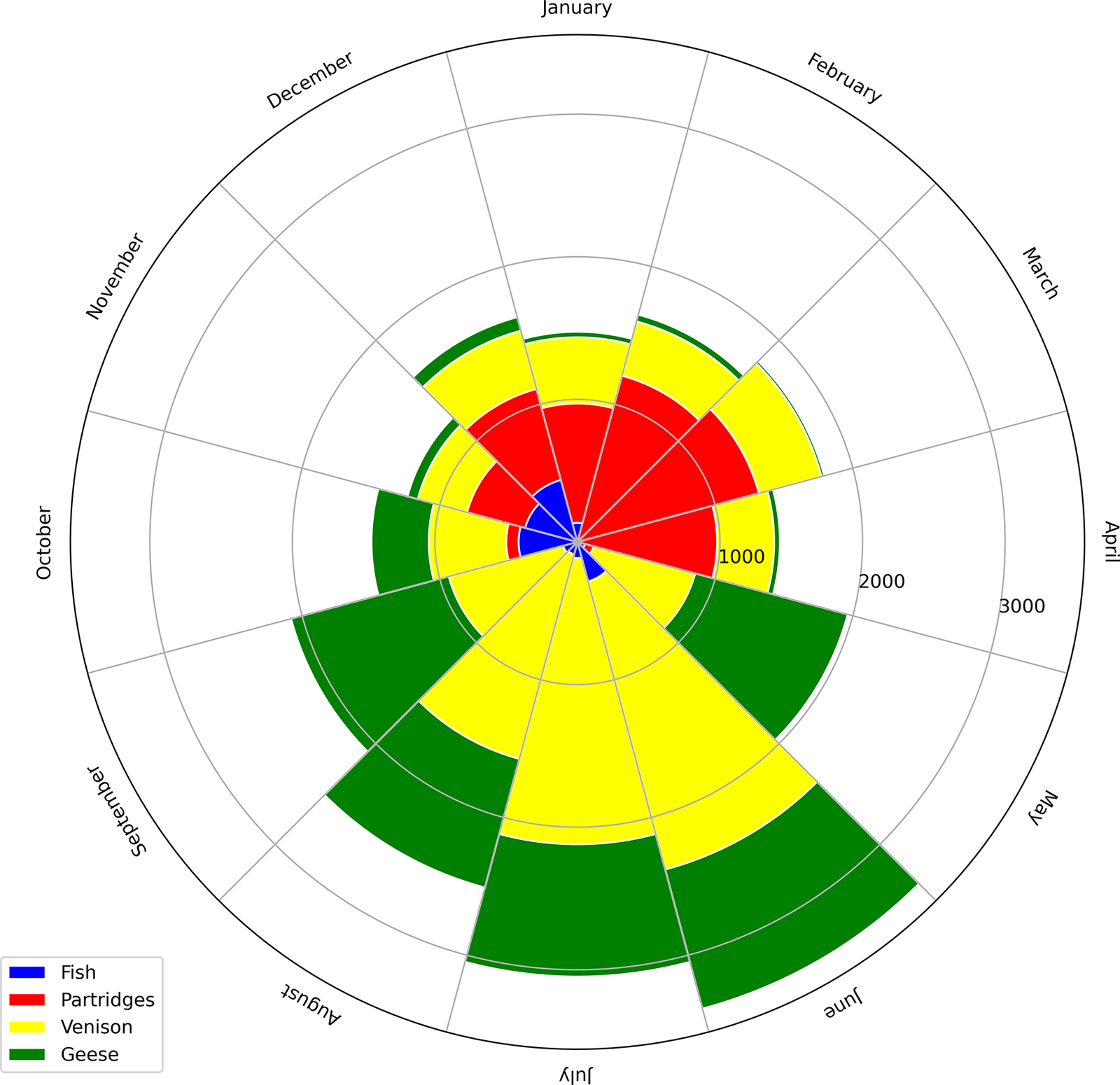
The rhythm of hunting at York Fort influenced the distribution of rations, which together justified Colen’s sense that a shortage of partridge threatened the lives of the men under his care. Generally, servants expected to be served out 3 lbs of meat per day if given partridges, venison, or geese; they expected more if they received fish.Footnote 56 Drawn from the fort’s provision books, Figure 2 is a pound-for-pound comparison of the distribution of the same four country provisions under Colen. In it, I show that company servants consumed both goose and partridge in season; they ate venison year-round. Further, I show in Figure 2 that servants regularly ate more partridge than venison during the winter, likely due to the nature of the meat. Venison consumed in these months was far more likely to be preserved, either salted or pickled. Partridge, by contrast, was served fresh (if typically from frozen). To meet servants’ expectations of at least three days of fresh meat per week, Colen depended almost entirely on partridges.Footnote 57 By the 1780s, it was no longer a “secondary” food source, like the rabbits snared around the fort.Footnote 58 Rather, in the long and lean winters, partridge was often the primary source of meat that servants consumed, and effectively irreplaceable.
Country provisions distributed, monthly averages, York Fort: 1786–1798.
Sources: York Factory Provision Book: 1786–1787, B/239/d/90 & York Factory Provision Book: 1787–1791, B/239/d/92 & York Factory Provision Book: 1791–1795, B/239/d/104 & York Factory Provision Book: 1795–1801, B/239/d/122, HBCA.

Need ensured that the demand for partridge at York Fort was essentially inelastic during this period. In March of 1790, Colen offered a brief explanation as to why when he tried to account for the rising consumption of brandy—“the life and soul of work”—at York Fort.Footnote 59 During the 1788–1789 trading year, York Fort expended 623.75 gallons of brandy, valued at 2495 mb. Footnote 60 In 1789–1790, however, that figure rose to 909.5 gallons, valued at 3638 mb—an approximately 46 percent increase.Footnote 61 While the “double allowance” of brandy that Colen provided to company servants engaged in “Labourious duties” accounted for a significant part of that increase, so too did the fort’s need for partridge. As Colen explained, “The Indian Hunters travel long distances in search of Partridges and as encouragement [I] am obliged to pay well for the Birds killed.”Footnote 62 While Colen never quantified what it meant to “pay well” for partridges shot far from the fort, the account books for York Fort confirm that brandy was regularly paid to those Maškēkowak hunters who pursued partridges, which Colen evidently felt obliged to increase on account of the distance travelled. Rather than limit consumption when prices rose, York Fort paid more for what few partridges could be found, where they could be found.
The HBC did have one way to reduce the costs of hunting partridges: nets. As early as the 1740s, company servants at Albany Fort, located south of York Fort on James Bay, had begun to use specifically designed nets to catch partridges. While some company servants credited Indigenous hunters for this invention, the London Committee was disappointed when a “pattern of the Partridge net contrived by Mr. Isbister” did not arrive in 1742, confident that it would save the HBC on its expenditures of partridge shot and gunpowder.Footnote 63 These nets, a square twenty-feet by twenty-feet, were most often used between January and April and hung above piles of gravel, which partridges ingest to help digest willow buds.Footnote 64 For proof of the effectiveness of netting, the London Committee only needed to consult the tallies of netted partridges kept at the start of Albany Fort’s post journals for 1742–1743 and 1743–1744.Footnote 65 But given the London Committee’s concerns about the “ill consequences of an entire dependence on the Natives” at the end of that decade, the HBC likely hoped that nets manned by company servants would also limit the ability of Indigenous hunters to collectively raise the prices of country provisions—what the committee somewhat obliquely referred to as the “Combinations of the Indian Hunters.”Footnote 66
By the 1760s, York Fort regularly used nets to hunt partridges. Totals extracted from the fort’s account books indicate that netting effectively helped to reduce the company’s use of partridge shot. Indeed, rather than a rise in the expenditure of this shot to meet the growing need for food at York Fort after 1774, Table 1 instead reveals a general decline between 1740 and 1790, one that starts just when the fort began to consistently document its use of nets. This correlation, however, requires qualification. There are a number of individual years in which York Fort recorded no expenditures of partridge shot but still received partridges. Rather than indicate that netting entirely replaced shooting in those years, the small number of partridges received outside the netting season instead reflects the fact that hunters sometimes used duck shot to hunt partridges, likely when that shot seemed to be had in excess.Footnote 67 Indeed, as factor Ferdinand Jacobs explained in 1763, expenditures of partridge shot at York Fort did not necessarily index the efficacy of nets. In January of that year, he excitedly endorsed netting, “by which method I hope to make a Great saving in Powder Shot and Flints & get as many Partridges as I shall want to expend this winter.” But in the very same entry, Jacobs reminded the London Committee that he still needed to “supply y Natives with Powder & Shott to Shoot Partridges for the Support of their Familys.”Footnote 68 Nets could not undo York Fort’s obligation to Maškēkowak families.
Average partridge shot expenditure (lbs)

Sources: York Factory Account Book: 1740–1741, B.239/d/31 to York Factory Account Book: 1789–1790, B.239/d/87, LAC.
Nor were nets always favoured by company servants, as factor Humphrey Marten reported in 1776. That winter, he complained that “some of our men abominate the nets.” After two company servants brought home just twelve netted partridges, Marten believed the men were simply “lazy,” as “the Indians I have that way do very well.”Footnote 69 When other hunters along the North River asked for shot and powder, he refused and insisted that if they were “industrious,” they should be able to catch partridges with nets.Footnote 70 Maškēkowak hunters provided support for his belief; they brought 160 netted partridges “from the North River where our men said none could be got” just a few days earlier.Footnote 71 Company servants certainly improved in their use of nets, as evidenced by later tallies recorded in post journals. Between February and March of 1778, for example, company servants netted 1,580 partridges while Maškēkowak hunters netted 1,100.Footnote 72 Yet as this tally and similar ones throughout the 1780s indicate, York Fort’s partridge hauls continued to rely heavily on Maškēkowak hunters, who proved to be at least as skilled as the company’s servants with respect to netting.Footnote 73
Maškēkowak hunters did not respond to the lower prices paid for netted partridges by limiting the amount supplied, despite an economic incentive to do so. In 1776, York Fort paid twice as much for these hunters to shoot partridges as it did to net them. “I pay the Indians four [made] beaver for every hundred birds the[y] bring to the Fort,” Marten wrote, “which if killed by the gun would cost three [mb] in powder, three in shott, one in flints & tobacco, and one in brandy.”Footnote 74 By 1786, the price of netted partridges had actually slipped. Three separate entries between February and April record that Maškēkowak hunters received brandy valued at either two mb or three mb for 100 netted partridges.Footnote 75 These hunters may have reacted to this price decline by driving a harder bargain when asked to travel further from the factory to shoot partridges, as reported by Colen just four years later. But the seemingly inelastic supply of partridges from Maškēkowak hunters likely stemmed from a larger conviction that hunting for the fort enabled Maškēkowak families to draw on it in times of need. Colen captured this reciprocal calculation in an unusually direct description of an otherwise typical encounter in 1797. “Three Indians came in to beg provision,” he wrote, “Engaged them to hunt for the factory.”Footnote 76 Maškēkowak hunters figured their payment for partridges in reciprocal terms. They looked beyond the moment of exchange—beyond the mb price.
The HBC wanted partridges to be cheap because it could not afford to go without them. These birds were York Fort’s sole source of reliable fresh meat during the long winter months. Nets, however, could only do so much to reduce the price of partridge, which hunters still shot in huge numbers. And nets arguably did less to reduce the fort’s dependence on Maškēkowak hunters, who brought food to the fort according to the principle of reciprocity and expected similar treatment in turn. Struggles over the cost of food were about who provided it and why.
Nutritional Value
Hunting alone did not determine what constituted an acceptable price for partridges. The process of rationing and the very act of eating partridges became opportunities to further weigh the cost of food and shape the distribution of power within the HBC’s provisioning system. The bodies of those who ate partridge served as evidence of its value, as well as the dangers of substituting preserved meats for partridges when hunters failed to kill enough birds to get the fort through the winter. Under Colen, company servants and officers at York Fort justified demands for partridges with recourse to its perceived nutritional benefits, a logic which frustrated attempts to reduce decisions around provisions to a search for the cheapest foods.
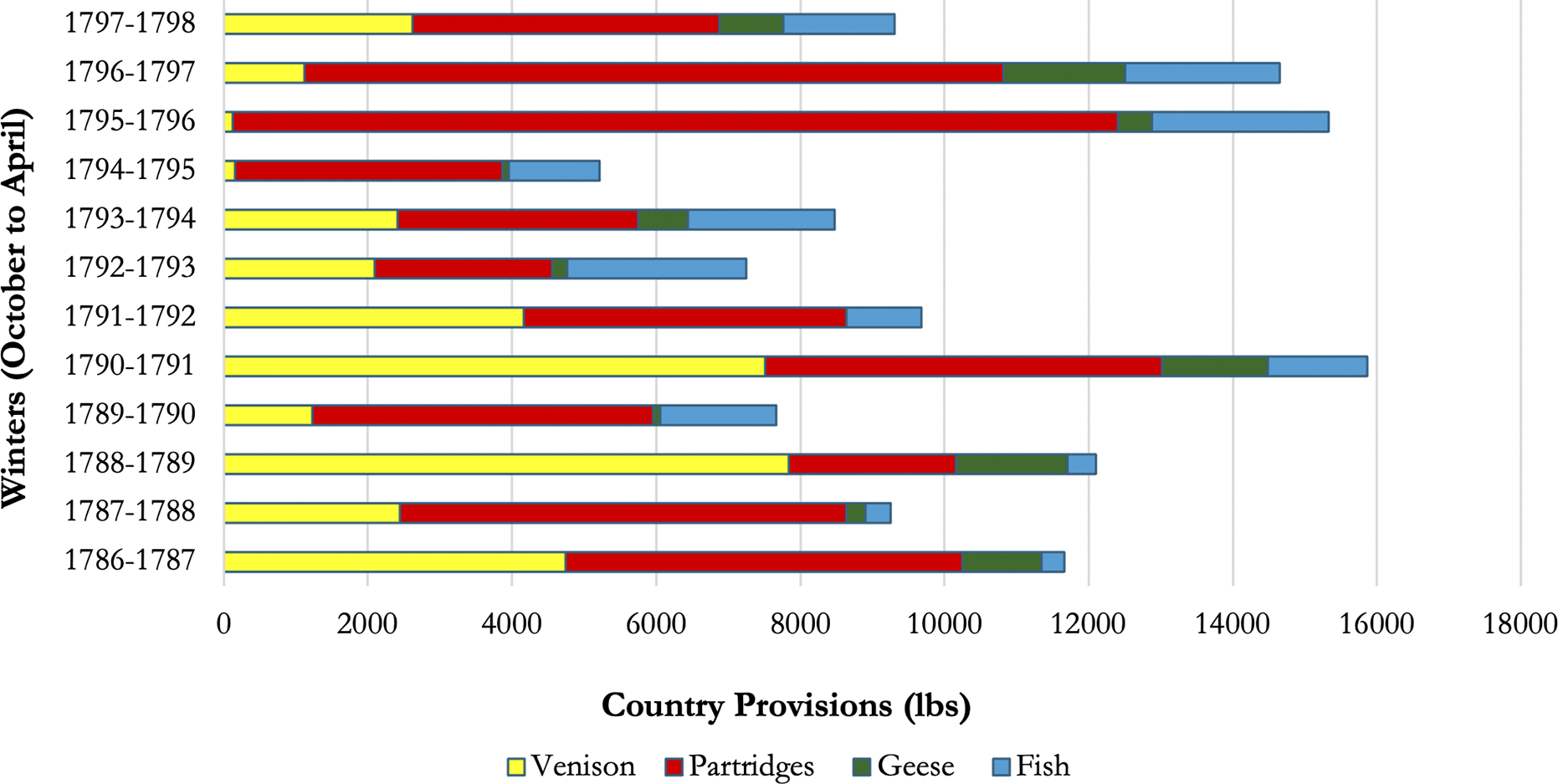
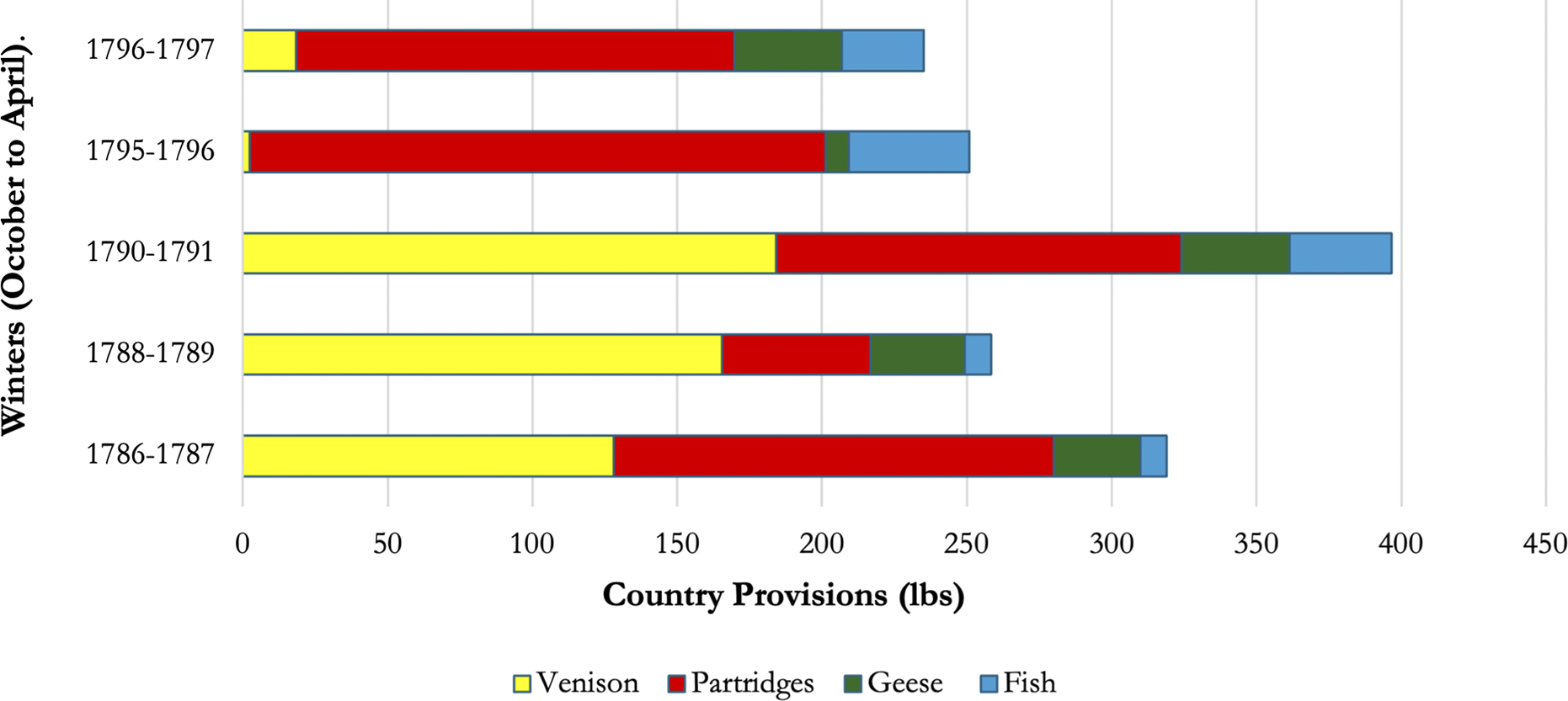
Factors around Hudson Bay regarded partridge hauls as a bellwether of short allowance. A “failed” hunt might lead factors to reduce men’s rations in hopes of stretching out the provisions stocked in the warehouse.Footnote 77 Yet the provision books for York Fort indicate that the composition of rations weighed on this decision too. In Figure 3, I provide the total weight of country provisions served out every winter between 1786 and 1798, when short allowance was most often instituted at York Fort. These country provision totals reveal a general trend: years where the fort served out less than 10,000 lbs of meat had a higher likelihood of short allowance. Put differently, short allowance was common at York Fort. An anomaly to this trend, 1788–1789, is similarly suggestive. That winter, York Fort distributed 12,103 lbs of country provisions, only to see Colen put his men on short allowance. To understand why, I take the five years where the distribution of country provisions totaled more than 10,000 lbs and divide those totals by the number of men provisioned at the fort to arrive at an average ratio of provisions per person. As shown in Figure 4, 1788–1789 is not unique for the quantity of meat a servant received; servants ate fewer country provisions in both 1795–1796 and 1796–1797. What is remarkable is the composition of those provisions. A servant received dramatically less partridge in 1788-1789—between one-third and one-fourth less than what they received in other years, over 10,000 lbs. As such, the decision to go on short allowance during the winter months depended not only on the quantity of meat consumed, but also on the quality, with particular attention paid to partridges.
Totals of major country provisions served out, York Factory: 1786–1798.
Sources: York Factory Provision Book: 1786–1787, B/239/d/90 & York Factory Provision Book: 1787–1791, B/239/d/92 & York Factory Provision Book: 1791–1795, B/239/d/104 & York Factory Provision Book: 1795–1801, B/239/d/122, HBCA.

Major country provisions served out at York Factory per servant in winters over 10,000 lbs: 1786–1798.
Sources: York Factory Provision Book: 1786–1787, B/239/d/90 & York Factory Provision Book: 1787–1791, B/239/d/92 & York Factory Provision Book: 1791–1795, B/239/d/104 & York Factory Provision Book: 1795–1801, B/239/d/122, HBCA. Importantly, the book for 1795–1796 does not record the number of servants provisioned. Based on the number of men at the factory in June, when the 41 inland servants arrived at York Factory, July, when 55 left, and August, when 58 servants remained, as many as 72 servants might have been at the factory in the winter. However, because 58 men were fed at the factory in the winter of 1794–1795 and 1796–1797, I have estimated 58 servants.

Efforts to replace partridge with other meats put the health of the fort’s workforce at risk. Colen attributed the poor partridge hauls of 1788–1789 to a series of dramatic weather events, beginning with the warm, wet summer of 1787 and culminating when the Hayes River burst its banks in May of 1788. Partridge flocks, he wrote, “were nearly the whole destroyed when the Island was overflown by the late Deluge,” a flood that required Colen to rebuild York Fort on higher ground.Footnote 78 By January of 1789, he recorded that the shortfalls of partridge had stopped him from serving out even three days of fresh meat, which led his men to eat more imported salt beef and venison, with disastrous results. “The living on salt Provisions so long has caused the Scurvy to break out among the poor men,” he concluded in early 1789.Footnote 79 With such an assessment, Colen framed scurvy as a product of putrefaction: the eighteenth-century theory that salted meat existed in a state of slow decay that might transfer to the body of the person who ate it.Footnote 80 Eager to get his men off this salt meat diet, Colen turned to Maškēkowak hunters for help. “A few Natives in since Xmas,” he wrote in January, “poor and wretched I sent them all to the Northward to kill Partridge so that I have hopes by our own exertions and the assistance of God to keep the malady from getting a head or proving fatal.”Footnote 81 Partridge might not cure scurvy, but they kept men from eating what Colen considered to be its cause.
In support of his contention that salt beef was behind the scurvy outbreak, Colen marshalled evidence beyond his account books. For their own part, company servants refused even beef that Colen judged to be good for fear that any of it might lead to scorbutic symptoms.Footnote 82 To convince the London Committee that bad beef, rather than poor management, led to scurvy and short allowance in 1788–1789, Colen also collected opinions from “Gentlemen,” including the fort’s surgeon, who called the beef “unwholesome and unfit for human Eating.”Footnote 83 In support of this judgment, Colen conducted a terrible human experiment. In April of 1789, he gave some of the suspected beef to a number of Maškēkowak hunters. “And what is very singularly extraordinary,” he later wrote, “several Indians that eat of the tainted salt beef which I gave them (several pieces) are afflicted to a violent degree with that disorder.”Footnote 84 The sick bodies of Maškēkowak men served as Colen’s defence to his superiors in London for both the state of York Fort’s workforce and its demand for partridge.
Maškēkowak families reacted with revulsion to Colen’s experiment, a transgression of the principles of reciprocity in food sharing. While the London Committee accepted that the “bad state” of salt beef was to blame for the disorder of 1788–1789, these families knew that York Fort was to blame for their suffering.Footnote 85 In June, Colen recounted how some Maškēkowak hunters refused to accept the fort’s salted beef, certain that it “contains poison.” Others simply threw the beef into the river. The breakdown in the fort’s relationship with these hunters only made it harder for Colen to get the fort’s servants off short allowance that summer. He even feared that it would affect the number of furs brought to the fort. As he confessed, “their bitter objections to English provisions cuts me to the Heart and I am apprehensive that our Trade will be greatly injured in consequence.”Footnote 86 To repair this breach, Colen reported that he dispensed more flour and oatmeal to Maškēkowak families than usual.Footnote 87 It was a worthwhile expense. As Colen explained, the three Maškēkowak hunters whom he convinced to provide for the fort brought in more fresh meat during the winter of 1789–1790 “than all the English Hunters together.”Footnote 88 So long as York Fort needed partridge, it needed Maškēkowak hunters.
After the 1788–1789 scurvy outbreak, company servants put further pressure on Colen to acquire partridges, no matter the cost. As part of an increasing tendency for collective labour action among company servants following the move inland, those aforementioned English hunters launched a series of protests in response to Colen’s rationing policies.Footnote 89 In March of 1790, English hunters first protested that they deserved a larger food allowance than servants from Orkney, off the coast of Scotland.Footnote 90 While Colen refused to meet their demand, he did not deny that rations were scant. Over seven months, fifteen men hunting, alongside those three Maškēkowak hunters, supplied just forty-six days of full allowance for fifty-six servants.Footnote 91 To end the protest, Colen not only agreed to limit his own rations. He also fired his cook, accused of “purloining” partridge for favourites. “Indeed a single Partridge at these times is of consequence,” Colen declared.Footnote 92 At least one member of the London Committee got the message, placing a manicula beside the entry.Footnote 93
A second labour action two years later raised the more pressing question of what counted as food at York Fort. In the midst of another shortage of partridge in January of 1792, Henry Gaines, a carpenter, and his fellow servants demanded “English provisions”—salted pork and beef—in lieu of salted venison. Evidently less concerned about scurvy induced by salt beef, Gaines’ work stoppage was likely in response to Colen’s decision to reopen Flamborough House as a depot to increase the production of salted venison.Footnote 94 But so too was it galvanized by a recent book, written by a former York Fort officer, Edward Umfreville. “They all seem to regulate their conduct by Umfreville’s publication which has been dispersed among them,” Colen admitted, “every one are determined to be unanimous on their refusal of salted Country provision in future.”Footnote 95 The publication in question, The Present State of Hudson’s Bay, attacked the HBC for its secrecy and exposed its provisioning practices. Stockpiles of salted geese and venison, Umfreville insisted, had all the nutritional value, or “nutriments,” of “the shavings in a carpenters’ shop.”Footnote 96 Colen, of course, disagreed. The venison was “wholesome,” he told the London Committee. What is more, servants had received far less of it that winter than in ones prior, a point Colen could back up thanks to the fort’s provision books.Footnote 97 Still, two labour actions in nearly as many years impressed upon him the dangers of an overreliance on salted meats, as did successive scurvy outbreaks that afflicted as many as thirty men.Footnote 98 Faced with deadly disorder, efforts to obtain fresh meat seemed increasingly worthwhile.
Concerns about the nutritional value of different kinds of meat impacted not only what York Fort ate but also its relationship to Maškēkowak hunters. As early as 1790, Colen doubted that the environs around the fort could support the increased need for food necessitated by inland expansion. Another fort, Severn, struggled to feed eighteen men when it had ten times as many partridges, Colen noted before he queried how he was supposed to feed fifty-seven.Footnote 99 By 1794, every man who could hunt partridges did just that. Hunting tents stretched as far east as Cape Tatnum, as far north as Sams Creek, and at a number of locations down the Hayes River.Footnote 100 Importantly, Colen also convinced more Maškēkowak hunters to provide for the fort than ever before. In 1797, he noted, “I have no less than twelve Indian Hunters engaged to kill Partridges besides 10 Englishmen at Tents yet with all their exertions can scarcely keep want at a distance.”Footnote 101 The dramatic increase in the number of Maškēkowak hunters supporting York Fort undercut efforts by the HBC to increase the self-sufficiency of its posts and, in the process, better control the costs of food. If York Fort could not afford to go without partridge, Colen reasoned, then it could afford whatever expenses their pursuit entailed.
The Costs of Want
Between York Fort’s growing reliance on Maškēkowak hunters and the rising costs of provisioning due to inland expansion, the 1790s saw the London Committee move to increase control over food. In 1793, it wrote to Colen to address reports of hunger at the inland settlements and put the blame on Maškēkowak hunters. These hunters, the committee insisted, wasted time “rambling about the Country” when they should be hunting for those inland settlements that “intirely [sic] depend on provisions from these Natives,” at least when it came to fresh meat.Footnote 102 While the committee expected Colen to compel these hunters to obey, it also did not want Maškēkowak hunters to draw too heavily on the provision stores of any of these same settlements. The following year, the committee reminded Colen that in order “to prevent the too great consumption of Provisions at the interior Settlement, the Masters there are not to harbour the Indians about them but dispatch them to their Hunting Grounds, as soon as possible.”Footnote 103 Reciprocity did not factor into the London Committee’s calculations. It wanted Maškēkowak hunters to provide as much fresh meat as possible for the inland settlements and take as little food as possible in return.
Experience led Colen to cast doubt on the London Committee’s plan. Those Maškēkowak men and boys who agreed to hunt for the HBC did not necessarily allow the company to dictate where and when they hunted. Some hunters, Colen knew, refused to kill partridges after the middle of April, “as the Birds are pairing and by the killing of one, many are destroyed.”Footnote 104 Others refused to restrict their hunting to particular forts, a practice the HBC tried to enforce by ensuring debts drawn at one fort could not be paid at another.Footnote 105 In one such instance, Maškēkowak families who drew debts on a more northern HBC fort—Churchill—refused to leave York. If Colen forced them to return, they threatened to “prevail on many of their Relations (with whom they would wish to remain) to accompany them to Canadian settlements.” Rather than see these families go over to the HBC’s competitors out of Montreal, Colen engaged many of them to hunt for his fort. “This I find necessary for the welfare of men at the Factory,” he wrote in 1794, “and having such a number of Indians around am obliged to find employment for them.”Footnote 106 Three years later, Colen again repeated his warning that the HBC should not expect to receive either food or furs if it did not feed hunters. “Indians have many sources to supply their Wants which they had not some years ago [and thus] their dependence is not on the Company’s warehouses only,” he wrote in 1797, “the Indians who have been long in habits of hunting near the factory have told me this in plain terms.”Footnote 107
Though Colen did not deny that a reliance on Maškēkowak hunters came at a cost, he sought to contextualize that fact within the HBC’s larger commercial strategy. In 1797, he informed the London Committee that hunters for York Fort brought in “small furs,” mostly from martens and foxes, valued at 600 mb. That figure could be twice as high, he believed, “had not our distress for provisions obliged me to take the Hunters from trapping. It is not only the loss of furs but the expense attending the hire of Indians to kill Partridges: – considerably more in my opinion than Provisions would have cost in England.”Footnote 108 Not only did Colen question whether country provisions were actually cheaper than alternatives from England, but he also pushed the HBC to consider opportunity costs. The more hunters were focused on food, the less they were focused on furs.
Despite Colen’s suggestion that greater revenues from furs could underwrite greater expenditures on food, the London Committee instead pursued a policy of retrenchment—what Colen called the “mistaken plan of economy.”Footnote 109 In 1796, the committee announced that it was “obliged to curtail considerably the Indent,” a preliminary budget of necessary goods and imported provisions put forward by York Fort. In future, what the HBC’s ships brought to York Fort was expected to last two years.Footnote 110 Colen feared that an accounting error had led the committee to dramatically underestimate York Fort’s needs in formulating this plan. The fort’s steward, he explained, penned a “fallacious account” of the quantity of remaining provisions in August of 1795. This account was recorded in both the general account book and provision book sent back to England, and gave the impression that the fort’s warehouse held 6 to 7 tons more goods than it did, leading to dramatic shortfalls. “Of many Articles there is not any in the factory,” he wrote in 1797, with shortages of oatmeal and other grains most acutely felt.Footnote 111 Tellingly, the committee also denied York Fort the twenty-five kegs of partridge shot requested by Colen. Rather than 1,400 lbs of shot, the fort received just eight kegs, or 448 lbs of shot. As a result, Colen expended a mere 573 lbs of partridge shot between 1797 and 1798, down nearly 75 percent from the prior trading year.Footnote 112
Colen tried to keep York Fort’s state of want from Maškēkowak hunters. “I am fearful our poverty will get wind,” he confessed, especially as other forts appeared to be far better supplied.Footnote 113 In January, two Maškēkowak men asked how it was that Colen had no oatmeal when Churchill Fort had “luxuries” like figs, prunes, and raisins. Colen was incensed. Allegedly, Churchill’s factor boasted that the HBC supplied him well, “and that no Indian would know want who visited Churchill, which is not the case at York,” where these Maškēkowak men alleged that company servants ate worse than Churchill’s dogs. Conscious that his fort could not make the same promise of reciprocity and eager to reduce any advantage that Maškēkowak hunters might gain from competition between the two forts, Colen put up a front of indifference. When he learned of a partridge roost between York and Churchill, he engaged Maškēkowak hunters to go there. Yet “to prevent their taking advantage of our present situation, and to convince them my dependence did not rest entirely on them,” Colen permitted those hunters to take the partridges to either fort.Footnote 114
The London Committee took the issues at York Fort as a sign that its provisioning strategy needed to change. It looked at Colen’s management of the fort’s warehouses and claims of accounting errors with increasing suspicion. “How are we to come at the real Facts of the Matter?” the committee asked.Footnote 115 In 1796, it appointed an inspector to investigate the fort’s stores and books, a task which prefigured the appointment of accountants as part of the administrative reforms instituted by the HBC nearly two decades later.Footnote 116 Ironically, the food scarcity at York Fort so concerned the inspector that he decamped for Churchill.Footnote 117 Yet his absence did not prevent the committee from charging that the fort’s relationship to Maškēkowak families was part of the problem. “The chief Cause of the Scarcity of Provisions last year evidently arose from the great Number of Indians harbour’d at the Factory,” it concluded in 1798. Provisioning these families, the committee alleged, formed part of Colen’s attempt to increase the trade in food and furs at York Fort, which was carried out at “so great a Disadvantage” to the HBC.Footnote 118 That Churchill appeared able to increase the productivity of Maškēkowak hunters without such expenses made appeals to the principle of reciprocity look like little more than an excuse for mismanagement.Footnote 119 In March of 1798, the committee recalled Colen, ending his tenure as factor at York Fort.
By the turn of the century, the London Committee determined that the HBC could not rely on either partridges or Maškēkowak hunters as it had under Colen. “The Home guard Indians have of late been a Burden to the Factory continuing there in a State of Idleness serving only to consume Provisions and remained in a continual state of intoxication,” the committee wrote in its official instructions of Colen’s successor in 1799. “Formerly they used to supply the Factory with Partridges Geese and Ducks but lately have been of little or no use whatever.”Footnote 120 As such, the HBC entered the nineteenth century in search of a new food source fit to feed the expanding fur trade, one whose pursuit disciplined rather than empowered Maškēkowak hunters. At the same time that the HBC overhauled its accounting system to better manage the move inland, it pursued a range of other animals, including those herds of buffalo that produced a proverbial “pemmican empire” in North America and the inland fisheries, which the HBC explicitly established “for the purpose of fishing all winter owing to the scarcity of provisions at York Factory.”Footnote 121 Although the fort continued to eat huge amounts of partridge well into the nineteenth century, the success of the HBC’s operations no longer hinged on this bird or the exchange relations that determined what it cost.
Conclusion
Partridges mattered at a crucial moment in the HBC’s history for more reasons than their cost. As the sole source of fresh meat available at York Fort during the lean winters, these birds were valued as an essential part of a nutritious diet, one which reduced the fort’s dependence on salted provisions, be they imported from Europe or produced in Hudson Bay. Faced with virtually no alternative and an increasing demand for food driven by the company’s move inland after 1774, Joseph Colen and his predecessors pursued this bird even when it was expensive. The company relied on partridges to keep its servants both healthy and orderly—to discipline labour to the demands of capital. A more serviceable bird, as Andrew Graham dubbed it, was hard to find.
Yet dependence on partridge became a problem for the HBC when it led to a dependence on Maškēkowak hunters. Even as the company accounted for partridges in mb, the principle of reciprocity structured the relationship between York Fort and these hunters. The HBC hoped that netting partridges would not simply save them shot and gunpowder, but also increase York Fort’s self-sufficiency and, in the process, limit its obligation to provide for Maškēkowak families. Colen’s tenure effectively undercut those aims. The committee’s objection to the cost of partridges in the 1780s and 1790s was born from their frustration with the productivity of Maškēkowak hunters, whose commitment to reciprocal food exchanges clashed with the company’s plan of economy.
The shifting place of partridge in the HBC’s provisioning system was just one instance in the drive to account for food during the eighteenth century. No quantitative practice arises due to technical utility alone, and, in this sense, the HBC’s provision books are no exception.Footnote 122 They were tools of control in contests over the quantity and composition of rations, with distinct social consequences. Accounting reforms centered on partridge and other foods fueled conflicts among the London Committee, Maškēkowak families, and company servants, who held to an embodied knowledge around diet that resisted efforts to reduce decisions about provisions to mb price.Footnote 123 Rather than achieving objectivity, quantification highlighted just how subjective fights over food were in the political economy of the fur trade.
The price of partridge neither fully captured nor predicted how the politics around provisioning in the HBC took shape during the eighteenth century. Decisions about what to eat and how to hunt were always the product of power struggles in which cost was simply one variable under consideration.Footnote 124 Well into the nineteenth century, control was the measure used to determine the value of food.
Acknowledgment
He would like to thank Scott Berthelette, Ann M. Carlos, Amitava Chowdhury, Keith Pluymers, Jeffrey L. McNairn, and Melanie Ng, as well as the anonymous readers and editorial team at Enterprise & Society, for all their comments and criticisms on this article. Earlier versions of this paper were workshopped at the McNeil Center for Early American Studies, the Wilson Institute for Canadian History, and Queen’s University’s Global History Initiative. Finally, a special thanks is owed to David Zhou for his assistance with the figures.


 Open access

