

Introduction
In 2022, the Russian war on Ukraine and its consequences dominated German politics, which prompted the governing traffic light coalition of the Social Democratic Party/Sozialdemokratische Partei (SPD), the Alliance 90/Greens/Bündnis 90/Die Grünen and the Free Democratic Party/Freie Demokratische Partei (FDP) led by Chancellor Olaf Scholz (SPD) to call a new era/Zeitenwende in German foreign and security policy. The chancellor had vowed to increase military spending while condemning the war as inhumane, contrary to international law, and unjustified (Bundesregierung 2022). Throughout the year, however, the government was criticized, both domestically and internationally, for its hesitation and restraint in support of Ukraine with military equipment. As a result of the war and the dependence on Russian gas, Germany—as most other European countries—saw a significant increase in energy costs that drove up consumer prices in 2022. Combating these rising energy prices and inflationary pressures kept the governing coalition on its toes, while the COVID-19 pandemic had been taking more of a backseat in German political debates. A so-called “Double Whammy” for affordable energy was introduced comprising a gas price cap and 200 billion euros support package.
The election year 2022 saw the German presidential election, in which the incumbent President, Frank-Walter Steinmeier, was re-elected by the Federal Assembly/Bundesversammlung, and four regional elections in Saarland, Schleswig-Holstein, North Rhine-Westphalia, and Lower Saxony.
Election report
Presidential election
On 13 February 2022, the Federal Assembly/Bundesversammlung re-elected Frank-Walter Steinmeier in the first round with 72.7 per cent of the votes, securing a total of 1045 votes. The Federal Assembly consists of all members of the Bundestag and an equal number of members who are appointed by the Länder parliaments. These include members of the state parliaments and public figures. At the turn of 2021/2022, the FDP, the Greens and the Christian Democratic Union/Christlich Demokratische Union (CDU) and the Christian Social Union/Christlich Soziale Union (CSU) confirmed their intention to support Steinmeier's re-election. Consequently, the sister parties CDU and CSU refrained from nominating their own candidate. The Alternative for Germany/Alternative für Deutschland (AfD) nominated Max Otte, who was still a CDU member at the time of the presidential election. Max Otte secured 9.7 per cent of the votes, receiving a total of 140 votes. The Left/Die Linke nominated the independent candidate Gerhard Trabert, who garnered 6.7 per cent of the votes with a total of 96 votes. The Free Voters/Freie Wähler nominated Stefanie Gebauer, who obtained 4 per cent of the votes, amounting to 58 votes (Bundestag 2022a, 2022b).
Regional elections
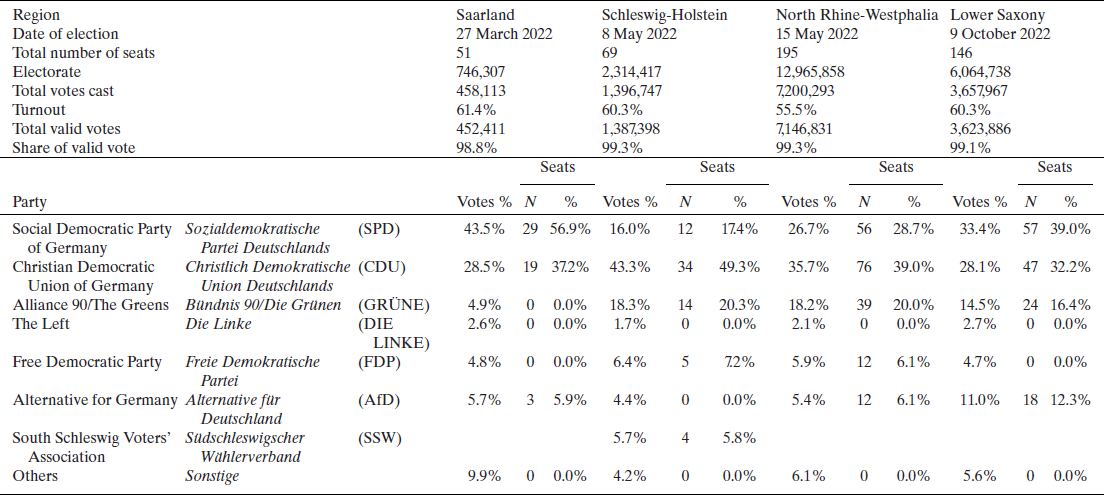
Land elections were held in Saarland (in March), Schleswig-Holstein (in May), North Rhine-Westphalia (in May), and Lower Saxony (in October) (Table 1).
Results of regional (Saarland, Schleswig-Holstein, Nordrhein-Westfalen, and Niedersachsen) elections in Germany in 2022

In Saarland, the SPD emerged victorious from the election on 27 March, winning the absolute majority in the state Parliament with 43.5 per cent of the vote (+13.9 percentage points), and has since governed the Saarland without a coalition partner. The CDU suffered a heavy electoral defeat, with a loss of 12.2 percentage points, achieving only 28.5 per cent of the vote. Oskar Lafontaine, the then parliamentary party leader of the Left Party in Saarland, withdrew from the party before the election (see Political Party Report section), resulting in a significant loss of votes for the Left Party (−10.3 percentage points) to 2.6 per cent. Additionally, the Greens narrowly failed to overcome the 5 per cent threshold, with the party being only 23 votes short of entering the state Parliament. Voter turnout fell by 8.3 percentage points to 61.4 per cent, compared to the previous Land election in 2017. On 25 April, the newly constituted state Parliament elected Anke Rehlinger (SPD) as the new state Prime Minister (Forschungsgruppe Wahlen 2022a).
The Land election in Schleswig-Holstein was held on 8 May. The CDU emerged as the clear winner, with 43.4 per cent of the vote and a gain of 11.4 percentage points. The party missed the majority by only one seat. The SPD, on the other hand, suffered a heavy blow, losing 11.3 percentage points. With 16 per cent of the vote, it achieved its worst-ever result in the state. The Greens became the second strongest party with 18.3 per cent of the vote and achieved their best result in Schleswig-Holstein. With 4.4 per cent of the vote (−1.5 percentage points), the AfD failed to pass the 5 per cent threshold and will therefore not be represented in the state Parliament. Despite heavy losses, the FDP managed to re-enter the state Parliament with 6.4 per cent of the vote (−5.1 percentage points). After six weeks of negotiations, the CDU and Greens renewed the governing coalition without the FDP, and the state Parliament re-elected Daniel Günther as state Prime Minister (Forschungsgruppe Wahlen 2022b).
On 15 May, a new state Parliament was elected in North Rhine-Westphalia. Even though a close race had been predicted between CDU and SPD, the CDU surprisingly emerged as the clear winner, with 35.7 per cent of the vote (+2.8 percentage points), while the SPD received 26.7 per cent of the vote and lost 4.6 percentage points. The former junior coalition partner, the FDP, lost a significant 6.7 percentage points and received only 5.9 per cent of the vote. The Greens increased their vote share by almost 12 percentage points, gaining 18.2 per cent of the vote. Compared to the previous Land election in 2017, turnout fell by almost 10 percentage points to 55.5 per cent. A coalition of CDU and Greens replaced the previous one of CDU and FDP. On 28 June, the state Parliament re-elected Hendrik Wüst as state Prime Minister (Forschungsgruppe Wahlen 2022c).
The Land election in Lower Saxony took place on 9 October. Both the SPD and the CDU suffered electoral losses: The SPD lost 3.5 percentage points and received 33.4 per cent of the vote, while the CDU lost 5.5 percentage points and received 28.1 per cent of the vote. The CDU scored its worst result in a Land election in Lower Saxony since 1955. The Greens gained 5.8 percentage points and received 14.5 per cent of the vote. The election was also a success for the AfD, which gained 4.8 percentage points to achieve 11 per cent of the vote. Thus, the AfD almost doubled its previous election result. For the FDP, the election was disappointing, as they lost almost three percentage points and missed re-entering the state Parliament with 4.7 per cent of the vote. For the first time since 1998, the FDP is not represented in the state Parliament of Lower Saxony. The previous coalition of SPD and CDU was replaced by a coalition of SPD and Greens. State Prime Minister Stephan Weil (SPD) was re-elected. (Forschungsgruppe Wahlen 2022d).
Cabinet report
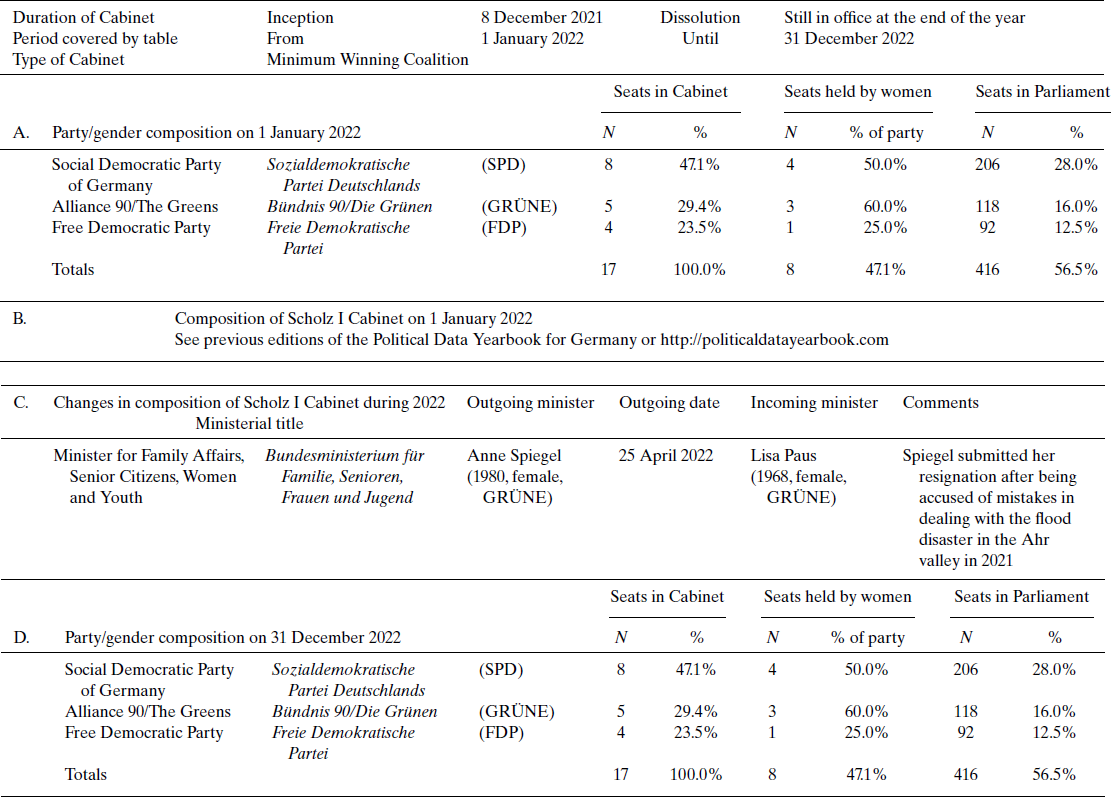
Table 2 shows the composition of the Scholz I Cabinet.
Cabinet composition of Scholz I in Germany 2022

Sources: Angenendt and Kinski (Reference Angenendt and Kinski2022); Bundestag (2022c).
In April, Anne Spiegel (Greens) resigned as Minister of Family Affairs after accusations that she had neglected her official duties during her time as Environment Minister of Rhineland-Palatinate. Spiegel had gone on holiday shortly after the devastating floods that hit her state in 2021 (Angenendt & Kinski Reference Angenendt and Kinski2022). Lisa Paus (Greens) was appointed as her successor (Bundestag 2022c).
Parliament report
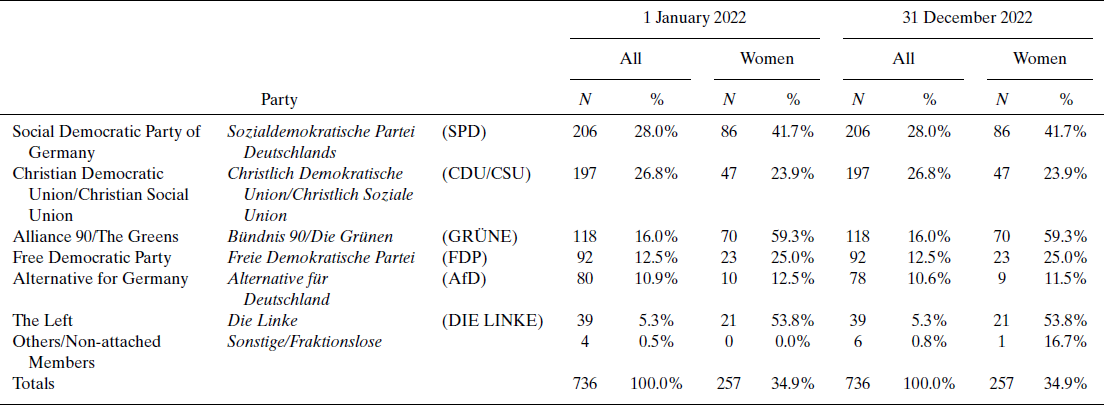
Table 3 shows the party and gender composition of the German Bundestag.

There have not been significant changes during the year. Former Justice and Foreign Minister Heiko Maas (SPD) announced in December that he would resign from Parliament at the turn of the year. His successor was Emily Vontz, chair of the party youth organisation in Saarland, but she did not begin her mandate until 1 January 2023 and is, therefore, not yet listed as a female member of Parliament for the SPD (Bundestag 2022d).
After the 2021 election, the AfD would have had a parliamentary group size of 83 deputies, but Matthias Helferich never joined the party group. On 31 December 2021, Bundestag members Uwe Witt and Johannes Huber left the AfD parliamentary party group, resulting in a parliamentary group size of 80 deputies as of 1 January 2022. By the end of the year 2022, two more deputies left the parliamentary party group due to resignations, Robert Farle (on 8 September 2022) (Tagesschau 2022) and Joana Cotar (on 21 November 2022) (ZDF 2022).
Political party report
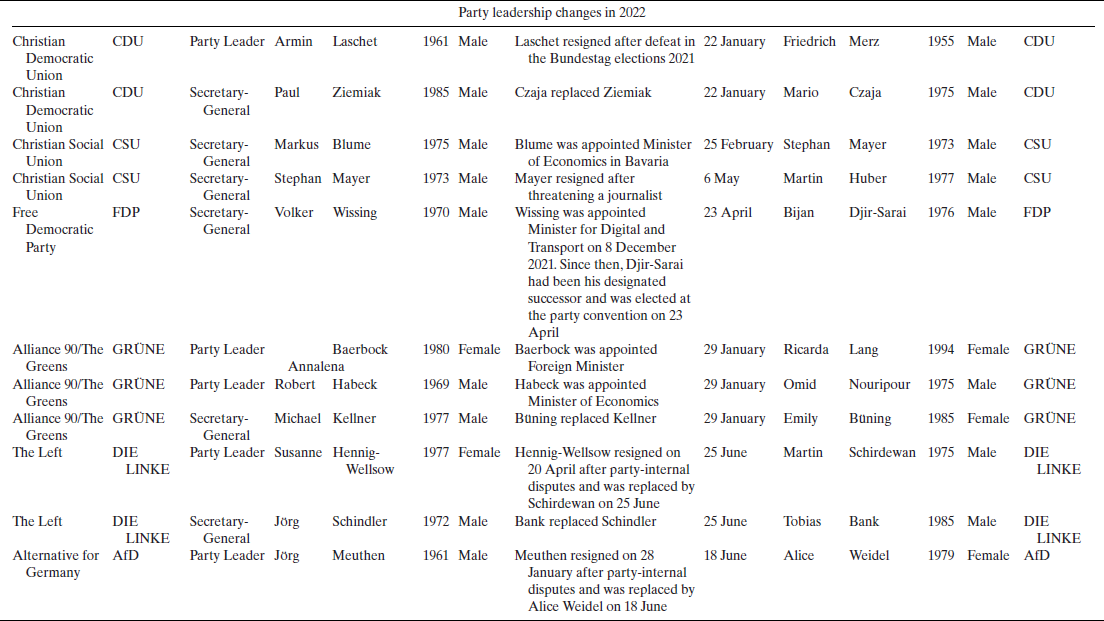
On 22 January, Friedrich Merz was elected as the new party chair at the CDU's digital party conference. Mario Czaja became the new secretary general (CDU 2022). In February, Stephan Mayer became the new secretary general of the CSU (CSU 2022a). He resigned after only 10 weeks in office, citing health reasons. However, he had previously received heavy public criticism for allegedly threatening a journalist by telephone. At the beginning of May, Martin Huber was elected as the new secretary general of the CSU (CSU 2022b).
In January, Jörg Meuthen resigned as co-chair of the AfD and left the party. At the AfD party conference in Riesa in June, Tino Chrupalla was re-elected as party chair and Alice Weidel became second chair (AfD 2022).
At the FDP party conference in April, Bijan Djir-Sarai was elected as the new general secretary (FDP 2022).
On January 29, Ricarda Lang and Omid Nouripour were elected as the new party chairs at the digital party conference of the Greens; Emily Büning became the new secretary general (Bündnis 90/Die Grünen 2022).
In March, Oskar Lafontaine resigned from the Left Party shortly before the Saarland Land elections. He was one of the party's co-founders in the mid-2000s and had shaped politics in Saarland over a long period. The co-chair of the Left Party, Susanne Hennig-Wellsow, also announced her resignation in April. In June, the Left Party elected Martin Schirdewan and Janine Wissler as new party chairs at its party conference in Erfurt. Tobias Bank became the new secretary general (Die Linke 2022).
Changes in political parties are summarized in Table 4.

Institutional change report
There was no major institutional change in 2022.
Issues in national politics
Germany experienced significant inflationary pressures due to the Russian invasion of Ukraine. The 2022 inflation rate was reported at 7.9 per cent (Statistisches Bundesamt 2023).Footnote 1 The significant increase in energy and fuel prices, in particular, shaped the public debate throughout the year. The German government attempted to mitigate the rise in energy prices through state subsidies and eventually announced a gas price cap and a support package amounting to 200 billion euros. These measures were approved by the Bundestag and Bundesrat in mid-December.
On 27 February, Chancellor Olaf Scholz announced a new era in German foreign and security policy. In his government declaration, he announced a one-off special fund of 100 billion euros for the German armed forces/Bundeswehr and an increase in annual defence spending. In June, the Bundestag and the Bundesrat (upper house of Parliament) passed the special fund for the Bundeswehr.
The German government made a political U-turn in April and announced the delivery of heavy weapons to Ukraine. At the end of April, after heated debates between the government and the opposition, the Bundestag voted by a large majority in favor of the delivery of heavy weapons. The discussions on which types of arms (not) to deliver significantly shaped public debate in Germany in 2022. While the Left Party and the AfD rejected arms deliveries, the CDU/CSU accused the federal government of hesitating.
In mid-April, Ukraine rejected a planned trip by Federal President Frank-Walter Steinmeier to Kiev, which irritated the German government. Steinmeier and Ukrainian President Zelensky resolved this irritation in a telephone conversation at the beginning of May. Ultimately, an invitation from Ukraine to the Federal President followed, and in October, Steinmeier traveled to Kiev.
The Federal Constitutional Court/Bundesverfassungsgericht ruled in mid-June that Angela Merkel (CDU) had violated the rights of the AfD during her time as chancellor by making statements on the election of the Thuringian Prime Minister in 2020 (Kinski Reference Kinski2021). Following a ruling by the Cologne Administrative Court in March, the Federal Office for the Protection of the Constitution/Bundesverfassungsschutz is allowed to classify the entire AfD as suspected right-wing extremist.
At the beginning of July, the Bundestag passed a legislative package stipulating that 80 per cent of electricity must come from renewable energy sources by 2030.
In the coalition dispute over the extension of the operation of German nuclear power plants, Chancellor Scholz took a firm stance in mid-October. This was preceded by a dispute between the coalition partners FDP and the Greens. The FDP wanted to keep the last three German nuclear power plants in operation until 2024. The Greens were against the requested extensions but were willing to compromise and allow two of the power plants to continue running until April 2023. The chancellor finally decided that all three power plants should continue to run until 15 April 2023. In mid-November, the continued operation was approved by the Bundestag.
On 16 November, the Berlin Constitutional Court declared the election for the Berlin House of Representatives and the district parliaments of 26 September 2021 invalid and ruled that they must be repeated due to numerous irregularities in polling stations (Angenendt & Kinski Reference Angenendt and Kinski2022). The Bundestag also decided to repeat the federal election in some electoral districts in Berlin, which had taken place on the same day. The CDU/CSU and the AfD demanded a repeat in more districts, and on 16 December 2022, the decision was challenged before the Bundesverfassungsgericht/Federal Constitutional Court (RBB 2022).
In December, law enforcement conducted a raid against a suspected militant network known as the Reichsbürger and apprehended 25 individuals. The network is believed to have intended to carry out a violent coup and currently has over 50 suspects, among them a former member of the Bundestag from the AfD.
Acknowledgments
The authors thank Nico Bodden, Benjamin Hoss, and Aaron Schlütter for their valuable support with the data collection.
Open access funding enabled and organized by Projekt DEAL.

 Open access

