This volume is devoted to one of the most important periods in Chinese history: the Song dynasty (960–1279). This introduction provides an overview of the era, the sources for studying it, and the structure and organization of this anthology. It is followed by Patricia Ebrey’s reflections on Western scholarship on the Song over the last century. The heart of the book is the twenty chapters that provide multiple perspectives on Song institutions, ideas and practices, people and places, and daily life and material culture.
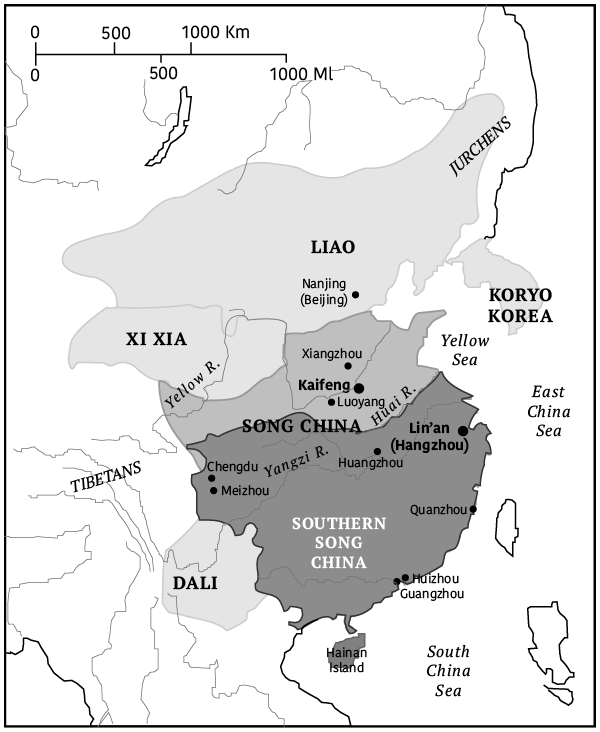
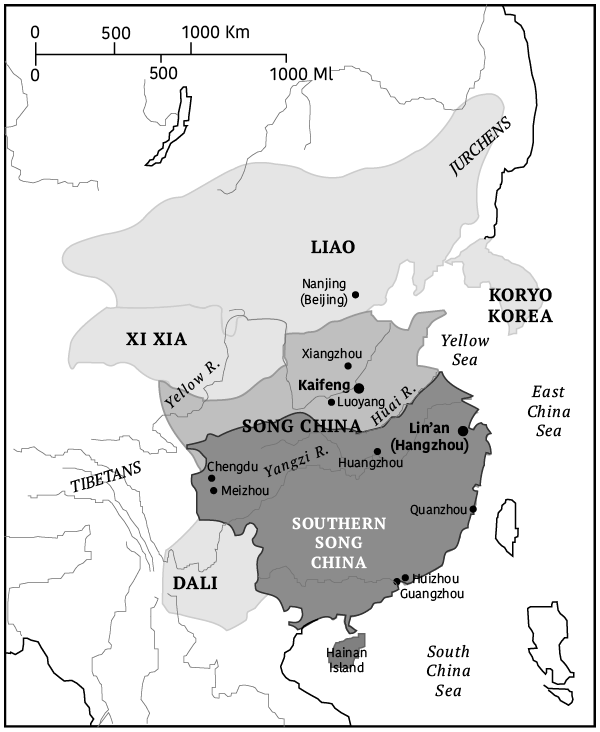
The Song dynasty was founded in 960 by Zhao Kuangyin (posthumous title Taizu, 927–976, r. 960–976) and his younger brother, Zhao Guangyi (posthumous title Taizong, 939–997, r. 976–997), and ended when the Mongols conquered the entire Chinese realm in 1279 and deposed the last of their descendants to occupy the throne. The eighteen Song emperors lived in palace complexes located in two capitals, first Kaifeng (in Henan) in north central China, then, after much of north China was lost to the Jurchen Jin (1115–1234), in Lin’an (Hangzhou, Zhejiang) in southeast China. Based on the locations of the two capital cities, modern scholars have conventionally divided the Song into two periods: Northern Song (960–1127) and Southern Song (1127–1279).
Fundamental changes are a central part of the story of the Song. According to the widely accepted Tang–Song transition thesis, the four centuries from the mid-Tang (618–907) to the mid-Song witnessed major demographic, economic, and institutional changes. The population doubled, the use of money increased, and more people lived in cities. The great families of the Tang and earlier were replaced by a new elite whose fortunes were tied to examination success and officeholding. Many trends evident during the Song continued into the Yuan (1271–1368), Ming (1368–1644), and Qing (1644–1911) periods, such as the shift toward the economic and cultural dominance of the south and the growing influence of local elite families.
Many aspects of Song life would have appeared familiar to people living in earlier and later times. Monarchy was understood in similar ways. Since ancient times, Chinese political and cosmological thinking designated the emperor the Son of Heaven (tianzi) who ruled “All under Heaven” (tianxia) from the center of the world. There was thus a religious side to rulership, seen also in the emperor’s regular sacrifices to Heaven (tian), Earth (di), and many nature gods and spirits. Like earlier and later emperors, Song emperors handled routine governance of the country through an Outer and an Inner Court. His highest civil officials managed the Outer Court, which directed tens of thousands of civil and military officials. The Inner Court consisted of the emperor’s closest female relatives: empress dowagers, empresses, and dozens of consort women, as well as hundreds of other palace women and eunuchs (castrated men) who tended to the needs of the imperial family. In addition, these palace attendants copied documents and managed communication with the outer court. Eunuchs also safeguarded the palace complex and performed duties outside the palace such as collecting information and leading troops.
The Song government was fundamentally bureaucratic. A group of grand councilors and other high-ranking officials would meet regularly with the emperor to discuss policies and draft decisions regarding important civil and military matters. These decisions would then be promulgated in the form of imperial edicts, pronouncements, or statutes for implementation by relevant offices and local governments. The regional administration had about 200 prefectures (zhou or fu) and over 1,000 counties (xian), each headed by a centrally appointed official in charge of the administrative, fiscal, and judicial matters of his jurisdiction. The prefect and county magistrate’s main responsibilities ranged from collecting taxes and adjudicating lawsuits to managing disaster relief and maintaining local order. The court appointed a few lower-ranked officials to assist each prefect and county magistrate, but much of the work was done by larger numbers of clerks and runners who were recruited locally. Some of these clerks and runners received salaries; others were there to fulfill a variety of labor service obligations. Both the regular officials and the local subordinates worked closely with rich and influential local families to keep order in their community.
Ordinary people in the Song lived lives not all that different from their counterparts in earlier and later times. Most were farmers, owning or renting the land they cultivated, and lived in small villages. They would visit markets to sell surplus produce or handmade goods in exchange for daily necessities such as salt, tools, cookware, and sewing needles. A much smaller portion of the Song population lived in cities and towns, where more consumer goods, as well as restaurants, hostels, and many forms of entertainment, were available. Like other premodern societies, the gap between the rich and the poor was large in both the countryside and the cities.
The most basic social and economic unit in the Song was the patrilineal family. A typical household consisted of a married couple with their unmarried children and one or both of the husband’s parents. Universal marriage was taken for granted. The value placed on continuing the sacrifices to patrilineal ancestors meant that families arranged brides to bring home for their sons and eagerly awaited the birth of grandsons. Nevertheless, given high infant and child mortality rates, families could find themselves without an heir, so adoption, concubinage, and other less desired alternatives were also widely practiced. Sons and daughters-in-law were expected to express filial devotion to parents by caring for their physical well-being, showing respect and deference, and observing proper mourning and ancestral rituals upon their deaths. When two or more sons survived into adulthood, the property would eventually be divided equally among them. Family disputes could occur, especially over property, which is one reason why the state, community leaders, and family heads kept extolling family virtues and domestic harmony.
The majority of the Song people, like their counterparts in other premodern societies, had to work hard to maintain even modest living conditions. People died at all ages, with pregnancy and childbirth major causes of death for younger women. The monotony of daily life was broken by both regularly scheduled community festivals and family events such as births, weddings, and funerals. Festivals occurred throughout the year, the most important being the Lunar New Year, the Qingming and Cold Food Festivals, the Double Fifth, the Ghost Festival, the Mid-Autumn Festival, the Double Ninth, and the Winter Solstice. Some of these celebrations marked the change of seasons, while others promoted family solidarity or commemorated historical figures. Storytelling and theater performances were staples at the marketplace. Temples and shrines drew both men and women, with Buddhist monasteries attracting the largest following. In the Song and late imperial times, Buddhist monks and nuns, Daoist masters, and leaders of local or regional cults were a ubiquitous presence in towns and villages, offering villagers and townsmen a variety of services, such as death rituals, exorcisms, and divination.
Just as important as these continuities with earlier and later periods are the things that make the Song period stand out. Civilian control of the military is one of the most striking features of the dynasty. Zhao Kuangyin and his younger brother, Zhao Guangyi, grew up in an age of political fragmentation and constant war. Known as the Period of Five Dynasties and Ten Kingdoms (907–960), five successive states in north China lasted on average only a decade; they were ruled by over a dozen emperors with eight different surnames. The Zhao brothers, like the Latter Zhou (951–960) emperors whom they served, were military men. When Zhao Kuangyin was declared emperor by his supporters in 960, it was widely feared that the Song might prove as short as the dynasties before it. If Zhao Kuangyin and Zhao Guangyi, aged thirty-four and twenty-two respectively, wanted the Song to outlive them, they had to find a way to break the pattern of chronic political instability.
The Song founders succeeded in this goal. In the two decades following the dynasty’s establishment, the Zhao brothers conquered the ten southern kingdoms, unifying China for the first time in a century. The Song went on to become one of the longest-lasting dynasties in Chinese history, with a remarkable record of peaceful exercise of power. Violence at court was rare. Altogether, nine empress dowagers served as regents to young emperors, but none of them or their families dominated politics in ways that caused political crises like those in earlier and later eras. Similarly, eunuchs in the Song were at least as deeply involved in administrative and military affairs as eunuchs in other periods, yet they did not wreak havoc on the scale of their powerful Han (202 BCE–220 CE), Tang, and Ming counterparts. The Song certainly experienced its fair share of banditry and regional unrest but remained the only major dynasty in Chinese history that was not brought down by an empire-wide rebellion.
Political stability coincided with economic and technological developments, especially in industries such as printing, shipbuilding, and iron and ceramics manufacture. Domestic and international trade flourished. Chinese and foreign goods changed hands in large volumes at border markets, as well as port cities like Quanzhou (in Fujian; see Map 0.1) and Guangzhou (in Guangdong, better known as Canton; see Map 0.1). The Song state drew much of its revenue through taxes on commerce. The world’s first paper currencies were issued in the early eleventh century. At the time the Song ranked among the most urbanized, commercialized, and wealthiest societies in the world. Rising standards of living and long-lasting peace resulted in rapid population growth. It was during the Song dynasty that China’s population reached 100 million for the first time. The distribution of this population, along with the country’s economic, political, and cultural center, also witnessed a major shift. More people resided in the south than in north China, a trend that continued over the next thousand years.
The Song Dynasty
These Song-specific phenomena were the result of several interconnected developments, the first of which was the vision of the Song founders. As military men eager to bring fighting to an end, Taizu and Taizong set out to reconfigure the civil–military relationship. This effort resulted in concrete policies that promoted civilian rule by men with classical education and examination degrees. By the end of Taizong’s reign, about four decades into the Song, the most important policymakers at the central government were civil officials primarily known for their administrative acumen. Few high-ranked officials had any connections to the military.
One of Taizong’s most important initiatives was his expansion of the civil service examination system, which made it possible for learned men to earn degrees (the most prestigious of them being the degree of jinshi, “presented scholar”), then enter officialdom. By the reigns of Taizong’s son (Zhenzong, 968–1022, r. 997–1022) and grandson (Renzong, 1010–1063, r. 1023–1063), almost all the top civil positions were occupied by degree holders. The civil service examination system had been introduced centuries earlier, but it was not until the Song period that it became the major channel to select officials. Because office brought political power and social status, the country’s most talented and ambitious young men studied for the examinations in growing numbers, effectively reducing the appeal of military careers. The Bureau of Military Affairs (Shumiyuan), one of the Two Administrations (Liangfu) at the central government, became a civilian-run agency, with the result that even the highest-ranked military officers were shut out of decision making at court.
The declining status of military service occurred just as the Song faced chronic military challenges on its borders. Compared to earlier dynasties, whose main rivals were large nomadic empires, the Song had powerful sedentary and semi-sedentary northern neighbors that considered themselves in no sense inferior to the Chinese state: the Khitan Liao (907–1125), Tangut Xi Xia (1038–1227), and Jurchen Jin (1115–1234). In the wake of the Song–Liao war of 1004, the Song acknowledged Liao as an equal in the Chanyuan Covenant (1005) and agreed to pay huge annual tribute. The treaty led to a century of peace between the two countries and set a precedent for the Song’s relationship with the Xi Xia and Jin, which, like the Liao, received annual payments from the Song. The Song’s loss of north China to the Jin in 1127 and the whole of China to the Mongol Yuan in 1279 were among the most devastating events in Chinese history.
Many Song officials were deeply troubled by Song’s inability to gain the upper hand with its neighbors and had irredentist dreams of recovering lost territory. Heated court discussions starting in the early eleventh century focused on how to enrich the state and strengthen the military. Song emperors and their officials diverged widely on the exact means to achieve these goals. Almost everything was up for debate: how to select and evaluate officials, manage state finances, reduce government corruption, and promote agriculture. Supporters and opponents of the Qingli Reform (1043–1044) and the New Policies (1068–1085) came to form factions that vilified their enemies and sought to get them dismissed. Recurrent factionalism would remain a problem for the rest of the dynasty.
In terms of their family and educational backgrounds, officials in different factions were much alike. Almost all of them entered officialdom through the examination system, which required many years of schooling to gain mastery of the Confucian classics, literary composition, and other material tested in the examinations. Those who shared this experience came to be seen as a distinct social stratum, the shidafu or scholar-officials. Hailing from various parts of the country, many of these men became known for their exceptional talent. The Song produced some of the most accomplished poets and essayists, historians and connoisseurs, and painters and calligraphers. Among the best known are Ouyang Xiu (1007–1072), Sima Guang (1019–1086), Wang Anshi (1021–1086), and Su Shi (1037–1101), men who nevertheless took different sides in the factional disputes of the New Policies era.
By making classical learning a central component of its curriculum, the examination system directly contributed to the revival of Confucian learning. This movement can be traced back to the eighth century, when Han Yu (768–824) and other Tang scholars urged a return to the classics to deal with contemporary political problems and the growing influence of Buddhism and Daoism in culture and society. Generations of Song thinkers, including Liu Kai (946–999), Zhang Zai (1020–1077), the Cheng brothers (Cheng Hao, 1032–1085, and Cheng Yi, 1033–1107), Zhu Xi (1130–1200), and Lu Jiuyuan (1139–1193), further developed these ideas. Neo-Confucianism, as this movement is called in the West, was one of the most consequential intellectual movements in Chinese history, culminating in the triumph of Zhu Xi and his Learning of the Way (Daoxue) or Principle (Lixue) in the thirteenth century.
The Neo-Confucians’ central intellectual concerns included the relationships between learning and government service, culture and politics, and state and society. The growing competition in the examination system and the persistence of factionalism at court led some scholar-officials to think more about what could be done locally to improve society. Some turned to kinship-based activities such as family ritual observances, lineage estate building, and genealogical writing. Others took up local initiatives like compiling and administering community compacts, funding and constructing temples and shrines, or supporting infrastructure projects such as roads, bridges, and wells. All these undertakings required the collaboration of the “national” elites and their local counterparts, gradually blurring the distinction between the two groups. More broadly speaking, Song scholar-officials’ intellectual and scholarly pursuits, literary and artistic creativity, and political and social programs had a tremendous impact on Chinese history over the next millennium.
The Sources for Song Studies
In the next essay, Patricia Buckley Ebrey offers an account of growing scholarly interest in the Song dynasty in Europe and the United States over the past century. Scholars writing in English and other European languages have written on Song political, economic, and intellectual history, as well as its art, literature, religion, and society. Recently there has been much interest in environmental history, gender and the family, medical history, and the Song dynasty’s interactions with and perceptions of the outside world.
Just as important as new research questions and innovative approaches and methodologies have been creative use of sources. Compared to scholars of earlier periods, Song researchers are fortunate to have a wider range of sources available to them. A combination of factors – rising literacy, the popularity of the examination system, a flourishing printing industry, and economic prosperity – contributed to the production and preservation of both texts and material objects in increasing numbers.
An important goal of this volume is to showcase the value of different types of sources to our understanding of the Song period. “Traditional materials,” such as government documents, dynastic histories, poetry, and treatises, are certainly frequently cited in this volume, but the authors also creatively draw on many other sources, ranging from travel writing to medical texts and local gazetteers. Particularly worth noticing is the use made here of visual art and material culture. These include tomb art and tomb goods, funerary inscriptions, various illustrated manuals, and objects recovered from maritime archeology. Anecdotal writing (biji) is also a source drawn on by several authors. Approximately 500 biji works have survived from the Song dynasty. These are compilations of miscellaneous things the author had seen himself or heard of from others. The most frequently cited here is the Record of the Listener (Yijian zhi) by the Southern Song scholar-official Hong Mai (1123–1202). Hong’s work stands out first and foremost for its size: over 2,700 of its original 4,000 entries have survived. The collection is especially important for its focus on Song religious beliefs and practices and its attention to the lives of ordinary people.
While acknowledging the richness of available sources for study of the Song, it is important to recognize the limitations that these materials impose on our understanding of the era. For example, factional struggles during the Song led to self-censorship by authors and the deliberate alteration or purging of certain records by both official and unofficial historians. As a result, we are left with a very unbalanced portrayal of the political and intellectual culture of the time. Another important point is that most of the extant texts were authored by well-educated men, who comprised only a small fraction of the Song population. While many women in elite families and even ordinary people were literate, very little of their writing has survived. We need to keep in mind that, when elite male authors wrote about people outside their own circles, they were observers and interpreters, providing us with a perspective that reflects their own views on Song society and culture.
Organization and Themes
This anthology includes a second introductory essay and twenty chapters. In “Reflections on Western Scholarship on Song History,” Patricia Buckley Ebrey offers rich details about the evolution of the field and the work of several generations of Song scholars in Europe and the United States. The twenty following chapters, organized into five thematic parts, strive to achieve a balanced coverage of the Northern and Southern Song, the different regions of the country, and various aspects of Song history.
Part I, titled “Power at the Center,” has three chapters: Charles Hartman’s “Governing Song China: The Technocratic–Confucian Hybrid,” Paul Jakov Smith’s “Mobilizing the Literati State for War,” and Christian Lamouroux’s “Taxation in Song China.” Together these essays offer a comprehensive survey of the operation of the Song state and the perennial challenges it faced. They also serve as a foundation for the subsequent chapters, which are focused more on Song society and culture.
Part II, titled “Values and Practices,” examines how both elite and ordinary men and women structured their lives around key ideals and beliefs. The four chapters in this section, “Perpetuating the Patriline” by Beverly Bossler, “Serving the Gods” by Mark Halperin, “Studying the Classics” by Ming-kin Chu, and “Burying the Dead” by Fei Deng, highlight some of the key ideas and practices in Song society. These include the centrality of the patrilineal family and strategies for its continuation; the popularity of Buddhism, Daoism, and a multitude of popular cults; the value placed on classical education; and the belief in afterlife and ancestral worship.
Part III, titled “People,” continues to explore Song society and culture by looking more closely at select individuals or groups. This is the largest section of the book. Of its six chapters, three focus on the Northern Song and three on the Southern Song. We begin with a collective portrait of a group of elite women in the family of the statesman Han Qi (1008–1075). This is followed by the introduction of two prominent elite men, the Neo-Confucian thinker Shao Yong (1012–1077) by Douglas Skonicki and Ronald Egan’s portrayal of Su Shi (1037–1101), perhaps the greatest man of letters in Chinese history. The second set of three chapters includes Song Chen’s focused discussion of Wei Liaoweng’s (1178–1237) career as a local official, John Chaffee’s exploration of the maritime diasporic communities in south China’s port cities, and Xiao Rao’s portrayal of ordinary men and women featured in Hong Mai’s Record of the Listener.
Part IV of the book brings in geography and regional variation. Ruth Mostern’s chapter provides a concise environmental history of the Yellow River in the context of the Song’s geopolitical challenges and dynastic decline. Xiaolin Duan focuses on Lin’an, the capital of the Southern Song, exploring its role as a thriving commercial hub and a center for leisure and entertainment. Jun Fu’s essay on Song villages offers an introduction of the lowest levels of local society and a vivid portrayal of rural life. In “Life along the Ancient Road of the One Hundred Yue,” James A. Anderson turns to the Sino-Vietnamese border in the twelfth and thirteenth centuries, examining trade activities, regional dynamics, and the interactions between Chinese and indigenous communities near the Hengshan Garrison on the Song’s southwestern borders.
The final part of the book, titled “Things,” complements Part IV’s focus on material culture and daily life from a different perspective. The three chapters, Shih-shan Susan Huang’s study of Buddhist illustrated woodblocks, Yiwen Li’s exploration of ceramics production and trade, and Ruth Yun-ju Chen’s analysis of the Song Imperial Pharmacy, highlight the advances in technology as well as the transmission of goods and knowledge during the tenth and thirteenth centuries.
To maximize both its utility and its readability, this volume is conceived with two key principles in mind. First, each essay is structured in a way that combines a broad overview of the larger historical context with deep dives into specifics. Second, the chapters do not have to be read sequentially. Multiple authors present intimate details about the lives of the elite class (Chapters 1, 4, 6, 8–11) and ordinary people (Chapters 3, 5, 7, 12–13, 15–20), both as individuals and as a group. Song economic and technological development is featured in roughly one third of the twenty chapters, most prominently in the chapters on taxation (Lamouroux), burials (Deng), print culture (Huang), ceramic manufacturing (Li), and ready-made drugs and medical writings (Chen). Readers who are interested in military history (Chapters 2, 3, 14, 17), material culture (Chapters 7, 15, 17–20), and women and the family (4, 7, 8, 13) will find multi-perspective introductions. To deepen one’s understanding of Song religious and spiritual life, one can turn to “Serving the Gods,” “Burying the Dead,” “Ordinary Men and Women in the Record of the Listener,” and “The Spread of Buddhist Print Culture.” Read together, Paul Smith’s “Mobilizing the Literati State for War,” John Chaffee’s “Maritime Diasporic Communities,” James Anderson’s “Life along the Ancient Road of the One Hundred Yue,” Susan Huang’s “The Spread of Buddhist Print Culture,” and Yiwen Li’s “Ceramics: Production, Circulation, Consumption” impress us with the Song’s close interaction with neighbors far and near, over land and sea, during conflicts and peaceful times, and through the movements of people, goods, and information.
To encourage readers to further explore topics of particular interest, each chapter ends with a “Suggested Readings” list of five to ten books or articles.