




Introduction
Castles often survive as historic monuments long after their original purpose has vanished. Others linger only as atmospheric relics, usually having seen action and fallen into disrepair. Hizen Nagoya Castle is rather unusual in being neither of these things: a ruin without a battle honour. Furthermore, it thrived for just seven years before its people and much of its physical infrastructure were dispersed.
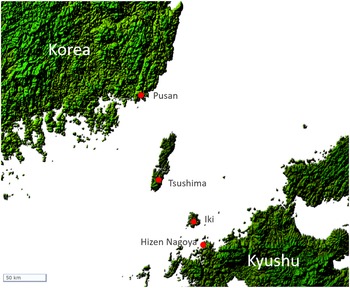
Hizen Nagoya forms a peninsula in the northern part of Eastern Matsura (modern day Saga Prefecture; see Figure 1). Cresting a hill overlooking the Genkai-nada Sea, the castle was then Japan’s second largest, enclosing an area of least 170,000 m2. Until 1591, this area had only hosted a small fishing village, although it could trace a history of maritime exchanges with China and Korea back to the Heian period. Nevertheless, the castle is best remembered as the launch pad for Toyotomi Hideyoshi’s East Asian War of 1592–8. It was the largest global conflict of the sixteenth century, and Japanese forces undertook what was then the largest amphibious operation in recorded history.Footnote 1 Between 150,000 and 160,000 men crossed to Korea from Hizen Nagoya in 1592, with 100,000 more remaining in reserve.Footnote 2 The castle was a major cog in this military machine, with over 150 daimyo encampments within a 3 km radius, but it also became something more; a home to over 200,000 residents and a temporary capital.Footnote 3 Given their diverse local heritage – drawn from Kyushu to Ezo (modern day Hokkaido) – Hizen Nagoya inevitably became a cultural melting pot and a significant entrepôt. Thus, Hizen Nagoya here refers not only to the castle but also to the surrounding encampments and the castle town.
Map of Tsushima Strait. Autho’s collection.

This article explores aspects of the legacy and aftermath of the East Asian War, both its short-term and long-term impacts. Memories of the war were indelibly imprinted on the Japanese psyche, despite the best efforts of the succeeding Tokugawa regime (1600–1868) to suppress them. These bakufu restrictions serve to illustrate how collective historical memories are constructed and contested over time, shaped by the prevailing social and cultural forces. This study focuses on how Hizen Nagoya was remembered, recorded and inscribed in material and memory, that is, the continued and renewed use of the castle after the reverberations of the continental invasion had subsided. In particular, this article examines the shifting roles that Hizen Nagoya has performed over time, despite an enduring identity with the East Asian War.
Given its brief existence, primary sources detailing life at Hizen Nagoya Castle are surprisingly rich and varied. As well as the surviving documents of Hideyoshi and his daimyo, there are numerous reports from foreign visitors and contemporary diaries which detail their author’s everyday routine. Images, including realistic paintings and architectural plans offer invaluable perspectives on the castle’s layout and its relationship to the local area.
Sources published after the castle’s demise illustrate how it has been remembered. In addition to the many histories of the period that mention the castle, maps of the region drawn throughout the Edo period shed further light on its legacy. Creative works including plays, films and novels have also featured Hizen Nagoya. It attracted not only Japanese sightseers, but also Korean visitors. Archaeologists have helped to explain how the castle was demolished, while several extant documents describe the recycling of the castle. This deconstruction proved to be a multi-stage process, driven by varied motives reflecting the needs of the time.
Hizen Nagoya may have enjoyed but a short-lived existence as a castle, yet its legacy has endured and even gained an international dimension. Hizen Nagoya will always be associated with the invasion of Korea – fame by association – but employing a wider lens will help readers to re-evaluate the castle’s significance. This also entails identifying contemporary comparators that did not play a major part in the invasion of Korea, such as Fushimi and Osaka castles. The evidence presented here will support the contention that the legacy of Hizen Nagoya is both deeper and wider than previously thought. Much of this heritage has remained hidden, so this article will reveal the extent to which Hizen Nagoya survived physically, politically, culturally and economically.
Japanese castle development
Hizen Nagoya Castle may have been unique, but it was part of a wider phenomenon and hence a little historical context is useful before examining Hizen Nagoya in detail. Japanese castles, like their European counterparts, began as simple structures surrounded by wooden palisades and earthen ramparts. During the fifteenth century, they became slightly more sophisticated with fortifications being erected on mountains with wooden palisades and stone embankments. By the late sixteenth century, Japan was experiencing a ‘castle boom’. Enormous stone fortresses were now constructed on the plains and hills to combat a new threat, the arquebus.Footnote 4 Castles during this era were usually built in phases, with daimyo often cooperating to complete the task. They often sought advice and assistance from the Anō guild of stonemasons about stone wall-building techniques.Footnote 5 The most famous of these early stone strongholds was Azuchi Castle – the headquarters of Oda Nobunaga (1534–82), Japan’s so-called ‘first great unifier’. Built between 1576 and 1579 to the south-east of Lake Biwa, by 1582 the castle was in ruins. Yet, its legacy lived on as large stone walled castles with moats, multilevel keeps and multiple baileys or enclosures spread throughout western Japan.
Toyotomi Hideyoshi (1537–92), Oda Nobunaga’s successor, en route to pacifying the land, ordered that castles not under the control of loyal daimyo be destroyed. Hundreds of mountain citadels were consequently demolished, abandoned or dismantled and recycled, highlighting their vulnerability and sometimes temporal nature.Footnote 6 Of course, such large structures could not easily be moved and thus reuseable castle elements were usually removed and placed on sledges until they could be loaded onto boats for transportation to their new home, whether castle, temple, shrine or garden. Such methods had been practised since the Heian era.Footnote 7
The life of Hizen Nagoya Castle
Having briefly surveyed the development of Japanese castles in general, this section explains when, why and by whom Hizen Nagoya was built, and offers some glimpses of daily life in and around the castle.
Construction
Most contemporary sources contend that construction of Hizen Nagoya Castle began during the second half of 1591, with one third of the troops levied from Kyushu put to work for this purpose.Footnote 8 Nevertheless, in 1994, archaeologists unearthed roof tiles inscribed with the date 1590 fifth month. Subsequent excavations found others dated 1590 eleventh month and some engraved with family names or with the place-name ‘Hakata’ (today, Fukuoka City, Kyushu).Footnote 9 There are at least two likely explanations for this anomaly. First, building a large castle requires extensive preparation, and thus a substantial lead time is not surprising. Furthermore, since Hattori Hideo believes that artisans were unable to mass produce tiles at the castle site, they also needed to factor in the delivery time from Osaka to Hizen Nagoya.Footnote 10 Second, the roof tiles may simply have been recycled or redirected from other construction projects which Hideyoshi had suspended. Moreover, this was not the only instance of recycling at Hizen Nagoya Castle. A Franciscan source asserts that a church in Nagasaki was demolished, and its timber reused at Nagoya.Footnote 11 Hideyoshi undoubtedly foresaw the need for a convenient base for the continental invasion, and it is reasonable to assume that he ordered planning and preparation to begin a year in advance, perhaps even before selecting the site.
Archaeologists posit two phases of construction: from mid-1591 to mid-1592 and from then until 1598. The first period coincides with Japanese and European sources which assert that the castle was completed in barely six months.Footnote 12 Under intense pressure, workers managed to present the main citadel (honmaru) and ringed walls in time for Hideyoshi’s arrival towards the end of the fourth month of 1592. However, many contemporary documents support the view that there was a second phase of building.Footnote 13 This included the addition of new buildings as well as repairs to existing ones, and even an extension of the castle footprint.Footnote 14 In short, construction of the castle was an incremental process.
At the heart of the castle was the honmaru, surrounded by five major baileys through which visitors (or attackers) had to progress before they could reach the castle keep (tenshukaku).Footnote 15 At five storeys high, it was the tallest part of the castle.Footnote 16 Most entry points featured a tiger’s den gate (masugatakoguchi), which enabled defenders to fire down onto attackers who would be trapped in a tight box-like courtyard.Footnote 17 Details of those who built Hizen Nagoya Castle may be found in the Hizen Nagoyajō kyūki, believed to have been written in the early Edo period. For example, Hasegawa Sōnin (1539–1606), master of tea ceremonies and painter, erected the tea-ceremony arbour (honmaru sukiya), while Ishida Masazumi (?–1600), daimyo and vassal of Hideyoshi, designed the gardens in the hillside bailey (yamazatomaru), Hideyoshi’s private residence.Footnote 18
Raison d’être
Castles traditionally fulfilled both defensive and offensive purposes. Hizen Nagoya’s primary function was to act as the base of operations for Hideyoshi’s continental invasion. Yet, if a logistical base and staging ground were all that were required, then relatively small encampments would have sufficed. That Hizen Nagoya castle was also built to perform defensive duties is evidenced by its high stone walls, a layout carefully designed to delay attackers, and the fact that 100,000 troops remained behind to guard it. Hideyoshi may have built the castle at Nagoya because he anticipated a Korean or Chinese counterattack, or conceivably a local uprising, yet aesthetic practices later emerged that made Hizen Nagoya a significant cultural hub of the Azuchi-Momoyama era (1568–1600), somewhat compromising its protective functionality.Footnote 19 Still, having but recently pacified Japan, another motive for Hideyoshi was to demonstrate his unprecedented political power, both domestically and internationally.Footnote 20 It is worth noting that Hizen Nagoya Castle was the only venue where Hideyoshi managed to gather almost all of Japan’s leading daimyo, albeit not simultaneously.
A large town had already grown up around Hizen Nagoya Castle by the time of Hideyoshi’s arrival. Matsumoto Toyotoshi believes that Hizen Nagoya was simply a military base with a town attached to it and hence its fate was to disappear gradually, but others recognise Sengoku (1467–1568) and Edo period castle town elements.Footnote 21 Tamai Tetsuo argues that the castle was not a temporary garrison, and hypothesised that it was developed to be a permanent capital.Footnote 22 Nakai Hitoshi strongly disagrees, denying that Hizen Nagoya was a castle designed to serve any political function.Footnote 23 Yet, one consequence of Hideyoshi not crossing to Korea was that Hizen Nagoya became a proxy capital from mid-1592.Footnote 24 A communications system established between the Kinai (Kyoto and the surrounding five provinces) and Nagoya enabled Hideyoshi to continue to exercise ultimate political authority.Footnote 25 Murai Shōsuke concludes that, for a time, the Toyotomi regime effectively had three seats of government: Hizen Nagoya, Kyoto and Osaka.Footnote 26 Nagoya’s importance derived from Hideyoshi residing there, but Arisaka Kazuki speculates that had Hizen Nagoya survived it would have ultimately absorbed Hakata, Hirado, and potentially even Nagasaki, to form a north-western Kyushu megapolis.Footnote 27
Despite having planned to cross in person to Korea, Hideyoshi, along with many eastern daimyo, left Hizen Nagoya during the eighth month of 1593 for the birth of his son Hideyori, never to return. Its time in the political limelight proved short-lived. Hideyoshi went to Fushimi Castle and thus Fushimi inherited the political status, as the third capital, that Hizen Nagoya had previously enjoyed. Yet, given Hideyoshi’s hegemonic vision for East Asia, if the war had achieved its ambitious aims, then Hizen Nagoya would at the very least have remained a vital hub in the chain linking Kyoto and Osaka to Hansŏng (Seoul) and Beijing.Footnote 28
Life at Hizen Nagoya
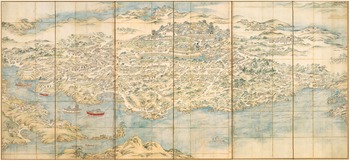
Reimagining daily life at Hizen Nagoya relies on examining first-hand accounts, archaeological remains, and the Hizen Nagoya Castle folding screen (Hizen Nagoyajō zu byōbu; see Figure 2).Footnote 29 Daimyo from across the country were summoned to Hizen Nagoya in early 1592; some even brought their families with them.Footnote 30 Merchants from Osaka, Kyoto, Sakai and Hakata set up shop in the town as well as around the encampments of major daimyo and were able to supply almost anything, for a price.Footnote 31 Troops en route to Korea were probably their principal customers, but traders also stocked everyday items and a diverse array of luxury goods. The Ōwada Shigekiyo nikki, the diary of Ōwada Shigekiyo, a vassal of Satake Yoshinobu (1570–1633), the daimyo of Hitachi Province (modern day Ibaraki Prefecture), lists a veritable cornucopia of items that residents could purchase, ranging from falcons and skins for taiko drums, to chopsticks and ceramics.Footnote 32
Hizen Nagoya castle Folding Screen. Hizen Nagoyjō zu byōbu. Late Azuchi-Momoyama to Early Edo Period. Saga Prefectural Nagoya Castle Museum.

The Hizen Nagoyjō zu byōbu clearly illustrates bustling streets with women and merchants carrying rice sacks on their backs, artisans at work, peddlers hawking their wares, people loitering, children playing, and even an Iberian man (nanbanjin).Footnote 33 As the famous Portuguese Jesuit Luís Fróis observed, ‘many houses, shops, and inns started to appear not just for lords and their vassals but also for merchants and artisans. Thus, straight and splendid streets were built and Nangoya (sic) became a big, wonderful town.’Footnote 34 Despite the appearance of solid, well-built lodgings in the byōbu, a dearth of building materials indicates that the merchant houses were very simple structures.Footnote 35
Archaeological excavations have unearthed a variety of finds at Hizen Nagoya, suggesting that ostentatious consumption was a common aspiration. These included roof tiles in opulent gold leaf and others etched with a paulownia, the Toyotomi family crest.Footnote 36 The remains of gardens, tea ceremony arbours, noh stages, and evidence of smithery were also uncovered.Footnote 37 Nagoya was one of the first castles to emphasise pleasure, featuring exquisite landscaping that became a prototype for the early modern stroll garden.Footnote 38 In Nagoya, Hideyoshi became infatuated with noh, listing the ten plays being performed in a letter to his wife in Osaka on 1593.3.5.Footnote 39 Further digs have revealed ceramic and lacquer bowls from China, Korea and across Japan, portable whetstones, bronze smoking pipes, iron fishhooks, baked salt jar lids, as well as small wooden sticks used as ‘toilet paper’. Kinai-area culinary culture made the journey down to Nagoya as well, and featured melon, wax myrtle, gourd, plum, shiso, sesame, Japanese pepper seeds, rice plants, buckwheat, spring onions and fish.Footnote 40
By the late sixteenth century, tea drinking and the art of the tea ceremony were extremely important to the warrior class; Hizen Nagoya was no exception. Tea was a form of diplomacy and a way of easing tensions between the various daimyo.Footnote 41 Hideyoshi had at least two tea ceremony arbours built within the castle. The Hizen Nagoyajō zu byōbu depicts a tea arbour similar to the one still standing in Kōdaiji (Kyoto).Footnote 42 Yet, it appears that Hideyoshi spent more time having tea in daimyo encampments than in the castle.Footnote 43 The Sōtan nikki, the diary of merchant and tea master, Kamiya Sōtan (1551–1635) written during 1586–1613, mentions that on 1592.5.28 various daimyo performed tea ceremony within the honmaru.Footnote 44 Ōwada Shigekiyo mentioned enjoying tea ceremonies on numerous occasions.Footnote 45 Hizen Nagoya became a centre of tea ceremony during the East Asian War and Osaka’s golden teahouse may have been relocated there.Footnote 46 Indeed, according to Miyatake Masato, a new style of tea ceremony (wabicha) was popularised there and subsequently spread across Japan once the daimyo returned home from the war.Footnote 47 This represents one aspect of the castle’s cultural legacy.
The daimyo encampments not only served as military barracks but also catered to the combatants’ social life. Many included tea houses, noh stages, and both ornamental and vegetable gardens.Footnote 48 Hiratsuka Takitoshi, another vassal of the Satake Yoshinobu, describes daily fishing trips to gather seaweed, goby fish, molluscs, snails and abalone.Footnote 49 He also mentions playing ancient East Asian boardgames including go, Japanese chess (shōgi) and Japanese backgammon (sugoroku), as well as enjoying fireworks and collaborative poetry writing (renga) parties.
Encouraged by the Toyotomi regime, foreign trading ships brought various exotic goods, as well as news and customs from around the world, turning Hizen Nagoya into a thriving, cosmopolitan community.Footnote 50 For example, Ōwada reports that ships from Cambodia brought peacock tails and elephant tusks. Ōwada’s group observed nanbanjin cook a chicken and they ate nanban food on several occasions. They also appear to have learnt some foreign words, although sadly they are not recorded.Footnote 51 The author may even have gone aboard one of the foreign vessels.Footnote 52 Moreover, despite Hideyoshi’s earlier ban on Christianity, Jesuits and other missionaries frequently visited Nagoya.Footnote 53
Life at Hizen Nagoya was not all fun and games, however. For Niiro Tadamasu (?–1608), a Shimazu retainer, and his men, their two-week stay in Hizen Nagoya consisted of building stone walls and huts.Footnote 54 The Date nikki (the Date family diary) describes a dispute over drinking water between Tokugawa Ieyasu’s and Maeda Toshiie’s men that nearly resulted in a shootout.Footnote 55 Justice was sometimes brutal. Ōwada references an investigation following the killing of a cow that resulted in two men being crucified.Footnote 56 Similarly, Hiratsuka writes of the regular arrival of enslaved Korean men and women to Nagoya.Footnote 57 In addition, Hizen Nagoya served as the consignee of a grisly collection of thousands of Korean heads, ears and noses, before they were sent on to Kyoto and beyond.Footnote 58
Hizen Nagoya also functioned as a diplomatic venue, albeit without boasting any negotiated breakthroughs. As depicted in the Hizen Nagoyajō zu byōbu, and observed by Satake Yoshinobu and his men, on 1593.5.15, Ming envoys arrived for peace negotiations.Footnote 59 Hideyoshi hosted the Ming envoys a week later, where they enjoyed food and tea in the golden tatami room.Footnote 60 Yet, at the end of the sixth month, Ōwada witnessed the Chinese envoys depart from Hizen Nagoya for Korea without reaching an agreement.Footnote 61 As well as Ming envoys, Hizen Nagoya also hosted representatives of the Governor-General of the Philippines in 1592 and 1593.Footnote 62
The afterlife of Hizen Nagoya Castle
The fate of Hizen Nagoya Castle after Hideyoshi’s death has received scant scholarly attention, but it has not been completely forgotten. This article’s examination of its afterlife is divided into two sections: the tangible and the intangible legacies.
Tangible legacies
The date of Hizen Nagoya Castle’s post-war demolition is still debated. Few contemporary sources refer to this process. Most likely the daimyo, merchants and most residents of Nagoya packed their bags and returned to their home provinces, but there are no diaries which indicate their camps being destroyed. Perhaps, like old soldiers, Hizen Nagoya simply faded away. Of course, some stones were likely to have been repurposed by locals during the last 400 years. However, many fine stones were left in situ, so it is difficult to conclude that the castle’s state solely reflects neighbourly depredations.Footnote 63
Hizen Nagoya Castle must have been deliberately mutilated, since archaeological excavations have revealed that the site’s erosion was not the result of natural physical processes. Sound walls survive beside crumbling ones, with cornerstones removed and other stones left in V-shape piles.Footnote 64 The deconstruction of the stone walls was very methodical and given the time and effort required, probably did not happen immediately after the castle was abandoned.Footnote 65 Certainly, demolition would have absorbed substantial labour and resources; a significant economic burden.
Yet, contradictions abound. In the honmaru, the stone walls to the west and south suffered the most systematic destruction. The riding ground was destroyed, but other parts of the castle were left relatively untouched. In the second bailey (ninomaru), the stone steps were violently assaulted, thus rendering them unusable, but at their foot lay meticulously assembled rows of roof tiles. Moreover, in the third bailey (sannomaru), archaeologists uncovered a hole containing many roof tiles from the main citadel, as well as seaweed and tea bowls.Footnote 66 In the ruins of the castle’s yamazatomaru, hidden and preserved under a layer of yellow clay, archaeologists have detected the foundation stones of buildings and a garden with a pond. Following demolition, it appears that the clay was used carefully to backfill the debris, perhaps suggesting a kind of ritual or symbolic activity. This technique has been discovered at other castle ruins too.Footnote 67 According to Takase Tetsurō, this implies that sections of the castle were dismantled at different times.Footnote 68
During the eighth month of 1593, Hideyoshi, along with many eastern daimyo, departed Hizen Nagoya Castle for the last time, to celebrate the birth of his son. Hideyoshi’s vassal Terazawa Hirotaka (1563–1633) seems to have been left in charge of the castle and soon controlled most of Eastern Matsura. Thereafter he worked as an intermediary between the daimyo in Korea and Hideyoshi in the Kinai.Footnote 69 By mid-1598, most daimyo had returned to Japan.Footnote 70 Hideyoshi died on the eighteenth day of the eighth month, but it seems that Terazawa was one of the last daimyo to depart Korea at the end of the eleventh month.Footnote 71 Somewhat surprisingly, he chose Hakata as his homecoming port, rather than Hizen Nagoya.
At the Battle of Sekigahara in 1600, Terazawa sided with Tokugawa Ieyasu (1543–1616) and was rewarded with more land in Kyushu. As daimyo of Karatsu domain (han), Terazawa ordered the construction of a new castle approximately 15 km from Hizen Nagoya. Surviving sources disagree on the start date, with estimates ranging from 1593 to 1602, but the erection of Karatsu Castle certainly coincided with the initial demolition of Hizen Nagoya Castle. Still, there is no consensus on which elements of Hizen Nagoya were repurposed at Karatsu. Lumber is a given, but tools, gatehouses (yaguramon), stone walls (sometimes including those from the daimyo camps), and even Hideyoshi’s residence (oyakata) only feature on some lists.Footnote 72 Moreover, stones from Hizen Nagoya Castle can also be seen in temples and domestic residences in Karatsu.Footnote 73 Archaeologists have confirmed that the same roof tiles were used at both castles.Footnote 74 Therefore, Karatsu Castle could be characterised as Hizen Nagoya Castle reborn, or since much of the stone and the design of the castle keep are different, perhaps its offspring. Yet, none of the historical sources claim that Hizen Nagoya was completely destroyed. In sum, Terazawa recycled parts of the castle and perhaps the daimyo encampments, but this did not entail their complete demolition.
It is frequently suggested that Hizen Nagoya Castle experienced further waves of demolition in 1615 and/or 1638. On 1615.i6.13, shortly after the Siege of Osaka concluded, shogun Tokugawa Hidetada issued his ‘one castle per province’ order (Ikkoku ichijō rei), declaring that ‘daimyo castles may remain but all others must be completely destroyed’.Footnote 75 Some daimyo responded almost immediately.Footnote 76 The following month, the thirteen article ‘Laws for the Military Houses’ (Buke shohatto) extended these restrictions.Footnote 77 Article six stated that ‘daimyo castles in the various provinces may be repaired, but such activity must be reported to the bakufu. Structural innovations and expansions are strictly prohibited.’Footnote 78 New castles were banned in part because earthworks and walls were seen as facilitating rebellion.Footnote 79 Of course, there were exceptions and examples of reprimands for those who disobeyed the law.Footnote 80 Thus, it seems reasonable to assume that Hizen Nagoya Castle was another victim of the Ikkoku ichijō rei, although there are no written records to confirm this supposition.
The next stage in the destruction of Hizen Nagoya Castle might have occurred after the Shimabara rebellion of 1637–8, led by the Christian samurai Amakusa Shirō (1621–38). One trigger for the rebellion seems to have been mismanagement of the domain by Terazawa Hirotaka’s son Katataka (1609–47). The rebels barricaded themselves inside the old Hara Castle, which had been partly destroyed in 1616. During the second month of 1638, bakufu forces stormed the old castle and after Amakusa Shirō was killed, the rebels surrendered. The castle was again abandoned, but fearing a repetition, the bakufu completed its destruction and extended the order to various other old castles.Footnote 81 Hizen Nagoya is said to have been further ‘slighted’ after this incident, although primary sources are again lacking.Footnote 82
From the above, it appears that there were three periods when Hizen Nagoya Castle was likely to have been knocked down, although it is impossible to be certain. For instance, archaeologists are confused by the discovery of three mid eighteenth-century coins in the back-fill of these stone walls. Since their location indicates that they were dropped during the destruction process, this implies a potential fourth phase of destruction.Footnote 83
The decremental demise and recycling of Hizen Nagoya invites questions as to motive. Such behaviour fits into a broader pattern in traditional Japanese culture where the repurposing of virtually all objects, whether made from paper, cotton, wood, clay, stone, or metal, is a practice of long standing, and even the recycling of large buildings was not unusual.Footnote 84 This prudent lifestyle apparently reached its zenith during the Edo period, and it is generally assumed that this frugality rested on a combination of a limited resource base, pragmatism and religion; in particular a Buddhist respect for the essence of all things.Footnote 85
There appear to be additional factors propelling castle recycling in the Edo period. Hideyoshi and other leading members of the Toyotomi regime were not averse to indulging in opulent displays of wealth. Although castles such as Hizen Nagoya, Fushimi and Osaka were built to last, the incorporation of valuable resources strengthened the incentive to recycle them. In general, the more valuable the material the more likely it was to be repurposed. Castle construction was one of the most expensive, time consuming and labour-intensive economic projects that a daimyo could undertake. Therefore, the most obvious motives for recycling castle elements were the savings of time, money and skilled labour.
Although not exactly modular in the truest sense of the word, the fact that castles were built without cement and rarely used nails in the timbers made it relatively easy to deconstruct and reconstruct most castle elements without significant damage, danger or delay. Where timbers were too far decayed, they were easily substituted. This implies that reusability was deliberately built into castle design.
Recycling may have been cheaper, but it was not free. The daimyo probably engaged in some kind of cost-benefit analysis. Wastage is inevitable in the reuse process, but it seems reasonable to conclude that many materials were recycled locally, leaving little of the original castle for the archaeologists to unearth. Moreover, sometimes stones were simply too big to move, or the cost of reusing them outweighed the perceived benefits. Ships carrying stone (ishibune) often sank; hence, given the cost and dangers associated with transportation, it is not surprising that reuse was more likely the shorter the distances involved. This helps to explain why it was a relatively common practice in the Kinai, where multiple castles and temples existed in close proximity, and perhaps this logic is relevant to Karatsu Castle. A variation on the economic law of diminishing marginal utility also applies here in that subsequent attempts to recycle castle elements are likely to prove less satisfying.
A final economic motive relates to supply. Timber shortages were accentuated after Toyotomi Hideyoshi and Tokugawa Ieyasu consumed vast quantities of wood in their grandiose building projects. In contrast, high quality stone was plentiful, but when quarries were distant, or masons few in number, daimyo were forced to pool their resources to construct large castles, and this increased the opportunities and incentives for reuse.Footnote 86
Castles are often eliminated for practical reasons, such as to prevent their use by an enemy, but this act could also reflect symbolic motives: to nullify a visual representation of authority or advertise a shift in political power. Hizen Nagoya was a magnificent castle that not only represented a huge investment of time and resources but also symbolised Hideyoshi’s acknowledged dominance over a recently pacified Japan. According to Nakai Hitoshi, it seems that the succeeding Tokugawa bakufu wished to erase the Toyotomi house from history and the ‘slighting’ of Hizen Nagoya Castle was a manifestation of this ambition.Footnote 87 Logically, if eliminating the castle’s defensive strength was the main concern then the so-called tiger’s den courtyards should have been targeted first. Yet, there is nothing to indicate that damage was concentrated on these areas.Footnote 88 Hence, it is hard to argue that Hizen Nagoya was destroyed purely for strategic reasons.
Given the unstable political environment of early seventeenth-century Japan, with the Tokugawa regime regulating castles for fear of Toyotomi loyalists and domestic uprisings, it is not surprising that a degree of urgency was often attached to castle recycling. Sometimes repurposing commenced while the ashes were still warm. Of course, there are also examples of decades elapsing before materials were reclaimed. Generally, the longer a castle had been left abandoned the less likely it was to be reused.Footnote 89
Daimyo also salvaged parts of castles to prevent rivals or potential enemies from using them. For some daimyo such pre-emptive action was a means to maximise their autonomy, whereas for the Tokugawa it served to minimise daimyo independence. In this sense, castle recycling may be seen as a key factor in the battle for strategic dominance. Furthermore, the fact that these castle elements had often proven their worth in battle (and withstood earthquakes) added another layer of military reassurance. Politically, castle recycling in the early Edo period served a dual purpose: dismantling the Toyotomi legacy and reinforcing the new Tokugawa order. The Tokugawa also policed the subsequent castle renovations, and in some cases displaced troublesome daimyo.
Fushimi and Osaka castles are good examples of the Tokugawa’s binary approach. Fushimi Castle was originally designed to serve as Hideyoshi’s retirement palace, and he died there in 1598. After the Tokugawa victory at the Battle of Sekigahara in 1600, Ieyasu had Fushimi Castle rebuilt as a symbol of his newfound political authority, with it serving as the venue for the installation of the first three Tokugawa shogun. He reused elements of the old castle such as the Toyotomi paulownia crest roof tiles.Footnote 90 Moreover, in an act of political theatre, floorboards allegedly stained with the blood of his vassals (chitenjō) during the siege of Fushimi Castle were reused as ceiling beams and panels in a number of Kyoto temples.Footnote 91 Apparently, this discharged a spiritual function, to pray for the souls of those sacrificed, thereby imbuing their new location with additional spiritual resonance, yet the overt political symbolism cannot be overlooked. In another transparent example of Tokugawa reinforcing the new order, further elements were temporarily moved to Nijō Castle to impress the emperor during an official visit in 1626.Footnote 92
Although not part of the castle’s fabric, a clear example of the way in which cultural artefacts were used to achieve political ends occurred in 1615. Ieyasu ordered parties to search the ruins of Osaka Castle for renowned objects previously owned by Oda Nobunaga and Toyotomi Hideyoshi. As recent scientific tests have confirmed, expert craftsmen then reforged, repaired and where necessary re-formed heirloom swords, tea ceremony ceramics and lacquerware to join the Tokugawa collection and thereby boost the new regime’s legitimacy. As Morgan Pitelka observed, implements were redeployed because their prestige remained embedded in the material even if their meaning changed in the new setting.Footnote 93
Four years later, the Tokugawa decided to transfer the political and military functions of Fushimi to Osaka.Footnote 94 According to the Taitokuindonogojikki (an official record of Toyotomi Hidetada’s achievements), when Osaka Castle was being rebuilt in 1619–20, some of the stone used to repair the walls came from Fushimi.Footnote 95 Other elements, such as gates, watchtowers and even whole palaces were relocated to various castles and temples.Footnote 96
Returning to Karatsu, the main reasons why Terazawa Hirotaka recycled parts of Hizen Nagoya were probably economic, with political factors in the background. It was much cheaper and easier to reuse the lumber. However, since much stone remains in Nagoya, it was probably too difficult to move. From the archaeological record, it seems that the northern side of the castle and the keep, which were visible from the surviving Nagoya village, were disassembled for symbolic purposes. Kijima Takashi argues that the Terazawa probably destroyed the castle to demonstrate their loyalty to the bakufu. If so, then the probability of the walls being destroyed by 1602 was very low because the Terazawa had only sided with the Tokugawa at the Battle of Sekigahara.Footnote 97 They did not chip away at the cornerstones but rather targeted specific areas and demolished those sections. Not all districts were destroyed at the same time, but different structures at different times, and for different reasons.Footnote 98 In short, it is clear that during the Edo period Hizen Nagoya did not function as a castle.
Intangible legacies
Hizen Nagoya was built during a period of transition and hence acted as a catalyst for the diffusion of recent castle construction techniques that subsequently spread throughout western Japan and Kyushu. The castle builders divided the construction process into parts (the so-called waribushin technique). This technique became common practice during the Tokugawa period and was first practised by the Toyotomi regime to construct Osaka Castle and Jurakudai.Footnote 99 Hizen Nagoya also featured improved construction methods, with higher cut stone walls and a more refined wedge stone splitting technique (yaana), which made it easier to cut the stone more accurately.Footnote 100 Moreover, by standardizing the raw materials, it was possible to estimate how long the construction would take.Footnote 101 This proved influential, although later castles could not always match Nagoya’s combination of medieval craftsmanship and early modern technical advances.Footnote 102
Hizen Nagoya Castle, as the headquarters of the continental invasion, not surprisingly also has an international legacy; a legacy most clearly seen in post-war Japan-Korea diplomacy. As early as 1599, an entry in the Korean source Sŏnjo sillok (‘The Veritable Records of King Sŏnjo’) claimed that a letter requesting the re-establishment of friendly relations between the two countries arrived from Nagoya and Tsushima, but was snubbed.Footnote 103 Two years later, a plan was mooted to send a Korean spy to Iki and Nagoya to gather information on the Japanese situation.Footnote 104 Whether this plan was operationalised is uncertain, but in 1605, relations seemed to take a more positive turn when an unofficial Korean envoy visited Japan and met Tokugawa Ieyasu at Fushimi Castle, near Kyoto. More importantly, in 1607, the first of three ‘Reply and Prisoner Repatriation Envoys’ arrived in Japan to restore diplomatic ties and repatriate prisoners. They were granted an audience with Tokugawa Hidetada (1579–1632) in Edo.Footnote 105 According to the diary of a member of the Korean delegation, on their return journey to Korea the envoys visited Hizen Nagoya on 1607.6.20, identified as the location where Hideyoshi had established his military camp in 1592. The diary adds that although the village had once prospered, only a few houses remained.Footnote 106 The main reason for their sojourn appears to have been to await favourable winds, but perhaps it was in part a military inspection. Shin Yu Wŏn speculates that Hizen Nagoya Castle was dismantled specifically to appease the Korean envoys.Footnote 107 If so, the Tokugawa thereby demonstrated that they had distanced themselves from Hideyoshi’s aggressive grand strategy. If not, the fact that the Tokugawa were not maintaining or using Hizen Nagoya Castle would still have inspired Korean goodwill.Footnote 108 The second ‘Reply and Prisoner Repatriation Envoy’ planned to visit Hizen Nagoya ten years later in 1617. However, bad weather meant they could only moor at Yobuko, the neighbouring inlet, where they stayed for a few days to meet with forty-four prisoners from the East Asian War.Footnote 109
Koreans revisited Nagoya in 1643, during the second official post-war ‘Communication Envoy’. This time the envoy party stopped at Nagoya on their way both to and from Edo. On 1643.5.17, they were welcomed by several hundred people holding flaming brands and the village chief hosted a feast even more spectacular than the one they received on Iki.Footnote 110 The envoys recorded that the domain belonged to the Terazawa family, and it was the most fertile region of Kyushu. They also mentioned the presence of a small castle with evidence of fighting in the vicinity and recognised it as the site where Hideyoshi’s men were encamped during the East Asian War. Moreover, the envoys were informed of the so-called ‘Korea village’ consisting of about 100 houses some 12 km from Nagoya, where former prisoners made earthenware and porcelain. Finally, the envoys praised Nagoya as one of the best places they had visited on their travels so far, and on their return journey, they again stopped in Nagoya to look for ex-POWs, perhaps with the intention of repatriating them.Footnote 111
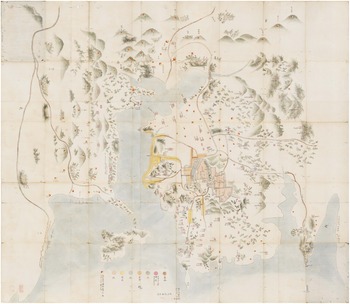
After the East Asian War, the numerous towns surrounding the castle lost their economic function, although throughout the Edo period a settlement remained. Yet, despite Korean assessments, Hizen Nagoya did not simply revert to being a small fishing village. Numerous Tokugawa era maps mark the location of Hizen Nagoya Castle and the daimyo encampments, show diagrams of the castle, or indicate that an old castle existed there.Footnote 112 Indeed, the Edo bakufu ordered that maps of the provinces be produced on four separate occasions between 1605 and 1838.Footnote 113 The Keichō (1605) and Shōhō (1647) era maps reveal that Nagoya village was measured as 2,843 koku and 1,995 koku, respectively, implying that it remained a rather substantial centre of agriculture and fishing, albeit a shrinking one (see Figure 3).Footnote 114 These maps confirm that Hizen Nagoya remained bound to the memory of the war.
Map of Hizen Nagoya Castle. Hizen Karatsu Nagoyajō jinsho ezu late Edo period. Saga Prefectural Nagoya Castle Museum.

Oddly, in 1628, when the Tokugawa bakufu sent men to Kyushu to investigate Hizen province, they surveyed Karatsu, Hirado and Nagasaki castles, without mentioning Nagoya Castle.Footnote 115 Yet, ten years later, on the 29th day of the third month of 1638.3.29, daimyo Matsudaira Nobutsuna (1596–1662) and Toda Ujikane (1576–1655), commanders of the bakufu forces during the Shimabara uprising, spent a night at Hizen Nagoya and inspected the old castle.Footnote 116 Details are scant, but it seems that the bitter experience of the Shimabara campaign left them unwilling to see other castles used in the same way, which supports the claim that Nagoya Castle was further ‘slighted’ in 1638.Footnote 117
In 1647, Terazawa Katataka committed suicide, perhaps due to the loss of land resulting from the earlier Shimabara incident. Since Katataka lacked a son, his domain was confiscated by the bakufu. Two years later, the Ōkubo family was given Karatsu. Around this time, Hizen Nagoya Castle’s role shifted. In 1650, daimyo Nakagawa Hisamori (1594–1653) inspected Karatsu domain and drew a map of the area. Nakagawa mentioned there being seventeen watchtower guardhouses (to’omibansho), including one at Hizen Nagoya Castle.Footnote 118 Nakagawa also produced a diagram of Karatsu Castle, yet historians suspect that because of the arrangement of the districts and the inversion of the ninomaru and sannomaru, this is in fact a diagram of Hizen Nagoya Castle.Footnote 119 The remains of the guardhouse were later discovered near Nagoya Castle’s keep.Footnote 120 The Hizen koku Karatsu ryō jōkaku chisei shoki [Records of the castle topography of Karatsu domain in Hizen Province] published in 1678 resembles the Hizen Nagoyajō kyūki in that it presents the dimensions of specific parts of the castle.Footnote 121 According to Miyatake Masato, the majority of district names that remain come from the first part of the Edo period.Footnote 122
Subsequently, at the behest of the bakufu, Karatsu domain passed through the hands of several families: the Ogyūmatsudaira (1678–91); the Doi (1691–1762); the Mizuno (1762–1817) and the Ogasawara (1817 until the Meiji Restoration). During the Mizuno tenure, in 1778, a new kabuki play called Kinmon gosan no kiri [The Golden Gate and the Paulownia Crest] was staged at Osaka’s Kado no Shibai theatre. The story revolves around a thwarted plot to take over Japan by Sō Sokei, a retainer in the service of the Ming emperor, and the subsequent actions of his son Ishikawa Goemon, a notorious thief, to avenge his father’s death by killing Mashiba Hisayoshi (Toyotomi Hideyoshi). The play’s most famous scene takes place at the golden gate of Nanzen-ji temple in Kyoto, but the first act opens at Hizen Nagoya Castle and the surrounding military camps.Footnote 123 Although a work of fiction, it demonstrates a continuing popular interest in Hideyoshi, the East Asian War, and even Hizen Nagoya.
When Japanese cartographer Inō Tadataka (1745–1818) visited Nagoya for several days late in the ninth month of 1812, he verified the existence of an operational watchtower guardhouse. Inō alluded to the remains of the stone walls from Hideyoshi’s camp nearby. Inō also listed the location of several daimyo encampments and acknowledged that Hizen Nagoya served as the base for Japanese ships during the East Asian War.Footnote 124
By the nineteenth century, Hizen Nagoya had become a sightseeing destination. For example, in 1861, a sword master called Muta Takaatsu (1830–90) visited the area on a whaling expedition. On the morning of 1.27, he and his companions reached Nagoya Castle. They saw the ruins of the honmaru, the ninomaru, the sannomaru, as well as the gatehouses and the well. Muta also visited the Tokugawa encampment, which had been turned into a pine grove, and Ryusenji temple, where he discovered a document very similar to the Hizen Nagoyajō kyūki. Muta noted the sections of the castle and their builders, and mentioned the fact that a watchtower guardhouse stood at the foot of the honmaru.Footnote 125
With the Meiji Restoration and the overthrow of the Tokugawa, Japan experienced a Toyotomi boom, which started with the emperor’s visit to Osaka in 1868 and eventually led to the rebuilding of Osaka Castle, as well as his interment at Fushimi Castle, but appeared to bypass Hizen Nagoya.Footnote 126 Hizen Nagoya essentially disappeared from the historical record until 1920, when prince Yasuhiko Asaka (1887–1981) made an imperial inspection of the castle ruins. In 1926, prince Kaya Tsunenori (1900–78) reprised the role. It is said that they both planted pine trees to commemorate their visits.Footnote 127 Perhaps it is no coincidence that in 1926, the Hizen Nagoya Castle and daimyo encampment ruins were designated a ‘site of historical importance’, which was upgraded to ‘special historical importance’ in 1955.Footnote 128
These days, the local economy is heavily reliant on castle-related tourism to supplement the traditional fishing and agricultural industries. Thus, the most important cultural legacy is perhaps the Saga Prefectural Nagoya Castle Museum, built in October 1993. Rather than attempting to whitewash its troubled history, the museum reimagines the site as a special venue for cultural communication between Japan and Korea, ‘a place to research and teach about the long history of exchange between the Japanese islands and the Korean peninsula, including the Japanese Invasions of Korea’. Going beyond the traditional heritage realm, it also serves as ‘a base for the exchange of art and culture between Japan and Korea’.Footnote 129 Since 1999, the museum has helped to support foreign cultural interaction at local schools and offered Korean language classes. To facilitate scholarly collaboration, the museum works closely with the Jinju National Museum (located in Jinju Fortress, South Gyeongsang Province, South Korea),which also specialises in the East Asian War.Footnote 130 As well as preserving various historical sites associated with the war, such as the ‘Nose Mound’ (later renamed Mimizuka, lit. Ear Mound) in Kyoto, a variety of festivals featuring reenactments, parades, horses, lanterns and turtle boats (an original Korean designed warship which proved very effective) commemorate the war and promote peaceful coexistence and cultural exchange between Japan and South Korea. Hizen Nagoya lives on today through the many thousands of tourists and schoolchildren who visit the ruins and museum each year, as well as the ongoing annual archaeological digs.
Conclusions
This article has considered the overlapping themes of construction and recycling, cosmopolitanism and symbolism, legacy and memory. Hizen Nagoya Castle’s construction was a rapid but cumulative process, though it cannot be said to have been completed in six months or less. Similarly, according to archaeologists, the castle was also demolished in stages, often in a no less meticulous manner, leaving only the stone foundations for future generations.
Hizen Nagoya was a gateway community, not only for soldiers en route to the continent, but also for foreign diplomats, priests, sailors, traders and their wares coming from far and near. News from the outside world flooded in. It was a melting pot that brought together cultural practices from distant Japanese regions, cross pollinated with some foreign flavours. For the transient Japanese residents, Hizen Nagoya was a place where they spent time eating, drinking, fishing, playing and being entertained, despite all the hard labour. The numerous drinking vessels and bowls unearthed by archaeologists confirms the impression gained from contemporary accounts that they ate and drank to excess.
Japanese castles should be understood not only as military architecture, but like other buildings of this era, as flexible structures, capable of being disassembled, transported, reassembled and even repurposed to suit the demands of the regime and local residents.Footnote 131 Hizen Nagoya Castle had been partially constructed from second-hand materials, and they were redeployed once the castle had outlived its usefulness. This could be seen as a prime example of Japan’s devotion to repurposing material culture, but in this case the recycling appears to have been more opportunistic than systematic.
The dismantling and relocation of architecture in Momoyama Japan (1573–1603) was never a matter of mere convenience. For Watsky, it was a political-spiritual act; as well as recycling building materials, they redistributed sacred authority and memory.Footnote 132 However, in the case of Hizen Nagoya such behaviour was motivated more by practical political, strategic and economic considerations. Nevertheless, castle fragments also functioned as ‘afterlives’ of power; their movement reflecting both the collapse of the Toyotomi regime and the persistence of Hideyoshi’s prestige in material form.
Hizen Nagoya’s construction may be attributed exclusively to Hideyoshi’s strategic preparations for the continental invasion, and the war’s outcome was equally responsible for the castle’s decline. Under the Tokugawa bakufu, Hizen Nagoya lost its prominence and became just another guard post. Its strategic importance evaporated since there was no longer any desire to invade the mainland or a perceived naval threat from the continent. Therefore, even if Hizen Nagoya had not been recycled so soon after the war, it probably would have fallen into disrepair, as did many other castles during the long Tokugawa peace.Footnote 133 Moreover, unlike other castles such as Osaka and Fushimi, which were physically reconstructed and symbolically redeemed despite their equally negative domestic political associations, Hizen Nagoya was deconstructed and irredeemable; a good example of ‘slighting’ by a successor regime. Eliminating a symbol of hostility may also have helped to remove a diplomatic thorn in the side of Japan–Korea relations. Yet the fact that many Edo era official maps continued to depict this old castle implies that it retained at least a residual level of political repute, albeit only as the departure point for the invading Japanese troops. In the domestic context, it had also become a relative backwater, on the periphery far from the centre of power.
Hizen Nagoya Castle may never have faced the ultimate test, but it still served as a thriving regional economic hub. Yet, the fact that archaeologists could not find any substantial building remains in the castle towns supports the idea that although some were extant for over seven years, most were cheap, pop-up buildings with shallow or no foundations. This could imply a transient community always aware of the temporary nature of this unplanned town, or a rapidly growing metropolis curtailed by unexpected events on the continent. It is hard to say, but the latter seems more likely. Little is known about life in the castle town once Hideyoshi and many eastern daimyo departed towards the end of 1593. Whether this marked the start of a gradual decline, or whether the end came suddenly after Hideyoshi’s death, only further research may reveal. Despite possessing a good road connection, Hizen Nagoya lost out in the commercial competition with other ports nearby, such as Hakata and Nagasaki, which became the main gateways to Edo period Japan. The economic boom proved fleeting and hence the most enduring legacy has been cultural. Notwithstanding the proximity of forcibly transplanted Korean residents, Hizen Nagoya struggled to retain its cosmopolitan ambience, although the returning soldiers and dispersing merchants disseminated this Momoyama hybrid culture across the archipelago. In other words, while the East Asian War left a gruesome legacy of death and destruction, Hizen Nagoya offered a delicate silver lining of cultural creation, refinement and diffusion for the rest of Japan.
It seems that Hizen Nagoya will be remembered for as long as the East Asian War. Ongoing efforts to convert this site into a centre of scholarship and reconciliation are commendable, even if perceptions of the castle will always diverge. For those with direct experience of life at Hizen Nagoya it was recorded and remembered quite fondly, perhaps most especially by the warriors who never joined the fight in Korea. Strict Tokugawa censorship was unable to prevent the publication of numerous Japanese histories and stories about the war, which helped to keep collective memories alive for subsequent generations.Footnote 134 For Japanese, Hizen Nagoya simultaneously represented a painful memory of defeat, but for the Koreans it was a hated reminder of oppression and conflict. It was not only the location from which the Japanese launched their invasion, but also the destination for many thousands of captives. Not surprisingly, Korean literature has long emphasised the tragic and sorrowful aspects of the war, and preferred ‘fictional depictions designed to inspire spiritual victory over Japan’ to critical analyses of their battlefield performance.Footnote 135 Yet, for the handful of post-East Asian War Korean visitors, Hizen Nagoya was surprisingly a welcoming place.
In a sense, the legacy of Hizen Nagoya has always been overshadowed by the agony of the East Asian War and the larger-than-life personality of Toyotomi Hideyoshi. The invasion provided the castle’s sole raison d’être and thus it is difficult to distinguish its legacy from the wider impact of the war. The fact that Japan’s official museum of the East Asian War is located beside the ruins of Hizen Nagoya reinforces the point that the two remain indelibly linked in the Japanese psyche, yet the castle offers a unique perspective on this period. While not entirely forgotten, Hizen Nagoya’s life and afterlife are more significant than the collective memory allows. Hence, it is easy to underestimate its contribution to the war effort and recent attempts at rapprochement.
Hizen Nagoya Castle graphically illustrates how particular sites and structures can perform a succession of roles and even simultaneously fulfil multiple functions; some of which may be contradictory rather than complementary. The castle was a relatively short-lived, dynamic, military-civil hybrid settlement. During the war, it was a rallying point for over 160 daimyo from across the archipelago: an unparalleled display of Hideyoshi’s political hegemony. Yet, the castle’s purpose changed several times in quick succession; from the quick-build headquarters for an invasion force to a bustling castle town. Hizen Nagoya also served as an impromptu seat of national power and an important diplomatic venue, before retrogressing into a mere loading area for troops. Later, it became a port of return for many of the defeated troops. However, Hizen Nagoya not only exported violence to the Korean peninsula, it also flourished as a cultural crossroads, even if some of the imported cultural practices and artefacts were stolen. Thus, the castle’s transformation did not start with its demolition; it began during the war. Post-war, the castle was promptly abandoned, the encampments dismantled and the merchants dispersed, leaving behind few physical remnants but powerful memories. It soon became a source of raw materials for local residences and the new castle constructed at Karatsu. For the new Tokugawa regime, Hizen Nagoya was a potentially dangerous rallying point for rebellion, and after further demolitions, it was reduced to a simple lookout post to track the movement of foreign ships. Meanwhile, Hizen Nagoya also became a venue for Korean and Japanese visitors interested in aspects of the castle’s heritage. At one time, the area was utilized mainly for agricultural purposes, before finally serving as a stage for study, commemoration and reconciliation. How structures are used (and abused), both literally and symbolically, clearly reflects the needs of each succeeding generation and the values of society at any given time. After centuries of neglect, Hizen Nagoya Castle has re-emerged as the antithesis of its original function, namely, a site dedicated to peace not war.

 Open access

