




Context
We write this paper gratefully acknowledging that we are both Caucasian settlers on the unceded territories of the Coast Salish peoples. Louise’s ancestors were French-Canadian farmers and makers. She was drawn to the discipline of industrial design out of a desire to apply her creative capacities in socially helpful ways. Sean is a widely published philosopher of education who spends most of his life barefoot in sandals and doesn’t own a cell phone. The human-made world of designers and the natural, self-arising (Bonnett, Reference Bonnett, Jickling and Sterling2017) world of environmental educators can be very far apart. This unlikely collaboration – a design educator engrossed in the creative world and a philosopher who stays close to the wild, has opened some important doors for design pedagogy in the metacrisis. These include tactics to shift the conception of knowledge, ways of facing the discomfort involved in change, and leveraging from the known and familiar to embrace the unknown. This also offers environmental educators fresh perspective on their own rich pedagogy.
Designers in the Modern West envision and shape products, information, homes, and cities according to the deeply held belief systems of Modernity, including the importance of rationality, industrial progress, and capitalism. Many designers are concerned about at least some of not all of the crises that make up the metacrisis, but usually find themselves indoors, working on computers and learning about sustainable materials (Shafer, Reference Shafern.d.) or perhaps strategizing about the circular economy (Kopnina, Reference Kopnina2018). Valuable contributions are made through this work, but it hasn’t yielded the magnitude of change that is needed. Since Van der Ryn and Cowan first proposed Ecological Design in Reference Van der Ryn and Cowan1995, the forces of extraction and consumption have increased significantly (Krausmann et al., Reference Krausmann, Lauk, Haas and Wiedenhofer2018). Although marketing, industry and consumerism are responsible for much of this, designers can create artefacts and other forms of daily communication that convey values and relational understandings through the phenomenological: the symbolic, tangible, and visceral. Design can influence consumer culture and societal approaches to nature both subtly and overtly. Attempts to design in relationship with nature over history have been undermined by illusions of mastery and a deficit of ecological literacy in the discipline (St. Pierre, Reference St. Pierre2015). This leaves designers vulnerable to industry greenwashing about the health of materials like bioplastics, and poorly informed about how to design for ecological benefit or ecological relationality (St. Pierre, Reference St. Pierre, Fletcher and Tham2014). Design education for the polycrisis has tended towards practices of Ecodesign residing in management, measurement and mastery (see for example; White et al., Reference White, Pierre and Belletire2013; Faludi et al., Reference Faludi, Acaroglu, Gardien, Rapela, Sumter and Cooper2023). Pedagogy has been furthering the problem.
According to Stein (Reference Stein2022), the metacrisis centres on four aspects of education: Sense-making, Legitimacy, Capability and Meaning. All of these are necessary, and all overlap. Current design pedagogy confers some Sense-making through ethnographic research and extends Capability via skill development. Design pedagogy includes some exploration in Legitimacy through collective decision-making and co-creation practices. The last one, Meaning, is the most challenging and complex in design, as many designers feel that meaning is found through problem-solving and the development of new artefacts or technologies to ease human life. Louise has been seeking a pedagogy in design that finds meaning in relation with the natural world and nature’s systems. Much of her motivation stems from her teenage years where she learned about farming as ecological stewardship from her father (St. Pierre, Reference St. Pierre, Fletcher and Tham2014). This set her passion for ethical design. She was an early leader in Ecodesign practices with Philip White and Steve Belletire (Reference White, St. Pierre and Belletire2003, Reference White, Pierre and Belletire2013) but felt that Ecodesign too easily prioritised the needs of industry and capitalism over the health of the Earth. Her vision is one where needs of all beings are considered in design decisions. Okanagan elder Jeannette Armstrong (Reference Armstrong, Stone and Barlow2005) wrote about how the En’owkin decision-making process includes a representative to speak for the land. Similarly, with the Council of All Beings John Seed and Joanna Macy (Reference Seed, Macy, Fleming and Naess2007) conceived a pedagogical means for bringing more-than-humans into decision-making. In her design studio course Design With All Beings, Louise explores how students might connect with the voices of Mountain, Bird, Tree, and Bear. Her hope is that these Deep Ecology (Naess, Reference Naess1973) practices might temper Enlightenment assumptions about rational objectivity, mastery and entitlement that are often found in design. A pedagogy of reconnection and re-immersion in the more-than-human might lead design to an understanding of our intra-connection (Barad, Reference Barad2007) with the natural world.
Early classroom experiences suggest that at the very least, connecting with the more-than-human can counter the alienation and existential distress that design students feel in the metacrisis. This connection provides an avenue to confer the emotional resources to confront the metacrisis directly and energise the search for responses. For designers, this practice might lead to a rebalancing of the way that they conceive of artefacts and outcomes, reaffirming the considerable skills and imaginative range that designers have, while encouraging a more thorough consideration of ecological limits. These nascent directions bring implications for a wholesale reset of the practices and priorities of design.
Sean’s research and writing about wild pedagogies (Jickling et al., Reference Jickling, Blenkinsop, Timmerman and Sitka-Sage2018) and eco-schools (Blenkinsop & Kuchta, Reference Blenkinsop and Kuchta2024) has for years informed Louise’s work developing nature-centric pedagogies for designers. This past January of 2025, the two of us sat together and talked about Sean’s recent research with Mark Fettes and Blenkinsop (Reference Fettes and Blenkinsop2023), investigating how education might need to change in order to support Canadian governmental policy that seeks to “live within the Earth’s carrying capacity” which, obviously, led to exploring the qualities of sustainable intentional communities. At this point, Louise was heading into her 4th iteration of the Design with All Beings class. Several aspects of this pedagogy are challenging for design students. Students who are embedded in Modern Western models of Scientism see knowledge as something concrete to collect or acquire (much as Colonisation and Consumerism do with resources of the world). Productivity-focused students find it difficult to slow down and pay deep attention to nature, to spend time in the outdoors, listen to and try to hear the voice of the natural world. They have a love of working with materials and creating new artefacts. They are comfortable engaging in project challenges in order to create visible and tangible outcomes. It is a long leap for them to embrace forms of knowing that are not quantifiable, visible, or tangible. And another leap for them when university educators like Louise and Sean develop and offer pedagogies and curricula that seek to do this kind of deep change work. Ultimately the question became, what might design pedagogy look like if it were not only to bring the natural world more actively into the mix and push the idea of what design is and can be but also actively question the biases, assumptions, and imaginative limits of the design students, pedagogies, and institutions themselves? How might the pedagogy support and encourage change in both the act and the actor as it were?
Together, Sean and Louise worked with the Design With All Beings 2025 cohort, which was comprised of 11 students between the ages of 20 and 24 from a variety of different cultures including Canadian, Asian, and South Asian local and international communities. By the time design students enter this third-year course, most of them have learned the basics of their various disciplines, whether it be graphic, Industrial or interaction design. They learn how to shape things, how to shape messages, how to program a website, or how to build a prototype. Many students have been informed by the hidden curriculum in North America or in their countries of origin. These diverse influences confer a faith in progressive technological innovation and economic growth. Could Sean’s recent research into ecological-social – cultural relationships and his theories of pedagogies of change bring renewed authority and energy to Louise’s pedagogy? Could it offer frameworks to leverage Louise’s content, while at the same time opening space for new discussions and engender what Willems-Braun (Reference Willems-Braun2018) calls a humble, participatory, and integrated relationship with ecological systems? Could this support Louise’s attempts to bridge design and nature and to help students reposition themselves in more equitable relations with all beings? Altogether, might the prompts offer ways to anchor the nascent pedagogy of designing with all beings and give us insights into teaching for and during the metacrisis? What follows is an introduction to the six prompts and how they impacted teacher, student, and designer through the semester. We found that the prompts both liberated and supported the teacher. They reassured the students, enabling them to relax into new forms of learning. And they inspired the young designers to shift the way that they thought about design.
The six prompts
Fettes and Blenkinsop’s (Reference Fettes and Blenkinsop2023) research project on eco-social – cultural change found and detailed six shared qualities of small communities that positioned themselves as being different from “mainstream” Canada, interested in change, and with a particular focus on increasing ecological and social justice. Examples included: Indigenous societies/organisations, alternative living communities (e.g. eco-villages), educational programmes (e.g. eco-schools), and community change organisations (e.g. advocacy groups). Fettes and Blenkinsop drew out these six themes or qualities that were present in all the interviewed communities. They called them “design prompts,” with the intent to avoid being dogmatic (like a principle) or otherwise limiting. Louise thinks of these prompts as Worldview Lenses. To her, they offer discrete ways to reset creative thinking towards a pedagogy in authentic relationship with the ecological world.
The six design prompts.

Some of the prompts were an easy fit within the design curriculum culture at Emily Carr University of Art and Design. The first prompt, All our Relations connected to prior understanding. Emily Carr has been working for years to Indigenise the academy, and students often hear from Indigenous faculty members about our relationship with all beings: Cedar, Stream, Mountain and Magpie. The prompt Abundant Time was also very understandable – When Louise mentioned Abundant Time during the semester, students would laugh (there is no such thing as abundant time in their high-pressure curriculum). Abundant Time resonates with Slow Design theories (Pais & Strauss, Reference Pais and Strauss2016), which some students were aware of. The third prompt, Mystery/Unknowability is a powerful way to challenge the drive of designers to pin down all the knowledge that they can. Ancient Futures brings the opportunity to rethink our allegiance to linear time, and the tendency for designers to assume that newer means better. Embeddedness/Integration offers an elegant set of ideas about relationality, reminding designers that we rarely know the ultimate consequences of our work, and opening up conversations about relationships. And the final prompt, (Re)Creative Dissonance, suggests that things can become better through rupture and reassessment, affirming the existing understanding that a design is always in flux, and that a design project evolves through iterative processes.
These prompts were brought into the classroom with the desire to support student learning, but they had a surprising impact on the teacher herself. For Louise, who was sometimes struggling to guide students to this pedagogy, these prompts were a gift.
On teacher: Oddball teacher/weirding
Louise: I was not an oddball teacher when I was teaching medical product design, an area of work that is highly respected and valued in design circles. These days I name myself as an oddball teacher because I will sit with a group of students asking them about their relationships with Crow, Eagle, Groundhog, Garry Oak, or River. I am an oddball teacher in that I contest the importance of the bottom line relative to the value of the natural world and I do this in a discipline that has largely been shaped by growth, technology, and capitalism. I am an oddball teacher who asks the students to: “Explore the worldview of Bat, Swamp Sparrow or Bottlenose Dolphin; Allow yourself to learn from them; What would they say to you? And through all this, how are you changing? What is your authentic relation with them?”
I am not comfortable being an oddity. I am vulnerable to anxiety about whether students are receptive to the content and approach I am offering. Designing with nature has many unknowns. I’m also teaching against the hidden curriculum that tells young people the world of design is about beauty, speed, cool styling, neat stuff … the stuff they read about in magazines, and that their friends admire as leading-edge technology. I spend the first part of the semester agonizing about how things are going. Are the students receptive? Are they confused? How can I help them through their confusion? Time and experience show that we always manage to make our way through this fraught time and that we (nature and I) gain the trust of most of the students. They usually come to terms with how their work connects with Painted Turtle, Mallard Duck, and Snow Berry. Still, the teaching is full of moments of strain and self-doubt. It may be that these feelings are inevitable when we are teaching a curriculum of change, when we are moving against the dominant frames and expectations.
Successful design studio pedagogies find ways to engage students in projects quickly and capture their energy in a forward moving momentum. Teachers set out interesting project goals, materials and criteria so that students can immediately start brainstorming, problem-solving and prototyping. Students are ready to leap into projects that are, above all, purposeful. This is their ontology. Teaching differently from the expectations of this framework stretches the capacity of faculty, particularly where the pedagogical goals are difficult to describe, define, or assess. To teach in contrast to Modern Western expectations is to place oneself squarely in the role of the oddball teacher.
One day Louise read to students from Anna Tsing (Reference Tsing2015) who writes about the complex relations between humans, economies, and mushrooms. She was surprised at how much pleasure there was in seeing students pay close attention. Teaching is satisfying when we are well prepared with tangible content, when we feel like we’ve delivered organised information to the students. When we can offer some clarity about what we expect them to learn. This is the deeply ingrained Modern Western model of education. The Design With All Beings course has little of this – it is about research. The complex challenge of teaching with no evident outcome was compounded with how Louise was trying to teach to a paradigm shift: asking students to realise that we are all part of nature, that all beings in nature have something to say to us, to teach us… and that we must modify ourselves in order to be able hear those teachings. And only after this, to explore what this means to design. This is a curriculum aimed to respond to the metacrisis. It is a vulnerable place for a teacher.
Teaching in vulnerable spaces challenges the teacher to tune in and carefully moderate student emotions as well as their own. This is a task of constant awareness, and for some, constant worry. Teaching is much simpler when one has conferred authority as from an established domain like medical product design, or from the texts of others, such as a reading from Tsing (Reference Tsing2015) mentioned above. There, the teacher can confidently lean on what is already known and can relax in the position of expert. The teacher can offer some clarity about what is going to be learned. The student too, can then relax.
It is easy to feel inadequate when leading students into unknown territory. Van Der Ryn and Cowan first opened up the possibility of Deep Ecology for designers in Reference Van der Ryn and Cowan1995, but few knew what to do with this theory beyond pragmatic impact reduction. Joanna Boehnert also highlighted the relationship of ecological literacy and design in her Design, Ecology, Politics (Reference Boehnert2018). The book Design & Nature: A Partnership (Fletcher et al., Reference Fletcher, St. Pierre and Tham2019) began to open up dialogue about the potential relationship designers could have with nature, but this was far from mainstream. Sean’s notion of “sanctioned weirdness” is helpful. This involves recognising how when doing change work teachers often come up against diverse emotions that arise from “doing something wrong or different”. These are our own emotional responses to doing something differently from the cultural frames we are embedded within. Many teachers are deeply “programmed” to roles, whether it be of a conventional teacher or a radical design innovator – both of these have cultural frames that support and/or limit us. Pushing against these deeply held tropes can feel uncomfortable right down to our very bones. This discomfort can get in the way of change and undermine confidence. It is valuable for the teacher to find time to sit with the discomfort and acknowledge their emotions around teaching curriculum for change, maintaining awareness of the culturally created emotional triggers that pull us back from the change edge. It is empowering for the teacher to acknowledge that they themselves need to change (or have changed) and that they are operating outside of the norms and expectations for typical design professors. This is how we can find ways to sanction our own weirdness… to allow ourselves to be different. We give ourselves permission.
Tapping into our discomfort as teachers also allows us to better understand what the students are going through as they engage in projects that challenge the norms they have grown up with. We can draw on our own experiences of awkwardness to empathise with the students and to begin to offer them the kinds of supports that will help them to also give themselves permission to be different. We might offer some preparatory information, reveal our own feelings, offer guided meditation in class, talk with them about the powerful emotions that are keeping us in familiar roles, and support them into being better able to “lean-in” when the going gets tricky. It might be liberating for them to know the process of sitting with discomfort. The self-reflective teacher can help students to sanction their own weirdness as well.
Unlike reading from a text, little is known in nature relations, and even the notion of knowledge is contested. Nobody can know what a student will learn when they sit in the forest. This is where the prompts became helpful for Louise. A frank discussion of the Mystery & Unknowability prompt brought more ease into the classroom, and empowered Louise’s stance of not having answers or absolute clarity. It brought the value of ambiguity into discussion with the students. In addition to taking some of the pressure off, it validated the sense of unsureness that students felt when faced with the unfamiliar expectations of this class.
The prompt of Abundant Time gave Louise the direct inspiration to adjust the schedule and deadlines to allow for more open-ended exploration and time outdoors. As you will read later, this didn’t work for all the students, but was still important for others. Louise understands the value of Recreative Dissonance in how she iterates her pedagogy, giving herself permission to try new tactics each time she teaches. So, the prompts offer direct support and validation to the teacher as well as to the students.
On student
One of the biggest anxieties for a design student is wondering whether or not they will design a well-resolved and compelling project by the end of the semester. A design student anticipates that each class contributes projects to a portfolio that will help them find employment after they graduate. They approach their studio classes with an eye to the projects that they will create, the outcomes of the semester.
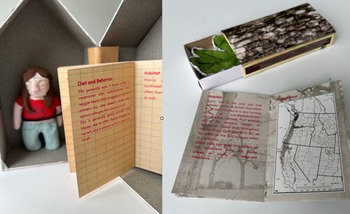
A pedagogy of change needs to meet the students where they are and prepare the ground for something unusual – there is an art to teaching for change (Fettes & Blenkinsop, Reference Fettes and Blenkinsop2023). The teacher must navigate how to understand where the student is, asking them to stretch, but not so far that they become lost. When teaching Design With All Beings, Louise first asks the students to become intimately familiar with one being, whether Stream, Rock, Heron, or Whale. This practice of intimately understanding a specific being allows students the opportunity to employ ethnographic design methodologies that are familiar to them, thereby beginning from a familiar footing. They gather information about two chosen beings. This can be analytical (Where does this being live? What do they eat?) as well as relational (this being has their own feelings and forms of knowledge.) From this they build a Species Card, a brief introduction to the species. Students are asked to do a parallel Species Card about themselves. Ella*, for example, referenced birding books when she described herself as a species of Mammalia in the primate order, with proportionally short arms, who sometimes makes a loud “HA” sound, and can often be found in the living room with her family. Other students named gluten intolerance or a penchant for junk food as part of their diet and some noted climate change as a threat to their survival. This assignment provides some grounding in a familiar activity of fact-gathering and analytic assessment and offers a nudge for students to see themselves as a species among other species. Ideally, this also begins to create the space to be in relation with a being who is different from them, to care about that being. It seeds the possibility of a shift in worldview away from anthropocentrism, human entitlement and mastery.
Ella Fortin’s representation of herself and Garry Oak with models and booklets. Images reproduced with the consent of the student.

Jonah Randell’s bundles of data for a hermit crab as well as one for himself. Images reproduced with the consent of the student.

Moving from scientific knowledge of the species cards to relational learning within nature brings intertwined challenges, the first of which is pragmatic: how to motivate the students to spend contemplative time outdoors. The second is that, for many students, expectations of learning are tightly constrained in a Western model of scientism, which leaves them searching for a specific method that they think will lead to a specific kind of “success”. The Modern Western expectation of knowledge is that it be repeatable, evident, delimited, resolvable, clear and precise. Western knowledge can be possessed, owned and contained in the same way that any other extracted resource can. This makes it difficult for students to make sense of learning as being something that can happen outdoors, that is incomplete, and that isn’t a human possession. The common expectation is that time outdoors is about freedom and personal enjoyment, learning happens in classrooms after all. Students don’t place much significance on the outdoors as a place where learning might happen.
While some students gravitated to open-ended time outdoors, many found it difficult to shift from the productivity-focused and problem-solving modes of design school. Giving them additional class time (with reference to Abundant Time) was only partly successful, because of the pressure of the overall curriculum. Students reported that they had chosen to work on their other courses rather than spend the allocated time outdoors.
Many indigenous populations have known the value of learning in nature for centuries. Class guest Aaron Nelson Moody (Squamish) talks quietly about sitting in the forest to learn. You just have to be still, he says. Chief Bruno Barras Duplyeke (Yshir peoples of Paraguay) spoke in the same way. He proposed directly naming the forest as a university, the university of the forest (Reference Vera and bruno Barras Duplyeke2022).
Complementing this is the need for openness to other ways of knowing. Jan Zwicky (Reference Zwicky2019), writes that gestalt knowing, a form of knowing that emerges without scaffolding and does not rely on logical accumulation of facts, has been ignored since the enlightenment. Recently, local Squamish First Nation guest Nicole Preissl (Reference Preissl2025) told the class a Halq’eméylem** word for a kind of knowing that is not in the mind, can only be felt: Shxwelí. She says it is one of those words that is not translatable, a non-detailed, non-specific way of knowing. It is understood as the essence that connects people, animals, plants, water, and the land, the shared life energy that links everything together. According to Nicole, Shxwelí describes a way of knowing where you don’t know that you know. Karl Wixon (Reference Wixon2020) founder of the Maori Design Society, describes how learning from nature relies on engagement of all the senses. If, as Stein (Reference Stein2022) says, the metacrisis is a confluence of crises in sense-making, capability, legitimacy and meaning, then modern knowledge systems have already failed us, and it is time to embrace these other ways of knowing. The challenge is to guide a student away from the quest for knowledge acquisition and towards a paradigm shift, an understanding of the value of our relationships with nature. This is not concrete knowledge. This kind of knowing is felt, learned through the body, incomplete, not a possession, often situated within a community or place, and certainly not just a product of an individual human intellect (see also: Bai et al., Reference Bai, Hockings, Haskell and Linds2001; Ford & Blenkinsop, Reference Ford and Blenkinsop2018; Jickling et al., Reference Jickling, Blenkinsop, Timmerman and Sitka-Sage2018; Fletcher et al., Reference Fletcher, St. Pierre and Tham2019).
For some students, this is too ambiguous. The cultural frame for education is to learn some THING, and that thing is usually imparted in the classroom. A few students were direct about this, saying that they had a much easier time focusing when they’re outdoors if they knew they were learning something. They wanted a specific role like counting species. They want to know what they are supposed to learn, and they want to know how they are going to learn it. This points to the potential of citizen science activities as a thresholding technique. M.J Barratt et al. (Reference Barrett, Harmin, Maracle, Patterson, Thomson, Flowers and Bors2017) writes about how a thresholding activity can help to bridge a student from the familiar to the new. Activities like citizen science do function as gateways to help people begin to connect with the natural world (Dickinson et al., Reference Dickinson, Shirk, Bonter, Bonney, Crain, Martin, Phillips and Purcell2012). Louise’s strategy was to assign a nature journal. This was revelatory for some but not for others. Swapping to read each other’s journals helped each to see how others worked through their experiences with poetry and drawing, while others did rubbings and wrote notes. Some journals triggered imagination, and others simply documented. All were valid. But still, this curriculum was inching along.
At this point, about a month into the 3.5-month semester, Sean visited the class and began introducing the prompts to the students through small group discussions. We felt a measurable lifting of worry in the room. The students seemed relieved that something about this discussion of sustainability and nature relations made sense to them. There was a relaxing of shoulders and a settling of postures. They began to chatter amongst one another about small, tangible things like learning from their elders, or understanding that all beings have a role to play in their futures. The class discussion was invigorating. Students noted that at first the prompts were challenging and complicated, but when they heard each other’s perspectives, many things came together. Some found they finally understood the connection between climate violence and social violence. This insight alone validates the importance of the prompts. The success of the introduction may have been in part due to Sean’s gifts as a teacher. Many students commented on his capacity as an active listener. They felt that he understood what they were saying and remembered what they had said when he returned to their group a second time.
The ease with which the students embraced the prompts was also an indicator of how accessible they are. Because there are six different perspectives, almost anybody can find their way into their relational worldview. Turning to the six prompts provided many grounding moments during the course. The prompts allowed the students to make sense of why they were learning this and what they were learning and at the same time, they opened new possibilities.
After the introductory seminar with Sean, the texts for the prompts were posted on the class online site, and students were asked to choose one or two prompts that they would focus on for the rest of the semester. This enriched the classroom discussion and provided an anchor, touchpoint, and reference for teacher and students as the semester evolved. For example, students talked about how the embeddedness prompt supported a way to access complex information by segmenting it. It became clear how the prompts are an example of this … how these huge concepts that we’d all been trying to grapple with became more accessible when we entered through the six prompts. Students spoke of how easy it was to see the overlaps between the prompts. In this way, the prompts became naturally integrated in class conversations at different points and times through the remainder of the semester. Louise would refresh herself regularly with reminders to focus on one or two of the prompts forward each week.
In this course, Indigenous guests have discussed All My Relations in different ways. Connie Watts (2020–22) maintained with a clarity throughout that we are all one. She spoke of how everything is energy, and all is related. For many of the students, and for Louise, she opened joyful possibilities of having a relationship with Rock, Tree, or Mountain. When Aaron Nelson Moody (2023–24) contributed, he embodied relationship in the way that he carried himself, the way that he told stories instead of giving answers. When he talked about sitting in the forest to learn, he conveyed a resonant experience, a gravitas, a truth that made All My Relations tangibly present in the class. This deeply embodied knowledge is something that educators might develop in themselves with the kind of time and dedication that Buddhists bring to their practice (Nhat Hanh, Reference Nhat Hanh2016). Nicole Preissl (Reference Preissl2025), attributed a lot of her wisdom to her lineage, which was very powerful. When she said “…well, my grandmother taught me that we are all related,” her words carried authority in a way that they would not from a Caucasian-settler teacher. During this current iteration of the course, the pre-existing familiarity and comfort with this prompt made it easy to move quickly to acceptance of the other prompts.
The Mystery &Unknowability prompt was especially important to all groups: teacher, students, designers. With the help of this prompt, the students quickly accepted that they didn’t need to know everything. Early in the semester, they were working on a system map, a visualisation of the interconnected world of a being. They initially approached this as a fact-finding task, packing their diagrams with masses of detail. Bringing Mystery &Unknowability into the discussions allowed for a shift of focus from facts to relationships. Louise felt able to be clear about letting go of a quest to figure everything out. This shifted the student energy away from mapping as a technical assignment to “fill in the blanks” and opened up the possibilities for conceptual and spiritual understandings. Working pedagogically with this prompt allowed conversation about how it can be empowering to stop trying to acquire content and sit still to see relationships. Indigenous guest Nicole Preissl reminded them that they might not see their species, but they can connect with many of the companion species in their ecosystem. She talked about companion species and how they are grouped together, suggesting that students might learn about the beings who are in relationship with their chosen being to connect a bit more with their being. In essence, making friends with the being’s friends. Her frankness about how long it takes to get to know another species was helpful. Mystery &Unknowability is liberating. Even more radical is the full embrace of the unknowability, the opening to an awareness that there is something on the other side, either literally behind a tree or, deep inside that we can’t come close to understanding or knowing. This begins to counter the scientism that pervades expectations of design (Cross, Reference Cross2001). Mystery &Unknowability releases the designer, and educator for that matter, to work more in a realm of imagination, to stretch their intuition and other ways of thinking, and to accept that spiritual perspectives are important.
There is something poetic about the prompts that takes us out of the instrumental mindset of design. Design’s efforts have been explored by many designers who engage with the metacrisis (Boehnert, Reference Boehnert2018; Fletcher et al., Reference Fletcher, St. Pierre and Tham2019; Walker, Reference Walker2017). Internationally renowned design theorist Tony Fry (Reference Fry2009) has long claimed that early attempts at sustainable design were instrumental and weak. Exploring the liminal and the poetic is one route away from instrumentalism. Louise would ask the students to focus in on a prompt from time to time. “Design to the prompt as if your being is sitting beside you, encouraging you.” Snowberry might be the voice encouraging a bit of joy when designing to the prompt of Embeddedness & Integration, asking the designer to wander gently around possibilities rather than strive for a “solution.”. Raven as trickster might encourage humour and play while exploring Abundant Time, and so on. These kinds of questions can help students step outside of their own norms and assumptions, and out of the assumptions of the field itself. The following section considers what the prompts offer to designers.
On designer
Designers are flooded with information and guilt about the ecological crisis, much of which is overwhelming and confusing. The segmentation into 6 prompts helped to temper the anxiety and sense of being overwhelmed that the student designers may have felt. Further, designers labour under the burden of the expectation that they are supposed to arrive at a “solution”, a specific applicable answer for mitigating at least some if not all of the crises. This expectation is both unrealistic and constraining. The prompts offer many ways into and through sustainable and ecological design, allowing a focus on different views at different times. The prompts support forays into exploratory thinking, poetic exploration, and relational awareness. We extrapolate that the prompts could be valuable to all designers.
While all the prompts foster exploration into relational awareness, Embeddedness and Integration does this most directly. Kritchai (Jet) Bhianok considered this prompt’s insights into transformation and evolving relationships as he explored how to represent the monarch migration. He created butterfly imagery by transforming soda cans, orange peels and leaves. At first, he assembled these as separate representations, but he was not satisfied, so he looked again. His final project combined all his orange peels, soda cans and leaves, in an image of the monarch migration across North America. This is an example of how Recreative Dissonance, works in the design process. Teachers strive to help students become comfortable with what we call iterative design: make it once, shape it twice, unravel it a third time, and so on, becoming increasingly familiar with the discomfort of the ruptures, and becoming disengaged from any early assumptions. Iterative design, or Recreative Dissonance is a central part of the creative process.
Kritchai (Jet) Bhianok: First renditions of monarch on the left, finished map on the right, combining all materials. Images reproduced with the consent of the student.

The same prompt could mean different things to any designer. The prompt Ancient Futures helped students talk about time passing before, within, and after their project, which is something design students and designers rarely consider. Designers also often feel a great deal of pressure to be original, even though the wisest designers know that is not truly possible. Still, the notion that new is always better drives their clients, and their briefs. Student designers who learned through the Ancient Futures prompt that ideas circulate constantly, and new is not always better, mentioned feeing a relief from the pressure to be an original. Seasoned designers could benefit from this reminder, even if they are buried in the pressures to perform as if new is possible. Two examples below illustrate how a single prompt like Ancient Futures can inspire projects in different ways.
When Ella Fortin talked about Garry Oak, there was no question that she loved this being. Citing Ancient Futures, she told stories about how Garry Oak loses limbs, making homes for other creatures over time. On a personal level, she described how she hoped that she might pass along the gifts of loving Garry Oak to her descendants. This took the class into a discussion about Ancient Futures as a constant evolution of life. Ella created a lamp with a removable muslin cover that one could write, draw, and print on to bring memories of Garry Oak (and other beings) home with them. More than a tribute to Garry Oak, this is a process of active attention that could be shared with others.
Ella Fortin: A muslin notebook of impressions of Garry Oak becomes a lamp of memories in the home. Images reproduced with the consent of the student.

Haoyu (Kaya) Ding related Ancient Futures to the long life of Ginkgo Tree and tapped into how, for her, Gingko carried a mythological sense of time and history. She created a poetic device intended to question our notions of time. Her project is a collection of hand carved stamps representing life stages of Gingko, and a series of cards to be stamped with ink from Gingko seeds. These cards can be placed on a personalised “flip book”, to animate a story of time passing. The quality of time was open to interpretation by the person who stamped the cards and filled in the flip book. Haoyu’s quoted discovery below became an important component of the work and a window into the change possibilities that might exist.
Haoyu Ding: Carved wooden stamps representing life phases of Gingko and flip book style presentation of time passing. Images reproduced with the consent of the student.

By the end of the semester, the theme of care and affection was prevalent among the students. Nayantra Chilaka spoke of love for her being, Swamp Sparrow. For her, this project was “a shift from studying nature as an outsider to being in relationship with it.” Nayantra’s goal was to get into the space and mindset of Swamp Sparrow and discover how she might see through their point of view to some extent. To this end, she created a series of explorations including folded paper, habitat models and creative imagery that helped her feel into the elusiveness and strength of this being.
Nayantra Chilaka: Embodiments of Swamp Sparrow; creature in hiding, physical installation, imagery, model of habitat. Images reproduced with the consent of the student.

The prompts offer many ways of accessing and grappling with the pressures and tensions of the metacrisis. For designers, who often feel pressured to take action in the face of a crisis, the prompts help us to begin to temper our motivations and invite us to interrogate who we are and how we live in this world. The designers featured above have diverted from the conventional expectations of design, beginning to indicate a new approach for the discipline. All have used the tools, methods and processes of design to deepen an inquiry into meaning – meaning that can inform better responses to the metacrisis.
Summary thoughts: What we would do differently
Despite the many successes of this course, there are some needs for change. Louise would like to talk to students more openly about the traps and pitfalls of Modern Western education and its notions of knowledge. She would lead with the prompts earlier in the course and discuss the metacrisis as a philosophical rather than a pragmatic problem. This might help the students realise they were being invited to begin to think differently, and also to be different. She would be more explicit with the students about cultural frames, what they are, and how they constrict some forms of learning. Cultural frames are nuanced for student, for teacher, for designer. Louise would like to provide activities for students to notice and document their emotions, to feel into the cultural frames, and to know more about their learning/knowing edges. This might carry opportunities to bring students into the conversation about cultural weirding, discuss Recreative Dissonance in more depth, and challenge the drive of the design student to arrive at a finished, detailed, highly photogenic prototype.
For environmental educators some of the discoveries of this research probably seem recognisable, comfortable, and even confirming. Holding space for the body, emotions, the natural world to be part of the learning/creating process makes sense both in theory and in practice. Challenging students to engage with the natural world, discovering that nature and the outdoors can be both places of learning and active teachers, and allowing space in the pedagogical process for the unexpected and spontaneous have long been considered in various ways in the field. But perhaps, a couple of learnings from this, such as the power of physical making, might help frame these concepts differently, challenging environmental educators to make explicit some of the work they are doing and even change the emphasis, nuances, and foci of environmental pedagogies.
The first, takes us right back to Louise’s sense of self as “oddball” teacher and her feelings, anxieties, concerns, questionings of being different. These feelings are located not only deep within the psyche and the understandings of the cultural norms but appear deep in our bodies. The “Truths” of a particular culture are inscribed in our flesh. Environmental educators likely recognise these arisings from student responses to being asked to spend time alone in a city park or to having to describe a deep relationship they have had with a tree. Students express discomfort by describing their worries that other humans might think they are doing something weird. They may also frame their comments with somewhat undermining rejoinders (e.g. “I know this sounds a little out there …”). These are indicators that one is touching the boundaries of the acceptable, the edges of one’s internalised culture. Yet, for the work of eco-social – cultural change to have a chance it is apparent that education must play on, and even over, these boundaries. We have chosen to name this area of pedagogical practice “sanctioned weirdness.” In this example we can see it in role modelling as Louise is willing to stand at the edge of the cultural boundaries of educator and designer (and human perhaps) despite her anxiety. We see it in the creation of a pedagogical arc that recognises where students are at, builds on the students’ comfort, then offers threshold activities and touchstones (like the prompts) that allow the space for students to take a step closer to the edge and perhaps lean-in, all while leaving space for the unexpected, mysterious, and unknown. It is a pedagogy of discomfort, always wanting to take another step. And it is a pedagogy of deep care as well, one that is seeking to expand the range of possibilities for all. We see the pedagogy of care in Louise’s commitments as educator, her work for nature as a co-teacher at every step through offering ongoing immersive activities followed up by check-ins while asking students to build relationships with a particular being. Her search for how to enact a genuine praxis is also visible in how she finds to critique and expand the design culture in which she has long been immersed.
A second learning drawn from this work we are calling “radical incrementalism.” Though less explicit than sanctioned weirdness in the above discussion it comes through nonetheless. The radical component of the work is that it is always active, seeking to flex and change boundaries. The work is active in its criticality both of the larger frame against which the pedagogy is pushing be it design, education itself, or the larger culture in which those are immersed. But it is also actively reflective of oneself as educator, designer, human. We can see this process in Louise’s practice whereby there is never a sense that we have reached the end of the journey, a happy place of comfort; this is activist in its continuing nature. Eco-social – cultural change is work. It is not unenjoyable and the arrivals along the way are absolutely worth celebrating but the “end” is never achieved. Just as how Louise’s pedagogy honoured the complexity of knowledge and its ability to slip away just out of reach, so too is the work of change. This is the incremental component of this learning. The cultural change needed to respond in rich and just ways to the metacrisis is not going to happen in one fell swoop, nor is it going to be the result of an individual’s good efforts. We agree with critical design theorist Tony Fry who calls for “the drifted, tribe, desperadoes, and the coming community of design striving to be set free of its tutelage” (Reference Fry2018). Important responses to the metacrisis will happen as a result of myriad radicals working incrementally across communities while also constantly being on the lookout for the next increment, the next place for possible change, as it appears.
Summary thoughts: What worked
Radical Incrementalism entails constant re-learning. In Design and Nature (Reference Fletcher, St. Pierre and Tham2019) Kate Fletcher and her colleagues advocated physical relationships and direct contact with the earth as one way of re-learning how to live in the ecosphere. Louise’s primary goal with this course was to bring students into visceral awareness of themselves as part of the natural world where we are no better or no worse than any other being. This repositioning of ourselves as humans as equal members of a living world is an important part of re-learning for dealing with the metacrisis. It opens the door to different possibilities with regards to being human and makes some of the challenges of eco-social – cultural change more explicit, something most environmental educators are quite comfortable with.
What worked, in the context of this course was to be prepared with some specifics, moments of clarity, and thresholding activities. Students need something to hold onto (we all do). In doing so, it was important to continue to teach some of the qualities and skills of design that are familiar and valued by designers. It is also important to recognise that eco-social – cultural change is not about throwing everything out and starting anew. That is an impossible task and tends to bend the change process back to the status quo because there isn’t enough to build on. This inclusion of the familiar gave the students some moments of grounding. Depending on where the course is contained, this kind of disciplinary connection would necessarily be different. We have mentioned some examples from design, like journaling in nature, peer learning, mapping activities and traditional ethnographic research. There are many other parts of any teacher’s toolkit for change pedagogy, like clear checklists, leveraging from what is familiar to embrace change, circling back to check-ins regularly, and so on. To this, we add the value of the prompts as touchpoints that help to centre conversations and give students something to hold on to as they push off into the deeper waters of change.
For the design teacher, working the prompts helped to offer moments of reassurance and insight throughout the course. Because the prompts are written in academic language, they helped Louise to bridge conventional expectations of learning and to free herself into a “sanctioned weirdness.” The prompts provided leverage to challenge modernity, and to unseat contemporary expectations of design. Admittedly the prompts have never been systematically applied in environmental education this way (that we know of) but it is our contention that they could potentially have similar effects. Perhaps, in some cases, the prompts might land more in environmental education, given their underlying commitments to justice and the ecological. How might, for instance, a prompt such as abundant time influence a riverine environmental studies course or (re)creative dissonance change the focus and languages employed during a nature walk?
For the student, the prompts offered ways of dealing with the overwhelm. As students became less overwhelmed, they could relax into what the course was offering them, usually enough to open to the visceral and other ways of knowing conferred by nature as teacher. The prompts offered a way to enter into a different view of the world and refreshed or reset conventional expectations of learning. They brought a shift in the conception of what knowledge is. For many environmental educators this shifting of epistemologies might be a welcome encounter and having the prompts adds language and support to the work being done.
For the designer, the prompts opened up new territories of creativity and helped to ask the larger relational questions. One asked, “A tree provides a hiker with a walking stick, but what does a hiker offer a tree?” Another came to the realisation that instead of trying to design a product to sell or use, she could be designing something that helped people feel the greatness of Gingko Tree. These insights are not always easy to see in the “product” outcomes of a design class, but these shifts in how young designers are thinking are the true success of the course. Perhaps a small step towards a more substantive change not just in the behaviour of a few individuals but in the very idea of what it means to be learner, educator, designer, and even human.
In looking at the metacrisis, we see how important it is to be in relationship with the socio-ecological fabric that predicates our existence. This paper has highlighted some strategies for a pedagogy of change and noted how they are supported by these six design prompts for eco-social – cultural change. Regardless of the discipline, the prompts function as touchstones and windows to help the learner become more engaged with the ecological world, with a wider range of possibilities for who they might become, and with a more diverse, vibrant, polyvocal, and ethically demanding world abutting the edges of their conventional frames.
Epilogue: After the writing of this paper, Louise is in her next iteration of teaching this course and is finding it much easier to be relaxed and confident in the classroom. Her efforts to be honest about her own tensions around her cultural frames as a teacher have opened up lines of trust between her and the students. These days, teaching is fun!
*This student has given permission to include their name and their story in this paper.
** Halq’eméylem is one of the many First Nations languages of the South West coast of British Columbia, comprising as many as 17 dialects. See also: https://www.firstvoices.com/halqemeylem/our-language
Acknowledgements
Appreciate the work of all the editors, guest and otherwise, involved in making this special issue happen. Thanks! We also acknowledge the efforts of all the students in DESN 340 and INDD 310 at Emily Carr University in the Spring semester of 2025.
Financial support
This research received no specific grant from any funding agency, commercial, or not-for-profit sectors.
Ethical standards
All of the students were informed that the professors were writing a paper on pedagogy of this class. The students whose work is featured in this paper signed release forms to allow the publication of their images and stories fully credited with their names. They were also given the opportunity to review this paper before publication.
Author Biographies
Louise St. Pierre is a design professor in the faculty of Design and Dynamic Media at Emily Carr University. She has been teaching and researching animist and Zen Buddhist relationships between design and nature since 2005. She is co-author of internationally recognised ecological design curriculum, Okala 2003, 2013), and established Canada’s first Design for Social Innovation and Sustainability (DESIS) Lab at Emily Carr University, (DESIS n.d.). She has authored several books and chapters on Nature’s systems, including Design and Nature: A Partnership (2019)
Sean Blenkinsop is a philosophy of education professor in the faculty of education at Simon Fraser University. Current research explores teacher education and imagination, school and cultural change, eco-social justice, and nature as co-teacher and co-researcher. Most recent books are: Wild Pedagogies: Touchstones for Re-Negotiating Education and the Environment in the Anthropocene Palgrave-McMillan (2018); Ecoportraiture: The Art of Research when Nature Matters Peter Lang (2022); Education as Practice of Eco-social – cultural change Palgrave-McMillan (2023); and, Ecologizing Education: Nature-Centred Teaching for Cultural Change Cornell (Reference Blenkinsop and Kuchta2024) which gathers learnings from a series of eco-elementary schools he has helped create and research.



 Open access

