


An independent judiciary wielding judicial review is thought vital for a wide variety of outcomes, including the rule of law (Helmke and Rosenbluth Reference Helmke and Rosenbluth2009), property rights and development (North and Weingast Reference North and Weingast1989; Voigt, Gutmann, and Feld Reference Voigt, Gutmann and Feld2015), democratic stability (Blauberger and Kelemen Reference Blauberger and Daniel Kelemen2017), and human rights protection (Powell and Staton Reference Powell and Staton2009). As a result, explaining independence is “the central puzzle” in comparative law and courts scholarship (Vanberg Reference Vanberg2015, 168). Fundamental to any answer is why other political actors, specifically the executive, would establish, allow, or expand the judiciary’s power. That is, why would democratic actors ever countenance or create another actor capable of challenging their powers and prerogatives, and deciding on the constitutionality of their chosen policies?
Strategic accounts focusing on the endogenous incentives of political actors in respecting judicial authority have emerged as the leading framework in tackling this puzzle (VonDoepp and Ellet Reference VonDoepp and Ellet2011; Vanberg Reference Vanberg2015). In such accounts, although more independent judiciaries do directly constrain democratic leaders, under certain conditions the indirect benefits they offer outweigh these constraints. These benefits can include ensuring credible commitments (Landes and Posner Reference Landes and Posner1975; Hayo and Voigt Reference Hayo and Voigt2007) and avoiding blame for unpopular policies (Graber Reference Graber1993). The most prominent and well-examined benefit, however, derives from work on the insurance model of independence, which posits that the signal benefit of independent courts accrues to leaders once they are out of office. Here, independent courts serve as insurance policies against future unconstrained policymaking that can imperil the policies, politics, or persons of those formerly in power, because the minoritarian constraints imposed by independent judiciaries can inhibit the wholesale reversal of policy accomplishments, limitations on political access, or politicized prosecution by opponents who have secured electoral office (Dixon and Ginsburg Reference Dixon and Ginsburg2017). These minoritarian constraints are thus attractive when those in power are uncertain of remaining there, and costs are paid in the present to insure against future downside risk.
First advanced by Ramseyer (Reference Ramseyer1994), the policy-focused version of the argument was given a more extended treatment by Ginsburg (Reference Ginsburg2003) and formalized by Stephenson (Reference Stephenson2003). Since then, insurance-based explanations have become common, to the point of being the dominant explanation for the phenomenon. Finkel (Reference Finkel2005) and Ríos-Figueroa (Reference Ríos-Figueroa2007), for example, offer insurance accounts for increasing independence during the era when the Partido Nacional Revolucionario (PRI)’s dominance of Mexican politics ended; Finkel (Reference Finkel2008) takes Ginsburg’s argument about Asia and applies it to a comparison of Latin American countries, and Stroh and Heyl (Reference Stroh and Heyl2015) consider insurance’s relevance in Africa. Chavez (Reference Chavez2003), on the other hand, examines within-country variation, showing that the concentration of political power at the provincial level helps explain differences in judicial independence across Argentina. It has even moved beyond the purely democratic context, with Popova (Reference Popova2012) and Epperly (Reference Epperly2017) offering arguments about competition’s role in electoral democracies and autocratic regimes, respectively. Despite much work applying the insurance model, theoretical development of the model has been minimal, with almost all work shifting the focus to new cases rather than refining – explicitly or otherwise – the causal logics underpinning the theory. This has not only inhibited theoretical advances, but also systematic analyses: after two decades, there exist only a handful of pieces attempting to test the insurance account across time and space, with these further suffering from problems of measures not matching concepts, problematic coding of cases, or the inclusion of independence as an explanation for itself.Footnote 1 Given the prominence of insurance accounts, this theoretical and empirical research gap presents serious problems for advancing our understanding of the primary concern of comparative law and courts scholars.
What, however, are the causal logics underpinning the theory, and how has their development not kept pace with the research output of insurance proponents? While the analogy of independence as “insurance” might originally have been primarily a framing device, it is not a mere analogy: thinking more explicitly about the demand for judicial independence as akin to the demand for insurance more generally better captures the causal logics underpinning the insurance account of independence. This is because at heart, insurance theory is about an expected utility calculation made by those in power (Ginsburg Reference Ginsburg2003): given the parameters, what is the ideal strategy (insured vs. uninsured) going forward? Attempts to model this argument – theoretical and empirical – need, therefore, to model the underlying demand for insurance, rather than simply using electoral competition as a suitable proxy. This is because the demand for insurance is itself a calculation comprised of three specific parameters, which only in combination are able to adequately gauge the need/demand for insurance.
The first parameter is the probability of the event being insured against. In the context of judicial independence, this is the likelihood of losing office, almost always operationalized as the degree of political (specifically electoral) competition, as when opposition parties are more electorally successful, the likelihood of being swept out of office is higher. In existing research, this (incorrectly) proxies for the overall demand for insurance, which means these accounts ignore the second parameter of demand for insurance, the magnitude of the risk/threat imposed by the event being insured against. The level of risk affects not only whether one purchases insurance, but also how much. Despite being ignored in existing work, for insurance models the risks imposed by losing office are fundamental. Recall, mitigating these risks is the solution to the puzzle of why political actors would ever bind their hands with independent judiciaries in the first place; existing work therefore treats as constant and assumes away the very thing – the perceived risk of being out of office – that motivates the causal story. The third parameter is the cost of insurance, that is, the premium one must pay regardless of whether one ever cashes in on their insurance policy.Footnote 2 The insurance premium here is the constraints independent judiciaries impose on political actors: whether or not one ever needs insurance against the downsides of losing power, one nonetheless must pay the premium for the insurance offered by independent courts.
One reason theoretical development of insurance has failed to keep pace with the research output of its proponents is because this research focuses almost exclusively on the first parameter of insurance theory’s expected utility calculation, improperly treating it as the demand for insurance itself rather than one parameter that demand. While variation in this first parameter (the likelihood of losing power) is obviously of vital importance, and while variation in the third (the insurance premium imposed by independence) can perhaps help explain less democratic contexts (Popova Reference Popova2012), in democracies it is critical that we also account for variation in the risks associated with the event being insured against.Footnote 3 This is because absent serious attention to risk, insurance theory remains inadequate as an explanation to the central puzzle of comparative law and courts. And although some scholars observe that the risks of losing office vary (Epperly Reference Epperly2013; Dixon and Ginsburg Reference Dixon and Ginsburg2017), no attempts have been made to either systematize these insights or integrate them into insurance explanations of independence. Addressing this lacuna – both theoretically and empirically – is our goal.
To do so, in the next section we develop a theoretical account that addresses this fundamental oversight, focusing on the demand for insurance rather than simply one aspect of said demand. Revisiting the fundamentals of insurance in general, we develop a framework that takes into account not only electoral uncertainty but also how dangerous it is to lose power in a given political environment (formalizing this in the supplemental information). In the subsequent section, we first present a cross-national analysis of nearly half a century of data on the relationship between the demand for insurance and de facto judicial independence. Recognizing that such an observational analysis is far from definitive with regards to the causal nature of the theorized relationship, we present an instrumentation strategy to help achieve identification. Drawing on disparate literatures and behavioral work, we explicitly address the plausibility of the instruments. In the final section, we discuss the implications of our manuscript for the comparative study of law and courts and the challenges we identify for both our theoretical framework and further research.
Our three key contributions follow the order of the manuscript. First, we not only provide the most “complete” articulation of the insurance model of judicial independence to date, but in doing so theoretically advance the insurance literature. Despite being the dominant explanation for the central puzzle of the subfield, existing work ignores, in effect, half the calculation being made by political actors when they weigh the demand for insurance. We integrate this and lay out a new important factor for the dominant explanation to the puzzle. To better theorize, model, and examine the calculations made by political elites regarding independent courts means taking seriously not just the likelihood of losing office, but the risks thereof. This first contribution reframes the theoretical study of independence; our second and third contributions are empirical.
Second, we offer the most thorough cross-national test of insurance in democracies to date. Rather than using a cross-sectional analysis that conflates autocratic regimes with democracies (Aydın Reference Aydın2013; Stephenson Reference Stephenson2003), we examine decades of data to explain variation within democracies over time as the demand for insurance varies. Third, we present one of the first attempts to leverage instrumental variables to identify the causal effect of the demand for insurance. The plausibility of our instruments meeting the exclusion restriction is of vital importance, and addressing it is itself a contribution to the toolkit of comparative courts scholars. Combined, we offer the most complete theoretical account of the logic underlying insurance theory thus far, and use the most carefully constructed universe of observations to make a first assessment of the causal nature of the relationship. As a result, we are able to offer the most fully developed answer – again only to date, of course! – to the central puzzle of comparative judicial politics.
Insurance
Insurance in general dates back nearly four millennia, with the Code of Hammurabi developing a system of mitigating risk for merchants, and the earliest recorded independent insurance contracts (unconnected directly to other investment or economic exchanges) occurred in Genoa nearly seven centuries ago. By the end of the 17th century, formalized corporations providing fire and marine insurance were established in London. Fundamental to insurance is risk, the possibility of uncertain adverse future events. For Babylonian and Genovese merchants, this was the possibility of ships or cargo being lost at sea; modern insurance was spurred by the risks faced by property-owning Londoners after the Great Fire in 1666 (Dickson Reference Dickson1960). The various forms of contemporary insurance are generally known not by the method of insurance (co-, dual-, self-insurance, etc.) but rather by either the risk being insured against (e.g., flood or earthquake) or the thing of value that is being insured (e.g., auto, health, or life). Risk is thus foundational to insurance, and not only the risk of the adverse event occurring, but also the severity of the potential outcome. Recognizing both aspects of risk, and their supreme relevance for insurance generally, is critical to a better understanding of the underdeveloped causal logic fundamental to insurance accounts of judicial independence.
The insurance model to date
Insurance models – though lacking the storied, millennia-long history of insurance more generally – have been a, if not the, dominant explanation for judicial independence for two decades, decades which saw increasing scholarly interest in comparative judicial politics (VonDoepp and Ellet Reference VonDoepp and Ellet2011; Vanberg Reference Vanberg2015). The logic underpinning the existing argument in existing research is straightforward.Footnote 4 In democracies where electoral competition is such that there are reasonable expectations of losing power, those in power should be far more willing to allow, expand, or establish an independent judiciary capable of checking unconstrained executive power. More competition, on balance, means more independence. This is not because a judicial check provides any immediate benefits to those in power, but because of the downstream effects of such a judiciary constraining those in office after alternation in power. The likelihood of losing office induces restraint and respect for a minoritarian institution capable of protecting policies, prerogatives, and persons once out of power.
The insurance logic thus foregrounds the importance not only of competition, but of sustained competition. When previously competitive systems become dominated by a single party, the likelihood that judicial independence is curtailed increases. When previously dominant parties slip, on the other hand, more de facto independence is expected. This is because independence is, like insurance, a way to manage risk: by tying one’s own hands now, one can reduce the political and policymaking power of successive opposition actors once in power. Existing accounts, however, treat electoral competitiveness, a measure capturing the likelihood of losing office, as capturing the demand for insurance itself; in doing so, however, they confuse one component of demand for demand itself.
The demand for insurance
A fuller understanding of the importance of the demand for insurance as a risk-management device requires attention to more than just the likelihood of losing office. Rather, it requires recognizing all three component parameters of the expected utility calculation implicit in all insurance accounts, and subsequently modeling the demand for insurance accordingly. The product of these three parameters affects the strategy pursued by political actors. That is, whether the pursuit of political insurance via an independent judiciary is worth the costs that judiciary imposes. The first factor, the likelihood of losing office, requires little further elaboration, being the focus of existing accounts. The second parameter affecting the demand for insurance (and thus whether political actors seek insurance) is the severity or magnitude of the uncertain outcome, here losing power. This second factor (severity of downside risk), when combined with the first (likelihood of realizing the risk), defines the risk which insurance is being “purchased” to mitigate.
Thinking of insurance more generally is again instructive. While the choice to carry life insurance is conditioned by an assessment of the likelihood that one may die, of equal (if not more) importance is an assessment of the severity of this event’s consequences: an unmarried individual lacking dependents is far less likely to consider the event’s severity (for insurance purposes) to be as great as would a sole breadwinner of a large family. The same is true of more esoteric insurances like career insurance, which insures against injuries that prevent an individual from resuming their professional career. Expansive career insurance policies are commonplace in the world’s top soccer leagues, where possible lost income can reach massive sums. Despite generally comparable likelihoods of injury, this is not the case in lower leagues, where losses from career-ending injuries are far lower. Note here, that variation in the second factor, not the first, largely determines the strategy pursued: expansive (and expensive) insurance for players in top leagues, minimal (if at all) insurance for those in the sport’s lower echelons.
This leads to the necessary question of whether the severity of the event being insured against – losing office – varies enough to be considered non-constant. In conventional insurance accounts, the downside of losing office is largely envisioned as an unconstrained government reversing preferred policies. Obviously, the degree to, and rapidity with, which policy change occurs varies considerably across democracies, with some having minimal veto points, making extreme policy revision more likely. Similarly, within countries, temporal variation is also relevant, as who succeeds who is also important: the policies of a center-right government being followed by a centrist coalition are less threatened than if followed by a unified left-wing government. Clearly, the severity of losing power for policy outcomes can vary across and within democracies.
Recent research, however, suggests that policy reversals are neither the only, nor even the primary, risk leaders might insure against. Instead, political prerogatives, access to economic resources, and even personal security, are risks of losing power, and risks that independent courts have been theorized and shown to help mitigate (Epperly Reference Epperly2013; Dixon and Ginsburg Reference Dixon and Ginsburg2017). For example, scholars examining the Philippines, Italy, and South Africa argue that independent courts have clear incentives to maintain existing levels of political rights and challenge unilateral attempts to revise constitutional bargains, and that leaders establish or entrench their independence to ensure such (Hirschl Reference Hirschl2004; Volcansek Reference Volcansek2010; Gatmaytan Reference Gatmaytan2011). When it comes to personal insurance, the story is different but the implications are the same. In this framework, independent courts offer protection against targeted punishment via politicized prosecution. In systems with dependent courts, new leaders either replace judges appointed by those previously in power, and those that remain often “strategically defect,” aligning with those now in power (Helmke Reference Helmke2005). Independent courts, however, retain their levels of independence after transfers of power (Epperly Reference Epperly2019), and are able to provide meaningful bulwarks against politicized prosecution; both because such attempts are more likely to fail when justice is impartial, and because meddling with independent courts can spark public outcry (Vanberg Reference Vanberg2005).Footnote 5 In the subsequent section, we leverage this third, personal form of insurance to model variation in the severity of risk associated with losing power.
The final factor that combines to create the demand for insurance is the cost independent judiciaries impose on those in power. This factor is integral because it is the puzzle producing the research question itself: why allow other actors to constrain your behavior? It is these constraints that determine the “premium” political actors must pay for an insurance policy. To date, none have attempted to measure or show that the costs independent courts impose vary, with all instead treating these costs as a constant. The potentially insurmountable empirical problems in doing so are likely why. Measuring the independence of a judiciary is a difficult – though hardly impossible – enough task (Ríos-Figueroa and Staton Reference Ríos-Figueroa and Staton2012); measuring the costs imposed by an independent court is substantially harder. Consider, for example, the issues facing the use of rulings against the government as a signal of the costs imposed by courts. While governments are often unhappy with rulings blocking their preferred policies, significant research also suggests they sometimes welcome unfavorable rulings, which allow them to avoid blame for unpopular policies (Whittington Reference Whittington2009). Similarly, historical and recent experiences from differing polities such as the United States and Hungary illustrate the problem of using partisanship of the executive appointing high court judges in determining how much they might constrain leaders.Footnote 6 It is thus likely that for the foreseeable future, insurance research – like all comparative law and courts scholarship – will be forced to recognize that while independent courts no doubt constrain, the variation imposed by such constraints is difficult to ascertain.
We previously stated that insurance theory is fundamentally predicated on the demand for insurance. It is worth reiterating that the risk being insured against is the product of both the probability of the uncertain outcome and the severity of such an outcome if it occurs (conditional on the costs imposed by independent courts). For independence-as-insurance, this is the (i) likelihood of losing power and (ii) severity of losses if power is lost. As this is the case, the product of the two is the demand for judicial independence as insurance, as insurance is simply a way to mitigate against uncertain negative outcomes, that is, risk. Understanding that the demand for insurance is the product of these two factors is key: one demands insurance when the likelihood of an uncertain negative outcome is at least moderate, but does so only when the losses associated with the outcome are significant. In other words, one insures against large losses one can plausibly foresee occurring, rather than either exceptionally unlikely catastrophes or predictable but insignificant losses. Those living along the lower Mississippi are likely to seek flood insurance (indeed they are forced to), as losses can be large and the uncertain event is somewhat likely. On the other hand, because they view it as an exceedingly low-probability event, few on the Pacific Northwest coast seek earthquake insurance, despite the fact that a full-margin rupture of the Cascadia subduction zone would be the worst national disaster in North American history (Schulz Reference Schulz2015). Capturing the demand for any form of insurance therefore requires attention not to the individual components producing the demand, but their product, the overall demand itself.
We contend that the same calculation is built into the insurance theory of judicial independence. This perspective may seem intuitive, as it does, after all, comport with what we know about both risk-management and insurance more generally. Intuitive or not, however, the robust insurance literature in comparative law and courts universally disregards the second component of risk. Ignoring this hinders theoretical development of the insurance framework, and is a key reason for nearly two decades with only minimal theoretical advances (empirical have occurred) in the study of this central puzzle. A further result is the fact that no work to date has accurately modeled or tested the actual causal logic – the demand for insurance – upon which the insurance model is built.
The risks of losing power
While an independent judiciary may be able to insure against unwanted policy reversals by providing minoritarian protections, it also offers other forms of insurance to those formerly in power. Epperly (Reference Epperly2013) first articulates this, arguing that independent courts provide far more personal security against politicized justice than their dependent counterparts. This is because those staffing dependent courts, fearing replacement, rarely remain dependent on those who appointed them once political winds shift (Helmke Reference Helmke2005). Using data on whether leaders are punished after losing office, Epperly demonstrates that higher levels of independence are strongly associated with lower probabilities of punishment, regardless of democratic age, level of economic development, or nature of the executive. Dixon and Ginsburg (Reference Dixon and Ginsburg2017) further develop the idea of varieties of insurance, arguing they can be categorized into power, policy, and personal-based forms. As they note, when political elites face exit from power due to declining electoral fortune, there are two risks more immediate than losing policy influence. First, that this decline in power and exit signals not the ebbs and flows of normal politics, but a long-term loss of power. Second, “that they will be subject to individual forms of retaliation or punishment at the hands of a new government” (Dixon and Ginsburg Reference Dixon and Ginsburg2017, 994). It is clear that an independent judiciary can mitigate both risks. First, because an independent judiciary is far more likely than one beholden to those newly in power to block expansions of executive power that tilt the playing field against the opposition. Second, because as Epperly (Reference Epperly2013) explains, independent judiciaries are far more able – and likely – to provide a check against the use of legal means of targeting former leaders. It is this second aspect of political insurance, and empirics on the likelihood of being punished after leaving office, that we leverage to more fully develop a theory capturing the demand for insurance.
A focus on the risks of personal targeting after leaving office offers two important benefits that other forms of risk do not. First, whether an independent judiciary provides insurance in the form of personal security is arguably the most fundamental form of insurance it might provide, as protecting policy outputs is cold comfort for a former leader facing politicized prosecution. Indeed, it is difficult to imagine a judiciary able and willing to robustly protect minoritarian policy prerogatives, yet unable or unwilling to protect personal security; personal security is therefore in a sense a “floor” of any insurance policy. Second, it is easy to observe what happens to former leaders in any given state, meaning those in power have some baseline expectation of what sorts of things happen to former leaders in their society; this means one of the key components of the demand for insurance can be effectively measured. Unlike questions of policy stability or attempts to tilt the political playing field – where obfuscation is for obvious reasons common – whether previous executives faced punishment after leaving office is unambiguous. Whether or not such punishments are “fair” is irrelevant for those in power considering their predecessors’ fates. Many executives in democracies engage in actions for which plausible arguments of venality, overreach, or outright criminality can be made: consider calls were made by mainstream actors for investigating the actions of Tony Blair, George W. Bush, and Gerhard Schröder, let alone more recent executives.
There is likely a random component for any given leader with regards to the likelihood of punishment after leaving office. Among those who do engage in actions worthy of prosecution and punishment, for example, there should (like with any crime) be variable expectations of “getting away with it.”Footnote 7 On the other hand, for those facing politicized punishment after leaving office, potentially-unrelated “random” factors such as the state of the economy, popularity on leaving office, and the vindictiveness of the opposition should all introduce a random component into the equation. Of course, to the degree that these functions are in fact random, their effects are unpredictable and should have little effect on calculations leaders make. As such, leaders should be able to gauge the acceptability of targeting former leaders in a given polity, and from there discern some baseline probability of punishment.
Measuring personal risk
Given that absent other evidence the past is the best guide for the future, the fate of a polity’s previous leaders is highly instructive for those in power. As such, to capture this aspect of the insurance calculation, we calculate the percent of post-World War 2 leaders who were punished after leaving office,Footnote 8 with punishment defined as former executives who were either imprisoned, exiled, or killed after leaving office, using data popularized by Goemans, Gleditsch, and Chiozza (Reference Goemans, Gleditsch and Chiozza2009). For ease, we aggregate these three punished categories, so that the substantive interpretation of our percent-previously-punished measure is straightforward: if in 1990 a given state had, for example, four previous post-war leaders, two of whom were punished, then that observation would be 50% of former leaders punished. If by 1991 a sixth leader had assumed power, and the fifth leader (in office in 1990) was unpunished, then the percentage would fall to 40%; had said previous leader been punished, the percentage would rise to 60%.
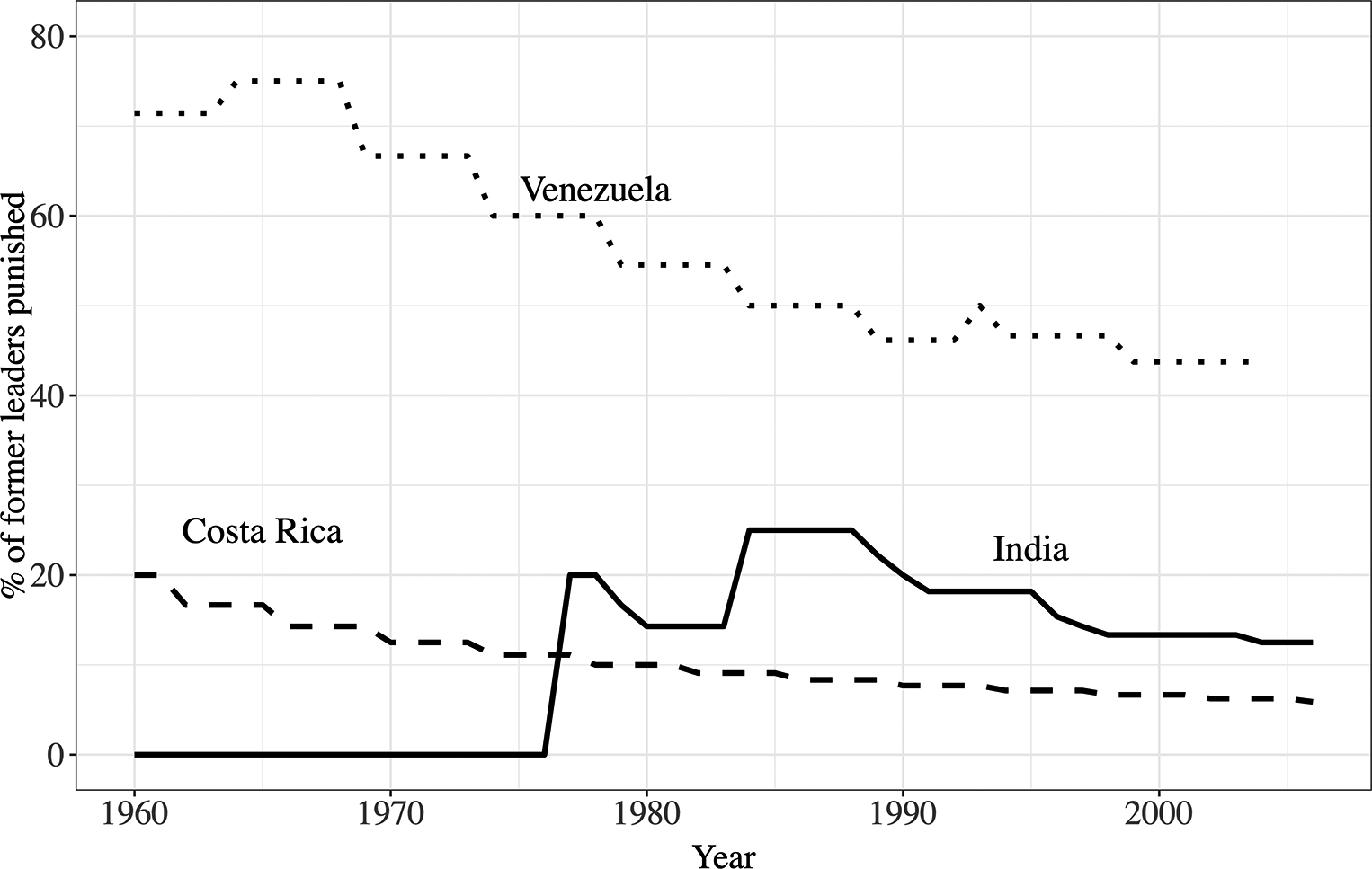
To illustrate our measure concretely, Figure 1 plots time-series of the percentage of post-war leaders punished after leaving office for Costa Rica, India, and Venezuela. Looking at Figure 1 we see that in 1970, over 60% of post-war Venezuelan leaders had been punished after leaving office, compared to 12.5% in Costa Rica, and 0% in India. Figure 1 thus conveys how examining the prevalence of punishment offers an obvious understanding of the causal logic outlined above. Over the second half of the 20th century, both Costa Rican and Venezuelan executives became less likely to be punished after leaving office, thus suggesting that the risk being insured against was falling in both states, but always far higher in Venezuela. Contrast this to India, which observes a sharp rise through 1977–1985, tapering off towards the 21st century.
Percentage of Former Leaders Punished After Leaving Office in Three Countries. The Distribution of Punishment of Those Previously in Power as a Percentage of Post-War Leaders in Costa Rica, India, and Venezuela.
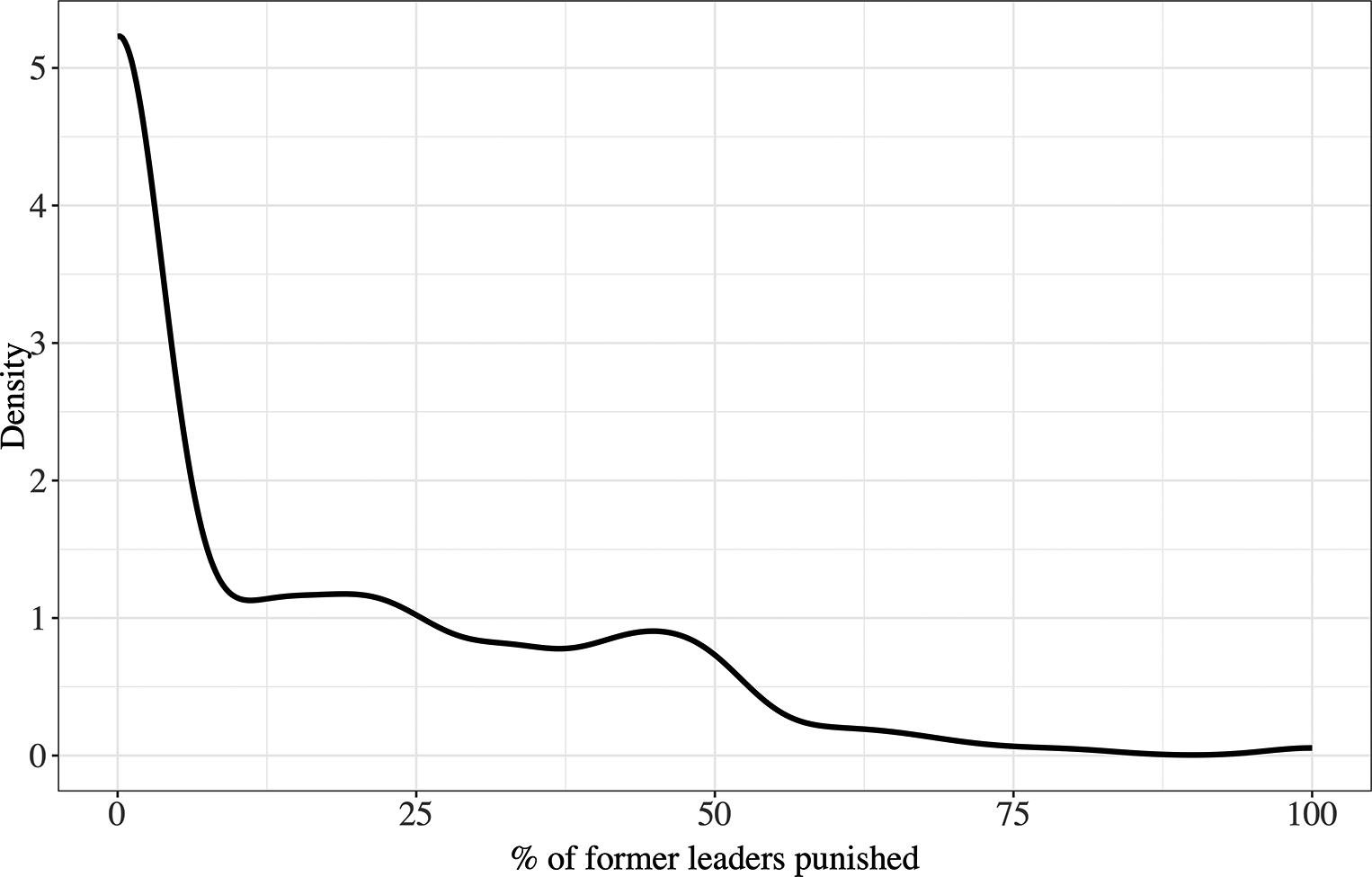
Although Figure 1 shows the percent of former post-war leaders punished over time for three states, it does not show to what degree these are representative of democracies as a whole. To illustrate this, Figure 2 plots the density of percent-previously-punished in the population of democratic country-years. Figure 2 demonstrates that there is significant variation in the frequency of punishment, and thus the risk to be insured against. While in most instances no former leaders experienced post-tenure punishment, in 43% of country-years, a non-zero percentage of former leaders were punished. In this large minority of observations, on average one out of every three leaders was punished after leaving office (both the median and mean values are 0.33). In other words, the risk associated with losing office varies widely within and between democracies.Footnote 9 And given the fundamental nature of the demand for insurance generally, significant differences in personal risk implies that the demand for independence-as-insurance should vary, irrespective of the likelihood of losing office.Footnote 10
Distribution of Former Leaders Punished After Leaving Office. The Distribution of Punishment of Those Previously in Power as a Percentage of Post-War Leaders by Country-Year.
Measuring the demand for insurance
Assessing our theoretical model requires, most importantly, effectively operationalizing the demand for insurance, which is the product of (i) the likelihood of losing power and (ii) the risks associated with this outcome. Obviously, no leader choosing to purchase, continue paying for, or cancel an insurance policy has a perfect gauge of whether the downside risk will occur, let alone a precise probability of such. Nonetheless, lacking a precise value is not the same as lacking any estimate, and therefore finding a proxy that captures a general degree of risk is necessary. We discuss above how to measure such risk: the percentage of previous leaders of a given state at a given point in time who were punished after leaving office.
Effectively operationalizing the demand for insurance also requires measuring its first component, the likelihood of losing office. Here, we follow general consensus in the literature, measuring this as the competitiveness of the electoral system. While the choice of specific measure of electoral competitiveness varies, we follow Epperly (Reference Epperly2017), who argues that the Henisz (Reference Henisz2000) political constraints measure captures the underlying concept better than other measures. As the reason for insurance is to constrain future actors, rather than competition per se, the Henisz measure is best because it captures two aspects other measures of electoral competitiveness do not: the distribution of partisan control of the upper house of the legislature (if one exists), and the degree to which opposition parties are fractured in each house, as many small parties are less of a threat to coordinate and constrain than one large party (Ginsburg and Versteeg Reference Ginsburg and Versteeg2013). The score’s value ranges from 0–1, with 0 an executive facing no opposition control of any seats in either house, and 1 a (hypothetical) executive facing a legislature entirely controlled by one opposition party.
Following the above, properly testing the insurance logic requires looking at the demand for insurance. That is, assessing not the individual values for either the competitiveness of the electoral environment or the percentage of previous leaders punished, but rather the product of the two terms. Although failing to include constituent terms of interaction effects is a widely-recognized problem (Brambor, Clark, and Golder Reference Brambor, Clark and Golder2006), it is a problem when the relationship being theorized is one factor conditioning another factor. In other words, where both factors have independent effects in addition to their joint effect. For our purposes, however, the issue at hand is not that competition itself matters and is also conditioned by some other factor, but rather that fears of what might happen when out of power induces those in office to establish, maintain, or expand judicial independence; a test of the actual theoretical logic of insurance theory requires testing demand, the actual parameter doing the heavy lifting. Put differently, we are not suggesting scholars use an alternative measure of competition, but rather that existing research, prior to the measurement stage, is not appropriately operationalizing the core concept of the demand for insurance. And it is the demand upon which the causal logic of the insurance model is built.
We therefore construct a variable more accurately operationalizing the demand for insurance, using the product of (i) the Henisz constraints measure and (ii) the percentage of previous leaders punished after leaving office. To do so, however, we cannot simply take the product of each because both are 0–1 ratios, and doing so would produce many observations where perceived threat is 0. While there are almost no observations where competitiveness is 0, in approximately half the observations there were (as of that year) no recorded instances of previous post-war leaders punished after leaving office. As we do not mean to suggest that there is thus no chance of bad outcomes for former leaders, we need to produce a variable where previous punishments augment the threat imposed by competitive electoral environments, rather than nullify them when no former leaders faced punishment.Footnote 11 Adding 1 to the ratio of previous leaders punished does just this, producing a linear change in values that accurately captures the logic above.Footnote 12
This procedure neatly follows the logic of the insurance framework: if one expects to lose office, there should be a threat of risk being realized regardless of what has been observed in the past, though this threat is sensibly far lower than if every previous leader was punished. On the other hand, the risk associated with being punished after losing an election should in fact be effectively zero in the rare instance of zero legislative seats held by an opposition party. Actors need not insure against outcomes they think impossible (e.g., homes on the tops of high hills do not need flood insurance), and therefore the demand for insurance would be zero in such a situation. It is imperative to note that this is not to say that a leader might not be punished if removed via extra-legal means. But such a removal from office is not what the insurance framework is expected to insure against (law being a weak shield against extra-legal attacks). Our measure purposefully only captures the perceived threat of losing elections, and therefore is precisely assessing the demand logic implicit in all insurance accounts, and made explicit above: the degree to which those in power perceive the risks associated with losing office to obtain, and the severity of such an event.Footnote 13
A simple comparison illustrates that a variable so constructed best operationalizes the concept underlying the insurance model’s logic. If there exist two states where the level of competitiveness is 0.4 (for ease, imagine a unicameral legislature where one opposition party controls 40% of the seats), it should be the case that if every former leader of State A has been punished, whereas none have been punished in State B, then the demand for insurance is higher in State A than B. Despite the risks associated with losing office being fundamental to the demand for insurance, no existing research – regardless of its importance otherwise – theorizes, let alone operationalizes and empirically examines, the implications of the causal logic implied by the insurance model.Footnote 14
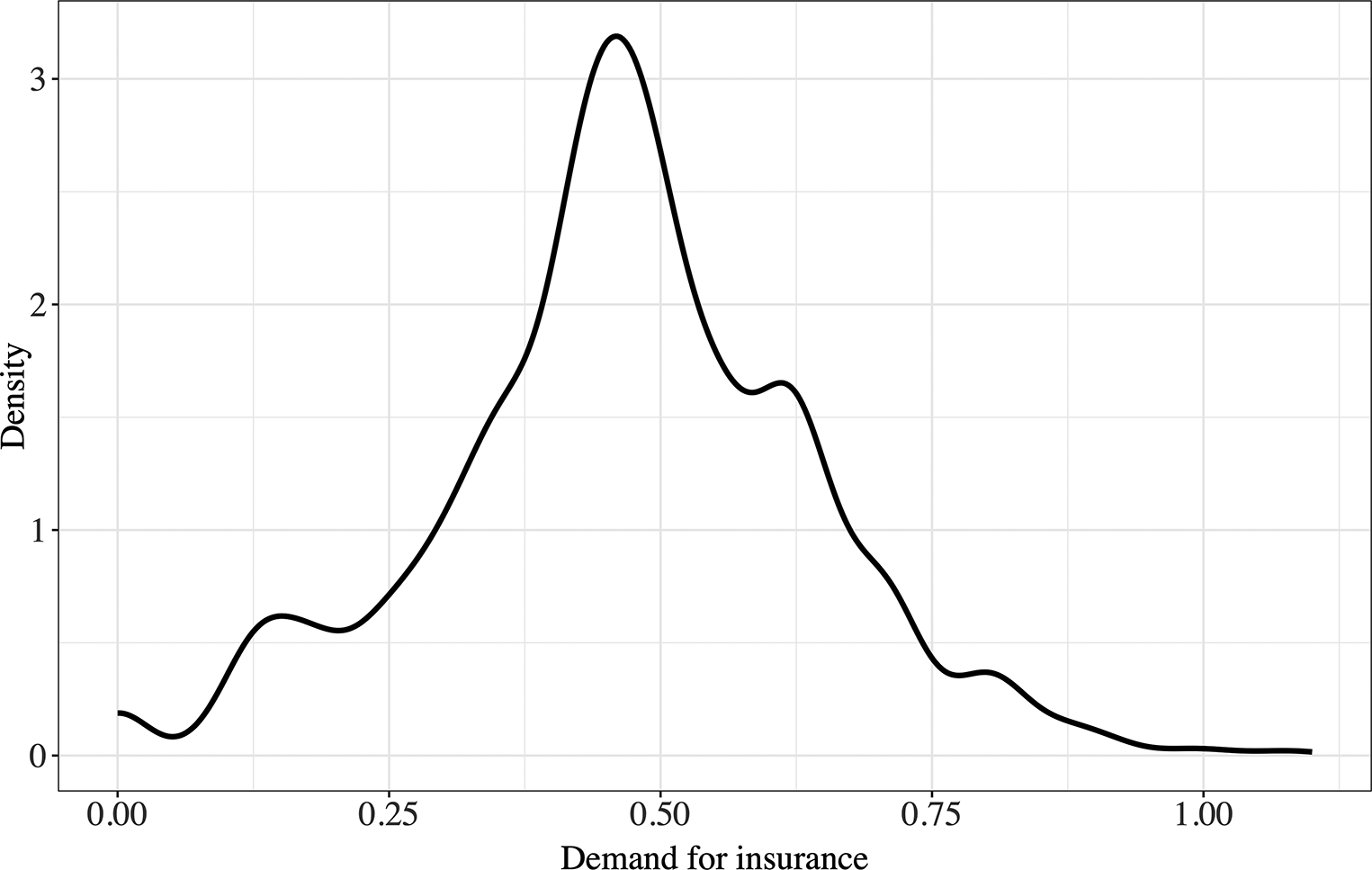
Our demand for insurance variable has a theoretical range of 0–2: 0 if competition is 0, and 2 if competition were 1 and every preceding post-war leader had been punished. Practically, however, values above 1 are uncommon, as Figure 3, where the maximum observed value is 1.07, illustrates. This is of course to be expected: the maximum observed value of the Henisz competition component is 0.72, and the mean percentage of former leaders punished is 16% (the latter reflected in Figure 2). Note: while we think the demand for insurance is a better conceptualization than existing insurance model research, as it more closely captures insurance theory’s causal logic, it is also a better empirical measure, as well. In the supplemental information, we show that employing just our demand for insurance variable produces better model fit than models that also include its components, or that look only at the competitiveness of the electoral environment.
The Demand for Insurance. The Distribution of the Demand for Insurance Variable.
Empirical analysis
We identify and include in our analysis two variables plausibly related to both the demand for insurance and the independence of the judiciary. The first of these is the level of economic development, argued a determinant of independence because of increased need for property rights protection (Clague et al. Reference Clague, Keefer, Knack and Olson1999), and to be closely related to the competitiveness of the political arena (Frye Reference Frye2010). To account for this, we include the log of per capita GDP in international dollars at 2000 prices. The second potential confounder is the duration of democracy, as consolidation is argued to affect independence (Aydın Reference Aydın2013), and because former leaders in new democracies are punished at higher rates. We therefore include the log of the number of years a country has been democratic, using the Boix, Miller, and Rosato (Reference Boix, Miller and Rosato2013) data on regime type.
De facto independence
As is increasingly the standard in comparative law and courts work on judicial independence, we employ the latent judicial independence (LJI) measure (Linzer and Staton Reference Linzer and Staton2015, 13), which “makes use of the general agreement among the indicators, yet addresses concerns resulting from measurement error and missing data.” Rather than aggregating across different measures, it is an item response model that uses eight of the most common de facto independence measures analyzed by Ríos-Figueroa and Staton (Reference Ríos-Figueroa and Staton2012). The measure directly models the time dependence inherent in the concept of independence, as well as takes into account concerns of missing data in the individual component indicators. Note: we use the original eight-item LJI measure, not the updated version that adds two components from the Varieties of Democracy (V-Dem) data (“High Court Independence” and “Compliance with High Court”). This is because, as Epperly (Reference Epperly, Epstein, Šadl, Grendstad and Weinshall2024) shows, there are serious validity concerns with the V-Dem measures, which extend to the updated LJI measure including these two components.
Analysis
Table 1 presents the results of four models of de facto judicial independence in democracies; coefficients are standardized to ease comparison, and independent variables lagged to prevent simultaneity bias. Models 1 and 2 are linear models with country-fixed effects, fit to over 2,200 country-years across 85 democracies between 1960–2006 (we employ the dichotomous Boix, Miller, and Rosato (Reference Boix, Miller and Rosato2013) measure of democracy). The results of Models 1 and 2 are clear: the demand for insurance has a strong and positive association with the level of de facto independence, a relationship only minimally attenuated (at the level of the third decimal place, and still statistically significant at the $ p<0.001 $
level) with the inclusion of the two possible confounders. As we show in the supplemental information, these results are robust, demonstrating high out-of-sample accuracy via cross-validation.
$ p<0.001 $
level) with the inclusion of the two possible confounders. As we show in the supplemental information, these results are robust, demonstrating high out-of-sample accuracy via cross-validation.
De facto independence and the demand for insurance. Four models of de facto independence and the demand for insurance. Models 1 and 2 are linear models. Model 3 and 4 are 2SLS models instrumenting for the demand for insurance (Model 4 with multiple instruments).
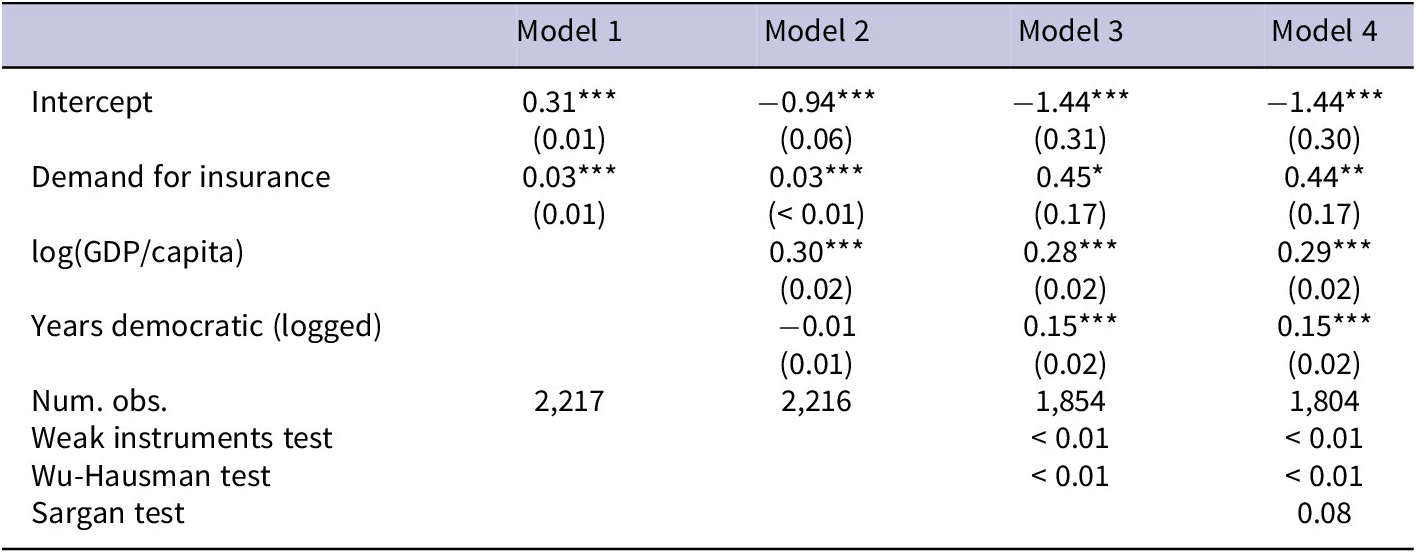
Note: *** p < 0.001; ** p < 0.01; * p < 0.05.
One potential issue with the above analyses is, of course, the issue of reverse causality. This is especially a concern given the structure of our model: the demand for insurance is the product of competition and a perception of how risky being out of office is. Yet, we have strong reason to suspect that the likelihood of punishment in the past was itself a function of the independence of the judiciary. In other words, we have some residual amount of judicial independence being estimated on the right hand side of the equation, via its effects on the likelihood of former leaders being punished. There are, however, two reasons to suspect this is not a critical concern. First, in the short term, the effects of these past levels should be minimal. Indeed, in the long run all major institutional variables are endogenous to one another, and it would be naive to think leaders do not take into account the levels of independence they inherit (Epperly Reference Epperly2019). While we think this mitigates a valid concern, it does not erase it entirely. To address this (and potential bias from unobservables), we therefore examine whether this relationship holds when employing two plausible instruments for our key explanatory variable in Model 3. To meet the exclusion restriction, we need variables affecting the demand for insurance, but not judicial independence itself. As we are unable to identify a single variable that would serve as an instrument for the demand for insurance, we instead canvassed for two instruments, each able to serve as an adequate instrument for one of the two constituent elements of the demand for insurance discussed above. That is, we need to identify plausible instruments for both the probability of losing office and the downside risks associated with such an outcome.
Thankfully, a plausible instrument for the likelihood of losing office’s effect on de facto independence (the first component of the demand for insurance) has been used in two recent studies (Epperly Reference Epperly2019; Staton, Reenock, and Holsinger Reference Staton, Reenock and Holsinger2022). The foundation of the instrumentation strategy for this first component is the fact that spending is popular with voters because it allows for both public goods provision and goods targeted to key supporters (Levitt and Snyder Reference Levitt and Snyder1997); taxation, however, is not popular (Paler Reference Paler2013). Therefore, non-tax sources of revenue are consistently shown to decrease the likelihood of incumbents losing elections (Morrison Reference Morrison2014), and thus facing potential post-tenure punishment. Because measures of non-tax revenue are therefore effective predictors of the likelihood of (not) losing office while being unrelated to judicial independence (in the short term), then they are good candidates for instruments for this first component of the demand for insurance.
Unlike for this first component, the threat of losing office does not have an existing instrument in the literature upon which we can rely. What we need is a $ z $
variable that plausibly meets the exclusion restriction:
$ z $
variable that plausibly meets the exclusion restriction: $ z $
is something that should be associated with
$ z $
is something that should be associated with $ y $
(de facto independence), but only via its effect on
$ y $
(de facto independence), but only via its effect on $ x $
(a leader’s assessment of the severity of the risks associated with losing office). Recall we operationalize the second component of the demand for insurance as the percentage of previous post-war leaders who faced punishment after leaving office. To instrument for this perception of risk, we employ the percent of previous post-war leaders of all neighboring states who were punished after leaving office. This is a plausible instrument because executives are often aware of the politics of their neighbors and attentive to situations where executives in neighboring states routinely face punishment after losing office, as the prosecution of Latin American leaders illustrates (Mendez Reference Mendez2009; González Calvet Reference González Calvet2023). It is therefore plausible that the frequency of neighboring executives facing post-tenure punishment would affect a leader’s perception of the risks associated with losing office, and thus their demand for insurance.Footnote 15 At the same time, what has occurred in neighboring states should in no way directly affect the outcome variable of judicial independence. As such, we take the average percent of previous leaders of all neighboring states that had been punished as the second component of our instrument for the demand for insurance.
$ x $
(a leader’s assessment of the severity of the risks associated with losing office). Recall we operationalize the second component of the demand for insurance as the percentage of previous post-war leaders who faced punishment after leaving office. To instrument for this perception of risk, we employ the percent of previous post-war leaders of all neighboring states who were punished after leaving office. This is a plausible instrument because executives are often aware of the politics of their neighbors and attentive to situations where executives in neighboring states routinely face punishment after losing office, as the prosecution of Latin American leaders illustrates (Mendez Reference Mendez2009; González Calvet Reference González Calvet2023). It is therefore plausible that the frequency of neighboring executives facing post-tenure punishment would affect a leader’s perception of the risks associated with losing office, and thus their demand for insurance.Footnote 15 At the same time, what has occurred in neighboring states should in no way directly affect the outcome variable of judicial independence. As such, we take the average percent of previous leaders of all neighboring states that had been punished as the second component of our instrument for the demand for insurance.
Because the result of the average percent of former leaders in neighboring countries is a ratio, we again add a constant of 1 (similar with how we create our standard demand for insurance variable). Doing so allows us to create an instrument for the overall demand for insurance: the product of the plausibly-exogenous instrument for each component. The instrument we employ in Model 3 is therefore the product of (i) the total value of oil production, shown to stabilize incumbents (Morrison Reference Morrison2009), and (ii) the average percentage of previous post-war leaders of neighboring countries that were punished after leaving office (to which a constant of 1 is added). In addition to this primary instrument, Model 4 adds another demand for insurance instrument, as doing so allows us to conduct a Sargan test for evidence concerning the exogeneity of our instruments. This second instrument is the product of (i) the sum of foreign aid commitments – as aid is another non-tax revenue source stabilizing incumbents (Morrison Reference Morrison2014) – and (ii) the average of former neighboring leaders punished.Footnote 16
While in the end, any choice of instrument must be driven by theory, fit statistics for Models 3–4 provide assurances that the instruments are appropriate: the instruments are strong in both models, as the weak instruments test has a p-value of $ <0.01 $
in each; the Wu-Hausman tests (in both models
$ <0.01 $
in each; the Wu-Hausman tests (in both models $ p<0.001 $
) suggest that the 2SLS models are as consistent as the OLS version; and rejecting the Sargan test in Model 4 (
$ p<0.001 $
) suggest that the 2SLS models are as consistent as the OLS version; and rejecting the Sargan test in Model 4 ( $ p=0.08 $
) means we have evidence that our instruments are in fact exogenous.
$ p=0.08 $
) means we have evidence that our instruments are in fact exogenous.
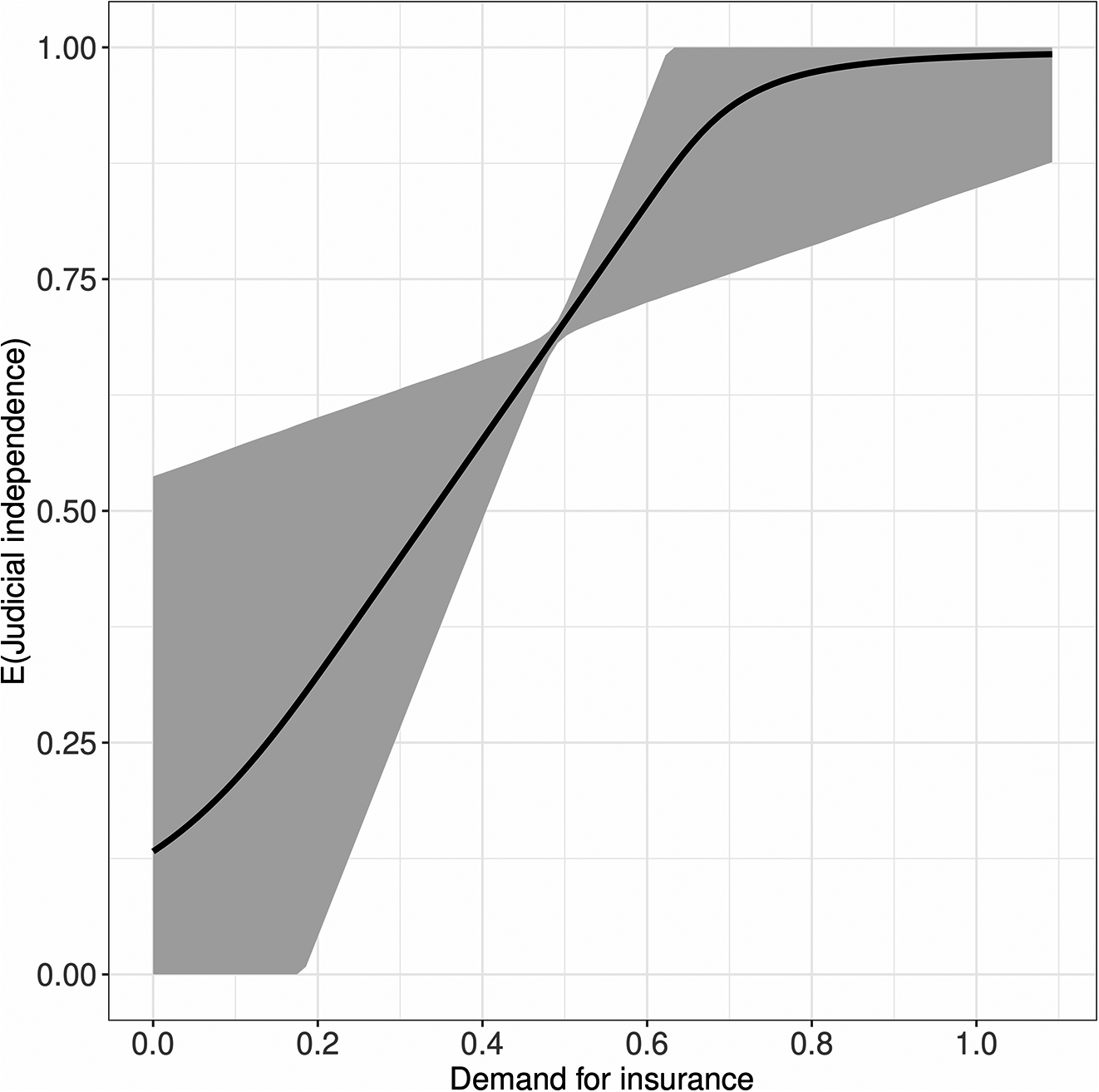
To better assess the substantive significance of these empirical tests of our theory, we present marginal effects from Model 4 in Figure 4. It illustrates that, holding development and duration of democracy constant, the effects of the demand for insurance (instrumented) are large: moving from the minimal to maximal demand for insurance is associated with a large shift in the predicted level of independence, from the lowest to the highest levels observed in democracies. Moving from the first quartile of the demand measure (0.37) to the third (0.57) is associated with a one-standard deviation change in independence, a difference in magnitude the equivalent to the change in independence of the judiciaries in multiple Latin American countries over the course of their democratic experiences, or Botswana in the late-1970s to mid-2000s. In other words, the effect of the demand for insurance is not only statistically significant and well-instrumented, but substantively important, producing large changes in judicial independence.
The Demand for Insurance and Judicial Independence. Marginal effects showing the expected value of de facto independence from Model 4 (with 95% confidence intervals), when the demand for insurance (instrumented) is allowed to vary from its observed minimum to maximum (although a linear model, probability estimates, like the LJI measure itself, are by design bound by 0–1).
The above results are robust to a variety of alternative specifications and tests, as discussed in the supplemental information. There, we show that the observational models are highly predictive out of sample (using split-sample cross validation). We also show that using the demand for insurance as a single covariate – which we argue above is a far better way to conceptualize and operationalize the implicit logic of the insurance model of judicial independence – produces better empirical results than using the demand variable and its components or the components without their product. Other specifications exploring robustness include deferentially weighting (i) the likelihood of losing office, (ii) the form of punishment of former leaders, or (iii) the recency of punishment of former leaders (all affecting demand).
Conclusion
We make three contributions to what is regarded as the central question for comparative law and courts. First, we take an important step to move the theoretical development of insurance accounts of judicial independence forward, recognizing the fact that the demand for insurance involves not only the likelihood of negative outcomes, but also the severity of such outcomes if they occur. Beyond simply recognizing this, we develop a way to measure the severity of these downside risks, focusing on the role that courts can play in ensuring personal security after losing elections (Dixon and Ginsburg Reference Dixon and Ginsburg2017). As such, we are able to explicitly theorize and test what is left implicit in existing work: the demand for insurance. In doing so we offer the most “complete” theoretical account of the insurance model to date, one that focuses on the demand for insurance by integrating both the likelihood of losing office and the risks if such occurs.
Our second and third contributions are empirical: offering the most thorough analysis of the insurance model to date, and introducing a number of variables that are effective and plausibly exogenous instruments for the demand for insurance. Despite the logic of the insurance account being focused on change over time within polities, existing statistical examinations of the insurance model in democratic contexts are purely cross-sectional (Stephenson Reference Stephenson2003; Aydın Reference Aydın2013), either snapshots of a single year, or a decade’s worth of values averaged. They therefore are unable to assess the “within” variation present in the models we present, or to address the omitted variables that are country-specific.
Beyond presenting the most comprehensive panel analysis of the insurance account in democracies to date, we also offer one of the first attempts to identify the causal relationship theorized by the insurance explanation of judicial independence. While instrumental variables are certainly no panacea (and introduce their own inferential assumptions), they provide a valuable tool to examine the potential for a causal rather than merely associational relationship. And given the extreme difficulties in using experiments to address big institutional questions (Zhu, Witko, and Meier Reference Zhu, Witko and Meier2018), they will likely for some time be one of our only such tools. Leveraging existing research on the role non-tax revenue plays in decreasing incumbents risk of losing office, we present three variables that are plausibly exogenous and meet the exclusion restriction. While we hardly expect (or even hope) this is the final word on their utility in assessing insurance models of independence, our introduction of these into the literature is a contribution itself, ideally spurring increased attention to identification by law and courts scholars, and increased attention to finding other potential instruments and natural experiments.
There are two ways our theoretical model remains incomplete, and both are ripe avenues for future research. First, we offer one way to conceptualize and measure the risks associated with losing office (important for assessing the demand parameter). While we think that personal security is one key form of insurance (and, as important, a tractable way to operationalize the realization of risk), we recognize that there are likely other means of doing so; examining alternatives to better ascertain the applicability and limits of insurance accounts is needed. Second, although we introduce the importance of operationalizing the full demand for insurance rather than simply one of its terms, we nevertheless treat the parameter capturing the costs imposed by independent courts (the insurance premium) as constant.Footnote 17 We fully believe that a “complete” insurance model seeking to lose the scare quotes must account for the fact that independent courts do not always impose the same costs across time and space, and that attempts to address this will be vital in future research on the central question in the study of comparative law and courts.Footnote 18
While a full discussion is beyond the scope of this conclusion, we nonetheless identify one example showing why costs can differ, and thus why future work integrating them into insurance accounts is important. It relates to the degree high courts are perceived as dominated by judges of opposing ideological perspectives, and who are willing to engage in judicial activism to curtail new governments. One need only look at discussions among democrats in the US today to observe political actors positing that not only does the current judiciary impose differential costs to left-wing policy goals (e.g., through the use of its shadow docket or Loper Bright Enterprises v. Raimondo), but that it also imposes differential costs to left-wing political efficacy (e.g., jurisprudence on campaign finance, gerrymandering, or voting procedures).Footnote 19 Critical here is that actors do not think the costs of judicial independence are borne equally by all governments, and that the benefits courts provide are also differential (e.g., Trump v. United States). Identifying general conditions where costs are markedly higher while benefits remain the same (or decrease) is thus a critical aspect of a theoretically complete – rather than “complete” – insurance model. Put differently, in polities with Weltanschauung politics, we might expect a reversal of the insurance model’s empirical predictions, precisely because the political stakes are perceived as existential, and the continued independence of a court that has taken a side is thus itself viewed as an existential political threat.
This is one example why more attention is needed to the theoretical development of our models of judicial independence, not least the insurance model. Because despite being the leading framework for understanding judicial independence in democracies, its theoretical development has largely languished even as its application to diverse cases has flourished. As we illustrate, however, careful attention to the logic of the demand for insurance can both advance our understanding and highlight areas in need of increased focus.
Supplementary material
The supplementary material for this article can be found at http://doi.org/10.1017/jlc.2024.29.
Data availability statement
All replication materials are available on the Journal of Law and Court’s Dataverse archive.
Acknowledgments
The authors would like to thank Benjamin Engst and Jay Krehbiel for helpful comments, as well as participants at the European Political Science Association annual conference.
Financial support
No funding was received for this project.
Competing interest
Authors declare no conflicts of interest.


 Open access

