

Milk composition varies among cattle breeds depending on their genetic makeup (Poulsen et al., Reference Poulsen, Gustavsson, Glantz, Paulsson, Larsen and Larsen2012). Superior milk composition and properties of native/indigenous cattle breeds compared to generic and/or crossbred cows have been reported in the literature (e.g. Sharma et al., Reference Sharma, Ahlawat, Aggarwal, Dua, Sharma and Tantia2018). In general, indigenous/native cow milk is an important source of protein, fat, vitamins and minerals in many countries. Differences in milk composition may lead to beneficial technological and functional properties in dairy products. The potential health benefits associated with the consumption of indigenous cow milk may also create higher consumer attraction towards the dairy products made from their milk.
Mostly, indigenous cattle produce less milk or meat compared to generic breeds. However, these animals are well adapted to harsh environmental conditions and can tolerate a wide range of low-quality feedstuffs. Also, they are generally more resistant to disease conditions compared to generic cattle breeds. Therefore, indigenous cattle play an important role in rural traditional production systems, as they can thrive without the use of expensive inputs (Hoffmann, Reference Hoffmann2013). A lot of indigenous cattle breeds have been subjected to extinction in many dairy farming systems, due to the continuous introduction of generic breeds in genetic improvement programmes. Investigating the characteristics of indigenous cow milk to produce high-quality dairy products could shed light on halting the extinction of valuable genetic resources of those breeds through improved utilization. Therefore, the current study aimed to evaluate the textural, microstructural, sensory and colour properties of set-yoghurt made using milk from two indigenous cattle types (Thamankaduwa White:TW and Lankan cattle: LC) and two generic cattle breeds (Jersey and Friesian) reared in Sri Lanka. We hypothesized that the use of indigenous cattle types is advantageous in producing set-yoghurts due to their superior textural, microstructural, sensory and colour properties compared to generic breeds reared in Sri Lanka.
Materials and methods
Experimental design
Milk samples (n = 15 from each) were collected from 60 individual cows representing four different breeds/types, i.e. TW, LC, Jersey and Friesian. Animal selection criteria and management system details are given in the online Supplementary File. An example of phenotypic illustrations of cattle breeds/types are presented in online Supplementary Fig. S1. Milk from three biological replicates representing five animals from each breed/type was pooled and used to produce the set-yoghurt. Colour and textural property analyses were carried out in triplicate.
Physicochemical parameters
Milk compositional properties including fat, protein, lactose and solid non-fat content of the whole milk (online Supplementary Table S1) and physicochemical parameters of the set-yoghurt (online Supplementary Fig. S2) made of four breeds/types were evaluated in a previous study conducted by the same authors (Weerasingha et al., Reference Weerasingha, Ranadheera, Prasanna, Silva and Vidanarachchi2021).
Preparation of set-yoghurt
Preparation of set-yoghurts was conducted separately using 3% (w/v) fat standardized milk from four breeds/types according to the procedure described by Weerasingha et al. (Reference Weerasingha, Ranadheera, Prasanna, Silva and Vidanarachchi2021). Thirty litres (30 l) from each breed/type were used to prepare the set-yoghurt.
Instrumental texture
Textural properties, namely firmness, adhesiveness, cohesiveness and gumminess were measured using a Brookfield texture analyser (TexturePro CT V1.8, USA) loaded with 10 kg load cell, according to the method described by Hashim et al. (Reference Hashim, Khalil and Afifi2009). The back extrusion method was used to determine the texture profile of set-yoghurt over the refrigerated storage of 21 d.
Apparent viscosity
The apparent viscosity of the samples was measured using a Brookfield viscometer (Brookfield RVT, USA) with a spindle no.6 and rotational speed of 2.5 × 10⁻⁴ g at 4 ± 1°C (Izadi et al., Reference Izadi, Nasirpour, Garoosi and Tamjidi2015).
Instrumental colour
Instrumental colour (L*, a*, b* values) of set-yoghurt was measured by using Minolta Chromameter (Konica Minolta Co., Ltd., Japan) according to the CIE-LAB system.
Microstructure
Scanning electron microscopic (sem) images were observed according to Jaya (Reference Jaya2009), with few modifications. The samples were mounted onto an sem specimen stub, coated with gold using Sputter coater (Quorum, Germany) at 1 × 10⁻² kPa and examined under sem (ZEISS EVO 18, Germany) operated at 15 kV. Micrographs were captured in two magnification levels as ×1000 and ×5000.
Sensory characteristics
Set-yoghurts were evaluated using 5 points hedonic scale for colour, aroma, taste, texture and overall acceptability during the refrigerated storage (on the 1st and 14th day). The tasting panel consisted of 40 untrained panellists.
Statistical analysis
Instrumental texture, colour and viscosity data were analysed using one-way ANOVA and differences were considered significant at P < 0.05 using Tukey–Kramer post hoc test. Sensory data were analysed by Friedman non-parametric test. Pearson's correlation coefficients between milk physicochemical properties and textural properties of set-yoghurts were evaluated. Both parametric and non-parametric data were analysed using Minitab 18.1 software (Minitab Inc., State College, PA, USA). Principal component analysis (PCA) was used to analyse milk composition parameters and instrumental texture parameters of set-yoghurts using simca 16.0 (Sartorius Stedim Data Analytics AB, Sweden).
Results and discussion
Instrumental texture
Texture profiles comprising firmness, adhesiveness, cohesiveness, gumminess and viscosity are shown in Table 1. Firmness is the most commonly assessed physical parameter for the evaluation of set-yoghurt texture, which is defined as the force required to attain a certain deformation. Set-yoghurts made from indigenous cow milk resulted in higher firmness (P < 0.05) compared to set-yoghurts made using generic cow milk. Moreover, we could visualize that the set-yoghurts made from Friesian and Jersey milk resulted in weaker gels, thereby not yielding a clean cut with a spoon, compared to the yoghurt gels from LC and TW milk (online Supplementary Fig. S3B and S3C). Over the entire storage, set-yoghurts made using LC milk demonstrated the highest (P < 0.05) firmness followed by the set-yoghurt made from TW, Jersey and Friesian milk. Stabilization of the yoghurt gel matrix is facilitated through increased total solids, casein protein and fat contents of milk (Nguyen et al., Reference Nguyen, Ong, Lefèvre, Kentish and Gras2014). Set-yoghurts made from LC and TW milk showed higher firmness, which is probably due to the high total solids content in milk of those indigenous cattle types (Weerasingha et al., Reference Weerasingha, Ranadheera, Prasanna, Silva and Vidanarachchi2021). A positive correlation between the total solid content of milk and gel firmness has been previously reported by Amatayakul et al. (Reference Amatayakul, Halmos, Sherkat and Shah2006). Milk protein, mainly casein content has a direct effect on yoghurt gel firmness as the yoghurt gel matrix is a three-dimensional network of casein. When milk contains a higher content of casein protein, gel formation is fast. Therefore, the increased cross-linking of the gel network resulted in a greater aggregation rate resulting in firmer curd (Dimassi et al., Reference Dimassi, Neidhart, Carle, Mertz, Migliore, Mané-Bielfeldt and Zárate2005). Previously, Abeykoon et al. (Reference Abeykoon, Rathnayake, Johansson, Silva, Ranadheera, Lundh and Vidanarachchi2016) reported both TW and LC milk to contain higher casein content than Friesian milk. This could have also contributed to the higher firmness of the set-yoghurts made from TW and LC milk compared to the milk from generic breeds in the current study. In agreement, the yoghurts made from Simmental crossbred cow milk which contains higher protein and casein contents have shown higher firmness values compared to yoghurts made from Chinese Holstein cow milk (Li et al., Reference Li, Ma, Xiao, Long, Wu, Tong and Chen2019).
Variation of textural properties and colour spaces of set-yoghurts made from Jersey, Friesian, Lankan cattle and Thamankaduwa White milk over the storage of 21 d

The values (average ± sd; n = 3) followed by different lowercase letter superscripts within the row and uppercase superscript letters within the column for respective texture and colour properties are different (P < 0.05)
The adhesiveness of set-yoghurts was not influenced (P > 0.05) by the cattle breed/type or the storage period in the present study. In contrast, Domagala et al. (Reference Domagala, Sady, Grega and Bonczar2005) observed cow milk yoghurt with a 2% fat level had the highest adhesiveness at the storage of the 7th day, which tended to decrease with longer storage. Set-yoghurts made from indigenous cow milk showed significantly higher cohesiveness compared to the set-yoghurts made from generic cow milk until the 14th day of storage. Both LC and TW milk set-yoghurts showed a reduction (P < 0.05) of cohesiveness after the 14th day of the storage. Similarly, TW and LC milk set-yoghurts showed higher gumminess while recording no significant changes with the storage period. In agreement with the current study, Domagala et al. (Reference Domagala, Sady, Grega and Bonczar2005) also reported a decrease in the cohesiveness of yoghurt, but no significant changes in gumminess during the storage period.
Set-yoghurts made from TW and LC milk exhibited greater (P < 0.05) apparent viscosity than that made from Friesian and Jersey milk. Apparent viscosity of set-yoghurts made from Friesian, Jersey and TW milk increased until the 7th day and then decreased, whereas set-yoghurts made from LC milk increased until the 14th day and then decreased. The total solid content of milk is one of the key determinant factors affecting the viscosity of yoghurts. A high number of interactions between casein micelles in set-yoghurts, as well as their structure and spatial distribution also affect the viscosity of yoghurts (Lucey and Singh, Reference Lucey and Singh1997). Therefore, the higher total solid content and higher casein content favouring the micelles interactions in indigenous cattle milk may have led to greater viscosity values in TW and LC milk set-yoghurts (Abeykoon et al., Reference Abeykoon, Rathnayake, Johansson, Silva, Ranadheera, Lundh and Vidanarachchi2016). The apparent viscosity of yoghurts tends to increase along with the storage period due to the rearrangements of proteins and interactions among protein molecules (Sahan et al., Reference Sahan, Yasar and Hayaloglu2008). In contrast, Lee et al. (Reference Lee, Hwang, Lee, Ahn and Kwak2007) described that the apparent viscosity of yoghurts tends to decrease with the storage time.
Correlation analysis
The milk solid non-fat content showed a positive correlation with apparent viscosity (r = 0.50) of set-yoghurts while it showed a lower correlation with both cohesiveness (r = 0.33) and gumminess (r = 0.39) of set-yoghurts. Moreover, the milk protein content showed a moderate positive correlation with the cohesiveness of the set-yoghurts (online Supplementary Table S2). These correlations suggest that the milk composition parameters (protein and solid non-fat) probably contributed to the determination of textural parameters of set-yoghurts (Lucey, Reference Lucey2002). None of the milk composition parameters significantly affected the firmness of set-yoghurts. The results are in accordance with the acid milk coagulation results reported by Abeykoon et al. (Reference Abeykoon, Rathnayake, Johansson, Silva, Ranadheera, Lundh and Vidanarachchi2016) where the protein, fat and lactose content of milk had no significant correlation with the firmness of the acid milk gels. However, previous studies have reported a correlation between set-yoghurt firmness and total protein content (Li et al., Reference Li, Ma, Xiao, Long, Wu, Tong and Chen2019). Texture parameters including apparent viscosity and firmness showed a negative correlation with syneresis of the set-yoghurts (r = −0.60) while showing a positive correlation with cohesiveness (r = 0.43) and gumminess (r = 0.46). In general, higher casein or whey protein content leads to a firmer yoghurt gel network, which can trap the serum and therefore, result in lower syneresis (Lee et al., Reference Lee, Kim, Watkins and Batt1994). However, in contrast, Oraç and Akın (Reference Oraç and Akın2019) reported a positive correlation between syneresis and firmness of set-yoghurts. Further, the present study reported a moderate positive correlation between the set-yoghurt pH and the cohesiveness of the set-yoghurts.
Instrumental colour analysis
The results of the colour analysis and visual appearance of the colour of set-yoghurt gels are shown in Table 1 and online Supplementary Fig. 3A, respectively. The results depict that the set-yoghurts made from Friesian and LC milk showed significantly higher lightness (L*) values on the 1st day and 7th day. However, LC milk yoghurt remained with the highest lightness on the 14th day and 21st day of the storage. Milk composition parameters including fat, protein, Ca, P and processing conditions affect the physical structure of milk which can modify the L* value (Dufossé and Galaup, Reference Dufossé, Galaup, Toldrá and Nollet2021). According to Yoo et al. (Reference Yoo, Song, Park, Oh, Ham, Jeong and Kim2019), fermented milk made from Jersey milk resulted in significantly higher L* values than that of Holstein milk, illustrating the effect of the breed on the colour variation of fermented milk gels. Although a general reduction of L* values of all set-yoghurt was observed during the storage of 21 d, a significant reduction was observed only in set-yoghurts made from Friesian milk. The reduction of lightness in dairy products could have resulted from non-enzymatic browning reactions including lipid peroxidation, degradation of ascorbic acid and Maillard reactions (Chudy et al., Reference Chudy, Bilska, Kowalski and Teichert2020). Cais-Sokolińska et al. (Reference Cais-Sokolińska, Wójtowski and Pikul2016) reported a similar decreasing patterns of L* values for set-yoghurt during the storage. In contrast, Teichert et al. (Reference Teichert, Danków, Pikul and Osten-Sacken2015) have observed a significant increase in set-yoghurt lightness at 21 d of cold storage. The colour stability of the set-yoghurts along with the storage period acts as a key determinant factor of consumer acceptance. The set-yoghurts made of indigenous cattle and Jersey milk were able to maintain the stability of lightness during the storage period. Maintaining a stable colour over the entire storage period is highly crucial for dairy products as discolouration may reflect fat oxidation and losses of nutrients such as vitamins and amino acids (Borle et al., Reference Borle, Sieber and Bosset2001), which may ultimately lead to less consumer attraction.
The a* values of all set-yoghurts had negative values illustrating that the green-tone is dominating over the red in all set-yoghurt samples (Table 1). The set-yoghurts made from Jersey milk had significantly higher a* values on the 14th and 21st day than on the 1st day and 7th day of the storage suggesting an increase of green tone with the storage period. The a* values of Friesian milk set-yoghurts showed a decrease (P < 0.05) on the14th day and then an increase on the 21st day which is not significant. A similar trend has been reported by Jakubowska and Karamucki (Reference Jakubowska and Karamucki2020) for the a* values of set-yoghurts with storage. The a* value of the set-yoghurts may vary depending on the degree of photooxidation and the level of antioxidants present in milk. Therefore, the observed reduction in a* value could be due to oxidation reactions over the storage period (Popov-Raljić et al., Reference Popov-Raljić, Lakić, Laličić-Petronijević, Barać and Sikimić2008). However, set-yoghurts made from TW and LC milk showed no differences (P > 0.05) for a* values over the storage of 21 d. All the b* values recorded in the present study were above zero, confirming that the yellowness is dominating over the blue in all samples. Higher (P < 0.05) yellowness was noted in both Jersey and LC milk set-yoghurts on the 1st day and 7th day of the storage. The set-yoghurts made from LC milk retained the highest (P < 0.05) yellowness on the 14th and 21st days of the storage. Primarily, the yellowness of milk is governed by the amount of β-carotene pigment contained in the milk fat component. The colour of milk fat tends to vary among different cattle breeds even after adjusting for fat concentration (Scarso et al., Reference Scarso, Mcparland, Visentin, Berry, Mcdermott and De Marchi2017). The b* values of set-yoghurts made from LC, Jersey and Friesian milk reduced with the storage period except for the set-yoghurts made from TW milk. Yoo et al. (Reference Yoo, Song, Park, Oh, Ham, Jeong and Kim2019) reported that b* values of fermented milk produced with Jersey milk were significantly higher than fermented milk made from Holstein milk. Duffosse and Galaup (Reference Dufossé, Galaup, Toldrá and Nollet2021) found that the yellow colouration of the dairy products made with Jersey milk is higher than the Holstein or Montbéliarde cattle breeds. Currently, the addition of food colourants is not well accepted by consumers as the colourants could mask the poor quality of a food product. The yellow colour of dairy products is highly preferred among consumers as it makes a more green-product concept that is associated with grazing animals (Descalzo et al., Reference Descalzo, Rossetti, Páez, Grigioni, García, Costabel, Taverna and Chaiyabutr2012). Therefore, identifying the potential of milk from different breeds to produce set-yoghurts without adding artificial colourants could support the attraction of consumers. The LC milk showed a promising trend towards manufacturing set-yoghurts with better yellowness which is persistent along the storage period.
Sensory analysis
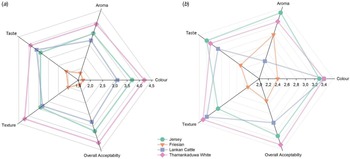
According to the 1st and 14th-day ratings of the panellists, set-yoghurts made from TW and Friesian milk had the highest and lowest (P < 0.05) sensory scores, respectively, for all sensory attributes (Fig. 1). However, set-yoghurts made from LC and Jersey milk had higher acceptance for colour and texture over the set-yoghurts made from TW milk on the 14th day of the storage period. The sensory attributes of TW milk set-yoghurts decreased (P < 0.05) on the 14th day compared to 1st day of storage while Friesian milk showed an increase (P < 0.05) in sensory quality during the same period. On the 14th day, colour and texture parameters of Jersey, LC and TW milk set-yoghurts showed higher (P < 0.05) values than set-yoghurts made from Friesian milk. Nevertheless, TW milk set-yoghurts showed significantly (P < 0.05) higher overall acceptability than Friesian milk. However, taste attributes did not vary significantly among the set-yoghurts on the 14th day. Domagala et al. (Reference Domagala, Sady, Grega and Bonczar2005) have reported that the sensory quality of cow milk yoghurt increased along with the storage period while the highest scores were obtained on the 7th day of the storage. A high level of syneresis was observed by panellists in set-yoghurt made from Friesian milk compared to the other breeds/types. This may lead to poor acceptability of the set-yoghurts made from Friesian milk. The sensory properties of yoghurt depend to a large extent on the relative balance of flavour compounds which are derived from the catabolism of fat, protein, and carbohydrate in milk. The type of starter culture and their metabolism can also influence the textural properties and sensory attributes of yoghurts (Priyashantha et al., Reference Priyashantha, Quintáns, Baixauli and Vidanarachchi2019).
Sensory attributes of set-yoghurts made of Jersey, Friesian, Lankan cattle and Thamankaduwa White milk at 1st (A) and 14th (B) day of the storage.

Microstructure analysis
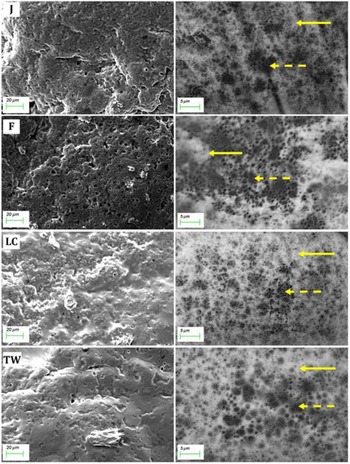
Microscopic observation of set yoghurt is important for observing the changes occurring at the microstructural level in response to studied variables. The microstructures of four set-yoghurts on the 7th day are shown in Fig. 2. According to the micrographs, all the set-yoghurts had similar structures with a protein matrix surrounded by void spaces (Nguyen et al., Reference Nguyen, Afsar and Day2018). Set-yoghurts made from TW milk had fewer and smaller void spaces and a dense protein network compared to the set-yoghurts made using milk of the other three breeds/types. Set-yoghurt made from Friesian milk showed a more porous structure and thinner protein strands than those of other set-yoghurts. Comparatively high porous microstructure of set-yoghurts made from Friesian milk indicates that the yoghurt gel is delicate and highly prone to breaking and deformation under external mechanical forces. Microstructure acts as a key factor influencing texture and other physical properties of yoghurt. The microstructural observations of the current study are in accordance with the results of the instrumental texture analysis of this study where set-yoghurt made from TW milk and Friesian milk showed the highest and the lowest firmness values, respectively.
Scanning electron microscopic (sem) images of set-yoghurt gels made from Jersey (J), Friesian (F), Lankan cattle (LC) and Thamankaduwa White (TW) milk at magnification levels of 1000× and 5000×. Solid arrowheads denote the protein matrix and discontinued arrowheads denote the void spaces.

Principal component analysis
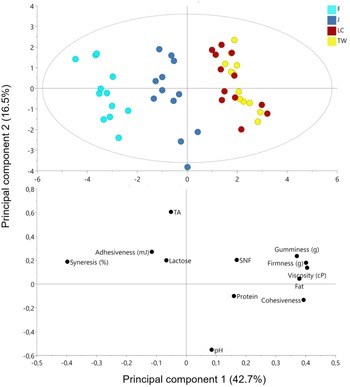
A PCA model, explaining 42.7 and 16.5 percent of the variance in the first two principal components, respectively, was used to assess the overall variation of studied parameters. According to the illustration in the score plot (Fig. 3, upper panel), the set-yoghurts made from LC and TW milk were different from Jersey and Friesian milk set-yoghurts. Also, Jersey and Friesian milk set-yoghurts were different from each other. LC and TW set-yoghurts are located on the same side (right) of the PCA, while Jersey and Friesian milk set-yoghurts are located on the opposite side (left) of the score plot. The loadings of each parameter (Fig. 3, lower panel) showed that the grouping of different set-yoghurts is primarily influenced by certain parameters as apparent from the loading plot. Set-yoghurts made using indigenous cow milk showed comparatively greater influence from texture parameters (i.e., viscosity, firmness, gumminess, cohesiveness) and fat content of milk compared to yoghurts made from generic cow milk. Jersey milk yoghurts had a higher influence from titratable acidity of set-yoghurts and lactose content of milk. Set-yoghurts made from Friesian milk had higher syneresis compared to the other three set-yoghurt types. According to the loading plot, the set-yoghurts with higher firmness and viscosity resulted in lower syneresis. Usually, the higher fat and protein content of milk increases the firmness of milk gel (Guinee et al., Reference Guinee, Gorry, O'callaghan, O'kennedy, O'brie and Fenelon1997).
Principal component analysis (PCA) score plot (upper panel) and loading plot (lower panel) of studied parameters and their relationship with set yoghurt made from cattle breeds/types: Friesian (F), Jersey (J), Lankan cattle (LC) and Thamankaduwa White (TW).

In conclusion, set-yoghurts made from indigenous cow milk had better textural properties with higher firmness and cohesiveness than those of set-yoghurts made from generic cow milk. Set-yoghurts made from Friesian milk formed a weak gel with larger void spaces leading to a fragile body that is highly prone to deformation under external forces. Set-yoghurts made from TW milk had the highest overall acceptability in sensory analysis during the storage. The hypothesis tested from this study was accepted, since set-yoghurts made from TW and LC milk showed better textural, microstructural and sensory properties than the set-yoghurts made from milk of Friesian and Jersey cows. The outcomes of the study suggest the potential use of underutilized indigenous cow milk in the production of dairy products with improved textural and sensory attributes. Thus, it provides a otential route into the conservation of this valuable gene pool of indigenous cattle, which is still idling. Also, the current study sheds light on the importance of including milk composition in genetic selection and breeding, as milk compositional parameters affect the milk processability and technological properties of fermented milk.
Supplementary material
The supplementary material for this article can be found at https://doi.org/10.1017/S0022029922000693
Acknowledgement
Financial support from the Rajarata University of Sri Lanka (research grant number RJT/R&PC/2018/Agri/R/06) is highly appreciated.



 Open access

